
29
The narrow ways of English folk
Are not for such as we;
They bear the long accustomed yoke
Of staid conservancy.
ANDREW BARTON “BANJO” PATERSON, “The Old Australian Ways,” 1902
The winter of 1917 was no time to be in London. But Archie had nothing to say in the matter. On February 10, after a month in hospital at Etaples, he was sent back to England with a warrant for admission to the military hospital at Lakenham, outside Norwich.
When the boat docked in Folkestone, he took the train to London. From Waterloo Station, he needed to cross the city to Liverpool Street Station for the hundred-mile trip to Norwich. But what visitor from the far side of the world could resist the temptation to spend at least an evening in the city regarded by Anglo-Saxons as the heart of civilization?
This, after all, was Blighty, the homeland that Tommies imbued with an almost mystical air of perfection. From the Afghan word bilāyatī, meaning “home,” Blighty was used by Indians and British soldiers posted to India as an all-purpose adjective for anything English.
Early in the war, the word assumed all the longing of nostalgia. “Blighty leave” was time spent on the other side of the Channel. A “Blighty wound” was one that got you discharged. It turns up in such popular songs as “There’s a Ship That’s Bound for Blighty,” “We Wish We Were in Blighty,” and in particular, “Take Me Back to Dear Old Blighty,” which articulated the homesickness of the Tommy in the trenches.
Take me back to dear old Blighty!
Put me on the train for London town!
Take me over there,
Drop me anywhere,
Liverpool, Leeds, or Birmingham, well, I don’t care!
No other country had Britain’s idealized concept of a national homeland. A doughboy could sing “Swanee, how I love ya, how I love ya” without implying any superiority to another’s “little gray home in the west.” Australians loyally sang along with their British and American comrades, as enthusiastic for Tipperary or Tralee or Texas as if they’d actually been there.
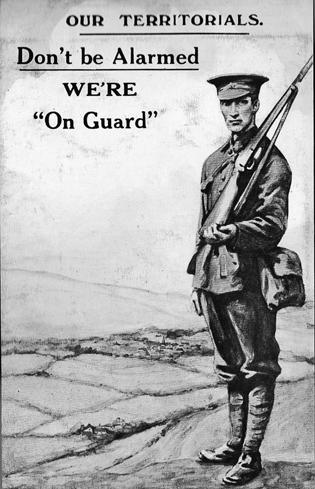
The Home Guard
Among themselves, Australians didn’t sing about places but people, and in particular figures from the country’s criminal past: “The Wild Colonial Boy,” “Waltzing Matilda,” and a rogues’ gallery of bushrangers, as highwaymen were called, in particular Ben Hall and the folk hero Ned Kelly. It wasn’t until the postwar rise of nationalism that they would start singing about “the track winding back to an old familiar shack along the road to Gundagai.”
In London, Archie reported to AIF headquarters in Horseferry Road. Any serviceman who failed to do so risked being listed absent without leave and hunted down by the feared and despised military police or provosts. The Horseferry Road complex, a former Methodist training college on a dingy street near the Thames, was branded “a slum” by the official Australian war historian, and worse by the men who used it. But Archie could collect his pay there, eat (free) at the noisy, crowded Anzac buffet restaurant, funded by the Australian Natives Association, or pay for a quieter dinner at the army-run Australian Soldiers Club. After that, they’d find him a bed in one of the bleak hostels maintained for troops in transit. In between, he would have dodged the prostitutes, amateur and professional, who haunted the area, on the lookout for well-paid and free-spending Aussies.
Next day, he probably drew a new uniform. As fleas and lice were an occupational hazard anywhere troops gathered, soldiers never missed an opportunity, in the days before dry cleaning, to boil their clothes or, better still, turn them in for a new set. Archie also received a warrant for the train journey to Norwich. This would have brought him in contact with the AIF’s notorious bureaucracy. It so enraged one anonymous serviceman that he composed a song that, in various degrees of profanity and bile, was still being sung as recently as the Vietnam War.
He was stranded alone in London, and strode
To Army Headquarters in Horseferry Road,
And there met a poofter Lance Corporal, who said
“You’ve got blood on your tunic, you’ve mud on your head;
You look so disgraceful that people will laugh,”
Said the cold-footed bastard from the Horseferry staff.
The digger jumped up with a murderous glance;
Said “Fuck you. I just came from the trenches in France
Where fighting was plenty and cunt was for few
And brave men are dying for mongrels like you.”
Over the years, the song acquired numerous additions, including one with a happy ending.
Well, the question soon came to the ears of Lord Gort
Who gave the whole matter a good deal of thought;
He awarded that digger a VC with bars
For giving that Corporal a kick up the arse.
Australians were everywhere in London. Neither their good nature nor their bombast could be ignored. It was a standing joke that every digger, true to his nickname, claimed to own a gold mine back home, or thousands of acres teeming with cattle, sheep, or, to believe the more outrageous liars, kangaroos. Both the Aussies’ thirst for beer and their belligerence when drunk were legendary, but most irritating to the British high command was their contempt for authority.
Some officers adjusted better than others. General William Birdwood, born in India of British parents, commanded the Australians at Gallipoli, and earned their respect for his personal courage, if not for the orders imposed on him by London. Though Anzacs referred to him as “Birdy,” sometimes within his hearing, he accepted it as the price of their respect and cooperation. Supreme Allied Commander Douglas Haig believed his methods undermined discipline. “Instead of facing the problem,” he wrote, “he had gone in for saying everything is perfect, and making himself as popular as possible.”
A story went round of Birdwood chatting with a friend in the street when an Australian soldier passed without saluting.
“Aren’t you going to call him back and tear him off a strip?” asked the friend.
“And be abused by one of my own men in the middle of the Strand?” Birdwood said mildly. “Why would I want that?”
Unlike Paris, which did its best to deny the reality of war, London embraced it with the fanaticism of a monk for his hair shirt. Ordinary life was put aside. Magazines, newspapers, and books dwindled in size as paper was rationed. Voice radio, poised to become a mass medium, was taken over by the armed forces, to be used exclusively by the military, particularly on ships at sea.
Before the war, moralists would have protested the suggestiveness of Arthur Wimperis’s lyrics for the recruiting song “I’ll Make a Man of You.” But nobody objected when they were sung in the cause of keeping up the number of volunteers.
On Sunday I walk out with a Soldier,
On Monday I’m taken by a Tar,
On Tuesday I’m out with a baby Boy Scout,
On Wednesday a Hussar;
On Thursday a gang oot wi’ a Scottie,
On Friday, the Captain of the crew;
But on Saturday I’m willing, if you’ll only take the shilling,
To make a man of any one of you.
Crude propaganda such as Harold Begbie’s poem Fall-In took a different line, playing on the very British concern for What People Will Say.
What will you lack, sonny, what will you lack
When the girls line up the street,
Shouting their love to the lads come back
From the foe they rushed to beat?
Will you send a strangled cheer to the sky
And grin till your cheeks are red?
But what will you lack when your mates go by
With a girl who cuts you dead?
Unrelenting peer pressure urged men of draft age to “take the king’s shilling” and enlist. Any young man not in uniform risked being handed a white feather, the symbol of cowardice. Women approaching him in the street would smile and show every sign of interest—then, as they got closer, register repugnance at his civilian clothes.
France had self-appointed patriots too, but didn’t take them seriously. One cartoon showed the speaker at a woman’s group announcing melodramatically, “I swear I will never marry any man who returns from the trenches alive!” Nor were their critics afraid to point out that talk was cheap: the women encouraging men to fight would never have to face a bullet themselves.
Any Briton brave enough to plead conscientious objections to the war faced the risk of elaborate cruelty, even death, certainly privation, imprisonment, hard labor. Even so, sixteen thousand applied for exemption, although few achieved it. One absolutist who refused to contribute to the war in any way, even by helping the injured, was forced into uniform and taken to the trenches under guard. He promptly stripped off the battle dress and walked back behind the lines naked.
Some people made their point with less agony. The writer Lytton Strachey was so frail he would never have been called up, but he chose to plead conscientious objection as a way of protesting the war. Tall and gangling, with a long beard and a fussy, effeminate manner, he turned the hearing into a farce. Complaining of the hardness of the courtroom benches, he produced an air cushion, which he noisily inflated. When the chairman of the panel asked the standard question, “What would you do if you saw a German soldier about to violate your sister?” Strachey replied in his fluting falsetto, “I would try to interpose my body between them.”
By 1917, the war was costing Britain, in today’s terms, twenty million pounds an hour, three billion pounds a week. Through sheer willpower, the country had wrenched itself from a civilian to a military economy. Women worked in factories and took over large parts of the public services. Pots, pans, and the railings around parks and churches were melted down for weapons. All food was severely rationed, not to mention beer, tobacco, coffee, and tea. Such was the need for acetone, a component of the explosive cordite, that much of the grain harvest was allocated to its fermentation. Starvation was averted only when Chaim Weizmann discovered how to make it from chestnuts. Every child in the British Isles was instantly ordered to gather them.
In February 1917, while Archie was in London, revolution ended the rule of the czars. That an ancient monarchy could be toppled overnight, and by the very people it ruled, shocked royalty everywhere, particularly since many crowned heads were cousins, descended from the remarkably fecund Victoria and Albert. The abdication of Nicholas II made his cousin, George V of England, who resembled him enough to be his brother, realize no throne was safe. He renounced the family name of Saxe-Coburg-Gotha, replacing it with Windsor, after the favorite castle of Queen Victoria. His subjects welcomed the gesture. Punch published a cartoon of his majesty, in ermine robes, using a yard broom to sweep everything German from Britain.
Anti-Teutonic sentiment, already high, hardened as Gotha bombers flying from bases in occupied Belgium dropped high explosives on the Channel ports and, occasionally, London. The RAF’s underpowered fighters had made easy meat of lumbering low-flying zeppelins but couldn’t climb fast or far enough to attack the Gothas. All the same, many more people died than should have, because, instead of hiding, they ran out to see the show. The government responded by imposing a blackout in towns or cities within bombing range. Street lighting and illuminated signs disappeared. Heavy curtains covered every window. London reverted to the gloom of Victorian times, the funereal city evoked by Dickens in Bleak House.
Smoke lowering down from chimney-pots, making a soft black drizzle, with flakes of soot in it as big as full-grown snowflakes—gone into mourning, one might imagine, for the death of the sun. Dogs, undistinguishable in mire. Horses, scarcely better; splashed to their very blinkers. Foot passengers, jostling one another’s umbrellas in a general infection of ill temper, and losing their foot-hold at street-corners, where tens of thousands of other foot passengers have been slipping and sliding since the day broke (if this day ever broke), adding new deposits to the crust upon crust of mud, sticking at those points tenaciously to the pavement, and accumulating at compound interest.
After the sunny calm of Sydney, its wide empty streets and limitless food, London was disorienting. The average Australian arriving in 1917 was, as one historian wrote, “astounded by the scale and magnificence of even a blacked-out capital, and inexpert in dealing with its more opportunistic inhabitants. Besides their awe at historic buildings they had only ever heard of, they gaped at its traffic-clogged streets, its vastness, the modernity of escalators and the wonders of the Underground.”
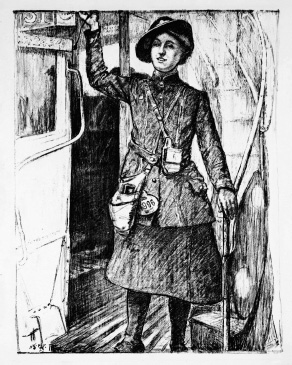
A London bus conductress
I see Archie as part of that crowd. That’s him waiting at the bus stop next to Piccadilly Circus, a tall young man, face as dreamy under the flat cap as it had been in his wedding photograph, hands shoved in the pockets of his army greatcoat, a sausage-shaped canvas kitbag beside him. As the bus arrives, he climbs onto the open back platform, wincing from the pain in his legs. The conductor, a pretty girl, grabs his bag and hauls him aboard.
“Cummon, Aussie! Ups a daisy!”
Her familiarity embarrasses him. He still isn’t comfortable speaking to women, least of all one as self-assured as this girl, effortlessly doing a man’s job. Once she’s clipped his ticket (a flake of card falling to join the confetti littering the platform), he hauls his bag up the spiral stairs to the open upper deck. Most passengers prefer to stay below, inside, but a few huddle up here, sufficiently interested, like him, in the sights of London not to mind the cold.
Knowing that, one day, he’ll be asked, “What’s London really like?” he watches, dutifully, taking note: the mixture of automobiles and horse-drawn wagons in the streets below; the gray granite frontages of the City, as London’s financial center is known; the occasional church, discreet but proud and superior in that eighteenth-century way Australia will never achieve. It is, he decides tentatively, looking up into the overcast, something to do with the light.
“Liverpool Street. Liverpool Street Station.”
A minute later, he’s on the curb, staring up at a block-long berg of ash-gray brick. It dwarfs the people surging through its wide doors and the motor cabs that clatter up the incline to the main entrance. Not just a railway station, the complex, as befits the station serving the City, houses a hotel, shops, offices, and the largest Masonic temple in Britain. Shouldering his bag, he trudges up the slope. In May, a thousand-pound bomb from a Gotha G.V will crash through the glass roof of the main concourse and kill 162 people. Archie has no conception of such disasters, any more than millions of other people involved in this war, except that, of course, they will never happen to him.
He is mostly aware of himself—his cold, his hunger, his loneliness. Any fears are not of bullet, bomb, or bayonet but of childish things—getting lost, looking foolish, being found out. Tears come to his eyes. Though he believed, on so gratefully leaving Australia, that he would never feel such an emotion again, he wishes he were back home.