
37
Yet all experience is an arch wherethrough
Gleams that untravelled world, whose margin fades
For ever and for ever when I move.
ALFRED, LORD TENNYSON, “Ulysses”
On October 24, 1917, Archie Baxter set foot for the second time on French soil when he stepped off the boat in Le Havre.
Ships filled the vast ugly harbor: some standing out, waiting to dock; others moored, holds open, hatch covers off, cranes dipping into their guts, winches hauling out bulging cargo nets. Many boats were American. Black soldiers working as longshoremen offloaded crates onto the dock and wrestled them into railway trucks already coupled to locomotives leaking steam, ready to pull out.
Archie’s experience of black men was limited to the few aboriginals who hung around the outskirts of Sydney, living in rough shelters, panhandling for cigarettes or beer. To him, these Americans were as exotic as flamingos; another promise of those different worlds he’d begun to glimpse the moment he made the decision to enlist.
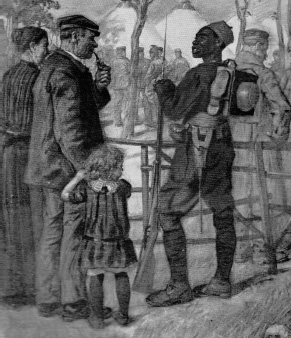
Black French soldier guarding German prisoners
It was still warm, the banked heat of autumn, so the Americans had stripped to the waist. They sang as they worked, the syncopated, repetitive chants of the slave life they hoped had ended with the Civil War. French stevedores handling cargo next to them took no notice. Recruits from the African colonies had made black skin even more of a commonplace. They sang too: tribal chants whose similarity to the Americans’ work songs revealed their shared heritage.
Not that color made any difference to the French. Once they acknowledged you as citoyen, physical characteristics were of no significance. Whether a coolie from Cochin, a Zouave from Algeria, or a Spahi cavalryman from Morocco, you belonged to the culture of France, its art, its humor. When a Tommy wished to show skepticism, he might sneer, “Pull the other leg. It’s got bells on.” The poilu, to signify the ultimate in improbability, said, “Oui. Et la main de ma soeur dans les culottes d’un zouave.” Sure. And my sister’s hand in a Zouave’s trousers.
After waiting in line for an hour at the routing office, Archie got a chit to spend the night in town.
“We’ll send you up to the front with the next convoy,” said the corporal behind the desk. “Might be a couple of days. Until we get together enough of you to make it worthwhile.”
“Send us up where, corp?”
“None of your bloody business, mate. Report at HQ in town tomorrow. Next!”
With other Aussies off the same boat, Archie scrounged a lift into the center of town. The horse-drawn ambulance was returning empty after delivering wounded to a ship taking them back to Australia. The other new arrivals climbed into the back, under the canvas, finding room around the now-empty stretcher racks, but Archie, after one look at the bloody bandages littering the floor and a sniff of the mingled stink of disinfectant, unwashed bodies, and corruption, mounted the open front seat with the driver.
“G’day,” he said.
“G’day,” the driver replied.
As Australian etiquette went, it was a warm, even enthusiastic welcome.
The swaybacked chestnut pulling the ambulance made Archie realize how long it had been since he’d sat behind the complacent backside of a horse. Years. He hadn’t missed it. Twenty years of living with a barnyard, and particularly with pigs, cured him of any affection for farm animals.
The road was solid with traffic, as far as the eye could see. Most of it horse-drawn: ambulances in one direction, many with casualties sitting next to the driver or cross-legged on top; in the other direction carts and trucks loaded with munitions, supplies, the nourishment of war.
European roads were not made for heavy traffic. Tall trees, mostly poplars, lined this one on both sides. Beyond, fields ran off into the distance, disappearing from sight in the mist that hung perpetually over Europe’s plowed earth. Archie thought of Australia: the grass crisped brown, as if in an oven; the omnipresent hum of insects; the sky, white with heat; the sensation of sweat vaporizing on the skin. During a year in England, he’d forgotten what it was to be warm.
A dispatch rider on a motorbike roared down the center line between the two stationary lanes of traffic. Otherwise, nothing moved. After a few minutes, the driver put the reins down on the worn wooden seat and started to roll a cigarette. Sensing slackness, the horse twitched its head. Automatically Archie took the greasy leathers and tugged lightly. Reassured, the horse snorted and, without notice, dumped a load of turds onto the road.
Before they’d stopped steaming, Archie heard a scraping of spades below the wagon. Two kids in ragged hand-me-downs and wooden clogs were scooping the droppings into a bucket. Most houses had a manure heap filling the few square meters of space between the front wall and the ditch running along the edge of the road. This was still farmland, and fertilizer was wealth.
Striking a match on the wooden seat, the driver lit the cigarette, took a draw, then handed it to Archie. The smoke grated in his throat. Though the makings tasted only notionally of tobacco, he felt a diminishment of hunger and the beginnings of a buzz.
The driver nodded toward the ambulance halted on the opposite side of the road. The canvas was rolled back, probably to dissipate the smell that drove Archie up here to the front seat. Inside, as if in an insect nest, wounded men were exposed, swathed in bandages like larvae. Some lay silent and motionless on stretchers. Others lolled against bench seats. Some had their eyes bandaged; others a hand or foot.
“SIVs,” the driver said.
“Eh?”
“Self-inflicted.”
“How can you tell?”
“Haul enough of the buggers, you learn the signs.”
“All of them?”
“Most. And more of ’em every week.”
Every old stager had a recipe for a Blighty wound. The less imaginative blew off a toe or raised a hand above the parapet, hoping to be drilled by a German sniper without losing any fingers. Others ate the emetic ipecac or cordite from a rifle cartridge; it gave you shortness of breath and bad color, but it was easy to spot. A whiff or two of gas could burn your lungs or eyes badly enough to be invalided back but—with luck—do no permanent damage. An injection of petrol into the joint could make a knee or elbow swell, or, if under the skin, cause a nasty-looking ulcer. . . .
A powerful need to move seized Archie. He handed back the reins.
“Hoo-roo.”
Startled, the man said, “If you want a jimmy riddle, go ahead. We’re not moving.”
“No, it’s apples, mate. Good luck.”
He shook the man’s hand, dropped to the road and crossed to the other side, ignoring a horse that whinnied and showed its teeth, hoping for an apple or a carrot. Slithering down the embankment, he hopped the stagnant water in the ditch, filmed like a blind eye with algae, and scrambled up the other side. From the look of the few stalks of greenery mixed into the dug-over earth, the field had been under turnips until a few weeks ago.
Hands in his pockets, head pulled into the collar of his greatcoat, Archie wasn’t sure he’d been spotted leaving the road—or, if he had, that anyone would care. The Allied forces were leaking people. He sensed them evaporating, the way a hot wind sucks away the liquid beaded on a canvas water bag. About the narrow raised bank between this field and the next, there was a quality of the foretold that steered him toward the line of trees about a quarter of a mile away; trees that could only mean one thing.