
CHAPTER SEVEN
Ranville
Distance between stops by vehicle: 1.6 miles (2.57km)
Total walking distance at stops: Approx 2 miles (3.22km)
Recommended time allowed for tour: 1 to 2 hours
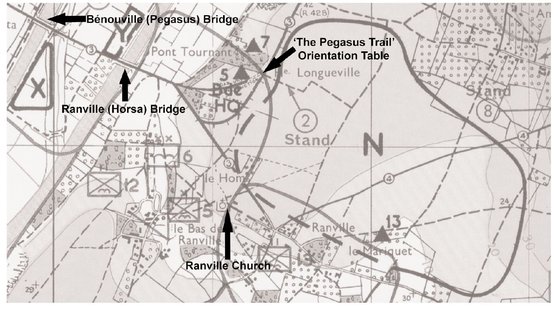
Drive back down Avenue du Major Howard and take a left turn onto the D514 road heading east across Horsa Bridge. Take the third exit (D514), at the roundabout. Drive to the top of the hill and take the first sharp right signposted Ranville. Park on the grass verge just after the semi-circular orientation table on your right. The area to your left is:
A. DZ/LZ N (North) & ‘The Pegasus Trail’ Orientation Table (2) This is the area where 5 Para Bde landed in the early hours of 6 June, followed by part of 6 Airldg Bde landing on the evening resupply mission on the evening of D-Day. The Pegasus Trail orientation table, the second of three, will help you identify local landmarks. The third orientation table is situated just under 1.5 miles (2.41km) away, to the SE, across the open fields on the far side of DZ/LZ N near Hérouvillette (see Battleground Europe book Merville Battery & The Dives Bridges Ch. 6, F1).

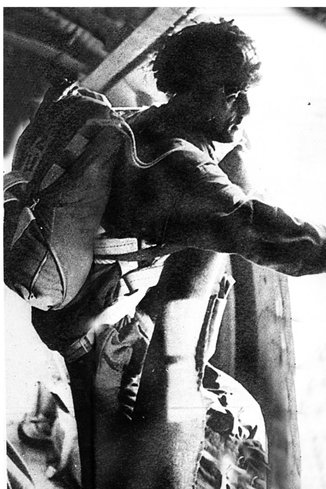
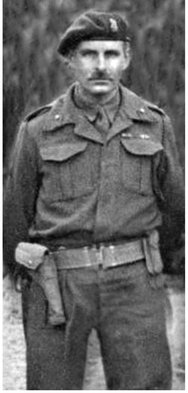
Brigadier Nigel Poett.
One of the first men to land here was the commander of 5 Para Bde, Brigadier Nigel Poett. He landed with the pathfinders of 22 (Ind) Para Coy whose job it was to guide in the following aircraft by marking the DZ/LZ with radar beacons and coloured lights. Some thirty to forty minutes later 7, 12 and 13 Para were dropped here but were unfortunately scattered both on and around the DZ/LZ.
My chute developed normally, and as my body swung into the vertical I looked around... To my front, but some distance away numbers of red and orange balls were shooting up into the sky. This display I reasoned was the ack-ack defence of Caen. I stared at them far too long, because when I finally looked down, much to my horror it seemed I was destined to land in one of the orchards bordering the eastern side of the DZ... I prepared myself for a tree landing. I had never made such a landing, but I remembered what to do; head down on the chest, arms crossed in front of it, and knees raised to protect my marriage prospects. Down I came, crashing through branches and foliage, without so much as a scratch or bruise, but when I stopped falling and opened my eyes, I was completely surrounded by greenery. I felt around for a branch to get my feet on, but found none, So I turned the quick release on the parachute harness, gave it a bang, the straps flew apart, and my Sten which was broken into three parts, and threaded under them, fell to the ground. I slid out of the harness, keeping a tight grip on it, lowered myself to the end of the leg straps, and I hadn’t reached the ground and was still enclosed in the foliage. I let go of the webbing harness, and dropped all of twelve inches[305mm] to the soil of Normandy.
LIEUTENANT ELLIS ‘DIXIE’ DEAN, 13 PARA
Only sixty per cent of 13 Para had made the RV before B and C Coys set off towards their objective which was to secure and hold the village of Ranville. They would also, along with 12 Para, deny the enemy the southern approaches to the river and canal bridges. Meanwhile A Coy, of 13 Para, was assigned the task of helping the sappers of 591 Para Sqn RE, in the clearance of the anti-glider poles that covered the DZ/LZ. Initially two strips, each 1,000 yards (914m) long by 60 yards (55m) wide, had to be cleared and ready for the glider landings that were to take place before dawn just over two hours later. These strips, when completed, would then be illuminated with lights by the pathfinders. As you stand with the orientation table in front of you, you are looking west across the breadth of DZ/LZ N. The two illuminated landing strips ran from left to right across the western side of this area.
Major J. Cramphorn’s company from 13 Para was detailed as an infantry working party made up of four officers, twelve NCOs and 120 ORs. Before their arrival two Royal Engineer reconnaissance parties were to have taped out the landing strips. However, only one arrived on the DZ in time, but nevertheless managed to mark out both areas with frugal use of these limited tapes.
With cover provided by a protection party from 13 Para, the men began to clear the two strips. This involved the demolition and removal of a complete row of anti-glider poles in each strip. Once cleared, each would provide enough room for thirty-five Horsa gliders to land.
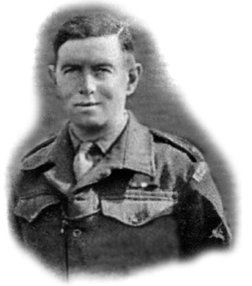
Major J. Cramphorn.
There remained the problem of dropping the poles and then removing them. Permission was obtained to fell some 100 trees in the New Forest, something unheard of in peacetime, and these were then transported to Bulford Fields on Salisbury Plain where they were erected according to the pattern in the air photographs. Following trials of various possible methods a standard drill was evolved as follows:
(a) The ground around the base of each pole was excavated to a depth of 6in [152.4mm] and about 12ins [304.8mm] out from the pole.
(b) A 5lb [2.27kg] sausage of plastic explosive was attached round the base of the pole to be fired by safety fuse and igniter. These sausages were made up in bicycle inner tubes and carried down by the parachute engineers as bandoliers.
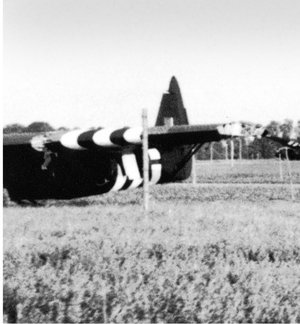
Horsa gliders scattered among the dreaded anti-glider landing poles.
(c) Each pole was then removed by human porterage provided by an infantry working party and the shallow crater filled in and stamped down. Demolished poles were carried away to the side of the strip and laid at the base of a standing boundary pole and at 45 degrees to the axis of the strip to allow gliders to turn off. Six infantry teams of twelve men were required for each strip and they were headed by a RE NCO to ensure a safe separation from the demolition parties.
LIEUTENANT FRANK LOWMAN, CRE 6TH AIRBORNE DIVISION
‘The Pegasus Trail’ Orientation Table to the left of Drop Zone N alongside the D 514.
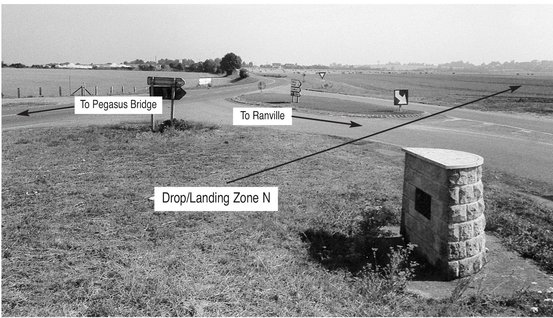
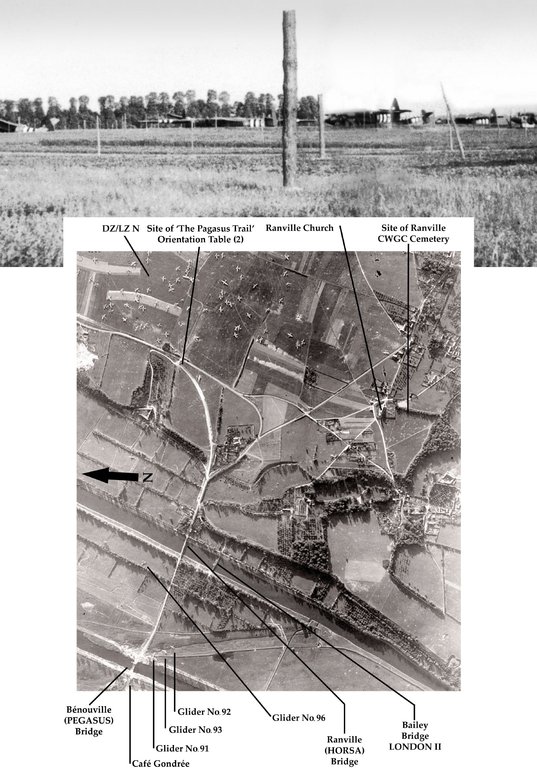
In training each strip took one and a half hours to clear. This target time was also achieved on D-Day, despite being under fire from German patrols. This was partially due to the fact that many of the poles were of a smaller diameter than expected and the strips were ready for the first wave of gliders with time to spare. However, the lighting of the strips proved inadequate since some of the specialised equipment had been destroyed or lost in the drop and subsequently the gliders came in from all directions for their landing. Fortunately, though, casualties and accidents were few.
The whistling sound and roar of the engines suddenly died down; no longer were we bumping about, but gliding along on a gloriously steady course... Round we turned, circling lower and lower; soon the pilot turned round to tell us to link up as we were just about to land. We all linked up by putting our arms round the man next to us. We were also strapped in. In case of a crash this procedure would help us take the shock. I shall never forget the sound as we rushed down in our final steep dive, then we suddenly flattened out, and soon with a bump, bump, bump, we landed on an extremely rough stubble field. Over the field we sped and then with a bang we hit a low embankment. The forward undercarriage wheel stove up through the floor, the glider spun round on its nose in a small circle and, as one wing hit one of those infernal stakes, we drew up to a standstill.
MAJOR GENERAL RICHARD GALE, GOC 6TH AIRBORNE DIVISION
As soon as all the gliders had landed and unloaded on the LZ the Royal Engineers and paratroopers began to work on two more landing strips, this time on the eastern side of the LZ. These were for the evening landings of 6 Airldg Bde. Since this landing included a greater number of Hamilcar gliders these strips had to be 90 yards (82m) in width, which meant an extra row of poles had to be removed. This task was completed by 0500hrs. But not everyone who was tasked with clearing the LZ had landed on or made it to the DZ.
I did not recognize the piece of ground I landed on, so I shinned up a signpost, thoughtfully left by the French, and struck a match to see where I was. It was almost two miles [3.22km] from where I was supposed to be. All around was the thudding of army boots as more men came down, and as there was not much ‘asparagus’ in my neighbourhood I used the explosive strapped around my waist to blow up a telegraph pole across the road to deter enemy reinforcements, which must have been tiresome to our troops who had to remove it later... After comforting a parachutist who was moaning in a ditch from a broken leg and whom I had no means of helping, I saw Lieutenant Colonel Luard who was rallying his men with a hunting horn... [later] an engineer major offered me a lift in his jeep which was scheduled to go to Troarn and blow up bridges, but thankfully I declined as it was the wrong direction. On the way to Ranville, where the château was to be Div HQ, I came across the divisional commander, General Gale, who had just arrived in his glider. It was near a crossroads and the general ordered a sergeant to clear some men from the crossroads, always a dangerous spot from enemy artillery. The man foolishly replied that they were not his men. General Gale exploded: ‘What! Shamus, [Hickie, AA & QMG] here’s a man arguing with Richard Gale!’ Needless to say a frightened sergeant rapidly did as he was told.
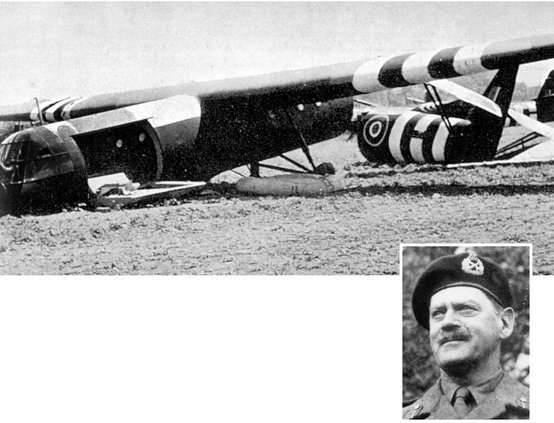
Horsa glider, chalk mark No. 70, in which Major General Richard Gale landed. Below right his commemorative bronze bust.

Major General Richard Gale.
MAJOR ANTHONY WINDRUM, ADJUTANT 6TH AIRBORNE DIVISION SIGNALS
In the meantime 12 Para, with barely fifty per cent of its men, had set off on its task which was to take and hold the area south of Ranville around le Bas de Ranville and thereby protecting the southern approaches to the DZ, Ranville and the bridges over the river and canal. 12 Para were in their positions ready to ward off any German attack by 0400hrs with only the hospitality of the local Normandy people holding them up.
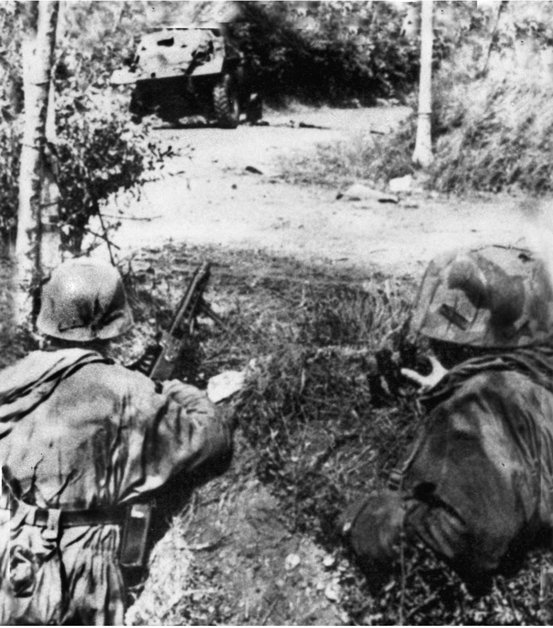
German MG team covering a road junction as they seek to contain the British paratroopers.
We reached our objective, le Bas de Ranville village, where a French lady came from her farmhouse, which was on the land where we were digging in. Not being able to understand the French language very well, I could only guess that she was asking who we were and what we were doing. In the little French I knew, I told her we were British and that this was the invasion. She went back into her farmhouse and minutes later came out with a jug of milk and some bread. I had a block of chocolate in my camouflaged Denison smock which I gave to her.’
CORPORAL R. DIXON, 12 PARA
But it was not long before the battle started and 12 Para were soon engaged with advancing German patrols. In one of these was Captain John Sim, with twelve of his men, entrenched in a hedgerow, assisting a FOB pick out suitable targets for their offshore cruiser to fire at. A German patrol spotted them and, with two SP guns in support, they overpowered the small group of paratroopers in a fierce firefight. Captain Sim was forced to retreat, but only three of his men were able to accompany him. Later the position was retaken with reinforcements and the German SP guns destroyed by artillery.
As the wounded were collected by stretcher bearers Captain Sim, who was later awarded the Military Cross for his action that day, collected the dead and took them to Ranville churchyard. Today eight of them are still buried in the grass bank surrounding the churchyard. Later it was discovered that another man, who was in charge of a Bren gun position, had also escaped from the carnage. However, he was later taken prisoner.
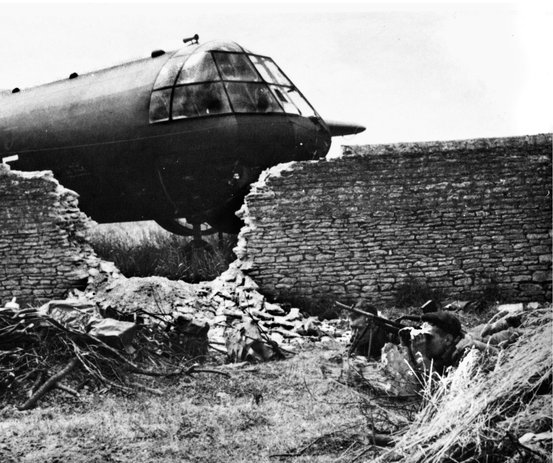
Bren gun team guarding the landing zone.
The Germans now rushed a tank along the lane to our right with infantry on the top of it. There seemed to be a lull in the fighting and I began to think of our situation, which was that there were two of us left alive in the hedgerow. I decided to order Private Gradwell with his Bren to the rear, then I would follow him. He refused to retreat, saying, ‘I’m not bloody going anywhere’ and took up a firing position behind a fallen tree trunk. After several more orders to move, which he refused, I stood up and kicked him in the ribs. He then picked up the Bren and ran along the ditch that Captain Sim had used. I then decided to move back myself... I started to crawl back through the field of wheat which was nearly 3ft [0.9m] high. But under a clear blue sky I began to lose direction. So I decided to crawl back towards the roadside ditch. I moved the wheat stalks aside and dropped into the ditch, about a yard in front of a German machine-gunner and three others who were using the ditch to advance towards our main company position.
British prisoners: Lance Corporal Frank Gleeson, front left, 12 Para, after he had been taken prisoner. Also taken as prisoners were medics from the parachute field ambulance who had remained with the wounded.

LANCE CORPORAL FRANK GLEESON, 12 PARA
B. Ranville
Return to your car and follow the road down into Ranville. As you pass the village sign you will see beneath it another sign acknowledging that the district was liberated by the 6th Airborne Division on the night of 5/6 June, 1944. In the distance you can see Ranville Church.
Continue down into the village and go straight across at the crossroads. Take the next left along the Chemin de Longueville and onto the Rue des Airbornes. This will take you to the front of Ranville Church. Follow the road round to the left, take the first road off the mini-roundabout and on the left-hand side are some parking spaces. To your right is the entrance to:
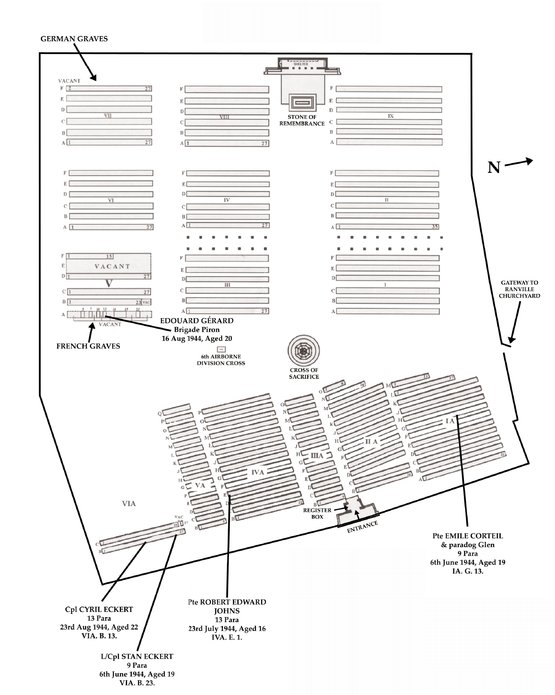
1) Ranville Commonwealth War Cemetery. As you walk through the gateway and under the stone entrance arch you will see, to your left, a small brass door above a stone seat. In here is kept the cemetery register, cemetery map and visitor’s book. The cemetery register lists in alphabetical order all those known to be buried in this cemetery with Commonwealth nationals listed first, followed by foreign nationals.
In total 2,236 commonwealth nationals are buried in this cemetery including: 2,058 identified and ninety-seven unidentified from the United Kingdom; of whom ninety known and nine unknown are from the Royal Navy, 1,945 known and eighty-four unknown from the Army, twenty-three known from the Royal Air Force, two unknown from the Merchant Navy and two of unknown service. There are also seventy-six Canadians; of which sixty-seven known are from the Canadian Army and nine known are from the Royal Canadian Air Force; two known Australians from the Royal Australian Air Force; and three known from the Royal New Zealand Air Force.
In addition there are also 328 foreign nationals including; one known from the Belgian Army; five known from the French Army; one known from the Polish Army; and 213 known and 106 unknown from the German Army and two known from the German Air Force.
In total some 2,564 burials which are all maintained by the Commonwealth War Graves Commission (CWGC). If looking for a particular individual, the location of their grave is given at the end of their entry in the register. You can then use the map at the front of the register to find each location within the cemetery grounds. All visitors are welcome to put their own personal entry in the visitors’ book after their visit.
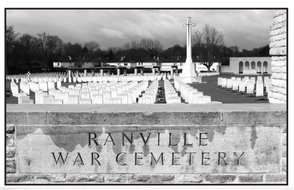
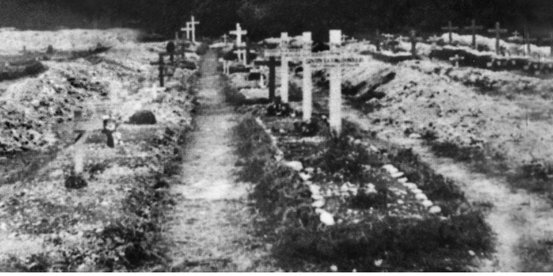
Ranville War Cemetery in 1944.
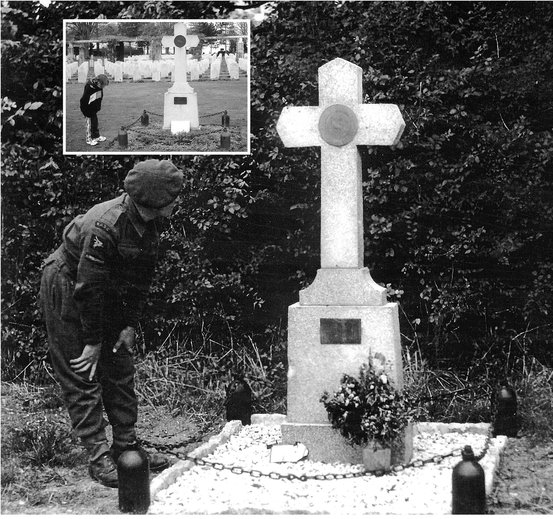
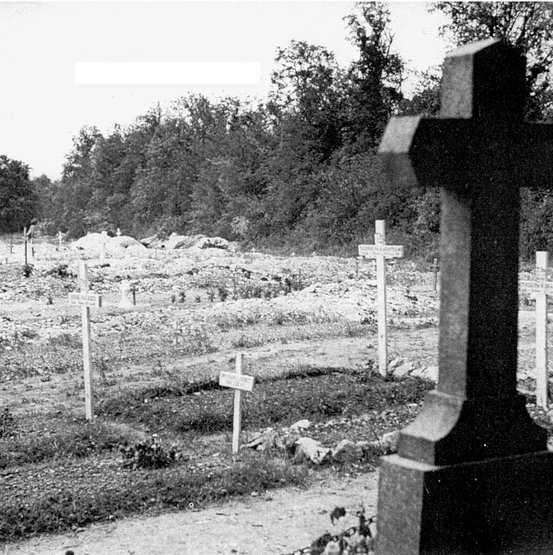
Memorial Cross to the 6th Airborne in 1944. Inset: the author’s daughter Michaela stands in for Sapper Hanslip in this comparison.
In the centre of the cemetery, you will see the large Cross of Sacrifice, there is one of these in each of the eighteen Commonwealth War Cemeteries that were constructed for casualties from the Normandy campaign. Just to the left of the Cross of Sacrifice, is:
2) Memorial Cross to the 6th Airborne Division. As with the signpost at Pegasus Bridge, it was Lieutenant Colonel Frank Lowman who had approached Major General Gale and also the Senior Chaplain, George Hales, with the design and idea for the cross. Permission was granted and the cross was made by Sapper Hanslip of 286 Fd Pk Coy RE. Using cement, he sprinkled the mould with coal dust to simulate marble. The two copper plaques, one of the Pegasus emblem and the other with the simple inscription ‘6 JUNE 1944’, were originally made from copper compressed air cylinders salvaged from one of the Horsa gliders. The original plaques are now on display in the Memorial Pegasus Museum (see Ch. 6, B). The cross is surrounded by glider lashing chains that are held in place by brake fluid casings. As the, then temporary, divisional burial ground began to fill up the cross was erected and the ground consecrated by the Senior Chaplain on 24 June, 1944. The cross has since been moved from its original position to where it now stands today. After the war it was decided that the cemetery would become a permanent resting place for those buried here. Today, because of the number of airborne casualties interred, Ranville Commonwealth War Cemetery is still referred to as the 6th Airborne Division, or Airborne, Cemetery.
Headstone for sixteen year old Pte R. E. Johns. The youngest British paratrooper killed in the Second World War.
Original map © Commonwealth War Graves Commission. Reproduced with kind permission.


Also in the cemetery, although periodically repositioned, are two wooden benches, one donated by the Thanet branch of the PRA and the other with a memorial plaque dedicated to 8 Para.
As you walk around the cemetery you will see that the headstones for those who are identified from the Commonwealth forces can provide a great deal of information about the individual. There will be their name, rank service number and their regimental service or unit badge carved into the headstone. For those of the Jewish faith there will also be a Star of David and for those of the Christian faith a Latin cross. Beneath, at the base of the headstone there will usually be an inscription, penned or chosen, by the next of kin. But perhaps the most striking information given is the ages of the young men who now rest in this cemetery.
Over to the left-hand side of the cemetery the French graves are marked with a cross and a plaque; the Belgian headstone is a similar shape to the Commonwealth headstone; and the Polish headstone is also similar but with a more pointed peak. In the far left-hand corner of the cemetery are located the German graves, again similar to the Commonwealth headstones but with a sharp, rather than rounded, peak at the top of the headstone.

Brothers Corporal Cyril and Lance Corporal Stan Eckert.
It may seem insensitive to select people who now rest in this cemetery for particular mention, as it is important to remember that all these men were individuals; each with a family and story of their own. Nevertheless it seems fitting to at least give the reader and visitor alike a brief insight into the type of personalities that now rest here and detail, without prejudice, a few of the many.
Among the fallen is Private Robert Edward Johns (plot IVA, row E, grave 1) who represents the youngest British paratrooper killed in the Second World War, if not indeed the youngest British soldier. Serving with 13 Para his unit liberated and secured the village of Ranville on D-Day. Private Johns was killed six weeks later on 23 July 1944. Only after his death was it discovered that he had given a false age so that he could enlist for the armed forces. He joined up aged only fourteen years old and when killed he was found to be only sixteen years old.
Private George White (left) and Lance Corporal Stan Eckert.

Also buried here are two brothers; twenty year old Corporal Cyril Albert James Eckert (VIA, B, 13) of C Coy 13 Para, and nineteen year old Lance Corporal Stanley George Thomas Eckert (VIA, B, 23) of C Coy 9 Para.
Corporal Cyril Eckert was seriously wounded during an attack at Pont l’Evéque in August. Using an old door as a makeshift stretcher, he was then carried off the battlefield by his comrades. Despite being under fire, they managed to get him across the River Touques and to relative safety. He was then taken by ambulance to receive urgent medical attention. However, he succumbed to his wounds and died on 23 August. Initially he was buried in a small temporary burial ground in the village of St Hymer, to the south of Pont l’Evéque, later he was reinterred at Ranville.
There are many other heroic and tragic stories that could be told about those who now rest in this cemetery. One of the most heart-rending is that regarding a letter written by Corporal Cyril Eckert’s younger brother, nineteen year old Lance Corporal Stan Eckert, to his mother on 6 June. A copy of the letter, and a photograph of the brothers can now be seen in the Merville Battery Museum (see Battleground Europe book Merville Battery & The Dives Bridges Ch. 5, D). The letter though is now faded with age and barely legible. What follows is a transcript:
Somewhere in France.
Dear Mum,
I am writing this letter at the bottom of a ditch very near the front line and I hope to get it posted pretty soon as my pal and I have a good idea that tomorrow we will be prisoners of war. I am writing this short note here so as if it is ever found by anyone they can forward it for me.
Do you know mum dear, I have never realised how much you meant to me, until now? If I can get home again, you will see a very different Stan, just wait and see. The same goes for dad, too, and the rest of the Eckerts. There is one thing that worries me, and that is what happened to Cyril. I hope and pray that he is safe and well.
Well, mum, just sit and wait for the end of the war when I will be ‘home’ once again, for good. Don’t worry at all, will you.
With love to everyone at home, especially you.
Your ever loving son.
Stan XXXXX
Lance Corporal Stan Eckert would never see his mother again. Stan died on D-Day. His body was found by a Royal Marine commando, who discovered the letter and it was eventually passed on to the family. Initially the family received a telegram informing them that their son Stan was missing in action. Within seven weeks the family received yet more tragic news when a second telegram arrived informing them that Cyril had been killed in action.
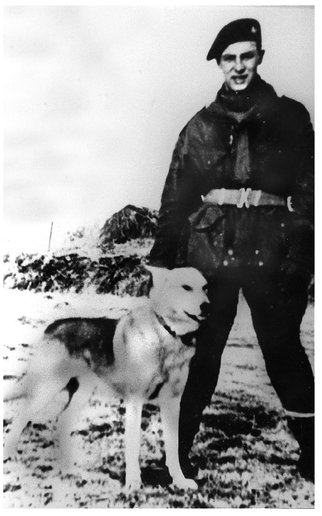
Pte Emile Corteil and his paradog ‘Glen’.
Stan’s body though was not recovered until much later, by which time his brother Cyril had already been laid to rest in Ranville. For this reason the two brothers, although in the same row, are not buried beside each other. Also killed on 6 June, and buried nearby, is Stan’s closest friend in 9 Para, twenty-one year old Private George Vincent White (VA, E, 2).
Headstone for Pte E. S. Corteil and his paradog ‘Glen’ buried with him.
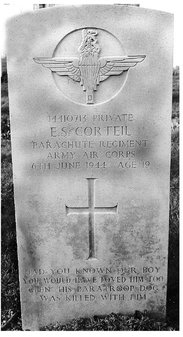
In Ranville cemetery rests a body that is unique to any of the CWGC’s 2,500 worldwide cemeteries; this is a body of a dog. Called ‘Glen’ he landed with his keeper, nineteen year old Private Emile ‘Jack’ S. Corteil (IA, G, 13). Glen, ironically a German Shepherd, was both the battalion mascot and a well trained sniffer dog used to smell out explosives, detect people and carry messages. He was also a trained paradog, and was fitted with his own parachute for his landing in Normandy in the early hours of 6 June. Sadly both Private Corteil and his companion ‘Glen’ were killed on D-Day (see Battleground Europe book Merville Battery & The Dives Bridges Ch. 4) in what is known in military parlance as a ‘blue on blue’ incident. Today it is more commonly known as friendly fire.
It was Private Corteil’s CO, Major Allen Parry, that decided that since the two were so devoted to each other they should be buried together. Private Corteil’s mother wrote the epitaph for the base of the headstone.
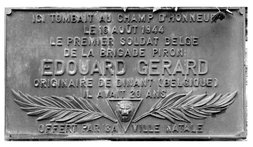
Ranville is also the final resting place for the first and youngest Belgian soldier to be killed in Normandy, twenty year old Edouard Gérard (V, A, 12) who served with Brigade Piron. He was killed on 16 August 1944 (see Ch. 7 B8, B18 and Battleground Europe book Merville Battery & The Dives Bridges Ch. 5, A2, A3, B5 & D21).
For one paratrooper who survived the war, Ranville cemetery is a particularly memorable place. Not just for the reason that it is the place where many of his comrades now rest.
It was right here I landed… [between the memorial cross and the southern perimeter of the cemetery] We were in a stick of about twenty, inside, the hole was in the middle [of the aircraft] so you’re either side. Then one goes, another goes, alternatively jumping down and you’re shuffling tight up behind one another to stay as close as possible, so you could very quickly get out. And the idea was you wouldn’t land too far apart from one another. In actual fact we were pretty good, because when we dropped near Ranville I dropped and within a few moments I’d caught up with at least three and the fourth one had hit the churchyard wall and broke his arm. It was Thompson. What we did was take his morphine and we injected him with his own morphine. We didn’t know to what extent his injuries were. And I always worried what had happened to him, taken prisoner or shot or what had happened to him ‘cos obviously he was in a bad way and we had to leave him in the pitch dark...

Earnest Stringer at the wall where he helped an injured comrade.
Ranville Cemetery during 1944.
We eventually picked up some others around the church and there was a good five of us initially, and we made our way into Ranville. We came round by the church up a lane and we met some more, an NCO and somebody, and made our way, single file down towards the bridges. It was still dark and what I really remember is the noise, banging and terrific noise going on. Obviously the Germans were coming back at the bridges already. And we were going towards it. We ran across the bridges and then separated along the banks.
[After the war] I was up at a reunion and talking to this chap [7 Para veteran] Ron Perry and I said to him ‘this chap I’ve always been worrying about, and has been on my mind for many, many years, Thompson’ and he said ‘oh, he’s still alive’... he’d smashed many bones in his arm and had to have lots of operations… He told me he became his best man at his wedding and he’d kept in touch with him… ‘Cor, gee whizz’, I said, ‘I didn’t know what had happened to the poor bugger’.
PRIVATE ERNEST ‘ERNIE’ STRINGER, HQ COY, 7 PARA
For nineteen year old Private Stringer, the intense fighting in and around Bénouville lasted only for a day or so until he was wounded; a bullet having gone through the side of his left foot. Private Ron Perry, after the war, told Private Stringer that he had been treated for his wounds in the cellar of the Café Gondrée. After his treatment at the RAP, he was evacuated to the beaches and then back to the UK.
Along the churchyard wall where Thompson had his unfortunate landing, there is a gate that leads through into:
3) Ranville Churchyard.
Through the gate, and to the right, a cinder path leads towards the front entrance of the churchyard. After passing the entrance gates on your right you will see, in front of the churchyard’s low boundary wall a further forty-eight white CWGC headstones.
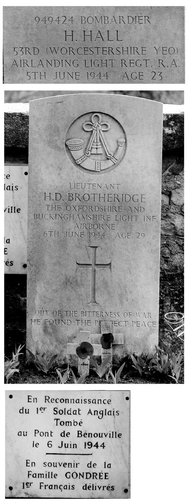
Among those buried here is one person with a headstone unique to any other CWGC headstone in Normandy in that it bares the inscription 5 June 1944. This headstone is for twenty-three year old Bombardier Henry ‘Nobby’ Hall (grave 19) of 53 Airldg Lt Regt RA. It is not known for certain if or how he was actually killed on 5 June 1944. No surviving veterans have been found who can recall how he met his fate. One comrade from 212 Bty of 53 Airldg Lt Regt RA, however, does recall the time Bombardier Hall received some unexpected news when back in the UK.
Nobby was not with us long before he received a posting out of the regiment, this was against his wishes and he was informed that the only way he could stay was to volunteer to become a parachutist… Nobby completed his course and took part in exercises. In one particular exercise on a night jump he landed in a tree, fortunately suffering only superficial injuries. He went off with the rest of the lads to prepare for the invasion.
GUNNER JAMES B SAUNDERS, TECHNICAL ASSISTANT
212 BTY 53 (WY) AIRLDG LT REGT RA
Bombardier Hall went on to train as a Parachutist FOO signaller and would form part of the 53 Airldg Lt Regt Forward Observation Section (FOS) and Airborne Support Net (ASN). This unit would relay targets for the regiment’s three batteries of 3.7 inch (75mm) pack howitzers as the battery took up its position to the east of Pegasus Bridge. They would also later provide information for other artillery units as they came into the line. The FOS was split into twelve parties consisting of three men, comprising of one officer and two signallers; parties were then attached to 6th Airborne Division’s HQ, brigades and their respective battalions. A party was also attached to 1 SS Bde and later they would also provide support for the 51st Highland Division.
One of Bombardier Hall’s closest friends, Gunner David ‘Dai’ King, also a FOO signaller in 53 Airlanding Lt Regt RA, recalls the final time they were together.
The last time I saw Nobby was the end of May 1944. We were then sent to the respective transit camps ready for D-Day. We didn’t know which para battalion we would be dropping in with, as you can imagine security was a priority.
GUNNER DAVID ‘DAI’ KING, SIGNALLER
53 AIRLDG LT REGT RA
Gunner David King, attached to 3 Para Bde HQ, was to land in the same drop zone as 8 Para. But no official records have yet been found regarding which unit Bombardier Hall was attached to, or indeed when and where he landed. Suggestions have been made that Bombardier Hall was reassigned to SAS or even SOE units that were dropped before the 6 June. However, in consideration of the lack of any evidence to support this, no conclusive answer can yet be given as to whether the mysterious and unique date on his headstone is actually correct or to the actual circumstances surrounding his death.
Further along the row of headstones is the grave of twenty-nine year old Lieutenant Den Brotheridge (grave 43). To the left of his headstone is:
4) Memorial Plaque To The First English Soldier Killed At Bénouville (Pegasus) Bridge. This memorial plaque was donated by the Gondrée family.
Continue along the path until you reach the church tower that is separate from the main church, to your left is the entrance to:
5) Ranville Church. It was to be used as an aid post on 6 June but when Captain David Tibbs, of No. 3 Section 225 Para Fd Amb RAMC, had made his way to the church from the DZ at 0430hrs, he was unable to gain entry. Not yet having any casualties to deal with and content that the field ambulance was being set up he decided they would not need to use the church at that time.

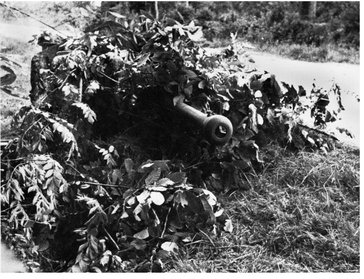
British 6pdr anti-tank gun awaits the Panzers.
Later the church was turned into an Advanced Dressing Station (ADS). Private Ray Shuck remembers the church well as a result of being taken there for treatment after he was seriously wounded a few days after D-Day. Private Shuck had landed by glider onto DZ N with his section from 4 Airldg A Tk Bty RA at 0330hrs on 6 June.
We crashed, but we were lucky as he swerved and he kept the glider level. We managed to get the ramps out and the 6 pdr anti-tank gun and the jeep out with all the ammo in and we weren’t far from Ranville and that’s where we started to meet opposition. We were to rendezvous at the church, so we fought our way through Ranville and then turned towards the bridges.
PRIVATE RAY SHUCK, 4 AIRLDG A TK BTY RA,
ATT 13 PARA, 5 PARA BDE
Private Shuck and the rest of his three man crew, Sergeant Les Marriot and Private Les Atwell, quickly got their 6pdr gun into action. Within a few days Private Shuck’s comrade, Private Atwell, had his leg blown off below the knee. Soon after, in action against another German attack, Private Shuck also became a casualty when he was shot by a sniper. As the layer/firer he was moving about near the front gun shield of the gun, raising his head just a fraction too high on one occasion was enough to present a German sniper with a target. Private Shuck fell to the ground unconscious. As the battle continued he remained unaware until he regained consciousness and found a young boy trying to stop the bleeding from his head.
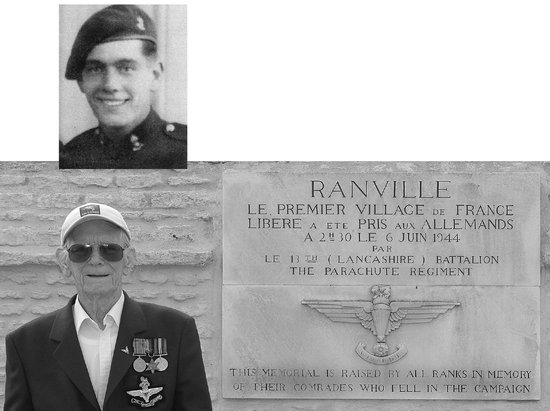
The lad that saved my life, I thought he was a French boy. I found out later he was a Russian living in Ranville and after the war he emigrated to New Zealand. I was twenty at the time this lad was about fifteen. He got me to a French doctor ‘cos I was pouring with blood out of my head. I found out later the doctor’s name was a Dr Izzard. The doctor and this boy, as some of our troops had advanced by then, they managed, I don’t know how and God knows how far it was, they managed to get me back to the church… I can tell exactly where I was laid ‘cos I’d come round a bit after blacking out. In that church all the pews and everything were moved out, it was like one big floor. And you know where the pillars are, all down one side. The narrow part of one side all the dead were down there, French as well. And the wounded were in the middle. Our medics were treating Germans as well as us. The Germans didn’t think that would happen they thought we wouldn’t bother, but they were treating them in turn. There was rows and rows of wounded. How the bloody hell they managed, I don’t know…My wound put a groove in my skull and the bullet came in and out of my tin hat... But I was fortunate; the surgeon said if it had been any lower it would have blown the back of my head out.
Private Ray Shuck (top right) being evacuated after his medical treatment.
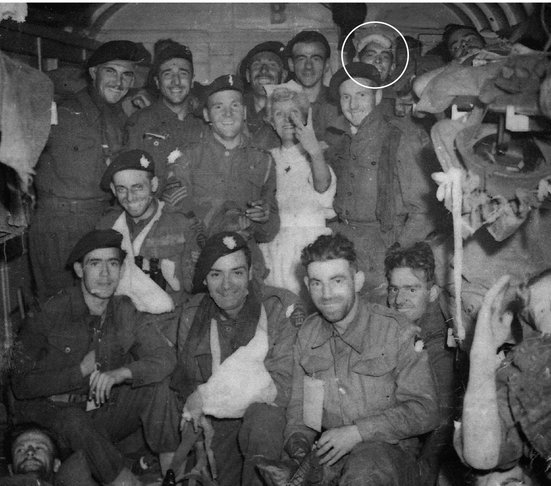
PRIVATE RAY SHUCK, 4 AIRLDG A TK BTY RA,
ATT 13 PARA, 5 PARA BDE
Inside the church in the far right corner is a:
6) 6th Airborne Division Memorial Stained Glass Window. This beautiful window is dedicated to the men of the 6th Airborne Division. Beneath the window on the wall is a white marble:
7) 13 Para Bn Memorial Plaque. Dedicated to ‘Luard’s Own’, after their commanding officer Lieutenant Colonel Peter Luard, and 13 (Lancashire) Para Bn. Left of this there is a brass:
8) Memorial Plaque to Edouard Gérard. This memorial is dedicated to the first Belgian soldier to be killed in Normandy. He was killed in the village of Sallenelles. (see Ch. 7, B1, B18 & Battleground Europe book Merville Battery & The Dives Bridges Ch. 5, A2, A3, B5 & D21). His grave is the only Belgian soldier buried in Ranville Commonwealth War Cemetery. Nearby, to your right there is a brass:
9) 1 Cdn Para Memorial Plaque. This memorial is dedicated to the people of Ranville by 1 Cdn Para Bn Association for their friendship and preservation of the graves of the Canadian paratroopers who died in Normandy during 1944.
Return to the main entrance of the churchyard and exit the churchyard via the wrought iron gates. To your right there is a marble plaque on the side of the churchyard wall that names this area:
10) Place Général Sir Richard Gale, named in honour of the CO of the 6th Airborne Division, Major General Richard Gale. Behind you, approximately 75 yards (69m) away on the Rue Des Airbornes in the grounds of the Mairie (town hall), in front of the Bibliotheque Municipale (town library), there is a:
11) Bronze Bust of General Richard Gale. This bust, The second of three sculptured by Vivien Mallock (see Ch. 6, A24 & Battleground Europe book Merville Battery & The Dives Bridges Ch. 5, D33), is also dedicated to Major General Gale 1896 – 1982, and was presented to the mayor and people of Ranville by the Airborne Assault Normandy Trust in 1994 and unveiled by HRH The Prince of Wales. To the right of the bust on the wall there is:
12) Original 13 (Lancashire) Para Commemorative Plaque. This memorial was originally sited some 260 yards (238m) away farther east along the Rue des Airbornes at the junction of the D37 and D223 at Place du 6 Juin 1944. This plaque, raised by all ranks of 13 Para in memory of all their comrades who fell, was originally unveiled and dedicated in August 1944. It was later moved to this present location.
Walk out of the Mairie grounds and turn left along the Rue des Airbornes up towards the Place du 6 Juin 1944. Here is sited:
13) New 13 (Lancashire) Para Commemorative Plaque. This new plaque, again in memory of those of 13 Para Bn who fell, was unveiled at this junction on 7 June 1998. If you continue due north-east, across the road from Place du 6 Juin 1944, along the D233 for approximately 210 yards (192m) you will come to a road on your left-hand side called:
14) Rue du Général Poett. This road is named in honour of the CO of 5 Para Bde, the then Brigadier Nigel Poett. This was unveiled by Major Simon Poett in memory of his father.
If you continue down Rue du Général Poett for about 95 yards (87m) it leads to:
15) Allée Charles Strafford. In honour of Major Charles Strafford (see Ch. 7, B19).
Walk back to Place du 6 Juin 1944 and back along Rue des Airbornes, past the Mairie, and turn left at the junction. About 15 yards (13.5m) from the junction, along the footpath, stop at the:
16) OVERLORD l’Assault Marker. This is another of the many markers that covers the route through the Anglo-Canadian Sector (see Ch. 6, A23).
Continue walking along the path until you reach your vehicle. Adjacent to the car park, on your left, there is a wall on which there is a:
17) Map of 6th Airborne Division’s Operations. Originally drawn by Sapper G.L. Rawlinson of the Royal Engineers this map was presented and unveiled to the people of Ranville in 1981. The map details accounts of the operation and lists the units involved.
Continue to walk along the footpath, across the street, Rue de la Brigade Piron, and towards the old mill tower some 32 yards (29m) away. On the blocked up doorway to the tower, facing the cemetery, there is a bronze:
18) Memorial Plaque to the Belgian Piron Brigade. This memorial is dedicated to the Belgian combatants who fell in August 1944 and to their comrades in the 6th Airborne Division. 1 Belgian Piron Bde was placed under the command of the 6th Airborne Division on 8 August, a day after their arrival in Normandy. In the following weeks the brigade would experience some of its action in and around the village of Sallenelles, where one of their youngest members, Edouard Gérard would become the first fatal casualty for the brigade (see Ch. 7, B1, B8 and Battleground Europe book Merville Battery & The Dives Bridges Ch. 5, A2, A3, B5 & D21). To the left of the mill tower there is a low stone wall with a marble:
19) Major Charles Strafford MBE Memorial Plaque. In memory of Major Strafford who served with General Gale in 6th Airborne Division HQ. After the war he became a summer resident in Ranville until he died in 1993, aged seventy-nine (see Ch. 7, B15 & Battleground Europe book Merville Battery & The Dives Bridges Ch. 5, D3). Back around the other side of the mill tower there is a seat bench, facing the cemetery. On the backrest there is a brass:
20) Memorial Plaque to the Fallen Scottish Airborne Soldiers. This seat and plaque was dedicated by Brigadier Alastair Pearson CB DSO MC KSJ TD on 18 October 1994, on behalf of the Central Scotland Branch of the Parachute Regiment Association, in memory of the Scottish airborne soldiers who died in Normandy. The ceremony was also attended by the mayors of Ranville, Troarn, Bures and Touffréville.

Edouard Gérard.


Memorial plaque to Belgian Piron Brigade.
This concludes your tours around the memorials of 6th Airborne Division in this sector. For a complete tour of the area of operations of the 6th Airborne Division this tour can be continued in Chapter 5 of the Battleground Europe book Merville Battery & The Dives Bridges.