
CHAPTER THREE
THE FIRST ASSAULT
Pegasus Bridge (see Maps 1 & 2) is along the D514 between Caen and Ouistreham. Take the road to Bénouville and park your car near the Café Gondrée on west side of the Caen Canal before Pegasus Bridge. For more information on memorials and exhibits in this area refer to Ch. 6, A & B.
At 0016hrs, 6 June 1944, the first of the three Horsa gliders, chalk marked No. 91 and piloted by Staff Sergeant Jim Wallwork and Staff Sergeant Johnnie Ainsworth of the Glider Pilot Regiment, landed at LZ X. Aboard, leading the coup de main operation, was Company Commander Major John Howard, his wireless operator Corporal Ted Tappenden, Lieutenant Den Brotheridge and his twenty man strong assault troop from No. 25 Platoon of D Coy 2 Oxf Bucks. In addition, five sappers from No. 2 Platoon of 249 Fd Coy RE were on board to clear any explosives from the bridge.
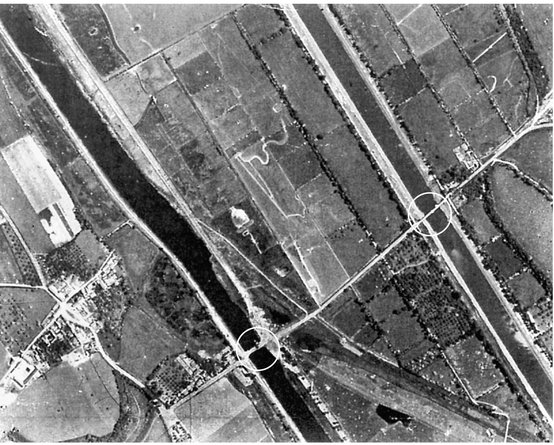
The destination – Bénouville (Pegasus) Bridge and le Port on the left. To the right, Ranville (Horsa) Bridge. Note the white dots in many of the fields. These are ‘Rommel’s Asparagus’, anti-glider poles. The 10ft-high timber poles were designed to rip apart any glider that tried to land in the area. They also provided an unwelcome hazard for descending paratroopers.

Cockpit of a Horsa glider during the fly-in
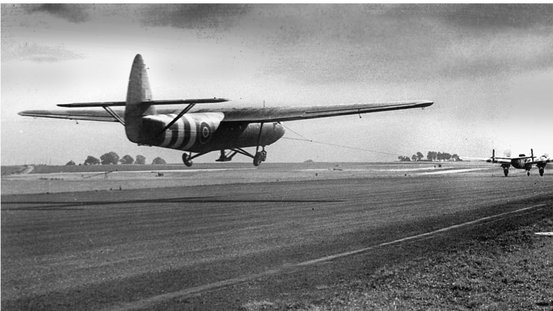
On their way – an Albemarle takes off with a Horsa in tow.
Superb flying skills put the gliders in exactly the right place.

Staff Sergeant Jimmy Wallwork.
Together with another five gliders, Major John Howard had a total of: thirty engineers, 132 assault troops, one HQ wireless operator, one officer and two NCOs from the RAMC, one officer from 7 Para and twelve glider pilots. These 180 men would form the first wave of Operation TONGA.
As a fine example of their extraordinary flying skills the men of the Glider Pilot Regiment put down their great wooden aircraft right on target at Bénouville Bridge. Later it was described by the Commander of the Allied Air Forces on D-Day, Air Vice-Marshal Leigh-Mallory, as one of the most outstanding flying achievements of the war. The sudden and violent impact rendered some of the men temporarily unconscious or disorientated, but the gliders had come to rest only 50 yards (47m) from their objective, now known as Pegasus Bridge.
Minutes later Brigadier Nigel Poett, CO of 5 Para Bde, came to ground on the east side of the River Orne near Ranville at DZ N (Map 1). After he had discarded his parachute harness he heard explosions and the distinctive crackle of Sten guns as Major Howard and his men stormed the bridge one mile (1.61km) or so east of his position. Brigadier Poett’s first task was to gather his men and make his way to the troops fighting for Bénouville (Pegasus) Bridge over the Caen Canal and, 575 yards (525m) before, Ranville (Horsa) Bridge over the River Orne. The battle for Normandy had begun.
Walk over to the eastern side of Pegasus Bridge and position yourself, facing, due west, towards the Café Gondrée, at Point A (Map 2) on the Esplanade Major John Howard by the 50mm (1.97in) KwK (Kampfwagenkanone) anti-tank gun which is mounted in its Tobruk pit.
The night of 5/6 June 1944, had been warm, in keeping with the time of year, but the night sky was still unsettled after the storms of the previous day. Night vision, despite the full moon, varied because of high clouds and strong winds. At ground level though, the night air remained relatively still. Schütze Helmut Romer, a sixteen year old Berliner, together with another sentry, paced up and down the length of the bridge, their paths crossing every few minutes at the centre as they dutifully carried out their duties.1
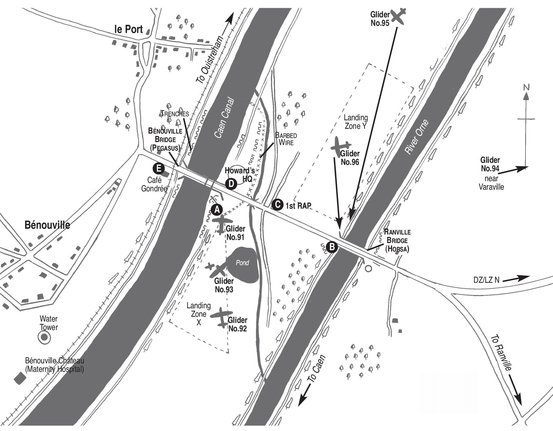
Map 2
Across the road, due north, to your right, on the now flat piece of land and canal bank beyond the bridge, there once stood a pillbox with a machine-gun muzzle poking through its narrow slit. Nearer, still on your right, next to the bridge, was another pillbox which also doubled as the garrison HQ. To the left of this, along where the canal bank is now, the Germans were standing in their slit trenches. Those men of the fifty-strong garrison who were off duty, were asleep in their billets or had retired, having just changed the guard on the bridge, to Bénouville to enjoy the rest of their evening at the local brothel.2

The new Pegasus Bridge today seen from Point A Map 2.
The sky above Caen, some 5 miles (8.05km) away along the canal to your left, and along the Channel coastline, 3.5 miles (5.63km) to your right along the canal, was alight with searchlight beams and ack-ack fire as the Allied bombing raids softened up the German defences ready for the invasion. By the end of the night the war diaries of Bomber Command listed two new records. One for bombing missions flown in one night, 1,211 sorties and another for the greatest tonnage of bombs dropped in a single night, over 5,000 tons (5,080 tonnes). Their casualties amounted to only eight aircraft lost.3
The anti-tank gun was left unmanned on the night of the 5/6 June as the commander of the garrison, Major Hans Schmidt, did not have his men on full alert that evening. Adding to the Allies good fortune he had also failed to put the demolition charges into their chambers on the bridges in case they were accidentally set off or sabotaged by members of the French Resistance. Despite knowing the strategic importance of the bridges he protected, he had concluded that the stormy weather of the past few days would rule out an imminent invasion. After finishing his duty for the day Major Schmidt spent the night with his girlfriend in Ranville.4
Just after midnight on the night of the 5/6 June 1944 three gliders descended into the area behind where you now stand. Unseen by the Germans and without making a sound, the pilots had swept the giant plywood birds through 180 degrees, reducing their airspeed from 160mph (257kmh) down to around 100mph (161kmh). They then deployed their arrester parachute brakes as they touched down on the small, 300 yard (274m) triangular LZ X, also known as EUSTON I, reducing their landing speed down to approximately 80mph (129kmh). The leading glider ploughed to a crashing halt at where now stands the first glider landing marker.
Just as ordered, the pilots had crushed the first defensive line of barbed wire around the bridge perimeter. Those guards who heard the crash dismissed the noise as the remnants of some striken Allied bomber falling to the ground. Had they been more alert, in the first half-minute or so while the crew and occupants of the glider were temporally dazed or even unconscious, the German machine-gunners could have slaughtered the British assault troop before they had even exited their aircraft.
The glider had lost its wheels on its first contact with the ground. The fuselage had bounced back into the air for a few seconds before landing again. The side door, which had already been opened during flight to help ensure a quick exit, gave the occupants a view of flashing sparks as the glider’s metal skids struck the barbed wire fencing and stones on the ground. Those who witnessed the scene thought that they were under fire, believing the sparks were tracer bullets. So when glider No. 91 finally came to a standstill the troops were surprised when the sound of screeching metal, tearing canvas and splintering wood gave way only to silence.5
The dazed silence did not seem to last long because we all came to our senses together on realising that there was no firing. There was no firing! It seemed quite unbelievable...
Everyone automatically released their safety belts and felt their limbs for breakages. I realized that everything around me had gone very dark and my head was aching. My God I can’t see! I clutched at my helmet and found that I must have hit the top of the glider during that last hell of a crash and all that had happened was that my battle bowler had come down over my eyes. What a relief! I quickly pushed it up and saw that the open door I was sitting in front of a few minutes earlier, because we had opened it in flight after we had cast off from the Halifax bombers, had completely disappeared. The door had collapsed because we had telescoped. The poor glider pilots were thrown right through the cockpit and over the wire. And we could hear them moaning, but we couldn’t do anything about it because the great thing then, knowing where I’d got, first there, was to capture that bridge intact.
MAJOR JOHN HOWARD, COMPANY
COMMANDER, 2 OXF BUCKS

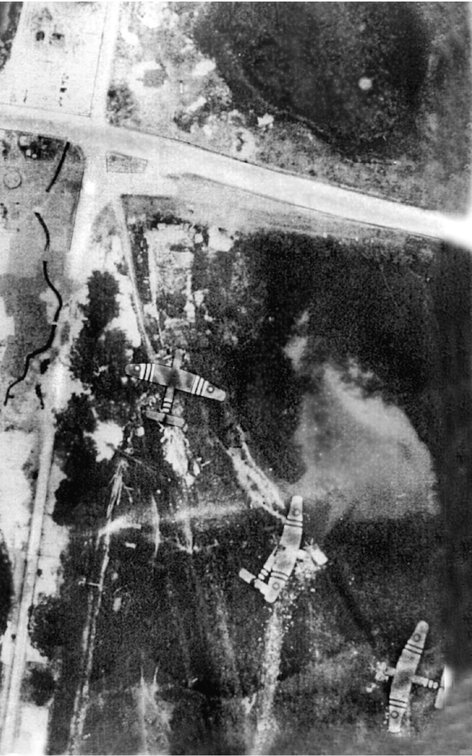
An RAF reconnaissance photograph taken on D-Day clearly shows how close the three gliders were to the bridge

Major John Howard
After the men had recovered from the initial shock of the landing and scrambled out from the wrecked hull of the glider, they instinctively carried out their assignments just as they had practised, time and time again, back in England on a swing bridge over the Exeter Canal. As No. 25 Platoon D Coy went into action Lieutenant Brotheridge sent Private Jack ‘Bill’ Bailey and two of his comrades to take out the pillbox containing the machine-gun. Within a minute of landing Major Howard saw his men storm the bridge just as the second glider, chalk marked No. 92 and piloted by Staff Sergeants Oliver Boland and Phillip Hobbs, crashed and came to a sudden stop before the pond.
The men of No. 24 Platoon D Coy, commanded by Lieutenant David Wood, quickly exited the glider and made their way to join the developing battle.
By this time Lieutenant Brotheridge had gathered his platoon and charged up the embankment on to the roadway over the bridge shouting their platoon call sign Able, Able! as they advanced; one of the bridge sentries, Schütze Romer, had just passed his opposite number and was heading for the east side when he was horrified to see the group of screaming, camouflaged, black-faced troops dashing towards him. The German soldier, with just a Mauser rifle for protection, took only seconds to assess the situation. He turned and fled, yelling, Fallschirmjaeger! (paratroopers) and dived into the nearest trench. The other sentry, an NCO, pulled out his flare pistol in order to raise the alarm.6

Nearest two Horsa gliders with the Café Gondrée across the canal. The bridge structure can just be seen through the trees.
My job, as the bren gunner, was to rush the right-hand side of the bridge. Den Brotheridge got up and said, ‘Come on, lads’. He ran. I followed him and as we made our approach to it I saw a German sentry with what looked like a Very light pistol in his hand. I fired and he went down, but at the same time he pulled the trigger of the Very pistol and the bright light went up. Still firing we went across.
PRIVATE BILL GRAY, 2 OXF BUCKS
The raiding party continued to execute their tasks. The Germans in their slit trenches and at their machine-gun posts, though stunned and shocked by the swift attack, soon became fully alert. Their own instincts for survival took over, causing the action to heat up.
I stopped and looked across the bridge just for a brief second. Looked at the Very light being shot up. Then I turned and one of the dugout doors half-opened and closed again. I shot across [the roadway]. By this time I had a No. 36 grenade, the pin out. Into the dugout, opened and shut the door. The explosion went off. [Private] Charlie Gardner came in. I opened the door again and he just machine-gunned inside. Onto the second dugout and the same; in with the grenade, bang the door shut, explosion, smash it wide open again and Charlie finished them off. As we came back past the first dugout suddenly there was a moan or something from inside and I pulled out a 77 phosphorous. Took the cap off, gave it a twirl, undone the tape and jumped in and that went off.
CORPORAL ‘WALLY’ PARR, 2 OXF BUCKS

Lieutenant Richard Smith.
Staff Sergeants Geoff Barkway and Peter Boyle had now landed the third glider, chalk marked No. 93, right on target, but perilously close to the pond. Again the glider passengers paid the price for the abrupt standstill of the glider.
I went shooting straight past those two pilots, through the whole bloody lot, shot out like a bullet and landed in front of the glider... I was covered in mud, I had lost my Sten gun and I didn’t really know what I was bloody doing. Corporal Madge, one of my section commanders, brought me to my senses. He said, ‘Well, what are you waiting for sir?’
LIEUTENANT RICHARD ‘SANDY’ SMITH,
2 OXF BUCKS
Lieutenant Smith pulled himself up out of the mud, picked up his Sten gun and made his way to the bridge. With him were other men from No. 14 Platoon B Coy who had been able to free themselves from the wreckage. On the ground, next to where Lieutenant Smith had been thrown, lay Captain John Vaughan, their medical officer. Having also been thrown out of the glider he was not so lucky and was left unconscious, face down, in the marshy ground. Half a dozen of the men had also been trapped in the wreckage and one of them, Bren gunner Lance Corporal Fred Greenhalgh, drowned in the pond. The time was 0018hrs. The first known British soldier had lost his life in Normandy on D-Day.

Major John Howard’s glider, Pegasus Bridge is obscured by the trees
Taken from the same position today this photograph allows the new larger Pegasus Bridge to be seen more clearly

Sappers from No. 2 Platoon 249 Fd Coy RE had by this time scrambled across the superstructure of the bridge and begun looking for the explosives with the intention of hastily disconnecting and ripping out any fuse and detonation wires. As Brotheridge approached the eastern side he lobbed a grenade into the machine-gun nest on his right. Return fire, from the MG 34 or from a guard’s Schmeisser, caught Brotheridge in the neck. He was thrown back by the force and lay sprawled in the middle of the road. Mortally wounded, he became the first acknowledged fatal casualty from enemy fire on D-Day (see Ch. 6, B8 & Ch. 7, B4). Private Bill Gray and the rest of the section proceeded with their tasks of systematically destroying the remaining machine-gun posts.
Feldwebel Heinz Hickman of the Fallschirmjäger-Regiment 6, accompanied by four men, had at this time just driven through le Port. He was about to make a left turn at the T junction at Bénouville in order to cross the bridge and continue his journey on to his HQ near Bréville, when he heard the distinctive rattle of the assault troops’ Bren and Sten guns. He stopped the car, dismounted and split up his men into two patrols. They then continued cautiously to approach the bridge by edging down either side of the road as quickly as possible.
Then [we saw them] moving across the bridge. It was a full moon, very few clouds about. I recognised they were British soldiers. They can’t be land forces so they must have come out of the air, either parachute or glider-borne troops. So [we moved apart] crept slowly forwards, I watched my blokes, said ‘Come on, come on,’ gave the order, ‘don’t start firing before I fire, wait for me.’ I think we made more noise than we did hitting anybody so in the end we stayed there near the bridge, roughly about a hundred yards[away] firing, and I more or less ran out of ammunition .... I’m not a coward but at that moment I got frightened. If you see a para platoon in full cry, they frighten the daylights out of you...the way they charge, the way they fire, the way they ran across the bridge....Then I gave the order to go back. What can I do with four men who had never been in action?
FELDWEBEL HEINZ HICKMAN, FALLSCHIRMJÄGER-REGIMENT 6
Lieutenant Smith was in the meantime hobbling across the catwalk – he had wrenched his knee in the landing – having received orders to take and secure the far side of the bridge. As he reached the end he gave a burst of fire from his Sten gun at a German about to throw a stick grenade. He was too late. The grenade had already been primed and exploded as the bullet-ridden German fell dead on to the low wall in front of the cafe. The blast tore Smith’s battle smock and trousers. Despite a deep laceration to the wrist on his trigger hand, he was still able to pull the trigger of his Sten and make his way forward towards the café. Leading his platoon they finished off the remaining resistance from the machine-gun pits and trenches. Later he was awarded the Military Cross for his bravery.
The east side of the bridge was thought to have been secured by No. 24 Platoon D Coy, and their commander, Lieutenant David Wood, decided to report the completion of his tasks to Major Howard. However, a German they had missed opened up with his Schmeisser and Wood took three bullets in his leg and fell to the ground in agony.
I was hit in the leg by a burst of fire, which also caught my platoon sergeant and my runner. I regret to say there were no heroics, although I had heard about folk who can run around on only one leg. I found I simply fell down and couldn’t get up. My platoon medical orderly gave me a shot of morphia, applied a rifle splint and found my flask in my hip pocket.
LIEUTENANT DAVID WOOD, 2 OXF BUCKS
Corporal Claude Godbold temporarily took over command of No. 24 Platoon D Coy from Lieutenant Wood. By 0022hrs Major Howard had set up his command post in a trench at the pillbox on the north-east side of the bridge. As situation reports came in from his runners the results and cost of their assault became clearer. Captain Henry R.K. ‘Jock’ Neilson, commander of the sappers, was first to report to Major Howard with news that the bridge was clear of explosives. Then the bad news came. Three of his platoon commanders including his best friend, Den Brotheridge, had all been wounded. Corporal Wally Parr found Lieutenant Brotheridge’s body.
He was laying about 20 yards [18m] from the café in the middle of the road. I thought he was a German at first and then I stopped and realized, came back.... I put my hand under his head to lift him up. He just looked. His eyes sort of rolled back. He just choked and lay back. My hand was covered in blood... a terrible waste. The first thing that went through my mind. What a terrible waste.
CORPORAL WALLY PARR,
2 OXF BUCKS

Corporal ‘Wally’ Parr.

Lieutenant Den Brotheridge, the first British soldier to be fatally wounded by enemy fire on D-Day.
As the firing dissipated Howard realized that his first objective, codename HAM, had been accomplished. The bridge over the canal was under their control. He then waited anxiously for news, via his radio operator Corporal Ted Tappenden, of the fate of No. 22 and No. 23 Platoons from D Coy, and No. 17 Platoon from B Coy. On board gliders chalk marked Nos. 94, 95 and 96, their objective was the bridge over the River Orne.
Pre-war photograph of the River Orne Bridge, looking east.
