
CHAPTER EIGHT
YAMASHITA in the Philippines recognised that his struggle against MacArthur’s armies could have only one outcome. If the Americans found the campaign tough, they were always advancing. Even during this last phase of the Second World War, however, in one theatre Japan’s armies continued to gain ground, and to win victories. In China, a million Japanese soldiers sustained and even enlarged their huge, futile empire. Neither Mao Zedong’s Communists in the north nor Chiang Kai-shek’s Nationalists in the west and south proved able to frustrate Japanese advances. The killing and dying, the rape and destruction which Hirohito’s armies had unleashed in Manchuria in 1931, persisted and even intensified on the Asian mainland in the last months of the war.
Thirty-six-year-old John Paton Davies, a U.S. Foreign Service officer born in China, the son of missionaries, knew that country’s vastnesses as intimately as any man. He witnessed the Japanese seizure of Manchuria. For much of the war he served as political adviser to Lt.-Gen. Joseph Stilwell, until October 1944 Allied chief of staff to Chiang Kai-shek. Afterwards, with the bitterness of a man whose diplomatic career was destroyed by Senator Joseph McCarthy for his alleged role in the American “loss” of China, Davies described the country as “a huge and seductive376 practical joke, which defeated the Westerners who tried to modernise it, the Japanese who tried to conquer it, the Americans who tried to democratise and unify it—and Chiang and Mao.” He likened China’s condition in the 1940s to that of fourteenth-century Europe. He was an intimate observer of twentieth-century America’s titanic and wholly unsuccessful attempt to impose its will upon a society impossibly remote in circumstances as well as geography.
China’s wartime sufferings, which remain unknown to most Westerners, were second in scale only to those of the Soviet Union. It is uncertain how many Chinese died in the years of conflict with Japan. Traditionally, a figure of fifteen million has been accepted, one-third of these being soldiers. Modern Chinese historians variously assert twenty-five, even fifty million. Ninety-five million people became homeless refugees. Such estimates are neither provable nor disprovable. Rather than being founded upon convincing statistical analysis, they reflect the intensity of Chinese emotions about what the Japanese did to their country. What is indisputable is that a host of people perished. Survivors suffered horrors almost beyond our imaginings. Massacre, destruction, rape and starvation were the common diet of the Chinese people through each year of Japan’s violent engagement in their country.
Historians of Asia assert that the Second World War properly began in China, rather than Poland. In 1931 Japan almost bloodlessly seized Manchuria—the north-eastern Chinese provinces, an area twice the size of Britain, with a population of thirty-five million people, ruled by an old warlord—to secure its coal, raw materials, industries and strategic rail links. The Nationalist government based in Nanjing was too weak to offer resistance. The following year, Tokyo announced Manchuria’s transformation into the puppet state of Manchukuo, nominally ruled by the Manchu Emperor Pu Yi, in practice by a Japanese-controlled prime minister, and garrisoned by Japan’s so-called Guandong Army. The Japanese perceived themselves as merely continuing a tradition established over centuries by Western powers in Asia—that of exploiting superior might to extend their home industrial and trading bases.
As a sixteen-year-old in 1941, Souhei Nakamura was dispatched by his family from Japan to work for an uncle’s motorcycle-repair business in Manchuria, where he was introduced to the delights of colonial mastery. “It was wonderful there—an easy life with lots of good food, much better than being at school. All I had to do was keep an eye on the Chinese doing the real work.” He had money in his pocket, and used it to pleasant purpose. After being sent packing by the first local brothel he visited—“You’re much too young”—he was introduced to a twenty-four-year-old geisha, who solaced the teenager’s life for the next four years. “In Manchuria in those days377, every Japanese was a privileged person. I will tell you just how privileged. One day in town, I watched a Chinese policeman book a Japanese woman for crossing a road against a red light. A Japanese soldier who saw them told the Chinese to release the woman and apologise. When the policeman refused, the soldier shot him dead.” There was a frontier atmosphere about Manchuria, soon overflowing with Japanese peasant immigrants who were supposedly obliged to buy land from local Chinese, but who in reality sequestered what they wanted without payment.
The Japanese annexation of Manchuria, and their progressive advance into China thereafter, involved rapacity and brutality on a scale which shocked the world, and inflicted untold misery on those in their path. “For me, the war started on 18 September 1931, when the Japanese seized my home town,” said Wen Shan, a Manchurian lawyer’s son who fled south to Yunnan to escape the occupation. “We were victims of those gangsters378 for the next fourteen years.” He was reared on Nationalist propaganda about Japanese barbarities, much of it true. In 1937 Japan extended its mainland empire, occupying most of the Chinese coastline with its ports and industrial cities, chief sources of wealth in a chronically starving land. “The Japanese forced my father379 to become a traitor, by joining one of their business syndicates and working for them,” said Jiang Zhen, a landlord’s son from Shanghai. “When he would no longer do so, they made him a slave labourer, and when he became too sick to work, they sent him home to die.”
As the Japanese armies moved inland, millions of Chinese fugitives fled west, including the Nationalist government of Chiang Kai-shek. He abandoned his capital, Nanjing, in favour of Chongqing. The Nationalist army’s resistance to the invaders cost much blood and achieved little success. Xu Yongqiang, an engineer’s son who lived in the British concession at Tianjin, south-east of Beijing, a precarious island of safety amid the rising Japanese tide, said: “Every morning we watched corpses380 drifting downriver to the sea. Out in the countryside, the Japanese were using peasants to build pillboxes for their positions. When the pillboxes were completed, they shot the peasants.”
China is larger than the United States, and characterised by extreme variations of climate and topography. In 1944 only around 12 percent of its surface was cultivated, because the remainder was too high, dry or steep—around half the country lies more than a mile above sea level. Hundreds of millions of Chinese eked out primitive lives in conditions of chronic misery. Zhu De, for instance, commander of Mao Zedong’s Communist armies, was born fourth among thirteen children of his parents. He was the last one to survive, for his younger siblings were drowned at birth in the absence of means to feed them. Although there were frequent outbreaks of plague—some deliberately propagated by the Japanese through their biological warfare Unit 731—there were no medicines. It became a commonplace prophylactic against infection to tie a live cockerel to the chest of a convenient corpse, to ward off spirits. Most of the population lived in huts built of mud and rubble. The average farm was less than four acres. Foreigners who visited China were enchanted by places of extraordinary beauty, “of lacquerware and porcelain381, embroidered silk and bridges over still pools, courtyards pierced by moon gates.” The dominant images, however, were of tragedy and destitution.
Photo Insert One
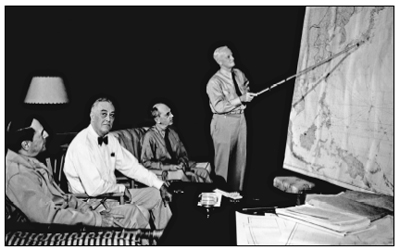
The president as U.S. commander-in-chief: in July 1944, in the midst of his re-election campaign, Roosevelt summoned MacArthur and Nimitz to meet him on Hawaii, allegedly to expound their plans for victory over Japan.
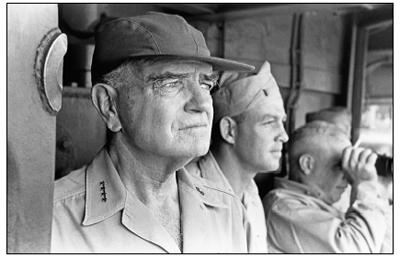
Admiral William “Bull” Halsey on the flag bridge of the battleship New Jersey as he led his Third Fleet towards the Philippines in September 1944.
THE BRITISH EMPIRE IN BURMA
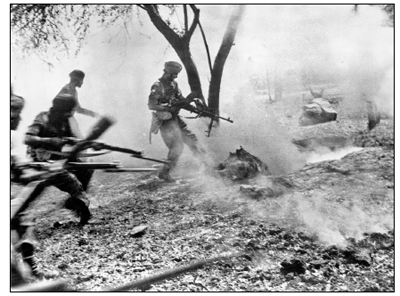
Sikhs charge a foxhole.
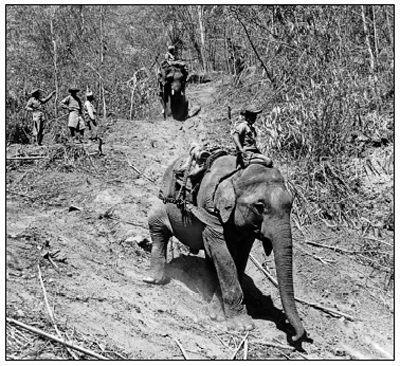
Elephant transport played a significant role in enabling the Fourteenth Army to build bridges and move supplies amid some of the most intractable terrain on earth.
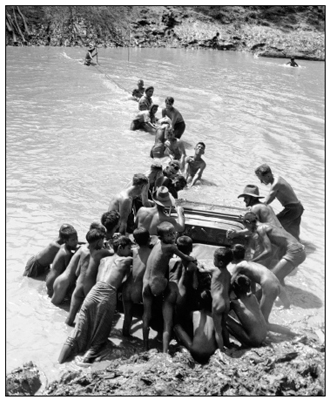
One of thousands of river crossings during the 1944–45 campaign.
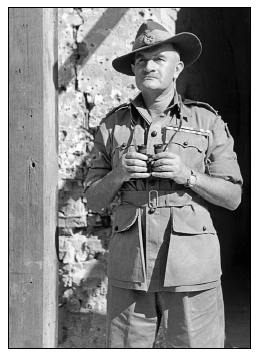
The indomitable Bill Slim, probably the ablest and certainly the most sympathetic British field commander of the Second World War.
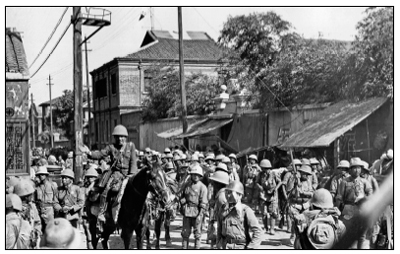
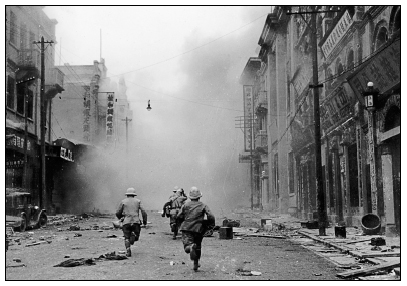
War in China, where at least fifteen million died. Scenes during the Japanese invasion, which inflicted untold suffering and destruction without giving Tokyo a decisive victory.
CHINESE LEADERS
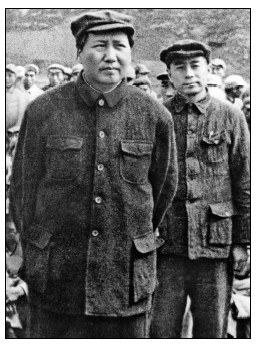
Mao Zedong and Zhou Enlai.
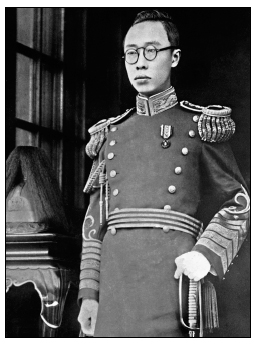
The puppet emperor Pu-Yi.
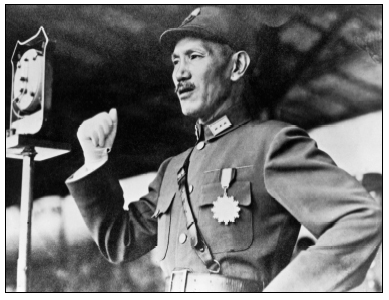
Chiang Kai-shek.
AT SEA
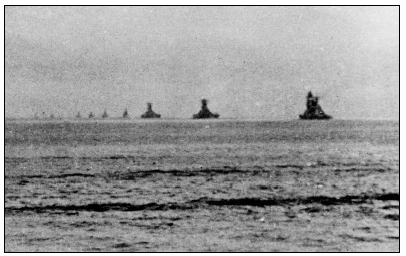
A snatched glimpse of the Japanese Combined Fleet on its passage towards destruction in September 1944.
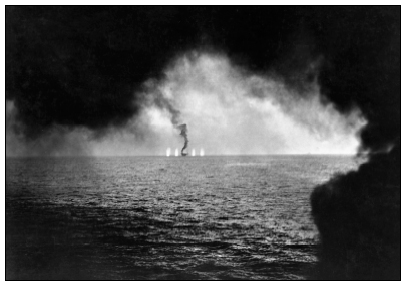
USS Gambier Bay bracketed by Japanese fire during the Battle of Leyte Gulf.
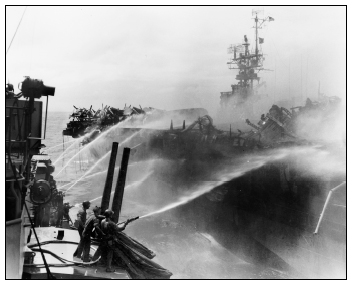
The cruiser Birmingham aids the stricken Princeton after a crippling air attack.
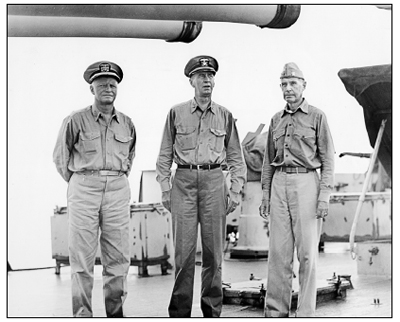
Commanders Nimitz, King and Spruance photographed aboard the cruiser Indianapolis.
COMMANDERS
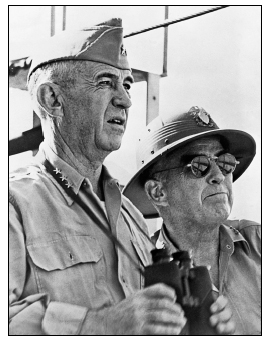
Krueger and Kinkaid.
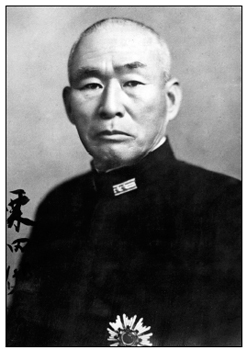
Kurita.
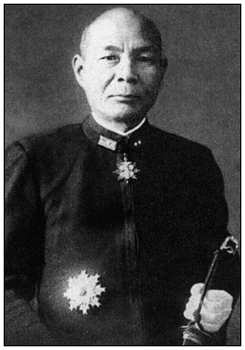
Ugaki.
ISLAND ASSAULTS
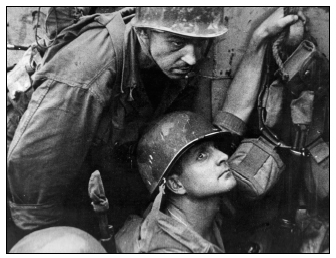
Men crouch, tensed aboard a landing craft.
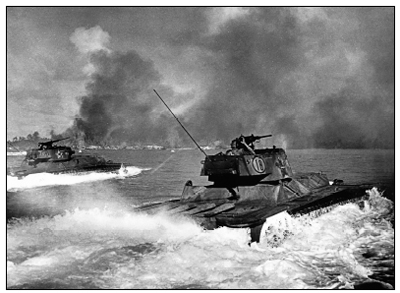
Marine amphibious vehicles approach Peleliu.
“FLYBOYS”
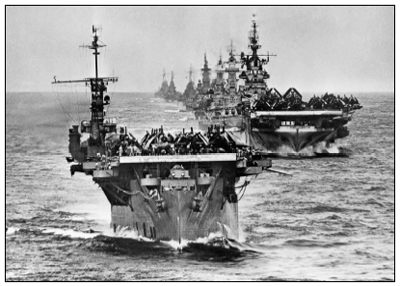
A task group led by some of almost one hundred U.S. carriers at sea in late 1944.
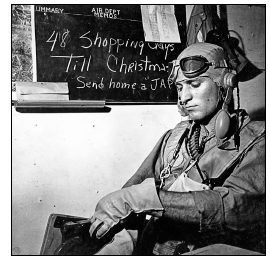
A pilot in the “ready room.”
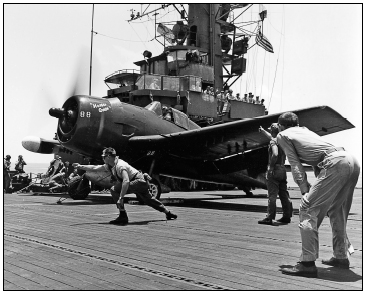
Launching a Hellcat.
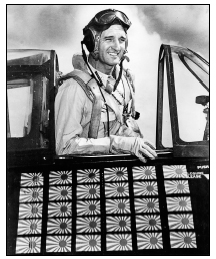
One of the U.S. Navy’s foremost Pacific aces, Commander David McCampbell.
ASHORE IN THE PHILIPPINES
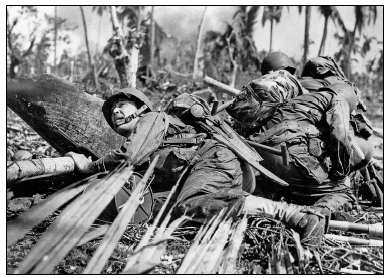
U.S. soldiers taking cover on Leyte in November 1944.
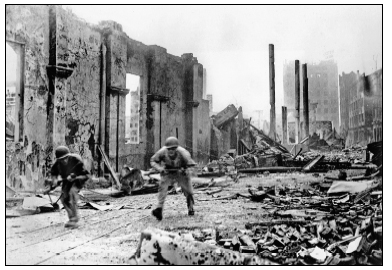
U.S. soldiers fighting through the wreckage of Manila in February 1945.
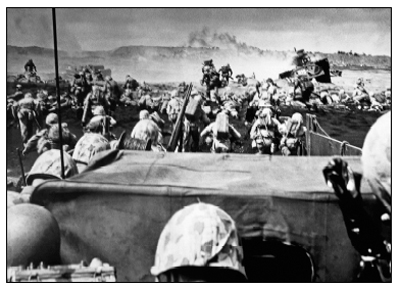
The Marines land on Iwo Jima.
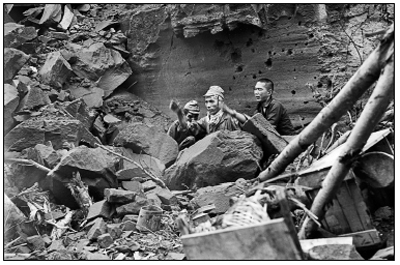
Only a handful of Japanese, such as these men, chose surrender rather than death in the last stages of the bloody struggle for the island.
SOME AMERICANS IN THE PACIFIC
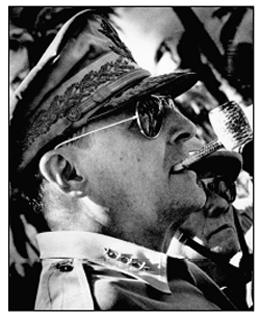
MacArthur.
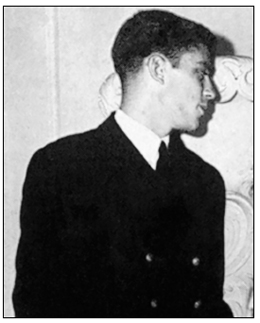
Bill Bradlee.
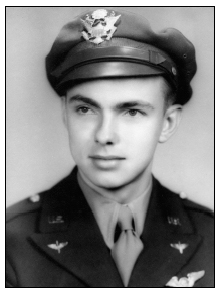
Lieutenant Philip True.
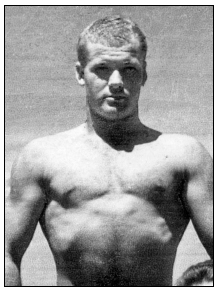
Emory Jernigan.
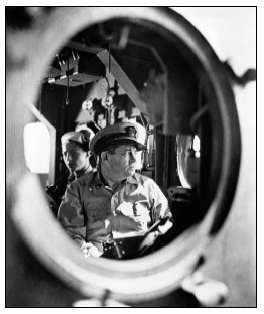
Rear-Admiral Clifton Sprague.
THE PLIGHT OF NIPPON’S PRISONERS
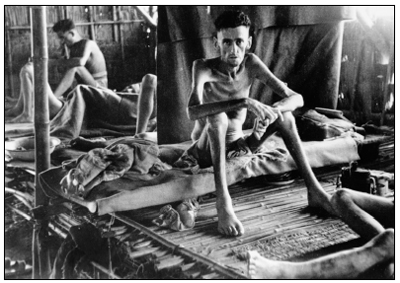
A British survivor at Nakhon Pathom, Siam, in 1945.
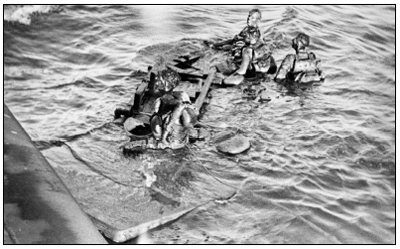
Four Australians drag themselves to the U.S. submarine Pampanito, which had sunk the transport taking them to Japan. Most of their companions perished.
Japanese policy in China was determined overwhelmingly by the army, often against the strong wishes of Tokyo’s civilian politicians. By 1941, at a cost equivalent to 40 percent of Japan’s annual national budget, the invaders had gained most of the territory they wanted. For the Chinese people, the miseries of a brutal occupation were overlaid on the floods, famines, plagues of locusts and other natural disasters which rendered their ordinary lives wretched enough. “If the city gate catches fire,” warns a Chinese proverb, “the fish in the ponds below will be scorched.” Yang Jinghua, a modern Chinese historian born in Manchuria during the war, was brought up by his father to cherish the memory of nine close family members—two sisters, two aunts, three uncles, two cousins—killed during a Japanese visit to their village near the Korean border in 1944.
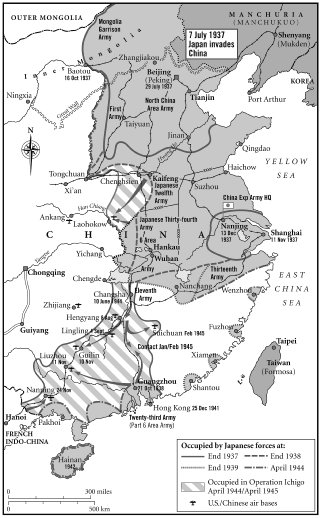
The Japanese occupation of China, 1937–45
Wu Yinyan, twenty-year-old daughter of an official in a village near Tianjin, was fortunate. Her family—parents, grandmother, uncle, two brothers and three sisters—had enough money to flee as the Japanese approached. Sometimes they walked, sometimes they bought rides in carts. The neighbours left behind suffered the usual fate of their kind: “Women were raped, houses were burned,” said Wu laconically. The family went to stay with an aunt in Beijing, where Wu was able to attend school and later university. Yet when the Japanese occupied the city, a curtain of fear descended. “I never went out alone, without friends, because a Japanese could do what he wanted to anyone. I was always afraid.” Every Chinese was obliged to bow to every Japanese, a source of bitter resentment. Wu’s family survived mainly on maize, for there was no meat and few vegetables. Like almost all Chinese women, she lived in conditions of strict sexual segregation. Only in Communist areas did war bring to China some of the new freedoms and opportunities which it conferred upon women elsewhere. The family had no radio, and until August 1945 they knew almost nothing of what was happening in the outside world. Like most Chinese, they focused upon survival from one day to the next, nursing a dull hatred of their occupiers.
Whatever the Japanese wanted, they took. Lin Yajin was nineteen, gathering rice in the fields near her village in Hainan with three other girls one day in October 1943 when they were all seized by Japanese troops. At first they were merely questioned about local guerrilla activity, then held overnight in a hut. Next evening, in separate buildings the screaming girls were raped by a succession of Japanese soldiers. Thereafter, this became a nightly routine. Often, one soldier watched while another addressed a girl. When the unit moved to another village, the women were herded behind. By the summer of 1944, Lin had become seriously ill, and therefore of less interest to the soldiers. She was allowed to go home. She had contracted venereal disease, but there were no medicines to treat her condition. Both she and a sister who suffered the same fate were mocked by their neighbours, and indeed became near outcasts in the years that followed. She never married or had children. In 1946 she learned that the other three girls seized with her three years earlier had died of disease in Japanese hands.
Chen Jinyu was only sixteen when the Japanese army took her to become a “comfort woman,” together with every other available girl in her village in Baoting district. “Because I was pretty they used me more often than the rest. After a month I couldn’t bear it any more. One day I and some other girls were bathing in the river. I slipped over to the far bank and had started running when a Japanese guard saw me. He blew his whistle. Soldiers caught me, beat me pretty badly, then locked me up. Next morning, in heavy rain, I was forced to crawl across the ground in front of everyone, then beaten till I was a mass of cuts and bruises. In the end I couldn’t move any more, and just lay there in the mud and the water. The other girls begged the Japanese officers to spare me. If they hadn’t intervened, I doubt that I would have survived.” She remained a comfort woman until June 1945, when in desperation she escaped to the mountains, where she scavenged until the war ended.
Jiang Fushun, a boy of thirteen in 1944, was one of eight children of a peasant who worked as a water carrier for the Japanese at Hutou in Manchuria. They knew nothing of the outside world: “We were conscious there was a war—that was all. We knew the Japanese expected to fight, because they were building all these fortresses.” They never saw the hapless slave labourers who toiled underground for months behind the Japanese perimeter wire, then were killed in their thousands to ensure that the secrets of Hutou’s defences were kept. Fields behind the town became the property of some of Manchuria’s 300,000 Japanese immigrants. The new landowners’ ventures into agriculture met with little success, however. To crop rice, many were obliged to enlist the labour of dispossessed locals. There was no social contact between occupiers and occupied.
One day the Japanese announced that the garrison was holding an exercise. All Chinese must remain indoors with their windows closed. It was a hot afternoon. The uncle of Zhou Baozhu opened his window. He was beaten half to death by Japanese police. Other offenders were thrashed with iron bars or thrown into boiling water. For local children, there were no games, no play with friends, no schooling, for all association was forbidden. In return for labouring all day beside his father, carrying water on their shoulders from the river to the garrison huts, Jiang’s family received a monthly ration of cooking oil and twenty-four pounds of corn, which somehow kept them alive, supplemented by wild vegetables from the nearby forest.
Liu Yunxiu, twenty-year-old daughter of teachers in Changchun, Manchuria, found herself obliged to learn Japanese in school, and to attend Japanese-sponsored classes in the arts of housewifery—cleaning, cooking, sewing: “This sort of thing was not at all the Chinese style.” Liu would have liked to train as a doctor, but such options were closed to a woman. Like Wu Yinyan, she knew nothing of the war, save as “noises off.” For instance, a friend’s brother ran away to join Communist guerrillas. His family heard long afterwards that he had been killed. Another classmate left the school to make an arranged marriage to the puppet emperor Pu Yi. Liu remembered the girl’s parents sobbing at her departure, because thereafter they were forbidden to see her.
Liu’s chief awareness of the war derived from chronic shortages, especially of food. She and her family were sometimes reduced to eating the bitter greenstuff xiang shan. One morning, her grandmother opened the door of their house to see corpses lying in the street. A typhus outbreak had struck the city, and her sister-in-law contracted the disease. In the absence of medicines, folk remedies revived. They bathed the girl’s body in a mix of egg white and rice wine. She lived. Liu’s parents, like Wu Yinyan’s, were intensely strict, “indeed, feudal.” She was forbidden to leave the house alone, or to have any contact with boys. As for the Japanese, “My parents felt382 that the only choice was to obey. They told me not to join or take part in anything. There was never any talk of politics in our house. That is how things were.”
In such a way did many Chinese survive the Japanese occupation—and the twentieth century. Collaboration with the Tokyo-imposed puppet government in Nanjing was widespread. “The Japanese made everyone spy on each other,” says historian Yang Jinghua. “If one family offended against the regime, ten were punished.” Many stories of resistance to the Japanese lacked heroic endings. Xu Guiming was born into a peasant family in Ji Lin Province, Manchuria, in 1918. In his early childhood there was some money, and he attended a Confucian school. But the family’s fortunes declined into abject poverty. At the age of thirteen he joined a local guerrilla group named the Red Guard Union, 5,000 strong, operating around the Songhua River. He shared their battles through two years that followed, until he was wounded by a bullet in the stomach in a clash with a Japanese-sponsored Manchukuan unit. For three months his father tended him in the guerrilla camp, then transferred him to the care of local Buddhist nuns. Soon after he recovered, the guerrillas became locked in a series of battles with local collaborators and supporting troops, determined to secure the area for planting opium. After weeks of skirmishes and hasty retreats, only two hundred guerrillas remained, encircled by Manchukuan troops and police posts. One night when they were sleeping in a local temple, Xu was taken aside by the chief monk. “You are much too young to be involved in this bloody business,” he said. “Go home.”
Back in his own village, however, Xu found no sanctuary. Local collaborators called. They told his family there was a choice. Everyone knew that their son had been a guerrilla. They must pay “squeeze,” or the Japanese would reward informers handsomely. The only member of the family who had money was Xu’s brother-in-law. He raised 120 silver yuan to pay off the blackmailers, but they knew this would not be the end of the matter. Xu needed to disappear. He made his way to the city of Jilin. There, through the next few years of occupation and unyielding hardship, he strove to acquire a training, or at least some education. He was apprenticed for a time to a sock maker, then to a bicycle repairer. He spent six years working in a rice factory, then became manager of a Korean-owned grocery store. At twenty-one he acquired an unsatisfactory wife with an expensive taste for mahjong and an irritating one for gossip.
Yet, as Xu observed wryly, he achieved a sort of success. He became a bourgeois who could write, count and speak some Japanese. Much as he hated the occupiers, they represented the best, if not only, source of employment. In 1944 he obtained work as a clerk in the Japanese propaganda bureau at Aihni, beside the Russian border on the Amur River. He worked there until August 1945. By definition, he became a collaborator. Yet how else were a host of Chinese to sustain existence? “Even when the Japanese383 were obviously losing, they behaved as arrogantly as ever,” said Xu. “In such a job, at least I was safe from the army and police. We were in the business of survival. I needed the money.”
Li Fenggui, born in the countryside near Shanghai in 1921, grew up in abject peasant poverty, his childhood landmarked by natural disasters, even before the Japanese entered the stage. There were two years of Yangtse floods, when everything which his family grew was submerged and ruined. In one year their landlord, “a very cruel man,” permitted them to keep only 160 pounds of corn from the harvest, to feed a family of fourteen. Once Li remembered the whole family being taken by their father to a nearby town to beg in the streets. In March 1940, the Japanese descended. Some 140 people were herded away from his hamlet and its neighbours to become slave labourers. In the next village to their own, just two miles away, twenty-four houses were burned, three people were killed, seven women raped, all the rice and grain taken. One of those killed was a fifty-eight-year-old woman who was bayoneted after being raped. Such experiences, multiplied a millionfold, explain the passion of the Chinese people towards the Japanese invaders. “In 1942,” said Li, by then a Communist guerrilla, “when the Americans had entered the war, we were so happy to have allies! We felt a surge of hope that Japan would be defeated very quickly. That soon died, and we grew more realistic. We knew that we must win sometime. But we had no idea when.”
CHINA’S PRINCIPAL RULER, Generalissimo Chiang Kai-shek, was born in 1887, son of a modestly successful trader near Ningbo in eastern China. He received much of his military education in Japan, and rose to prominence as a protégé of Dr. Sun Yatsen, who led the 1911 revolution which overthrew imperial rule. By the time Sun died in 1925, Chiang was his chief of staff, enjoying the support of some of the most powerful secret societies in China, of much of the army, and—more surprisingly—of the Soviets, who identified him as a coming man. Chiang shared with Mao Zedong an absolute ruthlessness, vividly exemplified by his destruction of the Yellow River dikes in the path of a Japanese advance, exposing six million people to flooding and starvation. He was indifferent to his own armies’ casualties, save where these threatened his power base. He gained control of China for his Kuomintang movement—abbreviated as the KMT—through a progressive series of advances north from Canton between 1925 and 1931, sweeping aside such lesser aspirants as Zhang Zongchang, the “dogmeat general” of Shandong, who was said to have “the physique of an elephant, the brain of a pig and the temperament of a tiger.”
Political power in China was attainable only with the support of bayonets. Chiang exploited his skills as a military organiser to become the most powerful of all warlords, also having pretensions to a revolutionary ideology. “Fascism is a stimulant for a declining society,” he declared in an address to his “Blue Shirt” followers in 1935. “Can fascism save China? We answer: ‘Yes.’” He described liberal democracy as “a poison to be expelled from the country’s body politic.” Yet his professed Christianity and enthusiasm for the West caused many Americans to overlook the absolutism, brutality and corruption of his regime. Thus, for instance, former China medical missionary Congressman Walter Judd in 1944, comparing Americans and Chinese: “The two peoples are nearer385 alike, we are nearer to the Chinese in our basic beliefs, our basic emphasis on the rights of the individual, and in our basic personal habits of democracy, than we are to most of the countries of Europe.”
Indian political leaders admired Chiang as a nationalist, and applauded his outspoken opposition to colonialism. Nehru and the Congress Party described him as “the great leader.” Many modern Chinese scholars are far less dismissive of Chiang than might be expected. Yang Jinghua, a historian of Manchuria who has been a Communist Party member for more than thirty years, today regards the generalissimo as a great man: “We say about Mao that he was 30 percent wrong, 70 percent right. Despite the fact that Chiang was a profoundly corrupt dictator, I would say the same about him.” Such assertions do not signify that Chiang Kai-shek was a successful or admirable ruler; merely that some of his own people retain respect towards his aspirations for a modern, unified China.
Many Japanese politicians and soldiers learned to regret their entanglement in China as they struggled to stem the American tide in the Pacific. Occupation delivered nothing like the economic benefits which the invaders had expected. Had the huge Japanese forces committed in China—amounting to 45 percent of the army even in 1945—been available for service elsewhere, they might have made an important contribution. That year, Hirohito and army chief of staff Field Marshal Hajime Sugiyama held a conversation which became legendary. The emperor enquired why the China war was taking so long to finish. “China is bigger than we thought,” said Sugiyama. Hirohito observed: “The Pacific is also big.” In 1943 or 1944, Tokyo would have been happy to withdraw from most of China if the Nationalists had been willing to abandon hostilities and concede Japanese hegemony in Manchuria. This, however, Chiang would never do. And as America’s commitment in China grew, the Japanese could not permit U.S. forces or their Nationalist clients to gain control of the coastline. They perceived no choice save to use a million soldiers to hold their ground.
The occupation of Manchuria and eastern China was mercilessly conducted. Unit 731, the biological warfare386 cell based near Harbin, was its most extreme manifestation. Beyond hundreds of Chinese prisoners subjected to experiments which invariably resulted in their deaths, often by vivisection, the unit sought to spread typhus, anthrax and other plagues indiscriminately among the Chinese population, sometimes by air-dropping of germ cultures. Post-war Japanese claims that reports of atrocities were exaggerated, and that soldiers’ misdeeds were unauthorised, are set at naught by the very existence of Unit 731. Its activities matched the horrors of some Nazi concentration camps. The surgical evisceration of hundreds of living and unanaesthetised Chinese, under the official auspices of the Japanese army, represented the nadir of its wartime conduct.
For an ordinary Japanese soldier, China was a miserably uncomfortable, as well as perilous, posting. “Your parents have got four other sons, so they shouldn’t miss you too much,” an NCO declared callously as he detailed Private Iwao Ajiro for service on an airfield an hour from Beijing. Ajiro hated everything about China, and that airfield. There were no facilities except a brothel staffed by Chinese and Korean comfort women, whom no one much cared for. Their Japanese counterparts were described euphemistically as “nurses,” or, in modern parlance, “paramedics.” “A man’s pay was only seven yen a month,” Ajiro complained, “and one of those women cost a yen.” The hoary old soldier said in 2005:
Nowadays the media387 go on and on about what terrible things Japan is supposed to have done in China. It’s a joke. They only tell one side of the story. What about all the Japanese who got killed out there? What do you think it was like for us in a signals section, who had to go out on patrols in parties of four or five, looking for line breaks? If you found a lot of cable missing and went to look for it in the nearby village, there’d be a hundred people there who could kill you—and sometimes did—if you pushed them too hard. They’d steal the cable not to “do their bit” against Japan, but because they were so dirt-poor they needed the stuff.
We Japanese take a bath every day. Those “chankoro”—“chinks”—were so desperate they only got a bath twice a year, at New Year and on their birthdays. They had no running water, only wells. Their houses were made of mud that melted in the rain. In the war, we sometimes ran short of toilet paper, but they never used anything but leaves—leaves, for heaven’s sake! Outside the great east gate of Beijing, you’d see pigs snuffling about. We used to argue about why they were so poor. We decided they were just lazy. Those Chinese would never do a thing more than they had to. The cleaners in our barracks would sit down and take a smoke as soon as they’d done exactly what orders laid down. Japanese, now, are different—we get on with things without being told to. Chinese water was always filthy, but they were so inured to it that they didn’t get ill. Ours had to be filtered before a Japanese soldier could drink it. We’d try to teach the Chinese how to do things properly. They just shook their heads and said: “We have our own way.” They’d never learn, never learn.
Ajiro’s testimony represents a vivid exposition of the cultural contempt which pervaded the occupying army in China. A modern Japanese historian observes laconically: “More than a million Japanese soldiers388 served in China, and not one of them troubled to learn its language.”
Yet Americans in the country suffered their own fatal illusions and frustrations, founded upon a romantic vision which had been a century in the making. “If the American way of life is to prevail in the world,” thundered a prominent member of the “China lobby,” novelist Pearl S. Buck, in 1942, “it must prevail in China.” The U.S. sought to make Chiang’s nation a major force in the Grand Alliance, an objective which proved wholly beyond the powers of both sponsor and protégé. Churchill was exasperated by what he perceived as a U.S. fixation with China—“an absolute farce”—which appeared to extend even to a willingness to grant Chiang a voice in the post-war settlement of Europe. The prime minister wrote to his foreign secretary, Anthony Eden, in August 1944: “I have told the president389 I would be reasonably polite about this American obsession. But I cannot agree that we should take a positive attitude…”
The war efforts of both the Allies and Japan were drained by their respective China commitments, though the U.S. was vastly better able to bear its share. China was too crippled by its own burdens and dissensions to wage effective war against a foreign power. The Nationalist army sometimes fought hard in the early years following the invasion, killing 185,000 Japanese between 1937 and 1941 in exchange for the loss of vastly more of its own men. By the time the Western powers engaged, however, the best of Chiang’s soldiers were dead, and the survivors were exhausted. Hatred of the Japanese did more to unite the Chinese people than any other force in their history. Yet their puny efforts to resist the invader brought upon them death and destruction out of all proportion to any military accomplishment.
Chongqing, Chiang’s wartime capital, was detested by almost all those obliged to serve and live there: servants of the regime, foreign missions overwhelmingly dominated by that of the U.S., refugees from all over China, carpetbaggers, Japanese spies, black marketeers, swindlers, merchants, influence-peddlers, beggars—the flotsam of a continent. An old imperial city standing on cliffs at the junction of the Yangtse and Jialing rivers, Chongqing lay in the south-east of Sichuan, China’s largest province. Its squalor was notorious. Sewage ran down open ditches, even in thoroughfares renamed with grandiose Kuomintang pretension the Road of the National Republic or Street of the People’s Livelihood. Many universities and armament manufacturers, refugees from the coast, had established themselves around the city. Six cinemas served the cultural requirements of exiles from all over China, who swelled the local population from 300,000 to a million. Restaurants learned to serve ham and eggs for Americans. Movie-makers from Hankau made propaganda films for the China Film Corporation. The Hankow Herald, now published in Chongqing, offered English-language news, while foreign listeners to the Voice of China heard bulletins read in English by Ma Binhe, a six-foot Chinese in a skullcap who was once a Dubliner named John McCausland.
Rickshaws and sedan chairs plied the streets, but carried scant romance. It was a dank place of fogs and Japanese bombings. Two enormous red paper lanterns, set on poles on nearby hilltops, warned of imminent attack; a green stocking was hoisted to signal the “all-clear.” “The streets were full of squealing pigs, bawling babies, yelling men, and the singsong chant of coolies carrying loads up from the river,” recorded American correspondent Theodore White. John King Fairbank, another U.S. visitor, claimed that the city resembled “a junk heap of old boxes390 piled together…There is no colour. Nothing grows out of the rock, the stone is all gray and slightly mossed; people, houses, pathways all blend into gray, with the gray river swirling between.” As in every Chinese city, the streets of Chongqing were densely populated with beggars, sometimes whole families together. Educated mendicants saved face by dispatching letters to solicit money, rather than doing so in person.
Chiang wielded power alternately from a villa headquarters and a residence, situated on opposite sides of the river. He and his remarkable wife sometimes serenaded each other as they crossed the Yangtse by launch. Meiling, forty-seven in 1944, came from a powerful mercantile family and had been educated at Wellesley College, Massachusetts. She was said to speak English better than Chinese. After becoming the generalissimo’s third wife in 1927, she was sometimes described as the most powerful woman in the world. For years she served as her husband’s deputy, patron of a galaxy of organisations, honorary commander of Gen. Claire Chennault’s American Volunteer Group—“the Flying Tigers”—and a formidably energetic propagandist for the KMT in the United States. “She can become at will391 the cultivated, Westernised woman with a knowledge of literature and art,” the British writer Christopher Isherwood wrote admiringly, “the technical expert, discussing aeroplane engines and machine guns; the inspector of hospitals; the president of a mothers’ union; or the simple Chinese wife. She could be terrible, she could be gracious, she could be businesslike, she could be ruthless; it is said that she sometimes signs death warrants in her own hand.”
When Gardner Cowles, publisher of Look magazine, prevented Madame Chiang from flying to the U.S. with Republican presidential candidate Wendell Wilkie after his 1942 tour of China, she gouged her nails into his cheeks. In her tumultuous progresses across America, this startling beauty charmed reporters and addressed both houses of Congress, but created unpleasantness by clapping her hands to summon White House servants. Stafford Cripps, the British Labour politician who met the Chiangs in 1940, enthused with characteristic foolishness that he found them “perfect dears392, so kind and simple and natural.” This was perhaps because Cripps never encountered the KMT’s notoriously brutal secret police, or maybe because the generalissimo offered him a job. Madame Chiang’s close alliance with Gen. Claire Chennault, whose buccaneering flying exploits had made him a national hero in the United States, served the regime well until at least 1944, when Chennault’s star waned in Washington, as American leaders came to understand that he was a wildly over-promoted adventurer.