
TEN
PLACE-NAMES which pass into history often identify locations so unrewarding that only war could have rendered them memorable: Dunkirk and Alamein, Corregidor and Imphal, Anzio and Bastogne. Yet even in such company, Iwo Jima was striking in its wretchedness. The tiny island lay 3,000 miles west of Pearl Harbor and less than seven hundred south of Japan. It was five miles long, two and a half wide. Dominated at the southern tip by the extinct volcano of Mount Suribachi, five hundred feet high, in the north it rose to a plateau, thick with jungle growth. Iwo had been claimed by Japan in 1861, and desultorily employed for growing sugarcane. A Japanese garrison officer described it sourly as “a waterless island of sulphur springs489, where neither swallows nor sparrows flew.”
The perceived importance of this pimple derived, as usual, from airfields. During the last months of 1944 and the early weeks of 1945, American aircraft pounded Iwo Jima on seventy-two days. As fast as Japanese squadrons reached the island, their planes were destroyed in the air or on the ground. The usefulness of the base to Tokyo thus shrank to the vanishing point. Yet, in the boundless ocean, the U.S. Navy coveted Iwo as one of the few firm footholds on the central axis of approach to Japan. In the autumn of 1944 the joint chiefs mandated the island’s seizure. After various American hesitations and delays, which served the defenders’ interests much better than those of the invaders, an armada was massed. Even as MacArthur’s soldiers battered their way across the Philippines, three Marine divisions were embarked.
One of the island’s garrison, Lt.-Col. Kaneji Nakane, wrote to his wife a few weeks before the U.S. landing, with the banality common to so many warriors’ letters: “We are now getting enemy490 air raids at least ten times a day, and enemy task forces have struck the island twice. We suffered no damage. Everybody is in good shape, so you don’t have to worry about me. The beans brought from our house were planted and are now flowering. Harvest time is approaching, and the squashes and eggplants look very good. Yesterday we had a bathe, and everybody was in high spirits. We get some fish, because every time the enemy bombs us a lot of dead ones are washed ashore…We have strong positions and God’s soldiers, and await the enemy with full hearts.”
Another Japanese on Iwo Jima was a teenager named Harunori Ohkoshi. The youngest of five children of a Tokyo roofing contractor, he had cherished illusions about the glories of service life. In 1942, at the age of fourteen, he applied to the navy to become a boy sailor, forging a letter of parental consent, for which he sneaked access to the family seal. When all was revealed, his mother was distraught, his father supportive. Less than two years later, at sixteen, he was serving as flight engineer on a navy transport plane, carrying engine parts from Kyushu to Saipan, when it was bounced by Hellcats. Easy meat, the transport ditched in the sea. Four men died, but Ohkoshi and two others were retrieved by a passing fishing boat, and eventually deposited on Iwo Jima. When the local command found that the survivor was a qualified engineer, he was posted to a maintenance unit.
Ohkoshi and his comrades grew accustomed to being strafed by American P-38s, which approached too low and fast to offer warning. They were also bombed from high altitude by B-24s, and shelled by warships. Comrades taught the teenager to lie across the line of attack when he prostrated himself before machine-gunning fighters claiming that he thus presented a smaller target. By February 1945, because length of service counted for more than age, at seventeen he found himself a technical sergeant—and no longer an aircraft mechanic. Every man on Iwo Jima was pressed into combat infantry service. Ohkoshi was given command of a fourteen-man group. They were issued with helmets and equipment, together with a makeshift assortment of weapons ranging from machine guns to hunting rifles and pistols. Along with 7,500 other naval personnel, the teenager was trained to address tanks by thrusting pole charges into their tracks. Ohkoshi’s group dug bunkers deep, deep into the hills and rock of Tanana Mountain, at the centre of the island. He covered his own hole with the wing of a wrecked Zero, overlaid with timber and camouflage. On 16 February 1945, as the final American bombardment began, Ohkoshi was sent with a patrol to view the coast. He returned awed, saying: “You can hardly see sea491 for ships.” Then he and his squad took up positions which they scarcely left through the next seventeen days.
Watching from offshore the devastation wrought by the bombardment, Marine lieutenant Patrick Caruso felt a stab of pity for defenders like Ohkoshi: “I…thought of the helpless feeling492 those poor Japanese must have had on that island.” Another lieutenant bet Caruso, whose unit was in reserve, a bottle of brandy that they would not need to land. William Allen of the 23rd Marines “couldn’t understand why we needed three divisions to take this piddling island.” Private First Class Arthur Rodriguez, a BAR man, offered a tortured figure of speech: “My first impression of Iwo Jima was that it looked like a termite nest in the shape of a turkey drumstick with Suribachi as its kneecap.” What followed became the most famous, or notorious, battle of the Pacific war.
Some of the men who began to land along the south-east coast on the morning of 19 February had been six weeks at sea, on passage to an objective initially identified to them only as “Island X.” Others had embarked at Saipan a few days earlier. When word came to “saddle up,” the Marines of 4th and 5th Divisions found it hard to climb the ships’ ladders, each of them being weighed down with at least fifty pounds, sometimes a hundred pounds, of weapons, kit and ammunition. The clumsy clamber down scrambling nets from a ship’s side to an assault craft pitching on the swell was an alarming experience even for veterans. One man itemised his own load: clothing and helmet493, backpack and entrenching tool, poncho, three light and three heavy rations, two packs of cigarettes in a waxed paper sack, leather case of weapon-cleaning kit, extra socks, gas mask, cartridge belt, pistol and two clips, sterile canned compress, two water canteens, one GI knife, two fragmentation grenades, binoculars—and a Browning Automatic Rifle weighing thirty-six pounds. Men bent under such burdens made hard landings in the boats. James Shriver crushed his fingers in a hatch, and was nursing the pain as he looked towards Suribachi and thought miserably: “They expect me to get up that fucking mountain!” Shriver was an eighteen-year-old assistant BAR man from Escondido, California. His original gunner was removed by military police just before embarkation, having been discovered to be only fourteen. Now, with a substitute, Shriver prepared to land with the 28th Marines.
As amtracs splashed forth from the hulls of their parent transports, correspondent John Marquand likened the spectacle to “all the cats in the world having kittens.” The first wave of sixty-nine hit the beach at 0902. From his landing craft, James Vedder glimpsed wrecked planes on the airstrip, terracing inland, and further south the sheer rock walls of Suribachi. Under the thunder of the bombardment, debris flew skywards, great clouds of smoke drifted across the shore. Vedder, a surgeon with the 3/27th Marines, watched as two Zeroes struggled off the ground, only to collide with the bombardment and plunge into the sea. As he touched the shore and stumbled through the clogging black ash underfoot, the first human he saw was a dead Japanese, obviously burnt by a flamethrower. The doctor noted curiously that half the corpse’s moustache was scorched away.
As soon as the invaders began to scramble up the steep terrace behind the beach, shells and mortar bombs fell in dense succession, maiming and killing with almost every round among the crowds of heavily laden Marines. Pillars of ash erupted into the air. Burning vehicles, dead and stricken men, unwounded ones hugging the earth, created traffic chaos. Some braver souls pressed on inland, but as these were cut down, the assault’s momentum faltered. One of Vedder’s corpsmen had been tasked to carry his instruments ashore. In a moment of panic, the man simply ran forward, leaving the surgeon’s bag on their boat. Vedder found fragments of hot steel smouldering on his clothes, and brushed away a splinter that was stinging his backside. Within seconds of landing he was at work, removing a large fragment of jawbone wedged in the back of a Marine’s throat, to enable him to breathe freely again. He could do nothing, however, for the ruin of his face: “I wondered how our plastic surgeons494 would ever restore this man’s identity.”
The bombardment had destroyed Japanese defences close to the beaches. The Marines were quickly able to stake out positions three hundred yards inland. Yet the entire perimeter remained within easy range of the enemy. When armour began to land, tracks thrashing for a grip in the ash, most was swiftly knocked out by anti-tank guns. Some 361 Japanese artillery pieces, together with plentiful heavy mortars and machine guns, were dug into Iwo Jima’s defences. An ordeal began which persisted through the days and nights that followed. Shelling, mortar and small-arms fire inflicted casualties and relentless misery on every American unit from the shoreline to the foremost positions.
Lt.-Gen. Tadamichi Kuribayashi, the slender, elegant, fifty-three-year-old commander of Iwo Jima, had no illusions about the outcome of the struggle to which he was committed. He had served in Canada and the U.S. in the 1930s, and knew the relative weakness of his own nation. “This war will be decided495 by industrial might, don’t you agree?” he mused to a staff officer. Kuribayashi had opposed the conflict, because he did not think it winnable. Yet fatalism did not impair his meticulous preparations to defend Iwo Jima. He had no faith in the survivability of positions on the beaches or airfields, though he could not prevent the navy contingent, beyond his authority, from devoting heavy labour to such entrenchments. He concentrated upon defence in depth, exploiting rocky heights. In the months before the American landing, some fifteen hundred natural caves were sculpted and enlarged into an intricate system linked by sixteen miles of tunnels, centred upon Kuribayashi’s command bunker, seventy-five feet underground.
If such burrowing represented a primitive response to the technological might of the invaders, it was also a formidably effective one. Most Japanese positions were proof against shells and bombs. Guns were sited so that they could be rolled out from caves to fire, then withdrawn when the Marines responded. Much American historical hand-wringing has focused upon the restriction of the pre-landing naval bombardment to three days. Spruance chose to conduct carrier operations against Japan while Iwo Jima was assaulted, depriving the attackers of Fifth Fleet’s firepower. However, given the limited effectiveness of low-trajectory naval gunfire against fixed defences of such strength, it is hard to believe that further bombardment would have altered events. By far the most significant American mistake was to delay an assault on Iwo Jima for so long. If the Marines had landed in late 1944, they would have found Kuribayashi’s defences less formidable.
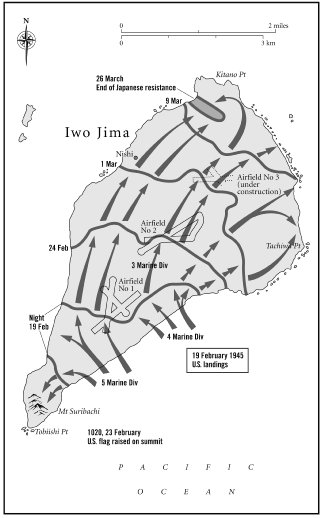
Iwo Jima, February–March 1945
As it was, even Japanese artillery sited in the midst of the island could fire on the beaches, while being too well camouflaged and protected to be easily suppressed. By nightfall on 19 February, 30,000 Marines were ashore—but 566 were already dead or dying. The invaders held a perimeter 4,400 yards wide and 1,100 yards at its deepest point, within which every man was striving to scrape a shallow hole, or merely nursing his fear. There was no respite from Japanese shelling.
In a shellhole, a corpsman asked Private First Class Arthur Rodriguez to hold a man’s protruding intestines while he applied sulphur powder, then pushed them back into his abdomen. A nearby explosion caused body parts to rain down upon them. The young BAR man tried to focus his mind on his sweetheart, Sally, back home rather than upon the ghastly spectacle before him. Soon afterwards, “I saw my group leader496 Privett sitting there with his left arm dangling by the skin. He just grabbed it with his right arm and pulled it off and threw it away.” Rodriguez and his squad blazed away at rocks and small bushes till someone demanded in puzzlement: “What are we shooting at?” Like so many men in their predicament, they were wasting ammunition simply to vent frustration, to convince themselves they were not mere targets. Corporal Jerry Copeland spent his first night ashore in a hole with two American corpses and four dead Japanese, praying incessantly: “‘God, if you save my life I’ll go to church every Sunday497 of my life—never miss’…It was my first time with God.”
In the days which followed, the sole tactical option available to the Marines was frontal attack. They were obliged to advance across Iwo Jima yard by yard, bunker by bunker, corpse by corpse. This is what they did, at a cost of much blood and grief, through the next five weeks of February and March 1945. Almost all the ground traversed by the invaders was overlooked by the Japanese. Battalion after battalion, the Marines launched open-order assaults. Most petered out after one or two hundred yards, because so many participants fell. True, the application of technology helped. Armoured bulldozers hacked routes uphill for tanks. Flame-throwers proved invaluable, lancing cave mouths to make way for explosive charges. Warship and artillery fire did something to suppress Japanese fire. But to occupy Iwo Jima, to stop the mortar bombs and shells scouring every American position back to the beaches, the Americans could discover no effective substitute for sending men forward again and again, to prise each cluster of rocks piecemeal from shockingly dogged defenders.
The more exposed Japanese positions around the airfields were overrun in the first days, as Kuribayashi had anticipated, but their navy occupants accounted for significant numbers of Americans before perishing. Mount Suribachi fell on the fifth day, 23 February, after a savage struggle with its 1,500 defenders. Lt. Harold Schrier led forty men of the 5th Division onto the summit. When crews on the ships offshore witnessed the Stars and Stripes rising on the volcano’s summit, many raised a spontaneous cheer, as did the American people when they saw the legendary photograph of a second flag raising. Yet American triumph in the south left most of the 22,000-strong Japanese garrison still entrenched in the north, with an overwhelming advantage. Since they were neither willing nor able to leave Iwo Jima alive, their immobility conferred priceless invisibility. The defenders were told: “Each man should think of his foxhole as his own grave, fighting to the last to inflict maximum damage upon the enemy.” The Japanese held a small area in which even infantry bunkers were impervious to anything less than a direct hit, and in which there was no scope for outflanking manoeuvres. The onus was entirely upon the Americans to move, and thus to expose themselves.
“We had a gross misconception498 of the enemy before we encountered them,” wrote Patrick Caruso. “They were not jokes; they were not inept. We hated them enough to kill them, but we did respect their ability. I often thought that if we had to go to war again, I would want them on our side.” The Marines were surprised to find that many Japanese corpses were those of large men, for they had always thought of the enemy as pygmies. They were bemused to see some sprouting heavy black beards, such as never featured in American propaganda images.
After several days of combat, wrote Arthur Rodriguez, “we had not seen any of the enemy499 to shoot at. It made us feel frustrated and angry, because we had almost nothing to show for all our casualties.” The U.S. Marine Corps was a formidable fighting force, but on Iwo Jima the sight of so many men dying if they attempted to move created a popular bias in favour of hugging cover. This was natural, but militarily crippling. “The terrain was most favourable to the defense…The uncanny accuracy of enemy rifle fire caused many casualties,” wrote Lt. Col. Joseph Sayers. He thought Japanese artillery poorly directed, but noted that the defenders did not squander men in futile charges, as they had done in earlier Pacific battles. “The enemy is a much improved fighter.” Sayers delivered a bleak after-action verdict on a typical day for the 2/26th Marines on Iwo: “Low morale, fatigue500, an average strength of 70 men per company,” and next evening: “Morale was very low, and the strain of many days in the line was evident. It was noted that the men became more careless, and exposed themselves more to fire when fatigued.” He urged a halt to the practice of dispatching replacements to join units on the line, for there was no opportunity to instruct them in even the basic skills of survival. Ten out of seventeen replacement medical corpsmen sent to his battalion were killed or wounded within days simply because, in the view of their commander, they were ignorant of fieldcraft.
As an operations officer with the 24th Marines, Maj. Albert Arsenault was responsible for making a nightly situation report, characteristically exemplified as: “Progress a hundred yards501, casualties thirty-seven. Tied in for the night.” Regimental headquarters demanded: “How many Japanese did you kill?” “None that we could be sure of.” “None! Thirty-seven casualties and you haven’t killed any Japanese! You’ve got to do better than that.” Arsenault thereafter projected Japanese losses at least double those of his own unit: “One day was pretty much like another: small advances, heavy casualties.”
Warrant-Officer George Green, an artillery forward observer (FO) with 3/21st Marines on Airfield 2, kept seeing a bespectacled Japanese popping his head up. When he urged a nearby rifleman to shoot him, the man replied crossly: “He’s in I Company’s sector—let them get him.” A captain radioed Green, demanding to know why he was not firing. The FO answered that he could see no targets. “Pick some prominent landmark502 and fire anyway,” said the officer. Two grenades suddenly arched through the air, and fell nearby. Green shouted to a nearby BAR man, who rashly walked towards the bushes from which the bombs seemed to have come. There, he toppled dead. A fire team eventually silenced the Japanese with grenades. Amid endemic nervousness in the perimeter, a Navajo Native American “code-talker” who spoke poor English was mistaken for a Japanese by a group of Marines. The man sat paralysed with well-merited fright until he was identified by another Navajo.
The 3/9th Marines landed on 23 February in tearing high spirits, eager for battle. Languishing on the ships in reserve through the first days, they and the rest of 3rd Division were fearful of missing the action. The tinny, echoing ship’s PA system informed them that 4th and 5th Divisions had met only “light resistance.” Within minutes of reaching Airfield 1, however, they found themselves under shellfire. Oklahoman Lieutenant Clyde McGinnis, at thirty the oldest man in K Company, urged his nearest companions to follow him into a crater, where they found a freshly decapitated Marine, still holding a smouldering cigarette in his hand. McGinnis said: “Damn, this is a hot place,” and started singing “Take Me Back to Tulsa.” He called back to the men behind: “I’ll be all right here, but I do think those guys are trying to kill me.”
Firepower alone was incapable of destroying Japanese positions. “The most discouraging thing was, right in the middle of this tremendous barrage you’d hear the damned enemy open up their machine guns,” wrote Lt. Col. Robert Cushman, twenty-nine-year-old commander of the 2/9th Marines. “It wasn’t knocking out those bunkers. So it was just a painful, sluggish business with tanks, H. E. and flame-throwers. And then the infantry with their flame-throwers and grenades and pole charges, digging them out.” Cushman’s battalion went through two complete changes of platoon leaders. Once, when his battalion was reduced to two hundred men and he ordered a charge, “nobody got out of their foxholes. So I picked up a rifle and bayonet and went round and got everybody out the hard way, and eventually they got moving along with the tanks.”
“At times, it appeared that the only sure way503 of leaving Iwo Jima alive was to be wounded,” said Patrick Caruso. For almost every man who was hit, comrades had a word of consolation. Corporal Robert Graf, however, noticed that when his platoon encountered an intensely unpopular officer prostrate on a litter, the whole file of men passed without speaking. Graf’s own turn came a few days later. A shell fragment struck him in the buttock—the “million-dollar wound.” As he was carried back to the beach for evacuation, “not only alive but leaving504 this godforsaken island…so many prayers of joy and happiness sprang to my lips.”
It was often hard to tell how bad a wound was. Lt. John Cudworth of 9th Marines saw his close friend Bill Zimmer, a former Marquette University baseball and football player, ride past on top of a tank, smoking a cigarette. Zimmer told him: “I got hit in the balls505 and I guess I’m doing OK. Can you get me a couple more cigarettes?” Cudworth handed up half a pack and waved “So long.” Next morning the doctor told him: “Zim didn’t make it.” Men especially feared the hours of darkness, because they knew that if they were hit, it was unlikely that any help could reach them before dawn. Some cracked. Combat fatigue cases mounted alarmingly. “Before getting on the ship in Guam, and on passage to Iwo, little ‘Oiky’ Erlavec was all excited, he was going to get to shoot some Japs,” wrote John Cudworth. “After seeing dead Marines on the island506 and having artillery land near us, he blew higher than a kite and had to be sent back. A sorry event for such a young kid.”
For the defenders, of course, each day of the battle was as terrible an ordeal as for the Americans—worse, because they were far more meagrely provided with food, water, medical supplies, or hopes of victory. Harunori Ohkoshi’s naval unit was spared the early attentions of the invaders, but the heat in their bunkers was almost unendurable: “If you put a bare hand on that volcanic rock, it was scorched.” Through the first ten days, cooks and water carriers made circuits of their positions before dawn and at dusk, but thirst remained a chronic problem. During the long, tense time of waiting, with the thunder of the battle a few hundred yards distant, they made desultory conversation, mostly about home.
Ohkoshi shared his hole with three other men. He felt closest to his runner, Hajime Tanaka, a Tokyo type like himself in a unit of farmboys: “He was a good bit older507 than me, maybe twenty-five, a real family man, and wonderfully steady whatever was happening.” At intervals they were dispatched in small groups on reconnaissance or fighting patrols. These were nerve-racking affairs. On terrain where rocks and vegetation restricted visibility to a few yards, as they crept forward they knew their lives hung upon whether they spotted Americans first. Only once did they clash directly, with a small group of Marines whom they surprised and wiped out with grenades and bayonets. One American got close enough to hit Ohkoshi with the barrel of his pistol before the Japanese killed him.
Each day, American battalions lunged forward, sometimes gaining a few hundred yards, more often declaring themselves pinned down after suffering substantial casualties. The usual quota of brave, sacrificial Marines paid with their lives for being willing to force themselves forward just a little further, inducing others to follow where they led. The combination of thirst, rain, filth, cold food and fear ate into the spirits of even the best. Lt. Ken Thomson, a former sergeant commissioned following heroic performances on Guam and Bougainville, said: “Once I get back home508 to Minnesota and marry my girl, I’ll never leave.” He was killed a few days later. Sometimes, when Japanese perceived their own positions as hopeless, or simply grew weary of enduring bombardment, a handful of screaming figures hurled themselves at the Americans, to be cut down. But most of Kuribayashi’s men obeyed orders to hug their positions and die where they lay. All battles break down into a host of tiny, intensely personal contests, but this was especially true of Iwo Jima. Each man knew only the few square yards of rock, vegetation and stinking sulphur springs where he sheltered, crawled, scrambled and fought with a shrinking handful of companions.
FOR THE MEN aboard the ships offshore, it was a harrowing experience to find themselves so close to and yet so remote from the horrors which their fellow Americans were enduring. True, a handful of kamikaze aircraft broke through to the fleet, sinking the escort carrier Bismarck Sea and damaging Saratoga, but for the most part sailors were embarrassed by the comfort and safety in which they witnessed the battle. Coastguard Lt. Paul George, a twenty-two-year-old from Vinings, Georgia, never experienced personal fear on his LST, because he had no cause to, “other than feeling sorry for the guys509 who were ashore.” Surrealistically, from a distance of a few hundred yards “we could just watch the war going on. Through the glasses I could see tanks trying to get through the sand and not having a whole lot of luck, Marines diving into foxholes.”
Dr. Robert Watkins was operating shipboard: “Sometimes we were so close510 to shore that we could see the infantry and tanks fighting as though they were in our backyards. Some days were clear and lovely; on others the chill wind and fog whipped across the scudding whitecaps, raising waves that almost wrecked our landing boats. Some days the sun shone and I did not know it. Some nights the moon was bright, but not for me. Some sunrises I watched through the portholes as I washed the blood of the night’s work from my hands and clothes.”
Watkins hated operating on men with stomach wounds, because each case took at least four hours, together with many more hours of postoperative care, and half died anyway: “In the time that one belly wound511 is being operated on, I can save half a dozen lives and limbs with other wounds. And I am a lousy belly surgeon.” A man being prepared for the operating table protested as a chaplain removed his watch. “You don’t need my watch512…You’ve got a watch,” he said feebly. Corporal Red Doran, an Iowan BAR gunner from 3/9th Marines, lost his sight to blast. Evacuated, his bedmates had to endure the ghastly experience of hearing Doran join two other young men in similar plight, singing “Three Blind Mice.” The captain of an attack transport was named Anderson. One day, his own Marine son was brought aboard, hopelessly mangled. The boy said: “Dad, I sure hope you’ve got some good doctors aboard.” They were not good enough, for young Anderson died. His father buried him in the American cemetery ashore.
The faces of forward observers, directing naval guns alongside the infantry, remained unknown to ships’ crews, yet their voices became intensely familiar down the radio. An FO’s voice called “Fire!” Shipboard, there were deafening concussions, a pause, then a voice again: “Fan-fucking-tastic,” or perhaps, “Bull’s-eye,” or sometimes, “That was a little close, friends. Back off a blond one.” When one destroyer’s FO at last paid a visit to the ship, its crew cheered him aboard. Ben Bradlee, the gunnery officer, wrote of the Marine: “He turned out to be my age513, and even younger-looking, all jerky gestures and haunted eyes…I didn’t know how to tell a man I loved him in those days, but I sure loved him.” The visitor ate so much ice cream that he threw up.
The concentration of tens of thousands of men fighting over a few square miles of blasted rock and blackened vegetation created all manner of unwelcome problems. Radio nets became entangled. When phone wires were cut, it was often too dangerous to ask linesmen to search for the breaks. “It was necessary for officers514 to expose themselves constantly in order to maintain control,” wrote Lt. Col. Joseph Sayers. Within days, excrement, abandoned equipment and debris lay everywhere. Few men found it necessary to dig their own holes, because of the mass of craters and foxholes which pockmarked the battlefield. Armour was vital to forward movement, yet dangerous to nearby infantrymen. The lumbering monsters crushed foxholes and drew Japanese fire. When surgeon James Vedder found tanks halted by his aid station, he told them angrily to go away.
John Lane, a New York jeweller’s son, joined the 2/25th Marines in the midst of the battle. “We replacements were despised515 and perhaps hated by the survivors of the company,” he wrote, “because we were so green, untrained and innocent, hated because we were there because their buddies had been killed or wounded…All were so bearded, dirty, dusty and exhausted that at first I couldn’t tell them apart.” Lane, a company runner, became famously lucky. He never saw a live Japanese, nor fired his rifle, nor was hit, though it sometimes seemed to him that everyone else was. “You’d come across little piles of dead Marines, waiting to be collected. Six or seven guys piled up, turning greenish-gray, then black. Dead Japanese, some hit by flame-throwers, eyes boiled out, lips burned away, white teeth grinning, uniforms burned away and sometimes the first layer of skin, too, so the muscles would show as in an anatomical sketch. Penis sticking up like a black candle stub. Napalm boiled the blood, causing an erection, some said.”
Patrick Caruso found himself succumbing to silent reveries in the wary hours of darkness: “My mind traversed the spectrum516 of my past: school and college, and how final exams were so critical—until Iwo; why making the football team was so essential—until Iwo; how making a good impression on a date was so important—until Iwo; how getting a job during summer vacations was so significant—until Iwo; what’s in store for my future. My future? Iwo is my present and future…” Marine Jack Colegrove had written home on 26 February: “Dear Mom, finally got time to sit down and write a few lines. I know you must be pretty worried about me by now, no doubt you heard that I am on Iwo Jima. I have come through the battle thus far without a scratch, so did my friend Pentecost, I cant write to everybody so can you just tell all my friends I’m okay, all my love Jack.”
Three weeks later, however, Colegrove was obliged to report: “Gosh, sweetheart, I’m sorry I haven’t written for such a long time. However I have a very good excuse—I have been wounded and all that sort of stuff. Two days before I got hit, Pentecost was hit in the stomach, tho the fellows say it wasn’t too bad. At present I’m in a hospital in the Marianas, no telling how long I’ll be here, might be quite a while. Has our little island grown very popular back there? Man o man, that sure was a rugged place, wasn’t very nice at night, either. Sure did lose a lot of swell buddies…Think I’ll have to come home soon—for good. Guess I’m washed up as a Marine…I was thinking today that it’s a good thing I or you won’t have to pay my hospital bill. It must be quite a bit. Lets see—150 shots of penicillin, hundreds of sulfa pills, blood plasma and whole blood, dressing, chow etc. Today I managed to get into a wheelchair…”
As gently as he could, Colegrove was breaking terrible news to his mother. He sent another letter to a friend in Detroit named Torbet: “I wanted to ask you a favor. You see I lost my left leg on Iwo Jima. I don’t know if I should tell mother now, or wait until I get an artificial leg and start walking again. If you think it best to tell her, I wish you would. I don’t know what the matter is with me, but I can’t seem to tell mom myself. I sure am getting tired of laying around in these damn hospitals.” Next day Colegrove made the effort to write to his mother himself: “You wanted to know how bad517 I was hit, well, here goes, stand by!! one piece of shrapnel in left elbow, another piece in my right leg, last and not least—no left leg. Better let that idea of me getting married ride for a while. Don’t worry cause I’m getting along swell. Lately I’ve been tearing up & down the ward in a wheelchair—whee! Bye now and take it E-Z, love and kisses Jack.”
Most men on Iwo Jima felt a dull, bitter loathing for the enemy who inflicted such horrors upon them. Lt. Robert Schless expressed uncommonly sensitive emotions when he wrote to his wife, Shirley: “I was never once sore518 at the Japs. The more I learned of them, the more I could understand their motives. They were scrupulously clean, despite living underground. They carried photos of their families with them, and those families had a nobility which would be difficult to match. Many of their personal objects—their fans and swords and other things—are of great beauty. If Japan is at present going through a Victorian period of bad taste nevertheless there is taste among all her people. I believe the symbol of the rising sun has for them a great beauty of a pristine, virginal nature.”
More commonplace was the attitude of the group of Marines whom eighteen-year-old Corporal Jerry Copeland encountered poised over an oil drum in which they were boiling Japanese skulls, which earned them $125 apiece. Copeland, who described himself as a San Francisco juvenile delinquent until he joined the Marines, had loved training on Parris Island, South Carolina, and was among the few who now found the experience of combat rewarding: “The first guy I ever killed519, I got so much joy, so much satisfaction out of it…Flame-thrower’s great to get guys out a cave, but boy, the guy who’s got to approach the cave has a problem. You don’t move too well with a flame-thrower.”
In the first days of March, just as MacArthur’s men were completing the capture of Manila, the Marines on Iwo Jima started direct attacks on the positions of Harunori Ohkoshi’s naval group. Incoming fire was devastating. Ohkoshi and his companions found that in daylight they dared not raise their eyes to the weapon-slits of their bunkers. They were forced to fire their heavy machine gun blind, pulling a lanyard from beneath. After two days of American assaults, the navy men were ordered to withdraw into the dense network of tunnels and bunkers at the summit of the position. On 8 March, they were told that they were to sortie for a mass night attack, to regain the lost summit of Mount Suribachi.
It was plain from the outset that this was suicidal, and initiated by officers disobeying the stringent orders of General Kuribayashi. Their objective was more than two miles distant. Every Japanese movement provided the Americans with the opportunity for a massacre. Yet some of the navy’s officers, knowing they must face death anyway, chose to indulge themselves by doing so on their own terms. They sprang from tunnel entrances at the head of their men, into the path of overwhelming fire. Darkness offered the Japanese no protection, for flames and American flares lit the battlefield. By the time Ohkoshi and his group emerged, the ground was piled with bodies. “The attack was a shambles,” said the young sailor. “The whole thing never had a chance.” Not every Japanese sought martyrdom eagerly: “We had to push a lot of men out of the tunnels, because they knew what was waiting for them on top.” Around eight hundred navy personnel perished, for negligible American losses.
One senior soldier, Lt. Col. Baron Takeichi Nishi, tried in vain to dissuade the naval officers. Nishi was a legendary figure who had won an equestrian gold medal at the 1932 Los Angeles Olympic Games. Ohkoshi had glimpsed him a couple of times before the battle, riding by on a horse as he and his comrades dug trenches. Now, Nishi commented contemptuously on the navy men’s futile action: “Anyone who wants to die can do it any time. It’s only fifty metres to the American positions.” Uncertainty shrouded Nishi’s end. Some said that he shot himself, others that he was led into an attack by his orderly, having been blinded by blast. He left behind a fine collection of photographs of himself in Olympic playboy days, beside such Hollywood stars as Douglas Fairbanks, Mary Pickford and Spencer Tracy.
Though most of the navy men died running forward towards the American positions, a few survivors remained in the open. Harunori Ohkoshi and his group crawled some three hundred yards, inch by inch, attempting to regain their tunnels under the American fire raking the battlefield. At intervals the seventeen-year-old called softly to those behind him, checking who was left. Each time, fewer voices answered, as machine guns silenced them one by one. Dawn found Ohkoshi pinned down with just three others, amid a jumble of Japanese bodies. They adopted desperate expedients, smearing handfuls of human debris onto themselves to simulate convincing corpses. “The blood and guts of the dead kept us alive,” said Ohkoshi. They lay in the open for forty-eight hours, in plain sight of the Americans. When their water was gone, they sucked blood. Days and nights were alike punctuated by the screams of dying Japanese, their cries of “Mummy, mummy!” or the names of loved ones. The noise of firing was deafening, scarcely ever stilled. At last, American activity in their vicinity seemed to slacken. The battle had moved on. The four Japanese crept back into the tunnel system.
Underground, they found a few medics and other survivors such as themselves, perhaps fifty men in all. Day after day they lay in stifling heat, and at night crawled out to search the battlefield around their positions for water bottles or food. A steady trickle of men failed to return from these scavenging missions, having been shot by the enemy, or fallen foul of booby-trap wires. A core of survivors like Ohkoshi lingered, however, long after the Americans declared victory, and most had left the island.
By the time K Company of the 3/9th Marines reached Iwo’s north beach, about 50 men remained of the 230 who had landed less than three weeks earlier. On the afternoon of 10 March, when some had thought their battle over, they were ordered to carry out a local reconnaissance. Sgt. Gordon Schisley said to Patrick Caruso: “You know, Lieutenant, the men who are here now have come all the way. Wouldn’t it be hell if someone were to get hurt on a little patrol like this?” Caruso nodded. His two platoons advanced perhaps a hundred cautious yards without glimpsing the enemy. Each cave mouth they passed received a flamethrower’s kiss. The sun shone brilliantly, and there was a welcome breeze off the ocean. Suddenly, they were under fire. Caruso’s men scrabbled for cover. The battalion commander called on the radio: “King 2, bring the men back.” But Caruso could not withdraw until he could pass word to his scattered Marines. Sergeant Schisley fell, hit in the neck. Sergeant Henry, a Nebraskan who saved every cent of pay for improvements to his farm, collapsed. Caruso was shocked by the anguished look of appeal on Henry’s face as he died. Everywhere men were being hit, and soon the lieutenant himself fell with a bullet in the leg. He crawled behind a rock, and was eventually evacuated with the other survivors. His combat career had lasted twelve days. The 3/9th Marines lost all twenty-two company officers who originally landed on Iwo Jima. Ten were killed, the rest wounded.
U.S. headquarters declared organised resistance on Iwo Jima ended on 14 March. Most surviving Japanese were thereafter fugitives like Harunori Ohkoshi rather than combatants, though they continued to harass American mopping-up operations with small arms and occasional wild, hopeless charges. In his underground headquarters, General Kuribayashi found time to send a signal to the general staff in Tokyo, offering advice gleaned from the Iwo Jima experience: “However strongly you build beach defences, they will be destroyed by battleship bombardment. It is better to erect dummy defences on the shoreline. It is essential to maintain eavesdropping watches, since the enemy communicates in plain language. The violence of enemy fire is beyond description. It can take more than ten hours for a junior officer to move a single kilometre to pass information. Where telephone links are used, cables must be buried. Radios should be located at a distance from headquarters, to protect these from bombardment following enemy radio location. Enemy headquarters are often noisy, and sometimes use lights at night. Defence against armour is critically important—anti-tank ditches must be dug. It is essential to stockpile ammunition, grenades and mortar bombs on isolated islands which are to be defended. The enemy’s ground control of aircraft is very good. Snipers should regard flame-thrower operators as priority targets.”
Neither then nor later did the Americans perceive much useful to be learned from Iwo Jima and its notorious killing grounds—Turkey Knob, the Amphitheater, Charlie-Dog Ridge, the Meat Grinder—save about man’s capacity to inflict and endure suffering. The experience renewed the usual fierce criticism from the army about the Marines’ allegedly sacrificial tactics. Maj.-Gen. Joseph Swing of the 11th Airborne Division, for instance, wrote an angry letter home on 8 March in response to rumours that Nimitz rather than MacArthur was to command the invasion of Japan. Swing regarded the admiral as standard-bearer for Marine methods which he held in low esteem: “It makes me sick520 when I read about the casualties on Iwo Jima. It can be done more scientifically. We laugh at the fruitless method of the Jap in his banzai attacks and yet allow that fanatic”—he referred to Lt.-Gen. Holland Smith of the Marines—“to barge in using up men as if they were a dime a dozen.”
There were those, including Holland Smith, who persuaded themselves that a longer preliminary bombardment of Iwo Jima would have made the early days, especially, less costly. There was agreement that more heavy artillery was needed, especially eight-inch howitzers. Yet there is no reason to suppose that any alternative tactical method would have changed anything, in that close and densely fortified area. Many Marines argued that the only effective means of shortening the battle would have been to pump poison gas into the Japanese underground complexes. They derided the brass in Washington for being squeamish about such methods. Even Nimitz later expressed regret that gas was not used.
Though it often seemed to the Americans that the battle would never end, they prevailed at last, occupying the entire wretched island. A Marine had fallen for every Japanese, a most unusual balance of loss in Pacific battles. On 26 March, some 350 Japanese staged a final banzai charge in the north-west. Startled Americans found themselves fighting hand-to-hand with swordsmen. The assault was broken up, the Japanese killed. General Kuribayashi emerged from his headquarters bunker one night, marvelling to see that the trees and foliage which had once covered the hillside were all gone, leaving only blackened rock and scorched stumps. He sent a last signal to Horie, his staff officer on neighbouring Chichi Jima: “It’s five days since we ate or drank, but our spirits are still high, and we shall fight to the last.” Then, on 27 March, he and his staff killed themselves. The senior naval officer, Admiral Toshinosuke Ichimaru, walked at the head of sixty men into the path of American machine guns outside his cave—yet survived, probably to his own disappointment. Having failed to get the enemy to kill him, he shot himself soon after Kuribayashi’s death.
In the struggle for Iwo Jima 6,821 U.S. Marines and 363 navy men died. A further 17,372 were wounded. Such a toll would have seemed negligible to the Red Army, fighting the Germans in Europe, but represented an extraordinary intensity of loss for a battle conducted over an area only a third the size of Manhattan Island. More than one in three of the Marines committed became casualties, including nineteen of the original twenty-four battalion commanders. In Maj. Albert Arsenault’s battalion, 760 men were killed or wounded. The 5th Division had required twenty-two transports to bring its men to the island, but was carried away in just eight. All but a few hundred of the 21,000 defenders perished.
It was six weeks before American troops addressed themselves systematically to clearing the caves in which such survivors as Harunori Ohkoshi clung on. First, they tried teargas. Then they sent captured Japanese to broadcast by loudspeaker, who sometimes called on men by name to come out. One POW approached Ohkoshi’s tunnel entrance, bearing water and chocolate, only to be shot by the occupants. “We were doing him a favour,” claimed Ohkoshi laconically. “His honour was lost.” On 7 May, in bright sunshine, men of the army’s 147th Infantry poured a hideous cocktail. They pumped 700 gallons of salt water into one of the biggest tunnel complex entrances, then added 110 gallons of gasoline and 55 of oil. The deadly flow, ignited by flamethrower, raced through the underground passages, starting a string of ammunition fires, incinerating many Japanese and causing others to kill themselves amid the choking, clogging smoke. Some men embraced each other, then pulled pins on grenades held between their bodies. Ohkoshi finished off several dying men with his pistol. Yet after three months of subterranean animal existence, he decided that he himself would rather die in the sun. The Americans had sealed the tunnel entrances, but by frenzied labour some Japanese clawed passages to the surface. Ohkoshi was the first to burst forth, like a shaggy, blackened mole. He was at once seen and shot by an American, and fell writhing with two bullets in the leg. His surviving companions were more fortunate—or not, as the case might be—and were captured uninjured. Nursing shame and exhaustion, they were taken away into captivity. When Ohkoshi saw his own features in a mirror on Guam, he did not recognise the skeletal ruin of a human being which he represented. A U.S. officer’s report on the episode concluded dryly: “Fifty-four were eventually taken into custody with some difficulty. Two of these subsequently committed suicide.”
Captain Kouichi Ito, an army officer521 who remained a lifelong student of Japan’s wartime campaigns, believed that Iwo Jima was the best-conducted defensive operation of the Japanese war, much more impressive militarily than the defence of Guadalcanal, or the subsequent action in which he himself participated on Okinawa. Yet it would be mistaken to suppose that most Japanese defenders of the island found their experience, or their sacrifice, acceptable. A survivor from the 26th Tank Regiment, Lieutenant Yamasaki, wrote afterwards to the widow of his commanding officer, in a letter which reflected a sense of the futility of what he and his comrades had endured: “In ancient times522 our ancestors said: ‘Bushido, the way of the warrior, is to die.’ This may have sounded wonderful to knights of old, but represents too easy a path. For both the living and the dead Iwo Jima was, I think, the worst of battlefields. Casual words about ‘bushido’ did not apply, for modern war does not make matters so easy. Unfeeling metal is mightier than warriors’ flesh. Where, when, how, who died nobody knew. They just fell by the wayside.”
When Marine veterans got back to Hawaii, one group marched triumphantly down the street waving a Japanese skull and taunting local Japanese-Americans: “There’s your uncle523 on the pole!” The experience of Iwo Jima had drained some survivors of all human sensitivity. Was the island worth the American blood sacrifice? Some historians highlight a simple statistic: more American aircrew landed safely on its airstrips in damaged or fuelless B-29s than Marines died in seizing it. This calculation of profit and loss, first offered after the battle to assuage public anger about the cost of taking Iwo Jima, ignores the obvious fact that, if the strips had not been there, fuel margins would have been increased, some aircraft would have reached the Marianas, some crews could have been rescued from the sea. Even if Iwo Jima had remained in Japanese hands, it could have contributed little further service to the homeland’s air defence. The Americans made no important use of its bases for offensive operations.
Yet to say this is to ignore the fact that in every campaign in every war, sacrifices are routinely made that are out of all proportion to the significance of objectives. Unless Nimitz had made an implausible decision, to forgo land engagement while the army fought for the Philippines, to await the collapse of the enemy through bombing, blockade, industrial and human starvation, the assault on Iwo Jima was almost inevitable. Whether wisely or no, the enemy valued the island, and took great pains for its defence. It would have required a strategic judgement of remarkable forbearance to resist the urge to destroy the garrison of the rock, a rare solid foothold in the midst of the ocean. If some historians judge that America’s warlords erred in taking Iwo Jima, the commitment seemed natural in the context of the grand design for America’s assault on the Japanese homeland.