
THIRTEEN
JAPAN’S 1944 DISASTERS in Assam and Burma prompted a wholesale sacking and replacement of its generals. The new commander-in-chief, Gen. Hoyotaro Kimura, set about painstakingly rebuilding his forces in readiness to meet the British Fourteenth Army, advancing south-eastwards. He offered no challenge to Slim’s crossings of the Chindwin in November and December. As the British advanced, they encountered pitiful relics of their 1942 defeat: a column of thirty-eight Stuart tanks, blown up when they could not be evacuated, together with scores of rusted civilian vehicles, some still occupied by skeletons. Slim snapped at a man who decorated his jeep with a skull, telling him to take it off: “It might be one of our chaps592, killed on the retreat.” In northern Burma, shortly before Christmas men of 19th Indian Division joined hands with advanced elements of Stilwell’s Chinese divisions at Banmaux. By the end of January, the Burma Road into China was at last open all the way to Kunming, and the first truck convoys of supplies began to move north. To acute British dismay, Chiang Kai-shek, having gained what he wanted from the campaign, ordered his Nationalist divisions back to their homeland, leaving Slim’s forces to pursue unaided the advance towards Rangoon.
It seemed to the Japanese inevitable that the invaders would now drive south towards Mandalay, that city of temples beside the Irrawaddy, a lyrical rendezvous in British imperial folklore. Kimura’s plan was to allow the British deep into Burma, where their lines of communications would become extended, while his own remained short. He then intended that the ten divisions of his 15th and 33rd Armies would smash Slim’s forces as they sought to cross the Irrawaddy north of Mandalay.
Unfortunately for Kimura, however, Slim anticipated his foe’s intention. In addition to notable powers of generalship, the British commander also possessed the luxury of strength, not only in infantry numbers but also in overwhelmingly superior air, artillery and armoured forces. He was able to support his advance with supplies air-dropped on an unprecedented scale, a facility which went far to counter the difficulties of terrain. Most of the Japanese formations, by contrast, lacked half their men and were desperately short of guns. Slim dispatched one British corps to make a noisy feint in the north—19th Division crossed the Irrawaddy at Thaneikkyin on 11 January 1945. This was where Kimura expected an assault, and the Japanese launched exactly the big counter-attack Slim wanted to provoke. Next, the British XXXIII Corps staged another demonstration north-west of Mandalay, before beginning river crossings at Ngazun on 12 February. This prompted Kimura to commit the bulk of his forces. Yet all the northerly activity masked Slim’s real purpose: to push another corps across the Irrawaddy fifty miles to the south-west at Pakokku, and then drive east to the vital road junction of Meiktila, far behind Kimura’s front, cutting off most of the Japanese formations in Burma from their supply lines. By St. Valentine’s Day 1945, the southerly British force, IV Corps, had secured an Irrawaddy bridgehead against negligible opposition, and was poised to launch the decisive coup of the campaign, the seizure of Meiktila.
A soldier of 17th Indian Division, George MacDonald Fraser, wrote wryly of Operation Cloak, Slim’s deception to confuse the Japanese: “He confused 9 Section593, too; we dug in at no fewer than three different positions in as many hours, Grandarse lost his upper dentures on a sandbank, little Nixon disturbed a nest of black scorpions in the dark…the general feeling was that the blame for the whole operation lay at the door of first, Winston Churchill, secondly, the royal family, and thirdly (for some unimaginable reason) Vera Lynn…We did not know that ‘Cloak’ had worked brilliantly; we were footsore, hungry, forbidden to light fires, and on hundred percent stand-to—even although, as Grandarse…pointed out, there wasn’t a Jap within miles.”
Deception on this scale was only possible when the Japanese had lost the capability to conduct air reconnaissance, indeed possessed negligible intelligence-gathering capability. They lacked transport swiftly to change deployments, and firepower to hit hard even when they did so. The open country suited British armoured and mobile forces. This does not diminish Slim’s achievement, however, in wrongfooting his enemy and masterminding an offensive which now began to inflict devastating casualties upon the Japanese, at small cost to Fourteenth Army. There was hard fighting in Burma between February and May 1945, when the British entered Rangoon. But the energy of Japanese defensive actions and counter-attacks reflected despair, rather than any realistic expectation of reversing the tide.
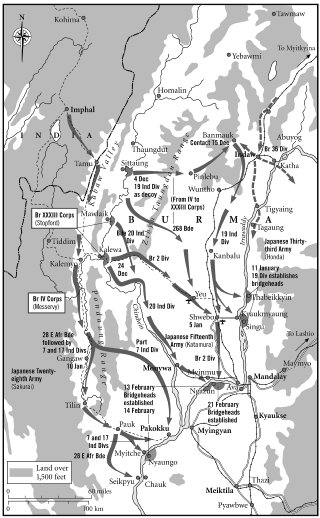
Fourteenth Army’s advance on Mandalay, November 1944–February 1945

EVERY MAN of Fourteenth Army experienced a surge of relief when, in the first days of 1945, they left behind the thick jungle and steep hills of northern Burma, breaking out into the flat paddy fields of the country’s central plain. “There was a wonderful594 spirit of freedom and sheer joy at being able to move in open country again, to see tracks and villages,” wrote Col. Ted Taunton of the Northamptonshire Regiment. “The bad spell of claustrophobia against which we had had to fight so hard during the past three weeks was a thing of the past.” When they met Burmans, however, they sensed uncertainty. Local people questioned whether the British had returned for good, or were merely conducting further Chindit-style guerrilla operations from which they would retreat once more into India, leaving inhabitants who had smiled upon them to face Japanese retribution. A divisional headquarters wrote of the Burman: “He is neither pro-Jap595 nor pro-British, he will go with the winning side. When the British left Burma he looted the British and if the Japanese are on the run, he will loot the Jap in the same way.”
Slim’s men found themselves facing not sustained Japanese resistance, but fierce local battles wherever the enemy thought these worthwhile, or found himself unable to withdraw. Maj. John Hill commanded a company of the 2nd Berkshires in his battalion’s attack on an abandoned village named Kin-U. No artillery was available, but three hundred mortar bombs plastered the area to cover their assault, on a frontage of two hundred yards. The British had advanced most of the way through the village before its eighty-odd Japanese defenders responded. These were desperate men—a captured diary showed that they had been feeding themselves on monkey and dog meat. They poured all the fire they could muster upon the Berkshires, whose gunner forward observation officer was badly wounded. By one of the drolleries of war, Hill found that this man’s replacement had attended the same prep school as himself. A sergeant-major was killed as he brought forward ammunition. Hill’s company headquarters became so heavily engaged that his second-in-command and storeman killed a Japanese soldier apiece.
At nightfall, the young captain led forward a patrol of Indian stretcher-bearers to his foremost platoon, pinned down by the enemy. They found two dead and one wounded British soldier, but could not locate the rest. Next morning, however, they awoke to find the enemy gone, having killed six and wounded seven of Hill’s company. This was a characteristic little action, of the kind which steadily eroded Slim’s strength. So grave was the worldwide British shortage of manpower that casualties, and especially junior leaders, could seldom be replaced. Fourteenth Army’s numbers shrank with every step that it advanced southwards.
From an early stage, though the invaders sometimes met tough resistance, they also found evidence that the Japanese lacked the skills and determination of earlier times. Their patrolling seemed halfhearted, and they sometimes exposed themselves carelessly. The familiar Japanese savagery towards prisoners was undiminished, however. After a battle on 21 January, the Berkshires found dead British soldiers beaten, stripped of their boots and suspended by electric flex upside down from trees. This encounter sharpened the battalion’s sentiment against their enemy. “Very few of us596, whether professional soldier or conscript or volunteer, felt any twinges of remorse when one either saw a dead Japanese or killed a live one,” wrote John Hill. “We had, after all, spent the whole war learning how to kill the enemy—and he us. No one expected any mercy.” At Kabwet, on the Irrawaddy north of Mandalay, Hill’s battalion lost nine officers and ninety other ranks, twenty-five of these in his own company, during operations to destroy a Japanese bridgehead. Gazing upon the enemy’s dead after the battle, one of his men said with a twinkle in his eye: “None of them surrendered597 then, sir?”
Slim’s feint in northern Burma has been hailed by posterity as a brilliant stroke, but for those at the sharp end, the price was hardship and fear. When the British 2nd Buffs began to cross the Shweli River near Myitson with 36th Division on 1 February, they were cruelly punished. Private Cecil Daniels reached the Japanese bank unhurt, and lay under its lee with other men, watching the sufferings of those caught by fire in midstream. “One of our chaps598 was calling, ‘Please help…I’ve got it in the guts.’ I felt so sorry for him…to be all alone and dying on a sandbar miles away from home tugged at my heartstrings but common sense got the better of me, I thought of my parents at home who had already lost one son. I was still cogitating whether to put one’s life at risk when his cries got fainter and he slowly slipped beneath the water and floated away.”
That night in the precarious British bridgehead, Daniels was eating his rations in a foxhole when the darkness was rent open by gunfire and the cries of his platoon sergeant: “They’ve broken through, get out, every man for himself!” The soldier wrote: “Then came the pounding of boots and silhouettes of men in flight, rushing past me kicking sand and dirt in my face as they ran down the bank, jumping into the swirling water. I sat in my hole quite bewildered by the rush of events, still eating my K ration.” Daniels was reluctant to quit his hole for the river, but in the chaos he saw no choice save to abandon helmet and pack, and join the panic-stricken throng wading back to the British bank of the Shweli. At dawn “a scene of absolute misery met our eyes—the rest of the company (what remained of it) were morosely sitting or wandering about in a daze, very downhearted. Each one seemed to be asking others: ‘Have you seen so-and-so?’” A lavish rum ration was issued.
Most men had lost their watches. Daniels had given his to a mate to mend. Now, he discovered that the mate was dead. Gazing at the brown water of the river, he saw the body of another company’s sergeant-major lying bloated in the current: “Although he wasn’t much liked in the battalion, it was a shame to see him like that.” Though Daniels’s company commander received a Military Cross for the action, it had cost the Buffs 114 dead and wounded. During the fortnight which followed, the river was successfully bridged elsewhere. It was fortunate for the spirits of Daniels and his comrades that they remained oblivious that they suffered in pursuit of a mere diversion.
The Shweli was a modest obstacle, beside the Irrawaddy. Slim staged Fourteenth Army’s crossings of one of the biggest rivers in Asia with a ramshackle armada of assault craft, pontoons and rafts which Eisenhower’s armies in Europe would have viewed with disbelief. There were no amtracs here. Slim himself observed ruefully: “I do not think any modern army has ever attempted the opposed crossing of a great river with so little.” The “big picture” at the Irrawaddy was of overwhelming British success. Yet some units suffered severely. The Northamptons, crossing at Kyigon with 20th Indian Division on 13 February, found some of their boats foundering and others drifting far downstream from their objectives. In rough and rising water, craft overturned, precipitating overburdened infantrymen into the current. While scores crawled through the shallows to duck incoming fire, Bombardier Lees of 114 Field Regiment splashed upright for five hundred yards in full view of the enemy. He was carrying a gunner forward observer team’s radio, and refused to get the set wet.
Fifty miles southwards at Myitche, where 7th Indian Division crossed the Irrawaddy on its way to Meiktila, Slim’s men were assisted by another diversion, which drew off the most effective local Japanese formation to meet a threat from an East African brigade at Seikpyu. So successful was this, asserted the British official historian blandly, “that it was counterattacked599 and driven back to Letse, thereby drawing away from the main battlefield the only formidable striking force the Japanese had in the area.” This account was a trifle disingenuous. In truth, Fourteenth Army was dismayed by the precipitate flight of the East Africans. An apologetic signal from their commander sought solace in the fact that one unit had retained its cohesion when the remainder fled: “Despite recent bad behaviour600 bulk 28 EA Brigade, 46 KAR (Nyasaland) remained unaffected…and have stood firm. Consider this fine performance especially in view behaviour remainder brigade.” Yet, while it was true that one significant Japanese unit went in pursuit of the East Africans, sufficient enemy remained at 7th Division’s crossing point, four miles above Nyaungu, to cause much grief to the South Lancashire Regiment.
Its men undertook the longest opposed river crossing of World War II. The Irrawaddy at this point was over 2,000 yards wide, which rendered it an alarming obstacle for heavily laden infantrymen in frail boats, even if the enemy was weak. The first of the South Lancs successfully rowed their boats across in silence and darkness during the early hours of 14 February. They established a bridgehead on the far bank without alarming the enemy. Then two Japanese were spotted swimming, apparently for pleasure. The enemy soldiers were shot, and thereafter a firefight developed. The rest of the South Lancs were late reaching the riverbank, and began the passage in daylight. Many of their boats’ chronically unreliable outboard engines puttered to a stop in midstream. Japanese machine guns began to rake them, killing two company commanders and wrecking wirelesses. The commanding officer’s boat was sunk. He and his companions with difficulty swam to safety back on the British bank.
The current began to sweep boats downstream, in a deadly parade past Japanese guns. A battalion of Punjabis which followed the South Lancs faced the same ordeal. Col. Derek Horsford and his Gurkhas watched the melodrama with mounting horror: “The South Lancs’ CO601 eventually staggered into the presence of the brigade commander stark naked, and collapsed before his eyes, totally exhausted by his own and his unit’s ordeal.” Yet matters were not as bad as they briefly seemed. Horsford’s Gurkhas made the crossing almost unscathed.
“With maddening sluggishness602 the boats nosed their way across the water,” wrote an eyewitness. “Two boats grounded on a submerged and treacherous sandbank, but the men, quite undaunted, waded shoulder-deep in the swift current up to the beaches. At last all the boats grounded and the men swarmed up the cliffs and nullahs to their objectives on the high ground. More and more boats followed, heavily laden with troops, until boats were going both ways in an almost continuous stream while the air and artillery curtain of fire moved gradually downstream, and then back again behind the cliffs and beaches.”
Once the British and Indian vanguards were ashore, they met little serious resistance. Some Japanese scuttled into tunnels, in which Slim’s men entombed them with explosive charges. In one place, astonished British soldiers saw Japanese survivors form up in full equipment, then march into the river to drown themselves. Other defenders proved to be halfhearted members of the renegade Indian National Army, who surrendered or melted away into the countryside. Within days, the British striking force was concentrated on the east bank of the Irrawaddy, with no Japanese capable of stopping the dash on which it now embarked, sixty miles eastward to Meiktila.
The Japanese were soon being forced back from the river everywhere Slim’s forces crossed. On 8 March, north of Mandalay the 19th Indian Division reported, “Opposition encountered appears very disorganised.” Its senior staff officer, Col. John Masters, wrote exultantly:
We rumbled down the cattle tracks in the heavy dust, past strands of jungle where the crackle of small arms fire showed that we had caught some Japanese. The tank treads clanked through villages blazing in yellow and scarlet conflagrations, palm and bamboo exploding like artillery, grey-green tanks squatting in the paddy round the back, ready to machine gun any Japanese who tried to escape before our advancing infantry…trudging along the sides of the road plastered with dust and sweat…The light hung sullen and dark overall, smoke rose in vast writhing pillars from a dozen burning villages, and spread and joined to make a gloomy roof. Every village held some Japanese, every Japanese fought to the death, but they were becoming less and less organised.
Even at this late stage, the Japanese commanders refused to acknowledge the British push towards Meiktila as more than a feint. Thus, when 17th Indian Division reached the town, its spearheads met only a ragtag defence, which was swept aside in the first days of March. The Japanese 15th and 33rd Armies in the north were now cut off. At last, Kimura understood how disastrously he had been outmanoeuvred. He perceived no alternative save to throw everything into an attempt to regain Meiktila. As the British poured reinforcements into the town by road and air, one of the most desperate battles of the Burma campaign began, while further north Slim’s forces closed on Mandalay. Each side deployed some six divisions. The Japanese, however, were obliged to do most of the attacking. Wherever they moved, they exposed themselves to British aircraft and artillery. While the units of Fourteenth Army were well-fed, heavily armed and equipped, those of their opponents were in sorry condition. There were around 3,200 Japanese in Meiktila itself, but most were service troops. Allied tanks moved boldly, because the Japanese were poorly supplied with anti-tank weapons and mines. Indeed, given the state of their formations, it is astonishing that Kimura’s soldiers put up the fight they did.
The 1/3rd Gurkhas, who were flown into Meiktila, fought their first action in defence of its airstrip. The battle proved “fairly traumatic,” in the words of its adjutant, Captain Ronnie McAllister. “The tanks took a pasting603 because we advanced across open ground, unreconnoitred. It was a general shambles. The Japanese did not open fire until our chaps were twenty-five yards away.” In earlier years back in India, McAllister, a career soldier, worried that he would be left out of the war. Now, however, he and his comrades found themselves in a nightmare predicament. They were led into battle by an old “dugout” North-West Frontier colonel named “Badger” Spaight, who was utterly confounded by the experience. To the relief of his men, after the first days Spaight was sacked, to be replaced by his second-in-command, Robert O’Lone, “who thoroughly understood what he was doing, after three years in the job.” Thereafter matters went much better, though in Burma the battalion suffered a total of four hundred casualties, almost half its strength. “The Japanese still had the reputation604 from 1944, and we were very scared of falling into their hands, but by now we had much more of everything than they did. It was obvious we were winning.”
On 16 March, 17th Division signalled insouciantly to Fourteenth Army: “Jap suicide squads dug in605 Meiktila airstrip, temporarily delaying today’s fly-in…clearing north end airfield proceeding merrily situation quickly developing slaughter.” For the Japanese, the battle was a ghastly experience. Gen. Masaki Honda, the eager fisherman now tasked to retake Meiktila, told his commander-in-chief bitterly: “There aren’t twenty serviceable guns left among the two divisions. It’s quite hopeless to go on.” When ordered to hold his ground to enable the remnants of 33rd Army to escape, Honda asked for the order in writing, but said: “My army will keep fighting to the last man.” So it did. Lt. Hayashi Inoue said: “Meiktila was a place606 where almost everyone died. There was nothing we could do. The British were so much stronger. Our anti-tank weapons simply bounced off their armour. We could only entrench ourselves behind the embankments of rice paddies. We were simply in the business of clinging on.”
Ronnie McAllister, like every British Gurkha officer, deeply admired the courage of his little Nepalese soldiers, especially when acting as artillery observers, often three or four hundred yards in front of the infantry positions. Naik Dhanbahadur Limbu of the 3/10th Gurkhas was once manning an observation post, alone in a tree in front of his battalion position, taking muzzle-flash bearings of Japanese guns. He reported by phone that a big enemy attack was developing, and was told to clear out: within five minutes a British barrage would start falling around him. He chose instead to stay put. When a Japanese officer and several men assembled under his tree, Limbu dropped a clutch of grenades on them, killing three and wounding the officer. The Japanese never realised whence their nemesis came. All that night, Limbu calmly reported the enemy’s movements as British salvoes bracketed his tree.
Further north, British and Indian soldiers driving down from the Irrawaddy were awed by their first sighting of Mandalay Hill, surmounted by its temples gleaming gold in the dusty haze. “Here before us607,” wrote John Hill, “was our first real goal at last: a recognisable place on the world’s maps, not just an unknown village or a tangle of jungle.” By 11 March, Fourteenth Army’s daily situation report described “house-to-house608 and pagoda-to-pagoda fighting” taking place in Mandalay city. By the twentieth, the city was largely secured. Maj.-Gen. “Punch” Cowan, commanding 17th Indian Division, learned that among the British dead in its streets was his own son.
Everywhere, the Japanese were cracking. “We just overran them609 and killed them and killed them and killed them,” said Lt. Col. Derek Horsford without sentiment. On 8 April John Sandle led his company of Baluchis to seize an objective named Point 900, west of Pyawbwe. A sepoy was shot as the Baluchis went in. When the defenders crumbled, Randle shouted to take prisoners. His subadar cried in response: “It’s no good, sahib! They won’t listen.” Randle wrote: “They were in a blood lust…baying in high-pitched screams, with their lips drawn back over their teeth which gave them a ghastly wolflike insane grin. I found myself both exhilarated and appalled by this sheer animal lust to kill. In about ten minutes of grenade work, tommy-and bren-gun fire and the bayonet the whole Jap company was wiped out, with no prisoners taken. They put up little resistance, and I only had one other man killed.” This was the only moment of the war at which Randle saw a Japanese officer turn and flee—to be shot for his pains. The bodies of 124 Japanese were dumped in a convenient ditch. Gunner Lt. John Cameron-Hayes said: “We felt it was going to be over611pretty soon. The Japanese were on the run. Their corpses lay everywhere. They were much less aggressive than in the past.”
For the men of Slim’s army advancing, winning, was a wonderfully rewarding experience after the past years of pain and defeat. “I’m afraid I enjoyed the campaign612,” said Captain Ronnie McAllister afterwards. “It was great fun. We never thought of Burma as a sideshow, but as splendid theatre. We were tremendously proud of the regiment and the division.” In those last weeks, British commanders found themselves hampered by lack of provost personnel to direct traffic, as tank and truck convoys jammed the few roads. Whole artillery units had to be diverted to this humdrum task.
Yet the visible rewards of the Burma campaign seemed pathetically drab. Slim wrote: “It was always a disappointment613…to enter a town that had been a name on the map and a goal for which men fought and died. There was for the victors none of the thrill of marching through streets which, even if battered, were those of a great, perhaps historic, city—a Paris or a Rome. There were no liberated crowds to greet the troops. Instead, my soldiers walked warily, alert for booby traps and snipers, through a tangle of burnt beams, twisted corrugated iron, with here and there, rising among the squalid ruins, the massive chipped and stained pagodas of a Buddhist temple. A few frightened Burmans, clad in rags, might peer at them and even wave a shy welcome, but at best it was not a very inspiriting welcome, and more than one conquering warrior, regarding the prize of weeks of effort, spat contemptuously.”
Though the men of Fourteenth Army perceived themselves as winning a great victory, American scepticism persisted about almost everything the British did. A U.S. military observer group reported on an action of 23 April 1945: “Again in typical fashion the enemy held the initiative…19 Division seldom knew where the enemy was…the enemy again proved himself able to conceal his movements, and to deny to the British any knowledge of his strength.”
By the end of March, Slim had gained control of Burma’s road and rail net. The orders received by Japanese units became increasingly fanciful, demanding the occupation of positions already irretrievably lost. One day in April, Honda’s army headquarters in a garage on the outskirts of Pyawbwe found itself under fire. Every truck, car and radio was destroyed. The general lay writing his will while the position was defended by three hundred men, of whom a third were medical orderlies and other non-combatants. The Japanese received an unexpected deliverance when British tanks veered away northwards, unaware of the prize at hand. When darkness came, carrying only a cane and a handful of salvaged possessions in a pack, Honda led his survivors on foot towards Yamethin. The general was seen at his best in the days of flight which followed, still dispensing to his exhausted men the brothel jokes for which he was notorious. A few of his units were fortunate enough to possess transport. Maj. Mitsuo Abe described the Japanese 53rd Division’s retreat: “Among the stream of vehicles614, men of all manner of units commingled, many of them wounded. Some had their arms in improvised slings…some were bandaged with towels or strips of shirt. Some had lost eyes, others cried aloud for their mangled limbs to be cut off, others again raved in malarial fever. There were those who pleaded with friends to make their wills, and younger soldiers moaning ‘Mother…mother.’ Some cried out for their commanders as they struggled on, supported by a comrade on each side. It was hell on earth.”
Slim’s purpose was now to drive hard and fast for Rangoon, Burma’s first city, 320 miles south of Meiktila, then turn back and mop up enemy remnants on both sides of the road. The chief impediments to the British advance proved to be logistical—weary men, worn-out tanks and trucks which had travelled almost a thousand miles since the campaign began. On 27 April, Fourteenth Army signalled to Mountbatten: “Leading troops now only 72 miles615 from Rangoon port…spirit of competition of leading troops in race south now intense. Since capture MANDALAY 20 March [Fourteenth] Army troops have advanced 352 miles in 38 days.”
British commanders emphasised the need to minimise losses in this last phase of the campaign, when the outcome was decided: “Men are the most precious thing616 we’ve got,” warned 20th Indian Division’s commander, Douglas Gracey. “Use them with the greatest care.” The dash for Rangoon, in the first days of the monsoon, which came a fortnight early, represented the high peak of Britain’s war in the Far East. The Japanese were broken, even if some soldiers still possessed their familiar, terrifying will to fight: “I turned to see617 a Jap racing across in front of the bunker, a sword flourished above his head,” wrote a soldier of 17th Division south of Meiktila. “He was going like Jesse Owens, screaming his head off, right across my front; I just had sense enough to take a split second, traversing my aim with him before I fired; he gave a convulsive leap, and I felt that jolt of delight—I’d hit the bastard!”
A Cumbrian soldier said: “If thoo wez a Jap, an’ saw this lot coomin’618—Goorkas, an’ Pathans, an’ Sikhs, an’ them bloody great black boogers frae th’ East African Division—fookin’ Zulus, or suumat—aye, an’ us, an’ a—wouldn’t you pack it in?” For the last time in its great history, Britain’s Indian Army rode to the charge, triumphant after more than three years of defeat and disappointment. Slim himself was almost killed overflying Rangoon. Japanese fire hit his aircraft, wounding an American liaison officer. On 1 May, 25th Indian Division staged an amphibious landing on the coast south of the capital. Two days later, after killing four hundred of their own wounded who could not be moved, the Japanese abandoned Rangoon, and retreated eastwards. Prisoners at the city’s jail painted a huge sign on its roof for the RAF: JAPS GONE. EXDIGITATE. The British marched in.
The Japanese retreat from Burma was marked by systematic atrocities against Burmans and Indian civilians, who were tortured and casually killed until the very end. The vanquished vented their bitterness on any victims to hand. Through the months that followed, Fourteenth Army fought on against broken Japanese units striving to retreat eastwards into Siam—there were still more than 60,000 enemy at large—but Slim’s forces dominated the battlefield. The main campaign was ended. The British Union flag flew once more over Burma. The scale of loss on both sides619highlights the fact that the decisive battles had been fought in 1944. At Imphal and Kohima, the Japanese suffered more than 60,000 casualties, the British and Indian armies 17,587. By contrast, in the Irrawaddy, Mandalay and Meiktila campaign Japanese losses were around 13,000, British and Indian 18,195—but only 2,307 of the latter were fatal. In the final, “mopping-up” phase, the Japanese lost perhaps 28,000 men, Fourteenth Army 435 killed. As in every Far Eastern campaign, overall loss figures mask a huge disproportion in numbers of dead. Thirteen Japanese died for each fatal British and Indian casualty. Significantly more Chinese fell in the struggle to reconquer Burma than did British soldiers. The Raj’s Indian volunteers paid most of the human price for victory. The Japanese lost around two-thirds of all their forces deployed. The remainder were able to escape across the land frontier into Siam, whereas escape from the Pacific islands was almost impossible. The modest British figures masked heavy losses suffered by some rifle companies. Just 12 out of 196 men who had entered Burma with B Company, 2nd Berkshires, in November 1944 remained in its ranks in June 1945. Five officers and 107 men had been killed or wounded, while the unit as a whole lost 24 officers and 374 men. “I began to realise how much620 the battalion had changed,” wrote Maj. John Hill. “So many had left us and so many arrived…We had very few men left who lived in Berkshire.”
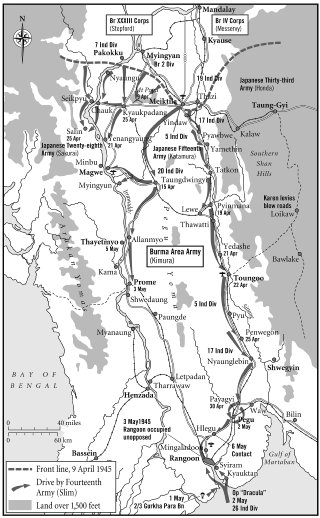
Slim’s drive on Rangoon, April–May 1945
ON 9 MAY, in the very hour of its triumph, Fourteenth Army was struck by a thunderbolt. The hero of the campaign, their commander, was summarily relieved. The supremo of Burma operations, Gen. Oliver Leese, a former protégé of Montgomery’s in North Africa and Italy, had never thought much of Slim. Leese chose this moment to announce his replacement. Slim’s chief of staff, Brig. “Tubby” Lethbridge, wrote a stunned letter to his wife: “The most incredible thing621 has happened—Bill has been sacked! Just at the moment when this masterpiece of his was being finished…There has been, I suppose, a clash of personalities. Bill is I think the finest man I have ever met, and every one of us would quite literally die for him—he is that sort of chap. The whole thing has sickened me and shaken my faith in my fellow man. He of course took it magnificently, being the magnificent gentleman that he is. I don’t know what he will do—I think he will retire. The thing just doesn’t make sense…For my own part of course, it means that as his chief of staff I go too. That is the custom of the service, so I fear darling I shall not get that division after all.”
This was an extraordinary episode, which sent shock waves through the British and Indian armies, and permanently blighted Leese’s reputation. “We were infuriated,” said Captain Ronnie McAllister of 3/1st Gurkhas. “Slim’s sacking impinged on everyone.” Within a few days, both Brooke in London and Mountbatten in Kandy understood that a blunder had been made. Leese’s decision was reversed. Slim stayed. Leese himself was relieved shortly afterwards. Yet the commander of Fourteenth Army never received from either Brooke or Winston Churchill the laurels which were his due for his triumph in Burma. It is a measure of British priorities that in the whole of Brooke’s voluminous wartime diaries there are only fifty-four references to Japan, amid countless concerning Germany. Montgomery is mentioned 175 times, Slim just 5. On 6 April 1945, Churchill wrote to his wife from Yalta: “Dicky [Mountbatten], reinforced by622 Gen. Oliver Leese, has done wonders in Burma.” This seems akin to paying tribute for the triumphs of a football team to its owners rather than the manager. Slim received only three perfunctory, albeit respectful, mentions in Churchill’s war memoirs. His name is unnoticed in Martin Gilbert’s multivolume biography of the prime minister. Whether or not Fourteenth Army was “forgotten,” Britain’s leaders seemed content that its commander should be. It is unlikely that either Churchill or Brooke harboured any personal animus towards Slim. More plausibly, their attitude reflected disdain for the whole Burma commitment.
REMNANTS of Japan’s broken armies trickled south-eastwards into Siam across the Sittang and Salween rivers through the early summer of 1945. Col. John Masters, senior staff officer of 19th Indian Division, described how he and his commander deployed their men along the Sittang in blocking positions to receive Kimura’s broken forces:
Pete and I drove up and down [the line], making dispositions as though for a rabbit shoot. We were ready to give mercy, but no one felt pity. This was the pay-off of three bitter years…Machine guns covered each path, infantry and barbed-wire protected the machine guns. Behind, field guns stood ready to rain high explosive shells on every approach…Tanks stood at road junctions. Fighters and bombers waited on the few all-weather airfields…The Japanese came on…The machine guns got them, the Brens and rifles got them, the tanks got them, the guns got them. They drowned by hundreds in the Sittang, and their corpses floated in the fields and among the reeds.
Lt. Hayashi Inoue of the 18th Division led ten men and two oxcarts on an epic march south from Meiktila to the sea. They reached the bridge at Sittang, the path to safety, after two months, having lost two men killed by guerrillas of the Burma National Army. “The Burmans were very friendly to us when we were victorious,” said Inoue bitterly, “but when we started losing, they turned on us.” In the last weeks of the campaign, the so-called Burma National Army raised by the Japanese changed sides and fell on its former sponsors. Captain Renichi Sugano was managing a railway supply depot at Moulmein, troubled only by British bombing which killed ten of his men, until in June 1945 soldiers of Japan’s defeated forces began to trickle through his area. “They looked like beggars623,” he said in wonderment. He was even more shocked when immaculately uniformed commanders and headquarters staff officers, refugees from Rangoon, arrived at Moulmein. “When those men began to come, for the first time I realised that our army was in very serious trouble,” said Sugano. “It was a terrible shock. We all wondered: ‘What happens to us now?’” There was disgust within the Japanese army that whereas its commanders in the Pacific island battles chose to perish with their men, during the retreat from Burma many senior officers scuttled ignominiously to safety.
Japanese soldiers became as angered as their Western counterparts by the comfortable lives sustained by base units. In hospital in Bangkok, Hayashi Inoue requested the use of a vehicle to take six wounded men for an outing. He was turned down. “Petrol is as precious as blood624 here,” shrugged a transport officer. Yet the same night, Inoue saw a staff car disgorge a laughing cluster of junior officers at a local restaurant. “It made me sick,” he said, “to watch our people in places like Singapore and Saigon, taking out girls and living it up, while in Burma our soldiers were starving and fighting to the death.”
THAT THE JAPANESE had suffered a massive defeat was not in doubt. But what had the British won? Although some Indian units fought with distinction in Iraq and Italy as well as with Fourteenth Army, Churchill was surely correct that the reconquest of Burma represented a slender return for the mobilisation of an Indian army of two and a half million men. A former British district officer who returned to the country in 1945 wrote: “The old unquestioning confidence625 had gone—on both sides. We had been driven out of Burma. The Burmans had seen this happen. In the trite phrase, things could never be the same again.”
Although the renegades of the Indian National Army had fought poorly against the British, in captivity their interrogators were dismayed by the recalcitrance sustained by some. A report to the War Office on 5,000 INA taken in Rangoon warned that if these men were sent back to their old regimental depots, they would be obedient on parade, but “in their leisure time they will talk626 among themselves and to their comrades about Netaji Subash Chandra Bose, the Dream of Independence, the hardships they bore to make that dream a reality, and of the glory of an Indian Army officered solely by Indians…Source considers that no form of rehabilitation for the men of the INA can be successful unless it is based on the fostering of a national rather than a religious or provincial spirit.” Though such men were vastly outnumbered by the Indian soldiers who fought loyally for the British, the renegades’ spirit reflected the fact that the sands were fast running out for the Raj.
A British ranker, Brian Aldiss, wrote afterwards of the Burma campaign: “Exactly what purposes it served627, except for the political one of convincing the Americans that their enemies were our enemies, is hard to say.” He himself, a signaller who had seen only corpses, never watched a man die, ended the campaign with an odd regret: “I realised that I had longed628 to kill a Jap, just one Jap, riddle him with bullets and see him fall.” Few of those who did the killing would suggest that Aldiss missed a rewarding experience. Without great enthusiasm, British forces in Burma and India prepared for their next operation, a huge amphibious landing to restore to Malaya, also, the tarnished glories of imperial rule.