
TWENTY
IN THE EARLY hours of 9 August 1945, Japanese outposts on the Manchurian border were bewildered to find themselves first under heavy shellfire, then attacked by infantry, swiftly identified as Russian. In some sectors the picture was confused by torrential rain. “It was the worst855thunderstorm I’ve ever seen,” said Soviet sapper Ivan Kazintsev. “The lightning caused us to lose our night vision, our sense of direction—and lit us up for the enemy on Camel Hill. We managed to capture it by dawn, though.” Kazintsev’s general, A. P. Beloborodov of 1st Red Banner Army, wrote: “Lightning kept flashing unexpectedly. Dazzling streaks split the darkening sky, thunder growing ever louder. Should we delay the attack? No…The rain would hinder the enemy as much as ourselves.” Beloborodov was right about that. Japanese Imperial General Headquarters issued an emergency order, reporting that the Soviet Union had declared war and started entering Manchurian territory, but adding absurdly: “The scale of these attacks is not large.” In reality, the first elements of a 1.5-million-strong Soviet host were in motion: infantry, tank formations, trotting columns of horsed cavalry and mounted infantry, supported by river flotillas, air fleets, guns in tens of thousands. Assault operations extended across land and water fronts of 2,730 miles, from the Mongolian desert in the west to the densely forested coast of the Sea of Japan. This was the last great military operation856 of the Second World War.
The initial Japanese response accorded with every wider delusion about their nation’s predicament. Even those in Tokyo who had accepted that Stalin was “waiting for the ripe persimmon to fall,” who were warned of great Soviet troop movements eastwards, believed the Russians would not be ready to attack in Manchuria until that autumn, or even the spring of 1946. This was yet another gross miscalculation of the time available to Japan to find a way out of the war. Among Japanese civilians, the reaction of aeronautical engineer Jiro Horikoshi was typical. He was still reeling from news of Hiroshima when “a still more shocking report857 came in to us, announcing the bolt from the blue that Russia has declared war.” In the early months of 1945, many refugees from the Japanese home islands had moved to Manchuria with all their possessions, supposing that the colony represented a safe haven. Japan’s Guandong Army was nowhere near operational readiness. Its best units had been sent to Okinawa or Kyushu. Few demolition charges were laid. Some senior commanders were absent from their posts.
In Nanjing, Japanese staff officer Maj. Shigeru Funaki and his colleagues at China Army headquarters said to each other: “At last!858” They had always anticipated such an assault, “yet we felt very bitter towards the Russians for doing it now. It was so unfair! We had been obliged to send so many men to other Pacific fronts. It was as if they were burglars breaking into an empty house.” In Manchuria, no steps had been taken to evacuate hundreds of thousands of Japanese civilians even from border regions, on the grounds that such precautions would promote defeatism. The Guandong Army’s commanders found themselves in the same predicament as the British in Malaya and the Americans in the Philippines in December 1941: struggling to defend wide fronts with weak forces and negligible air support. It was now the turn of Japan’s most cherished colony to suffer the fate which had befallen the West’s imperial possessions in Asia almost four years earlier.
Russia’s official war history declares: “The Soviet Union’s aims859…were…the provision of security for its own far eastern borders, which had been subjected to threat again and again by Japan; the fulfilment of obligation to its allies;…to hasten the end of the Second World War, which continued to bring incalculable suffering to the people; the desire to provide assistance to the workers of east Asia in their liberation struggle; and the restoration of the USSR’s historic rights in territory which Japan had earlier seized from Russia.” In truth, of course, Stalin’s simple purpose was territorial gain, for which he was prepared to pay heavily. Before launching their assault in Manchuria, the Soviets made medical provision for 540,000 casualties, including 160,000 dead. Here was a forecast almost certainly founded upon an assessment of Japanese paper strength, of much the same kind as the Americans made about a landing on Kyushu.
Since 1941, Stalin had maintained larger forces on the Manchurian border than the Western Allies knew. In the summer of 1945 he reinforced strongly, to create mass sufficient to bury the Japanese. Three thousand locomotives laboured along the thin steel thread of the Trans-Siberian rail link. Men, tanks, guns fresh from the Red Army’s triumphs in eastern Europe were loaded onto trains at Königsberg and Insterberg, Prague and Brno, for a journey that took a month to accomplish. Moscow strove to disguise the significance of the huge migration. Soldiers were ordered to remove their Leningrad and Stalingrad medals, to repaint guns emblazoned with such slogans as “On to Berlin!” No one doubted their new objective, however. As the troop trains crawled across Russia, at stations sympathetic locals called to their passengers, craning from windows: “Ah, boys, they are taking you860 off to fight the Japanese—the yaposhki.” A veteran muttered wryly: “So this is military secrecy!” Men of Maj. Vladimir Spindler’s rifle regiment gave away their bulky European loot to Russian civilians whom they met as they moved east. Spindler gazed pityingly on starving urchins crowding the rail tracks. Some asked wistfully: “Uncles, is our daddy861 among you by any chance? He fought against the Germans too.”
“Everyone slept a lot862, catching up on all the sleep we’d lost,” said soldier Oleg Smirnov. They discussed the eastern campaign. Most soldiers grudgingly acknowledged that “the samurais,” as Russians called the Japanese, had to be dealt with. “We reckoned it would take a month to sort them out,” said Smirnov, “which proved about right. Myself, I couldn’t help thinking what a pity it would be to die in a little war after surviving a big one.” Lt. Stanislav Chervyakov and the men of his katyusha rocket unit travelled by train from Prague to Moscow, exhilarated by a delusion that they were going home. They had fought through four long years at Stalingrad and on the Don, in Romania, Austria and finally Czechoslovakia. The first intimation that their rulers had other plans came as they approached the capital. Their train, instead of proceeding to Moscow’s central station, took the ring line. Chervyakov was less dismayed than most of his comrades. A career soldier, “I was twenty-two863, and I didn’t give a damn who I fought.”
By contrast, Sgt. Anatoly Fillipov, radio operator with an intelligence unit, was weary of war. He was twenty-eight, and had been the first to bring news to his commander of the June 1941 German invasion, for which he was roundly cursed and told to “cut out the bullshit.” In 1943 he was wounded and taken prisoner on a secret mission into neutral Turkey, and badly beaten by his Turkish captors before escaping. Fillipov was in Moscow in May 1945 when told that he was being posted to the Far East. He enlisted the good offices of his brother, a staff college student, to delay his departure until after Victory Day, Stalin’s equivalent of VE-Day, twenty-four hours later: “Please, Lyosha, could you ask864 your commander to get permission for me to stay? I so much want to see the Parade!” Fillipov got this wish, but his wider ambitions went unfulfilled. He was a sailor at heart, raised aboard a Volga river steamer on which his father was an engineer. All he wanted now was a chance to join the merchant fleet and travel the world. He cherished a special dream of seeing Rio de Janeiro. Instead, he went to Manchuria.
Oleg Smirnov was deeply saddened by his unit’s journey east. In East Prussia on VE-Day, he had emptied his pistol into the air, holstered it with finality, and declared: “Those were the last shots I shall ever fire.” Now he was called upon to fight again. Crossing Lithuania, his train was attacked by anti-Communist partisans, who had to be driven off. Despite the bands and welcomes from local people at every Russian station halt, “we came to realise the price865 we had paid for victory. Day after day while the train crawled slowly through European Russia we saw around us only burnt-out ruins, chimneys amid charred wastelands, fields scarred by trenches and craters…Even beyond the Volga where the villages stood intact, one saw no fit men—only women, old men and cripples. I remember looking out at women dragging ploughs and homeless kids at the stations.” A railway guard at Chita scrounged a cigarette from Smirnov and said: “What a host is moving east!866 The samurais are in for a bad time, and those rats must know it. Look at the Japanese consul here—he sits every day by the river with his fishing rod, counting trains. He can count as many as he likes, but his lot are for it!”
After travelling 6,000 miles from Europe by rail, some units, including Vladimir Spindler’s, marched the last two hundred to the Manchurian border across the treeless Mongolian desert in blazing heat. A large influx of young recruits joined them, many weak from malnutrition. These were given hasty training, and as much food as could be spared. “Frankly, most of us hated having to do this,” said anti-aircraft gunner Georgy Sergeev, a veteran of the European campaign. “I was due to turn twenty in September. I kept thinking, would I now live to be twenty?” After all that they had survived in the west, now they were back under the sun and stars, living on field rations. Once again, in Sergeev’s words, “there was that perpetual uncertainty867, not knowing what would happen tomorrow, or whether there would even be a tomorrow.”
“I’d taken part in plenty of offensives868, but I’d never seen a build-up like this one,” said one soldier. “Trains arrived one after another, off-loaded men who formed ranks and marched away across the steppe. The diesels of hundreds of brand-new tanks roared, as they were started up by crews of veterans, frontoviks, who had fought in Europe. There were tractors towing heavy artillery, katyushas, cavalry, dust-covered trucks, and ever more infantry. Even the sky was crowded: there were always bombers, sturmoviks, transports overhead.” Machine-gunner Anatoly Shilov869 was bemused to find himself at a wayside station where he was presented with 5 mechanics, 130 raw recruits, and crates containing 260 Studebaker, Chevrolet and Dodge trucks which he was ordered to assemble, then deliver to a formation sixty miles away. He managed this notable feat by coupling the vehicles in pairs, the front wheels of the rearmost lashed high onto the body of the one in front.
As the infantry marched, “the earth smelt not of sagebrush, but of petrol,” wrote a soldier. “Dust hung in a dense cloud over the column, it lay on our faces, rasped between our teeth. It was hot as hell, a hundred degrees or more. Sweat dripped into our eyes, our throats were parched—we could fill only one waterbottle a day.” Dust storms whipped the steppe. Captured German mess tins with covers became much prized, because only these excluded sand from everything eaten. Most men lost their appetites for food or cigarettes, caring only about thirst. When they reached a lake, the water proved saline. Those who drank retched in disgust. They marched day and night, with four-hour halts which offered little respite, because the bare earth was too hot for a man to lie upon without discomfort. “It took us a week870 to reach the Manchurian border. By the finish we were stumbling, falling asleep as we moved. The tramp of marching feet was always audible, even above the roar of tank and vehicle engines, the clatter of tracks.”
By early August, 136,000 railway cars had transferred eastwards a million men, 100,000 trucks, 410 million rounds of small-arms ammunition, 3.2 million shells. Even firewood had to be collected from forests and shipped four hundred miles, to enable units deployed in treeless regions to cook their rations. Thirty-five thousand tons of fuel were needed on the Trans-Baikal Front alone, requiring as much haulage capacity as ammunition. As part of Stalin’s bargain with the Western Allies, he insisted that the U.S. should help to feed and arm the Soviet soldiers whose participation in the eastern war was expected to save so many American lives. This aspect of their forthcoming campaign did not escape the Red Army: “Guys rubbished the Americans871 for wanting to get other people to do their fighting,” said Oleg Smirnov. Moscow called on the U.S. for 860,410 tons of dry goods, 206,000 tons of liquids—mostly fuel—and 500 Sherman tanks. Most of these commodities and weapons were indeed shipped to Russia’s Pacific ports.
As troops approached the frontier, elaborate camouflage and deception schemes were adopted to mask their deployments. Senior generals travelled under false names: the commander-in-chief and victor of the East Prussian campaign, Marshal Alexander Vasilevsky, became “Colonel-General Vasil’ev.” Vasilevsky, only forty-nine in 1945, was originally educated for the priesthood. He started his military career as a Tsarist officer, joined the Red Army in 1918 and was commanding a regiment a year later. Big, handsome, silver-haired, a surprisingly benign figure for a Soviet commander, he served as the Stavka’s representative at Stalingrad and Kursk. He was Zhukov’s closest colleague, yet never achieved the celebrity of some other marshals—nor incurred the consequent resentment of Stalin.
The Soviet plan called for massive envelopments of the Japanese defences by offensives on three axes, followed by the capture of Sakhalin and the Kurile Islands, and then if possible northern Hokkaido. The Trans-Baikal Front, commanded by Malinovsky, was to attack western Manchuria; Meretskov’s 1st Far Eastern Front was to drive into eastern Manchuria, heading for Mukden—modern Shenyang—Harbin and Jilin. In the north, Purkaev’s 2nd Far Eastern Front would launch supporting attacks, while a mechanised group headed directly for Beijing. This was to be a blitzkrieg, relying on speed to pre-empt Japanese responses. The Guandong Army—which Moscow estimated at a million men, instead of the actual 713,724, organised in twenty-four divisions—would be denied any respite to form new defensive lines. The so-called Manchukuo Army, raised from local Chinese collaborators, numbered 170,000 but possessed neither will nor means to give much combat support to the Japanese.
The Russians, with 3,704 tanks and 1,852 self-propelled guns, enjoyed a paper superiority of two to one in men, five to one in tanks and artillery, two to one in aircraft. In quality, however, the disparity was much greater. More than a third of the Soviet troops were veterans, as were their commanders. Japanese divisions were woefully understrength. The Guandong Army had been progressively stripped of its best units to reinforce other fronts. Its heavy weapons were entirely outclassed by those of the Red Army. Some Japanese bayonets872 were forged from the springs of scrapped motor vehicles. Many mortars were homemade. There was sufficient ammunition to issue riflemen only a hundred rounds apiece, without reserves. The Japanese themselves estimated that their formations in China and Manchuria possessed one-third their pre-war combat power.
Soviet soldiers grumbled when, on approaching the border, they were ordered to dig in. “We’re supposed to be attacking, aren’t we?” they said. They were warned that the Japanese might use biological weapons, and were inoculated against cholera and typhoid. Veterans were dismayed when they saw the poor quality of reinforcements sent to swell their ranks. “These were ‘war babies,’” wrote Oleg Smirnov, “weak boys reared on the meagre food available behind the fronts.” Men fed to fight under Zhukov and Konev in Europe were amazed to see the condition of those who had served in eastern garrison units, subsisting on starvation rations: “They were simply skin and bones873, dressed in shabby uniforms, shod in foot-bandages such as we had never seen.” There was a deep psychological divide between “westerners” and “easterners” in the ranks of Vasilevsky’s armies.
The marshal’s original orders from the Stavka called for his forces to attack on the morning of 11 August, Far East time. Following news of Hiroshima, however, on the afternoon of the seventh he was abruptly directed to advance his timetable by two days. In the hours before the assault874, senior officers were briefed on what little was known about the atomic bomb. Implausibly, they were urged to seek any available intelligence about the new weapon which they could extract from Japanese prisoners.
It was evident to Moscow that Japan’s surrender had become imminent. It thus became vital to secure Russia’s promised prizes, lest the victorious Americans have second thoughts about acquiescence. Soviet reasoning was indistinguishable from that of the British in Burma. It was perceived that only physical occupation of territory could ensure subsequent jurisdiction over it. On 8 August, like thousands of others, Lt. Alexander Fadin and his fellow officers of 20th Guards Tank Brigade were summoned to the unit commander’s tent. Hitherto, though every man knew the purpose of the huge mobilisation, it had never been openly avowed. Now, the colonel said: “The time has come to erase the black stain of history from our homeland…” Political officers believed that the most plausible motivation which they could offer Soviet soldiers was to invite them to reverse Russia’s 1905 defeat by Japan.
To achieve surprise, the Soviets denied themselves air reconnaissance of Japanese positions behind the Manchurian frontier. Their maps were poor, and few displayed contours. The Soviet 15th Army in the north crossed the Amur River with the aid of a makeshift flotilla of commercial steamships, barges and pontoons. In some places the Japanese sought to impede landings by setting fire to floating timber and barges. Soviet gunboats with such names as Proletariat and Red Star duelled with shore batteries. There was fierce street fighting in Fuchin, until Soviet tanks landed to reinforce the first wave of infantry. One armoured brigade’s lead elements were sixty-two miles deep in Manchuria before its rear units got ashore. In nine days, the Amur River Flotilla transported 91,000 men, 150 tanks, 3,000 horses, 413 guns and 28,000 tons of stores. The operation was chaotic, but against weak opposition it worked.
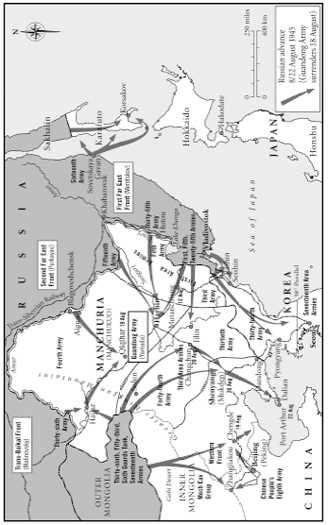
The Russian invasion of China, August 1945
In the north-west, as Sgt. Anatoly Fillipov’s vehicles approached the border at Atpor with their unit of the Trans-Baikal Front, a Soviet frontier guard waved enthusiastically: “Say hello to the Manchurians875 for me!” The central plain, where all the region’s important industries and commerce were concentrated, could be reached only by traversing great expanses of marsh, forest, mountains or desert. At H-hour in Oleg Smirnov’s sector, a T-34 with its lights on rattled past his infantry unit, slowed just short of the crest beyond which lay Manchuria, and fired its gun. “Immediately, hundreds of engines roared all over the steppe,” said Smirnov, “hundreds of lights blazed, and everything began to move.” The armoured columns met only isolated resistance from border posts. Pillboxes were quickly silenced. At dawn the tanks began to race forward across the Manchurian plain, dry riverbeds their roads, motorised infantry and fuel trucks in their wake. “Soon there was this crazy heat876 and dust—and no water.” Men developed nosebleeds from exhaustion and dehydration. They glimpsed lakes, rushed forward shouting with joy, only to perceive them as mirages. They passed their first dead Japanese without sentiment. “We knew it was necessary to finish the last battle of this great war.”
The Japanese had constructed fortified zones to protect recognised roads over the mountain passes, but they lacked men and materials to hold a continuous perimeter. In the first hours of the Soviet invasion, the defenders reacted with dazed bewilderment. It is hard to comprehend how the Guandong Army allowed itself to suffer such tactical surprise, when for years Tokyo had feared a Soviet invasion. Japanese officers knew of the huge deployment across the border. As so often in Japan’s high command, however, evasion of unpalatable reality prevailed over rational analysis of probabilities. Now, hasty staff meetings were held. A struggle began to evacuate tens of thousands of Japanese civilians and undertake belated demolitions. One Japanese commander led a convoy of trucks laden with evacuees and supplies to the Mudanjiang River, only to find that Japanese sappers had already blown the crossing, which proved too deep to ford. Eventually, soldiers and civilians alike took to their heels, throwing away weapons and baggage. Many artillery pieces were abandoned for lack of tractors.
Outposts reported by telephone that they were being overrun by “overwhelmingly superior forces.” A pitiful signal from one local Japanese commander on 10 August described how the hundred men of his kamikaze unit sought to stop a Soviet armoured column: “Each man of the Raiding Battalion’s 1st Company equipped himself with an explosive charge and dashed at the enemy. However, although minor damage was inflicted, the charges—seven to sixteen pounds—were not powerful enough to stop tanks.” The Japanese were astonished and dismayed by their first encounters with Soviet rocket launchers, the katyushas whose massed salvoes carpeted the paths of attacks.
Engineer assault groups of 1st Far Eastern Front were parachuted ahead of the ground advance, to seize intact tunnels and bridges on the vital eastern China railway. Most Japanese guards were stealthily dispatched with knives and clubs, but a few pillboxes offered resistance. After the tunnels were secured, Maj. Dmitry Krutskikh met a cart taking his casualties to the rear. He looked at one boy, no more than eighteen, obviously badly wounded, unlikely to live. Krutskikh asked: “Does it hurt?” The soldier said: “It does indeed, comrade officer, but I’ll fight again!” Krutskikh wrote long afterwards: “Sixty years have passed877, but still I remember that soldier’s voice and eyes. Those firefights were pretty rough.” The advancing Russians heard news of the atom bomb attack on Nagasaki. “To be frank,” said Major Krutskikh, “we had too much on our minds to pay much attention. And, of course, none of us could imagine the scale of destruction.”
ON THE MORNING of 9 August, the Guandong Army’s commander, Otozo Yamada, called on the palace of Emperor Pu Yi at Changchun. Yamada, a slight, moustachioed cavalry veteran of the 1905 Russo-Japanese war, was habitually solemn and taciturn. Now, crisis rendered him voluble. His assertions of confidence in victory were somewhat discredited by the sudden wail of air-raid sirens, followed by the concussions of falling Russian bombs. Emperor and general retreated to continue their conversation in a shelter.
Pu Yi, a hypochondriac prey to superstition and prone to tears, was consumed with terror that either the Japanese or Chinese would now kill him. A tall, gangling, immature creature of thirty-nine, for years he had indulged his sexual enthusiasms with a bevy of consorts and concubines, his petulant sadism by beating domestics. Under the Japanese, he enjoyed a much-diminished portion of the trappings of majesty. At his court, only ten eunuchs remained of the 100,000 who had served the Ming emperors, or of the hundreds whose quarters he liked to snipe at with an airgun in his earlier life as child-emperor. As nominal ruler of Manchukuo, Pu Yi signed official documents, death warrants and industrial plans without discrimination, earning the loathing of the Chinese people for his collaboration. His pages were recruited from Changchun orphanages, where they languished after their parents were killed by the Japanese. He was saluted as a head of state, yet in reality was merely Japan’s most prominent prisoner.
Now, the prospect of becoming a dead one threw him into ecstasies of terror. He began to carry a pistol day and night. On 10 August, a Japanese officer arrived at the palace to announce that the army was withdrawing south. The emperor must prepare to leave immediately for Tunghua. Pu Yi’s pleas secured a two-day postponement, but the Japanese said bleakly: “If your majesty does not go878, you will be the first to be murdered by the Soviets.” When the emperor demanded food, he was told that all his cooks had fled. On the night of 11 August, carrying in the baggage his dynasty’s sacred Shinto objects, the wretched little imperial party set off on a slow, faltering private train.
THE CHIEF PROBLEMS facing the Russians were those of terrain. Gunners dragged artillery pieces by brute force through marshes, while infantrymen discarded their rifles to help build tracks for the passage of heavy equipment. Troops of 1st Far Eastern Front ferried across the Ussuri River found themselves wading through chest-high swamps on the Manchurian shore. Engineers struggled to cut wire and clear minefields under torrential rain. Forest approaches were no more hospitable. “Between the trees, thick undergrowth created a carpet of thorns, each as long as a man’s finger and sharp as a sewing needle,” wrote A. P. Beloborodov. “These created hazards879 that could cripple an unwary man in minutes, gashing flesh and piercing the soles of boots…Streams and creeks were so swampy that even tanks as powerful and manoeuvrable as T-34s became bogged.” The Khalkin-Gol River at the southeast border of Manchuria was not more than sixty yards wide and four feet deep, but its racing current overturned trucks and gun tractors. The Russians solved the problem880 in characteristic fashion, by deploying across the flow a line of Mongol cavalry on their shaggy ponies, riders locked knee to knee. Infantry then waded across upstream of them, gripping the beasts’ manes to keep their footing.
Everywhere, the Soviets forced passages. Again and again they confounded enemy strongpoints built to cover roads by cutting across open country. Japanese suicide troops—smertniks, as the Russians called them—launched raids by day and night against sappers clearing minefields and in the attackers’ rear areas. But these could do nothing to halt the relentless advance. A Soviet account described a rare set-piece action, near Zixincun:
The road widened somewhat881, but nevertheless only two tanks could advance abreast, almost locked together. We glimpsed wooden peasant huts ahead, and heard explosions as Japanese anti-tank guns opened up from the high ground. The column halted to return fire. Some tank crews found ways to bypass the road across country, and broke through to the strongpoint. Fighting became general. Tank engines raced amid a tangle of trenches, pillboxes, dugouts and gun positions…Japanese shells often struck home, while huts and grass caught fire. For more than an hour, our forces experienced perhaps their bloodiest battle since the campaign began. Finally the enemy faltered. [We could see] hundreds of retreating Japanese dotting the hills and marshy stream beds. The tanks raced after them.
A Japanese account described suicide teams leaping out from the roadside to attack the foremost Russian armour, while anti-tank guns attempted to knock out the rearmost and block the road. “Yet even when tanks were hit882, the damage was slight, for our shells were not armour-piercing,” recorded a despairing officer. “The enemy calmly carried out repairs in full view of our lines, his arrogance mocking our impotence…We noticed that some tank crews included women.” At 0900 on 14 August, a Japanese divisional commander received a report from a position in the Central Sector, delivered by a horseman in the absence of radio or phone links: “Because of the difficulty of holding883 our positions, the regiment will launch a counterattack behind its colours. This may be our last report.”
During the first days, Japanese aircraft offered sporadic resistance. Soviet pilot Boris Ratner’s wing884 began the campaign full of apprehension, given the historic reputation of the enemy’s air force, but quickly found its confidence soaring. One Russian flier was lost on his first ground-attack sortie, none thereafter. Pilots struck repeatedly at Japanese troop and vehicle columns. Anti-aircraft fire occasionally holed Russian planes, but brought down scarcely any. A handful of Japanese reconnaissance aircraft were destroyed wherever they appeared. The Russians were surprised to discover that most enemy airfields contained only dummy planes. They began to perceive how feeble were the defences of Manchuria.
The Japanese high command quickly wrote off its own frontier outposts, and set about creating shorter defensive lines well to the rear. This policy was realistic enough, but became hopelessly compromised when Guandong Army headquarters attempted simultaneously to reorganise its formations. Many officers were left uncertain to whom they were reporting, never mind what they were supposed to hold. They lacked time and mobility to redeploy effectively. Some units were still trying to move to new positions when the war ended. “Many Japanese lacked the will885 to fight hard in Manchuria—they knew the war was lost,” said Chinese historian Wang Hongbin. “A million defenders sounds a lot, but these troops had never been obliged to fight a modern enemy such as the Russians were, fortified with all the experience of their campaigns in Europe, and with very strong air support. The Russian war machine was incomparably more advanced, and the Japanese could enlist no local assistance.”
RUSSIAN TANK columns advanced ninety-three miles the first day across the desert facing the western Trans-Baikal Front. Some units became lost, disorientated by the great dust clouds they threw up. “Units advanced from hill to hill886 under the blazing sun, their men rejoicing at each breath of breeze,” wrote Col.-Gen. Liudnikov Doroga. “The hills seemed endless, and made distances deceptive…Daytime temperature reached ninety-five degrees, and medical officers became alarmed by the threat of heat stroke. Men knew that snatching at a waterbottle only intensified thirst. They endured. Vehicles did not. Engines overheated and radiators boiled. At last, the Grand Hinggang loomed…The mountains were bathed in silence. We had got there before the Japanese, and must scale them at once.”
Lt. Alexander Fadin of 20th Guards Brigade said: “We were completely exhausted887 by the heat and the struggle to overcome so many natural obstacles. When the order to halt came and we climbed out of the tanks, men could hardly stand up.” Each division reported thirty to forty heat-stroke cases a day. Flimsy canteens cracked, leaving their owners dependent on more fortunate comrades to assuage thirst. “When we found a well, we had to draw water from thirty or forty feet down,” said Stanislav Chervyakov. “It was ice-cold, and after drinking some men suffered agonies from twisted guts. Several died. We learned that it was essential for officers to get to wells first and carefully supervise men’s drinking. It was an incredibly wild country. We scarcely saw any Japanese. We had been told to expect attacks from their guerrillas, but there were none. We were shocked by the poverty of the Chinese. Their mud huts were such a contrast to what we had grown used to in Europe. Whatever our ranks, they called us all ‘Kapitana’!” The 59th Cavalry Division faced special difficulties888, needing water for its ponies and lacking means to carry much. Its commander detailed a special squadron to ride ahead, identifying and securing wells on the line of advance.
Sgt. Georgy Petryakov’s principal anxiety was not to get himself killed. He had survived four years of war, spent partly on the German front and partly on garrison duty in the east. Now he had applied for Communist Party membership, that passport to all good things in Soviet life. He wanted to be around to enjoy them. “I could never have believed889 such a climate possible—thirty degrees below freezing in January, a hundred degrees in August.” He hated everything he saw of the parched countryside of Manchuria, including the inhabitants whom they had come to liberate: “What hypocrites the Chinese were! Grinning, bowing, fawning on us,” he said in disgust. Yet he was still more repelled by the contempt with which Japanese, even as prisoners, treated Chinese civilians.
Before dawn on 11 August, 39th Army began to force a path up the steep ascent of Grand Hinggang. The Japanese deemed it impassable, and thus had done nothing to fortify the crests. Even small forces covering the approaches would have immensely complicated the invaders’ task. As it was, however, the Russians fought only the mountains. T-34 tanks took the lead—American Shermans were less rugged, and used more fuel. In places, tracks were barely ten feet wide, traversed by streams and gullies, each one of which had to be bridged. Some units found their advances blocked by rock walls. Then heavy rain fell, and the wheeled vehicles thrashed helplessly. “At first, we were so thrilled890 by the rain,” said Oleg Smirnov, “and afterwards, how we learned to curse it!” Soldiers have better cause than other men to hate foul weather, for they can seek no refuge from it. Flooded mountain streams pushed great boulders downhill. Soldiers compared the lightning to the flickering of a katyusha barrage. Men laboured to push and pull stranded trucks through the mire—they later asserted that they got their vehicles up Grand Hinggang by “fart power.” Sometimes a truck slipped off a precipice and sailed into space, to shatter far below. Even in daylight, the low cloudbase forced vehicles to use lights.
On the mountain ascent, engines revved in frenzy as tracks slipped on wet rocks, tanks skidded into deep mud. “Even experienced drivers shook their heads as they gazed up the hills,” said Alexander Fadin. His own tank made three attempts on the highest pass, before negotiating it by linking three T-34s with steel cables. Lt. Stanislav Chervyakov, who had been so careless about his assignment to Manchuria when the campaign began, found himself a much less happy soldier amid the defiles of Grand Hinggang. He and his men had to off-load crates of katyusha rockets, then haul their big, heavy Studebaker trucks up the mountain on ropes, by main force: “It was hopeless terrain for us, and there was nothing for the katyushas to do.”
The descent on the far side of Grand Hinggang proved more hazardous than the climb, with tanks careering uncontrollably down steep, slippery defiles. There were constant breakdowns, and still no respite from the rain. At last, the tank crews heard firing ahead. It was their reconnaissance unit, engaged with the Japanese in the town of Lupei. The brigade hastened forward, to find the defences already crushed. They drove curiously past the Japanese positions, noting pole charges lying beside the enemy’s dead. A disappointed voice said on the radio net: “We’re too late again891.” That evening of the twelfth, some tanks ran out of fuel. “How’s the milk situation?” the battalion commander enquired by radio, in primitive code. Fadin responded that most of his company had only enough diesel for a further twenty or thirty miles. They were ordered to give all but a few litres to their brigade’s first battalion, which would keep moving. Next morning, their own tanks were resupplied by transport aircraft which landed in a neighbouring field and off-loaded drums. Soviet aircraft humped to the spearheads 2,000 tons of fuel and seventy-eight of ammunition.
If a tank broke down, it was taken in tow by another. On the plain, the armoured column found that the Japanese had blown dams, flooding huge areas. The only passable line of advance lay down a high, narrow railway embankment from Tunliao to Chzhaniu. With their crews feeling acutely vulnerable, a procession of tanks began to bump along the line. Vibration caused breakdowns and track breakages. Cripples were rammed aside into the waterlogged paddies. A lone Japanese kamikaze aircraft destroyed a T-34 and several soft-skinned vehicles. At last, however, the Russians found themselves back on solid ground, and racing forward.
Some Japanese cavalry put up a fight, but many defenders chose to surrender—1,320 prisoners were taken on the evening of 14 August. Russian veterans of the European war cried “Hande hoch!” to enemies who appeared willing to quit, for they knew no words of Japanese. The commander of the Manchukuo 10th Military District arrived in the Russian lines to surrender, at the head of a column of a thousand Chinese horsemen. Though isolated strongpoints held out, most were bypassed. Sixth Guards Tank Army advanced 217 miles in four days, its chief impediments a shortage of fuel for vehicles, water for men. On 19 August, Soviet aircraft landed at Shenyang (Mukden) and Changchun to seize the cities’ airfields. Two days later they met their brethren of the armoured columns, arriving overland.
The men of 1st Far Eastern Front found themselves advancing through a maze of wreckage left behind by Soviet bombardment and air attacks: dead men and horses, papers and photographs fluttering loose on the wind, burnt-out vehicles and debris trampled into the mud. The stench was indescribable892—a blend of death and excrement, burnt rubber and bloated animals. Victor Kosopalov’s regiment was briefly checked by a bee swarm. Gunfire had wrecked the creatures’ hives: “They went mad and stung893 everyone until they were tranquillised with smoke candles.”
LI DONGGUAN and his Soviet-sponsored reconnaissance team were working behind the enemy lines as so often before, in the city of Dongan, pinpointing Japanese positions and reporting by radio to their base. Within days they were overrun by the Russians, and the remaining Japanese threw down their arms. Li, in Russian uniform, suddenly found himself confronted by Japanese with their hands held high, bowing in abject submission. “They deserved everything894 they got,” he said laconically. “Nobody had asked them to occupy our country.”
Jiang De was among a contingent of Soviet-trained guerrillas who were suddenly mustered at their forest base in eastern Russia on 8 August, to be told: “You’re off.” They were taken to an airfield, where sixty Chinese in fifteen four-man teams were loaded aboard three transport aircraft, with strict orders that none were to discuss their destinations with others. Then they took off for Manchuria. For Jiang’s group, there was an alarming problem. By a characteristic piece of Soviet carelessness, while most of their comrades had received parachute training, they had not. Appalled by the prospect of making their first jump onto a battlefield, they sought to console themselves with the thought that they would play a prominent role in the liberation of their country.
Two hours later, they hurtled into the darkness over Manchuria. Jiang and two of his comrades were lucky enough to survive intact. At first light they contacted local peasants who told them that their fourth comrade had been less fortunate—his corpse lay in the fields. Jiang made radio contact with his Russian base. He was told that it was vital to find the body of their companion, to recover his maps and papers. The peasants led them to the place where he had landed. Sun Chengyu had been a good friend of Jiang. Now, “his corpse looked a shocking mess.” The static line of his parachute had snapped when he jumped, and the canopy never opened.
The three survivors, two in Japanese uniform and one in civilian clothes to meet alternative eventualities, set about their business—reporting troop movements and inciting local people to make trouble for the enemy. At lunchtime on 11 August, only a few hours after their landing, peasants reported that a platoon of Japanese had arrived in their village, and were demanding food. “Give it to them,” said Jiang. “Try and get them together in one place. Then, when you’ve got them all eating, find somewhere to hide.” The Japanese were wholly unsuspecting when the three Chinese burst into the hut where they sat, and opened a murderous fire with sub-machine guns. When the first magazines were spent, only four or five wounded Japanese still moved. The Chinese reloaded, finished off the cripples, then left the peasants to carry off the corpses in carts to be thrown into the nearby river.
“We felt really pleased with ourselves,” said Jiang. “The Japanese had killed so many of our people that it felt wonderful to even the score.” They summoned all the villagers they could find, announced who they were, proclaimed that the Japanese were finished, and invited local people to help them to gather information. The young Chinese agents threw away the Japanese uniforms in which they had jumped, replacing them with Russian tunics. Their mission enjoyed one more moment of excitement: on 14 August they spotted a column of Japanese withdrawing from the nearby town of Mudanjiang, and reported this by radio to their base. When a devastating Russian air strike hit the road soon after, they liked to believe that their signal had prompted it. After the attack the agents went down to the road, gathered all the Japanese weapons they could find among the bodies and wreckage, and distributed them to peasants. Next morning, they met a column of advancing Russian infantry “who gave us a great welcome895.” The three Chinese were dispatched by jeep back to their headquarters in Russia.
IN SOME PLACES there was heavy fighting. “This was no country stroll896,” said tank officer Alexander Fadin. “The samurais resisted desperately, especially during the first week. All those stories about Japanese suicide soldiers proved to be true.” Radio operator Victor Kosopalov’s unit approached a pass between two ridges, and suddenly came under fire from the high ground. Everybody dashed for cover, and from behind a rock Kosopalov watched curiously as bullets severed scrub branches over his head and struck sparks off stones. Eventually an officer gave him the coordinates of the Japanese position, which he passed in plain language to divisional headquarters. After a long pause, artillery fire deluged the Japanese. When at last the Russian infantry rose and advanced warily onto the high ground, they met no further resistance. On the summit they found897 a few Japanese corpses. Kosopalov was struck by the sight of an abandoned field kitchen, still steaming and full of boiled rice. They marched on.
Early on 13 August, Japanese general Yoichi Hitomi of the 135th Division approached the city of Hualin by rail with his staff and reinforcements, only to see the bridge across the Mudanjiang River blow up in their faces. Russian tanks began to shell the stranded train while some men jumped in the river and attempted to swim to safety. Hitomi and his men eventually found a way into Hualin on foot. He took command and for several days repulsed repeated Russian attacks.
Sgt. Anatoly Fillipov’s first intimation of resistance from the Japanese garrison at Hailar came when his battalion glimpsed a flock of sheep in the fields, as it advanced towards the town on the evening of 11 August: “Suddenly the sheep were shooting898 at us: ta-ta-ta-ta! Japanese soldiers had worked their way in among them. They killed six of our men, which caused a bit of a panic.” The Russians called down artillery fire on the Hailar defences, which included a deep anti-tank ditch and lines of trenches anchored to pillboxes. Sappers crawled forward to lay charges on the Japanese emplacements. As these exploded, infantry ran up and fired point-blank into the embrasures.
Yet still the attackers could not break through. “Japanese mortar and machine-gun fire was so heavy that we hardly dared raise our heads,” said gunner forward observer Dashi Irencheev, whose corporal was killed beside him. “On the evening of 15 August899, at about 1700 a battalion of samurais—kamikazes—rushed at us shouting ‘Banzai!’ brandishing their swords, tunics unbuttoned and sleeves rolled up. Our gunners wasted no time, and killed half. Then our infantry counterattacked, and overran them. Not one retreated or surrendered. Some wounded samurais killed themselves. The field was littered with bodies.” Soon after, a Japanese mortar bomb landed beside Irencheev, so close that he was concussed and deafened. He was eventually dug out by comrades with blood running from his ears. The Japanese in Hailar held out against artillery fire and infantry assault until 18 August, when 3,827 survivors surrendered.
The Russians learned the hard way the importance of protecting their rear echelons. A medical company of 3rd Rifle Division was bivouacked on the night of 14 August when a kamikaze force stormed its positions. The weary Russians were asleep. Japanese were already dragging doctors and nurses out of a vehicle when the alarm was given. After a brief firefight the enemy retreated, taking with them three nurses. Their mutilated bodies, hacked to pieces, were found nearby. This episode, declared an angry Soviet report, was due to “criminal carelessness900” by the officers responsible for ensuring their unit’s security. A platoon of sub-machine gunners was detailed to provide protection for the medical team.
A key reality of the Manchurian campaign was that the defenders possessed no means of shifting forces in the face of total Russian air superiority and their own lack of vehicles. They were also critically short of anti-tank guns. Yet where the Russians were obliged to attack painstakingly constructed defensive positions, the Japanese resisted stubbornly and inflicted substantial losses. In the east, at the heavily fortified road junction of Mudanjiang, two Japanese divisions fought for two days against 1st Far Eastern Front. A Japanese soldier described the action there on 15 August:
As soon as our anti-tank guns901 had been silenced, about thirty enemy tanks appeared in front of 278th Regiment’s main positions. They opened fire, inflicting heavy casualties, picking off the defenders one by one and destroying our heavy weapons…At about 1600 hours the regiment’s telephone link with divisional headquarters was cut. Four enemy tanks were destroyed and five damaged. Soon afterwards, fifteen more tanks appeared in front of the division command post. A squad of five men from the Transport Unit, each armed with a 15-kilogram charge, launched a suicide attack on the leading elements, each man destroying one tank. On seeing this, the rest of the enemy armour hastily made off towards Sudaoling, and their accompanying infantry were also routed.
The respite persuaded the Japanese divisional staff to abandon plans for a final “banzai” charge. They maintained a conventional defence for a time, hampered by the fact that their phone lines were cut and radios almost non-existent. On 16 August, a certain Major Ueda of the 278th Regiment arrived at headquarters before dawn to report that the rest of the division had withdrawn. His commanding officer, Colonel Hajma Yamanaka, said simply: “I shall die here902. I shall not withdraw in the absence of an explicit order.” A few hours later, an overwhelming Russian tank and infantry force attacked their positions. At noon, Colonel Yamanaka respectfully bowed to the east, burned the regimental colour, rallied his survivors and led a counter-attack. When this failed, he and Major Ueda committed hara-kiri. Japanese accounts asserted that the capture of Mudanjiang cost them 4,000 dead, while the Soviets claimed 40,000. The truth is probably somewhere in between. The Red Army reckoned that this one battle accounted for half its total losses in Manchuria, including scores of tanks.
The city was cleared only on the evening of 16 August. Many Japanese never learned that they had been ordered to withdraw, and fought to the death. Over-ambitious Soviet spearheads, racing ahead, suffered severely from local counterattacks, but by 20 August they had reached Harbin. Organised resistance in North Korea, overrun by 1st Far Eastern Front, ended on 16 August. Some Japanese units, however, continued fighting for a further ten days. The Russians were grudgingly impressed by the fashion in which enemy strongpoints refused quarter, and had to be reduced by piecemeal bombardment and infantry attack. In the words of David Glantz, foremost Western historian of the campaign: “The defending troops in the Japanese fortified regions903 put up a tenacious, brave yet meaningless defense…Garrisons fought to the point of exhaustion or extermination.”
BOTH WITHIN and without Manchuria, the Chinese received news of Stalin’s onslaught with mixed feelings. In the first days, local people greeted the Russian armies enthusiastically. Victor Kosopalov’s unit was delighted to be met in each village by peasants proffering buckets of springwater: “It was so hot904 and we were so thirsty—this was the most welcome delicacy they could have given us.” Russian soldiers contemplating a flooded torrent were amazed when Chinese on the far bank leapt into the river and swam across to meet their liberators, carrying ropes to facilitate a crossing. Thousands of others went to work alongside Soviet sappers, repairing dams blown by the Japanese. Peasants gave warnings of ambushes. “When we entered the city of Vanemiao905,” said Oleg Smirnov, “the Chinese welcomed us with cries of ‘Shango!’ and ‘Vansui!’—‘10,000 years of life to you.’ They were waving red flags and almost jumping onto our tank tracks.” In reality, local people were most likely crying “Zhongguo wansui!”—“Long live China!”—but Smirnov and his comrades were not to know that.
On the Pacific coast, Russian naval infantry launched amphibious assaults to take the towns of Unggi and Najin on 11 and 12 August, and at Chongjin four days later. Even after the defenders were forced out, many continued fighting in the surrounding hills. Units of the Soviet 2nd Far East Front still faced heavy counter-attacks on 15–16 August. Russian warships found themselves duelling with an armoured train ashore. Fighting for Chongjin ended only late on 16 August, when troops of the Russian 25th Army arrived overland to meet the naval infantry.
The emperor Pu Yi’s train approached Meheguo on 12 August. The Guandong Army’s commander, Yamada, boarded the imperial carriage to report that Japanese forces were everywhere victorious. His assurances were immediately belied by the spectacle of crowds of screaming Japanese fugitives of all ages and both sexes, brawling soldiers and police, at Jelin station. Next day, the emperor arrived at Dalizikou, a coal-mining community set among beautiful mountains. Here, through two days of terror, Pu Yi and his bedraggled little party waited on events, and his fate.
It was plain that Japan was defeated, but it seemed much less obvious what would follow. “Most of us knew that Stalin906 was doing this for his own reasons,” said Chinese Nationalist captain Luo Dingwen. “We had no reason to love or trust the Russians.” Xu Guiming was a Chinese clerk at the Japanese Propaganda Bureau in the town of Aihni, on the Manchurian side of the Amur River, now in the Soviet 2nd Far Eastern Front’s sector. He lived a few hundred yards from the office building, in a courtyard occupied by three families. There was his own, and that of Zeng, another clerk in the Propaganda Bureau. The third family was that of their landlord, a rich Muslim named Mr. Chen who owned ten cows and was customarily so deep in an opium-induced stupor that events of war and peace passed him by. On the evening of 9 August, a telephone rang in the courtyard. It was the Propaganda Bureau. All its employees were to report to the office immediately, to receive vital news.
Xu reached the squat three-storey building to find Japanese scurrying hither and thither with piles of documents, which they were hurling onto a huge bonfire. Inside, the staff assembled. The director announced that he had received information that Russian forces had crossed the border into Manchuria. Everyone must leave the town by next afternoon. The Japanese staff bowed their heads in abject misery. Xu felt no emotion, for nothing about his employers commanded his sympathy. They all queued to receive three months’ salary apiece, then returned home as their workplace was put to the torch.
In the courtyard, Xu found his neighbour Zeng exploiting his ownership of four ponies to flee with his wife, children and what little they could carry. Xu discussed the situation with his own family, which included a brother and assorted children. They decided to seek shelter nearby. By the time they had taken themselves into the fields, darkness had fallen. Exhausted, they huddled together into a slumber which lasted well past dawn. Daylight revealed that while about half Aihni’s 20,000 population had fled further afield, many inhabitants like themselves had chosen to remain, watching events which soon unfolded. A procession of Soviet gunboats appeared, steaming steadily downriver. They opened fire, raking the shoreline and pouring shells into the nearby railway station. To and fro the guns ranged, killing an old woman and a cow not far from Xu. Then, as Russian marines began to storm ashore, the head of the local labour union advanced to meet them. “Welcome to the north-east,” said this rather brave Chinese. He told the Russians that all the Japanese had gone, and that there were no weapons in the town. Some 4,000 Japanese troops held out nearby, however, surrendering only on 20 August.
THE DAYS and weeks that followed the Russian occupation were a brutal shock to the “liberated” people of Aihni. They witnessed their share of the orgy of rape and destruction which overtook Manchuria. On 13 August, Xu Guiming saw two Russian soldiers accost in the street a local girl named Zhang—half-Russian, half-Chinese, like many people of the region. “We reckon you owe us one,” they said, throwing her to the ground. One man held her down while the other bestrode her, and a ghastly little drama took place. Zhang fought fiercely, throwing aside her rapist. This caused the other man to unsling his gun and shoot her. His careless bullets also killed his comrade, however. The occupants of a passing Russian vehicle, seeing what happened, themselves unleashed a burst of fire which killed the murderer. Three corpses were left unheeded in the street.
Xu did not himself witness another local incident which became notorious. A Russian burst into the home of a local policeman, Mr. Su, who was sitting with a man friend and his twenty-year-old wife, newly delivered of a baby. The Russian brusquely ordered the men out, and raped the girl. When he emerged, the outraged Chinese seized and bound him, then thrust him down their well. This incident rendered the avenging Chinese briefly famous, and a local hero. However, when the Communists soon afterwards took control of Aihni, Su was arrested for killing the Russian, “our ally,” and summarily shot. His raped wife was denounced as a counter-revolutionary, an outcast, and forbidden ever again to marry or receive the protection of a man.
Xu said bitterly: “This was not justice907. Everyone was sickened by the things that happened. The Russians were supposed to be our liberators, our brothers, but we quickly learned to regard them as enemies. They masqueraded as revolutionaries, but in truth they were no more than wolves.” Xu himself was fortunate to escape retribution for his time working for the Japanese. “I was too unimportant a person,” he shrugged. Like millions of Manchurian Chinese, he now found himself witnessing a drama on which the curtain would ring down in accordance with Moscow’s timetable, not that of Tokyo or Washington.