
Chapter 10
By 27 March Operation VARSITY was coming to an end paving the way for the next phase of Montgomery’s plan, Operation PLUNDER. The German troops facing 17th Airborne Division were at breaking point and as more tanks and artillery moved onto the east bank of the Rhine, it was only a matter of time before General Miley broke free into open country. 30th Division was still making steady progress in Staatsforst Wesel and while one of its Regiments had already broken free from the northern corner, another had reached the south-east perimeter. To the south 79th Division was preparing to expand the bridgehead towards the Rhine-Herne Canal to make room for 35th Division to enter the line. It was only a matter of time before First Parachute Army’s line snapped.
17th Airborne Division
6th British Guards Armoured Brigade had joined 513th Regiment in reserve during the night and after the trials of the past few days Colonel Coutts’ paratroopers were looking forward to acting as mounted infantry. However, before the advance to Dorsten could begin, the rest of the division had to push beyond the Paris and Detroit lines and clear the road through Schermbeck.
Yet again the German rearguards were unable to stop the 507th Regiment’s coordinated attacks and before long Colonel Coutts instructed 2nd Battalion to mount up and lead the rest of the Regiment towards Schermbeck. The column of Shermans and Hellcats reached the Paris Line at the far side of the town by mid morning and as 1st Battalion followed behind, they found that the Germans had abandoned the ruins. By nightfall 507th Regiment had reached the Detroit Line and after four days of hard fighting it appeared that the paratroopers had finally broken First Parachute Army’s line; the armoured column could attack at dawn.
30th Division
As it began to grow light groups of Panzergrenadiers, bypassed during the night, were rounded up in Staatsforst Wesel and in 117th Regiment’s sector bazooka teams had to hunt down a Stug III still operating behind its lines.
As General Hobbs’ men consolidated their positions and prepared to advance out of the forest, 116th Panzer Division struck back at 117th Regiment’s sector. At 10:00 hours two tanks and a company of Panzergrenadiers emerged from Besten village (Objective Jo-Jo) and attacked 2nd Battalion. An hour later the main body of tanks and halftracks broke free from Gahlen and headed for 3rd Battalion’s positions. Overcast skies meant that the Panzers could operate in the open without having to worry about air attacks and Colonel Johnson was left hoping that 118th Field Artillery Battalion could keep the Germans at bay. 117th Regiment’s Signal Journal records the tense moments as 116th Panzer Division made its final attempt to contain 30th Division in Staatsforst Wesel:
12:05 3rd Battalion says they are receiving heavy small-arms fire and direct fire in their area.
12:10 Enemy infantry approaching Objective Jo-Jo; have placed artillery in their path. Also, there are tanks in position blocking that approach in case of any enemy armour.
12:15 Enemy infantry and tanks approaching from the northeast, between Objective Jo-Jo and Objective Marie; they are keeping us busy now.
12:45 One enemy Mark V tank withdrawing north out of Marie.
13:00 One enemy tank between Jo-Jo and Checkpoint 5, situation clearing up some but still having trouble in northeast sector of Marie.
13:25 Enemy infantry moving northwest out of Jo-Jo on Highway 1.
13:40 Things clearing up in northeast sector of Marie and enemy making withdrawal to northeast.
The American howitzers and mortars had dispersed the Panzergrenadiers, leaving the tanks vulnerable to bazooka teams; they soon withdrew to safety. Company G’s commanding officer later recalled that the barrage had been the heaviest he had ever witnessed and his men agreed with the following statement:
I’ll give the artillery credit for keeping the remainder of the enemy from attacking.
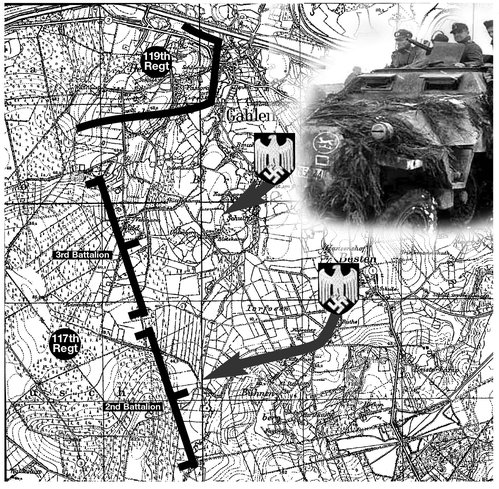
116th Panzer Division’s final counter-attacks against 117th Regiment. Inset: Half-track with the Windhunde (Greyhound) emblem of the 116th Panzer Division on the front.
As the attack on 3rd Battalion subsided, a second column of Panzers and halftracks headed for 2nd Battalion’s sector. Following a warning from the Piper Cub artillery observer plane circling overhead, Colonel Johnson had sent three Sherman tanks to the danger point but the crews missed 2nd Battalion’s guides and drove straight through the American lines towards the approaching Germans. Two tanks managed to return to 1st Battalion’s lines but the third was captured and turned against the GIs. Yet again it was down to 118th Field Artillery Battalion to keep the Germans at bay and by nightfall the danger had passed; 117th Regiment had weathered the storm.
On 120th Regiment’s front 3rd Battalion expanded its perimeter along the edge of the forest, contacting 1st Battalion, and by mid morning another section of Staatsforst Wesel had been cleared, however, it had not gone unnoticed. Shelling intensified as the GIs dug in and a lone Stug III moved close to threaten 3rd Battalion. Private Leake took the initiative and ran forward, using rifle grenades to force the assault gun to withdraw; eventually he struck lucky when a grenade penetrated the machine’s engine and forced the crew to bail out as it burst into flames.
As the GIs consolidated their perimeter and looked forward to moving into reserve, General Hobbs sent through new orders to 120th Regiment. Although the men had been in action for four days without a break, Colonel Purdue had to take one more objective before turning his sector over to the 8th Armoured Division. He wanted three hamlets covering the approaches to Kirchhellen clearing before the tanks moved forward and the attack was planned for later that night. In the meantime Purdue instructed Major McCullough to cut the Besten road on the Regiment’s north flank to guard against German counter-attacks from the direction of Gahlen.
Lieutenant Shaw’s platoon from Company I climbed on board a platoon of tanks and two tank destroyers and at 10:00 hours the small armoured column raced across the fields drawing fire from all directions as it reached the Kirchhellen road. Realising what Shaw was trying to achieve, the Panzergrenadiers counter-attacked from every direction, destroying the tank destroyers, two of the tanks and killed or wounded twenty-four of Shaw’s men. The survivors held on until nightfall, severly restricting the Panzers’ movements.
Company K tried to come to the aid of the beleaguered platoon but a damaged bridge and mines prevented the tank moving forward leaving the infantry exposed to heavy fire from Besten village. Once again low mist prevented McCullough calling for air support and as his men withdrew General Hobbs realised that the capture of Besten could wait until 119th Regiment had moved up behind the village.
On the north flank of 30th Division’s front 119th Regiment was heavily engaged along the south bank of the Lippe Canal as 60th Panzergrenadier Regiment tried to breakout from Gahlen. Colonel Baker’s men had spent the night fighting for their lives in the village but the arrival of tanks and tank destroyers at first light turned the tide in 1st and 3rd Battalions’ favour. The GIs and Shermans battled the Panzergrenadiers and their Panzers throughout the morning but as the hours passed, one street after another fell into American hands.

Sherman tanks roll forward once again after defeating another counter-attack.
This Sherman had to be pushed off the road into a shell crater after it had been disabled, to make way for other vehicles.

With the 17th Airborne Division closing in on Schermbeck north of the Lippe, there was no chance of retiring north of the river, and the way into the woods blocked by 119th Regiment, the Germans were only left with one option, a break out to the east. The Panzers withdrew first, taking up positions on high ground overlooking Gahlen to the east, and gave covering fire as the Panzergrenadiers withdrew towards Dorsten. By midday on 27 March, Objective Hubert was safely in 119th Regiment’s hands.
On 120th Regiment’s front Colonel Purdue had spent the day preparing to capture Objective July, the three hamlets along the ridge overlooking the approaches to Kirchhellen. 2nd Battalion had been chosen to make the attack and Lieutenant Colonel Cantey’s three Companies were detailed to seize Ekamp, Janinhof and Holthausen in turn, while Company K from 3rd Battalion secured the main crossroads to their rear. After the success the previous evening on Besten airfield, Purdue had arranged for a mile wide smokescreen box to protect the troops. Once again the GIs were to break through the German lines in a cloud of smoke.
As it began to grow dark, artillery and mortars started to shell the hamlets. Company G moved into position facing Ekamp on the left, while Company F deployed opposite Janinhof and Company E prepared to advance against Holthausen on the right. Columns of tanks and tank destroyers moved up ready but, as they were confined to the roads by the poor ground conditions, the infantry would probe the German defences on their own. The tanks would wait until the roads were clear. As the final preparations were made and zero hour approached, the artillery switched to smoke creating a huge ‘U’ shaped wall of smoke around Objective July.
The signal to move out was given at 21:00 hours and as Lieutenant Colonel Cantey’s men advanced down the slopes towards Kirchhellen, German artillery fired blindly into the smoke. Company G came under machine-gun fire as it approached Ekamp but while the rest of Captain Montcrieff’s men hit the dirt, Private Cashion ran ahead with his machine gun and fired on the Germans’ flank. Cashion’s actions distracted the enemy long enough for the squad leaders to kick their men into action and thirty prisoners were taken in the charge that followed. Ekamp was taken soon afterwards and the tanks and tank destroyers rumbled forward to join Montcrieff’s men on the slopes overlooking Kirchhellen.

120th Regiment clears the road to Kirchhellen.
A mobile flak gun engaged Company F as it moved towards Janinhof but the vehicle withdrew as Captain Jacobsen’s men moved closer to the hamlet. Company E also came under fire from flak guns as it approached Janinhof and the new commander, Lieutenant Guy E Hogle, was forced to rally his men several times. After knocking out one halftrack, Company E encountered a Panzer IV covering the approaches to the village. It was time to call up the armour but as the radio failed at the critical moment, Lieutenant Hogle decided to take on the Panzer with rifle grenades while Lieutenant William Barenkamp went to the rear to contact the tanks.
Hogle began to stalk the tank as the rest of the Company gave covering fire and before long he hit the Panzer’s engine with a smoke grenade, blinding the crew inside. A bazooka team came forward, firing two rounds into the Panzer’s tracks to disable it, and forced the crew to bail out; it had been a sharp lesson in anti-tank warfare. Soon afterwards the American armour pulled up alongside Company E and followed Lieutenant Hogle’s GIs into Holthausen; by 03:00 hours the road forward lay open.
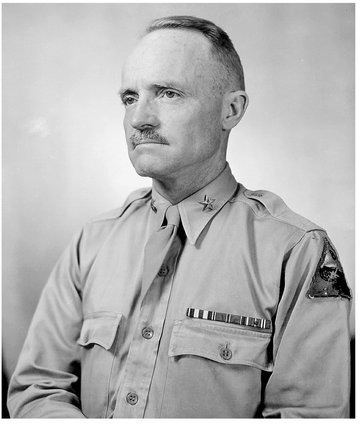
Brigadier General John Devine and the 8th Armoured Division had to wait in reserve until 30th Division had broken free of the forest. 111-SC-197518
As 120th Regiment cleared the ridge overlooking Kirchhellen, 117th Regiment moved into Besten, finding it clear of German troops, 116th Panzer Division had withdrawn from the outskirts of Staatsforst Wesel. The time to unleash 8th Armoured Division had arrived and the Thundering Herd was on the move.
79th Division
27 March marked the start of the second phase in General Anderson’s plan for expansion on his southern flank. With 30th Division on the verge of clearing Staatsforst Wesel, XVI Corps needed more space to deploy 35th Division on the east bank of the Rhine and General Wyche received the order he had been waiting for during the early hours; he could advance south to the Rhine-Herne Canal.
The advance started before dawn and 313th Regiment moved quickly towards the canal, through drab villages surrounding huge factories and refineries. 2nd Parachute Division had abandoned the area between the two canals but Colonel Bibber’s men soon found to their cost that the paratroopers had been digging in on the south bank of the Rhine-Herne Canal for the past forty-eight hours.
Outposts spotted 2nd Battalion as it approached the canal and as the GIs regrouped, German engineers blew the bridges and the infantry opened fire from the embankment beyond. The way forward was blocked but on 1st Battalion’s front Colonel Bibber had more luck. GIs rushed one bridge before the German engineers realised they were under attack, and set up a defensive cordon on the far side of the canal. General Wyche was delighted to hear that he had a bridgehead and as 315th Regiment moved up alongside 313th Regiment his staff began to plan how to exploit the coup.
314th Regiment faced stiff opposition as it attacked Holten and Wehofen (codenamed waffle-iron town due to the regular criss-cross plan of its streets) on the left of 79th Division’s front for although organised resistance had collapsed, groups of fanatical soldiers and civilians continued to fight on. Snipers fired at unwary GIs while Panzerfaust teams crept through the ruins in the hope of catching a Sherman tank unawares. Progress was slow and from time to time the alarm was raised when a lone German tank was spotted lurking around one of the factories.
Teams armed with anti-tank weapons, the Panzerfaust and the Panzerschreck, (German version of the bazooka), hunted down the American tanks as they cleared Wehofen and Holten.

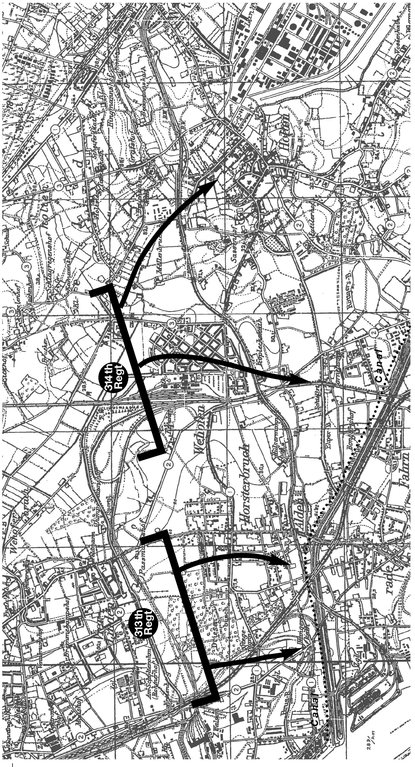
79th Division’s advance to the Rhine-Herne Canal.

The highly effective, one shot Panzerfaust.
A Sherman edges forward after firing shells into a German held house.

2nd Battalion’s patrols found machine-gun posts covering the Dinslaken railway on the Regiment’s left flank and 717th Battalion’s tanks found it difficult to manoeuvre through the ruined villages and industrial plants. Panzerfaust teams knocked out two of Company B’s Shermans and two others were bogged down as they tried to find a way forward to support the infantry. Meanwhile, an early breakthrough on 3rd Battalion’s front turned out to be a trap. German troops held their fire until Company G had crossed the railway and were advancing across the open ground beyond before opening fire from the oil refinery east of Holten. It took several hours to recall the company but by moving through 315th Regiment’s sector, Colonel Robinson’s men managed to attack and capture the refinery before nightfall. By the end of 27 March 79th Division had taken many of its objectives and 35th Division was starting to take over, the Cross of Lorraine men could look forward to a long rest.