
Part III
Chapter 10
The campaign that culminated in the famous battle is one of the events described least competently in the works of Herodotus. This must be due to the animosity of Pericles to the family of Miltiades. For this reason, one has to make as much as possible of accurately narrated events.
Herodotus describes the army dispatched in 490 BC as numerous and well-furnished (Her VI.95,1), under the joint command of Datis the Mede and Artaphrenes son of Artaphrenes, Satrap at Sardis (Her VI.94,2). These two might have met and co-operated during the final stage of the suppression of the Ionian Revolt. This new army emerges in Cilicia, where it meets with the assigned fleet (VI.95,1); this meeting point implies a royal army, not (only) satrapal levies. A mixed army most probably, with a royal contribution under Datis enhanced by satrapal levies, which must have been mobilized under Artaphrenes the Younger. Importantly, it is a new army, as the previous one, of Mardonius, had been badly mauled and probably decommissioned after its inglorious return, with the commander in disgrace (Her VI.94,2). Trying to fix the mistakes – not only those of Mardonius – Datis must have suggested that this time the Accursed Mountain, Athos (Grundy 1901), was to be avoided altogether by an approach through the central Aegean (Her VI.95,2).
It was the first time the Persians would embark on a massive, amphibious-only, operation. They had moved armies by ships to invade Samos (Her III.139,1), the islands of northern Aegean (Her V.26), Naxos (Her V.32) and Cyprus after its revolt (Her V.108). They had also used fleets to shadow and support land invasion forces, as in Egypt (Her III.19,2 & 44.2). In the latter campaign, the stage had been set for the imperial navy to flank enemy holding forces so as to unlock the advance of the army (Holland 2005), a routine most feared by the Greeks. Not only in Marathon, in the form of amphibious outmanoeuvring of the Athenian army (Her VI.115), but also during the invasion of Xerxes. In the latter campaign the risk was identifiable during the preparatory phases of the battle of Salamis (Her VIII.60) and, in a less orthodox manner, before Plataea, as described by Chileus the Tegean in Sparta (Her IX .9,2).
In 490 BC the previous idea was evolved: a major offensive would be seaborne, with the assault troopers carried on the decks of the war galleys (Her VI.95,2) while the rest of the vessels carried supplies and support personnel plus spare space for the plunder and the slaves. Also, for the first time, there were horse transports (Her VI.95,1) a striking novelty (Burn 1962; Lazenby 1993) intended to afford the amphibious task force an invaluable mounted arm, most indispensable for a land campaign in some depth. Being shipborne, the army is by definition limited and thus elite. The prospects of a small, flexible task force of elite troops instead of a massive invasion army like the one assembled and led by Xerxes must have been discussed by the Persian leadership of the time quite extensively. And it has been argued hotly among scholars throughout the ages who occasionally fail to remember that the card of the small, elite task force was played in the campaign which cumulated in the battle of Marathon (Delbruck 1920; Burn 1962). And it did not play well.
Once aboard, troops in the triremes and horses in the horse transports (Her VI.95,1), the task force sailed to the west, skirting Asia Minor. Herodotus does not describe the early phases of the campaign, but it is possible that the fleet called to different islands off SW Asia Minor to subjugate them, if the attempt of Datis to storm Lindos (Burn 1962) refers to this campaign and not to the one four years earlier, just before the battle of Lade as mentioned previously. Up to this point, it is like mopping up areas that were overlooked due to urgency in the naval campaigns of 494 and 492 BC, although this may be inaccurate and the sailing might have been uneventful. This last proposal is corroborated by simple logic; Mardonius would surely have settled similar issues with his navy before launching to Europe, especially as he was aboard for the trip from Cilicia to Ionia. As the fleet moved northwards, with obvious (or declared?) destination the Hellespontine area and Thrace (Her VI.95,2), one may surmise that despite repeated expeditions, the area had not been totally and utterly pacified.
But reaching the latitude of Samos, the imperial fleet turned due west (Her VI.95,2) to initiate an aggressive island hopping of conquest (Map 10.1). The first target was Naxos, which was taken by surprise, as it must have been a day’s warning or less from the turn of the fleet westwards to troops landing on its beaches. There was no time for preparations to withstand a siege, and the Naxian host, which in the days of glory some ten years earlier was 8,000 Hoplites (Her V.30,4), had no expertise nor stomach for a pitched battle, especially with a force vastly superior and – what a prodigy – supported by a seaborne cavalry arm! The city was taken summarily and all the inhabitants caught by the imperial patrols and raiding parties were enchained and enslaved (Her VI.96).
Naxos had never harmed or insulted the Empire; attacking it twice in ten years was simply an act of cruel imperialism. The news and the smoke from Naxos made the successive landings more of a cruise than a campaign. A second pillar of smoke completed the carrot and stick policy (Holland 2005): Datis landed at Delos and called back the terrified islanders who had been evacuated to the nearby islands, declaring his most solemn purposes and intentions towards Apollo, the God of the island, by his own account and by royal decree (Her VI.97). After the religious atrocities in Ionia some four years before (Her VI.19,3), especially against Apollo, this show of tolerance towards the same God sent positive waves to Delphi and appeased the previously and currently subjugated Ionians (Holland 2005), who had joined the armada late (Her VI.98,1) and were not only a source of intelligence and linguistics but also hostages and proof of the goodwill of their recently subjugated-anew-cities (Ray 2009).
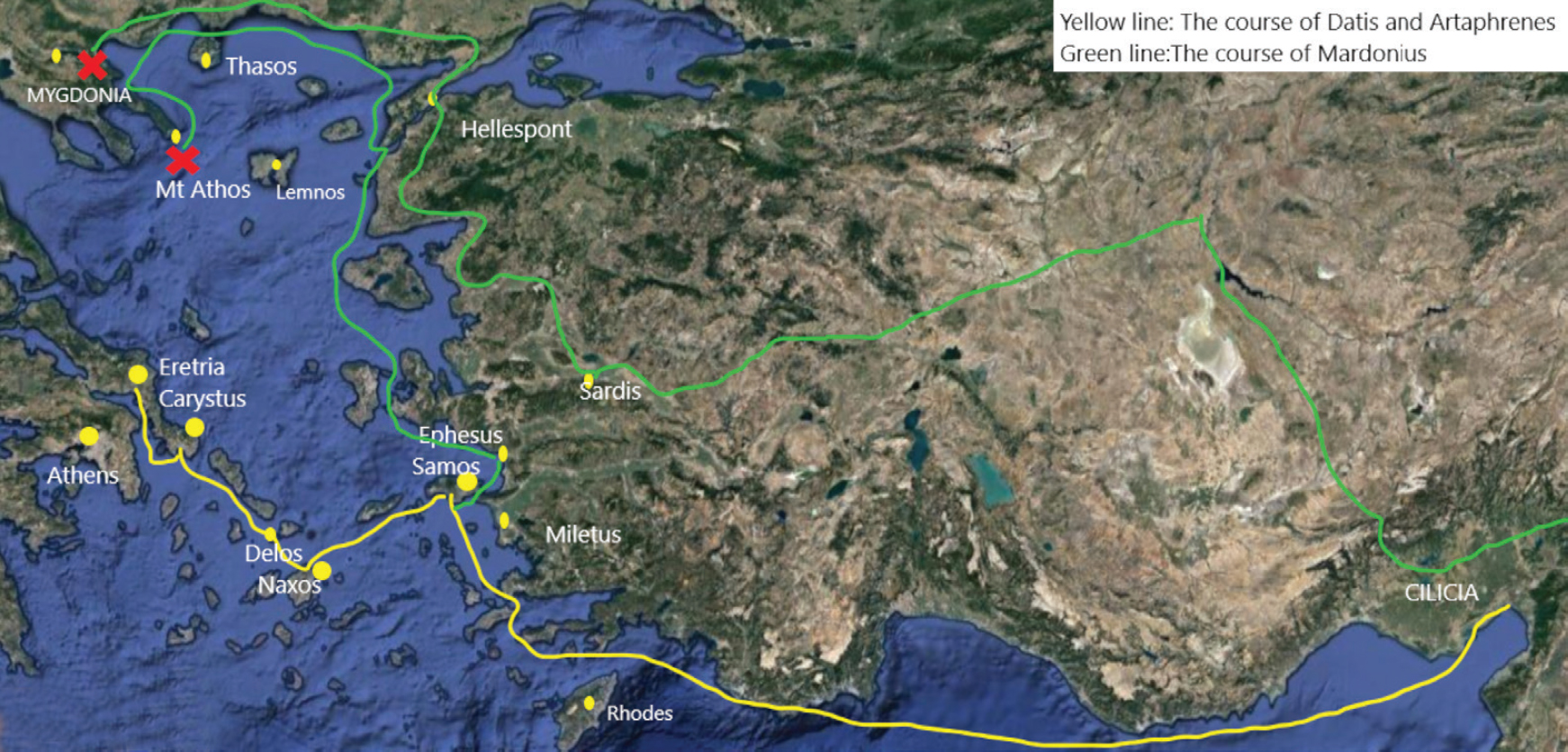
Map. 10.1.
This tolerant, albeit highly political, gesture tends to be inflated, to prove the alleged Medizm of the Apollonian priesthood (Burn 1962) due to the stunning divination of the Oracle of Delphi to Cnidians back in the days of Cyrus I (Her I.174). This may have been true at that time, under Cyrus, but not under Darius. The reputable oracle and Temple of Apollo situated at Didyma near Miletus was thoroughly plundered and levelled after the suppression of the Ionian revolt (Her VI.19,3), thus showing a state of perpetual war between Ahura-mazda and his servants on the one hand and the followers of Apollo on the other; a state of war underlined by Xerxes’ torching of the apollonian oracle at Abae and his attempted plunder of Delphi (Her VIII.33 & 35 respectively).
In any case, the policy of Datis was an unqualified success. Everybody in the islands surrendered and duly produced hostages and naval contributions to participate in the campaign (Her VI.99,1). Only Carystus initially declined but it surrendered after a brief siege and some pretence of devastation (Her VI.99,2) and followed suit. Carystus was a most strategic site: it was the entrance to the Southern Euboean Gulf and its territory formed with the island of Andros a sea channel from which fleets descending from the north had to pass through to enter the Saronic Gulf (Map 10.1). The invaders needed a friendly local state of affairs there, as it was a stepping stone but could be used also as a base (Map 10.2). When the Imperials were in Carystus, the next targets, Athenians and Eretrians, would be kept in uncertainty of the highest order: the next Persian attack may be either just across the channel, Attica, or along the coast, to Eretria (Bradford 2001). The defenders would not know where to concentrate, even if they were up to concerted action.
The next target, a capital one this time, was to be Eretria, a state that had indeed hurt the empire by assisting the Ionian revolt with a meagre five triremes (Her V.99,1) and was thus one of the two major objectives. It had been marked for total destruction and its population for deportation (Her VI.94,2). This serial pursuit of major targets allowed the militarily very sane concentration of force on one objective at a time while keeping the enemy divided, and cannot be considered an indication of mediocre numerical strength as Burn (1962) proposes. The Imperials started from the easiest and smallest target and proceeded gradually, knowing that each step was to build their morale, sap that of the enemy and compromise the bigger target, both in terms of morale and in terms of possible reinforcements for a decisive fight. To concentrate so as to achieve crushing superiority is both ancient and contemporary wisdom in Shock and Awe; Xenophon stated that winning overwhelmingly is not a problem, but a blessing (Xen Hipp 8,11).
The sacking of Eretria
Approaching Eretria, the Imperials, excellently informed of the assets of the city, overshot it while inspecting the shorelines. Hippias, the Medizer Peisistratid who instigated the campaign and served as a political liaison, negotiator and military advisor knew the area, but the commanding officers scanned for troops. The city might have been able to field 3,000 Hoplites and 600 cavalry (Bradford 2001). The latter was a very dangerous proposal if it could intervene with the landing, and this must be one of the reasons for assigning cavalry to the expedition. Then, seeing none, the Imperials disembark at three coasts, near the city but far enough away so as to hit the beach unimpeded (Her VI.94,2), especially by the cavalry. In such uncontested landings, the Imperials seem to use a new, aggressive operating procedure: they disembark cavalry first (Her VI.101,1) to secure the mounts and allow them to stretch after the voyage. This allowed their cavalry to raid the area in depth, provide reconnaissance and loot and terrorize the locals (Demosth Or 59,94; Plut Mor 305) with little warning, and possibly to intercept or delay enemy forces sent to contest the landing or attack the bridgehead; especially enemy cavalry.
The Eretrians had decided not to risk a battle, but to trust their walls; they had requested reinforcements from Athens, which they received just in time; an impressive 4,000 Hoplites from the Athenian military colony at Chalcis to their NW, established some 15–17 years earlier (Her VI.100,1), after the victory of the infant Democracy against the Chalcidians (Her V.77). They were true, they were many, they were near, they were fast and they were not weakening the Athenian metropolitan host by one man; the Athenians were not to leave Attica defenceless or compromise its defence by crossing the channel while the enemy had naval superiority, or rather dominance, and could easily outmanoeuvre them or cut them off (Burn 1962). A sensible decision, exactly to the tune of the decisions of the allied general headquarters ten years later, which left Attica to the torch.
But since the Eretrians were terrified, deliberating whether to imitate the Naxians and flee to the mountains or to undergo a siege, the Athenian reinforcements, once tipped off (Her VI.100,3), had no intention of being trapped in a besieged city and thus retired to the opposite side of the Gulf, to Oropus (Her VI.101,1), in the NE corner of Attica (Map 10.2), leaving the Eretrian allies alone. It was actually an act of mass desertion (Grundy 1901). Still, the position of the Eretrians was far from hopeless. Naxos had admirably withstood a siege ten years earlier and Eretria was a stronger city. Unfortunately, the enemy was infinitely more powerful than before with triple the vessels and much better prepared, with an advisor very capable in machinations and well-networked locally. Hippias’ father, Peisistratus, had resided in Eretria for some years and from there started his ascent to power in Athens, followed by his sons (Her I.61–2).
For some days the defence was successful, but in less than a week, two aristocrats opened a gate (Her VI.101,2), thus allowing a total and complete Imperial victory, resulting in the expected atrocities. The city was razed and burnt to avenge the burning of Sardis (Her VI.101,3). The population was arrested, enchained, enslaved (ibid) and moved to a nearby island for safekeeping (Her VI.107,2), along with the loot, expecting to be joined shortly by the oncoming harvest (captives and spoils) from Athens, as the task force moved from Eretria some miles down-channel, to the beach of Marathon (Her VI.107,1).
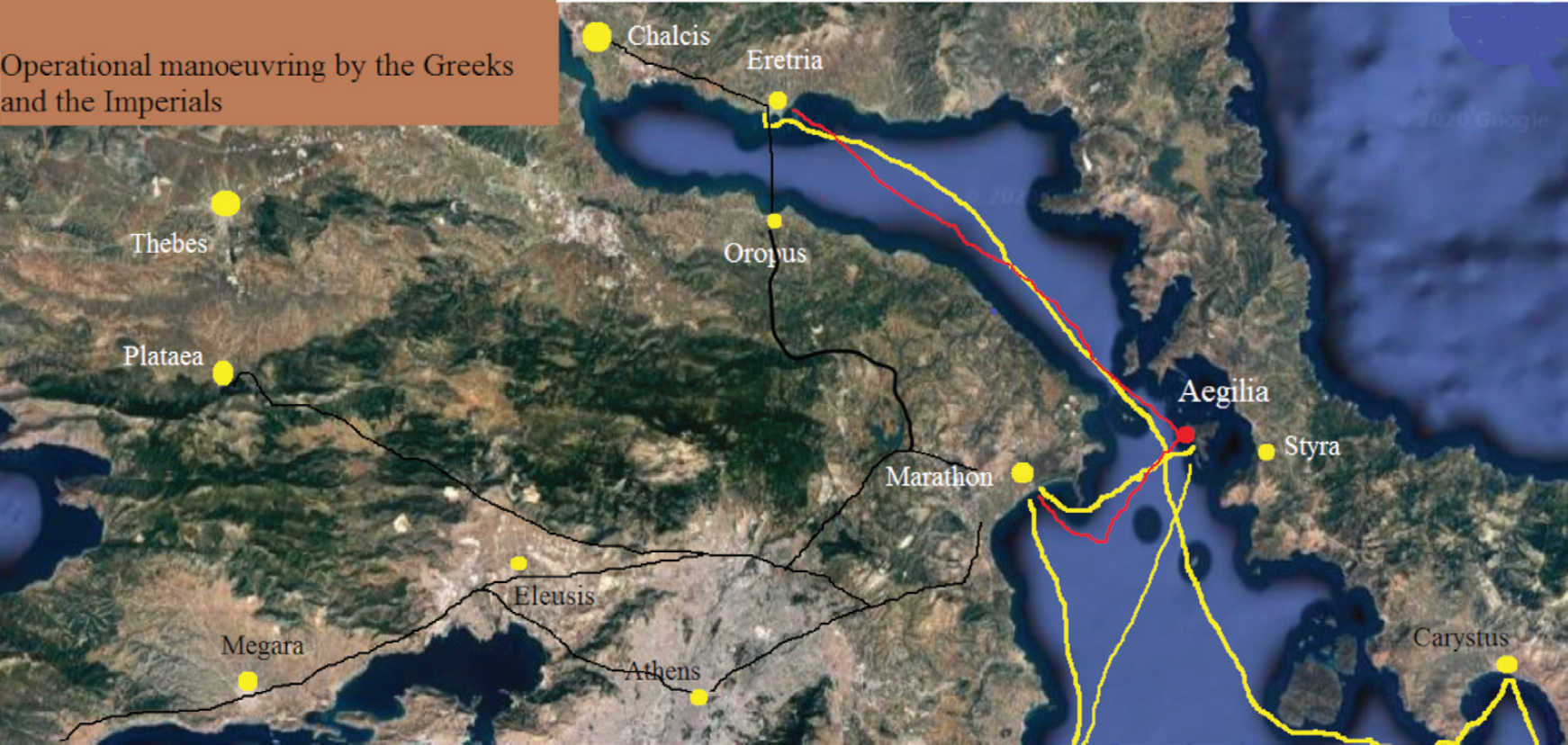
Map. 10.2.
It was a place well-known to Hippias, where his family had strong ties and affiliations that allowed him to hope for a repetition of his father’s ascent to prominence: from Eretria he crossed to Marathon with allies and mercenaries where he assembled his supporters. Then he moved through Pallene, where he brushed aside by surprise his mustered and overconfident but undisciplined enemies, to the Acropolis of Athens (Her I.61–3). Marathon was a spot well-watered, near to Eretria, suitable for cavalry action and grazing and offering a perfect and safe anchorage (Burn 1962). Hippias had every reason to assume that his supporters and followers would muster under his standard and the somewhat intimidating assurance of the Persian spears (Burn 1962; Lazenby 1993). The reason this never happened, and both the medizing democrats of Cleisthenes and the followers of the Peisistratids did very little to promote the Persian cause, might have been the result of the cruelty shown in Eretria. Instead of paralysis through terror, Datis effected a wake-up call for the medizing Athenian riff-raff, who, if not actively assisting, proved neutral or supportive to the upper-class Hoplite campaign (Grundy 1901).
Attica invaded
The fall of Eretria took some days to happen (Her VI.11,2) and afterwards the imperial army took some more days to move to Attica (Her VI.102). Some Athenians, as were the 4,000 reinforcements who retired ignominiously (Her VI.101, 1), had witnessed at least some of the action and brought valuable intelligence back to Athens. If their retirement was indeed an issue of cowardice (Grundy 1901), such intelligence might have been instrumental for not pressing any charges against them, although their sheer numbers, which practically doubled the Athenian Hoplite army (Ray 2009), would have been enough to steer them out of any trouble or even reproach.
More preliminary intelligence must have come during the Persian island hopping (Her VI.99,1), which was the definite early warning that a menacing armada was incoming. Thus, the Athenians had some time to deliberate. The deliberation was to fight on land; not to attempt any naval defence (Burn 1962; Grant 2012). With their fifty or so vessels, one per naucraria (Haas 1985; Tarn 1908), the latter would have been suicidal; the same could be said for their cavalry (Ray 2009), 100 horsemen, two per naucraria (Spence 1993; Haas 1985). Most importantly, the Athenians deliberated that the invader should be met as far from the city as possible (Her VI.103,1), to deny (i) any opportunity to the imperial sappers and engineers to decide the issue, as in Miletus and Cyprus; (ii) an effective isolation and interdiction of their army to meet and make contact with the expected Spartan – and perhaps other – reinforcements (Burn 1962); (iii) any chance for the collaborators and agents to interfere, as had happened in Eretria (Bradford 1980) and (iv) a free ride to devastate Attica.
There was a finite number of suitable landing places, and the Board of Generals must have identified them, along with the most convenient itineraries to reach them in force and the best positions from where to deploy. Especially after the fall of Eretria and the deportation of the inhabitants (maybe not all of them, but quite a proportion of the population), even moderate Athenians would have been much more determined and the defeatists much less prominent and outspoken. Thus, as the magnificent Persian organization neatly took in and stored loot and prisoners on the island of Aegilia and re-embarked materiel and troops (Map 10.2), the Athenians had a day or two to deliberate, even then, that the enemy would be met away from the city walls, to deny him contact with the traitors within and, most importantly, access to opportunities engineered by said traitors. The two most prominent choices for the Persians, and their guide, Hippias, were Phaleron and Marathon (Map 10.4); not the only ones, but the most prominent. The former was the main port and base of the Athenian fleet and allowed a fast dash to the city. The latter was an area with political and natural advantages. The former included the strong support of the locals for the Peisistratids – or at least this was what Hippias (would have) counted on. The latter included good cavalry ground, a decent anchorage, fodder and water, a short distance from Eretria and the prisoner of war camp established for the Eretrian loot and slaves on the island of Aegilia (Her VI.107,2), a usefully long distance from Athens and several egress routes that created uncertainties to the defender (Map 10.3) and allowed a campaign of devastation from a central position, so as to entice the Athenians out of their walled city (Sekunda 2002).
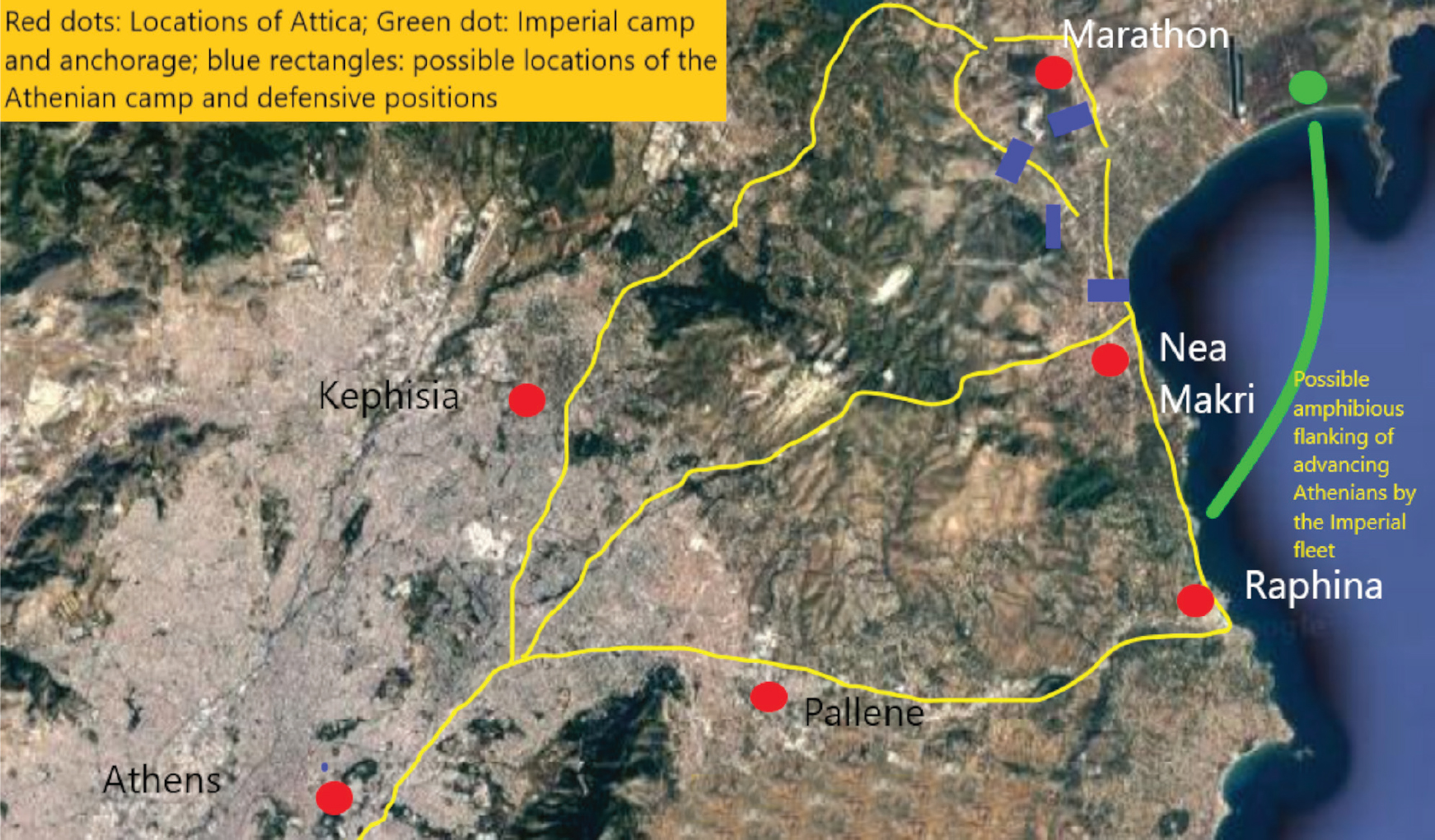
Map. 10.3.
Both areas, and possibly some more, must have been identified, reconnoitered and inspected beforehand and the same must have happened for the routes and tracks connecting them to Athens (Her VI.116). Once watchers (or beacons) reported that the target of the enemy fleet was Marathon (Burn 1962), the Athenian army moved forward, having been mobilized beforehand and kept on high alert, while at the same time dispatchers were sent to possible sources of reinforcements; definitely to Sparta and Plataea – the latter being their subject pure and simple (Badian 1993), no ally or friend (Her VI.108,1) – but possibly elsewhere as well. The expedited march to Marathon was something like eight or ten hours. Given that after landing the Persians had to raid the area so as to secure their immediate surroundings (Plut Vit Aris 5,1), feed and rest their horses, establish camp and organize their bridgehead (Bradford 1980; Burn 1962), the Athenians had a day, at the very least, to move to intercept. They needed 8–12 hours. But even if the Persian army had been able to bypass them and move towards Athens, they could return, if tipped off by observers, or continue; the Persian army would be facing a walled city and the Athenian army would have been in front of an exposed fleet, having just cast anchor and begging to be captured. There is no way, no matter what Green (1970) felt, that the Persians would have started a 40-km expedition through passes without having established a camp to protect their fleet.
The main Athenian asset was the Hoplite army. If at 10,000 Hoplites or so (Paus IV.25,5 & X.20,2), it was just a third of the free citizens (Her V.97,2); the other two thirds were prospective Medizers and the slave attendants of the Hoplites were deemed more dependable than such free folk and were raised to follow their masters in the campaign and eventually to the field (Paus I.32,3). Thus, this army was the prime concern of the Athenian leadership. This means one thing only: that the army took the road from Kephisia to Marathon (Hammond 1968; Grundy 1901), or the road to Nea Makri, but not the nice long road through Pallene (Green 1970). Both choices are shorter than the approach through Pallene; they are also fully negotiable by infantry, but not so by horses en masse. Some scholars who deny such a prospect by judging its suitability for a Second World War-type infantry division (Burn 1962) simply miss the point: the quintessence of the campaign was the Decree of Miltiades (Arist Rhetor 1411a; Demosth 19303), probably prepared, voted and put into effect before the fall of Eretria.
The deliberation was ‘take food and march’ (Burn 1962); it is Napoleon’s verdict, ‘where two soldiers can pass, an army can pass’ (Bonaparte 1830); especially a Hoplite army, with Hoplites and attendants, and possibly draught animals but, most probably, no carts. An army which might have got moving at night (Clement Stromat 162,2), through partly non-existent roads and paths, as was the Kephisia road (Burn 1962; Berthold 1976) but also the one through Nea Makri. Had they taken the coastal road through Pallene, the Persian fleet could launch a landing behind them (Berthold 1976), the way it might have happened in Egypt under Cambyses and in the same manner as envisaged for Thermopylae and the Isthmus of Corinth in 480–79 BC. By not taking a road running along a coastline, the defenders were not subject to outflanking by the enemy navy and amphibious forces. It must be noted that the Nea Makri road, ending in the whereabouts of the Vrexiza marsh, at the south entrance of the Marathon plain, but much shorter than the angular itinerary via Pallene, might have been the return itinerary of choice and should be given consideration for the Athenian arrival at Marathon as well, as it shuts the southern exit without taking the Hoplites into an area suitable for cavalry operations as does the route through Pallene. Its rough, overland character meant that an amphibious manoeuvre further south, as in Raphina, would not cut off the Athenian army at Marathon (Map 10.3).
Thus, if the Persians intended to make a surprise dash to Athens or to any other place in Attica (a limited, cavalry-only raid as the infantry would be making camp), they had to take the road through Pallene and thus would not run into the Athenian army on the march (Hammond 1968; Grundy, 1901). Such an occasion would have been catastrophic for the natives (Berthold 1976). The southern, main road through Pallene, spacious and level, allowed precisely this: a fast Persian column dashing into the Athenian Hoplite army as the latter would be squarely in a window of vulnerability; in marching order to Marathon, at break-neck speed, which means lax in discipline, low in readiness and out of formation – and possibly of breath as well. One such disaster had befallen the Athenians before, during Peisistratus’ quest for power (Her I.63) and the current Board of Generals had no intention of inviting a replay. Thus, contrary to what some scholars consider a gift to the Persians, that is an open road to Athens (Green 1970; Sekunda 2002; Berthold 1976), the Imperials would have had the opportunity for only limited raiding with their cavalry while setting camp. In truth, they would do nothing of the kind before getting everything they needed for the security of their bridgehead in place, disembarked or unloaded and becoming absolutely positive about the whereabouts of the Athenian army. The imperial operational tempo was too slow to have an opportunity to intercept the Athenians en route (Burn 1962). Although the Athenians could not bet on it, they could count on it. But in any case, the Athenian army had a safe approach to Marathon. The imperial task force was unable to easily negotiate the roads through Kephisia or Nea Makri, which offered the defending Athenians opportunities for an ambush.
The Persian commanders had selected Marathon for many reasons, among which was that they had no intention of walking to Athens; at least not immediately. They raided nearby to catalyze the movement of the Athenian army to their whereabouts, obligingly leaving all ingress routes accessible (Grundy 1901; Burn 1962) – if one believes the Imperials had time, intention and resources to occupy, control and guard them. Once the Athenian army reached Marathon, the Imperial command could assess its size and thus the size of their prospective fifth column, but also keep the army as far away as possible from the city, from the approaching Spartans and the Plataeans. Both reinforcement bodies would then have had to walk 40 more kilometres to engage and their supply trains just the same to deliver. Furthermore, the Imperials wanted the reactionaries (the Hoplites) away from the city, to allow more enlightened and co-operative Athenians, their collaborators, freedom of action. The final appeal of Datis for a conditional surrender (Diod X.27), if it happened, was an opportunity to acquire some first-hand intelligence and establish contact with sympathisers. The idea must have been that the Athenian traitors would make the move and the Imperials would force it home, suppress any resistance and carry away the reactionaries to Asia, allowing Hippias to control the less radical social groups (Burn 1962) – which must have been the actual interpretation of the events in Eretria.
To accomplish the above, the Imperials did not need to fight. They had to keep the enemy fighting element away from the city and the looming events (Sekunda 2002) and provide credible support for such developments. Fighting was to be avoided and pursued only with enough tactical advantages secured. Still, one should remember that Datis had no reason to doubt a victory if an engagement occurred, and that the standard of Achaemenid counter-insurgency as effected by Darius and his proxies dictated one or two decisive field victories before proceeding to siegecraft (DB 18–9; 26–7; 29–30), thus having the opponent with shattered morale and seriously depleted, possibly unable to fully man the fortifications. This approach made easier and much faster the final step, the storming of the fortified position.
Since the invasion was amphibious, there were few support troops, thus actual siegecraft was also a last resort, a fact corroborating the previous argument. Erecting mounds and sapping circuit walls demands a considerable workforce (fleet rowers might have been destined for such duties), time and commissariat. Time was all-important: if the operations dragged on, other Greeks might grow sinew – or conscience – and assist the Athenians. Surprise, as in Naxos, and encouragement of some locals to co-operate, as in Eretria, were far more advisable; fighting an open battle in advantageous terrain with high morale and a comfortable numerical superiority was the third-best option (Burn 1962). Interestingly, it seemed to be the most compatible with the Athenian war mentality, as demonstrated by their recent string of field victories against invaders, a fact that may have something to do with a possible unsatisfactory condition of their walls; although the causality of the two facts remains debatable (Lazenby 1993).
Miltiades knew the Persian modus operandi and understood that they would advance their infantry from Marathon to Athens through Pallene while devastating Attica with their cavalry and meet their fleet at Phaleron. Thus they would isolate the Athenians from any help, especially the Spartans, (Grundy 1901; Burn 1962) while establishing easy contact with their agents within the circuit – a repeated motive in Persian siege warfare (Her VIII.128,1 & VI.101,2 & III.158). The Athenian army was positioned to cover all possible ingress routes available to the Imperials, a fact allowing it to manoeuvre at the operational level with impunity, should the need be (Grundy 1901). The Vrana valley offered such luxuries. Athenian operational manoeuvring was likely to be unimpeded by Persian interventions as the Hoplite host and their subordinate light infantry (their retainers) could hold the high ground of the passes with token forces against the Persian army. On high ground they were safe from imperial cavalry onslaughts; additionally, the imperial archers were also at a disadvantage to advance and fire. The inclination marred aiming and reduced range, while the selected or prepared positions offered the defenders some protection from incoming missiles. Herodotus – of course – says nothing, but fieldworks are insinuated (Nepos Milt 5), most probably palisades (Delbruck 1920; Ray 2009; Hammond 1968) to cover either prospective deployments and/or the position(s) already held.
Palisades do not only repulse cavalry action; they also infringe with infantry assaults, and Miltiades must have been introduced to such practices defending the Chersonese against marauders, both light infantry and horse, from nearby Thracian territories. Alternatively, the Athenians might have been taught the trick by Cleomenes I (Ray 2009; Front Strat II.2,9) when he invaded Attica to oust Hippias (Her V.64,2) and repulsed with casualties the Thessalian cavalry under Cineas who were supporting the latter (Her V.63,3). The very silence of Herodotus on the subject bolsters the proposition that Miltiades was responsible for such works, at least in executive if not intellectual terms.
And what about the main, (partly) coastal road to Athens to the south, through Pallene or Nea Makri? How were the Athenians able to shut that too? They were not. And they did not. To egress from Marathon it was a narrow strip between seashore and mountain foot, if the marshland had been dry in early autumn or non-existent at the time (i.e. Lazenby 1993). If it were not, it would be even narrower, a nightmare to cross under attack. The Athenians shut the one road that was important to them, the double, bifurcated pass to Kephisia and Oinoe and by just being there, hemmed in and threatening, they denied the second, southern access to the Persians. If they were to try to follow the second road, to Pallene or Nea Makri (the latter not a very appealing option) the Athenians would take their flank or rear (Grundy 1901) or any rearguard the Imperials might have deployed (Delbruck 1920). Still, there is not one example during the Persian Wars of armies advancing under threat while covered by rearguards.
Contrary to some scholars (i.e. Lazenby 1993), the Athenian priority was the security of their army, not the shutting of any approach to Athens. The army being lost, no passage could have ever been denied. The Athenians could not block all exits from Marathon, nor apply modern strategy and defend a range from behind. So they did it the Hoplite way, defend it from before, so as to deny the enemy access to the various egress points, although wisely kept on ground most unfavourable for their opponent.
The aforementioned concept of a Persian advance under a rearguard, to any of the available passes, was a good way to precipitate an engagement, had the Imperials wished to do so. They did nothing of the kind, staying put and watching. Thus they did not wish for a fight even on their terms. Empires are not built on bravado, but on war economics. Psychology, influence, diversion are more appropriate means; Periclean Athens, Macedon, Rome and every other empire ever since (and possibly before) understood this simple and plain truth.
Well, these means have their limitations, too. The Persians were excellent manipulators and had a perfect understanding of the temporal parameter. They used it to their advantage admirably. They took their time from Eretria to Athens, to allow the message of terror to strike home, while making all the proper arrangements with the spoils of war. The bitter fruits of resistance, the desolation, the destruction, coupled to the menacing cold-blooded efficiency of their bureaucracy in handling and processing the product of such devastation, as if an everyday amenity, would break any warlike spirit. Thus, once in Marathon, they knew that the more they kept the Athenian army away from the city, the more its resources would be strained and also the more likely would be a coup d’état.
But they also knew that they could not keep fooling around indefinitely themselves. It was, up to a point, a matter of provisions, exacerbated by the fact that they had to care for their prisoners as well. Issues of supplies could be partially managed by straining their new subjects, Carystus and the islands. The main problem for the Imperials was in the plain of Marathon. As the days passed, the Spartan arrival was getting closer and the Imperial staff had no idea as to how many they would be. The Spartans were genuinely pious (Green 1970) and this piousness was to cost them a king and 300 elites some ten years later. This means they would launch an expedition immediately after the full moon at the latest. ‘Immediately’ would be a matter of hours, as the troops would have been notified, prepared and kept at the ready; and this was the best-case scenario for the Imperials. Moreover, keeping their host stationary against the Athenians was counter-productive for the Imperials; not only for their troops’ morale, which would be dropping due to inactivity and lack of progress after an almost stellar campaign, but especially for their enemies’, who would grow accustomed to the Imperial presence and perhaps demystify it. This would erase any direct psychological advantage the razing of Eretria would have produced.
There is no concrete evidence that the actual battle was fought with the Imperial cavalry absent; there is such a report, but it is not a definite conclusion. Even if this was the case, it might have been that the cavalry was caught off position or operating independently (Hammond 1968), as they customarily did (Her VI.29 & IX.49,1 & IX.32), out-of-area and too far to intervene during the battle. But it is more plausible that the whole point was exactly the independent, deep cavalry action. When the opportune moment arose, the conspirators would signal to the Persians and they would board their cavalry and send it to Phaleron (Map 10.4). Cavalry only, no boarding of infantry whatsoever, contrary to Green’s views (1970). From there the horsemen would gallop to Athens, finding the gates open and perhaps a coup in development. Cavalry surging through open gates, no matter how few, would achieve a formidable surprise (Burn 1962) and send a panic tsunami throughout Athens; nobody would count, nobody would ever observe there was no infantry. In the chaos and murder, the psychological impact would have decided the issue for the Imperials; the collaborators were their infantry and their amplifier, making the panic widespread and paralysing everything. With families and fortunes in Persian hands, the Hoplites could capitulate or roam, as guerillas, the wilderness of Attica, since the Persian infantry and the fleet (probably all the fleet but for the horse transports) would prevent them from swimming to Euboea… The prospect of the Persian infantry being transported to Athens and after its occupation moving to Marathon to trap and destroy the Athenian field army (Green 1970) is overcomplicated and unnecessary.
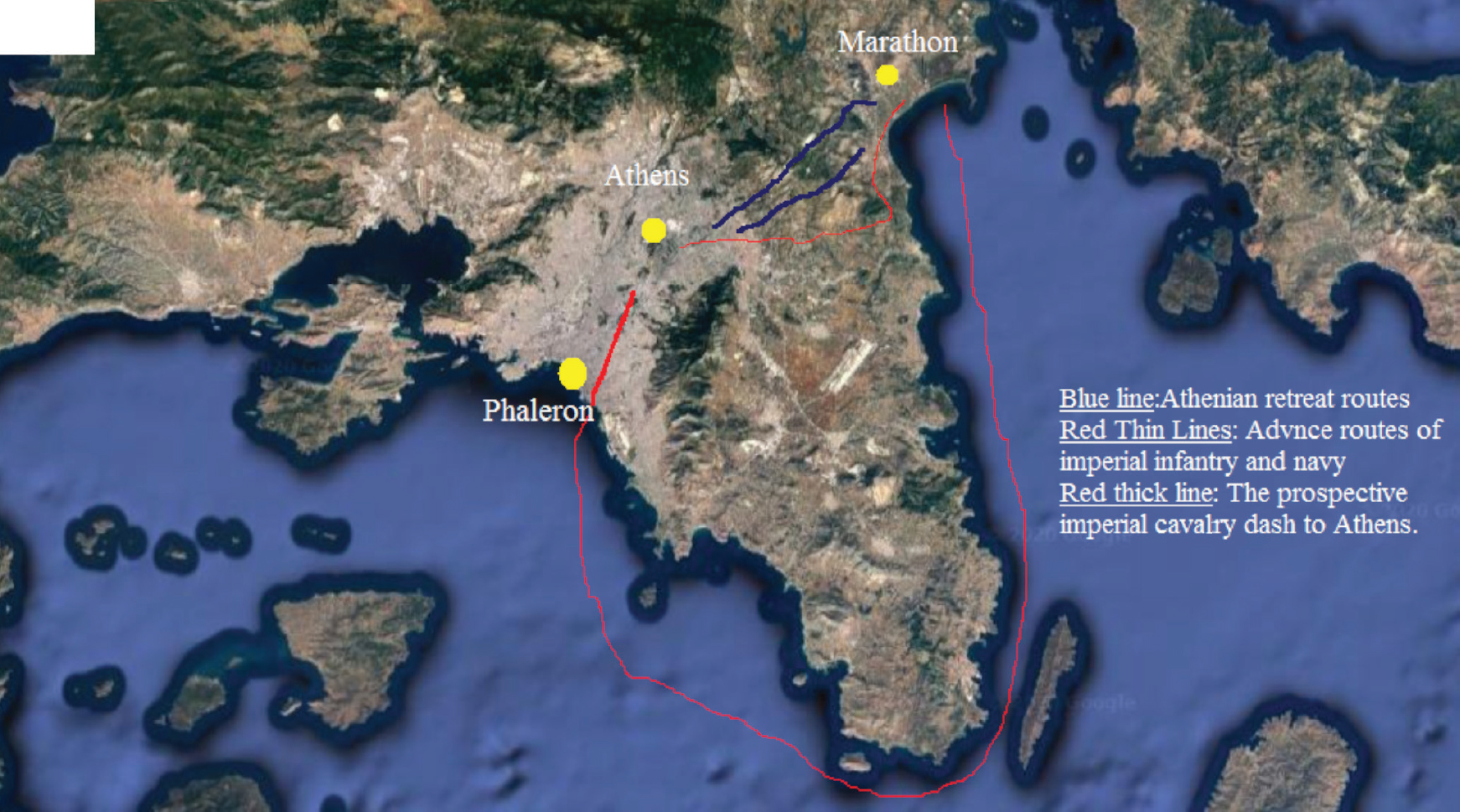
Map. 10.4.
The opposing armies
There are some interesting issues about this particular Persian army. First, it is under two commanders. It is the first time this comes into the attention of the reader of Herodotus. Previous cases concerned commanders of separate forces operating, or moving, simultaneously, with the possible exception of the army annihilated off Pedasus (Her V.121) and the campaign against Naxos (Her V.33). Whether the two commanders in Marathon are equal or one is second-in-command, or simply the Master of Horse of the host, one cannot tell. But if there is a seniority issue, Datis the Mede is the leading candidate (Plat. Menex. 240a) for Spadapathis; Artaphrenes is a young aristocrat, son of Artaphrenes, Satrap of Ionia (Her VI.94,2) and contrary to Datis, never mentioned in a way suggesting a commander as in making proclamations (Her VI.97,1), executing operations (Plut Vit Aris 5,1) or inspecting the ships searching for specific items of plunder (Her VI.118,1) among other things. After the blunder of Mardonius, Darius, nepotistic par excellence, stopped assigning supreme commands to sons-in-law (Her V.116 & VI.43,1), cousins or nephews (Her V.32) etc. and used a seasoned commander, Datis, who might have been instrumental in the suppression of the Ionian revolt (Holland 2005; Burn 1962) and perhaps the author of the idea of an amphibious-only campaign. The family man was delegated to a second and perhaps subordinate role. Still, there is another possibility: that the dual command was a solution whenever a satrapal force was augmented with a royal one for a specific campaign. This explains why the campaigns against Naxos of 500 BC and 490 BC had dual command schemes, contrary to all others, pursued by either satrapal or imperial forces but not both.
Rather than considering suspicious the recurrent number of 600 war galleys for Persian fleets (Her VI.9,1 & VI.95,2) as do some scholars (Shepherd 2012; Ray 2009; Burn 1962), the recurrence implies rather a standardised Achaemenid naval echelon (Sekunda 2002), possibly two basic fleets or rather naval districts of 300 vessels (Sekunda 1989) and thus it should be accepted without any fuss as accurate and representative of the Achaemenid Standard Operating Procedures. Infantry and cavalry are another issue altogether. The horse transports limit the number of cavalry to the order of thousands, and few at that; 1,000 horse is the absolute minimum operational unit, a mounted hazarabam. The number and capacity of the Persian horse transports are unknown. The later Athenian ones, which were retrofits of older triremes and thus in no way more capacious, took 30 mounts and their grooms and riders. A 40-strong horse-transports squadron would allow slightly excess capacity (1200 mounts), for the mounts of high officials, liaison officers and commanders – and this only if the imperial vessels, built from the start as such, were limited to the capacity of the Athenian retrofits. If not, fewer vessels would suffice.
Furthermore, if 30 infantrymen were delegated to each fighting vessel, on top of the native marines, a practice dictated by the 40-strong rebel Chian boarding parties (Her VI.15,1) and repeated by Xerxes’ navy (Her VII.184,2) the boarded infantry was at the very least 30x600=18,000 and, supplemented by at least 10 native boarders, 24,000 fighting troops, cavalrymen excluded. Support troops were on the transports, which ferried supplies and secretariat and were expected to load the plunder and the captives; thus, denying the existence of such vessels (but for the horse transports) as proposed by some scholars (Sekunda 2002) seems incompatible with the whole idea of a seaborne campaign. On the other hand, taking the figures of Menexenus of Plato (240a) to suppose a fleet of just 300 triremes but rejecting all the other figures and even vessel types in this particular work (Ray 2009) – which is notoriously inaccurate and meant to bolster the Athenian spirit and morale – is simply a quest to trim Imperial numbers near to or less than these of the Athenians. Indeed the Imperials could not pursue simultaneously both main targets, Athens and Eretria, by dividing forces (Burn 1962) as they had done during the Ionian revolt (Her V.116); perhaps they did not want to, as the previous example had led to a strategic stalemate after just one reverse, the ambush in Caria. Perhaps they declined to act similarly even to subjugate the islands of the Cyclades (Her VI.96 & 99) and selected a strictly sequential rather than a simultaneous expeditionary plan. Nothing informative here, the principle of concentration was known to the ancients; they were ancients, not ignorant.
But still, the Imperials were well-informed on their objectives by Hippias. Thus, keeping in mind that both cities were walled (and Naxos as well), which means that all their available manpower was prone to be brought to account, plus the fact that the fortifications are force multipliers for the defenders if they can man them properly, the Imperial host must have planned accordingly. Expected casualties during the successive operations should have been factored in, and resulted in a force size superior to the possible united field armies of their enemies by quite a margin. As the Achaemenid army organization was based on the 10,000-strong division, the baivarabam, the invading army is much more probably to have included three baivaraba, that is 30,000 infantry, probably including the native marines. This implies 50 troops on the deck of each of the 600 triremes.
This is not something unheard of. Without even contemplating the Athenian threat of loading all people and possessions to their triremes to mass migrate ten years later, a threat considered credible, if not imminent, by their contemporaries (Her VIII.62–3) there is a very solid proof that over 40 marines could be transported if the triremes of the era were not to engage in a sea-fight. In the Tempe campaign, ten years later, an army of 10,000 Hoplites, obviously each accompanied by one attendant, was ferried by the Greek fleet to the Thessalian shore of Alus (Her VII.173,1–2). The Greek fleet in that instance was of unknown strength, but cannot have been more numerous than its full capacity version deployed at Artemisium some months later, which was 320–330 vessels (Her VIII.2,1 & 14,1). This produces 60 individuals, Hoplites or/and attendants, ferried by each trireme. The existence of some pentekonters may slightly trim the number 60, but not much as their presence in Artemisium, some months later, was quite insignificant, at less than 10 vessels of the type (Her VIII.1,2). As a result, ferrying 30,000 troops was entirely doable for the 600 imperial warships of the 490 BC campaign, and the support vessels were for hauling freight and support personnel.
In these 30,000 Imperials, one should locate the core troops, Persians and Saka (Her VI.113,1) which together should be a third of the total, more or less. Sekunda (2002) proposes some hazaraba of Persians and Saka, although the operational unit is the baivarabam and thus figures divisable by 10,000 should be sought, augmented by 10 per cent or 20 per cent for the cavalry. A similar idea is followed by Ray (2009). Whether mixed baivaraba existed in the Achaemenid army remains controversial, and there are no clues in the sources allowing for the identification of any other ethnicity in the army (Her VI.113,1); in the navy, Ionians and Phoenicians are mentioned (Her VI.98,1 and VI.118,1 respectively); as there was no clash of Ionian infantry against Athenians (a pernicious proposal to start with) the native boarders might have been withheld from the infantry line to secondary duties, i.e. to guard the camp.
Concerning other sources and traditions which raise the number of the invaders to six digits (Plat. Menex. 240a, Nepos Milt 5), before starting trimming, one must remember that the total number of troops and sailors was more than 100,000. The 600 triremes had 200-man crews (Her VII.184,1), including or excluding the boarding parties; thus, an impressive 120,000 minimum is reached, without any support personnel and the crews of the merchantmen (including, but not restricted to, horse-transports).
The Athenian army has been traditionally estimated at 10,000 Hoplites, either including or excluding the 1,000 Plataeans (Paus IV.25,5 & X.20,2; Nepos Milt 5,1), whom some scholars (Shepherd 2012) trim to 600 by reverse-factoring their number in the 479 BC campaign (Her IX.28,6). It is clear that it consists of 10 taxeis, one for each Athenian tribe, as reorganized by Cleisthenes, commanded by one general elected by the tribesmen (Arist Ath Pol 22,2–3); the ten generals form the Board of Generals that deliberates by voting. The Polemarch (Arist Ath Pol 22,3–5) – elected by the whole electorate – presides over the board and has a vote in the event of an impasse; still, supreme command lies with one of the generals, rotating daily (Her VI.110) most probably by the official enumeration of their respective tribes. For both Athenians and Plataeans it was a full levy, not an expeditionary one with mobilization quota. The danger was existential and both Athens and their ally (or subject) Plataea would be annihilated in case of defeat.
Herodotus mentions no figures, and for good reasons – there are significant issues. There were 4,000 Athenian Hoplites, the Cleruchs from Chalcis, in Oropus long before the Persians landed. What happened to these? They moved to Athens, to join the main army? Were they staying put at Oropus to guard the Persian crossing there, and subsequently dispatched to Marathon, as the force nearest to the area, to occupy the position selected for the deployment of the army? This would deny any opportunity to the Persians to interdict the approach of the Athenian army to the plain of Marathon. To do that, they had to arrive there before the Persians took control of the plain, as the ingress point of the Athenian army was practically on the other side of the Persian bridgehead. Additionally, should these 4,000 be included in the 10,000 Athenian Hoplites or be added to them? Pausanias (IV.25,5 & X.20,2) leaves little doubt that the latter was not the case. Then, the core Athenian host was just 6,000 Hoplites, a really minuscule number, but compatible with the army of the era of Solon, not that long ago as may be estimated with a restrictive interpretation of some excerpts of the Athenian Constitution of Aristotle (Sekunda 2002), which brings the total to 3,600 shields; Naxos had some 8,000 (Her V.30,4). The Naxian Hoplites might have never been intended for a set-piece battle but, as in most islands, for naval action as boarders and marines. Still, it is a weird comparison. Lacedaimon, having incorporated Messene, was double the size of Attica and was fielding some 8,000 Peers and at least as many Perioikoi (Her VII.234,2); Thebes though, a city more to the measure of Athens of 490 BC, before the great expansion of the army brought by the vigorous trading with the west, fielded a similar number (Bonner 1910). It is no surprise that in 479 BC the Athenians have some 10,000 Hoplites including the expeditionary force of 8,000 at Plataea (Her IX.28,6), the boarders in the fleet under Xanthippus and probably a garrison at Salamis.
In any case, should the total be inclusive of the 4,000 Cleruchs, they would have been incorporated into the 10 Taxeis-brigades based on their origin before being dispatched to Chalcis, as these brigades were far from territorial: each taxis brigaded troops from different communities located in all three residential zones of Attica. On this account, Sekunda (2002) proposes a 9,000 total levy. This agrees with the restrictive interpretation of the Athenian Constitution by Aristotle, whence the four Ionian tribal brigades of the Athenian army (of 3600 shields) were formed up by three trittyes of 300 men, one for each residential zone; each trittys had ten triakades, the smaller organisational and conscription unit of 30 men each. If the organization of the new Cleisthenic tribes remained similar, with three 300-strong trittyes accounting for 900 shields for each of the now ten new tribal brigades (Taxeis), a 9,000 army is reached. The incorporation of some émigrés in this context was not a problem. For all the days of the waiting game, they were training with their native peers so as to develop cohesion and be able to apply the tactics of Miltiades.
Intentions and dispositions
Miltiades must have been known to Datis and vice versa; maybe not in person, but they were on opposite sides during the Ionian revolt, if indeed Datis had been instrumental in its suppression (Holland 2005). Moreover, many of the commanders, if not sailors also, of the Ionian fleet were his old friends and comrades-in-arms; some of them must have known him personally during the operations of the Hellespontine rebellion and the campaign of Histiaeus at the straits (Her VI.5,2–3), if not from the days of the Persian ebb from Scythia and the Thracian rebellion. Thus, Miltiades knew much about Datis. He knew that the waiting game had a reason and an expiration date. The reason was Datis’ anticipation of developments in Athens, which would allow him a nice campaign similar to the ones of Cambyses and Darius in Egypt and Babylon respectively where traitors won the battle for him before the engagement was on; Sun Tzu’s prerogative, to fight when the battle is already won, as had been at Lade, four years earlier.
The wide, operational manoeuvre of the imperial fleet to outmanoeuvre the whole Athenian army must have been taken from the book of Cambyses and his fleet of the invasion of Egypt (Holland 2005). The opening of the gates by agents within was already tried in Eretria (Her VI.101,2) and also effected in Babylon by Zopyrus (Her III.158). Thus, Datis, before sending his cavalry alone to a dash from Phaleron, was waiting for his collaborators to act. Despite the early tradition of dividing his infantry forces in half (Nepos Milt 5), any infantry would be a liability in this dash due to the slow pace of advance, but also any such dispatch would weaken the field army in Marathon, which was pinning down the Athenians. Miltiades knew that Datis needed only his cavalry to conquer Athens; his Athenian collaborators would provide the infantry.
But keeping Athens was another matter; there Datis needed his infantry and/or to disable the Hoplite army of Marathon. Assault was out of the question due to the position and the characteristics of the troop types. But the imperial army in Marathon could opt for an advance by the coastal road; then the Athenians would have to engage at the level against superior numbers and archers or retire, possibly under a rearguard which would make pursuit impossible for the Imperials. In the latter case, though, the retreating Athenians could not intercept the Persian infantry. All such events would develop with Athens occupied and the families of the Hoplites at the mercy of the enemy…
Thus Datis was probably lining up his infantry for battle every day to taunt the Athenians (Burn 1962); had they accepted the challenge, he would face them on his own terms, in cavalry ground with his force full and ready. Had they denied, as they did, his troops would have higher morale (‘the enemy do not dare to face us’), his collaborators in Athens an even higher one, understanding that they had bet wisely. The moderates in Athens would start questioning the sagacity of resistance as an option and the Athenian troops would have suffered a plunge of their own morale, denying the challenge day after day. The repeated, everyday challenge and the psychological pressure might lure one of the Athenian generals, on his command day, to accept the challenge, especially if the Imperial formation was cutting the Athenian army off the coastal road southwards. It was a well-judged psychological move. Should the Athenians find themselves needing to retire, the Persians would have secured the use of the easy Pallene road, so they could outmarch the Athenians and catch them near Athens without risking exposure to traps and ambushes as would be the case if trailing them along the Kephisia itinerary.
On the other hand, Miltiades and his fellows were expecting the Spartans, while remaining vigilant for an opportunity to engage (Burn 1962). In the meantime they were using the stand-off time productively to observe and time the Persian battle arrangements, which, should the Athenians accomplish surprise, would be automatically executed by the Imperial troops; the operative idea behind their training and drilling. This explains how it was eventually possible for the Athenians to start their advance early in the morning before the Imperials were set into their regular positions, and still have a deployment adapted to the enemy one. This apparent antithesis makes many a modern scholar draw erroneous temporal conclusions, that the Athenian charge started after the Imperial line was properly formed (Holoka 1999). Moreover, the Athenians would have become accustomed to the spectacle of the enemy line-up and demystified the opponent. If the prospect of the arrival of Spartan assistance is factored in, the Athenians had no motive to accept the challenge and engage without a good reason. Might this be an opportunity or an adverse development, as would have been an attempt against their defenceless city. (Burn 1962; Grundy 1901).
But all these had an expiration date. Once the Spartans were in Athens (Athens, not Marathon) the prospect of treason would be less than zero (Grundy 1901). Thus Datis had to act before; if his agents did their job, so much the better, but in case they could not deliver, he had to make a move (Burn 1962). He could take the coastal road and risk a fight in questionable terms or worse; the Athenians might simply retire near Athens overland, to facilitate the impending Spartan approach. Or, Datis could execute the amphibious manoeuvre anyway, hoping that once his cavalry was seen approaching, shock and collaborators could result in an open door. That meant Datis had at most two days after the full moon that ended the taboo of the Karneia; the Spartans would start at the earliest after the full moon (Her VI.106,3) and the 200 km from Athens would take them at least four days to arrive as an army ready to engage. Thus, the next day of the full moon Datis would have to make his move to allow for any unforeseen delays or eventuality.
Miltiades knew well the limitations and motives for Datis’ policy. He knew that, eventually, the Athenians would have to fight alone, without the Spartans, because Datis had the initiative and would not grant them the chance to wait for such help. Miltiades must have concluded, along with his fellow generals that even if a coup, aided by Persian cavalry, was to take over Athens, should the Persian infantry be decisively beaten the situation was conceivably susceptible to remedy upon the arrival of the Spartans. It would be preferable not to lose the city, but in any case, there was some leeway. Having witnessed the daily drill and procedure of the Persian field army without showing anything of theirs, the Athenians could achieve surprise. Callimachus, the ceremonial Commander-in-Chief (Polemarch), was persuaded (Her VI.110) and turned the vote for Miltiades. At least the other four generals who agreed, passed their designated days of Supreme Command to him (Plut Vit Aris 5,2; Her VI.110), probably so as to be able to execute his plan (Plut Vit Aris 5,2) upon any opportunity. The plan was made known to all and, contrary to the view of Lazenby (1993), once the battle was decided, it was a matter of timing. Miltiades, and nobody else, knew the right moment; could assess time and estimate distance and the applicable tolerances in terms of space, time, manpower (Delbruck 1920). Herodotus said Miltiades accepted the pass but waited for his designated day (Her VI.110). He was waiting for an opportunity, not for his designated day of supreme command.
And his contacts on the Imperial side did not fail him. Either because the Athenian lines, by their defensive outworks, had approached the Persians, or through the no-man’s-land due to lax Imperial security, the Ionians in the Persian camp notified Miltiades the moment the cavalry was gone (Suda ~1000 AD). Where to, we can only assume, and Phaleron is a valid assumption; but Miltiades, who would have assumed similarly as a worst-case scenario, raised his colleagues and the army and after days spent to make the proper arrangements without being seen by the Persians, mobilized his units to gain every second as the sandglass had been turned.
Deployment and the running charge
The fastest way to deploy before daybreak would indeed have been by two lines emerging from the camp, going at opposite directions and forming there, in a Y pattern, with the centre forming up last (Burn 1962; Humble 1980). This is by no means difficult, as some modern scholars suggest (Lazenby 1993), especially if rehearsed. The renowned formation (Figure 10.1) of the deep wings and shallow centre (Her VI.111,3), a 2 to 1 ratio, possibly 8 against 4 lines deep (Burn 1962; Lazenby 1993; Ray 2009) to a battle line matching that of the enemy (Her VI.111,3) was preconceived, prearranged and perhaps tacitly practised and drilled before daybreak or after dusk, to keep the Persians in the dark and familiarise the Hoplites with performing it in low ambient light.
The argument that the wings were deeper than the centre by accident, as the Athenians tried to match the width of the Imperials (Lazenby 1993) is not simply erroneous; it borders on malice. If the Athenians had to reduce locally their phalanx depth to match the front of Imperials, they would have done so at the wings, not at the centre, to extend them – or, if they had deployed right first, they would have extended the left wing. They would have no way, and, more importantly, no reason to thin their centre where the best enemy troops were posted. Even if Miltiades had no particular knowledge of the Persian practices first-hand (Lazenby 1993), he must have discoursed with many Imperials during the Scythian campaign and with many rebels during the Ionian revolt to know that the best troops were at the centre, to effect central penetration and collapse of the whole enemy deployment. Thus, to match the line and to take pains, against any automatism, to keep the wings deep and weaken the centre instead, means that the centre was destined to give way. If this rationale makes Hannibal seem less original or brilliant (Lazenby 1993), so be it. Such concerns cannot be used as an argument against its plausibility.

Fig. 10.1. The deployment of the Imperials (red) and of the Athenians (blue) just before the battle. The black line is the first rank of the Athenian hoplites.
The Athenian line, under the orders of Miltiades, deployed at dawn, making as little fuss and noise as possible. The tribes kept their set order – which might be standard or rotating by the day – with one exception. The Polemarch Callimachus was leading the right wing as per tradition for the commander (Rey 2011; Hanson 1991) and his tribe must have been behind him as a post of honour, despite the actual order which was followed by the other ones (Lazenby 1993). The Plataean allies/subjects were posted at the far left (Her VI.111,1). Once deployed, the Athenians charged. They may have charged from an uphill position as the tradition suggests (Her VI.112,1). Or they may have closed their distance from the Persians gradually over days by advancing their defensive works and lines (Hammond 1968). Which course of action they followed, cannot be deduced. But the former is supported by the repeated efforts of the allied Greeks to position themselves similarly at Plataea in 479 BC: first at the Asopus’ ridge, then at some hilly ground. But charge they did, and at a run; or at a jog (Her VI.112,1).
It is possible that the Persians, once more intending to deploy to taunt the Athenians – and this time keeping their routine for an added reason, to conceal the departure of their vessels and thus their moves – were just starting their move when the Athenians charged. Their camp is never mentioned as fortified, and it is not known whether such proceedings, being standard by 480 BC (Her IX.15,2 & 97) were standing Achaemenid Standard Operating Procedures or came into effect after Mardonius’ blunder of 492 BC (Her VI.45,1), or even later than that. Actually, there was no good reason to fortify their camp and doing so would have afforded the Athenians more time to advance from Athens to Marathon and solidify their position. In any case, Miltiades would like to have the Persians out in the open and not hiding or taking cover somewhere, as the idea was ultimately to use the strengths of the phalanx to win decisively. Thus, while the Persians were once more labouring to get into position for no obvious (to the rank and file) reason, bored and half-asleep, they saw the Athenians charging through the morning mist (de Souza 2003). The morale effect of the surprise was devastating. Still, they fell into position in time, although amazed at the running charge. They met it, but it is questionable whether they had any time to shoot volleys; and if they did, the long-range shots would have been wasted, as nobody had run a charge while protected by Hoplite shields before, so they were not accustomed to correct their shooting accordingly, nor to revert to more effective alternatives. One or two arrows in direct mode per archer, inside of the 50 metres might have been fired as well, squarely onto the shields as there was no time to aim obliquely, between the shields of distant files, nor low, beneath the rim of the shield, to the shins, where greaves cannot stave off shots from close range.
Before describing the impact, one has to take a moment. The Athenian Hoplites ran. For how long is the usual question. How many of them is the correct question. Herodotus gives the distance of the two foes at 8 stades (Her VI.112,1), some 1.3 km, with ~160m per stade (Engels 1985); but this may refer to the original positions. Especially if the Greeks had advanced their positions gradually (Hammond 1968) this figure should have been lowered; the Persian deployment might have shrunk it further. In any case, is it possible that the Athenian Hoplites ran the whole distance? Experimenting with college athletes (Emanuel 2012) or asking the opinion of the Chief Medical Officer of the Imperial German Army (Delbruck 1920) are not valid approaches. They are, in a positive function; should they confirm such ability, it would be definite. But in a negative sense, they are useless. Different body indices, different training, different lifestyle. If Zulus could run, or jog 10 km to reach the battlefield and then were able to engage in hand-to-hand, gruesome combat (Morris 1965), there is no reason for the Athenians not to have been able to do so. The Race-in-Armour (hoplitodromos) had been an official event since 520s BC, at the 65th Olympiad (Emanuel 2012; Sekunda 1986; 1998; 2000). Sparta had been in a state of war with Persia since Cyrus II and might have promoted the inclusion of Hoplitodromos in Greek athletic festivals since 520 BC, which were officially considered as preparation for envisaged war eventualities (Paus V.8,10), if not a simulation and griefless warfare.
The Race-in-Armour featured mostly distances of one and two stades (approx. 160 and 320 metres, respectively) which was the projected drastic range of the bow of the day. But there was also an event of much longer range, possibly 15 stades (Emanuel 2012), most likely intended to prepare participants for both operational and tactical moves at the run in full gear. It is not known when the latter event started being practised; still, in 490 BC even the 50-year-old draftees had been practising the basic spinoffs of the race-in-arms since their twenties. Such practice was widespread in the gyms, and some might have competed during the Panhellenic religious festivals or tried to qualify for such events. Thus, almost the whole Hoplite body had the knowledge and the training.
Moreover, any notion that the Athenian Hoplites did not take their full gear with them and left their cuirasses behind (Sekunda 2002), should be rejected out of hand, as the cuirass was the key component that most orientals – the bulk of the troops raised by the Imperials – were lacking, and of paramount importance in hand-to-hand fighting. But one should remember that no matter how well and exhaustively trained and drilled they were – and the Athenians were no Spartans – at their 40 or 50 years of age, neither lung nor knee nor waist are the same. Thus, the question becomes ‘Who and how many among the Athenians could actually have run?’
The answer is straightforward: the 20–30 age-class, which was to become known thanks to Xenophon much later. Xenophon gives the specifics (Hell IV.5,14); there is no need to doubt that the practice was identical before his days and adopted throughout the Greek world, wherever there were Hoplites. It was based on biological and bioergonomic realities, to which the date, 390 or 490 BC, makes no difference. Thus, the first ranks of the Athenian infantry closed at a run; the Persians, and the Ionians who watched and relayed events and opinions and gossip to Herodotus, could not have noticed that the first two lines at best were incoming, and the rest of the phalanx was following at a trot (Figure 10.2). Their field of view being seriously limited, in terms of depth, the Orientals would concentrate on this obvious but elusive target, not being able to see the less elusive ranks following at a trot. Having their bodies slightly tilted with the left side projected and the right denied, and with their shields canted upwards, but still firmly resting on the left shoulder and projected up and front when a volley was incoming, the runners had no top speed at the moment of impact. But their spears, levelled and crouched under their right armpit like the medieval lances, the underarm technique (Matthew 2012), accumulated all the kinetic energy of a running Hoplite in a very small area. This produced more than enough momentum to pierce any oriental shield (taka or spara) and then either the skull or the jerkin/cuirass and the torso of the shield-bearer and throw him back, onto the man behind him with force enough to beat him out of balance.
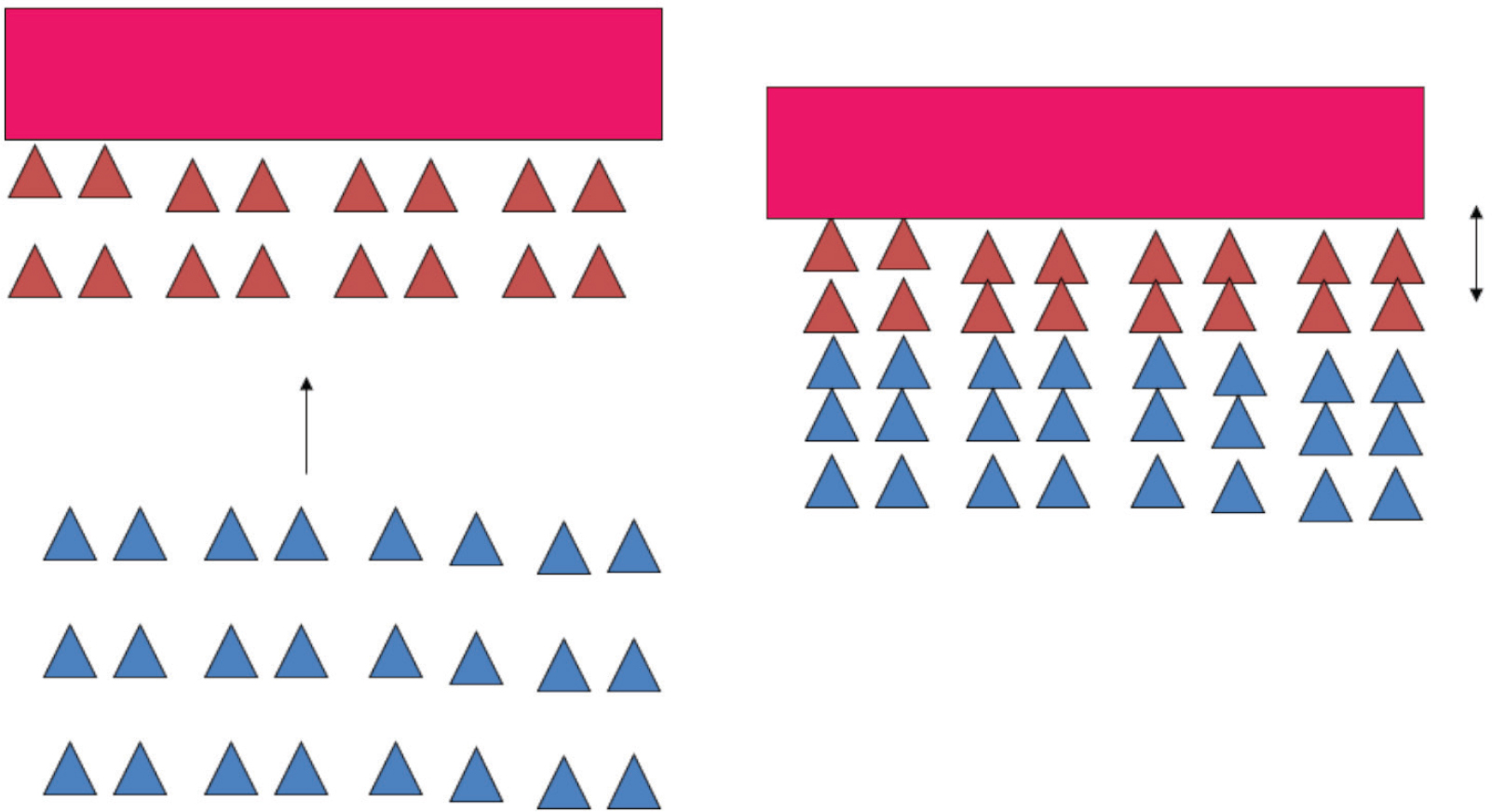
Fig. 10.2. The running charge: Left, the first Athenian ranks crash on the Imperial line and spear it vigorously; the rest close at a jog. Right: the rear ranks join in, to support and steady the engaged front ranks and to add weight to the shoving match.
Alternatively, a charge with spears levelled low (Sekunda 2002) is just as possible, as the ergonomics of the running and of presenting the shield are more favourable in this case. It delivers the sum of the stamina onto the impact plus the momentum of the hand thrust proper; it allows a degree of lateral correction to aim better and aim low, at the unarmoured thigh or groin (Anderson 1991; Goldsworthy 1997), where massive bleeding is deadly; even the Hoplite shield is less effective.
Crashing on the Persians, spears extended, the running Hoplites would have exacted quite a toll: the imperial first rankers, the best troops in every army in every locality and era would have ended up impaled. Smashing at the second line, or at the survivors of the crumbling first line, the charging Hoplites would have caused immense chaos and disorganization (Anderson 1970; Luginbill 1994). The Hoplites were out of breath, indeed (Sekunda 2002) but this original thrust and impact would have afforded them a respite of seconds to get a breath. They had to shove and thrust for some time until the rest of the ranks of the phalanx could reach them and steady their backs (Figures 10.2 & 10.3), adding their cumulative weight for a possible shoving match (Krentz 1985; Goldsworthy 1997)
They seem to have done well, judging by the results. Eventually, the Orientals, in a deeper formation, perhaps the standard 10-deep if they were Sparabari (Sekunda 2002), somehow did recover from the mental and physical shock and resist (Plut Vit Aris 5,3). That they did not panic to immediate flight once their weapons proved inefficient against an army of lunatics, who subsequently skewered many of them and crushed some more with their outsized shields, is a testimony of the discipline and courage of the Imperial units. They came around and they began to fight back, but possibly not quite effectively for some time, affording the Athenian hind rankers time enough, as they approached trotting or running – but for much less, perhaps the last hundred metres – to arrive and take position, steadying and bolstering their engaged front rankers (Figure 10.4). And that must be the solution to the issue of the running charge. Possibly all Hoplite armies could run the last 150–300 metres (Sekunda 2002), but this action was called Epidromi, not Ephodos. In Greek, what is known in English as the running charge, the-charge-at-a-run or charge-at-the-double (emphasis on ‘charge’) is mentioned by the historians as Dromaia Ephodos. The first word means ‘running’, but the second, Ephodos, describes the advance, not the charge (Sekunda 1986). A Hoplite army, once set, advances against the enemy – Ephodos (Sekunda 1986) – and when very near charges, or, actually, may charge at a run – Epidromi (Sekunda 1986). By calling the Marathon event as they did, the Greeks implied that the Athenians, or some Athenians, ran the whole distance. And this was the novelty; to run during the entire advance, not merely for the final charge as supposed (Sekunda 2002; Emanuel 2012).
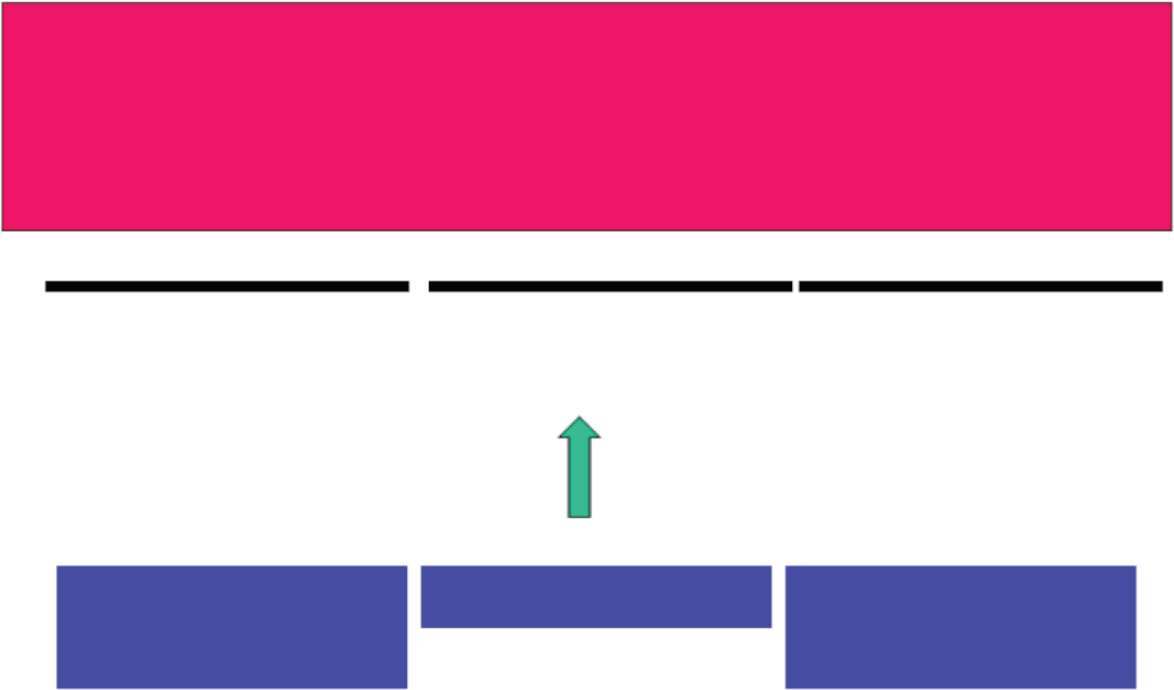
Fig. 10.3. The first Athenian rank(s) charge at a run and crash on the Imperial line while the rest of the Athenian phalanx close at a jog.
After the shocked and faltering Imperials steadied themselves due to their depth and skill, the two lines started exchanging blows. It is possible, or even probable, that the Athenians, after the first clash, refused extra-close, shoving contact. Rightly so; the Imperials were formed in a deeper line and carried shorter offensive arms. If kept at spearing distance, the Hoplites had all the advantages, with longer and probably stouter spears, larger and definitely stouter shields and better armour; thus the casualty exchange ratio was extremely lopsided. At close range, the Imperial short spears could exact some toll if handled well and with some luck. In such conditions, should the spearing be kept on for some time, it would function as a grinder and could disintegrate the Imperial line, or at least soften it enough for some determined Hoplite shoving to do the trick. Something along these lines happened in both Imperial wings, where lesser and less motivated troops faced a storm of spears and they simply broke and fled, with the Athenian wings in limited, not hot, pursuit (Figure 10.5). Once the flight became irreversible, the pursuers were recalled (Figure 10.6). How, with what kind of signal, by whom, we cannot deduce with any certainty. Trumpet would be an option, provided that the Athenians had adopted already open or semi-open helmets, like the Chalcidian and the Attic models (Connolly 1981; Snodgrass 1967).

Fig. 10.4. As the rest of the ranks join the first rankers with minimal loss, they form up to nominal depth. A pushing, shoving and thrusting match develops.
The turning point
At the same time, the crack Persian and Saka troops at the centre of the imperial line, once stabilised, they formed and dressed their line and tried to pay back the Hoplites with their own medicine. The spearing had them at a disadvantage. Thus, they advanced violently to close the distance, bring their shorter spears and sidearms into play and perhaps shove the flimsy enemy line, of just four men – easily countable before their eyes – into breaking and fleeing (Figure 10.5).
However, the Hoplites of the flimsy Athenian centre had been well schooled not to let this happen. They speared feverishly, to intercept, if not to slay, the Imperials and back-stepped, to avoid entanglement. Four ranks deep, such back-stepping was achievable without devolving to disorganisation, confusion, stumbling and flight. There is no way the nimble sparabari – or takabari – would have pursued broken Hoplites as supposedly happened (Her VI.113,1) without effecting a carnage; and no such mishap occurred to the Athenian centre in Marathon. Most of the 192 dead Hoplites fell after the victory was secured, near the imperial ships (Her VI.114), thus proving the sagacity of the limited, fully organised and disciplined Spartan pursuits (Plut Vit Lyc 22,5).
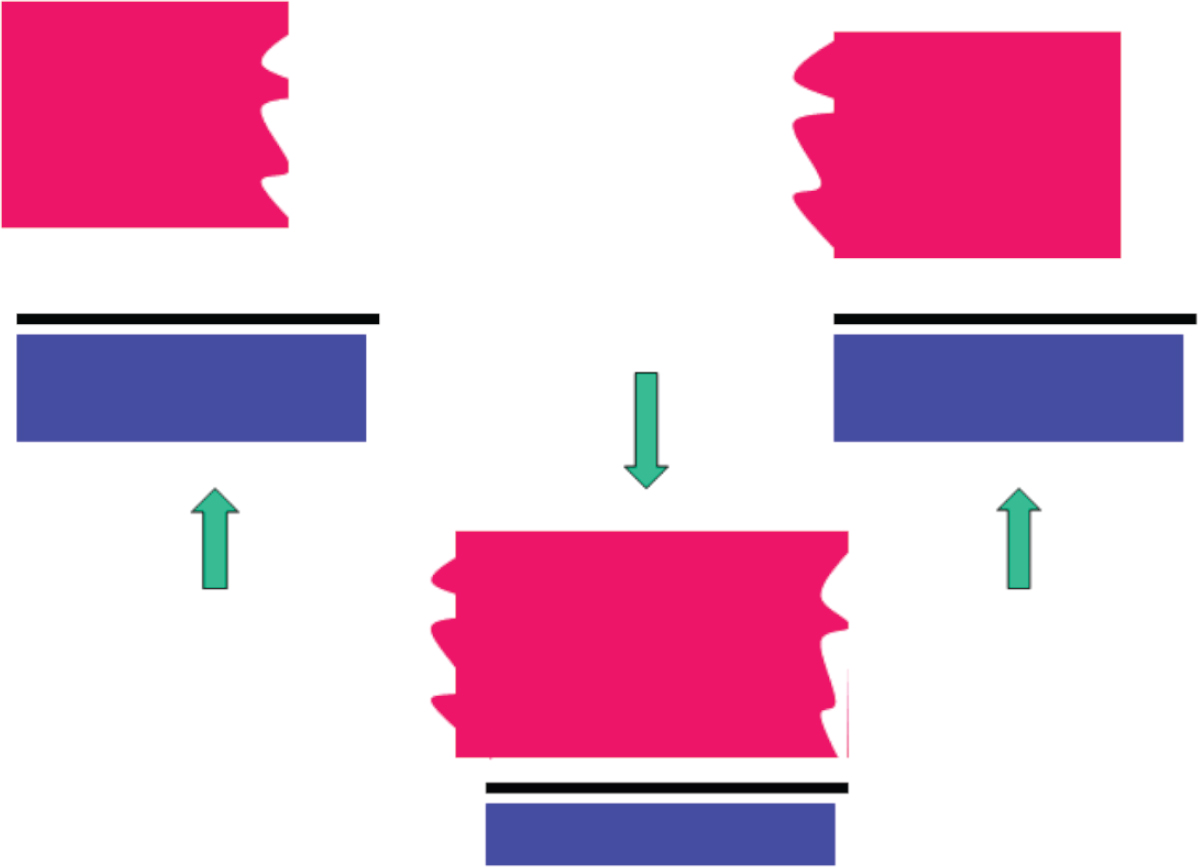
Fig. 10.5. The Imperial centre pushes the slim Athenian one far inland, but the deep Athenian wings put the Imperial ones to flight and give brief chase.
The Athenians of the centre never broke, nor fled; they were back-stepping under pressure. Thus, it was not that the Imperial centre had beaten the Athenian centre and was pursuing it inland, this is important (Her VI.113,1), it was that the Athenian centre was performing a fighting retreat (Grundy 1901; Ray 2009) to achieve two goals: to deny the Imperials the opportunity to deliver a decisive blow by pressure or impact and to lure them as far from their ships and camp as possible. Should the Athenian positions have been advanced the previous days (Hammond 1968), they may have been retreating towards these positions, flanked by palisades, to get some flank protection. As the Imperial centre detached the Athenian one, Greeks and Persians bypassed each other (Figure 10.5).
The Greeks had their orders and did nothing; the Persians, why did they not strike the Greek wings from the flanks? They had no orders. They may have exchanged opportunistic blows and chance thrusts as they bypassed each other, but the Imperials were frontally engaged after a most unpleasant surprise and were now sensing victory. No way would they take the initiative to leave their position and main effort so as to slap some Greeks going the other way.
Once the Greek wings had gone the other way for quite some distance, so as to disperse the Imperial wings beyond any thought of rallying and thus out of any further involvement, they stopped cold and regrouped. They probably formed their ranks as they were before, and drew the two wings together to form the original phalanx minus the centre (Figure 10.6). A Greek phalanx was thus formed at the rear of the Persian centre. Then, either the troops about-faced, or they countermarched to change front, and then charged back at the rear ranks of the Imperial centre (Figure 10.7). The first option would engage the rear-ranking Hoplites, fresh as up to this point they had done precious little; moreover, countermarches (Figure 10.8) were complicated manoeuvres and possibly Spartan specialty and privilege (Xen Lac Pol 11,8) but they allowed engagement with the best troops, the fittest ones and with the most relevant and recent training and drilling before the days of the campaign.
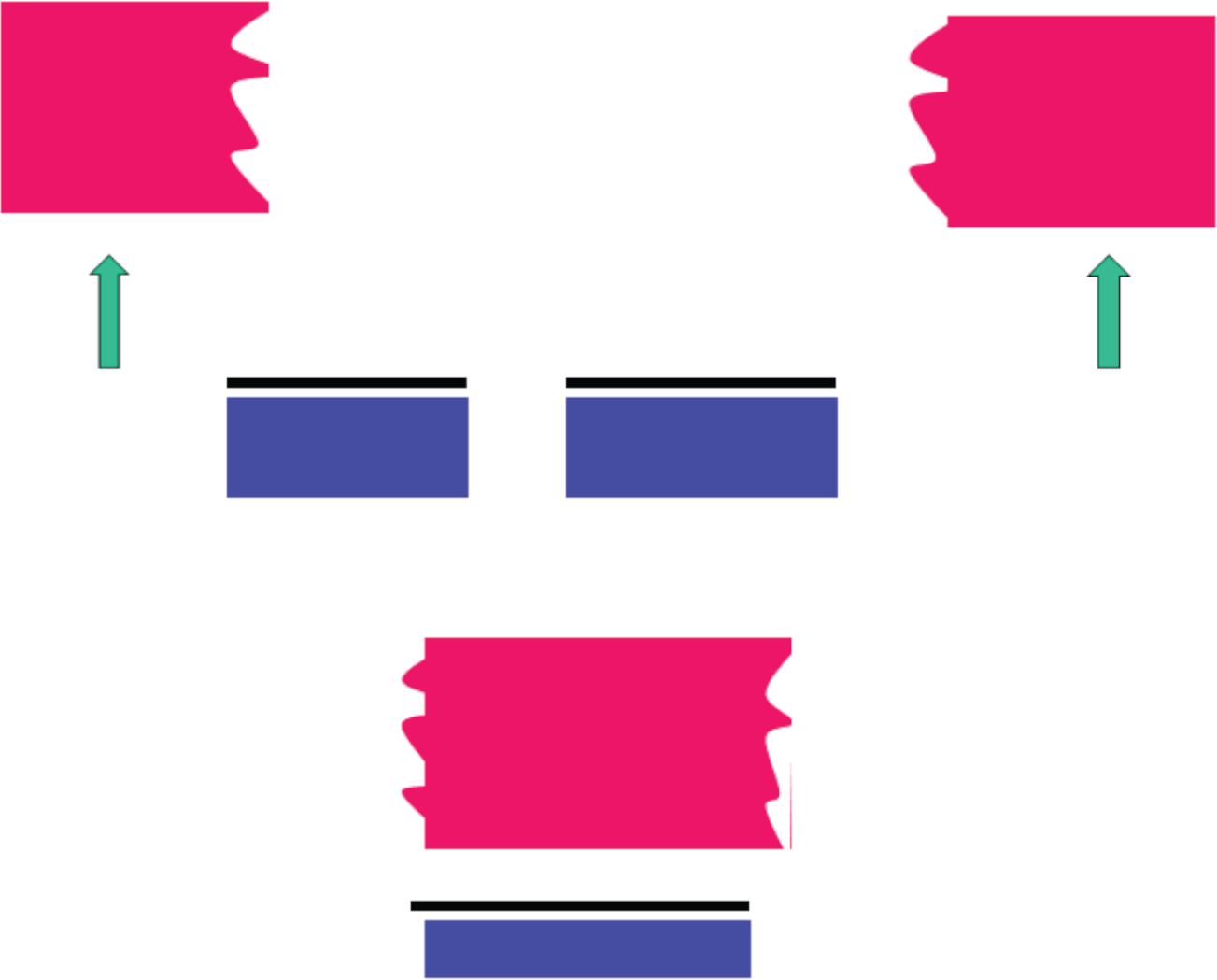
Fig. 10.6. The Athenian wings pause the pursuit and draw together, forming at the rear of the Persian centre and cutting its retreat.
Irrespective of which method the Athenians used, about-facing or countermarching, they took the Imperial centre from behind, possibly before they were seen to be incoming. And then, the slaughter started. The Imperial centre taken from front and rear was smashed. The troops were trapped, in panic and skewered by long lances which by now and after effective shoving, must have been able to reach at least two thirds of the ranks, had the Imperials been 10 deep. Hemmed in, they had escape points at their flanks, but to rush there meant turning their own flanks to the Athenian spears. Still, many were leaking but they found themselves, as they had been lured inland, to be far from their vessels and with the great marsh of Marathon square in their way. Maddened from shock and fear, many perished in the marsh, and the others, who skirted it, were this time hotly pursued and speared in the back.
Two things must be straightened out. No matter how much one (dis)likes, (dis) believes, accepts etc. the possibility that the Athenian wings took the Persian rear, this is what Herodotus states (VI.113,2), clearly and unequivocally. He says nothing about attacking their flank(s). Consequently, interpretations of how the Athenian wings came to be in flanking position without the proper drill, either by spontaneously turning inwards as a matter of the inherent mechanics of the Hoplite phalanx (Lazendy 1989 & 1993) or by the wings detaching from the centre to execute a converging attack (Burn 1962), simply complicate a straightforward chain of events.
Other, more imaginative interpretations, which completely revise Herodotus’ account and suggest that the victorious wings ran back, all the way, to the main battle and instead of taking the flanks or rear of the Persians, bypassed them and reformed behind the Greek centre to reinforce it (Green, 1970) blatantly mock Occam’s Razor. The notion of the latter scholar that if the Athenians attacked the enemy rear, the Imperials would have been pushed forward and thus would have crushed the Athenian centre as it was frontally engaged with them is absurd, at the very least. Nothing of the kind happened in the battle of Cannae (App VII.4,23), nor in the battle of Bagradas (Polyb I.34) and this is so for excellent reasons: when hit from the back, a body of troops does not intensify, it weakens its pressure frontally (App VII.4,23), if not due to the unnerving and demoralizing effects of shock and terror, then because some of the troops have to turn to face the new danger and thus do not press forward any longer.
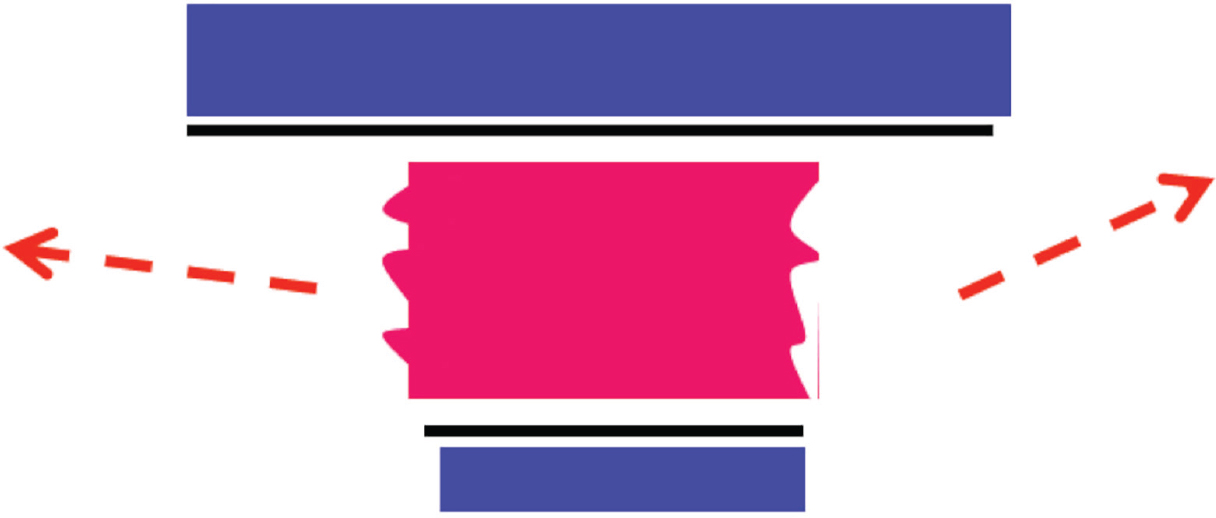
Fig. 10.7. Either by about-facing or by countermarching to reverse their front, the joined Athenian wings attack the Imperial centre from the back and slaughter ensues. Survivors leak from the flanks towards the beach.
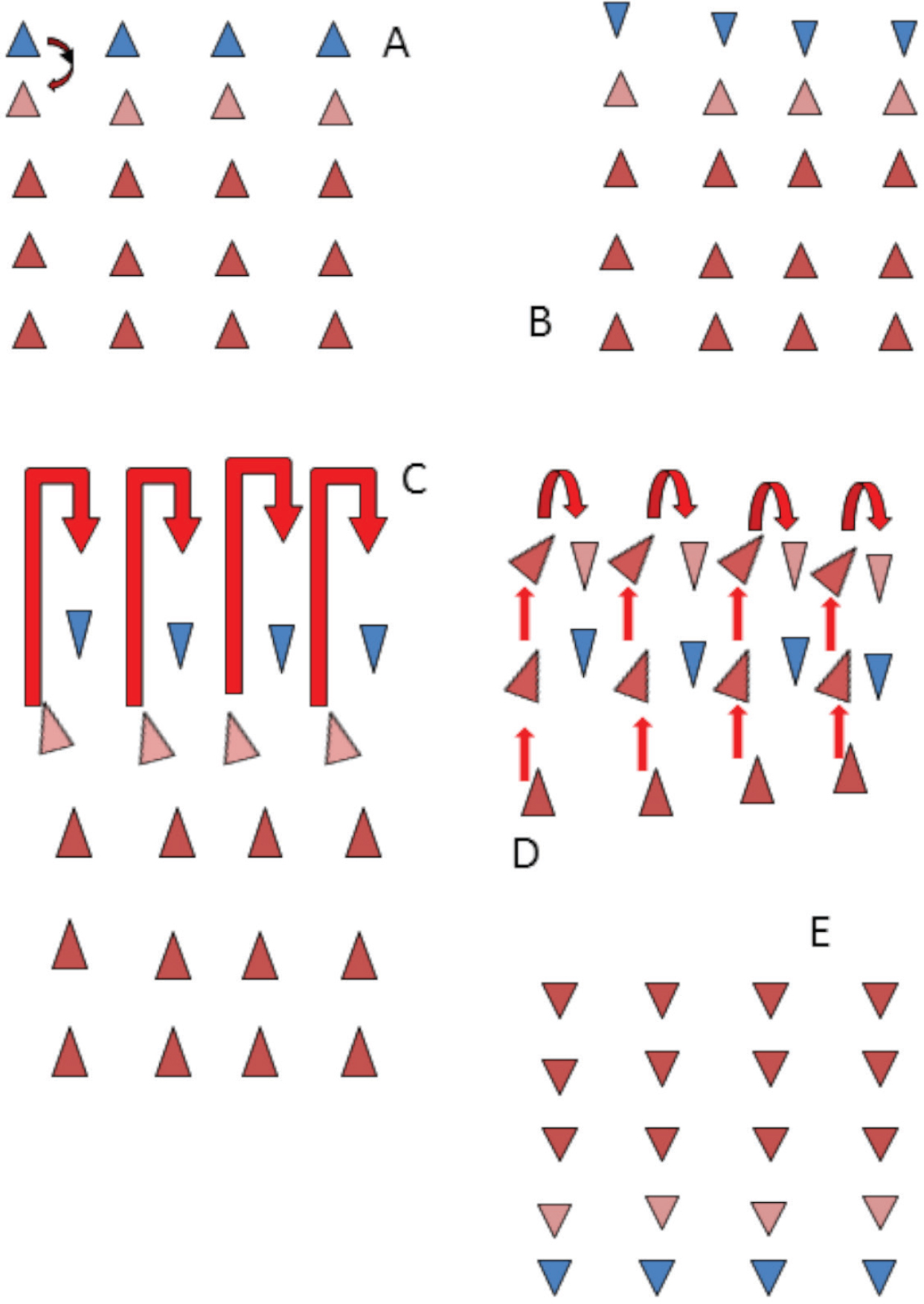
Fig. 10.8. Countermarch.
In line with the above, the second issue is the exact site of the battle. Marathon is one of the battles of the Persian wars that were fought with the orientation and the exact location still unknown to us; the problems posed by Salamis, Artemisium are comparatively minor but also refer to sea-fights; our blind spots on the events at Plataea are comparatively minor. It is hard to tell where the different phases of the battle took place, but there are some indications on the site: first, the tumulus, the monumental burying mound for the Athenian dead has nothing to do with any phase of the battle. The troops were buried in the battlefield probably for very practical reasons, such as the possibility of rotting during their transportation after the come-and-go of the army between Marathon and Phaleron. Thus, the tumulus is no sign, and moving some 200 corpses within the plain for whatever reason required minimal energy and resources; maybe ten wagons of standard, agricultural model. The trophy, on the other hand, has a very specific function in the context of the Hoplite battles regarding its exact location. It is set where the enemy phalanx/battle line first breaks and gives way (Krentz 2002). Marathon was a most unorthodox battle in every respect, even in its after-battle rituals (i.e. the state funeral of the victors in situ). If strict orthodoxy was pursued in this particular case, then at the location of the erected trophy one of the two imperial wings must have presented signs of collapse and retreat, possibly before evolving to flight.
But in this particular battle, the turning point for gaining the victory was the collapse of the Persian centre and it might well be that the monument marks the site where the Persians and Saka of the centre were attacked from the rear and collapsed. The key factor though to understand where and how the battle was fought is the clear reference that many fugitives of the Imperial centre perished in the Great Marsh during the flight (Paus I.32,7). Contrary to some scholars’ views (i.e. Lazenby 1993), one must notice that if the Athenian wings were reorganized at the rear of the Imperial centre and attacked from behind, as proposed herein, the free right flank of the Imperials would be leaking straight to the marsh, especially if the battle had been fought with the battle lines roughly parallel to the coast and away from any notion of the Athenians defending the southern road (Map 10.5).
This means that their flight path, left unobstructed by the Athenian manoeuvre, was taking them to the marsh on their way towards their base and their ships. Efforts to skirt or avoid the marsh were resulting in a longer distance to cover, a very unwelcoming prospect for terrorised troops hotly pursued. This detail, along with the absence of any reference that any Imperial or Athenian flank rested at the beach, a very poor choice as the shallow water would allow flanking by mobile infantry, argue against all suggestions that the battle was fought near, and even less along the shore, with the battle lines perpendicular to the shoreline (Sekunda (2002) and thus with a view to the control of the coastal road.
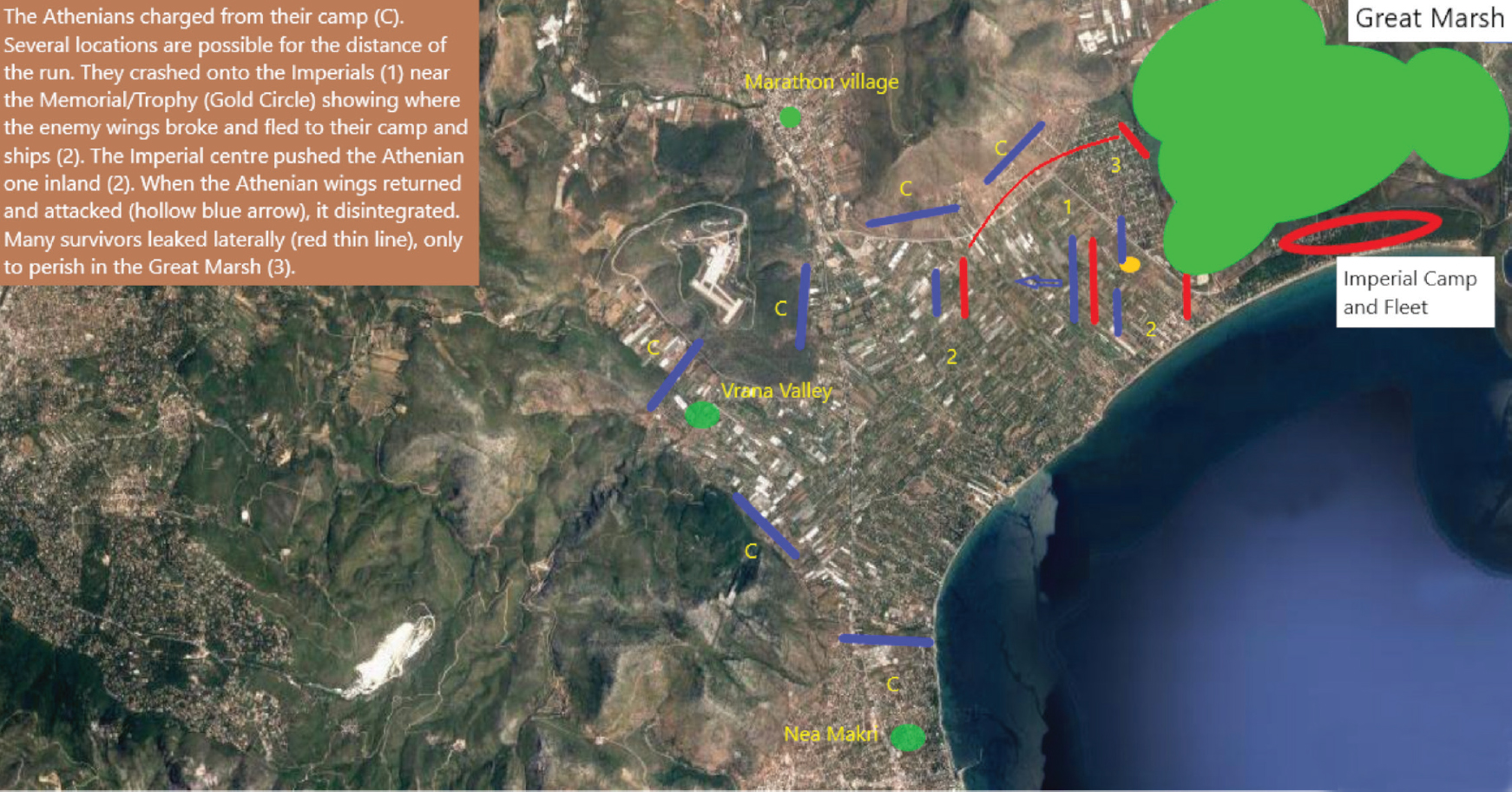
Map. 10.5.
Now the Athenians had conquered and were keeping no order. The Imperial centre being disintegrated, they were pursuing hotly – but they were pursuing lighter opponents, who had been less hard-pressed and thus had more breath and were incentivised by terror. Having reached the enemy vessels, a success unimaginable some hours ago when they were contemplating how they would bruise the Imperial army, they were now nearly destroying it. But they could not carry or spark fire to burn the fleet (Her VI.113,2). They did however capture seven triremes (Her VI.115), a mere one per cent, but a most important source of intelligence for Themistocles’ future shipbuilding programme, as they were to reveal the secrets of the enemy shipwrights. These seven triremes were manned by something like 1,000–1,400 mariners, (boarders excluded as they were at the fight). What happened to them? Did they embark on other triremes and leave? Were they butchered when their vessels were taken? Or were they taken prisoners? Most probably the second. This final act of pursuit, with no order and system, against a desperate and massive enemy, resulted in many Athenian casualties for no apparent reason. It was telltale for their lack of true discipline and an excellent justification of the limited and measured pursuit practised by the Spartans (Plut Vit Lyc 22,5).
Moreover, these casualties were well-known individuals (Her VI.114); not because the well-known ones died preferentially in battle, but because this was the army of the elite of the society and did not include the lower social groups and classes. In Marathon the bourgeois were fighting, leaving the riff-raff of Democracy, maybe 20,000, at the city, as untrustworthy; they placed more trust in their slaves, who followed as attendants and perhaps were enticed to fight, than to the poor. They neither armed nor even mobilize the Thetes as retainers and stewards of the Hoplites (Delbruck 1920).
The poor, the basis of Democracy and suspected for Medizm (Grundy 1901) were following their two patrons. The faction of Hippias, having been an unconditional blessing for the Athenian populace under Peisistratus (Grundy 1901), allegedly became pro-Persian, once their leader invited the Median bows; that of Cleisthenes had always been so and had offered Earth and Water (Her V.73,2–3). Hippias must have pitched himself to Artaphrenes (Her V.96,) as a more reliable puppet than the volatile Alcmaeonids, as he had a blood feud to settle (Her V.55) and not simple ambition. And, much more important, his re-establishment at Athens, which would nullify the revolution, would not only stop the exporting of such practices and mentalities, but was an excellent acid test for the Athenian compliance to the imperium and an opportunity to show their good faith by honouring their commitment to the empire (Her V.96,2).
After a battle won – winning the war
The imperial host evacuated the bridgehead. Hippias, almost 80, would have been difficult to evacuate in such conditions; but Herodotus makes no mention, which means he must have been with the advance force, with the cavalry, to enact any communication between the invaders and the collaborators. This was one more reason for the spent Athenians to dash to their city, or, rather, to their other intercepting position, meant initially for the case the Persians would have tried to land on the beaches of the western coast, after leaving Eretria. All Athenian Hoplites had run or trotted in attack, engaged, some of them had run again in brief pursuit and prompt return, then engaged some more with the trapped Imperial centre, pursued it to the shore and engaged once again. It was the second engagement for the centre and the third for the wings (Burn 1962). It was fast, but gruesome. The two tribal brigades of the centre, having taken the brunt of the fight, were spent. They stayed on the spot (Plut Vit Aris 5,5) to secure the battlefield; not so much from looters from the surrounding communities, but from possible, though improbable, Imperial aggressive return.
Being there, they collected the prizes and roamed the battlefield. This roaming of the battlefield, collection of spoils and later study of the dead (by the Spartans) and their transportation for mass burial supports the figure of 6,400 Imperials KIA (Her VI.117,1). Even if the Greeks were not performing body counts – which they did; the corpses and their possession were paramount issues in the outcome of a battle and defined winner and loser in unclear outcomes (Xen Ages 2,15–6; Krentz 2002) – in this particular battle a body count was performed and thus any suggestion to review the number 6,400, especially by long shots based on yearly sepulchral practices (Sekunda 2002) sounds unsubstantiated at the very least.
The rest of the Athenian army, first of all, dispatched a runner to notify the city of the great victory (Plut De Gloria 347c), which meant, in simple parlance, that even if a coup was attempted and Persian support arrived, the city would not remain occupied. With the Persian army shattered on the battlefield and a Spartan army incoming, Persians and traitors would have been in a terrible position. This piece of news cemented everyone’s resolve and sapped the confidence of collaborators who now understood they had bet on the wrong horse. No negotiations, no open doors.
Well, better safe than sorry. Despite the above, the Athenian army dashed off for Athens and deployed outside of the city circuit, at Cynosarges, to intercept an invader approaching from Phaleron, in a classical application of manoeuvring along interior lines. Both they and their runner would have climbed once more the shorter, Kephisia road, or the Nea Makri road; but not the Pallene road (Map 10.4). Herodotus, after all, would have mentioned Pallene if the Athenian army had taken the coastal road to either ingress or egress the plain of Marathon. This argument lacks in actual validity, as Herodotus is not at his best; he might have never visited the place, but this is no excuse. The event was wildly celebrated for decades and vital events, such as the orientation of the battle lines and the ingress and egress itineraries of the Athenian army would have been easy to ask about, if not veterans, definitely their sons and nephews.
The coastal road, easier for spent troops, was longer, a very bad choice when troops are spent and cannot pick up the pace, while time becomes of essence. Remarks that the Kephisia road is unsuitable for large armies (Green 1970) are off the mark. This army was not marching in formation, in ranks of four or eight under the drum and singing anthems to keep pace. They were stumbling, Hoplites and their attendants who must have taken up shield, spear and helmet at the very least, trying to make fast. And they did. They approached the city from the east, in full sight of the Persian squadrons bringing in the cavalry and took their interceptive position, not knowing the number and intent of the enemy fleet.
Seeing the Hoplites there, the commander of the task force knew things were going sour. There was no point in landing his force; the city would not succumb to some cavalry after a field victory and with its unscathed Hoplite army nearby. Thus, the Imperial vessels remained off shore, at anchor (Her VI.116) as they expected news and preferably the rest of the fleet, to determine the wisdom of a forced landing en masse and a direct confrontation.
The squadrons of the Imperial fleet evacuating the task force from Marathon, instead of going as fast as possible to Phaleron, to attempt a landing, collected the Eretrian PoWs (Her VI.115) from the detention camp on the isolated islet Aegilia, off Styra, (Her VI.107,2) halfway between Eretria and Athens (Map 10.2) and then resumed their course to Phaleron. It sounds idiotic since these captives could not escape and the Athenians had no fleet, or at least not at their eastern seaboard; their naval base was the port of Phaleron.
This attitude means the commander of the pinning force had no illusions; the whole force would do nothing, when reunited, except return home. Not only had he suffered a crushing defeat, with a large, disproportionate number of casualties of the most reliable and battle-worthy troops, the Persians and Saka of the centre (Her VI.113,1). Not only were these Hoplites pitted against him better drilled, better trained and much more determined than the ones at Ionia (or at Eretria). It was that they had discovered a way that neutralized the imperial chief weapon, the bow; these Hoplites had smashed into them with practically no casualties, as their running tactics shortened the available time for an effective barrage, while also denying proper aiming. This had been witnessed by troops and commanders alike and had destroyed their confidence; it would have done so even if the Persians had taken their leave of Marathon with no casualties. Coupled to the fact that the foes they were seeing in front of them had suddenly appeared, almost if by magic, not behind them in a general term but squarely at their back and slaughtered them by the thousands, the morale was hitting nadir. The Imperial infantry had no stomach for anything further.
Box 10.1
A legacy in tactics
Themistocles, aged 38 at Marathon, Archon in the year 493 BC (Carmichael 2009; Sekunda 2002) had already initiated the fortifications of the Piraeus due to his western vision, which built upon the previous one of Solon that had been interrupted due to the policy of Peisistratus, to turn to the Euxine. As the Persian Empire cancelled all such efforts and prospects, the West was the only source of grain, but heavy competition was expected by the Dorians who controlled the western trade. Thus, naval preparations were indispensable, and the Imperial threat made things easy, as the Achaemenid proceedings against Miletus, a show of cruelty and terror, had stricken awe and fear into the hearts and minds of the hapless Athenians, on top of their guilt for breaking their commitment to Artaphrenes.
At the same time, Miltiades arrived in Athens, having escaped the Phoenician pursuit. Themistocles readily befriended and supported him when he was prosecuted by the Democrats. Having heard his thoughts and reports and being a front-line fighter at Marathon, Themistocles acquired an understanding of the Persian psyche and first-hand experience of the stunning effect of violent Hoplite charges upon the Orientals, but also of the inflicted psychological fluctuations: if the Orientals repulsed the Hoplite charge, they were becoming overconfident, arrogant, engaged and careless, very prone to tricks and entrapments like the flanking in Marathon and repeated events in Salamis, Thermopylae, Plataea, Mycale. Given that the Spartans inspected the battlefield at Marathon and conversed with the Athenians, it might be surmised that the feigned flights at Thermopylae, Plataea and Salamis had a common denominator and inspiration, the – most probably fighting – retreat of the Athenian centre at Marathon, which became ingrained in future Spartan operational doctrines against the Orientals.
Box 10.2
The Achaemenid concept of jointness
There is a one-sided view of ancient warfare concerning the infantry-cavalry co-operation and the merit of combined operations. Whether the Achaemenids during the early 5th century were able to do so could be the wrong question, although it is a hotly contested one; in any case, the arguments negating such an approach are indeed more convincing (Hammond 1968). But the correct question would be whether they intended to do so. The answer is not so clear-cut.
Historians seem perfectly convinced that the proper way and the most evolved doctrine was similar to this of Epaminondas or, even better, of Philip II and Alexander III the Great. But career military personnel are less unanimous: the close co-operation between two arms of different mobility seems a waste of resources. Examples are aplenty: the use of the tank to escort infantry, the quintessential reason for its development, was tested, has been vindicated over time in many cases, but at least operationally it is considered a foul practice, exposing it to direct fire, depriving it of its mobility and limiting it to infantry escort. Doctrines for independent armour action behind enemy lines are considered the proper way to use a tool that can bring results in operational, not tactical, terms if used independently and daringly and, most importantly, with the proper mass on suitable ground. The German Panzerwaffe is an excellent historic parallel, much better than the knightly European armies, as in early 490s the Persian infantry was the king of battle, as has always been the Prussian or German infantry; later on, in the late 5th and during 4th century, the Achaemenid infantry declined to the status of medieval infantry in knightly armies.
The same can be said for the air forces. Their initial use was to assist the land army and the navy, originally without providing interception or strike. Reconnaissance was all-important. As technology progressed, independent air branches were established; both in Britain and in Greece, with its minuscule but pioneer air force engaged in combat since 1912 in both land and sea missions, the Air Force became a separate branch. The US followed after four decades, seeing that the strategic potential the USAAC showed in the Second World War, being amplified by the nuclear bomb, was wasted within the context of an army requiring overhead support and protection in deep, but limited battlespaces compared to the intercontinental reach of the new breed of aircraft. The close tying of the German Luftwaffe to tactical and operational missions to support both army and navy, without a properly formed strategic constituent is considered a major flaw leading in part to its defeat, especially in the Battle of Britain.
Thus, it is no wonder that the Achaemenid cavalry was not closely co-operating with their infantry, but selectively and rather as an exception. They could achieve different objectives and the proximity in temporal but also in spatial terms could cause friction rather than incubate synergies. The infantry was the arm to decide battles for the Imperials; had done so repeatedly during the Ionic Revolt and there was not one reason to doubt its ability to repeat such stellar performance in 490 BC, without any need for cavalry support.
Box 10.3
Takabara vs Sparabara
It is usually assumed, for no really good reason, that the main oriental troops in the campaign of 490 BC were sparabari (plural of Sparabara). They could have been, but they might, just might, have not. In Marathon, the Imperial troops are considered to have been sparabara, the standard type (Sekunda 2002; Sekunda and Chew 1992).
It is not necessarily so. Some indications point to the possibility that takabara fought in Marathon for the Empire. First, Herodotus nowhere mentions the spara wall as he does in Plataea and Mycale. He may simply not mention it – Marathon is not his best story. Or, the Imperials may have had no time to plant it due to the Athenian surprise attack, although planting a spara takes half a minute at the most. Additionally, the kinetics of the battle, with the advances and retreats perpendicular to the direction of the original frontline, preclude such an obstacle, even erected in the most rudimentary manner. Furthermore, Herodotus’ notion is that the Imperials had archers, while their opponents had none. Not that they were archers, as was the case with the sparabara. This implies archer units, probably the Saka, within the army, not an army of archers; a condition satisfied with the deployment of both sparabara and takabara. Directly corroborating with the previous issue, is the famous fresco of Polygnotus, Panaenus and Micon found at the Poikile (Painted) Stoa (Colonnade) of ancient Athens. If the brilliant reconstitution by Schenck has anything to do with the original, the imperial shock infantry at Marathon is the takabara, with troops armed either with taka and spear or with the bow (obviously the Saka) and no spara or sparabara anywhere to be found.
Last, but not least, is the concept of mixed troop types. The takabara is thought to have been a satrapal levy troop type (Sekunda and Chew 1992), although this might be incorrect and the takabara might have been regulars, of the Persian national reserve (Xen Cyrop I.2,13), met more frequently on the battlefield once the Greeks started offensive operations, where local Persian musters had to be mobilised to respond. Whatever of the above might have been the case, in Marathon a mixed task force of sparabari and takabari might had taken the field, with royal and satrapal regiments containing either but not both. Alternatively, a combined force might have been the case, as they were both expeditionary troops and would have provided a combined Persian nucleus, with archer-spearman and CQB (Close Quarters Combat) elements within each unit, imperial or satrapal.
One may even venture to factor this asymmetry to the renowned order of battle prescribed by Miltiades, which would have taken the respective weaknesses and liabilities into consideration. The main phases of the battle are described, or rather examined elsewhere, but, briefly, following this account the amassed Hoplites would brush the takabara aside with very little fuss, while the thin Hoplite front at the centre would make the arrow storm launched by the massed sparabari less effective. The shoving event, due to the great size of the spara, would also have been less risky for the individual Hoplites in terms of opportunities afforded to the overbearing Imperials for stabbing around, or over the spara. In truth, the Imperials with the best equipment for CQB, i.e. stabbing fight, the takabari, would not be able to perform, being pushed back by the weight of the Hoplite charge augmented by the running effect. The heavier sparabari would have caused little impression with their arrows and the weight and size of their shield would have slowed down their advance, making a breakthrough less probable, while allowing little opportunity for effectively stabbing their solid but recoiling enemies. As a result, they remained concentrated in a compact body, to be sacked and netted once the wings were disintegrated.