
Chapter 4
Our attempt at explaining Gothic origins has taken us a very long way from our narrative, indeed a long way from the ancient world, and into a discussion of modern intellectual history. The detour has been important. It looked at the way modern accounts of Gothic migration, whether they claim to be supported by historical, archaeological or linguistic evidence, are all in one way or another echoes of Jordanes’ sixth-century Getica. Consciously or not, modern narratives of Gothic migration are rooted in the very old quest for Germanic origins, a quest to give northern Europe a past independent of Roman history. Unfortunately, as we have seen, contemporary evidence supports neither migration stories nor any narrative derived from Jordanes. On the contrary, it suggests that – like the Franks and the Alamanni further west along the frontier – the Goths were a product of the Roman frontier itself. That conclusion not only makes sense of the evidence of the late third century, it also fits in well with the much better understood evidence of the fourth century.
In the first three decades of the fourth century, as we shall see in this and the next chapter, the Goths became the indisputable masters of the lower Danube, from the eastern edge of the Carpathians to the fringes of the Caucasian steppelands. Language itself began to acknowledge these facts. Thus, by the 320s, the lower Danube was known as the ripa Gothica, the Gothic bank. Soon thereafter, we find the Greek word Gothia designating the tract of land beyond the Danube, a word that was imported into the Gothic language as Gutthiuda, the Goths’ word for their own lands. This tremendous extension of Gothic power was not inevitable. Instead, the Goths were encouraged to become so powerful because it was useful to the political schemes of successive Roman emperors for them to do so. In other words, just as the Goths themselves were created by the political pressures of life in a Roman frontier zone, so Roman emperors made the fourth-century Goths what they were. The revolutionary reign of Diocletian marks the turning point.
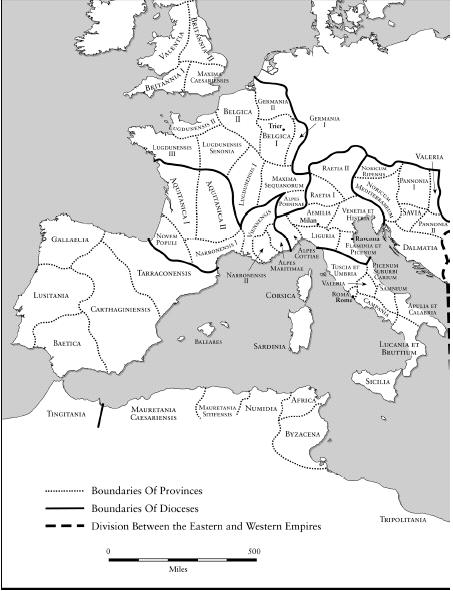
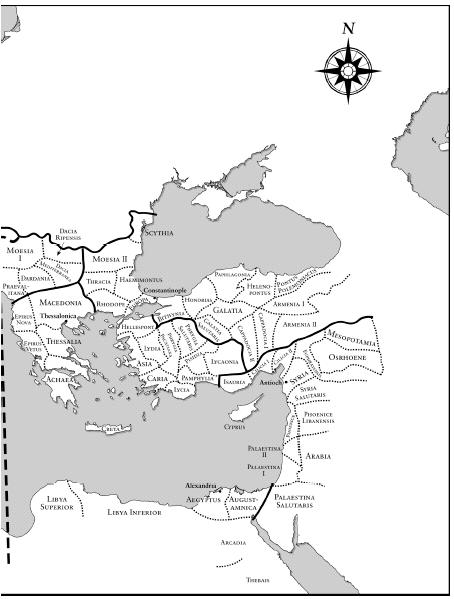
Map 3. The Roman Empire of Diocletian.
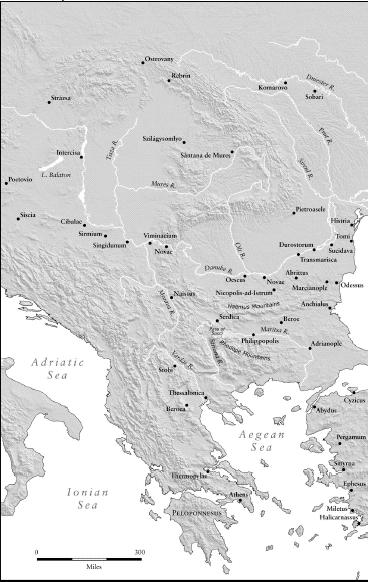
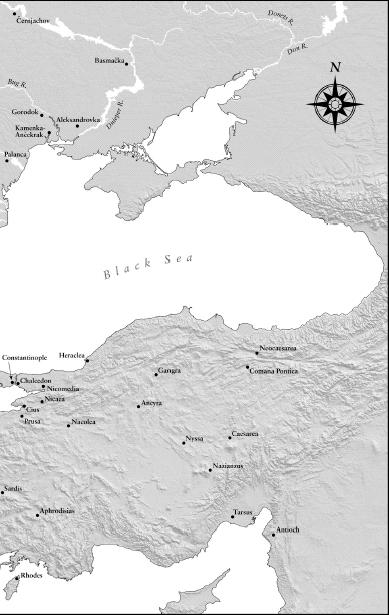
Map 4. Asia Minor, the Balkans and the Black Sea region, showing Roman cities and Sântana-de-Mureş/Černjachov sites mentioned in the text.
Diocletian’s New Roman Empire
In the course of the 290s, Diocletian transformed the Roman empire beyond recognition. A governmental revolution grew out of the emergency measures which Diocletian undertook piecemeal in order to keep himself secure on his throne. The cumulative effect of such measures was enormous. It removed many of the systemic causes of disorder that had plagued the third-century empire, and thereby created the powerful Roman state with which the fourth-century Goths had to deal. As we have seen, the first important step that Diocletian took was to appoint Maximian as his fellow augustus, or co-emperor, in 285. The point of this measure was to multiply the imperial ability to deal with many different threats at one time. An emperor who was on the spot and seen to be doing his job was a powerful disincentive to usurpation by a local governor or general. Diocletian took this principle still further, by appointing two junior emperors, called caesars, as a complement to the two senior augusti. Together, these four emperors would form an imperial college in which the actions of each emperor would symbolically be the actions of all four: a law issued by one emperor was issued in the name of all four, and when one emperor won a victory, all four took the victory title associated with it. This college of four emperors is known to scholars as the tetrarchy (‘rule of four’ in Greek). For as long as it lasted, the new tetrarchy of Diocletian and Maximian, with their caesars Constantius and Galerius, ensured that an emperor was on hand in nearly every trouble spot of the empire, ready to suppress a looming threat and thereby discourage any local response that might challenge the hold of Diocletian and his colleagues on their thrones. The tetrarchic system was also meant to ensure a smooth succession, as a caesar would be waiting to succeed a senior augustus should the need arise.
Diocletian’s reform of the imperial office was accompanied by an elaborate religious ideology that assigned to the ruling emperors divine descent from Jupiter and Hercules, those gods that were most ostentatiously Roman in the traditional pantheon. The tetrarchy also insisted on renewed attention to the imperial cult – the worship of past, deified emperors and of the genius, or protecting spirit, of the living emperor. Both measures were designed to ensure that the gods would smile on and protect the empire. The famous Diocletianic persecution of Christians, widely known as ‘the Great Persecution’, was a consequence of this tetrarchic ideology, because Christians refused to worship any god but their own and by doing so might endanger the health of the state. If religion was one basis on which Diocletian rested his authority, he took other measures as well, reforming the currency, expanding the army, and re-enforcing the elite guard units that traveled with the emperor. Most importantly, he broke up the very large provinces of the early empire into more than a hundred smaller provinces, while also separating the military and civilian hierarchies in the imperial government. The first measure dramatically reduced the scale of any one official’s command, while the second meant that the officials who collected taxes and disbursed state salaries to the soldiers were not the same officials who commanded the troops in the field. Together, both measures undermined the ability of either military or civilian officials to claim the imperial throne for themselves. As we have said, the various Diocletianic reforms were ad hoc measures, meant to deal with the many different problems that had afflicted the third-century empire. Yet as a group, they were revolutionary: they not only allowed Diocletian to hold his throne for more than two decades, they also produced a system of government that remained effective even after the tetrarchy itself broke down. In other words, the type of imperial goverment originally outlined by Diocletian and the tetrarchy was in essence the same one with which Alaric had to deal a hundred years later. More important for our immediate purposes, however, Diocletian’s reforms meant that for the first time in over half a century, a Roman emperor was secure enough on his throne to deal effectively with barbarians beyond the northern frontier – with serious consequences for the Goths.
The Tetrarchs and the Northern Frontiers
This new imperial strength meant that the constant stream of frontier wars slackened considerably in the years before 305, when the augusti Diocletian and Maximian abdicated and passed the senior title on to their caesars Constantius and Galerius, who then appointed two new caesars to serve as their junior emperors. Instead of constantly reacting to events beyond their control, the tetrarchs were increasingly able to decide when and where they wanted to fight along their frontiers. They began to co-opt powerful barbarian leaders into imperial circles, and to manage the affairs of their barbarian neighbours in what they perceived as the best interests of Roman power. This policy can be inferred from obscure, but clearly very important, disturbances along the lower Danube in the 290s and early 300s. We saw in chapter one how Diocletian won a victory over one group of Goths, the Tervingi, as the panegyric of 291 attests. We do not know what prompted the campaign that led to that victory, but the decade that followed seems to have witnessed the substantial growth of Tervingian power. Although this Gothic expansion is not attested by positive evidence, it can be inferred from other known events, most importantly the displacement of an older barbarian grouping. Sometime before early 307,Galerius fought a campaign against the Sarmatians, which is to say in the region between the Danube and the Tisza rivers. Then, in the summer of 307, he attacked the Carpi further east, settling a very large number of them in a Roman province south of the Danube as defeated subjects of the empire.[54]
The willingness of the Carpi – virtually all of them, it seems – to be removed from a territory in which they had dwelt for well over a century is significant. It suggests that the military pressure of a neighbouring barbarian power had become too great for them to sustain and that their attempts to find refuge in the empire had provoked a punitive imperial campaign. The Gothic Tervingi are the barbarian group most likely to have affected the Carpi in this way. We seem, in other words, to see an increasingly powerful Tervingian polity near the mouth of the Danube extending its power at the expense of its immediate neighbours, perhaps with the tacit support of the imperial government. That support can probably be inferred from the fact that the tetrarchs fought no campaigns against the Tervingi after 291. On the contrary, Goths may have been recruited into the imperial army and served with Galerius in Persia, though the only evidence comes from Jordanes and is therefore suspect.[55] It is thus quite likely that the tetrarchs were complicit in the build-up of Tervingian power, viewing them as a favoured barbarian group which could help keep in check other barbarians further up the course of the Danube.
There was a real logic to that approach. While the lower Danube was consistently under the firm control of an emperor resident in the Balkans (first Galerius, then Licinius), the provinces of the middle and upper Danube were the usual setting for confrontations between rivals in the years after 305. Because this imperial preoccupation with the upper and middle Danube lasted for a full two decades after 305, imperial support of Tervingian hegemony in this period is quite plausible. It would, moreover, allow us to make sense of two massive ditch-and-rampart wall systems which were built around this time in Bessarabia and Galatz, well beyond the imperial frontiers. Like the long east-west wall system known as the Csörsz-árok, built beyond the Pannonian frontier in modern-day Hungary, these fortifications are of a quality and on a scale that could not have been attained without imperial approval. From the imperial point of view, it would be useful to have a reliable Gothic ally keeping the lower Danube quiescent. By favouring the Tervingi, allowing fortifications to be built in their lands on such a scale, their strength and security could act as an additional layer of imperial defence, allowing emperors to focus on more immediate threats elsewhere. Imperial support along these lines explains why the Tervingi are so much more powerful when we next meet them in our sources, around the year 320.
The Breakdown of the Tetrarchy
In the meantime, however, the tetrarchic experiment had broken down entirely. Diocletian and Maximian abdicated in 305, for reasons that remain extremely controversial. Galerius and Constantius became augusti, but the choice of new caesars caused problems. Rather than the sons of Maximian and Constantius, who had long been groomed for the succession, two of Galerius’ close supporters were appointed as caesars. Before long, however, both the imperial children had seized the purple for themselves. After his father died at York in 306, Constantine was acclaimed emperor, supposedly at the instigation of the Alamannic king Crocus, a client of the late Constantius and an early example of a barbarian noble holding a high position in the imperial army.[56] Maxentius, the son of Maximian, was proclaimed emperor at Rome in the same year, with the support of the Roman populace. Constantine’s proclamation was soon recognized by the senior augustus Galerius, but Maxentius was never accepted as a legitimate emperor. For half a decade between 307 and 313 the Roman empire was wracked with civil wars that gradually eliminated most of the key claimants to the imperial title. By 313, there were only two emperors left, Constantius’ son Constantine (r. 306–337), now a fervent Christian, in the West, and Licinius (r. 308–324), an old comrade of Galerius, in the East. Despite their violence, the civil wars of 307–313 demonstrate the basic solidity of the Diocletianic reforms, because the hallmarks of the third-century crisis are entirely absent from the post-tetrarchic conflicts: no provincial general made an opportunistic bid for the throne, no provinces broke away under their own imperial succession, and no barbarian kings exploited the situation to launch a major invasion across the frontiers.
Indeed, a firm hand was kept on the imperial frontiers despite active civil war. Even before they had done away with other rivals, Constantine and Licinius between them controlled most of the Rhine-Danube frontier. Both undertook traditional imperial campaigns into the barbaricum, Constantine leading Frankish kings in triumph at Trier, Licinius attacking Sarmatians near the Danube bend.[57] As always, we cannot know precisely what prompted the individual campaigns, but the perpetual demand for imperial victories, combined with a need to control barbarian politics while preparing for internal Roman conflict, can explain most of the fighting. A similar calculation probably lies behind the momentous propaganda decision which Constantine took in 310. In the old tetrarchic ideology, Constantius had been the adoptive son of Maximian, and hence took on his adoptive father’s putative descent from the god Hercules, along with the name Herculius that represented it. In 310, however, Constantine repudiated the Herculian name which he had inherited from Constantius. He instead began to claim descent from the emperor Claudius Gothicus, a fiction first attested on 25 July 310.[58] It made sense for Constantine to rid himself of the old Herculian connection after his final break withMaximian and Maxentius in 310, but there may have been more to it than that. Claudius, one of the third century’s great military heroes, won his Gothic victories in the Balkans. Constantine’s claim to a Claudian descent may be the first indication of the Balkan ambitions he was to demonstrate before too long.
Constantine and Licinius
Between 313 and 316, Constantine and Licinius maintained the cordial neutrality that had allowed them to work together during the last years of the civil wars, but their truce was uneasy and they came to blows in 316. The western Balkans fell to Constantine in this war. He took over Licinius’ residence at Sirmium, dividing his time between that city and Serdica, and leaving his son and caesar Crispus in Trier to guard the Rhine frontier and campaign against the Franks and Alamanni.[59] Constantine’s eastern ambitions were now clear, as his choice of residence could hardly fail to demonstrate, and he used the old tactic of disciplining the barbarians to provoke a final confrontation with Licinius. In 323, Constantine campaigned against the Sarmatians on the frontiers of Pannonia, winning one battle, over a king called Rausimod, at Campona in the Pannonian province of Valeria, and a second considerably further downstream at the confluence of the Danube and Morava in Moesia Superior.[60] Coins issued at Trier, Arles, Lyons and Sirmium celebrated the success with the legend Sarmatia devicta (‘Sarmatia conquered’) and Constantine took the victory title Sarmaticus.[61] He may also have instituted new celebratory gladiatorial games, as an epigraphic reference to ludi Sarmatici, Sarmatian games, suggests.[62] Regardless, the campaigns were a provocation of Licinius, into whose territory Constantine had marched while attacking the Sarmatians. Almost certainly intentional, this violation of his fellow emperor’s sovereignty led to the final break between Constantine and Licinius – the latter supposedly melting down Constantinian gold coins celebrating the victory in order to make the point as publicly as possible.[63]
In the ensuing civil war, both sides made substantial use of barbarian soldiers. Licinius had won a victory over the Goths before 315 and peace terms may have included Gothic service in his army.[64] In the war against Constantine, Goths fought on the side of Licinius, probably under a general named Alica. Constantine had used Frankish auxiliaries in his earlier campaigns and by the time of the war with Licinius, the Frankish general Bonitus had reached a position of rank in Constantine’s army.[65] As we have seen, barbarians had always served in imperial armies, but there is some reason to think that the build-up to war between Constantine and Licinius represents a new phase in this phenomenon. For one thing, the early 320s were the first period since the onset of military crisis in the third century during which rival emperors had ample leisure to recruit troops for themselves. For another, both Constantine and Licinius were competing for roughly the same pool of manpower, that is to say, barbarians from the middle and lower Danube – Sarmatians and Goths, generically “Scythians” – and such competition almost always increases both supply and demand. This increasing reliance on barbarian recruits is partly hypothetical, but is probably confirmed by the testimony of the Caesares, a satire on his predecessors written by the emperor Julian, which is scathing about Constantine’s recruitment and subsidy of barbarians.[66] Certainly, as the fourth century progressed, emperors made more and more use of barbarians in filling up the ranks of the army. That being the case, it seems likely that the precedent set by Constantine and Licinius in the early 320s was validated by its very success: Constantine routed Licinius.
Constantine and the Danube Frontier
That victory allowed Constantine a free hand in the Balkans, which he used partly for grandiose construction schemes. The manpower which these projects required is attested by a dramatic increase in the region’s supply of bronze coinage in the late 320s. In the valley of the Porecka near the Iron Gates, a major wall system was put up to control threats from across the river. That was eminently practical, but a more spectacular venture was a new bridge over the Danube from Oescus to Sucidava, which in 328 established a real and a symbolic bridgehead onto what one source now calls the ripa Gothica.[67] Constantine also continued the tetrarchic program of constructing quadriburgia along the Danube. These small forts, enclosing less than one hectare, were a new development of the early fourth century. They were characterized by a tower at each of their four corners (hence their name), and were built both on the right bank of the river in the Roman provinces of Moesia Secunda and Scythia, and also on the barbarian left bank. Primarily useful for keeping the barbarians under observation, quadriburgia could also serve as advance posts for Roman military action. Although the whole Danube frontier received this sort of imperial attention, the lower stretch of the river, and hence presumably the Tervingi beyond it, was the main focus. Thus in parallel to the Oescus-Sucidava bridge, Constantine built a new quadriburgium at Daphne, on the left bank of the Danube across from Transmarisca. How should we account for this focus on the stretch of the Danube opposite the lands of the Gothic Tervingi? Perhaps the most obvious explanation is the fact that Goths had fought on Licinius’ side in the recent civil war. But the support which the tetrarchs and Licinius seem to have given to the rise of Tervingian power in the region probably also worried Constantine.
Constantine’s Gothic War
The later 320s witnessed a series of disturbances beyond the Danube frontier which may have justified such worries. As with the displacement of the Carpi twenty years earlier, these events can be understood in terms of Tervingian threats against their neighbours. First, in 330, a number of Taifali invaded the Balkan provinces, perhaps driven there by the Tervingi.[68] A request for imperial aid from some of the Tervingi’s Sarmatian neighbours soon followed, and developed into a major Gothic war. The Sarmatians had long been subject to the usual Roman mixture of subsidy and punishment. The remains of the large Sarmatian defensive systems just to the east of the Danube bend – most famously the Csörz-árok mentioned earlier – were undoubtedly built with Roman permission and suggest the sort of alliance that would have justified the Sarmatians’ request for assistance. The extent of Gothic power is revealed by the response to this request. Constantine launched a campaign against the Goths, the first stage of which was won ‘in the lands of the Sarmatians’, thus beyond the Pannonian section of the Danube frontier.[69] That implies a range of Gothic military action far away from the point where the Goths had hitherto appeared in our sources.
One must surmise that, in the aftermath of Constantine’s victory over Licinius, and while he himself was distracted by internal political problems, a Tervingian king had seized the opportunity to expand his hegemony at the expense of barbarian neighbours, although without directly threatening a Roman province. Probably he expected events of the previous two decades to repeat themselves: his defeated enemies would be accepted into the Roman empire and settled there, while he would be allowed to continue expanding his control in the trans-Danubian lands. If that was indeed his calculation, he did not foresee the scale of the imperial response. Constantine sent his oldest surviving son and caesar Constantinus to campaign across the Danube. This imperial thrust, so we are told, drove many Goths (the sources speak improbably of 100,000) into the wilderness to die of hunger and cold. Constantinus demanded and received Gothic hostages, amongst them a son of the Gothic king Ariaric.[70] The defeat of the Goths was followed by a successful campaign against the Sarmatians, who had supposedly proved unfaithful to their agreements with the emperor.
The Peace of 332
Constantinus had won a major and lasting victory that remained worthy of note two decades later: in 355, when Constantine’s nephew Julian delivered a panegyric to another of Constantine’s sons, the emperor Constantius, the scale of the Gothic victory could still be celebrated.[71] In fact, for more than thirty years after 332 the lower Danube was at peace. Yet despite its evident importance, we know very little about Constantine’s Gothic peace. The limitations of our evidence have encouraged modern scholars into much hypothetical reconstruction along two different lines, the first on the continuity of Gothic leadership, the second on the terms of the peace. In both cases, the testimony of Jordanes is a complicating factor. The real problem is the obscurity of the contemporary fourth-century sources, none of which allows us to gauge how important a king Ariaric was, and none of which tell us how, or whether, he was related to Tervingian leaders of the later fourth century. Instead, we have to infer this information from the limited evidence at our disposal.
The first clue to doing this lies in the location of Constantine’s first Gothic campaign. Given that it took place in distant Sarmatia, and given the scale of the tribal displacement that preceded it, we can perhaps infer that Ariaric was the ruler of a very substantial polity. Although we cannot be sure that he was the only Gothic king involved in the war of 332, he is the only one attested by name, probably another sign of his importance. We are on less certain ground when it comes to his connection to later Tervingian leaders. It is widely agreed that Ariaric was the grandfather of Athanaric, the powerful Tervingian chieftain against whom the emperor Valens campaigned in the 360s. However, that genealogical connection is based on the hypothetical identification of Ariaric’s unnamed hostage son with the equally unnamed father of Athanaric who is said to have had a statue erected to him in Constantinople.[72] The only ancient source that explicitly connects Ariaric with the Tervingian leaders of the later fourth century is Jordanes.[73] But as we have seen, Jordanes was determined to construct a continuous Gothic history. Given that he elsewhere invents demonstrably spurious connections to provide genealogical continuity, the value of his testimony for Ariaric is suspect. In other words, while some connection between Ariaric and later Tervingian kings is plausible, it can only remain speculative.
The same holds true for the terms of the treaty. Fourth-century evidence is limited, while Jordanes imposes on it an anachronistic Byzantine interpretation. He supposes that Ariaric’s Goths became foederati, a word that by the sixth century had a technical legal content implying specific responsibilities on the part of both empire and federate allies. In 332, however, the formal status of foederatus did not exist, and the word for treaty, foedus, is not a technical term. Even though many scholars think that the treaty of 332 invented the type of technical foedus known in the sixth century, nothing in the fourth-century evidence makes that plausible. The peace of 332 marks a significant stage in both Roman and Gothic history not because of any legal innovations, but because it was so very decisive. It imposed more than thirty years of peace on the lower Danube or, as bishop Eusebius of Caesarea put it in the Life of Constantine that he wrote shortly after the emperor’s death in 337, ‘the Goths finally learned to serve the Romans’.[74]Indeed, some of the defeated Goths would continue to claim a special loyalty to the Constantinian dynasty for many years, decades later supporting a usurper named Procopius on the grounds of his dynastic connections.[75] In the interim, they offered tribute to the emperor, and provided a large supply of military recruits for the Roman army. Such military service was not explicitly required by the terms of 332, as Eusebius’ testimony makes clear: he is nowhere able to state that Goths served in the army as a result of the treaty, even though elsewhere in his Life he is consistently very enthusiastic, and very specific, about Constantine’s recruitment of defeated barbarians.[76] Regardless, the peace brought benefits to both sides.
The Peace and the Gothic Economy
The frontier was opened to trade all along its length, a most unusual measure, given that Roman emperors had for centuries regulated the export of Roman technology outside the empire. Yet the fact that trade surged all along the river is demonstrated by the large number of bronze coins found in the band of territory north of the Danube. Bronze issues of the late 330s to the early 360s dominate the archaeological record, which suggests that the Gothic side of the lower Danube came to be quite thoroughly integrated into the Roman monetary economy in those years. In fact, the distribution of bronze coins in the region immediately beyond the frontier is very nearly as intense as in the Roman province of Scythia itself.[77] That such coins were used for commercial exchange is placed beyond serious doubt by the existence of locally produced imitations of Roman coins which must have been struck to eke out insufficient supplies of genuine Roman coinage in commercial circulation. It must be noted that bronze coin finds are dramatically concentrated right beside the frontier, generally within fifteen or twenty miles of it, but less so in the Gothic regions opposite Scythia and Moesia Secunda than those across the river from Moesia Prima. Although this fact has led some scholars to question the level of monetization of the Gothic economy, the sheer quantity of low-value coinage beyond the frontier make these objections hard to sustain.
That Roman diplomatic connections with the Gothic elite also increased rapidly from the 330s onwards is suggested by the distribution of Roman silver coins. Much less common in the immediate vicinity of the Danube, silver is instead found in large quantity further north and east, in modern-day Moldova and Ukraine. Unlike the bronze, silver coinage is uncommon in stray finds at industrial and residential sites. Instead, silver siliquae are concentrated in small hoards, for instance one found at Kholmskoě near Lake Kitaj or another at Taraclia in Moldova. The Kholmskoě hoard is especially significant: its ninety-three silver coins of Constantius Ⅱ were all of the same value and type, struck between 351 and 355, bearing the legend VOTIS.ⅩⅩⅩ – MULTIS.ⅩⅩⅩⅩ, and virtually unused. This fact raises some doubts about whether they circulated as money or as bullion. It is possible that our extant finds of silver coinage are not evidence for trade across the frontier – especially since silver siliquae are very rare in the Roman province ofScythia itself – but rather for gift-subsidies to Gothic chieftains whom the empire had an interest in cultivating. All the same, there can be no question that the economy of Gothia was both fairly sophisticated and closely linked to the Roman world. Indeed, archaeological evidence from modern-day Romania, Moldova and Ukraine gives us precious insight into the social and economic world of the fourth-century Goths.
Gothic Society and Archaeological Evidence
As we saw in chapter three, it is very rarely possible to assign a particular material culture to a specific barbarian group known from the written sources. Fortunately for us, one of the few places where we can do precisely that is in the area occupied by the so-called Sântana-de-Mureş/Černjachov culture between the late third and the late fourth centuries. This archaeological culture gets its unwieldy name from two cemeteries, one in modern Romania, one in modern Ukraine, each coincidentally at the edge of the culture’s extension, which lies between the Donets river in the east and the Carpathians and Transylvania in the west. The Sântana-de-Mureş/Černjachov culture is dated, partly on independent archaeological grounds, to the same period in which the literary sources show the Goths as the dominant political force along the lower Danube and northwest of the Black Sea. Many barbarian groups other than Goths lived within the Sântana-de-Mureş/Černjachov zone and the culture itself is diverse and derived from several different cultural traditions. However, because it is a new development of the later third century – exactly the period in which the written sources attest the growth of Gothic hegemony – it is likely that Gothic leaders inadvertently created a stable political zone at the edge of the Roman empire in which a new material culture could develop out of numerous different antecedents. Because this new Sântana-de-Mureş/Černjachov culture was the material context in which Gothic history was embedded, it can help us understand the world of the Goths we meet in our written sources.
The geography of the Sântana-de-Mureş/Černjachov region shaped the social diversity of its archaeological culture. The culture extended across three major geographic zones. At its northernmost reaches, it occupied the so-called forest steppe, a broad transition zone between the heavily wooded regions of northern Europe and the open plains immediately north of the Black Sea. This northwestern Black Sea region is actually the westernmost end of the great Eurasian plain, which is at its widest breadth in Central Asia and gradually shrinks to a narrow band along the Black Sea coast to the east of the Carpathian mountains. Unlike the forest steppe to its north, this Black Sea steppe was not heavily wooded, and its drier expanses were better suited to the sort of pastoralist exploitation common to the Eurasian steppe than they were to agricultural cultivation. Several important rivers flow through this region into the Black Sea, among them the Dnieper, Bug, and Dniester, as well as the Sireul (Sereth) and Prut, which join the Danube just before it turns east and enters the Black Sea itself. Along these rivers and their many smaller tributaries there is rich land suitable for the intensive cultivation of food crops, particularly grains. Because of these environmental contrasts, the region has always supported two parallel ways of life, settled agricultural populations in the river valleys coexisting alongside semi-nomadic pastoralists in the steppes. These pastoralists have often had strong cultural, and sometimes political, connections to other nomadic groups further to the east, where the Eurasian steppe becomes broader north of the Sea of Azov and the Caucasus. This coexistence of pastoralists beside sedentary farming populations seems to have characterized the region since prehistoric times and certainly continued to do so deep into the middle ages. In the third and fourth centuries, the nomadic population of the Sântana-de-Mureş/Černjachov zone was in regular contact with the settled population: at a site like Kholmskoě, for example, the remains of a nomad camp are present very close to an agricultural village. Although it was commonplace until recently to read such contrasts between pastoralism and agriculture in ethnic terms (for example, Alan and Sarmatian nomads versus sedentary Goths and Taifali), they are better understood by comparison with Arabia in the same period, where the pastoralist bedouin of the deserts lived alongside the settled populations of the oases and desert fringes, politically but not ethnically diverse.
Agricultural Life
Despite the presence of pastoralists, the Sântana-de-Mureş/Černjachov culture was fundamentally agricultural and the majority of its population were farmers. Settlements were concentrated along the great river valleys and along their tributaries. Even from the quite limited survey data, it is clear that population was dense, with villages scattered every few kilometres along the rivers. Villages could be quite large, sustaining twelve or fifteen families, along with their livestock – mostly cattle, with sheep/goats (almost indistinguishable archaeologically) or pigs as secondary animals, depending on which was better suited to the local topography. Horses were rare in the agricultural settlements, and presumably confined to the use of elites. For the most part, settlements were well organized, with houses in rows. The houses themselves were built in a fashion known from all over central Europe, which scholars always refer to by their German name of Grubenhäuser (‘sunken houses’). Such Grubenhäuser were half-dug into the ground, with varying amounts of the house – sometimes as little as the roof – projecting above the surface. The houses were generally of wood, and sometimes of wattle and daub, but in regions near to the Black Sea stone floors were common. Regardless, the sunken construction maximized insulation in both winter and summer, very useful in a continental climate with considerable variations in temperatures. Another type of house common throughout the barbaricum was found alongside the Grubenhäuser at many Sântana-de-Mureş/Černjachov settlements. Called Wohnstallhäuser, these houses were built of timber and entirely above ground, combining within a single structure a dwelling area for the human residents with stalls for the livestock.
As with the types of houses one finds in the Sântana-de-Mureş/Černjachov zone, there is nothing strikingly unusual about the region’s economy, which conformed to the patterns found in all the agricultural cultures of the barbaricum. The economy of most Sântana-de-Mureş/Černjachov villages was self-contained. Wheat, millet and barley were the staple grains, and most of what was eaten seems to have been ground at home by hand. Agricultural and woodworking implements made of iron were common, though forge-sites are barely known and we cannot tell whether every village had a blacksmith or whether there were more centralized distribution spots for metal tools. For cooking, hand-made pots were used alongside wheel-turned pottery of considerably higher quality, and many ceramic forms found in the region have long-standing local precedents. Much of this pottery must have been made in the villages where it went on to be used, but there is also evidence for commercial workshops of different types – for instance a well-known glass factory at Komarovo – and for trade in fine wares with the Roman province of Scythia.[78] The bronze and occasionally silver ornaments that are quite common in the grave goods of the region were presumably made in regional workshops and distributed by means of trade. Similarly, workshops for bone combs have been discovered, with production on a scale much too large for purely local consumption.
Long-Distance Trade
Trade with the Roman empire and with other more distant regions of the barbaricum is also attested. Although some have argued for substantial imports of basic foodstuffs into Sântana-de-Mureş/Černjachov regions from the Roman empire, the evidence is debateable. Mediterranean amphorae have been found at Sântana-de-Mureş/Černjachov sites, presumably a sign of some trade in the grain, oil, and wine that were transported in amphorae. On the other hand, amphorae remains are not extensive and we do not know how widely the Mediterranean preference for olive oil spread beyond the lower Danube – certainly animal fats were preferred to olive oil in most of central Europe. It is similarly hard to imagine an extensive grain trade: various grains, including some not grown inside the empire, were widely cultivated throughout the region, which had historically been able to serve as an important granary for the Greek world of the Mediterranean.[79] Wine, by contrast, might well have been a fairly substantial export into the Sântana-de-Mureş/Černjachov regions, but it will take more detailed study of the amphora evidence for us to be sure.
Wine, as a relatively high-value item not readily available from local sources, probably served the needs of Sântana-de-Mureş/Černjachov elites, as presumably did Roman glass and fine ceramics. It is, however, higher-value goods that most clearly demonstrate the existence of this sort of interaction with the empire. We have seen that Roman bronze coins were common close to the frontier and represent the monetization of the local economy. More striking are the large gold coins – multiples of the solidus – worn as medallions inside the barbaricum. In the Sântana-de-Mureş/Černjachov zone, such multipla are known from between the early third and the early fifth century, but fully eighty percent of the finds cluster in the middle of the fourth century, under ConstantiusⅡ,Valentinian, and Valens. These multipla are distributed in a zone between the lower Danube and Black Sea on the one hand, and the Vistula and Oder rivers on the other, which suggests that they passed from the empire to the Sântana-de-Mureş/Černjachov elites and then onwards through a network of treaty relations into east-central Europe. The absence of such medallions from the Upper Danube and the Rhineland suggests that they are a phenomenon specific to the relations between the empire and the Goths, and in turn between Gothic elites and neighbours further to the north. Examples of portable art more representative of Danish, Scandinavian and northwestern German regions, found at Sântana-de-Mureş/Černjachov sites like the large cemetery at Dančeny, suggest traffic of the same sort in the opposite direction.[80]
The Elite Population
In all likelihood, then, trade and diplomatic activity between the empire and the Sântana-de-Mureş/Černjachov elites brought Roman luxury goods into the barbaricum, while gift exchange distributed some of those same goods from the immediate vicinity of the frontier into remoter parts of central and northern Europe. Unfortunately, we know somewhat less about Sântana-de-Mureş/Černjachov elites than we do about other barbarian elites further to the west. Archaeologists have not, for instance, uncovered anything like the same number of fortified sites as were raised by Alamannic chieftains along the upper Rhine. On the other hand, sites like Bašmačka, Aleksandrovka and Gorodok are all distinctly larger than the more usual small villages and all display considerably higher levels of imported Roman amphorae. They were thus probably royal or aristocratic strongholds rather than just farming villages. Traces of fortification confirm that impression. Aleksandrovka, for instance, sited at the confluence of the Inguleč and the Dnieper, was surrounded by a ditch and an earth rampart, and the foundations of the site’s walls were of stone with evidence of three towers, the whole design very reminiscent of the late Greek architecture of the Black Sea coast. Palanca, near the Dniester, Gorodok, on the lower Bug, and Bašmačka, near the Dnieper rapids, also had stone walls.[81] All three sites controlled important east-west routes across the region northwest of the Black Sea.
A considerably more intriguing site than any of these can also be interpreted in the context of the Sântana-de-Mureş/Černjachov elite. The fourth-century village at Sobari, in the modern republic of Moldova between the upper Prut and Dniester rivers, was first discovered in 1950 and has been excavated intermittently ever since then, uncovering remains of eight houses and a ceramic workshop. The village lay near the Dniester river and was walled – three sides of the wall have been found – with large cut-granite stones and smaller rubble fill. What makes the site so impressive is the lavishness of one of the standing structures. Although it may have consisted of only two rooms, one roughly 5.5 × 7.5 metres, the other 7.5 × 10 metres, the building itself is unparalleled in thebarbaricum for its use of a colonnade, of which sixteen column-bases survive. The building was roofed in the standard Roman fashion, with terra cotta tiles, and more than 14,000 pieces of roof tile have been found. Still more strikingly, at least some of the windows were of glass. We cannot be sure whether this structure was a public building like a church or a temple or whether it was a residence, but it certainly is an anomaly in a village where ceramic finds are otherwise typical of the Sântana-de-Mureş/Černjachov region as a whole. Sobari is nearly 300 kilometres from the Roman frontier, yet whoever built this house did so knowing what an elite Roman settlement ought to have, namely a central structure with columns, a tiled roof and glazed windows. It is not at all far-fetched to see in Sobari the residence of a Gothic lord who had spent some time in the service of the empire, possibly converted to one of its religions, and developed a taste for its aesthetic habits.[82] Much the same interpretation may explain the large farming village of Kamenka-Ančekrak near the Black Sea, where the central structure and its several outbuildings were built of stone and revealed a much higher incidence of imported ceramics than did ordinary houses in the surrounding village.[83]
Nobles like those whose residences we can see at Sobari and Kamenka-Ančekrak were presumably the owners of the few horses known from Sântana-de-Mureş/Černjachov villages, and it may well have been they who were responsible for the relatively small number of wild animal bones found at such sites – hunting was throughout the ancient world an aristocratic pursuit. This same elite can probably account for the treasures discovered in the Sântana-de-Mureş/Černjachov region. Indeed, the distribution of such treasures may help us to map royal and aristocratic strongholds, if we interpret treasure finds as collection points for tribute and for the exercise of such governmental functions as existed. The conspicuous redistribution of portable wealth was a major part of all barbarian leaders’ relationship with their followers and we have considerable, if somewhat later, evidence for the importance of inherited treasures to the continuity of a barbarian royal line. Unfortunately, in the Sântana-de-Mureş/Černjachov zone we lack the same sorts of evidence that we have from regions further west along the Danube. There, from sites like Strásza, Ostrovany, Rebrin, and Szilágysolmlyó we have a variety of golden fibulae and imperial symbols that must almost certainly represent the direct diplomatic support of the Roman state. The famous gold hoard of Pietroasele, though found within the Sântana-de-Mureş/Černjachov region, belongs to a somewhat later period, and most of the culture’s prestige items were of silver rather than gold, for instance the hoard of silver items of ca. A.D. 380 from Valea Strîmbǎ.[84] Regardless of the specific provenances of any particular find, the ability to display and dispose of valuable treasures was clearly an important index of social distinction among Sântana-de-Mureş/Černjachov elites. This social display is particularly evident in the many grave finds from the region.
The World of the Dead
As is so usual in studies of late antique barbarians, cemetery sites are considerably better known than are settlements, a fact that raises all sorts of problems because what people take to their graves does not always reveal what they did or thought in life. All the same, the whole Sântana-de-Mureş/Černjachov region stands out from the rest of the barbaricum for the striking variety of its funerary customs. Some cemetery sites contain both cremation burials, whether in an urn or straight into a hole in the ground, and inhumations, some of them in wooden chambers, some in more or less elaborate graves with or without stone coverings. In general, we can observe a trend throughout the Sântana-de-Mureş/Černjachov region away from cremation and towards inhumation, but cemetery chronology is too uncertain for us to press that point. Grave goods vary just as much as do burial typologies. With very few exceptions, the sort of enormously rich ‘princely’ burials – loaded with gold and silver and known throughout western and north-central Europe – are absent from the Sântana-de-Mureş/Černjachov zone.[85] Most Sântana-de-Mureş/Černjachov graves were unfurnished, some were furnished with pottery alone, some with fibulae (brooches – either one or two). Many bodies were belted, since belt buckles appear in large quantities, and some belts were decorated with hanging ornaments known as pendentives. Weapon burials are even rarer than they are in the Rhineland and upper Danube but by no means unknown. Grave goods might be positioned in different ways in different types of inhumation, while in cremations grave goods were sometimes burned along with the body, sometimes deposited intact with the ashes. In a few inhumations, the body was arranged on a raised platform within the grave, and a very few bodies show signs of deliberate cranial deformation in the skulls of the deceased. Both these latter habits are characteristic of steppe-nomad customs known from earlier and later periods, and quite common further to the east.[86]
These variations in burial type are perhaps the best sign of the diverse cultural traditions that made up the Sântana-de-Mureş/Černjachov culture. Everyday artefacts also show a mixture of nomadic, Roman, northern European, and local traditions, but the diversity of burial ritual in the Sântana-de-Mureş/Černjachov is truly extraordinary. That raises questions on many different levels. Unsurprisingly, differences in burial customs have generally been interpreted in ethnic terms, some rituals and artefacts ascribed to one ethnic group, some to another. But that is problematical. The material culture of the living population was relatively uniform across the Sântana-de-Mureş/Černjachov zone, however many different cultural traditions lay behind it. By contrast, the material culture of the dead was highly differentiated both within and between cemetery sites. In other words, cultural differences are not uniformly distributed across every social context in Sântana-de-Mureş/Černjachov culture, but are confined to the specific context of burial ritual. What is more, no one has been able to demonstrate that the particular ornaments singled out for burial with a dead person were widely used while he or she was still alive. For that reason, although the differences in burial ritual may well reflect different beliefs about the afterlife, there is no evidence that funerary customs and objects differentiated people except at the brief moment during which the body was displayed before its cremation or interment. That fact helps us to interpret Sântana-de-Mureş/Černjachov burials in a more nuanced fashion than a strictly ethnic reading requires.
Funerary Ritual and What it Tells Us
The ways in which burial ritual communicates clues about identity has been rigorously examined in the Frankish world, and some of that research can be applied to the Sântana-de-Mureş/Černjachov zone as well.[87] Burial ritual is, at least originally, a reflection of beliefs about the afterlife, but it is also a social ritual for those who remain alive to bury the dead person. Although the materials deposited in tombs are all that we have left to study, they were not meant for us. Rather, they are the surviving traces of a ritual that was viewed and experienced for only a short time by the people who took part in it. This burial ritual not only commemorated the deceased and prepared his or her way into the afterlife, it also helped delineate the social relationships among the people who came together to bury the dead. In other words, contemporary observers both inside and outside the dead person’s family would read and interpret burial ritual for the social signals it conveyed. Thus, people buried with more and better goods may have occupied a higher social station than those with less – or at least their living relations will have been asserting the higher status of the deceased, and therefore their own higher status, as the heirs or family of the dead. In the Sântana-de-Mureş/Černjachov zone, there seems to be a correlation between richer grave goods and the alignment of bodies with the head to the north, and this too may have had a status link now lost to us.
However, the sheer heterogeneity of the Sântana-de-Mureş/Černjachov burials is such that purely status-based explanations seem inadequate. Beliefs about the afterlife must also come into the picture, beliefs that differed widely between neighbours. Whether one was burnt or buried, with a sword or without, raised on a wooden platform or deposited straight into the earth would seem self-evidently to reveal different expectations about what was going to happen in death. The question that has most exercised scholars, of course, is whether these differing beliefs reflect ethnic difference, whether we can tell Goths from Gothic subjects on the basis of how they were buried. The answer is complicated by the fact that there are really two separate questions. At some point, the wildly divergent burial customs we meet in the Sântana-de-Mureş/Černjachov zone must have derived from populations with different beliefs about the afterlife. This impression is re-enforced by the parallels that exist between burial rituals in the Sântana-de-Mureş/Černjachov zone and those elsewhere in Europe and central Asia. But the fact of differing derivation – even differing ethnic derivation – does not mean that burial ritual continued to have an ethnic meaning within the Sântana-de-Mureş/Černjachov culture. This is especially true because, thanks to patterns of material preservation, we have no evidence that the population of the zone marked such differences in any context other than that of burial ritual.
That fact suggests that rituals representing different beliefs about the afterlife, which had at one time corresponded to ethnic origins, had no ethnic content within the Sântana-de-Mureş/Černjachov culture. This suggestion may well seem implausible to those who believe that burial ritual is a primordial depository of ethnic beliefs. But it is in fact not at all far-fetched. We know for a fact that groups of people within the same society can have incompatible beliefs about what happens after death without thereby ceasing to share social and ethnic common ground. The best ancient example is the Roman empire itself. There, elite Romans of the second through fourth centuries shared a single material, literary and aesthetic culture, as well as the legal status of Roman citizens, but their religious and philosophical views differed enormously and came from the most various provincial and ethnic traditions. The differences in burial ritual within the Sântana-de-Mureş/Černjachov culture should be interpreted as a parallel to this contemporary Roman reality.
Why the Sântana-de-Mureş/Černjachov Culture is Gothic
The Sântana-de-Mureş/Černjachov zone was, in this view, a complex cultural world in which many different historical strands had mingled. It may have been much smaller in scale and less socially varied than its imperial Roman neighbour, but it was not fundamentally different in kind. The wealthy military elite whose status display remains so visible to us led a society that was recognizably Gothic for Graeco-Roman observers. When Romans of the fourth century looked beyond the lower Danube, they saw Goths, divided into different groups like the Tervingi, but Goths all the same. They did not see what they saw at the Danube bend, in the ‘land of the Sarmatians’, where an ethnically distinct subject population could be distinguished from the Sarmatians. Nor did they see what they saw in the Sântana-de-Mureş/Černjachov cultural zone at a later date, in the fifth century, when distinctly Hunnic masters ruled over many different subject populations, Goths included.
It is, in other words, fundamentally wrong to follow the many modern historians who call the Gothic realm of the fourth century ‘polyethnic’. It was polyethnic only in the sense that no culture is totally autonomous and free from the admixture of disparate cultural strands. The Sântana-de-Mureş/Černjachov culture emerged within two generations of the Goths first appearing in contemporary written sources. Its origins are nearly contemporary with the decade in which, according to the literary sources, Goths come to dominate the lower Danube and the northwestern Black Sea region. As we saw in the last chapter, nothing in the material evidence suggests that ‘the Goths’ came from somewhere else and imposed themselves on a polyethnic coalition; nothing contemporary tells us that Goths ‘came’ from anywhere at all. Instead, in the crucible of Roman frontier politics, people of very different backgrounds came together under leaders who were defined as Goths in their constant interaction with the Roman empire. The relative clarity of that relationship with the empire led to a stable political system just beyond the frontier in which the material culture we call Sântana-de-Mureş/Černjachov developed. That culture, its agricultural base and its nomadic hinterland, were the foundations on which different Gothic polities grew up and solidified in the course of the fourth century. Some of those polities are deeply obscure, glimpsed only as shadows in our sources. Others, closer to the frontier, were more heavily implicated in the life of Rome’s provinces and are therefore quite well known to us. The history of these Gothic groups, and the Tervingi in particular, will occupy us in the next chapter.