

October 20, 1819–May 3, 1914
HIGHEST RANK:
Union General
ASTROLOGICAL SIGN:
Libra
NICKNAMES:
Devil Dan
WORDS TO REMEMBER:
“Satisfied as I was of his guilt, we could not live together on the same planet” (regarding Philip Barton Key).
On July 5, 1863, Dan Sickles lay feverish in a Washington, D.C., boardinghouse, contemplating the loss of his right leg while chatting amiably with Abraham Lincoln. Sickles was no stranger to the president’s company, having long since become familiar enough at the White House to tease the Lincoln children and join the first lady’s séances. But the painful stump that challenged his legendary composure that hot Sunday afternoon bore testament to the grim turn events had taken since his last occasion to speak with the president. And as he fought off delirium by sucking on a cigar, Sickles took this opportunity to do more than exchange pleasantries with his friend and commander in chief.
In fact, General Sickles had damage control on the mind: a keen desire that his cherished reputation should not share the fate of his leg. Two days earlier, on the second day of the epic struggle at Gettysburg, he had performed a maneuver with his infantry corps that was either courageous or disastrous. Sickles was determined that the world, and President Lincoln in particular, should know it as the former. And as the wincing, sweat-soaked general calmly pleaded his case, Lincoln no doubt showed one of his knowing and world-weary smirks. For as everybody in the country knew, Dan Sickles was a man of many talents. But avoiding controversy, on or off the battlefield, was definitely not one of them.
A native son of New York City, Sickles was emblematic of the churning, opportunistic, multicultural stew that produced him. His old Dutch ancestry went back six generations, making him a “Knickerbocker” with inroads to the city’s most privileged circles. But besides his father, George, Sickles’s closest associates were Americans whose pedigree in the New World didn’t run nearly as deep. The Da Pontes, worldly Italian immigrants who had befriended Sickles’s parents, educated young Dan in the requisites of sophisticated bachelordom: opera, theater, poetry, the moral relativism of dissolute gentry, etc. And the Irish at Tammany Hall provided Sickles with his calling: the Democratic Party, which began grooming him for politics at a very young age. (At sixteen he was delivering rousing speeches on behalf of presidential candidate Martin Van Buren.) Men of dash, wit, and character were required for the organization’s demanding schedule, packed with graft, intimidation, pamphlet-burning, ballot-stuffing, and street brawling. Though Sickles attended New York University, his education and law study were nearly superfluous compared to his close Tammany ties. Party connections allowed him to pass the bar, set up a practice, and get elected to the New York State Assembly. In late 1853, he secured the post of corporation lawyer of New York City, but he decided soon afterward to risk it all on a posting abroad.
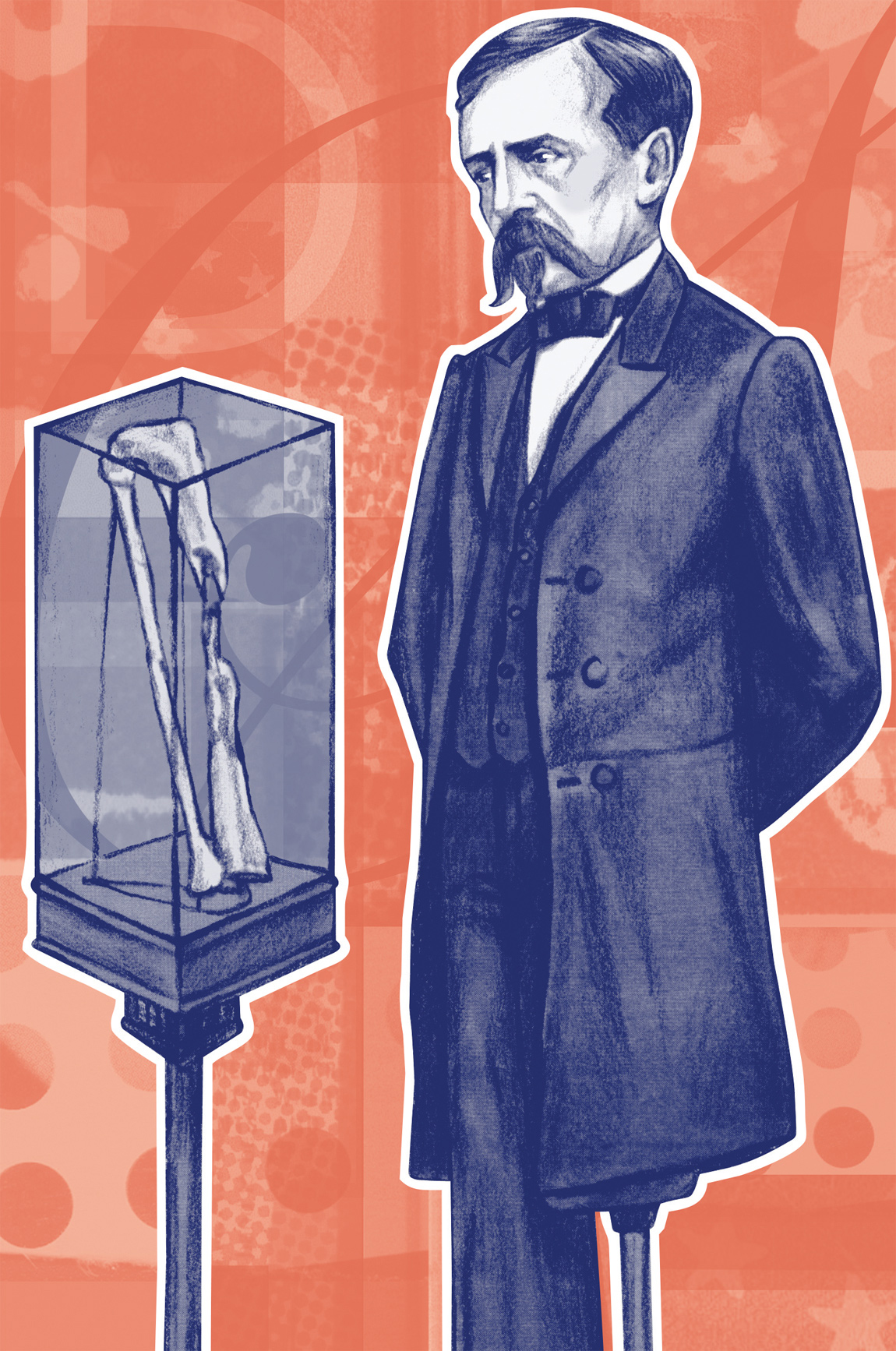
Daniel Sickles lost his leg in the Battle of Gettysburg, but the limb was preserved in a glass case in the District of Columbia’s Army Medical Museum. In later years, Sickles would visit his old appendage on the anniversary of the battle that took it from him.
Sickles’s name had reached the ear of senior Democrat James Buchanan, the newly appointed minister to Great Britain. “Old Buck” needed someone to be his first secretary, and Sickles, though hesitant at first to give up his cash cow as New York’s corporation counsel, realized the opportunity he was being offered and took it. He would never regret the decision, for it commenced a long relationship with Buchanan that would serve him well in times to come. In the meantime, Sickles set about doing what he did best: stirring up trouble.
Sickles was already a controversial figure before he hit London in 1853. The purest creature of Tammany Hall’s clannish chicanery, he had narrowly sidestepped an 1846 charge of grand larceny—an imbroglio over a misplaced property deed that came to nothing with the help of political friends. He was also very publicly connected with one of New York’s most successful prostitutes, Fanny White. And it was she, rather than Sickles’s wife of barely a year, who accompanied him to the Court of St. James, resulting in a scandal that confirmed Sickles’s uncanny gift for flouting public censure. Sickles’s wife, Teresa, eventually came over to join him with their young daughter in the summer of 1854—in time to be present at a July 4 celebration in which Dan made headlines on both sides of the Atlantic by refusing to stand for a toast to Queen Victoria.
But this stuff would look like amateur theatrics compared with what was coming. After returning to America, Sickles got elected to the New York State Senate and then, in 1856, to the United States Congress. He had come a long way; the Sickles family was soon dividing its time between a country home in northern Manhattan and a plush mansion along Washington’s Lafayette Square. Though Sickles continued to carry on extramarital affairs, it was Teresa’s infidelity that would lead to sensational catastrophe. Sickles was virtually the last person in both New York and the nation’s capital to learn that his wife was regularly sleeping with Philip Barton Key, the Washington, D.C., district attorney and son of Francis Scott Key, composer of “The Star-Spangled Banner.” His sacred honor thrashed beyond hope of repair, a raving Sickles shot his wife’s paramour to death in Lafayette Square on February 27, 1859, before numerous witnesses.
It was a spectacle, to be sure. And the murder trial was just as memorable. Drawn by tight political ties, his legal team featured some of the toughest lawyers on the East Coast, including future secretary of war Edwin Stanton. In a bravura performance of legal gymnastics, they argued that their client could not be held responsible for the blood rage that had consumed him, originating as it had in response to a heinous betrayal that undermined everything Christian society stood for. They buttressed their case by pointing out that Key had done more than just indulge in adultery: He had polluted another man’s property. Because the body of Sickles’s wife belonged to Sickles, his violent act was not unlike self-defense. The jury agreed. It was the first successful temporary insanity plea in American history.
Interestingly, pumping Philip Barton Key full of holes in broad daylight and getting away with it did little to tarnish Sickles’s public standing. Indeed, quite the opposite. Free to resume his congressional career, he found himself more than just vindicated: He was now feted by many of his countrymen as an avenging hero who’d boldly taken a matter of honor into his own hands, damn the consequences. He was a killer, to be sure, a fact that sickened many, but his reputation seemed mostly to benefit from this spectacular tragedy.
No, what really ticked everyone off is what he did next: forgive his wife. Dan’s public pronouncement that he was reconciling with Teresa was received with scorn and even outrage. Once a cuckold, Sickles had rectified the situation, only to go crawling, it seemed, after the wanton woman who’d shamed his good name. He had the welfare of his daughter, Laura, in mind when he did it, but that was lost on his countrymen. His political career was all but ruined.
Sickles needed something to resurrect his prospects, and he would get it soon enough. Like so many at Tammany Hall, he was a devout Democrat with plenty of friends in the South and no use whatsoever for Republicans and their abolitionist caterwauling. The very thought of taking up arms against another state—even a state that seceded from the Union—was anathema to Sickles. But when the Southern states began occupying Federal installations and forts, he changed his tune. After all, secession was one thing; aggression against the nation’s property was quite another. The shelling of Fort Sumter decided the issue for him: He was now a “war Democrat.”
After raising, equipping, and drilling a brigade of troops (which he named the Excelsior Brigade), it looked as if Sickles had found his true calling. Military culture and leadership came naturally to him, and the company of men in a dread cause appealed to his sense of honor. In 1862, as part of McClellan’s Army of the Potomac, Sickles fought up the Peninsula toward Richmond and back down it again in the retreat of the Seven Days, displaying a remarkable coolness under fire that would distinguish him as a fighting general. He was rewarded by his superior, “Fighting Joe” Hooker, with command of a division, which was spared the butchery of Fredericksburg by being assigned a supporting role in the battle. Then, when Hooker was elevated to command the whole Army of the Potomac, he gave Sickles his old corps. Dan was truly going places.
And not because he was a military genius. Though brave and clearly popular with his men, Sickles was relying on his connections, as much as anything else, to get ahead in the army. Rumor had it that James Buchanan, who was president during Sickles’s murder trial, had worked behind the scenes to take some of the punch out of the prosecution’s case. Now Sickles was getting close to another president. His relationship with Lincoln began in 1861, when Sickles, who risked losing much of his brigade to the governor of New York over a militia jurisdiction dispute, went directly to the president to plead his case. The two hit it off, and Sickles had been getting closer to the Lincolns ever since. First Lady Mary Todd Lincoln was particularly taken with Sickles’s dangerous reputation and aura of rakish urbanity and began inviting him to swing by the White House whenever his duties allowed.
Sickles’s most important patron, however, was Fighting Joe Hooker, a hard-drinking West Pointer who shared Sickles’s enthusiastic moral turpitude. The two scoundrels got on swimmingly, turning the Army of the Potomac’s headquarters into what one indignant officer dubbed “a combination of bar-room and brothel.” The party came to an abrupt end at the Battle of Chancellorsville in 1863, when Hooker allowed himself to be hoodwinked and mauled by the one-two punch of Bobby Lee and Stonewall Jackson. Chastened, Hooker backed up to defend Washington and then gave the Army of the Potomac over to George Meade.
The reversal at Chancellorsville meant more to Sickles than the sacking of his sponsor and drinking buddy. It had also imparted a lesson that would have tremendous consequences. During the battle, he’d been ordered to retire from a strategic bit of high ground called Hazel Grove, and after grudgingly doing so, he watched the Confederates occupy it with batteries that proceeded to pour shot and shell into Union ranks with deadly effectiveness. It left in him an obsession with high ground that came back to haunt him two months later near a Pennsylvania town called Gettysburg.
It was there, upon the ridges that overlooked the town in a broad arc, that the Army of the Potomac was afforded an opportunity to turn back Lee’s invasion of the North. It would do so, of course, during three of the most important days of the Civil War—but not before “Devil Dan” Sickles had his controversial day in the sun. Arrayed along a ridgeline that dominated the local terrain, Meade’s forces were in an ideal situation to receive an attack—which, given Lee’s relentlessly aggressive style, they were sure to get. But there was one stretch of the Federal line, all the way down on the left wing, that dipped below the rest, looking very much like a break in the high ground.
And guess whose corps occupied it.
The ignominy of Chancellorsville fresh in his mind, Sickles wasn’t happy with his situation, not at all. But a solution presented itself three quarters of a mile to his front, where higher ground beckoned. All he had to do was get permission from his superior to go seize it. Granted, that would mean breaking the integrity of the Union line, exposing his flanks on an exposed crest almost completely devoid of cover, but it was high ground, and he wasn’t going to stand idly by while the Rebels took it and used it against him.
Though instructed to maintain his position on the left flank in line with the corps to his right, Sickles thought the matter important enough to see Meade in person. After asking whether he could dispose of his troops according to his own discretion, Sickles was testily told by Meade (the two didn’t particularly like each other) that, of course he could, “within the limits of the general instructions I have given you.”
Sickles rode back to his position with a member of Meade’s staff, who concurred with Sickles’s opinion and then rode back to Meade’s headquarters for further consultation. An hour then passed without hearing anything more from Meade. So Sickles acted.
Moving forward in splendid formation, Sickles marched his corps toward the Emmitsburg Road and established a line short of it that went through a peach orchard. But with more ground to cover, the corps was spread thin, jutting out from the rest of the army like a bubble just waiting to be burst. He had taken the high ground. But at what cost?
The answer to that question came soon enough. Sickles’s corps had barely completed its redeployment when the Rebels unleashed an assault on both wings of the Union line, giving his exposed troops a dreadful punishment. The orchard and a neighboring wheat field became a frenzied killing ground, forcing the Third Corps back—to its original position, the line it had held before moving forward. But in the time it took to beat back Sickles and his troops, the Federals had brought up reinforcements to secure the far left wing. The Union flank had not been turned. And the Confederate attack, despite harvesting a slew of Yankee lives and tearing Sickles’s right leg to bits, had failed.
Historians continue to debate whether that failure was due in part to Sickles’s rash move. Many good men in the Army of the Potomac believed that, had Sickles remained where he was, the Confederates would still have been repulsed, without the bloodbath in the orchard and wheat field. The battle was barely over before acrimonious debate began in earnest. Meade lost no time dismissing the old Tammany lawyer as reckless and insubordinate, and Sickles gave as good as he got, taking every opportunity to blast his commander as dilatory and confused. Though unconvinced of his tactical ability, the nation never doubted Sickles’s bravery: thirty-four years later, he was awarded the Medal of Honor for “conspicuous gallantry.”
Whatever the truth, the cannonball that slammed into Sickles’s right leg that afternoon ended his wartime career. Perhaps sensing this, he maintained the presence of mind to light a cigar for his departure from the battlefield, affecting a dispassionate demeanor in his stretcher that no one present would ever forget.
His days in uniform may have been over, but he was far from done. After pestering the president for something to do, Sickles was charged with touring occupied sections of the South in preparation for postwar reconstruction plans. Then he took on the jungles and highlands of Central America, sent there by Lincoln to negotiate passage across the Isthmus of Panama for American troops and to inquire about the possibility of settling freed slaves in Colombia. After the war, he served as military governor of the Carolinas, only to be dismissed in 1867—the same year his wife, Teresa, died. Two years later, President Grant appointed him minister to Spain, where he married again, to a woman named Caroline de Creagh, and proceeded to alienate her with sensational extramarital affairs that galvanized his reputation as an incurable reprobate.
Even in old age, Sickles was incapable of avoiding controversy. After returning to New York City, he was made chairman of the New York State Monuments Commission, charged with overseeing the memorials at Gettysburg that pertained to soldiers from the Empire State. It seemed, at long last, that somebody had found a job for Dan Sickles that he couldn’t turn into a front-page headline. But no. In 1912 more than $28,000 of the commission’s budget went missing. Though Sickles had clearly purloined a hefty sum for his own use, public opinion was overwhelmingly forgiving. State officials began a subscription to raise the money, and he never served a day in jail. He died two years later, a rapscallion to the end.

THE TURN OF THE KEY
It was on the evening of Thursday, February 24, 1859, that Dan Sickles received an anonymous letter informing him of Philip Barton Key’s ongoing affair with his wife. Key would lie dead in Lafayette Square the following Sunday afternoon.
Sickles had heard of the affair before that fateful Thursday, but dismissed the rumor out of hand. His angelic Teresa had never shown anything but ardent devotion to him. And Key was a friend; indeed, Sickles had used his political connections to reconfirm him as district attorney. That the two could betray Dan in such a fashion was inconceivable to him.
Inconceivable or not, they’d been doing just that—and for nine months. Teresa was quite taken by “Barton,” as he was commonly known, whose family legacy and easygoing aristocratic manner made him a popular fixture in the capital’s social scene. As for Teresa, she was a legendary beauty, a lively socialite who was fluent in numerous languages, and very young—less than half her husband’s age, in fact. She had never lacked male admirers. For the older Barton, capturing this ingenue’s heart was something of a coup.
Smitten, Barton went so far as to rent a house on Fifteenth Street, not far from the Sickles home on Lafayette Square, for their assignations. It was reckless behavior like this that set tongues to wagging and ultimately got Barton killed.
Since receiving the anonymous letter, Sickles had had some close friends look into its veracity and discovered the monstrous truth. Life in the Sickles household had since become, to put it mildly, tense. Dan loudly confronted his distraught wife, then forced her to write out and sign a confession (which, in the weeks to come, would ingloriously find its way into the pages of Harper’s Weekly). He then fell into a depressive funk punctuated by crying jags.
It was in this state of mind that an incredulous Sickles saw the agent of his destruction brashly waving a little hanky out in Lafayette Square to signal his beloved. Wild-eyed, Sickles donned an overcoat and stuffed several firearms into it. He then stormed into the square yelling, “You must die!” and fired a shot at Barton, grazing him in the hand. Barton, pathetically, hurled a pair of opera glasses at his attacker. The two then grappled before Sickles produced another revolver and perhaps a derringer and shot Barton twice, mortally wounding him. He died soon afterward.
Though Sickles forgave Teresa not long after his acquittal, he maintained an uneasy emotional distance from her for the rest of their marriage.
FRIENDS IN HIGH PLACES
Though President James Buchanan was in the White House when his friend Dan Sickles slew Philip Barton Key, he did not witness the altercation. A White House page, however, did. Electrified by the drama in Lafayette Square, J. H. W. Bonitz ran into Buchanan’s office and began recounting what he’d seen. Buchanan, unaware that Bonitz wasn’t the only witness to the murder, was worried that his excited employee might be called to court as an eyewitness. His reaction was to give the fellow some money and tell him to get out of town on indefinite leave, back to his home in South Carolina—by any standard, a suspicious act for a practiced lawyer and president of the United States.
OBJECTION!
Based as it was on moral outrage, the defense of Dan Sickles during his murder trial stood the very real chance of derailing if the prosecution brought up the defendant’s own unrestrained behavior. Whether because of gross incompetence, pressure from politicians (such as President Buchanan himself), or the inequity of nineteenth-century mores, Sickles’s sexual shenanigans were never at issue in the courtroom.
Which is rather astonishing, because they were spectacular. Throughout most of the time in which his wife was carrying on with Barton, Sickles was carrying on with an anonymous married woman in a Baltimore hotel they’d established as the location for their regular trysts. And during the war he quite possibly produced a child with another woman. This was hardly unusual for Sickles, who, despite his undeniable attachment to Teresa, seemed woefully unsuited to monogamy.
His long relationship with high-profile New York prostitute Fanny White is a prime example. Sickles never held himself to the restrictive Christian standards of behavior that shaped so much of his era’s social structure. Hence his decision to embark upon his new assignment as first secretary to the American minister in London with Fanny on his arm instead of his wife, home with a new daughter too young to travel. This was bold, to be sure. But when Sickles went to a royal reception and formally presented Fanny, under an alias, to Queen Victoria, folks on both sides of the Atlantic blanched. The papers back home were neither fooled nor amused, and responded accordingly—partly because it had all happened before. While a member of the New York State Assembly, Sickles had taken Fanny to Albany (before his marriage to Teresa) and given her a tour of the assembly chamber. Disgusted, the speaker of the assembly issued a censure.
Another of Sickles’s more scandalous relationships occurred years later, after he’d been appointed minister to Spain. On a trip to Paris, he met Spain’s deposed monarch, Isabella II, who reputedly maintained an insatiable sexual appetite into her twilight years. Sickles obligingly accommodated her whenever the wooing of his future second wife, Caroline de Creagh, allowed. Such a precarious state of affairs was bound to backfire, especially when Isabella was the most famous of his numerous liaisons. In time, despite producing two children, his marriage to de Creagh fell apart.
Sickles would play his hand out in the company of aged widow Eleanor Wilmerding, his housekeeper in New York during his final years. While Sickles’s somewhat estranged wife, Caroline, and the kids lived just blocks away, he carried on with Eleanor as if it were the most normal thing in the world. And for Dan Sickles, it was.
Getting a Leg Up
Sickles was astride his horse on the Gettysburg battlefield when, on July 2, 1863, a twelve-pound cannonball crashed into his right leg, destroying the tibia. Delivered to the Third Corps field hospital behind the battlefield, the doctor sedated Sickles with chloroform and amputated his leg a little above the knee. But instead of being thrown aside to join all the other bloody limbs that were removed that day, Sickles’s leg was quickly wrapped for shipment to the Army Medical Museum in Washington, which was looking for displays. And there it remained for years, behind glass, a curious gift to posterity. Sickles himself was known to visit his old appendage on the anniversary of the battle that took it from him.