

July 13, 1821–October 29, 1877
HIGHEST RANK:
Confederate General
ASTROLOGICAL SIGN:
Cancer
NICKNAMES:
Wizard of the Saddle
WORDS TO REMEMBER:
“War means fighting, and fighting means killing.”
The war in the West was unusually mean. Fought by hard men who’d been raised on the frontier, across great swaths of scrub, swamp, and forest that were often denuded of forage or supplies, it had a desperate edge to it that set it apart from the conflict in Maryland, Pennsylvania, and Virginia. But what happened at Fort Pillow, Tennessee, on April 12, 1864, was hard even by western standards. A strongpoint that overlooked the Mississippi River some forty miles above Memphis, the fort enclosed a small Union garrison of fewer than six hundred soldiers, roughly half of whom were black. That afternoon, after a demand to surrender was turned down by the fort’s garrison, some 1,500 Rebel troopers stormed the works, easily overwhelming the smaller force within. What happened next has been the subject of heated debate ever since. Either the defenders were cut down during a fighting retreat to the river, or they were slaughtered like sheep after surrendering. Or both. Whatever the truth, the results were shocking: thirty-five percent of the white defenders lay dead. The black mortality rate stood at a staggering sixty-six percent.
The weight of evidence leans toward a massacre, as recent scholarly accounts have pointed out. Nevertheless, we shall probably never know for sure. Certainly a surfeit of killing had occurred (66 percent?!), but what about the Rebel commander? Did he order a fight without quarter?
Nathan Bedford Forrest was already a legend in his own time before Fort Pillow became good copy for Northern newspapers looking to stir up a cause célèbre. To him, Fort Pillow was a significant triumph—nothing more, nothing less. The Federal presence there had threatened his control of western Tennessee, which he had been using as a source of supplies and recruits. After sending the cavalry troopers ahead under a subordinate to invest the works, he showed up himself the day of the assault and, true to form, conducted an unusually thorough reconnaissance of the place on horseback, allowing him to deploy his troops in such a way that took advantage of the terrain, undermined the firepower of the defenders, and even rendered a Union gunboat moored in the Mississippi superfluous. He was thorough and incredibly resolute. And his surrender demand to the commander of the garrison concluded with a threat that, though a favorite of his, had never been stated quite this way before: “Should my demand be refused, I cannot be responsible for the fate of your command.”
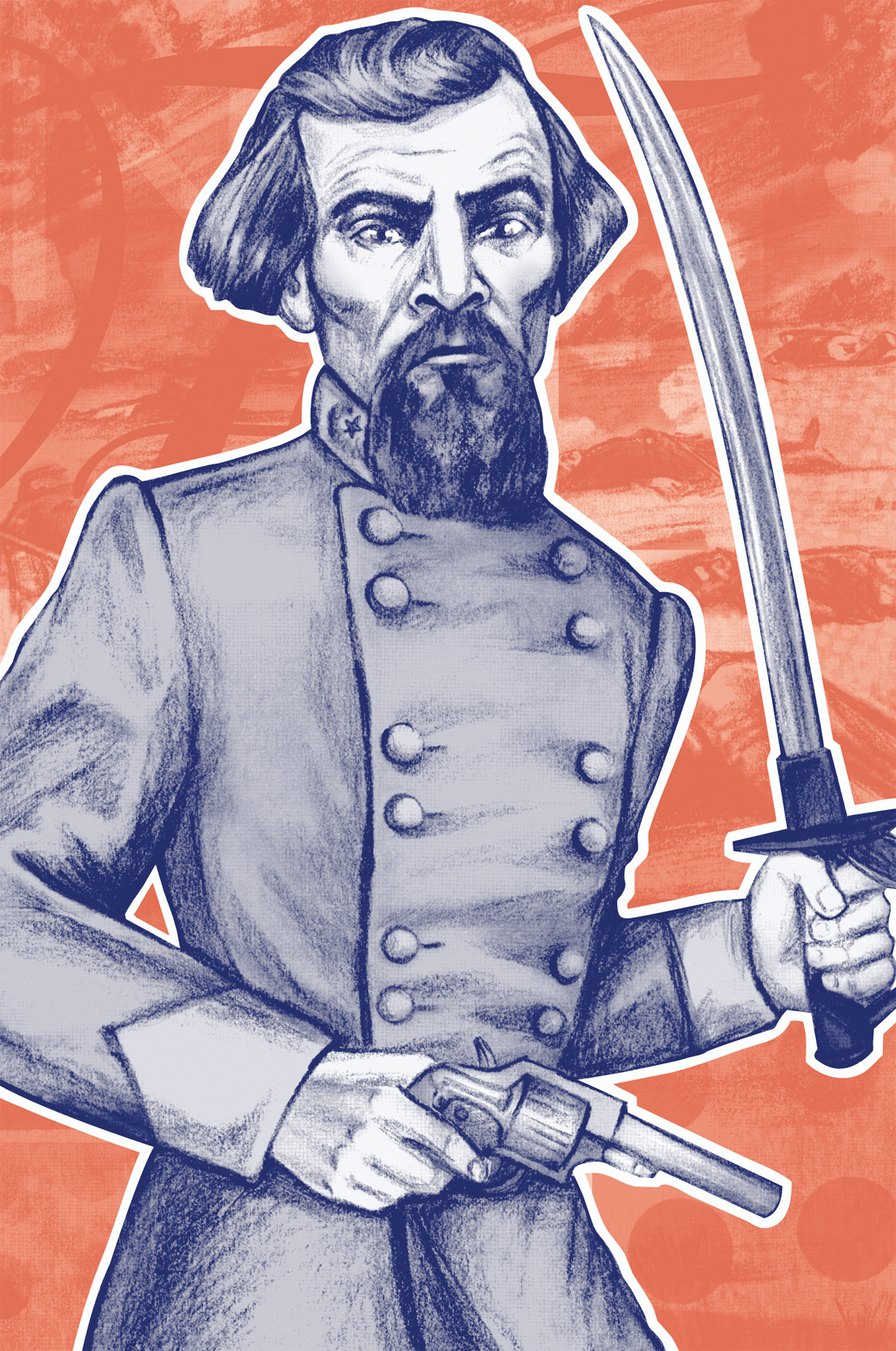
Of all the men you wouldn’t want to meet on a Civil War battlefield, few were more ferocious than Nathan Bedford Forrest—a general who personally killed some thirty men.
Responsible indeed. Whether or not this dark little chapter of the Civil War can be laid at his feet is a question that has endured precisely because
Bedford Forrest was the sort of man who could believably have done such a thing. In a way, he was emblematic of the western theater he so brilliantly dominated: extreme, tough, and at his best when he was breaking the rules. Long before the end of the war, such qualities—and a few others that don’t lend themselves so easily to description—had made him arguably the greatest cavalry virtuoso that America, Union or Confederate, had ever produced. Not for capricious fate was he the only man on either side to enter the war as a private and end it as a lieutenant general. This guy was a breed apart.
He was born in Bedford County, Tennessee, into a family that would eventually become quite large. Raised to help his mother deal with his siblings and make ends meet, he grew into a canny administrator with a sense for the practical and the profitable. He became the quintessential self-made man of the South, making a considerable fortune in Tennessee and Mississippi as a cotton planter, livestock breeder, and slave trader—all with less than six months’ worth of education. He served as a Memphis alderman, paid for his siblings’ schooling, and became respected as a man of importance.
Such credentials were enough for many rich men to buy themselves into the officer caste at the outbreak of civil war. Forrest demurred, however, and joined a Tennessee unit as a private. After all, his military experience added up to nil. But pressure from prominent Memphians and the governor himself convinced the man to raise and equip a cavalry battalion of his own. They obviously understood Forrest’s abilities better than Forrest did, for it was the beginning of an astounding military career. The new colonel of cavalry gave some idea of the sort of man he was in February 1862 when he refused to surrender with the rest of the Confederates who had been trapped by Grant at Fort Donelson, surreptitiously leading his troopers to safety without a shot being fired at them. Forrest had come to fight, not surrender.
And fight he did. In April, after the Battle of Shiloh, he staged a profoundly daring rearguard action to protect retreating Confederates, bringing William T. Sherman’s pursuit to a halt with just three hundred hard-fighting troopers. The following July, the month he was made a brigadier, he captured Murfreesboro and its much larger garrison, securing a treasure trove of supplies. It was the first in a long series of remarkable triumphs as one of the South’s preeminent raiders. Often saddled with green recruits, he nevertheless managed to fly across the countryside like a ghost, making trouble wherever he went and moving too quickly to be caught. He wreaked havoc with Grant’s supply lines, crippling the advance on Vicksburg, and chased a column of Union raiders through Alabama and Georgia like a relentless bloodhound, bagging hundreds of prisoners toward the end of spring. At the Battle of Chickamauga, he threw his dismounted cavalry into the fight like infantry, proving the versatility of his command. Following the battle, in the midst of arguments over whether or not to recapture Chattanooga, Forrest blew his lid with his superior, Braxton Bragg (hardly an unusual thing for Bragg), and—after threatening to kill him if they ever met again—demanded another assignment in northern Mississippi and western Tennessee. He continued to burn his name into Northern nightmares with the controversial victory at Fort Pillow and, in June 1864, the astonishing clash at Brice’s Cross Roads, Mississippi. There Forrest performed one of his classic double envelopments, slashing both of his enemy’s flanks at once, allowing him to defeat more than 7,500 Federals with a force less than half as large. Sherman, whose designs on Atlanta were now hampered by such Rebel exploits, began referring to “that devil Forrest.” Indeed, his praise went further, insisting that the infernal raider from Tennessee should be “hunted down and killed if it costs 10,000 lives and bankrupts the treasury.”
Fortunately for Sherman and his superiors in Washington, it didn’t come to that. But clearly Forrest wasn’t going down without a very nasty fight. How had he come to be such a martial phenomenon? It certainly wasn’t because of his education—Bedford Forrest was no West Point man, and he had no trouble saying so. Rather, he came to cavalry fighting as if it lay in his genes behind a glass sign reading, “Break in time of war.” He was a natural, blending bold imagination with good ol’ common sense. Subterfuge was a favored weapon. In 1861, after recruiting his first unit of cavalry rangers, he camped his men along the Louisville & Nashville Railroad, swelling their ranks with wives, friends, and kinsmen, all gathered beneath a great Rebel flag. The intention was to impress passengers riding past with the size of his host, knowing full well that they would take the information south to the Union force waiting for him, scaring it into withdrawal. The ruse worked.
Such trickery came naturally to Forrest, who understood that the psychological elements of war were decisive. Hence his penchant for issuing the “surrender or be put to the sword” ultimatum to enemies, many of whom outnumbered him (and nearly all of whom accepted the offer). War wasn’t all mind games, however. By the end of the war, Bedford Forrest would personally kill an estimated thirty enemy combatants; more than twenty-five horses died while bearing him into battle. He not only led from the front—he hacked from the front, eagerly drawing his saber in a melee once his pair of “navy sixes” had been emptied. More than a few witnesses attested to his wild-eyed, red-faced aspect in battle, like a six-foot-two-inch brute who had come to vent his rage. “So fierce did his passion become that he was almost equally dangerous to friend or foe,” penned one of his officers. This was not the way of Virginia’s chivalric finest, those well-bred gentlemen back east who wooed the British press and dazzled the ladies with their subtlety and wit. Jeb Stuart may have prided himself on romantic flummery and circuitous steeplechases around McClellan’s army, but Forrest staked his reputation on something altogether different: violence, rapid and gory. Toward this end, his men were tools to be cared for. Unless on a forced march, they were given every small luxury that circumstance would allow. In battle, however, they were expected to obey instantly and fight like furies—to turn the battlefield into a hell unsuitable for any sane enemy. “Shoot any man who won’t fight,” he was fond of telling his subordinates. Like the grim ultimatums he gave his enemies, he meant it. And his soldiers knew it.
Almost from the beginning, this unlearned planter-turned-ravager employed maneuvers taught at the military academy whose pedagogical titles he had never heard of. Combined with his instinct for conjuring chaos and flouting convention, they made him formidable. Nevertheless, it couldn’t last. Serving in Tennessee during the final months of 1864, he found himself at the head of all the theater’s cavalry and was promoted to lieutenant general the following February. But no amount of daring or duplicity or sheer luck could save him from the reckoning that Northern forces, now irresistible, were arranging. He surrendered at Gainesville, Alabama, in May 1865, his legendary command having shrunk to a husk of its former self.
Not surprisingly, the war had destroyed his fortune. Forrest attempted to resurrect his long-gone finances through cotton farming, which he knew well, and then as an insurance agent and a railroad baron. Nothing worked. Nevertheless, he was a man of immense stature—a hero (in the South) who had pulled off some of the most dazzling achievements of the rebellion. His name meant something—especially to the Ku Klux Klan. Originally a sort of foolish gentleman’s club established by bored racists in Pulaski, Tennessee, the Klan developed popularity amongst the small-minded who felt threatened by Reconstruction. It eventually swallowed up other groups with a similar bent and became a force to be reckoned with. Forrest, taken with their aggressive rejection of the new order, fell in with the cult and became their first grand wizard—a title created, so the story goes, because of Forrest’s “Wizard of the Saddle” moniker. At any rate, it was a decision he came to regret. Already excoriated throughout the North as the butcher of Fort Pillow, his association with the white-hooded riders of the night became a grisly sensation—like a man adding insult to his own injury.
Time heals all wounds, so it is said. And Bedford Forrest morphed into old age like a man trying to forget old injuries. In his waning years the man who’d become a symbol of the KKK distanced himself from the organization’s rampant, sadistic violence. Indeed, he became one of the Klan’s sincerest critics and an outspoken supporter of programs for freedmen that he once viewed as a hallmark of Republican intrusion. But by that time, the South had gone back to its antebellum ways, and the Klan’s goals of returning blacks to political and social bankruptcy had been secured. Against this background, it can hardly be surprising that the uncompromising fighter called Forrest should remain one of the most controversial—and divisive—figures in American history.

GETTING PHYSICAL
In the sensational charge that Forrest made to buy time for the withdrawing Confederates after Shiloh, he found himself in the midst of enemy infantry, completely surrounded and alone. Wheeling around with the intention of fighting his way out of the trap, he was shot in the left side. He remained in the saddle, and is said to have scooped up one of his assailants and used him as a shield while galloping back to safety. The story would seem nearly impossible to believe if it weren’t for the fact that Forrest was always getting into scrapes. Indeed, he seemed entirely at ease in physical confrontations. In the spring of 1845, he got into a street fight in Hernando, Mississippi, that ended up making the newspapers. It seems that his uncle, Jonathan Forrest, got into a heated argument with some fellows named Matlock and one of their employees, an overseer. The younger Forrest intervened, insults were exchanged, and one of the Matlock brothers drew a weapon—probably a gun, but perhaps a stick. Bedford drew a revolver of his own, but fired off only two shots before the thing clicked empty, whereupon somebody threw him a large knife, with which he finished his handiwork. Though Forrest walked away from the scuffle wounded, his uncle was killed.
Forrest received four wounds during the war—one of which was from his own subordinate. Lieutenant A. W. Gould, who received word that Forrest was transferring him to another command, confronted the latter for an explanation. During their heated exchange, Gould, insisting that a transfer might be construed as an indictment of his courage, decided to avenge his wounded honor by drawing a pistol from his duster. He got off one shot before Forrest, now wounded in the hip, grabbed his assailant’s pistol hand, held it, opened the blade of a penknife with his teeth, and thrust it into Gould’s side. (Forrest had been using the knife to pick his teeth before being rudely interrupted.) The two bleeding contestants now staggered away from each other—Gould, to be helped into a tailor shop, where he was examined by a doctor; and Forrest, to the office of another physician, who determined that his gunshot wound might be fatal. Now convinced that he would soon be dead, Forrest snatched up a brace of revolvers and set out for the tailor shop to finish off his murderer. Gould, seeing him coming, got up off the table on which he was being examined and stumbled out the back door, trailing blood the whole way. Forrest fired a shot at the fleeing target but missed. (The ricocheting bullet, incidentally, struck an innocent bystander in the leg.) After seeing Gould crumple in a patch of weeds behind the shop, Forrest, satisfied, got some more medical attention. When it was discovered that he had incurred merely a flesh wound, he was overcome with remorse for his treatment of Gould and ordered his doctors to go and save him. They were unable to, however. Within two weeks the lieutenant was dead.
SO MUCH FOR THE COMPETITION
Even Forrest’s marriage began with a series of bullying standoffs. He first met Mary Ann Montgomery in 1845 in a creek bed: The carriage carrying her and her mother to church was stuck in the mud. As a slave wrestled to free the wheel himself, two dandies who didn’t want to sully their Sunday clothes sat their horses off to the side and watched. When Forrest came along, he waded out to the wagon, carried the women over to the dry bank, and helped the slave free their carriage. He then made a point of confronting the two male witnesses, calling them useless and threatening to kick the crap out of them if they didn’t immediately make themselves scarce. Deciding to court the young lady, Forrest showed up at the Montgomery residence a few days later, only to discover two other callers waiting on the porch. Recognizing them as the two boneheads from the creek, he again threatened them with bodily harm, literally chasing them off the grounds. Forrest was wed to Mary Ann before the year was out.
DELUSIONS OF GRANDEUR
A few years after the war, Forrest—not unlike many former Confederate officers—found himself staring failure and boredom in the face. Ennui set in, and he couldn’t help waxing nostalgic for the glory days. According to some of his associates, Forrest hatched a plan that can only be called outrageous. It involved recruiting an army of former Rebels and buying or stealing enough rifles to arm them—say, twenty thousand. At the head of such a host, he would descend on Mexico, conquering the entire country in just six months. After confiscating all the church property (Forrest was never a very pious fellow), he would establish himself as king and open the borders to immigration. He was convinced that 200,000 Southerners, easily, would flock south to escape Reconstruction. Needless to say, the world would never find out if he was right. Forrest eventually came to his senses and apparently abandoned the scheme.
“BURP!”
The Fort Pillow “massacre” remains a deeply controversial topic to this day, and rightly so—whatever the truthful details, such things should never be forgotten. As for Bedford Forrest, he was never allowed to forget. One story has it that he was gruffly challenged one morning in a hotel by a formidable-looking woman with a Bible in her hand. After establishing that he was in fact the “Rebel General Forrest,” she demanded to know if it was indeed true that he had “murdered those dear colored people at Fort Pillow.” “Yes, madam,” he replied. “I killed the men and women for my soldiers’ dinner and ate the babies myself for breakfast.”