

December 3, 1826–October 29, 1885
HIGHEST RANK:
Union General
ASTROLOGICAL SIGN:
Sagittarius
NICKNAMES:
Little Mac, Young Napoleon
WORDS TO REMEMBER:
“The climate of Spitzbergen and Arabia are not more different than the characteristics of a Civil and a Military man, and as well might we expect those climates to change in an hour, as to see a citizen become a good officer without years of training.”
What the hell was this guy’s problem? It’s a question that occurs to virtually everyone who reads about the career of George McClellan. Rarely has one so brilliant failed so spectacularly to deliver on prospects so glorious. He was the natural choice to lead the nation’s military machine—and he was largely responsible for the army’s inability to end the war in 1862. It’s enough to give you a headache.
The young McClellan showed so much promise that West Point chucked its age requirement just to let him in. In 1842, at fifteen and change, he entered the academy amongst cadets who had to be sixteen to get through the door. Moreover, he came with more than the usual learning under his belt, having already attended the University of Pennsylvania for two years (!). The son of a prominent Philadelphia doctor, he was young but big on smarts, and he graduated second in his class.
The year 1846 was a wonderful one to graduate if you wanted to kill people as soon as possible. The war with Mexico was just getting underway, and great things beckoned for young lieutenants with the grit to squeeze the present situation for all it was worth. As one of his class’s greatest stars, McClellan went right into the prestigious engineers, earning two brevets during the Mexican War. Afterward he developed into a man of protean ability—a sort of wunderkind in uniform. Having acquired an impressive facility with languages, he translated French training manuals while teaching at West Point. He explored the source of the Red River and surveyed possible routes for a transcontinental railroad. He was an inventor, builder, instructor, and explorer. He was also an observer: In 1855, his superiors sent him and several (much older) colleagues to witness the Crimean War and report on military developments that might prove of use. McClellan, still a young man, had become a big shot.
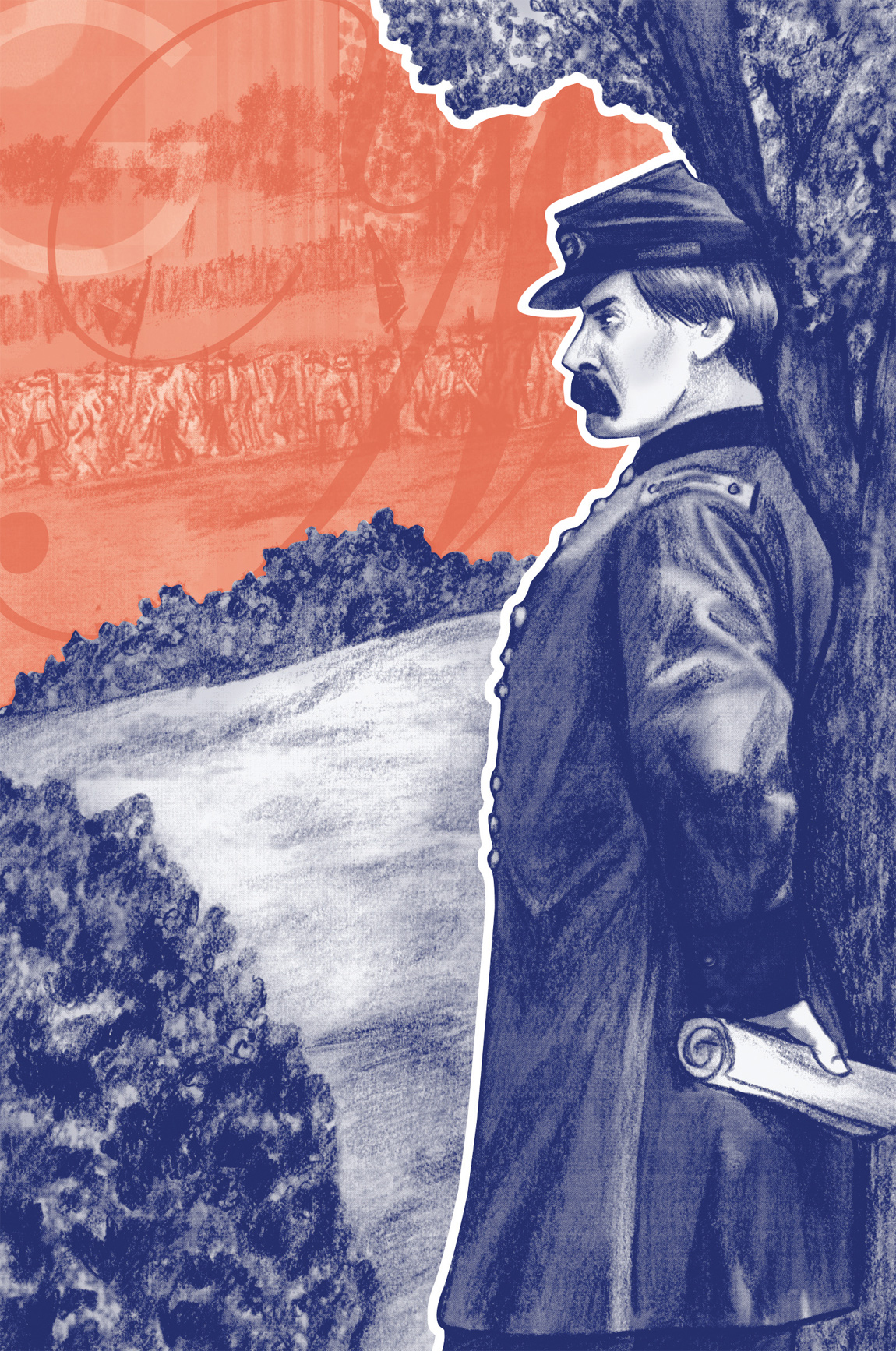
Talk about a missed opportunity: Union general George McClellan once stumbled across the battle plans of the Army of Northern Virginia—then spent so much time second-guessing himself, the opportunity was squandered.
The unlimited prospects of civilian business beckoned, and he resigned his commission in 1857 to become a railroad engineer. When civil war came in 1861, McClellan was sitting behind a desk in Cincinnati, having become president of the Ohio and Mississippi Railroad. Governor William Dennison pounced on him to whip Ohio’s volunteers into shape, though President Abraham Lincoln—who had been an attorney for the Illinois Central Railroad when McClellan worked there after leaving the army—was keeping his eye on the impressive young West Pointer. McClellan was soon elevated from the head of Ohio’s militia to a major general in the United States Army in charge of a crucial department that included Ohio as well as parts of Kentucky and Virginia.
A juggernaut of efficiency, McClellan shaped his command into a force to be reckoned with, and he used it to secure two crucial areas for the Union: Kentucky, a vital border state that had hoped to remain neutral, and western Virginia, a largely pro-Union region whose citizens were hoping for deliverance from the state’s Confederate authorities. They got it when bluecoats under McClellan’s authority cleared the area of Southern forces during a series of battles in the second half of 1861, thereby laying the foundation for what would become West Virginia. McClellan found reasons to whine about his subordinates throughout the campaign (“In heaven’s name give me some general officers who understand their profession,” he once wrote his superiors), but his greater numbers prevailed. The victory would elevate McClellan to national importance with the help of a certain Union humiliation at Bull Run. Suddenly, the young buck from Philadelphia was the North’s only real war hero. Lincoln, quick to seize on anything that might conceivably offer some hope of success in what was turning out to be an awful debacle, made George McClellan the solution to everything.
In August, the general assumed command of the enormous fighting force that would soon be dubbed the Army of the Potomac. By November, he had replaced the retired Winfield Scott as general in chief. He was thirty-four friggin’ years old.
With incredible energy, the “Young Napoleon” set about turning the mass of recruits under his leadership into an army. This was a Herculean feat, and perhaps no one in the country was more qualified to pull it off. Tireless, pedantic, and self-assured, McClellan drilled his men endlessly, saw to every conceivable need, demanded perfection and absolute professionalism, and held reviews—lots of reviews. The result was the most powerful martial host the western hemisphere had ever seen, by a long shot. Though well fed, heavily armed, and thoroughly disciplined, the Army of the Potomac’s most conspicuous characteristic was loyalty—to the spitfire called “Little Mac.” This is understandable, in light of what McClellan had given them: structure and pride, two indispensable qualities in every victorious army. But McClellan’s popularity with the troops would in time produce frightening problems for the Lincoln administration—as would McClellan’s inability to use armies with anything approaching the brilliance he displayed in creating them.
The general set a pattern that would end up driving those in power crazy. More afraid of failure than anything else, McClellan obsessed over preparation. The army had to be at a state of perfect preparedness before engaging in operations. There were never enough stockpiles of food and munitions, never enough spare shoes, and there was never enough time—to drill, drill, and drill some more. It had the effect of making McClellan look like a man in a hurry to avoid clashing with the enemy. The president would end up calling it “the slows.”
By the time McClellan was ready to move, the cabinet was ready to snap. The general had even suffered a bout of typhoid fever in December, further delaying any action. When he finally did take the field, the Confederates had withdrawn from the positions with which they had been threatening Washington. Nevertheless, McClellan had been devising the perfect plan for his perfect army. Leaving troops behind to protect Washington (barely enough, as an uneasy Lincoln saw it), McClellan proposed sending the Army of the Potomac, with the navy’s help, down to the Peninsula, the district between the York and James rivers, from which it would march on Richmond. A giant flanking maneuver that utilized the North’s strengths in numbers and sea power, the plan offered real hope of ending the war with one fell swoop.
While in Europe, McClellan had witnessed firsthand the siege of Sevastopol, an epic tableau of entrenchments and elephantine siege guns. Now, faced with Rebel works at Yorktown, he settled down for an American version of the same. Once he got the men situated on the Peninsula, McClellan wasn’t planning a lightning thrust toward the Confederate capital: He intended to wage war at a snail’s pace. This was an exact science, after all, and one that he—the great West Point–educated engineer—knew better than anyone, especially that rogue’s gallery of civilians in Washington who wouldn’t shut up about moving things along.
Like a hungry, sluggish leviathan in the habit of sleeping off its meal after every engagement, the Army of the Potomac crept inexorably toward Richmond, its Confederate opponents frantically stabbing at the oncoming mass to no avail. By the end of May 1862, things looked truly dire for Richmond.
Then Robert E. Lee assumed command of the Rebel defenders, when Joseph E. Johnston fell wounded at Seven Pines, fundamentally altering the spirit of the struggle around Richmond. Though Johnston was one of the most revered military leaders on either side of the struggle, Lee possessed something that McClellan seemed absolutely incapable of handling: recklessness. By going over to the offensive on his left and leaving Richmond protected on his right by a skeleton force, Lee was gambling that his opponent wouldn’t spot the weakness and exploit it. He was right. McClellan, ever the cautious and prudent plodder, could not conceive of an army commander doing something so insane.
Worse, McClellan met his enemy’s aggressiveness with panicked timidity, withdrawing like a turtle into its shell. During the Seven Days’ Battles in June, the Young Napoleon retreated steadily before Lee’s poorly coordinated attacks, checking him nearly every time but pulling further back nevertheless. McClellan was lashing Lee but losing the campaign. Too unnerved to risk taking the initiative, he found it safer to respond to his enemy’s actions, convinced that he and his army were fortunate to escape. Indeed, he exuded no small amount of pride in “saving” the Army of the Potomac from certain destruction.
For such an exceptionally bright fellow, McClellan had shown himself to be a little out of touch—indeed, delusional. Everyone was to blame for the failure of the Peninsula campaign except the man in charge of it. He railed against the men in Washington, particularly Lincoln (whom he dismissed as a backwoods monkey-man) and Secretary of War Edwin Stanton (whom he loathed viscerally), for not giving him everything he requested. In fact, his demands were becoming so unrealistic that one wonders if McClellan had heard a reliable rumor that the President was hiding a genie in the Executive Mansion.
He also blamed the enemy, and in this he had a little help. Allan Pinkerton had helped to establish the federal government’s secret service in 1861, then joined McClellan to become chief detective of the Department of the Ohio. The two had been inseparable since. McClellan, a man whose self-importance could not allow him to explain the failure of his own genius without conjuring insurmountable obstacles, had an unwitting accomplice in his spymaster—who, it can safely be said, needed to go back to intelligence-gathering school. In overlong, officious-looking reports based on interrogations of people with extraordinary imaginations, McClellan built a case that the Confederacy was fielding a veritable horde. From the moment he landed on the Peninsula to the day he realized that the Army of the Potomac would have to be evacuated, McClellan never doubted that he was outnumbered. In fact, the reverse was always true: the real Confederate numbers were less than half of those that mocked McClellan in his nightmares.
The general’s superiors were beginning to catch on to the McClellan treatment: lots of boasting and secrecy followed by glacial maneuvering, hand-wringing, excuses, derision, accusations, and bitching. While McClellan waited on the banks of the James to be the last one to leave the Peninsula, his units on their way to Washington were being reassigned to the Army of Virginia under John Pope, a bombastic fool who would lose badly at the Second Battle of Bull Run in August. McClellan, stuck in Washington with little to do but watch Pope misuse the Army of the Potomac that had once been his, inwardly cheered at the Bull Run disaster. With the capital threatened, a desperate Lincoln once again turned to the damnable Young Napoleon, who seemed at once the solution and the doom of the Northern cause. Having lost his title as general in chief during the Peninsula campaign (an administration tactic to help McClellan focus on the Army of the Potomac and its march on Richmond), Little Mac was once again put in charge of all the forces in the eastern theater.
Though it tasted like a bitter pill to guys like Lincoln and Stanton, bringing McClellan back electrified the men in the ranks. Upon hearing the news during the retreat from Bull Run, the men raised a cacophony of ecstatic cheers that could be heard for miles. It was perhaps the greatest moment of McClellan’s career. How could he possibly top it?
The answer to that arrived soon enough. On September 13, a copy of Lee’s “Special Order No. 191” fell into the hands of a Union soldier, who found it lying on the ground wrapped around three cigars. In it Lee spelled out, in great detail, the entirety of his plan to capture Harpers Ferry, Virginia, in preparation for his invasion of Maryland—a plan that involved the splintering of his army into several columns. McClellan now had the means to run down and defeat the Army of Northern Virginia. It was, quite simply, the greatest intelligence coup of the American Civil War.
But it fell into the hands of the man least prepared to exploit it properly. McClellan was elated at first and convinced that he had the means to destroy his wily opponent at last. But with a giant break comes the pressure not to blow it. What if he acted on this invaluable information rashly and failed? Unforgivable. Better make sure and do it right. See to the details. Prepare the men for what will surely be the showdown of the war. Yeah, that’s it. Slow and easy.
By the time McClellan got his ass in gear, the window of opportunity had vanished. Lee, eventually alerted to his predicament, did his frantic best to gather the disparate elements of his army for the blow that was about to fall. Had McClellan acted with anything approaching the alacrity that defined the best Confederate operations, he could have easily destroyed a large chunk of the Army of Northern Virginia and hastened the end of the war. Indeed, Lee’s best efforts to gather his strength behind the Antietam Creek near Sharpsburg, Maryland, still wasn’t enough: He faced a two-to-one disadvantage against McClellan. But when the armies met on September 16, McClellan—incredibly—believed once again that he faced a larger foe. The battle that he initiated on September 17 brought on the bloodiest day in American history, producing some 23,000 casualties.
Antietam was emblematic of all that was wrong with George McClellan. Interestingly, it was the first time that he’d been present for a major engagement from beginning to end. Like Xerxes at Thermopylae, he directed it like a player moves his chess pieces—aloof, intellectual. He even slept through the first bloody clashes in the morning, as if the gears he had set in motion no longer required his full attention. Obsessed with the notion that the South was able to put more men in the field than he was, he fought the battle with the mind-set of a demigod doing his minions a favor: If the Army of the Potomac was ruined by this nonsense, it wasn’t his fault. After all, he was fighting against the odds, so any gains at all should be considered virtually incredible and a testament to his infinitely sound judgment. In fact, Lee’s army was fighting for its life at Antietam, and would have been in very grave shape had the Federals pressed it hard at all points with everything they had. As it happened, McClellan never committed more than three-quarters of his army throughout the day, and that only in piecemeal thrusts.
It is not too much to say that Antietam should have been the end of the Army of Northern Virginia. Instead, the Union had to settle for a check on Lee’s tepid invasion of the North—enough of an accomplishment for Lincoln to release his preliminaryEmancipation Proclamation. But it was a lost opportunity of the first order, which McClellan never seemed to fully grasp. “Those in whose judgment I rely,” swelled the general, “tell me that I fought the battle splendidly and that it was a masterpiece of art.” Unfortunately for him, he followed his masterpiece of art with a masterpiece of procrastination, letting Lee’s mauled army flee unmolested to the refuge of Virginia.
This was the last straw. Since the beginning of the war, the headstrong generalissimo from Philadelphia had been testing the patience of everyone who stood for the Union. He had been known since his West Point days to have professed affinity for Southerners and disdain for his fellow Northeasterners. And no one could forget the pamphlets he had printed in 1861, during his advance into western Virginia, assuring citizens he would protect their right to hold slaves and even forcibly crush any Negroes bold enough to look at his campaign as an excuse to rebel. McClellan was a conservative Democrat, a feverish foe of abolitionists, and a man who—it seemed—had dithered a bit too conspicuously in his military duties. The final nail in his coffin came in October, when Jeb Stuart’s ubiquitous cavalry once again rode around McClellan’s army. The Young Napoleon was relieved of his command.
So intense and universal was Little Mac’s popularity with the troops that Lincoln and his cabinet actually feared a military coup. But his perceived popularity went to the heart of the misunderstanding between McClellan and the men who directed him. That he hated them was less an indication of his disdain for civilian rule than it was proof of a petulant man’s hatred of interference from nonprofessionals. Moreover, few men in uniform despised secessionists more than McClellan, whose genuine fondness for Southern manners and society stood totally separate from his ruthless insistence on union. With these dubious credentials, Democrats nominated him to take on Lincoln in the 1864 presidential election. He was the unlikely candidate of a divided party—a professional soldier committed to total victory representing men who pushed for peace. With such an insecure platform and a troubled party, McClellan’s candidacy made it easier for those on the fence to vote for his opponent, whose reelection ensured that the war would be prosecuted to its end. In other words, McClellan—quite unintentionally—helped defeat the South in a way he never could have on the battlefield.
Not that he never won political office. In 1877, he won election as governor of New Jersey, where he displayed an admirable degree of effectiveness with very little effort. But it was, to say the least, anticlimactic. He had become a huckster cashing in on previous exploits. In the end, his greatest tribute came from the unlikeliest of sources. Five years after Appomattox, Robert E. Lee was asked to name the ablest opponent he faced throughout the War Between the States. “McClellan, by all odds,” he replied without hesitation.
Go figure.

BACK IN THE SADDLE
When George McClellan returned from his European tour in 1855, he had acquired numerous ideas that would influence the American military establishment. But none of them acquired the longevity of his ideas on cavalry equipment. Armed with designs from Hungary and Prussia, the young McClellan set about overhauling the standard-issue saddle for American cavalry units. The result was the “McClellan saddle,” an easily maintained design that became the standard for all units on horse until the mounted arm was abolished by the United States Army, well into the twentieth century.
ALTERED STATES
A native of Philadelphia, McClellan wanted to fight for Pennsylvania when war broke out. Though impressed by Ohio governor William Dennison’s eagerness to sign him up, he earnestly lobbied the authorities of his native state to give him a commission. As it happened, they ended up doing just that. But the telegram informing McClellan of his new rank in the Pennsylvania volunteers was accidentally sent to Chicago, rather than Cincinnati. By that time he had accepted the offer from Dennison. As a result, McClellan was attached at the beginning of the war to Ohio, where he made a name for himself against inferior Confederate forces, rather than Pennsylvania, whose attachment to the eastern theater would have associated him with the defeat at Bull Run. The result—stemming from an errant telegram—was the abrupt rise of a hero.
Spanking the Monkey
“The original gorilla” is how a piqued McClellan loved to refer to Abraham Lincoln. It’s a term he first heard from Secretary of War Edwin Stanton, another man for whom the general—after an initial friendship—ended up embracing a long and sincere distaste. McClellan hated deeply and for keeps, like a testy little prince whose vulnerability brooked no slights. When combined with his gift for the drawing room snub, it produced legendary results. In November 1861, the president and Secretary of State William Seward called on McClellan and were told that he was attending a wedding. The executive party decided to wait. An hour later the general returned—and went right up the stairs to bed without so much as acknowledging his esteemed visitors or, for that matter, his orderly’s announcement that the president of the United States was paying him a call.