10
What of the warnings and indicators that Allied intelligence picked up? Enigma revealed to Bletchley analysts some twenty-nine decoded messages intercepted between 18 September and 15 December concerning preparations for the offensive. Forthwith, Ultra was no longer going to hand over German battle orders on a plate, as it had done at Mortain in August; Allied intelligence officers were going to have to work harder to extract nuances from the Bletchley intercepts. The first Ultra intercept definitely associated with the Ardennes, decoded on 27 September, was of a German message transmitted nine days earlier, on the 18th, which summarised ‘SS Operations orders the rest and refit for 1, 2, 9 & 12 SS Panzer Divisions, three heavy panzer battalions, and 1SS Panzer Corps troops. All are assigned to the new 6 Panzer Army, Sepp Dietrich commanding. Assignment of Sepp Dietrich is clear sign of an offensive purpose.’1
The time lag of nine days is indicative of the everyday challenges Bletchley staff experienced in finding cipher keys to crack the daily Enigma code for each headquarters. The 18 September message, with its mention of Oberstgruppenführer Josef ‘Sepp’ Dietrich of the Waffen-SS, was worrying, for his was a name that rang alarm bells throughout the Allied military community. Having established a reputation for being a hard-driving and tenacious division and corps commander in Russia and Normandy, Dietrich’s personal reappearance on German orders of battle sent shivers down the collective Allied spine. Coupled with mention of ‘heavy panzer battalions’, which was a Wehrmacht euphemism for units of Tiger, or King Tiger tanks, the two were assessed as heralding extremely aggressive military activity.
Deutsche Reichsbahn (German railways) also used a version of the Enigma enciphering machine to coordinate their activities across Europe, which Bletchley analysts first cracked in November, revealing some military movements. For example, on 3 November, intercepts of Reichsbahninstructions unveiled two movements for the Fifth Panzer and Seventh Armies, with forty-one trains for the 352nd Volksgrenadier Division and twenty-eight trains for another formation identified.2 Two days later, Army Group ‘B’ called for fighter protection in an arc over Cologne while important trains were unloaded. These belonged to Sixth Panzer Army and over the next month other similar signals followed, shifting gradually to locations in the Eifel, directly east of the Ardennes.3
On 10 November, a Reichsbahn message betrayed the rail movement of Sixth Panzer Army HQ and 12th SS Panzer Division to west of the Rhine, while in another the Director General of the Transport Office demanded that Sixth Panzer Army order all its formations to observe strict punctuality in loading trains, reporting that 2nd SS Panzer Division was thirty-six hours late, Panzer Lehr twenty-four hours, and 12th SS Division, twelve hours behind schedule.4 On 21 November, a message was intercepted, revealing that 9th and 10th SS Divisions, which comprised the same II SS Panzer Corps that had countered the Allies so effectively at Arnhem, had arrived at Euskirchen, a town south-west of Cologne and a mere twenty miles east of US troops along the Belgian border.5 Illustrating the frustrating nature of Ultra decrypts was the message at the end of November, requiring the allocation of 150 vehicles to Dienststelle (Department) Skorzeny. Intelligence knew who Skorzeny was, but not what he was up to, so the decode was of no immediate value.6
Key air force intercepts included Central Rhineland Luftwaffe Command on 16 November, calling for daily serviceability returns from all airfields for the aircraft involved in the Jägeraufmarsch (fighter concentration). The latter was a special Luftwaffe term for the build-up of air strength to support an operation; this was highly significant because the concentration was a reversal of recent policy to strip the Eastern and Western Fronts, creating a huge reserve of fighters over Germany to combat Allied bombers. On 23 November, intercepted Luftwaffe communications discussed the participation of assembled fighter units in ‘combat air patrol (CAP) missions for the concurrent rail movements’, clearly indicating vital trains that needed escorting to their onward destinations.7By 29 November, the Luftwaffe were responding to requests from Army Group ‘B’ for aerial reconnaissance sorties over the Meuse river crossings, which on 8 December were switched to the much faster Arado 234 jet, whose speed made it almost impossible to intercept, which was of itself an indicator of the importance of the targets.8 Meanwhile, reports of a conference of almost all Western Front fighter commanders, held in the vicinity of Cologne on 5 December, alerted analysts to an approaching major Luftwaffe effort in the west.9
This theme continued on 2 December, when an Army Group ‘B’ signal requested ‘with special urgency’ fighter protection for troop movements in the Moselle Valley. The same day a Luftwaffe West HQ transmission referred to twelve formations involved in these movements, including the mechanised Führer-Begleit-Brigade (Führer Escort Brigade). Analysis of the sudden appearance of Hitler’s expanded personal guard was that it ‘had to be for an offensive purpose’. Again, on 2 December, an OKW Order was intercepted, calling for the withdrawal of 1,000 trucks from Italy for use by the Sixth Panzer Army. Analysts pondered where the formation was going that it needed so much extra transport.10 Finally, on 10 December Bletchley analysts reported preparations for the establishment of radio silence by Sixth Panzer Army, a universally acknowledged indicator of an impending attack.
These messages were just some of the endless stream intercepted daily from Deutsche Reichsbahn, Luftwaffe, OKW and other military headquarters transmissions, which referred to thousands of formations, units or trains. Each separate German organisation changed its cipher daily, which diminished Bletchley’s ability to decipher messages on some days. Ultra was monitoring as many headquarters throughout the Reich as it could, from which thousands of messages emanated, and Bletchley analysts had no way of knowing which were important until deciphered. In this context, none of these intercepted communications in themselves provided enough information to press a ‘panic button’ (although the name of ‘Dietrich’ came close), and illustrated that for the true intelligence picture to emerge, then as now, the right questions had to be asked, with data assembled from multiple intelligence sources, of which Ultra was but one. Consequently, unless the indicators were interpreted correctly, there would be no straightforward directives to alert the Ultra analysts at Bletchley Park to the forthcoming maelstrom.11
One of the potential ways to crosscheck information was Magic. Since mid-1941 the United States had been intercepting and decoding Japanese diplomatic traffic, the process code-named ‘Magic’, sent via cipher machines similar in concept to the German Enigma device. The machine itself, nicknamed ‘Purple’ by the Americans, was first used in 1940, but never by Japan’s military. There remains controversy over ‘who knew what before Pearl Harbor in 1941’ because there were indicators of the coming attack from the Japanese Foreign Ministry’s instructions to its embassy in Washington, DC, to sever diplomatic relations. A similar situation arose in late 1944.
No military plans about the Ardennes were leaked by coded wireless signal, but on 4 September Hitler had boasted to the Japanese ambassador to Berlin, Baron Hiroshi Oshima, that ‘when the current replenishment of the air forces is completed and when the new army of more than a million men is ready, I intend to combine the new units with others to be withdrawn from all possible areas and open a large-scale offensive in the West. Asked when, Hitler replied, “at the beginning of November”.’12 The baron dutifully reported this to Tokyo two days later, but his intercepted signal was then open to a variety of different interpretations: was this a misunderstanding, an exaggeration, an idle boast or a credible threat?
The baron had a further meeting with German Foreign Minister von Ribbentrop on 15 November, which he summarised for Tokyo five days later: ‘Hitler’s health has returned and is engaged in operational planning and rebuilding the German air force. Hitler is opposed to defence and war of attrition. There is no change in his intentions to undertake a large-scale offensive as soon as possible. No definite time or method has been decided on.’13 Hitler was deceiving his ally, for by then he had certainly fixed the method and timescale. However, as time moved on and no offensive was forthcoming, the significance of the two possible Japanese indicators seemed to fade.14
On 12 November, four days before the start of a major offensive that was supposed to break through the Hürtgen to the Roer beyond, both General Strong at SHAEF and ‘Monk’ Dickson at First Army issued estimates that identified a possible German offensive. The SHAEF Weekly Intelligence Summary, No. 64, judged the German military reinforcement (meaning the establishment of strategic and tactical reserves and the strengthening of the Westwall) as preparation for the final showdown before the winter set in.15 In tandem, Dickson’s First Army Intelligence Summary of 12 November echoed the same: ‘it’s a race against time, can the enemy complete his dispositions for his offensive prior to the launching of our attack? With the approach of winter in the east, it is believed the enemy will stake all on an offensive in the west.’16 Here is the evidence, derived from all sources, not just Ultra, that Bradley’s superior and subordinate formations both felt there was a threat.
While the battle for the Scheldt estuary was still raging, early in the morning of 27 October the 9th Panzer and 15th Panzergrenadier Divisions (of Freiherr von Lüttwitz’s XLVII Panzer Corps) launched a powerful local assault against thinly held British VIII Corps positions at Meijel in the Peel Marshes, south-east of Eindhoven. The attack actually hit the British–US Army Group boundary on the extreme right of Dempsey’s British Second Army. The terrain was difficult, with low-lying marshes criss-crossed with canals, natural streams and drainage ditches. Considered an unlikely venue for an attack, the Germans nonetheless managed to build a bridge over the Deurne canal in daylight to facilitate the venture.
By 28 October Dempsey’s troops had swarmed into the battle’s northern area, allowing Major-General Lindsay M. Silvester’s US 7th Armored Division, attached to Dempsey, to counter-attack the south. In spite of strong Allied fighter-bomber activity on the 29th, the panzers still gained ground at the expense of 7th Armored, with a few Luftwaffe sorties in support. During the morning of 30 October, aided by 140 Luftwaffe sorties, the panzers made more gains, expelling the Americans from their positions, but by afternoon Allied resistance and counter-attacks had grown so powerful that the assault ceased, and XLVII Panzer Corps withdrew back to their line of departure.
The Twenty-First Army Group G-2 (Brigadier ‘Bill’ Williams) had underestimated German forces in the area, but the spoiling attack managed to push five miles west in two days along a ten-mile front, threatening a narrow salient the Allies had gained during Operation Market Garden over a month earlier. While the real purpose was to deflect Montgomery’s attention away from the German Fifteenth Army defending the Scheldt estuary, it managed some temporary success before stalling. For his failure (as much in front of the British, as the Germans, one feels), Silvester was relieved of his command on 30 October and replaced by Brigadier-General Robert W. Hasbrouck.
The significance of this relatively minor action lay in a later Twelfth Army Group G-2 Periodic Report, issued on 17 November, with an annex on the Peel Marshes attack.17 It concluded: ‘(a). With the lengthening nights and with limited air observation and photography during the day, the enemy has demonstrated that he can mass a large force – two divisions with up to fifty tanks – in an assembly area close to our lines without any of our sources becoming aware of it. (b). Then taking advantage of the morning fog or haze he can attack and be on us with less than half an hour’s notice. These conditions and proximity of the wooded areas greatly increase the necessity for alert OPs, listening posts, air OPs, aggressive patrolling and defensive preparation for a variety of eventualities. Rapid, complete dissemination of each bit of information to the next higher echelon can frequently produce the picture of lurking dangers and avoid disaster … . (d). The German selection of the swamps west of the Meuse as a spot to employ two of his best mobile divisions alerts us to the fact that the enemy cannot be trusted always to attack according to the “book”. He remains a clever, aggressive foe.’18
Here was ample evidence of what the Germans could still achieve in the west: undetected concentration of troops and armour, bridge-building under fire, a surprise attack in the dawn mists, some local air support, and progress despite Allied air cover – which all amounted to the ability to overwhelm a battle-hardened US division – Silvester’s 7th Armored had arrived in Normandy during August and covered huge distances under US Third and Ninth Armies. More importantly, this may have been a useful ‘trial run’ for Lüttwitz and his XLVII Panzer Corps, for although they had yet to be informed, they would appear in the Ardennes within two months under similar circumstances – as would Hasbrouck with his 7th Armored Division.
The intentions of Sixth Panzer Army continued to perplex and concern SHAEF, Twelfth Army Group and US First and Third Armies. In several reports beginning as early as 1 November, Koch at Third Army had highlighted the strength and general location of the Sixth Panzer Army, stating ‘this force had a strong offensive capability anywhere in the US zone’. On 21 November, Sibert at Twelfth Army Group published his Intelligence Summary No. 15 for the week ending 18 November; hedging his bets, he wrote:
So far the enemy has not produced the counter-attack or counter-offensive punch which Sixth Panzer, with perhaps 500 tanks, is capable of delivering … The necessity for launching a strong counter-attack to stop an Allied thrust toward Cologne or the Ruhr has not yet arisen. On the other hand if the enemy intends to launch a major counter-offensive against any Allied salient East of Aachen, designed to re-establish the Siegfried Line positions, or to cripple American forces in this area, the most opportune time will presumably come when our attacks have spent their forces and our supplies are dwindling. The enemy is thus in the position of holding his punch and awaiting developments … He will then be in a position to launch a major counter-offensive or move some or all of the elements of Sixth Panzer Army to Army Group ‘G’ or to whatever vital area is seriously threatened. However … it is unlikely that he will move Sixth Panzer Army from this area.19
Meanwhile, the flow of ominous Ultra intercepts caused Strong, who was at Versailles with SHAEF, enough concern to issue an Intelligence Estimate on 7 December which suggested ‘the increasingly strong German reserve could be used by the German High Command to rupture Allied lines’. He ventured ‘a possible German objective might be to disrupt the overstretched US VIII Corps in the Ardennes’. Was it significant that this also happened to be the third anniversary of Pearl Harbor, when Americans would have been more than usually sensitive to unpleasant military surprises? For a fleeting moment Strong (an Englishman, but serving an American-dominated headquarters) had unwittingly penetrated the murk of German operational security, though he was unaware of it.
The Allied reaction was immediate. The SHAEF chief of staff, Lieutenant-General Walter Bedell ‘Beetle’ Smith, directed Strong to visit and brief General Bradley on his concerns.20 On 9 December, Koch (Third Army’s G-2) in Nancy briefed Patton on the assembly of forces in the Eifel and the next day published his Intelligence Summary No. 186, stating ‘although the Allied offensive is destroying weekly a number of German divisions, nevertheless the enemy has been able to maintain a coherent front without drawing on the full of his infantry and armored reserves, thereby giving him the capability to mount a spoiling offensive in an effort to unhinge the Allied assault on Festung Deutschland’.21 The same day, 10 December, ‘Monk’ Dickson’s First Army Weekly Intelligence Summary No. 37 warned of the possibility of an ‘all out counter offensive’.22
His document provided the strongest pre-battle indication of a forthcoming offensive, and Dickson for the rest of his life used it to proclaim he was the ‘prophet in the wilderness’. He identified the recruitment of English-speaking personnel for Skorzeny and associated it with an action in the west. ‘Von Rundstedt’, Dickson wrote, ‘has skilfully defended and husbanded his forces and is preparing for his part in the all-out application of every weapon at the focal point and in the correct time to achieve defense of the Reich west of the Rhine by inflicting as great a defeat on the Allies as possible.’ Dickson identified the general area of Sixth Panzer Army’s concentration and noted that morale among the latest prisoners was at ‘a new high’, expressed by attempts to escape to ‘rejoin the battle for Germany’. However, Dickson wasn’t sure whether this ‘concentrated counter attack with air, armor, infantry and secret weapons’ would take place before or after an American attack across the Roer, on the way to the Rhine, or where; he speculated about a fifty-mile area between Roermond and Schleiden, well north of the Ardennes.
In other words, Dickson had assumed that, if there was an offensive, it would follow the logical military lines of the ‘Small Solution’, as proposed by Jodl, Rundstedt and Model, aimed at encircling US forces around Aachen and culminating at Liège on the Meuse, but certainly not straying beyond the river. As recent deserters and prisoners had spoken of ‘winning back Aachen as a Christmas present for the Führer’, Dickson ascribed no specific threat to VIII Corps’ thinly held Ardennes sector further south. Nevertheless, the 2nd and Panzer Lehr Divisions were identified as lurking over the border in the Eifel, but Dickson believed they were to counter-attack in the event of an American seizure of the Roer river dams, and did not order an increased G-2 collection effort in the Eifel. Hodges’ First Army’s attention was focused firmly on their impending attack to take the Roer dams. They knew that the dams held a huge volume of water and, had the Germans released the winter water, the resultant tidal wave would have impeded the Allied advance into the Reich for many weeks and swept away its vanguard.23
However, almost immediately the various headquarters began to backtrack, perhaps fearing they were being unduly alarmist before Christmas, and anxious to preserve their reputations if no attack transpired. Sibert – in Luxembourg at Twelfth Army Group – for example, decided to view events more positively. He was anxious not to be cast in the same mould as Dickson, whom he considered an alarmist, tending to pessimism. In complete contrast to his 21 November Intelligence Summary, on 12 December, Sibert’s Twelfth Army Group G-2 Summary read in part: ‘It is now certain that attrition is steadily sapping the strength of German forces on the Western Front and that the crust of defences is thinner, more brittle and more vulnerable than it appears on our G-2 maps or to the troops in the line.’ He wrote of ‘the ample evidence that the strength of the infantry divisions that have been in the line on active sectors since the beginning of our offensive has been cut by at least fifty percent and several other divisions are known to have been virtually destroyed’.24
He suggested that the Wehrmacht had suffered such horrendous casualties, without replacement, that they were incapable of any mobile or offensive action. Third Army’s Koch, however, stuck to his guns, on 13 December estimating the Fifth and Sixth Panzer Armies at fourteen divisions, when Dickson at Spa with First Army had pinned down only eight or nine; his comprehensive understanding of German orders of battle, as displayed in his impressive office, and a sympathetic boss, contributed to his more realistic assessment of the German threat.
Two days later, on 14 December, Strong explained to Bradley in Luxembourg the reasoning behind his 7 December SHAEF Intelligence Estimate, which had spoken of the ‘increasingly strong German reserve’ that might ‘rupture Allied lines’, particularly ‘the overstretched US VIII Corps in the Ardennes’, as he had been instructed to do by Bedell Smith. Being closer to Bletchley in the Ultra paper trail, Strong would have been surer of his sources than Sibert, who was present, the latter repeating and defending his more sanguine Army Group Intelligence Summary of 12 December, which emphasised the attrition of German forces. Bradley, as he had to, stood by his intelligence chief, and went on to say he was ‘aware of the danger’, and had ‘earmarked certain divisions to move into the Ardennes should the enemy attack there’. Bradley’s dismissive and unfortunate parting shot to Strong was, ‘Let them come!’25
The Germans obliged two days later.
Brigadier General Sibert was determined to reinforce the arguments he used in the 14 December meeting with Strong and Bradley, and issued his last Intelligence Estimate before the storm, on 15 December, which read in part:
It would seem doubtful that the enemy can hold the Aachen area without committing the Sixth Panzer Army … [or] The enemy may have to divide the Sixth Panzer Army, thus risking defeat both in the north and in the south, or if he holds Sixth Panzer Army in the north, run a good chance of the US Third and Seventh Armies reaching the Rhine this year in the area of Mainz. Finally, to solve this problem with reinforcements from the Russian front is to invite disaster in the east.26
All these G-2 officers and their commanders were looking straight at the strategic picture through logical military eyes, as they assumed Rundstedt was doing, unable to notice the serpents in their peripheral vision. The collective assumption was that Hitler had reappointed his oldest field marshal to run the war for him in the west, while the Führer ran Germany’s war in the east. They were all wrong. Rundstedt was merely the figurehead, but his presence fooled the Allies. As we have seen, the Ardennes campaign was Hitler’s and his alone: he launched it in defiance of military logic, against Rundstedt’s advice, which is why it surprised the Allies. Rundstedt’s military dominance was such an obvious military assessment to make, that initially the G-2 reports and newspapers all spoke of the ‘Rundstedt offensive’. That wounded the old Prussian gentleman, who never approved of Hitler’s reckless gamble.
Autocratic rulers from Mussolini to Nasser and Saddam Hussein have frequently wrong-footed their opponents by defying military logic. So madness prevailed, and Hitler was content to risk disaster in the east in order to spring his Christmas surprise. Brigadier ‘Bill’ Williams, Monty’s G-2 at Twenty-First Army Group, had it right in his 16 December Intelligence Appreciation, when he argued that ‘if Hitler were running the war we could expect a surprise action before Christmas. [However]… We know that Rundstedt is now running the war and he is a cautious man.’ Williams continued:
The enemy is at present fighting a defensive campaign on all fronts; his situation is such that he cannot stage major offensive operations. Furthermore, at all costs he has to prevent the war from entering a mobile phase; he has not the transport or the petrol that would be necessary for mobile operations, nor could his tanks compete with ours in the mobile battle.27
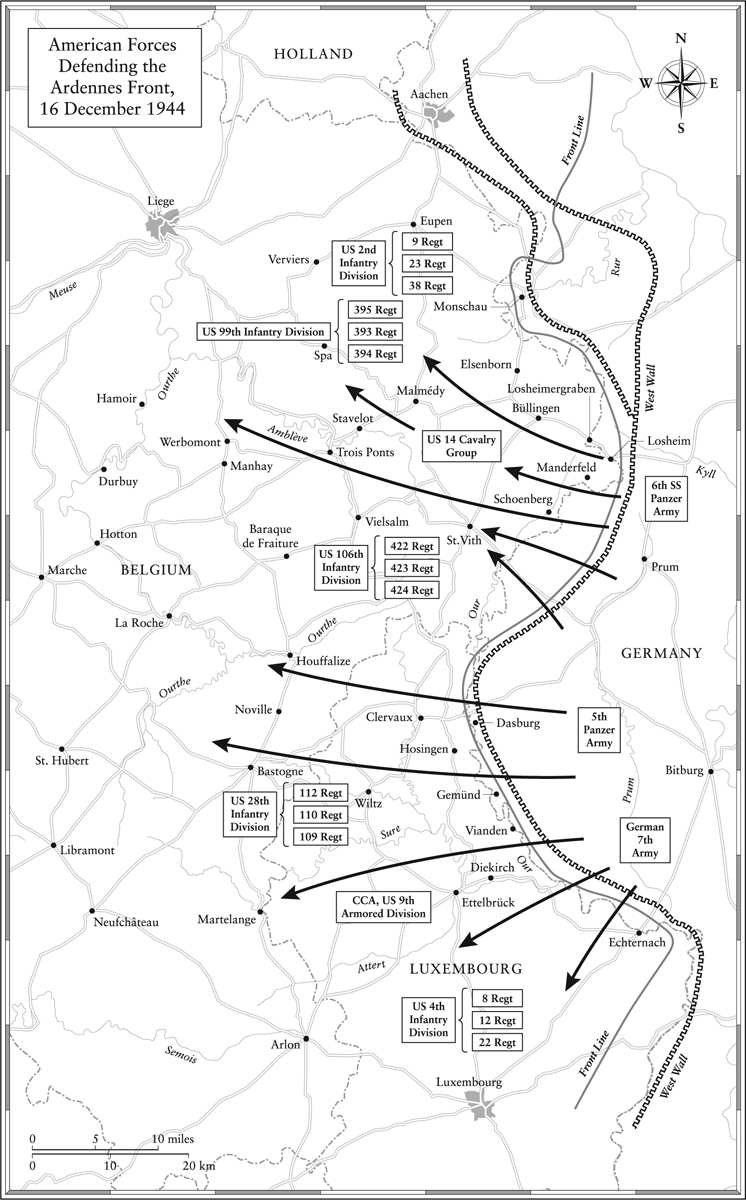
To imply the US Army was adhering to Patton’s maxim ‘If everybody is thinking alike, then somebody isn’t thinking’ is untrue. There were a wide range of interpretations at every level as to German capabilities and intentions for late 1944: the presence of Dietrich’s Sixth Panzer Army taxed every G-2 mind, but few divined its real purpose. Further down the First Army’s chain of command, within Leonard T. Gerow’s V Corps sector – on the very northern edge of the future battlefield – Walter E. Lauer’s newly arrived 99th ‘Checkerboard’ Infantry Division was told that German capability was limited to potential ‘battalion-sized infiltrations in several locations throughout the division sector’. Assessments of the threat repeatedly read ‘no change’ and were based solely on terrain analysis with no mention of location, strength or identification.28
The 99th Infantry Division were green and had never met ‘the enemy’ before. Activated at Camp Van Dorn, Mississippi, in November 1942, after training they had landed in France exactly two years later, immediately heading for a quiet area of the front to acclimatise. On D+156, 9 November 1944, with Lauer’s HQ in a Belgian villa just behind the front, at Bütgenbach, they first entered battle, mounting patrols in the Ardennes.29 ‘It was a very cold and rainy season, and the roads were basically impassable due to mud, even to 6 × 6 vehicles. We were deployed into different forests to cut pine trees to make logs … these were laid side-by-side crossways on the road to create a passageway for the trucks,’ recounted one Checkerboarder of this pre-battle time.30 Most were concerned more with the plunging temperatures than combat; although they suffered 187 killed or wounded in November 1944, four times that number, 822, were hospitalised with trench foot, pneumonia or frostbite.31
Cecil R. Palmer was a twenty-two-year-old staff sergeant in the Checkerboard’s 394th Infantry Regiment, drawing $96 a month basic pay, plus a 20 per cent Foreign Service Allowance. Cold weather has always since reminded him of those November days in the Ardennes, before the Bulge: ‘The Army did not provide us with the proper clothing or boots; so many men got trench foot or froze to death,’ he recalled. ‘Each time I shave, I cannot help but think of Captain Goodner making the men in our company shave every day, no matter how cold it was, tears freezing in our eyes from the pain of the cold. Other companies were allowed to grow beards but not ours. He did it out of concern for our safety; having a beard would not allow for a good tight seal if we needed to use our gas masks … We were given the nickname “Battle Babies” because of our inexperience.’32
New Yorker Jerry C. Hrbek was drafted in February 1943 and assigned as a military policeman with 99th Division; on the afternoon of 15 December he was escorting nineteen German prisoners to an old farmhouse near Berg for interrogation. The interrogators, sergeants of the division’s G-2 staff, quizzed their captives one by one. On being asked their units, the first four had answered Fifth Panzer Army, but the next one answered he was from the Sixth. Surprised, ‘the sergeant behind the table looked up from his writing and asked him again. He got the same answer. Slowly the sergeant stood up and stood there about thirty seconds looking at the man. His open hand shot out and with a thunderous slap he hit the Jerry across the face.’ The interrogator thought his prisoner was lying. The twenty-year-old Hrbek, bystanding, complained at the sergeant’s behaviour and pointed out, ‘We’ve been getting prisoners from the Sixth Panzer for the last three weeks, one here, two there.’ Eventually, six of the nineteen revealed they were from the Sixth Panzer Army, the remainder from the Fifth. The interrogator’s reaction was ‘it couldn’t be, the Sixth Panzers were in Holland’, as indeed some of their constituent units had been – once.33
Hitler’s paranoia about security had forbidden any of the attacking units to venture near the front lines, much less undertake reconnaissance patrols of their future battle terrain, leaving each individual intelligence staff officer (termed the ‘Ic’) in the dark.
Had they done so, they might have discovered elements of the battle-hardened 2nd Infantry Division lurking on their extreme right flank. Major-General Walter M. Robertson’s ‘Indianheads’ (after their shoulder patch) had landed on Omaha Beach on D+1, fighting through Normandy until arriving in St Vith on 29 September 1944. However, the eyes of his G-2, Lieutenant-Colonel Donald P. Christensen, were elsewhere, for on 11 December two of their three regiments were ordered north to attack and seize the Roer river dams. This left the highly experienced, full-strength 23rd Infantry Regiment on the high ground of the Elsenborn Ridge, whom the Germans mistook for soldiers of the vastly less experienced 99th Division. Among their number, at just twenty-one, was Captain Charles B. MacDonald, commanding ‘I’ Company, of the 3rd Battalion in 23rd Infantry, who has left us two important accounts encompassing his adventures there and elsewhere.34
Gerow’s V Corps intelligence staff, led by Lieutenant-Colonel Jack A. Houston and based at the Caserne Antoine in Eupen, recorded vehicular movement south of Düren, while the last tactical reconnaissance reports (on 7 December) observed troop concentrations opposite, but did nothing about them. Aerial reconnaissance patrols – when they could fly (there were no flights on the 13th, as we’ve noted, due to thick fog) – likewise picked up troop concentrations and camouflaged dumps, but these were assessed as belonging to German units in transit to positions north or south of the Ardennes. On 14 December, Thunderbolt pilot Captain Jack Barensfeld piloted his P-47 over the Eifel Forest – the German concentration area east of the Our – and encountered a huge amount of anti-aircraft fire coming from what should have been (according to his pre-flight briefing) near-empty woods; it killed one of his wingmen.35 The 99th’s G-2 report, that ‘the enemy has only a handful of beaten and demoralised troops in front of us and they are being supported by only two pieces of horse-drawn artillery’, lodged firmly in the memory of Captain Charles Pierce Roland, the 3rd Battalion’s executive officer (XO) in the same 394th Infantry Regiment as Staff Sergeant Palmer. He and many others were lulled into a false sense of security by the ‘fir forests whose cone-shaped evergreens standing in deep snow and sparkling with crystals formed a scene of marvellous beauty’.36