
14
HITLER ENVISAGED THE star turn of his Ardennes offensive to be the Sixth Panzer Army, an entirely new creation. That it was to be led by the Waffen-SS’s senior field commander, and contain four SS panzer divisions, was no accident. This was another of the Führer’s responses to 20 July: thereafter the only organisation with which he felt safe, on which he could rely, was Himmler’s SS. Heinrich, Graf von Einsiedel, a great-grandson of Otto von Bismarck and a young lieutenant in 1944, observed, ‘The generals kept on assuming that the army was the only arms-bearer of the nation. But it was quite clear that another force was being built up that wanted to compete with the army for power’.1 It was almost as though Hitler built the Ardennes offensive around the capabilities of his Sixth Panzer Army, created expressly for the purpose on 14 September 1944 and bulging with SS troopers, rather than the force being harnessed to Hitler’s master plan.
Back in the early 1980s, over dinner one night when stationed in Germany, I exchanged a few civilities with a spry, well-groomed and respectable looking citizen of what was then West Germany, seated at the next table with his wife. Our conversation – for these were the years of the Cold War – turned to the threat posed by the USSR. It soon transpired that he had personal experience of the east, conning a panzer through the endless Russian steppes. Following several schnapps, and after other encounters, his guard lowered, my new-found friend revealed himself as the former Obersturmführer Hans Hennecke, a tank commander who had served in Russia, Normandy and the Ardennes.2
Born in August 1920 in the northern spa town of Waren, Hennecke spent his spare time in the HitlerJugend while at school, and after six months compulsory service in the Reichsarbeitsdienst he volunteered for the Waffen-SS. ‘I was lured,’ he remembered, ‘partly by the snappy black uniform and also by recruiting posters.’ The clothing was designed by the fashion consultant Hugo Boss, and the posters were the work of Ottomar Anton, an SS officer who produced pre-war art deco-style travel advertising for the Hamburg-Amerika, Cunard and White Star shipping lines and the Berlin Olympics. By using top designers, the Nazis showed an appreciation of the importance of branding and image, which appealed domestically to millions of Germans like Hennecke, and overseas to many who frankly sympathised with Germany’s ideals, at least until war came.
He was immediately accepted, volunteering just as the Waffen-SS had started to expand following the fall of France; with a possible invasion of England looming, they needed to fill their ranks. Pre-war volunteers for the SS had to be perfect physical specimens, to show proof of pure Germanic ancestry back to 1800, while those who became officers had further to demonstrate their ancestry to 1750; all signed on for an initial period of four years, but under wartime conditions all these requirements were gradually relaxed.
‘Our training,’ Hennecke remembered, ‘stressed three points: physical fitness, weapons proficiency and character. Our days began at 06.00 a.m. with a rigorous hour-long physical training session, a pause for a bowl of porridge, then intensive weapons training, followed by target practice on the ranges and unarmed combat lessons. We continued after a hearty lunch with a drill session, followed by cleaning duties and finished off with a run or a couple of hours on the sports field.’ He thought it was ironic that he spent relatively little time on drill and more on tactics, because the unit he served with, the Leibstandarte, ‘originated as Hitler’s personal body guard and, spending most of their time on the parade square, had acquired the derisory nickname of asphaltsoldaten(asphalt soldiers)’. Nevertheless, thanks to athletics and cross-country running every day, Hennecke and his SS comrades developed levels of fitness and endurance enabling them to cover half a mile in full kit in twenty minutes, which far surpassed the requirements of conscripts in the Heer, the German army.
On qualifying as an SS-Schütze (private), Hennecke and his class were awarded their SS walking-out daggers during a ceremony at the Feldherrnhalle Memorial in Munich. This annual ritual, steeped in mysticism and intended to reflect the traditions of medieval Teutonic knights, was held each 9 November, the date of the unsuccessful putsch of 1923 (and later, ominously, of Kristallnacht). Etched on his dagger’s blade, he remembered, was the SS motto, Meine Ehre Heisst Treue (My Honour is Loyalty). On 20 April (Hitler’s birthday), they had each taken their oath of loyalty to the Führer.
After gruelling service in the ranks in Russia, Hennecke was selected for officer training and sent to a Junkerschule in 1943. The Waffen-SS offered advancement to promising candidates regardless of their education or social background, and named their academies Junkerschulen(schools for young nobles). ‘We were even issued an etiquette manual that included a chapter on table manners,’ he recalled. ‘In the middle of the war we were being taught “champagne glasses to be parallel to the third tunic button, arm extended at forty-five degrees, white wine to be drunk from tall glasses, red from short”. I’ve never forgotten that … In the middle of the war!’ Hennecke broke off, shaking his head in mirth. ‘Off-duty, officers and men were obliged to address each other with the classless title of “Kamerad”, as you would say “mate”, or “buddy”. We were forbidden padlocks on our lockers to build the mutual trust necessary in a combat unit, whilst unconditional obedience was required at all times. Such obedience was embodied in the term Führerprinzip (leader principle), which essentially meant that Hitler’s word was above all written law and therefore refusal of orders from him or his delegates was not an option.’
Evening sessions concentrated on Nazi ideology, the evils of Bolshevism, Aryan genealogy and Nordic mythology, all now exposed as bogus. Hennecke observed of those times, ‘we lapped it up, knowing nothing else’. They had to study Hitler’s book Mein Kampf, and he recalled that during his five-month course, one officer candidate in three was rejected for failing the ideology examination. Simultaneously, field exercises were designed to turn Hennecke and his generation into not just leaders, but an elite. Even before the war, SS schools were producing more than 400 officers a year, but by 1942 nearly 700 Waffen-SS officers had been killed in action, and Hennecke remembered fellow officer candidates from several occupied countries. Most foreigners who volunteered for service in the Germanic legions enlisted to fight Communism, but still had to be able to prove Aryan descent for two generations, and to possess a ‘good’ character, whatever that meant by SS standards.
Leadership training groomed them to notions of individual responsibility and military teamwork. At the heart of Waffen-SS doctrine, reinforced by Russian Front experiences, were combat concepts born of the final year of the Great War, when Sturmtruppen(elite storm troop units) were raised and trained for trench raids. Here, the need for speed, shock and surprise was paramount, all of which required strong leadership skills, the ability to employ initiative when circumstances dictated, and exhaustive training to be able to use any weapon, fight at night and cope with being surrounded and cut off. Leaders were trained always to take immediate, aggressive action, counter-attack without thinking and induce fear in the enemy. Such Great War combat was unconventional and necessarily ruthless, employing knuckle-dusters, trench knives and bayonets, grenades and entrenching tools with edges sharpened to razors. Under these circumstances the taking of prisoners was often regarded as an inconvenience.
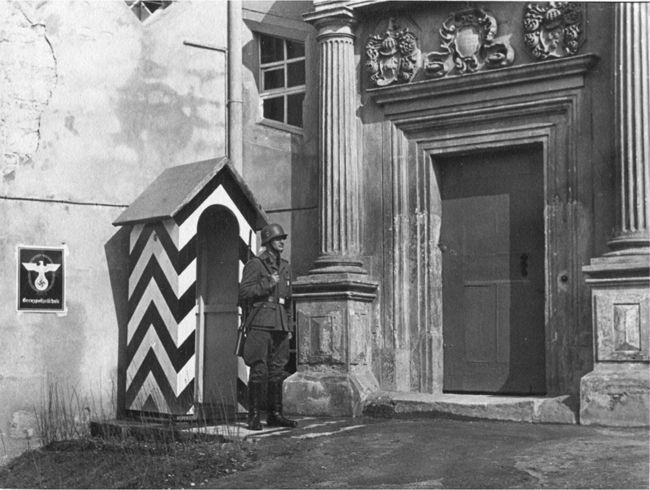
Hans Hennecke at the beginning of his career in the Waffen-SS. By December 1944 he was a seasoned veteran of the Russian Front, had won the Iron Cross, gained a commission and was commanding a tank platoon in Jochen Peiper’s 1st SS Panzer Regiment. (Author’s collection)
Though the scale and technology had changed from 1918, such extreme ruthlessness and fitness, when fused with ideology, made the Waffen-SS a lethal opponent. Taught to believe that the Russians were subhuman and that they were embarking on a crusade to save Western civilisation, Hennecke and his colleagues were indoctrinated to achieve victory at whatever cost. On the Eastern Front, Hennecke remembered his battalion’s motto, Wir nehmen Tod, Wir teilen Tod Aus (We accept death, we hand out death). Nearby in Russia, he reminisced, was a unit (III Battalion of the 2nd SS Panzergrenadier Regiment) which acquired the nickname of der Lötlampe Abteilung (Blowtorch Battalion) because of the speed with which they burned through Soviet formations and torched villages. Such concepts the Waffen-SS brought to the Western Front and would employ against their American foes in the Ardennes: they knew no other way.
Hennecke could still recite his SS serial number (363530), and proudly recounted that by 1944 he had become a seasoned veteran of the Russian Front, won the Iron Cross, gained a commission and was commanding a tank platoon in the 1st SS Panzer Regiment. He proved very adaptable and served as a platoon leader (Zugführer) of tank, anti-aircraft and combat reconnaissance units, which was his role when an Untersturmführer in an SS Kampfgruppe during the Battle of the Bulge, aged twenty-four.3
Hans Hennecke’s story was typical of many ‘true believers’ in the formations which comprised Josef ‘Sepp’ Dietrich’s Sixth Panzer Army. The potential presence of Dietrich, as we have seen, greatly worried Allied intelligence because of the unique reputation he had accrued to this date, for he was no ordinary military commander but one of the original Nazis. In contrast to the younger and immature Himmler, he was a colourful character, said to be ‘larger than life’ and one of the closest men to Hitler, who had won over many contemporaries with his sheer military competence during the Second World War; Rundstedt called him ‘decent but stupid’. His several biographers agree that his rise to prominence was not necessarily due to Nazi fanaticism, acceptance of unsavoury National Socialist racial policies or political beliefs, but from blind, stubborn loyalty, as well as tactical military skill.4 Perhaps Hitler identified with the mustachioed, stocky, five-foot-six Bavarian ex-sergeant-major, with blue eyes and brown hair, who had a strong, square jaw and spoke with a broad accent. By all accounts, he was extraordinarily brave, had an infectious sense of humour and enjoyed his drink. 5
Possibly aware he was overpromoted, Dietrich relied heavily on his chief of staff, Fritz Krämer, a former Wehrmacht officer, to run his command on a day-to-day basis, while – ever the sergeant-major – he spent time with his troops, for example visiting tank repair workshops where he distributed Iron Crosses to the mechanics who kept his panzers on the road.6 Although Dietrich was liked by many non-SS personnel, the panzer staff officer Oberst Bernd Freytag von Loringhoven observed, ‘We weren’t impressed with his talents as a commander. He had no prior training at all. He’d been a sergeant in the First World War and after that he never had any kind of advanced military training whatsoever.’7 The Jesuit-educated cavalry officer Oberstleutnant Philipp Freiherr von Boeselanger (who with his brother was part of the Stauffenberg circle of plotters) agreed: ‘Dietrich had a strange way of giving orders. I heard several of his during the war. He’d say “You attack this, you that, then sort it out”. It wasn’t the way we gave orders in the army, with clear aims and limits and so on. His method was simply “Well do it this way. You left, you right”.’8
The final instructions for Herbstnebel issued to Dietrich and Krämer renamed their command the innocuous-sounding Auffrischungstab 16 (Refurbishment Staff No. 16), in a final attempt at operational deception (Manteuffel’s Fifth Army was similarly retitled as the meaningless Feldjäger-Kommando z.b.v) – though Bletchley Park saw straight through these half-hearted ruses. Model’s orders, issued via Rundstedt’s OB West headquarters, were that they should ‘break through the American front to the north of the Schnee Eifel, and resolutely thrust forward with their fast-moving units [i.e. panzers] on their right flank, towards the Meuse crossing points between Liège and Huy, in order to capture these in conjunction with Operation Greif [Skorzeny’s commandos]. Following this, Sixth Panzer Army will drive forward to the Albert Canal between Maastricht and Antwerp … As soon as the Sixth Army has secured the Meuse crossings, this defensive flank will be placed under command of Fifteenth Army. Operation Strösserwill be carried out with 800 paratroopers at 07.45 a.m. on Null-Tag … should this operation [Strösser] not take place because of unfavourable weather conditions, it will take place 24 hours later …’9
Privately, Dietrich felt the plan was doomed, but his political nose had taught him to keep his reservations to himself and do what he was told. In a famous September 1945 interview with the Canadian intelligence officer Milton Shulman, all Dietrich’s tensions about the offensive bubbled to the surface, with Shulman witnessing him flinging out his arms and puffing out his cheeks. He was under investigation at the time for war crimes against murdered GIs; nevertheless Shulman recorded Dietrich’s outburst, expressed in the following dramatic terms:
‘All I had to do was cross a river, capture Brussels and then go on and take the port of Antwerp. And all this in December, January and February, the worst three months of the year; through the Ardennes where snow was waist deep and there wasn’t room to deploy four tanks abreast, let alone six armoured divisions; when it didn’t get light until eight in the morning and was dark again at four in the afternoon and my tanks can’t fight at night; with divisions that had just been reformed and were composed chiefly of raw untrained recruits; and at Christmas time.’ The crack in Dietrich’s voice when he reached this last obstacle made it sound like the most heartbreaking of all.10
We have to take it at face value that these were Dietrich’s private thoughts at the time, and there seems no reason to doubt the victor of endless fights under mountains of Russian snow in much worse sub-zero conditions. Hitler’s favouritism towards the SS was reflected not only in the strength and equipment of those individual units committed to battle, but in the size of Dietrich’s Sixth Panzer Army itself. With five infantry and four panzer divisions distributed over three corps, plus substantial artillery, Nebelwerferand engineer units, the formation was the size of Fifth and Seventh Armies combined, and clearly designed to be the Schwerpunkt, or main effort. He had nearly 700 tanks, tracked tank destroyers and assault guns at his disposal, 685 artillery pieces and 340 Nebelwerfers.11
None of Dietrich’s infantry divisions belonged to the SS, although they came under his command for the offensive. In contrast to Manteuffel’s approach in the Fifth Panzer Army’s sector, of advancing on a wide front on the basis that ‘if we knock on ten doors simultaneously, several will open’, Dietrich and Krämer proposed to move along narrow attack corridors, echeloned in depth, which the Fifth Army commander felt inappropriate in the treacherous Ardennes region with its poor roads, numerous rivers and challenging terrain.
Manteuffel argued with much logic that such a tactic offered endless opportunities for the ardent defender to slow down his attacker with well-sited roadblocks and ambushes. The baron would prove correct, as did his map appreciation of the Herbstnebelbattlefront. Sixth Panzer Army, with the most powerful forces, had been allocated the most difficult terrain. It would not matter how much combat power Dietrich possessed; if the Americans chose to block him, there was no power in the Reich that could force a passage through what was termed the ‘northern shoulder’. Manteuffel argued with great foresight in December 1944 that just a little of Dietrich’s combat power transferred south to Brandenberger (who had no tanks and too few bridging units) and to his own Fifth Army would yield much greater opportunities than being stuck in traffic jams north of the Schnee Eifel. This was not sour grapes; hindsight has proved Manteuffel right.
Dietrich’s Sixth Army included three corps, only two of which were staffed by the Waffen-SS. The exception was that of Generalleutnant Otto Hitzfeld, bearer of the Knight’s Cross with Oak Leaves, five times wounded and known as the ‘Lion of Sevastopol’ for his victory there in 1942. He had taught infantry tactics at the Infantry Kriegsschule in Dresden alongside Rommel in the 1930s, later commanding units in France and Russia, before being appointed to lead LXVII Corps on 1 November. Then forty-six, Hitzfeld commanded two horse-drawn Volksgrenadier divisions, whose appearance was in total contrast to the usual image one might have of an SS panzer army.
Knight’s Cross holder and Eastern Front veteran Oberst Georg Kosmalla commanded the 272nd Volksgrenadiers, which had been engaged in heavy fighting against the American 78th Division in the Hürtgen Forest.12 One of his officers, Leutnant Günther Schmidt, a survivor of the original 272nd Division which had been badly mauled in Normandy, returned to Germany as the only officer left in his battalion. His experience of preparing for Herbstnebel was like that of so many other junior leaders: ‘Every day more newcomers came; many in grey-green Kriegsmarineuniforms, or in the blue-grey of the Luftwaffe. Most of them had only short and insufficient training.’13
Another Normandy survivor was Obergefreiter Otto Gunkel of the 981st Volksgrenadier Regiment, who remembered the replacements, ‘well-fed guys equipped as if it was peacetime, and who were not very happy about a duty as infantry. They had first to resign themselves to their fate and then they would become good and loyal infantrymen’.14 In overall terms, Kosmalla’s division, recalled Schmidt, included about 20 per cent skilled infantrymen and the rest were former Kriegsmarine or Luftwaffe personnel. On 30 October they boarded a train in the dark heading westwards; at Cologne they stopped while an air raid was in progress. ‘The train stopped between houses, no one was allowed to get out of the train. The Flak started to shoot and some bombs fell in the distance.’ 15
Echoing the experience of the US 4th and 28th Divisions, the Hürtgen soon reduced the much-battered 272nd Volksgrenadiers to a ‘sad little group of tired soldiers, with dirty, unshaved and torn uniforms, one third of our original strength,’ remembered Obergefreiter Gunkel. ‘Our company HQ detachment had only four men. Both our heavy-machine gun platoons were decreased to squads. The 5th company was wiped out – wounded, dead, or taken prisoner. This was the horrible result of only ten days in the Hürtgen Forest, even higher losses than during the first ten days in Normandy. I walked behind the horse-drawn cart that was loaded with our dead of the day before.’16 As they withdrew from the Hürtgen to prepare for Herbstnebel, Gunkel saw that the woods around Gemünd and all the other small villages were full of soldiers from newly arrived units.
‘These men were well equipped with winter camouflage uniforms, winter-boots, fur-hoods, etc. Long convoys of armoured vehicles, assault guns and artillery were standing along the roads. But we did not then know that these troops were preparing for the Ardennes Offensive.’17 Arriving after the Hürtgen was seventeen year-old Grenadier Andreas Wego, apprenticed to a mason by trade, who was inducted into the Kriegsmarine in July 1944 for three months’ basic training. This included ‘half-mile forced marches with a sixty-pound pack and combat gear while wearing a gas mask, followed by classroom training back at the barracks’. At the end of September, when he received his last monthly naval pay of 30 Reichsmarks, his whole class was transferred into the army and the 272nd Volksgrenadiers. He then had a month at the divisional battle school near Berlin before heading for the front in November.18
Many histories of the Ardennes campaign have alleged the Germans were better-equipped and trained than the opposing US forces. Here is evidence which suggests a different overall trend. German infantry divisions in the Bulge were in nearly every case inferior to their American counterparts and some, such as the 272nd Volksgrenadiers, had already taken huge casualties in the Hürtgen, with a consequent effect on morale.
General Hitzfeld’s other division was the 326th Volksgrenadiers, reformed from another formation annihilated in Normandy and partially containing ethnic Volksdeutsche from Hungary. It was commanded by Generalmajor Dr Erwin Kaschner, who had been captured by the British in the First World War and served in France and Russia from 1940 to 1943. His division was originally slated for Manteuffel’s Fifth Army, but due to its lack of mobility (it was 400 horses short), it was transferred to the Sixth for operations to protect Dietrich’s right flank, where there was less call for movement. Both the 272nd and 326th Volksgrenadiers had a largely static role, not unlike Brandenberger’s Seventh Army in the south, of seizing the high ground of the Elsenborn Ridge and protecting the flanks from counter-attacking US divisions.
Gelinenkirchen-born Josef Reinartz was a twenty-eight-year-old platoon commander with the 326th in the Ardennes. He had been conscripted in 1938, seen action in France where he was wounded, and Russia where he survived the awful 1941–2 winter before being discharged with severe exhaustion and the effects of frostbite (missing toes) in June 1942. Reading between the lines, his discharge may also have been connected with combat stress (PTSD). He worked on the Deutsche Reichsbahn as a locomotive engineer until being recalled to the colours in September 1944 under Himmler’s recruitment schemes. He was attached to the 753rd Volksgrenadier Regiment and moved to the front with his unit on 26 November, being promoted Unteroffizier on 1 December. Combat experience like his – Reinartz had been awarded an Iron Cross and Infantry Assault Badge in Russia – would make a huge difference in the coming days.19
Another Landser in the 326th was Alfred Becker of Köln, a twenty-year-old Gefreiter, who still sports a purplish-red letter ‘A’ tattooed on his left shoulder blade because ‘my Erkennungsmarke (dog tags) omitted to indicate my blood group, so I had it done on my shoulder’.20 In the Ardennes, Becker wore ‘an overcoat with a Kopfschutzer (toque), mittens with a trigger finger and a sweater with a high neck. Some in our division had camouflaged snow suits.’ At the front, Becker smoked a pipe, observing, ‘pipes were popular with young men back then. They were better for the front lines. You can see a cigarette burning and so they tend to draw bullets to your face. This is not good for your teeth.’ Becker carried a carbine and a smoke grenade. ‘The smoke grenade was to hide you if you wanted to attack or get away. Later on, when I became the squad leader, I carried a sub-machine-gun.’ He remembered of his days in the Ardennes, ‘We thought we could beat the English and Americans in a fair fight, but they had more matériel than we did, so the fights were very uneven. If you shot at an American infantry unit, they would blow you to bits with bombs or artillery shells. This was very frustrating. The Americans were very spoiled. Lots of good food, good clothing, nice boots. But they were very humane.’21
Despite the fact that Hitzfeld’s LXVII Corps mission was to help clear the way for the 1st and 12th SS Panzer Divisions, then contain the ‘northern shoulder’ of the Bulge, his two divisions wholly, or in part, would fail to achieve even that. Due to the unexpected US V Corps (78th and 2nd Divisions) attack to reach the Roer dams on 14 December, some of the 326th Volksgrenadiers would be tied down fighting the US Army at Wahlerscheid. At the same time, Kosmalla’s 272nd Division, also embroiled in the same battle, were likewise too preoccupied to shift south and take a full part in the Ardennes assault. Both found themselves fighting hard to retain the village of Kesternich because it was a transit point for Herbstnebel units heading south for the concentration areas in the Eifel. Though the pressure on the Germans eased on the days after 16 December, when the US V Corps withdrew south to aid their comrades, the damage had been done. Hitzfeld’s divisions had been unable to contribute to the start of the Ardennes attack, besides losing badly needed personnel.22 The failure of Hitzfeld’s corps to support Sixth Panzer Army was not his fault, but further evidence that Hitler had thrown together his Ardennes plan without any real reference to what the US Army might do to thwart him.
The forty-three-year-old Gruppenführer Hermann Priess commanded the I SS Corps, formerly Sepp Dietrich’s old formation, which contained 1st and 12th Panzer Divisions, totalling around 240 panzers on 16 December. We have seen via Dietrich’s career how the Leibstandarte expanded from a motorised regiment in 1939 to the largest division in the armed forces by December 1944. Priess himself had joined the nascent SS in 1934 and fought in Poland, France, Russia, where he led the 3rd SS-Panzer DivisionTotenkopf (Death’s Head), and in Normandy leading a corps. Agile and clever, he took over his formation on 30 October. Even though an SS panzer corps sounded the very epitome of a ruthless, fully motorised formation that would slice its way through any opponent or terrain in Herbstnebel, Priess was allocated three infantry divisions in addition; their job would be to carve their way through American positions to allow the following panzer divisions unimpeded passage.
The infantry included the 277th Volksgrenadiers of Oberst Wilhelm Viebig, an artilleryman by background, who had served in Russia on Field Marshal von Manstein’s staff, and assumed command of his division on 4 September. Though formed from the pitiful remnants of a formation that had crawled out of Normandy, few of Viebig’s headquarters staff, officers or NCOs were battle-hardened. Many of the replacement grenadiers were Volksdeutsche, hailing from Croatia, Alsace (whose loyalty was tested, holding French sympathies), and Vienna, then under threat from the Soviets. Their crest (a ‘V’ crossed with a sword, referring to Viebig) was painted on their few vehicles, but most mobility rested on bicycles and horses. Field Marshal Model, who inspected them on 28 November around Dahlem, was well aware of their deficiencies but insisted they would perform well through ‘ardour and spirit’. At only 80 per cent strength, and with one of their eight battalions already committed to defending a portion of the Siegfried Line elsewhere, the 277th’s mission was to break through to the Elsenborn Ridge, north of the Losheim gap.
Alongside Viebig was the 12th Volksgrenadier Division, under Generalmajor Gerhardt Engel, an impossibly distinguished combat commander and already holder of a Knight’s Cross with Oak Leaves, an adjutant on Hitler’s staff from 1938 to 1940, and possessing high decorations from Italy, Serbia, Romania and Finland. A high-flying officer, he had taken over his Volksgrenadiers on 9 November and received advancement to Generalmajor on 15 November, only three months after his promotion to Oberst. One of the best Volksgrenadier units allocated to Herbstnebel, their badge of a shorting bull reflected the aggression and confidence of its commander – which was mirrored throughout the formation; unlike most of the other Volksgrenadier divisions, the 12th was highly experienced, efficient and possessed most of its authorised equipment.
Their role was to punch through the American lines along one of the routes assigned to elements of the 12th SS Division, through Büllingen towards Malmedy, working ahead of the panzers. Helmut Stiegeler of the 12th remembered the night of 15 December when he and his mates received a rare hot meal, and a bottle of schnapps each. Then they began to advance through the hills in the darkness. ‘The villages through which we marched lay peaceful in the December night. Perhaps a dog barked here and there, or people were talking and looking at the passing soldiers. Out of an imperfectly blacked-out window a vague light shone out. With all these sights, most of our thoughts were of home in our warm houses with our families.’23
The third infantry unit under Priess was the 3rd Fallschirmjäger Division under the bespectacled forty-eight-year-old Generalmajor Walther Wadehn; this was an old veteran unit that no longer contained any veterans. Completely destroyed in the fighting around St Lô in July and Falaise in August, its numbers had been made up with Luftwaffe ground personnel, like the 5th Fallschirmjäger Division further south. Most of the old jump-trained Fallschirmjägers, veterans of Crete or Russia, had already been sacrificed in combat and their replacements were relatively unfit with little understanding of ground combat. Photographs of the division in action show most of its men wearing the ordinary coal scuttle-shaped Wehrmacht helmet, rather than the signature cut-down Fallschirmjäger version, which indicated a veteran paratrooper and was only worn by the German parachute force.
Johannes Richter was a not untypical platoon commander in the 3rd Fallschirmjägers. He had enlisted as a twelve-year army man in 1932, but was transferred to the Luftwaffe at its creation, and served with the Condor Legion in Spain. He spent nearly ten years with a Fliegerhorst(aerodrome) Company, responsible for general supply, maintenance and guarding duties, reaching the rank of Oberfeldwebel. That easy life ended when he was transferred to a parachute school in September 1944, where his training lasted six weeks (without any parachuting), before being posted to the division on 11 November. Promoted to Fahnenjunker/ Oberfeldwebel (Senior Cadet Officer/NCO) in the 6th Company, Richter and his regiment were almost immediately pitted against the US 1st Infantry Division in the Hürtgen fighting, where he was wounded twice and his formation suffered 1,658 casualties in two weeks. Some of them were still in combat around Düren when the rest of the division transferred south for the start of Herbstnebel.24
This is why the Sixth Army chief of staff, Krämer, assessed the 3rd Fallschirmjägers ‘at only 75 per cent strength’ on 16 December, an optimistic rating in itself, given they had no armoured vehicles (StuG assault guns) in their anti-tank battalion. Although Wadehn, its commander, had taken over back in August, his chief of staff was so clueless about land operations that Wadehn had to request his immediate replacement. By Null-Tag, only two of the division’s three regiments were assembled, with the third disengaging from the fighting in Düren. The Fallschirmjäger’stask was to dislodge the US 14th Cavalry Group from the Losheim gap, overwhelming it in the towns of Manderfeld and Holzheim, and opening up routes for the 1st SS Panzer Division.
While also controlling four army Nebelwerfer and two army artillery regiments attached for fire support, the undoubted mainstay of Preiss’s corps were his two crack SS panzer divisions, and the 501st SS Heavy Panzer Battalion (Schwere-SS-Panzer-Abteilung) of around thirty monster sixty-nine-ton King Tigers, although only half of the latter were fully operational on 16 December. Despite the ravages of war, ‘crack’ was still an appropriate word to describe the combat power and efficiency of the men and equipment they contained. The youthful Brigadeführer Wilhelm Mohnke, aged thirty-three, commanded the 1st SS Panzer Division Leibstandarte. He had joined the Nazi Party in September 1931 and been one of the original 120 members of Dietrich’s SS Watch-Battalion-Berlin, formed to guard Hitler’s Chancellery in March 1933. Mohnke saw action in France, Poland and the Balkans, and was eventually given command of a regiment in the 12th SS Panzer Division Hitlerjugend.
After leading his regiment through the attritional Normandy campaign, on 20 August Mohnke was awarded his original division, the Leibstandarte, which he would take to the Ardennes. Normandy had been in every way a killer for his division, from which no tanks or artillery returned at all; in a typical 1,000-man battalion only fifty escaped to fight again in the Ardennes.25 Yet, by December, it managed to boast a formidable complement of armoured vehicles and half-tracks. Its panzer regiment, led by Joachim ‘Jochen’ Peiper (one-time commander of der Lötlampe Abteilung, Blowtorch Battalion), a former adjutant of Himmler’s and recently recovered from wounds received in Normandy, fielded thirty-eight Panthers and thirty-four Panzer IVs. Along with the King Tigers, Panthers and Panzer IVs, the division’s anti-tank battalion boasted ten Panzerjäger IVs, a grand total of nearly one hundred tanks and tank destroyers, over 19,000 officers and men and nearly 3,000 vehicles.26
It was in the Leibstandarte’s panzer regiment that Hans Hennecke served, leading a platoon of tanks from his mount, Panther No. 111, driven by Rottenführer Bahnes. ‘Peiper was the most dynamic man I ever met. He just got things done,’ Hennecke told me. ‘He was not much older than me, but seemed to belong to another generation. He was mature, spoke languages, was clever,’ Hennecke remembered, still in awe of his former comrade.27
In 1944, according to Hans Bernhard, then a twenty-four-year-old Hauptsturmführer and Wilhelm Mohnke’s 1c (intelligence officer), their men responded to the ‘guiding principles of duty, loyalty, honour, Fatherland, comradeship’.28
Duty. Honour. The Bulge gave rise to much debate about the brutality of Waffen-SS units towards American prisoners, and one commander consistently close to such accusations was Mohnke. On 28 May 1940, he had led an SS company which murdered eighty British prisoners of war at Wormhout, near Dunkirk. On 8 June 1944 his regiment was implicated in the killing of thirty-five Canadian prisoners in Normandy. We will never know how many Russians had disappeared under similar circumstances in the east. Carl-Heinz Bohnke remembered in Russia ‘We saw endless lines of prisoners. We couldn’t look after them. The later units did. We couldn’t.’29
Oberst Bernd Freytag von Loringhoven (an Ostfront veteran who would command the Bundeswehr’s 19th PanzerBrigade in the 1960s) also recalled seeing ‘a line of Russian prisoners and a group of SS soldiers getting ready to shoot them. The SS sergeant said, “They’re just sub-humans, colonel”. And it was absolutely typical of the ideology that leaders in the Waffen-SS had told the simple man, the NCO, that prisoners of war without weapons were simply to be shot whenever necessary.’30 The Russians themselves were already used to similar treatment from Stalin’s own thugs, but the consequences would be vastly different when organised murder met a democracy in war. It was this kind of unrestricted, premeditated horror, practised routinely by Himmler’s henchmen in Russia, which the Waffen-SS would bring to the Bulge. In short, murder and mayhem was the business of Mohnke and his men, as we shall discover shortly.
Such Nazi brutality was, and remains, beyond comprehension, except in one area. Ever since the RAF’s first thousand-bomber raid on Cologne of 30–31 May 1942, German soldiers and civilians had witnessed the terrible destruction of their own cities with consequential horrendous casualties, from which no one in the Reich was immune – except Hitler, of course, who refused to acknowledge or visit the stricken areas. On 16 November 1944 the city of Düren had been attacked by 485 Lancasters and thirteen Pathfinder Mosquitoes of the Royal Air Force. Sirens sounded and residents went down into the cellars. ‘When we emerged to clear up the mess, there was no mess to clear up because there was no town. There was just rubble. Düren was no more. The whole thing had taken about forty minutes,’ remembered one resident. Of 22,000 inhabitants, over 3,000 were killed and Obersturmbannführer Peiper and some of his men had been among those detailed to help rescue the survivors. After the war, the SS officer recounted how ‘the civilians had to be scraped from the walls’, and in response he swore he ‘would personally castrate the men who did that – with a piece of broken glass – blunt at that’. The Leibstandarte’s, and Peiper’s, viciousness could never be justified or forgivable, but the suffering of Düren, and other German cities, made it slightly more understandable.31
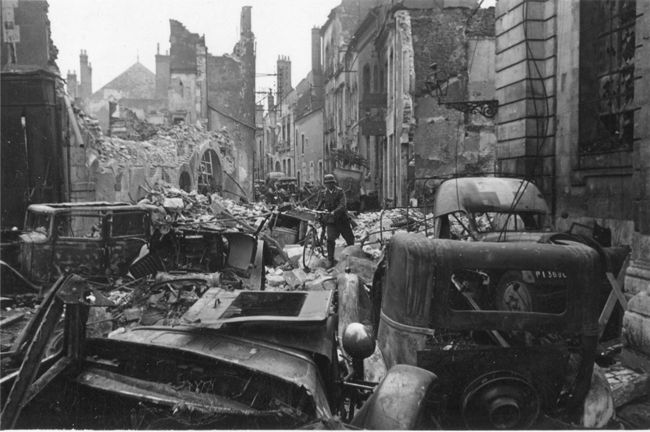
Exactly a month before the offensive, on 16 November 1944, RAF bombers attacked the German city of Duren, killing 3,000 and wrecking the town. Amongst those detailed to clear up was the 1st SS Panzer Regiment. On seeing the carnage wrought by Allied bombs, they vowed revenge. (Author’s collection)
Although Mohnke consistently denied he had issued orders to mistreat or murder captives, a similar pattern of deaths followed his military career wherever he served. In an organisation of thugs and murderers, with such ‘form’ Mohnke seems to have been near top in terms of nastiness. ‘After several years [of war] they were so desensitised,’ reflected Gerhard Stiller, a panzer commander with Mohnke’s division, ‘they didn’t even notice it any more. They’d bump someone off just like that. They had to develop humanity again, and that takes time.’32 Perhaps Mohnke and his crew echoed the conversation that an army officer, Leutnant Freiherr Peter von der Osten-Sacken remembered with some SS officers, ‘who more or less told me, yes, things are pretty bad, but we have to win. We have so many bad things on our conscience that we have no choice but to hold out.’ Eduard Jahnke of the 2nd SS Das Reich Division admitted the same in a different way: ‘We were sure, we Waffen-SS men, they’d take no prisoners, just put us up against the wall. So it was “fight to the last bullet’’.’33
The second armoured formation under Priess was Brigadeführer Hugo Kraas’s 12th SS-Panzer-Division HitlerJugend, which grew out of a cadre of the 1st SS Division in late 1943. Like his compatriot Mohnke, Kraas was born in 1911, joined the Nazi Party in 1934 and the SS the following year. He followed a similar career path in the Leibstandarte, fighting through Poland, France, the Balkans and Russia, but was wounded in January 1944 and missed the gruelling Normandy campaign which killed so many of his colleagues – the 12th left Normandy with 300 men, ten tanks and no artillery.34 It had commenced that campaign with a strength of over 20,000 men, many of them extremely experienced NCOs and veterans of Russia, and 150 tanks. Having recovered and passed a division commander’s course, Kraas stepped up to lead the 12th SS on 15 November when its former commander, Fritz Krämer, resigned to head Dietrich’s staff.
Assessed at 90 per cent strength in manpower and 80 per cent in equipment, on 10 December its Panzer Regiment included 38 Panthers and 37 Panzer IVs, the anti-tank battalion possessed 22 Panzerjäger IVs, while another 28 Panzerjäger IVs and 14 Jagdpanthers (‘hunting panthers’) served in attached formations, a total of 139 tracked, armoured vehicles.35 The forty-five-tonne Jagdpanther tank destroyer combined the 88mm gun carried in the Tiger I and King Tiger, with the excellent suspension and sloping armour of the Panther. Army Hauptmann Erwin Kressmann of the 519th Schwer Panzerjäger-Abteilung (Heavy Anti-tank Battalion) took his Jagdpanthers to the Ardennes, remembering, ‘With the enormous penetrating power of the eighty-eight we were able to effectively fight American tanks … We were able to let the enemy come fairly close, first of all because of our own armour and because of the strength and impact of the eighty-eight gun.’36
Among the Panzergrenadiers serving in the 12th SS was Werner Kinnett, of Duisburg, who had turned seventeen in 1944. In April that year, two officers from the 12th HitlerJugend Division had arrived at his school and shown a propaganda film depicting various Waffen-SS heroes on the Eastern Front; they followed it with a recruitment talk, ending with ‘Raise your hand if you want to join’. They all did, some out of enthusiasm, others probably because of peer pressure. A couple had wanted to join a Wehrmacht unit; the recruiting officer cleverly warned them they must wait a further year, but the Waffen-SS would take them immediately. Werner asked if he should get his father’s permission, but the officer again had a ready answer: ‘If it’s alright by the Führer, then it will be alright by your father’. He joined the division in April 1944, and eight weeks later found himself on the Invasion Front at Caen, where he was soon wounded. He remembered that at the front other SS units got beer in rest areas, but the boys of his unit were given only milk. In hospital he was poached by an officer from the Das Reich Division and joined its Aufklärungs Abteilung (Reconnaissance Battalion), training in the Eifel in readiness for the Ardennes.37
The nineteen-year-old Unterscharführer Hans Baumann, who would command a Hitlerjugend assault gun in the Ardennes, had already experienced combat with the Allies in Normandy. He observed: ‘We had already found out about the American army during the invasion. We were impressed by the high numbers of people and amount of matériel. We couldn’t keep up with that. You could be as brave as you wanted, but no soldier can endure that. We were simply overwhelmed by the vast amount of matériel. Even at that point our fight was basically already useless.’ 38Nineteen-year-old Bernard Heisig also fought in its ranks, recalling, ‘We didn’t like the name Hitlerjugend at all, as it made us sound like boys. We wanted to be real soldiers. The youngest ones weren’t given cigarettes. They didn’t smoke. They were actually given sweets instead.’39
Dietrich possessed an even more powerful armoured formation, equipped with around 280 panzers, commanded by the victor of Arnhem, fifty-year-old Willi Bittrich. The history of the latter’s II SS Panzer Corps was a short and violent one. It included the 2nd SS Division Das Reich, led by Brigadeführer Heinz Lammerding, aged thirty-nine, who took command of his division on 23 October. It, too, was rebuilding after Normandy, where it was recorded as losing all but 450 men, fifteen tanks and six guns.40 Assessed at 80 per cent strength on 10 December, Das Reich fielded 58 Panthers, 28 Panzer IVs and 28 StuGs, with 20 Jagdpanzer IVs in the anti-tank battalion, totalling 130 armoured vehicles. Commanding a company of Das Reich’s Panthers was Obersturmführer Fritz Langanke, who at twenty-five had already been awarded a Knight’s Cross for his leadership in Normandy. He enthused about his mounts: ‘The Panther was the most functional and best tank in the world until the very end of the war. This was based on three components: velocity, cross-country mobility and tank protection. The Panther definitely achieved the best results in all three. The Sherman was an easy opponent for us. They could fire at us, but couldn’t penetrate our tanks. They had to come close within a few hundred metres to stand a chance.’41
Bittrich’s second formation was the 9th SS Hohenstaufen Division, under the capable Brigadeführer Sylvester Stadler. The title came from a noble dynastic family who produced a number of kings and emperors in the twelfth and thirteenth centuries. The thirty-four-year-old Stadler, an Austrian, was another pre-war SS recruit who had fought in most campaigns prior to the Ardennes. In December 1944, the Hohenstaufen possessed 151 tanks and assault guns, distributed throughout the division: an impressive turnaround for a division reduced to 460 men, twenty-five tanks and twenty artillery pieces after Normandy, although it had fought more recently at Arnhem.42 Both the 2nd and 9th Divisions had followed the bloody trail of combat in Russia and Normandy and their few surviving officers and NCOs were very experienced indeed. With these two divisions, Bittrich’s strong corps was considered the most militarily professional in the Waffen-SS.
Full of young fanatics as all these Waffen-SS divisions were, in December 1944 it would not be correct to call all Dietrich’s men ‘true believers’. Until 1941 the SS was an entirely voluntary organisation, but after the invasion of Russia the original SS formations began receiving small numbers of Volksdeutsche replacements as the supply of German volunteers became exhausted. Serving under Jochen Peiper in the 1st SS Division, for example, was twenty-two-year-old Georg Fleps, tall, blond-haired and known as ‘a bit of a hot-head’; he was in fact a Romanian volunteer, and we shall meet him later.
Although Himmler’s divisions still had the pick of Germany’s manpower, at the same time they began to rely on draftees, in competition with the army. Two of the last prisoners brought into American lines before 16 December were from the 12th SS Division. One had stepped on a mine and caused quite a stir among the US medics treating him, as their first SS casualty. The second, unwounded, prisoner was Polish, recently drafted into the SS from a part of western Poland absorbed into the Third Reich. He and his mate were far from home, had no wish to fight the Americans and wished to desert, hence his friend colliding with a shu-mine in no man’s land at night. Both Hitlerjugend Division conscripts recounted a story to the medical staff, delivered via an interpreter, of how their division were assembling opposite for an attack, using searchlights to illuminate their advance, which – sadly – was not relayed to VIII Corps headquarters as the divisional intelligence officer concerned wished to talk personally with the prisoners.43
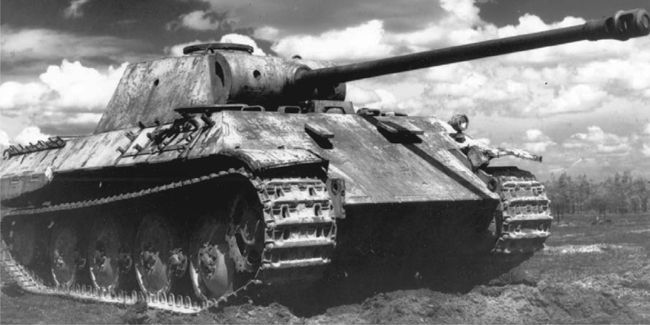
The Panzer Mark V ‘Panther’ was probably the best tank to emerge from the Second World War. It weighed in at 45 tons and although 15 tons heavier than its rival the Sherman, Panthers had excellent cross-country mobility due to their wide tracks. Its sloping frontal armour proved invulnerable to most Allied tanks, while its 75mm gun could kill its opponents at 2,000 yards. For Herbstnebel, each German armoured division fielded an under-strength battalion of Panthers (between 35–45 tanks), half the number the same divisions deployed in Normandy. In all, about 400 were committed to battle in the Ardennes. (NARA)
By 1944, it had become commonplace for Luftwaffe and naval personnel to be reassigned to the Waffen-SS, without any say in the matter. Although he did not fight in the Ardennes, the German writer and future Nobel Prize-winner Günter Grass was typical of this latter group, applying to join the submarine force on his seventeenth birthday in 1944, but on rejection was drafted into the 10th SS Panzer Division instead. Among numerous others in Kampfgruppe Peiper, for example, Rottenführer Heinz Schwarz, commander of a half-track in the 2nd SS-PanzergrenadierRegiment, was one of many in the formation to have been forcibly transferred from the Luftwaffe that summer.44
In the Ardennes, out of 150 personnel in one sample company of the Leibstandarte (10th Company of 2nd SS-Panzergrenadier Regiment), 10 per cent were Normandy veterans, 15 per cent came from the Luftwaffe (aged between eighteen and thirty), and 60 per cent were seventeen-year-old youths, all born in 1927, drawn straight from the Reichsarbeitsdienst (RAD), who had received at most three weeks of training. The remainder were new recruits from a variety of backgrounds with different levels of training.45Himmler’s desperate drive for recruits in 1944 – whether into the Volksgrenadiers or the Waffen-SS – had completely broken the system for recruitment and training in the Reich. In overall terms, of all the military recruits born in 1928, some 95,000 (17.3 per cent) were drafted into the SS. Few of these had received any meaningful military training, yet they made up the bulk of manpower within the SS divisions in the Ardennes. A GI on the receiving end may have viewed these statistics in a different light – each one would have seemed a potential killer – but youth and enthusiasm alone do not make a soldier.
This analysis is very much at odds with that of Hugh Cole, who in the US Army Official History of 1965, wrote, ‘The 1st SS Panzer Division … was the strongest fighting unit in the Sixth Panzer Army. Undiluted by any large influx of untrained Luftwaffe or Navy replacements, possessed of most of its T/O&E [Table of Organisation and Equipment], it had an available armored strength on 16 December of about a hundred tanks, equally divided between the Mark IV and the Panther, plus forty-two Tiger tanks belonging to the 501st SS Panzer Detachment.’46 Cole was writing from the best available data twenty years after the Bulge, but far more detailed information has surfaced since then.
Given that the Volksgrenadier infantry divisions were composed of many similar individuals, what set the SS divisions apart? It was the effort made to teach these new recruits, whether volunteers or conscripts, ex-Luftwaffe or Kriegsmarine, that they were an elite. Training times were ludicrously short, and the men themselves were not always as enthusiastic as the earlier, more impressionable youngsters, but veteran soldiers and NCOs were sprinkled at every level in all units, specifically to engender the SS ethos. The cavalry officer Philipp von Boeselanger realised, ‘They almost took it for granted that they would die; but they were also brutal in their killing’, while Rottenführer Jürgen Girgensohn later mused, ‘In retrospect I believe there was a strong esprit de corpsbased on a common attitude. We were convinced it was a just struggle and that we were a master race. We were the best of the master race – that does unite people.’47
However, this much is also clear: all the four SS panzer divisions were a shadow of their former selves in terms of personnel and equipment, when compared to the same formations that had fought in Normandy just six months earlier. Himmler had restored their numbers, but the replacements were immature, lacked experience and in some cases had received no meaningful combat training whatsoever. Whatever they were, they certainly weren’t superhuman. Some of the Waffen-SS troopers who fought in the Bulge were undoubtedly brainwashed thugs and fanatics, but many were ordinary conscripts, new to war and caught in a brutal system.
In the midst of this system was Hans Hennecke, by his own admission an enthusiastic ‘believer’, but someone who, I sensed, would have made an efficient leader of men in any army. His combat experience had made him a professional soldier. However, it was not until after his death that I discovered he had been sentenced to be executed in July 1946 for war crimes committed against American soldiers in the Ardennes, something he had never admitted to me in his lifetime.