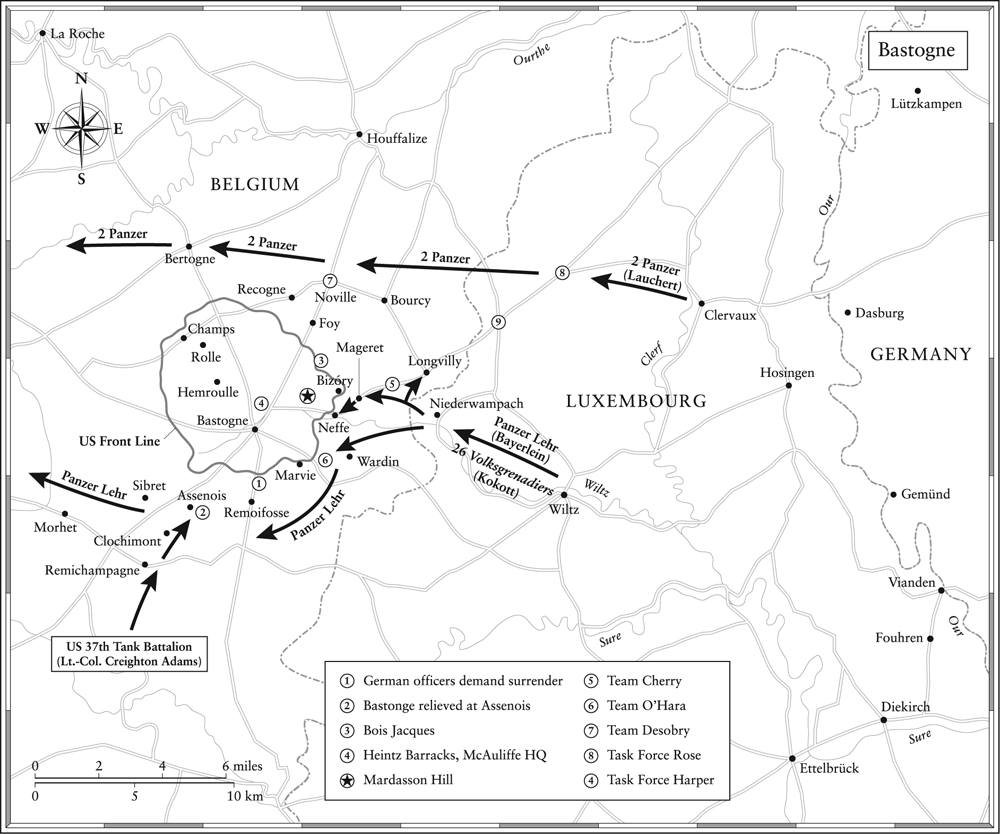
26
BASTOGNE. THE SMALL Walloon town of 14,000 lies in the Belgian province of Luxembourg, on a gentle ridge, 1,600 feet above sea level. The height brought it dominance over the surrounding terrain, and it was where several ancient, well-drained roads met. Ask a local the name of their town and you might get one of three answers, reflecting each of Belgium’s official languages: in Flemish it is Bastenaken; Germans call it Bastenach; the French speakers, who make up 40 per cent of Belgium’s population, have long known it as Bastogne (the end rhyming with ‘coin’). During and since the 1944 battles, many adopted the American pronunciation, where the end rhymes with ‘cone’. This ambiguity reflects Belgium itself, for both town and country were places that people passed through rather than stayed in. The first visitors were early nomadic Europeans searching for game or grazing. Later came armies heading east or west, spearheaded by the Romans; by then the region was inhabited by the Treveri, a tribe of Gauls.
The name described how the town appeared to the medieval traveller, emerging from the fog and forests of the Ardennes: a bastion. In 1332, John of Bohemia, Count of Luxembourg and son of the Holy Roman Emperor, had the settlement encircled by defensive walls. Its ramparts boasted fifteen turrets, of which only one remains today, named after the old Gallic tribe: the Porte de Trèves. Very little else survives from this era except the solid mass of the church of Saint-Pierre, which would play an important role as an aid station in the coming battle. John of Bohemia, alas, lost his sight – and ten years later, aged fifty – his life, groping his way into battle against the English on the battlefield of Crécy in August 1346. An ally of King Philip VI of France in the Hundred Years War, his courtiers tied their horses to his, and led their monarch into battle. All were found later, slain around their disembowelled leader ‘like the petals of a tulip, pluck’d’: a gruesomely appropriate image to retain 600 years later, when other warriors stumbled through the murk of the Ardennes – similarly alerted more by sound than by sight.
Belgian independence brought the installation of Leopold I as the nation’s first monarch on 21 July 1831 – Belgium’s national day. One of the first handbooks of the new European state, The Traveller’s Guide Through Belgium, published in Brussels in 1833, described Bastogne as a ‘rich, handsome town – the Paris of the Ardennes – the town is celebrated for the excellence of its hams, and for its extensive corn-market’, containing ‘nearly 2,000 inhabitants who are principally engaged in woollen manufacture and leather-dressing’.1 It was scarcely much larger when occupied, then pillaged by Imperial Germany during the First World War. Its experience from 1940 had been harsh, but it had not suffered the fate of nearby St Vith and Malmedy, both of which had been annexed into the Third Reich’s Rheinprovinz, and whose male citizens were conscripted into German uniform.
All this was ancient history to the American soldiers who arrived at the noisy and congested Belgian crossroads town near the Luxembourg border in December 1944. Despite the fact that there are certainly more picturesque places in the Ardennes than Bastogne, its importance was that all roads within the region led to and through the town: whoever occupied it controlled the route network of the entire region. The same is still true today – and hence why Bastogne remains easily the busiest of places in the otherwise tranquil and quiet Ardennes. Bars and cafés line the rue du Sablon, Bastogne’s main street that ends in the town square, now called the Place Général McAuliffe and graced with a Sherman tank. You can sip a beer in relative tranquillity, however, for the recently opened A26 highway to the west has siphoned much traffic out of the little town.
The sixteenth of December 1944 was a ‘wet, soggy day’ as PFC Don Addor of the 20th Armored Infantry made his way over to battalion headquarters. ‘It had been raining almost every day since we had landed in France’, Addor remembered thinking as he took over duty on his unit’s telephone switchboard. He was enjoying ‘how warm and comfortable my feet felt in my Christmas socks’, just mailed from home, when he took a call for his CO, Major William R. Desobry. ‘The calling voice with a strong note of authority said, “Major, how soon can you be ready to move out?” The major said, “In an hour or two”. The voice said, “Make that 45 minutes!” The major’s answer was “Yessir!” and the entire battalion began to haul ass in double time.’2
Just as Combat Command ‘A’ of the US 10th Armored Division had peeled off to aid the 4th Infantry Division in their defensive battles, Colonel William L. Roberts’ Combat Command ‘B’ – a long column of Sherman tanks, tank-destroyers and half-tracks, including Desobry’s 20th Armored Infantry – drove straight for Bastogne, arriving in the greying dusk of Monday afternoon, 18 December. These were the first combat soldiers to reach the vulnerable town, then home to Troy Middleton, the VIII Corps headquarters, quartered in the Heintz Barracks, and corps service troops, scattered in the vicinity. Combat Medic Robert Kinser of the 3rd Tank Battalion rolled into town at 9.00 p.m. ‘It was pitch black and we could not even see the next vehicle … We stayed at a big church [Saint Pierre], where we found the MPs living. That night all were sitting by the phone waiting.’3
There had not been time to evacuate the civilian population of Bastogne, and an estimated 3,000 civilians – their numbers swelled by refugees – who could not flee westwards, retreated to their cellars in fear, to sit out the battle. By the end of the fighting, 127 had been killed or wounded. Another forty would die later from unexploded ordnance. Of Bastogne’s 1,250 homes, 700 would be totally destroyed or made uninhabitable. These figures were eclipsed by the eventual death and destruction in the hamlets and villages within a six-mile radius of the town, where 350 civilians died, 3,556 homes, stables and stone barns were gutted and 1,300 seriously damaged. Few livestock, on which the farming communities relied, would make it through.
Nonetheless, most of these people also did whatever they could to help and provide shelter for their American liberators. A few, who felt they had already suffered enough, guarded their remaining possessions from the GIs, but under the guidance of the acting mayor, Léon Jacqmin, many inhabitants started offering up spare blankets to the Americans for warmth and bed linen for snow camouflage. Jacqmin was also responsible for centralising all the food stocks within the town – during the coming siege, the townsfolk would offer up countless pigs, cattle (and eventually horses) for slaughter, milk and sugar, and seven tons of flour and two tons of biscuits to ensure both defender and citizen had enough to eat.4 This was all gratefully received, because the defenders soon ran short of rations.
With all his fighting units further east already battling for their lives, Middleton directed Roberts, a veteran of the First World War, to deploy his command in three roadblocks, named after their leaders, five miles from the town in a crescent-shaped arc facing eastwards. Middleton was then ordered by US First Army to shift his own headquarters south-west to Neufchâteau, remaining only to see that McAuliffe and Roberts understood their mission: defend Bastogne to the last round. From his HQ in the Hôtel LeBrun (today the White House Restaurant and Hotel), Roberts ordered Desobry north to block the N15 at Noville. He then put an avuncular arm around the shoulders of the twenty-six-year-old major: ‘By tomorrow morning you’ll probably be nervous. Then you’ll probably want to pull out. When you begin thinking like that, remember I told you not to pull out.’5 Desobry took with him fifteen Shermans, five light Stuart tanks, a company of armoured infantry in half-tracks, five M-10 tank destroyers, three armoured cars and six jeeps. Colonel Eugene A. Watts later argued these roadblocks were ‘doomed to failure because we were ordered to use only one company of armoured infantry and one of tanks at each site’.6
Desobry recalled later being led to the edge of Bastogne by an MP. ‘Noville is two towns up, straight down that road … So we went through Foy, which was the first, then we came to Noville. No Germans there. The town was deserted. It was a bit after midnight [the first minutes of 19 December] and we deployed around the town and set up outposts. Then we proceeded to try to get some sleep.’7 PFC Don Addor didn’t even know the town’s name. ‘Our detachment of men and vehicles had to creep through the night. The damn fog was so thick we couldn’t go but a few miles per hour and ran off the road a couple of times. All of a sudden we stopped. A voice from up ahead declared we were here. I looked around and wondered where here was. As I got more used to the fog I could see stone buildings along each side of the road. It was a small crossroads town. The word was that we were to hold it and the intersection at any or all costs.’8
Some of Addor’s buddies started to make foxholes, forming an outer cordon forward of the town. They heard other troops entrenching around them. When it got lighter they decided to make contact with the other diggers. Addor’s friend stood up and looked out of his hole ‘and was staring a damn Kraut in the face’. Both sides ‘beat the Hell out of there. They ran back their way’ and his friends ran into Noville.9 All through the night, US stragglers drifted through; some Desobry drafted into his group, others ‘were in such a state of shock that they were of no value to the defense and allowed to continue into Bastogne’.10 Mercifully the fog shrouded such sights, which would have damaged Team Desobry’s morale far more than they did.
At about 04.30 a.m. the flow of stragglers ceased. A period of unnatural silence followed, and Desobry’s men tensed, waiting. It was better that Desobry and Addor remained in ignorance of their future opponents: they included Oberst Meinrad von Lauchert’s entire 2nd Panzer Division, who had already ejected Colonel Hurley Fuller’s 110th Regiment from Clervaux.
Under Colonel Roberts’ orders, a second task force, commanded by Lieutenant-Colonel Henry T. Cherry, had wheeled east out of Bastogne, following the N12 to Neffe, Mageret and Longvilly; a third group, led by Lieutenant-Colonel James O’Hara, took the N34 south-east to Marvie and Wardin, to block the highway from Wiltz. By this time, two earlier roadblocks from CCR of the 9th Armored Division, ten miles out along the eastern route leading to St Vith and about halfway between Clervaux and Bastogne (Task Forces Rose and Harper), had both had been overcome, and their survivors were falling back down the N12 to Longvilly. Amongst those killed was Harper himself, a West Point-educated tanker and classmate of Hank Cherry’s. By this point, Desobry, Cherry and O’Hara were the only real defence Bastogne would have until the arrival of 101st Airborne, under the temporary leadership of its artillery commander, Brigadier-General Anthony McAuliffe.
Middleton knew that time was against him. On his right flank, the US Fourth Ivy Infantry Division with the help of 10th Armored’s CCA had successfully blocked the advance of Brandenberger’s Seventh Army Volksgrenadiers. Colonel Rudder’s 109th Regiment had folded south, like the hinge of a gate, and was contesting every mile. However, VIII Corps’ left flank was dissolving before Middleton’s very eyes, as Alan W. Jones’s 106th Golden Lions Division was being overwhelmed on the Schnee Eifel, in front of St Vith. Colonel Gustin Nelson’s 112th Regiment had hinged back north to join CCB of the 7th Armored Division with Bruce C. Clarke, and the sole surviving regiment of the Golden Lions, the 424th, in defending the town itself. Their efforts at St Vith would buy valuable time.
To Middleton’s front, the situation was even more dire. During 17 December, Colonel Hurley Fuller’s 110th Regiment had been virtually destroyed by Manteuffel’s panzers along the west bank of the Our river in their defence of Marnach, Hosingen, Consthum and Holzthum. At Marnach, eight US tanks were destroyed in minutes. A mid-morning conversation on the 17th between Fuller and his commander, General ‘Dutch’ Cota, underlined the gravity of the situation. After responding to his subordinate’s plea for more artillery, Cota reminded the pipe-smoking colonel, ‘Remember your orders are to hold at all costs. No retreat, nobody comes back.’ Silence settled on the conversation. ‘Do you understand, Fuller?’ Cota reiterated. ‘Yes, sir’, replied Fuller, ‘nobody comes back.’11
Late on the 17th, at 6.25 p.m., Fuller phoned Cota to warn him that panzers were directly outside his own HQ, the Hôtel Claravallis in Clervaux. With that, he and his remaining staff escaped up the rock face to the rear from an upstairs room. At 6.39 p.m. a final message was received by Cota from 110th Regiment’s switchboard sergeant. He was alone and was about to sabotage his equipment. Fuller and his staff were soon captured while trying to make their way out of town. In Clervaux Castle, Fuller’s Headquarters Company of 102 officers and men fought on until early on 18 December, by which time five Shermans had engaged the panzers, destroying four Mark IVs for the loss of three of their own. (The Hôtel Claravallis is back in business, and a lifelike bronze figure of a GI, a restored Sherman tank and 88mm gun, plus a museum within the renovated castle, serve to remind the visitor to Clervaux of those dramatic moments of 17–18 December 1944.)
American aggressiveness on the 16th had been robust enough, but once the Germans had completed their bridges at Dasburg and Gemünd, nothing could stop the panzers from overwhelming or bypassing Fuller’s village strongpoints. From his CP in the Hôtel Schmitz at Hosingen, Captain Frederick Feiker, commanding Company ‘K’ of the 110th, had soon realised from a captured map that the German aim was to reach Bastogne, which gave a sense of purpose to his all-round defence of the little town. With a garrison of about 270 GIs, including engineers, anti-tank-gunners and some tank crew, he set about holding up the Germans for as long as possible. They were soon surrounded by scores of enemy dead; however, the situation changed as soon as the panzers were able to join the Volksgrenadiers in attacking the town. On the 17th, they lost much of their friendly artillery support, as the American guns were forced back out of range. Gradually their ammunition and food was whittled away until, in the early hours of the 18th, a quick check revealed only two rounds of smoke for their 81mm mortars, their supporting Sherman tanks had been knocked out and most of his men were, if not wounded, down to their last cartridges, as a result of heavy hand-to-hand fighting over the preceding two days.
With a heavy heart, and no prospect of relief, Feiker decided to surrender what was left. All spare K-rations were issued, records burned and supplies destroyed. At 09.00 a.m., with white flags hanging from the few remaining buildings, Feiker with his brother officer, Captain William H. Jarrett, walked across the rubble-strewn town to discuss surrender arrangements with an officer from the 26th Volksgrenadiers. As they played for time, the last military equipment was smashed. The last radio message, at about 10.00 a.m., read: ‘We’re down to our last grenades. We’ve blown up everything there is to blown up except the radio and it goes next.’ Then after a sob, the radio operator signed off: ‘I don’t mind dying and I don’t mind taking a beating, but I’ll be damned if we give up to these bastards.’12
Unteroffizier Ludwig Lindemann of the 26th Volksgrenadiers recalled that they had to ‘fight for every cellar and every garden wall’ in Hosingen, but destroyed seven tanks and captured 381 US officers and men.13 As well as Hosingen, Consthum and Holzthum also fell on the 18th, but they had already served their purpose: Manteuffel’s Fifth Panzer Army was way behind schedule.
By then Middleton knew that the remnants of Fuller’s 110th Regiment – who had lost approximately 2,750 out of 3,200 – CCR of the US Ninth Armored Division and Cota’s headquarters troops in Wiltz had nothing like enough combat power to prevent Manteuffel’s Fifth Panzer Army from knifing its way through the terrain and reaching his headquarters within a few hours. Bastogne was doomed.
Or was it? As a result of Eisenhower’s 16 December orders, from 5.00 p.m. on Monday, 18 December, all 11,000 men of the 101st Airborne Division, plus their heavy weapons, vehicles and equipment, were raced through the night in vast convoys of trucks, skating across the snow and ice, headlights blazing despite the black-out conditions of wartime, to reach Bastogne before the panzers. Some, like Ralph K. Manley of the 501st Parachute Infantry Regiment, had been on a twenty-four-hour pass in Paris, where he came across a loudspeaker van blasting out its urgent message on a repeated loop, ‘All soldiers report to your units immediately! As quickly as possible! Any way possible!’14 William R. Barrett of the 420th Armored Field Artillery remembered noticing one paratrooper who had come straight from leave still ‘wearing his dress uniform and carrying a .45 pistol as he jumped from his truck into the snow’.15
Manley’s mode of transportation to the front was a Port Battalion semi-trailer, used to haul bulk goods off merchant ships and into warehouses. He had no idea what was going on, but realised the seriousness of whatever it was when he saw a vehicle coming the other way laden with GI corpses and ‘as it rounded a corner some of the bodies fell off the truck’.16 Bill Druback was woken up and just told ‘to take whatever equipment you could get your hands on, and you grabbed what was available and that’s the way we went on these semis. Biggest truck I’d ever seen.’17Donald R. Burgett of the 506th Parachute Infantry Regiment (PIR), then nineteen, noted some of the trucks taking him to Bastogne ‘had been intercepted on roads throughout the region – no matter who they belonged to or what their priority – unloaded on the spot, and redirected to collect the paratroopers’.18 Manley and his colleagues began to arrive in and around Bastogne, frozen to the marrow, most having stood like cattle for up to fourteen hours in an open-topped semi-trailer, protected from the elements only by its four-foot wooden sidewalls.
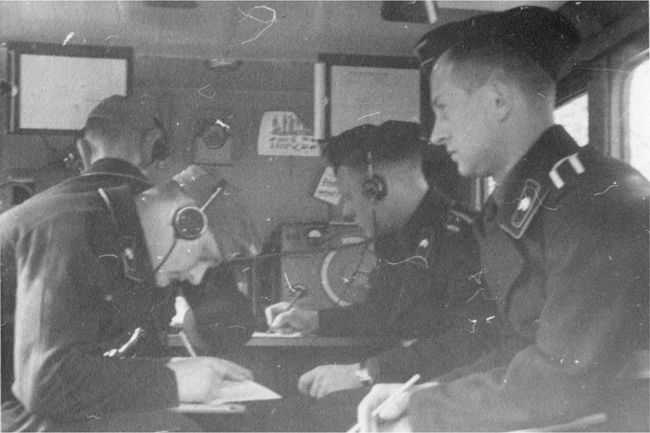
German signals intelligence (SIGINT) was excellent throughout the campaign. Patient interception alerted them to the move of the US 82nd and 101st Airborne Divisions from the Reims area towards the Bulge, while they also monitored Patton’s military policemen, who sent the numbers and identities of US vehicle columns to their own headquarters. (Author’s collection)
All the Screaming Eagles remember the same flow of panic-stricken GIs stumbling back that Team Desobry had also witnessed. Don Burgett observed, ‘they shambled along in shock and fear, blocking the road completely, eyes staring straight ahead, mumbling to themselves … I had never before – or since – seen such terror in men. Their fear was so great, so consuming.’19 Major Dick Winters of Company ‘E’ of the 506th PIR thought ‘they were just babbling. It was pathetic. We felt ashamed.’20 Burgett recalled the retreating hoards refused to hand over their weapons or ammunition but Dick Winters’ Company ‘E’ persuaded others to part with bandoliers, clips and grenades, noting that in surrendering their arms and ammunition, the fleeing troops may have – in their own minds – ‘relieved themselves of any further obligation to stand and fight’.21
Panic was expressed in another way. Burgett’s truck convoy was blocked by ‘some dumb son-of-a-bitch captain commanding a maintenance company that was retreating with heavy vehicles and refused to move’. It took the 101st’s Assistant Divisional Commander, Brigadier-General Gerald J. Higgins, alternatively ordering and cajoling every driver in person, to clear the road, but not before Higgins had drawn his pistol in exasperation and several of Burgett’s buddies had silently unsheathed their trench knives with another solution in mind.22
Eighteen of the US Army’s European tented redeployment camps (dubbed ‘repo-depos’), from where reinforcements (known as ‘repple-depples’) were sent to the front-line divisions, were based around Reims. The city hosted the US Assembly Area Command, whose communications the Germans routinely intercepted. After the war, Manteuffel would comment, ‘our signals reconnaissance functioned efficiently and speedily’; wireless traffic from Reims revealed to General von Lüttwitz, commander of XLVII Panzer Corps, that the airborne troops were on their way.23 He was ebullient, knowing who would be first in Bastogne. Earlier that day, the 26th Volksgrenadiers had secured bridgeheads over the Clerf river, easing the way for his twin tank divisions. Advancing on two roughly parallel axes, 2nd Panzer Division to the north with Panzer Lehr to the south, there seemed nothing to stop these two powerful formations from rapidly enveloping Bastogne. Lüttwitz also knew his panzers could make mincemeat of lightly armed paratroopers. He assessed the Screaming Eagles were 120 miles distant, and that with the darkness, wintry conditions and logistical nightmare of moving vast numbers of troops quickly, his panzers, about twenty miles away, would be sure to reach Bastogne first, with horrific consequences for its defenders.
Along the way, Panzer Lehr’s armoured reconnaissance battalion raced ahead to Wiltz, to where the remnants of Fuller’s 110th Regiments had retreated. A reluctant Cota was ordered by Middleton to move his 28th Division’s headquarters back to the Bastogne suburb of Sibret and leave the defence of Wiltz to Major Stickler, executive officer of Colonel Fuller’s 110th. Robert W. Eichner worked in the T & T [Telephone and Telegraph] Section of the 28th’s signal company in Wiltz, operating the division’s telephone and telegraph service. He remembered how ‘the headquarters was in danger of being captured, so we knew we would be infantrymen again, as we had been trained in the beginning. Our lieutenant picked me to detail five men to stay behind and man the switchboard. Others were told to do likewise in all sections of the headquarters, typewriter boys, police, medics, and engineers.’ Everyone else, recalled Eichner, ‘piled into the trucks, standing up only. I had only one leg in the truck body. The convoy started out into the dead of the night. How much noise that convoy made!’ However, Eichner’s group was ambushed. ‘Silhouetted was a German tank in the middle of the road. It lowered its gun and let go. The jeep up front was a direct hit. Then machine-guns opened up. I didn’t wait for any invitation to leave and headed for the forest.’24
Unteroffizier Eduard Job recollected the battle for Wiltz when acting as gunner in a Panzer Lehr Jagdpanzer tank destroyer. ‘The commander [the old Afrika Korps and Normandy veteran Generalleutnant Fritz Bayerlein] moved at the head of the battlegroup in his command half-track … The driver picked up the pace since we were being engaged. Small-calibre rounds were smacking into the side-skirts. The fighting compartment was ringing like a bell. We then reached a defile, which offered us some cover and concealment. Our four fighting vehicles rolled through it. At the end of the defile, which led to a patch of woods, we turned back in the direction of Wiltz. “Guns 1 and 3: ten o’clock … Guns 2 and 4: two o’clock!” The tank destroyers pivoted in the designated directions. Our vehicle gave a jolt when it moved through a ditch.’25
Every small settlement that Bayerlein and the other panzer commanders encountered harboured a potential series of hazards, whether narrow stone buildings, ideal for defence, trees, engineer-made obstacles or infantry and anti-tank weapons. Through the surrounding woods, groups of GIs trudged, among them Signaller Robert Eichner. As he left his ambushed convoy outside Wiltz, he noted, ‘the Germans sent a flare up. It lit the place like daylight. We were told during training if this ever occurred, to stand still. Movement is what they would see. When it burnt out I headed for the deepest part of the forest.’26 The threat from armed, organised gangs, like Eichner’s, also delayed Bayerlein’s march considerably, the more so in the bad weather and poor light; factors which had not been taken into account in the Wolf’s Lair or Berlin.
Job in his Jagdpanzer remembered seeing ‘the trail of flames revealing the location of a bazooka that had just fired … When I fired back, the round tore a big chunk out of the masonry building showering the area where the bazooka had been with rubble and concrete dust. There was no more firing from that location … Off to the right, where the fourth Jagdpanzer was located, we heard a couple of muffled blows … We saw a squad of American infantry had knocked out our sister vehicle. We opened up with our machine gun, sending the infantry scurrying and giving the crew some breathing room to dismount before their vehicle went up in flames.’27 Job’s account underlined how armour and infantry best worked hand-in-hand to subdue their opponents in any urban setting – it was this sort of relentless grind from village to village that tired and held back Panzer Lehr.
Among the defenders was Sergeant Max L. Noe. The Texan worked in the Postal Section under command of a captain who was director of the 28th’s divisional band. His squad dug in on a hillside outside Wiltz, armed with a machine gun that had no tripod, so they used an apple box for a gun rest instead. Sergeant Noe took charge, being the only one qualified on the weapon; as he recalled, ‘the machine gun bounced all over the place and if I hit a tank it was like throwing rocks on a tin barn’. However, his squad held the Germans for about eighteen hours before Noe and two others escaped into the woods, the rest of his men being killed, wounded or captured.28
Wiltz fell finally to attacks by the 26th Volksgrenadiers and the 5th Fallschirmjäger Division; the latter should not have been there at all. Manteuffel and Lüttwitz recorded their displeasure at the appearance of the paratroopers who seem to have been attracted by loot and the warmth of a large town, a relief from the penetrating cold. The German airborne formation was the northern division of Brandenberger’s Seventh Army, and though ordered to cooperate with Manteuffel’s panzers as a flank guard, had strayed across the inter-army boundary, against orders.
A small group of Fallschirmjäger engineers under Oberleutnant Walther Sander were surprised by a US vehicle column of the 110th Infantry moving at speed westwards through the Schumann’s Eck road junction three miles south-west of Wiltz. A quick-thinking paratrooper reduced the leading half-track to a flaming wreck with a Panzerfaust, and several US tanks shared the same fate before the GIs were overwhelmed. As they were led away, Sergeant Gene Fleury of the 687th Field Artillery remembered the ‘brazen paratroopers yelling “No more zig-zig [sex] in Paris”’. Another GI observed, ‘They slapped and banged you around, stripped you down, took your watch, wallet, penknives, even made me take off my shoes.’ Sander’s squad would later bring their several hundred prisoners, a large number of American vehicles and captured artillery back east at the end of the campaign, winning their commander a Knight’s Cross.29
The Lehr, meanwhile, had quit Wiltz, leaving the infantry to mop up, and pressed on towards Bastogne. Unfortunately, some horse-drawn Volksgrenadiers then slowed their advance by getting themselves mixed up with the armoured troops. Nevertheless, by 10.00 p.m. on the 18th, Panzer Lehr’s advance columns, pushing ahead through appalling conditions, had reached the hamlet of Niederwampach, just six miles east of Bastogne.
As they did so, the first scouts from the US 501st Parachute Infantry Regiment of the Screaming Eagles were pulling up in the Main Square at Bastogne: the race was still neck and neck.
Cota, meanwhile, obliged to quit Wiltz, sped down the foggy N34 with his driver and an aide to report to Middleton in Bastogne. Suddenly a challenge rang out. ‘Halt!’, a word that was the same in German and English. The jeep, displaying the two stars of Cota’s rank on a plate attached to its bumper, slowed to a stop. In the dark was a well-concealed patrol who had heard its approach – but from which side?
As Corporal Edward J. Gerrity, Jr, attached to Team O’Hara, later recalled, ‘Every rifle and my .30-inch machine-gun were trained on the vehicle. Its occupants could not see us. Cota asked us who we were. Sgt Tom Holmes the platoon leader asked him who he was. He told us. We were not sure if they were Americans or Germans in American uniforms. Holmes then said he was coming out to the edge of the highway and if they tried anything they would be cut down. You could have heard the proverbial pin drop. Cota started to get out of the Jeep. Holmes told him to stay where he was. A brief, taut dialogue then ensued. Cota mentioned he was in a hurry. I shouted “General, what’s behind you?” He barked, “The whole damn German army”, and with that he was allowed to proceed.’30
Following close behind in another jeep was a former New York City cop – the first to be drafted – Lieutenant John A. Foley Jr. As an MP, Foley had guarded Eddie Slovik for a while during the latter’s court-martial, and subsequently shadowed Cota everywhere as a sort of bodyguard. He remembered of that journey, ‘We had to weave our way through Germans most of the journey before we ended up in Bastogne. By that time, the 28th had been pretty much overrun and was scattered all over the place. Most of the guys left behind in Wiltz were taken prisoner. We travelled south along tracks and small roads and met up at the new CP in Sibret.’31
Nearby, Panzer Lehr’s commander, Bayerlein, was in the leading vehicle, a half-track, of an armoured column, also heading towards Bastogne. This was exactly where his mentor, Erwin Rommel (to whom he was once chief of staff) had taught him to be. Bayerlein had spent a frustrating day trading shots with GIs, skirting Wiltz, and struggling along minor, muddy roads, delayed by the Volksgrenadiers and their horses. Acutely aware of time running out, he had just received orders from his superior, Lüttwitz, to be in Bastogne that night, without fail.
He paused at the tiny gaggle of cottages that comprised Niederwampach and took stock with his operations officer, Oberstleutnant Kurt Kauffmann. They had three choices by which to reach their objective, less than an hour away: the column could lunge north to the N12; second, they could head south to the N34, but both were paved roads, and most likely well-guarded by the Americans; or, thirdly, they could plough straight on westwards along the track marked clearly on his map, which avoided both main roads and led through Mageret and beyond to Bastogne, a mere six miles away. According to a local farmer, the going was good and this had the advantage of being the most direct route, and was least likely to be defended.
Hedging his bets, Bayerlein sent part of his force north to Longvilly with some of the following Volksgrenadiers. Followed by fifteen tanks and Panzergrenadiers in half-tracks, he himself charged down the trail to Mageret. After a short distance the paved surface gave out to a softer surface; later still the route had become a farm track, barely distinguishable from the surrounding mud. To the local farmer in Niederwampach the going may have been good, but the Belgian was thinking in terms of horses and cattle, not a column of heavy armoured vehicles. Bayerlein realised that each set of caterpillar tracks churned the ground some more. Too late to turn back, he pressed blindly on, leaving bogged and stalled vehicles behind. (The trail has not changed and in December 1989, thoughtlessly following Panzer Lehr’s exact tank tracks, I had to pay a puzzled farmer to extract my car from the glutinous mud and use his tractor to tow me along Bayerlein’s route to the safety of a hard-surfaced road.) Back in 1944, the general’s tanks and half-tracks endured a four-hour nightmare before, exhausted, they trickled into the hamlet of Mageret, which they found packed full of trucks, jeeps and ambulances. Bayerlein was right in assuming the route was undefended, for he had stumbled on an American medical unit.
The panzer general summoned another local Belgian for information on US military movements and was told that an American force of ‘at least fifty tanks and just as many other armoured vehicles’ had earlier passed by, along the N12, heading eastwards. This was Combat Team Cherry from CCB of the 10th Armored, heading for Longvilly where they were to establish their roadblock. Bayerlein might have paused to consider the veracity of these details, given it was gone 02.00 a.m. and pitch black – Team Cherry had in fact driven past at 7.20 the previous evening and comprised thirty Shermans and Stuarts of the US 3rd Tank Battalion (which Cherry commanded), Company ‘C’ of the 20th Armored Infantry, and platoons of the 55th Engineers and 90th Cavalry Squadron.32 But he himself was tired and starting to make errors of judgement.
After an inexplicable wait in Mageret, at 05.30 a.m. on the 19th the Germans recommenced their cautious advance westwards along the hard-topped road towards Neffe, the noise of their engines drawing fire from US stragglers, the rearguard of Team Cherry and some of the 101st Airborne, now just deploying. None of this was a threat to his armour, but soon the Lehr’s lead tank ran over a mine and was disabled. As usual, Hauptmann Kunze and the men of the divisional engineer battalion hurried forward to remove the American explosives strewn across the road and either side, before the march resumed. By 07.00 a.m. Bayerlein’s column had reached the rail station at Neffe, just outside Bastogne. However, they were shattered, cold and anxious. They had no idea of the forces arrayed against them, could not see anything through the pre-dawn pea-soup fog and knew there were Americans equipped with tanks to their rear.
Although Bastogne now lay only two miles away – had the fog lifted they would have been able to see it clearly – Panzer Lehr’s attack had stalled and Bayerlein himself seems to have lost the initiative. By midday he had turned his back temporarily on Bastogne and returned to Mageret. Bayerlein himself wrote after the war how he had asked one of the captured nurses in Mageret to look after his wounded, noticing she was ‘young, blonde and beautiful’ and admitting he was ‘spellbound’ by her. Any meaningful movement by Panzer Lehr seems to have halted while the forty-five-year-old unmarried general, by his own admission, wasted valuable time flirting with his young captive. Many historians have repeated this astonishing tale, though few have attempted to validate it. Bayerlein’s biographer, Pat Spayd, has narrowed the candidate down to one of several military nurses in a platoon of the US 42nd Field Hospital, based at the Château de Wiltz, who had withdrawn and were taken prisoner at Mageret.33 One historian thought she should be given a medal for fatally delaying Panzer Lehr’s advance into Bastogne!34
The 107th Field Evacuation Hospital had already been obliged to leave Bastogne in a hurry as the fighting approached. ‘We were awakened in the middle of the night and told we were moving out,’ remembered Combat Nurse Ruth Puryear. ‘We could not take anything with us except what we had on. Hearing tanks in the distance we left everything except our patients, loading them on trucks, twelve to fourteen each. It was a race against the Germans. It was very cold and snowing; we had on long johns, fatigues and combat boots; we worked in them, and slept in them. We wore our boots in bed to keep warm. Little did we know that we would be in them for two weeks.’ Puryear’s unit relocated to an old castle. ‘The ballroom was used for surgery, where we did 380 operations in thirty hours, working round the clock. There was a trophy room with animal heads on the wall. That is where I hung the plasma bottles – on the horns and heads of dead animals.’35