28
MAJOR WILLIAM DESOBRY’S defence of Noville, the small town five miles north-east of Bastogne, over 19–20 December was achieved with the help of four M-18 Hellcat tank destroyers of the 705th Tank Destroyer Battalion. They were credited with an astonishing thirty kills against the 2nd Panzer Division over two days of intense combat.
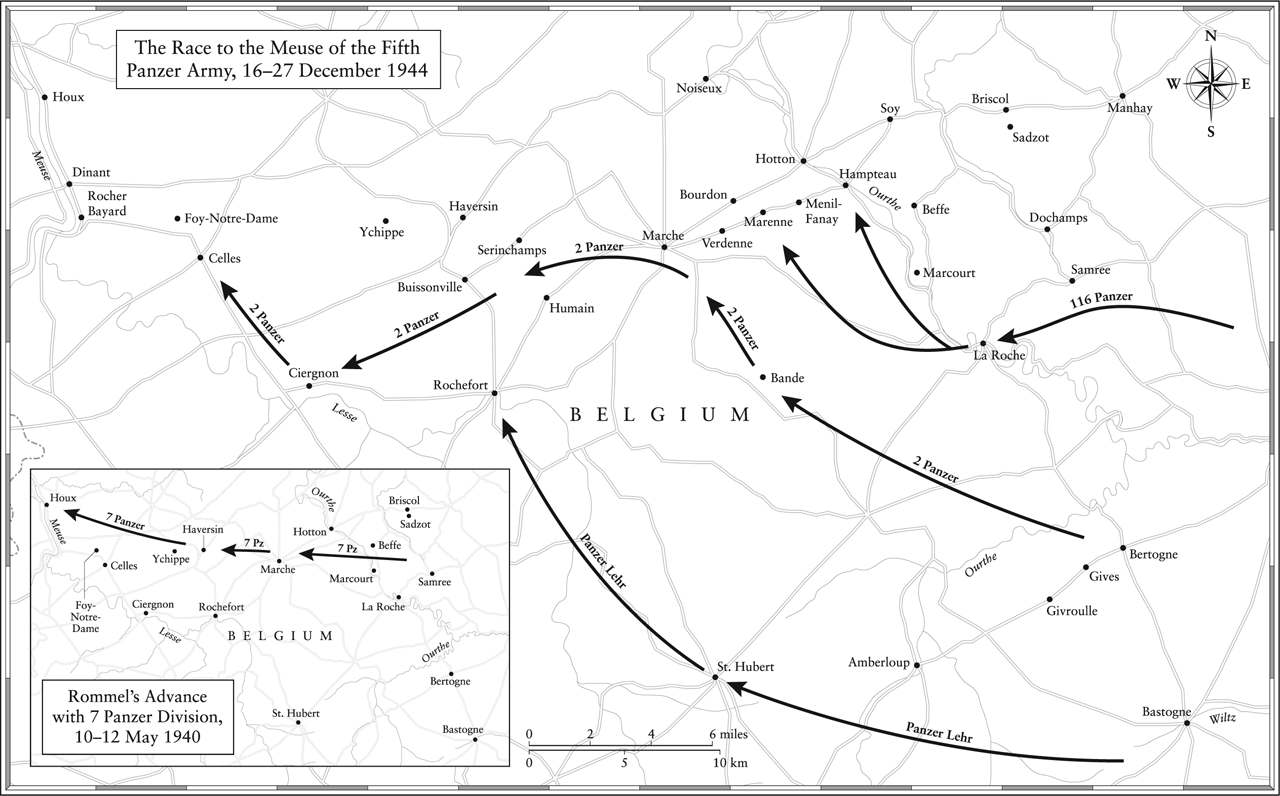
The many dramatic accounts and after-action reports of the 101st and Team Desobry refer to the presence of ‘Tigers’ in Noville, but there were none fielded by 2nd Panzer or any other unit in the vicinity. The sloping front shared by the Tiger II and Panther explained this frequent misidentification. It was partly the Hellcat’s efficacy that induced Oberst Meinrad von Lauchert, the division’s commander, to conclude that the little town was held by a much stronger force that it was. Refused permission to fight his way into the Bastogne ‘doughnut’, and goaded by an impatient Manteuffel, he left off his attacks and headed west to the Meuse. Already, on the 21st, although the visibility was still limited, a few Allied fighter-bombers had made their presence felt along the roads leading back from Bastogne through Longvilly and Clervaux to Dasburg and the Our river. Henceforth the panzers would roll west, but with one eye cast heavenwards.
At dawn on Thursday, 21 December, as Bayerlein’s troops from Panzer Lehr attacked the village of Morhet, those of the 26th Volksgrenadiers fighting alongside, took Sibret, both settlements to the south-west of Bastogne. There, the remains of the 110th Regiment and headquarters of the 28th Division were in place. Defending Sibret as an outpost of Bastogne’s defence were the remnants of 28th Division – 200 GIs equipped with three howitzers and two bazookas. They were soon subdued. Panzer Lehr then recommenced its thrust west towards the Meuse, in tandem with the 2nd Panzer Division. Meanwhile, the Volksgrenadiers continued to probe their way around Bastogne’s western perimeter, completing their encirclement of the town. The GIs within the ‘doughnut’ soon found the most effective remedy to German probes of their defences. A well-placed artillery concentration, fired indirectly from their several artillery battalions, and controlled by observers, rather than the use of direct-fire infantry weapons or tanks, would set the pattern for the next few days.
The cannoneers was soon reinforced by the arrival of a sister unit to the 969th Field (African American) Artillery Battalion. The 333rd were also an African American unit of the then racially segregated US Army, equipped with towed 155mm heavy guns. Despite the segregation of the era, some of its junior officers were black. They had landed at Normandy in July 1944 and seen continuous action since. The battalion had an impressive record, once firing 1,500 rounds in a twenty-four-hour period. They had also received recognition as Yank Magazine had published a laudatory article about them in the autumn of 1944. In the Ardennes, the 333rd had started out as part of Middleton’s VIII Corps artillery based at Schönberg, covering the 106th Golden Lions divisional area. Two batteries had been overrun by the Germans on 17 December and most personnel killed or captured, including the CO, Lieutenant-Colonel Harmon Kelsey – a white officer – and 227 other officers and men. The remnants, about 300, withdrew into the Bastogne perimeter, but eleven black GI artillerymen evaded capture and were given shelter by a Belgian farmer in the hamlet of Wereth, north-east of St Vith.
Four SS men from Kampfgruppe Knittel (of the 1st SS-Leibstandarte Division) on a reconnaissance mission arrived shortly afterwards, discovered their presence and took them away. They were never seen again until the February thaw uncovered eleven frozen corpses nearby. By the time Captain William Everett examined the bodies, they had lain under the snow for nearly two months. ‘On 15 February 1945, I personally examined the bodies of the American Negro soldiers listed below,’ he wrote in a report. ‘The perpetrators were undoubtedly SS enlisted men, but available testimony is insufficient to establish definite unit identification.’ He then went on to detail how each had been killed by blows to the head, stabbed repeatedly with bayonets and shot multiple times. The investigation was closed and forgotten until local civilians who had witnessed the event researched further, identified the soldiers, though not their executioners, and in 1994 Hans Langer, son of the farmer who had sheltered the fugitives fifty years earlier, erected a memorial on the site of the massacre.1
Meanwhile, Field Marshal Model had realised that Bastogne’s continued defiance was slowing the German advance considerably. The town lay on his Main Supply Route (MSR) and manoeuvring round it was time-consuming and fuel-inefficient. What the panzers needed was use of the town centre’s road junctions, which would give them quick access to the rest of the Ardennes. He directed that Bastogne must fall on 22 December, leaving Manteuffel to devise a plan. Fifth Panzer Army headquarters did not consider offering Bastogne the chance to surrender – so far, the Americans appeared to be in bullish mode and not short of defiant aggression, particularly if their performance at Noville was anything to go by. However, the local corps commander, General von Lüttwitz, was impatient and decided to try and bluff the defenders into submission, neglecting to warn Manteuffel or his superiors of his intended actions. He had his staff compose and prepare a surrender ultimatum for delivery on the 22nd. After the war, Manteuffel was emphatic that he ‘did not order either the writing or sending of a note of this kind’.2 Heinz Kokott, commanding the 26th Volksgrenadiers, and Fritz Bayerlein of Panzer Lehr were both convinced the attempt would fail, and that they would have to crush the troublesome garrison.3
Shortly after 11.30 a.m. on Friday, 22 December, Sergeants Oswald Y. Butler and Carl E. Dickinson of the 327th Glider Regiment manning the Bastogne perimeter first noticed the four Germans walking up the road from Remoifosse, south-east of town. They were waving a white flag. PFC Ernest D. Premetz, who could speak German, motioned them forward and was addressed by Leutnant Helmuth Henke in English. ‘We are parlementaires,’ Henke announced. The four Germans – Henke, an officer with Panzer Lehr, Major Wagner, on Lüttwitz’s XLVII Corps staff, and two enlisted men – were taken to a nearby platoon headquarters and, while the grenadiers waited, their officers were blindfolded and taken to the farmhouse which housed the HQ of Company ‘F’, where they presented their surrender ultimatum.
The document was brought to the 101st Division Headquarters at the Heintz Barracks by Major Alvin Jones, the S-3, and Colonel Harper, the 327th’s regimental commander. It was taken first to the division’s acting chief of staff, Lieutenant Colonel Ned Moore. He and Harper then found General McAuliffe and told him he had a surrender ultimatum. McAuliffe first thought that the Germans were trying to surrender to him; he was disabused of the idea and shown the letter, typed in German and English, addressed ‘to the U.S.A. Commander of the encircled town of Bastogne’. The English version read:
The fortune of war is changing. This time the U.S.A. forces in and near Bastogne have been encircled by strong German armored units. More German armored units have crossed the river Our near Ortheuville, have taken Marche and reached St Hubert by passing through Hompré-Sibret-Tillet. Libramont is in German hands.
There is only one possibility to save the encircled U.S.A. troops from total annihilation: that is the honourable surrender of the encircled town. In order to think it over, a term of two hours will be granted beginning with the presentation of this note.
If this proposal should be rejected one German Artillery Corps and six heavy A. A. Battalions are ready to annihilate the U.S.A. troops in and near Bastogne. The order for firing will be given immediately after this two hours’ term.
All the serious civilian losses caused by this artillery fire would not correspond with the well known American humanity.
The German Commander4
McAuliffe’s reaction was to chuckle in disbelief – the Germans, with inferior numbers (from what he could make out) and shivering in the freezing countryside were demanding that he surrender the town. It made no sense: ‘Us surrender? Aw, nuts!’ was his comment to Moore, essentially meaning ‘You’ve got to be kidding me’. He had just given the Germans, as he put it, ‘one Hell of a beating at Noville, and all knew it’. He was annoyed, too, about the emotional blackmail contained in the reference to potential ‘civilian losses’. McAuliffe treated the matter as some sort of sick joke on the Germans’ part, then returned to other, more pressing business regarding the disposition of his troops and organising his defences; the 101st had not long arrived in Bastogne and there was much work to do. The German message was ignored. Sometime later the German delegation, hearing nothing, pressed for an answer. Only then did McAuliffe and Moore realise that some sort of official reply was needed.
The commander pondered a few minutes, stymied. ‘Well I don’t know what to tell them,’ he told his headquarters staff. Lieutenant-Colonel Kinnard, who had grown up in Dallas and earlier coined the ‘doughnut’ metaphor, mused, ‘That first remark of yours would be hard to beat’. McAuliffe responded, ‘What do you mean?’ Kinnard answered. ‘Sir, you said Nuts!’ This drew warm applause all round. McAuliffe grabbed a pencil and wrote down: ‘To the German Commander, ‘Nuts!’ A.C. McAuliffe, Commanding’.
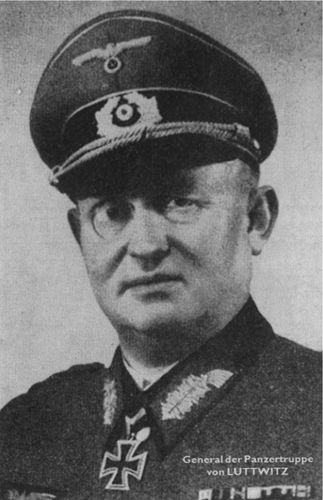
It was on 22 December 1944 that, against the wishes of his superior Manteuffel, the commander of XLVII Panzer Corps, Heinrich von Luttwitz (1896–1969), issued a surrender summons to Tony McAuliffe, defender of Bastogne. With his monocle, Knight’s Cross and distinguished-sounding surname, the German was the very stereotype of a Nazi officer from central casting. The contrast between the lineages of the Barons von Luttwitz and the Irish Catholic McAuliffe was emphasised by the American commander’s reply – ‘Nuts!’ It was backwoods levity to counter Prussian pomposity. (Author’s collection)
Such was the response to a request issued by the scion of an old and distinguished aristocratic family – Heinrich Diepold Georg Freiherr (Baron) von Lüttwitz, bearer of the Knight’s Cross with Oak Leaves, formerly ensign in Uhlan Cavalry Regiment No. 1, and nephew of a First World War senior general. The Lüttwitz family traced their ancestry back to 1430, and among his relatives were the Barons von Richthofen and General Kurt von Hammerstein-Equord, a former Chief of the General Staff. The contrast between the lineages of the monocled Baron von Lüttwitz and the Irish Catholic McAuliffe – from West Virginia, though West Point-educated – couldn’t have been greater. The ‘Nuts!’ reply was a little backwoods levity to counter Prussian pomposity.
Patton would, no doubt, have reached for some profanity, and a number of historians since have questioned whether McAuliffe’s comment was a sanitised version of the past. It seems to rank with Eisenhower’s ‘OK Let’s Go!’ to launch D-Day, as one of the great understatements of history. I met Kinnard, then a retired lieutenant-general, at a Washington, DC, hotel in the late spring of 1984, just prior to the fortieth anniversary of D-Day. When McAuliffe’s wife Helen first heard the story of the American reply to the German demand for surrender, the name of the commander who had sent the defiant message was not yet common knowledge. According to Kinnard, she knew instantly it was her husband, ‘That was Tony all over,’ she said, ‘because “aw, nuts” was his special way of announcing extreme frustration.’ Kinnard told me that after the war, in November and December 1945, the historian S.L.A. Marshall held ten debriefing conferences with some of the main players in the Bastogne story – Lüttwitz, Bayerlein and Kokott – which he also attended. At the first meeting, Kinnard’s youth was a ‘visible shock’ to the German commanders, and Lüttwitz asked whether Marshall ‘was certain he was chief of operations?’ which Kinnard took as a great compliment.
Little thinking the word would carry into posterity, McAuliffe had his response typed out and given to Harper, who announced ‘I will take it myself. It will be a real pleasure’. Harper drove to the farmhouse and told the waiting Germans that he had his commander’s reply. The still-blindfolded Leutnant Henke asked, ‘Is it written or verbal?’ Harper placed it in his hand. The Germans were allowed to take off their blindfolds and read the message. They were understandably puzzled, trying to translate ‘Nuts!’ The major then asked, ‘Is the reply negative or affirmative? If it is the latter I will negotiate further’. Harper started to lose his temper and retorted, ‘The reply is decidedly not affirmative’.
Harper then took them back to where their men waited, saying to Henke, ‘If you don’t know what “Nuts” means, in plain English it is the same as ‘“Go to Hell”… And I’ll tell you something else, if you continue to attack we will kill every goddamn German that tries to break into this town.’ Clearly surprised, the Germans saluted very formally. Henke responded philosophically, ‘We will kill many Americans. This is war’. Harper then waved him off, ‘On your way Bud’, adding, ‘and good luck to you’. By then it was 1.50 p.m.; Harper said later he always regretted wishing them good luck.5
Lüttwitz’s bluff had been called and he had been made to look ridiculous. The Prussian had suffered a personal affront for making a threat on which he could not deliver. To his own superiors, Lüttwitz had demonstrated his total misunderstanding of the American soldier. Word of the unfolding drama spread around the GIs like wildfire, and many took the opportunity of the temporary ceasefire to shave, brew some coffee or walk around, stretching their legs. (Some observed the Germans doing the same.) Under these circumstances, word of their general’s ‘Nuts!’ reply raised the morale of his defenders just when they needed it, for they were running desperately short of artillery ammunition. By the 23rd, one of the artillery battalions was down to 200 rounds. Determined to make every shell count, McAuliffe (usually in charge of the division’s guns) rationed each request for support to two rounds per fire mission, however tempting the target.
The first heavy snowfalls had occurred the night before and Private Warren G. Maddox remembered arriving in a forest on the edge of town. ‘For two hours I heard the clump of our picks and entrenching tools as we gnawed at rock-hard earth and tree roots. The night was clear. I remember the wind whistling past the trees, trunks ripped bare by the shelling. Our efforts were futile, but the exercise kept us from freezing. When we finally gave up chewing holes in the ground, we stomped up and down between the pines trying to stir up heat in our bodies. Any concerns about the freshly-turned earth identifying our positions disappeared with the fresh snowfalls of the twenty-second.’6
The air force promised to resupply when the weather cleared, and duly arrived overhead from 11.50 a.m. on 23 December. From wave after wave of C-47s, from the 53rd and 60th Troop Carrier Wings blossomed hundreds of parachutes, each in a different colour to indicate the nature of its burden. Many of the aircrew had flown the paratroopers below into Normandy on D-Day and wanted to help their buddies again. Kokott, commander of the 26th Volksgrenadiers, saw them from far away and thought the aircraft were dropping reinforcements of men, which caused confusion among the attackers. Although the US-built aircraft – known to Americans as the Skytrain and the British as a Dakota – had a formal capacity of 6,000 lbs, this was often exceeded.
Altogether 241 C-47s dropped 144 tons in 1,446 containers into a half-mile-square area around Bastogne, with such accuracy that ground troops were able to retrieve 95 per cent of the supplies. Even after the first drop, .30-inch calibre rounds, tank shells, penicillin, stretchers and blankets remained in short supply, but the air bridge had been opened and the formula was repeated on 24, 25 and 26 December. On the 20th, noted the 420th Armored Field Artillery’s after-action report, ‘Long awaited supplies dropped by parachute by several flights of C-47s. Battalion picked up 1,050 rounds of 105mm howitzer ammunition [but] no gas or rations. Ten gliders with gas and surgical team land.’7 Clear weather enabled the Allies to attack German troop concentrations in the vicinity – ‘3,500 Allied Planes Pound Enemy; Thunderbolts Watch Over Tank Columns; Air Fleets Out for 3rd Day in Row’ headlined the Stars and Stripes on 26 December. At night the Luftwaffe retaliated by bombing Bastogne.
By this time, Bastogne had become a symbol of American resistance, and, because of the publicity given to the (initially unnamed) defending general’s stinging reply to the German surrender demand, the world’s press was neglecting to report on most other aspects of the Ardennes campaign. Newspapers in the free world began wildly comparing the defenders of Bastogne to the Alamo, Verdun or Stalingrad. Although Bastogne was technically surrounded, at no time were the defenders outnumbered by their opponents. It was significant, too, that part of the defence was in the hands of airborne troops, who knew all about drop zones and the business of aerial resupply. Providing Roberts’ 10th Armored and McAuliffe’s Screaming Eagles could ‘batten down the hatches’, there was little doubt in Allied minds that Bastogne would survive.8
Thus Bastogne, rather than St Vith, was brought to the attention of the world. This, more than anything else, stirred Hitler to order that Bastogne be taken at all costs, a classic case of ‘mission-creep’, as considerable resources were redirected to achieving this new aim.
In addition to the surrender demand of 22 December, there were continuous probes around the now-continuous entire perimeter, but only two company-sized Volksgrenadier attacks developed in different sectors. On the 23rd, assaults were made in the west and south-east, but the clear weather attracted Allied air power which suppressed the German inclination to attack in daylight. However, patrolling, sniping and artillery fire brought a steady stream of casualties to both sides, as did the freezing weather. During the night of 24 December, combined tank and infantry attacks against the defenders were again launched and failed.
The attacks grew larger – up to regimental size – bolder, and more desperate on Christmas Day, but no more successful. Paratrooper Ed Peniche remembered the first hostile shells peppering his positions around 03.00 a.m. on Christmas morning, as a few Luftwaffe aircraft droned overhead dropping bombs. ‘Minutes later, wearing snow suits, the first Grenadiers crept forward against our lines, supported by a few tanks … The snow-covered battlefield soon became a spectrum of bright flares, deafening explosions and machine-gun tracers … Lying face down at the bottom of my foxhole, I remember praying both in English and Spanish.’9 The American advantage of interior lines, whereby a ‘fire brigade’ reinforcement of troops and tanks, collected from a huge miscellany of units, could rush between threatened sectors, aided the defenders and hampered the Germans’ efforts. They were known as Team SNAFU.10
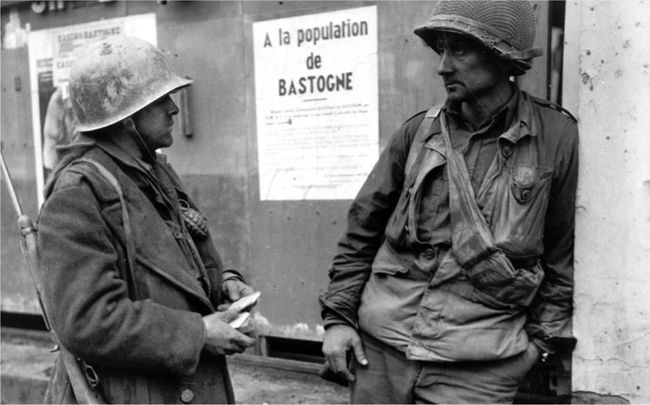
Pictured in Bastogne on 19 December, these two weary GIs had been in continuous action since escaping from Clervaux and fighting their way back, with the Germans snapping at their heels. Private Adam H. Davis of Philadelphia, Pa., and T/5 Milford A. Sillars, from Mooresville, Ind., were from Colonel Hurley Fuller’s 110th Regiment of ‘Dutch’ Cota’s 28th Infantry ‘Bloody Bucket’ Division. Both had become members of Team SNAFU, an ad hoc ‘fire brigade’ of stragglers, deployed to repulse German incursions of the perimeter. The prevailing view of the defending garrison was: ‘They’ve got us surrounded – the poor bastards!’ (NARA)
As well as high explosives, German artillery also fired propaganda leaflets into the town, urging the defenders to surrender. Among the many different versions, one, decorated with crude drawings of angels, candles and festive pine sprigs, read:
MERRY CHRISTMAS SOLDIER, and our deepest sympathy. It’s tough being away from home at this time of year … especially when you’re surrounded and out-numbered ten to one. Don’t you feel your loved ones worrying about you, praying for you? Yes, old boy, praying and hoping you’ll come back home again. Man, have you thought about it? What if you don’t come back? Just remember this: where there’s a will, there’s a way. HOT CHOW AND SAFETY are waiting for you ONLY 300 YARDS AWAY
Bored GIs collected and swapped them like football cards, or used them to supplement their meagre supplies of K-ration toilet paper.
The Christmas Day attack was launched by Kokott’s snow-suited VolksGgrenadiers, riding on eighteen white-painted Panzer IVs from the 15th Panzergrenadier Division, which attacked Bastogne from the north-west, between Champs and Hemroulle. The force, grinding forward in line abreast, broke through the outer lines of the 327th Glider Infantry, knocked out two American tank destroyers and wheeled towards two companies of the 502nd PIR. Directed by the regimental commander, Colonel Steve A. Chappuis in Rollé Château, the paratroopers responded by raking the tanks with machine-gun fire, killing many of the grenadiers. At the same time, US tank destroyers and bazooka teams accounted for several of the panzers as they re-formed into a column. Eventually American joint fires (from tanks, tank destroyers, bazookas and parachute field artillery) created such a storm of cross-fire that ‘the German tanks were fired at from so many directions and with such a mixture of fire that it was not possible to see or say how each tank met its doom’.11 This attack, however, showed that with more careful coordination and planning, the Germans still had the ability to penetrate the defences with near-catastrophic results. After the liberation of the traumatised ruins of Champs in January, the village schoolteacher found scrawled in chalk on the school’s blackboard,
May the world never again live through such a Christmas Night! Nothing is more horrible than meeting one’s fate, far from mother, wife and children. Is it worthy of a man’s destiny to bereave a mother of her son, a wife of her husband, or children of their father? Life was bequeathed us in order that we might love and be considerate to one another. From the ruins, out of blood and death shall come forth a brotherly world.
[signed] a German Officer.12
Manteuffel’s Fifth Panzer Army allocated more resources to crushing Bastogne, and on 26 December again attacked with battalion-size infantry and panzer teams. It was by then apparent that the defenders had perfected their infantry-armour-artillery (known as ‘combined arms’) defensive tactics, whereas the Volksgrenadiers and panzers rarely played to each other’s strengths, and their combat efforts were clumsy by comparison.
Meanwhile, Patton had committed the US 4th Armored Division to break the German hold on Bastogne, with tank columns pushing from the south, from Martelange and Neufchâteau, through terrain held by 5th Fallschirmjägers. On the road was Sergeant Nat Frankel who had managed to get his tank bogged down in the mud. He stuck his head out of the turret and looked around. ‘The first thing I saw was those two damn guns of his. Ivory-handled – ivory, not pearl, for, as he himself so famously said, only St Louis pimps wear pearl-tipped guns. They were strapped across his hips like a portable totem pole. Then I saw his eyes, glowering like two jewels planted in a Polynesian idol … His arms were waving, randomly but not fanatically. He was the very picture of total energy combined with godlike self-control … “What’s wrong?” he bellowed. I told him. “Goddamn! This is no time to get stuck! Get this goddamn thing rolling!”’13
Finally, elements of Combat Command R, including Lieutenant-Colonel Creighton W. Abrams’ 37th Tank Battalion, were poised at 3.00 p.m. on the 26th to close the final distance. Instead of a planned attack via Sibret, a late decision was made to dash along the less conspicuous Remichampagne–Clochimont–Assenois road, and into the perimeter. Abrams sent Captain William Dwight in his Sherman, leading seven others and a column of half-tracks from Company ‘C’, 53rd Armored Infantry Battalion, on ahead. With daylight fading, Abrams called for artillery support (four battalions were then available), directed by Lieutenant Bill Wood in a tiny spotter plane, on to Assenois, and such was his speed that when Dwight burst into the little village it was still under ‘friendly’ fire, which destroyed one of his half-tracks.
Covered by eight anti-tank guns, more than a hundred Germans emerged to tackle the column as it crashed through the settlement and the ensuing hand-to-hand fighting meant that only five Shermans and one half-track broke out of Assenois. In the confusion, nineteen-year-old Sergeant James R. Hendrix of the 53rd Armored Infantry, armed only with his rifle, forced the crew of an 88mm gun to surrender, destroyed two machine-gun nests before rescuing a burning GI from the flames of a half-track. His deeds would bring him a Medal of Honor. Guns blazing, the much-reduced column was stalled when the Germans spread Teller mines on the road, but these were cleared quickly by Dwight’s tank crew and the advance resumed.
The last German position was an old Belgian concrete pillbox, which received three 75mm rounds from First Lieutenant Charles P. Boggess’ tank, named ‘Cobra King’, then in the lead. As they cleared the surrounding woods, the relief column came upon an open field littered with blue, white and yellow parachutes from supply drops, and slowed down, reckoning they were approaching friendly lines. They saw foxholes with helmeted figures. Taking no chances, they called out. After several summons an officer emerged with a smile and said, ‘I’m Lieutenant Webster, 326th Airborne Engineers, glad to see you guys!’ It was 4.50 p.m. on 26 December and the siege had been lifted. Creighton Abrams in his tank ‘Thunderbolt IV’ joined them a few minutes later. All hope for German success to take Bastogne had died.14
McAuliffe had driven to the front line hoping Abrams’ force would break through; by order, his greeting party were well-dressed and clean-shaven, to demonstrate that the 101st had everything under control. The following day saw Maxwell Taylor, hotfooted from Washington, finally reunited with his division. It was en route to Bastogne that he offered four waiting journalists (Joseph Driscoll of the New York Herald Tribune, Norman Clark of the London News Chronicle, Cornelius Ryan of the Daily Telegraph and Walter Cronkite of United Press) a ride in his jeep down the still-contested road into Bastogne. They preferred to wait for a tank, knowing Taylor had no fear of acting as a ‘bullet-magnet’.
Another individual hurrying towards Bastogne was Robert Capa, muffled in a looted German coat. He was the world’s best-known war photographer by then; Hungarian-born, but a naturalised American, Capa’s fame dated back to the combat images he had taken of the ‘Falling Soldier’ in the Spanish Civil War – a rifleman flung back by a bullet, caught in the moment of death. He had since waded ashore with the first wave at Omaha Beach on D-Day and now wanted to capture the Ardennes for Life magazine. First Lieutenant Kenneth Koyen, a pre-war newspaperman then on the 4th Armored Division’s G-2 (intelligence) staff, was assigned to ‘mind’ him as he made pictures of the 4th on the road to Bastogne. Koyen suggested that for safety’s sake Capa remove his greatcoat, but in the freezing temperatures the cameraman refused. So the pair drove forward by jeep until they found troops attacking across a frozen stubble field, and Capa dismounted and began to work. ‘He was at some distance when I heard him shout and I then saw him running toward me with his arms upraised,’ recalled Koyen. “Ken”, he called, ‘“they’re shooting at me! Tell them to stop!”’ Some of the riflemen, advancing on foot behind us, had seen this strange figure on the snow-covered field and had fired. I signalled to the GIs and the desultory firing stopped. Capa and I exchanged a long glance. Without a word, he took off his coat and stowed it in the Jeep.’ Capa had his photos, which duly appeared in the 15 January edition of Life.15
Hot on the heels of the 4th Armored came the 6th Armored Division, followed by elements of the 11th, with truckloads of ammunition, medical supplies and mail – the first for at least two weeks. Combat Medic Robert Kinser of the 3rd Tank Battalion accompanied the casualties back on 27 December: ‘By then, there were over 2,000 wounded in Bastogne. I had an ambulance and went out with the first load … [in] a convoy of over 100 ambulances. We took them about forty miles back, transferred them, and went back to Bastogne.’16 Meanwhile, 130 C-47s flew resupply missions, thirty-two more gliders landed with vital stores and personnel and trucks departed with civilians and prisoners. While the siege had cost the 101st alone just over 2,000 killed and wounded, they had killed 7,000 Germans, captured 697 prisoners and destroyed approximately 200 armoured vehicles. Panzer Lehr and 2nd Panzer Divisions reckoned that Bastogne cost them eighty-one tanks.17
The battle in the Ardennes was fought and won on the ground. However, the threat which slowed and ultimately stopped the 1944 blitzkrieg came from the air. According to Albert Speer, it was on 23 December that ‘Model told me that the offensive had definitely failed – but Hitler had ordered it to continue’. As Reich Armaments Minister, Speer had set off for the front at the start of the campaign, having earlier pledged personally to Model that logistics for Army Group ‘B’ would flow unimpeded during the battle. Even on 16 December, his heart sank as he rode through the night ‘in a Reichsbahn diesel car’, when he saw the rail marshalling yards ‘east of the Rhine jammed with freight cars. The enemy bombers had prevented the movement of supplies for the offensive.’
Thereafter Speer stayed with Model as ‘a camp follower’, remembering the chaotic states of the roads leading to the forward lines. ‘Motor vehicles could move only a foot at a time along the three-lane highway. My car took an hour on average to move two miles, wedged in as it was by ammunition trucks. I kept fearing the weather might improve.’ When it did so, the passage of supplies did, indeed, dry up ‘when the foggy weather changed in a few days and the cloudless skies filled with innumerable enemy fighter planes and bombers. A drive by day became a problem even for a fast passenger car.’ Then the supply services could operate only at night. In the end, Speer was forced to conclude the Wehrmacht had ‘lost its erstwhile famous talent for organisation – surely one of the effects of Hitler’s three years of [total] command’.18
Afterwards, Lieutenant-Colonel Ralph Ingersoll, then on Bradley’s staff, drove over to see the famous battlefield. ‘It was a hard, stark thing,’ he wrote. ‘The tanks were not much good there except as artillery. The dead lay frozen and stiff. When the men came to load them in trucks, they picked them up and put them in like big logs of wood. On the edges of town you could see where the German columns had broken through the perimeter from the burnt-out panzers the Germans had left behind. Mixed in with the wrecks of the tanks were the wrecks of the gliders – and here and there, black in the sun, were the little basketfuls of charred junk, that is all that’s left of an aircraft when it goes into the ground at three or four hundred miles an hour.’19
To the north-east of Bastogne lies a very minor road, running from Bizory to Foy. When I first knew the region, everything to the right of the route was densely forested, but the terrain has since been levelled and become Les Bois de la Paix (‘the Peace Woods’). Created on the Bulge’s fiftieth anniversary, many trees are named in honour of the soldiers who fought there; from the air, I am told, the new trees are designed to form the emblem of UNICEF. A mile further ahead, on the left, is a little brick monument to Company ‘E’ of the 506th Parachute Infantry Regiment, made famous by the Band of Brothers TV series, though of course many other units fought here, before and after. Easy Company occupied foxholes in the Bois Jacques, on the left, another mile beyond, overlooking Foy.
On 13 January 1945, three companies of the Screaming Eagles attacked Foy, a drama depicted at length in Band of Brothers. The village had originally been seized on 18–19 December, as we have seen, by Lauchert’s 2nd Panzer Division. They were relieved by Volksgrenadiers, and later still by the second-wave 9th Panzer Division, who were in occupation with a Panzergrenadier company including snipers, tanks and artillery support, when the Screaming Eagles attacked. After a stiff fight, the Panzergrenadiers were ousted, but returned the next morning, initially ejecting the 101st. Foy was finally secured by the paratroopers later that day, who then went on to seize Noville, the crossroads town they had first fought over on 19 December. Both settlements changed hands at least half a dozen times and were reduced to smoking rubble by the battle’s end – incomprehensible today as both communities have recovered, with few traces left of the earlier destruction.
The pillbox on the rue de Fortin at Assenois remains, still bearing the shell-strikes from 26 December 1944, and is now a treasured landmark of the town. All around Bastogne, a ring of Sherman turrets on stone plinths marks the extent of the defensive perimeter along each of the seven main roads which radiated out in 1944. On the morning of 19 December a German patrol reached the Mardasson Hill, north-east of Bastogne; one member of the patrol was killed and is believed to be the grenadier who approached closest to the town. A huge star-shaped monument to the fallen was commenced on the spot in 1946, and the site has now been developed into a memorial complex and museum. Chiselled into the monument are the names of each American state and every US unit that participated in the Bulge, with a dedication to the ‘lasting friendship between the peoples of Belgium and the United States’. Cobra King, the first tank into Bastogne, is still in service with the US Army (when I saw her last, as the gate guard of Rose Barracks at Vilseck in Germany). The Kessler Farm, north of Remoifosse and west of Marvie, once the headquarters of Company ‘F’, where the German surrender delegates waited, still stands. So does McAuliffe’s command post; the night before the ‘Nuts!’ drama, Colonel William L. Roberts of the 10th Armored relocated his CP from the Hôtel LeBrun, overlooking the town square, to join McAuliffe at the Heintz Barracks. Both men had also moved their operations room and communications centre to some dingy cellars underneath, from where they jointly conducted the battle for Bastogne.
National defence cuts announced in 2009 threatened to demolish this historic site, but the Belgian army countered with their own proposals and McAuliffe’s CP is now ‘The Nuts Cellar’, a superb little museum, supplemented by exhibits loaned from the National Military Museum in Diekirch. It is run by a team of Belgian army volunteers who really care about this symbolic piece of American history. Their enthusiasm is tremendous.
In December 1944 Major John D. Hanlon, commanding the 1st Battalion of the 502nd PIR, appealed to the mayor of Hemroulle, north-west of Bastogne, for the loan of white bed linen for his men to wrap around themselves as camouflage against the snow. Monsieur Victor Gaspar rang the church bells to summon the villagers, explained the situation to them, and within no time more than 200 bedsheets had appeared, piled up in the little village square. All were gratefully received, with Hanlon promising to return them as soon as possible. His battalion – and the sheets – then disappeared into battle.
In 1947, a retired Lieutenant-Colonel Hanlon, by then the proud possessor of a Silver Star and two Bronze Stars, read an article on Bastogne in his local Boston newspaper, which mentioned, tongue in cheek, that Hemroulle was still waiting for the return of its sheets. He wrote to the Boston paper explaining that part of the story was his fault and, to his surprise, parcels of bed linen began to arrive in the mail from every corner of Massachusetts. When Hanlon returned to Hemroulle in February 1948, the church bells rang again, summoning the villagers. With much emotion on both sides, each received the same number of sheets they had ‘loaned’ him in 1944. Hemroulle then insisted on making Hanlon an honorary citizen and sending him home with paintings from the village church, which had survived the battle, and now hang on the walls of the churches of Winchester, Massachusetts, and its town hall.20