
CHAPTER 23
He was now “black”—free of surveillance. Moscow was his.
—Milt Bearden in The Main Enemy
The word “surveillance” comes from the French surveiller, to watch over. The CIA broadened the definition to “watching from anywhere” and relied on TSS and its successor organizations to build and deploy special equipment for surveillance and countersurveillance operations. The CIA has used surveillance for both offensive and defensive purposes by secretly collecting information about the movement and activity of recruitment targets and using countersurveillance to protect CIA officers engaged in clandestine acts.
Surveillance operations employ stationary (fixed or static) or mobile assets as needed. “Stationary surveillance” refers to sustained observations made from fixed sites, which can be apartment buildings, cafés, airports, or intersections. The monitoring attempts to identify either the people transiting the site or the type of activity conducted at the location. The target site would be observed from an observation post manned by trained surveillance personnel using still and video camera systems. As the capability and reliability of visual surveillance equipment improved, unmanned observation posts that recorded and transmitted images to a control point significantly reduced the number of personnel required for multiple fixed-surveillance sites.1
“Mobile surveillance,” conducted primarily by foot, automobile, or airplane, tracks a person or other moving target, such as a vehicle or shipping container. OTS supplied concealed surveillance cameras, disguises, and specialized communication equipment for mobile teams. Mobile surveillance becomes particularly important when terrorists are identified and their movements need to be observed and plotted.
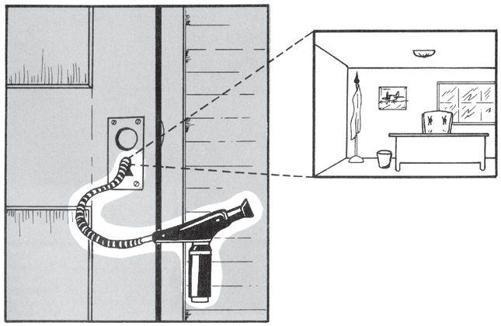
The Fiberscope is composed of a pistol-grip viewer and a flexible shaft designed to enable inspection of remote or inaccessible locations. A panoramic view was obtained by drilling a .315-inch hole in the adjacent wall or ceiling, or by sliding the tip through the target’s keyhole or under the doorway, circa 1968.
Surveillance photography serves dual operational purposes: to establish positive photo identification of a target and operational acts, such as meetings, exchanges of documents, and payoffs. The quality of the photography depends on selecting the right camera for the operational environment. In a stationary observation post, typically located inside a building, camouflaged cameras are prepositioned to photograph a target and can be controlled manually or remotely. Inside an apartment or hotel room with a common wall to the target, covert photographs can be taken from behind a ventilation grille, through a pinhole lens, or using a pre-installed camera “port.” Images from digital cameras may be immediately transmitted to an operational base. In the early 1990s, film cameras began to be replaced by high-resolution digital cameras. At first, images were recorded to videotape and then later to digital storage media. The advantages of advanced storage capacity and digital transmission of captured images expanded the applications for photographic surveillance. Miniaturization and capacity advances in the 1990s of small, low-light video cameras allowed video concealments to employ many of the same techniques previously used by audio surveillance to hide small microphones in wood blocks, books, or office equipment.
Mobile observation posts, using surveillance cameras carried by a person on foot, or riding on a bicycle, car, train, or aircraft, add another capability for covert collection. Concealment requirements and the need to compensate for the target’s movement limit the choice of cameras for mobile posts when compared to the fixed sites. At close range to the target, traditional camera systems will often be concealed beneath the user’s clothing or inside a briefcase or purse. The ubiquitous presence of cell phones and their integrated imaging features fundamentally altered the nature of visual surveillance by creating the reality that any action done in public is likely to have been photographed by someone.
Historically, for intelligence photography, 35mm cameras with varying lengths of standard and telephoto lenses provided the highest possible level of detail (resolution) in still images. In 2001, with the advent of the Nikon D1X (5.9 million effective pixels), OTS accelerated its movement toward digital imaging for all photographic requirements.
At greater distances, cameras with long lenses make a target appear closer and enlarge the image on the film media. These telephoto lenses could be 500mm, 1,000mm, 2,000mm, or even longer.2 A lens 300mm or longer is almost impossible to hand-hold without a tripod or other means of support. The commercially available Questar Seven 2,800mm lens with a 35mm camera and tripod can read the numbers on a license plate from more than two miles away with adequate lighting and favorable atmospheric conditions.3
Because surveillance pictures using film cameras are often taken at night during periods of little light, careful selection of available light, ultra-high-speed film, or infrared materials are required. Available-light photography requires the fastest available film and steady support. The sensitivity of commercially available ultra-high-speed film to ASA 6400 can be “push processed” to sensitivity above ASA 50,000 by manipulating the developing time, development temperature, or both.4 At these extreme ASA levels, it is possible to photograph a subject at night illuminated by a single birthday candle. Infrared surveillance photography that takes place at the end of the light spectrum is not visible to the unaided eye and requires only a standard 35mm camera, infrared film, and a strobe flash unit with an infrared filter .5
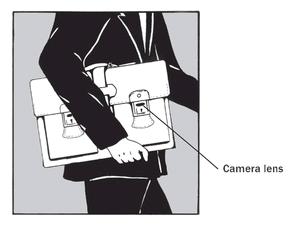
The spring-wound advance on the German robot camera could be remotely activated while the camera remained concealed in a leather attaché case.
“Tracking devices,” particularly beacons, aid mobile surveillance when close surveillance is impractical or undesirable. Tracking devices are selected based on the nature of the target and operational issues. In practice, beacons are most useful in tracking inanimate objects such as vehicles and shipping containers. Success in implanting a covert beacon inside the human body, despite assertions by some that “my teeth contain government-installed devices,” eluded the CIA. Contrary to certain remarkable scenes in spy movies, OTS found that human behavior, combined with technical limitations imposed by laws of physics, made “personal beaconing” practically impossible.
Beacons are considered both strategic and tactical. Tactical beacons, monitored from ground receivers, are usually located within a short range of the target; strategic beacons may be monitored from a highflying aircraft or satellites. Most clandestine beacons use a small radio frequency transmitter to broadcast a navigational signal to the surveillance team. For example, the CIA might covertly insert satellite-tracked beacons inside shipping containers of shoulder-fired missiles being transported by terrorists from Afghanistan to other locations in the Middle East and place a tactical beacon on a pickup that is hauling a few of the missiles to a terrorist safehouse.
During the Vietnam war, TSD disguised a small beacon inside imitation animal dung. Left in the foliage adjacent to a North Vietnamese Army or Vietcong campsite, the active beacon would not be noticed or disturbed because of its appearance. Attack aircraft could home in on the signal that pinpointed the site for destruction.6 In the Middle East, beacons were deployed inside briefcases and belts to protect individuals at high risk against kidnapping. When activated by nonalerting movements of the wearer, the beacon transmitted a signal for help and provided the location of the kidnapped individual.
Software beacons were created for operations against cell phones and portable computers. With brief access to a target’s laptop or cell phone, the beaconing software could be installed and, thereafter, anytime the target used his cell phone or logged onto the Internet with his laptop, his position was logged and his e-mails and conversations intercepted.
Taggants represent another means for tracking movements by identifying a targeted individual as he passes through choke points within the operational area. Similar to the plastic security tags attached to clothing that must be removed before departing a store, taggants made of chemicals, pheromones, or electronics can be remotely detected and the tagged individual identified.7 One of the best-known taggants used by the KGB was “spydust,” the chemical compound 5-(4-Nitrophenyl)-2,4-pentadien-1-al (NPPD). The Soviets’ use of spydust was of such concern to CIA operatives that OTS established a special program to analyze and counter the material.
The CIA employed audio, visual, physical, forensic, and electronic technical aids to enhance the organized study and observation of targets. Throughout most of the Cold War, audio operations and satellite photography dominated technical collection successes. Audio operations were an original function of the Technical Services Staff, but initially were no more important than printing, concealments, and disguise. However, by 1960, audio technical surveillance had become TSS’s top priority. Audio operations, designed to obtain positive or operational intelligence, targeted communications systems or facilities where conversations of interest might occur. Government telephone lines, official foreign missions and facilities, an office, residence, or hotel room—all were exploited by the audio techs.
Traditional landline telephones were particularly vulnerable to clandestine tapping. Almost every target individual anywhere in the world had and used a phone. The handset contained a high-quality microphone built into the mouthpiece and was connected to wires leading out of the building. TSS developed three basic systems for bugging phones in the early 1950s that remained viable for decades.
By tapping the line, both parties talking could be heard and the full conversation captured. The tap might require direct contact with the wires, or an “inductive” tap could be fitted as a collar around a line without making physical contact with the internal wires. An alternative was to modify the phone.
Normally when a telephone receiver is placed on its cradle the depressed hook switch ends the call. TSS developed a technique in the 1950s to bypass remotely the hook switch in order to use the sensitive mouthpiece microphone to listen in on all room sounds and conversation. Usually a tech required access to the telephone to make the modification but if the make and model of the targeted telephone could be obtained, a hook-switch bypass modification to an identical instrument could be made. Then, similar to a quick-plant operation, a cleaning person or service personnel could covertly exchange phones. The third basic system exploited the telephone’s own current. Telephone instruments draw current from the telephone company for power to operate the unit and activate the bell or ringer. This power level was sufficient to support other bugs and listening devices in the room and eliminated the need for batteries to be replaced.
Cellular telephones are particularly vulnerable to audio attacks. Cellular conversations can be intercepted while transmitting between the nearest cell tower and the handset, or as the signal is relayed between towers to the telephone exchange. All data and conversations sent to and from a cell phone, including e-mails, videos, images, and text messages can be captured without any physical access to the phone itself. Cell phones can be located to within 100 feet by triangulating the signal strength of the cell phone with the three nearest cell towers. By integrating this geographical positioning data with a moving map display, movements of the cell phone can be monitored in near-real time.
A cell phone can also be bugged by gaining access to the instrument for the time required to swap batteries. Modified batteries containing a microphone, digital storage media, and computer chip constitute a self-contained eavesdropping system. Once the audio is captured and stored in compressed format, the microcomputer chip in the system dials a preprogrammed number and burst-transmits the stored information to a receiver. The bug automatically recharges itself when the user charges his cell phone battery.
In the 1980s, cell phones communicated using analog signals that were easily intercepted and monitored. In the 1990s, digital cellular providers began offering limited protection from amateur eavesdroppers, but fell far short of the capabilities and technical resources of intelligence services and law enforcement agencies.
A bugged olive in a martini glass served at a black-tie embassy reception might play well to movie and television audiences but such things are usually unrealistic for CIA operations. To get the “good stuff,” surveillance techs installed listening systems in walls and ceilings of consulates, concealed recorders in attaché cases, and hid microphones and transmitters in apartments. They operated contact microphones to eavesdrop through the walls of hotel rooms, rigged telephones, intercepted cell calls, and bounced laser beams off windowpanes. Whether the techs left cigarette lighters with transmitters in target offices or wired microphones into a case officer’s brassiere, the objective never changed—to get secret intelligence in support of national security.
For each surveillance operation, the techs selected components that work together in order to capture the audio at the target site and transmit it to the listening post. Their equipment differed markedly from the repackaged consumer-grade products masquerading as “covert electronics” and offered for sale at retail spy shops.8 Consumer electronics normally lack the technical sophistication and reliability needed to operate in security environments where covertness is critical and climatic conditions uncontrolled and unpredictable. Compared to professional spy equipment, the consumer “spy” gadgets require excessive power, operate erratically, and emit signals that are easy to detect and intercept.
Many OTS spy electronics were the result of a collaborative development process between CIA engineers and private companies where a dedicated team of cleared contractors worked on Agency projects.9 This model of industry-government cooperation produced components with performances that eclipsed commercial standards by decades. Among the most significant examples were rugged, sensitive audio microphones that were later made public and introduced into hearing aids and small, long-life transmitter batteries that eventually powered heart pacemakers. Charge-coupled devices (CCDs) were used in OTS spy cameras a decade before the same technology was commercially available in digital cameras.
The latest and most sophisticated OTS audio equipment was usually reserved for targets in denied areas where hostile technical surveillance countermeasures sweep teams were the most formidable. OTS created a variety of components and eavesdropping devices, each with different characteristics and capabilities that allowed the tech to customize each system to meet the operational requirements and counter the threat.
Commercial microphones were developed in the latter quarter of the nineteenth century after Emile Berliner sold his microphone patent to the fledgling Bell Telephone Company. The world’s first electronic eavesdropping system, the Turner Dictograph introduced in 1915, contained a carbon microphone, battery, and earphone. Buyers were cautioned “not to use the device for illegal or immoral purposes.” Whether a microphone is located inside the mouthpiece of a telephone, or embedded in the wooden leg of a table, its purpose is the same—to convert the sounds of room noise and voices into an electrical signal.10
From the variety of microphones available, the techs matched the one with the most desirable characteristics to the operational requirement. Mics could be hardwired to the listening post, connected to a concealed recorder worn beneath the user’s clothing, or connected to a radio-frequency transmitter. While a hardwired mic offered security advantages, the radio-frequency transmitter quickly became the most commonly used audio system because the listening post could be placed in remote locations.
Contact microphones are effective in capturing sound waves from room audio that cause every hard surface in the room, including the walls, floors, and objects, to vibrate. A sensitive contact microphone with the capability to convert vibrations into an electric signal was especially useful in operations against targets in hotel rooms when the tech had physical access to one of the adjacent rooms, or the room above or below. The tech could affix the contact microphone to the wall or floor using glue or a nail to pick up the vibrations. A special type of contact microphone, the “accelerometer,” could detect vibrations of room conversation or movement through solid concrete walls up to eighteen inches thick. For opportunities that required quick reaction, OTS produced a special self-contained “motel kit,” disguised inside a small toiletries case, that consisted of a contact microphone, wall adhesive, pocket amplifier with optional output to a tape recorder, and earpiece.11 It could be packed in a briefcase or carried beneath a coat.
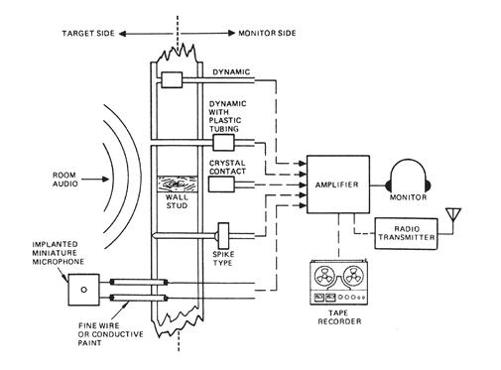
Illustrated are five different types of microphones intelligence services used for covert monitoring of conversations through a common wall. The degree of access to the target room and type of building construction determined which microphone was used.
The “vibro-acoustic” microphone, designed to be affixed to a reinforcing steel rod or bar inside a concrete column during building construction, could later be connected to concealed wiring that would run to a listening post. Conversations cause the concrete and rebar to vibrate and enable the vibro-acoustic sensor to capture the sounds. Multiple sensors inside the same column on different pieces of rebar could be selectively tuned by the monitor at the post to target specific conversations anywhere in a 360-degree circle around the column. However, the task of attaching the vibro-acoustic mics onto the rebar required bribing or distracting security guards at the construction site.
Pinhole mics, half the size of a pencil eraser, were a workhorse for the OTS audio techs. Whether mics were hidden behind a floorboard, inside a wall, or embedded in the base of a flowerpot, they required only a tiny (less than half a millimeter) airway to capture all of the room noises. The pinhole mic could be installed inside numerous objects or architectural features of a room. When denied access to the target room, the tech could install the mic in a common wall by drilling a pinhole too small to be noticed through the wall, floor, or ceiling.
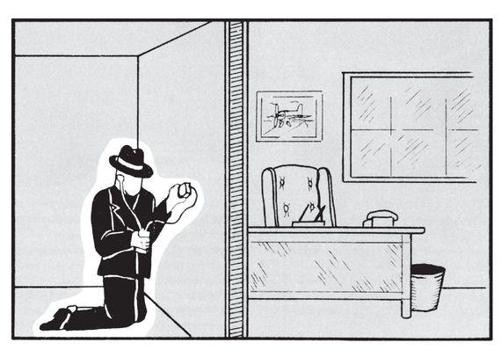
TSD developed a “Motel Kit” for surveillance of targets of opportunity. The self-contained eavesdropping kit included contact microphones, a battery-powered source, and earphones. The sensitive transducer detected vibrations on the wall caused by sound or conversation in the target room that, when amplified, were heard clearly through the headphones, circa 1970.
Advances in the 1980s made it possible for OTS to design a fiber-optical microphone that operated using only light waves transmitted to it along a cable thinner than a human hair. The fiber-optical microphone defied detection by a metal detector or nonlinear junction detector and its tiny wire was easily hidden.
Directional mics were designed for operations to pick up a selected conversation from individuals standing together and talking at a social event while excluding other room noise to either side. The rifle mic, a type of directional microphone, was used in outdoor seating or smoking areas to collect conversations from a distance. The increase in smoke-free buildings turned these gathering spots into ideal target areas to collect gossip and personal information. The directional rifle mic, composed of an array of tubes of varying precalculated lengths placed in front of the sensitive microphone, filtered out extraneous sounds and reduced all noises other than those from voices in the direction of the target.
Audio played a critical role in the rescue of seventy-one people held hostage for four months by the Tupac Amaru Revolutionary Movement (MRTA) in April 1997. Fifteen armed MRTA terrorists stormed the Japanese ambassador’s residence in Lima, Peru, during a diplomatic Christmas party on December 17, 1996, taking seventy-two Peruvian and foreign hostages. Several days later, when it became apparent that the hostages would be held indefinitely, the Peruvian government began infiltrating listening devices into the residence in hope of acquiring intelligence about the terrorists’ intentions and the status of the hostages’ well-being. Loudspeakers set up at the front of the residence to deliver messages and harass the terrorists were part of the government’s attempt to pressure a surrender.
In January, one hostage, a senior Peruvian government official, suddenly assumed the persona of an isolated eccentric. He began talking incoherently and at random to various inanimate objects in ways that suggested his mental state had deteriorated. The act was a ruse; the official had knowledge of audio operations from his previous work and made a calculated guess that something in the residence could contain a bug. In fact, a religious icon did conceal a transmitter and on one afternoon the listening post monitors heard the hostage pray, “If you hear this, play ‘La Cucaracha’ tomorrow.” Precisely at 6 AM the next morning, “La Cucaracha” blared through the loud speakers, baffling the Lima press as to why the government would use a famous Spanish Civil War song as a harassment tool.
After the musical acknowledgment, the eccentric continued talking to the icon for three months until April 22, when, minutes before the successful rescue assault, he reported that the hostages were in a relatively safe indoor area while the terrorists were in an open area playing their usual afternoon soccer match. The assault was launched, killing the fifteen MRTA revolutionaries and rescuing all but one hostage.
OTS audio techs left nothing to chance in preparation and advance planning for their operations. The complexity and the risk of the activity demanded that each phase of any technical surveillance operation be considered and documented. CIA Headquarters required that a survey and written proposal, known as “the 52-6,” be prepared, submitted, and approved before an audio operation could proceed. The survey consisted of six primary elements.
The target could be a person or a facility such as a telephone line, building, room, or automobile. Methods used to operate against a target varied by the type of information sought. If the target was a briefing by a senior military attaché during his weekly staff meeting, the embassy conference room would be the place to plant the listening device. On the other hand, if the attaché was being assessed for possible recruitment, his bedroom or the telephone line he used for personal calls might be locations where his conversations would reveal an exploitable weakness. Attacking the third-floor room of a trade mission with windows overlooking a busy street would require a completely different operational plan than one to bug the general’s briefing room inside a secure military base. Without a means of gaining unobserved access to the target facility, there could be no operation.
Audio operations required a thorough physical description of the site, including a viable location for a listening post. A signal “path loss” test identified any physical obstructions that would degrade the bug’s transmission signal. Activity patterns of occupants were recorded. Any security and alarm systems, including the use of guard dogs, was plotted. The survey estimated the operational life of the battery in the listening device, identified the number of people, their special skills, and the type of equipment required. The techs projected the time they could be safely inside the target, the optimum date and time for the operation, a proposed escape route, individual cover requirements, and the risk of compromise. The station and Headquarters weighed in on the expected value of the information to be gained from a successful operation.
Based on what was known of the target, the techs described their plan to enter the facility and do the required deconstruction, which could involve removing baseboards, drilling, implanting devices, reconstructing damaged walls, inventorying tools, and exiting securely. The scenario also included the plan for communicating with countersurveillance teams and contingency procedures—what to do in an emergency should technical or security problems arise during the operation.
After the installation, audio devices were managed from the listening post. The survey included information about the location, equipment, and staffing of the listening post. The station had responsibility for staffing the post, manning the tape recorders, translating and producing transcripts, while OTS maintained and serviced the equipment. When an audio operation ended, the techs conducted another clandestine entry to remove the device and to restore the facility, leaving no trace of the installation. This objective was not always achievable; operational judgment would balance the risk of exposure during a reentry with the value and importance of the equipment to be retrieved.
Both audio surveillance and concealed video camera operations consisted of three primary components: the collection device, the transmission link, and the listening or observation post. Collection devices were usually a microphone or camera that would covertly acquire the information for transmission down a wire or radio-frequency broadcast to a listening post. The collector might be a subminiature microphone embedded in the woodwork, a tap placed across the telephone line, or a pinhole video camera concealed behind a dressing-room mirror. Power for the collection device came from batteries or by siphoning power from the existing electrical lines at the target location.
The transmission link sent the collected signal containing the sound or imagery from the collection device to a receiving and recording location. The configuration of the target, the cooperation of the local security service, and the distance to the listening post were all factors in determining the type of link used—hard wire, radio transmission, or a more exotic system such as laser or fiber-optics. Where the monitoring post was positioned close to the target, as in the basement of an apartment building or in the adjacent room of a hotel, a hardwired microphone to the recorder would be preferable since no over-the-air radio signal was generated. Hardwiring a microphone or video camera could also eliminate the need for a power source at the target site and made the implanted device nearly impossible to detect without x-raying the floors, furniture, and walls. However, hardwiring is usually slow to install and potentially more susceptible to accidental discovery.
For microphones hardwired to the listaning post, OTS developed special tools to aid in their invisible installation. A small, easily concealed aluminum crowbar was developed for quickly prying baseboards away from the wall to hide wires, as was a special hand-held fine-wire kit that used a razor blade to slice a small slit in a wall, insert a pair of tiny wires, and finally seal the opening using a pencil eraser. The device could lay wires across a painted surface without leaving a trace.12 For audio installations involving damage to woodwork or walls, OTS engineers created special quick-drying putties and odorless paint to hide signs of construction. The tech could complete his installation and cover all traces of his work during a single entry into a target site.
The listening or observation post received and recorded signals from the transmission link for processing. A typical post could contain several recorders, each paired to an implanted collection device. Advances in digital recording created a virtually unlimited recording capacity.
The radio-frequency transmitter became the CIA’s most frequently used device for sending a stolen signal out of a target location. Although the transmitter required batteries or another power source, its signals had an advantage in that they could be monitored anywhere within a kilometer of the installation and farther with the use of repeaters. Since the early 1970s CIA surveillance systems have included the capability for remotely turning the transmitter on and off at selected times to conserve battery power, and storing collected conversations for a remotely programmed transmission at a later time.
For the hardest targets, exotic systems were developed to collect audio via lasers, infrared light, or fiber-optic cables. More technically complex and difficult to maintain than the radio-frequency transmitters, these systems were limited in use but effective in situations where a target employed aggressive technical countermeasures to block, identify, or neutralize a radio-frequency transmission link. Transmitting signals via infrared or laser reduced vulnerability to traditional TSCM “sweep” techniques.
MI6 officer Richard Tomlinson described the difficulties experienced in an operation to bug the penthouse apartment of a suspected Russian intelligence officer in Lisbon. A loft space above the apartment provided a suitable place for hiding the small microphone, but a problem arose in linking the microphone to the recording equipment located in another apartment below. Use of a normal radio link was ruled out for technical reasons, so the alternative was to link the two areas by running a small wire “through a convoluted drainpipe that wound its way down the building.”13 Technical officers experimented with various mechanical crawlers in an effort to thread the wire through the bends of the drainpipe to no avail before hitting on the idea of using a mouse. Tomlinson describes the operation:
Using a fishing line they could dangle the mouse, harnessed to the end of a fishing line, into the top end of the drainpipe. They would then lower it down the vertical section of the pipe to the first right-angled bend. From there the mouse could scurry along the horizontal part of the pipe to the next vertical section and so on, down to the bottom of the pipe where it could be recaptured. The wire could then be attached to the line and pulled through the pipe.
Trials of the mouse-wire delivery system on the Century House drainpipes, using three white mice borrowed from the chemical and biological weapons research establishment at Porton Down, proved reasonably successful. One mouse, nicknamed Mickey, was a natural and scampered through the pipes enthusiastically. A second, Tricky, tried to climb back up the fishing wire when dangled, but once in the pipe, was reasonably competent.14
Methods of clandestinely introducing a listening or photo device were as varied as the imagination of the techs. Eavesdropping devices embedded inside Trojan horse-style gifts were given to diplomats, businessmen, and other high-profile targets with the expectation that the device would be placed in an area used for important conversations.15 The gift, described by a case officer as one that “keeps on giving,” could be an engraved pen and pencil set for the target’s desk, a decorative flowerpot, or a handsome globe. Two primary weaknesses of a Trojan horse operation are the inability to predict or control where the gift, with the listening device, is placed and the potential blowback on the giver should the deception be discovered.
For short-duration audio operations, OTS developed small portable eavesdropping systems embedded in functional everyday items such as lighters and disposable ballpoint pens.16 Such a device could be attached by a member of the cleaning staff beneath a conference room table where it would not be noticed or secreted by an official visitor between the cushions of a couch. The eavesdropping device would collect and transmit room audio as long as it retained battery power or until removed or discarded. Ideally, an operation to deploy a quick plant included an advance visit to the target site to determine the best place to leave the device, identify an appropriate concealment, and determine a listening post location.
Concealments for quick-plant operations can be either tailored or generic. 17 Deployment of a generic device—say, a disposable cigarette lighter or expended ballpoint pen—requires little advance planning. OTS carried an inventory of bugged AC electrical adaptors that could be quickly installed between a lamp plug and the socket. These were available in the varied colors and styles appropriate for target countries.18 DCI William Casey credits himself with personally deploying a generic quick plant disguised as a large needle in the office sofa of a senior Middle Eastern official during a trip abroad.19
The wood block represented a frequently deployed variation of a quick plant.20 Wood blocks encased audio transmitters and were designed to be placed underneath a table or desk, or as part of a chair or a replacement for sections of chair rails and crown molding. High-quality wood blocks replicated the color and type of the wood, as well as shape of the molding and appeared as a normal part of the furniture or room design. Structural wood-blocks replaced the pieces of triangular-shaped wood that provided stability and support beneath most pieces of wooden furniture. These were unlikely to be seen and required less engineering effort to conceal beyond matching the general color of the furniture.21 Books were a variation of wood blocks, the spine of a book providing a tailored concealment cavity for a listening device.22 A visitor to the target location could execute a quick plant by unobtrusively replacing a specific book with a seemingly identical edition.23
When access inside the target location or to adjacent rooms proved impossible, more exotic systems enabled collection of audio from a distance. Laser microphones worked on the principle that a laser beam directed at an angle toward a glass window was reflected and could be captured at a listening post, compared with the original signal, and demodulated to recover audio. In the 1980s, OTS engineers developed a program that embedded a small prism inside window glass in key targets. The prism increased the sensitivity of the laser microphone and allowed OTS to control accurately the angle of reflection. With this prism system, the laser could be aimed at the window and the reflection would return along a parallel path to the LP. This eliminated the necessity for the transmitter and receiver to be in different locations and made detection more difficult.
A passive resonator concealed inside a wall or piece of furniture can be targeted with a radarlike signal transmitted from an exterior post. The reflected signal is demodulated to eavesdrop on all conversations in the room. Because its power source comes from the external signal, the device can transmit indefinitely. CIA technicians saw their first resonator in 1952 when one was discovered embedded in the carved wooden Great Seal of the United States.24
Inside the halls of the CIA’s Original Headquarters Building, a historical display from the Directorate of Science and Technology shows the inventiveness of CIA scientists. One device, a robotic catfish named “Charlie,” was designed to be indistinguishable, when viewed from the water’s surface, to channel catfish commonly found in rivers around the world. It appeared so lifelike while swimming in the water, that some feared that it might be consumed by even larger predators. Charlie’s mission was unspecified, but experts speculated he could be used to swim into freshwater rivers and canals to gather water samples near foreign nuclear power facilities. The mobile aquarobot could also serve as an underwater platform for eavesdropping devices.25
CIA officers abroad lived, worked, and operated under the constant awareness that at any time they could come under surveillance. Officer training included weeks of surveillance detection runs to develop and practice skills in recognizing and dealing with surveillance, either obvious or discreet.
Obvious surveillance was used when a foreign security service chose to send a message to an officer that his activities were being closely watched. Such surveillance could become aggressive, verging on harassment and intimidation. Tactics might include “bumper locking,” in which a trailing surveillance vehicle stayed so close that its bumper actually touched the target car. On the street, surveillance watchers could walk directly in front of, behind, or adjacent to the target, staying in close proximity even in shops and buses. Slashed tires, broken windshields, and stolen car batteries conveyed the same message: “We know who you are, and whatever you are up to, we don’t like it.”
Aggressive actions are sometimes taken by surveillance teams to retaliate for a provocation or to thwart an operational act.26 This happened to an active young CIA officer whose operational activities aroused suspicions of the local service. The officer received an unscheduled late-night visit at his home by the country’s chief of counterintelligence. After a tense discussion, the foreign chief left behind a parting compliment coupled with an unstated warning, “Mr. Paseman, you are very good. However, I suggest the remainder of your tour should be rather boring.”27
Discreet surveillance, while not physically intimidating, was difficult to recognize and more to be feared. Failure to detect counterintelligence watchers could lead to operational compromise and loss of an agent. Early in the 1970s OTS engineers created tiny body-worn receivers to intercept the radio transmissions of Soviet surveillance teams. These concealed receivers, unrecognized by the KGB for several years, gave CIA officers operating in Moscow a prized capability for detecting surveillance activity.
Well-trained surveillance teams, operating in familiar areas where they control the turf, will attempt to lull the officer into the false belief that he is “black” (free of surveillance). Should the officer fail to detect such surveillance and proceed to “go operational” he could unwittingly lead surveillance to his agent or be caught during an operational act. Discreet Soviet surveillance played a key role in the compromise of major operations and the expulsion of CIA officers from the USSR.
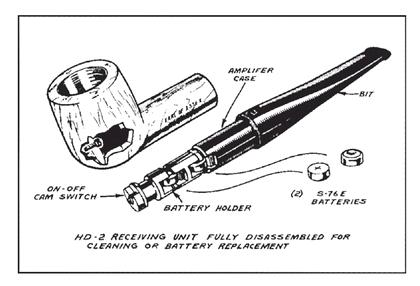
The Hearing Device-2 countersurveillance device, with a neck loop antenna and body-worn receiver, allowed an officer to hear nearby hostile radio communications through bone conductivity by biting down on the pipestem.
Disguises offered one method of defeating the KGB’s overwhelming surveillance advantages. OTS sculpted and fitted disguises for use by case officers and agents to evade surveillance and avoid recognition. Before leaving for foreign assignments, case officers were trained to apply a variety of false appearances and function normally while in disguise. Each received a “light disguise kit” tailored to the officer’s gender. The kit typically included items like false mustaches and beards, hairpieces, a fake wart, planar lens eyeglasses, hair coloring, collapsible canes, reversible coats, shoe lifts, and dental appliances.28 Some officers, whose assignment required a more elaborate disguise, received full or partial head and face disguises individually sculpted and tinted to blend fully with the wearer’s skin and hair color.29 Because surveillance teams relied heavily on visual indicators to track a target, quick changes in an officer’s appearance—adding or removing a hat, letting hair down, putting on or taking off glasses, or reversing the color of a jacket—might cause surveillance to lose their target in crowds or on busy streets.
In the cat-and-mouse game between surveillance and countersurveillance,the edge traditionally went to the side controlling home territory. For the CIA this meant that they were always at a disadvantage when meeting and handling agents in high-risk or denied areas. Agents had to communicate with their handlers, and defeating surveillance was the key to their protection. Whenever OTS developed a new gadget or disguise that offered an advantage against the ever-present watchers, it would be only a matter of time before its tactical superiority was lost. There had to be a better way for agents to operate and communicate without exposing themselves to hostile surveillance and for OTS the new technology arrived in the form of digital zeros and ones.