
CHAPTER 2
We cannot afford methods less ruthless than those of our opposition.
—John Le Carré, The Spy Who Came in from the Cold
With the end of the war growing near, Donovan remembered the lessons of Pearl Harbor and the value of intelligence in occupied Europe and other theaters of war. At the behest of President Roosevelt, he prepared a detailed memorandum calling for the creation of a permanent postwar agency to act as a central clearinghouse for intelligence. In the covering letter of this 1944 memo, Donovan wrote: “When our enemies are defeated, the demand will be equally pressing for information that will aid us in solving the problems of peace . . .”1
However, Washington politics during the last days of World War II eroded Donovan’s influence along with his dream of forming a civilian central intelligence service. Many in government considered the OSS a temporary wartime agency, not needed in peace time any more than the Office of Price Administration, which oversaw the rationing of sugar and car tires. For them espionage was an inconvenient wartime necessity like gas coupons and war bond drives. Unable to see future challenges to national security, they believed America’s involvement in spying should end with the war.
Donovan’s memo, intended for the private consideration of the President and the Joint Chiefs of Staff, was leaked to the press. Columnist Walter Trohan, leading the charge against a standing intelligence agency, wrote in February 1945, in the Chicago Tribuneand New York Daily News: “Creation of an all-powerful intelligence service to spy on the postwar world and to pry into the lives of citizens at home is under serious consideration by the New Deal. The unit would operate under an independent budget and presumably have secret funds for spy work along the lines of bribing and luxury living described in the novels of E. Phillips Oppenheim.”2
This was a direct policy and class attack on Donovan and his “blue-blooded” operatives, even down to the mention of Oppenheim. A popular and prolific British spy novelist of the day, Oppenheim pioneered the genre that would eventually became known as the international thriller, rarely missed an opportunity to have his characters revel in extravagant luxury. The message was clear: spying was elitist, unsavory, and un-American.
After Donovan’s confidential report remained unacted on by Roosevelt, a second negative report made its way to President Truman’s desk. This one, prepared by a Roosevelt aide, Colonel Richard Park, Jr., offered a devastating review of the OSS and with it, Donovan’s proposed peacetime intelligence agency.3 Truman accepted Park’s position and wasted no time acting. Within weeks of V-J Day in mid-August, the President signed an order on September 20, 1945, abolishing OSS and directing it to disband by October 1, 1945.4 Providing only ten days for the dissolution of the agency, the executive order left no time for a political counteroffensive by Donovan and OSS supporters.5
Two days prior to its official termination, the OSS staff gathered in Washington at the Rock Creek Park Drive skating rink (near the present-day Kennedy Center for the Performing Arts) to bid farewell to one another. Addressing the assembled crowd, Donovan said, “We have come to the end of an unusual experiment. This experiment was to determine whether a group of Americans constituting a cross-section of racial origins, of abilities, temperaments and talents, could risk an encounter with the long-established and well-trained enemy organizations.”6
Closing down of OSS did not completely dissolve its capabilities. Bits and pieces of the organization were seen as valuable and absorbed into other government entities. Research and Analysis was moved to the State Department, and other sections were incorporated into the War Department (later the Department of Defense) under the name Strategic Services Unit. Those transferred included overseas OSS stations and a skeleton crew from operations and technical support made up of a few experts in wireless communications, agent documentation, and secret writing (SW).7 However, the majority of OSS engineers, scientists, and craftsman assembled for wartime duty, returned to the private sector, taking with them their expertise in producing the specialized equipment required for intelligence operations.
America was without a functioning centralized intelligence agency, though not for long. In January of 1946, two months before Winston Churchill warned of the coming Soviet challenge in his historic “Iron Curtain Speech” in Fulton, Missouri, President Truman signed the Central Intelligence Group (CIG) into existence. The occasion became a jovial ceremony where attendees were supplied black cloaks, black hats, and wooden daggers.8
The CIG’s two basic missions were strategic warning and the coordination of clandestine activities abroad. Absorbing the Strategic Services Unit along with its officers, agents, files, overseas stations, and unvouchered funds, the new agency’s overseas component was named the Office of Special Operations (OSO), with responsibilities for foreign intelligence, counterintelligence, covert action, and technical support. However, without independent funds, the CIG did not function well and, within the first year and a half, had three directors.9
With the Cold War intensifying and with the CIG underperforming, government leaders recognized that without independent statutory authority, the structure could not carry out the required mission. As a response, Congress passed the National Security Act of 1947 that created the Central Intelligence Agency. Like the CIG, the new Agency focused on providing early warning and preparation for any Soviet invasion of Western Europe. On the military front, weapons were cached, agents infiltrated into Eastern European countries, stay-behind resistance groups organized, and plans for counterattacking Soviet invaders drawn up.
The more traditional job of spying fell to the OSO, which had been absorbed into the CIA intact. With more than one-third of its officers drawn from the OSS, the OSO proved effective, but technical support could not keep up with operational demands. As a result, in September 1949, OSO created an Operational Aids Division staffed by officers with prior experience in OSS Cover and Documentation Division. The “operational aids” included agent authentication and documentation papers, secret writing, photography, and audio surveillance.10
A year earlier, in September 1948, a separate organization known as the Office of Policy Coordination (OPC) was formed to conduct aggressive paramilitary and psychological warfare operations against the Soviet Union and Eastern Europe. Between 1948 and 1952, OPC grew from 302 employees, with no overseas stations, to a staff of more than 2,800 staff and 40 overseas stations.11 OPC had its own small R&D shop and staff, inherited from OSS, that conducted research in chemistry, applied physics, and mechanics.
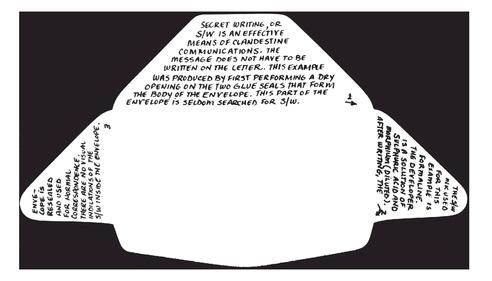
The underside of flaps of an envelope, shown here unfolded and after developing, were often used for secret-writing messages during World War II and afterward.
The two offices operated independently and competed for the limited resources available to produce the clandestine devices needed by agents and officers. With little quality control and without a coordinated research and development program, early CIA technical equipment was often in short supply and of uneven quality.
In October of 1950, President Truman, dissatisfied with the CIA’s intelligence following North Korea’s invasion of South Korea, appointed General Walter Bedell Smith as Director of Central Intelligence. Smith, in turn, appointed Allen Dulles head of clandestine operations, giving him the title Deputy Director for Plans (DDP) in 1951. All of the Agency’s operational components came under the DDP in January 1952.12 Dulles appreciated the value of technical equipment for clandestine operations through firsthand knowledge. As an OSS case officer, he had used devices supplied by Lovell’s R&D branch. He also understood that the CIA faced a problem of applying emerging postwar technologies to improve clandestine gear and deploy the equipment to field operatives.
Dulles first turned to Lovell, who had returned to the private sector, for advice in early 1951. The Professor Moriarty of the OSS responded by proposing a centralized technical R&D component within the Agency similar to the OSS/R&D division. This technical organization, working under the DDP, would develop technology for operations as well as conduct research on new capabilities that might contribute to intelligence gathering. The engineers would understand both the potential of new technology and how to apply it to clandestine requirements.
“Warfare is no longer a matter of chivalry but of subversion,” Lovell wrote to the man who would dominate U.S. intelligence for the next decade. “Subversion has its own special arsenal of tools and weapons. Only Research and Development is capable of creating such an arsenal.”13Lovell also advised that a central R&D component for the CIA should begin with a minimum staff of several hundred scientists and engineers.14
The recommendation found a receptive ear with Dulles and he assigned his special assistant, Richard Helms, to study the issue of technical support. In turn, Helms tasked Colonel James H. “Trapper” Drum, then head of the OAD, to produce a report with recommendations that addressed the problem. Four months later, Drum, a West Point graduate, who left the military a full colonel to join the Agency, produced a lengthy report that formed the foundation for a new approach to providing operations with technical support.
Known as Drum’s Bible, the report advised combining all technical elements responsible for supporting operations into a single organization directly under the DDP. Drum wrote to Dulles in August of 1951 that the proposed new office would “provide the tools of the trade required to support the operating components of the Clandestine Service.”15 As Lovell had recommended several months earlier, Drum envisioned a new organization with two primary responsibilities: centralized technical support to deliver gear needed by field operations, and research and development to improve collection capabilities.
Dulles accepted the recommendations and created a Technical Services Staff (TSS) with “powers and authorities” equivalent to those of the other operational offices in the CIA.16 On September 7, 1951, the DDP formally announced establishment of TSS, a small component numbering about fifty officers, with Drum at its head. Explosive growth followed. Within two years, the demand for TSS “products and services” was so strong that the staff expanded more than fivefold. TSS existed until July of 1960, and was then renamed the Technical Services Division (TSD).
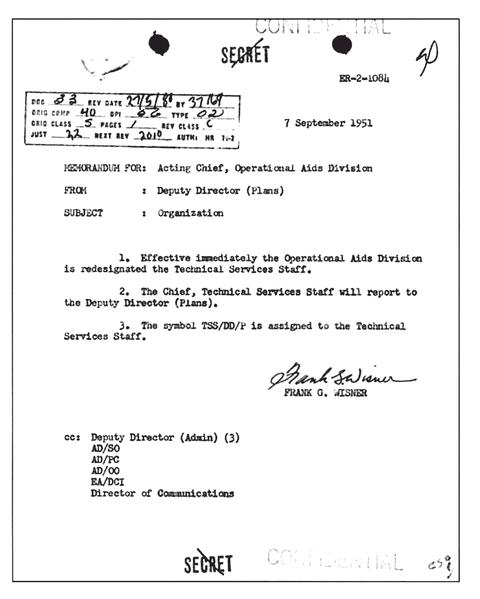
The OTS “birth certificate.” This official memo authorized formation of the Technical Services Staff on September 7, 1951.
It took nearly a decade for technical services to gain formal recognition as a DDP “division,” nomenclature previously reserved for components operating in particular geographic areas. However, before TSD celebrated its second anniversary, it faced the grim reality that the KGB’s counterintelligence capabilities far outmatched the ability of the CIA, using World War II tradecraft and technology, to run agents securely inside the USSR. Events that would teach those bitter lessons began promisingly in 1961 with a stream of spectacular intelligence reporting from a senior Soviet military intelligence officer, Colonel Oleg Penkovsky.