
CHAPTER 4
Soviet intelligence is over-confident, over-complicated, and over-estimated.
—Allen Dulles, The Craft of Intelligence
In nearly every respect, the Penkovsky case was a traditional agent operation. Relying more on the professionalism of the agent and handler than gadgets, the tradecraft employed differed little from what was used during World War II, and some methods, such as signal sites, dated back to the Old Testament.1 Penkovsky was briefed and debriefed in hotel rooms in London and Paris. These were cordial working sessions that lasted hours, filling the rooms with cigarette smoke, and then ending with the optimism of chilled wine and gracious toasts. In Moscow, Penkovsky used dead drops and brush passes to deliver his intelligence and, in one instance, used the overhead water tank of a toilet during a diplomatic function as a dead drop.2
Well-designed and properly executed dead drop exchanges are among the most secure means for agent communication. Brush passes, though less secure, are still relatively safe. However, Penkovsky conducted an excessive number of personal exchanges between October 1961 and January 1962, all with Mrs. Chisholm. Even more alarming, eleven of these exchanges were in public view and some were poorly executed and transparent to surveillance teams.3 The KGB’s Seventh Directorate surveillance officers later commented that while surveilling Mrs. Chisholm and her children in a park off Tsvetnoy Boulevard in 1961, they observed an elderly man approach one of the children and proffer a small box of chocolates. The young girl took the present to her mother who, without opening the box, placed it inside the baby carriage.4 To the KGB the act was suspicious, and the elderly man was later identified as Penkovsky.
Whatever shortcomings might have existed were not entirely without reason. There simply were no suitable devices on Agency shelves for this type of operation. For instance, as late as 1962 the CIA had yet to develop a small, reliable document copy camera for agents. Rather, Penkovsky relied on the commercially available Minox Model IIIs camera.5 Small enough to conceal inside a man’s closed fist, the Minox boasted an excellent lens that easily captured images of letters, memos, and pages from a book but could not be used covertly. The sliding shutter release required two hands, making it impossible to use inside an office or archive with anyone else present. Good pictures required even lighting, proper photo technique, and privacy.
The only item Penkovsky used that could properly be called advanced tradecraft was his “agent-receive” communications through a one-way voice-link. These encoded messages, known as OWVL, were broadcast over shortwave frequencies at predetermined times from a CIA-operated transmitter in Western Europe. Penkovsky listened to these messages on a Panasonic radio—strings of numbers read in a dispassionate voice—and then decoded them using a one-time pad. Although foreign consumer technology, such as a Panasonic radio, was rare in the Soviet Union, Penkovsky could display his openly in the small study of his apartment since the radio raised no questions of disloyalty for a senior officer in his position. However, the system only received messages and left him without a means to send a reply.
Penkovsky secreted his spy gear—one-time pads, Minox cameras, film, and commo plan—inside a clever homemade concealment built into a wooden desk in his study. All of this was eventually displayed in open court as proof of his covert activities.
In sharp contrast to Penkovsky’s basic spy gear was the sophisticated KGB technical surveillance operation that enveloped him after coming under suspicion. The KGB established three key points of observation to monitor his activities inside his home. The first was in the apartment directly above his, from which a KGB audio surveillance post monitored all conversations. A pinhole opening was drilled through the ceiling of his study from a monitoring post overhead and photographed Penkovsky with a special 35mm camera (codenamed LINOCK) while he worked at his desk.
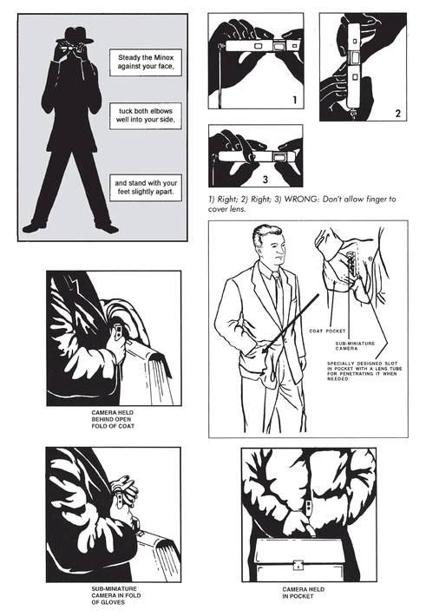
Minox subminiature concealment drawings. Covert photos with Minox cameras could be taken in a variety of circumstances but required user precision and experience to acquire high-quality pictures.
A second camera system, also from the apartment above, was mounted in the small balcony that overhung his window. Hidden in the concrete floor of this balcony was a camera and a small, remotely controlled trapdoor rigged to open and capture images as he photographed documents at the windowsill. The even light coming in through the open window, which overlooked the Moscow River, produced excellent images and he never imagined anyone could observe his activities.
The KGB set up a third observation post on the other side of the river in an apartment building facing Penkovsky’s apartment, at Naberezhanaya Maksima Gorkogo (Maksim Gorky Embankment) 36, Flat 59. From there, KGB cameras with telephoto lenses produced high-quality images of his photo sessions, even capturing Penkovsky at his desk as he monitored shortwave broadcasts and copied down the transmitted numbers.
After-action assessments following Penkovsky’s roll-up focused attention on the absence of effective spy gear, particularly in the area of agent communications. While in Moscow, his communication channels to his handlers were limited to dead drops and brief meetings. Silent phone calls were no more than prearranged emergency signals.
Technology did little to enhance either Penkovsky’s production or security. His remarkable success was achieved not because of technology, but despite the lack of it. His official position allowed him periodic travel outside the USSR and opportunities for extensive debriefings. Without these personal meetings, Penkovsky would not have been successful.
What became clear was that the CIA in the 1960s did not have the operational methodology, clandestine hardware, or personnel to run secure agent operations inside the USSR. The absence of a secure and clandestine means of communicating in Moscow forced both the agent and his handlers to take risks that eventually played into the hands of the KGB surveillance methods. The recruitment of agents inside the Soviet Union meant little if the KGB could quickly identify them or if they could not securely communicate the secrets to which they had access.
For agents to be handled clandestinely in-country, the CIA needed the means to detect and counter pervasive KGB surveillance before conducting an operation; to conduct secure impersonal communications; and to pass and receive materials securely from the agent. These were no small matters. In fact, a decade would pass before TSD and OTS engineers created the covert devices needed to conduct multiple sustained clandestine operations inside the USSR. Although neither side realized it at the time, Penkovsky’s capture marked the start of a fifteen-year span during which the technological advantage would swing decisively in favor of the CIA.
When Penkovsky volunteered to spy for the West, the CIA lacked the ability to handle him in Moscow. In contrast, the KGB and GRU packed Soviet embassies, consulates, trade organizations, trading companies, the United Nations, international organizations, and press offices around the world with intelligence officers and co-opted civilians, often to the annoyance of genuine diplomats.
For the few U.S. intelligence officers who could get into the Soviet Union, operational success was nearly impossible. While the Soviets could not accurately identify every U.S. intelligence officer, the KGB erred on the side of caution and assumed that all Americans worked for the CIA until proven otherwise.
The KGB’s Second Chief Directorate opened a file on each American and profiled each against age, gender, job description, personal activities, and possible intelligence roles.6
The KGB also charted “expected activity patterns” to go along with the profile that included predictable routes of travel to and from work each day. Even noted were the wives’ favorite place to shop or visit. Added to these were the necessary travel to sporting and cultural events, sightseeing, and social activities outside of work. They knew that activities outside the regular travel pattern could mask a more sinister purpose, such as an agent meeting, casing a site, or servicing a dead drop, and thus identify the suspect as an intelligence officer.
Americans also quickly learned that, contrary to spy novels and James Bond movies, obvious attempts to evade surveillance only proved counterproductive. Any aggressive action to escape the surveillance teams set off alarms among the watchers of the Seventh Directorate.
The KGB penalized its surveillance officers for carelessness, which included losing a person under close observation. So taunting, antagonizing, or making the surveillance teams’ job more difficult could result in dog feces being rubbed on car door handles or a smashed windshield. Particularly unnerving for most American drivers was a technique called bumper lock, in which the surveillance car remained literally inches from one’s rear bumper.
Provocations were commonly employed. Soviets posing as disaffected or greedy officials volunteered information in an effort to engage the CIA. These individuals, aptly called “dangles,” made it both difficult and essential to verify the authenticity of potential agents. Fortunately for the West, some of the most significant agents proved remarkably persistent in attempts to establish contact after their initial efforts were rebuffed.
If such caution toward volunteers was understandable, it could also lead to disaster. In 1963 a former officer in the KGB’s Second Chief Directorate,7 Aleksandr Cherepanov, handed a package to a pair of American tourists visiting the Soviet Union. Agency opinion differed on whether the material was genuine or part of a provocation. At the time, there was simply no way to tell.
The contents of the package, which provided details on KGB surveillance methods, were photographed and eventually handed back to the Soviets through diplomatic channels. Cherepanov, learning of the betrayal, fled Moscow. Eventually captured, he was tried in secret and executed in 1964.8
“It is not possible to determine why the Americans betrayed Cherepanov,” a KGB assessment observed. “Either they suspected that his action was a KGB provocation or they wanted to burden the KGB with a lengthy search for the person who had sent the package to the embassy.”9
Americans were closely observed even inside their own Tchaikovsky Street embassy. A ten-story structure erected in the 1950s as an apartment complex in a Russian version of beaux-arts style, it was typical of Soviet Union architectural design. The interior represented Soviet construction of the day, featuring a claustrophobic maze of narrow halls and small rooms.
American diplomats had been in the building since 1952, when Stalin ordered a move from Mokhaya Street near the Kremlin and the National Hotel to the more remote location. Had the Americans stalled, as the British managed to do, the move might have been unnecessary, as Stalin died a short time later.
Extensive renovation by the American occupants produced only limited improvements. American construction crews discovered that the walls and floors were insulated with sawdust, ash, and other debris from the original construction. Seemingly installed as an afterthought, the electrical wiring would have been state-of-the-art in the 1920s, but was inadequate for the power requirements of modern appliances.
Soviet citizens employed as workers by the U.S. Embassy had access to all but the most sensitive areas of the building. Working in low-level administrative, maintenance, or service positions, they reported on personal habits, personality types, and office gossip to the KGB. During the 1960s and 1970s, Russian nationals equaled or outnumbered American citizens working in the Moscow embassy.10 Conversely, the Soviet Embassy in Washington, D.C., did not employ a single American citizen.
The presence of so many Soviet citizens, a large percentage of them no doubt co-optees or informers, was not without its amusing moments. For two decades, a vivacious woman known as Valentina ran the barbershop and beauty salon in the embassy’s basement. No one doubted she reported to the KGB, but the situation became untenable when information regarding a KGB operation was traced back to her. Valentina was swiftly fired but returned to the embassy one last time when a group of her American customers hosted a going-away party for her.11
In addition to the ubiquitous informers among the embassy staff, pervasive technical surveillance within the embassy itself was discovered in 1963. A defector reported that the embassy was riddled with listening devices and the assertion carried enough credibility that an Agency sweep team was dispatched to find the bugs. For the majority of American diplomats, the embassy compound served as both home and office space. If the embassy was bugged, there was no limit to what secrets, personal and professional, the KGB’s microphones captured.
After the sweep team’s initial hunt for listening devices turned up nothing, Navy Seabees were flown in to conduct a physical search that included demolition of a sample office. Walls, floors, and ceilings were torn up without finding any trace of covert wiring. It was only after removing the cast iron steam radiator that squatted at one end of the room and dismantling the wall behind it, that the first listening device was discovered. Standing amid the wreckage of the demolished room, a tech pointed to an inch of protruding wood and asked, “Now, what do you suppose this is?”
Cleverly hidden behind the radiator, the device consisted of a hollowed-out wooden dowel positioned so its center was flush against a pinhole in the wall’s plaster. About a foot long, the dowel provided a clear air passage for sound to travel to a microphone concealed in an oversized brick on the building’s exterior. Wires from the microphone were not run through the interior walls, where they would have been more easily detected, but through the mortar of the exterior stucco façade and into the basement, eventually trailing off to a listening post.
Members of the sweep team marveled at the ingenuity. Low-tech dowels had defeated the West’s advanced metal detectors by placing the metallic microphone beyond range. Positioning the bug behind the radiator not only minimized the possibility of discovery, but also reduced the risk of the air passages being sealed by paint or plaster.
Given such realities, the psychological pressure on Agency personnel and their families throughout the sixties and seventies was especially intense. At times it seemed that the embassy took on a “through the looking glass” atmosphere. “You just assumed your apartment was bugged,” said the wife of a TSD tech. “The KGB came with the apartment, like the nanny.” Families needing privacy could go to “the bubble,” a Plexiglas-like box measuring ten feet by ten feet by six feet high in a sealed and shielded room in a section of the embassy off limits to Soviet nationals. The bubble, although facilitating personal conversation, served as a stark reminder of the extraordinary measures required to evade KGB listening devices.
The KGB capabilities extended to breaking into the safes of foreign embassies. Surreptitious entry teams used a portable x-ray device positioned over a safe’s lock to view the tumblers falling into place. The clever device came with one design flaw, the emitting of high levels of radiation that slowly poisoned its users. Within the KGB, members of these teams were known as bezzubyye, which roughly translates into “the guys with no teeth.”
Especially alarming was a case in the mid-1960s involving a foreign diplomat recruited by the Agency for a single mission: to load one dead drop site in Moscow. For the concealment package, TSD engineers fabricated a four-inch hollow anodized pointed aluminum alloy spike to hold a one-time pad and the agent’s commo plan. The cylindrical concealment was designed for quick planting at a precise location by simply stepping down on it, driving the spike into the ground and then covering the head with dirt.
However, the agent proved unreliable. Not only did he fail to load the drop but he also ignored security instructions. “We told him never to let the spike out of his possession because we had reliable information that KGB teams were going in and out of the safes in many of the embassies, including his,” said the officer who directed the operation. “But naturally, people didn’t believe us. They think this stuff only exists in the movies. So our agent stored the device in his embassy safe before returning it to his American contact.”
When the spike, still loaded with the one-time-pad and commo instructions, arrived back at Langley, the receiving CIA officer put it in his office safe. Several months passed before he got around to returning it to TSD. As he walked into the lab, a Geiger counter sitting on a nearby shelf sounded. The spike registered as highly radioactive.
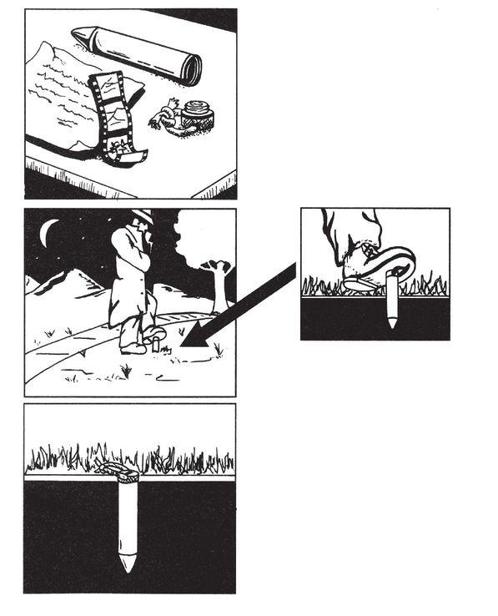
Illustration showing the emplacement of a hollow-spike concealment at a dead drop site in a park or wooded area.
The investigation that followed concluded that the KGB had entered the diplomat’s safe, removed the spike, extracted the contents, and impregnated the one-time pad with cobalt 60. It was estimated that the OTP contained enough radioactive material that a standard Geiger counter could register its presence through a brick wall. “That kind of experience makes counterintelligence very real,” said the officer in whose safe the spike had been stored. “When all of a sudden you realize you’ve been sitting eighteen inches away from a device emitting radiation for months, you understand what the Soviets are capable of. Anyway, the Agency’s Office of Medical Services gave me a lot of close attention for the next ten years.”12
For a decade after Penkovsky’s death the combined intense pressure from the KGB and scrutiny by the Agency’s own Counterintelligence (CI) staff caused a virtual cessation of agent operations in the Soviet Union. Headquarters placed severe limitations on recruiting and handling agents inside the USSR. Field officers could not instigate or engage in any operational activity without prior Headquarters review and approval. While officers could express opinions, by saying, for instance, “We don’t like that drop site because . . . ,” Headquarters made all final decisions.
Given such restrictions, recruiting agents in countries bordering the Soviet Union became the priority focus, but even those opportunities were so infrequent that any reasonable lead merited immediate attention. In 1968, a Russian-speaking case officer assigned to Headquarters received orders to make an immediate, unexpected a trip to Helsinki. There was a possibility that a Soviet target would become available. The officer waited in vain for a month in Helsinki for the Soviet to arrive, then returned home empty-handed. There was no other choice. With so few prospects, any potential opportunity received urgent attention.
Consequently, defectors, émigrés, and legal travelers to the USSR became important sources of intelligence. But these assets were, almost by definition, often far removed from the political and military centers of power or technical institutes. Only a spy near the center of power—given the ability to communicate securely with his handlers—offered the potential for a reliable stream of quality intelligence.
A tightly held secret among the elite of the CIA’s Soviet Russia Division and Counterintelligence staff was the reality that neither the United States nor its allies could confidently recruit and securely handle Soviet agents unless they were able to travel outside the USSR. Frustration over Moscow’s severely constrained operational environment remained with officers long after they retired. “I was in Moscow for two years in the mid-sixties following the loss of Penkovsky, and to my knowledge, we unloaded only one dead drop during that entire period,” said a veteran case officer. “In those twenty-four months I never had a ‘sit-down’ dinner or a private visit with a nonofficial Soviet. I spoke good Russian but was never invited to a Russian’s home. I traveled all over the country, and the only contacts I had were with people who, the minute they found out I was with the American government, either literally ran or turned their back on me and walked away out of fear.”
Those occupying senior positions at Langley shared the frustrations felt by CIA officers stationed in Moscow. “Our operations were criticized both by people who thought we were being duped and those who thought we were too timid,” recalled a Moscow hand. “There were others who thought it [running agents] wasn’t worth doing because the U-2 and satellites could gather intelligence just as well.”
“Soviet intelligence is over-confident, over-complicated, and over-estimated,” wrote Allen Dulles in his 1963 book, The Craft of Intelligence. Published the year following Penkovsky’s arrest, the assertion was more bravado than fact, as Dulles no doubt had full knowledge of the situation in Russia at the time.13
Dulles, however, was not blind to the potential of technology. Nearly a decade earlier, in the winter of 1954, a twenty-seven-year-old Technical Services Staff (TSS) officer received an odd proposition from the TSS chief, Willis “Gib” Gibbons. “He asked whether I was game for taking on an unusual job. I asked for a better description than that and, of course, didn’t get one,” the officer remembers.
The assignment turned out to be that of a technical tutor for Dulles, who had been appointed CIA Director by President Eisenhower in February of 1953. Dulles was not an unknown to the young tech. The two had met the previous autumn when the tech worked on another unusual job for the DCI’s security detail. As part of the construction of the new DCI suite, the tech installed several covert audio devices, including microphones in the ceiling hardwired to recorders in the security offices. He also installed a secret button on the DCI’s desk to summon a secretary should a visitor outlast his welcome.14
An intelligence officer of the “old school,” in which clandestine activity was conducted “nose-to-nose” or using easily understood devices, such as dead drops and concealments, Dulles realized that he was now involved in a technically complex world. Increasingly surrounded by engineers, including his deputy, Air Force General Charles P. Cabell, Dulles was determined to keep his knowledge relevant. He seemed to sense, even at this early stage, the advances in technology would shape Cold War intelligence as well as the CIA itself.
“Apparently Cabell stepped to the fore whenever anything technical came up, and Dulles didn’t like to be overshadowed,” the staff officer recalled. “The DCI wanted a technical education and needed it quickly. Basically, he was uncertain and somewhat afraid of the jargon—that sort of thing.”
As with many of his generation, Dulles was ill adept, if not ill at ease, with even simple technology, including his office telephone and intercom system. Born in 1893, he was part of the generation that bridged the nineteenth and twentieth centuries and witnessed the unfolding of technological miracles of a “modern world.” His generation was the first to experience the emergence of technology in daily life, in which the underlying science is neither intuitively apparent nor easily understood without some technical acumen.
The young engineer assigned as Dulles’s tutor was only three years out of college, and had a degree in physics and electro-mechanical systems. As he had done several times when making the DCI’s audio installations, he walked the two miles from the Technical Service Staff’s covert building on 14th Street near the Department of Agriculture to Dulles’s office on the second floor of South Building at 2430 E Street. Perched on a modest rise of land called “Medicine Hill,” the facility was a hand-me-down from the U.S. Navy. Several scattered buildings had sprung up over the years within the small fenced compound, which had also been the final Headquarters for the OSS.15 First home to the U.S. Naval Observatory, it then served as the Naval Museum of Hygiene, and the Naval Medical School with hospital facilities for sick officers. Now, in the mid-fifties, the complex was again pressed into service for a “spy agency,” though, by current standards, security was surprisingly relaxed.
“When I first went to see Dulles, I remember particularly the women who worked for him. They were an odd assortment. They struck me as being very grandmotherly old biddies but, in fact, were the sharpest creatures you would ever meet,” the technical tutor recalled. “They gave this very matronly appearance. They seemed thirty-five or forty years older than me. I was twenty-seven at the time and had an idea that they were somehow frail, elderly ladies. But once a man came to the office whom they knew intended to do bodily harm. He was one of St. Elizabeth’s [the nearby Washington Psychiatric Hospital] ‘walk aways.’ I watched them disarm the fellow, who had a pistol. They talked to him very calmly, very politely, and all of a sudden a big hulking security guy was behind him; then it was over quickly.” Inside the inner office, the tech found Dulles sitting behind an imposing desk. Bespectacled, gray-haired, and dressed in rough Scottish tweeds, he looked very much like the headmaster of a very good boarding school or a Wall Street lawyer at a prestigious firm (a job he had, in fact, once held). “I went in and introduced myself,” the TSS staffer recalled. “I asked him what he wanted to know, exactly, and he said, ‘I don’t have the slightest idea, just start broad.’ So, we talked about physics, and we talked about chemistry.”
Over the next nine months, the tech and the DCI engaged in nearly two dozen sessions. Dulles, ever the spymaster, was effectively debriefing the junior engineer. What started out with principles of pure science soon narrowed to specific questions or requested tutorials regarding particular technologies, such as Doppler radar or sonar. “In hindsight, I know this was at a time when he and the Air Force were arguing about the U-2. I don’t doubt that his deputy, General Cabell, was pushing the Air Force view, rather than Edwin Land’s view, which was more aggressive as to what could be done,” said the engineer. “Perhaps Dulles was beginning to feel that he was being cut out.”
Land, founder of Polaroid, was heading an intelligence subpanel of distinguished scientists on long-range missile development. He, along with Massachusetts Institute of Technology president James Killian, proposed a technologically ambitious overhead reconnaissance role for the CIA while the Air Force was advocating a more conservative approach. In the end, President Eisenhower approved plans for the more advanced plane championed by Land and Killian, eventually code-named U-2. The project was put under CIA control and the aircraft designed by the legendary Clarence “Kelly” Johnson at the Lockheed “Skunk Works” outside Los Angeles, California.
Dulles began his scientific push by forming the CIA Research Board in 1953. Comprised of prominent scientists and business leaders, members of the Research Board included Land and Rear Admiral C. M. Bolster (ret.) of General Tire and Rubber Company, with Navy Rear Admiral Luis de Florez serving as chairman. “They’d come in for a day or so, and Dulles would entertain them at the Alibi Club,” said the Advisory Board’s secretary at the time. “Many of the sessions were very informal. He—Dulles—liked the informality. Once we had oysters, and I mean they brought in bushels, put them on the table and everyone pitched in, with a trash can next to the table and plenty of beer.”
It is not difficult to imagine Dulles’s likely methodology. As the case officer, Dulles was debriefing and building networks—essentially conducting an intelligence collection operation on the giants of industry and the “technologists” driving the aerospace and electronics revolutions.
If Dulles’s pursuit of technical briefings seemed prescient, he was not alone. Other prominent national security experts saw substantial opportunities to use technology for intelligence objectives. In 1955, Air Force general and World War II hero James H. Doolittle, working at the request of President Eisenhower, led a small team in preparing a confidential report on the state of America’s intelligence capabilities.16
The sixty-nine-page report took just eight weeks to complete, and its conclusions sounded an alarm:
The usable [intelligence] information we are obtaining is still far short of our needs . . . [Therefore] the U.S. should [utilize] every possible scientific and technical avenue of approach to the intelligence problem . . . We must develop effective espionage and counterespionage services and must learn to subvert, sabotage, and destroy our enemies by more clever, more sophisticated, and more effective methods than those used against us.
Whether Doolittle sensed that technology could transform human spying, or concluded, as did a growing number of scientific thinkers, that technology applied to intelligence collection could replace traditional spying, is moot. The intelligence strategy of America would swing toward big technology programs. Technical collection—early satellite photography, spy planes, and signal monitoring—born in the 1950s and nurtured in the subsequent decades, soon became the focus for America’s intelligence investment, beginning with the Corona satellite program. This was “Big Technology” done in a big way, and with big budgets.17
Corona, a photoreconnaissance satellite conceived in 1946 by the Rand Corporation, was launched in February 28, 1959. The first flight failed, as did the next eleven attempts. On the thirteenth test launch, the low-orbiting satellite was a success and its engineering payload recovered. Then, on August 18, 1960, the fourteenth Corona test launch took images of the USSR from space and, the following day, successfully ejected the film canister over the Pacific Ocean for retrieval by plane in midair.18
Carried within the canister were more than 3,000 feet of exposed film that captured a million square miles of the Soviet Union, providing intelligence officials with their first look at vast outlying areas of Russia. There could be little doubt that U.S. intelligence had dramatically changed since August of 1949 when the Soviets detonated their first nuclear device. Then, intelligence analysts rummaged through Herbert Hoover’s Presidential archives at Stanford University, a collection dating back to the former President’s days as a mining engineer, looking for a map of the Ural Mountain region where the blast occurred.19 Now, with the satellite pictures, analysts had current images of precise areas of interest.
As Big Technology, with its big budget satellites and aircraft began operating against the Soviet Union, classic tradecraft struggled for relevance. The Big Technology programs attracted scientists, inspired technical creativity, and pushed engineering, literally and figuratively, to new heights. Satellites in the skies were viewed as less susceptible to the kinds of risks and unpredictability that plagued spies on the streets. In the minds of some, “technical collection” was untainted by the moral, ethical, and diplomatic entanglements associated with human espionage.
Satellites would not be arrested in the hallways of Moscow apartment buildings nor were they likely to cause international incidents. Satellites had no motive for betrayal and did not require reassurance and flattery. Moreover, if the satellites that delivered images cost billions of dollars, it was not because of some foreigner’s personal greed. Yes, satellites might have mechanical failures, but they did not quit working out of fear or disillusionment. They did not violate the territorial integrity of the Soviet Union while photographing facilities whose guards would shoot a trespasser. As long as they had fresh film, fresh batteries, and a cloudless sky, they delivered the otherwise unattainable: nonpoliticized data.
There were, to be sure, limitations. A satellite could capture the image of missiles deployed to remote areas, but seemingly endless spools of film and powerful lenses could not divine the intentions of Soviet leadership. It could see submarines in their pens at the Severodvinsk naval base, but could not penetrate the roofs of government labs in Moscow and Leningrad to record images of the future weapon systems spread out across the drawing boards of engineers. Nor could it see into the minds of the Politburo or capture the complex internecine dynamics of Kremlin leadership. Only an agent inside the Kremlin could do that.
Pictures neither lie nor reveal the complete story. With the early successes of the photoreconnaissance satellites, American leadership also desperatelyneeded to know more about what Soviet leaders were thinking and planning. At no time was this more publicly apparent than during the 1960 U.S. presidential election.
Democratic presidential nominee John F. Kennedy charged that Republicans were insufficiently attentive to national defense. How could the Republican administration, asked the Democrats, have allowed the United States to fall so woefully behind in this critical area? Backed by imprecise Pentagon estimates and Soviet Premier Nikita Khrushchev’s tough talk, the issue touched a nerve with American voters. Eisenhower, of course, was basing his moderate Soviet policy on secret U-2 photographs, which would support his position, if made public. The U-2 photographs appeared to provide convincing rebuttal to the argument that the Republicans were weak on national defense, but without credible corroboration, their interpretation was hotly debated. National Intelligence Estimates of Soviet missiles showed an alarming increase in capability and numbers, with the U.S. lagging behind. 20 The phrase “missile gap” entered the national vocabulary.
What the American public heard were Khrushchev’s exaggerated claims and Kennedy’s allegations against the Republicans. Two years later, intelligence provided by Penkovsky, combined with satellite photographs, prompted a downward revision of the official estimate of Soviet missiles during Kennedy’s presidency.21
Knowing Soviet capabilities with certainty was impossible. A totalitarian state such as the USSR possessed a large advantage over an open society in its centralized control of media and citizens. Within the Soviet Union, even road maps and railroad schedules were routinely falsified. Conversely, in any edition, The New York Times, the Washington Post, or the Wall Street Journal provided more reliable accounts for the Soviets on the thoughts and motives of the American leadership than U.S. intelligence could tell the American President about events within the Soviet Union. Farm reports, stock prices, economic statistics, and dozens of other sources of information, freely and widely available in the United States, revealed data that the USSR either held as a state secret or purposely distorted.
The Iron Curtain was a geopolitical one-way mirror. Soviet leadership could see out if they wanted, but American leadership, desperate for the smallest glimpse, could not see in. During the darkest days of the Cold War, the intentions of the Kremlin leaders remained obscure at best. The placement of Soviet officials on the reviewing stand atop Lenin’s mausoleum in Red Square during May Day festivities, combined with whatever grainy photos military attachés could get of the Soviet Army’s parade of military equipment, became objects of intense analysis for Western intelligence organizations. Anxious for any information, analysts considered nothing too trivial for scrutiny. The practitioners who studied such minutia had a professional name, Kremlinologists.
However, a small but growing cadre of officers emerged within the CIA who argued that new tradecraft based on advanced technology could be applied to operations on the streets of Moscow just as had been done in the skies above the USSR. These officers, subjected to Soviet counterintelligence tactics behind the Iron Curtain for more than a decade, had acquired a substantial body of operational knowledge that could be used to counter the seemingly invulnerable KGB.22 They argued that if new tradecraft methods, combined with yet-to-be-invented spy gear, were developed and applied selectively, then the KGB’s surveillance stranglehold in Moscow could be broken. This post-OSS generation of case officers found eager allies in Seymour Russell, Chief of the Technical Services Division (TSD), and his operationally oriented scientists and engineers.23