
CHAPTER 6
The Game is so large that one sees but a little at a time.
—Rudyard Kipling, Kim
Russell saw a new role for technology, particularly in its potential for enhancing agent communications. For a spy the greatest danger usually is not stealing a secret, but rather, passing it to his handler. Covert communication (known as “covcom”) dominated operational planning. Without the means to transfer information securely between agent and handler, espionage could not exist. The most secure covert communication system was an impersonal exchange that separated the agent and case officer by distance, time, place, or some combination of the three.
The tradecraft lexicon is filled with colorful phrases for impersonal exchanges of information. The best-known method, and most widely used, is called dead drop by the CIA, taynik by the Soviets, and dead letter box by the British.
Another personal exchange, the brush pass, requires the agent and handler to walk close enough to each other so that a note or package can be dropped or passed quickly and discreetly. The drop might be made into an open shopping bag or handed off folded into the morning’s newspaper. The car toss, a variation of the brush pass, involves throwing a package through the open window of a slowly moving vehicle.
What these pieces of tradecraft have in common is the goal of minimizing the time agent and handler spend in the same space at the same time. With some techniques, such as with the brush pass, the time is reduced to a fraction of a second. Nevertheless, even the seemingly insignificant half second required to make a successful brush pass brings the agent and handler to the same place at the same time. In hostile areas, such as Moscow, mere proximity of two individuals could arouse suspicion. Was it possible that in Moscow, a city of millions, an American would, by chance, bump shoulders with a leading scientist on a streetcar? The KGB would not believe in such chance encounters. Their view might well have been derived from the legendary New York Yankees catcher, Yogi Berra, who is reputed to have said, “That’s too coincidental to be coincidence.”
Dead drops, a preferred means of covert communication in denied areas, separate the agent and handler by time, but carry the risk of leaving the package unattended in an environment that could change without warning. A concealment package left at the site could be found by an unwitting passerby or buried by an unexpected snowstorm. The act of loading or clearing the drop site if it appeared unnatural could draw suspicion.1
Russell, the case officer, now surrounded by engineers, proposed a solution for improved agent communications that was both ingenious and technologically elegant. A TSD audio surveillance engineer remembered receiving an unexpected call from the chief. “Russell called me up one day in early 1963 and said, ‘I was just thinking last night: If you compromise your audio operation by telling the agent where a hidden microphone is, he can talk near it and you have a one-way communication system.’”
Soon afterward, techs began suggesting to case officers that audio devices or bugs, previously used exclusively for audio surveillance, could become a one-way communication system if an agent knew he could be heard through a concealed mic and transmitter.2The result became known as an audio dead drop. In one western European city, TSD techs planted a microphone in a tree in a park. To communicate with his handler, the agent “talked to the tree.” “I remember one time, we bugged the exterior of a building, so our guy could pause at the corner of the building, say whatever he had to say and keep on walking,” a TSD staffer recalled. “We really got involved in that. Audio dead drops took off like gangbusters once we started, and it all began with Russell.”
Imagining a dignified diplomat pausing and muttering a few words into a tree trunk seems comical. Yet, the humor is overshadowed by considering how dramatically this new capability expanded the options for communication beyond the chalk marks for signals or loading and unloading dead drops, the level of tradecraft employed by Penkovsky. However, even with the clever audio dead drop, two-way impersonal covert communications inside the Soviet Union remained the prize, a necessary weapon to counter the massive security apparatus of the KGB’s Second and Seventh Directorates.
Taking on the KGB inside the USSR began modestly when TSD launched operations to identify the postal censorship techniques used by the Soviets to monitor and examine both internal and international mail. In one basic method of covert communication, an ordinary letter with standard text could also contain a hidden message in secret writing. Mixed in with millions of pieces of mail, cover letters with nonalerting descriptions of vacations and family news could be virtually undetectable. Since World War II agents working for U.S. intelligence had routinely written and received hundreds of secret writing messages from most areas of the world. But the Soviet Union was different from “most of the world.”
The KGB watched the mail going in and out of the USSR assiduously. Soviet postal censors were well aware of SW techniques, and the KGB un-apologetically opened and inspected the mail of its citizens and foreigners alike. However, since even the KGB could not open, read, and test every single letter, the TSD staff theorized that the Soviets must have censorship protocols. If TSD could understand the systematic organizational sieve that captured and flagged suspicious letters, then they could defeat it.
“For us the question was always: What is the decision process that gets a particular letter routed to the KGB’s chemist inside Moscow’s Central Post Office? Once that happened, once the letter is suspect, and your guy, whether sender or receiver, is in trouble,” said a TSD staffer. “Their chemist may not have confirmed it yet, but there was something, an anomaly, that the first-line postal censor, who is not a chemist, sensed or saw. Why did he pull that letter aside? Why was that one sent over there to the chemist?”
In an exercise called probing, TSD staffers directed the mailing of hundreds of test letters in and out of the Soviet Union with a seemingly endless number of permutations including: date and time of mailing, site of postal box, country of destination, type of letter or postcard, and whether it was written or typed. Probing continued for several years with the letters varying in language, size, and style. Letters were sent from the United States to East European and Russian addresses. Letters were sent from those denied areas to accommodation addresses, known as “AAs,” in Europe and the United States.3 Many AAs were the homes of ordinary citizens recruited for the sole purpose of receiving mail from unknown parties. Once the mail was received, the recipient would call a number alerting the Agency of its arrival and requesting pickup.
The letters were delivered to TSD for examination and analysis. Envelopes were screened for markings, fingerprints, and opening techniques, as well as traces of chemicals that could have been used by the KGB to test for secret writing. Small details, such as the positioning of fingerprints along the perimeter of the paper, revealed valuable clues about the level of scrutiny given a particular letter.
“I traveled to Leningrad and then to Prague, just looking at transit times. One item, like a postcard, came through in about two days; sealed items came through in about two weeks,” recalled one member of TSD’s probe team. “We began to get a real good feel for what various countries were doing with censorship. The project gave us something solid to take to the Soviet Russia Division officers and recommend, ‘Use this technique for mailing from these cities.’ We had real postal data that the case officers wanted to hear and could use.”
Transit times of letters, postcards, and other commonly mailed items may seem a prosaic detail of intelligence, yet in this way TSD began chipping away at the massive KGB security apparatus.
It took years of efforts by the engineers to make even modest progress. George Saxe had an engineering degree when he was recruited into the Agency directly out of college in 1951. Like most new CIA officers of the time, his career path was not something he anticipated, although the happenstance manner that launched his twenty-five-year service in espionage remains one of his favorite stories.
As an engineering student in the Southwest, Saxe had high hopes for a corporate career in a solid company like Westinghouse or General Electric. It was during his senior year, facing a tight job market, that George spotted a recruitment notice on a campus bulletin board. Turning to a friend, he asked, “What do you think the Central Intelligence Agency is?”
President Truman had established the Agency four years earlier, but the organization had little visibility outside of Washington. George, with no better employment prospects on the horizon, signed up for the interview. When he arrived at the interview, George had no hint that the man seated across the table from him had introduced himself with an alias or that it was not George’s engineering skills that made him an attractive candidate.
“The guy had scars all over his face. And I’ve got papers with my grades and the courses I’d taken, and I’m ready to talk about engineering—what I’ve been studying for the last four years,” remembered George. “The first question was, ‘I understand you’re on the pistol team?’” George, as it happened, was the captain of the team and regularly posted the highest scores.
“The next question was about whether I ever handled a small boat. Now, this is in a setting where I’m the young engineer looking for my future career,” George said with a laugh. “Then he looked at me kind of intently and asked, ‘What do you think about jumping out of airplanes?’”
Truthfully, George had not thought about it all that much, but answered that he imagined he could do it. After a few more questions, the interviewer invited George to the campus hotel for a follow-up conversation. “I got there and the first thing he does is haul out a bottle of bourbon, which was not allowed on campus. So, that was my introduction. This was not exactly interviewing for a position at Westinghouse.”
Nor was Saxe interviewing for an engineering job. The CIA’s interest in George came from its covert paramilitary work to counter a potential Soviet invasion of Western Europe. Soviet-U.S. tensions had not yet coalesced into their four-decade Cold War standoff and all forms of military action seemed possible, if not likely.
“In the early 1950s the Joint Chiefs of Staff and National Security folks—everybody who thought they knew anything about the strategic situation in the world—believed the Red army was going to cross the Rhine River,” said George. “So my first tour in Germany had nothing to do with recruiting spies and everything to do with the Soviet Union. I was caching—burying—arms and demolitions for stay-behind teams to wage covert operations against the invading Soviets, like the French resistance during World War II. After a year, I had to fill out a reassignment questionnaire: Where did I want to go next? A fishing buddy of mine said, ‘Wouldn’t it be neat to go to Alaska?’ We got what we wanted. Alaska, not yet a state, was one of Soviet-Russia Division’s field locations.”
Assigned to Alaska with his fishing buddy, George became the most supervised employee in the CIA. As the only case officer in Anchorage, he was managed by both the Chief of Station and the Deputy Chief of Station. The three were there because Alaska, like Germany, was seen as another critical point into which the Soviet Union could launch hostilities. From a base just across the Bering Strait, Soviet pilots would regularly probe the Distant Early Warning line of U.S. radar and other air defenses protecting the U.S. western and northern borders. However, when budget cuts hit the tiny intelligence outpost a year later, George was ordered back to Washington where, on that early November day in 1962, he deciphered the message that signaled Penkovsky’s capture.
George spent the next two years in SR Division, running a modest number of peripheral operations and learning passable Russian before securing a Moscow assignment where he worked for two stressful but operationally uneventful years. Returning to Headquarters in the mid-sixties Saxe found a changed attitude in the SR Division. Despite the paralysis that gripped operations against Soviet targets, there was a new determination within the ranks of the SR officers to challenge the KGB on its own turf. The idea was to begin taking some risky, but carefully calculated initiatives that would, with luck, lead to productive operations.
Shortly after Penkovsky’s arrest, with Moscow operations all but dried up, a Soviet engineer had walked into an American Embassy outside of the USSR and offered his services. By way of bona fides, he brought with him images that detailed Soviet missile capability. With pressure not to make a mistake, the station provided the “walk-in” with a basic commo plan that included instructions on how to receive shortwave coded messages via OWVL, but no follow-up contact was authorized.
The lead had grown cold by the time George learned of the case. Sensing that an opportunity to reactivate the proposal remained, Saxe received approval to initiate an operation. No one gave him much chance of success, and the passage of time had only complicated an already complex situation. Even if the walk-in wasn’t a provocation, even if he could be recontacted, and even if he responded, the Moscow office had little ability to sustain communications.
Added to these problems was the fact that the volunteer had specified that he could provide detailed technical intelligence, specifically engineering drawings. It was difficult enough to pass printed or handwritten documents securely inside the USSR, but large blueprints presented special problems. Technical drawings could not be paraphrased or readily copied by hand, and they could not be removed from the facility for any significant length of time without triggering security alarm bells.
Out of necessity, the plan George developed departed markedly from operational tradition. First, the operation would be run not from the Moscow office, but out of SR Division at Headquarters. Second, there would probably be no face-to-face meetings. In all likelihood, the agent would never again talk with an American.
George was determined that the operation be handled exclusively through impersonal communications to lower both the political and security risks. “What would happen if this turned out to be a provocation? We could lose one of our few case officers in Moscow. And then what happens? It goes up to the Secretary of State who calls the Ambassador,” explained George. “What does the Ambassador do? He raises holy hell. He yells at the office chief, ‘You CIA cowboys are out there upsetting Soviet-U.S. relations! We have enough trouble with the Soviets without you jackasses going out and doing something on the street with a guy you know nothing about.’”
Aside from the risks of a diplomatic flap, there was also the safety of the agent to consider. The material was so specialized that if the KGB intercepted it, the agent could quickly be identified as the source.
George, although a case officer, was still an engineer at heart with a natural affinity for TSD. Working with the techs, he devised a one-of-a-kind communications plan. “For two years I spent half my time working on this one guy and working with TSD people,” George recalled. “The agent had access to a laboratory where blueprints for missiles were reproduced, and he could get 35mm reproductions of their engineering drawings of missiles.”
The plan that TSD engineers and George eventually devised was not simple, but ensured the safety of the agent.
TSD mail probes of the Soviet postal system had shown that a nonpolitical, inoffensive message from an American tourist on a postcard back to the U.S. attracted little attention from the censors. Conversely, a postcard or letter from a Soviet citizen going overseas warranted a more careful look. Without revealing the source or purpose of the request, encouragement went out to U.S. officials in Europe to buy black-and-white picture postcards, common across the Soviet Union, whenever they were traveling in the country. The postcards, of the variety favored by tourists, featured images of Russian landmarks, such as the Hermitage, the Kremlin, and Red Square. The postcards were sent to Langley and filled out by staffers with messages typical of an American tourist visiting the Soviet Union. The cards were then returned to the Soviet Union and dead dropped to the agent for use with his new commo plan.
Addressed to accommodation addresses in the West, the recipient’s only connection to the Agency was a “sterile” phone number to call when a card arrived.
The dead drop for the agent also contained a long portion of what TSD engineers called “stripping film.” Originally created for satellites, the high-resolution film was eventually rejected for the space-based program because the thin, light-sensitive emulsion layer was easily peeled away from the thicker plastic backing. Once separated from the backing, the film resembled the type of clear plastic wrap used to keep leftovers fresh in the refrigerator. Big Technology’s excess film became TSD’s operational treasure.
To create a covert image, the agent would transfer a standard 35mm image onto the larger-format stripping film by making a “contact print.” This involved placing 35mm negatives of the missile plans firmly against the stripping film and briefly exposing them to light. After developing the large-format film, the agent then bleached the image to a nearly transparent white and stripped away the backing. If done with precision, one postcard-sized transparency would hold up to nine 35mm images. In the final step, the agent fastened the clear plastic film to the front where the detailed diagrams, now bleached on the film’s emulsion, vanished against the images of Russian tourist attractions. The finished product, which looked like any other postcard printed on glossy paper stock, would attract little notice from the postal censors. However, the agent had to accomplish all this in his tiny Soviet apartment that offered little or no privacy.
Since mating a covert picture with a postcard was a complex procedure, George, the engineer, spent two weeks learning the process before writing up step-by-step instructions in Russian.4 He went back and forth with native Russian linguists on every word to confirm that the message would be clearly understood. Satisfied that he had both mastered the technique and accurately described the process in Russian, George turned his attention to the trusted one-way voice link radio. A brief OWVL message told the agent that a package had been put down at a secure dead drop site. Inside the package, the agent found his instructions:5
IN THIS PACKAGE WE HAVE INCLUDED A ROLL OF SPECIAL “STRIP-PING” FILM OF APPROXIMATELY 90MM. OPEN THIS FILM PACKAGE ONLY IN A DARK ROOM USING A SAFELIGHT. USE THIS FILM TO MAKE CONTACT COPIES OF YOUR 35MM NEGATIVES WHICH YOU WISH TO SEND TO US.
CUT OFF A PIECE OF THE FILM, SLIGHTLY LONGER THAN A PHOTOGRAPHIC POSTCARD. ARRANGE AS MANY OF YOUR NEGATIVES AS POSSIBLE ON THIS PIECE OF FILM (EMULSION TO EMULSION WITH THE 35MM NEGATIVES ON TOP). BE SURE THE 35MM IMAGES DO NOT EXTEND BEYOND THE SURFACE OF THE POSTCARD.
USING A 100 WATT LIGHT BULB POSITIONED ONE METER ABOVE THE 35MM NEGATIVES, THE EXPOSURE TIME SHOULD BE A FEW SECONDS. WE HAVE PROVIDED YOU WITH EXTRA FILM SO THAT YOU CAN EXPERIMENT TO OBTAIN THE BEST EXPOSURE TIME FOR MAKING GOOD COPIES.
DEVELOP THE EXPOSED FILM USING ANY HIGH QUALITY FILM DEVELOPER AVAILABLE TO YOU. ONCE YOU HAVE DEVELOPED, FIXED, AND WASHED THE FILM CONTAINING COPIES OF YOUR 35MM NEGATIVES, THEN PROCESS THE FILM IN A BLEACHING SOLUTION UNTIL THE 35MM IMAGES ARE TOTALLY BLEACHED OUT AND THE FILM IS AGAIN COMPLETELY CLEAR AND THERE IS NO SIGN OF THE LATENT 35MM IMAGES. WASH THE FILM THOROUGHLY.
PRACTICE THIS PROCEDURE USING A BLANK CARD (NOT ONE OF THE PRE-WRITTEN POSTCARDS WE HAVE PROVIDED YOU) UNTIL YOU ARE FAMILIAR WITH THE ENTIRE PROCESS AND ARE SATISFIED WITH THE FINAL APPEARANCE ON THE PRACTICE POSTCARDS.
CAREFULLY DAMPEN THE PICTURE SIDE OF A POSTCARD WITH WATER TO SOFTEN THE PHOTOGRAPHIC EMULSION, TAKING CARE NOT TO WET THE OPPOSITE SIDE OF THE POSTCARD WHERE THE HANDWRITING WOULD BE. THEN WHILE THE PIECE OF SPECIAL FILM IS STILL DAMP, GENTLY SEPARATE THE EMULSION FROM THE FILM BACKING. THIS “STRIPPING” FILM IS MANUFACTURED TO ALLOW REMOVAL OF THE EMULSION WITHOUT DAMAGE. PLACE THE EMULSION SIDE OF THE POSTCARD SO THAT THE SURFACE OF THE EMULSION WHICH WAS FORMERLY IN CONTACT WITH ITS FILM BACKING IS NOW IN CONTACT WITH THE POSTCARD EMULSION. STARTING AT THE CENTER OF THE POSTCARD AND WORKING TOWARD THE EDGES GENTLY PRESS OUT ANY AIR BUBBLES OR EXCESS MOISTURE TO ENSURE COMPLETE CONTACT. PLACE THE POSTCARD ON A SMOOTH, FIRM, DRY SURFACE, AND THEN PLACE CLEAN BLANK SHEETS OF ABSORBENT PAPER ON TOP OF THE POSTCARD AND ADD A BOOK OR SOMETHING SIMILAR TO ALLOW THE POSTCARD TO DRY WHILE PRESSED FLAT.
WHEN THE POSTCARD IS COMPLETELY DRY, TRIM OFF EXCESS FILM EMULSION ALONG THE EDGES OF THE POSTCARD AND CAREFULLY INSPECT THE POSTCARD TO ENSURE THAT IT APPEARS NORMAL IN EVERY WAY AND THAT THERE IS NO SEPARATION OF THE FILM EMULSION FROM THE POSTCARD.
WHEN YOU HAVE PREPARED ONE OF THE PRE-WRITTEN POSTCARDS, ADD THE APPROPRIATE STAMP, MAIL IT IN AN AREA THAT IS VISITED BY FOREIGN TOURISTS.
UPON RECEIVING ONE OF YOUR POSTCARDS, WE WILL RECOVER YOUR 35MM IMAGES USING ANOTHER PROCEDURE.
Each element of operational planning and preparation had required time-consuming, exacting attention to detail, but the work paid off. Images of top-secret Soviet missile blueprints began arriving in U.S. mailboxes in large cities and rural communities. The recipients, who had agreed to help the Agency out of a sense of patriotism, could not have suspected that some of Moscow’s greatest secrets were passing through their hands.
At Langley, the bleached images of engineering drawings were reconstituted at TSD using specialized equipment to produce high-quality prints. The first batch of images convinced both counterintelligence and Soviet-weapons analysts of the agent’s access, and as production continued, the operation was declared a major intelligence success.
The stream of technical information on Soviet missile design came at a point in the Cold War when knowledge of missile capability was a major requirement for the intelligence community. Yet the most serious operations have lighter moments. During one briefing, George sat in a conference room with ten analysts studying a copy of missile design blueprints. “I remember we couldn’t read every digit. The analysts were looking for serial numbers and parts numbers and those types of things. As hard as they tried they couldn’t be confident of every letter and number. Finally in frustration one of the analysts blurted out, ‘I hate to be critical of you guys in operations, but for Christ’s sake go out and buy the guy a better camera.’”
George recalled, “The analyst is thinking that we handed this guy a cheap Pentax camera. I remember what we went through to get those images back and what the techs had to come up with technically and operationally. Think about what the agent had to do and the pressure he was under. So all I could do is laugh when this analyst offered a solution to the part of the problem he saw. ‘Spend an extra three hundred bucks and get us a little bit clearer image. ’”
Later, as the operation matured, the agent communicated that he would be visiting a missile test site and offered to try to recover a piece of a spent missile. Soviet military materials were veritable “gold” for Department of Defense and CIA weapons analysts since the material’s composition could yield otherwise unobtainable intelligence about a weapon’s capability, design, and production processes.
The agent advised that officials of his rank traveling on government business were allowed to buy quantities of goods and foodstuffs from regions outside the cities and bring those purchases back home. This made it common practice for officials to travel with large empty suitcases to fill with local items such as meats, cheese, fish, vegetables, and other hard to obtain delicacies. The area of the missile test range, the agent noted, happened to be famed for its herring, exactly the type of fish that his family enjoyed. Since he would take two large cases to fill with herring for family and friends, there would certainly be enough room in one of them for a small piece of rocket assembly.
So important was the acquisition of a fragment from an operational missile that Langley approved a high-risk clandestine moving-car delivery on the streets of Moscow. The plan instructed the agent to arrive at a predetermined site in an alley that also served as a through street. The alley had no lights and the meeting would be scheduled for a moonless night. The agent, carrying a shopping bag, would hide the missile part under whatever was available at the market that day and remain at the location no longer than five minutes.
On the appointed afternoon, an American whose pattern of activity frequently involved early-evening shopping and a drink at one of the hotels catering to Western businessmen drove away from his house. As usual, KGB surveillance fell in behind the car, maintaining a polite distance.
For more than three hours, the American attended to routine activities with surveillance trailing behind. After finishing a nightcap consisting of more tonic than gin, he headed home at an unhurried speed. With surveillance hanging back at a steady fifty meters, the American assured himself there was ample distance for what would come next. After five more minutes of driving, surveillance did not close the gap. Apparently they were not going to “bumper lock” this evening, but neither were his KGB watchers going to abandon their surveillance. With both cars maintaining their respective speeds, the American concluded the surveillance vehicle was far enough back. This was the moment. If wrong, he would be signing the agent’s death warrant.
Making an abrupt right turn down an alley that served as a shortcut to his house, the American’s car was shielded temporary by three-story buildings on either side for a few seconds. Surveillance could see neither the brake lights blink nor the car’s three-second pause in the darkened alley. As the KGB team rounded the corner, the American was driving just a bit slower due to the narrowness of the alleyway and a few minutes later parked at his residence.
The next morning’s report by the surveillance team no doubt included details of an uneventful evening. No mention would have been made of a darting shadow that appeared from a hidden doorway at the very instant the American’s car turned the corner or that an old shopping bag was dropped through the open window on the vehicle’s passenger side.
That same morning George smiled as he deciphered an ops cable advising that a courier had departed Moscow that day for Washington with a special delivery. His package weighed somewhat more than normal for hand luggage and had a slightly fishy odor.
In part, because of his work in developing the sophisticated commo plan that yielded the valuable missile diagrams, Saxe was appointed special assistant to the chief of Soviet Operations in 1967. This new post not only took advantage of Saxe’s skill at creating commo plans, but also his ideas about using technologies that could finally make operations possible inside the USSR.
Sid Gottlieb, now heading TSD, recognized in George exactly the kind of ops officer that would assure the long-sought “relevance” of TSD to operations. George was one of the few case officers in the Soviet Division willing to spend time on technology and agent communication. While most of his colleagues wanted to make their career in recruiting agents, George possessed no aspirations to become the DDP or the DCI. He genuinely liked the techs and saw the value in what they could do for operations.
Six miles away from Langley, across the Potomac River at the TSD headquarters, George was able to translate the basic concepts of denied-area operations to TSD engineers who possessed little, if any, operational experience. The quandary was how to reveal the needed information about an operation without violating compartmentation. Seemingly minute details, such as an agent’s military rank or nation of origin, could breach security.
But without those basic facts, how could TSD techs know what type of camera to propose? Issuing a $1,200 camera in 1970s to an agent inside the USSR would surely attract unwanted attention. Suspicions might also arise if the agent, who had not been abroad, suddenly acquired equipment not available on the Moscow market. These were precisely the small but significant details TSD needed to understand. The techs needed to know what types of equipment, such as cameras or radios, an agent, based on his salary and status, could easily own in his country. Conversely, from the case officer’s point of view, high-quality images required better cameras, but only an informed tech could explain the necessary technical and security tradeoffs. SR Division officers would need to reveal more about the ops to the techs, and the techs would have to honor that trust.
Mastering operational requirements for equipment was no small thing, particularly for operations behind the Iron Curtain. To the case officers it sometimes seemed engineers operated from principles of design that were in conflict with covert operations. Engineers are schooled in the design of industrial and consumer products so that form usually follows function. The can opener in a kitchen and the ratchet wrench in the workshop look the way they do because engineers chose the most logical design solution. Spy gear inverts that concept. For clandestine use, function must often adapt to forms that disguise the true nature of the device. The challenge for TSD engineers was to design a can opener to look like a shoe, a vase, or a tube of toothpaste—anything but a can opener—and they had to do it without sacrificing any of the can opener’s functions or reliability.
One of SR Division’s early concealment requirements came to TSD during 1967 when operational planners needed a dead drop container for passing money to an agent. Moscow officers collected brick fragments from the dead drop area to match the color and texture of the local masonry. Even the brick collection operation required careful scripting, since Americans in Russia did not stop their cars and jump out to pocket a few random stone fragments from a construction site without prompting questions from KGB surveillance.
While the Moscow office concerned itself with finding brick fragments, another officer was dispatched to Switzerland to obtain nontraceable and well-circulated small denomination rubles. The TSD lab worked on fabricating a hollow “brick” and compacting a wad of money to go inside.
Its work completed, TSD called George to the lab for a look at the brick. What he found was a beautifully constructed concealment, matched in color, texture, and dimension, thanks to the brick fragments. Every detail was perfect, until George picked it up. It felt light as Styrofoam.
“This won’t work. Go back to the lab. Get a real brick and weigh it. Your brick doesn’t have to be precisely the same, but it has to be close,” he told the TSD staff. “I don’t care if you put lead in it or whatever you have to do. I know you have to make it hollow and large enough for the wad of rubles, and that paper is lighter than brick material, but whoever picks it up has to believe they’re holding a brick.”
What George wanted—and what the operation required—was a “brick” that fit into the environment in every way possible. It was not good enough that it simply looked like a brick. It had to be a brick to anyone who accidentally came across it. The critical question was: If you put it down in the playground, would a ten-year-old boy come over and pick it up and say, “Boy that’s a light brick,” or would he say, “That’s just an old brick,” and throw it away? Would a construction worker who picks up rubble all day say, “That doesn’t look or feel right”? This was the degree of protection required to handle agents inside the USSR and the product quality demanded from the TSD.
Getting money to agents in denied areas was, in fact, another ongoing problem. Operational security dictated that higher denominations of rubles were more likely to arouse the suspicions of shopkeepers or bartenders, who could report the unusually large notes to the KGB. However, for a dead drop concealment to remain inconspicuous there was a limit to its size. George took TSD a stack of twenty-ruble notes with the requirement to figure out a way to fit the Soviet currency into the smallest cubic inches possible. At the TSD lab, the engineers devised a combination shrink-wrap, vacuum-packing technique that compressed hundreds of ruble notes into a roll that felt like a stone of solid paper. That single process eventually enabled SR officers to pass millions of rubles in small concealments to the agents.
A few months later, a top-level Soviet scientist, acting on instructions from his OWVL message, approached a high-voltage transmission tower outside of Moscow. There, as instructed, he picked up a brick at a specific location that matched the dead drop description he was given. Something must be wrong, the agent concluded, because this was identical to all the other bricks scattered around the area by workers who erected the tower. Discarding the brick, he headed to the bus for the journey home wondering what had gone wrong.
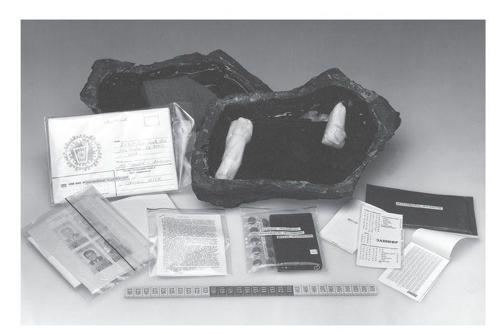
Russian counterintelligence image of a CIA Cold War dead drop rock container and contents, late 1970s.
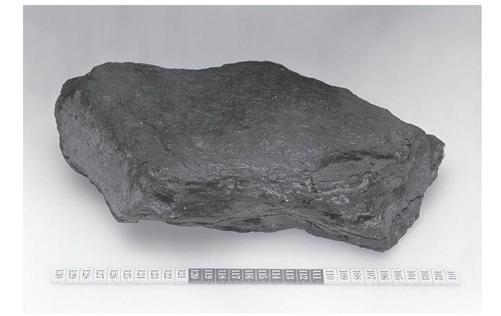
Closed CIA rock concealment of the type used to pass instructions, cameras, and money to agents, late 1970s.
Several anxious days passed as the case officer awaited confirmation that the agent had successfully “unloaded” the dead drop. Then came word that the agent had indeed gone to the site, but no “special” brick had been seen. An OWVL broadcast quickly followed, reiterating the instructions with assurances that the ordinary-appearing brick he had discarded was indeed a very special one. It was a modest, but important success.
“The guys in TSD were technically adept, but they were coming over into the operational lion’s den,” remembered George. “We who did Moscow operations were the most security conscious part of the whole SR Division, which was the most buttoned-up part of the CIA. I mean it was tight and TSD never had the benefit of having a tech assigned in Moscow or dealing closely with denied-area case officers in operational planning. At first they didn’t realize all the little points we were always thinking about, worrying about.”
A new way of thinking about the operational environment and technology in denied areas was required of both case officer and engineer. For case officers this meant understanding that technology used in satellites could be adapted and applied for operations on the streets of Moscow or Leningrad. For TSD’s engineers this meant experiencing the realities of operating in the denied area and integrating that knowledge into the design of clandestine gear. Success demanded that much of the traditional compartmentation of laboratory development from the field operations end.