
CHAPTER 8
Q: What is a Soviet trio?
A: A quartet returning from an overseas tour.
—1970s underground Soviet humor
In 1973, a Soviet diplomat stationed in Colombia entered the steam room of the Bogotá Hilton. A few minutes later, another man casually joined him and struck up a conversation in Spanish. The Soviet was Aleksandr Ogorodnik, a member of the Ministry of Foreign Affairs, and the other a CIA case officer. What appeared to be a chance meeting in an unlikely location was actually part of a finely coordinated plan to recruit Ogorodnik to spy inside the Soviet Union.
An economist with a specialty in Latin America, Ogorodnik had access to information about Soviet policy through his diplomatic status and assignment. Here was a chance for the United States to learn what the Soviet leadership was thinking and planning for its Latin American policy. If successful, this operation could provide sustained, detailed intelligence on Soviet plans and intentions not available from satellites.
Soviet officials were more accessible in countries outside the Soviet Union, but recruiting them was still no easy task. As much as possible, the Soviets tried to create a security cordon around their diplomats. Soviets living abroad were watched carefully by their own security officers stationed in the embassy, who, ever alert for a hint of the smallest political crime, would make note of something as harmless as attending a foreign movie. Soviet missions were laced with stukachi (informers) eager to curry favor with superiors by reporting any trivial transgression. Soviet diplomats were required to report even a casual conversation with Americans to the security officer at the KGB rezidentura (station) inside the embassy. Most complied with the restrictions because, compared to conditions in Moscow, foreign living was luxurious. These diplomats had prospered under the Soviet regime and guarded their elite status jealously.
However, when the case officer entered the steam room that day, he had every reason to believe the Soviet economist could be recruited. According to CIA assessments, Ogorodnik was different. Unconventional by the standards of the Soviet diplomatic community, he was known to like “the good life” and enjoyed a Western lifestyle that included a nice car and a poodle.
Ogorodnik also had three problems that made him vulnerable to recruitment. The first was that a KGB officer in the embassy was trying to recruit him to work as an informer. Such a role would place additional demands on the diplomat’s life, while turning down the invitation could generate questions of loyalty. Ogorodnik’s second dilemma was that, although married, he had a Colombian mistress, and she was pregnant with his child. This led to the third problem. He would be compelled to return to Moscow when his tour ended. Trapped in a diplomatic soap opera that involved a failing marriage, pregnant mistress, career ambitions, and the KGB, Ogorodnik faced a difficult situation.
Once contact was established, it became evident to the case officer that Ogorodnik had both strong motivations and character traits to become a spy. He hated the Soviet system and was prepared to work against it, though was not foolish. He required compensation and precautions. In exchange for his commitment, funds would be deposited into an escrow account to support his mistress and child in the short term. In the long term, after an undetermined period, the Agency would assist him in defecting. The CIA gave Ogorodnik a code name, TRIGON, and insisted that as few people as possible be involved in the operation, since the more people who knew about his secret work, the greater the risk that one of them would betray him. However, to be securely handled inside the Soviet Union, TRIGON needed intensive tradecraft training before returning to Moscow.
George Saxe got the call. The instructions were precise. He was to close up everything else he was working on and concentrate all his efforts on TRIGON. He could talk to no one about the new assignment in which he was to train the agent and create a communications plan for passing photographs of documents to the CIA in Moscow.
Although the training would take place in Colombia, there were still security concerns. The KGB had a strong presence in the country and maintained close ties with local sources, including police, journalists, and government employees. Ogorodnik’s Western lifestyle made him a high-profile personality within the diplomatic community, and local KGB officers were monitoring him as part of their own recruitment campaign.
It took George a month to work out a training and commo plan. Since he spoke and wrote excellent Russian, he would conduct the training himself in Colombia with an OTS tech available for technical consultation and assistance. Unlike Penkovsky, TRIGONwas not a professional intelligence officer. He would require basic instruction in tradecraft and operational techniques, including the use of dead drops, signal sites, brush passes, car tosses, and accommodation addresses. This would be followed by a series of more advanced covert technology and tradecraft techniques, such as document photography, receiving OWVL broadcasts, using one-time pads for encryption and decryption, secret writing, and microdot reading.
Even for professionals, comprehensive operational training takes months of study and years to perfect. Now, in a room in the Bogotá Hilton, George had the daunting task of schooling a spy to operate in the toughest counterintelligence environment in the world in a matter of weeks.
Among the devices issued to TRIGON was a new OTS ultraminiature camera. Work on the subminiature camera that began in early 1970 had a direct connection to Penkovsky. Quentin Johnson, during his assignment to TSD, pressed for development of “a camera that an asset could use to photograph documents while inside a KGB rezidentura.” Initially, the technical requirements seemed nearly impossible. In addition to being able to capture high-resolution images of a full page without distortion at the edges or benefit of flash, the camera needed a film capacity of at least a hundred frames and a silent shutter system. Added to this, the camera had to be small enough to conceal in an item that a person would normally carry with them into guarded and secure facilities.
OTS responded with a subminiature camera design that carried the designation “T-100.”1 Just one-sixth the size of the Minox issued to Penkovsky a decade earlier, its small size and cylindrical shape allowed the T-100 to be integrated into a wide array of personal items, such as pens, watches, cigarette lighters, or key fobs.
A jewel of watchmaking mechanical precision and optical miniaturization, the camera’s 4-millimeter diameter lens was made up of eight elements. Tiny, precisely ground glass elements, some only a bit larger than a pinhead, were exactingly stacked, one on top of another, to achieve clarity in photographing a standard 81 ⁄2-by-11-inch page.
“The craftsmanship and the technology that went into making the lens assembly was something that may never be repeated,” said George, more than three decades after the camera was first introduced.
The T-100’s film, lens, and shutter mechanism were housed in a single aluminum casing that measured one and a half inches long and three-eighths of an inch in diameter. As each picture was snapped, the film automatically advanced from one tiny spool inside the cassette to another, making it the world’s smallest “point and shoot” camera. Under optimum conditions, the camera’s 15-inch filmstrip could hold approximately 100 exposures.
Built under tight security to OTS specs by a precision optical contractor, the T-100 was designed specifically for document copying. An agent could appear to be studying a technical manual, engineering drawings, or a policy paper and noiselessly snap photos by holding the camera in his closed fist eleven inches above the target. Since the lens design allowed some tolerance in the focus distance, most users could place their two elbows at normal shoulder width on a table, and with the document between them, conceal the camera in clasped hands at the apex of the triangle.
In other document copy operations, agents could mount a 35mm camera on a tripod, frame the document, snap away, and be assured of quality pictures. With the T-100, the agent became the tripod and needed to position the camera precisely for each image. Although the film advanced automatically with each exposure, there was no autofocus function and without a viewfinder it was difficult to be certain the document was centered.2
Nothing about the T-100 was ordinary, right down to the film it required. Due to of the size of the cassette’s spools and operational realities that favored packing as many images as possible in a single cassette, extremely thin film with high resolution was needed. OTS engineers found the solution not in custom-made film, but in retired stocks of Kodak 1414 film used in early satellite photography programs. Because of the sensitivity to “pay-load” weight in satellite launches, the film was designed with ultrathin emulsion and backing. OTS sliced the film into 5mm-wide 15-inch strips to fit on the T-100’s spools. Big Technology had once again assisted with the smallest of devices.
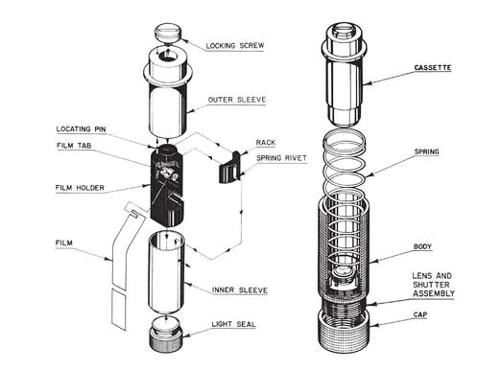
Drawing of the tiny, intricate T-100 camera assembly that could be hidden in a fountain pen or a cigarette lighter, 1972.
Loading the film into the subminiature cassettes required a skill that few could master. The small lengths of film were loaded by hand and wound around the tiny spool either in total darkness or with the aid of an infrared viewer. Then, once the film was loaded, questions always remained as to whether it was loaded correctly. “It’s kind of like testing flashbulbs,” said one tech. “The only way to test it is to run it through a camera, develop the film and see what the images look like. If they look okay, you say, that was good, but now I have to load another one. You had to have someone who knew what they were doing to load these things in a reliable way. If somebody did it all the time, the loading required about fifteen minutes. Since you couldn’t test each one, the best you could do was treat and package each one with care.”
The exacting work required to mount a loaded camera in its concealment and the precision needed to load the film was a job for the techs. Attempts to instruct agents on how to remove the camera from the concealment and insert a replacement proved to be extraordinarily difficult. TSD routinely found the threads of the concealment misaligned, stripped, or the camera improperly mated with the tension spring. After several frustrating operational failures, TSD began resuppplying agents not just with film, but an entirely new camera. This eliminated virtually all mechanical failures, although inadequate light, shadows over a document, or focusing problems would continue to degrade photo quality.
The second-generation camera, the T-50, was issued to George for TRIGON ’s training. The T-50 had all the technical and engineering features of the T-100, but held only fifty frames. The smaller film capacity represented a performance compromise by the design engineers to improve the overall reliability of the camera. Field experience with the T-100 revealed that the tiny film-advance mechanism was fragile and prone to inconsistent performance. By changing the clutch and sprocket design, the engineers eliminated the problem, at the sacrifice of some film capacity.
An internationally recognized luxury pen was reproduced for TRIGON ’s camera concealment. The expensive-looking pen would not be out of place in a diplomat’s pocket and it matched Ogorodnik’s fondness for the finer things in life. Fabricated by one of America’s most reputable pen manufacturers through a classified contract with OTS, the thick-bodied pen looked and worked like its commercial namesake, though a smaller ink sac and imperceptibly shorter base for the nib created a cavity for the spy camera.3
Before TRIGON’s training began, George perfected his own expertise with the T-50 by spending hours practicing clandestine photography techniques around Agency Headquarters and in the local library. He would carry the pen in his pocket, select a book or magazine, sit at a desk with others, and take covert photos. Repeatedly, George positioned his elbows on a table, forearms at an angle, hands together, and tried to establish a comfortable position. At home, with a ruler, he practiced using different postures to develop a “feel” for the exact 11-inch distance from lens to document. No one seemed to notice. After shooting several rolls, George returned the film to OTS where his work was developed and critiqued.
After an intense month of practice, George was finally confident of his own expertise with the camera. Flying into Colombia under an alias, he checked into the Bogotá Hilton to begin a Spartan existence. He minimized interaction with other Americans and purposely avoided the embassy and government officials. The CIA officer handling the case arranged clandestine meetings with George to coordinate activities and pass instructions, but made no effort to lessen the pressure. George knew the importance of TRIGON to SR Division, and with the operation based in Columbia, the Latin America division chief was also watching closely. The case officer had done his job recruiting TRIGON; now everything depended on the performance of the camera and operational training.
The first thing George would need to determine was TRIGON’s aptitude for learning the clandestine skills to operate the T-50. His first impression of TRIGON was “This guy is smart.” The training was in Russian, and George, conscious that his Russian was not native, repeatedly confirmed the instructions were understood and that he was using the correct verbs and sentence structure.
The training began with 35mm cameras to familiarize the agent with basic photographic techniques, equipment, and film. The camera selected was the Pentax OM-1, a $200 product that a Russian diplomat could reasonably acquire during an overseas assignment. TRIGON quickly grasped the instruction, and his practice photos produced nearly perfect results.
George then demonstrated the modified pen, emphasizing the critical importance of discreetly getting the body geometry of hands and elbow positioned and taking the picture without compromising the camera. Recalling his month-long self-training process, George knew just how hard this could be while also consciously maintaining situational awareness. Awareness of the environment while performing a clandestine act was a fundamental lesson TRIGON’s life depended on.
“When I did this,” George recalled telling TRIGON, “the hardest part for me was sitting in an office. Suddenly, either I’d catch myself paying no attention to the camera or no attention to what was going on around me. It’s difficult to maintain that split personality.”
Training progressed fitfully over several weeks, with TRIGON sneaking away for small blocks of time that did not disrupt his normal pattern of activity or catch the notice of the KGB. On one occasion, he left a few minutes early for an appointment at the Cultural Society, taking a route that included a visit to the Hilton. On another day, after giving a talk to the Bogotá Chamber of Commerce about Soviet assistance to Latin America, he stopped at the Hilton before returning to the embassy.
These unscheduled training sessions could last between fifteen minutes and two hours and George never knew when his pupil might arrive. Confined to his hotel room and fighting boredom, he waited for TRIGON to knock on the door and say, “I’ve got fifteen minutes” or “I’ve got an hour.”
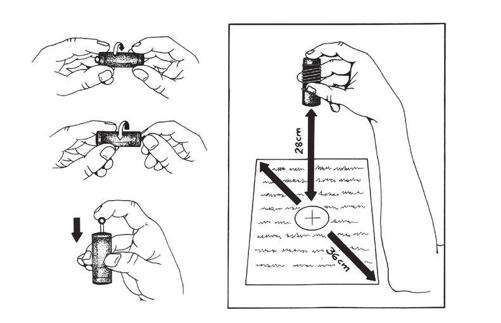
Diagrammed instructions for one method of using the OTS T-100 ultraminiature camera to photograph text on a full-sized sheet of paper in a single frame.
TRIGON proved a fast learner, but George understood it was one thing to perform flawlessly in the safety of the training environment with the instructor and quite another to operate spy equipment alone, with no support. However, whatever concerns George had about the agent’s courage were soon put to rest, when during one of the rushed training sessions, TRIGON dropped a bombshell. “There’s a new, highly restricted Soviet policy paper on China that has just come into the embassy and I should be able to have access to it,” he told George one day.
George did not encourage TRIGON to photograph the document, since his training on the camera was not completed and top-level policy papers were not readily accessible, even to diplomats. TRIGON had the security clearance for the information but the document itself was closely guarded. The policy paper was being held in the referentura and its control involved signing out the document from a custodian, then reading it while a guard observed the room through a small viewing port.
The instruction continued, and after three more successful practice sessions, TRIGON departed the room with the loaded pen saying, “I may be able to do this.”
Twice he returned to George, describing the security in the area and showing the strain of the risk he was taking. “After I get to the room, a guy walks behind me. I couldn’t use the camera,” he said. “You know what will happen if I make a mistake.”
George sympathized with the agent’s anxiety. “We would like you to do this,” he replied. “And I can tell that you would like to do it, but it’s not worth your life. Just keep thinking about it. This is good practice for when you are back in Moscow, although it won’t be as difficult there, since you should be able to take documents to your own office.”
A few days later, TRIGON reappeared at the hotel room door smiling. “I think I’ve got it,” he said.
After TRIGON departed, an elated George went to a public phone outside the hotel, called the tech standing by in another part of town, and passed the verbal parole for an emergency meeting. Securing the pen, still loaded with exposed film, in a money belt, George headed out. Fearful of taxi muggings, he walked for more than an hour to pass the pen to the tech who then caught the next plane to Washington, hand-carrying the treasure.
The report George received was astonishing. When the film was processed, only two frames out of fifty were illegible. All significant contents of the policy paper had been captured. With more than twenty years in Soviet operations, this was, to his knowledge, the first time that top-secret documents had ever been photographed by a CIA agent inside a Soviet embassy’s referentura. TRIGON had more than proven he could use the T-50 operationally.
The report added that the information had gone to the “seventh floor” at Headquarters from whence the DCI hand-carried it to Secretary of State Henry Kissinger, who was quoted as saying that the copied document was “the most important piece of intelligence that he had read as Secretary of State.”4
TRIGON had yet another surprise in store for George at the end of the next training session. He said, “Oh, and by the way, please get me something to kill myself, in case I think I’m going to be caught.”
Despite the fiction in espionage novels, lethal substances, called L-pills, were rarely deployed and not available as an off-the-shelf stock item from OTS. Only when an agent could not be dissuaded and after approval by the DDP himself would an L-pill be produced.
George reported the request to the case officer, who cabled it to Headquarters. An immediate answer firmly stated that the request had been reviewed by the Soviet Division chief and the Deputy Director for Operations and the answer was “No way.”
Since this was an “agent handling” matter, the case officer broke the news to TRIGON that his request had been denied. An L-pill would not be issued.
“Okay, fine, I won’t be working for you anymore,” TRIGON replied.
A furious field-to-Headquarters cable exchange followed. Headquarters asked if the agent was bluffing. The case officer asked George’s assistance in preparing a considered response. TRIGON and his handler, even prior to the steam room recruitment, had spent considerable time together in Bogotá. And while TRIGON did not speak English, the case officer, who was fluent in Russian and Spanish, used both languages to build confidence and trust. Their relationship included informal evenings sitting on street corners at night drinking and talking about politics, philosophy, and personal interests. The case officer was certain he knew TRIGON the person as well as TRIGON the agent, and George had just spent several intense weeks training the diplomat in espionage. The two agreed the cable should read: “EITHER HE GETS AN L-TABLET OR WE DON’T HAVE AN OPERATION.”5
OTS was instructed to produce an L-pill and conceal it in the barrel of a pen identical to the one that held the camera.
With his tour in Colombia at an end, TRIGON returned to Moscow in 1975 as part of the normal pattern of diplomatic rotation. From the Agency’s perspective, TRIGON could not have received a better Moscow assignment. Appointed to a key post in the American Department of the Soviet Foreign Ministry, TRIGON’s job gave him access to read and photograph reports from Soviet ambassadors around the world.6
Since Soviet officials returning from overseas were watched carefully by the KGB for signs of corruption, no immediate contact was attempted. Then, after a cooling-off period of several months, TRIGON recovered a dead drop containing new one-time pads, a commo plan, and the T-50 spy camera. Thereafter, he began providing a steady stream of documentary intelligence detailing Soviet policy, confirming the quality of both his training and equipment.
To maintain operational security, with a single exception, TRIGON never met his Moscow case officer. The operation relied on communications conducted using OWVL and written instructions passed through dead drops. TRIGON never met the case officer who loaded and unloaded the drops. Had he done so, he likely would have been shocked.
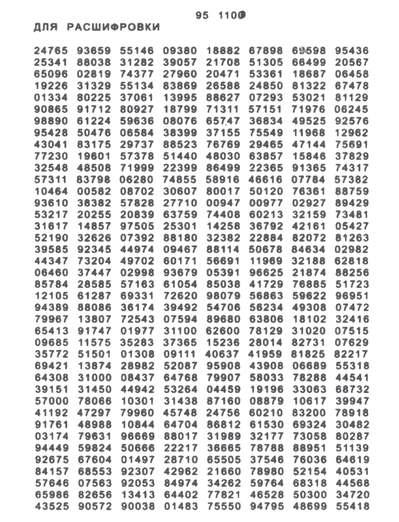
Page from a covert communications one-time pad for CIA agent TRIGON. The OTP’s random numbers were arranged in five-digit groupings. Only two copies were produced—one for the agent, the other for the handler. The number groups on each page differ from those on every other page. The size of the page was determined by the method by which it would be transported and concealed.
Martha Peterson arrived in Moscow in 1975. She worked a regular eight-hour daily cover job, improved her Russian language skills, and kept a low profile. For the KGB watchers, she merited little attention. Only on her scheduled breaks, lunch hours, and nights did she assume the responsibility of handling a spy she would never meet, the CIA’s highest-placed agent in Moscow.
A young woman, dressed in the latest fashions and doing a woman’s administrative job was not how the KGB envisioned a CIA officer. If Peterson did not fit the KGB profile of Agency personnel in the USSR, she did not fit the traditional CIA denied-area case officers, either. She had won the coveted assignment due to the insistence of the office chief who had been impressed by her earlier operational work.
From the time of his recruitment in Columbia, TRIGON had proven himself to be a productive agent. Then, in the spring of 1977, the operation took a turn for the worse. The first indication that something was wrong surfaced when communication schedules between the agent and CIA broke down. Finally, an early July OWVL radio message was sent to TRIGON instructing him to put out the standard meeting signal by parking a car in a specific location at a specific time. Uncharacteristic of his normal responsiveness, no car appeared at the site. However, a second request for an alternate signal, a red lipstick mark on a “child crossing” pole, did elicit the appropriate response—the red mark appeared on the pole the next day. The signal indicated TRIGON would pick up a package at a predetermined time and designated dead drop site.
On July 15, Peterson made a point to leave work on time. For the next four hours, she walked, rode, drove, and used public transportation, executing a carefully constructed surveillance detection run. Her single operational act that night would be to load a dead drop for TRIGON. She had conducted more than a dozen similar operations during the previous eighteen months. As in the past, she encountered no problems or indication that KGB surveillance might be following her.
The dead drop site was a window crevice in one of the arched pillars along the footpath on the Krasnoluzhskiy Bridge that spans the Moscow River. Peterson carried an OTS concealment fabricated to look like a piece of asphalt debris in her shopping bag. The relatively flat 6 × 8 × 4-inch “black rock” was sealed with reversed screws and rubbed with soil and mud to give it a dirty look. The cavity was filled with small-denomination Russian rubles held tight with a rubber band, a resupply of six loaded T-50 camera bodies, some jewelry, a pen concealment, new commo schedules, one-time pads, contact lenses, and a personal note on Kalvar film.7
Included in the package was a cautionary note in Russian that read:
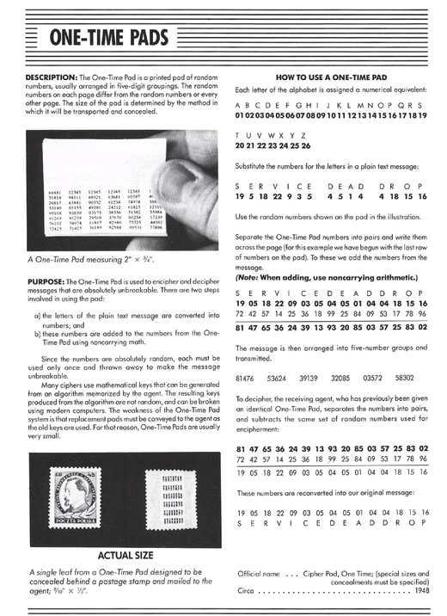
Instructions for use of a one-time pad in covert communications, 1975.
COMRADE! YOU HAVE PENETRATED INTO ANOTHER’S SECRET. TAKE THE MONEY AND THE VALUABLES, THE REST THROW INTO A DEEP PLACE IN THE RIVER. AND FORGET ABOUT ALL OF THIS. YOU HAVE BEEN WARNED.8 Should someone other than TRIGONstumble across the container, the note, with its threatening message, might persuade them to dispose of the package instead of reporting the find to the KGB.
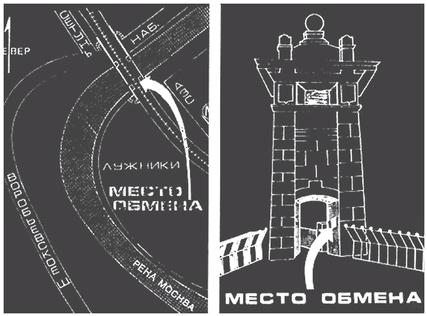
CIA-prepared dead drop instructions for TRIGON at Moscow bridge, 1977.
Dusk was darkening into night when Peterson finished her surveillance detection run. Confident she had no surveillance, she loaded the dead drop at 10:30 PM, pushing the concealment as far back as her arm could reach into the crevice, and then walked a few steps to a long staircase that descended from the bridge. Just before she reached the bottom, three men suddenly appeared in front of her and grabbed her arms. Immediately, a van pulled out from under the bridge and a dozen more KGB officers piled out. Sensing the KGB’s surprise at finding a woman loading the dead drop, she took advantage of the momentary confusion and screamed, “Provocation!” If TRIGON was in the area, the shout and the ruckus might warn him away. In a brief struggle that followed, Peterson’s green belt Tae Kwon Do instinct flared and she landed one painful kick to the groin of a Russian before being subdued.
The KGB recovered the dead drop container and its contents. Peterson was also searched and the KGB found, Velcroed to her bra, an OTS-developed frequency scanner used to intercept surveillance radio transmissions. Peterson’s “necklace” was the scanner’s induction coil antenna. Thinking the scanner was a communication device, the KGB officers talked into the black box in an attempt to elicit a response from another party. Throughout the ordeal, the small receiver Peterson wore remained undiscovered.
Peterson was then driven to Lubyanka, headquarters of the KGB’s Second Directorate, where questioning began. Within a short time, calls were made to the U.S. Embassy with news that an American citizen had been arrested.
The State Department representative who arrived at Lubyanka was as surprised to see Peterson in custody as the KGB was to see her at the bridge. By 2:00 AM, she had been released. The next day, the Soviet government declared her persona non grata and ordered Peterson out of the country. She left on the first flight out of Moscow, without ever returning to her apartment.
The CIA later learned that TRIGON had been dead for at least a month before Peterson’s apprehension, compromised by Karl Koecher, half of the Karl and Hana Koecher husband-and-wife spy team. The Koechers were Czech nationals sent to the United States in 1965 under the control of the Czech intelligence service—the Stani tajni Bezpecnost (StB). Claiming to have fled their homeland in search of freedom in America, they posed as virulent anticommunists. Karl earned a degree from Columbia University, and then landed a translator job at the CIA. The StB shared reports from its agents with the KGB and whatever information Koecher gleaned from his translation work about a Soviet diplomat working for the CIA in Colombia was enough for the Soviets to launch an investigation that eventually identified Ogorodnik.
Precise details of TRIGON’s death remain clouded, but his early insistence in having an L-pill was prescient, at least according to an account of the death of “agent Trianon” written in 2000. “Trianon” is clearly TRIGON. The author, a retired KGB officer, Igor Peretrukhin, who claimed he led the investigation, described “Trianon” sitting in his apartment surrounded by KGB officers at 2:00 AM. TRIGON requested paper and a pen to “write an explanation addressed to the KGB leadership.” He then requested his own fountain pen that was laying on the table and which one of the KGB officers had inspected. The pen received another, more thorough examination before being given to TRIGON. As he began writing, TRIGON slowed down and fiddled with the pen. When no one was near the table where he was writing, TRIGON managed to disengage the L-pill and get it into his mouth. Suddenly he quivered, leaned against the back of his chair, and began to wheeze. The KGB officers rushed to him and with a metal ruler tried unsuccessfully to open his firmly clenched teeth to find the suspected poison ampoule. Foaming blood began coming out of TRIGON’s mouth. He never regained consciousness.9
Karl Koecher was arrested in New York City on November 27, 1984, and charged with conspiracy to commit espionage. He served less than two years in prison before a swap for imprisoned Soviet dissident, Anatoly Scharansky, allowed him and his wife to return to Czechoslovakia.10