
Following its downfall, the core of the Taliban’s leadership relocated to the mountainous border regions within the Afghanistan–Pakistan border. Mullah Omar had, during the Taliban’s last days in power, promised a return and following his defeat immediately began recruiting students from the Pakistan madrasas, where so many of his loyal followers had originated a decade before. Mobile training camps on the Afghan–Pakistan border run by Al-Qaeda and the Taliban trained these new recruits in the methods of guerrilla warfare.
The Taliban may have been defeated as a political regime but militarily they proved, and would continue to prove, an organized, determined and tenacious enemy of the coalition forces. By the end of 2009 US intelligence admitted that the Taliban could sustain itself ‘indefinitely’. Ordinary Afghans, disillusioned by the lack of progress made under Karzai and his UN backers, derided the president for being a puppet of the US; and the reach of Karzai’s power beyond the capital was so limited that he was lampooned as the ‘Mayor of Kabul’. Bush’s ‘Marshall Plan’ had provided little improvement and the progress of reconstruction seemed non-existent. The new Afghan police force, trained by Germans, and the new Afghan National Army were seen as corrupt, ineffectual and consisting of illiterate recruits of questionable loyalty.
Warlords had re-emerged, controlling major roads and imposing extortionate tolls on trade, ruling by bribes and corruption. The police, and ultimately the government, found themselves powerless to intervene. Crime and insecurity became a constant feature of Afghan life. Access to the most basic of life’s necessities – food, accommodation, electricity and employment – became problematic. The Taliban fed off these grievances, supplying security where there was none, and becoming arbiters of disputes where government and foreigners had failed. Exploiting the rise of anti-US sentiment and resentment of foreign intervention, government corruption and ineffectiveness, the Taliban gathered support. Rumours about the treatment of Taliban and Al-Qaeda prisoners within US detention centres, such as Guantanamo Bay in Cuba, did little to help the government’s cause. Deaths of civilians at the hands of coalition forces also played into the Taliban’s hands.
From 2006 the Taliban escalated their campaign using tactics gleaned from insurgents in Iraq, namely suicide bombings and the deployment of improvised explosive devices (IEDs). In 2007 the Taliban perpetrated over 140 suicide bombings resulting in over 300 military and civilian deaths. On 27 February 2007, a suicide bomber targeted the visiting US vice president, Dick Cheney. Cheney was unhurt but twenty-three people were killed in the attack. By the end of 2007 the Taliban reputably controlled 54.4 per cent of the country.
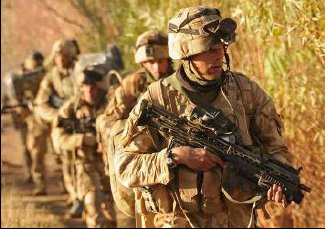
British Royal Marines, Helmand Province, December 2008
As part of the Bonn Agreement, the UK agreed to tackle the production of opium poppies, the main centre being within Helmand Province in the south-west of the country. The Taliban, in its latter years in power, had managed to almost eradicate the trade. Declaring the cultivation of poppies as un-Islamic, by 2001 the Taliban had cut its production by over 90 per cent.
Following the collapse of the Taliban, however, cultivation started again and expanded enormously to the point that now 90 per cent of the world’s supply of opium originates in Afghanistan. But how does one persuade Afghan farmers to switch to, for example, wheat when the poppy trade is ten times more profitable? Without the poppy Afghan farmers face poverty, and the Taliban, who did so much to stop the practice, now offer the farmers protection against foreign intervention.
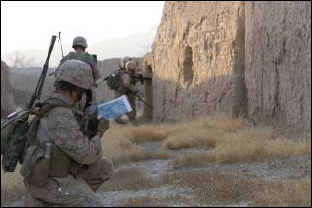
US Marines, Helmand Province, June 2009
In April 2006 the then UK defence secretary, John Reid, on a visit to Afghanistan said: ‘We would be perfectly happy to leave in three years and without firing one shot because our job is to protect the reconstruction.’ But attempts to compensate Afghan farmers and wean them off the poppy trade have failed. Suggestions to spray the poppy fields with chemicals were rejected. President Karzai declared: ‘If we don’t destroy the opium trade, then it will destroy us’, but while the country’s economy is so dependent on the crop, government officials are happy to take bribes. In October 2010 coalition forces destroyed an opium production factory near Jalalabad, destroying drugs with a street value of over $250 million. Karzai’s response was to complain of a ‘blatant violation of Afghanistan’s sovereignty. . . Any repetition of such acts will prompt necessary reaction by our country.’
In 2009 Karzai won a second election but one that was fraught with controversy and electoral fraud, including bribery, selling of voter cards and voting irregularities. The Taliban ensured a low turnout by threatening all those involved – from candidates to election workers to voters. Violence erupted on election day, 20 August, which saw one of the bloodiest days in Afghanistan since 2001.
On 28 January 2010, leaders from over seventy countries and organizations met in London for a one-day conference on the future of Afghanistan. The conference discussed plans for Afghanistan to take responsibility, province by province, for its own security. President Karzai said he was prepared to talk to the Taliban and would invite them to join a loya jirga, a meeting of tribal elders, to discuss the way forward. Although it was rumoured that the Taliban had met in secret with a UN special envoy in Dubai during January 2010, it responded to Karzai’s offer with, ‘We have said this many, many times. There will be no talks when there are foreign troops on Afghanistan’s soil killing innocent Afghans on a daily basis.’ The talks went ahead in June 2010; the Taliban not only refused to attend the conference held in Kabul but managed to launch a rocket attack during Karzai’s opening address. No one was hurt but it illustrated just how far Afghanistan is from finding a solution that will eventually lead to peace.
In December 2009 US president Barack Obama announced that an additional 30,000 US troops would be dropped into Afghanistan. ‘After eighteen months, our troops will begin to come home,’ he added. By passing the responsibility of security to Afghan forces, it would ‘allow us to begin the transfer of our forces out of Afghanistan in July of 2011’.
The corruption of the Karzai government, both real and perceived, the dominance of the opium trade, the lack of meaningful, long-term aid, and the increasing sense of anti-American and anti-Western sentiment have all led to the continuation of a seemingly unending war. The Taliban’s ability to exploit grievances or instil fear allows it to control vast tracts of the country while its capacity to attract new recruits and to adapt its approach allow it to sustain itself ‘indefinitely’ as a military force.
NATO’s attempts to train an effective Afghan army (pictured) and police force have been beset with difficulties: up to 90 per cent are illiterate, corruption and the acceptance of bribes is commonplace, and drug taking is rife. Discipline, motivation and confidence suffer but the long-term aim is still to pass the responsibility for security within Afghanistan to its own army and police force.
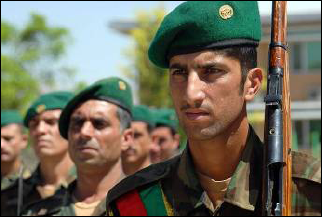
Afghan National Army, July 2007
The Taliban Insurgency
Following its downfall, the core of the Taliban’s leadership relocated to the mountainous border regions within the Afghanistan–Pakistan border. Mullah Omar had, during the Taliban’s last days in power, promised a return and following his defeat immediately began recruiting students from the Pakistan madrasas, where so many of his loyal followers had originated a decade before. Mobile training camps on the Afghan–Pakistan border run by Al-Qaeda and the Taliban trained these new recruits in the methods of guerrilla warfare.
The Taliban may have been defeated as a political regime but militarily they proved, and would continue to prove, an organized, determined and tenacious enemy of the coalition forces. By the end of 2009 US intelligence admitted that the Taliban could sustain itself ‘indefinitely’. Ordinary Afghans, disillusioned by the lack of progress made under Karzai and his UN backers, derided the president for being a puppet of the US; and the reach of Karzai’s power beyond the capital was so limited that he was lampooned as the ‘Mayor of Kabul’. Bush’s ‘Marshall Plan’ had provided little improvement and the progress of reconstruction seemed non-existent. The new Afghan police force, trained by Germans, and the new Afghan National Army were seen as corrupt, ineffectual and consisting of illiterate recruits of questionable loyalty.
Warlords had re-emerged, controlling major roads and imposing extortionate tolls on trade, ruling by bribes and corruption. The police, and ultimately the government, found themselves powerless to intervene. Crime and insecurity became a constant feature of Afghan life. Access to the most basic of life’s necessities – food, accommodation, electricity and employment – became problematic. The Taliban fed off these grievances, supplying security where there was none, and becoming arbiters of disputes where government and foreigners had failed. Exploiting the rise of anti-US sentiment and resentment of foreign intervention, government corruption and ineffectiveness, the Taliban gathered support. Rumours about the treatment of Taliban and Al-Qaeda prisoners within US detention centres, such as Guantanamo Bay in Cuba, did little to help the government’s cause. Deaths of civilians at the hands of coalition forces also played into the Taliban’s hands.
From 2006 the Taliban escalated their campaign using tactics gleaned from insurgents in Iraq, namely suicide bombings and the deployment of improvised explosive devices (IEDs). In 2007 the Taliban perpetrated over 140 suicide bombings resulting in over 300 military and civilian deaths. On 27 February 2007, a suicide bomber targeted the visiting US vice president, Dick Cheney. Cheney was unhurt but twenty-three people were killed in the attack. By the end of 2007 the Taliban reputably controlled 54.4 per cent of the country.
British Royal Marines, Helmand Province, December 2008
As part of the Bonn Agreement, the UK agreed to tackle the production of opium poppies, the main centre being within Helmand Province in the south-west of the country. The Taliban, in its latter years in power, had managed to almost eradicate the trade. Declaring the cultivation of poppies as un-Islamic, by 2001 the Taliban had cut its production by over 90 per cent.
Following the collapse of the Taliban, however, cultivation started again and expanded enormously to the point that now 90 per cent of the world’s supply of opium originates in Afghanistan. But how does one persuade Afghan farmers to switch to, for example, wheat when the poppy trade is ten times more profitable? Without the poppy Afghan farmers face poverty, and the Taliban, who did so much to stop the practice, now offer the farmers protection against foreign intervention.
US Marines, Helmand Province, June 2009
In April 2006 the then UK defence secretary, John Reid, on a visit to Afghanistan said: ‘We would be perfectly happy to leave in three years and without firing one shot because our job is to protect the reconstruction.’ But attempts to compensate Afghan farmers and wean them off the poppy trade have failed. Suggestions to spray the poppy fields with chemicals were rejected. President Karzai declared: ‘If we don’t destroy the opium trade, then it will destroy us’, but while the country’s economy is so dependent on the crop, government officials are happy to take bribes. In October 2010 coalition forces destroyed an opium production factory near Jalalabad, destroying drugs with a street value of over $250 million. Karzai’s response was to complain of a ‘blatant violation of Afghanistan’s sovereignty. . . Any repetition of such acts will prompt necessary reaction by our country.’
In 2009 Karzai won a second election but one that was fraught with controversy and electoral fraud, including bribery, selling of voter cards and voting irregularities. The Taliban ensured a low turnout by threatening all those involved – from candidates to election workers to voters. Violence erupted on election day, 20 August, which saw one of the bloodiest days in Afghanistan since 2001.
On 28 January 2010, leaders from over seventy countries and organizations met in London for a one-day conference on the future of Afghanistan. The conference discussed plans for Afghanistan to take responsibility, province by province, for its own security. President Karzai said he was prepared to talk to the Taliban and would invite them to join a loya jirga, a meeting of tribal elders, to discuss the way forward. Although it was rumoured that the Taliban had met in secret with a UN special envoy in Dubai during January 2010, it responded to Karzai’s offer with, ‘We have said this many, many times. There will be no talks when there are foreign troops on Afghanistan’s soil killing innocent Afghans on a daily basis.’ The talks went ahead in June 2010; the Taliban not only refused to attend the conference held in Kabul but managed to launch a rocket attack during Karzai’s opening address. No one was hurt but it illustrated just how far Afghanistan is from finding a solution that will eventually lead to peace.
In December 2009 US president Barack Obama announced that an additional 30,000 US troops would be dropped into Afghanistan. ‘After eighteen months, our troops will begin to come home,’ he added. By passing the responsibility of security to Afghan forces, it would ‘allow us to begin the transfer of our forces out of Afghanistan in July of 2011’.
The corruption of the Karzai government, both real and perceived, the dominance of the opium trade, the lack of meaningful, long-term aid, and the increasing sense of anti-American and anti-Western sentiment have all led to the continuation of a seemingly unending war. The Taliban’s ability to exploit grievances or instil fear allows it to control vast tracts of the country while its capacity to attract new recruits and to adapt its approach allow it to sustain itself ‘indefinitely’ as a military force.
NATO’s attempts to train an effective Afghan army (pictured) and police force have been beset with difficulties: up to 90 per cent are illiterate, corruption and the acceptance of bribes is commonplace, and drug taking is rife. Discipline, motivation and confidence suffer but the long-term aim is still to pass the responsibility for security within Afghanistan to its own army and police force.
Afghan National Army, July 2007