
The First Anglo-Afghan War
Dost Mohammad Khan 1793–1863
Dost Mohammad had ruled as Amir of Afghanistan from 1826 when, in 1839, he became embroiled in the ‘Great Game’, the intrigue between Russian and British interests in Central Asia. The British considered him unreliable and suspected that his loyalty lay with Russia. The removal of Dost Mohammad lay behind the First Anglo-Afghan War of 1839 to 1842. British forces invaded and placed their nominee, Shuja Shah, on the Afghan throne. Dost Mohammad fled and later surrendered, spending the rest of the war in captivity in British India.
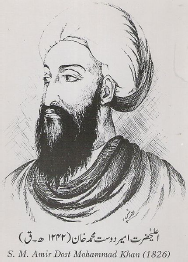
Dost Mohammad
Following Britain’s withdrawal in September 1842 and the murder of Shuja Shah, Dost Mohammad returned to the throne and ruled until his death in 1863.
Shuja Shah Durrani 1785–1842
Originally the governor of Herat, Shuja Shah became Afghanistan’s king in 1803, following the deposition of his brother, until he was deposed himself six years later. He spent his years of exile in India as a guest of the British government until 1839 when Britain decided to remove the new king, Dost Mohammad, and restore the more compliant Shuja Shah to the throne.
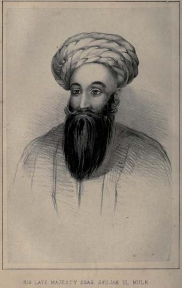
Shah Shuja
Although successful, following Britain’s forced retreat from Kabul, Shuja Shah’s position and life were vulnerable, and on 5 April 1842 he was murdered.
William Elphinstone 1782–1842
William Elphinstone served with distinction during Waterloo. In 1839, having had a quiet career in the British army, the 57-year-old Elphinstone was content to take command of a Bengal division in British India and eke out his final years until retirement. When, the following year, Lord Auckland, Governor-General of India, ordered him to take command of the British garrison in Kabul, Elphinstone argued his unsuitability, citing his advancing years and encroaching gout as sufficient reason. Auckland insisted and Elphinstone found himself in Kabul. But the old commander discovered that the situation was reassuringly stable with the garrison enjoying life within the walls of its cantonment.

William Elphinstone
The peace was not to last. Following the Afghan insurrection and the murder of the British resident, Alexander Burnes, Elphinstone panicked and proved incapable of making a decision. A swift retaliation should have been ordered but instead Elphinstone held numerous meetings, taking sides with whoever spoke last and deciding nothing.
With supplies dwindling and the opportunity for a show of strength lost, Elphinstone eventually negotiated with Akbar Khan from a position of weakness and Akbar’s resultant guarantee of a safe passage out of Kabul proved meaningless.
Elphinstone started out on the retreat but was taken back to Kabul as a hostage. Four months later, he succumbed to dysentery and died in captivity a broken man.
The Second Anglo-Afghan War
Sher Ali Khan 1825–79
The third son of Dost Mohammad Khan, Sher Ali became Amir of Afghanistan on his father’s death in 1863 but two years later was removed from power by his older brother, Mohammad Afzal Khan. Later, following his brother’s death in 1867, Sher Ali returned to the throne.

Sher Ali Khan
In 1878 Sher Ali became the latest pawn in the ‘Great Game’ between Russia and Great Britain. His attempts to stand up to the British were swept aside as British forces invaded his country, thereby starting the Second Anglo-Afghan War. As the British bore down on Kabul, Sher Ali fled, hoping to seek asylum in Russia, but died en route in February 1879.
Yakub Khan 1849–1923
The son of Sher Ali, Yakub Khan succeeded his father in 1879 and immediately entered into negotiations with the invading British army. He agreed to sign the Treaty of Gandamak which, in return for British subsidies, gave Britain control of Afghanistan’s foreign affairs and allowed for the presence of a British envoy, Pierre Louis Cavagnari, within Kabul.

Yakub Khan
Following Cavagnari’s murder in September 1879, Yakub Khan met with the approaching British army to plead his innocence and request leniency. Sir Frederick Roberts, in command of the British, found Yakub Khan’s presence embarrassing and, ignoring the Amir’s pleas, pushed on to Kabul.
Yakub Khan abdicated, took refuge in the British cantonment before leaving Afghanistan altogether for a life of exile in British-controlled India.
Frederick Sleigh Roberts 1832–1914
Joining the army of the British East India Company aged nineteen in 1851, Roberts first saw action during the Indian Rebellion of 1857 and was involved in the capture of Delhi. The following year he was awarded the Victoria Cross for his ‘marked gallantry’.

Frederick Sleigh Roberts
In 1879, now a major-general in the British army proper, Roberts led the occupation of Kabul during the Second Anglo-Afghan War. Then, in 1880, to relieve the British garrison besieged in the city of Kandahar, Roberts led the Kabul to Kandahar March, an event that caught the public imagination and earned Roberts the thanks of parliament and lifelong fame.
After his stint in Afghanistan, Roberts was appointed commander-in-chief, firstly in India then Ireland, during which time he was promoted to field marshal.
During the Second Boer War (1899–1902) Roberts was again appointed commander-in-chief, this time in South Africa. Forces under his command relieved the city of Kimberley ending a 124-day siege. During the Boer War Roberts’ son, also named Frederick and also a holder of the Victoria Cross, was killed in action. Roberts and his son are one of only three father/son recipients of the VC.
Roberts was in St Omer in northern France in November 1914, inspecting Indian troops soon after the outbreak of the First World War, when he caught pneumonia and died. He was eighty-two.
He was laid in state in Westminster Hall, the first of only two non-Royals to be so honoured during the twentieth century (the other, fifty years later, was Sir Winston Churchill).
Democratic Afghanistan and Soviet Era
Mohammad Daoud Khan 1909–78
Mohammad Daoud Khan served as the Afghan prime minister from 1953 to 1963 under the king, Zahir Shah, his cousin and brother-in-law. During his decade in office, and under his influence, Afghanistan drew closer to the Soviet Union, becoming dependent on Soviet imports and assistance. But tension between Afghanistan and its neighbour Pakistan forced Daoud into resigning in March 1963. The following year the king instituted a new constitution which prevented members of the royal family holding ministerial posts, thereby blocking Daoud’s plans to re-enter politics.
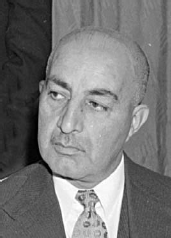
Mohammad Daoud Khan
Photo from Henryhartley
However, in 1973, while the king was detained in Italy undergoing an eye operation, Daoud staged a coup. But rather than naming himself the king’s successor, he declared Afghanistan a republic with himself as its first president.
Daoud distanced his country from Soviet influence, thus alienating the Afghan communist party, the People’s Democratic Party of Afghanistan (the PDPA), and alarming the Kremlin, who feared Daoud was aligning himself to the West.
The murder of a PDPA leader on 17 April 1978 convinced the Afghan communists that they were all at risk. Daoud, fearing a coup, had the leading communists arrested but nonetheless failed to prevent the revolt which, under the command of Nur Mohammad Taraki, took place on 28 April and came to be known as the Saur Revolution (Saur being Persian for April). Daoud, along with members of his family, was shot in the presidential palace.
Daoud’s death was not publicly announced and Taraki, as the new president, declared that former president Daoud had ‘resigned for health reasons’.
Daoud’s body was found thirty years later, in 2008, and in March 2009 the former president was reburied with full state honours.
Nur Mohammad Taraki 1917–79
During the mid-1960s Nur Mohammad Taraki became one of the founding members of the Afghan communist party (the People’s Democratic Party of Afghanistan). When, in April 1978, Mohammad Daoud, the then president, was assassinated, Taraki assumed the title of president and renamed the country the Democratic Republic of Afghanistan.

Nur Mohammad Taraki
Taraki tried to implement a series of Marxist reforms which included the emancipation of women and various land reforms, all of which were met with violent unrest. Taraki’s repressive response exacerbated an already volatile situation.
To add to Taraki’s unease, he fell out with his prime minister, Hafizullah Amin, suspecting Amin of wanting to overthrow him.
In March 1979 Taraki visited Soviet leader Leonid Brezhnev, and asked for assistance. Brezhnev refused to be drawn in but offered Taraki his advice – namely to slow down the pace of reform and to remove Amin.
Taraki returned to Kabul and in September 1979 called Amin to a meeting. Amin came prepared and in the ensuing gunfight Taraki was arrested and placed in a cell, where, at some point later, he was held down and suffocated.
Amin declared himself president, announcing that Taraki had died suddenly from a serious illness.
Brezhnev, on hearing the news of Taraki’s death, wept.
Hafizullah Amin 1929–79
A former teacher, Hafizullah Amin joined the PDPA, the Afghan communist party, during the mid-1960s and was instrumental in the overthrow of Mohammad Daoud Khan in April 1978. The new communist government, headed by Nur Mohammad Taraki, isolated much of the Afghan population by its Marxist reforms. Amin expanded his powerbase to the point that Taraki was forced into naming him his prime minister. In September 1979 Amin, aware of Taraki’s plans to eliminate him, forced Taraki’s removal and later had him murdered.
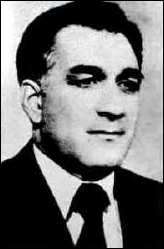
Hafizullah Amin
Amin, as a means of cementing his power as the new president, purged the PDPA of his internal enemies and terrorized the Afghan population. Deeply unpopular at home, Amin was also distrusted in Moscow and disliked for his murder of Taraki.
Further alarmed by his overtures to the US, the Kremlin decided that Amin had to be removed. In mid-December 1979, the Kremlin planted a chef into Amin’s kitchen with the idea of poisoning him but the plot failed.
During Christmas 1979, the Soviet Union invaded Afghanistan. On the third day Soviet soldiers overpowered Amin’s presidential guard and found him cowering behind a drinks bar, where they shot him dead.
Mohammad Najibullah 1947–96
Trained as a doctor, Mohammad Najibullah rejected medicine for politics and, as an 18-year-old in 1965, joined the Afghan communist party, the PDPA. But once the PDPA came to power, Najibullah fell out with the new president, Hafizullah Amin, and went into exile within the Eastern Bloc.

Mohammad Najibullah
Democratic Watan Party of Afghanistan
Following the Soviet Union’s invasion of Afghanistan in 1979, Najibullah returned to his country and was appointed by Babrak Karmal, the new Soviet-backed president, as head of the secret police, a position that Najibullah, the ex-boxer, relished, overseeing the torture and execution of thousands of Afghans.
In May 1986, the new general secretary of the Soviet Union, Mikhail Gorbachev, replaced Karmal with Najibullah as president of Afghanistan.
Following the Soviet Union’s withdrawal in February 1989, Najibullah attempted a conciliatory approach, trying to bring the Mujahideen into his government, a gesture that was roundly declined.
As the Afghan civil war progressed and Soviet aid diminished, Najibullah’s position became increasingly vulnerable. Following defections from within his own party and military, Najibullah resigned in April 1992. His attempt to flee Afghanistan the following month failed but he found sanctuary within the UN compound situated within Kabul. There he remained until the arrival of the Taliban in September 1996. Ahmad Shah Massoud, before fleeing ahead of the Taliban’s arrival, offered to take Najibullah with him, an offer Najibullah fatally declined. The Taliban entered the capital, forcibly removed Najibullah from the UN compound, and tortured and executed him.
Ahmad Shah Massoud 1953–2001
In 1976, as a 23-year-old, Ahmad Shah Massoud led a revolt against the Afghan government of Mohammad Daoud. After a forty-day fight, during which he sustained an injury to his leg, the revolt failed and Massoud decided that direct action against government forces was futile.
During the Soviet-Afghan War Massoud’s employment of guerrilla tactics caused much devastation and demoralization among the attacking forces. Throughout the war Massoud expanded his influence and territory – starting with less than 1,000 poorly equipped followers; by 1989 his force numbered over 13,000 and had emerged as a highly effective and organized fighting force. Massoud’s contribution to the Soviet Union’s defeat won him high praise, with the Wall Street Journal referring to Massoud as the ‘Afghan who won the Cold War’.
Following the war Massoud was appointed defence minister in Burhanuddin Rabbani’s government and, from within Kabul, successfully held Hekmatyar at bay.
In September 1996 Massoud fled Kabul ahead of the Taliban attacks and retreated to the mountainous north and formed the United Front, or the Northern Alliance, an alliance of anti-Taliban fighters.
But on 9 September 2001, two days before the 9/11 attacks on America, two Tunisian terrorists, posing as Belgian journalists, launched a suicide attack which claimed Massoud’s life.
The ninth of September, the day of his death, is observed as ‘Massoud Day’. In 2002, the year after his assassination, Massoud was nominated for the Nobel Peace Prize and President Hamid Karzai later awarded Massoud the title ‘Hero of the Afghan Nation’.
Gulbuddin Hekmatyar 1947–
While studying engineering in Kabul, Gulbuddin Hekmatyar emerged as an Islamist student leader, known for his radicalism and violence. During the years of Mohammad Daoud’s presidency he fled to Pakistan and found like-minded Islamic Afghans appalled by Daoud’s reforms. Here, Hekmatyar first met Ahmad Shah Massoud. Although members of the same Mujahideen group, the two men argued over its future direction to the point that Hekmatyar split and formed his own party, Hizb-i-Islami (the Islamic Party).
During the Soviet-Afghan War Hizb-i-Islami received over $600 million in aid from the US but Hekmatyar devoted as much energy fighting rival Mujahideen groups as the Soviets. When, in February 1989, the Soviet Union withdrew from Afghanistan the Mujahideen was too fractured to dislodge Najibullah’s Soviet-backed government. Despite US funding, Hekmatyar carries a lifelong hatred of the US and in 1985, during a visit to Washington, he refused to shake President Reagan’s hand.
During the civil war Hekmatyar subjected Kabul to sustained bombardment, purposefully targeting civilians with the express intention of undermining the government’s authority. Sibghatullah Mujaddidi, the first president of the post-Soviet Islamic government, called Hekmatyar a ‘true monster and enemy of Afghanistan’. But in May 1996 Hekmatyar was made prime minister by Mujaddidi’s successor, Burhanuddin Rabbani, a deeply unpopular appointment for the citizens of Kabul who had had to endure four years of Hekmatyar’s bombs. But as the Taliban closed in on the capital, Hekmatyar fled first into the mountains then eventually to Pakistan.
Since the fall of the Taliban, Hekmatyar has re-emerged in Afghanistan and is rumoured to have been behind several attacks, including an attempt on President Karzai’s life in September 2002. The same month he released a recorded message calling for a jihad against the US. He has worked alongside the Taliban and Al-Qaeda and in 2003 was named by the US as a ‘Specially Designated Global Terrorist’.
Afghanistan under the Taliban
Osama bin Laden 1957–2011
Osama bin Laden was one of fifty-two siblings born to his billionaire father, Mohammad, and his numerous wives. Osama’s mother, Alia, was fourteen when she married Mohammad and fifteen when she gave birth to Osama (‘young lion’ in Arabic).

Osama bin Laden
Photo by Abdul Rahman bin Laden
Mohammad had built from scratch a large building empire in Saudi Arabia and when, in 1968, he died in a helicopter crash – his many children inherited the family fortune.
Osama bin Laden stood 6ft 5in tall and married the first of his four wives, a 14-year-old girl, when he was seventeen. He had nineteen children, one of whom, his 22-year-old son, Khalid, was killed in the US attack that also killed Osama in May 2011.
Bin Laden first visited Afghanistan during the early weeks of the Soviet war and helped organize the supply of men, arms and money for the Mujahideen fighting the Soviet invaders.
Following the withdrawal of the Soviet Union, bin Laden returned to Saudi Arabia a hero for having contributed to the Soviets’ defeat. During the late eighties, possibly 1988, bin Laden formed Al-Qaeda, meaning ‘the base’.
Following the outbreak of the First Gulf War in 1990 the threat to Saudi Arabia seemed real. Bin Laden offered the Saudi king Mujahideen fighters to help defend the country but the king declined the offer and instead allowed 300,000 US troops on to Saudi soil from where they could attack Iraq. Bin Laden heavily criticized the Saudi king to the point his country of birth revoked his citizenship and had him banished.
In 1992 bin Laden migrated to the Sudan and from there built up Al-Qaeda. In 1996 bin Laden was forced to leave and he returned to Afghanistan where he met Mullah Mohammad Omar, the leader of the Taliban. Omar reputedly married bin Laden’s daughter. Bin Laden became the Taliban’s financial benefactor and helped mastermind their push on Kabul in September 1996.
In 1998 bin Laden issued a fatwa calling on Muslims throughout the world to ‘kill Americans wherever they are found’. Following the 1998 suicide bombings of the US embassies in Kenya and Tanzania, US president, Bill Clinton, demanded that the Taliban hand over bin Laden. But Mullah Omar refused to comply. Bin Laden’s support for the Taliban obligated Omar’s loyalty and to have handed him over would have violated his deep-rooted sense of hospitality.
Despite several rumours of his death since 2001, bin Laden was still alive until US intelligence finally tracked him down, living in a three-storey house within a fortified compound in Abbottabad in Pakistan. On 2 May 2011, a team of US Navy Seals stormed the compound and in a thirty-eight-minute operation, shot and killed bin Laden. Having confirmed his identity through DNA, his body was buried at sea.
Mohammad Omar c.1959–
Little is known of Mohammad Omar’s early life and the photograph here may or may not be of him. He was born near Kandahar, possibly in 1959, or as late as 1962.
During the Soviet-Afghan War he fought against the invaders and, during the late 1980s, lost an eye in an explosion. The myth exists of Omar removing his eye and sewing his eyelid shut.
During the Afghan civil war Omar claimed to have had a vision in which he was ordered to bring peace to his country. Leading a group of determined madrasa students, Omar embarked on a programme of restoring order and removing the bandits that terrorized the highways. The Taliban attracted increasing support both internally and from neighbouring Pakistan as it asserted its control from one town and province to another.
In 1996 Omar cemented his reputation with a symbolic act of vast significance. He removed a cloak, reputed to have belonged to the Prophet Muhammad himself, from within several locked caskets inside a mosque in Kandahar. By donning the cloak Omar was deemed ‘Commanderof the Faithful’.
In October 2001, a US bomb destroyed his Kandahar house, killing his stepfather and 10-year-old son.
Mullah (meaning religious leader) Omar is still at large.
Hamid Karzai 1957–
Hamid Karzai, born in December 1957, spent the Soviet-Afghan War in Pakistan raising funds for the Mujahideen. He served as deputy foreign minister during the first post-Soviet-backed government from 1992. He was an early supporter of the Taliban – of whom he said, ‘There were many wonderful people in the Taliban’ – but Karzai fell out with them and spent the years of the Taliban rule back in exile in Pakistan, trying to persuade the former king, Zahir Shah, to return to Afghanistan. In July 1999 Karzai’s father was killed, an act that Karzai has always blamed on the Taliban.

Hamid Karzai
Karzai allied himself with Ahmad Shah Massoud and travelled throughout the West preaching against the Taliban. In October 2001, during the US-led Operation Enduring Freedom, the operation to overthrow the Taliban, Karzai was injured in the face by US friendly fire.
Following the downfall of the Taliban, Karzai was named in the Bonn Agreement of December 2001 as chairman of an interim administration, followed, eighteen months later, with his appointment as the interim president.
In October 2004, in Afghanistan’s first democratic election, Karzai was elected president, winning 55.4 per cent of the vote. However his influence beyond the capital was considered so limited that he was lampooned as the ‘Mayor of Kabul’.
A second election in August 2009 was tarnished with accustions of electoral malpractice, and the presence of the Taliban ensured a low turnout. A UN investigation invalidated so many of Karzai’s votes that a run-off election between Karzai and his nearest rival was needed and announced for November 2009. However Karzai’s rival withdrew and Karzai was declared president for a second term.
Since the fall of the Taliban, Karzai has survived four assassination attempts, the most recent in April 2008.