
The Taliban with its army of orphans immediately began enforcing their codes of conduct and austerity upon the population and imposing the harshest penalties on those who failed to conform. They adhered strictly to Sharia law and delegated the task of ensuring enforcement to a religious police force, namely the Department for the Promotion of Virtue and the Suppression of Vice.
During the years of conflict women had suffered terribly – killed, bombed and raped. But the Taliban argued that, as Muslims, it was their role to protect women. Women were to be revered and so, the logic ran, their honour had to be protected. With protection came suppression. The woman’s place was at home to the point of not being allowed out of the home unless accompanied by a male relative and then only if she was clothed from head to toe in a burka. Any windows visible from the street had to be blacked-out to prevent her from being seen from prying eyes outside. Women caught outside dressed inappropriately were whipped and beaten (pictured below).
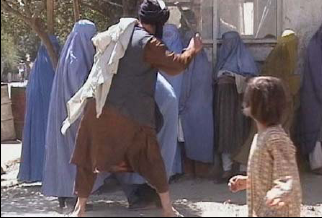
Member of the Taliban beating women, 2001
Photo from RAWA
Young girls were forced into marriages where the marital conduct of their Taliban husbands was never questioned. However if a woman committed adultery she risked being stoned to death. Adultery undermined the teachings of the Quran and, the Taliban argued, giving women rights would inevitably lead to adultery. When the UN protested about the Taliban’s attitude to women, Mullah Omar responded that the Quran ‘cannot adjust itself to other people’s requirements; people should adjust themselves to the requirements of it’.
The Taliban banned women from working. Many women were single or lone mothers having been widowed through war, and their income was vital to their survival. The majority of schoolteachers and healthcare workers were women, doing jobs that men considered unsuitable for their gender. But such difficulties and consequences were ignored. Male doctors were banned from treating female patients. Ninety per cent of primary school teachers were female, and when schools were unable to find the men to replace them, children of primary school age had no one to teach them. According to the Taliban, girls and women in education risked being subjected to pornography, and this was deemed sufficient reason to close over a thousand girls’ schools.
The West and Western culture was, as the Taliban saw it, universally immoral, corrupt and debased, and the Taliban sought to eradicate any Western influence from its society. Men were obliged to have beards and those who failed to conform were detained until their beards were deemed sufficiently long enough. The Taliban deplored Western-style hair fashion, they banned cinemas, television, music, dancing, paintings (unless they were of religious significance) and traditional pastimes such as kite flying (or kite battles) or pigeon racing. All books were banned and burnt with the exception of religious texts written in Arabic, which only a few could read.
Some team sports were tolerated and even encouraged – cricket, for example, and football. The occasional football match would include a half-time spectacle of gruesome proportions – mass beheadings.
Praying, five times a day, was obligatory and those who failed to maintain this degree of dedication risked being whipped with a rubber hose by the religious police. There was no toleration for other religions. Afghan Hindus were made to wear a yellow badge, reminiscent of the Jews wearing the yellow star in Nazi-occupied Europe, and in March 2001 the Taliban outraged international opinion by blowing up the ancient giant statues of Buddha in Bamyan in central Afghanistan, 150 miles north-west of Kabul. The order to destroy the Buddhas came directly from Mullah Omar, but his exact motivation, apart from religious intolerance, has never been established.
The Taliban sought international recognition through a seat at the UN and acknowledgement of their rightful place as the government of Afghanistan. But neither the UN nor the international community, with the exception of the United Arab Emirates, Saudi Arabia and Pakistan, obliged. The Taliban’s treatment of women and the seizure of Najibullah from within the UN compound in Kabul were cited as the official stumbling blocks, and the Taliban’s dealings in narcotics did much to damage its international standing.
In its earliest years of rule the Taliban certainly encouraged its farmers to grow opium to the point that it became one of Afghanistan’s greatest sources of revenue. Then, in July 2000, the Taliban suddenly changed tack, perhaps in view of international opinion, and banned its production. Farmers who had been encouraged to grow opium to the exclusion of anything else were suddenly left without an alternative source of income.
Mullah Omar remained in his home town of Kandahar, finding no reason to relocate to the capital.
On 7 August 1998 suicide bombs exploded and destroyed the US embassies in Kenya and Tanzania. The Kenyan bomb killed over 200 people, mainly Africans, and the Tanzanian bomb claimed a further eleven lives. Osama bin Laden and Al-Qaeda were deemed responsible and US president Bill Clinton demanded that the Taliban hand bin Laden over. The Taliban asked for proof of bin Laden’s involvement. No proof was provided and in retaliation Clinton ordered cruise missile strikes on known terrorist training camps near Jalalabad in Afghanistan. The attacks took place on 20 August and although many were killed bin Laden escaped unhurt. His name, hitherto unheard of in the West, was suddenly known across the world.
On 12 October 2000, during the last days of the Clinton presidency, Al-Qaeda struck again, this time bombing the US destroyer, the USS Cole, docked in the Yemeni port of Aden (pictured below). Seventeen US sailors were killed. Again Clinton demanded that the Taliban hand over bin Laden. While the Taliban condemned bin Laden’s attacks on the USS Cole, as they did following the embassy bombings in East Africa, they refused to bend to America’s demands. Bin Laden was their guest and thus, they felt, they were responsible for him.
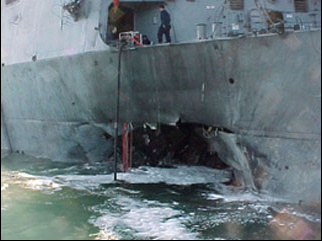
USS Cole after Al-Qaeda suicide attack, October 2000
In return the US placed an embargo on arms for the Taliban. For its part, in May 2001, the Taliban responded by closing down the UN-funded aid agency, the Special Mission to Afghanistan, which provided much relief for Afghan refugees. Relations between the Taliban and the West had come to an impasse.