
The men threw themselves upon the ground, and oblivious to the dead and dying around us, we slept the sleep of the weary.
Elisha Hunt Rhodes, 2nd Rhode Island Volunteers, Company B
Gettysburg, Pennsylvania, lies in the south-central portion of the state, just a few miles from the Maryland border. General Robert E. Lee saw the potential there to provide his men with badly needed supplies. But it was more than a raid to forage for supplies. Lee saw the opportunity to again take the war into the North, to let them see and feel some of the devastation that the South had been suffering for more than three years since the war began.
Furthermore, if Lee could secure a victory, it would likely end the war and the South would be left in peace.
That was why General Lee led 73,000 men into Pennsylvania on 24 June 1863. As they approached Gettysburg, the Army of Northern Virginia began to spread out and forage for the supplies they needed. Lee knew that forces led by Major General Joseph Hooker would likely follow him. He was counting on it. He was also counting on Major J. E. B. Stuart, a flamboyant, aggressive and effective cavalryman, who had never failed to provide Lee with the intelligence he needed regarding enemy troop movements.
What Lee didn’t know was that Stuart had been cut off and was unable to reach Lee. He couldn’t tell his general that Union troops were shadowing the Army of Northern Virginia. As they moved up the west side of the Blue Ridge divide, the 110,000 men of the Army of the Potomac were being led up along the eastern side, under a command that had been turned over to Major General George Meade after Hooker resigned in the middle of the march.
Lee’s move to take the war to the North came on the heels of a victory at Chancellorsville, Virginia. Lee’s army had carried the day, even though they had been outnumbered two to one by Hooker’s forces. But Lee had lost some of his most dependable men there. Among them had been General ‘Stonewall’ Jackson who had been accidentally shot by his own men and had died of complications not long after. Now Lee was about to lose a critical battle.
On 28 June, Lee realized that Union forces were nearby – closer to his army, in fact, than his scattered legions were to each other. The battle was about to begin. Lee sent couriers out to order his legions to converge on Gettysburg.
On 1 July, Confederate soldiers marching towards Gettysburg encountered Union cavalry and exchanged fire. The biggest battle of the American Civil War, in American history, and in the western hemisphere had just begun. When the three days of fighting was over, the place names of the few land features surrounding the market town of Gettysburg would become etched into the minds of the country: Cemetery Ridge, Little Round Top, Big Round Top, and the Devil’s Den that lay at the base where the two low hills converged. They would stand witness as the men fell, each army ironically suffering the same number of losses. Both lost just over 23,000 men, killed or wounded, while between 5,000 and 6,000 on each side were taken prisoner or went missing.
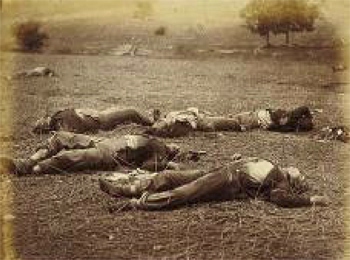
Dead soldiers at Gettysburg, photograph by Thomas H. O’Sullivan
On the morning of 4 July 1863, General Robert E. Lee, for the first time since the war began, retreated, using a rainstorm to cover his troops’ movements. On the same day, Vicksburg, Mississippi, surrendered to Major General Ulysses S. Grant following an extended siege. Control of the Mississippi River was finally in Union hands.
Shortly after the Battle of Gettysburg, land was purchased to establish the Soldiers’ National Cemetery of Gettysburg where the Union dead were moved from their shallow, hasty burials after the battle to more honourable places of rest. On Thursday, 19 November 1863, President Abraham Lincoln attended the dedication ceremony and offered a speech that was ten sentences long and which took only two minutes to deliver. Yet it has gone down in history as one of the most famous oratories, and is known as The Gettysburg Address:
Four score and seven years ago our fathers brought forth on this continent a new nation, conceived in liberty, and dedicated to the proposition that all men are created equal.
Now we are engaged in a great civil war, testing whether that nation, or any nation, so conceived and so dedicated, can long endure. We are met on a great battlefield of that war. We have come to dedicate a portion of that field, as a final resting place for those who here gave their lives that that nation might live. It is altogether fitting and proper that we should do this.
But, in a larger sense, we can not dedicate, we can not consecrate, we can not hallow this ground. The brave men, living and dead, who struggled here, have consecrated it, far above our poor power to add or detract. The world will little note, nor long remember what we say here, but it can never forget what they did here. It is for us the living, rather, to be dedicated here to the unfinished work which they who fought here have thus far so nobly advanced. It is rather for us to be here dedicated to the great task remaining before us – that from these honored dead we take increased devotion to that cause for which they gave the last full measure of devotion – that we here highly resolve that these dead shall not have died in vain – that this nation, under God, shall have a new birth of freedom – and that government of the people, by the people, for the people, shall not perish from the earth.
Abraham Lincoln, sixteenth president of the United States