APPENDIX II:
(written with Martin Tweedy Smith)
There are many problems with the precise reconstruction of the battle of Poitiers and those wishing to replay the encounter should come to their own conclusions in several cases as to the number and types of troops involved and the manner in which they were armed and armoured. The available sources are much less precise regarding French than Anglo-Gascon forces. Details are given below regarding the development of the various forces throughout the 1355–6 campaign.
Black Prince’s 1355 retinue according to indenture made with Edward III
|
433 |
men-at-arms |
|
400 |
mounted archers |
|
300 |
foot archers |
|
= |
1,133 total |
This included troops from:
Cheshire: 300 (Leaders: John Hide, Robert Legh [Macclesfield], Robert Brown [Eddisbury], Hamon Mascy, Hugh Golbourne [Wirral & Broxtowe], John Griffyn [Nantwich])
Flintshire: 100
North Wales: 140 (Leader: Grouno ap Griffyth)
This was augmented by troops led by the earls of Oxford, Salisbury, Suffolk and Warwick, Reginald Cobham and Sir John Lisle (d. 1355) who were the chief recruiting captains.
Total:
1,000+ men-at-arms
1,000+ mounted archers
400 foot archers
c. 170 Welsh troops
The chevauchée also included sizeable contingents from Gascony.
During the break in campaigning during the winter-spring of 1355–6, Richard Stafford returned to England in search of reinforcements, particularly archers as well as supplies.
1356 Anglo-Gascon reinforcements:
600 archers (300+ from Cheshire)
1356 Anglo-Gascon re-supplying:
1,000 bows} probably not acquired, forced to requisition all available
2,000 sheaves of arrows} stocks in Cheshire and ensure continuous production
30 baggage horses + others
30 grooms
Assorted victuals – wheat, oats, fish, salt pork
1356 Anglo-Gascon Army
The army that rode out in 1356 was further augmented by contingents led by a number of Gascon noblemen.
Composition of Army
3,000–4,000 men-at-arms.
This total includes knights and esquires – all knights were men-at-arms but not all men-at-arms were knights – as well as ‘lesser’ troops. English infantry units were not uniform in size nor were the proportions of different troop types. However, the army was possibly divided into groups of twenty (led by a vintenar) and 100 men (led by a centenar), these were often put in command of foreign troops to improve communication. See below for equipment.
Captal de Buch’s cavalry detachment: 60 men-at-arms, 100 mounted archers (fought on foot).
2,500–3,000 archers
Armour: leather jerkin or mail shirts, often also a helmet.
Arms: longbow, sword/dagger.
Longbow – range: 300-400 yards. Rate of fire: 15-20 arrows per minute.
The best bows were made of Spanish or home-grown yew but also elm, wych elm and ash were used. They may have had draw- weights of up to 150 lbs. The arrows were 30–36 inches in length (made of many different woods) and carried bodkin arrow-heads which could pierce plate armour at close range. Two sheaves of arrows were probably carried by each archer = 48 arrows.
NB - mounted/horsed archers fought on foot.
1,000 light troops
Armour - padded jackets/aketons and helmets
Arms: spear, sword/dagger
Commanders
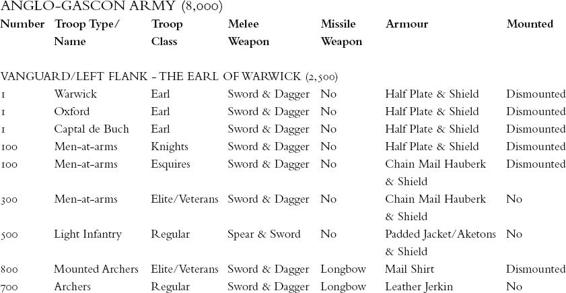
Vanguard/left flank: Warwick, Oxford, captal de Buch - 1,000+ archers, 500 men-at-arms, 500 light infantry (note captal’s cavalry strike in later stages)
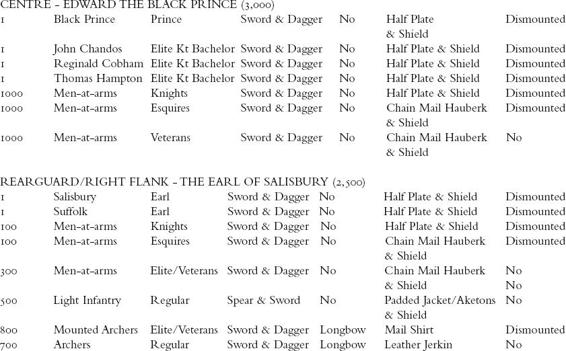
Centre: Black Prince, Chandos, Audley, Cobham, Burghersh, Loryng, Trussel, Alan Cheyne – 2,000+ men-at-arms
Rearguard/right flank: Salisbury, Suffolk - 1,000+ archers, 500+ men-at-arms, 500 light infantry.
The disposition of the Anglo-Gascon army within these three main divisions is uncertain; the numbers given above may act as a guide but should not be regarded as more than hypothetical. It is probable that the archers were divided between the vanguard and rearguard and that the prince’s ‘battle’ was composed solely of dismounted knights and men-at-arms.
Other notable Anglo-Gascon knights and members of the prince’s retinue and household
Ralph Basset of Drayton, Alan Cheyne, Stephen Cosington, Thomas Felton, Edward Despenser, Elie de Pommiers, Maurice Berkeley, Richard Stafford, John Wingfield, Baldwin Botetourt, Roger Cotesford, Dietrich Dale, Henry Aldrington, William Bakton, Robert Egremont, Geoffrey Hamelyn, John Henxteworth, Henry Berkhamsted, John Pailington
French Army
Composition of Army
8,000 men-at-arms (including knights and esquires)
See below for equipment
2,000 crossbowmen
Armour: ridged ‘kettle’ hat, mail hauberk or brigandine and coif, possibly plate greaves.
Shield: pavise – large shield with a prop so could be erected in front of the soldier during the reloading procedure.
Crossbow – range: 200–300 yards. Rate of fire: five quarrels per minute.
5,000–6,000 light infantry troops
Most were poorly trained (3,000–4,000 militia) mainly recruited using the ‘feudal’ ban and arrière-ban.
Armour: padded leather jerkin; simple iron helmet/war hat/’kettle’ hat; chain-mail collar.
Arms: halberd, sword/dagger.
Those better armed (2,000), including some of the men-at-arms were equipped as follows:
Armour: Lorigone (mail hauberk), bascinet, coat-of-plates, large pavise or smaller tablachos shield.
Arms: halberd or barde – a long-hafted axe with a thrusting point, sword/dagger.
Commanders
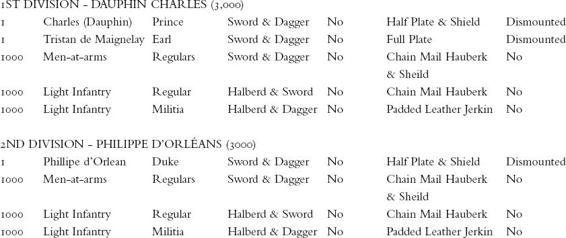
1st division: Dauphin Charles, Louis d’Anjou, Jean de Berri, William Douglas, the duke of Bourbon, the lords of Saint-Venant and Landas, and Thomas de Voudenay; Tristan de Maignelay (ducal standard-bearer) – 3,000+ men-at-arms/light infantry
2nd division: Philippe d’Orléans – 3,000+ men-at-arms/light infantry (over half left field without engaging the English)
3rd division:King Jean,Philip (future duke of Burgundy), count of Dammartin, Philippe of Valois, the counts of Ponthieu, Eu, Longueville, Sancerre and Dammartin, Charny - royal standard-bearer - 5,000+ men-at-arms/light infantry (including 2,000 select men-at-arms) + 500 crossbowmen
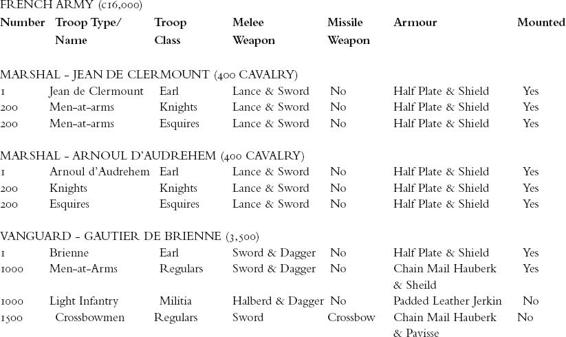
Vanguard: Gautier de Brienne (constable, led troops on foot), the lords of Aubigny and Ribemont and a German contingent under the leadership of the counts de Sarrebruck, Nassau and Nidau – 2,000+ men-at-arms/light infantry + 1,500 crossbowmen
Marshals:Jean de Clermont, Arnoul d’Audrehem – 300-500 cavalry (knights and esquires, heavily armoured)
Other notable French and allied knights
Eustace de Ribbemont, standard-bearer; Sir William Douglas (rode with Audrehem, brought 200 Scottish men-at-arms); Hugues de Chatillon
French Captives
Those wishing to recreate the battle accurately should note the period at which troops were dismissed from the field and the point at which captives were taken – see the description of the battle for further details.
Jean II; Prince Philip; Arnoul d’Audrehem; Jacques de Bourbon, count of Ponthieu; Jean d’Artois, count of Eu; Guillaume de Melun, archbishop of Sens; Bernard, count of Ventadour; Pierre d’Aumont; Count of Vendome; Count of Tancarville; Count of Auxerre; Count of Joigny; Count of Longueville; Lord Derval; Lord Daubigny; Count of Nassau; Count of Saarbrucken.
French casualties
Duke of Bourbon;Walter de Brienne, constable; Renaud Chauvel, bishop of Chalons; Jean de Clermont; Renaud V de Pons.
Further Details: English and French Men-at-Arms (including knights banneret/bachelor and esquires)
The men-at-arms, comprising, in the main, the broad ranks of the aristocracy and a number of professional soldiers were armed similarly in England and France. Apart from the small cavalry detachments led by Clermont and Audrehem, the French fought on foot in order to counter the attacks of Anglo-Welsh archers.
Similarly the Anglo-Gascon force fought on foot but had access to the horses which had carried the bulk of the army from Bordeaux to Poitiers. Some of these were remounted in the later stages of the battle and led in an encircling manoeuvre by the captal de Buch and possibly James Audley.
An English or French knight did not fight alone, he was part of a small group who served his needs and protected him. Usually this took the following form:
English: (described as a lance), comprising a knight, man-at-arms and two mounted archers (fought on foot)
French: man-at-arms, an esquire, three mounted archers and a hobelar (light cavalryman)
Armour: Mixture of chain-mail, cuir-bouilli (hardened leather), and half-plate.
Armour was undergoing a considerable evolution in this period. The wargamer may wish to arm the more experienced and affluent troops with the more ‘modern’ styles.
An aketon or simplified hauberk provided padding and a securing place for metal plates and areas of chain mail which protected the articulated parts and extended beyond the lower edge of the jupon. This was worn under a breast-plate which was beginning to replace the mail hauberk. This possibly had a corresponding rear plate. The plate was topped with a surcoat or jupon (more tightly fitting, shorter garment generally without sleeves, although not in the case of the Black Prince’s displayed above his tomb in Canterbury cathedral).
Protection for lower limbs advanced from chain mail to pour point (thickly quilted fabric) through to splinted armour (full plate or white armour by the end of the 14th century).
Feet were covered by mail or articulated sollerets.
Helmet: two types - helm and bascinet
Helm – one piece, reinforced at the front (some with visors developing in middle years of 14th century), becoming more domed/pointed. Worn over a mail hood and a padded cap.
Bascinet – often with exaggerated visor (pig-faced/snout-faced) with a curtain of mail (camail) to sides and rear.
Shield – heater-shaped, becoming smaller over the course of the fourteenth century (wood covered with leather, displaying coat of arms)
Tables and the Battlefield
Terrain
See battle plans.
Initial distance between forces should be 500+ metres
Figure Size/Scale and Colouring
25 mm figures - 50:1
10/15 mm figures – 25:1
Uniforms on both sides were rare with the notable exception of the green and white checks worn by troops from Cheshire. However, the soldiers may have carried some indication of their recruiting captain, possibly adopting heraldic colours, e.g. Arundel’s troops wearing red and white. During Edward I’s Welsh wars, English troops wore an armband bearing the cross of St George.
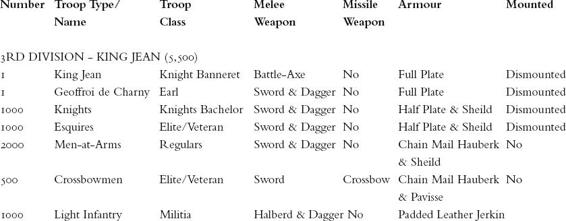
Summary Tables
It may be useful for the purposes of replaying the battle or reworking the battle under differing conditions to construct tables of combatants by troop type to the nearest 50 or 100. Players may wish to distinguish between men-at-arms, esquires, knights banneret, knights bachelor etc. and to attribute elite or veteran status to the remaining men-at-arms and archers. Such decisions will influence the ‘skill levels’ of each figure/troop grouping.
The following categories may be useful:
Section: vanguard, rearguard, centre/1st, 2nd, 3rd division etc.
Troop Type: men-at-arms, archers, crossbowmen, light infantry etc.
Troop Class: Elite, regular, militia/levy
Armour: light, heavy, none, shield
Weapons: sword, longbow, crossbow, halberd, lance etc.
Infantry/Cavalry.
For example: