

CHAPTER 4
Vietnam
Iwas scheduled to go to Vietnam in August, but since Eileen was due in September, I was able to switch my leave date with Rick Spitz. He was a bachelor and it didn’t make any difference to him. My daughter Laura was born on September 18, 1969. Eileen left Cherry Point before me to go to New Orleans and be with family and to find a place to live while I was in Vietnam. I then went on leave and joined her in New Orleans and eight days after Laura was born I caught a flight to Norton AFB in California from where I was to depart for Vietnam.
It was around 2:00 AM and I was sitting in this very empty terminal building in Norton AFB thinking, here I am going to war sitting all alone with an uneasy feeling in my stomach when a big black Navy Chief walked by.
I guess he saw the solemn look on my face and said, “How you doin’ Lieutenant?”
I said, “Fine, Chief, how about you?”
And he said to me, “You know, you can always tell a Marine, but not very much.”
That made me laugh and put a smile on my face and I said, “Thanks, Chief.” I needed that.
A few moments later up walks my good buddy from Basic School, Fred Bonati. He was on his way to Nam also. We were constantly on the same set of orders since our names were next to each other alphabetically. It was a long flight ahead for us. I think we flew to Guam first and then to Okinawa. We were on a commercial charter flight and everybody there was in the service and going to Nam so it was pretty somber. At some point one of the stewardesses walked down the aisle with a small box in her hands that made laughing sounds and it lightened up the whole airplane.
Somewhere along the flight, Fred, who was sitting next to me, looked out over the vast expanse of water and asked me, “What are your thoughts?”
I said, “There is a lot of water out there.”
And Fred answered, “Yeah, war is hell.”
Then we both kept up with a whole bunch of clichés, and for some funny reason, we both remembered that and would say that to each other every so often.
From Guam, we went to Okinawa. At Camp Henson we spent a few days checking in getting our jungle utility uniforms, and a bunch more shots. We had received about fifteen immunizations before we left North Carolina and now we were getting about a dozen more. You will never forget the Gamaglobulin shot. The needle looked like it was six inches long and as big around as a silver dollar. They shot so much vaccine into your butt that you had a big knot there for a day or so. We were issued our camouflaged utilities and then we were ready to proceed to Vietnam.
I don’t remember very much about that stay in Okinawa, but Rick Spitz and I went back there a month or so later for Sea Survival School, which provided more interesting stories. It seemed like whenever Rick and I teamed up we would get into some kind crap that made for great stories later.
I do remember our arrival at Da Nang, Vietnam. As we approached Da Nang in this commercial 727, the pilot came on the speaker to announce that there had been fire near the south end of the runway earlier so that they would be making a tactical approach to the runway. What we didn’t expect was for the pilot to put this airliner into a fighter plane type break. You know airliners come with gentle turns and slow descents to a straight in approach. But no, this guy comes in level at about three hundred knots over the end of the runway, racks the plane into a ninety degree bank, pulling Gs and goes into a descending turn to a solid touchdown. In the middle of the break, Fred, who was a F-4 fighter pilot looks at me, an A-6 attack pilot and says, “Son-of-a-bitch!” I don’t know if it was a dangerous situation that called for an extreme maneuver or just an airline pilot who always wanted to be a fighter pilot, or a fighter pilot who became an airline pilot. But it got our attention. “Damn, we are in a war zone, welcome to Da Nang, Vietnam September 1969.”
Fred and I and some other Marines were taken to a check-in facility and there I got in touch with my new squadron VMA (AW) 242. Rick Spitz came to pick me up and take me to squadron headquarters. After checking in there, I was assigned a locker in the ready room and then assigned to an Asian hut or a “hootch,” as they were called, to live in. They were not exactly the Holiday Inn, in fact they had a plywood floor, plywood walls about four feet high, and screens above the walls to the roof. It had two partitioned bedrooms, and no toilet. Still, it was better than the grunts in the field had.
We had a bomb shelter just outside of several hootches made of sand bags, but if you shined a light in there at night you would probably see some rat eyes looking back at you. It would have to be a serious rocket attack to go into it at night or for that matter during the day time.
Later on, Jim Jurjevich, a BN, and I would sit on top of the bomb shelter after the end of a late night or early morning mission, drinking wine and eating summer sausage his mom had sent him to unwind after the night’s mission. Watching the sun come up sitting on a bomb shelter with a bottle of wine should be a scene in a movie. What an image.
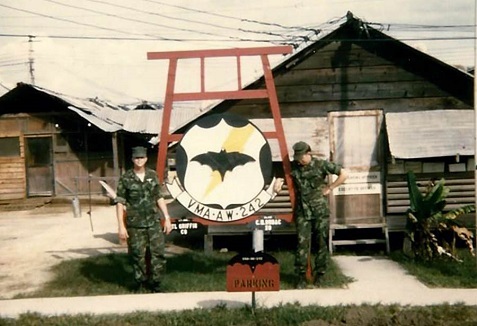
Squadron HQ VMA (AW)242
In our check-in briefing we were told about the rocket alert sirens, that they would sound off if we were under attack and that we should seek shelter immediately when they went off. So of course, on my first night there in that plywood hut and rat-infested bomb shelter, the sirens went off. I was sitting on the steps at about 9:00 PM in my green skivvies, tee shirt and unlaced boots when the siren sounded an attack alert. Remember this was my first day in war, so I ran inside, grabbed my flak vest, helmet and pistol and ran down to “Boys Town” which is where Rick and Fred stayed.
“Boys Town” was what we called the area which had a few Quonset type metal huts that each housed a number of air crews. The huts were surrounded with fifty-five gallon drums filled with sand and stacked two high for rocket protection. That sounded to me like a lot better protection than my plywood hootch. In the Boys Town hut were three or so rows of military beds each consisting of a metal frame and thin mattress set on a concrete floor for the pilots to sleep in and that was about it. You couldn’t really call it living space, just where you slept and kept your stuff. It was kept in the dark because some guys flew during the day and others flew at night.
I knew that Rick was in the center row and the eighth bunk from the door. I don’t remember if I had actually heard a rocket explode or not, but this was war and I was seeking safety. I got to the door of the Quonset hut after a block long sprint, opened it and went down the line counting beds, “one, two, three,” and so on until I counted eight. There was no place to sit so I jumped into this single bed with Rick.
He awoke in a startled state and said, “Who is that?”
I said, “Rick, it’s me, Ronnie.”
“What the hell are you doing in bed with me,” he said.
“We are under a rocket attack,” I replied.
“Well, that’s not a reason to get in bed with me. What is that in your hand?”
“My pistol,” I replied. “I’ve got my helmet, flax vest and boots on also.”
“For God’s sake, Ronnie, put your pistol away, go back to your hootch and go to sleep. The sirens go off all the time.”
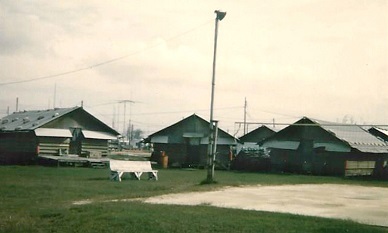
Asian Hut—
My Hootch
So Much for My First Day in the War
Istayed in the Asian hut for a week or two and then moved into better quarters with my buddy Fred Bonati as my roommate. These quarters were two-men Quonset huts with an air conditioner, one of those little table refrigerators, two beds and a table. There was a large shower and toilet facility (head) close by that served all the officers from the huts in that area. This was very special toilet facility made of wood studs and plywood and was called the “Erudite Shitter.” No profanity was allowed on the walls; graffiti yes, profanity no. Only noble writings, deep or eloquent thoughts, poetry, quotes from Shakespeare, or some Greek philosopher and things like that were to be found on the walls of the “Erudite Shitter.” It was incredible; sometimes I thought I should bring a dictionary in there to understand what I was reading. When the squadron left Vietnam to return to the states, they took the plywood walls and stalls with all the writing on it and brought it back with them to MCAS El Toro.
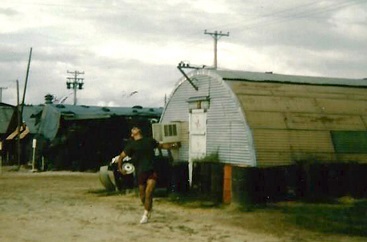
Quonset Hut — Fred’s and my Hootch
My favorite writing on a stall door was simply, “I had nothing vulgar to say, so I drew a rose.” And it was a nice rendering of a rose.
Jack Rippy remembers one writing that stated under the classic “God is dead, Nietzsche” and “Nietzsche is dead, God” was a variant - “God is dead, Nietzsche” with the reply; “No, He’s not, He’s alive and well and living on the Air Force side!”
In Da Nang the Air Force was on one side of the airbase and the Marines and Navy were on the other side. With the Air Force everything was first class, with the Marines everything was third class or coach and you had to make do with what you had. The Air Force side of the airbase had paved streets, the old Holiday Inn-like living quarters, very nice dining halls, an “O” club, and a swimming pool.
We had sand streets, Asian and Quonset Huts, outdoor shitters, plywood mess halls, an “O” Club, and water shortages that we claimed were because the AF was filling their swimming pool.
There were other head facilities located around the compound; these were the two-hole and four-hole out houses which had a bench like seat with a hole to sit on. Underneath was a fifty-five gallon steel drum cut in half and filled with diesel fuel. On a regular basis, once or twice a week or something like that, they would service the outdoor heads by pulling out the steel drums and setting the diesel on fire. This was called “burning the shitters.” No Marine who has ever experienced the ritual will ever forget that unique smell.
There was another part to the servicing of the heads and that was done by the infamous “MAG 11 Pee Pee Pumper.” The Pee Pee Pumper was a tank truck equipped with a pump, hose, and a yellow rotating warning light on top that was on when in the operation of pumping out the heads. I guess the yellow rotating light was a warning of sorts like, “Danger, stay clear, Pee Pee pumping in progress.” Man, I just wish I had a picture of that, because everybody who was there would remember that truck. It was 1st Marine Air Wing folklore.
I got into the routine fairly quick: got issued my flight gear, pistol and shoulder holster. I remember thinking that was a little bit like the old west, with everybody packing heat. Some guys didn’t want to go with the standard 38 caliber revolver and would get their own weapons. One BN that I flew with had this real long barrel big ass 44 caliber pistol that would have made Clint Eastwood proud of him. I was amazed that he could carry that big thing and still fit in the cockpit’s seat. But he said that if he ever went down, he wanted a fighting chance.
The daily routine depended upon whether or not you flew that day and what time your flight was scheduled. The A-6s flew all day long but a lot of our missions were in the middle of the night, since we were an all-weather electronic attack plane. The F-4s and the A-4s flew most of the day hops because they were visual attack aircraft. The F-4s were fighters, but in 1969 and ’70 there wasn’t much air to air fighting so they were dropping bombs for a living also. The A-4 was a great visual bombing platform and those guys were very good at what they did—close air support.
It wasn’t a rule, but I thought for some odd reason that they put the tallest pilots in the tight little A-4 cockpit and the smaller guys like yours truly in the spacious A-6 cockpit. I think that I was the only guy in the squadron that could stand up in the cockpit; maybe Roger De Jean or Dave Clary could do it also. But I did do it later to take a piss half way over the Pacific on a trans-pacific flight.
First Flight
Your first flight in- country was a “Fam Hop” or familiarization flight, in which you went up with an experienced pilot with the new guy riding in the right seat. The pilot would fly you around the area and point out various landmarks, flying procedures and things you needed to know about flying around Da Nang, Vietnam. In my case, I flew with Dave Clary who I knew from training in my earlier squadron at Cherry Point. Dave had been in- country for several months, was a very good pilot and had a little bit of a crazy streak.
We took off from Da Nang and he showed me Da Nang Bay, the Qua Son Mountains south of the base and then we flew up the coast, where he pointed out some of the now-famous battle areas, the walled city of Hue, Phu Bai, then Quang Tri and Dong Ha. And as we approached the DMZ separating North from South Vietnam, the missile warning light went off with that very urgent warning sound of “Dooo, Dooo Dooo!” All of a sudden Dave made a violent bank to port and then to starboard, then went inverted into a split S as he yelled out to me over the intercom “SAM,” which was a surface to air missile. My ass got real tight real fast and I began looking for the missile smoke trail. They briefed us that if you can see the missile you can beat it by breaking into it in an evasive maneuver whereby the missile can’t turn with you and goes ballistic allowing you to escape. I was straining to find the SAM when Dave said, “Just kidding.” He had set off the missile warning light while I was distracted looking out the cockpit.
But that wasn’t the end of his FAM experience for me.
He slowed the A-6 to landing gear speed, lowered the flaps, dropped the landing gear and said to me, “Are you a member of the Clam Shell Society?”
I said, “No, what is the Calm Shell Society?”
He said, “I’ll show you,” and began opening the canopy, which you just don’t do in a modern tactical jet; everything began flying out the cockpit and then he took a grease pencil and made an X outside on the windscreen and gave the pencil to me.
“Your turn,” he said. “This is to prove that we did open the canopy in flight and are now members of the Clam Shell Society.”
Jack Rippy said that Dave had another trick that he would pull on the new guys. He would do the slow down routine and say the cockpit was awfully dirty, open the canopy and turn the aircraft inverted whereby everything would fly out and Dave would say, “Now that’s much better.” Dave, as I said was a little bit crazy.
I got snapped into the routine and soon I was flying missions. This was what it was all about—flying missions in combat. It was like practicing for a football game, then finally getting into the real game. This was the real game with a lot more on the line.
I remember the first time I went into the locker room where we hung our flight gear, helmets, flight vests, and our “G” suits. There was mine with my name tag sewed on - R. Boehm and next to my locker was the flight gear of another guy—R. Boehm. I was Ron Boehm and he was Robert Boehm. I was five feet, six inches tall and Bob was six feet five inches tall. Thankfully we never got our flight gear mixed up. I pronounced my last name “Bo-em” and he pronounced his name “Beam,” so the CO called him High Beam and me Low Beam.
Your first flights were with an experienced BN who led you through the hop, got you to the target, set up the ordinance and ran the systems attack on his computer then showed you the way home. At first you did simple radar guided TPQs in Vietnam, whereby you would be flying about eighteen thousand feet or so and the ground-based radar controllers would guide you to the target and tell you when to “pickle” or drop your bombs. These hops were for the beginners and usually were not anywhere near our troops.
After the TPQ missions, then you got to fly some in-country (in Vietman as opposed to Laos) A-6 system hops. The RABFAC (Radar Beacon Forward Air Control) beacon hops in support of ground troops were only flown by the experienced air crews. In these missions, you were in contact with and controlled by a pilot/forward air controller stationed with the ground units and directing you to the target with a portable transponder.
After you got some experience under your belt two or three months in-country then you got to fly the missions at night over Laos. These were the missions where you could expect some action and often triple A to greet you. The Ho Chi Minh Trail coming out of North Vietnam and through Laos was one of the most heavily defended areas with anti-aircraft weapons in history.
First Laos Mission
“They’re shooting at us.”
My first mission over Laos was with Jim Wingerter, one of the most experienced BNs in the squadron at the time. I was nervous about the flight and the fact that I had never been shot at before. I wasn’t worried about getting killed, but rather I was worried about being a coward in a combat situation. Nothing would be worse for a Marine. To act in a cowardly fashion in front of another Marine I thought was worse than death itself. But my first experience with being shot at was nothing like what I was worried about.
We took off from Da Nang around 2:00 AM, headed up the coast and then turned westward just under the DMZ. Soon we were over Laos and leveled off at about eighteen thousand feet. We checked in with the 7th Air Force controlling agency, call sign “Moon Beam,” and they directed us to enter a holding pattern. The controller said that our target would be some “movers,” trucks moving south along the route package.
The “route package,” as we called it, or the Ho Chi Minh Trail was a system of roads coming down from North Vietnam through the mountains, jungle and through Laos, leading down into South Vietnam. This was the route by which the North Vietnamese sent their troops and supplies into the south. The hub of the so called route package was the town of Tchepone where several routes including Route 9 and Route 91 came together. Tchepone was located near the confluence of the Xe Banghiang and the Xe Pon Rivers. Our job was to disrupt that flow and destroy those supplies and troops.
Moonbeam gave us our target, three trucks moving south, our target time and the run-in heading which would bring our bombing run in line with the direction of the road at the point of attack. At night, Laos was pitch black; you were mostly over jungle and you didn’t see city lights like back in the States, just blackness and the occasional red “triple A” anti-aircraft fire coming up from the ground, lighting up the sky. That usually indicated where the hot spots were and you hoped they would not direct you to that area where the fire was.
At that time the route package, especially the mountain passes of Ban Karai and Mu Ghia were said to have the most heavy concentration of AAA guns, more so than even the Germans had around their cities in WWII.
I looked out of the cockpit and there was a stream of glowing red balls arching up towards us. But at the vantage point of eighteen thousand feet they seemed to float lazily upward towards us like a fireworks display.
I said to my BN, “Wow! Look at that, that’s awesome!”
And he said, “They’re shooting at us.”
I responded, “Oh shit!” The first of many “oh shits” I would exclaim during my time in Vietnam.
If we had a night flight, which was often the situation, we would go to a daily briefing at the Group Briefing Room in the afternoon and be given specifics regarding the mission: the target area, what kind of defenses we might encounter, our ordinance, the weather and other pertinent information. About an hour before takeoff the pilots and BNs would do their own briefing: discuss the flight plan, the target, the ordinance to be dropped and emergency procedures. If we were flying over Laos, which was the case quite often, since most of our missions were attacking trucks carrying supplies down the Ho Chi Min Trail from North Vietnam into South Vietnam, we would discuss our egress from the target area if we took a hit. The closest safe area was east straight to the South China Sea, but that would mean crossing North Vietnam. If you went down there you would probably be a guest at the Hanoi Hilton or some other prison in North Vietnam. Another choice would be to head west to Thailand, but that meant crossing Laos and if you went down there you had the best chance of surviving but you had a good chance of being killed if captured.
I heard that most of the aircrews that went missing in action in the war and never found went down in Laos. Of course, the best scenario was to keep your bird flying and make it back to Da Nang. But if you did go down, you had a good chance of getting rescued. There were several rescue units with some very good and very brave guys that would risk everything to save you and your crew. The Air Force Jolly Green Giants flying their Sikorsky MH-53 rescue helicopters and the A-1 Skyraiders flying in support of the Jolly Greens flown by the Air Force‘s “Sandies.” They would provide cover fire support for the helicopters.
The Sandies flew the Douglas A-1 Skyraider formerly the AD Skyraider, a large single engine prop plane with a massive 2500 HP radial engine. The A-1 came out in the late 1940s and flew in Korea and Vietnam conflicts. It was a great aircraft for its mission because it could carry bombs, rockets and guns, plus stay on station for a long time.
The South Vietnamese flew the A-1s also and since the pilots were a bit smaller than their American counter parts, I heard that they strapped wood blocks onto the rudder pedals so that they could handle the huge torque that that big engine produced on takeoff.
One Sandy pilot, Major Bernard Fisher USAF in March of 1966 even landed his A-1 while taking heavy fire to rescue another pilot who had been shot down and crash landed on the embattled airstrip of a Special Forces camp. He received the Medal of Honor for his courageous act of valor. (Source: Medal of Honor citation)
The Navy and Marines also had their rescue units that saved many lives. Their basic mission was an act of valor. Marine chopper pilots had large balls and their stories of heroic rescues are legendary. It seemed that every helicopter pilot I knew personally was shot down or shot up at least once. But then there is the saying that if your wings are going faster than your fuselage you are already in danger.
Charlie Carr
One of my first hops over Laos was with a BN who was a Marine Corps legend—Charlie Carr. Charlie Carr had more combat missions that any other BN in USMC history and his picture hangs on the wall of the USMC Museum in Quantico, Virginia. Charlie was a one of a kind character, but he was the best and most experienced BN in the Marine Corps and probably the Navy, too. When I was just about finished with my tour in Vietnam with VMA (AW) 242, Charlie was back with my original A-6 squadron VMA (AW) 224 on board the USS Coral Sea aircraft carrier. They were the first Marine A-6 Squadron to go on board the boat in quite some time.
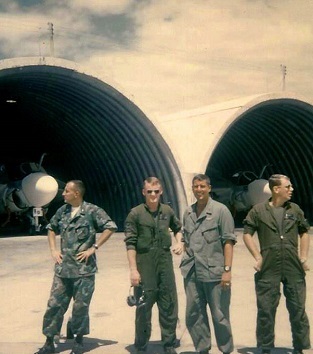
Maj. Davis, Beman Cummings
Charlie Carr, and Dick Davis
in front of revetments.
He was the CAG’s (Carrier Air Group) lead BN when the A-6s flew off the Coral Sea and seeded Hi Pong harbor with mines in 1970. Charlie started out as an enlisted Marine, then became a warrant officer, and when I met him, he was a Captain, and Major in our squadron VMA AW 242. He was a very colorful person but a very good flying officer. On this particular flight, I had a tape recorder strapped to my leg and plugged into the aircraft’s communication system so I could record an actual combat flight. When I played it back later after the flight, I found that every other word was an “F---“ or “MF” with some other very descriptive language. But Charlie got you to the target, found the target and put the bombs on the target. He finished his combat tours with six hundred or more missions, two hundred over North Vietnam. (Source: Fast Movers by John Sherwood)
Charlie was as infamous out of the cockpit as within. Some of his greatest fame happened in the “O” Club. On one event of flying some special mission or some special number of missions he came into the “O” Club covered, (with his hat on). Marines never say hat, it is your cover. Just like they never say gun; it’s your weapon, your rifle or your pistol, never your gun or your hat. The rules of the “O” Club were that if you entered with your cover on the bartender would ring the bell and you bought the house a round of drinks. Of course, drinks were only fifty cents, and there was the special drink of the month that was twenty-five cents. When the bartender rang the bell and pointed at you, you would say, “Shit, I can’t believe I forgot to take my cover off,” and you pulled out your wallet. The other rule was that you could not hang from the rafters or you would buy the house a round of drinks. But Charlie had a purpose, a celebration of sorts. After walking in with his cover on, he climbed up into the rafters, “dropped trow,” his pants, mooned the entire club and said, “Drinks on me.”
Talking about drinks, one of the more interesting drinks for us pilots was the “Afterburner.” It was a straight shot of alcohol of some type, I don’t remember exactly what, that they set on fire and you threw it down trying not to burn yourself up or ruin your throat. If you weren’t careful, you could ignite your mustache if you had one and that wasn’t much fun.
“O” Club Games
Rolling dice at the bar for drinks was a big past time. One of the dice games was “Ships-Captain-Crew,” and I’ve got to admit I can’t remember exactly how the game went. I just remember losing a lot of drinks. Another game was “Acey-Deucey” which was a variation of backgammon. But one of the most famous of the games, if you can call it a game, carried out in the Da Nang Marine “O” Club was “Dead Bug.” As everybody was drinking and having a good time, as best you could with no females around, somebody would cry out “dead bug,” and everybody dove to the floor putting their arms and legs up in the air like a dead bug. The last person on the floor with their arms and legs up in the air had to buy the house a round of drinks. The floor was concrete, the bar stools were pretty high and people got banged up diving down to the floor. It was an incredible sight to see fifteen or twenty guys all lying on the floor with their arms and legs up in the air. And, of course, these were our best and brightest.
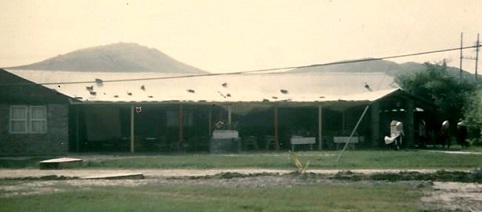
Mag 11 O Club Da Nang
One time I was sitting at the bar with Wally Siller a BN who later became a doctor. We were sitting with this lieutenant colonel who was an alcoholic and got drunk after 5:00 PM at the club just about every evening. The colonel leaned back in the bar stool a bit too far and it tipped over. He hit the concrete floor with an awful sound and just lay there. Hell, I thought he could have been badly injured or worse, dead, and Wally looked down at the colonel and said, “Dead Bug, Colonel?”
China Beach “O” Club
Another game was “Buck-Buck” or as we called it in grade school “Break the Camel’s Back.” In this game you would get one guy leaning over and grabbing a post or wall or something to hold on to. The next three or five guys bent over the guy in front and wrapped their arms around the guy’s waist in front of him.. This was the Camel or whatever. The other guys would line up about ten feet back and one by one yell, “Buck-Buck Number One,” and run at the guys bent over, jumping on their backs trying to break the camel’s back, break apart the bent over and jointed guys. Then the second guy would yell, “Buck-Buck Number Two” and he would run at the bunch of guys bent over and try to break the camel’s back and so forth and so on until the last guy was either riding on the bent over guys’ backs or until the structure collapsed. The guys forming the camel’s back would say things like, “Is there a flea on our back?” or “When are you going to start?” things like that. Did I mention that a lot of alcohol was involved in this very “adult” game?
It was at The Navy’s China Beach “O” Club in Da Nang on the South China Sea coast and the occasion being the Marine Corps’ Birthday on November 10, 1969, that this game became a notable event for our squadron. After dinner, songs and many toasts, they struck up a game of buck-buck. Unfortunately, the first guy of the camel was positioned right in front of glass doors. Well, you can see this coming. One guy got a big running start and glanced off the backs of the guys bent over and broke through the glass door. The squadron was on the edge of rowdiness already and this was (pardon the pun) “the straw that broke the camel’s back.” The Navy threw the whole squadron out.
As all this was going on, Dave Clary and I were down on the beach. China Beach was a beautiful beach with emerald green water and white sand. It was also beautiful at night with the moon light shining on the water and the waves rolling onto the beach. I think our intent was to go skinny-dipping. When we got back to the club everybody was gone along with our transportation.
I asked Dave, “How are we going to get back to the airbase?”
I don’t remember exactly how this all transpired, but Dave saw one of those small gray Navy school busses and said, “We’ll borrow the bus and take it back to the base.”
I looked a bit confused and was kind of drunk so I went along with it. We jumped in, Dave hot-wired the bus if my memory is correct (or the keys were left in it) and we took off back to the Da Nang Airbase which was some distance across town.
After a mile or so we came up to a South Vietnamese police check point with a barricade arm across the street.
I said, “Oh shit, what are we going to do; we’re in a stolen bus.”
Dave said in a semi-drunken voice, “Get down, we’re going to run it!”
Which we did and the Vietnamese guards came running out and opened fire on us with their rifles.
I had been shot at in the air, but this was my first time to be shot at on the ground. Kind of brings a different meaning to the term “friendly fire.”
We got back to the base and parked the bus outside the gate and walked into the base. Needless to say, we didn’t mention this to anybody with a rank higher than ours. I was tempted to go check out the bus the next day for bullet holes but I figured it was better to stay the hell away from it. War is hell.
Dave was a good pilot, but many of my memories of him involved crazy stuff. Only Charlie Carr who was legendary as being crazy out shined Dave in my view.
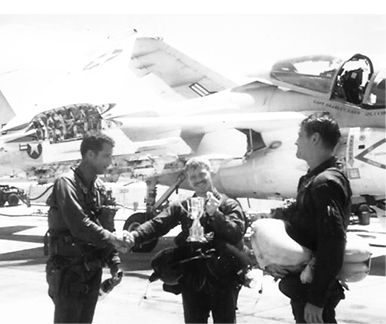
Lt. Col Stan Lewis, Dave Clery, and Lt. Earl Smith’s last combat flight.
Da Nang AF “O” Club
While we are on the subject of “O” Clubs, I have to tell a little story about the Air Force’s “O” Club on the other side of the airbase. As I had mentioned previously, the Navy and Marines were on one side of the field and the Air Force was on the other side. Our side of the field was kind of primitive with sand streets and outhouses; however, the Air Force lived in the former two-story Holiday Inn-type BOQs with a swimming pool and a really nice “O” Club which we visited occasionally. On one such visit I, along with my buddy Roger De Jean, who was only about an inch or two taller than I was, met two Air Force nurses.
Now “round-eyed” women (Caucasians) were a scarce commodity over there since most every woman that you saw was a “slant eyed” oriental. These two AF nurses were a little chunky, but they thought of themselves as queens because of the scarcity status.
When Roger and I met them and introduced ourselves, they looked at us and said, “We thought all Marines were big guys.”
I then said, “Depends upon how you define big and were you measure it.”
Roger chimed in and said, “Yea, we’re big where it counts.”
To which they replied, “Yeah, right.”
The next day Roger and I went out to one of the A-6s on the flight line to take a picture with a Polaroid camera of me standing on the nose of the A-6 with the refueling probe between my legs. The A-6 had a unique refueling probe protruding from the nose of the aircraft just in front of the windscreen. The base of the probe was about as long as my leg and came up at an angle. The probe itself that actually plugged into the refueling basket was aligned horizontally, was about twenty inches in diameter and about two feet long. The nose of the probe looked like a huge circumcised penis.
I got up on the nose of the plane with my right leg hiding the base of the probe, my left hand holding the giant penis and showing a great big smile on my face. Roger took the picture and took it back to the Air Force “O” Club that evening.
We spotted the two queen nurses and showed them the picture and said, “Here you are sweetheart, eat your heart out.” With that we went, laughing our asses off.
Lieutenant Colonel “Black Tom” Griffin
In the beginning of my tour in Vietnam my squadron commander with VMA (AW) 242 was Lieutenant Colonel Tom (Black Tom) Griffin. Lieutenant Colonel Griffin was a strictly by the book Marine Commander. He was a leader in the sense that he would always take the toughest missions, but to me he was aloof and distant with the men in the squadron or at least with the junior officers. The talk with us was that he would take the tough missions so that he could get a Distinguished Flying Cross award to better his career. He did try at least one time to better the camaraderie with his officers by having a mustache growing contest, which I won, beating him out for first place.
Lieutenant Colonel Stan Lewis
After about my third or so month in country we had a command change and Lieutenant Colonel Stan Lewis took over from Griffin. He was the finest example of a leader and commanding officer that I had ever served under. He was a very smart guy with probably a genius IQ, a very personable leader who really cared for his men, and he was also the best stick in the squadron.
You might be flying one of our very early two or three AM flights and meet him out on the flight line talking to the plane crew or handing them a wrench or something like that. When a young Marine finished his tour with the squadron, Lewis would write his family and commend him for the job he had done.
Lieutenant Colonel Lewis wasn’t the only smart guy in the squadron: we had a bunch of them. Carl Monk was one of the our best BNs and probably had a genius level IQ also. Carl Wydell and Rick Spitz were also very smart guys as were a handful of other guys. Jack Rippy was a lawyer before he became a Marine officer. It was very impressive to be surrounded by so many smart guys.
I was flying Lieutenant Colonel Lewis’ wing on a mission down south of Da Nang when we were diverted from our original assigned target for an emergency mission to help some Australian advisers with their South Vietnamese troops who were under heavy attack. When we arrived over target, the airborne FAC told us that the Aussies said that they were on this hilltop outpost, were about to be over run and that the bad guys were inside the perimeter fence. Next thing he said was that the Aussies were getting down in their holes and wanted us to drop on top of them. My heart went up into my throat, and I was very glad that I was with Lieutenant Colonel Lewis because of his skill and experience.
He radioed me, saying that we would lay a string of bombs up one side and over the hill top and said to follow his lead. He made his run and we followed his lead, making our run and placing our five hundred pound bombs up the side of the hill and over the top. My heart was heavy thinking we might be killing our own people. But a soldier on the ground would never call for this extreme action if he had any other option.
It seemed like an eternity passed from the time we released our bombs to when the FAC came up on the radio and said, “The Aussies said bloody good show Yanks, you tore the bad guys up.” I don’t think that I had ever felt such elation before in my whole life. These guys survived our bombs and survived because of our help. That was awesome.
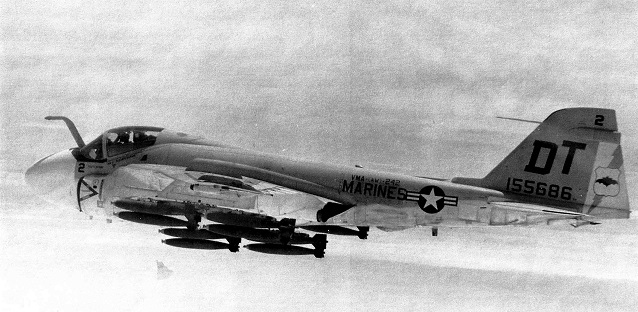
A6A with bombs in flight
Back in the squadron when we had an AOM (All Officers Meeting), Lieutenant Colonel Lewis initiated The Drink of the Day policy which made the attendance rate and atmosphere much better. It was a pleasure to serve under Stan Lewis: he was the best leader I had served under. At the time he seemed like an older guy, me being twenty-five years old, but he was only about thirty-six years old at the time. Whenever I compare or measure leadership, I use Stan Lewis as the standard.
Cubi Point, Philippines
In October of 1969, I got orders, along with Jack Rippy, Rick Spitz, and Major Coleman, to go to Jungle Survival School—the JEST Course (Jungle Escape and Survival Training)—in the Philippines. Our orders were to stay at Cubi Point Naval Air Station at the edge of the Subic Bay Naval Base. We had a day or so of classroom training and instruction by the Negritos, who were small indigenous people of the Philippines. They were famous jungle fighters of WWII that waged a guerrilla war campaign against the Japanese. The Negritos are an ethnic group that inhabit a number of islands in Southeast Asia. They are a short people and very skilled in the art of living in the jungle and they taught us what we could eat and drink, how to catch our food and what to avoid. After a few days of training, we were dropped off in the jungle to survive for a few days on our own without food or supplies.
I learned to drink water from a vine that grew in the jungle, and eat anything I could catch and kill. However, my buddy Rick Spitz was always looking for an angle to make things better for himself, and most of the time he did just that. So while walking down this jungle road we came upon some of the Marine school personnel with their vehicle stuck in the mud. They asked us for some help to get their vehicle un-stuck.
I would never have thought to take advantage of the situation because after all we were in school to learn to survive in the jungle in case we got shot down and had to do just that. But Rick is Rick and instantly said that we would help them if they gave us some of those C Rats (C Rations were military field food rations). They said that they could not do that, and that we were there to practice our survival skills. Rick said, “Good luck with your vehicle.” They reluctantly said, “OK” and we had food for the next few days while the other guys were catching lizards, snakes and stuff like that.
Time and time again I could always rely on Rick to find an angle, like later on at FAC School on Okinawa when everyone else was staying in the humble BOQ on the Marine Base and he got us into the Air Force BOQ at Kadina AFB. Trust me, the Air Force facilities are always superior to the Marine facilities.
While not in the jungle and back at Cubi Point, after school we got to go check out the night life in the adjoining town of Olongapo. To get to Olongapo from Cubi Point Naval Air Station, we had to cross the bridge over “Shit River.” I have no idea what the real name was, we just called it the Shit River because it was basically a sewer. And the thing we all remember about it was the people in boats next to the bridge diving for quarters that we would throw into the river. Just seeing it made me want to take a shower.
The main street in Olongapo was Magsiasia Drive which was said to have more clubs and bars than any other place in the world. (Source: Wikipedia) Olongapo was a kind of an opposite-like Mecca of decadence and the epitome of that was the East Inn Club. You entered the club by going up the stairs into a not very fancy room where the girls came up to your table and asked you to buy them a drink. For a dollar or two they did just about anything and would strip on your table, pick up your beer without using their hands and so forth and so on.
One of our buddies was a very good family guy and read the Bible daily, so Dick and I paid a couple of girls to pay special attention to him. They came up to him and started to strip and then one sat on his lap, all to his animated protest. Well, in the hassle, his chair fell over and he went to the floor with the two semi-naked girls. The two girls then sat on him, one on his mid-section and the other on his face while he was crying out in muffled yells, “Get them off of me, get them off of me.” Of course Rick and I were laughing like crazy at the sight of this Marine pilot taken down by two little Filipino girls. He didn’t think it was so funny.
You had to be careful in Olongapo and stick with a friend because it could be dangerous. The bouncers outside the clubs were armed with sub-machine guns and would use them, but you could get robbed or worse in a heartbeat.
Transportation was on foot or in a “Jeepney.” The Jeepneys were the Filipino version of the jitney. They were made from surplus WWII Jeeps that had been converted into a sort of taxi/mini-bus. They had no doors, just a roof, open sides and bench seats on each side. They were brightly painted, decorated with lights, reflectors, tassels, and beads, small statues of The Blessed Mother or some saint and all kinds of other stuff or glitter. They were a sight to see and ride in. But they too could be dangerous. My brother Lloyd while there in the Navy was riding in one with his arm resting on the back rest going down the crowded street when somebody ripped his wrist watch off his arm and disappeared into the crowd.
Fred Bonati’s squadron mate was trying to hire a Jeepney when an argument broke out between two competing drivers; one broke out a pistol and shot the other guy, killing him on the spot. Fred didn’t say if his buddy got in the Jeepney or not.
I was riding in one by myself late at night going to some club when the driver turned in the wrong direction and was heading up a dark street. It didn’t look good to me so I jumped out while we were still moving and ran my ass off in the other direction.
There was a curfew at midnight and you had to be either off the streets, in a hotel or back across the Shit River Bridge and on base. Fred stayed too late one night and one of the girls took him home with her to her family. He spent the night and they fed him breakfast in the morning and said they were very nice people.
Jack Rippy and I were walking back to the base down the main street which was about five blocks away when I looked at my watch and realized that it was about five minutes to midnight. We started to sprint in order to get across the bridge and onto the base before midnight. The buildings on each side of the streets were lined with clubs, guards and some girls. We were almost to the bridge and at the end of the buildings still running our asses off when from the shadows in between the last two buildings came forth a voice that said, “Psst, hey GI last chance for blow job.” Jack and I looked over and to our horror, there was this ugly ass woman with missing teeth and the others grossly stained red from beetlenut standing in the dimly lit space between the two buildings. It was just enough of an adrenaline boost to get us across the bridge in time.
Everybody knows that Naval Aviators go through carrier qualifications in order to land on the aircraft carriers, but “Carrier Quals” in the “O” Clubs and bars took on a different meaning. They came in a few different forms; one was when the guys cleared the bar off, poured beer down it and two guys stood at one end on either side of the bar holding a towel between them. The pilot attempting the “carrier qual” stood at the other end of the bar to get a running start, throw himself on the bar top, slide down the bar on his belly and hope to be stopped or arrested by the towel being held by the two guys at the end of the bar. Again, alcohol was an important factor in this endeavor. This arrestment wasn’t always perfect and some guys never made it to the end of the bar, rolling off the deck prematurely incurring possible injury, but the guys that made it to the arresting gear (the towel), using their necks as the tail hook, sometimes didn’t fare too well, either.
The “Carrier Quals” at the Cubi Point “O” Club started out being held on a three-foot wide concrete sloped ramp or bannister that ran along the sides of the steps at the club. There, the pilots took chairs with caster rollers from the club and rolled down the ramp. The bottom two feet or so of the ramp turned up from an approximate thirty degree slope to horizontal, so when the guy in the caster-rollered chair reached the bottom he was launched like on a ski jump.
When you have these highly-and expensively-trained pilots on cruises, breaking their arms and incurring other such injuries and then not being able to fly, those were serious problems. So the club or the Navy brass came up with an alternate to the carrier chair launch. They made the bar in the basement break proof with stainless steel mirrors, bar tops, concrete block walls and an ingenious “carrier qual” apparatus. It consisted of a wire cage simulated cockpit set on two rails that ended in a pool of water of about six foot by eight foot by three foot. Just before the pool at the end of the rails was a set of double doors and a step on which was an arresting wire.
You would be propelled down the rails in your cockpit by a couple bottles of compressed nitrogen; there was a handle in the cockpit that you pulled to release the arresting hook in order to engage the arresting wire that stopped you from going into the pool. If you dropped the hook too early you got a hook skip and missed the wire. If you dropped the hook too late you missed the wire and either way you went into the pool. You had to get the timing just right to avoid going into the pool. There were a lot of wet pilots there.
I was there one time with a bunch of Navy aviators from one of the carriers who were with a couple of nurses. There was a lot of drinking going on and somehow they strapped one of the nurses into the cockpit upside down with her legs up in the air and her skirt down around her waist. They fired her down the rails and somebody had to jump in the pool to rescue her from drowning. What a place. Man, when a carrier was in port it was sheer madness.
In 1991, Mt. Pinatubo, a volcano on the Island of Luzon, erupted, covering Olongapo, Subic Bay, Clark AF Base, and the area in ash. Those bases were evacuated just before the big eruption and that spelled the end for those legendary bases which just about any sailor, Marine or Air Force guy who had visited them left with bunch of memories.
Lieutenant Valovich
The squadron plaques from the Cubi Point “O” Club now hang on the walls of the reconstructed club in the Naval Air Museum in Pensacola, Florida. When I visited the Air Museum in August of 2011, I looked for and found my squadron VMA (AW) 242’s plaque from a later time and was pleased to see the squadron commander at that time was Lieutenant Colonel J.M. Valovich. Jim Valovich was a BN and my squadron mate in Vietnam. We were both First Lieutenants at the time and he was a good BN.
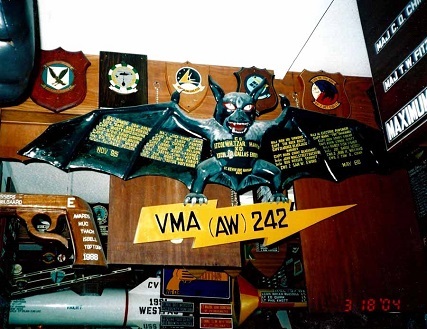
VMA (AW) 242
Squadron plaque from Cubi Point “O” Club now on wall of its mock up in the Naval
Air Museum in Pensacola, FL.
My favorite memory of Jim Valovich is one when he was about a couple days away from going on R&R to meet his wife in Hawaii. There was a joke at the time about this captain who told his sergeant to tell Private Jones that his father just died. The sergeant called the unit to attention and shouts out, “Private Jones, your father just died.” The private was stunned and the captain told the sergeant that he can’t just yell that out, he had to be more tactful and sensitive in a situation like that. So then he tells the sergeant to go tell Corporal Smith that his mother just died and to be more tactful this time. So the sergeant calls the unit to attention and says, “Everyone who has a mother that is still alive take one step forward. Not so fast Corporal Smith.”
Jim was complaining about being scheduled to fly a night mission over Laos where you usually got shot at when he was only a day or two away from going on R&R. So somebody said, “Yes, I can see it now, the person in charge of greeting the wives in Hawaii saying, ‘Everyone who has a husband meeting them on R&R take one step forward—not so fast Mrs. Valovich.’”
Rick Spitz
Back in Da Nang, my then roommate Fred Bonati and his F-4 Squadron VMF 314 moved down to Chu Lai about sixty-five miles south of Da Nang and Rick Spitz moved in with me in our Quonset Hut. On one occasion, Rick came back from a mission and said that they had taken a whole bunch of fire going into a target in Laos. They were on a mission to attack supply trucks coming down from North Vietnam along the Ho Chi Minh Trail. The trails were a number of mud roads through the jungle of Laos that led into South Vietnam. Ever since we had stopped bombing North Vietnam they had moved more and more anti-aircraft guns along the trails.
Rick’s mission, along with his BN Carl Monk, was to be a coordinated effort with the F-4s from Chou Li whereby the A-6s would attack the trucks moving along the trail and the F-4s would sit up top and wait for the guns to come up which would fire on the A-6s, then the F-4s would attack the guns to suppress the fire. On this mission, they were assigned a target by the 7th Air Force controller in which they were given the information on the number of trucks, target time (five minutes or so) and direction of attack which corresponded to the direction of the road at that point. The pilot timed the run to the target and descended to attack altitude while the BN set up the computer for the attack and started looking for movers. (Trucks moving more than four miles per hour could be picked up on the Doppler radar.)
The triple A picked up Rick’s aircraft early and started heavy fire that looked to Rick as if the bursts were flying formation with them. This was probably because of the ECM gear (Electronics Counter Measures) which gave a false radar image to the attackers’ radar and made the aircraft look like it was moved over from its true position.
As I said, Rick and his BN were taking heavy fire and Rick was wondering when the F-4 would attack the guns, but that never happened. Rick continued on the attack, even though they had a computer failure and had to go to a Manual Lay Down using time, heading and altitude to drop the bombs. At about that time, a whole bunch of 37 mm and 23 mm tracers converged on Rick’s A-6; some of the guns were actually firing down on him because Rick was running in the valley between the two mountains and the guns were on top of the mountains. The valley floor was about 1230 feet or so and they were running their attack at about three thousand feet AGL (above ground level), the mountains were about five thousand feet on one side of Mu Ghia Pass and about seven thousand on the other side of the pass; the rest of the tops in the area were around thirty-five hundred feet to four thousand feet.
Rick broke hard right and then hard left to avoid the fire. They dropped their bombs and got some secondary explosions. It was about that time he saw what Rick described as the brightest light he had ever seen that left him momentarily blinded.
In his maneuvering to evade the fire and being temporarily blinded by the light from the AAA burst, he glanced at the altimeter and realized that they were in a forty degree dive. He leveled his wings and pulled hard back on the stick and watched in horror as the altimeter bottomed out at about thirteen hundred feet which meant that he had just missed the ground.
Rick was a pretty good athlete and it was his fast reactions that probably saved their lives. As he pulled up he could feel that the aircraft wasn’t handling properly and was in a severe yaw condition. He then realized that the two racks of bombs on one side hadn’t come off.
They exited the target area, got the thing under control and Rick got the F4 pilot on the phone and asked him where in the hell were they. The pilot said that they lost their radio scrambling capability and aborted the mission. To which Rick probably thought, “Thanks a lot.”
Rick said that his hand was shaking so badly when they got back to the base that he could barely fill out the flight de-briefing.
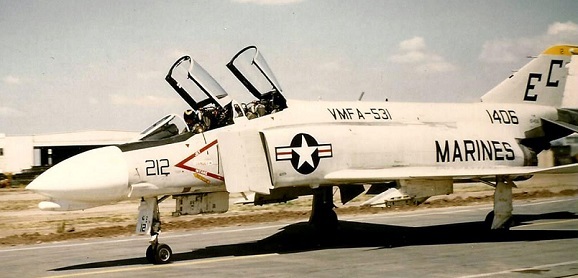
Marine F-4 taxiing in
Rick Spitz and his BN, Carl Monk were awarded the Distinguished Flying Cross for their skill and courage demonstrated on that mission. Rick and Dave Cummings, a Huey Cobra Pilot, were the only two guys that I know of from our Basic School Class of 5/67 to win this highest of flying awards.
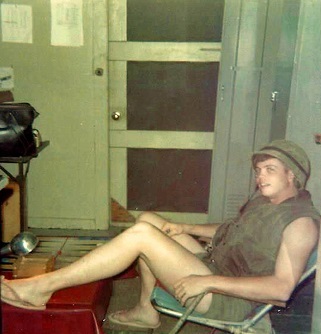
Rick Spitz in our hootch relaxed but ready for combat
Left My Lights On
Jim Ewing, “They couldn’t hit their ass with a baseball bat.”
Ihad a similar but not so heroic a mission as Rick’s. We were running a mission in the Mu Ghia Pass area and taking fire from radar-controlled fifty millimeter guns, and we saw the fire walking in on us; then we turned on the ECM equipment and saw the AAA blast walk away for us and seemingly fly formation with us. Getting fired on over the target with the tracers crossing in front of us like a fan spreading out made me think of the rice flying across you from both sides at your wedding on the steps of the church, but much more lethal.
On this mission, I was flying with Jim Ewing as my BN and as we started our descent and run in to the target, we started taking fire from about fifteen miles out. Usually, just a couple of guns would come up over the target and they fired at our sound so the fire was usually behind us. But this time it looked like they had us on radar and the fire was walking towards us. I switched on the ECM and the fire moved away some, but they followed us.
I didn’t want to get on our run-in heading too early, but rather I flew a zig-zag course until just before the target. We then turned onto our run-in heading and Jim said we had the target acquired. I pulled the commit trigger as we approached the target and the triple A was all over us. I remember someone telling me that if the fire looks like it is going to hit you, it will most likely go underneath you. If the fire looks like it is going to go over the top of you then that’s the one that will get you.
Well, this stuff was in front and above us. It was pretty tense and the last three miles to the target seemed like it took an eternity.
Finally, Jim said, “Bombs off.”
I pulled up and to the right, telling Jim, “I’m breaking starboard.”
He said in a higher-pitched voice than normal, “Oh shit, don’t go this way.”
He was looking at muzzle flashes and tracers coming right at us, so I broke to port, and seeing the same thing that Jim saw, I went straight ahead all the while pulling up.
This was taking us right to the North Vietnamese border and a SAM site just on the other side. As we climbed out of the AAA, Jim said in a mocking voice, “Those bastards couldn’t hit their ass with a baseball bat.” Hell, I was close to peeing in my pants. And before I could respond, the SAM warning light came on and the treat indicator showed it to be coming from straight ahead. The audio warning in my headset was going, “Beep, beep, beep” which meant the acquisition radar was tracking us. I was climbing and turning away from the SAM site while thinking that the last thing I wanted to hear was the beeping sound to go to a steady “beeeeeeeeee” sound, which would mean that they had launched the missile and now the missile’s radar would be tracking us.
Finally, the warning light and the treat indicator went off and as I regained some composure I noticed out the corner of my eye that my wing tip lights were still on. “Oh, shit!” I thought to myself and quietly turned them off without telling Jim that I had failed to turn them off.
The navigation lights had a two-position switch, and I mistakenly didn’t switch them all the way off, leaving the wingtip lights on. Then I had this image of these North Vietnamese gunners saying to each other, “Nguyen, look at this idiot with his lights on,” and blasting away at us.
Flying over Laos at night was always interesting; you and everyone else were flying with their lights off up and down the same route package. The Marine A-6s and the Air Force C-130 gunships worked the Ho Chi Min Trail from Tchepone, which was a hub of activity where several major routes or roads intersected, up to the North Vietnamese border and the two mountain passes, Ban Kari and Mu Gia passes. That’s where they really lit you up. And right over the border was a SAM site.
One night, we were in route to our target when Moonbeam told us to be advised that a C-130 was in area also. Just about the same time a dark shadow passed over the top of us. That must have been real close to a mid-air collision.
The Air Force C-130s gunships were flying out of Ubon, Thailand, and that is where we would go from time to time for a three-day mini R&R. Ubon was also the home of the famous 8th Tactical Fighter Wing flying F-4s and headed by the legendary Colonel Robin Olds. Olds was an Ace in WWII with thirteen aircraft shot down to his credit and four kills in Vietnam, one short of Ace status. As far as I know there were only two Aces in Nam, Captain Steve Ritchie, an Air Force F-4 pilot and Commander Randy Cunningham, a Navy F-4 fighter pilot.
Three Day Mini R&R — Ubon, Thailand
After you had been in country about three months, the squadron had a good deal for us flight crews: a three-day mini R&R in Thailand. We would fly our mission with a target time in Laos of about 0600 or 0630 and then continue on to Ubon, Thailand, after our mission was complete. This is where another crew from our squadron would be waiting on the tarmac to take the aircraft back to Da Nang. Then on our third day there we would be the crew waiting on the tarmac at 0730 to take the aircraft back to Da Nang.
When you landed there and had taken care of your aircraft, the first stop was to check into the BOQ, get breakfast and then head to town for shopping and a “hotse bath.” The hotse baths were a Thai massage parlor where these pretty young girls would put you in a steam cabinet, wash you, dry you, powder you and massage every muscle in your body. It was a little bit of heaven.
The girls would sit behind a glass window in a room and you could pick the one you wanted by the number on their badge they wore (what we called a VD number). Part of the massage was when these small girls would walk on your back and massage you with their feet. Wow! That was awesome and was one case where I didn’t mind women walking all over me.
You spoke to them in broken English; like “Number One” was the best, “Number 10” was the worst. They would say things like, “You number one GI,” or “I not like that, number 10.”
On my first visit to the hotse bath, I didn’t know what to expect except that everybody said that was the number one thing you had to experience in Thailand. So my BN and I headed to town after breakfast to a the massage parlor that was recommended to us. We walked in and were told each to go up to the window and pick out a girl that we wanted to give us a massage. You picked the one you wanted and identified them by the VD number. It was called a VD number because they were given a health inspection weekly and that was their assigned number by the health Department. I picked out this very pretty girl named Nawatee. She was part Thai and part French and probably in her early to mid-twenties. Most of the girls were in their teens.
The first thing she told me was to get undressed and get into this steam cabinet, a mini steam room to open up your pores and make you sweat. After about five minutes in the steam cabinet she told me to get into this tub of hot water. I did that and then she began to wash me. I was a little uncomfortable to say the least since the last time a female had washed me I was about five years old and it was my mother.
Having this pretty female wash my whole body resulted in that natural male response. So there I was sitting in this tub of water and I didn’t know what was the most red, my member or my face. The girl could see my embarrassment and said in broken English, “No sweat, OK.” She said it with a smile on her face.
After the tub and washing, she dried me off and told me to lie on a table. She then proceeded to massage every muscle in my body, from the ends of my fingers and toes, up my arms, legs to my torso, back and neck. Then she got up on the table and stood with her bare feet on my back and massaged my back with her feet as she leaned against the wall. That was great and I felt like a wet noodle after she was finished.
As I was lying on the table, I heard some girls giggling and looked over as Nawatee motioned these girls over to my table. They were like little girls giggling with a sense of awe showing on their faces. It seems that their awe was inspired by my hairy chest. Oriental men don’t have much body hair. So here were these three girls all in their teens being invited by my masseuse to run their fingers through my chest hair. As they did this they would say, “Oh, number one.” Of course, I hated every minute of it.
So from that time on I would always ask for Nawatee if she was there. We would get these Ubon flights about every three months or so if you wanted them. It was a great relief from getting your ass shot off or being bored to death. I read someone’s account of war as being “Hours of boredom interrupted by moments of sheer terror.” That was pretty accurate, I thought.
On one trip, I ran across Nawatee in the village away from the hotse bath as I was having lunch in this restaurant. She recognized me and said, “You Ronniesan GI from (whatever the name of the massage parlor was)” and I said, “Yes, and you are Nawatee.” I asked if she would like to have lunch with me. She was very surprised and told me that GIs didn’t usually ask girls to have lunch since they mostly only asked the girls to take them to their hotel for sex.
You could rent these girls by the hour, but since I was married that wasn’t what I had in mind. Just talking to a female was great since we had very few opportunities to do so and it was nice to see and talk to a pretty woman when you didn’t have to worry whether or not she or her boyfriend was a VC who wanted to kill you.
I asked if she went with the guys from the hotse bath and she said very emphatically, “No, I no go GI.”
I asked “Why?”
She said, “GI break my heart, I got babysan.”
I asked if babysan was from GI.
She said, “What you think? Babysan have blue eyes.”
After lunch, Nawatee asked me if I had seen much of the city or the surrounding area.
I said, “No, just the area around the base, the tailor shops, shoe shops, jewelry shops and a couple of bars.”
She then said, “You want, I take you to see big Buddha and temple; we go see the city.”
“That would be great,” I said.
I followed her and she flagged down a sanlo, which was a bicycle taxi, like a rickshaw with a guy peddling a bicycle in front instead of running down the street pulling the taxi carriage. We went to see a giant statue of the Buddha which was about thirty feet tall and covered with gold from little gold leave tablets that looked like cigarette rolling papers and placed on the statue by people as an offering. These were little sheets of gold. Gold was only about thirty-two dollars per ounce back in 1969 and 1970. The statue was covered with gold. It was an awesome sight and then she took me to the temple and that was beautiful also.
As we continued our tour, she said that she would show me where she lived; by now we were out of the city and in the country. It was a tropical or jungle setting with palm trees and bamboo everywhere. When we rode up to her house, I was amazed to see this was an all bamboo structure about twenty feet wide and maybe forty feet long that was about eight feet above ground. The structure was of bamboo with a thatched roof made of palm leaves and the walls and floor was made of woven bamboo strips. She lived with her entire family, parents, child, uncle, aunts and others. There were no rooms for privacy, just one large area off the ground to protect them from water and critters. And they slept on bamboo mats.
The tour was a neat experience that I would never have had if it hadn’t been for her. My BN Jim Jerjevich didn’t know where I was and was in sort of a panic thinking I was kidnapped or something. He was very relieved when I finally showed up.
Shopping in Thailand was a great deal also; tailor-made suits from the Maharaja’s were about fifty dollars then, handmade shoes of kangaroo skin or elephant hide were about fifteen dollars and of course there were the beautiful Princess Rings that looked like the crown that the princesses wore.
The Maharaja was an Indian tailor and he and his wife were very nice people. He would invite us to his home in the evening and his wife would cook homemade Indian food for us. It was a great cultural experience and a nice change of pace from being on the military base.
But getting back to the C-130 gunships: my BN and I were in the “O” Club bar having an afternoon drink and talking to the crew of one of the C-130s comparing stories about hunting along the Route Package when the pilot said they were flying that night and if we wanted to check out the action we could come along. I thought that was a great idea and said we would like to do that. But I guess we got involved in “The Ville” and, having had some drinks, we didn’t make the flight. The next day we saw the same guys and they said that they had a pretty eventful night the previous night and had come back with a hole in the wing that you could crawl through from AAA fire.
Cartoons in the Ready Room
Our Ready Room was just what it says, the place where you got ready for your mission or a place to wait for your next mission. Guys in their flight suits and flying gear would be sitting around briefing for their flight, playing Acee-Deucee or a game of cards. A cartoon on the wall showed a very gruff Marine with a three-days growth of facial hair, his helmet chin strap hanging down and a rifle in one hand. The caption above the cartoon said, “Yea though I walk through the Valley of the Shadow of Death, I shall fear no evil for I am the baddest mother fucker in the valley.”
There was also a cartoon in the Group Briefing room of two vultures sitting in the dead tree with one saying to the other, “Patience hell! I’m going to kill something.” It was amazing how much humor there was in the middle of a war, but I guess that was a way of handling the stress.
Who Will Carry the Mail into the Shau Valley
It seems as if everyone’s sense of humor was at it keenest while in combat. It amazed me how people in dire straits or in very stressful situations could come up with some very funny things. I guess it was a coping mechanism to deal with that stress of combat. And there were an abundance of jokes and humorous stories always going around.
One of my favorite jokes or sayings was “Who will carry the mail into the A Shau?” The meaning was who will fly or go into the A Shau Valley which was a bad ass place west of the city of Hue and on the border with Laos. It was a flat valley about twenty five miles long and a mile wide covered with tall elephant grass. It was bordered on either side by densely forested mountains from three to six thousand feet and was a major entry route for the NVA into South Vietnam along the infamous Ho Chi Minh Trail. (Source: Wikipedia)
The joke went like this: “Who will carry the mail into the A Shau?”
“I’ll carry the mail into the A Shau.”
“But there are lions in the A Shau.”
“Fuck the lions.”
“You would fuck a lion?”
“I’d fuck a lion’s mother.”
“Why you lion mother-fucker.”
The “Docs” — Squadron Flight Surgeons
Our senior squadron officers were for me a likable group; they included Lieutenant Colonel Stan Lewis CO, Major P.J. McCarthy XO, Major “Shooter” Dubeck Ops Officer, and Captain Charlie Carr.
Each squadron had a squadron doctor. Our “Doc” and our sister squadron’s “Doc” were some very cool guys probably in their early thirties. It was just like the TV show M*A*S*H with these two guys. Every week on Thursday nights they had movies at their hootch, served drinks or beer and showed porno flicks. Back then porno wasn’t like it was now, it wasn’t so common and available, and theirs were very much explicit. I have no idea where they got them from, but we had a room full of combat aviators drinking and cheering some flickering image of debauchery being shown on the portable movie screen from a sixteen millimeter projector. Of course, the film would always break or burn showing that brown melting image on the screen right at the best part which would bring on a chorus of boos.
The Docs, since they were flight surgeons, had to get so many flight hours per month just like we did, so they sometimes would go up with us sitting in the right seat. We showed them how to set up the armament panel, handle the radios and we took them on bombing missions. They loved it, but I don’t know how that worked out with the Hippocratic Oath and all.
Sea Survival School
In August of 1970, I received orders to go to Sea Survival School in Okinawa. My one vivid memory of Sea Survival School was our parasail training off a landing craft (Papa Boat) fitted with a deck like a small aircraft carrier and wire screen at the back end like a baseball back stop onto which they spread the parasail before the launch.
I was the first guy to be launched off the deck by means of a speedboat with a long rope attached to me and my parasail. The speed boat was just about to take off with me when somebody said, “Look at the size of that son of a bitch!” And everybody ran to the side rail to look.
I said, “What son of a bitch?”
And the reply came back: “A twelve-foot hammerhead shark; that SOB is really big!”
I asked, “Can we move to someplace else before I go?”
So we moved a little bit away from where we were, but not nearly far enough I thought.
When the boat took off and the slack in the tow line was taken up I started to run down the deck, but I was so light—about 135 pounds—that I took only about four steps before I was airborne and rose quickly. The boat ran with me in tow for a while and then I was given the sign to release from the tow line. This was to simulate ejecting from an airplane over water. On the way down you would release the seat pack with the inflatable life raft and a string of other survival gear - flares, signal mirror, water, shark repellant and other stuff all tied to a long line.
All I could think was that a twelve-foot hammerhead shark was following me. I knew it was an impossibility, but I think only the soles of my shoes touched the water when I hit because I was in that life raft so fast it seemed like a blur. I immediately began throwing out shark repellant and had the paddle in hand in case I had to beat the shark off. The name of this school was after all Sea Survival.
We sat out there in the ocean for a while and got familiar with the survival gear and supplies, and then they picked us up and we were put into a large circular rubber raft that was like a kids’ lawn pool with a roof.
The best part of these schools was that you got out of Vietnam for a while and back into the real world for a bit.
George Driscoll — Small World
Back in Da Nang with the squadron I got back into the routine of flying, and as usual we were flying a lot of our missions over Laos. One night I had a hop with a 0200 or 0300 target time. We launched out of Da Nang and turned northwest, headed towards our target area along the route package running down from North Vietnam through Laos and into South Vietnam. Over Laos we checked in with the 7th Air Force controlling agency “Moonbeam.”
The communication went something like this, “Moonbeam, this is Marine Ringneck fifty-four, angels eighteen with twenty-two delta twos for your pleasure tonight.” “Angels eighteen” was eighteen thousand foot altitude and “twenty-two delta twos” referred to twenty-two Mark (82) five hundred pound bombs. We usually carried six bombs on each ejector rack located on four wing stations, except for the two innermost stations on which we carried five bombs to give clearance for the landing gear doors.
Moonbeam would then instruct us to enter a racetrack holding pattern orbit and give us target instructions which would include the target time, run-in heading to coincide with the road’s direction at the point of attack and the target location positioned off of a reference point called a Delta Point. The BNs carried an area map with black triangles marked on them as reference points or Delta Points from which to navigate to the assigned target.
The way the system was set up, the Air Force had seismic and audio sensors dropped from the air along the jungle roads (Ho Chi Minh Trail) that would pick up trucks moving along the trail. These sensors looked like an artillery shell with leaf like foliage on top which was an antenna. They would transmit the info back to 7th Air Force command center in Nakhon Phanom, Thailand, which was situated on the Mekong River across from Laos.
Moonbeam would then assign us a target. The target was given to us as a reference off of a “Delta Point” which was a pre-briefed point located on the map from which the BN would locate the target and plug it into our weapons system computer. My BN, having entered this information into the computer, would then send that information to me and it would appear on my VDI (Visual Display Indicator.)
This was instructions to the target drop zone by way of the video screen. It showed as a yellow path, the end of which I would place in a square by maneuvering the aircraft (“Follow the yellow brick road”) and the computer would then guide us to the target. If everything went right, the BN would be able to pick up the target (trucks or movers) moving down the road at more than four miles per hour on his radar, lock onto them with his radar cursor hairs and we would then drop our bombs.
It was always a thrill to see secondary explosions.
On this mission as we checked in with Moonbeam, there was an Air Force F-4 up on the same frequency and when I checked in the Air Force pilot said, “Is this Romeo Bravo from Selma, Alabama?” Romeo Bravo referred to my initials R B in the phonetic alphabet and Selma, Alabama is where I went to flight school at Craig Air Force Base. He then identified himself as my buddy George Driscoll who was in my class in flight school and recognized my voice half way around the world, in the middle of the night, two years later in a combat situation. That was awesome. As I had mentioned earlier, in flight school my fellow student pilots used to gather around the radio in the flight shack to listen to me make my position calls with my thick New Orleans accent.
Arlen Handle
Under that same Small World theme, I was back in the MAG 11 “O” Club in Da Nang one day having a drink when I looked down the bar and to my amazement I saw a guy from my Holy Cross High School, Arlen Handle. We looked at each other with a surprised look for an instant or two and I said, “Arlen, what are you doing here?”
He said, “Flying F-4’s with VMFA 542 and my brother (another Holy Cross grad) is in the squadron with me.”
I had not seen Arlen since we graduated in 1961. He was a state champion wrestler in high school and went to OU on a wrestling scholarship, and now eight years later here we were both in the Marine Corps flying combat half way around the world from our home in New Orleans. What a small world.
Arlen had a close call on one mission. As he rolled in to drop on a target, he and his RIO took some small arms fire and he didn’t know they had got hit until they came back to the base. As his crew chief was helping him to get unhooked he noticed that Arlen’s parachute harness had been cut by a round that came through the canopy just missing him by inches. If he had had to eject it would have been too bad.
Da Nang, The Big PX
Even though we were stationed at the air base on the outskirts of Da Nang we didn’t get into town very often because it was Off Limits for the most part. Occasionally, however, we did get the chance to go into the city. One place we went to was the infamous White Elephant Club and of course a good time was had there. Another place on the list to go was the Big PX at Freedom Hill where you could buy all kinds of stuff that you needed or just wanted. It was like a military Walmart, although I don’t think they had Walmarts in 1969, or at least not all over the place like now. That’s where you got your stereo, cameras, clothes, food, candy and just about whatever you wanted. And you paid for the stuff in Funny Money (Military Pay Money or MPC.) They paid us in funny money to keep the greenback dollars out of the black market. One thing that I liked to buy at the PX was candy orange slices. I loved them and would stock up when I went there. When I went in the bush with 1/7, I practically lived off them. They were my energy food. Orange slices for candy and Tabasco sauce for spicing up food were staples in my diet.
One day I was walking down the street toward the Big PX when I almost got caught in the middle of an intramural fire fight between some white soldiers and some black soldiers. They were locked and loaded and firing at each other for a little while at about a half block range. Man, I ducked in between two buildings until the fire stopped. I didn’t want to be one of those crazy statistics having to do with odd events or “Non-combat action fatality.”
In 1969, the racial thing was coming to a head especially with the troops in Vietnam. I could tell that these guys were fresh out of the bush, because of their dirty, shabby dress and just plain unkempt appearance. Somebody said something to someone and somebody gave a finger salute and it escalated from there to a fire fight. Well, at least a few shots were fired from each side. It was just another day at war.
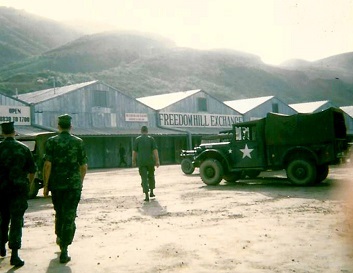
Freedom Hill PX Da Nang
Movies and Steaks at the “O” Club
There wasn’t usually a lot to do on the base in Da Nang and I looked forward to flying. If you weren’t flying you might be in your hootch reading, writing letters home, playing acee-ducee or having a beer at the “O” Club.
The club was no architectural gem, but it had an outdoor patio with tables, chairs and a BBQ pit where you could sit and have a drink outdoors or grill a steak for dinner. In the evening, movies were shown from one of those old reel-to-reel projectors onto a portable screen. The problem was that these movies were shown so many times and had been circulated all over the country so that they quite often broke in the middle of the movie and always at the most critical time. You would be really into the story and then you would see that melting of the film and then everybody would start cursing.
One evening, Jack Rippy and I were watching a movie, drinking a beer with a steak when the missile warning sirens went off. This was our third or fourth time to try to see the entire movie and we just looked at each other, said, “Screw it” and climbed under the table with our beer and continued to watch the movie.
Just about that time, the Vietnamese bar maid came out and said, “No sweat GI, rocket not hit here.”
Then Jack said, “Yeah, she should know, her boyfriend is probably the one firing the damn thing.”
Toga Night
Like I said, we had very little to do other than fly, so the squadron would think up all kinds of things to break the monotony and one of those things was “Toga Night.” I guess we got the idea from the movie, Animal House. We pulled the sheets off our beds for the toga and made those Roman head wreaths to wear on our heads. There was booze to be had and steaks to be grilled on the outside grill. I don’t remember very much other than getting drunk, losing my toga and cooking my steak with Jack Rippy naked until a MP came up and told us we couldn’t be out there naked grilling our steaks. That in itself was kind of amazing because Rippy was a pretty straight sane guy. I was probably a bad influence on him.
A-4 Smoke in the Cockpit and
Other Strange Arresting Gear Stuff
It seemed that there was always something unusual happening: after all it was war which by its nature is unusual and unpredictable. For instance, I was on a day time hop and just about to take the active runway when the tower told me to hold there for an emergency in progress. A Marine A-4 reported smoke in the cockpit and was on short straight-in final for an emergency landing. I was listening to the conversation between the tower and the A-4 pilot when the tower asked if he wanted the runway foamed. The A-4 pilot then responded in a slightly excited voice, “Hell, I don’t know; this is my first time to do this. You guys are the experts.” He made an otherwise uneventful landing and took the midfield arresting gear. The arresting gear was a system of cables at the beginning, middle and end of the runway strung across the runway so that an aircraft’s tail hook could catch and stop the aircraft like on an aircraft carrier.
Another time an airliner was landing on the other runway coming in just after an F-4 had taken the midfield arresting gear. They hadn’t wound the cable back yet and the airliner, I think it was a 727, engaged the arresting gear and came to an abrupt halt, much to the astonishment of the airline crew and everyone watching.
There was also a story about a Navy A-4 coming in to land at Da Nang with some sort of a problem and was to take the arresting gear at the approach end of the runway. Well, he missed the gear and his plane started to veer off the runway to the point that he thought he was going to leave the runway and he ejected. The A-4 didn’t leave the runway but ran into and caught the midfield gear.
I don’t know if this is really true, but I heard that the pilot descended in his chute, landed close to the A-4 which was still running while caught in the arresting gear. He supposedly walked up to the A-4, climbed up to the cockpit, reached in and shut the engine down. Pretty embarrassing I would guess, but as they say, “Any landing you walk away from is a good one.”
Flying in the Middle of the Night
Flying in the middle of the night was always a bit eerie to me. You would do your pre-mission brief and head out to the flight line. Hardly anyone else was around, just the flight crew or two, the duty officer and the ground crew. As you walked out to the flight line area and the steel and concrete revetments where the aircraft were parked, everything was quiet except for an occasional sound of faraway gunfire. As we approached the aircraft my stomach would start getting a little tight and an overall feeling of tension would come over me depending on what and where the mission was. Add to that the fact that this was two, three or four o’clock in the morning and things just seemed a little bit eerie.
One night as we got up to the aircraft, the plane captain met us. We did our walk around and climbed up the ladder to the cockpit. As I reached in to pull the ejection seat safety pins, I looked down and in my seat there were two NATOPS manuals (aircraft manuals) which were each about the size of a major city’s telephone book sitting on my seat. Me being the shortest pilot in the squadron, the implications were obvious. I looked down at the plane crew and they were having a big laugh. It relaxed me a bit and was kind of nice because it meant they liked me and knew they could fool around with me. Some officers were asses and too uptight about being officers in relation to the troops. I always wanted to make sure these guys were OK with me, because they kept my aircraft flying and my life depended upon them.
Flying Down the Beach
Coming back from our missions in Laos, we would cross just south of the DMZ and reach the South China Sea, referred to as “feet wet.” When we did, I loved to head back down to Da Nang by flying down the beach as low as we could get (about ten feet or so above the water).
Most BNs didn’t like flying just off the ground like that, nor did they like dropping bombs visually or unusual attitudes (flying upside down or pointing the aircraft down to the ground or up to the sky), but I was a twenty-five-year old jet jock flying this great machine, dropping bombs for a living and I had just dropped bombs on the enemy and survived. Hell yes, I was getting low and fast.
They said that if you got down below ten feet, you could kick up a rooster tail. I can’t confirm that since I couldn’t see below and behind us. But at that low level you got the aid of ground effect. The air was denser which gave you more lift. Pelicans use this same effect while skimming just off the water’s surface. I stopped that practice after we almost had a mid-air with a Huey chopper coming up the beach at the same altitude. Thank God for quick reflexes and good eyesight because the closure rate of two aircraft coming at each other from the opposite direction is pretty fast.
There was talk about a crew that was seeing if they could fly low enough to drop their tail hook in the water (about eight feet) and clean off the grease on the hook thereby proving they had got that low. As the story goes they got too low and skipped off the water like a rock that you would skip on a pond and ejected. As they were sitting in their one man lift rafts, they said, “OK, here is what our story is” on why they had to eject. I can’t say if that was true either, but it makes for a good story. But I don’t dismiss it either because when you mix a tactical aircraft with youth, a pilot’s ego and a derring-do attitude of cheating death for a living, you get some crazy stuff.
Ordinance Disposal
If for some reason you didn’t drop your bombs, your mission was canceled or some other reason, we were told not to return with the bombs and were directed to drop them in the South China Sea at a designated drop area which I think was the 075 degree radial off Da Nang at about seventy-five miles out to sea. So, on this one mission, our target as canceled and we headed to the drop zone. But I just hated to see twenty-two perfectly good bombs thrown away, so we armed them and let them go from about one thousand feet. I turned the plane around and rolled it over to watch the explosions. It was an awesome sight with pillows of water shooting skyward and then seeing fish and sharks float up to the surface. It was awesome. Thank God, we didn’t see a submarine pop up.
Mustache on Fire
As I said before, there was always something unusual, weird, or just crazy going on, not to mention the circumstances and horrors of war itself. But one of our squadron pilots decided to light up a cigarette in the cockpit while flying a mission. This was considered a bad idea by just about everyone in aviation. They were on a mission over Laos and were either in route to their target or in a holding pattern awaiting a target assignment when the pilot decided to light up. You’re in an oxygen environment with an oxygen mask on your face; add to this the oils from your skin and a mustache soaked with both those oils and oxygen. To remove your mask and put a flame close to that mixture—well, you can just imagine what happened next. Of course! His mustache caught on fire and burnt the hell out of his lip. They had to declare an emergency, cancel the mission and return to base.
I can just hear the radio conversation with the controlling agency.
“Moonbeam, we have an emergency and must cancel our mission.”
“What is the nature of your emergency, over?”
“Ah, smoke in the cockpit.”
“Can you make it back to Da Nang, and do you know what is causing the smoke, over?”
“Ah, yes, we can make it to Da Nang, and yes, the smoke is from my pilot’s mustache that caught on fire, over.”
Like the saying says, “There are old pilots and there are bold pilots, but there are no old bold pilots.”
Christmas Morning
Time was going by fast and I was averaging about five hops a week, which was great. Sometimes though, I would only get two or three hops and was bored, so I looked forward to flying. It was already getting close to the end of the year and in the early morning hours of Christmas day in 1969 I was flying a mission over Laos when someone came up on the Guard emergency radio frequency which broadcast over all frequencies, and said “Happy Birthday, Son.” And a reply came back, “Thanks, Dad.” There was humor in every circumstance it seemed.
It was little gems like these that would come time and again in what you would think was a pretty serious situation. It never ceased to amaze me the sense of humor people would display in the most unusual or tense of situations.
New Year’s Eve
On New Years’ eve, 1969, I was on a fifteen-mile final approach to Da Nang at about three minutes to midnight when the tower called me and said, “Ringneck, recommend you secure your landing lights.”
I replied, “This is Ringneck, why secure my lights?”
And the tower came back, “Because it’s three minutes to midnight and in three minutes everybody with a gun is going to be firing it up in the air and they would just as soon shot at something like an airplane than nothing at all.”
“Roger that,” I replied and quickly turned off my lights. And, sure enough, at midnight the entire coast lit up with tracers as far as we could see. What a sight. Happy New Year!
FAC School — Okinawa, (January 3-17, 1970)
On January 3, 1970, I had orders to Camp Hansen on Okinawa for FAC School or Forward Air Controller School, about a two-week course.
Included on our group orders were my buddies Fred Bonati, Rick Spitz, Carl Widell, Dick Davis, and Doug Burkett. We checked in at the Camp Hansen Marine Base on Okinawa and we were supposed to stay there in the BOQ, but Rick had other ideas. He somehow got us, Rick and myself, into the BOQ at Kadina AFB down the road a bit from the Marine base. All Air Force bases are innately superior in creature comforts to that of Marine bases, plus Kadina had a great happy hour. I don’t remember how we got back and forth from Kadina to Camp Hansen, but like I said earlier, Rick had a knack of manipulating the situation for his betterment and worked that out also.
I also don’t remember a great deal about FAC School, but a few memories are fresh in my mind. One was of flying in a Huey helicopter, going out to a field exercise when the helicopter pilot learned we were jet jocks. I guess he wanted to make an impression on us by showing us how low to the trees he could fly. Hell, when we landed, I looked at the skids to see if there were any tree branches stuck in them. Then we landed in a field full of ripe pineapples. We didn’t have any canteens of water so we ate pineapples, which were, to this day, the sweetest ones I have ever tasted.
The Marine Corps took pilots from the various squadrons with combat flying experience to train as FACs. The idea being that these pilots were familiar with what it took to fly in support of the ground troops and thus would be best at calling in the support from the ground for the rifle companies.
After FAC school I was later assigned as a FAC to 1/7 (1st Battalion 7th Marine Regiment) for a three-month tour in the jungles, mountains and rice paddies of South Vietnam. My official title was Air Liaison Officer, with the “grunts” my radio call sign was the “One Four Actual” and my radio man was just the “One Four.”
In the school, we learned how to call in air support for the Marines on the ground, whether it was close air support by directing the planes to drop bombs, calling for helicopter pick-ups, delivery of supplies, medevacs of the wounded or gun-ships for fire support.
One particular function was the use of the radio beacon to get all weather air support from the A-6s which is what I flew. This was a system called RABFAC (Radio Beacon Forward Air Control) which used a transponder to show the position of the FAC on the ground, thus allowing the A-6’s electronic weapon system to do off-set bombing in support of the ground troops. It was a very good system which allowed for the first time in the history of air support to be carried out in weather conditions that before would hold up air support until the weather cleared which is what happened in the Battle of the Bulge in WW II. The 101st was hard pressed to hold on against the German assault until the weather cleared and they finally got air support.
The A-6 had one of the most sophisticated aircraft weapon systems at the time with its all weather capability, unlike the F-4s, A-4s and A-7s which had to acquire the target visually in order to attack them. My squadron in Vietnam was VMA (AW) 242. The AW stood for All Weather.
One of my favorite memories from FAC School was when Rick and I went to the Kadina AFB “O” Club for happy hour and we met two other Marine pilots. They were CH-46 helicopter drivers with a whole bunch of combat missions and I think they might have even been shot down a time or two. One of the guys was pretty stressed out and I think they were given some time out of the country for a mini R&R just to recoup a bit.
So anyway, Rick and I and the two other Marine pilots were drinking and telling sea stories when somebody in the club rang a bell and everyone in the place stood up except for us.
An Air Force guy standing next to us said, “Stand up for the returning combat crew coming back from their mission over Vietnam.”
We looked at each other and laughed, and either Rick or I said, “Stand up, are you kidding me? These two guys have been flying combat missions multiple times daily getting their asses shot off and Rick and I have been flying over Laos at night getting our asses shot off. We we’re not standing up for anybody, especially B-52 guys flying thirty thousand feet over South Vietnam where small arms fire didn’t go up more than a thousand feet.”
That didn’t make us real popular with the Air Force guys. Don’t get me wrong, flying in combat is still flying in combat and those guys that flew up North over North Vietnam with the greatest concentration of anti-aircraft fire and SAMS ever were all heroes in my estimation, but this was a different situation. This was 1969 and the U.S. had stopped bombing up North.
Rick and I left to go to dinner or something and we heard later that the really stressed out Marine helicopter pilot got drunk and crazy and they tried to kick him out of the club. This led to a ruckus and the Air Force MPs chased him down the hall and finally up on the roof. The building that the “O” Club was in had a flat roof and was situated up against a hillside so that one end of the roof was about twenty some odd feet off the ground, but the other side was only about six feet off the ground. By luck or by skillful escape and evasion tactics he ran down the roof shouting, “You will never take me alive” and jumped off the roof on the low side. I don’t know what happened to him after that. But the guy really did need a break from combat it seemed.
Back with the Squadron in Da Nang
It was a new year, 1970, and we were flying our daytime and night missions on a regular basis. In general, things were a little bit quieter with regards to the war than at the New Year of the Tet Offensive in 1968 when all hell broke out all across South Vietnam. It was called the Tet Offensive because the offensive was launched on the date of the Vietnamese Luna New Year Celebration. It was an unofficial understanding that both sides would observe a cease fire for the Tet festivities, but the communist forces of North Vietnam (NVA) and the Viet Cong (irregular forces of South Vietnam) broke the agreement and launched the offensive in the early morning of January 30, 1968. Approximately eighty thousand communist forces attacked about one hundred towns and cities all over South Vietnam. In most places, they were stopped and beaten back fairly quickly, but in the Battle of Hue the fight lasted for a month and at Khe Sanh the fight went on for several months. (Source: Wikipedia)
All in all it was a big defeat for the communist forces, but the American news media painted a different picture and Walter Cronkite made it look like a defeat for the U.S. and South Vietnamese forces (ARVN).
Most of my TBS (Marine Basic Officers’ School) class of 5-’67 were in Vietnam for the Tet Offensive battles as 1st or 2nd lieutenant platoon leaders and company commanders. All of us that went into aviation were in flight school at the time. Ray Smith, who would eventually rise to the rank of Major General, took over as company commander of Alpha Company 1/1 right in the middle of the Battle for Hue against a North Vietnamese brigade size force of about seventy-five hundred. Nick Warr was a platoon commander for Charlie Company, 1st Battalion, 5th Marines and lost most of his platoon in the very beginning of the fight inside the ancient Walled City. His book Phase Line Green is a great account of the Battle for Hue which went down in the annuals of Marine Corps history with other epic Marine Corps battles. (Source: Boys of ’67, by Charles Jones; Phase Line Green by, Nick Warr; Wikipedia)
Les Palm, who like Ray Smith would rise to the rank of Major General, was an artillery officer at Khe Sanh and Hill 881 South with 1/13. On one occasion, the hootch that he used to live in took a direct hit from a mortar round. Thankfully, he wasn’t in it.
My good friend in Houston Steve Benckenstein was a CH-46 helicopter pilot and flew into Khe Sanh in the latter part of the battle when things had settled down somewhat and told me it was no fun even then to fly into a place that was subject to constant mortar and artillery bombardment. During the most intense time of the fighting, the Marines were being re-supplied by air, but it became almost impossible for the helicopters and the C-130s to land because the NVA had the runway and entire base targeted and would drop in mortars and artillery rounds whenever a plane landed. It got to where the C-130 would just make a very low fly-over and drop the supplies by parachute.
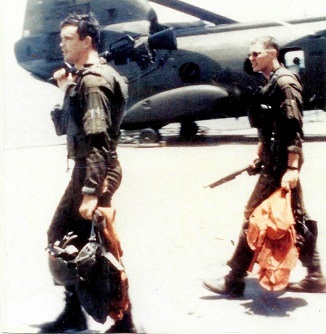
Lt. Steve Beckenstein comingback from a mission
The news reports were saying that the Marines could end up like the French at Dien Bien Phu in 1954 with a disastrous defeat. But Marines held on in what was a long and drawn out fight. The Marine air support along with the Navy and Air Force, especially the B-52s, pounded the hell out of the NVA. The B-52s dropped over seventy-five thousand tons of bombs on the NVA positions over a period of about nine weeks. It was the largest payload ever dropped on a tactical target.
The NVA and Viet Cong were on the ropes after they had spent themselves and got decimated by our forces, but thanks to Walter Cronkite, all the anti-war protest and the general public getting tired of the war Americans let the NVA off the hook. The military wanted to finish the job, but the politicians said “No.” The military didn’t lose a fight in Vietnam; we didn’t lose the war, the politicians did.
One account from the Marine Corps’ book about the Battle for Khe Sanh which I had mentioned earlier, describes one morning’s reveille. It describes the Marines standing up in their fox holes with their helmets and flack vests on saluting the flag then hearing the thumping of enemy mortar rounds leaving the tubes, the Marines getting down for the anticipated incoming barrage and the following explosions. As the dust settled there came from one fox hole a red flag waving back and forth in the air—Maggie’s Drawers, which meant you missed the whole target. What a great in your face retort from the Marines under siege and constant attack. I love that story.
At the end of the Tet Offensive, that lasted about five and one half months from January 21 to July 9, 1968, the communist forces were devastated and it took a while for them to rebuild and regroup. At the end of the battle for Khe Sanh, our forces withdrew and closed the base.
Ray Smith got his second Silver Star at Khe Sanh.
One of my buddies from my platoon in OCS and friend in TBS was Dave “Andy” Anderson who was also a fraternity brother of Tom Broderick back at Wisconsin. Andy, like most of the O302 infantry officers of our TBS class, had thirty days leave after graduation and was sent right into the fray of Vietnam. It was learn as you go for these guys and they were in the thick of combat right away.
On December 15, 1967, Andy was a 2nd Lieutenant Platoon leader with the 2nd Platoon of Bravo Company 1/1. They were in the point of a company size ambush against the NVA around Con Thien in Quang Tri Province. His guys sprang the ambush and opened up on several NVA soldiers. Andy went out to search the bodies or the wounded when a NVA soldier jumped up and shot him at close range in the chest. The bullet went through his bullet proof vest, through his chest, lung and exited through his back and the vest again. Lucky the round didn’t hit any bone or he would have been dead.
Then all hell broke loose. Andy’s company was in the middle of an NVA Regiment and his platoon had lost contact with the other platoons in his company. Andy was lying on the ground spitting up blood when a Corpsman pulled him into a bomb crater. The bad guys were running all over the place and Andy grabbed a grenade and pulled the pin and then thought to himself, “What’s the timing on this thing is it seven or ten seconds? Damn, I should have paid more attention in the class.”
Ray Smith’s Alpha Company 1/1 with tanks in support had to come in and rescue Andy’s unit. They put Andy on top of a tank to evacuate him all the while the tank is firing at the NVA. Because of the tank’s gun firing so close to Andy, he couldn’t hear for several days. He woke in a hospital, looked around and saw several Vietnamese nurses and thought he was a prisoner of war. But thankfully his was in one of our hospitals. He was then transferred to the Hospital Ship “Sanctuary” off shore and his combat tour was over. He was sent home to recoup from his wounds. All this happened while Fred, Tom and I were in flight school.
When he first told his story to our group of OCS platoon mates at our TBS class forty-year reunion in Quantico we were laughing at the bit about him thinking he was prisoner of war, but he was shaking as he told the story.
Feb. 14, 1970 — My Birthday and
the USO Valentine’s Day Show
There was a much anticipated USO-type show scheduled for Valentine’s Day at the MAG 11 “O” Club. The tables for each squadron were arranged ninety degrees to the stage with the attack squadrons lined up to the left side and the fighter squadrons on the right side. These were banquet tables arranged so that they would seat the whole squadron on one long continuous table.
Most everyone had their party flight suits on instead of regular flying flight suits. The suits were of the squadron’s colors and had their squadron’s insignia and your rank on them. My squadron VMA (AW) 242 had black suits with our gold Navy wings embroidered on the left side and a black bat with red eyes over a yellow lightning bolt on the right side. Under my gold wings was my name, Low Beam. When these suits were worn, it meant that you were ready to party.
The liquor was flowing and bottles of champagne were being passed around. We brought a special surprise to the event—our Beer Can Bazooka. This was in the old days when beer cans were made out of steel not the flimsy aluminum of today. We took about five beer cans, cut the ends off four of them, cut one end off of the end can and taped them together. We used a beer can opener to punch a hole in the one end of our bazooka. A tennis ball was then loaded into one end and lighter fluid was sprayed into the hole in the other end. It took a team of two to man the bazooka, one holding the tube and the other guy to ignite the lighter fluid with a cigarette lighter. It was awesome, the tennis ball would travel a high rate of speed and go about fifty feet through the air.
So as the party got really going we set up our bazooka and aimed it at the fighter squadron’s table on the other side of the room. However, to our surprise, they also had the same idea as we had and matched our technology with their own bazooka. Man, all of a sudden tennis balls were flying all over the place ricocheting off of walls and people. Everybody was diving for the floor and getting under the tables. One senior officer was standing up getting ready to give a toast when a tennis ball almost took him down. He quickly forgot about the toast and hit the deck.
What a great start for an evening of fun and entertainment. It was also a special night for me since it was Valentine’s Day and my twenty-seventh birthday.
The first band was from the Philippines and they had all the popular songs of the time down pat except for certain words with “Rs.” One song that was one of the most popular at the time was Proud Mary. They were singing “Rolling, rolling, rolling on the river,” but it came out as “wolling on the weeever.” Well anyway, I thought that was very amusing, but they put on a pretty good show. Hell, we were so starved for entertainment that we would have liked anything.
However, the next band was from Australia and they were also good and had a very pretty girl lead singer. We were all liquored up, having a great time and guys starting sending bottles of champagne up on the stage for the band. It wasn’t very long before the band was as drunk as the rest of us. They were supposed to play only so many songs and finish, but they just kept on playing and at one point one guy with an electric guitar was sitting in the rafters playing his guitar even though it wasn’t plugged in. Then the pretty singer said, “Will Lieutenant Ron Boehm come up on stage and get his birthday kiss?” Well, everybody, including yours truly, started cheering and some of my squadron mates picked me up and passed me hand to hand over their heads up to the stage and then threw me onto the stage. I stumbled to my feet and walked up to the pretty singer and said, “Lieutenant Ron Boehm reporting as ordered ma’am.” She then grabbed me, leaned me over and planted this big, long kiss on my lips, but both of us being drunk she dropped me and I fell on the floor. But I could have cared less; what a great birthday that I’ll never forget.
Easter Sunday, 1970
The next holiday was Easter Sunday and I had a middle of the night hop scheduled with a target time of about 3:00 or 4:00 AM over Laos. We were briefed that the area we were going into might have at least one fifty millimeter gun which was usually radar-controlled. Most of the AAA we encountered was twenty-three millimeter and thirty-seven millimeter which were not usually radar aimed and they just threw the stuff up in a barrage type fire or fired at the aircraft’s sound which was usually behind us. The barrage type fire was all over the place and you just flew through it as fast and best as you could. Once when we had heavy fire a quick thought came to me that it was like coming out of the church on your wedding with people throwing rice all over you. But of course that was a much nicer experience then flying through the glowing balls of deadly AAA fire.
The radar controlled guns would track you and you could see the AAA burst walking in towards you. We had a pretty good ECM system (Electronic Counter Measures) and we put that baby on, dumped chaff (strips of aluminum foil) that would, we hoped, fool the guns’ radar and it would lock up on the chaff instead of your aircraft. The ECM gear would electronically give a false reading to the radar and in essence made the radar image of your aircraft look as if it was moved over away from where you actually were. And when you put it on you would actually see (fingers crossed) the AAA burst move away from you and sometimes fly in formation with you off to the side.
So on this early Easter morning as my BN and I left the ready room and headed out to the flight line the thought of the fifty millimeter gun and the mission was on my mind and the closer I got to the aircraft parked in the covered revetment the tighter my stomach got. The procedure was that as you walked up to the aircraft you were greeted by the plane captain and maybe another ground crewman. The pilot and BN would do a walk around pre-flight of the aircraft, check the bombs and pull the safety wires, climb into the plane, go through the procedures to start the aircraft. After getting all the various systems up and running, we would then contact the tower for taxi instructions.
The ground crew helped you get in the plane and strapped in, get it started and on your way. As you left, the plane captain would salute you and you were on your way taxiing out to the runway.
On this particular night as we walked up to the plane to begin our preflight, I noticed that the ground crew had these big grins on their faces and then when I looked at the bombs attached to the racks hanging from the wings my BN and both broke out in a huge laugh for they had painted all the bombs like Easter Eggs. That was awesome and a welcomed laugh that helped to take the edge off. All l could say was, “You guys have too much time on your hands.”
R&R
In June of 1970 I got my very welcomed orders to go on R&R. Two weeks in Hawaii. The married guys mostly went to Hawaii to meet their wives and most of the bachelors went to Australia where the local Australian girls seemed to like the American GIs pretty good, probably because they knew these guys had two weeks to spend a bunch of money on them.
I got on a flight to Honolulu and met my wife Eileen there for the two-week vacation. She was waiting for me when I arrived at the airport and it was so great to see her. It was a funny thing, when you were “In country” (Vietnam) that was your world, but as soon as you went out of country to the real world then that was now reality and the two didn’t seem to mix. They were just two very different worlds.
Eileen had given birth to our daughter Laura only eight days before I left for Vietnam so it had been quite a while since we had a chance to make love and so we did a lot of catching up so to speak. We did manage to get out of the hotel room for some sightseeing and catch Don Ho’s show at a club.
We were not very impressed with Honolulu and Waikiki Beach so we only stayed there for two days. We then made arrangements to fly to the Island of Kauai. It was the very essence of what we thought Hawaii was, absolutely beautiful. It was where they filmed the movie “South Pacific.” In 1969 the island was scarcely populated, the beaches were wonderful and there was a canyon that was a scenic wonder. It was truly an island paradise.
One night Eileen and I decided to take a bottle of wine and go down from the hotel to the beach at night for a romantic evening and maybe go skinny dipping. We set up a blanket on the sand, opened up a bottle of wine and began our romantic evening. The moon was beautiful and bright with the moonlight shining off the magnificent white-topped waves rolling onto the shore, but Eileen wasn’t getting into the mood like I was and seemed uptight for some reason.
After some hugs and kissing didn’t seem to work in getting her into the mood I asked her, “What’s wrong?”
She said that she was afraid of the bears.
“Bears? There are no bears in Hawaii,” I said.
And in her very Eileen-like manner said, “You have never been here before. You don’t know that for sure.”
So the skinny dipping was out and any other ambitious ideas I had for a deserted beach. But the trip to Kauai was wonderful as was seeing my wife for the first time in six months.
It was over all too fast and we said good-bye at the airport as she got on a plane back to the States and I back to Nam. It was tough to say good-bye because it would be another six months before we saw each other again.
FACing with 1/7
Shortly after getting back from R&R, I was called into the Ops Officer’s office along with Rick Spitz and Carl Widell. The CO said that Carl and I were going out with the grunts on a three month FAC tour and that Rick was going to Group headquarters (Marine Air Group 11). The CO also added that one of us was going to 1/7 (1st Battalion 7th Marine Regiment) at LZ Baldy (Landing Zone Baldy) and the other to the ROKs (Republic of Korea Marine Unit). I did not want that assignment at all and then Carl who was a Princeton graduate, spoke several languages and majored in Southeast Asian Culture, spoke up and said that he would love to go to the ROKs. He said that it would be a great opportunity to learn another language and learn about their culture. And I chimed in by saying, “You are right, Carl, that would be a great experience for you.”
I learned later that my buddy Fred Bonati was also chosen to go FACing. Throughout our Marine Corps careers Fred and I quite often ended up on the same orders, our being names right next to one other’s since Basic School.
So in March I caught a helicopter ride down to LZ Baldy about thirty-seven miles south of Da Nang, the headquarters of 1/7 and reported in for my new duty as one of the Battalion’s Air Liaison Officers. There were three of us, a Major who was the Battalion 1-4 and two of us Lieutenants who would be out in the bush with the rifle companies, radio call sign “1-4 actual.” I reported into Lieutenant Colonel Cooper, the commanding officer of the 1st Battalion. He was a no-nonsense Marine infantry officer and a very good commander.
My duties were to coordinate air support operation for the company or battalion with helicopter and fixed wing aircraft support. This could be in scheduling and arranging for helicopter transportation, emergency medevacs, calling for air support from Marine or other service support like Army helicopter gunships, Marine fighter/attack aircraft, Air Force “Spooky” AC-130, and “Puff the Magic Dragoon” AC 47 gunships. I sometimes worked in the Battalion Fire Direction Center along with the Artillery Officer coordinating artillery fire and the aircraft passing through our area.
Mostly I dealt with the helicopters, CH-46s, CH-53s and Hueys. I was a few months senior to another 1st Lieutenant FAC so I took over for the Major when he went on R&R and worked with Lieutenant Colonel Cooper who wanted to tour the AO (Area of Operation) on a regular basis. So I arranged for the helicopters and accompanied him to visit the troops in Alpha, Bravo, Charlie and Delta Companies. When the Major was there I would go out into the “bush” for a couple weeks at a time, usually with Alpha or Bravo Companies and return to the battalion HQs. The other FAC officer pretty much stayed out in the field with Charlie and Delta Companies.
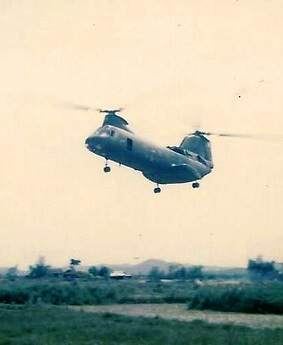
Marine CH-46 coming into the LZ
Ron Ambort
On my first combat ground patrol, I was with a squad size unit led by 1st Lieutenant Ron Ambort who was the Bravo Company Commander. Ron was under investigation for an incident that happened shortly before I got there in which a small patrol from his company rounded up a bunch of villagers and killed them. It was another patrol from his company that discovered the dead villagers and reported it. This was the Marine Corps Mi Lai incident and the Marine Corps was going to make sure there was not any cover up like what happened with the Army’s Mi Lai incident.
The village in which this happened was believed by the men of Bravo Company to be full of bad guys and often when a patrol went near that village they would come under attack. So somebody or some guys decided to take matters into their own hands and take retribution on the villagers. The investigation of Ron Ambort was to determine whether Ron ordered the action or had knowledge of it.
Bravo Company had the reputation as being a very aggressive unit under 1st Lieutenant Ambort and had the highest kill numbers of the four companies in the battalion. I thought from my own conversations with Ron he showed he did not like the Vietnamese at all and didn’t trust them. In a war were you could not know who was the enemy or who was friendly, I thought Ron just considered them all to be the enemy or potential enemy.
On this particular patrol my radio man, a Lance Corporal named Hank, and I were at the back of the patrol. We had just finished a lunch break where I was talking to a Marine with a scout dog. Ron called for everyone to mount up and called for the scout dog and his handler to go up to point at the front of the patrol. We were following the worn path around the edge of an elevated farm field that had been freshly tilled. It was all mud and little vegetation. As Hank and I came up to turn the corner of the field we heard a loud explosion and Ron shouted for me to get a medevac immediately. I rushed up to the front of the patrol and there were several Marines, a Vietnamese scout, the kid I had just been talking to minutes before, and his scout dog on the ground. The scout dog had tripped a Claymore mine booby trap and it got just about everybody in the front of the patrol. I got on the radio and called for a medevac helicopter.
Everybody was either setting up a defensive perimeter or trying to render first aid to the wounded. I went up to the young Marine with the scout dog; he was sitting up staring straight ahead. He had blood coming from several wounds. I opened his shirt and saw a couple small red holes in his chest, one in his forehead and one in his neck that was spurting out blood. I didn’t know what do, so I stuck my finger into the hole in his neck to stop the bleeding. As I did, his eyes rolled up in his head and he fell over dead. I checked for a pulse and there was none. At that point I almost lost my lunch and I remember thinking, “Come on Ron, get a grip, you’re a Marine officer.” It was the first person I had seen die.
My next thought was about bringing the medevac helicopter into the adjacent field. I thought to myself that if they set up a booby trap on the trail they would expect us to bring a helicopter into the adjacent field, and it occurred to me that they may have mined the field also. So my radioman and I started carefully walking the field looking for mines, probing suspicious patches of dirt with our bayonets just as I had been taught in Basic School. I was very nervous and I just had that fear of stepping on a land mine. Thank God there was none and we got the copter in OK. We loaded the dead and wounded into the chopper to be taken to the hospital.
Zippo Attack on the Village
Once we got the situation under control and the wounded taken care of, Ron Ambort got the remainder of the patrol mounted up, turned us around and headed back to the village we had come by earlier. Ron was pissed off and in my estimation he was going to make someone pay for this attack on his men. When we got back to the village, most of the people had cleared out already, but the ones that were left were pulled out of the huts and the troops searched the village for weapons.
Ron then took out his Zippo cigarette lighter and started to set fire to the bamboo and thatched roof huts. It was like the scene in the movie Platoon that came out after the Vietnam war where they burned the village down. When I saw that movie I immediately thought of this incident at this village. At that time, I had the fear that he was going to start shooting people, and I told Ron to remember that he was already under investigation for the patrol from his company that killed people from the other village of Son Thang. I don’t know whether or not it had any bearing on his actions, but I just wanted him to think before his anger got him in any more trouble.
Ron Ambort, in my estimation, was a damn good officer, combat leader and a fine company commander just based on the short time I knew and worked with him. When I left 1/7, the investigation was still on going and I didn’t hear what the results were or what happened to him until years later.
According to excerpts from an article published in the Michigan Law Review and the book “Son Thang: An American War Crime” by Gary Solis, a former Marine combat officer and judge advocate for eighteen years in the Marine Corps, 1st Lieutenant Louis R. Ambort (Ron Ambort), company commander of Bravo Company, 1st Battalion 7th Marine Regiment, sent out a fire team size (five member) “Killer Teams” to search for the Viet Cong, weapon and food caches. On February 19, 1970, one of these killer teams went to the small hamlet of Son Thang, found no men in the village, but rounded up sixteen women and children in three huts or as we called them “hootches,” and shot and killed them. This was similar to the Army’s My Lai Massacre which happened on March 16, 1968, which was in the same area as Son Thang, about twenty-five miles away, but unlike My Lai there wasn’t a cover up involved and an investigation into the killings was started the next day by the Battalion Ops Officer Major Theer.
The investigation resulted in four general court-martials with one team member given immunity for his testimony in the trials. One Private was convicted of pre-meditated murder and given a life sentence which was reduced later, one PFC was convicted of unpremeditated murder and given five years in prison which was later reduced, one PFC was acquitted, and the fourth team member, Lance Corporal Harrod, was also acquitted.
A couple of interesting side notes regarding Lance Corporal Harrod; he was put up earlier for a Silver Star and his defense team was aided by Lieutenant Oliver North who credited Harrod for saving his own life months earlier.
First Lieutenant Ron Ambort was charged with failure to obey a division order to report an incident thought to be a war crime, dereliction of duty for failing to take effective measures to minimize noncombatant casualties, not insuring that his men were aware of the rules of engagement, and making a false official statement regarding the killer team’s actions.
He received non-judicial punishment for making a false official statement and received a letter of reprimand rather than face a trial by general court-martial on the theory that he was Company Commander of the killer team and bore responsibility for their actions at Son Thang. (Source: Michigan Law Review, Vol. 96, No. 6; Reviewed by Robinson O. Everett, Prof. of Law, Duke University in Song Thang; An American War Crime, by Gary Solis)
Life in the Bush
Life in the bush was a little different than what we guys in the Wing experienced. Back at the air base in Da Nang we lived in luxury compared to how the “Grunts” lived. Out in the bush, you tried to keep yourself and your men as clean and shaved as best as you could. That meant washing and shaving out of your metal helmet. I remembered that an instructor back in Basic School told us to keep our men clean, shaven as best as possible and make sure that they ate with a fork and knife. At the time I thought to myself, “Why?” He went on to say the troops were mostly eighteen- and nineteen-year olds and that civilization was a very thin veneer and they would go animal on you in a heartbeat.
PFC with Ear Necklace
This became very clear to me when I was as out with the rifle companies. One time I went out to one of the platoons’ encampment which had been out in the bush for weeks. It seemed that most of the guys were without shirts, which was OK, after all it was 103 degrees. But I spotted one young Marine with a necklace made of leather string and two human ears. I called him over and asked what that was all about. He said, “Gooner ears, Sir.” I jumped all over him and asked if he had his Geneva Convention Card on him? The Geneva Convention Card listed the Rules of Warfare and we all were instructed on them in training. I told him that he was in violation of those rules and he had better go bury those ears now and if I ever saw him do anything like that again I’d have him court-martialed. He didn’t think it was a big deal until I called him on it. Like the instructor at TBS said, “Keep them clean as best as you can, make them eat with a fork and knife or they will go animal on you. Civilization really is a thin veneer on an eighteen-year old.”
Alley Cat
On one occasion I went out on a night ambush with a small group of Marines on what they called an Alley Cat. I don’t know if the Battalion CO would have approved it, but Ron Ambort said that I should see what the real action was like, so I went out with the fire team size Alley Cat. We stayed out all night and then just around daybreak all hell broke loose with sounds of a lot of gunfire and tracers going out. We had set up the ambush on this well-traveled trail through the high elephant grass. When the firing stopped, I rushed over to the scene and saw two dead NVA and blood trails which the troops were following.
I continued on with two of my guys and we came upon another wounded enemy soldier. This guy was a Viet Cong dressed in the typical black pajamas that they wore. He was lying in the tall grass bandaging his wounds when we came upon him and we had our guns aimed at him. I could tell this was a combat trooper for he was physically fit and looked to be hard as nails. I didn’t see as much fear in his face as pain. One Marine checked him for weapons and tied him up.
I heard a commotion coming from another area just fifty feet or so away, so I went to see what that was all about. There was a wounded NVA nurse who two of the troops had stripped naked below the waist and they were about to shove a pop-up flare up her vagina. Pop ups were flares that you would hold with one hand and hit the base with the other hand and that would send a bright luminous flare up about one hundred feet or so.
I said, “What the fuck are you doing?”
They then looked at me with a question on their faces and said, “Come on Lieutenant, she’s just a fucking gook.”
And for a guilty micro-second that thought went through my mind, “Yea, she’s just a gook.”
But I immediately erased that thought, put my hand on my pistol and said, “She is a wounded prisoner and you will take care of her according to the rules. Now put her clothes on, bandage her wounds and tie her up. We need to get both prisoners back to the company CP.”
One of the dead enemy was a pay master who had a bunch of money on him, some of it U.S. dollars, some Vietnamese money, and some U.S. military funny money.
It really came home to me again about what a thin veneer civilization was when you were in war and taught to kill the enemy. Religion and society had taught you, “Thou shalt not kill,” but that is what your job was, so in order to do that and for your mind to handle the contradiction, you had to de-humanize the enemy. You did that by changing their name to “Jap” or “Nazi” or “Gook” or “Gooner” and so on. They were somehow less than human and therefore you could kill them.
It seemed like your mind couldn’t put both worlds together: you were “In country or In the Nam;” then when you left Vietnam even for a day, you were back in “The real world.”
Back before you got in combat, John Wayne and all that hero stuff in the movies and the “High diddle diddle straight up the middle” was glamorous, but “War is Hell” and for the men that went through it, some of them went through hell. And some could never get over it.
Meal Time in the Bush
Meal time was an experience also; everyone sat around and we broke out our “C Rats” (C Rations) which consisted of a box containing such things as a can of meat, can of beans, can of fruit, bread or pound cake in a can, a chocolate bar, fork, spoon, toilet paper, a pack of five cigarettes, sugar, instant coffee, dairy creamer and heating tabs. There were various combinations of the items and, by and large, the food, I thought, was pretty good.
The technique we used to heat up the food was to take an empty can, punch holes in the bottom for air, drop a heat tab in it and light it. This was your stove; you set the can of food you wanted to heat with the top still on, folded, to make a handle on top of your stove. If you didn’t have heating tabs, you could use a pinch of C-4 explosive as a heat source. Just don’t try to stamp out a lit piece of C-4.
When they broke open a case of C Rats, the guy distributing these delicious cuisines asked, “Who wants turkey loaf?” or “Who wants corned beef?” and so forth and so on. The least favorite it seemed was ham and lima beans, but they were called something else. The call was, “Who wants ham and mother fuckers?” That was because those things would make you fart and then somebody would say “mother fucker” referring to the smell. That just tore me up every time I heard it. Of course you always had a bottle of Louisiana Hot Sauce with you because that stuff covered up the taste of almost anything.
Fruit cocktail was a big favorite, and guys traded off one thing for another. I didn’t smoke so I traded my cigarettes for peaches or fruit cocktail.
My favorite dessert was to take my canteen cup, add in some broken up pound cake, a pack of dairy creamer, and a can of peaches. God! It was like a peach cobbler and I loved it.
Sleeping, or the attempt to get sleep, was quite an endeavor, especially during the monsoon season when it just rained or drizzled all the time for about two to three months straight. In order to get off the hard ground, I had my “rubber whore,” a blow-up air mattress, but those little valleys in between the air-filled rolls funneled the rain water right to the lowest point, which was my ass. So there I was in a slight foxhole (the Marine Corps call them “fighting holes”) with a poncho for cover lying on my rubber whore that was funneling the water to my ass, holding my weapon, trying to sleep. Not too good. Us fly boys had it good back at Da Nang.
Radio Men Talking All Night
Another thing that happened in the middle of the night was that the radio men carried on all night conversations with each other. I guess it was the equivalent of teenagers talking for hours on the phone. Everyone else was trying to sleep except for the people on guard duty.
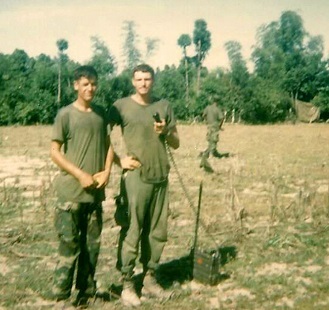
1-4 Radiomen in
the bush with 1/7
I heard this constant whispering, so I asked Hank, my radio guy, what was up.
He said, “Oh, they are just bull shitting.”
I said, “They are jamming up the net when there might be important transmissions coming in.”
“It’s no big deal Lieutenant; that’s just their little bit of relief from boredom.”
I finally agreed and didn’t worry about it again.
Tiger Bait
One of the more interesting events that I got to encounter was when I flew with the CO to visit one of our small combat outposts to the west of LZ Baldy. They were set up along the infiltration route through the Que Son Mountains and Que Son Valley.
The Battalion Commander Lieutenant Colonel Cooper was very big on visiting his troops out in the field on a regular basis to keep up with the fluid situation. Very often I accompanied him on these visits. Being an Air Liaison Officer, I worked with the Major who was the Battalion Air Liaison Officer to set up the helicopters, most often a CH-46, to pick us up at battalion headquarters and make the trip to one or more units out in the field.
On this one early morning, we dropped in on a Marine unit out in the bush and everyone was a-buzz about something, so I asked what was going on. A Lance Corporal told me that earlier that morning a tiger tried to bite a Marine’s head while he was sleeping in his foxhole. Lucky for the Marine, he had his helmet on and the tiger tried to bite the steel pot and drag him out of his foxhole. I asked what happened next and he said there was a lot of screaming and hollering and a bunch of rounds fired as the tiger got frightened off and the Marine probably had to change his shorts. Now that is not your average morning in the bush.
Three Kids with Homemade Coolers
On one patrol in the middle of the friggen jungle, miles from the closest village as far as I knew, we were approached by three kids with homemade Styrofoam coolers strapped to their shoulders. They’d made the coolers from packing material that was taped together. They were selling Cokes and popsicles, which were pretty attractive to the troops in the jungle with 103 degree temperatures and one hundred percent humidity. But you didn’t know what the popsicles were made of and I was worried about dysentery or something worse, so I told one of the troops to tell the kids to “de de” which meant scram or get out of here. But the kids paid no attention to him. So I said in a very firm and very officer-like voice, “De de mow” which translated loosely to, “Get the fuck out of here.” They took off running and went about fifteen feet; then they turned in unison and all three gave me the middle finger and said, “Fuck you lifer” in very understandable English. I wonder who they learned those words from. The troops referred to officers and senior NCOs as “lifers.”
Gunny and the Scout Dog
There was a Gunnery Sergeant with one of the companies who was a Marine’s Marine and the classic hard nose Gunny. I remember on one occasion, we were taking some light incoming fire so I got down, but I saw him standing up with flack vest opened, holding onto a green towel hanging around his neck looking for where the fire was coming from. He seemed invincible with that pose and all the troops respected him and didn’t give him any crap if they knew what was good for them.
As an officer you made the decisions, but it was a good idea to get the Gunny’s thoughts on the matter also.
There was a Marine with his scout dog attached to the unit who considered himself somewhat independent and had words with the Gunny over some matter. As I said, the Gunny didn’t take any crap and grabbed the Marine by the collar and got right in his face at which point the German shepherd scout dog lunged at the Gunny. The Gunny punched the dog and then the scout Marine, knocking him out with a right. Order was restored and the dog and the Marine both learned who was boss.
I learned later on after I had left 1/7 that the Gunny had been killed. A good man lost.
Marine Sniper
One day out in the bush with the Battalion CP we had a sniper with us. Frank, my buddy the artie (artillery) officer, and I had noticed for several evenings in a row these three to five “farmers” walking in a military-like spaced formation with their rice hats and black pajamas carrying hoes like you would carry a rifle. They were at the other side of a large rice field area about a “klick” (one kilometer, one thousand meters or .62 miles) away. This was a free fire zone, so we told the sniper about it and he said, “They’re bad guys, do you want me to take care of them?”
We asked if he could get them at that distance and he said, “No problem, that’s what they pay me for.”
That evening sure as hell, there were these three men walking across the rice field down that same path in formation just like we’d noticed. The sniper set up a shot and dropped one of the guys and the other two dove for cover and then got out of there. Nice shot.
On another occasion, Frank and I were looking out over the same area and looking at about the same situation of three or four enemy troops walking across the rice paddies and Frank said, “Let’s call in an “arti-mission on them” and asked if I would like to call the mission.
I said, “Well, it has been two years since Basic School when last I called in an artillery mission, but I’ll give it a try.”
We had no friendlies in the area so what the hell. I studied the map and looked out over the area with Frank’s binoculars where the bad guys were walking and called in the fire mission back to the fire base. We got the word from the fire base that the rounds were on the way. We saw no splash (the resulting explosion), and I called for the guns to drop five hundred—still no sight of the splash.
Frank took back his binoculars and said, “Here, let me show you how to do it” and then he said something about pilots missing targets.
Que Son Mountains
The 7th Marines TAOR at the time that I was with them in March through May of 1970 was an area south of Da Nang in Quang Nam Province. It lay south of the Republic of Korea Marines (ROKs) TAOR and their base at Hoi An near the coast ran west to the Que Son Mountains, Antenna Valley and north to the Song Tinh Yen River and the 5th Marines position and their base at An Hoa. To the south was the Army’s Americal Division.
The Regiment had three continuously occupied bases: LZ Baldy which was the Regimental HQ located at the intersection of Route 535 and QL 1 and about twenty miles south of Da Nang, Fire Support Base Ross which covered the Que Son Valley, and Fire Support Base Ryder which covered the Que Son Valley and Antenna Valley.
From the coastal planes and rice paddies the land rises to the west and southeast of An Hoa into the Que Son Mountains. This was a major NVA and Viet Cong stronghold along the infiltration routes from the Ho Chi Min Trail that had numerous base camps, headquarters and hospitals. The Marines were in there to conduct search and destroy missions, to destroy supplies of weapons and food, to deny the enemy the use of these base camps and to block the infiltration to the coastal areas. (Source: Marine Corps History 7th Marines in Vietnam)
The 7th Marines rotated their battalions around the various areas and these three bases. At this time, my Battalion 1/7 was at LZ Baldy protecting the Regimental HQ and surrounding areas. On one of these operations we had set up a base camp for 1/7 on a hill overlooking the river which ran down to the coast of the South China Sea. From our vantage point on the hill, we could see all the way to Hoi An on the coast and over most of the Que Son Valley.
Lieutenant Colonel Cooper had a set of a pair of ship’s binoculars on a base stand to look over the area. I spent some time looking through the binoculars and noticed that almost every evening a small boat came down the river and pulled into this area of large cane growth. It looked very suspicious and I told the CO. The next day he sent out a unit to check out the area and they found a pretty good size arms cache including AK-47s, RPGs (rocket propelled grenade), ammo and other supplies.
I went down to check out the captured cache of weapons and it was my first time actually to handle an AK-47 and RPG. So these were the infamous weapons that the enemy used to shoot at us. The AK was a very good assault rifle and the RPG was very simple but very effective.
They tried to burn down the cane field along the river but with little success. So the CO asked me if I could arrange for an air strike on the area. I said that I would love to since I hadn’t had much opportunity to work with fixed wing support and had mostly worked only with the helicopters. I called in the request to the DASC for a napalm strike on the enemy storage site. The DASC set it up for the next day.
The next morning, my radio man and I were monitoring the radio, waiting for a call from the airborne FAC who would coordinate with the F-4 to strike on this enemy cane patch. Soon the radio came alive with a call for the OV-10 spotter plane which was on station. I told him that this was the 1-4 actual and gave him the mission and coordinates. He said that he could see the smoke from our attempt to burn the cane and asked if he was “cleared” to mark the target with “Willy Peter” (white phosphorus rocket). I said that he was cleared and we all watched from on top of the hill as the OV-10 rolled in and fired off a rocket which struck right in the center of the cane field. The white smoke from the phosphorus rose from the site and AO asked if that was the correct target and that he had an F-4 Phantom circling overhead ready to light up the place with napalm. I said, “Roger that; you got a bull’s eye on the target, my troops are clear of the area and he is cleared hot.”
I looked up and could see the signature black smoke trailing from behind the F-4 who appeared to be up about three thousand feet. We then watched as the Phantom rolled in hot in a low angle dive towards the target. Napalm was dropped at a low dive angle with the bomb tumbling so that it would strike the ground and spread over a large area causing maximum damage and the high drag tumbling bomb allowed the fighter or attack plane to avoid its own bomb’s explosion. I could see the two napalm canisters leave the F-4 as the plane pulled up out of his dive. The napalm hit near to some of the cane patch and fired it up for a while, but when the smoke cleared, there was the cane patch still there, just a little blacker. The CO looked at me and said, “Well that didn’t do very much; do you have any other ideas, Lieutenant?”
“Well, Sir, the CH-53 helicopter guys say they have a very effective system to handle targets like this,” I said. “They hook up a cargo net under the chopper with fifty-five gallon drums of napalm, and when over the target they release one side of the net dropping the drums on the target. They have some kind of a make-shift aiming device like a bolt sticking out in front of the windscreen or something like that. When the drums hit the ground they are ignited by the door gunners or a gunship firing a couple of rockets.”
The CO told me to set it up, so I called DASC and they put me in touch with a CH-53 Squadron at Marble Mountain. I told them what the situation was and that I heard that they had this napalm weapon system that sounded ideal for our situation. They told me that what I said was correct and that they could do it. I gave them our location and all the pertinent information, my name and how to get in touch with me. Then I asked them when they could do the mission. They said they needed several days to get it cleared and to set it up and would get back with me.
In a couple of days, the squadron’s Ops officer got back to me and said everything was “go” and said that the CH-53 would be on station at such and such date and time.
War isn’t always excitement and things can get very boring at times so everybody in our unit on top of the ridge overlooking the river was keyed up in anticipation of the big show. Hell, everybody loves to see a good explosion as long as it’s not aimed at you.
So the fateful day arrived and I was in communication with the CH-53 as they and a Huey gunship approached our position. I directed the chopper to the target and after verification told them that they were cleared in “hot.” I said that so that the helicopter guys could feel like real attack pilots on a bombing mission.
The chopper made his run on the target at about two hundred feet or so, released one end of the cargo net and the drums full of napalm dropped towards the cane patch; however, only one or two of the drums hit the edge of the cane field and the other ones went in the river just off the bank. I responded with an “Aw-shit” and to my disbelief the Huey was right in behind the 53, firing its guns at the drums of napalm. Well, they all ignited and the cane patch was on fire, but so was half the damn river. I looked at Hank my radio man and he gave me that “I can’t fucking believe it” look. Meanwhile, the troops with us up on the ridge were cheering, jumping up and down and pointing like someone had just scored a touchdown or something.
I tried to avoid making eye contact with the CO, but cringed a bit when I heard him sarcastically say, “Very effective weapons system, Lieutenant. The air wing has saved the day again.”
I told Hank, “I hope that shit burns out before it floats down to the coast and burns down Hoi An.” As Desi used to tell Lucy, “You got some ‘splaining to do.”
AC 130 “Spooky” Gunship, More Entertainment
Afew days later, in an area not too far from the cane patch, we had a squad take some sniper fire from this small hamlet. It was close to sunset and they called in some artillery support but that didn’t suppress the fire. As I was talking with Frank our arti officer, I told him that we had an AC-130 gunship in the area looking for a target and he said, “Shit, let’s use them.”
So I told the CO and he said the same thing, “Let’s use them.”
I got on the horn and was told that “Spooky” would be on station in about ten minutes.
It was soon night we could hear the droning of the AC-130’s engines overhead and soon after that I was on the radio with the Spooky gunship. I gave him the target info and the pilot said that he would illuminate the target with a spotlight and told me to adjust his spot onto the target. At the same time, we were in communications with the squad leader that was taking fire and told him what the situation was and that he was to give the OK when the spot light was on target.
The pilot then said, “What kind of fire would you like for us to put on the target?”
I said, “What do you have?”
And he responded with, “We have twenty mike-mike Vulcan cannon, 7.62 mini-guns and forty millimeter pom-pom guns.”
I said, “How about a little of everything?”
“Roger that,” the pilot said. “You got it.”
Then out of the black night sky came this beam of light, and I adjusted the spotlight onto the target with help of the squad leader and told Spooky he was cleared hot. All of a sudden out of the darkness came this red waterfall of tracers arcing down from about two thousand feet or so and just destroying everything in its path. It was an awesome display of firepower and all the troops were hopping and hollering and saying, “Do it again, Lieutenant!”
I told the AC-130 pilot, “Great job Spooky, target destroyed.” That went a lot better than the CH-53 napalm for sure.
Hank, My Radioman
My radioman, as I mentioned, was a Lance Corporal named Hank, and he was quite a character. He was about twenty-one years old, about five foot, ten inches tall, slender and with a smiling face and a kind of cavalier attitude. I really liked the guy, and I don’t know if I believed half of the things he would tell me, but they were always very interesting. For example, once we were camped out in the Que Son Mountains on the south side of the river that runs into the Song Thu Bon River which runs down to the coast of the South China Sea and the ancient town of Hoi An. We were with the battalion CP when he told me that he knew of a cave nearby that was a VC/NVA hospital and that he was going to see if he could get an SKS (an enemy) rifle. The SKS was not an automatic rifle like the AK-47 and could be kept as a souvenir; AKs had to be turned in.
I said to Hank, “Exactly how were you going to do that?”
He said that he might find a VC or NVA sleeping in the cave, kill him and take his rifle.
“Well that sounds simple enough, Hank,” I said in a sarcastic way and didn’t think much of it; after all he did have some interesting stories. The next day he had a SKS. Now, he may have had found it and hidden it somewhere earlier or that was my assumption anyway, but it wasn’t out of the realm of possibility when it came to Hank that he did what he said he did.
So when I saw him and the rifle, I asked how many “gooners” he killed to get the rifle.
He said, “Just one.”
So then I asked how many kills he had.
He responded, “Here or in New York?” So I just dropped it there.
Another time he invited me to go with him to get some whores in the village that he said he had set up earlier. I told him, “No thanks. There are diseases in Vietnam that they don’t even have names for yet, and you have to be crazy to get with a whore in Vietnam. If her VC boyfriend doesn’t kill you then a disease will.” Then I added, “Hank, how do you find the time or means to come up with all this crap?”
He said, “War is hell and you have to make the best of it.”
As I said, I really liked the guy, and I knew that he had my back. Another time we were with a squad size patrol in the evening time crossing some rice paddies walking along the paddy dykes and talking to an OV-10 spotter aircraft overhead when we stopped in the middle of the rice paddy. Snipers look for antennas, guys wearing pistols or shiny bars on their collars. So here we were in the middle of this rice paddy with Hank carrying the PRC 25 radio and its antenna and me with a .45 on my hip and talking on the radio which indicated that I was an officer.
While we were talking on the radio, the squad had moved on past the paddy into the tree line up ahead. All of a sudden I heard a shot and the crack of a round hitting the paddy dyke in front of us. We both jumped behind the dyke for cover and a few more shots hit the dyke which was only about one and one-half foot to two feet high. I had this uncomfortable thought go through my mind that my ass was sticking up above the dyke and I would take one in the butt which was not the good way to get a Purple Heart. Of course there is no good way to get a Purple Heart. I also thought that each round hitting the dyke would wear it down exposing my ass even more.
Hank said, “Lieutenant, let’s make a run for it.”
I said, “Screw you, call somebody on the radio and get some rounds in that tree line where the shots were coming from.”
I had been shot at in the air but they were shooting at my airplane, this was the first time that someone was shooting at me, personally. So we did get the squad to give us some covering fire and Hank and I hi-tailed it to catch up with the rest of the squad.
Go to the Mama-San’s for Dinner
One evening we were just settling down and I was about to break out my c-rats for dinner when Hank came to me and asked if I wanted to go with him to the mama-san’s hut in this little hamlet out in the middle of nowhere to have dinner. We were camped nearby and I have no idea how he came up with some kind of an arrangement like that but after eating c-rats for weeks on end it sounded like it might be interesting. I asked him how he had pulled this off and he said that he was swapping the mama-san a case of c-rats for her cooked dinner. I then asked what we were having for dinner, and he said it was a surprise and I probably didn’t want to know anyways. So we hiked over to the mama-san’s hut which was a simple one room bamboo structure with thatched roof and walls and a mud floor which the mama-san was sweeping as we got there. It struck me as a bit odd that someone would sweep a mud floor, but this was a fairly primitive lifestyle.
The Vietnamese were very resourceful and would use discarded ammo boxes, pieces of metal, Styrofoam and anything else they could find to make something useful for them. I mentioned earlier that the kids had made Styrofoam ice chests out of waste materials. A lot of the people wore rubber sandals made from tire treads and straps made of strips of rubber inner tubes. As long as you don’t have hair on the top of your foot they were ok, but for me the rubber straps would pull on the hair on my foot.
The mama-san’s dinner was surprisingly good with vegetables, rice and some meat which I thought was duck, or I hope was duck, and of course nuoc mam, a Vietnamese fish sauce made from fermented fish. Nuoc mam is to the Vietnamese as olive oil is to the Italians. However, I had to pass on the nuoc mam, I couldn’t get past the smell, but the mama-san assured me it was “number one.” In the broken English and pieces of Vietnamese words that we communicated with each other “number one” was the best, “number ten” was the worst.
We sat on a straw mat that was on the floor and ate our dinner. It was a nice experience and another Hank event that never ceased to amaze me.
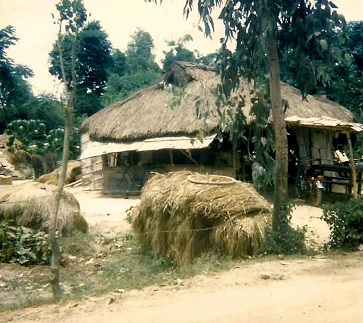
Mama-San’s hootch
Recon Marines Hanging from Rope Ladders
One of the strangest sights I encountered while out in the bush as a FAC was that of a CH-46 flying across the sky with three or four Marines hanging from a rope ladder. At first I thought how odd, then I realized that it was Recon Marines being extracted from a hot zone and probably with the bad guys hot on their tails. Force Recon are the elite of the Corps and their mission was reconnaissance, unlike the Navy Seals, who were often on a covert offensive mission. The Recon guys operated in the enemy’s hip pocket right up next to the NVA and Viet Cong. When I was in the Fire Direction Center at LZ Baldy with Frank the Arti-Officer we would listen in on their net (frequency) and they would be speaking in whispers because they were so close to the enemy. These guys train with the Seals and a cut above the rest of us.
Often when they were in trouble or just ready to be extracted from an area, they were on the run with the bad guys chasing them. They were in awesome condition, outrunning Charlie with fifty-pound packs on their backs. The choppers would come in with the rope ladder or lanyard hanging and rather than the chopper landing in a hot zone, the Recon guys would run up and hook C-clamp and lanyard onto the ladder and be hoisted away probably within a shower of AK-47 rounds. Those guys were heroes with big ones.
Phil Vannoy — Back at LZ Baldy
After being in the field for about two weeks I was called back to Battalion headquarters at LZ Baldy; the Major who was the Battalion Air Liaison Officer was going on R&R and I was to fill in for him while he was gone.
One night I went to the little “O” club bar there to have a drink and to my great surprise I ran into a buddy from OCS and TBS, 1st Lieutenant Phil Vannoy who had just taken over as Company Commander of Hotel Company 2/7. We drank some beers and chewed the fat a bit, but it wasn’t until our TBS Class reunion forty-five years later that I found out the circumstances involved with his taking over as Hotel’s CO. There had been a “fragging” incident (a term used to describe a fragmentation grenade tossed into a hootch or enclosure to injure or kill someone) in which the Company commander was wounded and a senior NCO was killed. This was in 1970, right in the middle of all the racial strife going on in the U.S. and it was very much in play in the war in Vietnam. Black and white soldiers and Marines would sometimes be on different sides of a big racial divide.
In this case the CO and NCO were white and it was thought that those responsible for the fragging were black.
I had almost been in the middle of an intramural fire fight in the street by the Da Nang PX when black and white Army troops opened up on each other at about a half of a block apart. I ducked in between two buildings to get out of the line of fire. It only lasted for a few rounds as they both retreated in opposite directions. This was also the time of the Black Power and other racially-charged situations. So I could appreciate Phil’s dilemma with having to deal with a racial situation and very little experience with that type of matter.
Phil, who was from Michigan, said that he had only known two blacks up to that point in his life, one in high school in Michigan and the other a fellow officer from OCS, Richard Jessie. Jessie, as far as I know, was the only black officer in our OCS and TBS class. But here Phil was sent in to calm down this explosive situation where the black Marines were all holed up together in a tent and not taking orders. I asked him how he slept at night and he said, “Not very well.”
David Noyes and “The Satchel Charge”
Another riveting story that came out of our TBS reunion, of which there were so many that you could fill volumes of books, was that of David Noyes, a friend of Phil’s who was a Lieutenant with 3/7 in Vietnam, but was there a year earlier than Phil and me.
He had been in Vietnam about three weeks and with his platoon for about two and one-half weeks. They had been on a Bald Eagle mission as a reactionary force for the division. They had returned to their normal position (Hill 25) which was a platoon-size outpost about eight klicks from their company and another eight klicks from the battalion battery position. It was in an area where “Charlie” (The Viet Cong or phonically “Victor Charlie”) would come down the Ho Chi Min trail from North Vietnam through Laos, cross over the mountains, called by us “Charlie Ridge” and mass in the Go Noi and Arizona areas right before the Tet offensive in 1968. Dave said that they were seeing a lot of action and the VC had determined that they needed to be eliminated.
He said that he had about thirty-five Marines and that the enemy hit them with about twenty mortar rounds and then with bandoliers to blow the wire. It was a sapper company estimated to be one hundred fifty VC.
Dave said, “I ran out of our CP tent to see what the fuck was going on. It was very dark and the only way to determine Marine from the sappers was the flash of light from an explosion. When I got over next to the wire I saw someone moving but I wasn’t sure if it was a Marine until I saw a flash and saw that it was a sapper with a satchel charge. All I had was my .45 caliber pistol and he was only about five feet from me. I fired but realized that I had not chambered a round. I think he had thought I was one of his unit until he heard the click and he froze for a second while I chambered a round and fired.”
By then the VC were on the hill and it was mass confusion and hand to hand in some cases. Dave ran back to the CP tent to call in for fire support and get his M-16. His platoon sergeant and radioman had already moved to a covered bunker. He got there and on the radio to call in for illumination and the on- call fire and found that the gunny already was calling for fire support. The enemy had a well-planned attack and had hit all the positions within the battalion TAOR with small probing action before they hit Dave’s unit so the battery was busy supporting them.
While he was on the radio he heard someone say, “honcho-honcho” (what the Vietnamese called officers) and, knowing they had no Vietnamese on their hill, realized that they were after him. They fired and threw in grenades and Dave moved back to the outside of the tent behind the sand bags and was firing back with his M-16.
They then were moving on both sides of the tent to envelop him.
“I saw firing from a squad bunker close by and ran over there yelling ‘coming over.’ The Marines said that I was within a hair of being shot by them. We set up outside the bunker and waited for them to hit us which they did and we killed four or five right in front of us.”
By then he was worried that they would get the radio in the CP tent so he tried to pin the VC down. It had been set up that if they were overrun, as a last resort, they would call fire on top of themselves with a green flare signal. The gunny on the radio set out the flare and everyone left dove for a covered bunker.
“They hit us with VT fused artillery (Variable Time) that went off about ten meters above ground for maximum damage to the VC. Two Marines were lost when a round went into their bunker. Of the enemy dead, one was a Chinese major and some of the men swore that they saw either a Russian or an American with the enemy.”
“The shelling got the VC off the hill and then the gunny got the fire fly and they did more damage.”
“The VC had set up an ambush in case our company tried to react. We lost ten Marines and another ten seriously wounded. We got out our dead and wounded and the reaction force finally reached us about at daylight that morning; the battle had started about 0200 on November 2nd,” Dave said.
Like most battles over there it was determined that the position they held was not that important and was disbanded shortly thereafter.
David Noyes received a Silver Star for his actions in Vietnam. Our TBS class earned twenty-nine Silver Stars, six Navy Crosses and two Distinguished Flying Crosses. We lost thirty-nine officers killed in Vietnam out of our class of 516.
Dave’s story wasn’t the exception to the rule. There were so many heroes with so many stories of courage and sacrifice over there. But when you talked to those guys, you see they never considered themselves heroes. I agreed with Dave when he said that most of us consider the guys that didn’t make it as heroes. It was like I said earlier, their stories would fill volumes.
Back with 1/7 — Evening Heat Casualties
It was quite often over one hundred degrees and about one hundred percent humidity in Vietnam and it seemed like the heat casualties would always come on in the evening time when we would stop to settle in for the night and prepare to eat dinner. On one occasion we had been humping the rice paddies and coastal plain area around LZ Baldy in one hundred degree heat and humidity, carrying heavy packs, weapons and equipment all day.
You had to really monitor your men and keep them hydrated because heat exhaustion and heat stroke were very serious problems in Vietnam and caused a bunch of casualties.
One evening while I was with Alpha Company, we had just stopped for the evening when the Company Commander called me to get a medevac helicopter to pick up one of the troops whose temperature was soaring above 103 degrees. I called DASC (Direct Air Support Center) for a Medevac, but they did not have a Marine chopper available, so I had Hank call the Army to see if they could help us out. It was getting close to sunset and I wanted to get them in before it got dark.
The Army said they would get something out to us ASAP. I told them thanks and that this kid was getting worse and had to be taken to an aid station “ricky tic.” We had moved out of the rice paddies and were in the tree line now which was a tall double canopy wooded area. I was looking for a good clearing for the helicopter to land in when I heard a chopper coming, but it wasn’t a Huey as I had expected. You could always tell the distinctive Huey two bladed “woop woop” sound. Then all of a sudden, here came a LOC (Light Observation Helicopter) that was a small sperm looking two-seated bird flying underneath the trees. He landed right in front of us and I ran over to the chopper and asked this young soldier where the pilot was. He said, “I am the pilot, Sir.” He looked like he was eighteen or nineteen years old and didn’t shave yet. He was a gutsy young Warrant Officer that had this new hot rod to fly instead of his hot rod car back home to drive, or that’s what I imagined. He told us to load the Marine into the left seat and he would drop him off at the nearest aid station.
The Army used the LOCs for observation as their name would indicate, but also in their Air Cav’s (1st. Air Cavalry Division) Red, White and Blue operations where they used them as bait. They would fly the small choppers low to see if they could draw fire and if they did, then they returned fire with a M-60 machine gun hanging by a bungee cord from the co-pilot’s door and/or drop hand grenades on the bad guys. That was the Red team. They would then call in the White team made up of Cobra gunships to hammer the enemy and then finally, if the situation called for it, they called in the Blue team. The Blue team was the Air Cav’s soldiers that they landed to destroy the rest of the bad guys. The Air Cavalry was some very good soldiers.
The Shower and the Tower
After about two weeks out in the bush I was called back to Battalion HQ. Lieutenant Colonel Copper, our CO, told me that he had a an observation tower that he wanted to have moved from Alpha Company’s area to our HQ’s hill at LZ Baldy. I said that I thought that we could get an Army Sky Crane to do the job, so he told me to get it set up.
I went through the necessary channels and put in a request for the big Sikorsky helicopter which was like a CH-53 with a cockpit but no cabin. It was great for carrying cargo underneath where the normal helicopter body would have been. I was told that the winds coming down from spinning blades could be 125 miles per hour. The people that I made the request to said that it would probably be several days to get the chopper to us, so I informed Lieutenant Colonel Cooper and he said, “Good, the sooner the better.”
In the meantime, it was good to be back at LZ Baldy where I had a roof over my head, a mess hall to eat in and a shower. Well, when I say shower I really mean a fifty-five gallon drum on top of a wood structure in the open area of a saddle between the two hills that made up LZ Baldy. There was no shower stall, just open air. The shower procedure was to fill a Gerry can with water, haul it up to the hill, climb the ladder, and pour the water into the fifty-five gallon drum; then you’d get underneath and pull the chain to release the cold shower water. Don’t get me wrong, it was better than a helmet full of water and a washcloth in the field, but being naked with no cover on a hill with a cool night breeze blowing on your wet body and thinking about what a great target for a sniper I would make was not my idea of the ideal shower. “I felt so naked.”
On the day that we had set up for the tower transfer, I was coordinating the operation and talking with the sky crane pilot. We had dug deep holes to set the four tower telephone pole main supports into and everything was ready to go. I tried to think of everything to the smallest detail to make sure the project went well, because it was my deal, my responsibility and the CO would be looking at the job that I did.
The chopper arrived and everyone on the base was watching this huge thirty foot tower suspended under the big Sky Crane helicopter being moved into place to drop into the holes. It took some finessing, but the crew on the ground and the helicopter crew got the tower into the holes and when the chopper released the tower it stood erect and solid. Everyone cheered. That was the good part, for as I had mentioned, the chopper’s blades created a down draft force of about 125 miles per hour. Well, the CO’s shitter was close to where the tower was being placed and the down draft winds blew the CO’s outhouse over.
Someone told me that the CO was in the shitter at the time, but I think he just wanted to pull my chain. It was bad enough that my operation didn’t go off perfectly well without the CO being in the shitter at the time. Things like that can reflect on your fitness report.
Back to Da Nang for a Flight — Low Pass Over LZ Baldy
Ihad been at LZ Baldy and out in the bush for a couple of months, and I needed to get some flight time so I asked the CO if I could go back to my squadron in Da Nang over the weekend and get a flight. He said that would be OK, and I caught a ride on a CH-46 out of LZ Baldy with brief stop to drop off some stuff to some troops out in the field; then we flew on to Da Nang. As we were coming into the LZ, we took some small arms fire that hit a hydraulic line and we came down hard from about twenty feet up. I guess we could say that we were technically shot down, but it amounted to a hard landing. We scrambled out of the chopper and took cover. There was no more fire. But we had to wait a while for another chopper to pick us up.
This was the second time riding in a chopper that ground fire brought us down. The first time we were lifting out of the zone and took some rounds that hit a hydraulic line that sent us back down from about fifteen feet for another hard landing.
In my 124 combat missions flying an A-6 I never took a hit, close, but never a hit. But there I was riding in helicopters and I got knocked down twice. I had a great admiration for the chopper jocks because they took fire and hits on a regular basis. We fixed-wing guys made fun of them and said things like, “Having rotary wing time on your flight record is like having VD on your health record” or “If your wings are going faster than your fuselage then you must be in a helicopter,” but they were very good at what they did and were an integral part of the Marine Corps’ infantry, air and sea team.
I had an uncomfortable feeling riding in choppers and I always sat on my “bullet bouncer” (flax vest) because I thought that I would rather take one in the chest or head than have a round take out my manly equipment or take one in the ass. The fire came from the ground, so it made sense to me to protect my bottom.
It was an unnerving situation to see a sudden pencil-like beam of light come through the thin aluminum skin of the chopper and realize that a bullet had just passed through and made that hole where none was before.
I finally got to Da Nang late that day and got to my old hootch with Rick Spitz and slept in my rack that was still mine since no one had moved in with Rick in the time I had been gone. I made it to the “O” Club, had some drinks and shared some grunt tales with my squadron buddies.
I saw my good buddy Jack Rippy and he told me that he laughed at the letter I had sent him while out in the bush where I described how I was with one of the rifle companies and we were taking some fire one night. That was actually the first time that I had been fired at on the ground and I was reluctant to stand up and see where the fire was coming from. There were these green and white tracers zipping in over our heads and red tracers going out from our guys. Someone told me that the green ones were Chi-Com and the white was Czech or vice-versa.
As evening passed into night, my radio man and I had taken cover in this moat-like earthen structure which had a round mound in the center and a depression around it.
I asked my radio man what was this thing.
He said, “A grave.”
“Oh great,” I thought. “I’m getting fired at and I’m already in a grave. This could be a grave situation.” I’m sorry, I couldn’t resist the pun.
Well anyway, I wrote to Jack that “I was lying very deep in a shallow hole.” Rippy loved that line.
While my radio man and I were in the grave’s moat talking to the air support people to get some flares to light up the area, artillery flare rounds started to pop right above us. Then all of a sudden I heard this “woop,” “woop,” “woop” sound over our heads and the sound of something hitting the ground right next to us. It was the base plates for the flares raining down on us.
In the middle of the action, the company commander, a captain, called me to come over to him, so I ran over to him in a low crouch as intermittent tracer rounds flew overhead. He had this combat vet smile on his face and said, “I told you I would get you a combat action ribbon, Ron.”
I said, “Thanks Captain, I appreciate it,” feeling embarrassed by my rookie fear of being shot.
The next day in Da Nang, I arranged with the Ops Officer to get a hop with an early morning target time that was just about at sunrise and it happened to be down south of Da Nang. We flew the mission and were returning when I thought that it would be cool to fly over LZ Baldy on the way back. I told my BN that I wanted to fly over LZ Baldy and show him where I was located with 1/7. He said great. We got to LZ Blady about 0700 and I descended to about two hundred feet or so in a slow descent while aiming for the saddle between the two hills and doing about three hundred knots airspeed. We came across the hills right at eye level with the observation house on top of the tower that we had just set in place. As we flew past the tower I pulled up and did a roll, thinking I wanted to give the troops a real show.
Later, when I got back to LZ Baldy, the Marine who was in the tower at the time told me that he almost shit on himself and that he could see me in the cockpit as we flew by at his eye level.
The CO asked if that was me flying over the base on Sunday morning and I reluctantly said, “Yes, Sir.” He then said that he thought it was incoming and dove in his bunker and didn’t see the low pass. He didn’t seem to appreciate the aeronautic display very much.
Airborne Assault
Iwas just back a short time when the Battalion 1-4 called me in to brief me on an upcoming operation that would be a company-size airborne assault on a bad guy position build-up in the Que Son Mountains. One company of 1/7 would make the airborne attack while another company would be in the ready as a reaction force. I helped the Major with some of the coordination with the helicopters. We had both CH-46s and CH-53s set up for the operation. This was my first air assault and my radio man and I were going in with a squad from one of the platoons. This was classic “vertical envelopment” as developed by the Marine Corps and the forte of the Air Cav in Vietnam. This was helicopters swooping in on the bad guys for some ass kicking.
We started loading up the helicopters at “O dark thirty” and my excitement level began rising by the minute. I tried to look cool, like an officer that has been there and done that, but this wasn’t going to be just some rounds going over head; this could be a big ass fight with the NVA.
Finally we were off, and inside the big CH-53 I went over some coordination details with my radio man and in no time we were going into the drop zone. Before the rear wheels touched down, the ramp was open and the squad of Marines was pouring out of the chopper. My radio man and I were the last to get off the bird which had set us down in a wet rice field. Thinking I was John Wayne or something like that I ran down the ramp with my .45 in my hand ready for combat. I was just getting off the ramp when the chopper started to take off and I landed face first in the mud of the rice paddy. I quickly looked to see if anyone had seen my combat face plant, but thank God no one saw me; they were too busy with their own situations. Damn! I thought, that didn’t look very Marine officer professional.
It turned out that there wasn’t much action, the bad guys must have got word and “de-deed.”
Dan DeBlanc Flies Through LZ Baldy AO
Alittle while later and back at LZ Baldy, I was sitting in the Fire Direction Center next to my buddy Frank the artillery officer, who like myself was a 1st Lieutenant, when I heard the Marine helicopter calling in for clearance through our AO. The pilot on the radio had a very thick New Orleans accent that I picked up on immediately and radioed back, “Who is this and is that a New Orleans accent?”
“Roger that, Lieutenant Dan De Blanc Marine Cobra gunship -----” came the reply.
“Dan, this is Ronnie Boehm, I’m down here at LZ Baldy as the 1-4 for 1/7.”
“Hell Ronnie, I’ll come down, land and visit you next time through your AO.”
“I’ll look forward to it Dan; give me a ride when you come back.”
“Roger that, I’ll give you a ride in the front seat and let you fire the guns; we’ll blow up some trees just like back at SLC with the dynamite.”
Dan was my friend back at Southeastern Louisiana College in Hammond, Louisiana. He was in my OCS class but not my TBS class. Back in college, he was a bull rider on the weekends, traveling around to rodeos. His crew in college or the guys he lived with and my roommates hung out together and one of our things was to go out in the woods and blow stuff up with dynamite that we would get from the local hardware store. That was before all the domestic terrorism stuff, back when farmers would go to the hardware store to get dynamite to blow up tree stumps. We would also throw a stick of dynamite in the river to catch fish to eat. So I guess blowing up stuff was a natural thing to us.
We never got to do the give-me-a-ride-and-blow-up-stuff, but later when I was back in Da Nang, Dan kicked open the door of my hootch in the middle of the night with a bottle of wine in his hand and yelled out, “Ronnie, let’s party.” Shit, I almost shot him. I had just come back from out in the bush where I slept with my pistol on my chest. Dan didn’t remember it that way, but that is how I remembered it and it makes for a good story.
Dan won a Silver Star for his heroic actions on March 17, 1969, while flying as co-pilot in a UH-1E Huey gunship with VMO-2 in support of a Marine company that was engaged with a large NVA force near An Hoa in Quang Nam Province southwest of Da Nang. The Marines were pinned down in a rice paddy by heavy automatic weapons fire and had taken several casualties. The enemy was in fortified positions and the wounded were too close to the NVA to use either artillery or fixed wing air support.
To paraphrase Dan’s Silver Star Citation: with deteriorating weather conditions and the heavy volume of automatic weapons fire directed at them, Dan and his pilot made numerous rocket and strafing runs over a four-hour period to suppress the enemy fire but it was not enough for the Marines to recover their wounded. The Huey pilot then decided to land their chopper to evacuate the wounded. While exposed to heavy enemy fire, they landed and loaded a wounded Marine into their helicopter while Dan was providing covering fire from his side of the Huey with his rifle. They took one wounded man to An Hoa Combat Base and returned on three more occasions to land and evacuate wounded men, all the while taking fire and with Dan helping the pilot and providing covering fire with his M-16 directed at the NVA gun emplacements.
Their Huey took extensive damage in this engagement, and Dan has a piece of the aluminum skin from the chopper with a big .50 caliber hole in it mounted on the wall of his restaurant in Slidell, Louisiana.
Dan also had the dubious distinction of flying the first Cobra to be shot down in Vietnam (September 1969 near An Hoa). He took three fifty caliber rounds to the transmission. Shortly after being shot down, he was sent to Da Nang DASC as the Marine Helicopter Director. Dan said, “I think my CO was pissed that I fucked up his chopper.”
Dan’s restaurant in Slidell is called the Southside Café and the walls are covered with Marine Corps memorabilia that has been given to him by the scores of Marines who have visited his place. Rich in history would be an understatement.
Dave Cummings “Dave’s Ride”
Of all the stories involving my friends in Vietnam, few can match the story of my friend Dave Cummings, a fellow squad mate in the 1st Platoon of Mike Company at The Basic School.
Dave was just a very nice guy and talented Marine, or as my buddy and fellow M/1 squad-mate Fred Bonati said, “Dave was just a natural at everything he did.” Dave was just like most of my TBS classmates of 5/67 in that he was a grunt 2nd Lieutenant infantry officer sent off to Vietnam just after finishing up at TBS. He was seriously wounded in a fire fight and was evacuated to the States to recuperate. While recuperating, and since he had always wanted to fly, he applied for Naval Flight School and was accepted.
After earning his “Wings of Gold” he returned to Vietnam at the same time that I got there in September 1969, as a helicopter pilot. He was also a squadron mate in VMO-2 with Dan DeBlanc. Tom Broderick was also in our M/1 squad along with Dave and Fred. When talking to Tom about Dave’s heroic story, he said, “We refer to it as Dave’s Ride.” And when I asked Dan DeBlanc about it, he said, “Oh you mean when Dave rode the rocket pod.”
Even I had heard of the story from someone I can’t remember back in Da Nang. The story is almost folklore in the Marine Corps, especially in the helicopter part of Marine Corps aviation.
It starts out in December of 1969 where a remote Marine observation team had set up a defensive perimeter atop Hill 845 about forty miles southwest of Da Nang in the Que Son Mountains. The team’s perimeter was being probed by elements of a battalion-size unit of Viet Cong and they had called for some air support. Responding to that call for close air support was a Marine OV-10 “Bronco” piloted by Captain Dennis Herbert.
It was the middle of the monsoon season and the cloud-base was rapidly deteriorating when the Bronco made contract with a ground-based forward air controller (FAC). After getting his target information, Captain Herbert made his attack run aimed at a shallow ravine leading up the mountain to the outpost. Captain Herbert fired off two Zuni rockets and followed them visually to the ravine where they exploded; he then pulled up hard to avoid the debris from the explosion and the thickly forested mountain and then punched up through the clouds on top. The FAC reported the mission a success and reported also that they had a very seriously wounded Marine who had tripped off an enemy bobby trap. He was bleeding profusely and was going into shock and the FAC asked the Bronco to relay a request for an immediate medevac.
Here’s an account of what happened after the request for a medevac was relayed by the Bronco pilot.
“Meanwhile, at Landing Zone Baldy, Cobra pilot First Lieutenant David Cummings and his aircraft commander, Captain Roger Henry, were standing by on routine medevac escort alert in their AH-1G gunship. The rear cockpit seat of the Cobra, normally flown by the pilot in command, would today be flown by the copilot, Lieutenant Cummings, as part of his aircraft commander check ride. When the call came to escort medevac helicopters, the pilots launched with another Cobra to marry up with two CH-46 Sea Knight transport helicopters as part of a constituted medevac (medical evacuation) package. After a smooth join up, the flight headed 40 miles southwest of Da Nang into the Que Son Mountains in Quanq Nam Province where they rendezvoused with the Bronco for a mission brief.
The weather at Hill 845 had deteriorated badly. Rain and lowering cloud bases made it virtually impossible for the larger Sea Knights to get into the area for the pick up. Despite persistent maneuvering, the rescue flight finally retired to the edge of the weather mass where they loitered to wait for another opportunity to come in and pick up the wounded Marine.
After obtaining approval from the medevac mission commander, the agile Cobra flown by Captain Henry and Lieutenant Cummings proceeded to scout the landing zone in order to facilitate a more expeditious evacuation. The worsening weather, however, prompted Captain Henry, positioned in the higher visibility front gunner’s seat, to assume control of the aircraft’s more difficult-to-use side console forward cockpit flight controls. Visibility was now practically zero.
In those days, there was a variation of a popular song theme that ‘only mad dogs and Englishmen ventured into noonday monsoons!’ Undaunted, Captain Henry and Lieutenant Cummings pressed on despite harrowing weather conditions. The two Marines worked their Cobra up the mountain-side amidst severe turbulence generated up and down gnarled mountain slopes. Scraping tree tops at airspeeds that often dipped below 30 knots, or required holding in perilous zero-visibility hovers, the flyers anxiously waited for a call from the outpost giving them either a visual or sound cue that they were above the elusive, ill-defined landing zone. After three hours and five different attempts (with refueling runs interjected in-between), the aviators finally found their mark.
Sporadic radio reports confirmed to Captain Henry and Lieutenant Cummings their worst fear that the injured Marine was succumbing to his wounds. Guiding the Cobra down through tall trees, Captain Henry landed the aircraft on the edge of a bomb crater in a skillful display of airmanship. The helicopter settled to the ground amid swirling debris. The tightness of the landing zone was such that only the front half of the aircraft’s skids rested on the rocky outer lip of the bomb crater. While the Cobra loitered in this precarious teeter-totter position, Lieutenant Cummings climbed out of the aircraft to investigate the situation.”
Dave saw that the wounded marine was in bad shape and probably close to death, so he ordered the casualty lifted into the Cobra. Then after strapping the semiconscious Marine into the back seat, Dave fastened the canopy shut and as the grunts looked on in amazement climbed atop the starboard stub wing rocket pod. Straddling the pod and facing aft, Dave banged his fist on the wing to get Captain Henry’s attention before giving him the thumbs up. With that, Captain Henry nodded and took off while Dave flashed the “V” for victory sign to the grunts remaining in the zone as they cheered.
The Cobra disappeared into the clouds and they leveled off at four thousand feet and increased speed to about one hundred knots to improve maneuverability. The wind, rain, extreme cold at altitude and the vibrations of the aircraft all added to a very hard and tenuous situation. Dave could hold on only by squeezing his thighs tightly against the rocket pod wing mount. To make matters worse, the wind grabbed the back of his helmet pushing it forward thereby causing the chin strap to choke him.
After about a twenty-five minute flight through the weather, the gunship descended through the clouds into the clear over a navigation point and headed for the medical facility. After landing, the wounded Marine was whisked into the medical facility for stabilization and the Navy Corpsmen helped Dave to defrost himself off the rocket pod. A short time later, a CH-46 arrived to fly the wounded Marine to Marble Mountain for emergency surgery. Captain Henry and Dave Cummings flew escort for the CH-46 to make sure their rescued Marine made it safely to the more sophisticated medical facility.
It was said that some more senior aviators “in-country” talked about censure and a court-martial for the rocket pod affair which they thought was grandstanding regardless of the fact that the young Marine would have died had he not received medical attention as soon as he did. But after Captain Henry and Dave were invited each personally by the Commanding General of the First Marine Division to dine as his special guests in his quarters, the issue was dropped.
For their action, Captain Henry and First Lieutenant Cummings were each awarded the Distinguished Flying Cross. The word Heroes is appropriate. (Source: A Marine Hero—Rescue at HIll 845, by Greg Johnson (retired USMC CH-46 helicopter pilot who flew many medevac missions)
Tom Broderick
Another buddy of mine from TBS was Tom Broderick. He was also in my squad in M-1 along with Fred Bonati, Dave Cummings, Pete Barber and Bob Bracken. Tom was also a good friend and fraternity brother of Dave “Andy” Anderson who was in my platoon in OCS.
Tom, like Fred, Pete and I, went to flight school after TBS and became a pilot. Fred and Pete got F-4s, I went to A-6s and Tom got to be a Huey gunship pilot. Tom had a near life-ending experience in Vietnam when his UA-1 Huey lost power over Da Nang Bay and went into the drink
I don’t know if it was that crash or another one of Tom’s several unplanned returns to the earth, but he told the story of losing his bottom teeth in a crash and having a tough time pronouncing some words, two of which being “Peach Bush” the call sign of HMM 263 a CH-46 helicopter squadron. He would say something like “Peech Buuss.” His squadron mates in turn called him “Fang.”
Cheating death seemed to run in Tom’s family; not only did Tom survive several aircraft crashes, but his older brother who was a Navy A-1 Skyraider pilot, lost power on takeoff from an aircraft carrier and went into the drink. He got out of the aircraft only to see this huge aircraft carrier’s bow coming straight at him. The ship actually ran over him; the propellers were stopped but this several-football-field long ship ran over him. He could feel himself bouncing along the bottom of the ship, and miraculously, he resurfaced again after the ship passed, but he was pretty much written off by the crew on the carrier. A destroyer doing a search spotted him and rescued him.
So Tom Broderick, his brother and his good friend Dave Anderson all narrowly escaped death and can thank God for their survival. I guess God wasn’t ready for them to come home just yet.
End of My FAC Tour
At the end of May, 1969, my three months FAC tour with 1/7 was up and I was anxious to return to my squadron in Da Nang and resume flying. The CO shook my hand and they gave me a wood plaque with the 1st Marine Division insignia of a number 1 with the word “Guadalcanal” on it and the 1st Battalion 7th Marines banner over it. I still cherish it and it brings back so many memories every time I look at it.
Flying an attack jet in combat was an awesome experience, but it was a different experience of war than what the grunts on the ground experienced. So I was grateful for the opportunity of seeing what the war was like for the troops on the ground. They were the war and we the aviators were the supporting cast. But one thing that really stood out in my mind about that experience was seeing the relationship of a young 2nd Lieutenant Platoon Commander with his men. Here was a twenty-two-year old brand new officer in charge of forty-five Marines, forty-four of whom were eighteen or nineteen years old and a Staff or Gunnery Sergeant who was about twenty-five years old.
If the Lieutenant was respected by his troops, they had this love, respect and protective attitude for him that was like “Don’t screw with my Lieutenant, he is my Lieutenant, our leader.” A good relationship between the Platoon Commander and his Platoon Sergeant was that of mutual respect and cooperation. That respect within the platoon really impressed me and is one of the basic foundations of the Marine Corps.
Back with My Squadron VMA (AW) 242
Antenna check, Grumman Film Crew, Carl Widell and the ROKS
Finally I was back with my squadron VMA (AW) 242, as was Carl Widell who had gone with the ROKS (Republic of Korea) as a FAC. That must have been a really unique experience. He told me about one of the disciplinary methods they used: the top sergeant would beat the troops who screwed up with a baseball bat and there was a very strict adherence with respect to rank between the officers of one grade and another and the same for the enlisted ranks.
We had heard stories about how the South Vietnamese, the “friendlies” on our side, had surrounded a U.S. truck that supposedly hit a child or someone and held it for ransom and that cash had to be paid to the “injured party” before the truck was allowed to leave. Well, that wasn’t a problem for the ROKS, for when they came through a village, the locals got the hell out of the way and were thankful that the ROKS didn’t kill everyone and burn down the village. That was the reputation the ROKS had. They were bad asses and didn’t cut the Vietnamese, North or South, any slack.
Carl also said that they had crappy equipment in Vietnam, because they sent all the good equipment that we gave them back to South Korea to deal with their number one enemy, North Korea.
Antenna Check
Since I hadn’t flown much in the last three months, the operations people got me some daytime hops in country and in support of the ground troops to get me up to speed. Some of it was visual drops, or system ordinance drops that became visual because of computer equipment failure. The pilots loved to drop visually like the F-4s and A-4s did, but the BNs hated it. Hurling this advanced electronic computerized weapon system that the A-6 was at the ground at four hundred knots and a thirty-degree dive angle using a bombsight wasn’t their cup of tea. But having been on the ground with the troops calling in the air support, I had an appreciation for what the grunts felt when they saw a jet coming in and dropping bombs on the enemy in support of them. There would be cheering on the ground and then often the troops on the ground would ask for an “antenna check,” which was a very low pass over their position—the lower the better. But some pilots got themselves in trouble doing this and either crashed or damn near crashed.
The problem was that a bomb run was right out of the book; there was a chart for a certain dive angle, airspeed, release altitude and making mental adjustments as you roll in on the target. However, an “antenna check” was just eyeballing it, winging it. I learned very quickly that the technique to use was to get down low and easy first, being more or less level before you got to their position and then pulling up as you went over their position and tipping your wings in a wave or if it was to really be “Shit Hot,” a roll, but only if you had the airspeed and plenty of altitude and in a climb. The roll wasn’t part of my repertoire. The A-6 didn’t roll very fast.
Grumman Film Crew
Ihadn’t been back very long when the XO asked me if I would like to escort a film crew from the Grumman Aircraft Company around for a couple weeks while they made a film about the A-6 Intruder All Weather Attack System. I jumped at the chance and it turned out to be fun. It was a chance to do something different and watch them make a thirty-minute sixteen-millimeter film showing the A-6 dropping bombs in the weather and at night using its sophisticated weapon systems and the Rab-Fac Beacon when most other fighter bombers had to rely on clear weather to drop visually.
The film began with images from the Battle of the Bulge when the American troops were under attack and surrounded by the Germans. The soldiers from the 101 Airborne Division couldn’t get air support or supplies from the air because the weather had them socked in. The film showed that that wouldn’t happen now (1970) because we had the A-6 Intruder for air support in any weather or condition.
I got to be in several shots in the film as did my squadron mates and guys from our sister squadron VMA (AW) 225. I was the pilot in a couple of shots where the cameraman did his filming from the right seat of my A-6 filming another A-6 dropping bombs while we were flying in formation. It was pretty cool to see up close an A-6 dropping twenty-two bombs as I flew next to it at about forty feet away in loose formation. You couldn’t tell it was me flying in the pilot’s seat since I had on a helmet with dark visor and oxygen mask. In another shot, I was in the ready room playing acee-deucee with my BN, waiting for our flight.
In one shot, they filmed several pilots and BNs sitting around a table in the mess hall talking about flying and the funny thing I noticed was that it was the BNs using their hands to indicate aircraft positions, and not the pilots. That just struck me as funny. Aviators always seem to talk with their hands.
When the filming was complete, I made sure to ask the Grumman Tech-Rep to get me a copy of the film, which he did and I still have it in the original sixteen millimeter reel.
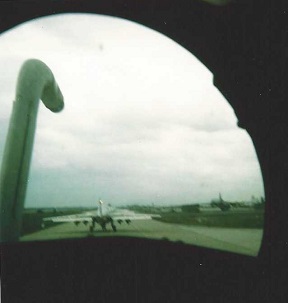
A-6s Taxiing Out
AF O-2 Cessna Push-Pull FAC — Flight of B-52s
One of my memorable missions started out as a support mission south of Da Nang, but when our target was canceled, we called DASC to report that though we had been canceled, we had plenty of time, fuel and twenty-two Mark 82 five hundred pound bombs if they had another mission for us.
DASC said that they did and sent us over to an Air Force airborne FAC flying in an O-2 Push-Pull Cessna Skymaster. This was the aircraft that Danny Glover flew in the movie Bat 21 in his effort to rescue Gene Hackman, based on the true story of the rescue of Lieutenant Colonel Iceal Hambleton, whose EB-66 was shot down behind enemy lines. There was an O-2B version equipped with loud speakers for psychological warfare that they called the BS Bomber. (Source: Warbird Alley, www.warbirdalley.com)
We checked in with the Air Force FAC on the frequency given to us, reporting in, “This is Marine Ringneck 54 an Alpha-6 with 22 Mark 82s looking for a target, over.”
The FAC came back with “This is a flight of B52s, over?”
“Negative,” I responded. “We are one Alpha-6 with 22 Mark 82s here for your pleasure today.”
The “flight of B-52s” was his little joke since they were not used to working with A-6s. We usually had missions that required systems drops and we didn’t do a lot of visual work. We also carried more bombs than the F-4s, A-7s and A-4s that they were used to working with.
He replied, “Shit hot, we are going to have some fun today. I’ve got a squad-size unit of bad guys that crossed the river and are hiding on the island in the middle of the river.”
He gave the target coordinates and said that he was orbiting the target area at one thousand feet.
We told him we were on our way and our ETA was oh-five minutes at Angels five (five thousand feet).
He said, “Roger that, report on station” and he would mark the target with “Willy Peter” (white phosphorus rocket).
We got to the target area and reported that we were on station and holding at five thousand feet.
The FAC said, “Roger that,” then went silent.
We tried several times to reach him but got no response.
Finally, after about five minutes, the FAC came back up and said, “Sorry about that” and that he had lost his head set out the window and had to use the pilot’s head set. Then he said that they were rolling in to mark the target with willy-pete.
I said, “Roger that, we are ready to make two runs with twelve bombs on the first and ten bombs on the second run if the FAC wanted it.” I reported that we saw his smoke on the island.
He said, “Roger that, you are cleared hot and we are clear of the target.”
I rolled the A-6 Intruder over on its back, pulled hard and got the smoke in my bomb sight, then rolled upright in a thirty-degree dive while watching the target track down towards the center of my bomb sight. At about three thousand feet, I pickled the bombs and pulled up hard, bottoming out at about fifteen hundred feet and came around to position us for a second run if necessary. I was in a turn to port and watched as our string of twelve bombs tore through the little island in the river.
The FAC came up and said, “Great shooting, how about a second run to make sure.”
I said, “You got it; I don’t want to take these home.”
The second run was just like the first, with a string of ten bombs tearing up the island and denuding it of trees. The FAC again said that it was a good run and that if there were any bad guys hiding there they were in the hurt locker now, but he didn’t see any bodies. He then gave us our BDA (Bomb Damage Assessment); one hundred meters of tree line destroyed and a stream cut. How in the hell do you cut a stream?
Napalm Run on the Side of the Mountain
On another visual drop mission working with an airborne FAC and in support of some troops on the ground, this time we were carrying “snake and nape” (“snake eye” five hundred pound bomb with high drag tail fins and incendiary napalm bombs) instead of the regular conventional fin five hundred pound bombs. Both of these weapons were dropped at a low altitude and at low dive angles. The purpose of the high drag tail fins was to slow the bombs down so that the aircraft dropping them wouldn’t be damaged by the same bombs that they dropped. It also made for better close air support accuracy, allowing the aircraft to get in lower and closer.
Napalm was a different story; made from jet fuel or gasoline and petroleum jelly, the bombs had no tail fins and that caused them to tumble when dropped which in turn helped to spread the flames when they exploded upon contact. The napalm burned with intense heat for about three to fifteen minutes and, being a jelly-like substance, it stuck to whatever it touched.
On this mission, as we arrived on station, we made contact with the airborne FAC who told us that he had about ten NVA troops on the run and they were heading up to a draw between two fingers on side of the mountain, a dead end. We got a visual on the OV-10 FAC and he made a run marking the enemy with a “willy-pete” rocket. We were right behind him and cleared hot. I came in low and at about a fifteen- degree dive angle; the BN had set up the armament panel to drop two napalm bombs. As we rolled in to initiate our run, I could see the NVA running up into this dead end draw. It was the first time I had ever seen people on the ground as my target—mostly you just saw smoke or a target area, but I released the bombs and pulled up out of the low angle dive and banked to the left to see the bombs exploding. The fire filled the small valley between the mountain fingers that the NVA troops were running into. The flames covered the entire draw; I couldn’t see how anyone would escape from that. That made a lasting impression. Like I said, as a pilot of a fighter/ bomber or attack jet I usually don’t see the people I am bombing.
Getting Short
Iwas getting to be a short-timer; my year’s tour in Vietnam was coming to an end. The Ops officer, Major Shooter Dubeck, told me that I would be part of a ferry flight of three aircraft to transpac across the Pacific Ocean to Whidbey Island Naval Air Station in Washington then across country to deliver the three Intruders to the Air Rework Facility at NAS Norfolk, Virginia. Upon signing the A-6s over to the Air Rework Facility, our tour in Vietnam would be over, and we would be on thirty days leave.
Several things would be in order before I would be on my way home; for one thing, I had to get a practice in-flight refueling hop which I had not done since Cherry Point, two years prior. We were to island hop across the Pacific Ocean and on one leg of the flight between Barber’s Point, Hawaii and Whidbey Island we had a six-hour flight and, therefore, we would have to refuel in-flight. Second, my last real combat flight was approaching; that usually happened about two weeks before you were to leave Vietnam. After my last real combat flight, most likely in Laos along the Ho Chi Min Trail, I might have several flights in country that were not very dangerous. But before my last flight—and they never told you when that was until you landed and the fire trucks pulled up and hosed you down—I would have my last mission over Laos and then on to the Air Force Base at Ubon, Thailand. There I would pick up all my stuff that I had bought, tailor-made suits, handmade shoes, wood carvings, jewelry and of course one last trip to the “Hotse Baths” for a rub and scrub.
I was scheduled for a couple in-flight refueling hops, but on the first one the C-130 refueling aircraft was down for maintenance reasons and then I was scheduled for another refueling hop and the weather was too bad to refuel. The bottom line was that I never got to practice in-flight refueling before my trans-pac. This meant that I would get to experience the pressure of attempting to refuel in-flight in the middle of the ocean when I had to do it or fall out of the sky into the ocean and I hadn’t done it in two years.
Last Trip to Thailand
As I had said, it was SOP that when you were about a couple of weeks from the from the end of your tour in Nam you would get one of the early morning Laos missions to drop your bombs in Laos and proceed west to the Air Force base in Ubon, Thailand, for the last time.
So it was on this my last flight to Thailand that we completed our mission in Laos, took some light AAA fire and then landed at the Air Force Base in Ubon at about 0730 hours. As we taxied up to the ramp, there were the two crew members from the previous Thailand flight waiting on the tarmac to climb in our A-6 and fly it back to Da Nang. In turn, on our third day, there we would be the crew waiting on the tarmac to take the flight back to Da Nang.
The procedure was that you would shut down one engine, climb out of the aircraft one at a time, and the other crew would climb in, get clearance, take off and, officially, we were not there.
The first thing we did was go to breakfast; then we checked into the BOQ. We relaxed a bit at the BOQ; then we went to town. Our first stop when we got to town was the hotse bath for a massage. Wow, what a nice feeling after a combat mission and having been up since about 0400. First was the steam cabinet, then the bath tub, dry off, powder and then the wonderful massage. I just felt like a wet noodle after the massage, every muscle was relaxed. Of course, it didn’t hurt that the girls giving the massage were all young and pretty and, if I remember correctly, the price was only about three dollars an hour.
After that, we went to a bar for a drink or two and then on to the shops to pick up the stuff we had ordered on earlier trips. The tailor shop that most of the guys in the squadron went to was The Maharaja’s Tailor Shop. He and his wife were Indian and very nice people. He did pretty well with all the GI clients either stationed in Ubon or with transients like us. We told him that this was our last trip to Ubon and we were picking up our tailor made suits. He said that he very much appreciated our business and invited us to his home for a homemade authentic Indian dinner cooked by his wife.
I don’t remember what we had for dinner other than the curry rice, but it was delicious. After dinner my BN and I went to a bar or two and in the process of going from one bar to another we ran into two girls from the hotse bath. One of the girls was the one that my unmarried BN favored and we stopped to talk to them and ask where there was a good bar to go to. As we were talking to the girls on the street a bicycle taxi called a “sanlo” came by; then it stopped just past us. Another girl from the massage parlor that I usually got my massage from, Nawate, got out and in a very angry voice said, “You number one butterfly, you som-ma-ma-bitch.” A butterfly flies from flower to flower and a “number one butterfly” of course was the best at doing that. Thai women were known for their jealous temperament. I tried to explain in broken English to her that we were not with these girls who took off, but just on our way to another bar. But she just kept shouting “You number one butterfly” while shaking her fist at me. Then I realized as I caught the glimmer of the street light reflecting off the blade that she had a knife in her hand and was shaking it in a stabbing like manner at me. And I thought to myself, “Oh, this is great! I just completed a hundred and some odd combat missions in Vietnam without a scratch and this girl is going to stab me in a mistaken jealous rage.”
Finally she settled down and got back into the “sanlo” and took off. My BN made the understatement of the day, “Wow! She was pissed.”
We made it back to the base and on the third day we were ready on the tarmac with all our booty to fly back to Da Nang.
Rick Spitz’s Last Flight to Thailand
My buddy and roommate Rick Spitz’s last fling to Thailand was also a memorable one. He and Doug Burkett, his BN, were literally the last A-6 flight to Ubon. They flew their mission over Laos and then continued on to Ubon where the previous crew met them and flew the aircraft back to Da Nang. Rick and Doug were then to catch a C-130 back to Da Nang on their third day thus ending his little mini — R&R set up since the A-6 squadrons were leaving country soon thereafter.
Well, like I pointed out earlier, Rick kind of thought that he should make his own rules and since he and Doug were having such a good time in Ubon which was a lot better than getting rockets fired at you in Da Nang or guns fired at you over Laos, they decided to stay a while longer. He had met some good-looking Thai girl with a beautiful face and big tits and that added to the attraction of staying.
So on the third day he called back to the squadron and told the Ops officer Shooter Dubeck that they had missed the daily C-130 flight but would catch the one tomorrow. When tomorrow came, they had another excuse and same for the next day on until the ninth day when finally Major Dubeck told them that he was sending two OV-10s, one for him and one for his worthless BN to pick them up and take them back and that they better be on them.
Rick was a story waiting to happen, and there are a bunch of them. That is why I loved to be with him; he was and still is a great friend.
My Last Combat Flight
We had just returned from a supposed piece-of-cake TPQ mission in country up north towards the DMZ and the Laotian border where we were to drop our ordinance on a suspected enemy position. In a TPQ mission, we were directed by an on-the-ground controller who guided us to the target via radar and we would pickle our bombs in level flight at six or eight thousand feet or so, well out of the range of enemy small arms fire. However, on this mission the target was cancelled and we jettisoned our bombs over the water at a designated drop zone. It was an uneventful hop other than cancellation and I didn’t think of anything other than getting back, taxiing into our revetment area, shutting down the aircraft and filling out the end of mission paper work. But as we were pulling up to our ramp area, a fire truck followed us and as we came to a stop, they started to hose us down. We shut down the engines, turned off all the equipment and I climbed out of the aircraft. Then they hosed me down and as I stood there, dripping, with my helmet bag and knee pad, Major P.J. McCarthy walked up to me and presented me with a bottle of champagne. He said, “Congratulations, Ron, this was your final in country hop - you did a good job.”
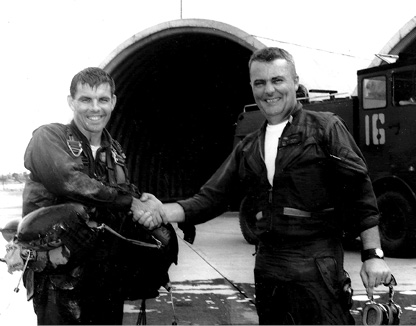
After my last
combat flight
So this was it, August 15, 1970, my last combat flight in Vietnam, number one hundred and twenty four. I made it and survived without a scratch. I was a lot luckier than a whole bunch of other guys that shed their blood or lost their lives in this war. Many guys carried scars within them that others could not see, but I had none and I was proud to be a Marine and serve my country in combat. I wasn’t a hero, but I knew a bunch of them. I just did my job as best as I could. Actually, it was the greatest thrill of my life.
My actual last flight in Vietnam, later on August 27 was with Wally Siller, my BN, and we were to go up and practice air refueling, but the weather was bad and we couldn’t tank as I explained earlier. That was a bad deal for me since I would now have to trans-pac and not have air refueled in well over a year.