
24

PRESIDENT ABRAHAM LINCOLN RECEIVED COUNTLESS PETITIONS ON myriad subjects during the Civil War, but the New-York Historical Society can justifiably claim to own the lengthiest and most impressive one ever created: a massive scroll some twenty-five feet long containing the names of more than eight hundred New Yorkers urging the recruitment of African Americans for military service in the summer of 1862.
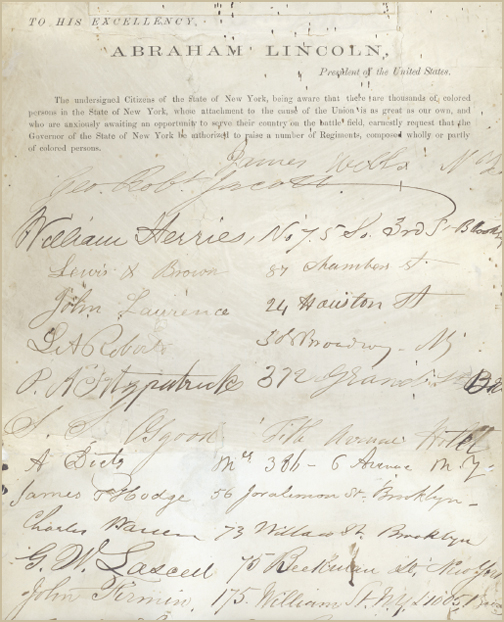
PLATE 24–1
In point of fact, a number of free black patriots had attempted to enlist in the Union army as soon as war broke out the previous spring, but the Lincoln administration, ever fearful that any acknowledgment of racial tolerance might trigger secession movements in the Border States along with political upheaval among Democrats in the North, refused to accept them.
By the time the petition campaign’s principal organizer, J. E. Gardner, gathered his impressive roster of black recruitment advocates, Lincoln’s policies were changing. Slavery had been abolished in the nation’s capital in April. The president’s effort over the following weeks to rally Border State congressmen around a plan to support gradual compensated emancipation had stalled, but Lincoln continued to hope the loyal slave states would adopt it. Freedom for the region’s 432,000 slaves—and the existence of another 129,000 free blacks in Delaware, Kentucky, Maryland, Missouri, and Washington, D.C.—unavoidably suggested a huge new pool of manpower for an army whose needs were expanding faster than white recruitments alone could satisfy. That same month, Congress officially authorized the president to admit black recruits, but Lincoln continued to resist the temptation to accept them into service. Unofficially, however, he offered no objections when Union forces began recruiting blacks to augment troop strength in areas like Kansas and the occupied sections of South Carolina and Louisiana. By the middle of the summer of 1862, following Union setbacks on the Virginia Peninsula, Lincoln had begun to consider emancipating slaves in the Confederacy as a military move. After all, the recalled federal commander George B. McClellan had constantly complained during the campaign that he lacked sufficient troop strength to defeat Robert E. Lee and the Confederates in their defense of Richmond.
Such were the prevailing issues when, on July 20, New Yorkers began signing their names to a preprinted petition addressed “TO HIS EXCELLENCY, ABRAHAM LINCOLN, President of the United States.” The document continued:
The undersigned Citizens of the State of New York, being aware that there are thousands of colored persons in the State of New York, whose attachment to the cause of the Union is as great as our own, and who are anxiously awaiting an opportunity to serve their country on the battle field, earnestly request that the Governor of the State of New York be authorized to raise a number of regiments, composed wholly or partly of colored persons.
One James Wells was the first to sign it, but the final list bore testimony not only to the widespread appeal of arming free blacks but also to the cultural and economic diversity of Manhattan, Brooklyn, Queens, and Westchester. It included a few Germans, a Jewish doctor, and Irish American patriots with monikers like O’Rourke, Flaherty, and O’Shea, as well as local royalty bearing elite names like Whitney, Vanderbilt, Pettigrew, Dodge, and Doubleday. When one William H. Hoogs signed the petition, he could not resist adding a pointed personal note: “For gds sake Abram to put the black to fighting.” Expressing similar impatience, James M. Boyd added his own advice: “There is no good Reason why Negroes should be Exempt.” F. C. Treadwell Sr. made sure to proudly list his age: seventy-one years. Perhaps the most intriguing name on the petition belonged to a crank who signed himself “John Brown of Harper’s Ferry.” Organizers struck it from the list.
At least one of the petitioners was a recognizable antislavery leader: Theodore Tilton edited the weekly newspaper the Independent and had sat on the platform on February 27, 1860, when Lincoln came to New York to deliver his Cooper Union address. He later appreciatively proposed that Lincoln’s tombstone feature this epitaph: “He bound the nation, and unbound the slave.”
Why this gargantuan petition was created in the form of a scroll has never been explained, nor have historians been able to unravel the most perplexing mystery it presents: Why was it never sent as intended to the president? Instead, the White House received a similarly worded variant bearing only seven signatures on a single sheet, among them those of Tilton; the Reverend Henry Ward Beecher, the minister of Brooklyn’s Plymouth Church, where Lincoln had worshipped during his Cooper Union visit; and Fred. B. Perkins, a former Independent staffer and self-described “extreme Radical” who later wrote a book about the creation of Francis Bicknell Carpenter’s painting of Lincoln’s first reading of the Emancipation Proclamation to the Cabinet. Perkins offered a small clue to his enthusiasm for the petition when he later explained that at the time it was circulated, “officers commanding in one and another locality found it a physical impossibility to dispense with the services of the negroes.” African Americans had become “fit material for enlistment…for a long time before the cautious President would determine that the hour was come for ‘proclaiming liberty throughout all the land.’” Why the organizers of the recruitment drive sent a petition bearing seven names rather than a monster demand bearing eight hundred remains difficult to comprehend. Perhaps as an intentional slap, the version that ultimately made its way to the White House omitted the respectful title “His Excellency.”
Meanwhile, Frederick Douglass maintained pressure of his own on Lincoln. Chiding him for evading “his obvious duty,” he complained that “instead of calling the blacks to arms and to liberty he merely authorized the military commanders to use them as laborers, without even promising them their freedom at the end of their term of service to the government, and thus destroyed virtually the very object of the measure.” Lincoln, Douglass concluded, suffered from a fatal “incapacity to do better.”
Unbeknownst to all these critics, just two days after the date listed on the Society’s mega-petition, Abraham Lincoln announced to his Cabinet—but, at their advice, tabled—a plan for an emancipation proclamation in the rebellious states.
For his part, Georgia’s Howell Cobb predicted that the idea of black recruitment was destined to fail. “If slaves will make good soldiers,” he warned, “our whole theory of slavery is wrong.”
By war’s end, the 200,000 or so African American men in arms proved Cobb’s point.