
50

HERE IS THE MOST SUPERFLUOUS, YET AT THE SAME TIME THE MOST significant, signature Abraham Lincoln ever affixed to a document: his approval of the congressional resolution for the Thirteenth Amendment to the U.S. Constitution abolishing slavery everywhere in the United States.
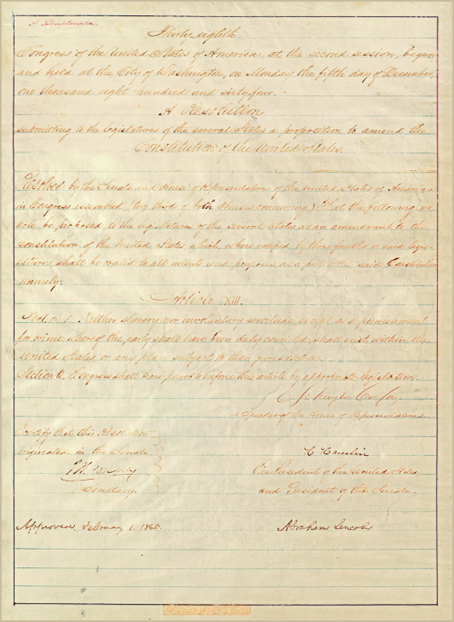
PLATE 50–1
For days, President Lincoln had waited anxiously for the House of Representatives to pass this resolution—waited, counted votes, hosted secret strategy meetings with undecided representatives, made a few unsavory promises, offered raw political deals, and, wherever necessary, twisted arms with a ferocity he rarely exerted on members of the legislature. It was January 1865. No addition to the Constitution had been approved in more than six decades.
Lincoln even rode up one day to the Capitol himself—not to lobby Congress for passage of the amendment, but to join the audience for a specially arranged charity concert. There, he was so touched by a rendition of a maudlin tune called “Your Mission” that he asked the singer Philip Phillips to perform an encore. But not even the sentimental music he loved eased his anxiety about the future of the freedom amendment or diminished his determination to fulfill his mission to end slavery before the lame-duck Congress adjourned.
Months earlier, the House of Representatives had failed by a handful of votes to approve the amendment with the required two-thirds majority. Even its leading advocates thought their best option would be to wait for the next Congress to be seated in late 1865, when the Republican majority would increase significantly. Perhaps Lincoln could advance that timetable slightly by calling a special session as he had done at the commencement of the war on Independence Day 1861. But Lincoln made it clear that he desired—insisted—that the lame-duck House reconsider the measure sooner rather than later. His reasons were complicated but, as usual, eminently sensible from a political and diplomatic point of view. At the time, the president still harbored the hope that he could persuade Confederate leaders to lay down their arms without further casualties on both sides. But he also remained firm that he would not negotiate away the terms of the Emancipation Proclamation—as many in the North now advocated.
To prevent that subject from even coming up at any future conference, Lincoln urgently needed the issue of freedom to be taken away from the executive branch, beyond the fragile legality of a presidential proclamation, and enshrined into law by the legislature and the states. Even as the House resumed debate on the amendment late in January, a delegation of Confederate “peace commissioners” quietly set off for Washington to seek an armistice. Lincoln ordered them detained at Hampton Roads, Virginia. In an effort to keep the initiative secret so it would not anger Republicans and jeopardize the upcoming vote, Lincoln was forced to deny that such a summit was even contemplated. “Honest Abe” skirted the truth that day—but came close enough to get away with it—by assuring Congress that as far as he knew, no rebel peace emissaries were expected in Washington. Left unsaid was the fact that the delegation awaited his arrival in Virginia.
The ploy worked beautifully. This time, a sufficient number of congressmen—some already defeated for reelection and thus emboldened to vote their consciences regardless of political consequences, the braver ones destined for punishing defeats in return for their enlightened votes—changed their minds. On January 31, 1865, with votes to spare, the House of Representatives moved to send the Thirteenth Amendment to the legislatures of all the states of the Union. Now, if three-fourths of them approved it, the amendment would become an official part of the Constitution—a document that had recognized the existence of African slavery for nearly four score years and had accepted no new amendments of any kind since 1804.
The next day, February 1, 1865, a clerk brought a copy of this document to Lincoln’s desk. The president had waited months for this moment. Here at last was the simple but broad language he had wanted: “Neither slavery nor involuntary servitude, except as a punishment for crime…shall exist within the United States.” As he could see, the official notice boasted the signatures of both Speaker of the House Schuyler Colfax and outgoing Vice President Hannibal Hamlin (the latter acting in his capacity as president of the Senate). Almost by instinct, Lincoln took up a pen and added his own endorsement: “Approved, February 1. 1865. Abraham Lincoln.” This is the very copy on lined vellum paper with ruled borders that the president signed and returned to Colfax, on loan to the Historical Society by the collector David Rubenstein. This is the only known signed copy of the joint resolution designated for any of the individual leaders who shepherded the amendment through Congress.
And then Lincoln paid a modest but embarrassing political price. Perhaps he had failed to realize that presidents were not required to sign resolutions on constitutional amendments (although his predecessor had affixed his name to an earlier, un-ratified Thirteenth Amendment that would have enshrined slavery permanently). Conceivably, Lincoln meant only to add his autograph to those of the others. One thing was certain: he was not about to be left out of this great moment—or this priceless document. He had fought too hard for its passage and believed that his name belonged on it, too. Whether or not he was required—or entitled—to approve, he signed his name. On February 7, the U.S. Senate actually passed yet another resolution, complaining that Lincoln’s approval had been “unnecessary.” As one irritated senator explained, presidents simply had “nothing to do” with amendments to the Constitution. Their signatures were not required, and Lincoln’s was apparently not appreciated. Worst of all, the criticism had come from the lips of a senator from Lincoln’s own home state, Illinois.
If this latest vote upset Lincoln, he did not allow it to show. By then, Illinois had done something far more important. It had become the first state in the Union to ratify the Thirteenth Amendment, and just hours after Congress approved it.
Within weeks, as other states rushed to ratify as well, the Thirteenth Amendment became much more than a resolution adopted by Congress. It became a precious object, mass-produced copies of which ordinary Americans were soon able to purchase to display at home. One artist responded to public demand with a composite picture of all the congressmen and senators who had voted for it. Lincoln’s portrait appeared at the very top. In reproductions of the document itself, legal or not, his signature usually appeared on the bottom—just where he had written it out in ink on February 1. From then on, and for all time to come, the name Abraham Lincoln would be associated with the amendment that, once and for all, did away with America’s original sin: slavery.
On the evening of February 1, the same date he boldly signed the resolution, a band of musicians gathered outside on the White House lawn and began to serenade the president. A crowd braved the winter cold to join the throng and shouted for Lincoln to appear. Before long, the large windows on the second floor of the mansion opened, and Lincoln appeared to acknowledge the ovation. He looked exhausted but elated. He had no written text that night; instead, he spoke from the heart. Lincoln thanked the audience for its compliments but insisted that the occasion called for congratulations not to him alone but “to the country and the whole world.”
The Thirteenth Amendment, he declared, had been desperately needed. Passage meant that another terrible “disturbance”—another bloody civil war—would never again tear the country apart over the issue of slavery. Yes, he was also proud of his Emancipation Proclamation, now two years old. The proclamation had begun the important work of ending slavery, but it had not gone far enough. It applied only to areas fighting a war against the Union—and not to loyal Southern slave states like Kentucky, where Lincoln had been born. There, slavery still existed, protected by the Constitution. As Lincoln put it that night, the proclamation alone simply could not “cure…all the evils” of slavery. But the amendment would. It was, in Lincoln’s words, “a King’s cure for all the evils.” To another hearty round of loud applause, he declared: “It winds the whole thing up.”
By then, no vote in Congress, no petty complaint, could ever separate Abraham Lincoln’s name from this grand achievement.
Abraham Lincoln, who had led the war to preserve the Union he loved and then to eradicate the flaw he hated, did not live to see the Thirteenth Amendment to the Constitution ratified by the requisite number of states. By the time Georgia became the twenty-seventh state to approve the amendment in December 1865, finally outlawing slavery everywhere in the re-United States, Lincoln had been dead for eight months.
But old resentments died harder. Kentucky, the state Lincoln proudly called “the place of my nativity,” rejected the amendment a few weeks before the president died. It did not reconsider and approve it until 1976.
Mississippi, the adopted home state of Lincoln’s wartime Confederate counterpart, Jefferson Davis, took longest to ratify. Its approval of the official end of slavery did not come until 1995.