
Relations between the new communist China and the Soviet Union began promisingly with the signing of the Sino-Soviet Treaty in 1950. But the relationship began deteriorating following Khrushchev’s speech in 1956 denouncing Stalin and his reign of terror. In 1958 Chairman Mao launched the Great Leap Forward: a massive drive to increase industrial output to match and exceed that of the West. He ordered farmers to build furnaces and make steel to the detriment of agriculture. The result was catastrophic with over 30 million dying from hunger, history’s worst ever famine the responsibility for which lay not with nature but a single man.
Mao saw himself as the leader of world communism and he viewed with growing disdain what he saw as the Soviet Union’s co-existence with the USA, confirmed for him by Khrushchev’s visit to the USA in 1959. Khrushchev’s subsequent visit to China did not go well and Mao felt slighted that the Soviet leader had gone to the USA first. Khrushchev’s withdrawal of missiles from Cuba was, to Mao, further evidence of his weakness. In turn, the Soviet Union withdrew its aid to China, including support for its development of the atomic bomb. But even without the Soviet Union’s support, China successfully tested its first bomb in 1964 and, three years later, the hydrogen bomb. By 1969, border disputes between the two communist superpowers led to fighting and risked escalating into full-scale and possibly nuclear war.
In 1966, Mao, fearing China’s revolutionary spirit was, like the Soviet Union’s during Khrushchev’s reign, slackening, launched the Cultural Revolution. Militant Chinese youth, the ‘Red Guard’, brandishing Mao’s Pocket Book, ran amok throughout the country destroying anything they considered old and bourgeois, including much of China’s ancient heritage, and terrorizing and killing anyone they deemed counter-revolutionary. Having reaped chaos across the country, and killed over half a million people, Mao reined in his Red Guard, sending them out to work on farm collectives to be ‘re-educated’.
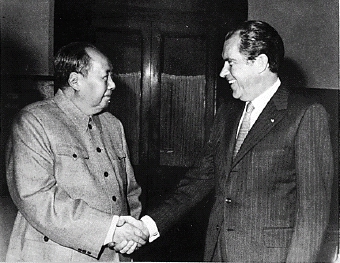
Mao and Nixon, 29 February 1972
White House Photo Office (1969–1974)
The USA, keen to exploit the rift between China and the Soviet Union, made increasingly friendly overtures to the People’s Republic of China. In 1971, an accidental meeting of the US and Chinese table tennis teams resulted, with Mao’s permission, in a championship won convincingly by the Chinese team. From this ‘ping-pong diplomacy’ great advances were made. China was admitted into the UN, the USA ended a twenty-one-year trade embargo on China, and Secretary of State Henry Kissinger’s secret visit to China in 1971 paved the way for President Nixon’s official visit in February 1972, where, among handshakes, toasts and photo-opportunities, Mao and Nixon (pictured above), both concerned about the threat posed by the Soviet Union, found a meeting of minds.
Meanwhile, the Soviet Union’s own improvement of relations with the USA made slow progress. The Strategic Arms Limitation Talks of 1969–72 (SALT I) brought much agreement on the deployment and potential uses of nuclear missiles, together with the signing of the ‘Basic Principles’, which called for peaceful co-existence between the two superpowers. In 1972, Nixon visited Moscow and the following year Brezhnev visited the USA. The Cold War had entered the era of détente.
The Nixon era came to a premature end when a bungled burglary on the Democratic Party’s HQ in Washington DC started a trail that led right to the White House and heart of government. Nixon’s attempt to cover up his involvement only led to his downfall. His claim, which he relied on in his interview with David Frost, that ‘when the president does it, that means it is not illegal’, did not wash. Public opinion put legality above state brinkmanship and in August 1974 Nixon resigned, the only president in US history to do so, to be replaced by Gerald Ford.
The post-war boundaries in eastern Europe had never been officially recognized. In 1969, in a policy named Ostpolitik, Willy Brandt, West Germany’s chancellor, formally accepted East Germany as a state, and in 1970 signed non-aggression pacts with the Soviet Union and Poland. It meant Germany had finally accepted the territory it had lost to Poland during the post-war settlements. In a symbolic visit to Warsaw, Brandt knelt at the memorial to the Warsaw Ghetto and expressed sorrow for Nazi crimes in Poland.
In 1975, détente reached its high mark with the signing of the Helsinki Accords, between the USA and the Soviet Union, together with thirty-three other countries. In the skies above, an American and a Soviet spacecraft symbolically docked together. Helsinki was a triumph for the Soviet Union, for the Accords recognized the existing borders within eastern Europe, an objective the Soviet Union had sought since the end of the war in 1945. But the payback, for Brezhnev, was the agreement to respect human rights and to allow freedom of movement within Europe.