
The appointment of Cardinal Karol Wojtyla as Pope John Paul II in October 1978, Poland’s first pope and the first non-Italian pope for over 450 years, inspired a country dogged by economic shortages and cultural stagnation. On his first visit home as pope, in June 1979, John Paul II fell to his feet and kissed the ground at Warsaw Airport. Throughout his tour of the country (pictured below) he was enthusiastically greeted with chants of ‘We want God, we want God!’ When he returned to the Vatican, the pope had left his people with greater courage and a vital slither of hope.
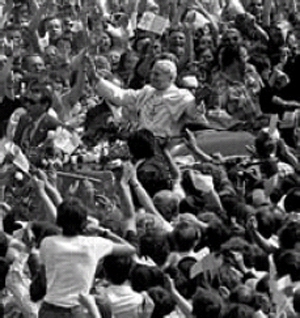
Pope John Paul in Poland, 1979
Price increases in Poland during 1980 led to widespread strikes and the formation of Solidarity, the first independent trade union within the Eastern Bloc. The Polish government, realizing the strength of the movement, allowed its existence and its right to protest if, in return, it recognized the Communist Party and the role of the Soviet Union. The charter was signed by former electrician, Lech Walesa, using a large pen that bore the image of Pope John Paul II.
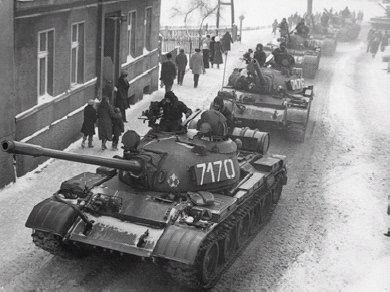
Martial law in Poland, 1981
J.  olnierkiewicz
Centred round the Lenin Shipyards in Gdansk on the Baltic coast, Solidarity demanded better wages, democratic reform and, following the pope’s visit, the right to worship. Moscow, by now embroiled in Afghanistan, refused to be drawn in. But over the following year economic hardship in Poland intensified, Solidarity’s membership expanded and the threat to the establishment grew more acute. Further strikes in December 1981 led, this time, to a crackdown by the Polish government tanks appeared on the streets (pictured above), martial law was imposed, Solidarity banned and its leaders, including Walesa, arrested and its supporters intimidated. On his arrest, Walesa declared, ‘This is the moment of your defeat, you have just put in the last nails in the coffin of communism.’ The crackdown had been wholly Polish the Kremlin had significantly stayed aloof, refusing to intervene as it had done in the past. It was a move away from the Brezhnev Doctrine that insisted on forceful intervention in any attempt to reject socialism within its sphere of influence.