
Acknowledgements
One of the most pleasant parts of finishing a book is to thank those who, in different ways, have contributed to the making of it.
My thanks first of all to the British Academy for a grant which helped me to undertake the initial, exploratory research. I am also grateful to the archivists and staff of the various record repositories where I have worked: the Bundesarchiv in Berlin/Lichterfelde, the Bundesarchiv/Militärarchiv in Freiburg, the Bibliothek für Zeitgeschichte in Stuttgart, the Bayerisches Hauptstaatsarchiv and Staatsarchiv München, the Staatsarchiv Augsburg, the International Tracing Service, Bad Arolsen, the National Archives in London, the Imperial War Museum at Duxford, and the Liddell Hart Centre for Military Archives in King’s College, London. At the Bibliothek für Zeitgeschichte in Stuttgart, part of the Württembergische Landesbibliothek, I had every reason to be most grateful for the help and advice of the library’s director and good friend of mine, Professor Gerhard Hirschfeld, and the head of its archival collections, Dr Irina Renz. Dr Susanne Urban was most helpful in guiding me through the extensive sources related to the death marches – only recently opened to researchers – at the International Tracing Service in Bad Arolsen, where I would also like to express my thanks to the director, M. Jean-Luc Blondel. At Duxford, I benefited greatly from Dr Stephen Walton’s expert assistance in consulting the valuable holdings of German documents. I started, and finished, the research for the book in the incomparable Institut für Zeitgeschichte in Munich, where I have had the good fortune to be a welcome guest for many years, and I would like to express my warmest thanks to the director, Professor Horst Möller, and his colleagues, especially the library and archives staff, who as always dealt with my many requests with unfailing courtesy and friendliness.
Professor Otto Dov Kulka (Jerusalem), a highly esteemed colleague and friend with whom I have shared a lengthy and fruitful correspondence over many years, first pointed me in the direction of the records at Bad Arolsen. Beyond that, as ever I have been extremely grateful for his interest in my work, and for his valuable suggestions. Laurence Rees, good friend and brilliant producer of television documentaries, was kind enough to make available to me relevant transcripts of interviews, kept in the BBC Archives in London, from one of the series on which we collaborated, offered excellent advice, and was as always stimulating company, cheerfully helpful and most encouraging.
Numerous other friends and colleagues also helped, sometimes perhaps without being aware of how helpful they had been. Among them, I owe thanks to Professor Daniel Blatman (Jerusalem), for answering a number of queries about the death marches, and for related material which he kindly sent me. Dr Andreas Kunz, of the Bundesarchiv/Militärarchiv in Freiburg, gave me some valuable tips on relevant archival holdings on my first visit there in connection with this project. Dr Heinrich Schwendemann of the University of Freiburg most generously went to great lengths to send me documents related to the French occupation of south-west Germany in 1945 and other relevant material that was not easy for me to access. Other colleagues who also supplied me with documents, papers or other materials, provided answers to my questions, or made me think more clearly about what I was attempting include Professor John Breuilly, Dr Michael Buddrus, Mr George Burton, Dr Simone Erpel, Dr Wolfgang Holl, Dr Holger Impekoven, Professor Tim Kirk, Dr Michael Kloft, Dr Alexander Korb, Mr Michael D. Miller, Professor Bob Moore (who went to undue trouble to send me a batch of documents on a specific point related to the Netherlands, his chief area of expertise), Professor Jonathan Steinberg, Dr Klaus Wiegrefe and Dr Benjamin Ziemann. I am glad of the opportunity to extend my warm thanks to all and apologize to anyone whom I have inadvertently omitted.
As I was feeling my way into the project, I benefited enormously, as always, from lengthy discussions with long-standing German friends, Professor Hans Mommsen (Feldafing), Professor Norbert Frei (Jena), Dr Hermann Graml and Dr Elke Fröhlich (Munich), all of whom helped me greatly in shaping my ideas. I am most grateful to each of them.
Two scholars and friends I want to thank especially. Dr Jürgen Förster, a fine historian and notable expert on the Wehrmacht at the Bundesarchiv/Militärarchiv in Freiburg, answered numerous queries, directed me to important records, and, not least, read and commented on the completed typescript. Dr Nick Stargardt, Magdalen College, Oxford, who is currently working on what will be an important study of German society during the war, has been full of penetrating insights throughout. He also took the time and trouble to read the entire typescript and make numerous valuable suggestions. I am most grateful to both. Of course it needs to be added, as always, that responsibility for any remaining errors is my own.
An important debt of gratitude for their valuable suggestions on the typescript is also owing to splendid editors at Penguin – Simon Winder in London, and Laura Stickney in New York – while Andrew Wylie has been, as before, a wonderfully supportive agent. I would also like to thank all at Penguin who have helped to produce the book, Elizabeth Stratford for her excellent copy-editing and Cecilia Mackay for researching the photographs.
Finally, there are the personal debts of gratitude. Traude and Uli Spät have, as on so many occasions in the past, been extraordinarily generous in their hospitality during my stays in Munich, and taken a keen interest in my work over many years. Throughout this project Beverley Eaton, my long-serving secretary, has continued to provide excellent support, even now that I have left the University of Sheffield, and I am particularly grateful to her for undertaking so efficiently the laborious task of compiling the List of Works Cited. Last of all, my family remain the foundation on which all is built. My thanks and love to Betty, to David, Katie, Joe and Ella, and to Stephen, Becky, Sophie, Olivia and now Henry – the latest wonderful addition to the family roster.
Ian Kershaw
Manchester, November 2010
Preface
As disastrous defeat loomed in early 1945, Germans were sometimes heard to say they would prefer ‘an end with horror, to a horror without end’. An ‘end with horror’ was certainly what they experienced, in ways and dimensions unprecedented in history. The end brought destruction and human loss on an immense scale. Much of this could have been avoided had Germany been prepared to bow to Allied terms. The refusal to contemplate capitulation before May 1945 was, therefore, for the Reich and the Nazi regime not just destructive, but also self-destructive.
A country defeated in war almost always at some point seeks terms. Self-destruction by continuing to fight on to the last, down to almost total devastation and complete enemy occupation, is extremely rare. Yet that is what the Germans did in 1945. Why? It is tempting to give a simple answer: their leader, Hitler, persistently refused to entertain any thought of surrender, so there was no option but to fight on. But this simply poses other questions. Why were Hitler’s self-destructive orders still obeyed? What mechanisms of rule enabled him to determine Germany’s fate when it was obvious to all with eyes to see that the war was lost and the country was being utterly laid waste? How far were Germans prepared to support Hitler to the end, even though they knew he was driving the country to destruction? Were they in fact still giving him their willing backing? Or were they merely terrorized into doing so? How and why did the armed forces continue fighting and the government machine keep on functioning to the end? What alternatives did Germans, civilians and soldiers, have in the last phase of the war? These and other questions soon arise, then, from what seems at first to be a straightforward query inviting a simple answer. They can only be tackled by examining structures of rule and mentalities as the catastrophe inexorably engulfed Germany in 1944–5. That is what this book seeks to do.
I first thought of writing such a book because, to my surprise, I couldn’t think of another book which had tried to do what I had in mind. There are, of course, libraries of books about the end of the war, written from different perspectives, and widely varying in quality. There are important studies of the top Nazi leaders and, increasingly, of some of the regional chieftains, the Gauleiter.1 Biographies exist also for many of the leading military figures.2 There are literally thousands of accounts of events in the final climactic weeks of the Third Reich, both at the front and, it sometimes seems, for practically every town and village in Germany. Many local studies give graphic – often horrific – descriptions of the fate of individual townships as the unstoppable advance of the Allied and Soviet military juggernauts enveloped them.3 Memoirs of experiences at the front or in the homeland, in cities pounded by Allied bombs, or facing the ordeals of flight and homelessness, abound. Detailed, often localized, military histories or accounts of specific Wehrmacht units or major battles are also commonplace, while the battle for Berlin, in particular, has naturally been the focus of numerous works.4 The sixth volume of the German Democratic Republic’s official history of the war, produced in the 1980s, despite its obvious ideological slant, provides a valuable attempt at a comprehensive military history, not confined to events on the front.5 And more recently, the last volumes of the Federal Republic’s own outstanding official military history series offer excellent detailed studies of the Wehrmacht, often stretching far beyond operational history.6 Even so, these and other fine works on military history7 touch on only some – if important – aspects of what I thought was necessary to answer the questions I wanted to tackle.
My initial intention had been to approach the problem through exploring the structures of rule in Nazi Germany in this last phase. It seemed to me that the major structural histories of the Third Reich tended to peter out largely by late 1944, dealing quite superficially with the final months of the regime.8 This applies also to studies of the Nazi Party and its affiliates.9 It rapidly became plain to me, however, that a mere structural analysis would not be enough, and that my examination had to be extended to the mentalities – at different levels – that underpinned the continued functioning of the regime. A comprehensive study of German mentalities in the last months has not yet been attempted.10 Reconstructing them has to be done, therefore, from fragments.
I have tried to take into account the mentalities of rulers and ruled, of Nazi leaders and lowly members of the civilian population, of generals and ordinary soldiers, and on both the eastern and the western fronts. It is a wide canvas and I have to paint with a broad brush. I can, of course, present only selective examples to illustrate the spectrum of attitudes. For not least of the problems in trying to generalize about mentalities is that during its final months, and at a highly accelerated pace in its last weeks, the Nazi regime was splintering as well as shrinking. Germany was a big country and while, obviously, the extreme pressures of war afflicted all of its regions, they did not do so at the same time, or in exactly the same ways. Experiences of the civilian population in the different parts of the country and those of soldiers in different theatres of war naturally varied. I have tried to mirror the differing mentalities rather than resort to superficial generalizations.
The book mainly relates to what we might call the majority German population. There were, however, others whose experiences, themselves not reducible to easy generalization, were quite separate from those of most Germans since they did not and could not belong to mainstream German society. The fate of the horribly persecuted pariah groups in the clutches of the Nazis forms a further important part of the story of the continued functioning of the Nazi regime, amid the inexorable collapse and gathering doom. For, unenviable in the extreme as the situation was for most Germans, for the regime’s racial and political enemies, ever more exposed to vicious retribution as it imploded, the murderous last months were a time of barely imaginable horror. Even when it was faltering and failing in every other respect, the Nazi regime managed to terrorize, kill and destroy to the last.
The history of the Nazi regime in its final months is a history of disintegration. In trying to tackle the questions I posed to myself, the main problem of method that I faced was the daunting one of trying to blend the varied facets of the fall of the Third Reich into a single history. It amounts to trying to write an integrated history of disintegration.
The only convincing way to attempt this, in my view, had to be through a narrative approach – though thematically structured within each chapter – that covered the last months of the regime. One logical place to begin would have been in June 1944, as Germany was militarily beset in the west by the consolidation of the successful Allied landings in Normandy, and in the east by the devastating breakthrough of the Red Army. However, I chose to start with the aftermath of the attempt on Hitler’s life in July 1944, because this marked a significant internal caesura for the Nazi regime. From there I look in successive chapters at the German reactions to the Wehrmacht’s collapse in the west in September, the first incursion of the Red Army onto German soil the following month, the hopes raised then promptly dashed by the Ardennes offensive in December, the catastrophe in the eastern provinces as they fell to the Soviets in January, the sharp escalation of terror at home in February, the crumbling of the regime in March, the last desperate attempts to hold out – accompanied by uncontrolled violence towards German citizens and, especially, perceived enemies of the regime – in April, and the efforts of the Dönitz regime even in early May to fight on until troops in the east could be brought westwards. The book ends at the German capitulation on 8 May 1945 and the subsequent arrest of members of the Dönitz administration.
Only through a narrative approach, I felt, could the dynamic – and the drama – of the dying phase of the regime be captured, as it inexorably fell apart in the wake of gathering military defeat. Only this way, too, I thought, was it possible to witness the ever despairing, but nevertheless for months partially effective, attempts to stave off the inevitable, the improvisation and scraping of the barrel that allowed the system to continue to function, the escalating brutality that ultimately ran amok, and the imploding self-destructiveness of Nazi actions. Some important elements of the story necessarily recur in more than one chapter. Bombing of cities, desertion of soldiers, death marches of concentration camp prisoners, the evacuation of civilian populations, collapsing morale, the ramping up of internal repression, the increasingly desperate propaganda ploys, are, for example, not confined to a single episode. But the narrative structure is important in showing how devastation and horror, if present throughout, intensified over the passage of time in these months. I have tried, consequently, to pay close attention to chronology and built up the picture essentially through going back to archival sources, including plentiful use of contemporary diaries and letters.
It is important to emphasize what this book is not. It is not a military history, so I don’t describe what took place on the battlefield in any detail and provide only a brief overview of developments on the fronts as a backcloth to the questions that are central to the book. Nor does my book attempt to provide a history of Allied planning, or of the stages of the Allied conquest.11 Rather, it views the war solely through German eyes in the attempt to understand better how and why the Nazi regime could hold out for so long. Finally, the book does not deal with the important question of continuities beyond the capitulation and into the occupation period, or the behaviour of the German population once a territory was occupied before the end of the war.12
It is impossible to recapture the reality of what it must have been like in those awful months, how ordinary people survived through extraordinary – and horrifying – circumstances. And, though I have worked on the Third Reich for many years, I found it hard, as well, to grasp fully the sheer extent of the suffering and death in this climax of the war. Suffering should not and cannot be reduced to bare numbers of casualties. Even so, simply the thought that the losses (dead, wounded, missing and captured) in the Wehrmacht – not counting those of the western Allies and the Red Army – ran at about 350,000 men per month in the last phase of the war itself gives a sense of the absolute slaughter on the fronts, far in excess of that of the First World War. Within Germany, too, death was omnipresent. Most of the half a million or so civilian victims of Allied bombing were caused by air raids on German cities in the very last months of the war. In these same months, hundreds of thousands of refugees lost their lives fleeing from the path of the Red Army. Not least, the terrible death marches of concentration camp internees, most of them taking place between January and April 1945, and accompanying atrocities left an estimated quarter of a million dead through exposure, malnutrition, exhaustion and random slaughter. The extent to which Germany had become an immense charnel-house in the last months of the Third Reich is barely imaginable.
At least by the end of writing the book, I did think, however, that I had come closer to an answer to the question I had set myself: how and why, given the scale of the mounting calamity, Hitler’s regime could function – if, naturally, with diminishing effectiveness – for so long. If others think that after reading this book they, too, understand that better, I shall be well satisfied.
The following list includes only those German political and military leaders who figure prominently in the text in some way, and is confined to indicating their positions or ranks in the months covered in the book, July 1944–May 1945.
POLITICAL LEADERSHIP
Reich
BORMANN, MARTIN (1900–1945): head of the Party Chancellery; Secretary to Hitler.
GOEBBELS, JOSEPH (1897–1945): Reich Minister of People’s Enlightenment and Propaganda; Reich Plenipotentary for Total War from July 1944.
GÖRING, HERMANN, Reich Marshal (1893–1946): designated successor to Hitler; head of the Four-Year Plan; Chairman of the Reich Defence Council; Commander-in-Chief of the Luftwaffe.
HIMMLER, HEINRICH (1900–1945): Reichsführer-SS; head of the German Police; Reich Commissar for the Strengthening of German Nationhood; Reich Minister of the Interior and Plenipotentiary for Reich Administration; Commander-in-Chief of the Replacement Army from July 1944.
HITLER, ADOLF (1889–1945): Leader; head of state; head of the Reich government; head of the Nazi Party; supreme commander of the Wehrmacht; Commander-in-Chief of the Army.
KALTENBRUNNER, ERNST (1903–46): SS-Obergruppenführer; head of the Security Police and the Security Service.
KRITZINGER, WILHELM (1890–1947): State Secretary in the Reich Chancellery.
LAMMERS, HANS-HEINRICH (1879–1962): Reich Minister and head of the Reich Chancellery.
LEY, ROBERT (1890–1945): Reich Organization Leader of the Nazi Party; leader of the German Labour Front.
RIBBENTROP, JOACHIM VON (1893–1946): Reich Foreign Minister.
SCHWERIN VON KROSIGK, LUTZ GRAF (1887–1977): Reich Finance Minister; First Minister and Reich Foreign Minister in the Dönitz government.
SEYß-INQUART, ARTHUR (1892–1946): Reich Commissar for the Occupied Territories of the Netherlands.
SPEER, ALBERT (1905–81): Reich Minister for Armaments and War Production; Reich Minister of Industry and Production in the Dönitz government.
STUCKART, WILHELM (1902–53): SS-Obergruppenführer; State Secretary in the Reich Ministry of the Interior; Reich Minister of the Interior in the Dönitz government.
Provincial
GIESLER, PAUL (1895–1945): Gauleiter of Munich-Upper Bavaria.
GREISER, ARTHUR (1897–1946): Gauleiter of Reichsgau Wartheland.
GROHÉ, JOSEF (1902–88): Gauleiter of Cologne-Aachen.
HANKE, KARL (1903–45): Gauleiter of Lower Silesia.
HOFER, FRANZ (1902–75): Gauleiter of the Tyrol.
HOLZ, KARL (1895–1945): Gauleiter of Franconia.
KOCH, ERICH (1896–1986): Gauleiter of East Prussia.
RUCKDESCHEL, LUDWIG (1907–86): Gauleiter of Bayreuth, April–May 1945.
WÄCHTLER, FRITZ (1891–1945): Gauleiter of Bayreuth until April 1945.
WAHL, KARL (1892–1981): Gauleiter of Swabia.
MILITARY LEADERSHIP
BLASKOWITZ, JOHANNES, Colonel-General (1883–1948): Commander-in-Chief of Army Group G, May–September 1944, then December 1944–January 1945; Commander-in-Chief of Army Group H, January–April 1945.
DIETRICH, SEPP, SS-Oberstgruppenführer and Colonel-General of the Waffen-SS (1892–1966): Commander of the 6th SS-Panzer Army, October 1944–May 1945.
DÖNITZ, KARL, Grand-Admiral (1891–1980): Commander-in-Chief of the Navy; Reich President following Hitler’s death.
GUDERIAN, HEINZ, Colonel-General (1888–1954): Chief of the Army General Staff, July 1944–March 1945
HARPE, JOSEF, Colonel-General (1887–1968): Commander-in-Chief of Army Group A, September 1944–January 1945; Commander of the 5th Panzer Army, March–April 1945.
HAUSSER, PAUL, SS-Oberstgruppenführer and Colonel-General of the Waffen-SS (1880–1972): Commander-in-Chief of Army Group G, January–April 1945.
HEINRICI, GOTTHARD, Colonel-General (1886–1971): Commander of the 1st Panzer Army, August 1944–March 1945; Commander-in-Chief of Army Group Vistula, March–April 1945.
HOßBACH, FRIEDRICH, General (1894–1980): Commander of the 4th Army, July 1944–January 1945.
JODL, ALFRED, Colonel-General (1890–1946): Chief of the Wehrmacht Operations Staff in the High Command of the Wehrmacht.
KEITEL, WILHELM, Field-Marshal (1882–1946): head of the High Command of the Wehrmacht.
KESSELRING, ALBERT, Field-Marshal (1885–1960): Commander-in-Chief South to March 1945; Commander-in-Chief West, March–April 1945.
MANTEUFFEL, H1 VON, General of the Panzer Troops (1897–1978): Commander of the 5th Panzer Army, September 1944–March 1945; Commander of the 3rd Panzer Army, March–May 1945.
MODEL, WALTER, Field-Marshal (1891–1945): Commander-in-Chief Army Group Centre, June–August 1944; Commander-in-Chief West, August–September 1944; Commander-in-Chief of Army Group B, September 1944–April 1945.
REINHARDT, GEORG-HANS, Colonel-General (1887–1963): Commander-in-Chief Army Group Centre, August 1944–January 1945.
RENDULIĆ, LOTHAR, Colonel-General (1887–1971): Commander-in-Chief Army Group Courland, January 1945, March–April 1945; Commander-in-Chief Army Group North, January–March 1945; Commander-in-Chief Army Group South (renamed ‘Ostmark’ at end of April), April–May 1945.
RUNDSTEDT, GERD VON, Field-Marshal (1875–1953): Commander-in-Chief West, September 1944–March 1945.
SCHÖRNER, FERDINAND, Colonel-General, from 5 April 1945 Field-Marshal (1892–1973): Commander-in-Chief Army Group North, July 1944–January 1945; Commander-in-Chief Army Group Centre January–May 1945.
VIETINGHOFF-Scheel, HEINRICH VON, Colonel-General (1887–1952): Commander-in-Chief Army Group Courland, January–March 1945; Commander-in-Chief South, March–May 1945.
WOLFF, KARL, SS-Obergruppenführer, General of the Waffen-SS (1900–84): from July 1944 Plenipotentiary General of the German Wehrmacht in Italy.
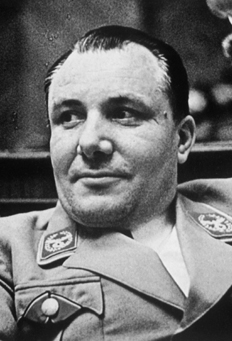

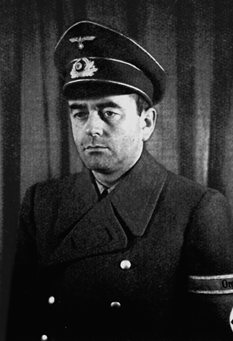
The ‘quadrumvirate’ of Nazi grandees: (above) Martin Bormann (left), Heinrich Himmler (right); (below) Joseph Goebbels (left), Albert Speer (right).


Captured German prisoners near Falaise in early September 1944.

German civilians leaving Aachen on 19 October 1944, two days before the city fell to the Americans.


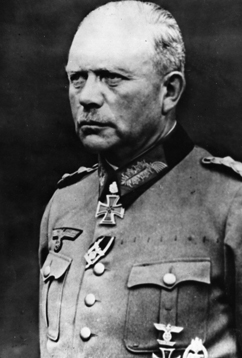
Military leaders: (above) Wilhelm Keitel (left), Alfred Jodl (right); (below) Heinz Guderian (left), Karl Dönitz (right).

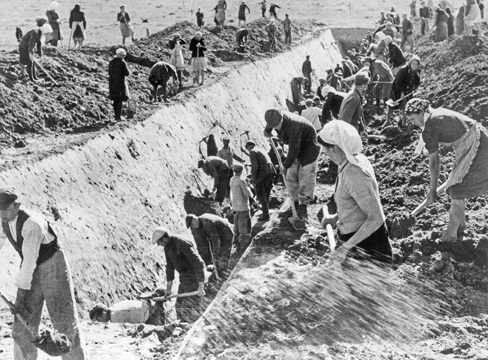
The rural population digging a defensive trench near Tilsit in September 1944.

Erich Koch, Gauleiter of East Prussia, inspects food provisions in his province, August 1944.

German soldiers viewing corpses in Nemmersdorf (East Prussia) following Soviet atrocities during the Red Army’s incursion in October 1944.
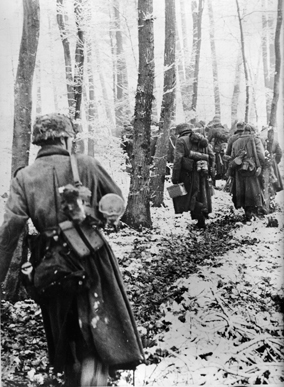
After initial successes, the Germans are forced to retreat during the Ardennes offensive in December 1944.


Front commanders: (above) Walter Model (left), Georg-Hans Reinhardt (right); (below) Ferdinand Schörner (left), Gotthard Heinrici (right).

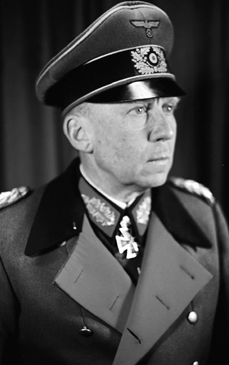

Ill-equipped Volkssturm men on the eastern front in October 1944.
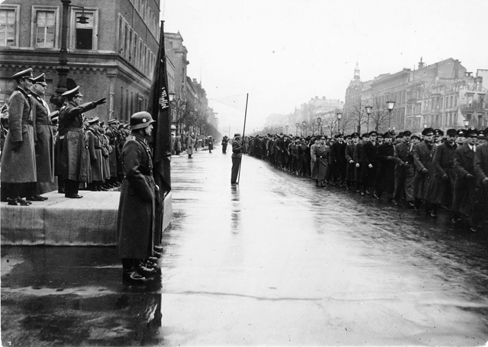
Volkssturm men march past Goebbels in Berlin on 12 November 1944.


Four prominent Gauleiter: (above left) Arthur Greiser (Wartheland), (right) Josef Grohé (Cologne-Aachen); (below left) Karl Hanke (Lower Silesia), (right) Karl Holz (Franconia).


Refugees crossing the frozen Frisches Haff in East Prussia in February 1945.

‘Somewhere in East Prussia’. An abandoned wagon in icy conditions after the Soviet offensive in January 1945.
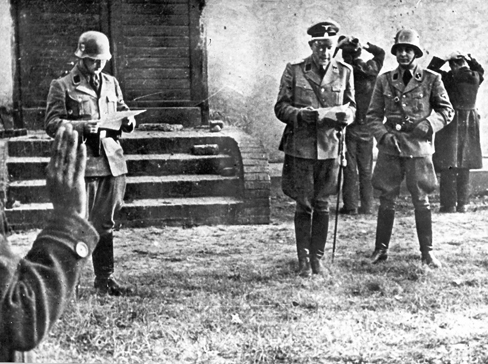
The verdict is read in a summary court martial.

The corpse of a soldier is left hanging in Vienna, April 1945. The sign round his neck accuses him of helping the Bolsheviks.

An overcrowded ship carries away refugees from Pillau in East Prussia, March 1945.

Death and devastation through Allied bombing: (above) Dresden, (below) Nuremberg.

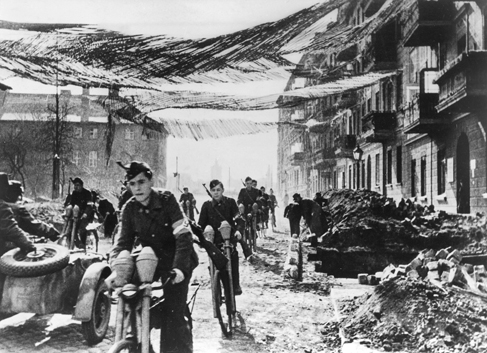
Young Germans near Frankfurt an der Oder, armed with the ‘Panzerfaust’ and cycling off to the front, February 1945.

Passers-by in Berlin glance at the propaganda placard: ‘Our walls break, but not our hearts’.

Prisoners in Buchenwald concentration camp immediately after its liberation by American troops in April 1945.

Prisoners on a death march from Dachau in late April 1945.

Germans in Königsberg surrender to the Red Army on 9 April 1945 at the fall of the beleaguered East Prussian city.

White flags fly from houses in Worms as the Americans take the Palatinate town in late March 1945.
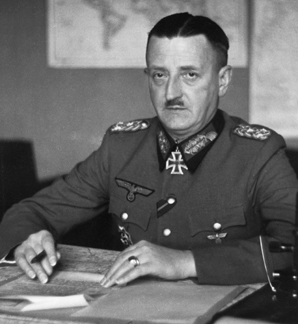

General Heinrich von Vietinghoff (left) and General of the Waffen-SS Karl Wolff (right) were instrumental in the German surrender in Italy on 29 April 1945 – the only surrender to precede Hitler’s death.
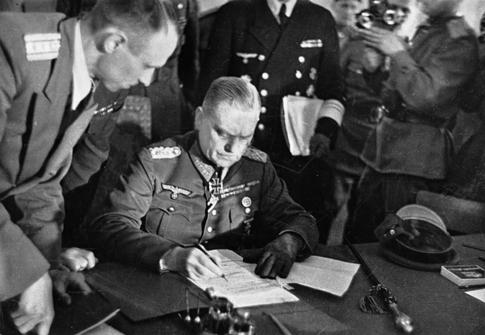
Field-Marshal Wilhelm Keitel signs the complete German capitulation at Karlshorst, near Berlin, on 8 May 1945.

The End: an angel high on the spire of the minster in Freiburg surveys the legacy of destruction left by the war.