
A Brief Note on Spelling
Vietnamese words, save for those clearly borrowed from other languages (for instance, oto, or “automobile”) and a few compound-word phrases, have one syllable. Thus it is not Vietnam but Viet Nam (pronounced Vyet Nam), not Hanoi but Ha Noi, not Danang but Da Nang, not Saigon but Sai Gon—and this is not even to include the various diacritical markings that indicate the tonal emphasis of each vowel. Our familiar Western corruptions occurred during the first years of U.S. involvement in Viet Nam, when newspaper headline writers smashed together alien place names in order to conserve front-page acreage. For Vietnam's most recognizable cities I have continued this somewhat embarrassing tradition and used the compounded form. For less well known cities, such as Nha Trang and Da Lat, and other Vietnamese terms, such as Viet Cong and Viet Minh, I have opted for usage appropriate to their language of origin.
ONE
The waters returned and covered the chariots and the chariot drivers, the entire army of Pharaoh that had followed them into the sea; not one of them remained.
—EXODUS 14:28
I
It would have been spring. The neighborhood yards still yellow and concrete hard, the side panels of the cars you pass on the way home from work spattered with arcing crusts of road salt, the big oaks and elms that loom along Lake Shore Drive throwing down long pale rows of shadow. These trees are covered with stony gray bark, their naked branches black lightning against a deepening indigo sky. Everywhere winter's grim spell still holds.
A midwestern spring at the Forty-sixth Parallel is a different sort of season than the spring one finds even five degrees lower, in Milwaukee, say, or Chicago. In Michigan's Upper Peninsula spring never truly arrives. It passes through for a few weeks, shrinks and smoothens the filthy fringes of snow that sit packed against the curbs, finishes with a fine icy sheen the misshapen islets of snow out in the yard that stubbornly refuse to melt, but spring does not arrive. It does not come. One receives only the suggestion of spring here, followed by a hot, windy summer. You are thinking of this as you circle around your huge yard (which takes up half the block), noting its lumpy archipelago of remaining snow, before finally pulling into the driveway. There is something exhausted about the way your station wagon's engine sputters and dies. For a moment you sit there in the car looking at the remaining mounds of snow. On bright days, when the sunlight angles down on the ice crystals just right, the reflection can be difficult to look at. But on this cloudy late afternoon there is but little light. Your eyes ache anyway, the silvery imminence of evening hovering above you. Where is spring? you think, now standing in your driveway, gazing upon your house, its coldly reflective windows, its closed doors. Today you have left work early and driven the long way home. It is 5 p.m. on April 29,1975.
The lights come on in the empty kitchen. You keep your hand on the circular plastic knob, fiddling with and turning the adjuster. Darker, lighter, darker. You cannot find the proper setting, going from break-room bright to dinner-party mild to opium-den dim at the speed of light. But what is the speed of darkness? The cabinetry is all chocolaty wood, the countertops a hard Formica blaze of orange, a room that seems dark even when it is blazingly illumed. At last (fuck it) you switch off the overhead light, the sound of your own heart more audible while you stand in charcoal shadow.
You stare at the kitchen table. Two ashtrays, one on each end of the table, form twin pyres of your wife Muff's lipsticked butts. An empty baby bottle, its sides still cloudy with clinging milk. A tall red, white, and blue can of Budweiser, its top-popped aperture keyhole-shaped. You know it is urine warm and half full before you even touch it. Your live-in younger brother Paul's, no doubt. (Muff claims to see Paul only when he is “drunk, sleeping, or hung over.” He is twenty-four. What can you do?) The lazy Susan and its cargo of gift-shop jetsam, souvenirs from trips you no longer remember: expensive glass salt and pepper shakers Muff had to have, the floral-patterned porcelain sugar dish, the toothpick holder shaped like a rotund little monk, the plastic tray freighted with a yellow slab of room-temperature margarine. A neatly planed pile of mail awaits you on the table's corner. All of it adding up to life, one little corner in a seven-year repository of marriage. You do not even look through the mail.
When I asked you what this time was like, you said only, “I was a young guy, working hard. Always pissed off. Always.” You were a trust officer at the First National Bank, managing other people's money. They save up here in the woods. From the millionaire widows living in fireplace-heated homes to the couples sitting on $700,000 portfolios while driving rusty Ford pickups, you were learning all about the strange camouflage and various neuroses of rural wealth. What made many of your customers’ mattress stuffing so frustrating was that you were broke. Every morning that you parked your used Chevy station wagon beside your boss's long cream Cadillac reminded you of this. The Bissells, of course, were reputed around town to have money—how faces in Escan-aba changed when the name Bissell came flying back at them!—but over the last seven years you had watched it all go up in the low fires of your various new responsibilities.
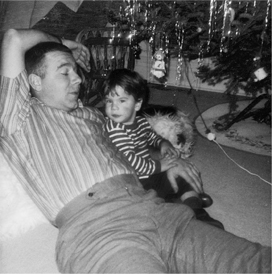
JOHN AND JOHNO BISSELL
Broke. Such a hard, simple, declarative word. You dreamed of making $20,000 a year, three times and more your current salary. Twenty thousand dollars: the number itself was talismanic, as beautiful as a finish line. It would bandage these seven years of hemorrhaging marital wounds and keep them stanched forever. Because now things were not well. “Your mother,” you told me once, without bitterness, “wanted a better life.” Everything at this time felt to you cold and dead, as though your touch itself were warmth-draining, death-contagious. Every room of the house was dark and angry that spring, unwarmed and unloved, but there were few places for blame to gather. Nor was there any place to hide.
You walk through your family's ancestral seven-bedroom house looking for your wife and sons, a journey of several minutes. To many visitors, the Bissell house, one of Escanaba's biggest, always felt less like a home than a series of pastel caverns linked by massively arched throughways. You drift across the canary-wallpapered dining room (the chandelier so huge and gaudy it was vaguely embarrassing to pass beneath it), the green-carpeted living room (most of its antique furniture having not known human weight in years), and pass into the final and most spacious—the television room. The Bissell house's placement on the littoral edge of town allows the television room's four massive bay windows to look out onto Ludington Park, beyond which spans the seascape tundra of still-frozen Lake Michigan. Today the lake is a surface storm of twirling snow devils. As expected, here you find Muff and your sons. Your little sister Alicia is upstairs, in her room, listening to the Monkees (she still refuses to acknowledge that they did not play their instruments), while your brother Paul, you can guess, is out with friends, most likely attached to a keg hose.
Muff is watching television with your son Johno, who at five resembles nothing so much as a pudgy, thin-haired Buddha. Muff looks beautiful, of course. How could she not? She once bested her classmate Farrah Fawcett in a junior high beauty contest in Corpus Christi, Texas. The hair your wife has bleached platinum blond every week for the last decade achieves gravity-defying proportions, a hair-spray skyscraper. She wears slightly too much powder blue eye shadow that is carefully matched to the color of her thin turtleneck sweater. She holds Johno on her knee, lightly bouncing him—though he is too big for this—her long hard white fingernails mildly alarming whenever she pushes his hair across his forehead. She looks at you and nods hello, already expecting the worst.
At the room's far edge, across a bay of orange carpet, almost swallowed by her recliner, Aunt Grace sits knitting. She is white-haired and thick-calved, wearing big nunnish brown shoes, a solid blue dress, and a red shawl so tasseled and incomplete-looking your initial thought is that she is knitting it upon her own shoulders. You know that amid the needles’ steady clicking Grace is waiting for the inevitable flare of discord between you and Muff, whereupon she will quietly stand to leave and, later in the evening, offer neutral comfort to you both. With age comes wisdom: the sort of bromide one hears all the time, even as less and less clear evidence seems to support it. Grace is welcome proof that—at least sometimes, in some people—with age comes wisdom. But Grace is not much help with what vexes you today. Her own husband Herb died of a heart attack in his forties, still wracked by the horrors of World War I's battlefields. Herb never spoke of the war to Grace, and thus, in your mind, she never truly knew the man she loved. War, then. Always war. In regard to the war, your war, you could very much use some human wisdom right now. You are thirty-three years old, and the events of the last few weeks have not made much sense. Or rather, the events have made sense, but nothing else has.
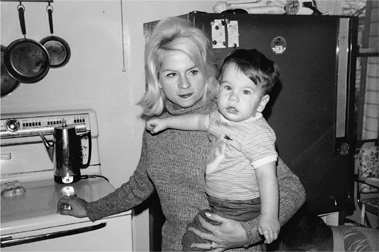
MUFF AND JOHNO
Vietnam is a dream to you. It has been eight years since you took in its scents, felt its Asian sunlight on your white skin. The war comes to you now not as whole memory but in pieces and fragments as ragged and drifty as ash. Up half the night, turning in the wet-flannel heat, checking on sentries, checking on your gunner placements. Up early in the morning for patrols, still hot. Or sleeping all day for night patrols, hot again, these night patrols the worst, always the worst, feeling like four-hour-long panic attacks enacted within a nightmare. Your clothes rotting, your feet rotting. The ankle sores that never healed and remained as bright and wet as fresh raspberries. The sweat that was like another layer of clothing. Your smell, that deep swampy smell of your body. The mold you picked from between your toes and flicked lightheartedly at whoever was nearest. The smell of twenty Marines’ unwashed asses and unbrushed teeth all around you, the olfactory orchestra of the jungle itself, the warm, buttery smell of a cleaned Ml4, the firecracker stench of gunfire. You still smell it, sometimes, when you wake up sweating, Muff having been driven to the couch hours before by your kicking. You smell it when the remnant of the malaria banished to the depths of your cells catches you with a chill that almost takes you to your knees, when your limbs thrum with a ghostly soreness, when the shrapnel wound on your neck glows with a sudden inner fire.
You left Vietnam in late 1966, a time when the word “quagmire” was just abandoning Rogefs as its most natural habitat. The war then was still tenable, winnable—or so it was thought. But now it was la fin de la guerre, the real fin, not the “peace with honor” that extricated the Americans in 1973, only two years ago, but the final campaign. A headline you saw only seven days ago: HOPE THINS FOR MILLIONS ADRIFT ACROSS INDOCHINA. Your hope has thinned, too, and your very body aches of its thinning. You feel incomplete, as though within you some crucial girder of emotion has gone missing. That part of you is still in Vietnam. That part never left.
II
In late March 1975, the Saigon newspaper Chinh Luan published an article, now known as the “Fare Thee Well” dispatch, that had been written in the midst of fierce combat between the armies of North and South Vietnam as South Vietnam was unraveling. The author was the South Vietnamese war correspondent Nguyen Dinh Tu. Through “the outstanding initiative and very strong leadership of the United States,” Tu wrote, “the Paris Peace Agreement was signed on the 27th of January 1973 to international applause of our friends, especially in the United States, leading to ‘Peace with Honor’ in accord with the desires of former President Nixon, the present Secretary of State Henry Kissinger, Congress, and the entire American people. The fact that these friends have been able to return to the warmth of their families is something for which I personally, with all my heart and soul, rejoice.” But Tu went on:
Now, after two years of “Peace with Honor [,]” through the reports of newspapers, wire services, radio, and television all over the world, those friends are now observing the disintegration that is spreading daily across my homeland. Thousands of my country's soldiers have continued to fall throughout the two years of “Peace with Honor.” Thousands of my people, including many children, have continued to die throughout these two years of “Peace with Honor.” Hundreds of thousands of my people are homeless, hungry, cold; and furthermore and even more important, without hope, without even the dream of a life worth living for these two years of “Peace with Honor,” and for the coming days, the coming months, and perhaps even the coming years. And everyone in Vietnam, including me, my friends, we now ask ourselves, how long will the “Peace with Honor” continue, and where will it lead? … [A] 11 of my people, and I personally, have understood that our friends, especially our American friends, the American Congress and the American people … look upon the war in Vietnam from which they have drawn so far away, as if it were a nightmare that must be pushed completely away from their minds in order for them to live peacefully and happily in the warmth of their families. No one, in psychological terms or any other terms, can continue forever to retain the affection and assistance of the person next to them, be that a single person, a friendly country, or an ally in a desperate situation. The soldiers of my country, my people (please understand “people” here to mean the overwhelming majority, the poor, the war victims, and not the rich and fat minority in Saigon and a few other cities in Vietnam and in some foreign countries), and I myself, we understand all of this…. Out of a feeling of helplessness, because I cannot find any words of my own with which to express my deep gratitude and bid a respectful farewell to the allies, especially to the Americans in the United States Congress, in the United States government, to the American soldiers and the American people who cherish “Peace with Honor,” let me with a heart that is completely sincere quote a line of poetry from Lord Byron to send to all these friends:
FARE THEE WELL! AND IF FOREVER,
STILL, FOR EVER FARE THEE WELL.
When the Paris Peace Agreement—officially known as the Paris Accords for Ending the War and Restoring Peace in Vietnam—was signed in lan-uary 1973, many regarded it as the virtual surrender of South Vietnam to the Communists. Nguyen Van Thieu, South Vietnam's tough, soft-spoken, intelligent, perpetually dapper, and moderately crooked president at the time of the accords’ signing, certainly never saw the terms imposed by the Paris Accords as anything but “an inhumane act by an inhumane ally,” as he later put it. He even wept in Henry Kissinger's presence when shown an early version of the agreement. While the accords’ terms were still being debated in March 1972, North Vietnam launched its biggest offensive in four years—a series of attacks almost Swiss in their synchronization. Several tank-backed battalions of North Vietnamese soldiers charged southward over the Seventeenth Parallel, which had divided North Vietnam from South Vietnam since 1954. They were quickly joined in battle by the Viet Cong. (“Viet Cong,” from “Viet Nam Cong San,” or “Vietnamese Communists,” was invented in the mid-1950s by either the South Vietnamese government or its American advisers—accounts differ—in order to blanket the resistance movement with purely Communist motives. Viet Cong also refers only to insurgency forces operating within South Vietnam; the Viet Cong's proper name was the National Liberation Front, or NLF. The People's Army of Vietnam, or PAVN, refers to North Vietnam's professional soldiers. The groups were in league but not always mind-melded, as was often assumed at the time.) The North's surprise Easter Offensive was finally broken by a fearsome use of American airpower officially known as Linebacker I.
The North was not only plotting offensives and being bombed while it contemplated the terms of the Paris Accords; it was also being prodded toward the signing table by its putative allies the Soviet Union and the People's Republic of China. Both nations were sick of shoveling rubles and yuan into the bottomless furnace of the Vietnam War and were eager to follow President Richard Nixon's lead along the first tenuous cobblestones of detente. If the South felt abandoned by the United States, the North felt in some ways equally abandoned by its Soviet and Chinese allies, both now publicly softening their views of the West. To have been a Vietnamese of any political inclination during the early 1970s was to have felt a dire sense of sudden, unfamiliar friendlessness.
What terms, then, did the Paris Accords impose upon the long-fighting nations of North and South Vietnam? Then-National Security Adviser Henry Kissinger convinced North Vietnam's chief negotiator, Le Due Tho, to release U.S. prisoners of war in both North Vietnam and Laos and to withdraw all PAVN troops from Laos. The North also agreed to the establishment of an Administration of National Concord (“whatever that meant,” Kissinger notes humanely in his memoirs), to be set up by the Thieu regime, and a coalition of southern Communists called the Provisional Revolutionary Government (PRG), which had recently been known as the Viet Cong and whose negotiation duties would largely consist of dismantling Thieu's regime. Two of these concessions (those of the American POWs and Laos) were of little use to Thieu, one (the PAVN withdrawal from Laos) was helpful, and one (the coalition government) reduced Thieu to rage. Partaking of any coalition government at all with Communists had been the most signal of Thieu's “Four No's,” a public relations campaign the Saigon regime launched shortly before the Paris talks began. The three remaining forbidden contingencies were (1) no negotiation with the Communists, (2) no Communist activity in South Vietnam, and (3) no territory belonging to South Vietnam to be ceded to the Communists.
What follows is the buffet of allowances from which Thieu and his countrymen were forced by Kissinger to dine. While the North pledged that its armies would vacate the parts of South Vietnam controlled by the South's Army of the Republic of Vietnam (ARVN), it was allowed to retain up to 145,000 troops in all areas “liberated” by the North and NLF, which meant a hostile standing army in South Vietnamese territory and, in effect, placed the NLF on equal political footing with the South Vietnamese government. Meanwhile, the South was not allowed to increase its ARVN troop strength and was forbidden to accept additional weapons from the United States, except as replacements for weapons falling under the forgiving designation of “worn-out” or “damaged.” Any and all American offices and military bases throughout South Vietnam, with the exception of the U.S. Defense Attache Office (known as “Pentagon East”) and the U.S. Embassy in Saigon, were to be shuttered. The South would additionally have to honor and obey an independent international coalition that would oversee “free and democratic” elections in South Vietnam.
President Thieu did receive various sweeteners, secretly and otherwise. For instance, the leases of American military installations were quickly transferred to South Vietnamese holders to allow their continued operation, and several billion dollars’ worth of “replacement” weapons were speedily shipped to South Vietnam from Taiwan, South Korea, and Israel, an operation known as Enhance Plus. This gave South Vietnam, quite suddenly, the fourth largest air force in the world. Most important, in one of three private letters Nixon had written Thieu, the U.S. president promised his Vietnamese counterpart that the United States “will respond with full force should the settlement be violated by North Vietnam.”
Kissinger and North Vietnam's Le Due Tho were jointly awarded the Nobel Peace Prize for coming to terms in Paris. Only Kissinger accepted the prize, though he did not attend the ceremony for fear of attracting protestors. Le Due Tho proceeded from the sensible premise that the only peace earned at Paris had been for the United States. He still had a war to fight. Tho would later be central in urging the North Vietnamese to proceed with the final, all-out offensive on South Vietnam.
Even though the South's army, which numbered almost one million soldiers, had been augmented by two decades of American aid and the North's army had been literally decimated after its surprise offensive of 1972, it was clear to most that the Paris Accords seriously undermined Thieu's government. Without huge tactical support from the United States, the South's armies were in most cases haplessly commanded, dangerously underpaid, and utterly corrupted. Not a few ARVN soldiers took to the old practice of selling arms and rice to the Communists to support their families. In other regions, ARVN officers demanded payment to authorize medevacs for the wounded and outright bribes to call in artillery strikes for their pinned-down comrades. However weakened, cautious, and hungry, the North's army and the NLF were growing in strength and determination in the early 1970s.
Not surprisingly, the Paris Accords’ cease-fire was quickly broken by both sides, nullifying the promised elections that would unify Vietnam. President Thieu called this outbreak of new hostilities “the Third Indochina War,” but for the first time in modern history the people of Vietnam were fighting without the direct presence of foreign intermediaries. Within a year of the Paris Accords’ signing, the South's army had lost 40 percent of its soldiers to desertion and death, and, in the words of the historian Larry H. Addington, “the corruption so endemic to South Vietnam had caused much of the war materiel that the Americans had lavished on the [South] to be drained away to improper uses.” This finally amounted to $200 million of “misplaced” and “lost” equipment and weapons. President Nixon's May 1974 request to set the ceiling of aid to South Vietnam at $1.6 billion was rebuffed by Congress. Nixon resigned three months later, to the shock of President Thieu, who had been assured that nothing amid Watergate's circus of illegality was an impeachable offense. The House-Senate conference committee that agreed to cap aid to South Vietnam at $1 billion gave Nixon a last kick by lowering the amount to $700 million.
Arguing for a return to the “revolutionary violence” of the late 1960s, North Vietnam's hard-liners advocated a full assault against the weakening Thieu regime. As the North's General Vo Nguyen Giap later wrote, “our people now had the historic opportunity to liberate South Vietnam totally…. [T]he time had come when the enemy was facing complete failure while we were in a position to win complete victory.” On January 7, 1975, the North Vietnamese, having patiently planned their move, finally attacked the South in force and quickly took the province of Phuoc Long, which was located a mere fifty miles from Saigon's suburbs. This most flagrant violation of the Paris Accords so far was also “a carefully calculated experiment,” in the words of one PAVN major general, to see whether President Gerald Ford would reengage the United States in the conflict. The collapse of Phuoc Long province was not a staggering military loss by any means, but it did demonstrate to the North Vietnamese that the “massive and brutal retaliation” Nixon had promised President Thieu would simply never occur. Nixon himself was on his way to the memoir-enabling sunshine of San Clemente, California, and Ford's war powers had undergone congressional vasectomy.
Many South Vietnamese units initially fought well during the North's 1975 offensive, but when it became clear to the South's people that no emergency aid was forthcoming from the United States, the ARVN's morale, fragile at the best of times, began a last disintegration. “There was a kind of sickness that infected them,” one ARVN general later said of his fellow soldiers to the historian Larry Engelmann, “the sickness of an idea…. They wanted to depend on America, and when they could not depend on America they ran away.”
On March 10, after sending out numerous false radio messages and leaking decoy troop movement schedules, North Vietnam marched 10,000 soldiers down the newly paved Ho Chi Minh Trail into a region of South Vietnam known as the Central Highlands, a strategically invaluable area due to its miles of elevated ground and the terminus of the Communist supply network that smuggled men and weapons into South Vietnam. For the North, the once-terrifying ordeal of journeying down the Ho Chi Minh Trail—a veritable autobahn now that it was no longer being cratered by American B-52s—was no more. Furthermore, the enemy the North met in the Central Highlands was galaxies from its ideal fighting condition. A large percentage of the South's soldiers in the Central Highlands were badly undersupplied (there are numerous stories of ARVN soldiers scrounging in the dirt for unspent rifle rounds and buying grenades with their own money) and, by one account, strung out on heroin, which had become newly affordable once South Vietnam was emptied of America's lotus-eating soldiers in 1973.
Within two days of its offensive in the Central Highlands, the North captured the important mountain town of Buon Me Thuot and sealed off the majority of the ARVN's supply routes in the region. On March 14, a straw-grabbing President Thieu ordered an ARVN retreat from the Highlands, which he claimed was part of a strategy to “lighten the top so as to keep the bottom.” Thieu's decision was so militarily baffling that many of the North's generals feared it was a trap. They were not the only ones caught unawares: the total evacuation of an important area under fierce enemy attack was unforeseen even by Thieu's most craven generals.
The ARVN retreat, which under the best of circumstances would have taken months to plan, instead got under way in hours. President Thieu's hope was that the Central Highlands’ retreating divisions would be met and reinforced at the coastal city of Tuy Hoa, whereupon some would turn around to wage a counteroffensive and others would form a heavily armed human moat around the Mekong Delta and Saigon. The retreating ARVN columns never reached their destination of Tuy Hoa. These soldiers had one route of escape from the Central Highlands— the thin, badly paved, and heavily mined Route 7B, an old logging road that had hitherto been abandoned as unfit for transport. When Thieu's withdrawal order reached the ears of the region's general populace, riots erupted. Soon Route 7B was jammed with 60,000 troops and 400,000 civilians. An ARVN colonel later described to Engelmann how the tanks and armored personnel carriers and trucks had been covered with desperate refugees and members of many soldiers’ families: “Sometimes they would fall off, and the convoy kept moving and they screamed and were crushed…. It was a nightmare.” Yet it got worse. Some ARVN soldiers in this “convoy of tears” (a phrase coined by the war correspondent Nguyen Dinh “Fare Thee Well” Tu), driven mad by fear and hunger, began killing and raping people. South Vietnamese A-37s accidentally bombed one retreating ARVN armored unit that had radioed for air support. When it rained, the road became a river of boot-swallowing, tire-stopping mud. By the time the North's armies reached the bogged-down, civilian-hampered battalions of ARVN soldiers, there was open revolt. Three quarters of the 25,000 troops were wiped out. The few who escaped fled to the sea, and the ARVN general responsible for transmitting Thieu's withdrawal order soon shot himself.
A North Vietnamese spy in South Vietnam's Central Intelligence headquarters now began to provide his unwitting comrades with false maps indicating the Communists’ attack plan. The air advantage the South had long held, already sorely weakened by a lack of American aid, was now fully obliterated. Empty forests were bombed as the North's untouched armies gobbled up South Vietnam's countryside. The coastal cities of the South began to fall in mid-March. The city of Hue then fell on March 24, Danang on March 30. All “nonessential” American personnel were secretly told by the U.S. Embassy to begin their evacuation the next day.
By the end of March, eight provinces had fallen to the Communists. The beginning of April was no better. In its first days Qui Nhon, Nha Trang, and Da Lat fell into PAVN and NLF hands. Thanks to looting ARVN soldiers, Nha Trang burned for almost a week before being formally occupied. Early April also saw the attempted assassination of President Thieu when a South Vietnamese F-5A jet, feigning engine trouble, broke away from its formation and dropped a bomb on the Presidential Palace in Saigon. The F-5A's U.S.-trained pilot, Nguyen Thanh Trung, was a long-scheming defector to the North whose Communist father had been killed by the Saigon government years before.
On April 4 an American cargo plane filled with hundreds of Vietnamese war orphans and various Defense Attache Office personnel left Saigon for the United States. This “orphan airlift” was the unofficial beginning of the evacuation of all Americans and those South Vietnamese particularly vulnerable to Communist charges of collaboration. Some U.S. Embassy officials in Saigon hoped that the arrival of so many Vietnamese orphans on American soil would provide a catalyst for public sympathy and win more aid for the South. But one of the plane's rear doors had not been properly latched and was torn from its hinges shortly after takeoff. The C-5A Galaxy (then the world's largest aircraft) crash-landed in a rice paddy outside Saigon, killing 135 and making the orphan airlift, at that point, the second worst disaster in aviation history. More than half of the dead were orphans, and most did not die during the crash itself but drowned while trapped in their seats. Those who survived, in the words of one rescuer, were “so frightened they couldn't even cry” and had to be hosed down to wash the mud from their bodies. On April 10, President Ford made a final attempt to convince Congress to appropriate $1 billion in emergency military assistance to South Vietnam, saying in a speech before the House that the “situation in South Vietnam … has reached a critical phase … and the time is very short.” At least two members of Congress stood and walked out in the middle of Ford's speech in what was (then) an unprecedented display of contempt for a sitting president.
III
I have before me a letter, undated. My mother, who gave it to me, says my father probably wrote it to her in the mid-1970s, when things between my parents, who divorced in 1977, were especially toxic. The letter is handwritten and badly folded (it looks like a blindfolded attempt at a paper airplane) and stained mysteriously pink along its top edge. But the ink still leaps off the page, as bright and resonant as a week-old tattoo. Obviously written after an argument, it reads:
My Dear Sweetheart,
Muffin, this is no poem, it can't be. I want you but you're too beautifully asleep. Muffin, you look so pretty tonight! I love you so much—so very much.
I honestly don't know what I would do, or where I would be, without you. Thank you for being here—with me; for now and forever.
The wind is blowing—I can hear the waves crashing onto the beach. In a way it reminds me of us. The storm comes but always you and the calm settles, both upon nature and us.
My darling, I love you and need you. Tonight you're in a flat calm and you're the most peaceful, beautiful thing I have ever seen. I have lived, died, laughed, cried, reveled, and moped with you for years now. I want to continue to do so for two thousand more.
I love you, Muffin.
Any glimpse we get of our parents prior to our incubation is liable to haunt and astound. It is hard to accept that your parents were once young, uncertain people, driven by passions and miscalculations. The first time I read this letter of my father's, it sat me down with damp, scalding eyes. This was not a sepia snapshot of two smiling strangers in superannuated clothing who somewhat resembled my parents. This was a narrow psychic tunnel into the subterranea of their marriage.
What was it about this letter that hit me so roughly? Perhaps the weird personal recognition I found in it. My father's letter does not sound terribly unlike the gut-torn missives I have written to the objects of my own reckless love. Or perhaps it was the discovery that these two human beings who treated each other so awfully when I was growing up once loved each other so much, and so indisputably.
I was lucky. I was three when my parents divorced, and they wound up living only blocks from each other. Unlike the children of most divorced parents, any questions of custody were for my brother and me ridiculous. I am not even sure which of my parents was granted custody (what an unfriendly word!) or what the terms of visitation were. My brother and I simply drifted back and forth between parents, as calculating as thieves. My clearest memories of my mother and father's early interaction are of my father standing out in the cold of my stepfather's house, waiting while we put on our shoes or finished breakfast, so he could take us to church. My mother would not allow my father inside the house. She would not even answer the door or speak to him. “Your father's here,” she would say coolly when the doorbell rang. When I opened the door, my father's expression was always the same, every morning, a host of multitudes. Embarrassment, pain, stoicism, anger— somehow his long, thin face contained all of them. His hands would invariably be stuffed in his pockets, his hair superbly combed. He would smile when he saw us and never said a word about having had to wait outside. Something about the way he stood out there in the dark cold— he seemed so wronged—made me unfairly blame everything that had gone bad between my parents on my mother. I was probably twelve or thirteen before she finally let him into the house. This letter of my father's provided my first real glimpse of the invisible wreckage that lay beneath those awkward mornings.
After Vietnam, my father wound up on a military base in Beaufort, South Carolina, where he traded his rifle for a clipboard and ran a motor transport and aviation gas company for the Marines, garrison duty he describes as “absolutely, totally boring.” But soon after arriving in Beaufort he met the daughter of Colonel Frank C. Thomas, chief of staff for the First Marine Air Wing, who had been in and out of Vietnam since 1964 and who was known to everyone as Colonel T. My father claims not to remember the first time he met my mother. If what my mother says is true, it is little wonder. She met him at the Marine Corps's Officers’ Club in Beaufort. “He was obnoxious, drunk, and crude,” my mother reports. “I dated a bunch of other guys before I finally went out with him. I guess he wouldn't take no for an answer. He kept bugging me. But he was funny. I loved his sense of humor—when he was sober. He was so dark when he was drunk, but when he was sober he was the most wonderful man. He also had a lot of integrity. I liked that.”
They married in 1967. My mother was nineteen, my father twenty-five and still limping, in every sense, from injuries he incurred in Vietnam. My father's father had died several years before, and his mother had struggled with, and after a stay in the Mayo Clinic was thought to have beaten, tongue cancer. Nonetheless, my grandmother was concerned enough about her health to have sat down with my mother shortly before she married my father. Of that day my mother particularly remembers the bright red scarves worn by my grandmother that hid gruesome surgical scars on her throat. My grandmother, after some general overtures, made my then-teenage mother promise that, if anything happened to her, she would raise her children Paul and Alicia, aged sixteen and twelve. My mother remembers feeling overcome by a great gust of shocked concern, then blurting, “But you're fine now!”
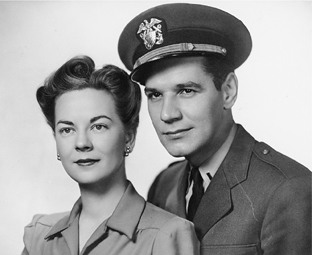
ALICIA AND JOHN BISSELL, SR.
“All the same,” my grandmother said, looking evenly at my mother, “can you promise me that you will do this?” My mother, still stunned, promised my grandmother that she would. Colonel T., at the same time, made my father promise him two things: that he would never quit the Marine Corps, and, more important, that he would never take his little girl, a true daughter of the South, back north to Michigan with him. My father, then up for major and beginning seriously to plan for his career in the Marine Corps, made these twin promises to Colonel T. with equally puzzled surety.
Thirty days after my parents were married, my grandmother died of the cancer that had unexpectedly spread to her lymph nodes. She was fifty. My nineteen-year-old mother found herself the custodian of two children only a little younger than she. While her promise shakily held, my father's was instantly broken. Over near-unanimous resistance from his fellow jarheads, Colonel T., and his new wife, my father resigned his Marine Corps commission and moved my mother to his hometown of Escanaba, Michigan, to take care of his brother and sister, whom he did not want to uproot. The move especially devastated my mother, a woman who proudly flew a Confederate flag off her front porch throughout my childhood. The sum of my mother's worldly experience to this point, other than partying her way out of the University of South Carolina, was the South and the Marine Corps, and now both had been cleaved from her. There was no anodyne for this severance, only the cauterizing assurance of the man she loved. But she loved him, I suspect, and in no small part, because he was a Marine. She once admitted to me that her fondest wish as a young woman was to be a Marine Corps wife. The seasonal balls, the crispness of the uniforms, the hot, orderly calm of military-base housing in the great American South: this is what she knew, all she wanted, and now it was gone.
Colonel T. was especially hard on my father about his decision to leave the Marine Corps. A letter from December 14, 1967, addressed to “Capt. & Mrs. John Bissell,” has my grandfather telling my father:
Quite frankly, I am not surprised by your actions. Do not misunderstand me, I am not speaking of potential, I think you have all the potential in the world to make the Marine Corps a career[,] I just don't think you have or have ever had the basic motivation and understanding of the requirements to do so…. My only concern is your and my daughter's stability and happiness. I expect you to provide stability, responsibility and maturity of an adult male regardless of your vocation. And the best way not to do this is to live your life like a feather on the wind, blown in whatever direction happens to offer the path of least resistance and appears most desirable. I have seen too many attempt this little game and then seen them at age 45-50 still looking for the career that will give them what they want…. John, I have known you a year now and have observed a complete switch in thought. To be able to change courses is fine, it indicates flexibility and adaptability, so long as it's based on logical rational reasoning and all factors and facts…. But a constant hopping from one field to another that looks greener indicates only insecurity, lack of self-confidence and a tendency to wallow in self-pity.
This letter was written to my parents from Danang in coastal Vietnam, a city referred to by Colonel T. as “the pearl of the Orient.” It ends with this: “Do not worry about the rockets. They pose practically no danger and if they hit you, you are either stupid or extremely unlucky, neither of which you can do a thing about. So if the poor little blighters want to lug them 400 miles on their back, for two seconds of whoosh, then I feel sorry for them…. So don't worry about me, I'm living high on the hog and am quite secure. Like a bug.” I imagine that my grandfather, a thoughtful analyst of military history, was familiar with Dien Bien Phu. This horrific, weeks-long final battle of the First Indochina War in 1954 had seen the “poor little blighters” of the Viet Minh dragging nearly eighty antiaircraft guns for two months through mountainous jungle in their triumphant effort to overwhelm the supremely confident French Expeditionary Corps, whose French, Vietnamese, Moroccan, and Algerian soldiers were dug tick-deep into the tactically worthless encampment of Dien Bien Phu. While the men and women of the Viet Minh hauled pieces of these one- and two-ton armaments on old carts and bicycles through the forest, this is what they sang: “The mountains are steep, but the determination in our hearts is higher than mountains./The chasms are deep and dark, but what chasm is as deep as our hatred?” Two seconds of whoosh, indeed.
I never knew my grandfather. I imagine that Colonel T. and I would have disagreed on many things, possibly everything, but from reading his letters I can discern an acute intelligence. This moves and saddens me, because it is intelligence in the service of the same blindness that in Vietnam shut the eyes of so many men. From a letter to my mother and father of October 1967: “Well here I am, another war, the same stupid faces with different names…. Things have changed a great deal since the last time I was out here. At least there are a helluva lot more Marines. In fact the place is fairly breathing with them. Lots of traffic and lots of gooks, on bicycles, water buffalo and bare feet…. It's interesting now, lohn, in the way everything is so closely tied together and the fantastic response time that we are now capable of in all kinds of situations.”

COLONEL T.
What the U.S. military was capable of seemed markedly less wondrous to Colonel T. only a year later: “I suspect the little brown gooks will continue to get pretty mouthy until the election in the U.S. is settled, but now while the idiots are mouthing off they will respond in any way they can … to influence American opinion in ways they think will help them most. So I don't look for any real cool off on their part, they will continue to kick up dust and a lot of people will still have to die. Mostly gooks but each time it does cost us Marines. I wish I could figure out a way it could end but I can't.” On February 9, 1968, shortly after the North launched the Tet Offensive, the suddenness and ferocity of which stunned everyone in the United States from LBJ down, Colonel T. (who by this point, according to family legend, had an NLF bounty on his head) wrote again from Danang. “I seem to have gotten a tad behind in my writing but I have been out on some rather sporty evenings lately,” he begins, jauntily alluding to the fact that during Tet, Danang had been hit repeatedly by 122 mm NLF rockets. After some irritated analysis of the surprise offensive, Colonel T. begins to reveal what one can only surmise is his growing despair about the war:
I do not think there is enough natural drive and courage to do much except talk. Not enough of us understand the problem and of those who do too many I'm afraid do not have the gumption or nerve to do anything about it. It takes an awful long and completely unselfish view to lay it on the line now for the benefit of coming generations. It's much easier, and safer, to, a la the hippies, only consider your own happiness in your life, dodge all responsibility and let those coming later try to take care of the situation. But I really don't believe that this mental and moral condition will apply in the U.S. too much longer, because as I've said before I think the generation starting about with [his son] Bo's time will revert, and from them will come those archers of the El Dorado who will stand tall and strong among all men and sit coequal and in peerage with Crockett, Washington, Lee, Sherman, and Jackson.
Two weeks after Colonel T. wrote these words, Walter Cronkite, on live television, publicly opposed the Vietnam War for the first time by saying, “It seems now more certain than ever that the bloody experience of Vietnam is to end in a stalemate…. The only rational way out… will be to negotiate, not as victors, but as honorable people.” Many of the proudest sons of the System, not only my grandfather and Cronkite but Lyndon lohnson himself (“If I lost Cronkite, I've lost Middle America”), could no longer abide the wasteful, destructive path upon which the System had confidently placed itself, only to be strangled by the vines of Vietnam.
My grandfather's casual use of “gooks,” his dismissal of hippies, and his odd placement of Davy Crockett along the mantelpiece of American military history all suggest that Colonel T. was a man of the South, and a product of Marine Corps thinking, in many if not most ways. He was also, by all accounts, a profoundly honest and decent man. As my father once told me, Colonel T.’ s formidable sense of ethics had led him to the professional Waterloo of opposing a new plane the Air Force was attempting “to cram down the Marines’ throat.” The guilty plane (“one of the Fs”) had been designed for ground-based use and was thus too heavy for aircraft-carrier landings. But warlocks in Air Force Research and Development insisted the plane's weight would not compromise its performance. Colonel T. disagreed and effectively killed the plane's deployment. “Some of the generals and admirals never forgave him,” my father told me. “That was big money. When you get up in the armed forces, any rank above colonel is the result of politics. From colonel on only the politicians win.” Colonel T. thus never became General T., a rank many of his friends and acquaintances had long anticipated for him. He made his embattled return home from Vietnam in 1969. In March 1970 he wrote my mother to wish “my little blonde girl a happy 21.… Age is turning out to be a really relative thing. I know that I'm getting older rather fast but so far I can't find very many things that it affects. I really don't feel any different now than I did when I was 21.” Five months later my grandfather died in his sleep of a heart attack. Within a few weeks occurred the one thing Colonel T. had been most looking forward to, the upcoming event he mentions in every letter: his first grandson, my brother, was born.
My mother did not take his death well. Her mother took it even worse, and within months she moved in with my mother and father in Escanaba. What followed my spectacularly southern grandmother's widowed arrival in one of Michigan's snowiest redoubts is among my family a matter of considerable omertà. Put simply, my grandmother and my father did not get along. Put perhaps more simply yet, my grandmother would not have pissed on my father if he were on fire. My grandmother was once a promising Hollywood ingenue—she very nearly married the actor lackie Cooper—and like most of the women in her line (my mother included) was extraordinarily beautiful and emotionally extravagant. The very few people my grandmother's considerable powers of emotional seduction proved unable to win were no doubt regarded by her with frustrated suspicion. But my father did something far worse than fail to succumb to my grandmother's Division One charms: he married a southern woman's child, a crime for which there is no easy forgiveness.

PRETTY GRANDMA
Moreover, losing her husband so early and unexpectedly could not have been easy. As a southern military wife, my grandmother had little to prepare her for life alone. Midwestern small towns are trying homes even for those of us who love them; to have been transplanted to such a place in a state of irreparable grief must have been dreadful. But my grandmother was almost surreally vain, forbidding, for instance, her grandchildren from calling her “grandmother,” the existential implications of which upset her. “PG,” or “Pretty Grandma,” was what we came up with in its stead. This lovely human orchid was now quite far from her steamy native soil and many admirers, and was cast instead to the affections of the unlettered, dipthong-shunning rubes of the high rural North. She lasted in Michigan only a few years, partly because of a many-thousand-dollar loan my father made to her, which she neglected to repay (or, eventually, remember). By the the early 1970s, when she left Escanaba for Los Angeles, where she lived until the months before her death in 1989, my parents’ marriage had taken on enough emotional bilge to capsize it.
Nowadays even to bring up the matter of my grandmother's Michigan sojourn with either of my parents—as I recently did when I came across a letter of PCs that referred repeatedly to “Sean,” to whom my mother had, apparently, given birth—is to splash kerosene all over smoldering deposits of resentment. So who is “Sean”? “Sean” is what my grandmother called my brother John for months after his birth. (“I will get off a present for Sean this week. What a smile that boy has!”) John, not coincidentally, is also my father's name. PCs insistence upon “Sean” continued until my mother finally caved in and gave John Clement Bissell II a nickname: not Sean but “Johno,” use of which my grandmother cheerfully took up. As did, for whatever reason, my father. In the end, my parents never really recovered from my grandmother's stay with them. Their marriage was nudged ever closer to the chasm.
Sometimes I wonder if when my father looked at my mother he saw PG—as if that would provide some causal explanation for the death of their marriage. The women looked startlingly alike, and not in the watered-down manner in which children usually resemble their parents. Their resemblance was rather a matter of photocopied enzymes, laboratory surreality, clone magick. They both had the same disarming smile, with its perfect teeth-to-gums ratio; the same elaborate coif of unnaturally white blond hair; the same dollishly too-big head, thin though fit limbs, and wonderfully trim figure. They even shared the same aura, some faded Old South glow that a mere parasol or colonnaded backdrop could have reenergized.
I can only wonder what you were thinking when you sat down on the couch beside Muff in late April 1975. The helpless anger you felt—the war, your marriage, the money you had lost to PG—I know about from having talked to you. But where did all the rage you were feeling go? In your anger, of course, you were far from alone.
The orphan airlift crash had benumbed everyone still paying attention to Vietnam. The pointless deaths of so many innocents took the more general pointlessness of the war and italicized it, capitalized it, underlined it in flame. Combat deaths, even defeats, meant something. But a plane crash in a war zone was barren of meaning. On the news you had glimpsed footage of the burned and muddy little bodies covered by Red Cross blankets—and some part of your mind neatly switched Vietnam off. You stopped caring. But now, three weeks later, you find you do care again, care deeply and totally, and you simply cannot believe what has been brought down upon Vietnam during the three-week leave of your concern.
Yesterday you read a piece in the Chicago Tribune written by a journalist who had previously served in the Marine Corps in Vietnam. He wrote of staring at a map of Vietnam: “places marked in grease pencil and the names of certain places underlined…. Hoi-Vuc, Binh Thai, Hill 270 and Charlie Ridge and Purple Heart Trail. It was difficult to accept the idea that they were now in enemy hands.” How difficult it was to accept this. The roads down which you had once commanded convoys are now the parade grounds of whole divisions of North Vietnamese armor. The thatched huts you had often held off your men from burning—how tender your heart went when confronted by the peasants of Vietnam—now happily fly the red, blue, and yellow flag of the NLF, the Viet Cong. Saigon itself is about to fall. On the radio during the ride home from work you learned that, a few hours ago, the American evacuation was completed. The latest predictions are that the city will not last the day. You stare at the television with Muff and Johno next to you. What is on is not of interest. Nothing is of any interest. Your reddened, open eyes see nothing, and your ears are immune to all sound but the black throb of your thoughts.
You are thinking, What a horrendous, lost effort. What, you wonder, will happen to your South Vietnamese friends? Not the cowards who have been losing the war faster than the North can win it but the ARVN Marines and Special Forces commandos who shared with you their fears of the Communists. These men had lost fathers and uncles to the Communist slaughter in Hue. Their cousins and grandparents had evaporated during the North's murderous land reform campaigns of the 1950s. You know that these men, and their families, will pay in blood for this day. As you stand and make your way to the humming couch-sized television, you feel at your core a great windy emptiness. You turn the television's knob, cycling through the same thirteen channels, hoping one of the networks has broken into regularly scheduled programming with a special report from Vietnam. Nothing. Nothing, nothing. Sometimes over the last few days the screen has been filled with All in the Family and sometimes with the nightmare of collapsing South Vietnam as narrated by Walter Cronkite. Coverage from South Vietnam has been like video incoming: upsetting, irregular, bracketed by a kind of strangely attentive silence. All the people at your bank claim to be unable to watch the news when Vietnam fills their screens. Too painful, they say. But it is all you want to watch. Or perhaps you want your pain to be everyone's.
IV
To say that this or that city fell to the Communists on such and such a date cannot begin to encapsulate the bedlam that was South Vietnam in the spring of 1975. Colonel T.’ s old coastal haunt of Danang is a case in tragically awful point. A month before it was taken over, Danang's streets were barricaded, curfewed, and quiet; a nervy, impotent vigilance had taken root in every household. Many in Danang took to watching the sea, not out of any expectation of rescue—most realized they were too unconnected for such an exalted fate—but rather out of simple longing for its blue vastidity of potential escape. (Many Vietnamese would try to escape by sea; many who did so died—of thirst, disease, starvation, drowning, tiger sharks, and something as sixteenth century as pirate attack.) By the time March literally and figuratively reached its ides, 30,000 PAVN soldiers were closing in on the city, and the first of an eventual million refugees had floated into Danang and transformed its shatteringly beautiful beaches and Buddhist temples into shantytowns. Some of the traffic jams into the city—containing “cars, jeeps, trucks, buses, motorbikes, bicycles, pushcarts … literally anything that can roll,” one American journalist observed—were ten miles long, making it difficult if not impossible for ARVN forces to move about the region and redeploy as battlefield circumstances dictated.
On March 19, President Thieu addressed the South Vietnamese people on national television. Although his audience did not realize it at the time, the address had been taped much earlier in the day. In an unusually steady voice, Thieu promised that the old imperial capital of Hue, then suffering rapid Communist encirclement, would be held to the last man. But Thieu had already transmitted secret orders to his generals authorizing Hue's virtual abandonment. This Thieu did partly to protect Danang and partly to transfer his best soldiers to Saigon to protect him in the increasingly likely event of a coup. Albert Francis, Danang's U.S. consul general, was asked by a visiting U.S. Embassy colleague how long he felt the city could withstand the Communists. Francis replied, “At least a month, I think.” It perhaps did not bode well that the USAID-operated hotel in Danang was called the Alamo.
Hue fell, as expected and dreaded, on March 24. The battle at Hue, General Vo Nguyen Giap wrote, was “very quickly fought. We gave the enemy no time to organize any resistance…. So they were quickly and neatly wiped out. Our strategic offensive thus became a lightning onslaught.” By this point the PAVN divisions were traveling so fast that, as one American described it, “they couldn't keep up with their own gasoline.” The next morning several PAVN artillery shells landed in Danang's clogged city center, wounding a dozen and killing six. Following this salvo came a downpour of rockets that struck the city's ARVN military outposts. This was part of North Vietnam's “blooming lotus” tactic, whereby intentional civilian deaths were used to incite panic, which in turn allowed a city to be quickly taken over. The visiting U.S. Embassy official told by Albert Francis that Danang would last a month was forced to flee for his life less than four days after arriving.
At 4:30 a.m. on March 28, a motor-driven barge pulled alongside Danang's U.S. Consulate, located on the Han River. The plan was to ship out of the city as many Americans and politically imperiled Vietnamese as quietly and secretly as possible. The street on which the consulate building was located had been blocked off, but the Vietnamese asleep along the nearby docks woke up and panicked. Within minutes the barge was under siege by as many as 5,000 terrified Vietnamese. David Butler's The Fall of Saigon tells us what happened next:
Then people started tossing small children from the pier up onto the barge. Some missed, the children falling into the black water between the dock and the barge, which rolled with the wakes of other traffic on the river and the surges of the several thousand people on board.
At five-thirty, there was a rush of ARVN troops. From the shore [U.S. Consul General Albert] Francis ordered the barge to depart.
But … the other Americans on board were unable to free a thick rope that ran from a bitt on the barge down to the dock. And the Vietnamese mob on the dock was not about to free the cable on that end. In fact, lithe young men used it to scramble up onto the barge.
Without realizing what he was doing, the captain of the tug let the barge drift back into the dock. The men scrambling up the rope like monkeys were crushed. The tug strained to break the rope. More young men and boys clambered up the rope. The barge swung back toward the pier and they were killed…. The ghastly scenario was played out twice more and then something finally gave way and they were free and that particular roundelay of death ended.
In the chaos, hundreds of Danang's consulate workers and CIA informants and their families were abandoned.
In Saigon the news from Danang, essentially a second capital in terms of its military and economic significance, was grimly received. It in fact threatened to unravel the quickly dwindling remainder of South Vietnam still controlled by Saigon. The U.S. ambassador to South Vietnam, Graham Martin, had for the last several weeks been attempting to preserve a sense of calm among U.S. officials and South Vietnamese. He has since been both loathed and admired, but Martin faced one of the least enviable situations in the history of U.S. diplomacy, and widespread panic was never more than a spark away from ignition. One of the last issues of Stars and Stripes to be published in Vietnam, for instance, carried a screaming headline promising the slaughter of “AT LEAST A MILLION” South Vietnamese if the North triumphed. Martin kept a fragile but certain calm in the last months and weeks largely by secrecy and studied, quotidian ceremony. The U.S. deputy ambassador, Wolfgang Lehmann, later recalled to Larry Engelmann that Martin “did things like keeping all our pictures hanging on the walls [of the embassy], because the moment you start packing—’ Oh, the Deputy Ambassador is packing up!’ —spreads like wildfire.”
Previously the U.S. ambassador to Thailand and Italy, Graham Martin replaced Ellsworth Bunker as ambassador to South Vietnam in June 1973, despite having never passed the Foreign Service exam. Vietnam had come to Martin long before he came to Vietnam: his helicopter-pilot nephew Glen, whom Martin had adopted, was slain during some of Vietnam's earliest fighting. The war was a highly personal matter to Martin, and he once attacked The New York Times journalist David K. Shipler in a blistering 4,600-word cable to the State Department wherein he all but called Shipler a Communist propagandist. Many of the journalists in Vietnam returned such antipathetic favor, especially when Martin routinely split hairs over the number of Communists and political prisoners held, and often tortured, by the Thieu government. While Amnesty International put the number at 200,000, Martin maintained that the number was more like 30,000. Martin made things no better for himself when he attempted to illume the bright side of Thieu's corrupt government by explaining, “A little corruption oils the machinery.” Knowledgeable estimates hold that anywhere from 20 to 40 percent of the U.S. aid received by South Vietnam was routinely raked off the top by knaves in its government and military. One popular South Vietnamese racket wound up stuffing the pockets of ARVN officers with $100 million a year. The racket in question? Washing GI clothes.
Yet Martin had opposed the Vietnam War, saying, “We should have never gone in there with American soldiers.” Years after the fall of Saigon, Martin told Larry Engelmann that he “never really had any great attachment to the Vietnamese, North or South. I don't particularly like any of them. I love the Thai. I think they're the most marvelous people in the world.” Martin's fondness for the Thai could no doubt be traced to his success as ambassador there: “We had the same sort of insurgency in the Northeast [of Thailand] that they had in the beginning in [Vietnam], and I kept insisting that I didn't see any white faces on the other side…. [N]o Americans in combat or any combat advisors, even…. I wouldn't let the Americans even carry sidearms on the bases out there.” The insurgency in Thailand was ultimately defeated by the Thai people themselves—and, Martin added, “We didn't have any My Lai massacres either.” As for Vietnam, a nation torn to pieces by a war he did not support, Martin had only one goal. As he told Henry Kissinger in February 1975, “There is absolutely no way that I am not going to be held responsible for the fall of Saigon. From beginning to end, it's going to be me. So I am not interested in doing anything except what makes sense right now to get the Americans out alive and as many of our Vietnamese friends, to whom we have committed ourselves, as we can.”
But Martin's notion of what the U.S. commitment to Vietnam amounted to had its limits, as Ed Daly learned when he barged into Martin's office on March 28,1975, the day of Danang's disastrous barge evacuation. Daly was the president and founder of World Airways, a charter airline, often in government employ, that had profited during the war by running rice and weapons to South Vietnam, as well as delivering copies of Stars and Stripes, which was printed in Japan, to Saigon. A former Golden Gloves boxer, the paunchy, bearlike Daly had a fondness for drama and bluster, as evidenced by his tendency to stroll around Saigon in flowered Hawaiian shirts and a shoulder holster crammed with a loaded .38. He was wearing the holster when he walked into Martin's embassy office, along with a many-galloned cowboy hat. A nervous Marine guard trailed after Daly. “Give the gun to the Marine if you want to talk to me,” Martin insisted. “I can get in to see popes,” Daly complained, “heads of state, generals, with one or two days’ notice. Why do you make me wait ten days to see you?” That he was commonly armed and routinely foulmouthed did not apparently occur to Daly as possible explanations for why Martin resisted meeting with him, nor the fact that Martin had been out of the country for several weeks.
Under the auspices of a U.S. Embassy contract, World Airways had over the previous few days flown three flights into Danang to evacuate Americans and South Vietnamese refugees. The evacuations, though harried, had been successes. Why, Daly now asked Martin, was World Airways being denied a last flight into Danang? Because, Martin explained, the situation was too volatile. Indeed, the embassy had just lost contact with Danang's U.S. consul general, Albert Francis, who would soon be beaten senseless and left for dead by score-settling ARVN soldiers. The South Vietnamese officials at Saigon's Tan Son Nhut air base had additionally threatened to shoot Daly's 727 down if he attempted to fly to Danang from there. “What,” Daly demanded, “are those bastards at Tan Son Nhut going to do if I take off without their goddamned clearance?” Martin said he imagined that they would hold true to their guarantee and take down Daly's plane. Daly asked Martin what he would do if they did that. “Applaud them!” Martin said. “Who the hell do you think you are?” Daly told Martin that he was “nothing but a used-car salesman.”
Jan Wollett, a World Airways flight attendant, described to Larry Engelmann being awakened in her Saigon hotel room at 6 a.m. the day after Daly and Martin's meeting. She went down to the lobby to find Daly and some others waiting for her. They were going to Danang. Wollett found it ominous that the flight had not been catered and that there were no guards or interpreters along. Inexplicably, some USAID people had assured Daly that the situation in Danang was “fine” and that guards would not be needed. A United Press International journalist named Paul Vogle, along for the ride, spoke fluent Vietnamese, so Daly believed they were covered. At 8 a.m. the 727 took off, carrying Daly, three flight attendants, five journalists (“Hey, the more the merrier,” Daly had said), the pilot, and the copilot. Another World 727 followed Daly's into the sky twenty minutes later.
Daly's recipe for heroism was to land the first plane, remain on the ground for “ten or fifteen” minutes, load up with passengers, and take off. The other World 727 would then do the same. Coming into Danang, Daly's pilot tipped the 727's wings to semaphore friendliness. The plane landed and taxied down Danang's spookily empty tarmac without incident—but the rescue quickly went bad. Wollett knew “something really bizarre was going on” when a small truck loaded with ARVN soldiers pulled up alongside the taxiing aircraft. One man jumped out of the truck brandishing a pistol, which he began to empty into the airplane's fuselage. As the 727 moved on down the tarmac, refugees hiding behind blast barriers and concrete revetments at the tarmac's far edge began a dash toward the plane. Those aboard the 727 place their number anywhere between 1,000 and 4,000. (One says it was 20,000.) David Butler tells us that the refugees “poured out in jeeps and trucks and armored personnel carriers and even in an old bulbous-nosed black Citroen taxi from the late 1940s.” There were many women and children in the onrushing mob, but they had the misfortune not to have been armed. The soldiers among them faced no such disability, and Darwinian improvisation went to work. The soldiers began shooting women and children, then other soldiers, in the back. A pickup truck loaded with civilians pulled abreast of the plane before nearly anyone else had made it there. An evilly quick-thinking ARVN soldier “sprayed it with an M-16,” according to one observer, “and the jeep flipped over and everybody went out of it.”
Daly was standing at the bottom of the plane's aft stairs waving his pistol when the shooting began. In response he fired several rounds into the air. Joe Hrezo, Daly's second in command, was also packing a .38 snubnose, but “figured if I started shooting … I'd have gotten the shit shot out of me.” The journalist Paul Vogle was next to Daly at the base of the stairs, shouting in Vietnamese, “One at a time, one at a time. There's room for everybody.” But there was not. A British journalist named Tom Aspell had jumped off the plane early to photograph the rescue and quickly realized his error. He attempted to make his way back to the 727 but could not fight his way through the crowd. Joe Hrezo, too, left the plane and was similarly unable to get back on board; he sprinted for the airport's control tower, where he established radio contact with Daly's pilot.
On the plane itself, the first soldiers had begun to board. One ran up and down the aisle screaming, “Take off. Take off! They're rocketing the field!” Jan Wollett, the flight attendant, shouted at this hysteric, “Shut up and sit where I tell you to sit!” and then went to the door. Outside, at the base of the stairs, she saw Ed Daly being clawed by panicking Vietnamese; blood poured from the deep scratches on his arms, and his shirt and pants had been all but ripped off. Wollett then saw a “family of five … running a few feet from me, reaching out for help to get aboard. It was a mother and a father and two little children and a baby in the mother's arms…. I reached back to grab the mother's hand, but before I could get it, a man running behind them shot all five of them, and they fell and were trampled by the crowd.” Wollett, too stunned for any emotion, immediately reached for another woman, but “a man behind her grabbed her and jerked her out of my arms, and as she fell away he stepped on her back and her head to get up and over the railing.” Daly, who witnessed this, hit the offending brute in the face. (Daly would leave Danang with a broken hand.) A “sheet of blood” splashed “across everything,” and the man fell off the stairs and was crushed by the crowd.
The plane, designed to carry a little more than 130 people, quickly filled up with more than 250. All but eleven of the rescued passengers were ARVN soldiers—and not only soldiers but members of the Hac Bao (Black Panthers), “the toughest, most elite unit in the 1st Division,” David Butler writes. The two members of the flight in who had not been able to reboard, Tom Aspell and Joe Hrezo, now attempted to jump back onto the plane. Via the tower radio, Daly's pilot told Hrezo that he would circle back to pick him up. The problem was that the pilot had to wend through the assortment of stalled and burning vehicles strewn across the runway. He also had to travel fast enough to elude those still chasing the plane and slowly enough for Aspell and Hrezo to board. He also had to find enough room to take off. The 727's problems increased one-thousand-fold when an ARVN soldier rolled a grenade under the plane, the detonation of which, in Paul Vogle's words, “jammed the [wing] flaps full open and the undercarriage in full extension.” Other abandoned soldiers began to shoot at the departing plane. One bullet struck the fuel tank (the 727 would leak fuel from Danang to Saigon) but miraculously failed to trigger an explosion.
Soon after North Vietnamese rockets began to hit the tarmac, Joe Hrezo made it aboard while Daly was still beating people off with his pistol. Tom Aspell was not as lucky. “Grab me!” he yelled as he ran alongside the aft stair, now warped and broken from the weight of so many passages. Aspell, “in the very best tradition of the business,” again according to Paul Vogle, threw his camera on board before attempting to climb the stairs himself. When he did, several Vietnamese lampreyed onto him. As the plane accelerated, Aspell lost his grip and fell, along with all the Vietnamese who had counted on his strength to ensure their escape. Aspell would be evacuated by an Air America helicopter several hours later, and his footage would be broadcast around the world the next day. It says something about the day's moral tumult that Vogle could congratulate Aspell for saving his footage, however historically valuable, when Aspell seems to have made no similar effort on behalf of his fellow human beings.
Daly's pilot, who had judged a runway takeoff impossible, opted to take off from the taxiway. But the taxiway ran out of cement, and soon the plane was rumbling along the grass. On liftoff, the 727 struck a vehicle and a fence pole and pulled from its pilings a long stretch of concertina wire. Yet people were still hanging on to the aft stair. One by one they were sucked away. “One guy,” the CBS journalist Mike Marriott recalled to Larry Engelmann, “managed to hang on for a while, but at about 600 feet he let go and just floated off—just like a skydiver. I watched him fly away.” Several men had stowed themselves in the 727's wheel wells. Others grabbed hold of the landing gear. As it retracted, one was crushed, rendering the gear inoperable. Another was photographed by a UPI photographer aboard Daly's accompanying plane (which never landed in Danang) losing his grip and tumbling thousands of feet to his death in the South China Sea. Marriott, for his part, had two thoughts. The first was “This is the start of the fall of the country. This country is gone.” The second was his “very strong” doubt that the bullet-pocked, grenade-wracked, fuel-leaking 727 would be able to land in Saigon. They were all going to die.
Airborne now, Jan WoUett confronted her passengers. People were sitting three to a seat, bleeding and crying. Wollett pushed the intestines of one injured man back into his stomach. Another man, bleating for help, began to pull on Wollett's pant leg. It was the scoundrel who had pushed the woman Wollett had earlier attempted to help before Daly smashed him in the face and sent him to the tarmac. Wollett aided the man to a seat, discovering only then that his “head was laid wide open, and I could see inside his head and it was just a bloody, pulpy mess.” Wollett tore open a flak jacket and used its sawdust innards to stuff the man's head wound and stop the bleeding.
Somewhat unbelievably, the plane landed safely in Saigon, though the normally forty-five-minute-long flight tookmore than two hours. Everyone cheered when it was clear that the damaged landing gear had held, despite the fact that, in Wollett's words, the “shock of what [the ARVN] soldiers had done to their friends and families seemed to be destroying them slowly…. They had run over each other and shot each other to get on this plane. Now the panic was disappearing and the realization of the horror of what had happened—of what they had done—was beginning to sink in.” All ofthe soldiers were arrested as they exited the plane. “They deserved it,” Paul Vogle wrote. Vogle's vivid UPI account of the flight—a piece of post-traumatic-stress journalism if there ever was one—has been described as “the single most memorable news story ofthe 1975 offensive.” One of Vogle's most chilling lines concerns the mangled body pulled out of the landing gear bay by Tan Son Nhut crewmen. The dead soldier's “M-16 [was] still strapped to his shoulder…. He got his ride to Saigon, but being dead in Saigon is just the same as being dead in Da Nang.”
Later that night, at a restaurant in a Saigon hotel, shortly before an exhausted Joe Hrezo “went across the street to a bar and found a girlfriend,” Daly tried to describe the trip to some journalists. But the journalists kept jabbering and drinking. Daly unholstered his pistol and said, “I want to have your attention here or somebody's going to get shot.” Daly, who died of a heart attack in 1986, would be depressed for years that his rescue mission had managed to save so few civilians. As World Airways’ official history relates, “Daly flew back to the U.S. with 218 Vietnamese refugees—including 57 orphans whom he took personal responsibility for. The U.S. Department of Immigration and Naturalization was none too pleased with the orphan airlift and attempted to fine World $218,000 for violating immigration rules. No fine was levied as public outcry in Daly's favor changed the government's mind.” Most of these orphans wound up in the care of various fundamentalist Christian churches in California.
Another man was troubled by Daly's rescue mission. After seeing Aspell's appalling footage, President Gerald Ford publicly lamented the “immense human tragedy” of Danang's collapse and privately said to an aide, “That's it. It's time to pull the plug. Vietnam is gone.”
On March 30, several trucks crammed tight with North Vietnamese soldiers moved into Danang, which the Communists would later call the most “gigantic development” in their push toward Saigon. Most of the soldiers were women. To the people of Danang they were an unfamiliar blur of pith helmets, green fatigues, rubber sandals, and Russian rifles. The women formed into units, hit the streets, and fanned out, shouting dogma-enriched instruction in high-pitched northern accents over their handheld bullhorns. The actual “liberation” of Danang did not, as the Communists boasted, “see a single shot fired”—or rather, the only shots fired were self-inflicted, into the skulls of terrified, left-behind ARVN soldiers who feared slaughter at Communist hands. But that particular roundelay of death ended as well. The next day it was Easter.
V
While you stand before the television fruitlessly changing its channels, Muff finally asks what you are doing.
Your response comes softly. —Looking for news.
—John, Muff says. That is all she says, a word containing an entire month's worth of frustration.
—There's nothing you can do about it, Johnny. This is Grace, speaking from the other side of the room. You have almost forgotten she is there. Slowly you turn. She is twenty-five feet and a universe of understanding from you. Her knitting needles are still. She is looking at you with small bright eyes, the face that surrounds them loose-skinned and kind. —You have to go on.
You look away and say nothing. You are choking on your anger, your simple human desire to be understood.
Muff is bouncing Johno, who has started to mewl and fidget, more roughly now. —Have a drink, she says, looking at Johno, the floor, her index fingernail. Anywhere but you.
A drink. It has been a bad month for that as well. The less you cared about Vietnam, the more necessary it became to forget everything else. The point man in your quest for amnesia was Pfc. Johnnie Walker. You have been leaving home, as though hypnotized, in the small of the night, wandering into bars, getting in fights. You had not remembered how easy getting into a fight was. Merely look at someone so hard they are finally obliged to inquire, What are you looking at? The answer: “You're pretty fucking ugly, you know that?” There is your fight. The last two you lost and came home laughing, your face a bouquet of bruise blooms, your lip seeping, your gums lined in red. Muff refused to take care of you those nights. She could not abide violence. But what did she think her father did there in Danang? The man was not eating prawns all day. He sent B-52s on bombing runs, a mass murderer from 17,000 feet.
Within you violence still prowls, and lately it has needed very little encouragement to slip through the bars of its cage. For instance: Dennis, your other brother, the second oldest, visited home a few months ago. Dennis was in the Air Force. This had been what had made it so easy for you to resign your commission. Dennis's Air Force service—in Thailand, primarily, building roads—meant that the Bissell family was contributing its share to the war effort, and your final clearance came through quickly. But you did not like how easily Dennis parlayed having flown over Vietnam, however hazardous this was, into having “fought” there. Over this very issue the two of you nearly came to blows—until Muff, cradling your son, inserted herself between the two of you, screaming, “Stop it! Stop it!”
Of course you know that if you keep behaving this way you are going to lose Muff forever. You know that as you stand before the television and stare at her as she tries to prevent Johno's small, explosive whimpering from turning into an emotional mushroom cloud. She looks so pretty tonight! You honestly don't know what you would do, or where you would be, without her. You have lived, died, laughed, cried, reveled, and moped with her for years now. You want to continue to do so for two thousand more. Yet running contiguous to this certainty are rivers of far inkier thought. They flow through the black, treeless landscape of your mind and feed into your heart, changing its electricity, coarsening it. Fuck her. She does not know. She cannot know. And your mouth is so dry. You need a drink. You pacify yourself by thinking of that drink, the way the scotch-soaked slivers of ice will melt against your teeth. You breathe and wait until the darkness passes through, but before it can do so Muff stands and walks out of the room, dragging Johno by the hand, both of them suddenly allied in tears. Grace goes after her, throwing a disappointed look your way before disappearing around the corner.
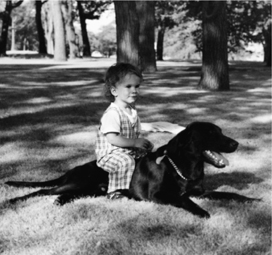
GUENELLA
You are standing triumphantly alone in the middle of your television room, listening to the spectral sound of the windows deflecting the wind, when your black Labrador Guenella comes trotting up to you, her tail sweeping happily back and forth. You named her after a young woman with whom you fell in love in Georgetown, during college. She spurned you for a Washington Redskins tackle, which at the time had seemed both remarkable and not at all remarkable. Naming your dog after her had been a crude form of revenge, but you now love this dog so much you cannot imagine what, at the time of its naming, you could have possibly been thinking. You crouch and run your hand over Guenella's sleek black brow. Her coat feels as soft as mink, and her long bologna tongue drops contentedly from her mouth. The tongue steals to your face, runs pink and frictionless up your cheek. Your eyes close, and your forehead presses against hers. She is a beautiful dog, the best you have ever had. You love the totality of her loyal ignorance. After a long while you look outside onto frozen Lake Michigan, the horizon beyond it preserving a fading hem of candied red light. Everything else is a different hue of dark, the snow low mounds of gray against endless black lawn. The room itself fading but for the blue flicker of the television. Darkness upon darkness, and nothing but this faint cathode fire to hold it back. You are sitting there with Guenella when the news, at last, comes on. In Saigon, you are told, it is morning.
What finally ended my parents’ marriage? Neither claims to remember the precise event that drove them both toward the false rescue of infidelity, and there the matter hangs. My birth, in January 1974, a little more than a year before the fall of Saigon, was, as they say, an accident. My mother had always had irregular periods and had no idea she was pregnant with me until a routine checkup. At the time my mother was on a hard-boiled-egg-and-wine diet, which was, according to her, “the big guru fad diet” of the day. When told the news, she exclaimed, “I'm going to deliver a pickled egg!” Neither she nor my father wanted or expected another child. As if to embody their apprehension, I was born a sickly, tiny thing and contracted pneumonia immediately. At one point a priest was summoned to give my days-old Catholic soul its last rites. My father spent that night in the hospital's chapel, praying. During the first, frail year of my life, I kept them together. When my condition improved, my mother remembers a near rebirth of goodwill between her and my father, then its sudden inexplicable collapse. But what caused this collapse? Again, neither remembers.
Once, after an argument of considerable megatonnage, my father gave my mother a charm bracelet. She still has it and sometimes even wears it. Attached to this bracelet are a poodle, a Labrador retriever, a sailboat, a tandem bicycle, my brother's and my birthstones, two baby boots, a diaper pin, a thimble, two enjoined hands, all of them references to the secrets and shared enthusiasms of a relationship neither much wishes to recall anymore. My father gave my mother the bracelet's first charm in a full champagne glass. She almost accidentally swallowed it. This first charm, my father's desperate attempt to mend what was clearly and hopelessly coming undone, was the pair of enjoined hands. He presented it to her on her birthday. My mother recalls this as one of the last truly happy moments in their marriage. She also recalls how soon things degenerated afterward. My father had engraved upon the charm my mother's birthday, followed by the year. My mother's birthday is March 20. The year is 1975.
VI
On April 3, 1975, Saigon was closed to all Vietnamese but those who could prove they lived there, a measure taken to slow the influx of refugees and prevent NLF guerrillas from establishing terrorist cells within the capital. On the day Saigon was sealed, officials in the U.S. Embassy, beginning to ponder the possibility of emergency evacuation, finally got together a list of all the 6,000 Americans known to live in Saigon and its environs. This number was arrived at by, among other methods, poring over records at the embassy's commissary that tracked liquor purchases. In Saigon's Presidential Palace things were relatively quiet. One of President Thieu's few formal orders in the first weeks of April decreed the closure of Saigon's plentiful saloons and whorehouses, apparently to encourage Saigon's men to save money for ammunition. The Western journalists recently dispatched to Saigon by magazines, newspapers, and networks left the city's hotels awash with more correspondents than at any time since the United States had withdrawn its soldiers. In the meantime, as the journalist David Lamb notes, the insurance premiums covering the lives of these journalists had increased by 1,000 percent.
Ambassador Martin did not believe Saigon would fall. He was certain that Vietnam's recently discovered offshore oil deposits would convince Congress to come to its senses and allow aid to South Vietnam. (When the local employees of two Western oil concerns, Esso and Shell, asked for embassy permission to be evacuated, Martin forbade them to leave, fearing it would render one of South Vietnam's most important industries inoperable overnight.) The ambassador's optimism was incurable, and possibly demented. As David Butler writes, Martin “spoke [to an NBC journalist] with evident sincerity about the prospects of holding a truncated South Vietnam, from Nha Trang south, living off the riches of the Mekong delta.” Martin diagnosed the disastrous retreat from the Central Highlands as “a minor problem” and boasted that in a year's time he would take a leisurely tour of one captured city.
Martin—along with Henry Kissinger, who was similarly doubtful of the prospect of Saigon's fall—had something resembling an excuse in the person of Saigon's CIA station chief, Thomas Polgar, who throughout April fed Martin and Kissinger selective intelligence that turned out to have a crippling effect on the embassy's ability to operate under what no one could bring himself to realize fully was siege conditions. The balding, bespectacled Polgar had been born in Hungary, escaped to the United States, and posed as a Nazi for U.S. intelligence during World War II. Although a committed anti-Communist, Polgar paid undue attention to the talk making its way around Saigon in the spring of 1975 that the North would allow a “transitional government” in South Vietnam, albeit one dominated by Communists, rather than conquer Saigon outright. This would permit the Communists a period of months, even years, to take over slowly, without alienating their longtime enemies. For this to happen, however, President Thieu would have to resign and preferably be replaced by Duong Van Minh, an ARVN general considered a neutralist—he was known to have argued against bombing the North, for instance—in South Vietnamese politics. Polgar held firmly to this ignis fatuus and used it to seed the stories of his chosen journalists, particularly Malcolm Browne of The New York Times. Polgar's deeply conjectural reading of the situation thus wended its way up to presidents Ford and Thieu, among many others, with seeming authority, creating what is called in intelligence circles a “false confirmation.” This helps to explain a high-ranking NLF officer's postwar comment that the Communists found that their “infiltrations of the American Embassy and the Central Intelligence Agency were not that important, because they really didn't know much about what was going on.”
Initial talk of a transitional government mainly came through French intermediaries, though the North's leadership, especially Prime Minister Pham Van Dong, had hinted for years that a transitional government after North-South negotiations was possible. (Whether a negotiated end to the conflict was ever possible is still being debated by scholars. By the 1970s, however, any talk from the North about its willingness to “negotiate” was a calculated untruth.) It is fitting that the French, the authors of so much disaster in Vietnam, would appear, as the curtain fell, with another garland of woe. Apparently it was not enough for the French to have essentially created the Communist insurgency by assailing the Vietnamese people's long-standing Confucian traditions, imposing ruthless taxes on staples such as salt, banning the distillation of Vietnamese rice into alcohol, forcing the Vietnamese to import pricey French wine, introducing the Brazilian rubber plant to Vietnam's ecology, throwing up dozens of brutally managed rubber plantations, establishing among the Vietnamese an impressive 5 percent literacy rate in what had previously been one of the most literate cultures in Asia, and designing a colonial policy that by design ensured that the Frenchmen who emptied the trash bins of Vietnam's leading universities were paid more than the Vietnamese professors who taught Zola and Hugo. (In neighboring Laos the situation was even worse. After the better part of a century of French rule, Laos, by 1960, had three Lao engineers, two Lao doctors, and one telephone for every 4,300 Laotians.) The French mission was so confident about the inevitability of a transitional government in South Vietnam that the 10,000 French citizens in Vietnam were told to stay put. This as many foreign embassies—among them the United Kingdom's, New Zealand's, Canada's, South Korea's, and Taiwan's—were burning their files and leaving.
In early April, sixteen PAVN divisions, or about 150,000 soldiers, were bearing down on Saigon—except for the single PAVN division that had been left behind to guard Hanoi, an attacking force that constituted North Vietnam's entire military. Only two years before, the ARVN had been one million strong. Of that million, a half-dozen infantry divisions, an airborne brigade, an armored brigade, and some harum-scarum ranger units were all that was left. Fewer than 90,000 ARVN troops remained to defend South Vietnam—others put the number as low as 60,000—almost none of whom had much spleen for fighting.
The leader of the assault on Saigon was General Van Tien Dung. Among the mummies of North Vietnam's Politburo, the fifty-eight-year-old Dung cut a dynamically youthful figure. He was also pragmatic and took orders well. This was especially crucial, as the North's policy as how best to deal with the South was never a settled matter within the Party. Le Duan—arguably the most militant member of the Politburo, a southerner by birth, and the leading Hanoi light after Ho Chi Minh's death in 1969—had long demanded an attack-dog course of action toward South Vietnam, which many of Duan's more moderate comrades opposed.
In October 1974, while the North's final offensive was being hatched, the Party issued an internal document known as the “Resolution for 1975.” Widely viewed as a compromise between the North's hard-liners and moderates, the resolution established a fluid plan of attack that would allow the North's policy to be made on the fly, according to battlefield developments. Although the Resolution for 1975 allowed for moderation, Le Duan made sure its intentions were heavily tilted toward all-out military victory. To this end the North began to draft every male up to forty years of age. Even Communist Party members, many of whom had been able to tiptoe around the war's hotter edges, were assigned combat units. Le Due Tho, Kissinger's co-Nobel Peace Prize winner, was sent to Saigon in early April. In Decent Interval— written by Frank Snepp, an analyst of North Vietnam in Saigon's CIA station, and arguably the finest account of the fall of South Vietnam— we learn that North Vietnam's president (as in the USSR, largely a figurehead position) pulled Tho aside as he was setting out. “You must win,” President Thang told the Nobel Peace Prize winner. “Otherwise you should not come back.”
—————
Through April, the Communists had seen only white flags and what General Giap fondly refers to as “big, very big, annihilation battles” during their campaign (though General Dung did have one genuinely frightening encounter—with a herd of stampeding elephants). Thirty-five miles away from Saigon, however, at the city of Xuan Loc, the North Vietnamese finally ran aground. Xuan Loc was a rubber-plantation bulwark and provincial capital of 100,000 that served as the gateway to Saigon and the nearby city of Bien Hoa, where 60 percent of ARVN's diminishing materiel was now held in a munitions dump. Because of Xuan Loc's location at a triple intersection of roads, including a highway that streaked south to the coast, Saigon could not be held without Xuan Loc's capture.
President Thieu sent to the imperiled city his best remaining divisions. After an artillery attack on April 8, the city emptied of civilians. The ARVN head of Xuan Loc's defense, General Le Minh Dao, who had set up his headquarters upon the grounds of an old French plantation, breathed fire days before the North arrived in force. “I vow to hold Xuan Loc,” General Dao said, according to The Fall of Saigon. “I don't care how many divisions the other side sends against me, I will knock them down.”
On April 9, Dung's and Dao's armies met in what would perhaps be the most horrific battle of the war. “Our troops,” admits the official Communist history of the People's Army of Vietnam, “fought the enemy for control of every section of trench, every house, every city block…. Enemy aircraft, taking off from Bien Hoa, Tan Son Nhat [sic], and Tra Noc airfields, pounded Xuan Loc with bombs. The battle turned into a hard, vicious struggle. Our units suffered heavy casualties.” One PAVN division saw 1,100 men killed in the first two days, its artillery was “seriously depleted,” and half its Soviet tanks were turned into red-hot scrap. In response General Dung sent the majority of his soldiers around Xuan Loc to outflank its defenders and, in some cases, bypass the city completely and move on. Even this proved costly to the PAVN assault. On the doorstep of their capital, the ARVN ceased to be what one writer had dismissed as “a collection of individuals, all of whom happened to be carrying weapons” and became an army. Aware that they were literally fighting for their children's lives, the abysmally outnumbered soldiers defending Xuan Loc would hold off the Communists for two sanguinary weeks.
At Saigon's Defense Attache Office, Vietnamese and “nonessential” Americans had been seeing evacuations for many days now. The DAO was a gigantic complex located on Tan Son Nhut air base, which was itself among the largest U.S. bases in the world. Four thousand Americans had once worked in the DAO, and its (air-conditioned, swimming-pooled, bowling-alleyed) operation had cost upward of $30 million a year. The evacuation protocol available to the Americans was found in a booklet two inches thick. “All of a sudden,” one U.S. Marine major recalled to Larry Engelmann, “people were dusting off plans that had been written in 1973 for emergency evacuation, and they were looking at them and saying, ‘Oh, Jesus, this is bullshit; now what do we do?’ “
The original evacuation plan had envisioned only two embassy airlifts, which would chopper out “between twenty and forty people.” Everyone else would be driven in buses to Tan Son Nhut, from which the evacuees would be flown out in fixed-wing aircraft rather than helicopters. By mid-April it became clear that this was not an adequate plan. So many Vietnamese had been tainted by their involvement with the Americans that a much larger evacuation plan was needed, and quickly. A scenario was gamed up to figure out how many Vietnamese could realistically be flown out of Vietnam. It was determined that 921,000 could be evacuated. However, this would require eight days, involve the participation of an astounding percentage of U.S. vessels in and around the waters of Vietnam, and “would only be practical assuming the following: No interference by either the NVA [North Vietnamese Army] or the VC; full cooperation by the Government of Vietnam; reasonable degree of crowd control.” Unfortunately, there was virtually no public support in the United States for such a massive and expensive airlift of Vietnamese, and the rules determining which Vietnamese could leave their country remained nebulous and often cruelly arbitrary.
The embassy found itself paralyzed with visa requests. As Wolfgang Lehmann, Ambassador Martin's second in command, told Larry Engelmann, “The categories of Vietnamese at risk were virtually endless…. It's not true we had no plan. We missed people; yeah, that's perfectly true. But there was a plan and there was a system. But again, we had no … formal authority to send any Vietnamese to the United States until the twenty-fifth of April.” A young American named Ken Moore-field was not satisfied with such spinelessness. During his first few hours working out of the DAO, Moorefield let through two hundred Vietnamese. Talk began to circulate among the Vietnamese at the DAO that Moorefield was softhearted, and they besieged him. Many families were unwilling to obey when Moorefield asked them to pull from the evacuation line their draft-age sons or elderly parents in the interest of creating space for others. “No, Mr. Moorefield,” one family said to him, “don't ask us to make those decisions. You make them for us.” As often as not, Moorefield was unable to do so. Once the officials within South Vietnam's Ministry of Interior arranged for their own departure, the Vietnamese no longer needed exit visas, and the rubber-stamping proceeded apace. Moorefield's heroics probably led to the evacuation of 10,000 people, and soon Vietnamese were flowing out of the DAO “around the clock,” a hundred people at a time, on both government and commercial flights, according to one U.S. official. Faced with this pressure, immigration officials in Washington were forced to relax visa requirements. Eventually all that was needed to escape was a piece of paper bearing the U.S. Embassy seal and the easily forged names of a Vietnamese beneficiary and American sponsor. There are stories of Americans adopting twenty Vietnamese at a time. One American adopted an eighty-year-old Vietnamese Catholic priest. When asked, “What in the hell is this?” by an Air Force officer at the DAO, the American replied, “Well, that's my adopted son.”
On April 11, Kissinger gathered together his senior State Department staff for a “pep talk” on Vietnam. “This thing,” Kissinger began, “is now going to run its course; its course is reasonably predictable. And what we are trying to do is to manage it with dignity and to preserve a basis for which we can conduct the foreign policy in which people can have some confidence in us…. I think people are going to feel badly [sic] when it's over. I don't think there are going to be many heroes left in this.”
In Saigon, rumor fed rumor. The city, Frances FitzGerald once wrote, “breathed rumors, consumed only rumors, for the people of Saigon had long since ceased to believe anything stated officially as fact. Rumor was the only medium.” Thus: President Thieu was actually an agent of the North. Thus: American B-52s were again seen prowling the sky— haven't you heard? Thus: General Nguyen Ngoc Loan, the Saigon police chief infamous for being photographed executing an NLF prisoner during the Tet Offensive, promised that if the Americans did not help evacuate more Vietnamese, the men under his command would kill every American they saw. As the military situation worsened, the Saigon regime broadcast shocking news that, in Hanoi, First Secretary Le Duan had murdered a Party rival, and that thousands of Chinese troops had consequently invaded North Vietnam. This last was a rumor that, for once in Saigon, no one took seriously—except for American journalists.
By now the forever-bubbling talk of a coup d'etat against President Thieu had been brought to a full boil. Those responsible for adjusting the thermostat included CIA Director William Colby and The New Yorker journalist Robert Shaplen. Colby argued that the United States should “jettison” (Kissinger's word) Thieu in exchange for the “unimpeded evacuation of Americans,” an idea for which Kissinger had harsh words:” [T]hose of us who were meeting daily in the White House Situation Room faced real, not theoretical, choices.” The influential Shaplen took a less theoretical view, pressing upon all who would listen the wisdom of replacing Thieu with Nguyen Cao Ky, the former prime minister of South Vietnam, with whom Shaplen was friendly.
A northerner by birth and trained by the French (and married, for a time, to a Frenchwoman), Air Marshal Ky had been made the first Vietnamese air squadron leader when France allowed Vietnam an independent military in the 1950s. He had been one of South Vietnam's most popular—which is not to say beloved—political figures. (Many young men in South Vietnam, for instance, grew jaunty mustaches in imitation of Ky.) The presidential age requirement initially written into South Vietnam's constitution had been lowered from forty to thirty-five explicitly for Ky. But his fighter-pilot arrogance—and he was, by all accounts, a brilliant pilot—had turned many of the Americans in Vietnam against him. It did not help that when Ky was once asked by a journalist which historical figure he most admired, he instantly answered, “Hitler.” Thieu finally tore power away from Ky and made him his vice president in 1967. Ky began plotting to remove Thieu, but many of his fellow malcontents were killed during the Tet Offensive, forcing him to abandon his plans. He spent the next few years stewing and flying around the country in his silver jet. Of the South's staggering surrenders in the spring of 1975, Ky in his memoir writes, “Ho Chi Minh couldn't have done it better.”
Emboldened by Shaplen and other allies, Ky was hosting luncheons shortly after Danang fell in which he discussed with equally outraged ARVN officers the prospect of deposing Thieu. Word of this instantly got back to the Presidential Palace, distracting Thieu at the moment he could least afford to be distracted. In early April, Ky approached General Le Minh Dao, commander of the 18th ARVN Division and the man who would later lead the stand at Xuan Loc. General Dao refused to help Ky (“Too busy fighting the communist, cannot participate”), and Ky was informed by Thomas Polgar that if he attempted a coup there would be no CIA support for it. For a man who had come to believe that Vietnam was merely an unloved puzzle piece in a Cold War jigsaw, this was too much.
“If only we had had time,” Ky writes in his memoir, “if only the Americans had not stopped us, we might have done something. Even if we had not lost Saigon, we still had the Mekong Delta. My plan was really to make Saigon a Stalingrad. All the women, all the children, all the old people would be evacuated. The only ones to remain in the city would be volunteers, but there would be half a million of us to defend our capital as the Russians had defended Stalingrad.” Lest one think that Ky is unaware that his plan was to replicate one of the bloodiest slaughters in world history, he goes on, “An American correspondent said [to Ky], ‘If you try to turn Saigon into a Stalingrad, thousands will die. Finally you will die. Do you really consider that to be a useful act?’ “Ky's response? “You mention the word Stalingrad. Do you realize after all these years people still know that name? That is enough for me.” Ky does not much bother to contemplate the possibility that South Vietnam's incessant political instability had more to do with its defeat than anything the Americans did.
Ky was growing so flamboyant in his coup plans that Ambassador Martin finally had to go see him. Ky's memoir is generally to be taken with a metric ton of salt, and it is not likely, for instance, that Martin really said to Ky things such as “I know you are extremely well-informed” and “I am inclined to think you are right.” Martin himself said, “[T]he whole point of that trip was to talk about a bloody coup that wouldn't have served any purpose on God's green earth at that stage except bolstering Ky's ego. So I just talked around the subject.” Martin walked out of the air marshal's house having succeeded in suggesting that while the embassy might conceivably support an eventual coup, it would be a good idea to hold off on such attempts for now. The chapter of Ky's memoir in which Martin's visit is discussed is titled “Graham Martin: Formula for a Double Cross.”
On April 17, President Thieu had what was likely the worst morning of his life. First he was told that his ancestral graves in a village outside the city of Phan Rang had been accidentally destroyed during an ARVN retreat. Ancestor worship is practiced by many Vietnamese, even those, like Thieu, who were nominally Catholic. Upon receipt of this news, David Butler writes, Thieu's face “writhed with agony. He walked from the room as if in a trance, retreated to the basement bomb shelter and was not seen again for twenty-four hours.” But he did not go into his bomb shelter before being told by his aides that he should probably resign. Three days later Ambassador Martin, under strong pressure by Kissinger, Ford, and Martin's contacts in the South Vietnamese military, dropped in on President Thieu in the Presidential Palace. There Martin made the tactical claim to “speak as an individual only, not as the representative of the President or the Secretary of State, or even as the American ambassador.” In David Butler's account, he then said, “Mr. President, I have reason to believe that if you do not step down, the [ARVN] generals will ask you to.” Thieu inquired of Martin whether, if he resigned, Congress might finally be persuaded to allow aid to South Vietnam. Martin said he did not think that was likely. Later that night, Martin returned home and wrote a dispatch to Ford and Kissinger detailing the completion of his distastefully passive-aggressive chore. He ended with this: “I went home, read the daily news digests from Washington, took a shower, scrubbed very hard with the strongest soap I could find. It didn't help very much.”
The next afternoon, Thieu resigned. During his lachrymal, hourlong speech, Thieu openly defied the United States. “You ran away,” he said, “and left us to do the job that you could not do. We have nothing and you want us to achieve where you failed.” He also said: “The three hundred million dollars that the Congress won't approve is what they used to spend to support their troops here for ten days.” And: “Kissinger did not see that the Paris Peace Accords led the South Vietnamese people to death. Everyone sees it and Kissinger does not see it.” Aware that the United States wanted the supposed neutralist General Minh to replace him, Thieu decreed that his replacement instead be his vice president Tran Van Huong, who was seventy-one years old, and blind. The negotiations that would supposedly begin with Thieu's resignation did not open up. From their headquarters at Tan Son Nhut's Camp Davis, the Communists’ Provisional Revolutionary Government (whose water, somewhat pathetically, Thieu had shut off) said that nothing was changed. There would be no negotiations. Thieu escaped to Thailand, where his brother served as South Vietnam's ambassador. It was also as far as Thieu's DC-6 plane could fly without refueling. Thieu had to escape for many reasons, not the least among them Air Marshal Ky's pledge to kill him. Henry Kissinger would later write, with considerable understatement, “Thieu had every reason to resent America's conduct…. [H]is country deserved a better fate.” Thieu himself would lament, “It is so easy to be an enemy of the United States, but so difficult to be a friend.”
At Xuan Loc, as the Communists were pushing from the city the last of the ARVN's stubborn remnants, the leaders of South Vietnam's military unleashed weapons so horrible they had only rarely been used in combat. The first were five-hundred-pound “daisy cutter” bombs designed to annihilate not human targets but Vietnamese jungle. A daisy cutter detonated above ground, evaporating everything within hundreds of yards, resulting in a charred, barren area perfect for Hueys to set down on. When the daisy cutters did not deter the Communists, a weapon called the five-ton cluster bomb unit was dropped. It was the first time that the five-ton CBU—called by Frank Snepp “one of the most lethal non-nuclear weapons in America's arsenal”—had ever been used in Vietnam. When the decision was made to deploy the “earthquake bomb,” it was discovered that not one of the South's ancient C-30 planes had bomb racks big enough to carry it. But Air Marshall Ky, “working throughout the night with Vietnamese maintenance men,” rigged up a new bomb rack. The five-ton CBU was then dropped. Anyone near its blast radius was perforated by the many thousands of flechettes and pieces of shrapnel the bomb hurled in every direction for half a mile. It also sprayed an eight-foot-thick wave of burning kerosene that traveled nearly as far. Those who did not perish from the shrapnel or kerosene wave were asphyxiated within the deoxygenated vacuum created by the five-ton CBU's apocalyptic detonation. “The destruction was so enormous,” Ky writes, “that for three days there was no fighting.” Despite the devastating effectiveness of the CBU, the South Vietnamese military command resisted using more of them. Air Marshal Ky then called in a favor with an old friend. The result? “No problem. Use the bombs when you need to.” Ky: “It did not change the outcome of the war, but perhaps some of us found a modest sense of achievement, of satisfaction, in being able to hit back at the hated enemy, even if it was now too late.” There were numerous international protests at the use of the five-ton CBU, and the Communists finally responded by destroying the runway of Bien Hoa's nearby airfield, from which the CBU-carrying C-30s were taking off.
Xuan Loc fell on the morning of April 21. Six hundred South Vietnamese soldiers voluntarily stayed behind to provide cover as the survivors of the remaining ARVN units were evacuated by helicopter. These courageous souls peered over their barricades to see 40,000 North Vietnamese troops rushing at them across a cratered, gray, altogether lunar city. They were quickly done away with, finally allowing the Communists to cut off Saigon from all incoming and outgoing land routes. The city could now be left to starve or suffer invasion from all sides.
Events now gathered a dreadful momentum. After a week in office, Thieu's replacement resigned and was replaced by the neutralist Duong Van Minh, also known as “Big” Minh. The literally though not figuratively toothless General Minh was said to have ordered the murder of South Vietnam's president Ngo Dinh Diem and his brother after the coup that deposed Diem in 1963, and Minh's personal bodyguard is believed to have been one of the killers. (The bodyguard later committed suicide in highly suspicious circumstances.) But that was all hiero-glyphically ancient history now, and General Minh became president on April 27. His first act was to put off his inauguration because his astrological chart was not promising. In his eventual inaugural speech the neutralist promised that in “the days ahead we will have nothing but difficulties, terrible difficulties. The positions to be taken are grave and important[;] our position is a difficult one.” Minh read robotically from a prepared speech that for the first time in the history of South Vietnamese politics acknowledged the existence of the Communists’ Provisional Revolutionary Government. He spoke of negotiation, of implementing peace on the basis of the Paris Accords, the need for “reconciliation” and ending “the coercive system imposed on the press.” Those listening to Minh are said by David Butler to have felt their hearts shrivel. Minh then paused and looked out upon his Presidential Palace audience. “In these difficult hours,” he said, no longer reading, “I can only beg of you one thing: Be courageous, do not abandon the country, do not run away. The tombs of our ancestors are here, it is here that we all belong.” “The room,” Butler writes, “applauded emotionally.” Minutes after the applause ended, the North launched a rocket attack and aerial assault on Tan Son Nhut air base—the final proof, if any were needed, that there would be no negotiation, no cease-fire, with or without President Minh, between North and South Vietnam.
The air attack on Tan Son Nhut was led by Nguyen Thanh Trung, the same defector to the North who weeks earlier had attempted to assassinate President Thieu by dropping a bomb on the Presidential Palace. (Trung now flies friendlier skies for Vietnam Airlines.) The North's General Dung called the attack on Tan Son Nhut “the most perfect joint operation ever by our armed forces and branches.” Much of the equipment used to attack Tan Son Nhut belonged to North Vietnam's enemies. During the North's drive on Saigon, billions of dollars’ worth of U.S. and ARVN equipment had been scooped up. Among the haul were 550 tanks and more than 1.5 million rifles. The planes Trung and his fellow pilots used to strafe Tan Son Nhut were almost all captured American warplanes, many of them picked up on the runways of the cities PAVN forces took without struggle. At Pleiku more than sixty working aircraft were captured, and at Phu Cat the North picked up fifty more.
Ken Moorefield was at the Defense Attache Office near Tan Son Nhut when the American-made bombs began coming down. “I remember thinking throughout how ironic this was,” he told Frank Snepp. “How many times in my two years as a combat officer in the delta had I called in air strikes against the VC! Now I knew what it felt like to be on the receiving end, and totally defenseless.” For those at the DAO that afternoon, the attacks were more terrifying than deadly. “We were grinding away,” Henry Hicks, the man in charge of evacuating the DAO, told Larry Engelmann, “flying people out, when all of a sudden there come these goddamned airplanes and they bomb us.” (The next morning Hicks was shot at by the “goddamned” South Vietnamese guards guarding Tan Son Nhut's entrance gate.) The people of Saigon, however, panicked. It was the first time they had ever been bombed in force, as the North had lacked offensive airpower for the vast majority of the war. In response President Minh declared martial law and followed that order by asking Hanoi for a cease-fire. The request was refused. Minh then demanded that all Americans in Saigon leave within twenty-four hours. This was a godsend. As Martin put it in a cable to Washington, “President Minh's request will permit the announcement of [our] departure to be by request, not from our panic.” In his memoir Kissinger takes a similar tack: “Since this coincided precisely with our withdrawal schedule, it in fact helped our extrication by avoiding the charge that America was abandoning its friends.”
In the early hours of April 29, the full last day the world would know the Republic of Vietnam (though few realized this: Thomas Polgar had a May 1 lunch date), we find one of the sadder episodes in the grief-sodden epic of the Vietnam War. Lance Corporal Darwin ludge and Corporal Charles McMahon were the only two Marines guarding a lonely sentry point near the Defense Attaché Office. The Marines were “buddies,” in the words of their sergeant, and had been sent to Vietnam as reinforcements—their unit's only reinforcements. Neither had been to Vietnam before. They had been given sentry duty because it was thought the least dangerous assignment available. Three days before, McMahon had sent his mother a postcard: “After this duty, they may send us home for a while…. I'll try to write when I have time and don't worry Ma!!!!” At four in the morning on April 29, a half-dozen 122 mm PAVN rockets—Soviet-made projectiles famous for their inaccuracy—struck the DAO complex and Tan Son Nhut in rapid succession, one landing less than two feet from where McMahon and Judge were standing. McMahon caught the brunt of the rocket and was reduced to what one witness described as “a charred stump.” Judge's body was in better repair; one of the first Marines to arrive at the scene believed Judge might still be alive. Darwin Judge and Charles McMahon were the last two uniformed American soldiers to die in the Vietnam War.
After the rocket attack, South Vietnamese Air Force pilots scrambled for their planes, unloaded their missiles and bombs, left them on the runway, and made for Thailand. Some pilots shot others for particularly contested planes. Soon after the rockets stopped, Nguyen Cao Ky writes, “the Communists started pounding the runway of the air base with their big Russian 130mm guns. Within minutes thick, oily smoke spread into a huge cloud as the enemy scored a direct hit on the mail fuel depot. Several planes on the ground exploded in gigantic orange flashes.” A huge portion of Saigon's remaining air force was thus destroyed on the ground. Graham Martin would later claim that Tan Son Nhut had been attacked because the South had in previous days been flying too many of its planes to safer havens. A PAVN general disagreed when he addressed the matter with Engelmann: “The real reason we shelled the runway of Tan Son Nhut was not because the Air Force had withdrawn their airplanes. We shelled the airport simply because that is when the artillery units arrived within shelling distance of Tan Son Nhut.”
A few braver Saigon pilots took to the air of their own volition. Air Marshal Ky himself had spent a portion of the previous day taking out batteries of rocket launchers in an F-5. Now, with the airfield of Tan Son Nhut under attack and that of Bien Hoa in flames, many pilots were sur-really refueling at abandoned Shell stations around the city. In some areas the line of planes waiting for gas stretched for blocks. Ky, who hours earlier had announced on the radio, “I will stay here until my last blood, until I'm dying,” flew himself in a chopper to South Vietnam's military headquarters. It was deserted but for one lieutenant general. “I don't know what to do anymore,” the man told Ky. “Come along with me, then,” Ky said. Ky flew to the USS Midway off the coast of Vietnam, where the ship's American commander “very touchingly” allowed Ky the use of his private quarters, in which Ky spent half an hour weeping.
On the morning of April 29, “departure envelopes” (diplomatic emergency kits stuffed with money and the addresses of various embassies throughout Indochina) were prepared for embassy officials in case anyone was separated during the evacuation—the imminence of which no one any longer had reason to doubt. When Ambassador Martin learned that Tan Son Nhut had been adjudged an impossible launching point for the evacuation, he demanded to be taken there in his bulletproof limousine, an errand that squandered two precious hours. At Khe Sanh earlier in the war, Martin later argued, planes had landed at and taken off from its bombarded airfield all the time. Martin would tell Larry Engelmann that he knew “a great deal about what flies and what doesn't fly…. Out at Tan Son Nhut… they were telling me they couldn't land the planes. That didn't make any bloody sense. I went out there to see and it still didn't make any bloody sense. You could have taken a jeep and cleared the runway of debris in thirty minutes.” The “debris” Martin spoke off included hundreds of live munitions, burning fuel tanks, partially exploded planes, and, in Frank Snepp's words, “one F-5 jet, its engine still running … abandoned just in front of the loading ramp.” It was finally impressed upon Martin that an evacuation from Tan Son Nhut's devastated runways would not be possible.
It had not yet been determined whether to keep a small staff in the U.S. Embassy after the Communists moved into Saigon. Martin felt strongly that the United States should; it was a matter of international dignity. Complicating matters was Article XXI of the Paris Accords, which required the United States “to contribute to healing the wounds of war.” If the United States had a diplomatic presence in Saigon after its government's collapse, it would likely be held accountable for Article XXI. During the Paris peace talks, Kissinger and Nixon had promised, but had not committed to paper, a $4.25 billion aid package to North Vietnam, the awarding of which they neglected to mention would depend on congressional approval. Hanoi's Liberation Radio had the temerity to keep bringing this up and on the morning of April 29 asked “whether the U.S. imperialists agree to compensate for and heal the deep and extensive wounds they have caused the Vietnamese people.” If the United States stayed, it would not only lead to a diplomatic relationship but the promise's violation, since Congress would never authorize such an aid package. It would also mean that the United States would have no standing to hold North Vietnam to Article VIII(b) of the Paris Accords, which concerned the return of U.S. soldiers designated as missing in action. The inevitable decision was made: full evacuation.
The evacuation's code name was initially Operation Talon Vise. When that code name was compromised, another, unintentionally flatulent code name was settled upon: Operation Frequent Wind. It was also called Option IV Options I, II, and III all involved fixed-wing aircraft, whereas the last-resort Option IV called for an evacuation exclusively reliant on helicopters. The one helpful aspect of Option IV was how much more difficult it would be for the Vietnamese to storm helicopters. Among the many unhelpful things about Option IV was the design of the embassy grounds, likened by more than one pilot to a well. As a Marine put it to Larry Engelmann: “They [the helicopter pilots] had about a seventy-foot vertical descent to get into the embassy. They had to come over, hover, then descend seventy feet into this hole, and there wasn't that much room.” For these overloaded helicopters to lift off would be no easier. “[Ijnstead of doing what they call a ‘translationai’ maneuver, where you get the bird off the ground and then lean it forward, they had to go straight up. There was no room…. They literally had to go straight up seventy feet.” If one helicopter failed to execute this midair slalom, Option IV would be over. There was no Option V.
The morning's one beam of sunlight was news from Moscow, which Kissinger received. The Soviets let it be known that the North would let the U.S. evacuation continue until midnight of that day, with the strong insinuation that it did not mind if many thousands of South Vietnamese were also evacuated. (Later the North's leaders would admit, with disturbing honesty, that the expatriation of so many southerners had helpfully prevented them from having to reeducate them later.) The Soviets’ note mirrored an earlier note from April 22, which read, “The position of the Vietnamese side on the question of evacuation of American citizens from South Vietnam is definitely favorable…. We are told that the Vietnamese do not intend to damage the reputation of the United States.” In those final words stands the colossal folly of the Vietnam War. The most powerful nation in the world, hotfooting it out of one of the poorest, being assured that no one intends to “damage” its reputation.
VII
In Saigon it is morning. But in Michigan it is night. What connects these places across mountains and seas, you feel certain, is a cord of bright endless pain that happens to feed directly into your collapsing nervous system. You sit staring at the television. Around you and within you everything ends, yet Escanaba itself is a cocoon of maddening stillness. Muff is upstairs, bathing the boys. You can hear, over the television's low volume, the sloppy, glorious sound of children in water. It is just after 9:30 p.m. Aunt Grace is long asleep. Your little sister Alicia, wearing an untucked red gingham shirt and knee-torn blue jeans ratty with denim tendrils, had wandered downstairs, taken one look at you on the couch, and retreated back up to her room. Your younger brother Paul has not yet come home. As usual these days, you find yourself all alone. You hate solitude until you have drunk past it, drunk until your grief becomes purely, endurably chemical and a mysterious chorus of conversation fills your skull. Then you cherish your solitude. Protect it. Get away from me.
But tonight solitude will not do. You begin calling your old Marine buddies, the only people who will understand why something happening a dozen time zones and 12,000 miles away can hurt you so profoundly. After three tub glasses of Johnnie Walker, your dialing finger feels as large and clumsy as a foot, and you mash apelike at the numeric keypad before finally getting your first call through. It is to R—— in Chicago, not your closest friend in Vietnam, but okay, he will do, as a start. The phone rings and rings. He should be home. You want him to be home, doing what you are doing, suffering what you are suffering. Or perhaps he wishes, this night above all others, not to talk. Get away from me. But suspecting he is there, and is listening to these rings, angers you.
You feel very lonely sometimes, stranded here upon Michigan's Upper Peninsula—a part of the country tacitly impossible to pass through by accident. Anyone who finds himself in the U.P. meant to find himself in the U.P. Yet you never intended to wind up back here. Your own cruel little paradox. The shabby churches, the clusters of prefab roadside homes, the gas stations on the brink of foreclosure, the shoppes whose hand-painted signs offer some staple (souvenirs, driftwood, smoked fish) of Escanaba's garage-sale economy. Sometimes you feel a hopeless, landlocked dementia take hold of you, and you long for Vietnam. For all its dreads, in Vietnam you never lost your simple human awareness of being alive. It was a young man's land, covered in a dew of terrifying possibility. But among these mute forests of the Upper Midwest it is as though the future never happens. You once believed that a young person growing up here had three options: to go mad, devote oneself to substance abuse, or develop a sense of humor as harsh as a drill bit. The last gambit was a great consolation to those who knew they would one day leave and a great annoyance to those who knew they would not. You seem to have managed all three, a hometown boy after all.
You are dialing G—— in New Jersey when you see Muff descend the stairs and without a word or glance turn at their base and imperially head off to your ground-floor bedroom. It could be that she did not see you. Television flicker sends sputters of color around the room, and you can almost believe that you are invisible in this odd darkness. But you know she saw you, or sensed you, and recoiled. When did you begin this long, impotent slide toward estrangement? In self-defense you have both formed new emotional jurisdictions, access to which requires passwords that change from day to day. You misconstrue the rawness of Muff's need as her loss of faith and know she believes your remoteness to be indifference. Every word you exchange has become an encrypted ultimatum. So you do not speak for days, and then, without warning, you make sudden, detoxifying love, begging for each other's forgiveness. But now, for the first time, your truces refuse to take. You have suffered some massive dislocation. In response Muff has been going on one retail tear after another, trusting that more possessions will form the simplest route to salvation. She wants a better life, a life you are beginning to see you are powerless to give her, because for her “better” means something quite simple: not with you.
You reach G——, a man who in boot was given to dumping an entire box of cornflakes into a huge salad bowl and pouring over this carbohydrate mountain a half gallon of milk. Like you, like all of you, a volunteer. He is sickened by the day's events, which are still being relayed only sketchily by the news. He is not nearly as drunk as you are. In fact, he claims to have not been drinking at all. This seems to you incredible. Before you know it G—— is speaking of betrayal, of how personally he took President Ford's widely noted remarks of April 23, six days ago, in a speech at Tulane University. Ford said this:
Today, America can regain the sense of pride that existed before Vietnam. But it cannot be achieved by refighting a war that is finished as far as America is concerned. As I see it, the time has come to look forward to an agenda for the future, to unify, to bind up the Nation's wounds, and to restore its health and its optimistic self-confidence. … We can and should help others to help themselves. But the fate of responsible men and women everywhere in the final decision rests in their own hands.
Decent, sensible, utterly obtuse words. President Ford (“the weakest president in U.S. history,” in the words of North Vietnam's prime minister Pham Van Dong) spoke of the war as some misadventure roughly as regrettable as a bounced check, not the scorching trip through the vortex by which an entire generation was third-degree-burned. “Optimistic self-confidence”? You and G—— know that, in hours, you will be veter ans of the only war the United States has lost—about which there is, apparently, some glee. When Ford said the word “finished,” Tulane's applauding students got to their feet.
There is no national confidence to be restored after this war, after that self-satisfied applause. Where to begin? You and your fellow warriors proved unable to find, with any consistency, an enemy hiding in an area less than half the size of New Mexico. You and your fellow warriors were unable to defeat an enemy outnumbered in active combatants by a margin thought to be five to one. You and your fellow warriors could not crush an enemy with a per capita income of $160, an enemy whose nation's gross national product was one four-hundredth that of your own. “Self-confidence”? In whom? In what? You sought to counter an insurgency and wound up activating a larger insurgency, in effect proving that everything the Communists said about the United States and its “puppet government” in Saigon was right, even though it was not. That is what you did: you made a lie true.
None of which Ford could admit, even if he believed it. Apparently, he did. Robert Hartmann, Ford's counselor, described to Larry Engelmann how the president had “conversationally” mentioned before the Tulane speech that he didn't “know why we have to spend so much time worrying about a war that's over as far as we're concerned.” “Well,” Hartmann replied, “then why don't you just say that?” At the last minute, the fateful Vietnam interlude was added to the text of Ford's speech. Kissinger called the insertion into Ford's speech “a typical inside-the-Beltway bureaucratic victory,” one “masterminded” by gutless “gloaters” who had not had the decency to consult Kissinger about the last-minute addition. (“I don't think Henry would like it,” Ford had worried to Hartmann. Hartmann: “You're the President, and if that's the way you feel, say it.”) Kissinger was angry because the speech signaled with no ambiguity that the United States was done with Vietnam. As Kissinger later argued in his memoirs, “ambiguity about how far we were willing to go [in saving South Vietnamese] was the sole bargaining card left.” In Kissinger we have a man who would strategize how best to escape from a burning skyscraper or issue a position statement from the cabin of a jetliner in free fall. (In fact, Kissinger had already stupidly shown his cards. After the Paris agreement was signed, Pham Van Dong asked him if the United States, like the Mongols, would return to attack Vietnam again. “Once is enough!” Kissinger responded.)
But neither you nor G—— blames him, exactly, for the collapse of all you fought and suffered for. You blame fifteen years of inexplicable decisions. You blame the war planners who forbade firing on any enemy boat larger than fifty feet or smaller than twenty feet. The colonels who on Monday would order that a Communist hill be taken, suffer a dozen Marine casualties in the doing, order its abandonment on Friday, and upon news of its recapture on Sunday order its takeover again. The Air Force majordomos who decreed that no U.S. pilot could shoot at North Vietnamese surface-to-air missile sites until they fired; meanwhile the patient American flyboy was ejecting from a burning metal comet. You blame lohn F. Kennedy. You blame Lyndon lohnson. You blame President Thieu. You blame Richard Nixon. You blame the American people for not understanding war. You blame the journalists for blowing the My Lai massacre out of all reasonable proportion and turning the public against what was a noble and just cause. You could have won the war, you know, if it had been fought the way war was intended to be fought. And for all that, you almost won. But Kissinger? “Had I thought it possible that Congress would … cut off aid to a beleaguered ally,” Kissinger wrote, “I would not have pressed for an agreement as I did in the final negotiations in 1972.” The man was a fly on the manure pile of war, believing above all else that the manure was his. You hang up with G—— even angrier than you were before you called him. lesus, where is Muff? You want to tell her how goddamned angry you are. Then you realize that, in all likelihood, this is why she has avoided you tonight and will be avoiding you for the foreseeable future.
Next you call C——, your closest friend from Vietnam and the man you made the godfather of your second son. C—— wound up in the Marine Corps because of several early indications of his promising career as a hoodlum. In 1963 he had stolen a car or some approximate last-straw offense. The sentencing judge offered C—— a choice of jail or the Marine Corps, a post-Korean War innovation of jurisprudence known as “alternative sentencing.” He wound up surviving three tours in Vietnam. Now, thanks to you, he works in Escanaba, in your own bank. C——‘s lakefront home is only blocks away from where you now sit and dial. He answers after one ring.
—You watching?
—Clusterfuck.
—Jesus Christ.
—I feel ill.
—Nothing we can do about it now. Dang di fucking good-bye, Vietnam.
—I'm ashamed of my country. For the first time in my life I'm ashamed to be an American.
—We hung those people out to dry. Every last one of them.
—Thing was won when I left, for Christ's sake. It was practically over. The VC were almost all dead. You could walk through VC villages in 1969 and there wouldn't be a single shot fired. There were roads I wouldn't even bother carrying a weapon on anymore. How did this happen?
—We didn't have the balls to see it through. It's politicians. Journalists. You can't fight a war if you're afraid of photographs. Or if you're listening to some goddamn poll.
—Where were the photos of the hospitals we built? The medicine we gave out?
—You know what we should have done. Invaded the North. Bombed Hanoi. I mean really bombed it. The Big One. War over. If the Russians and Chinese wanted to take issue with that…. The thing is, we never defined what we were going to do.
—It was defined. If you were in the Army, you were killing Communists. If you were in the Marines, you were trying to pacify the families of the Vietnamese guys the Army killed.
—Which means there was nobody with enough guts to define anything.
—You watching alone, or is she with you?
—She won't watch. She went to bed. Says she's sick of it. Says she hopes it really is over.
—That sounds familiar.
—She said the same thing to you?
—If we were on speaking terms, yeah. She might have said something very much along those lines.
—What do you suppose Caputo is doing right now?
—I don't know. Getting the hell out of there, I hope.
Philip Caputo, who before becoming a journalist had gone through Officer Candidate School with you and served a tour in Vietnam, was in Saigon in late April, wondering whether or not he should flee. “[H]ow would we, American correspondents,” Caputo wondered, “be treated by the Communist victors? In the final moments of chaos, would the South Vietnamese, feeling betrayed by Washington, turn their weapons on every American they saw?” On April 28, Caputo found himself on South Vietnam's main artery, Highway 1, outside Long Binh, writing “a personal account of what must be one of the great tragedies of modern times…. A hundred yards away, North Vietnamese mortar shells and rockets are slamming into government positions guarding the bridge over the Dong Hai River.”
Caputo was covering the long, desperate march of South Vietnamese peasants from the North's blitzkrieg toward Saigon. Many of these peasants were “refugees two and three times over—people who ran from Xuan Loc, from Da Nang and Ham Tam and Qui Nhon. Now they are running again, but this is their last retreat.” Caputo described the procession: “They shambled in the rain and heat: barefoot civilians, soldiers whose boots were rotting on their feet, some still carrying their weapons and determined that their little bands would stick together, most without weapons, broken men determined only to escape.” The previous night, Caputo could hear in his Saigon hotel room the crackle of small-arms fire, rockets hitting the airport, the thunder of field guns. He wrote that through his hotel's top-floor window, “I could see the flames of a burning fuel dump. Gekko lizards clung to the room's white walls, the walls quaking from the secondary explosions set off by the bombs, the lizards immobile in their reptilian indifference.” Seeing everything so obviously falling apart moved Caputo to reflect on the deaths of his friends: “Those men had died for no reason. They had given their all for nothing.”
—I feel like—
—I know what you feel like.
—Can you honestly tell me what we really did?
—We fought. We did our duty. We were Marines, and we did what Marines do. And sometimes Marines die.
—All so we could sit here and watch this.
—It's over. It doesn't have to mean anything.
—It has to mean something.
—Then it means what you want it to mean.
—You know what? I have no idea, no clue, what that could be. I think I want… my God. I want my friends back. I want the men I saw die to be alive again. I want every letter I wrote the parents of my boys to have never been sent. I want to walk around with normal thoughts in my head and not all this—
—Look. Drink.
—I have been. I am.
—Drink more. It's easier. And quit crying.
—It's not any easier.
—Then you haven't been drinking enough.
—It's less painful. That's not the same thing.
—Semper fucking fidelis.
—God, we bled. We bled so much.
—We're still bleeding. And we'll bleed a lot more before this is over.
VIII
On President Ford's order, the evacuation of Saigon was implemented at 10:25 a.m. local time. The choppers were supposed to have begun arriving in Saigon one hour after Ford's order. But on the U.S. ships awaiting orders in the South China Sea there was berthing confusion. Many of the Marines assigned to certain details found they were not berthed on the same ships as the helicopters in which they were intended to fly to Saigon. Not until half past noon did the initial wave of thirty-six helicopters depart. The flight to Saigon took forty-five minutes, and the first helicopters did not arrive at the DAO—pegged for earlier evacuation than the embassy—until 2 p.m., almost four hours after Ford's evacuation order. The tense Marines sitting within their ocean-skimming gun-ships were not the only people feeling confused. In Saigon the Western journalists, civilians, and Vietnamese promised evacuation were equally perplexed as to how they would find their way to their departure points. The plan held that everyone would gather at preassigned points, where buses would pick them up and take them to the DAO and the embassy. But the streets were already filling up with panic-stricken Vietnamese. The journalist Ken Kashiwahara, of ABC News, described for Larry Engelmann the morning of April 29 as “an island of one kind of insanity in a world of another kind of insanity. Nothing made sense anymore. Adding to the general insanity was the fact that the signal for the evacuation was the playing of Bing Crosby's ‘I'm Dreaming of a White Christmas’ over the Armed Forces Radio.” If playing a Christmas standard in April did not seem a clear enough indicator that something was afoot, the deejay announced at the song's conclusion, “It's a hundred and five degrees in Saigon and the temperature is rising. Mother wants you to call home.” The decision to play “White Christmas” was that of an Armed Forces Radio employee named Chuck Neil. “Why not play a recording of something that every American will recognize in a split second?” Neil later explained. Even this went awry. Neil learned that morning he did not have Bing Crosby's recording of “White Christmas” on hand. Instead he played Tennessee Ernie Ford's.
Among the people picked up by bus that morning was Philip Caputo. He arrived at the DAO to find rockets hitting the complex and the DAO's security detail emptying their clips into the sky. The New York Times journalist Fox Butterfield, traveling in the same convoy as Caputo, told Larry Engelmann that as they passed Tan Son Nhut air base “a C-119, a ‘flying boxcar,’ a South Vietnamese Air Force plane … took off to about 600 to 1,000 feet and a rocket hit it and it just came apart. It was filled with people.” After disembarking from the buses, Caputo and his fellow evacuees ran toward the DAO's tennis courts. With shells exploding all around them, Americans, journalists, Vietnamese civilians, ARVN officers, and “even a few old French plantation owners” scrambled for the CH-53 helicopters, known alternately as lolly Green Giants or Sea Knights. Giants, knights. A story holds that when the first French warship wandered into Vietnamese waters in the early 1800s, it was thought by the Vietnamese to be a dragon. So the colonial experience rode into Vietnam on the back of a dragon and now left via giants and knights. Caputo steeled himself against the choppers’ ninety-mile-an-hour propeller wash and climbed aboard. Shortly after his CH-53 lifted off, Caputo noticed on the ground a smoke puff, which was instantly followed by the uniquely terrible corkscrew trajectory of a heat-seeking missile spiraling up at him. A decoy flare was released by the chopper, and the incoming missile went lost in an orb of false heat. Caputo's chopper also took small-arms fire from ARVN soldiers until it cleared Vietnam's beaches and floated over the South China Sea, where Caputo saw “thousands” of fishing junks loaded with refugees. When the blocky silhouettes of the U.S. armada hardened above the watery horizon, he knew: “We've lost.”
“Well,” Caputo was told by a seaman when he climbed off the chopper, “that's one country we don't have to give billions of dollars to anymore.” He walked across the deck as Vietnamese—pilots, civilians, and generals—were frisked at gunpoint. The choppers that were no longer in use had their rotors locked and were pushed over the carrier's edge into the sea. Some Vietnamese, shocked into the realization that they were not going back to their homeland, attempted to jump after the drowned helicopters. An officer aboard the USS Denver took a long look at Caputo. He was wearing a dirty shirt and a beard he had not trimmed for days; his only possessions were some maps and his notebooks. He was assigned his berth in the ship, to which he quickly retired. He had been awake for thirty hours. He found other men in the berth, who paused as he entered, then nodded at him. As Caputo climbed into his cot, they resumed talking. Ambassador Martin was “nearly certifiable” for delaying the evacuation, they said. Did anyone else know he was walking his dog around Saigon as recently as yesterday? Did they realize how many classified files had fallen intact into North Vietnamese hands at Danang and Nha Trang? Caputo then realized that his bunkmates were CIA field agents. The deck officer had assigned Caputo to what he assumed was his fellow agents’ room. Caputo said nothing. Eventually he was too tired to listen and fell asleep.
Back in Saigon, Ken Moorefield was driving one of the evacuation buses. It says something about Operation Frequent Wind that although Moorefield had never driven a bus before, this somehow did not disqualify him for bus-driving duty. Moorefield quickly lost his patience with the journalists he was picking up, many of whom, he later told Frank Snepp, “were getting all tangled up in their equipment. ‘Leave it!’ I yelled to them. ‘For chrissakes, leave it!’ But not one of them would part with his precious tripods or tote bag—or raise a hand to help with the Vietnamese.” Later in the evacuation, as Snepp writes, one journalist “tried to elbow aside an old Vietnamese woman and push his cameras and tripods” into a helicopter. An embassy official walked up behind the journalist, “tapped him on the shoulder, flattened him with a roundhouse in the jaw, and threw his cameras into the bushes.”
The journalist Ken Kashiwahara, also on a bus, told Engelmann he saw “a Vietnamese man … running up alongside the bus. He was carrying a baby. And he held out the baby and was pleading, ‘Please take my baby! Please take my baby! Please take my baby!’ And the bus kept moving. And the man fell. And the baby fell, too, obviously. And the man dropped the baby. And the rear wheels of the bus ran over the baby.” Kashiwahara then had the bewildering thought that he and the rest of the bus's occupants might not escape the country. (Elsewhere in Saigon, others had been coming to identical conclusions. An American husband-wife team employed by the CIA as analysts made the decision that if Saigon filled up with pith-helmeted North Vietnamese before they escaped, the husband would put a bullet through his wife's brain and then turn the gun on himself.) Many of the buses traveled in circles, their drivers having no idea how to navigate Saigon's roadblocked streets. The journalist Ed Bradley, trapped on one bus, described to Engelmann how “every time our driver turned a corner with his bus he wiped out about three restaurants. This went on for seven hours!”
In the streets, Saigon policemen beat American “big noses” and when that grew tiresome opened fire on buses and cars carrying evacuees. The New York Times’ Malcolm Browne, who three years earlier had been expelled from South Vietnam by President Thieu, reported finding “a blanket on the sidewalk next to the Continental Hotel, in the heart of the downtown foreign quarter. On the blanket lay a sleeping baby, beside it a small plastic bag containing ragged clothing and some toys.” Browne wrote of Americans wandering the streets in search of old Vietnamese friends, then abandoning their searches when set upon by angry Vietnamese for whom no one was looking. Eventually Browne had the thought to call his contacts at the Provisional Revolutionary Government headquarters “after a particularly heavy shelling” of Tan Son Nhut air base. He asked how they were doing. “I cannot tell you how grateful we are for asking,” his PRG friend responded, “especially considering the circumstances. We hope you all get through this somehow.” Before boarding his designated bus, Browne was told by a weeping Vietnamese man, “You may hear after you leave that some of us here have died, perhaps even at their own hand. You must not spend the rest of your lives with that guilt. It is just a part of Vietnam's black fate, in which you, all of you, became ensnared for a time.”
The journalist Keyes Beech, of the Chicago Daily News, drove around Saigon in a packed bus after having been turned back at Tan Son Nhut's first checkpoint, where security conditions “were out of control.” The scene beyond his window was incomprehensible. The American PX had been broken into, its protective layer of barbed wire torn away while men with raked and bloody arms carried away refrigerators in rickshaws. Bicycles and scooters tore down wide avenues shedding contraband soap and candy bars at every turn. One witness described ARVN soldiers walking around with wristwatches “strapped all the way up to both elbows.” Some children were armed with pistols. “You could find almost anything that night,” Andrew X. Pham would write years later. “The defeated army discarded guns, ammo, helmets, knives, uniforms, boots, water tins….” Looters were stripping every American business of carpets, sofas, faucet fixtures, filing cabinets, and rolling chairs. The sharp stench of smashed whiskey cases blew through the streets. Through these Boschian tableaux Beech's bus journeyed. “We were a busload of fools,” he wrote, “piloted by a man who had never driven a bus [not Moorefield] and had to wire the ignition when it stalled because the Vietnamese driver had run away with the keys the night before.” A number of cars began trailing Beech's bus in the vain hope it would find some way out of the bedlam. “At every stop,” Beech wrote, “Vietnamese beat on the doors and windows pleading to be let inside. We merely looked at them. We already had enough Vietnamese aboard. Every time we opened the door, we had to beat and kick them back.” The bus—” our prison and our fortress”—was nevertheless overrun. “I found myself pushing a middle-aged Vietnamese woman who had been sitting beside me on the bus and asked me to look after her because she worked for the Americans and the Viet Cong would cut her throat.” At last, out of options, Beech's bus drove down Thong Nhut Boulevard (today Le Duan Boulevard) and stopped at the U.S. Embassy, around which 10,000 Vietnamese had formed a violent, writhing bracelet of grief.
The six-story embassy had been built in 1967. A year later, during the Tet Offensive, it was widely (and erroneously) reported that several shoeless NLF commandos had made it as high as the embassy's upper floors, which the CIA occupied, but apparently none had made it beyond the first. Since then its already fearsome armature had been considerably strengthened. The embassy's concrete artillery shield was possibly the strongest in the world, and in the last few days its ten-foot-high wall had been dressed in barbed wire. A break had been made in the wire, which eight Marines were guarding. This was essentially the only way inside, as the embassy's front gate had been reinforced with steel bars that, for good measure, were welded into place. The embassy's 160-Marine security force had set up in the courtyard a .30-caliber machine-gun nest, its barrel trained on the gate in case the Vietnamese broke through. The compound's inner concinnity had been equally disturbed. The embassy restaurant was in the alpha stages of being ransacked, and its swimming pool was doing double duty as a toilet and dumping site for whatever bullets and firearms any Vietnamese had managed to get inside, as there were rumors that NLF “assassination squads” were intent on killing American officials.
After the Vietnamese woman he had sat next to on the bus announced she was going home to poison herself, Beech and his fellow journalists beat and pushed their way through the crowd toward the wall. They “ceased to be correspondents. We were only men fighting for our lives, scratching, clawing, pushing ever closer to that wall.” Beech, at the time, was sixty-one years old. And this thought occurred to him: “Now … I know what it's like to be a Vietnamese. I am one of them.” The Marines at the wall had their orders: grab and pull up Americans first, third-country nationals second, and then, only then, approved Vietnamese. How anyone was to communicate his or her approved status is difficult to imagine, and there are many stories of ethnic-Vietnamese American citizens futilely waving their passports at the Marines. Ken Kashiwahara, as an Asian, was particularly worried about his chances of getting over the wall. He screamed the only thing he could think of that would convince the Marines he was an American: “The Dodgers won the pennant!” Luckily, he was recognized and pulled up.
Despite one American general's belief that there was “something about a United States Marine that demands respect from the Vietnamese people,” many Vietnamese climbed atop the wall and exchanged blows with the Marines before being heaved back into the crowd. The Marines did not treat only Vietnamese ruthlessly. One went so far as to smash an American journalist's television camera after the journalist caught on film a particularly brutal repulsion. When another Marine was pulled into the crowd by the Vietnamese, the journalist Bob Tamarkin wrote, “the mood … turned from bare tolerance to fitful rage.” The Marines broke children's noses with their M16 butts. They beat old women. The wall became so chaotic that other embassy officials were forced to pitch in. Tamarkin wrote, “One official drew his revolver, stuck it point-blank in the face of a young Vietnamese boy and screamed: ‘Get down, you bastard, or I'll blow your head off. Get down!’ “And: “One official who had thrown a young girl from the wall three times finally gave in. ? couldn't take it anymore. I feel sorry for her.’ “(The man was named Jeff Kibler. He was a twenty-four-year-old embassy accountant.) This is from Frank Snepp: “[Ojne Vietnamese woman, in an effort to climb over the surrounding fence herself, had become pinioned on a metal upright. Now she hung there like a speared fish, blood slowly oozing across the front of her [dress].”
Families who had arrived at the wall watched as one or two members of their group were selected from the crowd—acts of charity that nevertheless obliterated these families for decades. It is little wonder that while reading about the fall of Saigon, one repeatedly comes across the trope of Americans unwilling to look into Vietnamese eyes. Butler: “On the walls and at the gates, it was hard to look anyone in the eye.” The pull quote from a Harper's cover story entitled “Last Days in Saigon,” written by Dennis Troute, was “Don't Look in Their Eyes.” The scholar Neil L. Jamieson writes of his experience during Saigon's fall: “[Ojne man muttered to his companions: ‘Don't look in their eyes.’ The advice was unnecessary. We left with our heads down, confused, frustrated, and ashamed.”
Keyes Beech still had not made it in. In the scrum Beech's briefcase hit the face of a Vietnamese baby in its mother's arms. The baby's father began to punch and attack Beech, who “tried to apologize as he kept on beating me while his wife pleaded with me to take the baby.” Beech was finally pulled up the wall by a Marine with “long, muscular arms,” while others pushed and punched the Vietnamese attempting to scale the wall alongside him. Beech had arrived at the wall safeguarding the lives of some Vietnamese and lapanese friends. They were not pulled up. By 3 p.m., things had somehow gotten worse. It took Bob Tamarkin an hour and a half to move three yards through the crowd before he was finally pulled up. Meanwhile, French Embassy officials stood watching from the walls of their own next-door compound. All of those who approached the French Embassy begging for help were ignored.
The bus convoy system broke down late in the afternoon. Ken Moore-field arrived at the embassy at five and was pulled over the wall while some Vietnamese, as he later put it, “were waving documentation I myself had stamped the day before.” Moorefield found 2,000 people in the embassy compound, mostly Vietnamese but also many third-country nationals and journalists. He armed himself with an Ml6, horrified by how easily a saboteur could have lobbed over the wall a satchel of C-4. Not a single chopper had yet arrived at the embassy. The DAO, with its more implicated Vietnamese population, many of them high-ranking military people who had been waiting for weeks to be evacuated, was still the first priority. Sometime after 5 p.m., however, the first helicopters arrived. The larger CH-53 landed in the embassy parking lot, with the smaller CH-46 coming down on the roof.
At 6 p.m. what Tamarkin called the “rampage” began. Those Vietnamese lucky enough to have gained entrance into the embassy and observant enough to suspect that there was no way all of them would be evacuated began to pillage. It began innocently enough, with several hundred cases of soda being stolen from a storeroom, which was emptied, Tamarkin wrote, “within minutes.” The embassy restaurant's freezer was next, and when the looting spread to the storerooms containing cartons of American cigarettes, the Marines finally began beating Vietnamese in the halls and along the embassy's staircases, in some cases stuffing the dropped cartons of cigarettes into their own pockets and duffels. Outside now, it was quiet. The thousands of Vietnamese who crowded every embassy gate were sitting quietly, hopelessly. If any looked up at the roof of the embassy, they would have seen smoke gushing from the chimney of the embassy's rooftop incinerator. Every piece of paper generated since the embassy's founding twenty-one years ago was being burned. As Frank Snepp notes, the Saigon CIA station alone had more than fourteen tons of material to put to the torch. In the days leading up to the evacuation, thousands of laminated name cards for high-risk Vietnamese had been printed up, reserving seats for them on outgoing evacuation planes. They had never been distributed. Now they, too, were being incinerated.
“ [N] either Ford nor I,” Henry Kissinger writes in his memoir, “could influence the outcome any longer; we had become spectators. So we each sat in our offices, freed of other duties yet unable to affect the ongoing tragedy, suspended between a pain we could not still and a future we were not in a position to shape.” Kissinger describes an “almost mystical stillness” in the White House. He also describes what was tormenting him: namely, his “role in the next-to-last act: the acceleration of negotiations after Le Due Tho's breakthrough offer of October 8,1972. What has torn at me ever since is whether the demoralization of the Saigon structure which led to its collapse in 1975 started with the pace of negotiations we imposed … on the verge of both an honorable end of the war and national reconciliation.”
Kissinger had been in a “position to shape” so many nations’ histories, not only that of Vietnam but those of Cambodia, Chile, East Timor, Cyprus. It is a parade of such consistent misery that it is hard to believe that the baton leader could possibly allow himself a backward glance, much less a “pain” he would care to “still.” The men whose professional acquaintance Kissinger had made during the Vietnam War—Nixon, Thieu, Ford—fared well only by comparison. In fact, only one species of humanity seemed to emerge with consistently full sails after dealings with Henry Kissinger: Asian Communists.
IX
Standing beside lohno's bed, you reach through a pure stillness so dense and soundless it seems to you almost mystical. Your cupped palm comes to rest upon your son's tiny forehead, his skin blood warm, vaguely humid. You marvel at how this hard shield of young bone only millimeters beneath lohno's flesh gives way to an impossibly soft edging of fine black hair. You rub a bit of his hair between your fingers. The inexplicable reality of lohno stuns you. This small, sleeping mass of tissue, growing as you gaze upon him, is your five-year-old son. You know how terribly fragile tissue is, how prone it is to tear and bleed, how inadequately scaffolds of bone protect their sinewy cargo of heart and lung and liver. You touch this intact and whole little body, knowing only that he is yours. Your son.
Sometimes you want to crush your boys, to hold them so close that everything damaged inside you is pressurized into nothing but love. Your love is an inferno that, miraculously, destroys nothing. You are in awe of this ferocious yet harmless love, and you pledge, as you needlessly fuss with lohno's blanket, that your boys will never doubt your affection, ever, under any circumstances. Your own father firmly withheld his affection, and did so without apology. Manhood, for him, began at twelve, and a few years after you had passed this magically transformative age he proved it to you by dying. You have never been able to quite believe the men and women around Escanaba who approach you with stories of your father's munificence. The doorman at the House of Ludington describing the Christmas Eve your father handed him the gift of a transistor radio. The woman whose rent your father covered during a hard time. The waiters who fondly recall his extravagant tips. These people are only a little younger than you and, unaware that you have few similar memories of your father, always seem to expect something more than your pained smile and clumsy retreat. But he was a good man. So good. This you recognized, then and now. You wish merely that he had not been so indirect in his goodness. Even in death he is stingy, for what are your memories of him now but deficits he still refuses to cover?
You stagger down the hallway while walls and doorjambs leap out at you and picture frames jump from their nails. You stop to rub your battered shoulder as the floor beneath you pitches and sinks. What is wrong with this house? Why is it attacking you? Your little sister Alicia's door: locked. You worry about her—such a stubborn girl!—and remember the night she looked icily at Muff, who was basting a roast. “My mother,” Alicia announced, “didn't do it that way.” Muff's head fell and quietly hung there for several moments. “I'm not your mother, Alicia,” Muff finally said, looking over at her. “I'm never going to be your mother. And I'm sorry, but I can't do a thing about it.” Stubborn, stubborn girl, arguing with an equally stubborn girl about a surpassingly stubborn woman, lesus! You move down the upstairs hallway—a long dark space that deserves to be haunted—doorways passing you on the right, a solid bank of windows on the left. Your brother Paul's door is open. And there he is. He must have come in through the back and taken the narrow, rarely used staircase off the kitchen. His room smells like a brewery filled with sweaty socks next to a barnyard. Paul lies faceup on his bed, his open mouth emitting one chainsawlike snore after another, his arms flung out from his body and one foot still in its shoe. You stare at him, thinking, All these people in my care. All these eyes that keep me informed of how often I disappoint them.
They would not care to know the many beachheads of your concern. This house contains a multiplicity of futures for you to worry over. You can feel the future sometimes, moving through the passageways of the house, each version of it as distinct as an odor, each impossible to assign to its bearer. Like poltergeists of possibility, they drift by you, spin you around, and turn to mist as they pass through your spatulate fingers. And now another future seems to stir in the darker, more sinister quiet at the end of the hallway. You look through the floating shadows at this unknowable future—or is this something from the past? You are still outside Paul's bedroom and feel a sudden need to be elsewhere. You are only thirty-three, and already you have ghosts coming at you from every temporal direction. You go down the stairs (since when did they get so fucking steep?), stumbling once, near the bottom, turning your ankle and feeling it merely as the idea of pain—just as a ghost is merely the idea of a person, just as the future is merely an idea of the present.
Muff, promisingly, has left your bedroom door open, but you hesitate before going in. You know you are not ready for sleep. You are, in fact, horribly awake, your eyes so wide and raw they feel held open by toothpicks. You stand a single step outside your bedroom's threshold, staring into the thick breathing blackness at the just-visible foot of your bed, its comforter aglow in moonlight. You are awake, but is she awake? Is she waiting for you to slip beside her? Two rooms away the television still murmurs, splashing the room between you and it with inviting color. The momentum of looking over at the adjacent room sloshes your body's weight to the right. You list, slowly begin to fall, regain some modicum of balance with two thunderous steps, and fall into a nearby chair so elderly its springs audibly break beneath your weight. Much better. You have begun to come to grips with the fact that your inability to stand up straight is not so much a matter of the house attacking you but more that you are afloat on a wave of alcohol.
Still: how nice it is to be drunk. Much better than getting drunk, which took so much alienating effort. But being drunk required no effort, and by the time you were drunk everyone was gone. But now, for some reason, you are tired. You sit there, enjoying this room in which no one ever sits. The room feels different from other rooms. The absences are lighter, a pleasantly unexciting novelty not unlike sitting in a car no one has yet owned. Nothing obligates you here, and the feeling is shiveringly unfamiliar. You feel cold. So many rooms in this house, and within them so many different kinds of warmth. Moments ago you wanted only to hold your boys. But your wife, the woman you love more than anything, you want only to avoid. Once you have convinced yourself that this, too, is a form of love, you stand. Your hand closes around your bedroom door's glass knob and pulls it shut. The door catches with a snap. You know if she is awake she has heard this. You are making as much noise as a convoy. She has heard the whole thing.
In the kitchen, you prepare to wash up the dishes left over from lunch. You remove your tie. You scrape various tidbits off the plates into a mangy brown paper bag, to be given eventually to Guenella. You prepare a bubble bath in the sink for the plates and silverware, and with infinite care you lower an aquamarine bowl into the tepid foam. Its resonant flint glass emits a sound full of muffled mellowness as it settles down to soak. You work very slowly, with a certain vagueness of manner that might be taken for a mist of abstraction in a less methodical man. You grope under the bubbles, around the glasses, and under the melodious bowl, for any piece of forgotten silverware—and you retrieve a nutcracker. You rinse it, and are wiping it, when the leggy thing somehow slips out of the towel and falls like a man from a roof. You almost catch it—your fingertips actually come into contact with it in midair, but this only helps to propel it into the treasure-concealing foam of the sink, where an excruciating crack of broken glass follows upon the plunge. You hurl the towel into a corner and, turning away, stand for a moment staring at the blackness beyond the threshold of the open back door. You look very old, suddenly, weathered by emotion, until a film of tears dims your blank, unblinking eyes. Then, with a moan of anguished anticipation, you go back to the sink and, bracing yourself, dip your hand deep into the foam. A jagger of glass stings you. Gently you remove a broken glass. The beautiful bowl is intact—but of course, this is not my father. It is Nabokov's Timofey Pnin. This late scene from Pnin stands as perhaps the saddest few pages I have ever read. They have nothing to do with my father, of course. But neither does much of what I have written here. I am done trying to imagine how my parents experienced April 29, 1975. I scavenge Nabokov as I have scavenged all of my information about that night.
For the weeks and months I have been writing of this evening, for instance, I have been looking at a photograph of my mother. It is an old photo, white-bordered, its once-vivid colors now dim and tannic. She is sitting at the kitchen table of the Bissell house, a house I have no memories of her ever living in, a house in which I last slept when I was twelve. She is staring past my highchair-trapped brother, whose impish face is turned toward the camera. In the photo she wears too much eye shadow and a blue turtleneck, the costume in which my imagination has dressed her here. This photo is not from 1975. In fact, I have no idea when it was taken. (Neither does she.) The half-full can of Budweiser that my father discovers when he arrives home has its origin in this photo, as do the lip-sticked cigarette butts, as does the centerpiece loaded with knickknacks. I have ransacked this photo because it is virtually the only visual reference point I have for this time I could not experience and these events I did not witness. The Bissells were never a photographical family. Whatever photos were taken have been scattered by the various winds of divorce. About that I never much cared—until now.
While there is much I cannot know, I have come upon an equal amount I am unable to establish. My father says he came up with the name “lohno,” yet my mother makes an identical claim. My Uncle Paul tells me he was married in 1974 and by 1975 was no longer living with my parents, yet both my mother and father initially remembered him being there in 1975. And although my mother says she has “no vivid memories of Saigon falling,” she does “remember the day Elvis died.” (I am sure, too, that I was demandingly underfoot for much of April 29, 1975, but the inanity of writing about myself as a sixteen-month-old baby made itself clear after one quickly abandoned sentence.)
The relentlessness of all this uncertainty is not local only to the story of my family. A party was held at the residence of the Polish ambassador to Vietnam, for instance, the day President Thieu resigned. Some present at the party claim it took place in the afternoon, others at night. When Thieu slipped out of the country later that day, some put forth the notion that he was carrying a suitcase filled with gold (“The clink of metal on metal broke through the stillness like muffled wind chimes”), while others argue he was not (“That story is just bullshit”). A dissertation's worth of discrepancies exist between what Kissinger remembers and what Polgar remembers, between what Nguyen Cao Ky remembers and what Ambassador Martin remembers, between what Wolfgang Lehmann remembers and what Frank Snepp remembers. “I was appalled at what he told me,” Snepp writes of Lehmann. “His version of the truth, as he spun it out… bore little relation to what I remembered.”
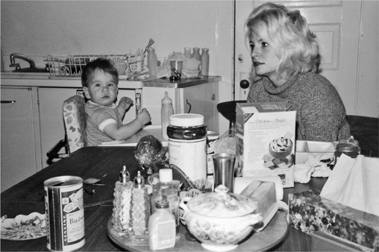
Among other things, history is the arrangement of memory. History is an argument with the past. The United States could have won the war in Vietnam if its soldiers had not been forced to adhere to disastrously protracted battle plans when it was clear by 1967 that simply killing huge numbers of the enemy was not a realistic path toward victory. The war in Vietnam was unwinnable due to the historically empirical difficulty of stifling insurgencies toward which a sizable portion of the indigenous population feels sympathy. The war was won in Vietnam by 1971 and lost in Washington. By 1971 it was clear to those fighting in Vietnam that the losing U.S. effort had passed beyond all moral solvency. Or: My parents’ marriage fell apart because of the emotional collapse my father suffered after the fall of Saigon in 1975. The marriage was over by 1972. “The reason we got divorced is because we got divorced. And frankly, it's none of your damned business.” “Your dad could be the kindest, gentlest, most wonderful man.” “I put a tremendous yoke upon her with Paul and Alicia, you know.” “Things were bad for the last three or four years.” “I think she wanted the marriage to be over, so she found someone else.” “He did the best he could do. We all did. But I fell out of love with him.”
Nothing is so impossible to imagine as disaster—until it is upon you. My father wrote my mother that he wanted to be with her for two thousand years. At the moment he wrote those words, any other fate must have seemed inconceivable. Henry Kissinger wrote that “the total Communist takeover” of Vietnam was a disaster that “four American administrations had resisted so strenuously for two decades.” Indeed, defeat in Vietnam, the columnist Joseph Alsop wrote in 1964, would signify the surrender of “all that we fought for in the Second World War and in the Korean War.” Secretary of State Dean Rusk wrote to President Johnson in 1965 that he was “convinced it would be disastrous for the United States and the Free World to permit Southeast Asia to be overrun by the Communist North.” The unthinkably disastrous occurred nonetheless, and I—we all—live in the paradoxical normalcy of aftermath. Of course, I do not intend to equate the destruction of my parents’ marriage with the collapse of South Vietnam, yet in my mind they are endlessly connected, just as the largest house can be entered through its smallest door.
Why do disasters demand such constant revisitation? Perhaps the first human being to delineate yesterday from today was not acting upon any natural observation but was instead seeking to commemorate some previously unthinkable event. Where were you when? Do you remember? Weemploy so many signifiers to hallow our larger, shared disasters that memory itself collapses beneath the weight. I was there. I remember. But all one truly remembers of most disasters is having forgotten what existence was like before they occurred. Disaster does not change one's world so much as narrow its parameters. Futures once as boundless as pastures shrivel into tunnels. What is lost in a disaster is never innocence. What is lost is a different sort of knowledge.
On April 29,1975, my father was losing something of himself. He was losing what was at that time possibly the largest part of himself. This was his certainty that what he had suffered in Vietnam was necessary. In other words, he was losing his past and future all at once. He would lose much more. We all would. We would lose so much we would forget, perhaps, what it was we had lost.
X
With night falling over Saigon, sedans belonging to the U.S. government, their headlights shining, were arranged in a circle around the embassy's courtyard. Thomas Polgar, who by this time had likely begun to realize the Brobdingnagian nature of his analytical blunders, went to the wall to look for his beloved Vietnamese chauffeur, Ut, who had gone out earlier in the day to look for people Polgar himself had inadvertently stranded and now was unable to get back into the embassy. Polgar— who may have been drunk at this point—proved powerless to get Ut pulled up. “I think I saw him in the crowd,” Snepp reports Polgar as murmuring, “but I could not reach him. I simply could not.” Polgar now sank into what he himself called an “emotional coma.” It is little wonder. The betrayals of so many Vietnamese—a series of careless American shrugs that tore lives in two—were growing apparent to all by the minute.
Hundreds of translators working for the CIA—men and women who were, in Snepp's words, “the best acquainted with CIA operations and personnel”—were left behind because the officer in charge of their evacuation took an early chopper out. Snepp also writes of the loyal U.S. Embassy guards of Nung descent—the Nung are one of Vietnam's eternally oppressed aboriginal people—with whom he exchanged words on April 29: “Remember us,” one Nung guard said to Snepp. It was “one of his few English phrases. That was the last I saw of him. He and all the rest would be left behind.” The embassy's switchboard could scarcely handle the number of calls coming in. Lacy Wright, a State Department officer, picked up one call. “We've been up here all day and nobody has come to get us,” the caller said, through heavy sobs. Wright swallowed hard, offered some useless advice, and hung up. More calls. One hundred and fifty people were trapped here. Two hundred more were trapped there. “We were told to come here. What do we do?” “I'm a Vietnamese, but I got my American citizenship in 1973. I've got three kids. What can I do?” Eventually, the embassy phone was simply not answered. Meanwhile, according to Snepp, Graham Martin overheard this exchange over the walkie-talkie in his office: “Hey, there's another gook climbing over the wall. Shoot him!” “I can't shoot him. For chris-sakes, let him over.”
Later in the evening, President Ford's chief of staff, a man named Donald Rumsfeld, cabled Martin about a pressing matter: “I understand that 154 IBM employees, including their families, are still awaiting removal from Saigon. I further understand they are now standing in front of the IBM building awaiting instructions where they should go for evacuation. I ask you to do your utmost to see that they are evacuated with the current helicopter lift.” One's heart goes out to these stranded souls. But it is a scenario of depressing familiarity that, among a metropolis of identical desperation, the only people our future secretary of defense felt any urge to look after were employed by a major U.S. corporation. Despite Rumsfeld's efforts, the IBM employees never made it out. Nor did the employees of Esso and Shell, whom Martin had earlier counseled to stay for the good of the country. None of the Vietnamese working for Western corporations received payment for their last few weeks of work. It has been estimated that the unpaid back salaries owed to Vietnamese by Western companies amounted to almost $1 million.
At the Defense Attache Office complex, 2,700 Vietnamese and Americans were suffering occasional, nonspecific potshots from disillusioned ARVN snipers. The specter of dying at the hands of South Vietnamese soldiers grew so dire that one American joked that “we were going to lock ourselves in a room … and pray for the arrival of the North Vietnamese Army.” One sniper was finally shot by Air Force officers. Another firefight, in the words of Sergeant Kevin Maloney, took place “right outside Tan Son Nhut. They made a big deal at the time about us getting out of there without firing a shot—well, I'm telling you what, the people who were saying those things weren't in Saigon.” This was not the only instance of fighting between the United States and Vietnamese. As President Ford later sheepishly admitted to Congress, U.S. and North Vietnamese forces engaged in combat at several places on Saigon's outskirts. PAVN missiles were fired at U.S. Phantom jets, for instance, and the jets responded with missile barrages of their own.
Frank Snepp wrote that, as the DAO evacuation neared completion, one U.S. official took “one final look” at Tan Son Nhut air base: “As far as he could see, the airfield was littered with fireballs, each going from blue to green to brilliant white as it rolled its way through rows of parked aircraft. He stared out at these Disneyesque images for a few moments, unable to believe that they, and everything else he had witnessed this day, were now part of the irretrievable past.” Shortly before midnight, the last of the Marines guarding the DAO were extracted, and the explosives placed throughout the complex were detonated by remote control from the DAO evacuation's final helicopter. The sky filled with magnesium-fed fire. Five miles away from the DAO, those within the steel wombs of Marine helicopters rising from the embassy's roof and courtyard felt their eyes fill with flames. Keyes Beech: “Tan Son Nhut was burning. So was Bien Hoa.” Lacy Wright: “[Y]ou could look out to the west and see Long Binh Base burning. A huge, huge fire…. Everything that we had tried to do was going up, literally, in flames.” Ken Kashiwa-hara: “It looked like the entire countryside was exploding in flames…. It really looked like all of Vietnam was burning.”
Two hours before the DAO was destroyed, Ambassador Martin, his hair (in the journalist Bob Tamarkin's words) “perfectly combed,” appeared to survey the damage done to his embassy. He said nothing, was not recognized, and vanished back inside. By now those at the embassy were waiting as long as fifty minutes between helicopter landings. When the White House asked if Martin might not be able to speed things along, he responded by cable: “Perhaps you can tell me how to make some of these Americans abandon their half-Vietnamese children or how the President would look if he ordered this. For more than 50 minutes there have been no CH-53s here. And only one CH-46.” The ambassador never lost his barbed nature, removing a photo of Henry Kissinger from an embassy wall and replacing it with a map of Hanoi. “May as well let them feel at home,” Martin said. Two hours after his previous cable, he was again hectoring the White House: “There is now a long lull. Nothing in last twenty minutes…. I sure don't want to spend my May Day here.” The North's evacuation deadline of midnight had now passed, which General Dung, waiting on the edge of Saigon, equated with the raising of “a divine hammer.” (“Once the bamboo is notched,” PAVN soldiers were told by their officers of the assault on Saigon, “one blow is enough to break it”) By 12:30 a.m., the approaching rumble of PAVN artillery could be heard within the embassy's reinforced walls. Parties of eighty Vietnamese at a time were slowly making their way upstairs to the embassy roof “like toothpaste through a tube,” in the words of one American. On the roof itself, a few Marines, no doubt driven to something resembling madness by the day's activity, began to “conduct” the crowds of Vietnamese to sing. The Marines, CIA agents, and embassy factotums not on the roof were going through the embassy destroying everything of possible use. One Marine was seen reading a copy of The Fall of Rome. Frank Snepp himself found a book: Don Oberdorfer's Tet! Snepp left the book where he found it, believing the embassy's next tenants “might be somewhat amused to learn what the Americans had thought of that last great offensive.” By 3 a.m., the evacuation was twelve hours behind schedule.
At 4:15 a.m., Martin cabled the White House for the last time: “Plan to close mission at about 0430 30 April local time. Due to necessity to destroy commo gear, this is the last message from embassy Saigon.” Minutes later, the embassy's communications officer whacked the “commo gear” with a sledgehammer, and Marines destroyed the rest with explosives. Martin made his way to the roof, which was, in Snepp's account,
a vision out of a nightmare. In the center of the dimly lit helo-pad a CH-47 was already waiting … its engines setting up a roar like a primeval scream. The crew and controllers all wore what looked like oversize football helmets, and in the blinking under-light of the landing signals they reminded me of grotesque insects rearing on their hindquarters. Out beyond the edge of the building a Phantom jet streaked across the horizon as tracers darted up here and there into the night sky.
After an aide checked the courtyard to make sure he didn't “see any white faces,” Martin climbed aboard the Lady Bird 9 carrying the American flag. It was 4:47 a.m. With Martin were various embassy personnel, including Ken Moorefield, and two missionaries. The chopper rose into a morning sky filled with monsoon-spawned lightning and headed for the USS Blue Ridge, the Seventh Fleet's flagship. Only months later, in a Hanoi museum, Ambassador Martin's departure from the embassy roof would be depicted in a primitive diorama, to the delight of Vietnamese children.
Unfortunately, anywhere from 400 to 420 Vietnamese were still in the embassy waiting for their promised evacuation. Army Captain Stuart Herrington was with some of them. As Martin's helicopter left, Herring-ton screamed at them in Vietnamese, “Khong ai se bi bo lai!” Nobody's going to be left behind! “And I believed it,” he later told Larry Engel-mann. Among those left behind were Vietnamese firemen who had been providing crowd control (their families had gone out earlier), a gaggle of drunk and unconscious South Korean diplomats, and a German priest, who, in Herrington's words, “helped out.” Before they could board choppers, the evacuation was terminated by White House order. The remaining Americans were told to be on the next flight out. Herrington argued, but it was no use. He informed the Vietnamese waiting with him that he was going to the bathroom and ducked away for the roof. On his way there he passed the embassy plaque that was inscribed: “In memory of the brave Americans who died defending this Embassy during the Tet Offensive, 1968.” Such was Herrington's bitterness that he said to himself, “To hell with the plaque.” It was later salvaged by an American journalist who had stayed in Saigon to cover the Communist takeover.
By 5 a.m., Herrington and three American civilians were the only non-Marines left in the embassy. One was the journalist Bob Tamarkin. The others, an American man and an American woman, refused to give Tamarkin their names. History will know them only for their deluded bravery, as they had come to help their Vietnamese friends escape the country before realizing the situation was hopeless. “You know,” Tamarkin heard the man say, “I had ordered $100 worth of tailor-made clothing yesterday when I arrived, and I paid for it in advance.” The last civilian helicopter left the U.S. Embassy with only four people on it. Herrington: “I was sickened, naturally. I never in my life felt worse, never will feel worse than at that moment walking away from those people…. I just couldn't stop crying.” In his memoir, Henry Kissinger would claim that he had no idea how the roughly four hundred Vietnamese had been abandoned. This is strange if only because the military officials present at the embassy said the evacuation had been terminated “by presidential order” after it had been made clear that many Vietnamese were being left behind. As he was borne aloft, Tamarkin looked down into the embassy courtyard. There, “hundreds of Vietnamese looked up,” waiting for the next helicopter.
In Decent Interval, Frank Snepp mentions “the legacy and shame of total defeat” that many Americans felt while abandoning Saigon to its fate. “There is a simple truth,” Aleksandr Solzhenitsyn once wrote,
which one can learn only through suffering: in war not victories are blessed but defeats. Governments need victories and the people need defeats. Victory gives rise to the desire for more victories. But after a defeat it is freedom that men desire—and usually attain. A people needs defeat just as an individual needs suffering and misfortune: they compel the deepening of the inner life and generate a spiritual upsurge.
Operation Frequent Wind was not, by any metric, a victory, despite its success in extracting from Saigon 1,373 Americans, 5,595 South Vietnamese, and 85 third-country nationals. The largest helicopter evacuation in history, Frequent Wind saw only two fatalities, when exhausted pilots were forced to ditch their helicopter over the South China Sea and were never found. Even General Dung, in his memoir, marveled at the success of the evacuation, the last thirteen hours of which were far from the entire story. Over the month of April, 51,888 people (45,125 Vietnamese and 6,763 Americans and other foreigners) had been airlifted from South Vietnam. Another 6,000 left by barge, and an unknown number thought to be in the low thousands escaped on unrecorded “black flights” engineered mainly by the CIA. Another 65,000 South Vietnamese escaped on their own. But the number of Vietnamese abandoned must exceed this total number by factors of five, ten, fifteen. In a war of such endless ambiguity and suffering, it is somehow fitting that even the stunning success of the evacuation was qualified with so many dismal failures and betrayals.
Nor was it over. Shortly after Herrington and Tamarkin's helicopter cleared the roof, Kissinger learned that “elements of the 9th Marine Amphibious Brigade protecting the evacuation—comprising 129 Marines—had been left behind for some inexplicable reason.” The airlift was resumed. Major Jim Kean, the commanding officer of the Marine unit responsible for protecting the evacuation, later told Larry Engelmann that he knew the Marines’ withdrawal could trigger “a big donnybrook in front of the embassy door.” After slinking away from their posts unnoticed, many of the Marines in Kean's command were thinking, “My God, we're only thirty seconds away from pulling this thing off without a fight.” Of course, “all hell broke loose. The crowd outside realized what was happening … and they panicked.” The Marines retreated deeper into the embassy, locking out the Vietnamese charging after them and littering the stairway to the roof with “big old fire extinguishers” to slow any who made it past the bolted doors. A CH-46 arrived, and the Marines were forced to leave behind their flak jackets and helmets in order to squeeze more men on board. Soon only eleven Marines were left. They were, as Major Kean notes, the last U.S. ground forces in Vietnam.
For a dismayingly long time no more choppers arrived. My father in Michigan was just returning home from work as dawn arrived in Saigon, where some Marines slept on the embassy rooftop as the sun came up. Others watched President Minh's “cavalcade of cars” pass by the embassy on its way to the palace. Before driving away, a few of Minh's guards shot at the looters tearing apart the open floors of the U.S. Embassy. While some Marines were counting ammunition in case they had to make a stand against the sixteen PAVN divisions driving into Saigon, Major Kean did “something kind of funny,” which was to whip out his .45 and pump into the embassy's satellite dish antenna every bullet he had. Eventually the Vietnamese smashed through the barriers the Marines had established and were now pounding against the locked rooftop door. “An arm smashed through the window of the door under the helipad,” David Butler writes. One Marine “got to it fast and pulled the arm into the broken glass, and it was yanked back with a cry…. More arms reached through the broken window. So they kept a man there to grab the arms and jam them into the glass.” This Marine also sprayed the intrusive Vietnamese with Mace. One Vietnamese man had succeeded in crawling up the side of the embassy, but someone dropped something heavy and knocked the man off as though he were nothing more than a barnacle. The final chopper set down on the roof at 7:53 a.m. Major Kean ordered that the helipad be teargassed as they lifted off. The last Marines to leave Vietnam thus caught a rotored-up miasma of gas while keeping their weapons fixed on the Vietnamese still trying to break through the rooftop door. The last words spoken by a Marine in South Vietnam: “Hey, Major, they want to know what kind of pizza you want in Manila!” Kean was not sure if he would be court-martialed for using tear gas. “Ultimately,” he told Engelmann, “they gave me a medal.”
The last, fiercest fighting of the war occurred on the northern edge of the city, near Tan Son Nhut air base, as the Marines were leaving. “I really had no idea we were fighting the last battle of the war,” one PAVN colonel would tell the journalist David Lamb years later. “We had been fighting for so long it was hard to believe the war would not go on forever. That morning the enemy fought well. The fighting was very heavy. There were dead on both sides. Then just like that the firing stopped and the war was over.”
As the war ended, a thirty-year-old Australian journalist named Neil Davis was eating a croissant on his hotel's patio. Davis was a beloved figure in journalistic circles. He had given thousands of dollars of his own money to war orphans throughout Southeast Asia and secretly paid for an operation that corrected the crippled leg of an eleven-year-old Saigon girl. He had been in Cambodia as Phnom Penh fell to the Communist Khmer Rouge earlier in the month, an experience that had hardened his determination to stay on in Saigon. “No more running,” he had said, according to David Butler. “It's fucking humiliating.” After finishing his coffee, Davis walked over to the Presidential Palace. Save for a few looters, the city around him was as empty and silent as an asteroid. Throughout their efforts to conquer the South, the Communists had counted on a popular general uprising or, in Communist argot, a Popular General Uprising, that would throw off Saigon's puppet government. The Tet Offensive had been the North's first major attempt to trigger the general uprising. Its failure was total. The Communists tried again during the Easter Offensive of 1972. Again the only southern response was acrimony, directed toward both the Communists and the Saigon government. Even on this day, with the Communist victory complete, there was in Saigon—” always the home of the entrepreneur and the collaborator,” in Frances FitzGerald's words—no uprising, only silence. On the radio were twelve-hour-old broadcasts from the Voice of America. At the U.S. Embassy, amid the shells of scorched sedans, people were still waiting to be evacuated. Snepp's Nung guards were there. In a few hours they would all be rounded up and many of them shot. As the morning progressed, a message recorded by President Minh began to play throughout the city over loudspeakers that had previously been used as air-raid sirens: “I believe firmly,” Minh's voice announced to the quiet city, “in reconciliation among all Vietnamese. To avoid bloodshed I ask the soldiers of the Republic to put an end to all hostilities…. I also call on our brothers, the soldiers of the Provisional Revolutionary Government, not to open fire.”
Meanwhile, PAVN tanks and Chinese-built trucks were filling up central Saigon, many covered in foliage to ward off the air attacks that never took place. Some of these tanks’ occupants climbed out into the sunshine and were approached by worried, curious Saigonese. The soldiers were mostly bumpkinish boys. They were surprisingly friendly, though one witness to the liberation noted that most of these short, pale young men were wearing ill-fitting uniforms: “You know what they looked like? They looked like tourists who were lost.” Faced with the wonders of Saigon, many of the Communists had questions for their defeated countrymen. According to David Butler, one question was “How could an army from a city like this not fight for it?” Another was “Why did you let us win? It will be terrible now.”
Neil Davis wandered into the Presidential Palace, which within days would be renamed Reunification Palace. There, in a “wide, carpeted marble stairway,” he ran into President Minh. Again, David Butler's The Fall of Saigon:
[Minh] was dressed in a darktan safari suit, and was unshaved and red-eyed. Davis was certain that the new president had not slept that night. He was almost as certain that he had recently been weeping.
“Oh, Mr. President,” Davis said, not in commiseration but in the tone of voice with which one says, “Oh, fancy meeting you here.” The two men had known each other for years. They shook hands. And then Davis’ mind went almost blank as he wondered what one said to a president, and a general, who had just surrendered after thirty years of war. Finally he asked, “What are you doing?”
“I'm waiting for the other side,” Minh answered.
“Are they going to come here?”
“Yes, very soon.”
Davis now could think of no way to carry the conversation forward. He initiated a parting handshake. Minh turned and walked toward the president's office down a long, open passageway colonnaded with marble columns along the front of the building. Davis filmed the retreating figure, thinking it was one of the saddest shots of his career.
Minh had an abundance of circumstance over which to weep. Waiting for the Communists to arrive at the Presidential Palace was not what the South's leaders had envisioned. They had recently remodeled a penthouse in the riverfront Majestic Hotel, which they had planned to use as a negotiation room. On April 24, the penthouse was destroyed in a PAVN rocket attack. As David Lamb notes, Minh also had trouble summoning his cabinet due to the fact that all of the palace's switchboard operators had fled. In a final indignity, the general who had that morning transmitted President Minh's cease-fire order, Nguyen Huu Hanh, was a secret Communist agent.
Davis drifted back outside. It was a beautiful, blue-skied day. Dragonflies, hundreds of them, floated about in the air. About fifty ARVN soldiers were lounging beneath the many trees on the palace grounds. None was holding a weapon, and some were in their underwear, having shed their uniforms in the optimistic wish that they would be mistaken for civilians. Then Davis noticed a T-34 tank—which he initially believed was an ARVN tank—coming down the street toward the Presidential Palace's front gates. Its treads clapped harshly against the pavement, and it fired one artillery round—the last such round fired during the war— over the palace. A few blocks behind the lead tank was a T-54 that contained Colonel Bui Tin. Colonel Tin was the only member of the 203rd PAVN Armored Brigade who had ever been to Saigon. He had with him a photo of the Presidential Palace, “so I knew what we were looking for,” as he would tell Larry Engelmann. The tankers did have orders, however, that read: “Cross the Thi Nghe Bridge. Proceed straight ahead on Hong Thap Tu Street. Go seven blocks and turn left. [The palace] is right in front of you.” Despite this, the 203rd had gotten lost in Saigon's streets. The lead tank had overshot the palace by a block on its first attempt to find it, and its crew sheepishly accepted the guide services of a Unemployed Vietnamese photographer, who would later wind up in a reeducation camp. The lead tank, Tank 844, was driven by Bui Due Mai. Emblazoned on the helmets of Mai's crewmen: “Onward Saigon!” Davis, fumbling to get his sixteen-pound camera up onto his shoulder, hurried over to the palace's entrance in order to get a better shot of Mai's tank as it bore down upon the heavy iron gates. The world suddenly shrank to fit within his camera's lens.
So much would happen, not only in the coming moments but also in the coming weeks, months, and years. Neil Davis would not get the shot he wanted, for the gates were opened before Tank 844 reached them. The indelible image of 844 triumphantly crashing through the gates was a minutes-later reenactment—so attuned were the victors, even at the instant of their victory, to the power of propaganda. Colonel Tin would find President Minh in his office. Minh would say, “I have been waiting since early this morning to transfer power to you,” to which Tin would answer, “There is no question of your transferring power. Your power has crumbled. You have nothing in your hands to surrender and so you cannot surrender what you do not possess.” The red, blue, and yellow National Liberation Front flag would in twenty minutes be flying from the Presidential Palace's flagpole. Saigon would be renamed Ho Chi Minh City, despite the fact that apparently its eponym's most vivid memory of his brief time spent there was his discovery of ice cream. President Minh would be arrested, consigned to a reeducation camp for a short time, and then, in 1983, be allowed to leave the Socialist Republic of Vietnam for France, where he would never speak of the war. General Le Minh Dao, who at Xuan Loc had vowed to be the shore against which PAVN's human waves would break, would perish in a reeducation camp in 1984. Nguyen Dinh Tu, the author of the “Fare Thee Well” dispatch, had numerous connections that would have allowed him to leave Saigon in the war's closing days, but he stayed to cover the Communists’ arrival, belatedly realizing that there was no one left to publish his dispatch, and would die in a Saigon prison in late 1975. Air Marshal Ky would open a liquor store in California that would go bankrupt. Ambassador Martin would suffer rumors among Washington's chattering classes that he had gone insane, retire from active State Department duty in 1977, and not get as much as a good-bye luncheon thrown for him. Communist Vietnam would invade Communist Cambodia, Communist China would invade Communist Vietnam, and there would remain Americans compelled by the logic of the Domino Theory. One million Vietnamese would abandon their country during Vietnam's first decade of reunification, despite the fact that the two Vietnams had suffered no significant exodus (other than the Catholics’ mass departure from North to South Vietnam in 1956) in three previous decades of more or less continuous war.
In 1975, you did not live in the world as it is today. There was no cable news, no live feed or satellite phone that would have allowed you to experience Saigon's final, inarguable fall while you sat in your Escanaba, Michigan, living room. There were only reports. Uncertain news from Indochina. Sketchy details emerging from Saigon. The most recent update. The last anyone had heard. Was living any easier when disaster was routinely secondhand? Were we all more able to relax? Or did you know, somehow, what was happening? Had you felt it? Are you feeling it now, as you rise from your couch, leave your unlit home without telling Muff, and wander out into the chilly spring night? What are you thinking as you start your car? How do you feel as the cold, ninety-proof vapors of your breath vanish in the car's gradually warming interior? Does the road look any different to you now as your headlights spill whitely over it? When you pass out of Escanaba and into the timbered silence of its surrounding woodlands, do you think at all of what will happen to you, your family, your children? You ride your chariot through two tall closing walls of darkness. At 11:10 p.m. Eastern Standard Time, when the gates of the Presidential Palace in Saigon are finally bashed from their stone pillars, do you flinch? And if so, is there any place for this sharp pain to go? The trees keep coming, the darkness beyond them never ending. Does the darkness have any bottom? Will it swallow you whole or crash down upon you? You are not sure. All you know is that now the darkness stands before you. You cannot go back. Your only choice is to drive right into it.