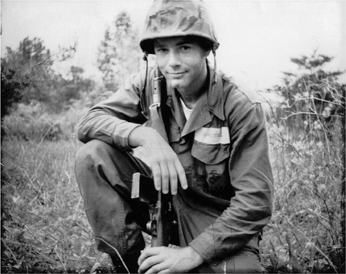
THREE
A person who has lived through a great war is different from someone who never lived through any war. They are two different species of human beings. They will never find a common language, because you cannot really describe the war, you cannot share it, you cannot tell someone: Here, take a little bit of my war.
—RYSZARD KAPUŚCIŃSKI, THE SOCCER WAR
Believe it or not, I once had a high school teacher who took us out in the woods for an afternoon in order to teach us about the war. It was … oh, God, what was it? I guess I'd say that it was completely crazy. My teacher was one of these vets that refuses to eat Chinese food, always sits facing the door in any room, always announces why he's sitting facing the door in any room, and maintained—in class—that the United States did not lose the Vietnam War. Remember Kevin Kline's character in A Fish Called Wanda,who says Vietnam was “a tie”? That was him. He taught history. This is the Midwest, right?
So he has us out there. He makes me and a few other kids Viet Cong. I think he made all the students he didn't like Viet Cong, but I was the only girl guerrilla. He sends us to one side of the woods to hide with some Ziplocs filled with rice—orange Rice-a-Roni rice that his wife made. The students he assigned as U.S. infantry he has doing some other idiotic thing. Formations or whatever. I honestly don't even remember what they were doing. But they had Spam to eat. While we're running around in the woods with our Spam and Rice-a-Roni, he begins his lecture about the disadvantages Americans faced in Southeast Asia. The guy did this with his history classes every year.
My dad was a medic in Vietnam, and when I told him about our field trip he got this very sad look in his eyes. He sat me down and talked to me, for the first time, about the war. What did he tell me? Well, he said that war, all war, was basically cruelty and anyone who sought to justify it, or explain it, or rationalize it, was not worth listening to. We had this huge talk. My father had never opened up about the war before. Vietnam had always been this black hole or forbidden zone. Later I told my mom about what he'd said. She was shocked. He'd never really talked to her about it, not once in twenty-five years of marriage. Of course, little things came up, but nothing like what he told me. Can you believe it took this moron at my high school to get my dad to talk about it? I think it offended his sense of honor or something. Maybe that was the only good thing about that war. For all the men it made like my high school teacher, it made men like my father too. He was the gentlest person I've ever known.

Do I hate Americans? I know why you ask. Because now I'm a little angry while I'm talking to you. You know, I'll be honest and tell you I do hate them a little. A little. Not all Americans, but many. I think you hate us a little too. Why do I hate them? I hate them because they think they have suffered. A lot of them come here and they cry, but they forget what they did. I've seen this many times. But have they really suffered? Okay, yes, that's true, but not like us. My brother suffered. My mother suffered. My other brother died. My uncle died. They never found my father's body. Do you know how many members of our Party lost wives, sons, and daughters to American bombs? In our government there are many such people, and now they must welcome your country's investments. Have you thought about that? Would you want to do that?
You said yesterday you were surprised by how little anger you have felt here, but there is anger within all Vietnamese who were alive then. Most of us can let it go, some of us can't. Often I can. Most often I am able to do my job and smile and be a good person. But if I think of my brother long enough I am not such a good person anymore. How? He was hit by a bomb. My uncle too. No, different bombs. I don't blame you. It's not your fault. Do I blame your father? Did he drop the bomb? He was a Marine? Well, no, probably he didn't drop the bomb. I don't blame your father. I guess there is no blame.
Today I don't have any work, so I drink beer and smoke cigarettes. My days are very long. What was my brother's name? Triet. Yes, Triet. Today my little brother would be thirty-four years old.
For some reason I was always sad when I was growing up. I wasn't a good student, either. I had trouble with other kids. I fought, stole, and did a lot of other bad shit. Something always seemed to just eat at me. Now that I'm older, I think a lot of this had to do with my dad.
When he wasn't drunk, he was getting drunk. There were some serious drug problems when I was a kid, actually; he may have spent a few nights in jail. My dad couldn't maintain human relationships, for one thing. He had so much fury in him. It's an odd word to use, but I think it's an accurate one. Fury. Hate. Distrust. It came out in all different ways, but it was always totally undirected, though he was absolutely racist against any and all Asians. When he didn't have anything to do, he would walk around with panic in his eyes. He could never be alone. But no one could really stand being around him for long either. That should suggest some of my father's ongoing problems. But I love the guy, despite it all.
Who really knows how much of this is attributable to Vietnam? I'm not even sure how much combat he even saw. But from what I've read, that wasn't a big consolation, considering that at certain points in the war you were as liable to get killed at your desk in Saigon as you were out in the jungle. He's gotten better in the last few years. Better, not good. I doubt he'll ever be good. Good is not really within my father's potentiality, if you know what I mean. I could blame Vietnam for that. Sometimes I do. But in the end I don't know.
Mostly I remember bombs falling, airplanes coming. I remember always moving. My father was political. He was a farmer, then he was VC. My mother was not political. My brother was not political. We were poor. We were chased out of our home many times. Sometimes by the VC when my father was gone, sometimes by the bombs.
I remember, as a little girl, not believing I would survive. I remember that: thinking, “Tomorrow, I will die.” Can you imagine? Later when I went to the United States to study, many professors asked me, “Why do you want to come here? Don't you hate Americans?” I said, “Behind the soldiers, behind the governments, there are always hearts, families, memories, childhoods, pasts.” I wanted to know more about the people behind those U.S. soldiers. I wanted to learn about American culture. So I told those professors that the United States was not just for Vietnamese refugees. Communists are people, too!
I started to read short stories about the war, stories by American authors. I don't really like them, no. I suppose because I never recognize the war in those stories. The war in those stories…. That was not my war. My war was my mother crying, my brother crying, always moving.
When I was in fourth or fifth grade, I found a section of the library that had a bunch of books about the war, and there was this one that had diagrams of booby traps and pictures of dead people and all that other bad stuff. I was very interested because I knew my dad had been there and I wanted to learn more about it.
My dad was a helicopter pilot for the Navy. I remember that this was something we all thought was very cool growing up, and my dad was proud of being a pilot. He loved to fly. In Vietnam he picked up wounded people and dropped off SEAL teams on covert operations, people going in at night, stuff like that. He had Purple Hearts—I think three or four. He crashed a couple of times. He was never seriously wounded, though. He was very dismissive of his Purple Hearts. He didn't show them off or anything; he didn't wear them around. I just found them in a box one day.
He didn't really talk to me about what happened to him, but there was one fantastic story—I say “fantastic” not in the positive sense—I remember hearing from my older brother, who my dad talked to more about the war because he was older. Anyway, one time, while he was flying in the middle of a firefight, the communications wire on my dad's helmet was cut by a bullet. The other guy could hear him, the next minute he couldn't. At the time, it sounded very exciting. When I was growing up, the way the war was talked about, or even not talked about… you internalize all that stuff. I don't think my dad, to this day, could bring himself to say that the war was a bad idea or that we were wrong to be there. No, I don't really know when I forged my own political ideas about it. There wasn't a whole lot of guidance from him.
I can sympathize, in some sense, with what it must have been like at the time, why we got involved. My dad's father fought in World War Two, and thus he grew up in a very patriotic household. He thought the United States could do no wrong. So when he volunteered he was just a kid who didn't understand what he was getting into. It's hard for me to point fingers about what part he must have played in the war. I'm not ready to do that.
A really weird thing happened a couple of years ago. I was visiting my grandparents, and they were giving away everything they had, and there was this little box of stuff my dad had sent them from Vietnam, and inside were some audiotapes he'd made while serving. I never knew these things existed, so I snatched them up and took them home. It was so bizarre. He recorded them at exactly the age that I was when I was listening to them. There he was sitting in this base and you could hear mortar shells, all these explosions, in the background. He had just come back from a mission, and I could hear the fatigue in his voice. He'd gone for two days without getting more than fifteen minutes of sleep. They were taking fire, and he was very blase about it. For the first time I thought about all the suffering he must have seen. He just sounded so tired. Not at all like the person I would know later, the guy who would endlessly justify the war. He was instead this exhausted guy who sounded so incredibly confused and weary, so completely unsure.
When my father turned eighteen, he got drafted. He had no choice. He was in the South, he was drafted. I think at that time my father had no idea about the war: one day, suddenly, he was holding a rifle. He was married during the war. His first daughter was born in 1967. In 1969, another daughter. Then another in 1972. He got very nervous. What if he died tomorrow with no son? He got a desk job in Saigon to avoid getting killed, so then they had me—that's all he's ever said to me about it.
I think my father doesn't tell me much about the war because of all the difficulty he had after. The Communists were very bad to him. When I was ten, he beat me because of the stress. He even beat my mom. But you should know that I think Ho Chi Minh was a great man. So does my father. It's very complicated.
Finally I think the war made our lives better. That's the biggest point. My father had a lot of GI friends, and he learned many things from them. He learned how important education was. Even the lowest-ranking American soldiers had gone to high school. Do you know he learned to read English because that was the only way he could read the canned food that came from America? He would want chicken, but he opened beef, or pork. So he had to learn how to read. He always dreamed of settling down in America, but he failed the exam at the U.S. Embassy in Saigon. It was like the sky collapsed for my father. He had saved so much money for that.
He used to talk about things that were made in the U.S.A. That was enough for him: if it was made in the U.S.A., it was good. So I think he was very amazed by those soldiers who came here. They had nice food, good cigarettes, clean hair. They even waited in line for everything and never pushed. My father used to dream about America. He is still dreaming about going to America—but now he is so old.
I think when my dad heard he was going to Vietnam he bought into the whole thing about war: “It's exciting, it's different, it's valiant!” But he always told me that from the minute he got there the most important thing to him—aside from anything that we think was important now, like stopping Communism—was that his men didn't get hurt in any way. Even when it became clear that there was no sure reason why they were there, they still needed to get home, and it was his job to get them home.
Do I feel like less of a man because I didn't go through that? When I think I'm having a bad day, I realize that I've not had a bad day. There's not one single issue in my entire life that compares—and I've even had a gun pointed at me. (It was on a sales job. In Texas. A shotgun. Long story.) At some point I realized that I was alive because he had dealt with problems greater than I had ever dealt with or was going to deal with. I'll give you a quick story. After he had reconnected with his Marine buddies in the late 1980s, he had them all up to Connecticut, up to the house, and I think I was disagreeing with him about something while we were barbecuing—a “Will you go get the lemonade?” type of thing— and this guy B———, who was a New York City cop, pulled me aside and said, “Your father was a different man over there. Every single one of us has him to thank for being alive.” I was like fourteen. And I was arguing with him. About lemonade.
My dad's situation in Vietnam sucked, on an exponential level, but he was able to deal with it. So in a way Vietnam was the only thing I really knew about him. It was the only past he had. He had no youth other than the Vietnam War. When he had a story to tell, it tended to be about the guys, the situation from Vietnam. Those were all his stories. That was all he had.
Do you see this river? It separated my country for twenty years. Yes, we can walk to the other side. You asked about my family. First you must know that it was illegal for family members on different sides of this river to talk. My father went North and my uncles joined the ARVN, so you can see that in my family there were difficulties. In this province, Quang Tri province, there were many families with these difficulties. I think Quang Tri province suffered more than any other in Vietnam. Most of the Agent Orange victims are here. There were so many dead bodies around Quang Tri that tigers used to eat them. Brothers and sisters fought against each other in these fields every night. Sometimes they killed each other. I read a story about that once: one man discovers he has killed his older brother, and then he kills himself. Then their mother kills herself when she learns she has lost both of her sons. A terrible story. Well, it's a Quang Tri story. The man who wrote it is from Quang Tri.
One night, long after the war ended, my father and my uncles talked and learned that they all fought in the same battle in 1974. They may have shot at each other. No, I don't think they thought that was funny. I think it made them frightened and sad. It took them many years to become friends again—at least ten years. One of my uncles was reeducated, and for a long time he refused to talk about anything related to the war. My other uncle became a drunken man. They will all talk about it now only when they're drunk, and only when they're alone. That's why I decided to study history, to learn about both sides of my country. But it's very difficult to learn about the southern side. I've had to ask my friends in France and America to bring me books about that.
The only thing I can remember being said about the war when I was a kid was when we saw the fireworks at the Mall in Washington, D.C., on the Fourth of luly. My dad said there was a firework he liked because it reminded him of the sound of artillery. And once he told me that in Vietnam someone in his compound had a tame skunk as a pet. Literally those are the only things I remember him telling me when I was a kid. And this was in the 1980s, when all those movies started showing terribly traumatized vets. My dad wasn't at all like that. He was still an active-duty soldier at that point. My impression of him as a soldier was that he went to the office, carried a briefcase, occasionally traveled to Israel or Turkey, and brought me back stamps. Very different from my brothers. They know all about it.
It's not like it's a forbidden subject. It's just that I never had any curiosity about it when I was a kid, and I never thought to ask. I have to think this is because I'm a girl. My dad served two tours, both before I was born. First he was with the First Cav doing intelligence, usually enemy interrogation. The second tour was with MACV. Of course I think about the fact that my father may have done stuff that encroached upon the morally disturbing. I think about it a lot now. During all the Abu Ghraib stuff I thought, “Oh, yeah. My dad sort of knows something about that.” His take on it was that it signified a failure in the chain of command, basically. He said, “There are always going to be some sadists in there, and my job was to weed those people out.” He told my husband—not me—that one of his strategies when interrogating people was to take out a big knife and threaten prisoners with it. He said he had to come on very strong, right away, if he wanted information, because the people he was interrogating figured out pretty quickly that he wasn't going to use the knife. When my husband told me that, something clicked. The way he dealt with us growing up when we got in trouble was like: explosion! He'd just blow up, get totally furious, and then, as soon as he'd made his point, he'd calm down. So it's like those tactics carried over, which is kind of spooky. It was hard to reconcile that with the impression I'd always gotten—and this may be very naive—that to my dad Vietnam was this extended Boy Scout expedition. See, he's very upright. He's that kind of guy. He loves nature, rules, proper procedure.
He did once admit to me, though—and it's amazing what's coming back now that I'm talking to you—he did once admit, “We Americans did terrible things, and the Vietnamese did terrible things.” But no, Vietnam doesn't have much resonance to me—at all. Vietnam has not loomed over me. I don't feel like there's something I have to settle there. I don't know that much about it and don't feel any need to know much about it. But you know what? I wonder if it's because I didn't ask my dad about the war that I don't know anything, or because maybe there was a part of him that liked having this one person in his family who had no conception of him in that role.
We weren't lucky. My father was drafted into ARVN and told me he never saw a Communist until the tanks came into Saigon. He tried to get out, but he wasn't lucky. Maybe we could have gotten out, but my mother didn't want to go. So we stayed. It's not that unusual. Why do you want to talk to me? I have nothing to say. We were just unlucky.
My father was reeducated for one year. After, he never talked about the war. He also never worked again, not a real job. My parents were very poor after the war. They still are, and I have to help them. That's why I do this work. No, they know what I do. It makes them very unhappy. Sometimes I like it. Sometimes the men are kind.
For me, what I think—what I think is that the war was like a thing that happened to us, do you know? Like an animal that attacked, or a storm. It took my family and pushed it in another direction and made it different. Everyone in my family has always been very sad. But nothing terrible happened to us, not really. We're not special. The worst my father was ever hurt was when a jeep ran over his foot. And yet the war changed everything for him, and us. I think that is so strange to think about.
As far back as I can remember, the war was who my dad was. He was in the Army. I think he was an infantryman. First Cavalry. I think. I don't really know any specifics because he won't talk much about it. Well, he would tell stories. And I always wanted to know, because as his daughter I was obsessed with this aspect of who he was. I was also obsessed with war movies—any war movie. Totally obsessed. In sixth grade we all had to do reports on something: space, Columbus, George Washington. I did mine on Vietnam.
The stories he would tell me were always very innocuous human interest stories. Like how when he was eating in the field the flies were so big and so numerous that he always had to brush them off his food or how the Vietnamese cut up snakes and ate them. As for the details of what he did, all I had to work off were the newspaper articles. They told the story about how he got the Silver Star. Yeah, he got the Silver Star. He and his buddies were in a situation in which they were overrun and his commanding officer was shot down while running up a hill toward the enemy. When the commanding officer went down, everyone started retreating. But my dad didn't, even though he had the radio on his back, which made him a target. He went back, by himself, and took out multiple foxholes filled with Vietnamese and went up and grabbed his CO. and dragged him back down. The guy died, eventually, but my dad tried to save him and while doing that single-handedly killed a bunch of people. The other newspaper story described how he was injured. He was actually pretty seriously injured. He was shot between the eyes, but the bullet exploded as it made contact with his face. Obviously if it hadn't he wouldn't be here and I wouldn't be here. His face was just blown apart. His nose today is plastic. His whole face was reconstructed. Anyway, after he got shot in the face, a medic bandaged up his head and put him in a helicopter. That helicopter got shot down. So he was on the ground next to a guy who'd been shot in the spine or something and couldn't move. But he could see and speak. My father could move and hear but he couldn't speak or see. So he was holding a gun and the other guy was sprawled next to him—they were all alone at this point; the pilots were dead—and the other guy started giving my dad the time on the clock. “Nine o'clock fire! Eleven o'clock fire!” And the two of them stayed together that way and managed to hang in there until someone came for them.
I have these monumental stories of what he did. It's hard for me to reconcile the man he is today with these superhuman stories. I wish I knew the man in those stories. We don't have a relationship now. We're estranged. I told him I couldn't speak to him anymore. He's just got too much hostility and aggression. No one in his life is ever good enough. He's really fucked up. He blames it all on the war and says he has post-traumatic stress syndrome. Personally, I have a hard time understanding this. He was a much different person ten years ago, fifteen years ago. I don't know why there would be such a delayed reaction to what he experienced. But maybe that's the way war is. He's been such a huge influence on my life. He was the parent I was closest to when I was young. He's the one who's been the best to me and the worst to me, out of anyone in my life. I've always believed that if I can somehow understand who he was then—that wonderful and brave and shiny young man—and figure out what's different now, and how those two people connect … God, I don't know. I just want to know that person so badly.
I was born in Hanoi on the first night of the Christmas bombings in 1972, and my dad was a very traditional Communist. In the war he was a communications soldier, not a frontline soldier. He doesn't talk about the war with me, but he's the kind of person who would have done what the others did. I don't know if he really wanted to fight. He still thinks that Americans are very dangerous. He thinks we must be really careful around people like you. When I had a job with an NGO, he asked me, “Where is the headquarters?” I said, “New York.” He said, “I don't want you to work for them. If you work with them, you must be really careful.”
I can understand his feelings. We were so poor after the war. When I was a girl in Nam Dinh—that's a very Communist province and one of the poorest—the conditions were terrible. We had a one-room apartment in a dormitory. No bathrooms, no kitchen, just one room. We had to share restrooms with two dozen other families, and there was rationed water and meat. I don't know how much we earned every month, but like everyone we usually ate noodles and rice powder. And my father was a Party member!
My feelings about the war? What I really think is that the war was about two small groups. The group here in Vietnam is the people who called themselves Communists. They raised that flag and told the people, “Go, go—fight for freedom!” But what is freedom? I think “freedom” is just for their benefit. A lot of my friends are teachers, and now their students are asking them, “Why didn't we just let the Americans own the country? Why did we have to fight? After ten or twenty years, they would have had to give us everything back, and we'd have such better conditions!” So I don't like the war. I don't like the way many people here—in my opinion—take the war and say it was for everyone when it was just for some people.
Does my father know about all the Communist abuses? Sure, he knows. One day I brought home a banned book, and I showed it to him. I asked him if he wanted to read it. He read some pages and gave it back to me and told me, “I know. I know all of this. There's nothing new in this. Everyone knows. And no one cares. I don't care. You shouldn't read this—it's too dangerous.” If you lived in the North and you didn't want to be a Communist and you didn't follow the Party, then what did you do? If you wanted to survive, then you needed your monthly Party ticket. Tickets for meat, for milk, for bicycle tires. Everything was in the Party's control. If you didn't go with them you had nothing. So you had no choice. There was no thinking. And they controlled the war. They still control it.
I have this very old friend in Hanoi. He's eighty now, and he has red blood, just like my father. He's red. Totally red. I asked him once about the Party, the war, and everything that happened afterwards, and he said, “From the bottom of my heart, we didn't want to do any bad things. We tried to be good. But it all became such a mess.”
That's my father right there. No, I've been here before. The first time I was here was right after it was dedicated. I guess I was twenty-one or twenty-two. If you recall, there was a lot of debate about whether or not this was a fitting or suitable memorial to the men who died. The stark-ness of it freaked a lot of people out. I mean, look around here. Statues, huge towers, domes: that's heroism, that's sacrifice. This is just a big scary wall with a bunch of names written on it. That it was designed by an Asian woman did not, I suspect, help matters. Yeah, I think I was a little troubled by it the first time I saw it. Now I can't imagine any better monument. I mean, look at it. It's just beautiful. It's perfect. It's probably the best memorial in the country, in my opinion.
I think about what my father would have thought about it sometimes. I was ten when he died, so I can't really say I have much of a sense of him beyond what my mom has told me or the letters he wrote me. Since he was writing those letters to a little boy, I don't know what his politics were or what he truly felt about the war. My mom's pretty liberal—she actually spoke out against the war after he died, and I think he probably would have not objected to that. I don't know. When someone you love dies, so much of your memory of him becomes really wishful. I try to avoid thinking about his true feelings, actually. Sure, I still have all those letters, but I haven't read them in years. It's not painful anymore, no. It all feels like it was a long time ago.
But growing up without a father was definitely hard, and even today there are things that I experience that produce this strange impulse to call him and tell him about it. I can't explain that impulse. God, I even remember looking for him in the bleachers when I graduated from high school. Maybe a child is hardwired that way, or somehow psychologically determined to have parents. If he'd lived, he'd probably still be alive today. So that's kind of bittersweet.
How did he die? Of friendly fire, in an accident. He was hit by artillery. Seven other men died with him. I've become pretty close with the kids of some of those other guys. We send one another Christmas cards, birthday cards. You try—I try—to avoid thinking about the war, any war, in terms of the sheer human waste they create, but look at all these names. My dad's just one name, one tiny name on this wall. And looking at it at this moment all I can think is “What a fucking waste.”
I always say to foreigners that my father was not VC. “Not VC! No, not VC! He was a good man. He was in the southern Army.” The truth is that he was VC. My mother hardly saw him for five years. One day the VC came in and took him. After that we heard very little from him. Sometimes we saw him but never for long. The VC took many men from our village. Some of them didn't want to go with them, some of them did. My father did. He was religious, and I think he believed it was his fate to fight. I had a father, but I don't know my father. I never knew my father. Do you know what I mean? He died five years ago, and I wasn't that sad. Who was my father? He was just a man who lived in our house.
My mother always said to me he was not the same when he came back. I was one when he left, seven when we reunified. My mother told me that sometimes when she woke up he would be sitting on the edge of the bed, holding his head in his hands, crying. We lived in the countryside, and at night it was quite loud. He couldn't sleep because of the noise of the countryside—the grass, the river, the insects. It reminded him of too many bad memories. But he never talked about it. He never really talked about anything. I don't know why. Maybe no one really talked about it because that generation all suffered so much. But I think my father saw and did awful things. The war took too many fathers and made them strangers to their families.
My father dodged the draft and fled to Canada. My mother went with him, and I wound up being born in Montreal. Eventually he came back, was prosecuted, defended himself—and won. That decision became the basis of President Carter's pardon for everyone who dodged the draft. I think the Vietnam War really drove my father's generation crazy, in a way. My dad, when he was a kid, had his “I Like Ike” buttons, so he grew up with one image of America and then had that image crash against the whole experience of the Vietnam War. He didn't go and bomb things or anything like that—he became a totally different kind of radical— but he essentially came to believe that the society he grew up in is a complete lie.
As a little boy, at the playground, I'd hear kids say, “My father is a lawyer” or “My father is a fireman” or “My father owns a store,” and I would say, “My father is an American traitor!” As if that were the most honorable thing you could be. I remember these times when I'd sit with my mother, looking through our family scrapbook. See, when his case was up, there was a television documentary made about him and Time and Newsweek did stories, so we had this huge scrapbook. My mom would say, “Now, here's your daddy being taken off to jail.” This was our family heirloom. But she was proud of it, and my father was proud of it. And I'm proud of it. I think he did the right thing. But I also can't have conversations with him when it comes to international issues or foreign policy without being pulled inexorably back into the orbit of Vietnam. Everything is looked at through that lens. I guess what I'm saying is that I was so indoctrinated into my family's way of looking at the war that only later did I ever even come across the idea that there was any meaningful debate about it.
For too long Vietnam didn't mean anything to me. Vietnam for me was a symbol, a code word, the thing that had thrown our family into the footnotes of history. In a way I criticize my father a little bit for that. As much as he didn't want to be a part of the war, and as much as he felt that what was happening to the Vietnamese was immoral, he didn't want to deal with Vietnam too much. He never learned that much about the history, the politics. I know vastly more about Vietnamese history and politics than he does. All he knows is that it was bad and he didn't want any part of it. Now that I've been to Vietnam, I realize everything is so complicated. The last time I was there I met Nguyen Cao Ky, and I found myself having a lot of sympathy for him and what he was trying to do as a Vietnamese patriot. I think Ky was deeply wrong and misguided about many things, but once you really wrestle with the war, solid notions of right and wrong seem incapable of capturing it.
Understand that I make clear political and moral distinctions. I still think it was wrong, but I have come to believe that maybe my dad recognized that in order to maintain the consistency of his opinions it was better not to know too much about Vietnam. So many people, once the war was over, once the choppers left Saigon, thought it was all done with. They do not know what happened to Vietnam after, and they don't care. I mean, they care. My father cares. But he doesn't care enough to know. I think caring enough to know makes it difficult to have the absolute moral high ground. Even Neil Sheehan. A Bright Shining Lie is a great book; it really does illustrate the weird American delusions that drove our foreign policy, but in his next book, which is about going back to Vietnam years later, you really begin to see the failure of the 1960s generation in dealing with this next step. They can only blame the way Vietnam is fucked up on the lingering aftereffects of the war, as if there is no agency among the Vietnamese themselves.
At a certain point I think my father's generation put the Vietnamese into the role of pure victim in such a way that it became intellectually stifling. So as a member of a very different generation, going to Vietnam was personally important. I felt like I was completing a project. I felt some need to both live up to the ideals of my father and the pathos of his generation and at the same time overcome those ideals and that pathos.
I never really pushed my parents on it. It was their version of the war, and I accepted it. You know, that the South would have won if the Americans hadn't pulled out. I should have asked them more about it. There's a lot that I probably should talk to my parents about, but I still haven't. How do they feel about my living in Vietnam today? I don't think they can accept what Vietnam is now. They can't accept that anything good can happen here. Vietnam has to be bad. When I was growing up, the whole Vietnamese thing was just kind of there. I didn't have Vietnamese friends. I liked Vietnamese food, but that was about it. My parents thought we were racist against Vietnamese! But my mom told me before I came over, “Don't trust anyone with a northern accent.” Which is unbelievable.
What does the war mean? For me, the war is what made me into a Vietnamese person brought up with Vietnamese values in a culture with American values. But no, there's no war inside me. I don't think so, at least. When I came back, it felt like the right thing to do at the time. The third day I was back here, everything felt good. Two years later, I'm still here. That said, I usually don't tell people, unless they seem like they're honestly asking, that I grew up in the States. You get such a huge range of reactions. I usually tell people I'm Korean. But I was very lucky to get out. We got out the last day. But I have no memories of that. I was eleven months old. That was the defining moment of my life, but I don't even know what happened.
My dad was a doctor, a ranger. He wasn't the guy fighting; he was patching other people up. But he was always proud to be a ranger. Beyond his pride, I never heard much about what my dad did. Once—I had just turned twenty-one—a bunch of my dad's friends from his ranger days got together in Houston in a very Vietnamese restaurant. They were all talking, and I suddenly saw my dad drinking beer the way you see Vietnamese men drink all the time here, and for the first time I heard stories of how my dad was running around the battlefield, being covered by these drinking buddies, while he saved people's lives. You need to realize that these weren't guys my dad hung out with typically. Most of his friends were doctors. These were different men. It was weird. But no, I don't have any lingering anger for the Communists. I think they're fucked up for reasons that are beyond ideology. It's just incompetence and no different from any other place where a small group has power and wants to serve its own self-interest. This is not my personal resentment, understand—it's an extension of my father's resentment. But it's not something I walk around Saigon thinking about.
The really fucked-up thing is that my dad's older brother was an officer in the North Vietnamese Army, and he has a son in Saigon. I know them. I met them the first time I came back. My uncle had passed away right before. This is all so messed up. My dad had two older brothers who died fighting the French and a sister who died fighting the French. She was one of those girls pushing a fruit cart around launching grenades out of it. So my family came out of that very rare ARVN few who fought the French. Anyway, my father and uncle never reconciled. I barely even knew he existed until right before he died. And then all I ever heard was how evil my uncle was. When I came back, my uncle had just passed away and my aunt and cousin were sitting there talking to me, and it turned out that my uncle had written a letter to us—I never saw the letter—but it was very apologetic, saying this never should have happened, it should have never divided our family like this, and when the letter came around to my father he refused to read it. Keep in mind, my uncle was dead. My dad still refused. My uncle protected everyone on my mom's side that was still here, even though he wasn't related to them by blood. Without my uncle, so many in my mom's family would have gone through hell. My uncle was a good officer, and really cared about my mom's family—a really fine man, it turns out. I would never hear this from my father. It all came out later.
But I don't know. I don't know what all this is, or means. I need to figure out Vietnam for myself. Do I have any reaction to Americans whose fathers fought here? No. I told you I don't think about the war. It's abstract to me. It's not even an issue.
My dad didn't talk about it very much when I was growing up. I always knew he was a Marine and was proud of that—that's part of what made me want to be a Marine—but his experiences over there weren't shared with the family. He's part of the reason I'm here in Iraq, sure. Not all of it. I used to work at a gas station in high school, and the Marine recruiter regularly filled up his government vehicle there. I talked to him a lot, just as a friend. He never approached me about being a Marine. I talked to him one day as I was nearing the end of my high school education—and that was it. I entered the Marine Corps in 1990, as an enlisted aviation mechanic. For the next twelve years I worked through school, graduated from S———1——— University in 2002, applied for my commission, and here I am today, a lieutenant leading Marines.
No, my dad never got that far, and I'll tell you how I learned that. After I was already a Marine, I was stationed in Hawaii, my dad came and visited, and we were having dinner at a friend's house. The subject came up that my dad was a medically retired lance corporal. At the time I was a corporal myself, so everyone at the table got very curious, naturally. We all asked, “How did you become a medically retired lance corporal?” He looked right back at us and said, “I stepped on a land mine in Vietnam.” Then tears come to his eyes—which was hard, very hard, to see. Since coming to Iraq, I can sense a little bit of kinship there, between us, and maybe it will open up a little more when I get back.
I don't think I could compare the two wars at all. Or at least I haven't really analyzed what the comparison is. I don't have any ideas of what to think about there. But I can definitely relate to my dad's … well, there are some things that I would prefer not to talk about when I get back home. So I definitely can relate to him there. Maybe I can talk to him about it, and maybe that'll open up and he'll talk to me a little more about what brought him to tears that day when we were at my friend's house.
Now I talk to him pretty regularly. I've called him a couple of times at work. The first time I did it, my mom said that it made his day. I've done it several times now. Look, I know Vietnam was a profound event in American history. And sometimes we're called to do things that are not necessarily the most popular decision, the popular choice, but as Marines, as servants of our country, we're called to do those things and sometimes what we think about it doesn't matter.
I am nervous to talk to you. Not nervous. I am reserved. Because I have many things to say. I remember everything. And what I remember is terrible. We still have many problems here. I was born in 1968. For those Vietnamese born during that time … things happened to us, but it is not good to talk about it. I can give you background. Please do not record me. My father fought in the southern army. He was an important man. He was wounded in 1974. He never left his bed again. He died in 1976. Now I cannot get a job here in Saigon. I don't know if it's because of my father. Maybe. Maybe it's because I'm from the countryside. I speak English, but I can't get a job. And now I'm not so young. I work for the veterans sometimes, when they come. I love the veterans. I love to talk to them. The U.S. veterans. I have veteran friends in many states. They are such good guys. It's important they come back here.
I think I like them because they remind me of my father.