
CHAPTER 6
As the sky lightened behind them the Marines of 3/3 looked westward past the bows of the ships at the dusky coastline. The sun was not yet over the horizon. In the early morning light the shore appeared so dark as to be almost black but for a narrow strip of silvery surf dividing land from the sea.
The first command came, “All Marines lay up to your debarkations stations.” The Marines of Kilo and India companies filed down into the well deck of the USS Cabildo and packed themselves into the amtracs with a minimum of confusion.
When Commodore McKinney issued the traditional command, “Land the landing force. Away all boats!” the landing craft splashed into the South China Sea, one at a time, and swam away from the mother ships. The Marines could hear bombs bursting ashore as fixed-wing aircraft prepped the helicopter landing zones.
The hatches in amphibian tractors leak, so when the vehicle Pfc Glenn Johnson was in came down the ramp of the LSD and hit the ocean, water poured in through the rear hatch. The landing ahead was momentarily forgotten as the Marines all shifted forward a bit to keep from getting wet.
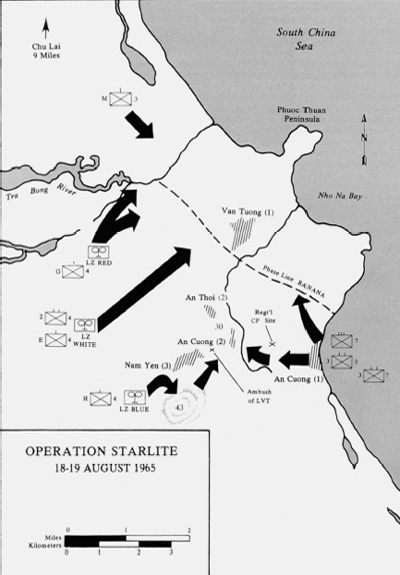
Low in the water and coughing clouds of blue exhaust smoke, the tractors circled until they got properly aligned. Captain Bruce Webb’s India Company was in the first wave, on the left, and Capt Jay Doub’s Kilo Company was on the right.
Once in place, the amtracs moved out together toward the beach, temporarily streaking the sea with wakes of white, foamy water. Most of the troops remained calm during the noisy, cramped ride to the objective. There was no sense of foreboding; they had done this before.
As the amphibian tractors moved steadily toward the shore, a flight of Marine aircraft strafed the beach in front of An Cuong 1, 3/3’s first objective. The decision was made at some higher level that the beach area not be bombed, because of the possibility of causing civilian casualties in the village.
The edge of the sun finally burst over the horizon and illuminated the objective area. The heat was already building toward the compression-chamber steambath that sucked up energy and purpose.
The VC opened fire with rifles and automatic weapons. Dutch-born Cpl Jake Germeraad, an 81mm mortar section leader, watched as an amtrac crewman came down out of his hatch for a moment. A Marine who was curious about what was going on moved up into the crewman’s seat and stuck his head and shoulders out to take a look. He was immediately shot through the shoulder and fell back into the tractor, spurting blood. The wounded Marine had collected a Purple Heart Medal sometime before under questionable circumstances.
Many Marines were superstitious about Purple Hearts. They thought that if they accepted one they did not truly deserve that they would earn it later by getting hit with a serious wound. This incident did nothing to dispel that philosophy.
As the amtracs neared the beach the Marines went through last-minute mental checklists, conscientiously going over their gear and thinking about their assignments.
Lance Corporal Chris Buchs looked up out of one of the hatches in his tractor at the rising sun. When the vehicle slowed right before it reached the soft sand of the beach and nosed slightly upward, Buchs and the other members of Cpl Robert O’Malley’s squad locked and loaded their weapons in preparation for rushing out as soon as the ramp was dropped. They did not know what would greet them.
The beach at An Cuong 1 is a soft, white, sandy shelf less than thirty meters across at most places. It runs north and south and is about a kilometer in length. It is a gentle, white crescent bordered by a dark rocky hill on the north and a stream that flows through black, rocky lowland on the south. Landward, the vegetation lies thick and green around the ancient fishing village. A few hundred meters inland, in most areas, the sand disappears and the soil becomes the familiar laterite that is the color of dried blood. On the morning of the landing, like all mornings, there were several tiny round fishing boats lying with their nets on the sand. The air was hot and still. The temperature was to rise to 95 degrees before noon and would rise to over 105 later in the day.
The amtracs, about thirty of them, came out of the water more or less on line, dropped their ramps on the beach, and disgorged Marines.
A few of the Marines did not have much experience with amtracs. Private First Class Chuck Fink of India Company was one of them. He had been among the first to board his amtrac before it left the mother ship. He thought that the ramp would drop from the rear of the vehicle after it hit the beach. He didn’t want to be the first man off the machine on a hostile shore, so he had squeezed his way up to the front of the tractor and faced to the rear. He expected to be the last man off. As his tractor came ashore and gained traction on the sand its bow pointed slightly upwards. The rearward-facing Fink was astonished and dismayed to find that the ramp was behind him, that it was beginning to drop, and that he had not only figured wrong about which end it was on, but he had to turn around before he could get off. Just as he recovered from his mistake, took a deep breath, and chased his shadow across the ankle-deep sand an explosion punctuated the activity around him.
From the ground just landward of the beach, grit and debris geysered upward in a noxious cloud of black smoke and flew everywhere. The blast was caused when Duong Hong Minh set off his command-detonated mine. It is likely that all the Marine combat power coming across the water convinced Minh to set it off as soon as he could, so he could clear out. Moreover, his instructions to fall back and protect the regimental command post colored his decision. Fortunately for the Marines, Minh’s anxiety attack caused him to detonate the device prematurely. No Marine was killed or wounded, but the blast convinced the skeptical among them that the enemy knew they were there.
INDIA COMPANY, 3/3. 0630
As the smoke and dirt cleared, Pfc Chuck Fink spotted an elderly Vietnamese running away from the beach. The man didn’t appear to be armed; indeed, he seemed to be hobbling with a cane. Fink wondered if he should shoot him. He asked himself what John Wayne would do and finally just stood there and watched the man disappear into the brush.
INDIA COMPANY, 3/3. 0645
Following a brief pause in the wake of the explosion on the beach, India Company, 3/3, shifted a bit to the south and proceeded into the brushy area beyond the sand. The company commander, Capt Bruce Webb, sent a squad to check out the source of the explosion. These Marines found a large hole with wires leading to it through a trench and on back into a cave complex. After they confirmed the origin of the blast, and found no enemy there, they commenced movement without incident through the southern half of An Cuong 1, which was adjacent to the beach.
A short way into the wooded area, the action ground to one of those halts that occur in combat while the situation is being reassessed. Private First Class Glenn Johnson and a squad went on a short patrol and discovered a VC hospital; they found bloody bandages and beds up on stilts but no other equipment. They were between one hundred to two hundred meters in from the beach at this point, and isolated from the rest of the unit. They didn’t know what to do, so they moved back to report their findings to India Company.
KILO COMPANY
Abreast, and to Webb’s right, Capt Jay Doub’s Kilo Company came ashore and moved rapidly inland. A few rounds of enemy fire snapped these Marines awake to the fact that this was an opposed landing. Lt Burt Hinson’s 1st Platoon secured and searched its portion of An Cuong 1 with little resistance. As it went through the village, Sgt Frank Blank, Hinson’s 1st Squad leader, reported seeing several VC as they ran from the huts away from the Marines. Hinson personally saw one or two dead VC on the ground.
Doub’s 2d and 3d platoons moved through the village and secured the high ground to the west, paused for a bit to check their orientation, and then moved inland around three-hundred meters.
3/3 COMMAND GROUP
The 3/3 battalion command group, embarked in flat-bottomed landing craft, followed behind the assault waves. The landing was conducted smoothly except that the landing craft carrying the 3/3 Alpha command group, including LtCol Joe Muir, became stuck for about twenty minutes on a submerged sand bar about four hundred meters off the beach. Landing an hour after low tide had a price, but this was one paid in inconvenience, not in blood.
KILO, 3/3. 0645
Lieutenant Burt Hinson kept his men going until they came up to the crest of Hill 22, a small rise to the west and a bit north of the landing area. Lieutenant Jack Kelly’s platoon was tied in on the extreme right flank of India Company, and Hinson’s 1st Squad, commanded by Sgt Frank Blank, was tied in to Kelly.
Hinson never got a chance to walk the line and see where it was tied in. While the Marines from Kilo Company were resting and planning their next activity a great deal of action started in the India sector, to their left.
Just before activity with India Company intensified, two or three amtracs, including a command tractor with 3/3’s LtCol Joe Muir aboard, somehow got out ahead of Kilo. When Captain Doub asked for a position report from the battalion command group, he checked his map and found that Muir’s group was in front of Kilo Company. Doub radioed Muir, “Colonel, what are you doing out in front of me? Are you trying to tell me that the CP group is now five hundred meters out in front of the lead company?” The amused Muir ordered Kilo forward to its next objective, and to be quick about it.
After just a few yards, the 2d and 3d platoons of Kilo Company attracted a tremendous amount of automatic weapons fire from across their front, and halted in place. Much of the fire came from another piece of high ground to the right front, and some from a trenchline to the left. This fire came from a delaying force commanded by Phan Tan Huan, who had the mission of screening the relocation of the regimental command post.
Lieutenant Hinson did not know that one of his casualties was Sgt Frank Blank, his 1st Squad leader, who was hit in the stomach and died. At about the same time Hinson’s platoon sergeant, SSgt “Catfish” Campbell, took a single round in his scrotum. He was medevaced later in the day, stitched up, and returned to the fight that night.
Unbeknownst to either Kilo Company, or the 3/3 CP group, Jay Doub’s Marines were headed directly for the 1st VC Regiment command post, which was located in the village of Van Tuong 1. The fire that greeted Kilo Company was designed to buy time and permit the withdrawal of the CP to Van Tuong 3, farther to the west, if necessary. Duong Hong Minh, who had set off the initial charge at the beach, and Huan were in charge of the force that faced Doub’s Marines. Nguyen Dinh Trong, the political officer who had inherited command of the regiment in the absence of his commander, ordered his men to pack up and prepare to move if it became necessary.
Except for one squad in Burt Hinson’s 1st Platoon, Kilo Company was pinned down by VC fire. Hinson grabbed this squad of Marines and took off after the enemy. He shouted encouragement to his men and fired his .45 at the VC as he moved. The meager force fought its way up a slope to the southeast of the village of An Thoi, about a kilometer from An Cuong 2. By driving the enemy and their automatic weapons from the crest of the slope, Hinson and his squad relieved the pressure along the entire 3/3 front. To this day he has no idea how many Viet Cong his Marines killed. He just remembers blazing away at the enemy on his way up the hill.
Upon reaching the crest Hinson saw four VC running down a path and squeezed the trigger of an empty .45- caliber pistol he had pointed at them. He was completely out of ammunition despite the fact he had gotten all those extra rounds and magazines from Staff Sergeant Bradley.
With the VC along this sector on the run, 3/3 began moving forward again. It was here that Burt Hinson was told of Sergeant Blank’s death and that Staff Sergeant Campbell had been wounded. Jay Doub later remarked to Lt Dave Steel, the battalion assistant operations officer, that he didn’t have any idea why Hinson was alive, because every type of weaponry the enemy possessed was fired at him as he led his people forward. Doub, “The Boiled Owl,” was not a person who normally got excited by something like this. Burt Hinson was awarded the Silver Star Medal for his heroic actions this day.
At the same time Hinson’s action was taking place, the reserve 1st Platoon passed through the line, assaulted, and carried the trenchline to the left. Because of the action in the adjacent sectors, Kilo Company was not able to advance any further that day, so it dug in about a kilometer short of the 1st VC Regiment command post. Huan and Minh had accomplished their mission; they had delayed the Marine advance on their command group.
LIMA, 3/3. 0730
Captain Jim McDavid’s Lima Company, the battalion reserve, and the second wave of the assault, came ashore next. That wave also included the battalion secondary, or “Bravo” command group, with Maj Andy Comer in charge. The Bravo command group vessel, an LCM-8, struck a submerged bar at high-speed, causing numerous minor injuries to those embarked because of the sudden impact. The boat was able to retract rapidly and deposited Comer’s group on dry land a little after 0730.
Lieutenant David Steel, the assistant operations officer, landed with Major Comer’s Bravo command group just as a VC machine gun low on the right of the beach opened fire. A redheaded lance corporal was talking with Steel on the beach and the lieutenant cautioned him to be careful. Within seconds the lance corporal was hit in the chest and slightly wounded. Marines quickly silenced the gun, and there was little additional fire from that sector.
THE RLT HQ COMES ASHORE
Shortly after 0730 and closely following the 3/3 command groups, the tactical control elements of the RLT-7 headquarters landed on Green Beech. By noon, when the RLT-7 command post was established a thousand meters inland, overall command of the operation shifted from Comdr William McKinney, the amphibious squadron commander, to Col Peat Peatross, the landing force commander.
Peatross could have gone in with the heliborne force, but, in accordance with doctrine, he chose to travel with the amphibious force. This permitted him to employ his command amphibian tractor’s communications capabilities and to be closest to the heavy elements of his command and his logistics base. In other words, he was best able from that location to control the battle. His command, control, and logistics organization was set up and functioning by the end of the day.