
3.
They had taken a door from its hinges at the Thompson house and placed it across fence rails to serve as a map table. Lee stood above it with his arms folded behind him, staring down. Although the morning was warm and humid his coat was buttoned at the throat, his face pale. He put one hand down, drummed on the map, shook his head, then turned abruptly and walked off to the edge of the trees to look toward Cemetery Hill.
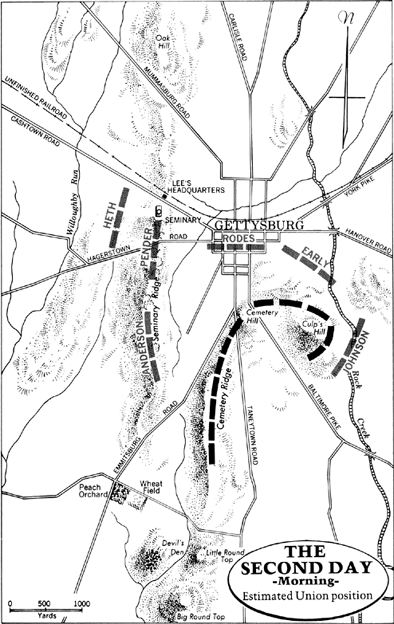
Longstreet sat gazing at the map, fixing it in his mind. Johnston and Clarke had scouted the Union position and it was drawn now on the map in blue ink. Longstreet looked down at the map and then up at the hazy blue ridge in the east, trying to orient himself.
There were two hills beyond Gettysburg: first Cemetery Hill and beyond that Culp’s Hill. The Union Army had dug in along the crest of both hills, in a crescent. From the two hills ran a long ridge, like the shaft of a fishhook, Cemetery Ridge, sloping gradually down to the south to two more hills, one rocky and bare, the other high and thickly wooded. Meade had put troops along the ridge so that his position was shaped like the fishhook, but there were no troops yet on the rocky hills.
Longstreet sat alone, a forbidding figure. He was thinking: Lee has made up his mind; there’s nothing you can do. Well. Then there will be a scrap. He took a deep breath. Ought to get something to eat.
“General?”
He looked down, saw the handsome face of Taylor, Lee’s aide.
“General Lee wishes to speak to you, sir.”
Lee was up on the rise by the seminary, walking back and forth under the shade trees. Officers sat quietly by, joking softly, respectfully with each other, keeping an eye on the old man walking back and forth, back and forth, stopping to stare at the eastern hills, the eastern haze. Longstreet came up.
“General,” Lee said.
Longstreet grunted. There was bright heat in Lee’s eyes, like fever. Longstreet felt a shudder of alarm.
Lee said, “I like to go into battle with the agreement of my commanders, as far as possible, as you know. We are all members of this army, in a common cause.”
Longstreet waited.
“I understand your position,” Lee said. “I did not want this fight, but I think it was forced upon us. As the war was.” He added, “As the war was.” He stopped and frowned, put up his fingers and rubbed the bridge of his nose. “Well,” he said. He gestured toward the north, toward Ewell. “General Ewell has changed his mind about attacking to the left. He insists the enemy is too firmly entrenched and has been heavily reinforced in the night. I’ve been over there personally. I tend to agree with him. There are elements of at least three Union corps occupying those hills.”
Longstreet waited. Lee had been over to the left, through Gettysburg, to inspect Ewell’s position, but he had not been to the right to check on Longstreet. It was a measure of his trust, and Longstreet knew it.
“I spoke to Ewell of your suggestion that he move around to the right. Both he and Early were opposed.”
“Early.” Longstreet grimaced, spat.
“Yes.” Lee nodded. “Both generals were of the opinion that an attack on the right would draw off Union forces and that they would then be able to take the hills. They insist that withdrawing from Gettysburg, giving it back to the enemy, would be bad for morale, is unnecessary, and might be dangerous.”
Lee looked at him, the deep-set eyes still bright, still hot, still questing. Longstreet said nothing.
“You disagree,” Lee said.
Longstreet shrugged. He had disagreed last night, had argued all morning, but now he was setting his mind to it. The attack would come.
“We must attack,” General Lee said forcefully. “We must attack. I would rather not have done it upon this ground, but every moment we delay the enemy uses to reinforce himself. We cannot support ourselves in this country. We cannot let him work around behind us and cut us off from home. We must hit him now. We pushed him yesterday; he will remember it. The men are ready. I see no alternative.”
“Yes, sir,” Longstreet said. He wants me to agree. But I cannot agree. Let’s get on with it.
Lee waited for a moment, but Longstreet said nothing, and the silence lengthened until at last Lee said, “You will attack on the right with the First Corps.”
Longstreet nodded. He took off his hat and wiped the sweat from his brow. He was beginning to relax inside, like an unclenching fist. Now that you knew for sure it was coming a man could rest a bit.
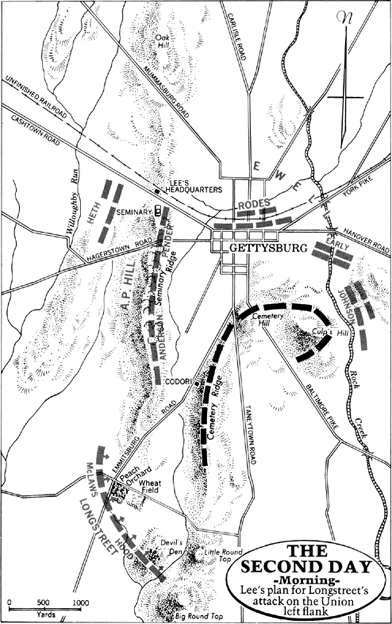
“I want you to attack en echelon, to take Cemetery Hill in reverse. Hill will support you with Pender and Anderson. Heth’s division will be in reserve. It had a hard day yesterday. Ewell’s people will demonstrate, to keep them from reinforcing against you.”
“All right,” Longstreet said. “But I don’t have Pickett. I have only Hood and McLaws.”
Lee said, “You will have to go in without him.”
Longstreet said stubbornly, “Law’s brigade is still coming up. I must have Law.”
“How long will that take?”
“At least another hour.”
“All right.” Lee nodded. His head bobbed tightly; he was blinking.
“It will take time to position the men, the artillery.”
“At your discretion, General.”
“Sir.” Longstreet bowed slightly.
“Let us go to the map.” Lee turned back toward the table. “I am suspicious of written orders since that affair at Sharpsburg.”
Back at the map table men waited for them expectantly. Someone told a joke; there was a ripple of laughter. Lee did not seem to notice.
McLaws and Hood were at the table, along with A. P. Hill. Hill had looked well in the morning, but he did not look well now. Lee bent down over the map. He said, “You will attack up the Emmitsburg Road, up Cemetery Ridge, passing in front of the Rocky Hill. Your objective will be to get in the rear of the Union Army.”
McLaws bent over the map. He was a patient man, stubborn and slow, not brilliant, but a dependable soldier. He had a deep streak of sloppy sentimentality to him and he loved to sit around fires singing sad songs of home. He tended to be a bit pompous at times, but he was reliable.
Lee said to McLaws, “Well, General, do you think you can carry this line?”
McLaws shrugged, glanced briefly at Longstreet. He was well aware of Longstreet’s theory of defensive tactics. He said pontifically, “Well, sir, I know of nothing to prevent my taking that line, but then, of course, I haven’t seen it myself. I wouldn’t mind taking out a line of skirmishers to reconnoiter the position.”
“Unnecessary,” Longstreet said. “Waste of time. We’ve had scouts out all morning. Let’s get on with it, General. I don’t want you to leave your division.”
McLaws looked to Lee. Lee nodded.
“Yes. Well, we will step off in echelon, from right to left. Ewell will wait until he hears your artillery. The left of your advance will be on the Emmitsburg Road. Your right will sweep under those rocky heights.”
“We’ll have enfilade fire coming down on us.”
“Not for long,” Lee said. “You’ll be up over the ridge and take them in the rear. When you are heavily engaged, Ewell will take them in the front.”
Longstreet nodded. It might work. Heavy loss, but it might work.
Hood, who had been silent, said suddenly, softly, “General Lee?”
They turned to face him. Lee considered him a fine tactician, and more than that, Hood was a man you listened to. He said, in that soft voice, “General, I’d like to send one brigade around those rocky heights. I think I can get into their wagon trains back there.”
Lee shook his head quickly, raised a hand as if warding him off.
“Let’s concentrate, General, concentrate. I can’t risk losing a brigade.”
Hood said nothing, glanced at Longstreet. McLaws was not quite sure where to post his division. They discussed that for a while, and then explained it to Hill. Longstreet turned suddenly to Sorrel, who was standing by.
“Major, I need something to eat.”
“To eat, sir? Of course, sir. What would you like, sir?”
“Marching food,” Longstreet said. “I don’t give a damn what.”
Sorrel moved off. Longstreet looked up and saw Harry Heth, a white bandage on his head, standing weakly by a tree, looking down vacantly to the map table, trying to comprehend.
“How are you, Harry?” Longstreet said.
Heth turned, squinted, blinked. “I’m fine,” he said. “What’s happening? Are you going to attack? Where’s my division?”
Lee said, “Your division will not fight today, General. I want you to rest.” There was that tone in his voice, that marvelous warmth, that made them all look not at Heth but at Lee, the graybeard, the dark-eyed, the old man, the fighter.
“Sir, I’m fine,” Heth said. But he could not even stand without the hand on the tree.
Lee smiled. “Of course, sir. But I would rather you rested. We will soon be needing you.” He turned back to the table. “Gentlemen?” he said.
They moved out. Alexander was off to place the artillery. McLaws moved out to join his division. Hood walked for a moment at Longstreet’s side.
“We marched all night,” Hood said. “Took a two-hour break, from two A.M. to four, then marched again to get here.”
“I know,” Longstreet said.
“Law’s people will come even farther, with no rest. It’s twenty-four miles to Guilford. He left at three A.M. When he gets here he’ll be pretty tired.” Hood squinted at the sun. “Not that it makes much difference, I guess. But one thing, General. Everybody here’s had first crack at the water. I want to round some up for Law’s boys when they arrive. They’ll be thirsty, wells may be dry.”
“See to it,” Longstreet said. “Any way you can.” He paused, watched the men around him moving into motion, men mounting horses, cannon moving past and swinging into position, the artillery people beginning to dig trenches alongside the guns. He said, “Your idea of moving to the right was sound, but his mind was set. Well, we’ll do what we can.” He turned. At moments like this it was difficult to look a man in the eye. He put out his hand.
“Well, Sam, let’s go to it. Take care of yourself.”
Hood took the hand, held it for a moment. Sometimes you touched a man like this and it was the last time, and the next time you saw him he was cold and white and bloodless, and the warmth was gone forever.
Hood said, “And you, Pete.” He walked away, thin, awkward, long bony strides. Longstreet thought: Best soldier in the army. If it can be done, he will do it. He and Pickett. My two. Oh God, there’s not enough of them. We have to spend them like gold, in single pieces. Once they’re gone, there will be no more.
Sorrel appeared with a tin plate, a steaming slab of meat.
“What’s that?” Longstreet sniffed.
“Bit of steak, sir. Compliments of Major Moses.”
Longstreet picked it up in his fingers, too hot, sucked the ends of his fingers: delicious.
“Major Moses thought you wanted fighting food, sir.”
Longstreet ate with slow delight. Hot food for a hot day. Will be much hotter later on.
Longstreet moved toward his command. The corps was to be led into position by Lee’s engineer, Captain Johnston, who had scouted the area this morning. Lee had gone off to see Ewell, to explain the attack to him. Longstreet told Johnston, “Time doesn’t matter here. What matters is surprise. We must go on unobserved. We’re hitting them on the flank. If they see us coming they’ll have time to swing round their artillery and it’ll be a damn slaughter. So you take your time, Captain, but I don’t want us observed.”
Johnston saluted, his face strained. “Sir,” he said, “may I make a point?”
“Make away.”
“General Lee has ordered me to conduct you to the field. But, sir, I scouted the Union position this morning, not the roads leading to it. I don’t know much more about how to get there than you do.”
Longstreet sighed. Stuart’s fault. If there were cavalry here, the roads and routes would be known. Longstreet said, “All right, Captain. But anything you know is more than I know.”
“But, sir, General Lee is giving me responsibility for an entire corps.” Johnston sweated.
“I know, Captain. It’s a weight, isn’t it? Well. You lead on as best you can. If you get nervous, call. But I don’t want us observed.”
“Yes, sir, very good, sir.” He rode off.
Longstreet took out a treasured cigar, lighted it, chomped it. Stuart. He ought to be court-martialed.
Would you do it? Court-martial Stuart?
Yes, I would.
Seriously? Or are you just talking?
Longstreet thought a moment. Lee wouldn’t. Lee won’t.
But I would.
The long march began at around noon, the sun high in a cloudless sea of burning haze. A messenger came in from Law: he had joined Hood’s column back at Willoughby Run. A superb march. Longstreet sent his compliments, hoped Hood got him the water. On little things like that—a cup of water—battles were decided. Generalship? How much of a factor is it, really?
He rode in the dust of a blazing road, brooding in his saddle. The hot meat had fired him. He rode alone, and then there was cheering behind him, raw, hoarse cheering from dusty throats, and there was Lee—the old man with the slight smile, the eyes bright with new vigor, revived, the fight coming up to warm him like sunrise.
“General.” Longstreet touched his cap.
“You don’t mind if I accompany you?” Lee said in the gravely formal gentleman’s way.
Longstreet bowed. “Glad to have you with us.” There was a peculiar hilarity in Longstreet’s breast, the mulish foolish hungry feeling you get just before an assault. There was a certain wild independence in the air, blowing like a hot wind inside his head. He felt an absurd impulse to josh old Lee, to pat him on the back and ruffle the white hair and tell immoral stories. He felt foolish, fond, and hungry. Lee looked at him and abruptly smiled, almost a grin, a sudden light blazing in black round eyes.
“Heat reminds me of Mexico,” Longstreet said. Visions of those days rolled and boiled: white smoke blowing through broken white buildings, wild-haired Pickett going over the wall, man’s face with pools of dirt in the eyes, sky wheeling in black blotches, silver blotches, after the wound. Lieutenant Longstreet: for distinguished service on the field of battle …
“Yes, but there it was very dry.” Lee squinted upward. “And I believe it was warmer. Yes, it was undoubtedly warmer.”
“That was a good outfit. There were some very good men in that outfit.”
“Yes,” Lee said.
“Some of them are up ahead now, waiting for us.”
And the past flared again in Longstreet’s mind, and the world tilted, and for a moment they were all one army again, riding with old friends through the white dust toward Chapultepec. And then it was past. He blinked, grimaced, looked at Lee. The old man was gazing silently ahead into the rising dust.
“It troubles me sometimes,” Longstreet said. His mind rang a warning, but he went on grimly, as you ride over rocks. “They’re never quite the enemy, those boys in blue.”
“I know,” Lee said.
“I used to command those boys,” Longstreet said. “Difficult thing to fight men you used to command.”
Lee said nothing.
“Swore an oath too,” Longstreet said. He shook his head violently. Strange thought to have, at this moment. “I must say, there are times when I’m troubled. But … couldn’t fight against home. Not against your own family. And yet … we broke the vow.”
Lee said, “Let’s not think on this today.”
“Yes,” Longstreet said. There was a moment of dusty silence. He grumbled to himself: why did you start that? Why talk about that now? Damn fool.
Then Lee said, “There was a higher duty to Virginia. That was the first duty. There was never any doubt about that.”
“Guess not,” Longstreet said. But we broke the vow.
Lee said, “The issue is in God’s hands. We will live with His decision, whichever way it goes.”
Longstreet glanced at the dusty face, saw a shadow cross the eyes like a passing wing. Lee said, “I pray it will be over soon.”
“Amen,” Longstreet said.
They rode for a while in silence, a tiny island in the smoky stream of marching men. Then Lee said slowly, in a strange, soft, slow tone of voice, “Soldiering has one great trap.”
Longstreet turned to see his face. Lee was riding slowly ahead, without expression. He spoke in that same slow voice.
“To be a good soldier you must love the army. But to be a good officer you must be willing to order the death of the thing you love. That is … a very hard thing to do. No other profession requires it. That is one reason why there are so very few good officers. Although there are many good men.”
Lee rarely lectured. Longstreet sensed a message beyond it. He waited. Lee said, “We don’t fear our own deaths, you and I.” He smiled slightly, then glanced away. “We protect ourselves out of military necessity, not fear. You, sir, do not protect yourself enough and must give thought to it. I need you. But the point is, we are not afraid to die. We are prepared for our own deaths and for the deaths of comrades. We learn that at the Point. But I have seen this happen: We are not prepared for as many deaths as we have to face, inevitably as the war goes on. There comes a time …”
He paused. He had been gazing straight ahead, away from Longstreet. Now, black-eyed, he turned back, glanced once quickly into Longstreet’s eyes, then looked away.
“We are never prepared for so many to die. Do you understand? No one is. We expect some chosen few. We expect an occasional empty chair, a toast to dear departed comrades. Victory celebrations for most of us, a hallowed death for a few. But the war goes on. And the men die. The price gets ever higher. Some officers … can pay no longer. We are prepared to lose some of us.” He paused again. “But never all of us. Surely not all of us. But … that is the trap. You can hold nothing back when you attack. You must commit yourself totally. And yet, if they all die, a man must ask himself, will it have been worth it?”
Longstreet felt a coldness down his spine. He had never heard Lee speak this way. He had not known Lee thought of this kind of thing. He said, “You think I feel too much for the men.”
“Oh no.” Lee shook his head quickly. “Not too much. I did not say ‘too much.’ But I … was just speaking.”
Longstreet thought: Possible? But his mind said: No. It is not that. That’s the trap all right, but it’s not my trap. Not yet. But he thinks I love the men too much. He thinks that’s where all the talk of defense comes from. My God … But there’s no time.
Lee said, “General, you know, I’ve not been well lately.”
That was so unlike him that Longstreet turned to stare. But the face was calm, composed, watchful. Longstreet felt a rumble of unexpected affection. Lee said, “I hope my illness has not affected my judgment. I rely on you always to tell me the truth as you see it.”
“Of course.”
“No matter how much I disagree.”
Longstreet shrugged.
“I want this to be the last battle,” Lee said. He took a deep breath. He leaned forward slightly and lowered his voice, as if to confide something terribly important. “You know, General, under this beard I’m not a young man.”
Longstreet chuckled, grumbled, rubbed his nose.
A courier came toiling down the dusty lane, pushing his horse through the crowded troops. The man rode to Lee. In this army Lee was always easy to find. The courier, whom Longstreet did not recognize, saluted, then for some unaccountable reason took off his hat, stood bareheaded in the sun, yellow hair plastered wetly all over his scalp.
“Message from General Hood, sir.”
“Yes.” Politely, Lee waited.
“The General says to tell you that the Yankees are moving troops up on the high Rocky Hill, the one to the right. And there’s a signal team up there.”*
Lee nodded, gave his compliments.
“That was to be expected. Tell General Hood that General Meade might have saved himself the trouble. We’ll have that hill before night.”
The courier put his hat back on and rode off. They rode on for a while in silence. Then Lee halted abruptly in the center of the road. He said, “I suppose I should be getting back. I’ll only be in your way.”
“Not at all,” Longstreet said. But it was Lee’s practice to back off, once the fight had begun, and let the commanders handle it. He could see that Lee was reluctant to go. Gradually it dawned on him that Lee was worried for him.
“You know,” Lee said slowly, looking eastward again, toward the heights, “when I awoke this morning I half thought he’d be gone, General Meade, that he would not want to fight here. When I woke up I thought, yes, Meade will be gone, and Longstreet will be happy, and then I can please Old Pete, my warhorse.”
“We’ll make him sorry he stayed.” Longstreet grinned.
“They fought well yesterday. Meredith’s brigade put up a fine fight. They will fight well again today.”
Longstreet smiled. “We’ll see,” he said.
Lee put out a hand. Longstreet took it. The grip no longer quite so firm, the hand no longer quite so large.
“God go with you,” Lee said. It was like a blessing from a minister. Longstreet nodded. Lee rode off.
Now Longstreet was alone. And now he felt a cold depression. He did not know why. He chewed another cigar. The army ahead halted. He rode past waiting men, gradually began to become annoyed. He looked up and saw Captain Johnston riding back, his face flushed and worried.
“General,” Johnston said, “I’m sorry, but if we go on down this road the enemy will view us.”
Longstreet swore. He began to ride ahead, saw Joe Kershaw ahead, on horseback, waiting with his South Carolina Brigade. Longstreet said, “Come on, Joe, let’s see what’s up.”
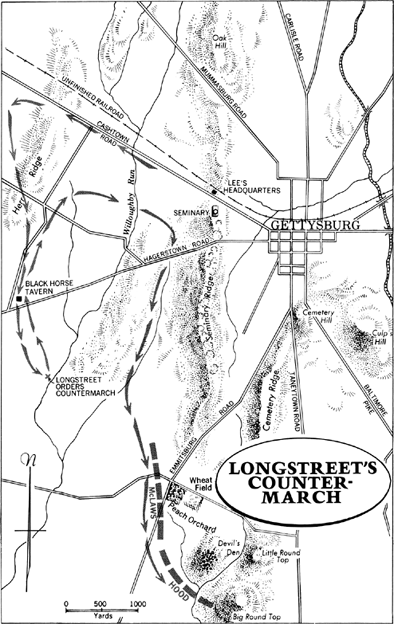
They rode together, Johnston following, across a road crossing from east to west. On the north corner there was a tavern, deserted, the door open into a black interior. Beyond the tavern was a rise—Herr Ridge, Johnston said, a continuation of the ridge leading out from town, facing Seminary Ridge about a mile away, not two miles from the Rocky Hill. Longstreet rode up from under a clump of trees into the open. In front of him was a broad green field at least half a mile wide, spreading eastward. To the south loomed the Rocky Hill, gray boulders clearly visible along the top, and beyond it the higher eminence of the Round Hill. Any march along here would be clearly visible to troops on that hill. Longstreet swore again.
“Damn!” he roared, then abruptly shut his mouth.
Johnston said worriedly, “General, I’m sorry.”
Longstreet said, “But you’re dead right. We’ll have to find another road.” He turned to Kershaw. “Joe, we’re turning around. I’m taking over as guide. Send somebody for my staff.”
Sorrel and Goree were coming up, then Osmun Latrobe. Longstreet outlined the change: both divisions would have to stop where they were and turn around. Longstreet rode gloomily back along the line. God, how long a delay would there be? It was after one now. Lee’s attack was en echelon. That took a long time. Well, we’ll get this right in a hurry. He sent Sorrel to Lee with word of the change of direction. Then he scouted for a new path. He rode all the way back to the Cashtown Road, getting madder and madder as he rode. If Stuart had appeared at that moment Longstreet would have arrested him.
To save time, he ordered the brigades to double the line of march. But time was passing. There was a flurry over near the center. Longstreet sent Goree to find out what was happening and it turned out to be nothing much—a skirmish of pickets in Anderson’s front.
They marched, seventeen thousand men, their wagons, their artillery. Captain Johnston was shattered; it was all his fault. Longstreet propped him up. If it was anybody’s fault, it was Stuart’s. But it was maddening. He found a new route along Willoughby Run, followed it down through the dark woods. At least it was out of the sun. Most of these men had marched all the day before and all the night and they were fading visibly, lean men, hollow-eyed, falling out to stare whitely at nothing as you passed, and they were expected to march now again and fight at the end of it. He moved finally out through the woods across country in the general direction he knew had to be right and so came at last within sight of that gray tower, that damned rocky hill, but they were under cover of the trees along Seminary Ridge and so there ought to be at least some semblance of surprise. Sorrel rode back and forth with reports to Lee, who was becoming steadily more unnerved, and Sorrel had a very bad habit of being a bit too presumptuous on occasion, and finally Longstreet turned in his saddle and roared, “Sorrel, God damn it! Everybody has his pace. This is mine.”
Sorrel retreated to a distance. Longstreet would not be hurried. He placed Hood to the right, then McLaws before him. Anderson’s division of Hill’s corps should be next in line. The soldiers were still moving into line when McLaws was back. He was mildly confused.
“General, I understood General Lee to say that the enemy would be up on the ridge back there and we would attack across the road and up the ridge.”
Longstreet said, “That’s correct.”
McLaws hummed, scratched his face.
“Well?” Longstreet said ominously.
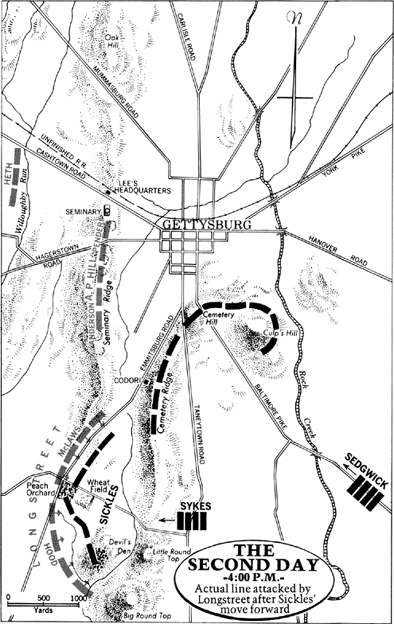
“Well, the enemy’s right in front of me. He’s dug in just across that road. He’s all over that peach orchard.”
Longstreet took out his glasses, rode that way, out into the open, looked. But this was a poor point, low ground; there was brush country ahead and he could not see clearly. He began to ride forward. He heard the popping of rifle fire to the north. Nothing much, not yet. But then there was the whine of a bullet in the air, here and past, gone away, death sliding through the air a few feet above him, disappearing behind him. Longstreet grunted. Sniper? From where? He scanned the brush. God knows. Can’t worry now. He rode to a rail fence, stared down a slope, saw a battery a long way off, down in flat ground beyond the peach orchard. Blue troops speckled a long fence. He could see them moving rails.
Behind him, McLaws said, “Lot of them.”
Longstreet looked up toward the ridge. But he could make out nothing at all. “You don’t suppose … they moved down here? Forward, off the ridge? How many? You don’t suppose a whole corps?”
He looked around, spied Fairfax, sent him off with word to Lee.
McLaws said, “What now?”
“Same plan. You hit them. Hood goes first. You key on his last brigade. That will be G. T. Anderson.”
“Right.”
Longstreet was running low on aides. He found Goree, sent him off to Hood, telling him to send vedettes ahead to scout the ground. There was not a cavalryman near, not one horse. Longstreet swore. But he was feeling better. Any minute now it would all begin. All hell would break loose and then no more worrying and fretting and fuming; he’d hit straight up that road with everything he had. Never been afraid of that. Never been afraid to lose it all if necessary. Longstreet knew himself. There was no fear there. The only fear was not of death, was not of the war, was of blind stupid human frailty, of blind proud foolishness that could lose it all. He was thinking very clearly now. Mind seemed to uncloud like washed glass. Everything cool and crystal. He glanced at his watch. Getting on toward four o’clock. Good God. Lee’s echelon plan would never work. Send messenger to Lee. Let’s all go in together. The hell with a plan.
But no messenger was available. A moment later one of Hood’s boys found him, riding slowly forward, watching McLaws moving into position.
“Sir, message from General Hood. He says his scouts have moved to the right, says there’s nothing there. Nothing between us and the Federal train. He suggests most urgently we move around the big hill there and take them from the rear.”
Longstreet sighed. “Sonny boy,” he said patiently, disgustedly, “you go back and tell Sam that I been telling General Lee that same damn thing for two days, move to the right, and there aint no point in bringing it up again. Tell him to attack as ordered.”
The young scout saluted and was gone. Longstreet sat alone. And there was happy-eyed Fremantle, dirty and cheery on a ragged horse. He seemed never to change his clothes.
“General, are things about to commence?”
“They are indeed.” Longstreet grinned. “I suggest you find a convenient tree.”
“I will, oh, I will indeed.” He turned, pulling the horse away, then turned back. “Oh, sir, I say, best of luck.”
“Charming,” Longstreet said.
Barksdale’s brigade, Mississippians, was passing him, moving into line. He watched them place all extra baggage, all blankets, all kitbags, and post one lone guard—a frail young man who looked genuinely ill, who sagged against the fence. Longstreet approached and saw that the cornsilk hair was not young, not young at all. The frail young man was a gaunt man with white hair. And he was ill. He opened red eyes, stared vaguely upward.
“Howdy, General,” he said. He smiled feebly.
Longstreet said, “Can I get you anything?”
The old man shook his head. He gasped, “Aint nothin’ serious. Damn green apples. Damn Yankee apples.” He clutched his stomach. Longstreet grinned, moved on.
He saw Barksdale from a long way off. The famous politician had his hat off and was waving it wildly and his white hair was flowing and bobbing, conspicuous, distinguished. Longstreet was fond of this brigade. Privately he thought it the best in McLaws’ whole division, but of course he couldn’t say so. But everybody knew Mississippi was tough. What was it that old man said back in Chambersburg? “You men of Virginia are gentlemen. But those people from Missippi.” Longstreet grinned. Another fella had said the same thing about Hood’s Texans. The joke about breastworks. Oh God, let’s go.
The same officer, back from Hood. The face was wary, the voice was firm. “General Hood begs to report, sir, that the enemy has his left flank in the air. He requests your presence, sir, or that of General Lee. He begs to inform you that in his opinion it would be most unwise to attack up the Emmitsburg Road. The ground is very bad and heavily defended. Whereas if we move to the rear, sir, there is no defense at all. The enemy has uncovered the Rocky Hill.”
Longstreet said, “Tell General Hood …” Then he thought: they uncovered the Rocky Hill. McLaws has troops in front of him. Good God. They aren’t back on the ridge at all; they’ve moved forward. He took out the map he had drawn of the position, tried to visualize it.
The Union Army was supposed to be up on the ridge. But it wasn’t. It was down in the peach orchard.
He stared at the map again.
So Hood had found an opening to the right. Of course.
Longstreet stared again at his watch. Almost four. Lee was miles away. If I go to him now … He saw again the grave gray face, the dark reproachful eyes. Too late.
Well, Longstreet thought, Lee wants a frontal assault. I guess he’ll have one. He turned to the messenger.
“Tell General Hood to attack as ordered.”
McLaws and Barksdale came up together. Barksdale was breathing deeply, face pale, ready for the fight. He said, “When do we go in?”
“In a while, in a while.”
There was a cannon to the right. The beginning? No. Hood was probing with his batteries. Longstreet extracted another cigar. The supply was low. Calmly he told Goree to go get some more. He looked up to see Harry Sellars, Hood’s AG. Longstreet thought: Sellars is a good man, the best he has. Hood’s trying to impress me. The cannon boomed. Sellars started talking. Longstreet said gently, “Harry, I’m sorry.”
Sellars said, his voice touched with desperation, “General, will you look at the ground? We can’t even mount artillery.”
“All right.” Longstreet decided to ride with him. Time was running out. Even now, if Lee attacked en echelon, some of the brigades could not attack before dark, unless everything went very smoothly, and it would not go smoothly, not today. Longstreet rode, listening to Sellars, thinking: when you study war it’s all so clear. Everybody knows all the movements. General So and So should have done such and such. God knows we all try. We none of us lose battles on purpose. But now on this field what can we do that’s undone?
He came on Hood, preparing to move out. There was something rare in his face; a light was shining from his eyes. Longstreet had heard men talk of Hood’s face in a fight, but he had not seen it; the fight had not yet begun. But Hood’s eyes, normally so soft and sad, were wide and black as round coals, shining with a black heat.
Hood said, “General, the ground is strewn with boulders. They are dug in all over the ground and there are guns in the rocks above. Every move I make is observed. If I attack as ordered I will lose half my division, and they will still be looking down our throats from that hill. We mustmove to the right.”
Longstreet said nothing. He looked down; through thick woods he could begin to see the boulders, great boulders tall as houses, piled one upon another like the wreckage of a vast explosion.
Hood said, “How can you mount cannon in that?”
Longstreet: “Sam …” He shook his head. He thought of it again. No. Too late. I cannot go against Lee. Not again. He said, “Sam, the commanding general will not approve a move to the right. I argued it yesterday. I argued it all morning. Hell, I’ve been arguing against any attack at all. How can I call this one off? We have our orders. Go on in. We’re waiting on you.”
Hood stared at him with the black round eyes. Longstreet felt an overwhelming wave of sadness. They’re all going in to die. But he could say nothing. Hood stared at him.
Hood: “Let me move to the right, up the Round Hill. If I could get a battery up there …”
Longstreet shook his head. “Not enough time. You’d have to cut trees; it would be dark before you were in action.”
But he was staring upward at the top of the Rocky Hill. Everywhere you went, that damned hill looked down on you. The key to the position. Once they got a battery up there. Longstreet said, “You’re going to have to take that hill.”
He pointed.
Hood said, “They don’t even need rifles to defend that. All they need to do is roll rocks down on you.”
Longstreet said, “But you’re going to have to take it.”
“General, I do this under protest.”
Longstreet nodded. Hood turned. His staff was waiting. He began issuing orders in a low voice. Longstreet backed away. Hood saluted and rode off. Longstreet rode back toward McLaws.
Goodbye, Sam. You’re right. You’re the best I’ve got. If I lose you, I don’t know what I’ll do. God bless you, Sam.
Longstreet was rattled. Never been this rattled in a fight. But the guns began and the sound livened him. We’ll brood later. We’ll count the dead and brood later. With any luck at all … but did you see those rocks?
He rode out into the open. That damned rocky hill stood off to his right, overlooking the field. That they should leave it uncovered was incredible. He saw motion: signal flags? Something was up there. Not a battery, not yet. The fire of Hood was spreading. The first brigade had hit. There was no wind now, the air all dead around him. Hood’s smoke stayed where it was, then slowly, very slowly, like a huge ghost, the white cloud came drifting gracefully up the ridge, clinging to the trees, drifting and tearing. The second brigade was following. The fire grew. Longstreet moved to where McLaws and Barksdale were standing together. Wofford had come up.
They all stood together, waiting. The old man who was guarding the clothing of that one Mississippi regiment was asleep against the rail fence, his mouth open. Longstreet rode forward with Barksdale. The man was eager to go in. McLaws moved back and forth, checking the line.
There were woods in front of them, to the left a gray farmhouse. The men were scattered all through the trees, red pennants dipped down, rifles bristling like black sticks. Longstreet saw a shell burst in the woods ahead, another, another. The Yanks knew they were there, knew they were coming. God, did Meade have the whole Union Army here? Against my two divisions?
McLaws came up. Even McLaws was getting nervous.
“Well, sir? When do I go in?”
“Calmly,” Longstreet said, “calmly.” He stared through his glasses. He could see through the trees a Union battery firing from an orchard on the far side of the road. He said, “We’ll all go in directly.” Something in Longstreet was savage now; he enjoyed holding them back, the savage power. He could feel the fire building in McLaws, in Barksdale, as water builds behind a dam.
But it was the point of an echelon attack. You begin on one side. The enemy is pressed and begins to move troops there. At the right moment your attack opens in another place. The enemy does not know where to move troops now, or whether to move any at all. He delays. He is upset where he is, not quite so definite. With luck, you catch him on the move. He does not realize the attack is en echelon for a while; he thinks perhaps it is a diversion, and he will be hit on another flank. So he waits, and then gradually he is enveloped where he is, and if his line was thin to begin with, you have not allowed him to concentrate, and if he gambled and concentrated, then he is very weak somewhere, and somewhere you break through. So restraint was necessary now, and Longstreet got down off the horse and sat astride the fence for a while, chatting, the fire growing all around him, shells coming down in the woods ahead, beginning to fall in the field around him, and McLaws stood there blinking and Barksdale running fingers through his hair.
“Not yet, not yet,” Longstreet said cheerily, but he got back on his horse and began riding slowly forward into the trees. In the dark of the trees he could smell splintered wood and see white upturned faces like wide white dirty flowers and he looked out to see a battery working steadily, firing into the woods. He heard the first moans but saw no dead. Almost time now. At his elbow, Barksdale was saying something, pleading. The Mississippi boys were staring not at Barksdale but at Longstreet. Longstreet looked down.
“Well,” he said, “I guess it’s time. If you’re ready, sir, why don’t you go take that battery, that battery right there?”
He pointed. Barksdale screamed, waved his hat. The men rose. Barksdale formed them in line, the shells zipping the leaves above him. They stepped out of the woods, Barksdale in front, on foot, forbidden to ride, and Longstreet saw them go off across the field and saw the enemy fire open up, a whole fence suddenly puff into white smoke, and the bullets whirred by and clipped among the leaves and thunked the trees, and Longstreet rode out into the open and took off his hat. Barksdale was going straight for the guns, running, screaming, far out in front, alone, as if in a race with all the world, hair streaming like a white torch. Longstreet rode behind him, his hat off, waving, screaming, Go! Go you Mississippi! Go!
*The Confederates did not know that the local name for that hill was “Little Round Top.” During the battle their most common name for it was simply “The Rocky Hill.”