
3
Washington
Han Pyo Wook, the thirty-four-year-old First Secretary at the South Korean Embassy in Washington, was at home in Tacoma, Maryland, on Saturday night, June 24, when a journalist acquaintance from United Press International telephoned him. “Philip”—the name Han had long ago adopted for his American life—“you know your country’s been invaded?”1 No indeed, “Philip” did not know. He called the Associated Press to confirm the news, then the State Department. The Administration, like Han, had received its first news of the invasion from the agency wires. But this was now being confirmed from Muccio’s office in Seoul. Han was told to come at once to Foggy Bottom with his ambassador, whom he telephoned. Wretched and silent, the two men drove themselves into the city. Han had lived in America since 1938 and was a devoted adherent of Syngman Rhee, whom he had come to know well. He was embittered by the chronic criticism of his President in the State Department, the complaints that he was dictatorial. “Sure, he’s dictatorial compared with President Truman,” Han said, shrugging. He hated always to go to the Far East Department at State as a suppliant. In May 1949, when Rhee personally requested him to explain to the Americans that his army lacked ammunition to train, Han was deeply wounded when John Williams, on the Korean desk, answered lightly, “Well, Philip, I guess you must be using too many bullets back there.”
This Saturday night the two little Koreans were shown at once into the office of Dean Rusk, the Assistant Secretary of State. They found him standing grimly among a little cluster of his officials, all in dinner jackets. Rusk said, “We have received cables from Ambassador Muccio indicating that there is no doubt that an armed attack has occurred. Do you have any information?” The Koreans shook their heads. They made an immediate plea for American military assistance. Rusk’s reply was inaudible, but plainly noncommittal. The Koreans were merely thankful that the possibility was not ruled out. Twenty minutes after their arrival, they drove home through the darkness to the ambassador’s residence. It was there, less than an hour later, that they took a call direct from Syngman Rhee in Seoul.
Rhee’s voice was remarkably clear, but in the background they could hear a babble of voices from his Cabinet. “The Communists have invaded,” said the doctor calmly. “Our soldiers are fighting courageously, but they lack weapons. Please ask the government of the United States to hasten the delivery of arms to us.” In reality, even as Rhee spoke he was preparing to flee with all the speed he could muster for the southern city of Taejon. But his representatives in Washington hastened to do his bidding. At 1 A.M. on Sunday morning they were back in Rusk’s office at the State Department, with the same group of American officials. “This is plainly a serious matter,” said Rusk, “a large-scale attack. This is a matter that should be the concern of the United Nations.” America’s ambassador to the UN was away in Vermont for the weekend, but his deputy had been contacted. The UN Secretary-General, Trygve Lie, had been requested to summon a meeting of the Security Council. But the Koreans still received no clear answer about military aid.
The next morning they flew from Andrews Air Force Base to New York with two State Department officials, alongside whom they worked through the flight, preparing a short statement for the United Nations Security Council. At the UN’s temporary home at Lake Success that Sunday afternoon, the Council met. Some members protested about the short notice, which had prevented them receiving instructions from their governments. The Yugoslavs demanded that if the South Koreans were to be heard by the Council, no resolution should be passed until the North Koreans had also attended to put their case. They were outvoted. On January 13 the Soviet delegate, Yakov Malik, had walked out of the Security Council in protest against the UN’s refusal to seat Communist China in place of the Nationalists. On June 25 he was still absent. In these extraordinary circumstances, at 6 P.M. a UN resolution condemning the North Korean attack, and calling for the withdrawal of Kim Il Sung’s forces south of the 38th Parallel, was passed by a 9-0 vote.
The UN resolution on Korea passed into history. It was a landmark event, probably never to be repeated in the history of this or any other world body. Here, for once, was no mere vote for a peacekeeping force, a body to intervene between two warring parties, but unequivocal support for one combatant against another. Many times since 1950 nations have committed flagrant acts of armed intervention in the affairs of others. In many cases the victim has appealed to the United Nations for military protection and heard this refused. Whatever excesses states commit against their neighbors—South Africa in Angola, Libya in Chad, Israel in Lebanon—the issues are adjudged too confused, the tangle of international loyalties and hostilities too great, ever to achieve a consensus for international military action. The UN intervention in Korea was a fluke of history made possible by the unique accident of the Russian boycott. In the absence of the Soviets, the United Nations in 1950 was still overwhelmingly the instrument of the Western democracies and their clients. In that last period before the rush of colonies to independence multiplied the UN’s size and its dissensions, it possessed only fifty-eight members. Many of these cherished a sincere crusading enthusiasm that the new body should prove capable of more than the sterile debates of the inter-war League of Nations.
Most international disputes are shrouded in such a fog of claim and counterclaim, outrage and reprisal, that it is difficult to subject them to any absolute moral judgment. In less dangerous times, the questionable legitimacy and obvious unpleasantness of Syngman Rhee’s regime in Seoul would have made many nations reluctant to come to his aid. There were few illusions about this in informed circles in the United States. “The unpopularity of the Syngman Rhee government and the questionable political and military reliability of the army and police force,” wrote Hanson Baldwin in The New York Times on June 27, “are the greatest weakness of the defending forces.” But it was not only the United States, in the summer of 1950, which saw in Korea an extraordinary opportunity to draw the line against Communist aggression. In Europe, in Asia, in the Middle East, in Latin America, the advance of communism—nourished if not directed by the agents of Stalin—was perceived not as an abstract problem but an immediate physical menace. The spectacle of Eastern Europe, the heart of such gaiety and culture for centuries, disappearing into the dark fog of totalitarianism had not only dismayed but frightened a host of citizens of free nations. Not merely Greece, but France and Italy also, seemed close to falling under Communist rule. The vision of Russian armies storming across the postwar occupation lines to assault Western Europe appeared perfectly plausible. It was a British Socialist Member of Parliament of that period who said, thirty-five years later, “People have forgotten just how indescribably bloody the Russians were at that time. Because the Soviets have now become more reasonable, less frightening, we should not lose sight of how ruthless and immediate a threat they then seemed.”2
The miscalculation of Kim Il Sung was to launch so blatant an act of aggression that even the least warlike spectators around the world found it difficult to take refuge in equivocation. The most ruthless Stalinist takeovers in Eastern Europe had been protected by a cloak of legitimacy, however threadbare. The most successful Communist acts of expansionism around the world, both before and after Korea, were achieved in a fog of moral and political confusion. Not even the tatters of a pretext had been erected along the 38th Parallel. Kim Il Sung set himself simply to seize South Korea by the exercise of naked military force. Even viewed from a Communist perspective, it was a huge act of folly. A former senior South Korean officer remarked many years later, “If Kim really wanted to get the South, by far his best course would have been to do nothing. His biggest mistake was to attack us.” The speaker meant, of course, that by 1950 Syngman Rhee’s regime was in deep internal political trouble. A few more years of discreet subversion could have ensured its collapse from within. But by precipitating his invasion, Kim gave Rhee what the South Korean President could never have gained on his own in a thousand years—a just cause and a banner of moral legitimacy. To these the United Nations rallied on June 25, 1950.
• • •
Dean Acheson met President Truman at Washington airport on Sunday evening with news of the UN vote. Truman returned from his troubled weekend at home in Independence, Missouri, to host a dinner at Blair House attended by all his most senior defense and foreign-policy advisers. For twenty-four hours Acheson and his officials had been examining every aspect of the Korean thunderbolt. It continued to surprise and confuse them. For months it had been thought likely that the Soviets would launch an operation to test the West’s will. Korea had been listed as a possible, but not a probable, battlefield. Berlin, Greece, Turkey, Iran all appeared far more vulnerable. Korea was geographically easy for America to reinforce, difficult for the Soviets. Yet now they had gone to war for it. “Plainly,” wrote Acheson later, “this attack did not amount to a casus belli against the Soviet Union. Equally plainly, it was an open, undisguised challenge to our internationally accepted position as the protector of South Korea, an area of great importance to the security of American-occupied Japan. To back away from this challenge, in view of our capacity for meeting it, would be highly destructive of the power and prestige of the United States.”3
If the first and last of these assertions were unchallenged by most of the President’s advisers, Acheson’s intermediate remarks were to be bitterly contested by his contemporaries . . . and by history. The Secretary of State was held largely to blame for sending the misleading signals to Pyongyang and Moscow which made the Communists believe they could attack with impunity. His statement to the Washington National Press Club in January 1950, when he so carelessly excluded South Korea from the defined perimeter of American vital interests in the Far East, has been fixed as a critical landmark on the road to war. Today there remains no shred of evidence from either Russia or North Korea to indicate what influence, if any, Acheson’s remarks had upon Stalin and Kim Il Sung. But Ambassador Muccio had warned for months from Seoul of the dangers of appearing to exclude South Korea from the declared interests of the United States. The withdrawal of American forces from South Korea, the visible lack of enthusiasm within the United States for Syngman Rhee’s regime, the opposition of right-wing Republicans to financial aid of any kind for his country combined with such public statements as that of Acheson to create an overwhelming impression of American indifference to Rhee’s fate.
And beyond the misjudgments made in the past, there now also existed the utmost uncertainty among the military men assembled at Blair House concerning Acheson’s easy assurance about “our capacity for meeting” the North Korean threat. By the summer of 1950 the American armed forces were at the lowest point of the great postwar rundown undertaken by the Administration. Their numbers had shrunk from 12 million men in 1945 to 1.6 million. Spending was down from $82 billion to $13 billion, just 5 percent of GNP. Nearly every unit in the army was understrength, undertrained, and underequipped. Almost every regiment in the four divisions of MacArthur’s occupation army in Japan had been stripped of a battalion or a battery, every company of a platoon, and so on. Their training and readiness for war—for whose shortcomings MacArthur would later seek to blame everyone but himself, their Supreme Commander—were lamentable. Admiral Forrest Sherman, the Navy’s Chief of Operations, declared later, “I was fully aware of the hazards involved in fighting Asiatics on the Asiatic mainland, which is something that, as a naval officer, I have grown up to believe should be avoided if possible.”4
Yet from the outset Truman’s Administration was determined to resist the North Korean aggression. “The symbolic significance of its [South Korea’s] preservation is tremendous, especially in Japan,” George Kennan told the British Ambassador in Washington, Sir Oliver Franks. The President and his advisers were convinced that, even if the Communist invasion did not signal Moscow’s readiness to risk all-out war with the United States, it represented a challenge to the will of the non-Communist world that had to be met. “The invasion of the Republic of Korea by the North Korean Army was undoubtedly undertaken at Soviet direction,” declared a CIA report of June 28, “and Soviet material support is unquestionably being provided. The Soviet objective is the elimination of the last remaining anti-Communist bridgehead on the mainland of northern Asia, thereby undermining the position of the United States and the Western Powers throughout the Far East.”5
At that first Blair House meeting Truman made three immediate decisions. First, MacArthur would be told to evacuate the 2,000 Americans in Korea, covering the operation with fighter aircraft from his command. Second, the Supreme Commander Allied Powers—SCAP—would be ordered to provide the South Koreans with every available item of equipment and round of ammunition that could be dispatched from Japan. Third, his area of command would be extended to include Formosa. The Seventh Fleet would deploy immediately between the island and the Chinese mainland to “quarantine” the Korean struggle and discourage either Mao Tse Tung or Chiang Kai Shek from embarking upon a dangerous escalation of Asian hostilities. Throughout those first days of the crisis Washington’s thinking was profoundly influenced by fears that the Communist powers were now embarking upon an orchestrated offensive that might be scheduled to extend at any moment to other flash points around the globe. Seldom has mutual ignorance between the superpowers seemed so dangerous, or the absence of solid political intelligence posed a greater threat.
• • •
At noon on June 26 the Korean Mission in Washington received yet another call from Syngman Rhee, this time audibly shaken. “Things are not going well militarily,” he said. “Please see President Truman and ask him for immediate supplies of arms, for help of any kind.” That afternoon at 3 P.M., distraught and weeping, the Koreans were shown into the Oval Office at the White House to meet President Truman and his Secretary of State. Han was impressed by Truman. Like some Americans and many foreigners, he had formed a picture of a somewhat homespun President, a hick from the sticks. Instead, now, in the flesh he saw a smiling, self-assured statesman. “We admire your people and their struggle in adversity,” Truman told the visitors. “Your soldiers are fighting bravely. Please convey my appreciation of this to President Rhee. I tell you two things: many years ago, when Americans were fighting for their independence, at Valley Forge, our soldiers lacked food, medicine, clothing. Then some friends came and helped.” The Koreans, with a somewhat sketchy grasp of American history, were bemused by this. The President continued, “In 1917, Western Europe was about to fall to pieces, Europeans were in despair, but some friends went over and helped them.” The meeting lasted thirty minutes, during which Acheson said nothing. But as Han and his ambassador left, the Secretary of State handed them a statement promising full United States support for the United Nations resolution. This the ambassador read to the great throng of reporters on the White House lawn. But the Koreans went away confused and unhappy about the President’s failure to give them an unequivocal assurance of American military support.
• • •
Early the next day, June 27, the Korean Ambassador and his First Secretary were at Washington airport, preparing to take a commercial flight to La Guardia for another meeting at the United Nations, when they were paged. They heard on the telephone that President Truman had promised immediate United States air and naval support for the Korean armed forces. Then the Koreans wept again.
Douglas MacArthur later wrote, “I could not help being amazed at the manner in which this great decision was being made. With no submission to Congress, whose duty it is to declare war, and without even consulting the field commander involved, the members of the executive branch . . . agreed to enter the Korean War. . . . All the risks inherent in this decision—including the possibility of Chinese and Russian involvement—applied then just as much as they applied later. “6
All this was perfectly true. The bewilderment caused in Moscow and Peking by the American intervention, against the background of the signals the Administration had sent in the past two years suggested such a different attitude, was remarkable. The British Ambassador in Peking cabled to London a few days later, “The strength and extent of American reaction has been a shocking surprise, and will prove a grave embarrassment to the People’s Government.”
Of all the decisions taken by the White House in those days, it was the declaration of interest in Formosa—which caused little heart-searching for the President and his advisers—that was to have the most profound long-term consequences. At a stroke it bound the United States more closely than ever before to Chiang and his Nationalists, and it signaled that commitment with dismaying clarity to Peking. The movement of the Seventh Fleet, and the extension of MacArthur’s theater to include Formosa, alarmed and angered Mao Tse Tung’s government far more than the other early American decision, to provide air and naval support for the South Koreans.
At 10:45 P.M. on Tuesday, June 27, a resolution sponsored by the U.S. Ambassador, Warren Austin, was passed by the United Nations Security Council calling upon member nations to “render such assistance to the Republic of Korea as may be necessary to repel the armed attack and to restore international peace and security to the area.” It was carried by a vote of 7-1, with Yugoslavia abstaining. At a press conference in the aftermath, Truman agreed with a reporter who asked, “Would it be correct to call it a police action under the United Nations?” This was a phrase that would later haunt Truman. Thousands of young Americans fighting and dying in Korea through the years that followed, and their families and friends at home, would laugh bitterly at the suggestion that they were conducting a “police action” against the massed waves of Communist infantry. But the immediate consequence of the United Nations vote on June 27 was that the President prepared himself to provide whatever military resources proved necessary to stem the Communist invasion. Truman had been accused of weakness in his stand against communism by his Republican opponents. Suddenly his beleaguered Administration had been provided with the opportunity to demonstrate, once and for all, the strength of its will. Truman seized upon it. The State Department also began a hasty round of calls upon its principal allies. The British were contacted for the first time since the North Korean invasion, with apologies from Acheson that there had been no time to contact them sooner. Would the British government consider, as a matter of urgency, what forces it might commit to the support of the United Nations? The earliest possible gesture would be welcomed. In a similar vein, Acheson’s officials talked to the Canadians, the French, the Australians, and every other non-Communist power with the resources to make even a token commitment to a great armed demonstration in the cause of freedom.
And MacArthur was to be their commander. In the light of the Administration’s subsequent difficulties with their general, it is remarkable how great was its almost mystic faith, in those first days of war, that SCAP could salvage the fortunes of the anti-Communist cause in Korea. If his appointment, as the man on the spot, afterward seemed entirely natural, even in those dramatic days there were skeptics who predicted with remarkable accuracy the risks of placing the direction of the United Nations forces in his hands. “At seventy,” wrote James Reston in The New York Times, “General Douglas MacArthur . . . is being asked to be not only a great soldier but a great statesman; not only to direct the battle, but to satisfy the Pentagon, the State Department and the United Nations in the process.” MacArthur had never been regarded as an Eisenhower, with the Kansan’s genius for international teamwork. SCAP, noted Reston, “is a sovereign power in his own right, with stubborn confidence in his own judgment. Diplomacy and a vast concern for the opinions and sensitivities of others are the political qualities essential to this new assignment, and these are precisely the qualities General MacArthur has been accused of lacking in the past.”7 It was impossible for anyone subsequently to suggest that the perils of appointing MacArthur had gone unnoticed.
But there was little doubt about the enthusiasm of the American people for the course their President had adopted. A lead article in The New York Times on June 30 was headlined “Democracy Takes Its Stand.” It praised Truman’s “momentous and courageous act” and welcomed the revision of the American policy in the Far East that “helped to lose China.” Wall Street fell sharply in a fit of war nerves, and an unholy alliance of the Daily Worker, The Wall Street Journal, and Colonel McCormick’s Chicago Tribune opposed American intervention in another foreign war. But Washington and Middle America seemed uncommonly united in support of the Administration. “The average American is pleased that the United States has for once boldly taken the initiative,” the British Ambassador Oliver Franks cabled to London, “proud that it has called the Soviet bluff and ‘won’t let them get away with it.’ Virtually all shades of opinion wholeheartedly support the President.” An hour after Truman’s announcement of the American military commitment, Congress passed a bill extending the draft, by 314 votes to 4. On June 30 the Military Assistance Program for Korea passed the Senate by 66 votes to 0. Fueled by the warmth of genuine outrage, the first American response to Communist aggression in Korea enjoyed overwhelming popular support. “I have lived and worked in and out of Washington for twenty years,” wrote Joseph Harsch in The Christian Science Monitor the morning after the announcement of American intervention in Korea. “Never before in that time have I felt such a sense of relief and unity pass through this city.”
• • •
Oliver Franks, Britain’s envoy, was a close personal friend of Dean Acheson. The two men spent much time together, at Acheson’s house in Georgetown or at Sandy Springs. If their business was very secret, they would talk it out in the midst of the fields, where in those innocent days they could not be “bugged.” Franks sometimes received letters from right-wing senators, disgusted with the Anglophilia of the American Secretary of State and some of those around him, saying “Take your Acheson and your Marshall back to England with you.” By 1950 more and more conservative Americans were unhappy about an Administration that still revealed such a strong preoccupation with decadent Europe. But to a European the quality of those men never seemed in doubt. More than thirty years later,8 almost the last living witness close to the very center of events in the American capital in the summer of 1950, Franks remarked upon the extraordinary accident that, at this moment of history, such a group of Americans occupied the principal positions of power in the Truman Administration: the President himself—“a man of wider outlook than you might think; he had read and enjoyed a lot of history, especially of Europe and of the American Civil War; he had a background of depth”; Acheson—“a natural First Class in any university”; Marshall—“he was looking at the big world all the time, a cool, definite mind which looked for solutions to problems rather than simply worrying about them”; Bradley—“very, very high class”; Lovett; and in the second rank, George Kennan, Chip Bohlen, Dean Rusk. Franks’s strongest personal enthusiasm, of course, was for the Secretary of State: “He came to believe that the United States had an appointment with destiny, from which there was no way out but for the nation to lead and bend its whole energies to ordering the world. He could be irascible, romantic, short-tempered. But he was a blade of steel.” To that group of men, Kim Il Sung’s invasion represented a watershed.
• • •
“Their thinking [said Franks] moved from the Czech coup in February 1948, to the Berlin airlift, to Korea. These were seen as stages in Soviet risk-taking that would culminate in their armed forces crossing boundaries. It is hard now to remember the shudder about the Russian seizure of Czechoslovakia and the ghastly memories that it evoked of 1938. There was the feeling that ‘we couldn’t do anything in ‘38, and we find we can’t do anything now.’ There was the sense of not knowing where the Russians would break out next. I myself saw Korea as the last in a series of events. I favoured countering the North Korean invasion, because I thought that if any army could cross any frontier when it chose, then chaos had come. Looking back, I don’t think I disagree with myself in 1950. It was one of those moments when people—the presence of that extraordinary group in the Administration—made a decisive difference to history.”9
Tokyo
MacArthur first learned of the North Korean invasion when a duty officer telephoned from his headquarters, “General, we have received a dispatch from Seoul, advising that the North Koreans have struck in great strength south across the 38th Parallel.” To the old general, it seemed an extraordinary rewriting of personal history. Here he was once more, in the Philippines in December 1941: “An uncanny feeling of nightmare . . . it was the same fell note of the war cry that was again ringing in my ears. It couldn’t be, I told myself. Not again! I must still be asleep and dreaming. Not again!
“Barring urgent developments, the Supreme Commander said, he wanted to be left alone with his own reflections. Stepping into his slippers and his frayed robe, he began striding back and forth in his bedroom. Presently Jean stepped in from her room. ‘I heard you pacing up and down,’ she said. ‘Are you all right?’ He told her the news, and she paled. Later Blackie bounded in, tried to divert his master with coaxing barks, and failing, slunk off. Then Arthur appeared for his morning romp with his father. Jean intercepted him and told him there would be no frolicking today. MacArthur put his arm around his son’s shoulders, paused, thrust his hands in the pockets of his robe, and renewed his strides.”10
When MacArthur at last emerged from Olympian seclusion to drive to his headquarters and begin to take up the web of vast new problems and responsibilities that now encircled him, his moods fluctuated. Some of those who saw him believed that ten years had fallen away, as a new crisis lent him new vigor. The extraordinary prospect that now, when it had seemed that the balance of his career could offer only dignified decline, he was once more to play a leading part in the destiny of the world mantled him in serenity, almost euphoria. At first he seemed slow to acknowledge that the North Korean action was more than a border incident. Even when events forced him to do so, he continued to declare his belief that the South Korean Army could hold them. While the general was still wavering about the seriousness of the threat, it was John Foster Dulles, unconvinced by MacArthur’s view that Rhee’s forces could look after themselves, who cabled Acheson, “Believe that if it appears the South Koreans cannot contain or repulse the attack, United States forces should be used even though this risks Russian countermoves. To sit by while Korea is overrun by unprovoked armed attack would start a world war.”
But if MacArthur was slow to grasp the climactic nature of the crisis, once he had done so he showed no further hesitation. For years he had watched with dismay and disgust while the Administration focused its overseas attention overwhelmingly upon Europe. It had always been his fundamental conviction that America’s destiny lay in the Pacific. He declared that he was almost as astonished that the Administration was showing the will to intervene in Korea as he was by the Communist invasion. But he was deeply gratified by Washington’s decision when it came.
Yet from the very beginning the Supreme Commander, entrusted with the execution of the American, and United Nations, response to the Communist invasion, revealed the gulf between his own attitude and the policy of Washington. The Administration’s purpose was to conduct a limited war. Communist aggression was to be repelled by whatever means proved necessary. But the struggle was to be confined to the Korean peninsula. The “quarantining” of Formosa, the diplomatic signals sent to Moscow were intended to demonstrate America’s determination to prevent an Asian incident from escalating into a global conflict.
From June 1950 until his dismissal ten months later, MacArthur displayed a wholly different perception of the Korean conflict, which he never concealed from his superiors, and scarcely at all from the world. He considered that it was the historic destiny of the United States, as the greatest capitalist power on earth, sooner or later to confront communism on the battlefield. He believed the immense advantage granted to America by her monopolistic possession of effective nuclear forces could not last. It was therefore strongly in America’s interests to conduct a decisive struggle against worldwide communism sooner rather than later. The conflict between Washington and MacArthur that was to become one of the most dangerous and divisive factors in the Korean War was essentially a simple one. MacArthur did not believe in the concept of limited war. He acknowledged the Thomist doctrine of just wars. As his biographer William Manchester has written, he “believed that if the battlefield was the last resort of governments, then the struggle must be waged until one side had been vanquished.” Furthermore, and far more alarming in its implications, had Washington chosen to grasp them, MacArthur took the view that once hostilities had begun, the general in the field became the central force in decision-making. If he was being entrusted with the direction of United States forces in the Far East in time of war, he expected to be granted the widest discretion in determining their employment. In World War II he had enjoyed extraordinary policy-making powers in the Pacific. He now expected to exercise such powers again, in the age of the new superpowers and of the atomic bomb.
From the beginning the Administration felt uneasy about MacArthur, the aging titan, the “overmighty subject,” in command in Tokyo. It was unthinkable to replace America’s greatest living field commander at a moment such as this. But given the convictions of the principal player in the drama, what was remarkable was not that Korea precipitated a crisis between the President of the United States and his Supreme Commander in the theater of war, but that the climax was delayed until the struggle was so far advanced.
• • •
Even the warmest admirers of General of the Army Douglas MacArthur have conceded his huge aberrations and defects of character. “His paranoia was almost certifiable,” wrote William Manchester.11 “He hated an entire continent: Europe.” Another recent American study of MacArthur revealed some hitherto unknown details about his private life when Chief of Staff of the U.S. Army before the Second World War: his penchant for histrionic threats of suicide; his enthusiasm for the platonic attentions of prostitutes, as an audience to boost his titanic ego. The author of this work suggested that, had these facts been widely known, they would have provided sufficient evidence of instability to disqualify him from high command, either in World War II or Korea. This seems a hasty judgment. A moment’s reflection upon great commanders of recent history shows that many have possessed eccentricities, to say the least: Patton, Montgomery, Stilwell spring to mind. Humility and the higher peaks of intellectualism are also doubtful assets to great captains. A sense of destiny may be shown to have been mistaken in the case of certain commanders, in whose ranks Hitler might be included. But the same attribute has guided others to marvelous achievements on the battlefield. MacArthur’s role in the Korean War can be viewed as a tragedy, or as a case history of the overmighty subject in a democratic society, or as an example of unchallenged military authority leading to megalomania. But it is not enough merely to paint a portrait of an aging general ruling a Byzantine court in postwar Tokyo and to argue that his nature and behavior made all that followed inevitable. There was a greatness about MacArthur which all his own efforts from the autumn of 1950 until his death have been unable to destroy.
Throughout his life he acted on the assumption that the rules made for lesser men had no relevance to himself. Few commanders of any nationality could have borne so large a responsibility for the United States military debacle in the Philippines in 1941–42 yet escaped any share of it. Fewer still could have abandoned his doomed command on Bataan and escaped to safety with his own court, complete even unto personal servants, and made good the claim that his own value to his country surpassed that of a symbolic sacrifice alongside his men. Even less so could they have escaped public censure for accepting a vast personal financial gift from the Philippines President at the very hour when the battle for his country was being lost. There remains considerable controversy about MacArthur’s achievement as Supreme Commander in the Southern Pacific, forever struggling with the U.S. Navy for greater personal authority, surrounding himself with sycophantic staff officers—“the Bataan gang”—sometimes slow to grasp tactical opportunities.
Yet no one could deny his stature as a symbol of American authority and the will to prevail, presiding over the vast military might deployed to destroy the Japanese Empire in Asia. His military achievement in the Second World War was very real. Even his pomposity, his studied grandeur suited the role in his country’s affairs that he had been called upon to fulfill. Then, when the Japanese surrender came, MacArthur was the architect of that supremely imaginative gesture, the pardoning of Japan. Only a regal figure could have dared to do it when the starving skeletons of the Allied servicemen who survived were still being released from Japan’s prisoner-of-war camps, when the people of the United States had been impressed for four years with the baseness and animality of their Japanese enemies. By 1950 MacArthur was seventy years of age. He had gained heroic status in the eyes of the Japanese people, who believed—perhaps not entirely incorrectly—that he had saved them from slavery, while his unsuccessful flirtation with the 1948 Republican nomination for the presidency failed to diminish his position in the eyes of America—the homeland he had not lived in since 1936—as her greatest warrior of the Second World War.
For a young officer to join the staff of the Supreme Commander Allied Powers in Tokyo was an experience akin to becoming a page at the court of a seventeenth-century European monarch. His palace was the squat concrete mass of the old Dai Ichi insurance building. The restoration of self-government to Japan had scarcely diminished SCAP’s authority over the nation he had first conquered, then resurrected. MacArthur remained the most powerful man in Japan, a legend not merely to Americans but to the Japanese people who still crowded outside his headquarters each day to watch his ceremonious arrivals and departures. The ruler worked an unusual routine: arrival at the office at 10 A.M., departure at 2 P.M. for lunch at home, return at 4:30 P.M., when he might remain until 9 P.M. or later. Weekends and public holidays meant nothing to him. The more cynical members of his staff disputed his need for their assistance since, in the words of one, “he made every goddamn decision himself.”12 But the “Bataan gang” still dominated the court. Willoughby, his intelligence officer, was nicknamed “Sir Charles” by the staff for his pomposity. Of his key men only General Almond, the Chief of Staff, was not a Bataan man, and very conscious of it. MacArthur liked and trusted Almond, for reasons unclear to some of his staff, who did not. They respected the Southerner’s energy and dedication, but they disliked his fierce temper and arrogance. Almond could never take the liberties with the Supreme Commander that, say, Willoughby might. If Willoughby wanted to buttonhole MacArthur, he might lurk ready to catch him, apparently by chance, as he walked down the corridor past the honor guard to take the elevator.
“Well, Charles”—that deep, sonorous, actor’s voice.
“Oh—you’re going home?”
“Oh, no, Charles”—taking Willoughby’s upper arm in that characteristic gesture—“come back in.”13
The curious group of men around the Supreme Commander could not be said to create a happy, relaxed atmosphere—rather, one of strained, ambitious professionalism. Almond never took time off, because MacArthur did not. Staff officers rode, shot skeet, played a round at the Far East Golf Club, worked out how many more months they must suffer on the rota before it became their turn to be allowed to have their wives come out to join them. But there was not a great deal of laughter, even at the big formal parties of which there were so many, in a country where servants were two for a nickel and any man with the right connections could buy a case of Canadian Club for $25.
Many of the staff were at just such a party, in the garden of one of the spacious villas every senior American in Tokyo possessed, late on the Sunday morning of June 25, 1950. MacArthur himself was not, of course, for he never attended mere social functions. He was already at the Dai Ichi. Almond called his aide, Captain Fred Ladd, and murmured discreetly to him:
“Get two or three of the cars lined up—we’re going back to the office.”
“Are we coming back here?”
“No.”
They left the wives at the party, drove across the city, and took the elevator to the top floor of the Dai Ichi, where they found a ferment of conferences and briefings already in progress. What units were available? What could be done to bring them up to strength? What equipment did they lack? How could they be transported to Korea? The answers to all these questions were much less than satisfactory. The Supreme Commander developed an early rage on Monday afternoon when he heard staff officers discussing the difficulties of finding quarters in Tokyo for some American personnel already evacuated from Seoul with their families.
“What do you mean—find space for the husbands? Why aren’t they at their posts? I want them all rounded up—use the military police if you have to—and sent back to their posts in Korea where they are supposed to be.”14
While the evacuation aircraft were landing at Kyushu all through Tuesday, June 27, the military reconnaissance party, detailed by SCAP to fly from Japan to Korea to make an urgent investigation of the military situation, waited at the airfield. At last, at twilight, the group of fifteen officers headed by Brigadier John Church boarded the transport and took off for Korea. They were met at Suwon by U.S. Ambassador John Muccio, standing with a cluster of Koreans alongside the abandoned Chevrolets of the embassy evacuees. They drove to a nearby school, where they were briefed on the situation, as far as anybody knew it: “The location of enemy forces was unknown, in short,” said Lieutenant Colonel George Masters, an ordnance officer from Far East Command who was among Church’s group. “But it was reckoned that they would be in Seoul at any time. “15 In reality, the enemy had taken the city that day.
The next day, the twenty-ninth, intermittent American aircraft landed at the strip. Some, from Japan, carried ammunition. Clusters of South Korean troops appeared from nowhere on the tarmac, hastily unloaded the cargo, and once more vanished. Two Japanese-based U.S.A.F. B-26s set down, damaged while carrying out strafing runs. The crews were sent off to headquarters. A few minutes after they had gone, two Communist Yaks appeared overhead and machine-gunned the tarmac and the cripples before making off. Scarcely had these vanished when another aircraft arrived from Japan. This one carried MacArthur himself, together with a clutch of press correspondents. He had come to be photographed and reported inspecting the scene of battle.
MacArthur’s brief visit was characteristic. His Constellation, christened the Bataan, was bounced in flight by a Communist fighter, which had to be driven off by the escorting Mustangs. MacArthur alone of its passengers watched the drama with keen curiosity, unencumbered by fear. He landed to be met by Ambassador Muccio, a distraught Syngman Rhee, and Brigadier Church. In a nearby schoolhouse, Church briefed the visitors on the military situation. Then, for eight hours, MacArthur drove by jeep through the rear areas of the battlefield. He saw the great columns of terror-stricken refugees pouring south, streams of South Korean soldiers among them. He watched the smoke from artillery and mortar bombardment pockmark the horizon, gazed upon the distant buildings of Seoul, already in enemy hands. He later declared that it was there, at that moment, that he conceived the notion of a great amphibious landing behind the enemy flank. Then he drove back to the Bataan.
On the airstrip, to the deep dismay of Brigadier Church’s mission, he told the fourteen American officers that they were to remain “and put some backbone into the Koreans.” Then he strode up the steps and ordered his pilot back to Tokyo. He sat puffing his corncob pipe through the flight back, scribbling notes for his report to Washington. He declared unequivocally that the situation in South Korea could only conceivably be restored by the commitment of United States ground forces. Men must be thrown in as fast as they could be shipped aboard ships and aircraft. He acknowledged the shortcomings of his Occupation Army for immediate combat, but saw no possibility of waiting until they were trained or re-equipped. Days, hours were now vital. He urged the Administration that the American commitment should be made on the most powerful possible scale: “Unless provision is made for the full utilization of the Army-Navy-Air team in this shattered area, our mission will at best be needlessly costly in life, money, and prestige. At worst, it might even be doomed to failure.” Even now MacArthur was not sketching a plan for the expulsion of the North Koreans from the South. He was demanding resources sufficient to inflict absolute defeat upon North Korea. He saw no lesser purpose for which it was worthwhile, or even conceivable, to wage war.
It was still the early hours of the morning of June 29 in Washington when MacArthur’s report began to rattle off the printer in the Pentagon. The Army Chief of Staff, General Lawton J. Collins, “Lightning Joe,” who had been Bradley’s ablest corps commander in Northwest Europe, was wakened from his makeshift bed in an anteroom to the Joint Chiefs’ quarters. Collins proposed to see the President with the report as soon as the White House could decently be disturbed. No, said MacArthur. Truman must be seen at once. With every passing hour, the North Korean T-34s were driving deeper and deeper into South Korea. At 5 A.M. Truman was in the Oval Office, ready to act upon MacArthur’s recommendations.
This was still 1950, less than ten years after Pearl Harbor and more than ten before the Tonkin Gulf Resolution became the cornerstone of an impassioned debate about the rights of Presidents to make war. Truman, like Roosevelt before him, considered it his function to make executive decisions in defense of the interests of the United States around the world, without need for prior reference to Congress. In his own mind, before MacArthur’s report arrived, he knew what he would do. There was some discussion with Acheson about a proposal that had come in the previous evening from Chiang Kai Shek. The Nationalist leader offered 33,000 men to the UN cause in Korea. Truman liked the idea of involving as many of America’s allies in the war as possible. He wanted to accept. Acheson was appalled, recognizing the likelihood that war with North Korea would at once become war with Mao’s China. The Chiefs of Staff then cast a deciding vote against the proposal, on the purely pragmatic grounds that they doubted the training and usefulness on the battlefield of Chiang’s divisions.
So it must be Americans, at first alone, who sought to check the Communists. Truman approved MacArthur’s request for authority to commit men drawn from the Occupation Army in Japan. From the White House the order passed through Frank Pace, the Army Secretary, to Collins at the Pentagon, and thence back to the Dai Ichi. Its substance was declared to the world within hours: a naval blockade of the entire Korean coast had been ordered; the United States Air Force in the Far East was to be committed to the war against the Communists. And “General MacArthur has been authorized to use certain ground units.” Within hours the first men of the 24th Division were enplaning for Korea. American forces in Japan, jerked unceremoniously from the ease and, indeed, unashamed sloth of occupation life, began the painful struggle to adapt themselves to a war footing. MacArthur and his staff at the Dai Ichi, with one of the least impressive armies the United States had ever put into the field, immersed themselves in the huge task of intervention in a campaign against a ruthless and victorious enemy.
• • •
An aide to Almond, MacArthur’s Chief of Staff, Captain Fred Ladd, later became one of the most respected American soldiers and advisers in Vietnam. Looking back on Korea many years later, he believed that even in those first days of the war at the Dai Ichi, the roots of all the later disappointments and disasters were there to be seen:
“All those officers, those generals: they really thought that they were going to go over there and ‘stop the gooks’—just the same as in Vietnam. Just who ‘the gooks’ were, they didn’t know, and didn’t want to know. You could have asked any American senior officer in Korea: ‘Who commands the Korean 42nd division—ROK or Communist—and what’s his background?’ He wouldn’t have known what you were talking about. A gook is a gook. But if the Germans had been the enemy, he’d have known.”16
Yet MacArthur would have said, What was the choice? If he, or America, stayed their hands until the nation was militarily ready, South Korea would have been gone. Better, surely, to stake out and defend some claim upon the soil of South Korea, however precarious, than discuss from Tokyo how to recover a peninsula entirely fallen to the Communists. And whatever the virtues of Kim Il Sung’s hordes, the defects of the 24th Division and its sister formations in Japan, American soldiers could surely somehow prevail against a barefoot Asian army.
Whatever the next Communist move, the Truman Administration was now committed to use whatever measure of force proved necessary to restore the independence and integrity of South Korea. It remained only to discover how many of America’s allies and members of the United Nations would lend tangible aid for the cause to which they had voted commitment.
• • •
To the enormous relief of Washington, Britain immediately dispatched her Far East fleet—a light fleet carrier, two cruisers, and five escorts—to join America’s warships in operations against North Korea; a token land force in brigade strength followed shortly thereafter. The Ministry of Defense cabled to Air Marshal Lord Tedder, then leading a British delegation in Washington, “We consider such demonstrations of solidarity are more important than the actual strength of the forces deployed, and we hope other members of the United Nations will quickly follow suit.”
Tedder’s hopes were fulfilled, in that more than a dozen major nations dispatched small contingents of men, ships, and aircraft to support the United Nations cause. But none showed any enthusiasm to provide substantial help in greater than battalion or brigade strength. Each in turn pleaded impoverishment of military resources to justify their reluctance to send major forces to Korea.
The direct consequences of Korea for Britain included the extension of National Service to two years and a mounting balance-of-payments deficit as a result of rearmament. But even most left-wing Socialists conceded the justice of the American cause in Korea. There was almost a euphoria among Members of Parliament about the raising of the banner of the United Nations. “I should like to remark,” said Mr. Harry Hopkins, MP for Taunton, “that we are, in fact, witnessing something quite unique in the enforcement by arms of collective security by a world organisation. . . . That is something that has never before occurred in the history of the world and it is, at least, a consolation that we are moving along the lines towards an international police force.” Thus, full of wordy ideals as well as economic and strategic fears, the British and other allies made their modest commitments to the cause of South Korea.
Seoul
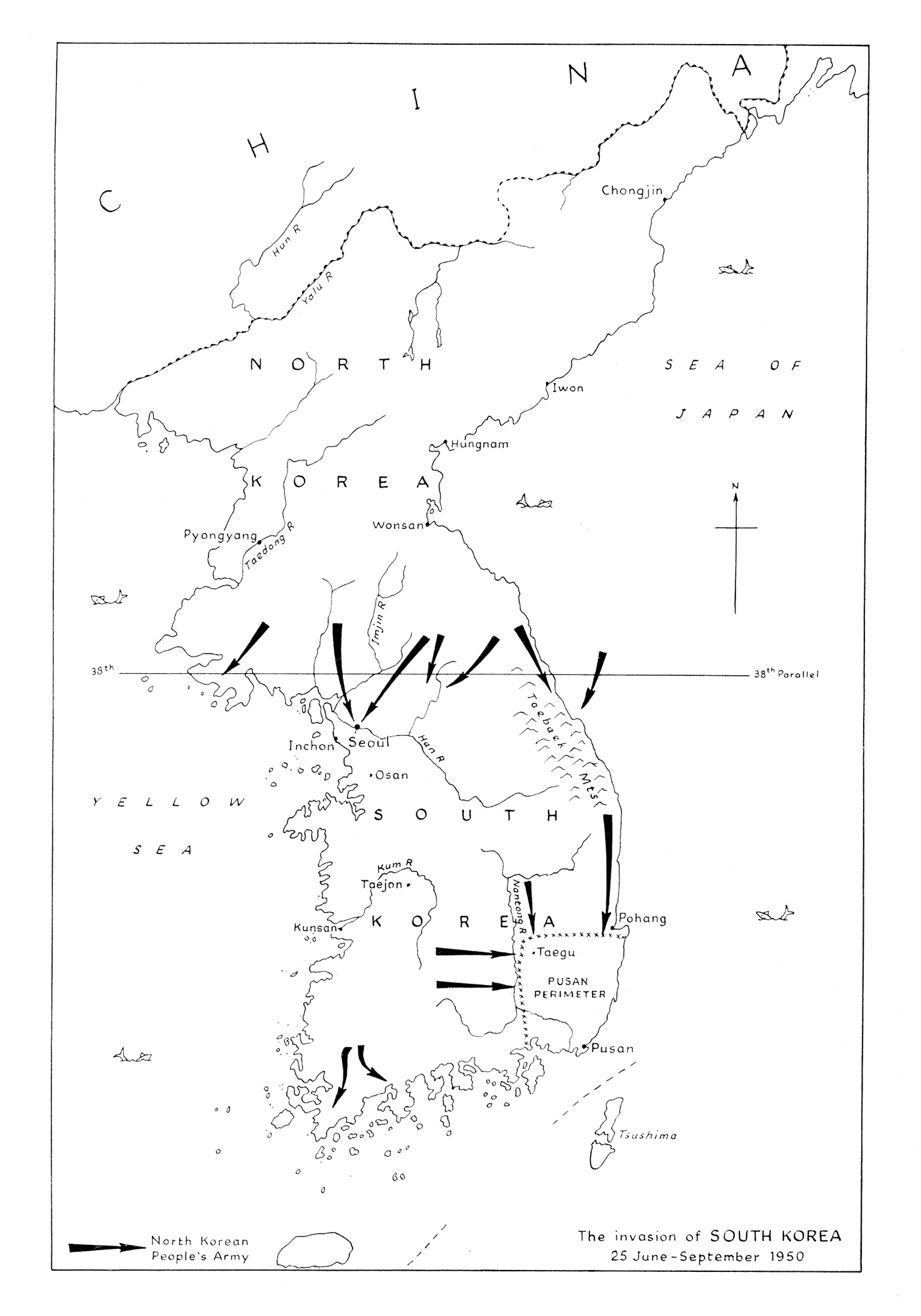
At 7 A.M. on Sunday morning, June 25, Major General Paek Sun Yup, the thirty-year-old commander of the South Korean 1st Division, was telephoned at home by his Operations officer to be told that the ROK forces on the west bank of the Imjin had been overrun. He had been away from his formation for ten days, attending a course at the army command school. Now he took a taxi at once to ROK army headquarters, in the old Japanese headquarters building in Seoul. The atmosphere there was still surprisingly calm: there was no understanding of the scale of the Communist offensive. Colonel Rockwell, his senior American adviser, took Paek in his own jeep to collect one of his regimental commanders who was at home in Seoul for the weekend. Then the three men drove north, up roads still peaceful, because the Korean public had been told nothing of the crisis.
At the divisional command post they found that half the men were away on weekend leave. Officers trickled in. Paek’s units were digging in south of the Imjin, but they had no wire, and they had already lost contact with one regiment north of the river. The commander and some stragglers escaped south a few minutes ahead of the North Koreans. It was learned that the engineers had failed to blow the Imjin bridges behind them. On Monday, the twenty-sixth, the division held its ground south of the river. But they learned that the 7th Division, on their right, had collapsed completely. They received a bitter blow when Colonel Rockwell and their other American advisers announced that they had been ordered to leave the front. Some of the Americans shed tears in their embarrassment. The Koreans were utterly dismayed. Paek said, “We thought that it was for this kind of situation that they were there, to help us.”17 Then the American KMAG jeeps drove away southward, leaving the Koreans alone.
The next day they began to retreat. That afternoon Paek received orders from one of his superiors immediately to pull back to the south bank of the Han River, south of Seoul. That order was hastily countermanded by the Army Chief of Staff. But the ROK 3rd and 5th Divisions, committed piecemeal to the battle, were being rolled back by the Communists. Everywhere the line was crumbling. On the afternoon of the twenty-eighth, the North Koreans broke through on their right flank. By now American aircraft were overflying the front, looking for targets. But the ROKs possessed no forward air controllers and had no contact with the planes. They were compelled to watch many unloading their ordnance on empty paddy fields. Far worse, hundreds of tons of ordnance were unloaded upon ROK troops by the U.S.A.F. in those first chaotic days. One of Paek’s regimental commanders announced that he knew a place where they might get a ferry across the Han. Paek told his men to make their way out as best they could and head for a rendezvous north of Suwon. Then, in small groups, they made for the river, crossed at the ferry, and started walking south—colonels, generals, and privates alike. After one week of war, Syngman Rhee’s army could account for only 54,000 of its men. The remaining 44,000 had merely disappeared, many of them never to be seen again. “South Korean casualties as an index to fighting have not shown adequate resistance capabilities or the will to fight,” MacArthur signaled bluntly to Washington, “and our best estimate is that complete collapse is imminent.”
• • •
Ferris Miller, the American who had first come to Seoul as a naval officer in 1945, and was now an economic aid adviser working from an office in the Banda Hotel, spent the night of Saturday, June 24, playing mahjongg at the Nationalist Chinese Embassy across from the Catholic cathedral. On Sunday morning he rose late, heard the news, and hastened to wake up a Korean politician friend. “It’s only a skirmish,” he told Miller casually. “It won’t amount to much.”18 Through the hours that followed Miller watched the tempo of panic rise: vehicles careering through the streets at reckless speed, radio appeals for military personnel. From a hotel room he watched Communist planes strafing. Yet still Miller could not escape a sense of ridicule, of fantasy, about what he was seeing.
That evening he attended a long-scheduled dinner party at the U.S. Army compound. Here he found growing signs of nervousness. By Monday night, looking out of his apartment window, he could see the gun flashes on the northern horizon. Then he heard on the U.S. Armed Forces radio that the situation was stabilizing. Emergency feeding arrangements would be suspended. As of Tuesday all U.S. personnel would once again be required to pay for meals in the mess. Miller went to bed somewhat reassured.
But in the early hours of the morning there was a fierce banging on his door. An American officer told him to bring a toothbrush and pajamas to U.S. headquarters in the Banda Hotel. Amid a total blackout, he packed his possessions in two footlockers and drove to the U.S. Embassy. Here he found chaos: men burning documents in great heaps on the street outside, Koreans besieging the building for help in making their escapes. Inside, Miller saw a Korean woman sobbing helplessly amid officials hastening to and fro. “Help me, help me,” she begged him. “My husband is in the States.” Miller could do nothing. At dawn buses came to take the staff out to Kimpo for evacuation. Miller was one of the last to leave. He felt guilty as he pushed his footlockers into the hold of a C-47, conscious of all the men and women around him who had salvaged nothing. The ambassador’s secretary climbed aboard with a dog under one arm, a bottle of scotch under the other. Then they started the engines and taxied bumpily across the tarmac for takeoff. Only when they landed in Japan did they discover holes in the fuselage from stray Communist ground fire. Only later did they learn of those left behind: the mining adviser who overslept in his billet and was never heard of again, the party of Americans who had been attending a wedding in Kaeson and became prisoners in North Korea for three long years.
• • •
Lee Chien Ho, a twenty-one-year-old tax collector’s son studying chemical engineering at National University, was in a barber’s shop having his hair cut on the morning of June 25 when the news of the North Korean invasion came through on the radio. His father was away in Inchon. Unlike many Koreans, Lee was eager to take some part in the defense of his country. He and a few score like-minded students spent much of the next two days at their university campus east of the city, pathetically standing guard armed with broomsticks. On the second night of their vigil, South Korean Army stragglers began to come through from Uijambu. “What do you kids think you’re doing?” demanded one. They told him they were defending the university. “You’re out of your minds,” the soldier said. “Go home.” Bewildered, they drifted away in ones and twos toward the city, among the dejected military fugitives. Lee slept that night at the School of Liberal Arts, by the streetcar terminal. Walking out the next morning, he saw a long row of large, shiny government cars abandoned neatly in front of the railway station. It was his first tremor of understanding of the scale of the disaster.19
Lee went home and told his mother that he was sure they should leave. At first she was bitterly reluctant to abandon all their household possessions. The banks were closed, so they had no means of recovering their money. But at last he persuaded her. On Tuesday afternoon, carrying a sack of rice on his back and leading his two younger brothers, Lee led his mother through the streets toward the Han River bridge. Curiously enough, he found few others going their way and many reentering the city from the south. They laughed at the family, burdened with their possessions: “What are you so worried about?” That night they slept in a schoolhouse, disturbed by the thunder of heavy rain on the roof and distant guns. The next morning, as they walked on southward, they heard the huge explosion as the Han River bridge was blown by Rhee’s retreating army. They struggled on amid a growing army of panic-stricken soldiers and frantic civilians, a confusion of abandoned possessions on the road and low-flying aircraft sweeping overhead—the wreckage of defeat.
• • •
To Suk Bun Yoon, a thirteen-year-old middle school pupil, the son of a merchant, the North Koreans looked more like a defeated army than a victorious one as they straggled into Seoul.20 Suk and his family had spent much of the previous two days hiding in a sewage pipe. On the twenty-seventh they struggled through the seething mass of refugees toward the Han River. But the press, the hysteria, the screaming mass of humanity fighting to reach the ferries was too great. Despondent and frightened, they returned home to await their fate. On the morning of the twenty-eighth, as the first Communists arrived, civilians in red arm bands hastened through the streets, urging the watching citizens to cheer their liberators. Some did so. But most of the older people slipped away to their houses, from whose windows they peered nervously out into the street at the solemn, olive-clad files padding past, some still wearing camouflage foliage in their helmets.
Many hundreds of thousands of the small men and women of Korean society, whose names featured on no lists, whose lives had merely been a struggle for survival, were unsure what to make of the Communists’ coming. Won Jung Kil was a peasant’s son who had grown up in Inchon as the breadwinner of a family of eight. Their father was dead, Won had no fixed employment: “We thought about food—nothing else.”21 Inchon was a stronghold of Communist sympathies of a primitive kind: Won and his kind hated Syngman Rhee because he did nothing for the working man, and loathed the police for their privileges. He was in Seoul the day war broke out. He hastened home, uncertain what to think. He found the local Communists running, exulting, through the street, preparing a grand welcome for the North Korean Army. The family talked. They decided that it was safer to go. There might be fighting in the town. They gathered up saucepans, blankets, children, and began walking southward. They expected that it would be safe to come home in a week. In reality they were embarking on a three-year odyssey shared by millions of their fellow countrymen, that would cost them their home—a shack carelessly destroyed by the warring armies—their freedom, for the young men of the family were conscripted and spent three years barely subsisting in uniform, and enormous hardship for the women, who would exist chiefly upon American milk powder and herbs picked from the mountains until many months after the war ended. For the nations of the West, the war that had now come to Korea represented a challenge to the principles of freedom and anticommunism. The democracies were to endure huge anxieties and frustrations in the course of seeking to meet this. But for the people of Korea, three years of unspeakable tragedy, privation, and sacrifice had begun, from which scarcely a family in that unhappy land would be spared.