
5
For all its undisputed Korean provenance, the name of Inchon possesses a wonderfully resonant American quality. It summons a vision of military genius undulled by time, undiminished by more recent memories of Asian defeat. Inchon remains a monument to “can do,” to improvisation and risk-taking on a magnificent scale, above all to the spirit of Douglas MacArthur. So much must be said elsewhere in these pages about American misfortunes in Korea, about grievous command misjudgments and soldierly shortcomings, that there is little danger here of overblowing the trumpet. The amphibious landings of September 15, 1950, were MacArthur’s masterstroke. In a world in which nursery justice decided military affairs, Operation Chromite would have won the war for the United States.
From the early stages of the war, as the Eighth Army struggled to maintain fighting room in the southeast of Korea, MacArthur’s thoughts had been fixed with almost mystic conviction upon a possible landing at Inchon. In July he told General Lemuel Shepherd, Fleet Marine commander, as they pored over the map in his office, “If I had the 1st Marine Division, I would make a landing here at Inchon, and reverse the war.”1 By all manner of improvisations and expedients, the 1st Marine Division was indeed being assembled and hastened across the Pacific. But six weeks of acrimonious, passionate debate preceded Inchon. On one side were ranged the Joint Chiefs of Staff, all the key naval officers in the Far East, and an overwhelming proportion of the Army, Marine, and amphibious specialists. For this, it must be recalled, was still the immediate postwar period, when the middle and upper ranks of America’s armed forces were still thickly populated with officers who had planned and carried out opposed landings from end to end of the Pacific. These men understood from experience every subtlety of tides, beach gradients, unloading capacity, fire support plans. They examined Mac-Arthur’s concept with acute professional care and, almost unanimously, declared against it.
When the G-3 of 1st Marine Division, Colonel Alpha Bowser, first arrived in Tokyo in the first days of September, he was greatly dismayed by the uncertain mood he encountered: “It seemed very ‘iffy’ to me. The feeling about whether we could go on holding at Pusan fluctuated from day to day. They appeared to be in a dreamworld at MacArthur’s headquarters. I could not understand how they could be so sanguine about what was happening to them. It scared the hell out of me.”2 Lieutenant Colonel Ellis Williamson, G-3 of X Corps, also found the atmosphere “pretty dismal” when he arrived in Tokyo from California. When first he heard talk of Inchon, he was among those staff officers who feared that the landing was being conducted on the wrong side of Korea. But MacArthur said to them, “It will be like an electric fan. You go to the wall and pull the plug out, and the fan will stop. When we get well ashore at Inchon, the North Koreans will have no choice but to pull out, or surrender.”3
Inchon was the only plausible target for an amphibious envelopment. Kunsan was so close to the besieged Pusan Perimeter that to make a landing there would be meaningless. Chinnampo, Pyongyang’s port, was too far north. Posung-Myon, below Inchon on the west coast, offered inadequate scope for a breakout inland. Yet Inchon’s thirty-two-foot tidal range was one of the greatest in the world. Only on three plausible dates—September 15 and 17 and October 11—would the tides be high enough to give the big landing craft three brief hours inshore before the coast became once more an impassable quagmire of mud. Beyond this problem, beyond the fierce current up the Flying Fish approach channel, there was no hope of achieving tactical surprise at the seawall where the main landing force must go ashore. Before the Americans could even assault Inchon, they must unmistakably signal their intentions eleven hours in advance by seizing the offshore island of Wolmi-Do, which commanded the approaches. Thereafter, the problems became worse: the limited cargo-handling facilities, the imminence of the typhoon season, the steep overlooking hills from which a competent enemy could pour a devastating fire onto the beachhead. Finally, the tide times dictated that the main landings must take place at evening, leaving the assault force just two hours of daylight in which to gain a secure perimeter ashore, amid a city of 250,000 people.
The memory of Anzio still bulked very large in military memory, when just such a grand envelopment as Inchon had landed—in Churchill’s memorable phrases—not “a wild cat to tear out the heart of the Boche” but “a stranded whale,” an invasion army besieged under heavy fire in a strangled perimeter. Why now take such vast risks when the commitment of the two available divisions to Eighth Army at Pusan should make possible a breakout by more conventional means? The Marines’ General Shepherd opposed Inchon because he perceived the North Koreans as a fanatical enemy capable of mounting as fierce a resistance to the Americans as the Japanese on Iwo Jima six years earlier.
Arrayed against all these arguments, and their proponents glittering with brass, MacArthur stood alone. He, too, admitted a fear that Inchon was a long march from the Pusan Perimeter. Yet he also saw the deeply demoralized state of the UN forces in Walker’s command. To commit the last readily available reinforcements at Pusan risked a disastrous strategic stalemate. MacArthur was determined upon a grand gesture, reaching out for strategic freedom, a war-winning thrust. Against all the reasoned arguments of admirals and generals and staff officers, he deployed only the rocklike, mystic certainty of his own instinct.
No man who was present ever forgot the conclusive August 23 meeting on the sixth floor of the Dai Ichi between MacArthur and America’s foremost commanders in the Far East. Stratemeyer was there, and Radford, and Collins and Sherman from Washington; there was Shepherd, Fleet Marine commander; Struble and Doyle for the U.S. Navy. Collins spoke openly of the Army’s fears about the consequences of withdrawing the Marine brigade from Pusan for the landing. Sherman advocated a safer landing at Kunsan. Then other naval officers, led by Admiral Turner Joy, outlined the overwhelming difficulties, as they saw them, of putting an amphibious force ashore at Inchon. It was Rear Admiral James H. Doyle who summarized the Navy’s attitude, concluding bleakly, “The best I can say is that Inchon is not impossible.” Then MacArthur stood, puffing on his corncob pipe.
“He spoke with that slow, deep resonance of an accomplished actor [recalled one of the officers who heard him]. ‘Admiral, in all my years of military service, that is the finest briefing I have ever received. Commander, you have taught me all I had ever dreamed of knowing about tides. Do you know, in World War I they got our divisions to Europe through submarine-infested seas? I have a deep admiration for the Navy. From the humiliation of Bataan, the Navy brought us back.’
“Then—literally with a tear in his eye—he said, ‘I never thought the day would come, that the Navy would be unable to support the Army in its operations.’ ”4
It was a great theatrical performance. MacArthur’s peroration embraced the Communist threat to Korea: “It is plainly apparent that here in Asia is where the Communist conspirators have elected to make their play for global conquest. The test is not in Berlin or Vienna, in London, Paris, or Washington. It is here and now—it is along the Naktong River in South Korea. . . .” He summoned up the ghost of his hero, General Wolfe, whose assault upon the heights of Quebec had also been opposed by his staff. He asserted the very implausibility of his own plan as its strongest argument for surprise, and thus success: “The very arguments you have made as to the impracticabilities involved will tend to ensure for me the element of surprise. For the enemy commander will reason that no one would be so brash as to make such an attempt.” Then, finally: “I can almost hear the ticking of the second hand of destiny. We must act now or we will die. . . . We shall land at Inchon, and I shall crush them.” The deep voice fell away to a whisper. After forty-five minutes of oratory such as the world seldom sees save from the orchestra seats of a theater, the Supreme Commander returned to his chair. The Chief of Naval Operations stood up and declared emotionally, “General, the Navy will get you to Inchon.”
This was not the end of the debate, for many of the most senior officers present left the briefing room unconvinced. But it was the turning point. Shepherd and Sherman made one more vain private attempt to convert MacArthur to a landing at Posung-Myon. But in the absence of a flat rejection from Washington, MacArthur continued to make his plans. On August 28 he received the formal consent of the Joint Chiefs of Staff to the Inchon landing.
Yet even as the plans for the landing were finalized, the doubts persisted. The Chiefs of Staff in Washington gained the written sanction of the President for the operation, a step that was militarily quite unnecessary but reflected their anxiety to ensure that they were not saddled with sole responsibility for disaster. Faced with the new Communist drive against the Pusan Perimeter early in September, General Walker showed deep unhappiness about releasing forces from his front for Inchon. It was decided that the Marine Brigade would be taken out of the line and sent to sea only at the last possible moment, and that a regiment of the 7th Division would be kept in Pusan Harbor as a floating reserve to deal with a possible Eighth Army crisis until it became essential for them to sail for Inchon.
The planners were irked to discover that, throughout the three-year American occupation of Korea, nothing had been done to assemble raw information about the geography of the country. Even the dimensions of the Inchon tidal basin were unknown. In haste, Tokyo set about remedying the yawning deficiencies in SCAP’s knowledge. Agents put into the Inchon area reported that there were only some 500 North Korean troops on Wolmi-do and a further 1,500 around Inchon. But only a few hours’ warning would be necessary for the North Koreans to move major reinforcements from the southeast. In an effort to keep the enemy in confusion until the last possible moment, a British naval task force was committed to carrying out a deception bombardment against Chinnampo, while a British frigate landed a raiding party at Kunsan. A courageous U.S. naval officer, Lieutenant Eugene Clark, was put ashore at Yonghung-do, fifteen miles south of Inchon, with similar coastal conditions. He returned to confirm the Navy’s worst fears about the waist-deep mud, the shallow water extending three miles offshore, the high harbor wall against which the Marines must land.
Lieutenant Colonel Robert Taplett, a tall, steady South Dakotan commanding the 3/5th Marines, was more worried about the prospect of the landing than most of his officers, “because I knew more about it. I thought it would be a very rough affair. I received an extraordinary message stating that once we were committed to the landing, we would continue with the operation until we had suffered 82.3 percent casualties. I thought, ‘God, what kind of idiot would write an order putting in a decimal point like that?’ ”5
Yet, against the background of such fears, it has been a mistake by some historians to presume that Inchon represented a great triumph for the underdog of the Korean campaign, against all odds. Rather, the mood of apprehension and outright dismay in which the landing was prepared showed how low had sunk the morale of the UN armies in Korea, and how great was the psychological dominance the enemy had achieved over their commanders, with the critical exception of MacArthur. The strength of the North Koreans’ continuing thrusts against the Pusan Perimeter masked the enormity of their losses since the war began. Allied intelligence was seriously overestimating the size of the forces facing Walker’s divisions. The staff continued to believe that the North Koreans possessed numerical superiority. Yet, in reality, Kim Il Sung’s ruined regiments besieging Pusan could now muster only some 70,000 men, against a total of 140,000 in Walker’s command. The Allies possessed absolute command of the air and sea and overwhelming superiority of firepower. The ferocity and effectiveness of the enemy’s assault troops should not be permitted to mask the immense handicaps under which the Communists labored, lacking sophisticated logistic and technical support. Their intelligence gathering, for instance, was as lamentable as the American Army’s security. The intention to land at Inchon was one of the worst-kept secrets of the war, the subject of open discussion among thousands of men in Japan and Korea. Yet, miraculously, no word leaked through to Pyongyang. Not a man was moved to strengthen the Communist defenses in the last critical days before the armada sailed.
• • •
At Walker’s headquarters in Korea, pessimism continued to prevail, not only about Eighth Army’s predicament, but about the western landing. It was MacArthur’s knowledge of this spirit, or lack of it, that must have contributed significantly to his decision to appoint his own Chief of Staff, Lieutenant General Edward M. Almond, to command the Inchon landing force, designated X Corps. So much criticism was subsequently heaped upon MacArthur for his decision to divide military authority between two separate commands in Korea, which would have important and unhappy consequences later, that it is worth examining his motives for doing so. The most obvious, and the least admirable, was that Almond was the Supreme Commander’s protégé, a ferociously ambitious soldier who had played a somewhat undistinguished role as a divisional commander in Italy in World War II and now hungered for a more promising battlefield command. Almond was not a man who inspired much affection among his subordinates. O. P. Smith, the 1st Marine Division commander whose poor relations with his Corps superior would become a serious blight upon the campaign, was antagonized by their first meeting before Inchon, when Almond dismissed the difficulties of amphibious operations: “This amphibious stuff is just a mechanical option.” Smith then “tried to tell him a few of the facts of life. But he was rather supercilious and called me ‘son,’ which kind of annoyed me.”6
Yet there was an entirely legitimate case for placing the conduct of the Inchon landing in hands other than those of General Walton Walker. MacArthur well knew the low morale that existed in Eighth Army headquarters, and it presented him with a difficult dilemma. Walker had conducted a stubborn defense of Pusan. But there was grave reason to doubt his ability now to lead the sort of imaginative and dynamic operation MacArthur planned. MacArthur considered, and rejected, the possibility of relieving him of his command. But this would have been a most unpalatable step to the American public. As is often the case in desperate situations, the figure of “Bulldog” Walker had been exalted by publicity to heroic proportions. MacArthur’s compromise was to entrust the amphibious operation to Almond. Whatever his Chief of Staff’s vices, he was an undoubted driver of men. MacArthur was supremely confident that this one great effort would be decisive. Once it had succeeded, issues of command would no longer be important. He told O. P. Smith, “I know that this operation will be sort of helter-skelter. But the 1st Marine Division is going to win the war by landing at Inchon.”7
Among the senior officers of the Marine Division there was never a moment’s doubt of the importance of the landing, not only for the cause of the United Nations, but for their Corps’ survival. Since the end of World War II they had been compelled to watch its remorseless shrinkage to a shadow of its wartime might. Many naval officers made plain their belief that the Marines should be confined to a role providing token shipboard contingents with the fleet. No less a figure than General Omar Bradley had declared his conviction, at the 1949 congressional hearings on the B-36 bomber, that in the nuclear age there would never again be large-scale amphibious operations. “The Marine Corps was fighting for its very existence,” said General Lem Shepherd.8 In Korea, and above all at Inchon, he and his fellow Marines perceived a supreme opportunity to show their nation what the Corps could still do.
The 1st Marine Division’s commander, O. P. Smith, was in many ways the least likely of Marine heroes. A slim, white-haired Texan of fifty-seven, of professorial manner, unfailing courtesy—even diffidence—Smith was a cautious commander who believed that “you do it slow, but you do it right.” But many of his subordinates in this big, heavy division of some 20,000 men were cast in more exotic molds. Ray Murray of the 5th Marines was perhaps the outstanding regimental commander, who would become one of the critical figures of the campaign. Colonel Homer Litzenburg of the 7th Marines was slower and less impressive. Colonel Lewis B. “Chesty” Puller of the 1st Marines was already a legend of his Corps, a bombastic officer who led from the front, beloved of his men—perhaps less so of his seniors, who were sometimes exasperated by his tactical carelessness. All these men, and many of their subordinates, possessed immense combat experience in World War II.
The first slow convoy of Admiral Struble’s armada of 260 ships sailed from Yokohama on September 5. It was a makeshift transport fleet that carried the Americans to Inchon. Of the bigger ships, thirty-seven LSTs were World War II veterans that had been transferred to the Japanese merchant service. They were now recalled to duty with their Japanese officers supplemented by American personnel flown in from the United States. Some ships smelled vividly of fish. There was much wisecracking speculation about the personal histories of their inscrutable deck officers. “Everybody believed,” in the words of a Marine, “that he was being ferried to Inchon by a Japanese who had been an admiral at Midway.” There were constant breakdowns of aged machinery: “The whole thing was a rusty travesty of World War II amphibious operations.”
Few men found the voyage to Inchon agreeable, crammed aboard old ships devoid of creature comforts. Many were violently seasick as the convoy plunged and heaved amid Typhoon Kezia, whose 125-mph winds wreaked havoc with the nerves of the naval commanders and the stomachs of 70,000 hapless Americans below decks. On some ships, tanks and vehicles broke loose, demanding desperate struggles to resecure them as they smashed hither and thither on the cargo decks. The men lay in their bunks or played cards incessantly. There was little left to prepare. The plans were all made. The command ship, Mount McKinley, sailed from Sasebo in the small hours of September 13, the anniversary of Wolfe’s triumph at Quebec. The ship’s captain gave up his own cabin to MacArthur and had a shed built for himself on the bridge wing. The convoy was maintaining radio silence, but Almond demanded that dispatches should be air-dropped to him each day. To the glee of his enemies on the staff, the first day’s attempt ended with the bag falling into the sea, and X Corps commander in a rage.
• • •
Lieutenant Jim Sheldon of the 17th Infantry, 7th Division, felt desperately anxious for the invasion and the war to be over, because Korea smelled so awful and he found his own platoon so dismaying. Sheldon was a rebellious twenty-year-old who had been dismissed from the U.S. Navy for misconduct, then enlisted in the Army and was commissioned from the ranks the day the Korean War broke out. He arrived in Japan as an officer replacement and was abruptly given a fifty-four-man platoon composed partly of Koreans, of whom some were wholly untrained civilians, ranging in age from the mid-teens to mid-sixties: “They were a pretty unhappy group of people for a twenty-year-old lieutenant to have to cope with, with their strange eating and sanitation habits. I couldn’t do anything to stop them sneaking out after dark and crapping in the middle of the compound.” In four weeks, with the aid of a handful of experienced American NCOs, he had instilled the rudiments of tactical training in them. Then they were shipped to Pusan, where as part of the deception plan they were required to disembark from their ships, march out into the country, and reembark three times in succession. At last, to their astonishment, they were told that they were on their way to take part in an amphibious landing. Sheldon and his platoon were not impressed.9
Just before dawn on September 15, the Mount McKinley and the transport convoy attained the Inchon Narrows. It was the fifth day of air and naval bombardment of Wolmi-do Island. The commanders had gambled heavily upon the success of the diversionary operations to blind the defenders to the real significance of the barrage. At 6:33 A.M., after a final storm of rockets and napalm from the carrier strike aircraft, a last deluge of shellfire from the cruisers offshore, the first Marines hit Wolmi-do.
Throughout the voyage from Japan the Supreme Commander had remained invisible in his cabin. Only now, as the first men clambered down into the landing craft amid the rolling thunder of the naval bombardment, did MacArthur betake himself to the bridge of the Mount McKinley in his grandeur. This was his creation, his hour, his last great moment of martial glory before the worm of disappointment, disillusionment, defeat began to gnaw into that enormous ego and reputation. He took the captain’s high seat on the bridge, to sit flanked by his reverential courtiers in all the stage properties of majesty: the corncob pipe; the massive peaked cap laden with brass; the proud chin and protective sunglasses. And there the photographers caught him for posterity, the master of ceremonies sitting high above the sea, watching the unfolding of his last triumph.
Ellis Williamson, G-3 of X Corps, did not trouble to beg a place in a landing craft, as had some staff officers. He remembered the British officer who said to him before D day in 1944, when he was still an impatient young lieutenant, “When you get over there, you’ll find there’s enough war for everybody.” Williamson had been wounded five times in northwest Europe: “By Inchon, I was no longer overly curious.”10
Until a late stage of planning, Almond had opposed the sacrifice of surprise for the seizure of Wolmi-do Island. But the Marines insisted that they could not assault the main beaches with the approaches unsecured. Their will prevailed. Now, Litzenburg’s 5th Marines swept ashore at “Green Beach” on Wolmi-do with almost contemptuous ease. Two Marine tanks smashed through a feebly defended North Korean roadblock on the causeway to the mainland. The Stars and Stripes was raised 300 feet up on Radio Hill, dominating Inchon Harbor, at 6:55 A.M. The entire position was secure an hour later. Marine bulldozers wrote a macabre footnote by entombing a handful of defenders who declined to surrender alive in the caves in which they had taken refuge. From the bridge of Mount McKinley, MacArthur signaled Struble: “The Navy and Marines have never shone more brightly than this morning.”
At noon, with half of the Chromite operational plan successfully completed and only desultory firing coming from the shore, the long, wretched interval began before the next act. As the tide swept back to reveal miles of dull, flat mud between the invasion fleet and the shore, the men in the ships waited, impotently, for the sea to return. The Marines on Wolmi-do, entirely isolated from the fleet, lay over their weapons, willing the enemy to maintain his silence. They requested, and were refused, permission at once to continue their advance across the causeway. They contented themselves by firing mortars and machine guns at the shore whenever they observed activity. Fighter-bombers roamed the roads for miles behind the coast, ready to strike at any Communist attempt to reinforce their coastal positions. Yet, astonishingly, none came. At 2:30 P.M. the cruisers resumed their fire upon the main waterfront.
“The guns began erratically [wrote the British war correspondent James Cameron]: a few heavy thuds from the cruisers, an occasional bark of five-inch fire, a tuning-up among the harsh orchestra. At what point the playing of the guns merged into the final and awful barrage I do not know; so many things began to take place, a scattered pattern of related happenings gradually coalescing and building up for the blow.
“All around among the fleet the landing-craft multiplied imperceptibly, took to the water from one could not see exactly where, because the light was failing now—circled and wheeled and marked time and milled about, filling the air with engines. There seemed to be no special hurry. We could not go in until the tide was right; meanwhile we lay offshore in a strange, insolent, businesslike serenity, under whatever guns the North Koreans had, building up the force item by item, squaring the sledge-hammer. The big ships swung gently in the tideway, from time to time coughing heaving gusts of iron towards the town. It began to burn, quite gently at first. What seemed to be a tank or a self-propelled gun sent back some quick, resentful fire, but it soon stopped. Later we found that one ship had thrown a hundred and sixty-five rounds of five-inch ammunition at the one gun: the economics of plenty.”11
At 4:45 P.M. the first landing craft pushed off from the transports, laden with Marines, headed toward the smoke-hung skyline of the city of Inchon. At 5:31 the first Americans sprang up the ladders onto the seawall, covered by grenades from the men who followed. After a brief scamper, the British Consulate was taken and a platoon reached the foot of Observatory Hill, overlooking the harbor. Amid the sharp firefights with pockets of defenders, it became rapidly apparent that most of the surviving Communists were still stunned and dazed by the bombardment. In the industrial suburbs south of the city, where the 1st Marines were landing on Blue Beach, the regiment overcame difficulties with mud and natural obstacles to establish themselves securely ashore in the first hours of the darkness.
The makeshift manner of the operation persisted even as the Marines descended into the landing craft. Major Ed Simmonds, commanding the weapons company of the 3/1st Marines, was a twenty-nine-year-old from New Jersey who had seen action in the Pacific as an engineer, where every landing had been intensely rehearsed and meticulously timed. Now he found himself clambering aboard an amphibious tractor as a young naval lieutenant pointed toward the shore and shouted almost hysterically through a bullhorn, “There’s your beach! Go find it!” A landing craft loaded with Koreans pulled alongside and somebody called, “Here’s your interpreters!” Two Koreans climbed on Simmonds’s tractor as it got under way. Neither proved to speak English. The Marine asked the driver where the compass was. The man shrugged. “Search me. Two weeks ago I was driving a bus in San Francisco.” Simmonds, aided by his own compass, set off toward the point on the shoreline where the smoke seemed thickest.12 The carefully planned landings by waves of craft were forgotten. They merely headed in columns for the beach, where they found a modest firefight in progress. Visibility was very poor amid the smoke and drizzle. Most men’s clearest memory of Inchon was of struggling ashore in soggy clothing, which still hung clammily about them as the light began to fail. Officers and men hastened hither and thither, searching for headquarters and company positions in the darkness, broken by occasional gun flashes and the flames of burning buildings. As the sounds of battle died away, they were replaced by the insistent patter of operators murmuring into radio handsets, struggling to gain contact with straggling units. But already the vital moves of the day were complete. The seal was set upon the American triumph when eight LSTs grounded side by side against the seawall on Red Beach. As the tide fell, they remained there, “dried out,” and from their cavernous holds poured forth a stream of tanks, trucks, jeeps, stores, laying vital flesh upon the bones of the beachhead.
Through the hours of darkness the Marines dozed over their weapons, apprehensive of a counterattack that never came. Astoundingly, two regiments were established ashore in Inchon at a cost of just twenty killed among a total of less than 200 casualties. If the landing on the west coast of Korea was a makeshift, amateurish affair by the standards of 1944 or 1945, it had proved formidableenough to overcome the primitive legions of Kim Il Sung. In the days that followed, as the men of 7th Division and the 7th Marines followed the vanguard ashore, MacArthur and his officers exulted. The gamble had triumphantly succeeded. All the Supreme Commander’s instincts about the conduct of the North Koreans had been justified. He had driven his spear deep into the flank of the enemy, who now reeled stricken before him.
First light on September 16 revealed Korean civilians picking their way among the shattered debris of the Inchon waterfront, among the fallen power lines and flickering fires and broken walls.
“There was quite a lot of Inchon still standing [wrote James Cameron]. One wondered how. There were quite a number of citizens still alive. They came stumbling from the ruins—some of them sound, some of them smashed—numbers of them quite clearly driven into a sort of numbed dementia by the night of destruction. They ran about, capering crazily or shambling blankly, with a repeated automatic gesture of surrender. Some of them called out as we passed their one English phrase, as a kind of password: ‘Sank you!’ ‘Sank you!’ and the irony of that transcended the grotesque into the macabre.”13
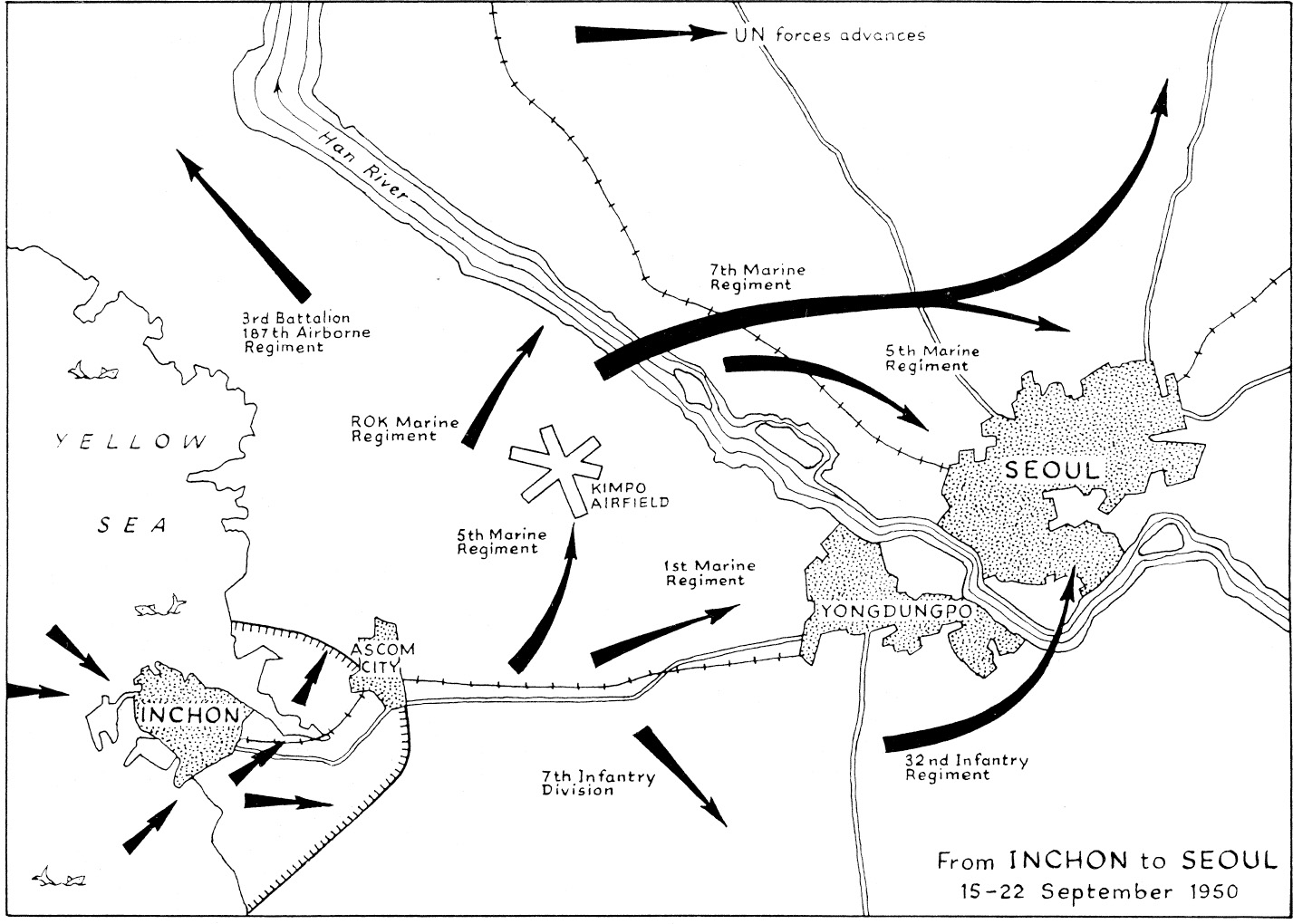
The 1st and 5th Marines linked up ashore early on the morning of September 16. They began at once to drive eastward, toward the capital, leaving the ROK Marines to mop up Inchon in characteristically ruthless fashion. Belatedly, a column of North Korean armor and infantry appeared, to be swept aside by air strikes and ground fire. The 5th Marines now led the advance on the north side of the Inchon-Seoul road while the 1st took the southern side. Smashing through sporadic Communist resistance, by the night of September 17 they held much of the big Kimpo airfield complex. By the evening of the nineteenth the 5th had cleared the entire south bank of the Han River on their front. The 1st Marines had meanwhile seen some heavy fighting in more difficult country, meeting a regiment of the North Korean 18th Division deployed in their path. But on the nineteenth they were on the outskirts of Yongdungpo, the suburb of Seoul on the south bank of the Han.
The raw relations between the Army and the Marines became increasingly apparent on the road to Seoul. O. P. Smith’s men displayed a lasting bitterness about the haste urged upon them by Almond, obsessed with fulfilling a promise to MacArthur that he would liberate the capital by September 25. This would be three months to the day since the Communist invasion. “He wanted that communique,” said the disgusted Smith. “I said I couldn’t guarantee anything—that’s up to the enemy.”14 But some army officers, in their turn, declared their dismay at the headlong tactics of the Marines. “The Marines were always too keen on frontal attacks,” argued Colonel John Michaelis of the 27th Infantry.15
“The Marines are a product of their history [said Colonel Ellis Williamson]. They are trained, indoctrinated, to go from ship to shore, then to keep running forward until they have taken the pressure off the beachhead. The thought of outflanking a position would horrify a man like ‘Chesty’ Puller. We used to call the Marines ‘the nursery rhyme soldiers’ because their motto was: ‘Hey diddle diddle, right up the middle.’ On that march to Seoul, I saw Marines doing things no army outfit would think of. I watched them crossing that great sweep of wide open ground in front of Kimpo airfield, hundreds of young men rising up and starting across the flats in open order. They took far more casualties than we considered appropriate.”16
It is interesting that Williamson’s perception of the U.S. Marines, as a soldier, is that shared by most army officers around the world about their amphibious brethren. It is probably true that the Marine Corps places greater emphasis upon headlong courage than upon tactical subtlety. Even their own General Shepherd afterward challenged the sluggishness of O. P. Smith’s move into Seoul: “If a man who is in command of a pursuit is someone who likes to have his ranks dressed all the time, you might just as well not pursue.”17 It was agreed by most senior marines that “Chesty” Puller had been overpromoted to regimental command and was saved from making disastrous mistakes only by the professional competence of Major Robert Lorigan, his Operations officer. Yet in Korea the courage and determination of the Marines remained unchallenged through three years of war, while many army units proved disturbingly lacking in morale and professional skill. If the senior officers of the 1st Marine Division could not be described as intellectual warriors, between Inchon and Panmunjom, O. P. Smith and his men would earn great gratitude from their country.
Twenty-year-old Corporal Selwyn Handler of the Weapons Company, 2/1st Marines, found the advance from Inchon to Seoul an intoxicating experience. In checks and starts, the long files of men moved forward, jeeps carrying the heavy equipment, ahead the sound of spasmodic artillery and small-arms fire as the point companies cleared the road. The local Korean civilians seemed delighted to see them. They scurried hither and thither across the battlefield, looting rice stores and abandoned equipment, hastily removing their families and possessions from the immediate line of fire. Once they found some North Korean stragglers hiding in a cave. Two men were detailed to escort them to the rear, but they soon returned. They said, “Prisoners are too much of a bother, right now.” Like most men on most battlefields, Handler retained brief snapshot glimpses of those days: leaping into a foxhole under shellfire, to be cursed by a man already sheltering in it whom he had last seen in high school in California; watching a child scuttling past, bent under the burden of a rice sack larger than himself; Marines filling themselves with beer in a brewery they occupied in Yongdungpo; watching a Corsair hit overhead, diving into the ground and blowing up. Korean children swarmed around them, even as they fought. One said incessantly, “North Korean! North Korean!” as he tugged at the American’s leg and pointed. Exploratively, Handler tossed a grenade into the rubble. Nothing moved, but still the child gestured furiously. The Americans threw two more grenades, and were rewarded with the bodies of two Communist soldiers.
• • •
As Almond’s X Corps drove east, on September 16 in driving rain Walker’s Eighth Army launched its long-awaited breakout. It began sluggishly. The Americans were not across the Naktong in strength until the nineteenth. MacArthur suffered a period of serious concern that even now the North Koreans could hold in the southeast. For four days the weather severely hampered the Air Force’s ability to support the UN advance. But as the weather cleared sufficiently to enable the bombers to operate, once the Communist front had been broken open, it collapsed with extraordinary speed.
The British contingent suffered a wretched little tragedy, indicative of the indifferent air-ground liaison of the period. On September 23 the Argyll & Sutherland Highlanders had just fought their way up Hill 282, on the left flank of the push across the Naktong. They called for air support and laid out their recognition panels. A flight of Mustangs swung in to attack with cannon and napalm, which they laid with terrible accuracy on the Scots’ positions. The survivors retreated in confusion from the summit. But Major Kenneth Muir, second-in-command, determined that they must retake it. He led thirty men toward the crest and reached his objective with fourteen. “The gooks will never drive the Argylls off this hill,” he said as he fell mortally wounded by automatic fire. Muir won a posthumous Victoria Cross. The Argylls lost seventeen killed and seventy-six wounded.
But this was the bitter small change of war. All along the front, the enemy was collapsing. North Korean units began to melt away, thousands of fugitives throwing away weapons, equipment, clothing. On the twenty-sixth at Osan, men of the 1st Cavalry driving north from the Perimeter met the 7th Infantry pushing south from Inchon. ROK units advanced up the east coast from Pusan, meeting negligible resistance. Everywhere, the North Koreans were breaking in flight, surrendering in hundreds, or taking to the mountains to maintain guerrilla war.
Farther north, the 1st Marines were obliged to fight hard for three days for Yongdungpo. Meanwhile, after a setback to their first attempt on the night of the nineteenth, on September 20 Puller’s 5th made a successful assault crossing of the Han River. By September 25 both Marine regiments were committed to the bitter, desperate street battle for possession of Seoul, which devastated great areas of the capital and continued for three days. Even as air reconnaissance revealed the main body of Kim Il Sung’s army fleeing northward, Communist rearguards fought on to delay the advance of Smith’s regiments, extracting their price yard by yard at each rice-bag barricade.
The battle for Seoul became a source of lasting controversy, and deep revulsion to some of those who witnessed it. It provided an example of a form of carnage that would become wretchedly familiar in Indochina a generation later—allegedly essential destruction in the cause of liberation. It was passionately argued by some correspondents and not a few soldiers that the civilian casualties and wholesale destruction could have been avoided by an effective enveloping movement rather than a direct assault supported by overwhelming air and artillery support. But MacArthur and Almond wanted Seoul fast. In their path stood some 20,000 still resolute Communist troops. “The slightest resistance brought down a deluge of destruction blotting out the area,” wrote an eyewitness, R. W. Thompson of the Daily Telegraph,18 In the words of the historian David Rees, “At the heart of the West’s military thought lies the belief that machines must be used to save its men’s lives; Korea would progressively become a horrific illustration of the effects of a limited war where one side possessed the firepower and the other the manpower.”19
The Marines advanced into the capital from north, south, and west, while a regiment of 7th Division and the 187th Airborne RCT covered their flanks. Some men were appalled by the evidence of atrocities they encountered. Selwyn Handler was among those who entered a jail compound in which they found several headless bodies, and the sword that had obviously been used for the executions. Ed Simmonds of the 3/1st saw a group of Marines clustered around a trench. A lieutenant waved him over. The trench was filled with dead Koreans—men, women, children, hundreds of them: “It was a ghastly sight. The stench was unbearable. For days civilians were coming out from the center of Seoul in the hope of identifying them. “20 Colonel Taplett of the 3/5th was less troubled by the evidence of the Communist occupation. “That’s the way these people treat each other,” he said, shrugging. It was a view that would be repeated through foreign UN contingents again and again in the years to come.
Darkness in the streets, still possessed of so many unknown perils, brought hours of acute tension to the Marines in the forward positions. On the night of September 25 the 5th Marines were appalled to receive a sudden order to launch an attack at 2 A.M. It was made clear that this was the direct consequence of General Almond’s obsessive determination to control all Seoul within the deadline he had promised MacArthur. Major Simmonds had assumed temporary command of a rifle company in place of its commander, who was hiding in a cellar. “I can’t do it! I can’t do it!” the officer cried amid the stress of battle. “Take my bars! Take my bars!” Simmonds was horrified to discover that a supporting artillery bombardment would be put down in the area to which he had just dispatched an eight-man patrol. But the American attack was preempted. Long before H hour, the Marines heard the grinding clatter of armor advancing toward their own positions. The North Koreans had launched their own movement. All night the artillery poured fire in front of Puller’s men, breaking up the Communist infantry concentrations. An immobilized Communist tank stood stalled in front of Simmonds’s company position. The major feared what it might still do to them with its gun when daylight came. He ordered up a 75-mm recoilless rifle and told its gunner to fire as soon as he had enough light to aim. At last, in the first glimmerings of dawn, he said, “I can see it!” and fired. The Marines were so absorbed in the enemy that they forgot the backblast of their own weapon, which bounced off a house behind, blowing them off their feet and showering them in mud and debris. But the Communist impetus was spent. American tanks moved up, and they began to advance again. The Marines found their own patrol intact, having taken refuge in a culvert all night, their fatigues concealed beneath civilian clothing stolen from a washing line.
• • •
The 5th Marines reached the Capitol Building only on September 27, two days after Tokyo had announced the liberation, in relentless accordance with the Supreme Commander’s schedule. To the chagrin of the victors, soon after they had hoisted the Stars and Stripes, they were diplomatically ordered to lower their nation’s colors and raise the blue flag of the United Nations. Two days later, MacArthur himself presided over the solemn ceremony in the shattered Capitol Building, marking the liberation of Seoul and the return of the government of Syngman Rhee. The Joint Chiefs in Washington sought in vain to prevent the ceremony, because of their reluctance to identify the United States so closely with the controversial South Korean President. They were unsuccessful. MacArthur was determined to savor his moment of ceremony, indifferent to the cynicism of his own troops, who had made it possible. “If the Inchon landing had been as carefully planned as that ceremony, it would have been marvelous,” said Ed Simmonds acidly. Immense labor and resources had been diverted from the battle to build a pontoon bridge across the Han that would enable MacArthur and his cavalcade to drive direct from Kimpo airport into Seoul.
In the midst of the ruined capital, the Supreme Commander unleashed a characteristic flood of rhetoric for the throng of soldiers, naval officers, and correspondents gathered around himself and Rhee: “By the grace of merciful Providence, our forces fighting under the standard of that greatest hope and inspiration of mankind, the United Nations, have liberated this ancient capital city of Korea. . . .” The Lord’s Prayer was interrupted by the crash of glass and masonry from the damaged dome a hundred feet above. MacArthur appeared not to notice. He turned to address Rhee: “Mr. President, my officers and I will now resume our military duties and leave you and your government to the discharge of the civil responsibility.” The two men shook hands. Rhee seemed overtaken by the emotion of the moment: “We admire you,” he murmured to the general. “We love you as the savior of our race.” The Supreme Commander flew home to Tokyo mantled in his own serene sense of destiny fulfilled, imbued with an aura of invincibility that awed even his nation’s leaders. He was confident that the war for Korea had been won, and that his armies were victorious. Now it was just a matter of cleaning up.