

Part II
In no engagement in its entire history has the United States Navy shown more gallantry, guts and gumption than in those two morning hours between 0730 and 0930 off Samar.
—Samuel Eliot Morison
Fourteen
The seas rolled calmly, stirred by a gentle easterly wind, when the early risers of the morning watch rose for breakfast at three A.M. to relieve the midwatch at four. Aboard the destroyer Johnston, washrooms filled with boisterous morning energy, lockers slammed, and the galley came alive with the hissing of steam, the banter of cooks, the sizzle of eggs and bacon. Quartermaster striker Robert Billie went to the mess, poured himself a cup of coffee, and decided to forget going back to bed. There were only two hours until morning general quarters would be called at six. Any teasing hints of sleep he might get would only deepen his fatigue. Until he could sleep in earnest, he might as well fill the remaining time with useful work. He went to the chart room to update his charts.
In previous campaigns, from the Marshalls to the Solomons to the Carolines, the Johnston’s crew had long ago proven their ability to function on a fractured sleep pattern. At six, per the daily routine, the claxons sounded, setting the steel decks and ladders vibrating with the concussion of quick footsteps. The dawn-dusk call to battle stations was part of the daily regimen of structure and discipline designed to keep minds sharp and equipment ready. The Johnston stood down after a few minutes on alert.
Then, unexpectedly, the general quarters claxon sounded again.
After a midwatch in the Johnston’s laundry, seaman first class Bill Mercer was fast asleep in his bunk when the GQ alarm began shrieking for a second time. He was at first slow to rise. But word that enemy ships were near shot life into him. Mercer sprang to his feet and sprinted toward his battle station on the port side forward forty-millimeter mount. He ran past Lee Burton, a ship’s cook who was busy setting up the breakfast chow line, and said, “How about some bacon? It may be the last I ever get.” Burton told Mercer to help himself, and he did, gladly and generously. Then Mercer saw the tall shell splashes straddling the escort carrier Gambier Bay off the Johnston’s port bow and immediately lost his appetite.
Ellsworth Welch, the Johnston’s junior officer of the deck, was leaning over the rail on the port side of the bridge taking in the warm aromas of breakfast when he first saw the columns of water towering over the decks of an escort carrier. Instinctively he looked skyward, expecting to see enemy bombers overhead. But then he realized that their air-search radar would have long since spotted any planes.
Torpedoman first class Thomas Sullivan mistook the sound of splashing water for dolphins at play. When he turned and saw the geysers, Sullivan knew that what he was seeing was the handiwork of a more warlike species of mammal.
In the chief’s quarters, chief boatswain’s mate Clyde Burnett was lying in his bunk awaiting breakfast when a ship’s talker came on the PA and announced that a Japanese fleet was some fifteen miles away. “I thought someone was joking until I got topside and looked aft. The whole horizon seemed to light up from the gunfire,” he said.
* * *
ABOARD THE HOEL, LT John C. W Dix knew something peculiar was in the air when he went belowdecks, cup of coffee and cigarette in hand, and ducked into the low-ceilinged compartment that housed the destroyer’s combat information center. Lt. Fred Green was at the plotting board, listening intently to voices on his headset and transcribing numbers with a grease pencil on the Plexiglas: 4, 6, 10. “Our Combat Air Patrol reports strange ships,” Green said, “four battleships, six cruisers, ten tin cans. Listen, the pilot’s coming in again.”
A burst of static washed through the speakers, bringing a distant voice: “I’m drawing fire.” Another wave of noise: “The bastards have pagoda masts.” Dix checked the radar scope. In the upper left corner was a cluster of small green blips. Dix counted seventeen of them. Their range was less than forty thousand yards—about twenty-two miles.
Waiting in line for breakfast near the starboard hatch leading to his general quarters station in the forward fire room, water tender second class Chuck Sampson saw Dix come running down the ladder from the CIC shouting something about enemy ships closing with them. Sampson abandoned his place in line and dropped through the hatch and down the ladder to his battle station. Standing on the grating that divided the cavernous chamber into a split-level power station, Sampson shouted above the boilers’ din, telling his fellows on the black gang what was happening.
Lt. Cdr. John Plumb, the engineering officer, arrived from the bridge to make sure the Hoel’s four boilers were lit. His snipes had already turned the wheels and thrown the switches that cut the boilers onto the main steam line. In the engine room someone threw open the main steam stop. Within minutes the ship had full power, its exhaust stacks unfurling large black clouds of boiler smoke.
As quartermaster Clarence Hood took the helm with Herbert Doubrava, the fighting tops of foreign warships became visible on the horizon, a scattered but growing forest of angry steel. An alarmed voice was heard coming over the TBS: “Where the hell is Halsey?”
The Hoel’s general quarters alarm began ringing now, a pulsing, synthesized minor-key gonging “designed to jar the brain, to wake you, speed the senses, make you feel the pitch of keen excitement in the air, the urge to reach your battle station fast,” as Lieutenant Dix put it. For the second time that morning the ship came alive with the percussion of soles on steel decks. The galley emptied. Earlier risers gulped down the last of their scrambled eggs, navy beans, and cinnamon rolls, then sprinted through narrow passageways, ducked through hatches, raced up and down ladders.
When GQ sounded, there was never any question where to go or what to do. But when the alert was unscheduled, a degree of mystery surrounded why exactly you were doing it. According to Lieutenant Dix:
Maybe it’s just a false alarm. You run. You don’t know what it’s for, and so you run. Torpedoes could be heading for the ship or bombers diving in. You never know. Nobody tells you what it’s for. You run. You take your station first and then you ask. Nobody seems to know. The bell still rings. It’s hardest on the guys who stay below. You’ve reached your station—forward magazine. The other fellow’s there. He grabs the phone and calls up to the handling room to ask what’s up. They’re telling him the word. You watch his face, and now he’s telling you and watching yours. You hear him say, “The Japs have opened fire.” He’s talking numbers. Twenty ships! A fleet! You don’t believe it’s true because you can’t get out on deck and see it for yourself.
Aboard the Samuel B. Roberts, Bob Copeland and everyone else who had spent the night listening to the Surigao Strait fighting on the TBS frequency knew that somewhere a Japanese fleet was in fast retreat. They had heard it with their own ears: the sighting reports, the heavy blasts, the satisfied chuckling of gunnery officers, and the plain-language chatter of Oldendorf’s skippers, exuberant as they ran down the stragglers of the Southern Force. The Japanese were fleeing, but in which direction? The question was of more than academic significance, for Taffy 3 steamed about a hundred miles north of where the Seventh Fleet’s big boys had routed Nishimura the night before. If the Japanese were fleeing north, there might be something to see.
Copeland was leaving the bridge to get a cup of coffee in the officers’ mess when Ens. Dudley Moylan, the officer of the deck on the morning watch, said, “Surface radar reports that they have a contact, sir, bearing three-three-zero approximately thirty or forty miles away.” Edward Wheaton, a radar technician second class, said the image was kind of fuzzy, but yes, there was a dense pattern of echoes on the surface radar’s A-scope. Like the radar returns observed by monitors on the island of Oahu on December 7, 1941, they were easy to dismiss. Just as likely they were echoes of rainsqualls or nearby land masses.
Peering out of a porthole from the pilothouse, Copeland spied a mass of gray clouds looming on the horizon. He told Wheaton, “Well, there’s a storm over there, but there could be something inside of it, so keep an eye on it.” Copeland was halfway down the ladder to the mess when a lookout called to Moylan, “Object on the horizon. Looks like the mast of a ship.”
With dozens of others George Bray thought he’d go out on deck and get himself an eyeful. He heard a voice come over the ship’s loudspeaker. It was the executive officer, Bob Roberts: “If you’re interested, come up on deck. Remnants of the Japanese fleet are fleeing over the horizon.” Here was something out of the routine. Bray, who was belowdecks turning in his laundry at the time, ran topside in time to see a white phosphorescent fireball illuminate the predawn morning with a phony brilliance, its smoky fingers falling in shallow arcs into the sea. The realization sickened him: somebody was taking a range on them. Sight-seeing hell, they had gone and gotten themselves into a fight. As the general quarters alarm sounded, Bray ran to his battle station in the after living quarters, grabbed the steel helmet out of his footlocker, and hustled to the stairwell where repair party number two was supposed to report.
Gunnery officer Lt. Bill Burton, who had an especially sharp eye for ship silhouettes, confirmed for his captain that the mystery ships on the horizon belonged to Imperial Japan. Battleships. Heavy cruisers. They were big ones. Bob Copeland never got his coffee. He got on the TBS radio and raised Admiral Sprague aboard the Fanshaw Bay. Copeland didn’t tell Sprague anything the admiral hadn’t already heard from Ensign Brooks, whose Avenger was at that moment being buffeted by flak from Kurita’s ships.
The revelation that the enemy was not fleeing but advancing had the surreal quality of a dream. In everyone’s mind the far-fetched possibility of disaster had hitherto been shouted down by the certainty that any Japanese force approaching from the north would have to confront the thoroughbreds of the Third Fleet. Just the day before, the crews of Taffy 3’s ships had lined the decks to watch the carriers Franklin and Enterprise, accompanied by the fast battleships Alabama and Washington and an assortment of lesser ships, steam northward to join the rest of Halsey’s huge force. In the wake of that parade of dreadnoughts, reports that Japanese fleets were on the move inspired little fear. Oldendorf was to their south, Halsey to their north. There was nothing to fear from Japanese surface raiders.
On the bridge of the Samuel B. Roberts Lt. Tom Stevenson, in his slippers, chinos, and a T-shirt, and the assistant gunnery officer, Lt. (jg) John LeClercq, watched the towering mainmasts of Japanese battleships rise on the horizon and felt their sense of safety dissolve. Now and then the distant silhouettes were obscured by silent flashes of light from their cannonade. Although neither acknowledged as much to the other, Stevenson and LeClercq both knew they had little chance to survive. Heavy shells were inbound, and their own tiny ship was much too far away to strike back. As they prepared to head for their battle stations—Stevenson below to the CIC, LeClercq to supervise the aft forty-millimeter gun mount—the two officers shook hands and wished each other luck.
Captain Copeland picked up the intercom mike and addressed the Roberts’s crew. That he was speaking for himself struck Ens. Jack Moore as unusual and urgent. Normally seaman Jack Roberts was the public address voice of his namesake warship. His southern drawl was all but unintelligible to anyone not acquainted with Dixie’s rhythms and diphthongs. But the skipper’s diction was as crisp as a litigator’s. He was talking fast and sounding more than a little nervous.
“A large Japanese fleet has been contacted. They are fifteen miles away and headed in our direction. They are believed to have four battleships, eight cruisers, and a number of destroyers.
“This will be a fight against overwhelming odds from which survival cannot be expected. We will do what damage we can.”
Jack Moore was already at his GQ station in Sammy B.’s decoding room. The ensign had been late getting there, having stayed awake till the close of midwatch reading a novel in his bunk. When Moore arrived in the small windowless compartment containing the coding machine, the chief radioman, Tullio Serafini, was already at work. Moore offered a sleepy “good morning” and Serafini acknowledged it. The portly Italian chief never talked much. Though he had played the royal baby at the crossing-the-line ceremony, he was the oldest man on the ship at forty-three and had little in common with boys twenty and more years his junior. Serafini was an immigrant from the Old Country whose Navy service dated to World War I. When Pearl Harbor was attacked, he had left a well-paying job in the Philadelphia Navy Yard and reenlisted despite both exceeding the age limit and his status as father of two. Serafini felt that he owed a debt of gratitude to the United States. Moore sensed that Tullio Serafini was the sort of guy who always made good on his debts. Captain Copeland was only too glad to accept payment on behalf of the nation. Recognizing Serafini’s talents, he waived the time requirements to make chief.
As a mail censor, Moore had gleaned some of Serafini’s personal history from a birthday letter the chief had written to his son. “Be a good, stout boy and mind your mommy all of the time, even when you think she might be wrong, so that your daddy can be proud of his eight-year-old man when he comes home again. [Signed] Your loving Daddy. P.S. Keep up the good grades in school.” The way Moore saw it, “Serafini’s entrance into the war was analogous to our country’s entrance…. They had worked and developed what they had until now it was worth protecting, even if it meant sacrificing their very being.”
A pronounced click on the intercom punctuated the end of Copeland’s announcement to his crew and left the young ensign and the old chief sitting in disbelieving silence. Serafini turned to Moore, cocked his head to the side, and puckered his lips in comic sadness. The communicator had nothing to say.
Through the Samuel B. Roberts’s tour of the Pacific, Moore had learned to calm his men’s fears by reciting the betting odds that stood in their favor. En route to the Philippines, he had posted odds of ninety to one favoring their safe return. During the big typhoon at Leyte, he put them at fifty to one. “What are the odds, Mr. Moore?” The question from an enlisted man took him aback. For the first time Moore could remember, the odds were not with them. He figured them at more like one to one—a fifty-fifty chance. Not fifty-fifty the Roberts and her band would win the battle, but fifty-fifty that any given man would live to see the next day’s sunrise. The enemy was too close, too big, too fast. One to one; that was about right.
Some other numbers helped tell that story. If the Japanese cruisers and destroyers could make thirty knots, they would gain about a mile on the fleeing eighteen-knot American carriers every five minutes. Any group of ships, no matter how swift, was effectively hostage to its slowest member. Moore avoided dwelling on where this arithmetic would put them in an hour or so. He occupied himself with the decoding machine, numbly punching in the five-character sequences he got from the radiomen.
The five-character code blocks came from the radio department next door, where a row of enlisted men were busily transcribing encrypted radio traffic transmitted in Morse code over their earphones. The six exchangeable wheels inside the coding machine took Moore’s keyed input and spun and lined up and printed a thin white ribbon of plain-English prose. One of the messages that spooled out onto the ticker tape was important but brief. It was from Admiral Nimitz, addressed to all ships. According to Moore, “It read something like this: DUE TO THE SPLENDID AIRMANSHIP SHOWN IN YESTERDAY’S ENGAGEMENTS, AND WITH A CONTINUING OF SUCH COORDINATED ACTION, I CAN ASSURE A DEFEAT OF THE JAPANESE NAVY FROM WHICH IT WILL NEVER RECOVER.” Ensign Moore threw the message to the floor in disgust. He didn’t know much about Kurita’s Center Force. Nor, as it happened, did Admirals Halsey and Nimitz. Whatever might be said of Admiral Kurita’s group, it had surely recovered from its beating by Third Fleet aviators the previous afternoon. It was bearing down now on Taffy 3, aiming to prove it.

Fifteen
At 6:35 A.M., as sunrise revealed a grayed-out and hazy dawn, the most powerful concentration of naval gun power the Japanese empire had ever assembled reordered its geometry in preparation for daylight operations. Twenty-five miles to Taffy 3’s north, lookouts on the heavy cruiser Chokai and light cruiser Noshiro reported aircraft approaching. So Halsey’s planes were coming after all, Takeo Kurita must have thought. Almost simultaneously, cat-eyed lookouts on the battleship Nagato spied masts on the horizon visible here and there through the rainsqualls that dropped down from the heavens like gauzy shrouds. An eight-knot easterly wind roused low swells from the sea. From the Yamato’s gunnery platform high above the bridge, Cdr. Tonosuke Otani, Kurita’s operations officer, squinted through a range-finding telescope and spotted the flat-topped silhouettes of American aircraft carriers.
The presence of carriers meant this was not Nishimura’s squadron. Kurita could not believe his luck. Here, within gun range at last, were the fast, first-line Essex-class fleet carriers that constituted the heart of the American fleet. There looked to be six or seven of them, accompanied by what lookouts took for Baltimore-class heavy cruisers, powerful combatants only six feet shorter than South Dakota-class battleships. The imagination of Admiral Koyanagi, Kurita’s chief of staff, ran wild. He believed they faced not an escort carrier group, but four or five big carriers escorted by one or two battleships and ten or more heavy cruisers.
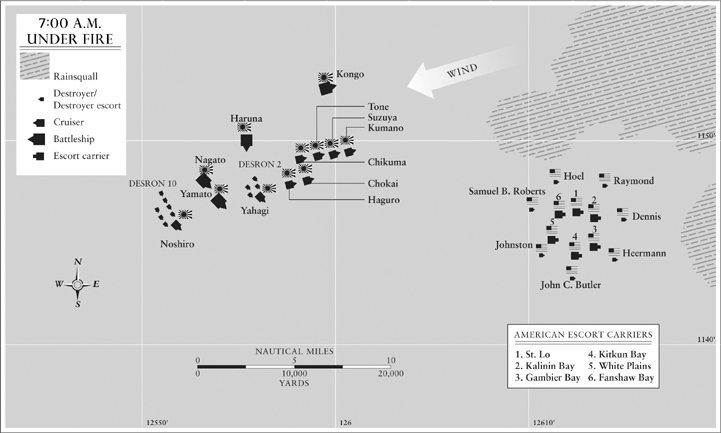
As Ziggy Sprague’s task unit flees eastward into the wind, its six jeep carriers scrambling their pilots and aircrews, Kurita’s Center Force begins its high-speed pursuit, its battleships firing heavy salvos at extended range.
At 6:59, loaded with rounds designed to penetrate heavy armor, the great 18.1-inch rifles of the battleship Yamato trained to starboard and opened fire on Taffy 3 at a range of nearly twenty miles. One minute later Kurita issued a fleet-wide order for a “general attack.” The Kongo turned out to the east, in fast but independent pursuit. Ahead of the Yamato to port, the six heavy cruisers of Cruiser Divisions 5 and 7 formed into a single column, trying to take the lead in the chase. Angling to the southwest, the Nagatoturned her sixteen-inch rifles twenty-five degrees to port and opened fire at a range of more than twenty miles. The swift Haruna loosed fourteen-inch salvos using its crude radar set.
Apparently unaware of the speed advantage his ships held over their American prey, Kurita seemed eager for his heavy cruisers to press the fight before the Americans could escape. A more disciplined (or better-informed) commander might have drawn his ships into a single line of battle, with destroyers in the forward van to scout the enemy and maneuver for a deadly torpedo attack.
For all the strength the Japanese Center Force brought into play, its commanders were unsettled about the manner in which the battle began. In the midst of the shift to a daytime antiaircraft formation, with each captain operating at his own freewheeling discretion, confusion took command of the Center Force. Vice Adm. Matome Ugaki, commanding Kurita’s First Battleship Division, composed of the Yamato and the Nagato, observed, “each unit seemed very slow in starting actions due to uncertainty about the enemy condition.” “I feared the spirit of all-out attack at short range was lacking,” Admiral Ugaki would write.
The heavy cruisers led the Japanese charge on Taffy 3. Cruiser Division 7’s commander, Vice Adm. Kazutaka Shiraishi, was a fifty-two-year-old Nagasaki native who had not had a seagoing command since 1940. Shiraishi received Kurita’s order, “Cruiser divisions attack!” and turned his ships to the southeast, steaming at their maximum speed of thirty-five knots. Aiming to flank the American ships from the east, he radioed each of his captains in succession: “We are closing the enemy. Intend to engage to starboard.” Then—bizarrely—though a general attack had been ordered, the vanguard of any such attack, the Center Force’s two divisions of hard-hitting destroyers, led by the light cruisers Noshiro and Yahagi, were ordered to the rear. Though there were doubters in his midst, Kurita was overjoyed by his perceived good fortune in encountering American carriers. At seven o’clock the Center Force commander dispatched a message that delighted Combined Fleet Headquarters: “WE ARE ENGAGING ENEMY IN GUN BATTLE” … and then “BY HEAVEN-SENT OPPORTUNITY WE ARE DASHING TO ATTACK THE ENEMY CARRIERS. The emperor’s fleet had been handed a dreamed-for chance. Carriers were queens of the seas, mobile and lethally armed with ship-killing planes. Now it was the Imperial Japanese Navy’s turn to move on the Philippine chessboard. Its rooks had America’s queens, so Kurita thought, lined up for slaughter.
Sixteen
As flecks of antiaircraft fire dotted the northern horizon around Bill Brooks’s Avenger, Ernest Evans emerged from his sea cabin on the destroyer Johnston and sized up Taffy 3’s predicament in an instant. Situated closest to the advancing enemy fleet, he could not have missed his ship’s consignment to quick destruction. Faced with it, Evans evidently saw no need to await orders from Commander Thomas aboard the Hoel or from Admiral Sprague. If carrier commanders traditionally saw the destroyers’ primary battle role as laying smoke screens to cover the flattops’ escape, Evans had other ideas about what he was supposed to do. Destroyers sortied. They interposed. They sacrificed themselves for the ships they were assigned to protect. Evans would do his duty for the Fanshaw Bay, the St. Lo, the Gambier Bay, the White Plains, the Kalinin Bay, and the Kitkun Bay. If that meant closing with an enemy whose guns were big enough to sink him with a single hit, so be it. He would make good on his commissioning-day promise—his warning—to his crew: the Johnston was a fighting ship. He would not back down.
Recalling his skipper’s speech in the context of the present situation, Bob Hagen, the Johnston’s gunnery officer, grew ill. As the ship’s senior lieutenant, he knew his skipper. The certainty that Evans would turn the ship into the teeth of the Japanese fleet saddled him with dread. This is an impossible situation with this skipper, Hagen thought. He’s not going to run. He doesn’t know how.
Hagen practically heard the orders before his skipper delivered them. His rapid-fire sequence suggested he had rehearsed all his Navy life for a moment such as this.
All hands to general quarters.
Prepare to attack major portion of the Japanese fleet.
All engines ahead flank.
Commence making smoke and stand by for a torpedo attack.
Left full rudder.
Lt. (jg) Ellsworth Welch couldn’t help but be impressed with his skipper’s brio, his calm, his directness of action, and clarity of thought. Why didn’t I think of that? he found himself wondering. Nothing like having a pro in charge.
Left full rudder meant that the ship would peel off to the north-northwest, away from the illusory sanctuary of the formation and charging toward the enemy fleet. The order made Robert Billie, a Minnesotan, want to go to ground like a gopher. “That was the only time I ever wanted to dig a trench.”
Bob Hagen ran his numbers—the fire-control computer could not help him here—and drew the same conclusion Jack Moore had on the Samuel B. Roberts: there was probably a fifty-fifty chance of survival. The long odds notwithstanding, he was in no hurry to climb up to the gun director. Though the situation seemed to demand urgent action—and indeed, he could count on his men being inside each of the five main gun mounts within about ninety seconds of going to general quarters—what was the point of hurry-up-and-wait? The gunners would have nothing to shoot at until the range to the enemy had closed from 35,000 yards to 18,000 yards, about six miles. Until then, the gunnery officer felt no immediate need to gaze upon the enemy ships through his binoculars.
The shellfire put out by the Japanese force was overwhelming. Battleship main battery rounds plunged down at the Johnston, shrieking like locomotives, smacking the sea with a slap and roar and sending up towers of dye-stained seawater. At that moment Hagen had as good a view of the Japanese dreadnoughts as he cared to have.
The Johnston’s gun boss contemplated the audacious path his captain had chosen and said quietly, “Please, sir, let us not go down before we fire our damn torpedoes.”
He did not doubt that Ernest Evans would do his best. Like the other officers on the Johnston, Hagen had come to see him as “a captain who could strike fighting spirit from his men the way steel strikes spark from a flint.” Evans’s conduct impressed him indelibly. “I can see him now,” Hagen would write, “short, barrel-chested, standing on the bridge with his hands on his hips, giving out with a running fire of orders in a bull voice.”
That Evans acted on instinct, ahead of actual orders, was elemental to his constitution and his experience. The crew in turn vested their faith in the all-encompassing will of the Cherokee warrior who had sworn that he would never withdraw. And who knew, perhaps promises as portentous as his carried with them some kind of implicit magic that assured their survival. The laws of probability and the lessons of recent combat history, however, heralded a different outcome. At the Battle of Savo Island, Japanese cruisers and destroyers had needed only six minutes to annihilate an Allied cruiser column. At Midway, American dive-bombers had wiped out most of a Japanese carrier task force in four decisive minutes. Alone against heavy cruisers and battleships—cruising through shell splashes fired by vessels up to thirty-five times her size—the Johnston would have no business surviving even that long. As the Army troops at Bataan or the Marines on Wake Island could attest, Americans had been overwhelmed in battle before. The Pacific had afforded them several occasions to refight the Alamo. Now, it seemed, it was the Navy’s turn.
As his ship sped to the northwest, alone against the Japanese fleet, Ernest Evans had no illusions that the Johnston’s five-inch main battery would do much damage. He knew that his only chance to send Japanese iron to the bottom of the Philippine Trench was to get close enough to fire his ten torpedoes, mounted in two quintuple mounts amidships, and plant a little torpex into their underbellies. Until then, all he could do was make his best speed and blow out as much smoke as his boilers were capable of making.
When the firemen received Captain Evans’s order to make smoke, they misinterpreted it as a reprimand. “But we are not making smoke,” came the defensive reply. Boiler room personnel trained hard to do anything but make smoke, lest the ship betray its location or foul its boiler tubes and require a painstaking cleaning. Evans grabbed the sound-powered phones and yelled, “I want a smoke screen, and I want it now!”
On the fantail, Lt. Jesse Cochran, the assistant engineering officer and head of a repair party, had trouble getting the chemical smoke generator going. Its valves were stuck fast from saltwater corrosion. Torpedoman first class Jim O’Gorek used a big adjustable wrench and vise grips to jog them loose, while Cochran and his party set depth charges on safe and dogged down all hatches and doors on the aft part of the ship. After a minute or so of urgent wrenching, the gray concoction was billowing in the ship’s wake, hanging close to the sea in the humid monsoon-season air. As the Japanese star shells burned overhead like miniature midday suns, advancing the light of the early morning, black smoke flowed from the ship’s two stacks, turning dawn back into night.
Smoke making was an act of sacrifice: the smoke flowed behind the ship that made it, shrouding everything in its wake. It gave its maker no protection. If Taffy 3 had a prayer to survive, it would depend on confusing Kurita and shielding the retreating escort carriers from view. “We were making smoke, zig-zagging and heading for the Jap fleet,” seaman John Mostowy would write, “at flank speed and alone.”
As the Johnston came around to port on Captain Evans’s order, taking a northwesterly course toward the Japanese fleet, seaman first class Bill Mercer pulled on a kapok life jacket. He was fastening it tight when a seaman named Gorman asked him if he was scared. Mercer, a Texan, said hell yeah, he was scared. In fact, his heart was thumping so hard beneath his ribs that he feared the Japanese might hear it. The only words Gorman could find in reply were a strange non sequitur: “This is fun.”
To quartermaster Neil Dethlefs, the situation seemed like the work of a cruel and uncaring universe. He had been on the Johnston for only three weeks. Not long ago he had been working aboard the hull repair ship Prometheus at Tulagi when the Johnstonentered the harbor flashing signal lights requesting a replacement for a quartermaster who had trouble with seasickness. Dethlefs and another quartermaster on the Prometheus fit the job description, so they cut a deck of cards to determine who had to go. Dethlefs pulled an eight to his colleague’s king and dutifully reported to his yeoman for transfer to the destroyer. The bitter thought seized him now: he had arrived aboard the Johnston just in time to get himself killed.
As Captain Evans rang up flank speed, officer of the deck Lt. Ed DiGardi knew the Johnston wasn’t ready for an extended high-speed engagement. The fuel report indicated that the ship had only 12,000 gallons of fuel oil. At standard cruising speed, the ship burned 500 gallons an hour. But at a flank speed of thirty-six knots, the rate jumped to 5,000 gallons an hour. In just over two hours the tanks would be bone dry. The ship would go dead in the water, whether it was hit or not. Lieutenant DiGardi told the engineering officer, Lt. Joe Worling, to do what the engineer already knew had to be done: mix the oil with the 10,000 gallons of diesel fuel the ship carried in separate tanks. Though engineers hated the way the dirty-burning grog fouled the delicate boiler tubes and required a painstaking cleanout, there was no alternative in these desperate circumstances.
Not everyone was entirely despondent. Looking down to the bridge from the gun director, Bob Hagen swore that he could see Captain Evans’s “heart grinning” as he led his ship into the fight.
Seventeen
From the bridge of the Fanshaw Bay, Ziggy Sprague took in the vicious columns of water rising around the White Plains and the other CVEs on the edge of the formation nearest the enemy and saw a terrible beauty. The splashes from the salvos rose in a rainbow of colors: red, pink, purple, green, yellow—each so dyed in order to help the enemy gunners correct the fall of their shots.
In the whole horrible course of the war in four wide oceans, not once had an American aircraft carrier been sunk by gunfire from an enemy surface ship. The historic nature of Sprague’s plight was not lost on him. In the triumphant closing phase of the war against Japan, Admiral Sprague, an emissary of the world’s greatest sea power, was going to see all six of his flattops sunk by gunfire. It was certain to happen. It wouldn’t take more than fifteen minutes. There was no other possible outcome.
For the kid from Rockport, the situation was beyond imagining. “I wouldn’t say it was like a bad dream, for my mind had never experienced anything from which such a nightmare could have been spun.” Once Clifton Sprague had dreamed of going to West Point, of parading on horseback before cheering crowds down his hometown thoroughfare. He had become a Navy admiral instead. Now he would have his appointment with notoriety, leading thirteen ships whose pending destruction would go down in history just as surely as they would go down to the bottomless deep of the Philippine Trench: “Neither could such dream stuff have been recalled from my reading in some history book, because nothing like this had ever happened in history.”
By any measure the mathematics of the engagement were preposterously against them. The Yamato displaced nearly seventy thousand tons. She alone matched almost exactly in weight all thirteen ships of Taffy 3. Each of her three main gun turrets weighed more than an entire Fletcher-class destroyer. Her armor belts—sixteen inches thick at the waterline and more than two feet thick on her gun turrets—were impenetrable to an American destroyer’s guns. Her nine 18.1-inch rifles were the biggest guns that ever went to sea, firing 3,200-pound shells more than twenty-six miles. Their development was so secret that even Admiral Kurita did not know their true size. The superbattleship’s secondary battery of six six-inch guns packed twice the hitting power of anything Ziggy Sprague’s largest escorts had. The ship was a great gray beast whose bulk pressed down into the ocean and possessed it, displacing enough water to raise measurably the level of a small lake. At flank speed of twenty-seven knots, the Yamato sliced the sea and drew it back around her in a roiling maelstrom, leaving a wake that capsized small boats.
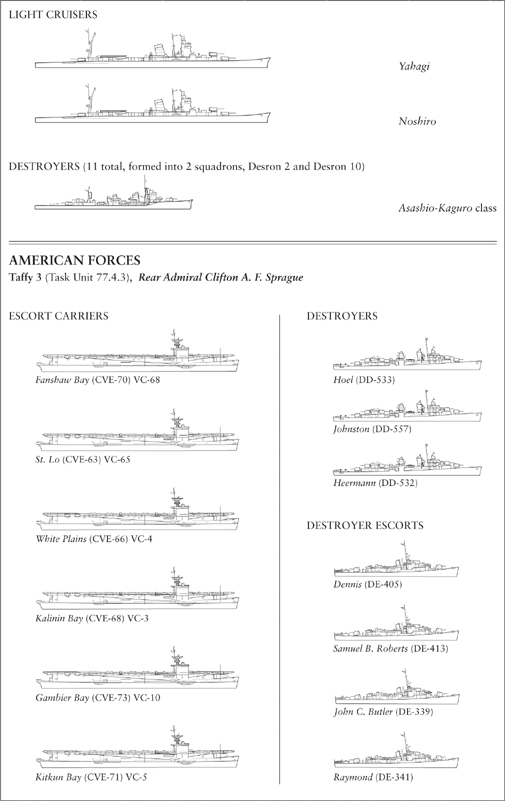
The Yamato was not the only ship that completely outgunned Sprague’s task unit. The Nagato, displacing 42,850 tons, fielded eight sixteen-inch guns, and the Kongo and her sister ship the Haruna (36,600 tons) were fast frontline battleships armed with eight-gun fourteen-inch batteries. Kurita’s six heavy cruisers were thirty-five-knot killers that had a cumulative displacement equal to that of the Yamato. Finally, Kurita had two flotillas of destroyers, eleven in all, each led by a light cruiser, the Yahagi and the Noshiro(8,543 tons), with six-inch batteries. On paper each of the destroyers matched the Johnston, the Hoel, or the Heermann in speed and torpedo power if not quite in gunnery. The only weapon in Sprague’s modest arsenal that Kurita could not match was aircraft. Each of the six American jeeps carried about thirty planes. But loaded with depth charges, antipersonnel bombs, rockets, and the machine guns in their wings—not to mention the propaganda leaflets they sometimes carried in lieu of more kinetic payloads—they were not armed for attacking heavy surface ships.
A fighting force cannot be reduced to its order of battle any more than a ship’s value can be reduced to the number of guns she carries or the shaft horsepower her turbines can generate. A vessel draws life from the spirit of her crew, which derives in large part from the leadership qualities of her chiefs and officers. Morale defies quantification—and yet it weighs significantly on the ultimate lethality of the tools of war. A ship’s effectiveness is the product of thousands of bonds that develop between individual officers and crew. The bonds form and break in a chain reaction, the power of which is determined by drill, by relationships, by fortitude, faith, and values. Task force commanders can be only abstractly aware of these uncountable qualities as they exist on the particular ships under their command. The officers of the ships themselves see these qualities more clearly but still can only guess how the chemical reactions will coalesce when the real shooting starts and men begin to die. And so orders of battle are drawn up to focus on the tangibles: speed, displacement, armament, and sensors. On that score Taffy 3 scarcely even registered on the scale of force that Takeo Kurita brought against them.
Thanks to Ensign Brooks’s diligent sighting report, Admiral Sprague knew precisely what he faced. “I thought, we might as well give them all we’ve got before we go down,” he later recalled. That meant getting into position to launch planes and putting as much distance as possible between his ships and the faster Japanese. Both of those goals could be met by heading east, into the wind.
Ziggy Sprague coolly measured what would become a steadily shifting matrix of variables—enemy course headings, patterns of wind and squalls, the effectiveness of his own ships’ evasions and protective smoke laying and the effect of the enemy fire—and instinctively planned his escape. He ordered his ships to turn from their northerly course to an eastward one, on heading 090. Three factors recommended that course: first, it was directly away from the Japanese fleet; second, it brought a strong wind rushing from bow to stern over his carrier decks—an apparent headwind of twenty-two knots was necessary to get a fully loaded Avenger airborne, even with catapult assistance; and third, it took him toward open ocean, where he could hope for the intervention not only of rainsqualls but perhaps also of other American ships. “I wanted to pull the enemy out where somebody could smack him,” he would write; either Oldendorf or Halsey, wherever they were, could handle that job. “If we were going to expend ourselves I wanted to make it count.”
At 6:50 Sprague flipped on the TBS radio and ordered the skippers of his command, “Signal execute on receipt. Shackle baker uncle easy unshackle turn.” Between the words shackle and unshackle was the coded numerical heading Sprague intended to follow. Baker Uncle Easy were the encoded integers for a heading of 090. All as one, the helmsmen on twelve of Taffy 3’s thirteen ships turned to the right, bringing their ships on an eastward heading. Sprague also passed the order to begin making smoke for concealment. Aboard the jeep carriers, flight deck crews raced to ready their planes for launch.
It took only five minutes to turn the six nimble carriers onto a windward course. Sprague ordered, “Launch all planes as soon as possible,” then hedged against the long-shot possibility that the fleet opposing him might yet be friendly: “Caution all pilots to identify all ships before attacking.” The roar and colorful splashes of incoming shells, however, all but removed that distant possibility.
Many of Sprague’s planes had been airborne since first light, flying off before daybreak to strike targets on Leyte. Now, needing the bombs they carried, he ordered them to abort and return. He also needed help from the other two Taffies to his south. On the TBS circuit he raised the commander of Taffy 2, Rear Adm. Felix Stump, “Come in please. Come in please…. To any or all: We have enemy fleet consisting of BBs and cruisers fifteen miles astern closing us. We are being fired on.”
Admiral Stump got on the line, already briefed by intercepted radio transmissions, and said, “Don’t be alarmed, Ziggy, remember we’re back of you. Don’t get excited! Don’t do anything rash!” Since Stump’s Taffy 2 was the only of the three Taffies not under direct attack—Taffy 1 would be fighting off land-based Japanese aircraft most of the morning—he was best positioned to help Sprague. Still, something about his tone tended to undercut his advice.
Thomas Sprague, in simultaneous command of Taffy 1 and all three Taffies, recognized that in the coming fight Ziggy Sprague should be free to decide how to conduct it. All that Thomas Sprague could do for him was cover bureaucratic bases and ask the Seventh Fleet’s commander of support aircraft for permission to launch all available torpedo bombers and “go after them.” The request was duly granted, and thereafter, according to Admiral Stump, “no orders were received from anyone during the entire day, nor were any necessary.” It was Ziggy Sprague’s battle to win or lose, “using the initiative that was required under the prevailing circumstances.”
Ziggy Sprague knew that help was a long way off. What he didn’t know was that Jesse Oldendorf’s battleships, idling in Leyte Gulf after their historic victory in Surigao Strait, would be kept from coming to his assistance because Admiral Kinkaid feared the Southern Force might turn around and attack again through Surigao Strait. Though one might question the wisdom of ensuring against a contingent disaster when a very real one was already at hand, the cold fact of October 25 was that Admiral Sprague, the ships and men of Taffy 3, and their brothers to their south, would have no help from the overwhelming naval power marshaled to their north and south. They were on their own.
Sprague’s moves in the crucible of imminent combat were swift but not rash. One trait of good commanders is that they make simple decisions at the right times and without delay. Sprague was an instinctive and forceful decision maker. He played golf in a hurry. He didn’t line up his putts. He just walked up to the ball and hit it. When he met his future wife, Annabel, he knew immediately he would marry her. At Pearl Harbor he knew right away what to do with the few weapons he had on the Tangier. On the morning of October 25, with an overwhelming Japanese task force pressing down on him, he saw instantly the surest route to his slim hope of survival. If he did not completely resign himself to dying, he at least accepted the reasonable certainty of an imminent swim. If no assistance came from other ships, Sprague would settle for the intervention of a heavenly being of whom during quieter periods of his life he had asked, and to whom he had given, relatively little.
Eighteen
In the ready room of the St. Lo, VC-65’s skipper, Ralph Jones, pulled on his Mae West, a parachute harness, helmet, and goggles as fast as he could. The pilots and aircrews of VC-65 followed suit, the boom boom rummp of the enemy ships’ near misses urging them on as they scrambled to the flight deck and climbed into their planes. Kurita had found their range. Pink, red, and blue columns of water rose up around them. Something crazy was happening—they were under attack, but by whom? There was no cause to question it, but how the hell was this possible? Takeoff would have to be quick, or it might not be done at all.
Ens. Ed Breeding had been up half the night, listening on the combat frequency to the fractured transmissions of the fighting down in Surigao Strait. Strapped into the cockpit of his FM-2 Wildcat fighter, engine started and idling, in queue for takeoff, the twenty-three-year-old watched as colorful spouts of water climbed into the air to starboard and port, then collapsed in rings of sea foam. A teenage plane handler jumped onto his wing, gestured toward the maelstrom, and asked, “Sir, what’s that?” The other pilots had nicknamed Breeding, a farmer’s son from Hill County, Texas, “Speedy” for the pace of his Texas drawl. He said, “Well, it looks like somebody’s shooting at us. You better put me on that catapult so I can go shoot back.”
Until he saw with his own eyes the big shells inbound from the battleships and heard with his own ears the crackling whistle of their descent, Holly Crawforth, a St. Lo radio technician, thought it was all some kind of sick joke. Confronted with a sudden vision of his capture and torture at Japanese hands, he took his dog tags and threw them away. On the sound-powered phones he could hear the guys in the engine room getting panicky. Belowdecks men fretted about the possibility of a torpedo hit swallowing them from below. “Tell us what the hell is happening!” they shouted.
The St. Lo’s skipper, Capt. Francis J. McKenna, called course changes to his helmsman, zigzagging hard, trying to throw off the aim of the Japanese gunners. As vital as his evasive maneuvering was, it complicated matters for pilots aiming to get airborne. With the flow of wind over the deck shifting with each turn, aviators never quite knew how crosswinds and engine torque would affect their takeoff. The catapult crews preferred to fire when the ship was facing the wind, so the rhythm of the launch was disrupted and the planes started their missions widely separated.
As ever, Lt. Cdr. Ralph Jones was first in line for takeoff. The catapult whipped him airborne, and the catapult crews raced to gather the harness and string it to the next plane rolling forward. Jones turned sharply to the left, fifty feet off the water, and headed for the Japanese fleet. Inching ahead in his Wildcat, Breeding’s squadron-mate, Lt. (jg) Larry Budnick, far from his Superior, Wisconsin, home, thought to himself, Let me the hell off this thing. Smoke from the carrier’s exhaust stacks, which rose barely above the flight deck, stung his nose with its acridity. One by one the planes ahead of him whipped aloft—Avengers using the catapult, Wildcats making deck runs. At last it was Budnick’s turn. He opened his throttle, rolled down the deck, and roared aloft after his commander.
The usual strike plan called for the Wildcats to escort the Avengers to the target and coordinate their attacks. En route the pilots of the swift Wildcats kept their throttles back, weaving and circling to stay with the lumbering torpedo bombers. At the target the fighters winged over to strafe while the Avengers lined up their excruciating low-altitude runs. That kind of teamwork was impossible now. There was no time to fly by the book. Larry Budnick had a hard time finding other fighter pilots to form up with. He found his radio frequency congested with confused transmissions: “I’m over here, where are you?” “If you can’t find me, go in by yourself” There was no rhyme to the babel, and no structure to the minuet. In the rush to get airborne, Commander Jones had had no time to give his pilots rendezvous instructions. It was going to be every pilot for himself.
* * *
ON THE FANSHAW BAY, Royce Hall rose early, ready for another day’s dull routine. The aviation ordnanceman first class from Emanuel County, Georgia, was the turret gunner on the TBM flown by Lt. Harvey Lively. Their aircraft, last in line for takeoff, was perched on the aft end of the flight deck. Hall climbed into the torpedo bomber through the small radio compartment hatch in the belly, twisted his torso around, stepped up, and squeezed into the flat-sided sphere of the Avenger’s ball turret. Hall sat down in the turret’s metal bucket seat, fingered his trigger, and peered through his illuminated gun sight. When he saw the great towering splashes around the ship, he craned his neck and looked skyward through the Plexiglas, expecting to spot enemy bombers. But Hall could not see above the low ceiling of clouds. Then he noticed the yellow-orange flashes of light breaking through the curtain of squalls on the northwestern horizon. The light bloomed and faded but never seemed completely to disappear. At first he took it for something burning—maybe a ship in its death throes. But when large splashes began bracketing the Fanshaw Bay, walking the water around her in tight three- and four-shell patterns and dousing the flight deck with dye-stained seawater, Hall knew that what he was looking at were blasts from the muzzles of some very large ships.
“Hey, Guns, what’s going on?” asked radioman Willie Haskins, seated below in the radio compartment, looking up at the soles of Hall’s leather-booted feet. “Oh hell, some SOB is shooting at us from way over yonder somewhere,” the Georgian replied. As the plane handlers muscled the Avenger forward toward the catapult, Lively, Hall, and Haskins, as the last crew to leave Sprague’s flagship, never thought they would make it airborne. The Fanshaw Bay was bracketed by at least fifteen shells before their TBM ever got into launch position. Finally the plane handlers hooked the catapult cable to hooks underneath the wings and looped it around the hook buried in the flight deck’s catapult track.
Without ceremony, the catapult fired. Hall reflexively tucked his chin between his knees to keep inertia from jamming his face back into his gun sight, and suddenly they were airborne—or nearly so. As the heavy plane clawed its way heavenward, Hall was treated to the turret gunner’s backseat view of the flight deck rising up above him as the aircraft dropped toward the water, the towering bow of the ship cutting the sea in pursuit of the plane until the Avenger’s fourteen cylinders finally caught air, gained the sky, and outraced its host vessel. Looking back at the thirteen ships of Taffy 3, Hall said a quiet good-bye. “My first thought,” he later recalled, “was that I would never see any of the task force above the water again.”
On the flight decks of the five other escort carriers of Taffy 3, a similar dance was taking place: pilots jogging to their aircraft, radial engines turning over, a queue to the catapult forming up, and planes flinging skyward. They left their ships carrying whatever ordnance they happened to have. The aviation ordnancemen, meanwhile, pushed their wheelbarrows to the edge of the deck and dumped overboard all bombs, rockets, and other armaments that were not already loaded onto an aircraft. From the Fanshaw Bay’splane captain’s shack, VC-68 aviation machinist’s mate Dave Lewis awoke to the sound of commotion, looked up, and saw an ordnanceman named Bob Kenny running down the flight deck shoving a two-wheeled bomb cart loaded with a hundred-pound bomb that hadn’t found a taker. Kenny was a big man, built like a football player, but Lewis had never seen him move so fast. “He was not inclined to exert himself. If he was running, I knew this was really serious.” Lt. Verling Pierson, watching the bombs going overboard, was impressed with the crew’s initiative if not entirely hopeful about its benefits. “A futile gesture, but it gave them something to do.”
As the pilots readily appreciated, it was probably more dangerous to remain aboard the fuel- and explosive-laden jeep carrier than to take off and glide-bomb a Japanese capital ship. As Leonard Moser, a plane captain on the Fanshaw Bay, was changing a carburetor on a VC-68 aircraft, half a dozen pilots hovered nearby, coveting a chance to climb into that cockpit and get their tails off the ship. The aviation machinist’s mate finished the job, then climbed up into the cockpit. “What are you doing?” one of the pilots asked.
“I’m going to check this damn engine out,” Moser said, “and then go find a hole to hide in.” The pilot said that he would do his own engine check this time, thank you very much. Moser stepped aside. “He got in, started it up, and took off with a cold motor. My helper didn’t even have all of the cowling on. That pilot was glad to leave.”
* * *
SEATED IN HIS TBM Avenger on the deck of the Kalinin Bay, his engine idling as he awaited launch, Lt. (jg) Earl Archer was soaked like a cat in a storm. The crash and splash of the near misses landing near the carrier had drenched him thoroughly. For the first time in his life, he really prayed: Lord, please don’t let me die sitting here on deck. He was number three for takeoff, behind VC-3’s skipper, Lt. Cdr. Bill “Pops” Keighley, and Lt. Patsy Capano. He was among the few TBM pilots with a full weapons load: four five-hundred-pound bombs, eight rockets, and two magazines full of .50-caliber ammo. Finally his turn on the catapult came, and his prayer was answered: he was airborne and outbound.
On the day Pearl Harbor burned, Earl Archer had driven his Buick from Hope, Arkansas, to Little Rock aiming to enlist in the Army Air Corps. When Archer, a junior at the University of Arkansas, arrived in Little Rock, he had a spiking fever. It might have been pneumonia. “When you get well, we’ll sign you up,” the recruiter said. Archer got home and talked to a friend who told him that naval aviation was where the action was. For a daredevil who came home from college on Friday nights so he could race cars at the fairground on the weekend, action was important. Archer went to New Orleans with his friend and signed on to be a Navy pilot.
In flight training at the naval air station at Lake Pontchartrain, Archer never missed a chance to go into town for a little nightlife. Tall and thin, eyes hooded by drooping lids that made him look sleepy all the time, he was improbably adept at getting girls. He told them his eyes looked that way because of an injury from shrapnel.
The line worked so well on the girls at New Orleans’s Copa Cabana Review that Archer became a semiregular patron of the Roosevelt Hotel, convenient for high-style rendezvous. So notorious was he among his fellow cadets for his stays in that hotel’s Blue Room that “Blue Room” became his nickname. Soon it was shortened to just “Blue.”
Blue Archer was still in training when the Battle of Midway was fought. At the officers’ club one day, an officer told him the Navy needed volunteers for torpedo bomber duty. Archer had heard about the catastrophe of Torpedo 8, the torpedo bomber squadron from the Hornet, butchered nearly to a man on June 4, 1942. But his concerns about danger—“Torpedo training? Are you crazy?”—were nothing that two martinis and the worldview of a race-car driver could not overcome.
From sinking a cargo ship with depth charges on an antisub patrol to retrieving an American flier from an airfield on Saipan still partially controlled by the enemy, there wasn’t much Blue Archer hadn’t done in his time as a VC-3 Avenger pilot. He was given to crazy stunts and inappropriate exuberance. When he snatched the flier from the airfield, he had landed under fire, stopped just long enough for the stranded aviator to clamber aboard the Avenger, then, gunning the engine, spun his plane around and started back down the runway, strafing the Japanese at the far end of the airstrip, swerving to spread his fire like a scythe as his plane gained the sky. Returning to the Kalinin Bay, Archer felt the urge to celebrate a little. He was already a well-known hot-rodder. Fully trained as a landing signal officer as well as a pilot, he felt that he knew how far to stretch the safety rules. So in he came, low over the waves—and lower still over his carrier’s flight deck. He buzzed his ship, sending flight deck crew ducking from the roar of his big Wright radial engine. When the jeep carrier’s air officer dialed his radio frequency and warned him not to try any such foolishness again, Archer circled back as if to land, flipped his plane over on its back, and buzzed the five-hundred-foot length of his carrier once more. His reward was restriction to the ship during shore leave—lubricated by an ample supply of beer provided by his delighted squadronmates. As far as torpedo pilots went, Blue Archer had seen and done it all—all, that is, except attack the main body of the Imperial Japanese Navy.
About fifteen minutes had passed since the Japanese had been sighted. The six jeep carriers of Taffy 3 had most of their available planes in the air. The pilots and their aircrew were on their own. They would see what they could do against Kurita’s onrushing leviathans.
Nineteen
It took just minutes for the Japanese gunners to demonstrate the horrible potential of their broadsides. At 7:04 the White Plains was straddled on a diagonal. “This salvo measured the carrier as calipers,” the action report noted, with a four-shell salvo from a battleship missing narrowly, two off the port quarter and two off the starboard bow. Even though the shells missed, their underwater blasts twisted and shook the CVE hard enough to throw men from their feet, send loose deck gratings hurtling across the engine room, and knock heavy equipment from its stowages. The ship lost steering, its radar failed, and when a circuit breaker was thrown open by the shock of the blast, its compartments went dark.
The damaging effects of shells that missed left to the imagination what might happen if others were actually to find their mark. Moments later they did. At 7:10 an eight-inch round from a heavy cruiser hit the White Plains. But because it was an armor-piercing round, fused to penetrate hardened armor plate and ignore lesser impediments such as mere metal sheet, it passed straight through without exploding, like a bullet holing a shoebox.
To the Japanese gunners, the thick funnel smoke flowing from the stacks of their targets presented the illusion of ships burning fiercely.
The Yamato’s great guns roared until about 7:05, when the carriers vanished momentarily into a wash of rainsqualls. Even when they had a clear line of sight, the Japanese still did not know what they faced. From the elegant proportions of their superstructures to their twin stacks to the graceful rise of their forecastles, Fletcher-class destroyers had silhouettes similar to those of Baltimore-class heavy cruisers. Japanese recognition books did not include Henry Kaiser’s new-fangled flattops. At 7:16 lookouts on the Kumano spotted an aircraft carrier afire. Satisfied with the presumed kill, they changed targets two minutes later and threw their next salvos at the St. Lo. By this time Vice Adm. Kazutaka Shiraishi had realized something vital: his quarry were not Essex-class fleet carriers after all but light carriers. But the cruiser commander apparently never relayed that information up the line. About that essential fact, Kurita would remain thoroughly in the dark.
Ziggy Sprague had no idea what the Japanese knew or did not know about his force. Armed with his own good reconnaissance, he could assume only that the Japanese knew what they faced. “At this point,” Sprague would later write, “it did not appear that any of our ships could survive another five minutes. The task unit was surrounded by the ultimate of desperate circumstances.” He knew that the sluggish exertions of his carriers’ Uniflow engines, the copious smoke, and the dauntless efforts of his carrier pilots would not be enough to save his carriers from annihilation.
At some point Sprague’s screen, as a unit, would have to form up and engage. As soldiers must occupy ground in order to win a land battle, control of the sea is best asserted by ships, not planes. Admiral Kurita had demonstrated that eloquently the previous afternoon when most of his Center Force survived five heavy air strikes from the Third Fleet and continued through San Bernardino Strait. If ever there was a time for America to bring its naval airpower to bear, this was it. Meanwhile, Sprague might yet forestall the onslaught of the Japanese fleet by throwing his destroyers into the breach.
With salvos from the pursuing Japanese battleships and cruisers landing close around Taffy 3’s carriers in all directions, Sprague got on the TBS circuit at 7:16 A.M. and ordered the screen commander, William Thomas, aboard the Hoel, “Stand by to form two torpedo groups, big boys in one group and little fellas in another group.”
There was little anguish in the decision to send the small ships to almost certain destruction. Under the impossible circumstances, there was nothing else for them to do.
* * *
WHEN CLINT CARTER REACHED the Johnston’s fantail and climbed into position in the left rear corner of Gun 55, assuming his general quarters post as its captain, he dryly informed the other men crowded into the steel enclosure, “Admiral Halsey is shooting at us.” Once the telltale pagodas rose into view on the horizon, they all knew otherwise. But until reality settled in, Carter’s gun crew shared the disbelief of everyone else in Taffy 3: This can’t be the Japs. We’ve got Halsey watching our back. Linked to Bob Hagen in the gun director via headset and sound-powered phones, Carter reported that Gun 55 was manned and ready. As the Johnston ran solo through a forest of shell splashes, swerving through rainsqualls and the back-drafts of her own smoke, all the gun crews could do was wait as the range closed, then feed the gun as rapidly as possible and hang on for the ride as Lieutenant Hagen slewed them from target to target.
Up in the gun director over the pilothouse, Bob Hagen felt powerless. “All this time I had been completely, sickeningly impotent. I had checked my gun stations, seen that everything was in order, but after that there was nothing I could do but wait.” Evans had ordered him to fire on any enemy target that came into range. At a range of 25,000 yards, the ship still had not been hit. Was someone looking out for them?
At 7:10 the distance from the Johnston to the nearest Japanese heavy cruiser closed to the five-inch/38-caliber’s maximum range of eighteen thousand yards, or about ten statute miles. Evans directed Hagen to target the leading heavy cruiser in the column to starboard. Hagen’s fire-controlmen, George Himelright and James Buzbee, fixed the ship in the director’s sights and fire-controlman Tony Gringheri entered ranges using his stereoscopic rangefinder on the mainmast. The data passed down into the ship’s Mark 1A fire-control computer. Developed by the Ford Instrument Company in the 1930s, the intricate but sturdy array of gears, cams, shafts, and dials was an analog device with no memory as we understand it today. Rather, it was designed only to predict the position of its target and align each of the five turrets to place its shell at the coordinates that the computer calculated the target would occupy at impact. Just as a football quarterback pedaling back in the pocket must place extra zip on his throw to compensate for his own rearward movement, the computer removed the imparted effect of the ship’s own motion from the firing solution. A gyroscopic stable element corrected for the pitching and rolling of the ship. Other critical inputs included the initial muzzle velocity of the ship’s five-inch shells—adjusted for bore wear and current weather conditions; the ship’s current latitude and the relation of its heading to true magnetic north, in order to compensate for the effect of the earth’s rotation and the “english” that it imparted to the shell’s trajectory; and the range to the target, which amplified the effects of all the variables.
It took the computer about thirty seconds to calculate a firing solution for a new target. Running adjustments on an existing target took only a few seconds. The computer transmitted electrical signals to the turret motors to aim the guns accordingly. Then Bob Hagen closed the firing key. With a flash of flame and smoke, the Johnston’s main battery came barking and cracking to life. Improbably, the Battle off Samar was joined by American guns.
Through his sighting telescope, Hagen could see his target return fire. It was the Kumano, the sleek 13,440-ton flagship of Admiral Shiraishi’s Cruiser Division 7. An eight-inch shell from a Japanese cruiser struck the water off the Johnston’s bow and sent up a wave of red-dyed water that washed down the entire forward superstructure. Bob Hagen wiped his eyes clear of the redness and said to the five men in the gun director with him, “Looks like somebody’s mad at us.” But the Japanese did not prove to be the shots that Hagen’s radar-directed gun system was. Hagen’s crews had lighter weaponry but far better aim. The humans were novices to surface combat, but the computer, like the radar and gyro that aided it, knew no fear.
The Johnston loosed a continuous ladder of shells over a two-hundred-yard stretch of ocean centered on the projected path of the heavy cruiser Kumano. During the five-minute sprint into torpedo range, the destroyer’s guns let fly with hundreds of fifty-four-pound five-inch rounds. When Hagen began to see his shells hitting the ship—flames and puffs of smoke obscuring the division flagship’s upper superstructure—he tightened the ladder to a hundred yards, concentrating the barrage. He landed some forty hits on the Kumano with his five-inch shells. Through his scope Hagen could see the smoky flashes tearing up the metalwork on the cruiser’s decks and gun galleries. They blew out portholes and killed men in exposed positions. Although this pummeling was not enough to sink the Japanese cruiser, the waves of shock, sheets of flame, and storms of shrapnel that buffeted the Kumano’s superstructure played havoc with its crew’s ability to return accurate fire. The Japanese gunners did not land a single hit in return on their bantamweight assailant.
With each gun mount firing seventeen to twenty rounds per minute, two mounts forward and three more aft, it didn’t take long for the hot empty shell canisters, discarded through a hole in the floor of each mount, to pile up and roll and clatter across the Johnston’s steel decks. Jesse Cochran, leading a repair party, was grateful that he had nothing better to do at the moment than toss them over the side.
The noise of the general quarters alarm had stopped some time ago, and on the bridge no one had a whole lot to say. Only the ship really spoke: the grinding vibration of the twin propeller shafts, the rumble of the gun director rotating on its mount atop the bridge, and the shock of the five-inch guns that bucked the deck and rattled crewmen’s helmets with their reports. As for the men, their emotions stayed under the skin. They were trained to deal only in facts, orders, data. The officers masked their desperation with the cool demeanor that disciplined leadership instills. The facts, the data, spoke for themselves, one more loudly perhaps than all the others combined, though it was not explicitly discussed: not one of them would get decent betting odds of surviving the gauntlet their skipper had steered them into.
The destroyer’s zigzagging inbound course was not entirely random. Evans deliberately turned toward and steamed through the roiling cauldrons of the enemy’s misses. Known as “chasing shell splashes,” the tactic relied on the diligence of the Japanese gunners to correct their aim. Because they continuously adjusted their range and train, naval salvos were like proverbial lightning, seldom striking twice in the same place. If the Japanese had caught on to the game, they might have fired successive salvos to the same range and bearing. But they did not. They had their training too. And so the Johnston pressed audaciously in, closing the range.
Clint Carter’s crew loaded and shot at such a brisk pace that the paint on Gun 55’s barrel blistered and burned. After each shot a blast of pressured air cleared the barrel of hot gases. Even so it was dangerous to let a live round sit too long in the breech. If you cooked it too long, it would cook you right back. Carter got a scare when a sudden course change forced his loaded gun mount to pivot and strike the cam stops that kept it from discharging. It was a precaution to keep the gun, when swiveled all the way forward, from hitting its own superstructure. But for agonizing seconds the safety device imperiled its operators. The round sat cooking in the breech, waiting for the computer to release it. “I was never as scared as I was in those few seconds,” Carter said.
Expecting a disastrous internal explosion at any moment, Carter raised Hagen and asked permission to fire the gun manually to prevent a detonation in the breech. But before the lieutenant could answer, the ship turned sharply again. When the director-controlled gun swung out automatically abeam to stay on target, it came off its stops and fired, ridding the breech of its time bomb.
The men assigned to train and point the gun had nothing to do as long as their weapon was on automatic director control. In Gun 54, forward of Carter’s mount and above it, atop the aft deckhouse, Bobby Chastain, the trainer, was responsible for swiveling the gun mount toward its targets in the event the automatic system failed. If the mechanisms that aimed their gun were knocked out but the mount still received train and elevation data from the director or from the CIC, crews could go to “modified director control,” aiming their gun manually by matching the dial pointer indicating the director’s orientation.
With Bob Hagen controlling his mount, Chastain’s telescope was useful only for sightseeing. Peering through the gun sight protruding through a small door positioned at eye level in front of his seat, he found that he couldn’t bear the sight of the larger ships. So long as Lt. Hagen didn’t need him to turn the gun, Chastain figured he’d spare himself some panic. He closed the gun sight door and pretended hard that he was safe.
Bob Hagen got information about targets from the executive officer and his radar-watchers in the CIC, or directly from the captain himself. Captain Evans was within shouting distance below, on the open-air bridge outside the pilothouse. Whenever Hagen felt the ship taking a new course, he could yell down to Evans, “What are you up to now?” Evans would look up at him and say, “Hey, take that ship over there.” After a target was chosen, Hagen slewed his director toward it, and as soon as his pointer and trainer hollered “On target!” Hagen closed his firing key, and the Johnston’s main battery resumed the bombardment.
Twenty
Clyde Burnett had been around the fleet long enough to know a hopeless situation when he saw one. The hourglass that measured the reasonable life expectancy of a lone destroyer charging a hostile squadron of battleships and cruisers had run out and emptied long ago. As the distance between the Johnston and her target closed, the chief boatswain’s mate took in the sight of shell splashes from enemy battleships all around his destroyer and told the members of his repair party to lie down on deck. He felt sure they were about to take a hit.
When Bob Hagen first opened fire, the range was eighteen thousand yards. As the range closed—fifteen thousand, then twelve—with Japanese shells straddling the destroyer, Captain Evans ordered, “Stand by for torpedo attack.”
The twelve-man surface search team in the fishtailing destroyer’s CIC, under executive officer Lt. Elton Stirling, relayed the range, bearing, course, and speed of targets to the bridge and the torpedo crew, while the other twelve-man section, the air search team, watched and waited. Closing to ten thousand yards under a crossfire this heavy was as unlikely as a man staying dry while sprinting through a driving rain. Miraculously, the ship made it. Impossibly, she was not hit. The target cruiser was steaming forty degrees off the Johnston’s starboard bow. At ten thousand yards the Johnston was within the outer limit of torpedo range.
To maximize their reach, Lt. Jack Bechdel, the torpedo officer, ordered the fish set on their slowest speed setting, just twenty-seven knots. As torpedoman first class Jim O’Gorek supervised the mount crews and stood by with a wooden mallet that could be used to fire the torpedoes if their igniters failed, two torpedomen, Thomas Sullivan and John Moran, cranked mount number one to starboard and trained it to 110 degrees relative to the ship’s heading, just abaft of the beam. Mount two, manned by Red Benjamin and Frank Gillis, was rotated out to 125 degrees relative. As soon as the range was good, Captain Evans shouted, “Fire torpedoes!”
With sharp rushes of compressed air, the Johnston’s ten torpedoes leaped from their tubes, one following the preceding at three-second intervals. They flew out over Burnett’s crew huddled on deck, their motors whirring wildly as they fell toward the waves. Hitting the water, their propellers found the resistance they craved and clawed into the sea. Carrying warheads tipped with three hundred pounds of torpex explosive, the Mark 15 torpedoes were about twenty-five feet long, nearly two feet in diameter. Adjusting to their set depth of six feet, the torpedoes turned to the right per the gyro settings that Lieutenant Bechdel had given them and accelerated to twenty-seven knots, running “hot, straight, and normal” toward the leader of the four-cruiser column.
With the torpedoes away, his ship blessedly untouched, Evans ordered Lieutenant DiGardi, his officer of the deck at the helm, to bring the Johnston into a hard turn to port. The beauty of the maneuver was that the ship now entered her own spreading smoke screen, blotted from the view of enemy gunners. As Bechdel counted down to the torpedoes’ calculated time of impact, the twin screws of the Johnston dug into the sea—driven by the combined sixty thousand shaft horsepower of her steam turbine engines—and drove her at top speed back toward the carriers of Taffy 3 that so desperately needed assistance.
At flank speed a Fletcher-class destroyer could outpace a Japanese heavy cruiser by a couple of knots. Speeding to rejoin Taffy 3 as her ten torpedoes ran the other way, the destroyer made the best possible use of that small margin, opening the range with the enemy while obscuring the interval with smoke. The flashes from the Japanese guns, and the concussion of their blast, eased only slightly as the distance opened. Whenever the squalls between the combatants thickened, the fire fell off measurably. But there was not enough rain to spare the Johnston entirely. It was daylight. The rising sun favored the fleet that flew its pennant from their fantails.
Destroyermen have this in common with submariners: they experience no greater suspense than while counting the seconds to their torpedoes’ time of impact. Jack Bechdel’s calculations were seldom wrong. Captain Evans and everyone else in the pilothouse listened to the countdown. They had shot their one spread; the ship carried ten torpedoes and no more. Bob Hagen’s good work in the gun director notwithstanding, this was their best and only chance to sink an enemy ship.
At 7:24 lookouts on the Kumano reported three torpedo tracks close off the starboard bow. Knifing through the water at more than thirty knots, the ship was traveling too fast to evade. The Kumano could not make the turn.
Between squalls and smoke Ellsworth Welch saw a bright flash and the long, dark form of a ship lift out of the water slightly, as if punched from below by an enormous fist. Torpedo explosions sounded different than gun blasts. Five-inch guns stung the eardrums with their sharp, concussive bark, throwing out shock waves that patted the clothes. Torpedo explosions were deeper and heavier—basso reverberations that could be felt in the sternum as readily as heard with the ears. The men of the Johnston felt a deep thrummp— some felt a second one, and then a third. The Johnston whipped through thickets of smoke, emerging long enough for Lieutenant Welch and others on deck to see a tall column of water rising beside the Japanese heavy cruiser, which appeared to be burning furiously astern. One torpedo from the Johnston struck the Kumano in the bow, ripping it clear away. The crippled cruiser fell out of line, limping along at fourteen knots.
The Kumano could still stand and jab, but with a broken bow she could not hold her place in column in a rapid running fight. Admiral Shiraishi ordered the Suzuya to come alongside, and he transferred his flag to her. The Suzuya was not fit to resume pursuit either. Near misses from aircraft bombs had ruptured her after fuel tanks, contaminating some eight hundred tons of precious fuel with seawater, starting fires that would burn into the afternoon, and restricting the cruiser’s speed to just twenty-four knots, no faster than the lumbering battleship Nagato. With his transfer to the crippled ship, Shiraishi took himself out of the battle. He may have had no other choice. He did not wish to hold back the two ships of Cruiser Division 7 that could still make chase. The Tone and the Chikuma sped past, joining Cruiser Division 5’s Haguro and Chokai in pursuit of Sprague’s carriers.
Twenty-one
The first thing Harvey Lively and Royce Hall of VC-68 saw upon breaking the surface of the cloud layer was a large formation of Avengers closing their position. As the planes drew near, Hall made out the distinctive tail markings of aircraft from another jeep, the Gambier Bay. Hall had flown with that ship’s squadron, VC-10, before. He knew its skipper, Lt. Cdr. Edward J. Huxtable, Jr.—or knew his reputation anyway. He toggled the intercom and told Lieutenant Lively that Huxtable could be counted upon to find whatever they were going after. The lone Avenger from the Fanshaw Bay tagged along with its sister squadron.
Huxtable would find the targets, but there remained the question of what he would hit them with when he got there. Before taking off, VC-10’s skipper had climbed into his Avenger only to find that his weapons bay was empty. He asked his plane captain to ask Buzz Borries, the air officer, for a bomb load. Huxtable watched as Borries brought the question to Capt. Walter Vieweg, standing on the Gambier Bay’s island superstructure. The skipper made a broad sweeping gesture with his arm as if to say, “Get these planes off my carrier.” Word came back to Huxtable that he would lead his flight without a load. The absence of a heavy torpedo or bomb load meant his plane would be able to stay airborne longer. Huxtable launched immediately, turned right, climbed to two thousand feet, and joined the other Avengers from his squadron.
It took just ten to twelve minutes to find the enemy ships bearing down on their carriers. Beneath the cloud ceiling at a thousand feet, it was hard to miss them. There were clear skies to the south, but the skies over the seas where the enemy fleet lay were roofed by gray clouds. Somewhere beneath that shroud of gray were the destroyers of Taffy 3’s screen. Edward Huxtable was stunned to learn that at least one American destroyer had turned to face the monstrous opponent.
Breaking through the clouds, the VC-10 skipper spotted the tin can running alone, returning to formation on a southeasterly course. He could see puffs of smoke coming from her batteries, and heavy splashes rising all around her as the Japanese fired in return. It was the Johnston. Transfixed by the sight, Huxtable then spied, farther to the west, the lethal slender forms of Japanese heavy cruisers giving chase. Beyond the cruisers, heading due east, he could just make out the thicker silhouettes of imperial battleships.
Huxtable decided that the heavy cruisers, faster than the battleships and better suited for pursuit, posed the most immediate threat to Taffy 3. Climbing through a cloud break to 2,500 feet, the VC-10 commander could see the cruisers firing rapidly at targets to their south. The battleships seemed not to be firing at all. Huxtable turned his formation from north to east, spreading his planes out in a wide front, and climbed to three thousand feet, above which the sky was solid overcast. Out to the east, flak dotted the skies. Apparently other planes were about. They would need all the help they could get.
The commander would have preferred more altitude. A properly planned air strike would have allowed time for pilots to locate holes in the squalls and plot their attack routes amid cloud-blinds and rain. Altitude gave a pilot options and flexibility. Over the radio came an order from the Fanshaw Bay’s air officer: “Attack immediately.” No reminder of the urgency was needed. Joined by Wildcats from VC-10, which heeled over into steep dives, strafing the enemy ships ahead of the torpedo bombers, Huxtable directed his Avengers to line up and move in behind them.
Lt. Burt Bassett watched Commander Huxtable dive left, heading for the second ship in column. Without ordnance Huxtable would make a decoy run. Its deterrent effect on the target ship would be no less pronounced; to a Japanese skipper, there was no telling what Huxtable’s turkey carried in its weapons bay.
Bassett lined up on the lead cruiser. As he nosed over from 2,800 feet and emerged from the clouds, he felt the full intensity of the flak. Tracers etched burning paths in every direction. Every so often a larger shell burst nearby, releasing an invisible spray of shrapnel through a small sphere in the sky. Bassett bore in steeply and released his first bomb from 2,000 feet. Almost immediately his aircraft shuddered from a hit to his starboard horizontal stabilizer. He released the second bomb right away, while he still could, pulling out at 1,500 feet. At about 200 knots, it took about twenty endless seconds for Bassett to reach the safety of a cloud bank ahead of the cruiser.
Since he had no bombs, Ens. Robert Crocker, third in the formation, was ordered to stay out of Huxtable’s first run. The fourth pilot in line, Ens. William Shroyer, went next. Angling his Avenger downward toward a battleship, Shroyer released short bursts from his two wing-mounted machine guns to sight his rockets. He fired them, and they shot ahead on coils of white smoke. Then Shroyer pulled the lever to open his bomb bay doors.
But something didn’t work. The doors stayed shut, trapping two five-hundred-pound bombs in his plane’s belly. Shroyer skimmed the water so low that his radioman, Louis Vilmer, Jr., looking out his small plate window in the TBM’s fuselage, had to look up to see the sailors on the Japanese ship’s deck. Shroyer climbed and circled for another pass, then followed a dozen Wildcats diving down to strafe. On the way in Shroyer instructed Vilmer to use the hand crank in the radio compartment to get the doors open. By the time Shroyer emerged from the clouds over a column of six large ships, Vilmer had succeeded.
Running up on a Tone-class cruiser from astern, Shroyer dropped his payload, and Vilmer watched the two bombs hit the water just a few feet behind the fantail, disrupting the ribbon of the cruiser’s wake with their detonation. The two pilots coming in behind Shroyer, Lt. Paul Garrison from the Kitkun Bay and Ens. J. F. Lischer from the Gambier Bay, reported that the cruiser had slowed and seemed to lose steering.
When Harvey Lively nosed over to attack, he didn’t say anything over the intercom. There was no “tallyho” or anything else kids heard in the movies. His first sortie against ships began without fanfare. Royce Hall just felt the plane push over into a shallow dive as flak bursts began appearing around them. When the nose of the plane pushed over, the tail swung up, the ocean dropped out of view, and Hall was left with a 180-degree view of the sky and squalls. As they approached the Japanese cruiser column from the rear, tracer bullets whizzed past him like angry fireflies to port and starboard. Lively pressed home the attack, engine at full power, the pin on the airspeed indicator trembling at 280 knots.
Lively closed on a cruiser from behind and released his four five-hundred-pound bombs. The pilot didn’t have the luxury of seeing the results for himself. He leveled off fifty feet above the wave tops, having traded altitude for airspeed and aiming to preserve every bit of it for his escape. From the tiny window in his radio compartment, Willie Haskins saw the bombs hit. One landed under the fantail of the cruiser and exploded. It might have been close enough, Haskins hoped, to damage the propellers. Lively sped low along the water, parallel to a line of ships. Royce Hall had been watching the skies for enemy planes to shoot at. Nothing came. But here now were ships. He recognized the opportunity for some improvisation.
Practice, practice, practice. The answer to the question “How do you get to Carnegie Hall?” was drilled into Navy gunners from day one. In fact, the training pamphlets supplied to air gunners by the Navy’s Bureau of Aeronautics played on a musical metaphor:
The concert violinist sets considerable store by his instrument … So it had better be with you and your guns. Learn to handle them, naturally and firmly, with all the precision and skill of a great musician … At first, all good gunners looked upon their weapons as cumbersome things that crash and vibrate, feel awkward and unwieldy. They also had the inward feelings that the guns, and not they themselves, were in charge. But as they learned to give their guns close personal attention and firm handling, their guns gradually turned into useful friends and allies.
Royce Hall had never given thought to the parallels between gunnery triangulation and the musical arts. He had devoted what few idle hours he enjoyed aboard the Fanshaw Bay to fleecing his squadronmates at the poker table. He had never imagined that he would have the occasion to pepper a heavy cruiser with his very own machine gun. The strikes he had flown over Leyte’s jungles and cane fields involved firing rockets and dropping bombs on Japanese troop concentrations. Shooting at a by-God heavy cruiser—this was something else.
There were few things more terrifying to a sailor than strafing. Heavy machine-gun bullets could make a mess out of the exposed positions on a ship, ripping through gun shields, breaking glass, and splintering wood. They destroyed electrical connections, shattered steam pipes, and tore flesh. In that light, Hall and every other gunner in Taffy 3’s six composite squadrons had a mission akin to that of the destroyer screen as a whole: to distract and delay the enemy’s pursuit of the carriers. Any weapon that could be brought to bear might contribute to their escape. Only a couple hundred feet of water lay between Hall and the cream of the Imperial Japanese Navy. He cranked his turret out to port and went hunting.
Hall could see Japanese gunners depressing their guns and blazing away wildly at his plane. Shooting at an unpracticed close range and at an angle nearly perpendicular to the target’s path of flight, the enemy would have needed considerable skill to knock the Avenger from the sky. It was a difficult matter of timing—like bird hunting, but with the weapons and prey inflated to giant size. As with shooting quail, the challenge was to place your lead not where the target was now, but where it would be in a second or two. Firing from the side at a fast-moving target required that the shooter lead it so that the target flew into the path of his bullets. In the panic of battle, undisciplined gunners attempting a deflection shot tended to shoot behind their targets. That was the case now with the Japanese. Lively’s plane was untouched.
The same principles operated as Hall returned fire, except that his target was slow and his plane was fast. The net effect of the geometry was as if the cruiser were speeding past him, away to the rear. And the ship was so large in comparison to Hall’s usual prey as to induce a sort of vertigo. Nonetheless, a target that big was hard to miss. From Pensacola Naval Air Station, where he had been a gunnery-range instructor, to the fields around Yemassee, South Carolina, where he had hunted quail and doves with his older brother, Hall was well practiced in the difficult craft of deflection shooting. Hall led the ship aft, pressing short bursts into its grayblack bulk, raking gun emplacements and gunwales. He could see the tracers spark and ricochet off the superstructure and rip through the metal shields protecting the Japanese machine-gun crews.
As Lieutenant Lively roared past the forward part of the ship, Hall raised his gun and sprayed the glass of the bridge structure. In return, originating from places tucked away throughout the steely rabbit warren of the cruiser’s superstructure, tracers flew past the Avenger’s wings. It was over before it had really started. The 280-knot plane overtook and passed the thirty-five-knot cruiser in just a few seconds. Lively zoomed past the last man-of-war in the column, then passed the next three cruisers ahead of her, allowing Hall a two-or three-second window in which to fire at each one. Hall emptied a two-hundred-round drum of .50-caliber ammunition, then yelled down at Haskins to send up another. Lively took his plane around for another pass while Hall changed ammo drums for the next run through the shooting gallery. Hall was beyond being scared. The poker shark of VC-68 had never felt calmer in all his life.
* * *
FROM TEN THOUSAND FEET, Larry Budnick picked his way through the cloud heads, looking for targets. The clouds were a nuisance to reconnaissance but ideal for stealth. Spotting a large ship below, the fighter pilot winged over into as steep a dive as possible. The roar of the FM-2 Wildcat’s engine and the rushing sensation of acceleration was relief from the circling and the thinking and the worrying.
Since there was no telling how many runs he would be called upon to make, Budnick tried to conserve his ammunition. On each run he set two of his four machine guns on safe. Gone from his mind now was anything not immediately related to putting his tracers into the armored leviathan wheeling beneath him. At three thousand feet or so, he opened fire. To avoid burning out the delicate rifling of his gun barrels—the inevitable symptom of which was an erratic corkscrewing path of bullets flying everywhere except where his crosshairs were fixed—Budnick kept the bursts short, two or three seconds at a pull. Their curving bright trails disappeared into the ship’s encompassing mass. The rattling he gave the ship’s decks was three times as deadly as it appeared, for only one round in three had a tracer load. But really there was no telling what the effect was. It was over too quickly for fastidious observation. Budnick knew one thing. This Catholic, converted to the faith on his wedding day, considered it a miracle worthy of Mary that he was never hit. As the flak rose at him in sheets, he was glad he had made time for Lt. Chris Maino’s thirty-minute services, held on the St. Lo’s hangar deck on most Sundays. Maino would become a priest after the war. But right now, in October 1944, he likely had in his lay ministry of aviators and airedales a flock as devout as any man of the cloth could hope to have.
Ens. Foster Dillard, a VC-10 Wildcat pilot from the Gambier Bay, found a hole in the clouds at 9,500 feet and began a dive on the lead cruiser. The next thing he knew he was recovering from that dive 800 feet above the sea. A large antiaircraft shell had struck his plummeting Wildcat, blowing out his glass canopy. The rushing wind carried off Dillard’s helmet and goggles, and his Wildcat fell out of control through nearly two miles of sky before the ensign at last regained his senses and pulled out just a few hundred feet above the water. Suffering from a concussion and barely able to control his aircraft, Dillard headed for the Tacloban airfield on Leyte, escorted by a plane from the Fanshaw Bay.
* * *
WITHOUT A TORPEDO, ALL that VC-10 commander Edward Huxtable could do was bluff. Having done it once, now he did it again, turning back to the west above a thin cloud layer at two thousand feet. Though the skipper no longer saw any Wildcats around, he decided this wasn’t the time to insist on by-the-book tactics. About two and a half miles out, the cruisers opened up a terrific barrage of antiaircraft fire. Huxtable bore in on the trailing ship’s starboard bow, hoping to draw its fire from the other planes of his flight. Ensign Crocker, armed with two light rockets, followed him in. On the intercom Huxtable told the others to concentrate on the lead cruisers. Finishing his run, he pulled out to the left and patrolled ahead of the cruiser line, tracking their movements. The ships turned to the northeast, and Huxtable relayed that information to Admiral Sprague. So much smoke and rain covered the waters between the antagonists that Huxtable thought for a moment that the Japanese had lost sight of their quarry.
Commander Huxtable had lost track of his fighter escorts after the first run, but VC-10’s Wildcat jocks found useful employment long after the Avengers dropped their ordnance. Starting at eight thousand feet, Ens. Joseph McGraw began a series of steep strafing runs at a battleship. He made eleven in all, then three more on a Tone-class heavy cruiser. Ensign Lischer and seven others from the Gambier Bay spotted a pair of destroyers and winged over to strafe. Lt. Richard Roby made a pair of runs on the tin cans before getting separated from the other fighters amid the squalls. Lischer and Roby made their separate ways to joining a northbound flight of Avengers and Wildcats led by the Kitkun Bay’s Lt. Cdr. Richard L. Fowler. Roby knew the Japanese were to the east, but Fowler evidently didn’t have radio contact. Roby pulled alongside Fowler’s Avenger and gestured as if to say, They’re over there. Fowler swung off to the east and found Japanese cruisers almost immediately.
After making his runs on the destroyers, Dick Roby found that two of his four .50-caliber guns were either jammed or empty. He made several runs at the cruisers until his ammunition ran out. Thereafter he continued diving on the ships without ammunition. Roby didn’t try to stay with Fowler. The Gambier Bay lieutenant lost him after the first pass as the planes continued their mad whirling dance over the Japanese fleet.
While making dry runs, Roby’s practice was to look for an Avenger with its torpedo bay doors open. Roby would line up ahead of the TBM, hoping its pilot really had a torpedo. As often as not, the Avenger pilot was bluffing as doggedly as Roby was. Even if both planes ran in and pulled out without shooting or dropping anything, they might draw fire from other planes and force their targets into sharp turns to avoid the apparent threat. As far as Ziggy Sprague was concerned, slowing the enemy’s pursuit was nearly as good as planting an actual torpedo into his ships. Owing to the frequency with which they turned to avoid air attacks both phantom and real, the cruisers’ angle of chase was ajar to Taffy 3’s line of retreat. The distance was not closing as fast as Kurita would have liked.
From the bridge of the Yamato, Admiral Ugaki was impressed by the courage of the U.S. pilots, who had been pestering and bluffing the Japanese task group since they first found them roughly twenty minutes after the fleets spotted each other. Ugaki counted airplanes taking off from the American carriers in the distance—he figured at least thirty planes attacked his battleship while he was closing with his enemy. “The rate of hits was quite good and most of the damages our cruisers sustained were due to them,” he would later write.
Admiral Kurita was doubtless frustrated by the imperative his ships faced to separate and scatter when confronted with such a persistent air attack. Their flak was perhaps more effective as a spectacle than as a defense. Each time Dick Roby emerged from the clouds, he was treated to a variety show of antiaircraft ordnance. “They were shooting the craziest combinations at us you’ve ever seen.” Star shells burst into white clouds and spat phosphorus chunks in every direction. When they peppered the wings and fuselage, the sizzling pieces made sharp snapping sounds, like the little firecrackers wrapped in white paper that kids throw on pavement. Main battery rounds were considerably more kinetic, exploding in a rainbow of colors and a blizzard of metal. Some of them left hanging in the sky snarled coils of steel mesh that radiated whipping wires at the U.S. planes. As impressed as he was by the innovation, Roby saw no planes fall to the strange killing contraption.
Like so many other Wildcat pilots, Roby lost track of how many dry runs he made before his gas tanks grew light. Without ammunition, he could still make himself useful. But without fuel, his morning was over. Roby too headed for Tacloban.
Twenty-two
The Hoel held her screening station on the northern edge of Taffy 3’s ring, zigzagging an eastward course, making smoke to cover the flight of the carriers. The smoke she generated, and that of the destroyer escort Raymond ahead, off her starboard bow, was carried to the west and south by the eight- to thirteen-knot wind. Though the smoke shielded the jeep carriers like a protective shroud, no one was making smoke to cover the Hoel. The wind whipped it behind her, keeping her exposed to enemy sight. The ships to her south churned out their own semicumulus wall of blackness and gray. It provided a high-contrast backdrop that framed the Hoel’s sleek lines for Japanese gunners.
Seaman first class Sam Lucas had a clear view of Japanese ships off the stern. He could see the flashes of their big guns and the smoke billow out. Light came first, followed by horrific sound. “It seemed to take a long time before I heard the crack of the guns and the projectiles as they passed overhead. They sounded like boxcars going through the air, end over end.” A salvo raised a wall of water dead ahead. There was another roar of freight trains, and three more shells struck close by to port, just thirty feet abeam the forward gun turret. Another salvo bracketed them to starboard, missing by just sixty feet.
Lieutenant Dix expected the next salvo to split the difference between the last two misses to either side and cut the air directly into the bridge. He tensed himself for it.
You stand there waiting—clutch the rail—and watch.
The bow swings back to starboard as we turn.
You’re hanging on to wait—and scared to death.
And then you hear the whistling sound again.
You freeze, you flinch, you wait to hear them, hit.
The seconds pass and nothing comes, no jolt.
Your hand’s there on the rail—you’re still alive,
But still just standing there. So then you turn
And look back aft and see the splashes leap
Well back beyond the stern—they’ve missed again.
The ship’s still safe, but you’re not quite the same.
You’re moving through the motions of your job,
Yet all the time you’re thinking of the odds
The Hoel came through unhit, entered a squall, and enjoyed a moment’s respite as rain pelted the decks. But the speeding ship passed through it in a few short minutes, entered the sunlight once again, and endured a new round of gunfire.
Standing on the bridge wing, Captain Kintberger conned his ship through the boiling whirlpools of the enemy’s misses. Chasing salvos, he steered the Hoel through the cauldron, testing his luck, keeping his ship from falling under the arc of the shellfire. His voice was steady and sure. Dix was impressed with his skipper.
“Right full rudder. Meet her. Steady up.
“Now left full rudder. Give it all you’ve got.”
He never once lets up. He’s calm and firm.
Damn but that guy’s magnificent today
The Hoel’s luck held, but it was not at all clear how much longer Taffy 3’s would. With every passing second the Japanese cruiser line closed with the carriers, their eight-inch salvos straddling and shaking the fragile hulls of the CVEs.
Like their fellows in the screen, Captain Kintberger and his men felt like a short-armed boxer enduring blows that couldn’t be returned. Admiral Sprague’s 7:16 order to make a torpedo run on the behemoths confronting them had had a bracing effect. They knew their best chance to survive required them to attack, not flee, to press within range of the enemy and take their shot. The last towering miss landed nearly close enough to pierce their tin can’s hull. No one saw any point in standing there.
At 7:18, as Ernest Evans, miles to the north, was preparing to launch the Johnston’s torpedoes, Leon Kintberger ordered a hard turn to port. Quartermaster Clarence Hood swung the wheel and didn’t bring it back until his ship was headed straight west, toward the advancing Japanese force.
* * *
TORPEDOES WERE A DESTROYER’S most powerful offensive weapon. The night before, at Surigao Strait, Jesse Oldendorf’s tin cans had demonstrated their giant-slaying qualities with expert aplomb. In Taffy 3’s desperate straits a torpedo attack had a purpose collateral to but no less important than actually hitting and sinking ships: forcing a superior fleet to break off its lethal pursuit. A destroyer skipper didn’t need to actually hit anything, so long as he brandished the threat of doing so.
An attacking column of ships had to stay together to maximize its fighting effectiveness. Ordering Taffy 3’s destroyers to attack separately from the slower destroyer escorts was the right way to do it. By staying together at flank speed and coordinating their torpedo spreads, they could make it hard for the enemy to escape their overlapping fields of fire. Speed was a destroyer’s best protection. It would have been foolish to rein in the swift Heermann and the Hoel for the sake of keeping them in column with the slower DEs. So thought Captain Copeland on the Samuel B. Roberts, in any event. But when Commander Thomas relayed Sprague’s torpedo-attack order to the screen, all Copeland heard was, “Little fellows, make a torpedo attack.”
“He didn’t designate a target or anything of that kind,” Copeland would write, “and so we didn’t know just exactly what was what. What did he mean by ‘little fellows’?” Not fully grasping his commander’s lingo, Copeland was concerned that Thomas wanted the destroyer escorts to accompany the faster destroyers. “It just didn’t seem right to me. So I got on the air and called Commander Thomas. I coined a little phraseology of my own to distinguish DEs from the DDs, or destroyers. I said, “Taffy 33 [denoting Commander Thomas], this is Juggernaut. Do you want the little little fellows to go with the big little fellows?”
Thomas replied, “Juggernaut, this is Taffy 33. Your last transmission negative—negative. The big fellows form up for the first attack, and the little fellows make the second attack.”
Well, that’s a problem too, Copeland thought. If the screen idled about much longer, they might well have no carriers left to protect. If the Roberts was going to launch its torpedoes, there was but a small passing window of opportunity. Certainly there was no time to form into a column with the other three DEs ringing the wide circle of fleeing escort carriers.
Beyond questions of geometry, time, and distance was the matter of command protocol. Because the captain of the Dennis, Lt. Cdr. Sig Hansen, was the senior skipper among the destroyer escorts, and Copeland the junior, by all rights the Dennis should have led the DEs to the attack. Yet the Roberts, stationed astern the Hoel on the northwest edge of the carrier formation, was best positioned to peel off and attack the Japanese cruiser line. In the absence of orders specifying how, with whom, and when the destroyer escorts might form up, and what targets they would engage, what was the skipper of the Samuel B. Roberts to do?
As Copeland pondered this question, a sleek dark form slid into view out of the smoke and squalls, swinging across the Roberts’s bow. There was no mistaking a Fletcher’s clean lines. It was the Heermann, racing to form up with the Hoel. At the battle’s outset Sprague had ordered Amos Hathaway’s destroyer to stay with the carriers, and so the Heermann stayed on the far side of the formation, making smoke. When Sprague’s 7:16 order went out to prepare a torpedo attack, Captain Hathaway had to cut clear across the middle of Taffy 3.
At full boiler steam, Hathaway conned his ship through the thicket of smoke and rain—right into the path of the Samuel B. Roberts. Faced with a collision, Bob Copeland ordered his helm to back down, as Hathaway steered clear. Both ships quickly rebuilt steam, but the Heermann could not quite keep pace with the Hoel running in.
Copeland stood at the captain’s conning station on the bridge of his ship, waiting to get his speed back, studying the evolving picture of the pursuit. Forming up with the other destroyer escorts would be impractical, if not entirely impossible. He thought, My God, how are we going to work this? You didn’t take a destroyer escort in alone against heavy ships. But Copeland was starting to think he should just do precisely that. Why not join up with the “big boys”? He estimated the course he would need to take to put the Roberts in position to fire torpedoes at the approaching heavy cruisers: sixty degrees off the bow of the target ship, range five to seven thousand yards. As it happened, the Japanese men-of-war were accommodating him beautifully. With a minor course change, he would be in an optimum firing position. Waiting to link up with the other DEs would forfeit the opportunity. Copeland reached over and grabbed the handle of his squawk box, twisted it down, and threw aside his concerns about staying with the faster destroyers. “Well, Sis on you, pister. Let’s go!” he said. When the order passed nearly twenty minutes later for the destroyer escorts to execute their own torpedo attack, the Samuel B. Roberts was long gone, already grappling with the Japanese.
Copeland called Bob Roberts, his executive officer in the CIC: “Bob, give me a course to put me sixty degrees on the bow of the leading ship in that cruiser column.” The computer clicked and whirred and produced a heading just six degrees to the left of the one Copeland had figured by dead reckoning. Then Copeland grabbed the JV phone and called his chief engineering officer. In formal duty settings officers addressed each another by surname. Casually, in the wardroom, most of them trafficked in nicknames. Lt. Bill Trow-bridge was known in private quarters as “Lucky.” In desperate straits, Copeland opted for informality. “Lucky, this is the captain. Lucky, we are going on a torpedo attack and I have rung up full speed; we are going in at twenty knots. As soon as we fire our fish, I will ring up flank speed and I want you to hook on everything you’ve got. Don’t worry about your reduction gears or your boilers or anything, because there’s all hell being thrown at us up here, and we’re just fortunate we haven’t been hit yet.”
Lucky pushed their good fortune a bit farther. The boilers on the Roberts were designed to carry 440 pounds of steam pressure. Lieutenant Trowbridge ordered water tender third class Wilfred Labbe to turn off the boilers’ safety valves and build up to 660 pounds of steam. Trowbridge would need every roaring ounce of it if he aimed to live up to his nickname and get the ship through its torpedo run. The Roberts fell in well astern of her larger cousins the Hoel and the Heermann. In the engine room the needle on the steam gauge broke new territory.
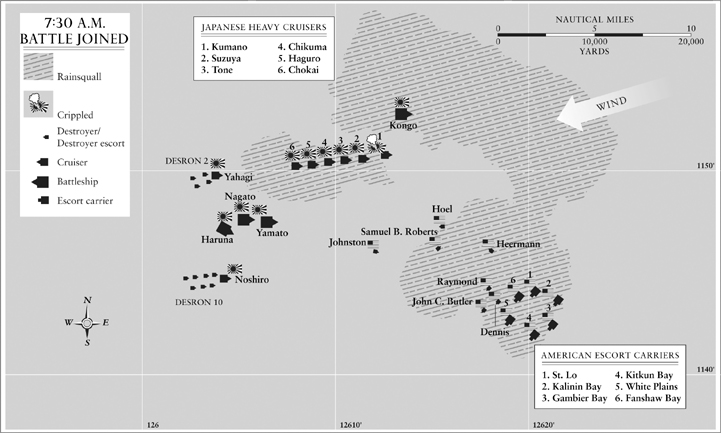
The destroyer Johnston, having struck the lead Japanese cruiser Kumano with her torpedoes, wheels around and returns to formation. The destroyer Hoel, already hit hard, leads the Heermann and the Samuel B. Roberts in for a torpedo attack. Hidden by rainsqualls, Ziggy Sprague gambles and turns his carriers to the south-southwest, momentarily outdistancing his pursuers.
Twenty-three
It had to be only a matter of time before Japanese shells broke not water but steel and drew men’s blood. Ernest Evans and the officers of the Johnston had scarcely stolen a moment to celebrate their torpedo hits when the destroyer walked into a double salvo of enemy shells. Running through her own smoke to return to station with the carriers, the destroyer was rocked by a dizzying series of blasts.
Bob Hagen saw and felt the impact from the gun director. On the highest point on the ship, movements were amplified. The impact seemed to shove the destroyer sideways. All across the Johnston’s 376 ½-foot length, men were knocked off their feet. “It was like a puppy being smacked by a truck.”
The first three rounds to hit the destroyer came from a battleship, probably the Kongo. The first one, a fourteen-inch shell, nearly fifteen hundred pounds, fell in a ripping arc and struck, opening a three-by-six-foot hole in the main deck, blowing out the plumbing and main drain from the ship’s head, tearing up the machine shop, penetrating down into the after engine room, and exploding against the bulky iron housing of the port-side propeller shaft’s main reduction gears—one of the few pieces of hardware on a destroyer substantial enough to detonate a hard-headed armor-piercing round. The second shell punched through the deck and slashed critical electrical cables and steam lines before detonating against the main steam turbine in the after engine room.
Belowdecks aft the Johnston was plunged into darkness. The third large shell demolished the source of the heat itself, striking a boiler in the after fireroom and extinguishing by concussion its oil-burning flames. With that hit the port-side screw stopped spinning, and the Johnston’s thirty-six-knot speed was cut in half. What the shell failed to do instantly, high-pressure superheated steam from shattered boiler pipes did with substantially less mercy. Not a man in the after fireroom survived the 840-degree bath that followed.
A moment later there came a sound like a whole load of sheet metal dropping onto a hard floor as the destroyer absorbed the blast of a smaller salvo. The first six-inch shell—from the Yamato’s secondary battery, or perhaps a light cruiser—holed the number-two exhaust stack, detonating underneath the director platform and twisting it upward on both sides of the uptake. Two other shells slammed into the port bridge wing, igniting a forty-millimeter magazine, which burned and popped smokily with the runaway bursts of antiaircraft shells.
Just seconds before impact Lieutenants DiGardi and Welch had left the bridge wing and entered the pilothouse to carry out Captain Evans’s most recent course-change order. They were just in time. An explosion propelled Welch forward into a pile of the wounded and the dead. He picked himself up, dazed, and tended to the injured. Ed Block was in shock, missing a large chunk of his right shoulder. The coxswain’s left shoulder was dislocated, an eardrum punctured. With small pieces of shrapnel lodged between his eyes, under his chin, and in his right eye, Block stumbled through the pilothouse hatch, past DiGardi, and crumpled against a gray metal bulkhead. Welch, standing over him, stated what was not altogether obvious—“Block is alive”—then grabbed his wrist and stuck him with a morphine syrette. As the drug permeated his bloodstream, Block regained his bearings. He made it down to the main deck on his own power, then joined the pharmacist’s mates who were escorting the wounded down to Lt. Robert Browne’s medical triage in the officers’ ward.
The blast to the bridge all but undressed Ernest Evans. It blew the cap from his head and tore the shirt from his chest. Shrapnel lodged in his face, neck, hand, and torso. Lieutenant Browne came to his captain’s aid. “Don’t bother me now,” Evans said. “Help some of those guys who are hurt.” Evans was still in charge—coolly so, seemingly unbothered at having two fingers sliced from his left hand. He ordered the survivors to clear the bridge.
Ellsworth Welch was transfixed by the grisly sights all around him. The well-kept and orderly pilothouse had been transformed into what might be mistaken for a dirty meat locker. Body parts were strewn throughout the compartment; limbs and fingers and indeterminate remnants of flesh filled the humid air with the rich, metallic odor of blood. Fearing the sight of the carnage would hurt morale, Welch gathered up what of the mess he could and tossed it overboard.
Time seemed to stop, though events surely rushed forward. Welch found Jack Bechdel, the torpedo and assistant gunnery officer, propped up against the wheelhouse, complaining that his arms were hurt, unaware that he had lost a leg at the knee. Bechdel asked for a drink of water. Welch pulled out a syrette and gave him a shot of morphine. Something large and sharp and moving too fast for the eye had cleanly severed the head of Lt. (jg) Joe Pliska, a ship and aircraft recognition specialist who had joined the Johnstonat Manus to train its officers. Ens. Gordon Fox died in the blast too. Signalman Joel Dixon was blown apart at his battle station.
Outside, below the bridge, at his post on the starboard forty-millimeter gun, Clarence Trader looked up and saw blood flowing like water from a hole in the steel bulkhead. Maybe it was blood. Maybe it was the residue of the crimson tower of seawater that a Japanese round had sent breaking over the Johnston’s superstructure. Possibly it was a swirled mixture of both. Trader heard Captain Evans ask for help removing bodies from the bridge. Clyde Burnett, the chief boatswain’s mate, responded to the call, coming forward to shepherd Bechdel to the officers’ ward, where the pharmacist’s mates could attend to him, stick him with more morphine, and tie a tourniquet to his leg stump. Hearing someone call, “Stand by below,” Bill Mercer glanced up and saw a human form being lowered from the bridge wing to the main deck. The body descended—feet, khaki trousers, torso—and stopped, seeming to hover next to him. It had no head.
It took a fraction of a second for a heavy shell to spin shrieking through the air and punch through bulkheads and decks and machinery and detonate or fail to detonate, ending lives in seconds and casting teenagers with the hard, dull look of veterans. In that time bold commissioning-day promises to sail into harm’s way acquired human and material consequences. This was naval warfare in the machine age. In 1944 Annapolis was still turning out men possessed by the idea that naval service was, in the words of one historian, “clean and professional, without the complications of civilians, refugees, partisans, looting or pillage.” But in fact, technology made it as brutal and hellish as anything the navy men of imperial Britain and Germany had suffered through a generation ago at Jutland.
When a heavy round from a naval rifle hits a ship and explodes, the energy released pulverizes the hardened steel of the shell and swirls up the shattered remnants of surrounding metal decks and bulkheads. All of this metal rushes outward on the edge of a wave of blast pressure that a typical shipboard compartment cannot hope to contain. The sudden and overwhelming “overpressure” turns the compartment itself into a weapon, its remains churning up into a superheated storm of fragmented or liquified metal. The blast wave’s effect on people is horrific. It collapses body cavities, crushes organs, and blows flesh from bone.
The size of the killing zone—the radius within which these effects will occur—depends on the amount of explosive the shell holds. A Japanese eight-inch armor-piercing shell, three feet long and 277 pounds in weight, had a 6.9-pound bursting charge. A fourteen-inch high-explosive shell, 1,425 pounds and five feet long, contained sixty-three pounds of explosives. The Yamato’s giant 18.1-inch armor-piercing shells, six and a half feet long and 3,219 pounds in weight, carried a seventy-five-pound bursting charge.
The men of the Johnston learned in an instant that shrapnel came in many sizes, sometimes large enough to cut limbs and grind flesh, sometimes fine and particulate, filling the air with hot driving mist. They learned that shells tumbling through layers of steel filled compartments with poisonous gases, that exploding shells could kill by shock or with a cascade of flames that doused them like liquid. Gone was the mystery of why Clyde Burnett, Bob Hollenbaugh, and the other senior boatswain’s mates kept them scraping paint for hours on end: it burned fiercely. The lesson had been learned in the shipboard conflagrations at Pearl Harbor and in the Solomon Islands in 1942. Now they saw it firsthand. Yet somehow ships still came off the line full of paint to scrape. This was harm, and the Johnston was in its way. This was what Captain Evans had promised them.
Bob Hagen had seen hell once already, from the decks of the destroyer Aaron Ward, damaged during the Solomons campaign. But now the absence of novelty did not diminish the horror. “I was looking out of the director at the time. Everything happened at once,” Hagen wrote. The force of the hits threw him from his stool in the gun director, helmet, headphones, and binoculars torn from his head. He recovered in time to see the mainmast fracture and topple. It housed the ship’s SC radar, the so-called “whirling bedspring,” used for air search. The whole thing came down, seesawed over the bridge tower, and swung back and forth like an off-kilter metronome. The impact tumbled the ship’s gyro stable element off its mount, tripped the internal communications circuit board for a few minutes, and cut the shearing pin that held the FD “Fox Dog” fire-control radar in its vertical position. Unable to slew his radars for elevation until the assembly was reset, Hagen climbed out of the director, grabbed the big antenna, and wrenched it into position toward the horizon.
Looking down on his ship, Hagen was dumbstruck by what had become of it. “The Johnston was a mess,” he later recalled. “There were dead men on the deck and gaping holes from the fourteen-inch shells through which a fat man could have plummeted.” Shrapnel had gashed metal bulkheads and decks like so much tinfoil.
Amid the hissing of steam and the screaming of men, Orin Vad-nais peered over the side of his forty-millimeter amidships gun tub and saw chunks of solid explosives from a smashed depth charge scattered across the deck. Up out of the giant hole opened by the falling shell popped Harold Beresonsky’s steel-helmeted head. A lit cigarette dangling from his lips, he started throwing chunks of the explosive overboard, casually, like a weekender cleaning up his patio.
When the big shells hit, the deck jerked up so sharply that Joseph Check rang his helmet on something hard overhead, then collapsed. Lying on the deck in the first-aid station, he could feel the thin steel growing hot to the touch as superheated boiler steam filled the engineering spaces below. Broken boiler lines were bad news for at least three reasons. The loss of steam bled the ship of engine power, slowed the turbines that ran the ship’s electrical generators, and liberated superheated vapors that killed men fast. A needle-sized hole in a steam line could release a cutting spray powerful enough to sever limbs. Battleship shells were less delicate than that. Steam was gushing out of three large holes in the deck where the fourteen-inch rounds had struck.
Jesse Cochran ran to the steam-stop valves on the main deck above the after fireroom and spun the large wheel to close the lines. It did nothing to stop the lethal hissing of escaping steam, for the detonations ruptured not only the lines but the tubes inside the boilers themselves. Joseph Check saw three men climbing out of the hatch from the after engineering spaces, emerging through the thick white steam. The effort to escape sapped them of their final energies. Check watched them collapse and slump back against the bulkhead, their skin, white as ivory, covering swollen flesh. The skin fell away here and there, revealing pink patches beneath. The steam had cooked them like so many shrimp. They did not live long.
Bob Hagen was on his sound-powered phones after the first onslaught of shells, polling his gun bosses to see who was with him and who wasn’t: “All stations—Control testing!” The replies came: “Gun One, aye!… Gun Two, aye!… Gun Three, aye!… Gun Five, aye!… Plot, aye!” He was relieved to hear he was not suddenly alone, but wondered after Gun 54. Bob Hollenbaugh did not respond. But the boatswain’s mate first class did not keep his gun boss in the dark for long. Momentarily a messenger came on the line, calling Hagen from a forty-millimeter mount back aft. He said Gun 54 had lost power and communications, and its link to the fire-control computer was dead.
Gun 54 was worse off than the other two aft five-inch gun mounts. Guns 53 and 55 had no electrical power to rotate the mount but were still getting signals from the gun director. All they had to do to benefit from radar control was to train and elevate their guns to match the dial pointers showing the director’s orientation at any moment in time. But Gun 54 was getting neither electrical power nor indicating signals for training and elevation. Hagen granted Hollenbaugh’s request to fire on local control, and as Hollenbaugh would write, “Gun 54 declared its own war on the Japs.”
Firing his gun the old-fashioned way—slowly and not terribly accurately—Hollenbaugh was cut off from everybody. He couldn’t talk to Hagen, nor even with the men below him in the ammunition handling room. Because his shell hoist was out, the shell handlers would have to pass ammo to him by hand. Hollenbaugh jumped out of the mount’s portside hatch and slid down the ladder on the aft side of the gun deck. Jumping over unrecognizable bodies, he stuck his head into the handling room, where the men were milling, unsure what to do without a working hoist to feed. He explained the problem to them and told them that their battle performance and probably also their survival would depend on keeping a steady bucket brigade of shells moving up to the gun. They would have to do it manually, the same way Hollenbaugh would be aiming.
Seated in Gun 54’s trainer’s brass bicycle seat to the left of the five-inch naval rifle, Bobby Chastain could only guess at the horrible extent of the carnage outside his station. The jolts and sudden movements of the ship, the sudden sickening reduction in the intensity of the engine vibrations—none of it made him optimistic. The trainer’s gun sight door remained closed, for he had seen enough Japanese men-of-war for a lifetime. Now, though, with his mount partially disabled and the loud voice of his gun captain saying something about “local control,” his willful ignorance had to end. Local control meant the gun crew would do its own shooting, training and elevating the gun by cranking handwheels in the mount. They had never drilled under local control before.
Back in the mount, Hollenbaugh stood on the gun captain’s platform, head poking up from the turret, shouting bearings to Bobby Chastain to guide his rotation of the gun, and ranges to Samuel Moody to determine how high to elevate it. The forty-millimeter mount immediately forward of Gun 54 had its own Mark 51 director, adequate for obtaining ranges if not for a complete gyro-aided, computerized firing solution. Walt Howard, one of the crew manning that gun, passed range information to Hollenbaugh, who made do with it what he could. Chastain and Moody turned and elevated their gun by turning brass-handled wheels on either side of the mount. They cranked them furiously back and forth as the ship veered and the guns barked and Hollenbaugh relayed ranges. But for the help they received from the radar operator on the forty behind them, they might as well have been refighting the Battle of Trafalgar.
Ahead of the stricken Johnston loomed a large rain cloud whose gray-black mass offered sanctuary from the relentless roar and slap of the Japanese salvos. The fury of the bombardment was worthy of Neptune himself. But the rain drifting across the water inspired hope that the god of the oceans knew mercy as well as wrath. The squall’s gray tendrils fell to the sea, dragged to their source by the friction of falling precipitation.
His crew might enjoy it for only a few brief minutes, for the squall appeared to be moving faster than the ship was: on a single working screw, just seventeen knots. But Evans would take what shelter he could get. Already the squalls were sheltering Ziggy Sprague and his CVEs racing south as fast as their engines could shove them. Ernest Evans steered the Johnston south, running for the rain.
Twenty-four
The White House staffers gathered in the Map Room were jolted from their work by the bracing immediacy of the uncoded, plain-language plea. Most of the Navy’s operational communications were routinely copied to them. They scanned them for compelling news and shared it with their higher-ups as it came. As the Battle off Samar was beginning, around dinnertime on October 24, Washington time, the Map Room staff received this message meant for Admiral Halsey:
ENEMY FORCES ATTACKING OUR FORCES COMPOSED OF FOUR BATTLESHIPS, EIGHT CRUISERS AND X OTHER SHIPS. REQUEST LEE PROCEED TOP SPEED COVER LEYTE. REQUEST IMMEDIATE STRIKE BY FAST CARRIERS.
A world removed from the fighting, at 1600 Pennsylvania Avenue, it wasn’t clear who had sent it. The staffers’ best guess was that it had come from the Seventh Fleet’s amphibious commander, Rear Adm. Daniel Barbey, whose group seemed most prone to needing emergency assistance. No matter who it had come from, they were certain the transmission required the president’s personal attention. The message was typed up in short order and submitted to Franklin D. Roosevelt as part of a briefing on the Philippines situation.
Though it is not known what he did or said upon receiving the briefing, the president was sufficiently intrigued by the unfolding events off Samar to request updates as the night progressed. The little ships were on a big stage, and now they had the president’s attention.
The worldwide audience to the drama off Samar included not only the White House but James Forrestal’s Navy Department, the top brass at Pacific Fleet Headquarters at Pearl Harbor, and the Japanese Combined Fleet leadership at Tokyo and Hiyoshi. At the U.S. Pacific Fleet’s new advance headquarters on Guam, radio eavesdroppers manned large battery-powered receivers mounted in the cargo beds of big Marine trucks. One radioman, Albert Fishburn, defying the burning sun and the considerable distraction of nearby Japanese snipers, manned his set all day long. He was captivated by what he picked up on the circuit designated 7910J: “It just operated all day long. It was just one ship after another.”
Information from the Guam radio intercepts was relayed back to Pearl Harbor, where Cdr. Jasper Holmes, deputy chief of the Navy’s Joint Intelligence Center, Pacific Ocean Area (JICPOA), monitored it. When Holmes saw the report of the developing situation off Samar, he was astounded. He telephoned fleet intelligence officer Capt. Edwin T. Layton to ask about the location of Task Force 34’s battleships. Holmes figured the battlewagons were already guarding San Bernardino Strait. Absent specific confirmation from Halsey, Layton was less willing to assume Lee’s heavies had been detached.
As it happened, Admiral Nimitz shared Captain Layton’s outlook. He did not know for sure whether TF 34 had been created per Halsey’s earlier battle plan. Though it seemed sensible enough, until now he hadn’t seen fit to ask. The commander in chief hated to be seen as second-guessing his theater commanders.
At 6:48 that morning Halsey had been stunned to discover that Kinkaid was assuming the actuality of a contingency—the detachment of Task Force 34. Halsey ended the mystery of his battleships’ whereabouts at 7:02, when he responded to the Seventh Fleet commander’s 4:12 A.M. request for confirmation that the battleships were guarding San Bernardino Strait. Halsey told him, “NEGATIVE. TASK
FORCE 34 IS WITH CARRIER GROUPS ENGAGING ENEMY CARRIER FORCE. That message took the customary two-hour trip around Robin Hood’s barn and the Manus receiving station before reaching Kinkaid. By the time it did, the Seventh Fleet commander had already transmitted a string of desperate messages indicating his own surprise at the impending disaster.
At 7:07 Kinkaid informed Halsey in uncoded English that Taffy 3 was taking fire from Japanese battleships and cruisers. That message reached Halsey at 8:22. At 7:27 Kinkaid radioed Halsey, “Request Lee proceed at top speed to cover Leyte; request immediate strike by fast carriers.” The tenor of Kinkaid’s pleas grew increasingly shrill. At 7:39: “Fast battleships urgently needed immediately at Leyte Gulf.” At 8:29: “My situation is critical. Fast battleships and support by air strike may be able to prevent enemy from destroying [escort carriers] and entering Leyte.” For Nimitz, that was enough. Bewildered by the evident short-circuiting of communications between the Third and Seventh Fleets, he composed a straightforward inquiry to Halsey: “Where is TF 34?”
A radioman on Nimitz’s staff saw the implicit emphasis and repeated the interrogatory phrase, “Where is—” Then the message was passed to an ensign responsible for encoding it, a process that involved inserting nonsense phrases at the beginning and end of a dispatch, on either side of a double consonant, so as to confound unauthorized recipients.
Thus the message that the Commander in Chief, Pacific Fleet, transmitted to Halsey’s radio department aboard the New Jersey read, TURKEY TROTS TO WATER GG WHERE IS RPT WHERE IS TASK FORCE THIRTY-FOUR RR THE WORLD WONDERS.
To this day the world wonders whether the Third Fleet radioman who received this message aboard the New Jersey was scholar enough to know that the phrase “The world wonders” appears in Alfred Lord Tennyson’s poem “The Charge of the Light Brigade,” commemorating a battle against long odds that was fought that very day, October 25, in a different century. The world wonders too whether he gave Chester Nimitz credit for the same literary acuity, recognizing with a grin CINCPAC’s historical flourish, uncannily suited to the circumstances, and assuming the reference was part of the message intended for Halsey. All the world knows for sure about the formulation and transmission of the query is that Halsey received it with the tail-end padding intact and took it as an armor-piercing broadside of sarcasm.
Reeling from the thought that his gentlemanly commander in chief had just insulted him, Halsey whipped his baseball cap from his head and chucked it to the deck, cursing bitterly. He had just ordered Ching Lee’s battleships to prepare for action against Ozawa’s aircraft carriers. Now he had no choice but to recall them. As Halsey raged, his chief of staff, Mick Carney, said, “Stop it! What the hell’s the matter with you? Pull yourself together.” Tempers cooled. Orders flew. And slowly, all too slowly, the majestic leviathans that comprised Admiral Lee’s battle line pulled out of formation and swung around to a heading of 180 degrees.
It was a gesture more than anything else. Fast though they were, the battleships weren’t swift enough to cover the two-hundred-mile distance in time to do Ziggy Sprague any good.
Twenty-five
Rain pelted the Johnston’s decks and hissed like droplets on a hot griddle, steaming on the metal above the shattered boilers in the number-two fireroom. Where it didn’t completely evaporate, the rain cleaned the decks of brine and drying blood.
In Gun 54, Bob Hollenbaugh set down his sighting telescope and hopped down from the gun, allowing his crew a breather. They emerged from the illusory safety of the gun mount’s thin steel walls, taking in their first unshuttered view of the killing field that the ship’s decks had become. “By now the topside of the Johnston looked like a mess of spaghetti,” recalled Robert Billie. So many men were dead, yet the ship itself continued to live, as if animated by its own force of will.
That too was an illusion. The ship was running now—maneuvering at least—principally on the sweat and pain of its sailors. The shells had knocked out not only half the ship’s steam power but most of its electrical power as well. The hits had severed the cables running aft from the number-two engine room’s distribution board. With the generator knocked out, the aft compartments of the destroyer were without power. The electrical pumps that might have stanched the flood of seawater into the engine rooms could not operate. Worse, there was no power to the steering engine, the motors that powered the ship’s large rudder. Without electricity to move the rudder, the only way to turn the ship was via “Norwegian steam”: the strong backs and shoulders of the enlisted crew.
When steering was lost, the call went out for able bodies to report aft. Men whose battle stations were redundant—gunners on light antiaircraft mounts, or survivors from crews that had been wiped out—gathered on the fantail. They took turns belowdecks, teaming up in pairs to crank the two-handled wheel attached to the hydraulic pump that turned the rudder. Facing each other and working in concert, two strong sailors could rotate the wheel reasonably well and move the rudder in accordance with orders called to them from the bridge.
The retreating destroyer was changing course so frequently that even the burliest seaman could handle just fifteen minutes at a time. And even with their best efforts, the ship was still sluggish at the helm. They never really kept up with the course-change orders that Captain Evans was calling over the JV phones from the bridge.
As leader of the number-three repair party stationed in the aft deckhouse, Lt. Jesse Cochran was in charge of restoring power to the rearmost parts of the ship. With electrician’s mates Alan Cravens and Burton Hoover, gunner’s mate third class Dave Lewis, chief mess cook Dusty Rhodes, and others, Cochran pulled cables from the forward engine room’s distribution board to the steering motors. But struggle as they did to route casualty power aft, they could not quite complete the circuit. The juice did not flow, and there was no telling why. With masses of cables and wires twisted together like ropes and threaded through round holes in bulkheads, one was all but indistinguishable from another. Certain critical lines had been painted red. What the others did was a mystery. Combat allowed little opportunity for protracted investigation. Critical or not, each cable was responsible for some piece of machinery’s proper functioning. They never sorted it out, and the rudder remained powerless.
During the twenty or thirty minutes in which Cochran and his repair party fought to restore the spark to the Johnston’s work stations aft, the temperature in the engineering spaces had cooled sufficiently to enable a rescue and salvage mission into the riddled bowels of the ship. Motor machinist’s mate Bob Sochor, Jesse Cochran, and other rescuers put on asbestos suits and descended the ladders—slowly, blindly—to search for survivors. In the aft engine room, which was taking on water, Cochran checked the tube packing that kept ocean water from seeping in around the port propeller shaft. It was intact. He then closed the intake valve to the condenser, which turned salt water to fresh for drinking. But still the water rose.
Cochran was amazed to find several boiler room machinists crawling like oversized rats out of the bilges below the grating. To elude the killing steam, the enterprising survivors had pressed themselves against the skin of the ship’s belly down in the bilges until the cauldron cooled and they could make good their escape.
Light from Sochor’s battle lantern scarcely penetrated the cavernous darkness. He groped around in the stinking, steam-soaked void, found a body, tied a rope around it, and pushed upward while men on deck lifted from above. When Cochran entered the after engine room, he found warrant officer Johnny Merritt, one of the ship’s best machinists and most popular “old men,” lying facedown on the grates where he had fallen at his station. With a heavy wrench in hand, another warrant machinist, Marley Polk, swam beneath the grating in the dark compartment, looking for the source of the in-rushing water. As he was submerged, there was a large vibration from a hit somewhere. A heavy piece of engine room machinery dislodged and splashed into the water, trapping him in the bilges. He struggled to get his head above water and ordered his rescuers to save themselves before the water again closed over his head.
Bob Sochor shimmied up the ladder to the main deck and removed his asbestos suit. He was looking down at the closed hatch leading to the after fireroom when to his amazement the round wheel started spinning, turned from below, and the hatch swung open: “Trying to climb out was a fireman by the name of West. I ran over to help him up the rest of the way. He had been down in that hot fire-room at least fifteen or twenty minutes after the boilers were hit and exploded. He stood on deck, his clothes wet and steaming, and he was shaking himself off as if to get the hot steaming clothes off his skin.”
Electrical fires in the after engine room burned stubbornly but eventually succumbed to the cool gusts of rescuers’ CO2 bottles. Three feet of water covered the deck. Rescuers rigged a submersible pump, but the cord didn’t reach the power supply. When a longer lead was spliced and linked to the engine room distribution board, still no power came. They would have to make do.
Sochor led West and several other wounded to the officers’ wardroom, which was used as an operating room in combat. “It was an awful sight to see,” Sochor said. “All those pathetic men sitting and lying on the crowded deck waiting to be treated by the doctor and pharmacists.”
Joe Worling, the engineering officer, ordered Sochor and water tender third class Fielden Critz to come with him to the after fire-room. The ship was running on a single screw, the starboard propeller shaft working over capacity at 350 RPM just to maintain the limp-along speed of seventeen knots. Driven by the turbine and reduction gears in the forward engine room, the shaft was squealing loudly, a sign of possible—and doubtless fatal—engine failure. Worling gave Sochor a pail of lube oil and told him to go pour it over the shaft and the spring bearings. Wearing gas masks and holding battle lanterns, Sochor and Critz climbed down through the hatch from which West had just escaped. Experienced snipes, as engine-room and fireroom personnel were called, could descend the fifteen-foot ladders to their stations with their feet never touching the steps. Saddled with the protective suit and moving sightlessly through smoke and darkness, Sochor’s progress was slower now. The fireroom was smoky, filled with steam from the shattered boilers. Cracks of sunlight shone between bent deck plates, but there was not enough light to penetrate the smoke. “With little help from our battle lantern,” he recalled, “we inched our way behind the blown boiler along the narrow catwalk, up and over piping, to the top of the shaft. We poured the oil all over the shaft bearing box, which stopped the squealing sound.” The ship continued creeping back to Sprague’s besieged carriers.
The interlude in the squall meant that the Japanese cruisers were blind and could not fire on the Americans. A Mark 37 gun director had no such blinders—it was as sharp-eyed in the fog or the dark as it was in the clear of midday. While the ship was enshrouded by rain, the gun director’s radar spied the column of Japanese cruisers closing on the escort carrier formation. As Bob Hagen and his gunners fired some 100 five-inch rounds at the nearest Japanese cruiser, the squall’s only impact on the efficiency of the Johnston’s gunnery department was the rude manner in which it soaked Hagen’s smokes. “It was the first time in my life I didn’t mind having a package of cigarettes ruined,” he wrote.
Time, however, was not on Taffy 3’s side. Though two Japanese cruisers, the Suzuya, damaged by aerial attack, and the Kumano, hit by the Johnston, were out of the battle, the four others still had their legs, and their captains were determined to draw blood. Through nearly three years of war, no aircraft carrier had fallen to Japanese guns. Admiral Kurita credited heavenly intervention for the opportunity. He would soon be in position to make use of it.
* * *
LARGELY ON THE INDEPENDENT initiative of its different division commanders, the Japanese fleet was fanned out and advancing in roughly parallel columns: four heavy cruisers steaming southward, out to the east; the Yamato and the Nagato looming a step behind them to Taffy 3’s north; the Haruna and the Kongo making independent tracks ahead of their slower heavies; and two destroyer squadrons bringing up the rear.
Against them came the Hoel, the Heermann, and the Samuel B. Roberts, formed into a loose semblance of a column and steaming into the open maw of the armored behemoths arrayed before them. Like the Roberts before her, the Hoel had narrowly avoided a collision with the Heermann as Hathaway’s destroyer made its dash across the Taffy 3 formation to line up for the attack. Now the three steamed north at flank speed, while Sprague’s jeep carriers ran southward. With each turn of their screws, the gulf between the destroyers and the carriers widened. Their exposure, their utter vulnerability, grew starker with every passing minute.
Destroyers were hit-and-run ships. As the Japanese had demonstrated time and time again with their own tin cans, and as Oldendorf’s destroyers had shown at Surigao Strait, torpedo attacks were best executed under the cover of night. This would be no replay of Surigao Strait. Though their stacks billowed smoke amid sheltering rainsqualls, Ziggy Sprague’s screening ships attacked in daylight. Their opponents had roughly three times the gun power of Nishimura’s group. The Americans were unsupported by a powerful battle line whose large guns offered a sheltering canopy to hide under upon withdrawal and a devastating deterrent to enemy pursuit.
Moreover, Kurita’s Center Force was not confined to a strait. Roaming free in open ocean, his ships had both room to maneuver and speed sufficient to overtake and encircle the jeep carriers and destroy them from all sides.
For the destroyer screen, the risk of encirclement was moot, for they were offering themselves for slaughter, throwing themselves willingly into it in the hope of delaying the inevitable for the carriers. Perhaps they would harry the Japanese enough to let Sprague’s CVEs slip away. “I had heard all along that destroyers were expendable but never quite believed. Now I knew it was true,” Everett Lindorff of the Hoel would write.
From the gun deck on the fantail of the Fanshaw Bay, situated on the northwest edge of the circular pod of fleeing escort carriers, ship’s cook Harold Kight had a front-row seat from which to observe the destroyer screen forming into line for their torpedo run. His battle station was in the handling room below the ship’s lone five-inch gun. When the gun was firing, he, Jack Frisch, and Warren Whitaker fed projectiles and powder cases into the hoist that supplied the crew on the open-mounted “stinger” or “peashooter.” Until the enemy got closer, the crew that Kight supplied did not have anything to shoot at. But with a clear 180-degree vista off the stern, there was certainly a lot to watch.
Kight looked on awestruck as the destroyers fell into line, lit off their boilers, and left their stations by the carriers to race off toward the Japanese battle line. The little ships seemed to possess a spirit all their own. And they reminded him of something—horses. On his family’s 250-acre farm in central Oklahoma, Kight worked with the Percheron draft horses that hauled his dad’s plows and pulled his wagons. They were powerful animals, stalwart and dependable. He knew the habits of the big black and gray beasts. Whenever a thunderstorm loomed across the plains, the broad-shouldered workhorses became as skittish as stallions. Their eyes bulged. Their nostrils flared. Spurred by the drop in barometric pressure, they sprinted and dashed around the pasture. When they accelerated from a standstill, their hindquarters dropped down, legs jackhammering the earth, heads pulled high, manes waving in the wind.
Harold Kight thought the two destroyers and the destroyer escort, sprinting in to attack, looked like that now, like horses sprinting exuberantly across a watery pasture. At flank speed, the Fletchers tossed up a flaring bow wave like a mane and their sterns sat low, digging their screws into the sea, sprinting like Percherons madly energized by a low-pressure front. As the flagship of Commander Thomas’s screen, the Hoel led the loose column, followed by the Heermann. Then went that determined pony, the Samuel B. Roberts. Kight figured this would be the last he would see of these ships and their vaguely equine nobility. He felt a lump rise in his throat at the realization that, most likely, none of them would survive to run under the thunder again.
Twenty-six
Seaman first class Sam Lucas could feel the Hoel’s deck vibrating from the exertions of the turbines. Their deep steam-driven hum resonated in his sternum. Lucas, a torpedoman striker, and torpedoman third class Earl Tompkins busied themselves setting the depth charges on the starboard and port-side racks on safe. There would soon likely be plenty of exploding going on. No need to contribute to the fireworks.
Painted with sharply angled camouflage patterns to confuse enemy lookouts, the Hoel was nevertheless inescapably framed against the veil of smoke and squalls behind her. The Japanese gunners walked splashes up and down and back along the American ship’s line of advance.
Jack Creamer, the Hoel’s assistant gunnery officer, could see the problem the impromptu torpedo line faced: time and distance were not on their side. While the Hoel was laying smoke for the carriers, the Japanese had closed the range rapidly with the formation. Because Captain Kintberger’s destroyer was closest to the enemy, she had the least room to maneuver to prepare her attack. The column was too long, the enemy too close, and the visibility too spotty for the U.S. ships to coordinate effectively.
The Americans and Japanese closed at a combined rate of more than fifty knots. Zigzagging to avoid shellfire and simultaneously calculating his own best approach to fire the Hoel’s ten torpedoes at the proper angle to the enemy ships, Kintberger was forced to seize his chance when it presented itself. The Hoel’s skipper elected to pass between the columns of battleships and cruisers. His ship would be exposed to fire from all sides, but at least there would be no shortage of targets. The steel decks were slick with rain. Despite the embrace of the laden tropical air, Hugh Coffelt, a gunner on one of the amidships forty-millimeter mounts, realized that he was shivering.
Fred Green was on his game in the CIC, lining up the torpedo attack and plotting the progress of the overwhelming Japanese force.
Bridge, this is Combat. Range one six five double oh. Give us a sight bearing on the battleships…. Three four two? That checks with ours by radar. Where is the cruiser column? Three five eight? Destroyers, two nine one and three three nine. That leaves the big ships unprotected then. Captain, suggest a course of three five three.
Then Green gave the gunnery officer, Lt. Bill Sanders, the benefit of the data flowing in from his radar.
Gunnery Control, this is Combat. Stand by to open fire. Range one four five double oh. Stand by. I’ll give a mark on fourteen thousand yards. Stand by to open fire. Stand by… stand by … mark—one four oh double oh.
On cue, the Hoel’s two forward guns opened up, crashing out at a large gray form looming off her bow. Sanders had a heavy cruiser in his sights. On the bridge, everyone’s ears rang from the concussion of Guns 51 and 52. Lieutenant Dix didn’t mind the roar.
Damn it was good to hear them speaking out….
The whole ship trembled with their rapid bursts
And Sanders up above us grinning there
Was giving out gun orders to his crews
Making them keep a steady, even pace,
“Just like your drills—forget about the Japs.”
Fourteen thousand yards was close enough for the guns. But to launch torpedoes, they needed to get a bit closer. Sanders slewed his gun director mount and trained his batteries on a battleship. The three after turrets joined in now, bucking the ship with their stiff report. The destroyer plunged ahead, fishtailing through shell splashes as the decks rattled from the exertions of her power plant. They haven’t hit us yet, Lieutenant Dix thought as the Hoel closed to torpedo-launching range. We’re almost there…. We’re all together now—let’s make it good. It all happened in the space of a hundred seconds, the events coming too fast for even the most meticulous quartermaster to record in his log.
∗ The sequence of events during the battle is obscured by some doubt. There is ambiguity in official documents whether the Hoel was hit before or after Sprague issued his order to the destroyers, the “big boys,” to make their torpedo attack. The TBS logs of several Taffy 3 warships record Sprague’s order going out at 7:35 or 7:40, ten to fifteen minutes after the Hoel was hit, on her way in to attack, at 7:25. The log of the destroyer escort Raymond, relied upon by Samuel Eliot Morison and John Toland, places the order at 7:16, which makes more sense, since the Hoel survivors consistently assert that their ship got hit on the way in and that Kintberger did not act ahead of orders. Admiral Sprague’s own published account of the battle suggests that he may have issued the order even earlier. Despite the twenty-nine minutes of ambiguity—and twenty-nine minutes is an eternity in a running battle—we do know with near certainty that the Hoel was first hit at 7:25. At 7:25 A.M. the Hoel’s impossible luck ran out.
Leon Kintberger had been chasing salvos in a desperate bid to keep the Hoel alive. Battleships and cruisers had the ship’s range, and so the splashes were not hard to find. The closer the ship got, however, the more futile the concept of “dodging” salvos became. It was mostly a pretense in any event, for no ship could actually dodge a high-velocity inbound shell. The first one that hit them was small in caliber—small at least relative to the fourteen-, sixteen-, and eighteen-inch battleship rounds that were splitting the air with palpable roars and, at the end of their twenty-mile trajectories, losing their grip on the sky and falling downward like tumbling trash cans. This one came in fast and unseen, striking the bridge high on the port side. Lieutenant Dix thought, Oh, Jesus, this is it!
The ship rocked and staggered. There was a flash and a crrrump and a whistling hail of metal that killed most of the men in the wheel-house immediately. Lt. Earle Nason, quartermaster Herbert Doubrava, fire-controlman Marcellino Dilello, and soundman Otto Kumpunen were gone in an instant. A surreal cloud of green-dyed mist settled over the carnage.
Sitting in the pilothouse lookout’s chair overlooking Gun 52, seaman first class Keith McKay felt a rush of wind around his left calf, looked down, and saw that shrapnel had shredded his dungarees. Blood was running down into his shoe, so he tied a red bandanna around his ankle. He looked down at the water sloshing around the deck of the bridge and saw that it ran not green but red. The reassuring rumble and grind of Bill Sanders’s rotating Mark 37 gun director stopped, leaving only ominous silence from the shattered battle station above.
The blast spattered the Hoel’s passageways with the remains of breakfast: pork and beans and cinnamon rolls flew out of the galley and littered the decks. The cloud of vaporized green dye dispersed and seemed to drift down the length of the ship as the Hoelpressed ahead. Some men who saw it wondered what new horror the Japanese now unleashed. Cries of “Gas! Gas!” could be heard from panicked crew. Thrown from his chair at the helm, Clarence Hood regained consciousness on the starboard side of the pilothouse and saw that Lieutenant Dix had taken over the wheel. Commander Thomas and Captain Kintberger were both hurt, but their injuries were minor. Hood’s were too, so he took back his post.
Miles to the north, Admiral Kurita saw an American ship erupt in smoke and flame, probably the Hoel, and the Yamato’s log recorded, “Cruiser observed blowing up and sinking at 0725.”
With the fire-control radar gone, control of the Hoel’s guns fell to the CIC team, led by Lieutenants Green and Creamer. They were able to take ranges with the much less finely tuned surface-search radar. The two officers focused on lining up the torpedo attack and relaying range and bearing information to the guns. As the ship groped its way toward the oncoming fleet, Hoyt White, a radarman in the CIC, called out ranges and bearings of the Japanese cruisers to the gunners over the sound-powered phones: 13,000 yards … 12,500 yards … The men winced at every vibration and rattle as the shells struck near the ship.
Seeing the destruction with one’s own eyes evoked one kind of fear; not being able to see it was perhaps worse. The men in the CIC or the radio shack or the engine room or the gun mounts or in any of the ship’s other enclosed spaces were spared the horrid beauty of the red, green, yellow, and blue waterspouts rising around the ship. Hoyt White felt the Hoel reel and shudder, absorbing the blows. There was no telling how serious any particular hit was, or where the next one would strike. From time to time he found himself staring at the bulkhead that stood between him and the humid, smoky air and wondering when a round might burst through it, bearing his name.
* * *
AS THE THREE SMALL ships pressed through the squalls on their run against the Japanese heavy ships—the staggering Hoel in the lead, followed by the Heermann and the Samuel B. Roberts— a sight greeted them unlike any they had seen before: a smoking gray-black wreck of metal, crawling south as they charged north. It was the Johnston.
Limping along on one engine, with no hydraulic steering, the ship was a ruin. And yet somehow Captain Evans was pulling her through, returning to formation. Though the destroyer remained on a fairly even keel, the battering she had taken was all too evident. The mast had toppled down around the superstructure. The metal shields and bulkheads around the bridge and the stacks were blackened, torn, riddled, and dented like a coffee can on a backyard tree stump. How a ship in that condition could still make steam was for its engineers to explain.
By any fair measure, the Johnston was entitled to call it a day. Her torpedo tubes were empty. At her hobbled seventeen-knot speed, she couldn’t keep up with the other destroyers on the way in. Sprague’s carriers needed her smoke. Everyone on the Johnston’sbridge had heard the admiral’s order, directing the “small boys” to form up and attack. Few if any believed it applied to their ship. Surely they weren’t expected to turn around and go in again.
When Captain Evans saw the Hoel and the Heermann, with the Samuel B. Roberts lagging behind in column, he arrived at a different view of his obligation. As long as his ship had guns that worked, the Cherokee figured he could do something in a fight. He told his dumbstruck men on the bridge, “We’ll go in with the destroyers and provide fire support.” Evans ordered Ed DiGardi to bring the Johnston around astern the Roberts and informed his officers of the plan. Owing to steering difficulties, the destroyer made a complete circle before steadying on course. The Johnston fell in line with the three other ships, plying the shell-torn waters between them and the Japanese fleet. Oh, dear Lord, I’m in for a swim, Bob Hagen said to himself.
Twenty-seven
On the bridge of the Hoel, Commander Thomas watched the other escorts in the strung-out torpedo line while Captain Kintberger steadied the ship on her own firing course. Torpedo officer Lieutenant Coleman, who had moved from the bridge to torpedo mount number two, owing to the loss of communication with his mounts, took over the helm as ranges and bearings were called out by Green and Creamer in the CIC. The Hoel’s torpedo mounts swung out to starboard. There a battleship loomed, at a range of ten thousand yards.
Kintberger bore in closer, fishtailing in to nine thousand yards off the starboard beam of a battleship, probably the Kongo, whose long dark form was visible intermittently through the smoke.
“Tube One—”
“One aye!”
“Half salvo, starboard side…. Steady now. Match pointers.”
“Ready One.”
“Stand by. Fire One!”
Five torpedoes rushed over the starboard rail and smacked the sea, running hot, straight, and normal. Kintberger ordered, “Left full rudder,” and the Hoel leaned into the helmsman’s hard turn of the wheel, running away to the south.
Belowdecks, amid the roar of the boilers and the 120-degree heat, water tender third class Francis Hostrander felt the ship shudder as a Japanese shell entered the forward fireroom on the starboard side, just above the waterline. It blasted a hole in the hull two feet in diameter, blowing a spray of red-hot shrapnel into the men working the boilers. Many were injured, but mercifully the storm of metal left the steam lines intact. The space went dark, save for the beam of daylight entering through the bulkhead’s newest porthole. No one’s name had been on that oversized bullet. The roar of the boilers surged on.
Seconds later another salvo struck, and one of its shells was covered with names. It entered the after fireroom, shattering lines and setting loose a holocaust of superheated steam. Those who were not immediately scalded to death were trapped by the hot steam cloud that rose to the top of the compartment and gathered by the escape hatch, blocking their exit until it cooled and condensed. Sixteen of seventeen men died. A sailor named Vern Simmons was the compartment’s sole survivor.
Another shell punched through the port side into the after engine room, making a clean two-foot hole just above the waterline and exploding against the heavy steel housing of the reduction gears, freezing the Hoel’s port screw. The destruction of the turbine shut down half the ship’s electrical generating capacity too. A cloud of wayward steam escaped topside, engulfing the crew of Gun 53 amidships in white vapor. Another shell struck below them in the gun’s handling room, starting a fire that laced the white clouds through with black smoke.
Live steam swamped the forty-millimeter gun on the port side amidships. Dick Santos, a radioman striker who was the trainer on that mount, had his feet and ankles burned so severely that he could not walk. Shrapnel peppered his back and legs. Bathed in steam, the position was fast becoming untenable, but Santos couldn’t move. Ship’s cook third class Jim Norris, with Santos, had a clear line of sight aft. He watched the shells hit Gun 53 and the engine and fireroom: “Guys were piling out of there screaming—some were scalded and some of them were on fire. God, it was awful. I didn’t count the hits. Let’s say there were too damn many.” Rolling masses of superheated steam finally drove Norris away from his mount. He ran toward the bow and tried to get inside Gun 52, but the crew refused him and held the hatch shut. Norris climbed down the ladder running to the main deck from Gun 52’s platform and heard men praying somewhere in an interior passageway. He came upon the bodies of pharmacist’s mate third class John Quinn and ship’s cook first class J. R. Lindsey lying sprawled on the deck. The sight of their corpses rinsing in bloody seawater made him retch.
Across the deck from Santos and Norris, the explosion lifted the heavy tub of the starboard forty-millimeter gun right off its revolving base. From within the steam cloud Larry Morris couldn’t see a thing. When the whipping wind washed it away, the seaman first class realized that several of his crew, including his gun captain, had disappeared altogether.
Three more shells from God knew where rocked the Hoel astern, one near the base of Gun 55, freezing the mount in train. Another one whistled overhead, slicing off a length of Gun 54’s barrel as cleanly as a giant blowtorch. The six-foot tube of hardened, rifled steel clanged to the deck and began rolling to and fro with the fan-tail’s every tilt. The final shell from this deadly salvo struck the chemical smoke generators on the fantail, spewing white phosphorus across the deck, which burned and burrowed into sailors’ exposed flesh.
“Stuff just flew all over us on the forty-millimeter gun,” said Hugh Coffelt, the pointer on the mount aft of Gun 53. “We had no protection at all. The Japanese kept firing at us, with great success, sometimes missing though, and when they did miss, it sounded like a freight train passing by. Then they began to use shells that would explode over us. That was when I and others on the gun got hit with shrapnel. I got hit so hard that it knocked me off my seat to the deck. I was the only pointer on that forty-millimeter gun, and I still can’t figure out how I was knocked off that seat to the deck, as I was hit in my left chest, not far from my heart.”
After turning on the smoke generator at the start of the battle, Sam Lucas had little else to do. He didn’t relish being a spectator to the horror unfolding around him, so he lay down on the deck between the depth charge racks and the gun shield of a fantail twenty-millimeter mount. He felt no need to see what came next. Seaman first class Marvin Compomizzo and signalman second class Charles Patten lay down beside him. They could hear the severed barrel of Gun 54 lolling heavily back and forth across the pitching deck; the sound of an aircraft engine—it sounded low, down on the water, moving in, getting louder; the chatter of machine guns out over the water—they were not American guns. They heard the screams and shouts as men ran for cover. They heard the staccato crack of the Hoel’s twenties firing back. They felt the ship lurch hard three times from heavy hits amidships. Then Lucas felt something burning horribly on his neck and back. He did not want to know what it was. He was too scared to give it a great deal of thought.
Dye and shrapnel and asbestos and a soaking stench of blood—it all filled the air over and around the battered after section of the Hoel. Somehow the destroyer did not break up and sink, although even her designers at the Bureau of Ships and her builders at Mare Island might have expected any ship to do so under such a pummeling. The three-eighths-inch steel of her hull held.
Her rudder did not. At the helm quartermaster Clarence Hood found his wheel suddenly unresponsive. The Hoel still carried five torpedoes that needed to get in the water. But now the ship could not maneuver to fire them. The rudder was locked in a hard turn to port, leaving the ship steaming in a circle drawn tighter because only the starboard screw was propelling them now. The Hoel passed through a rainsquall, but the respite was too brief to do any lasting good.
As the wounded destroyer circled against her will, the air was cut by the whoosh and roar of the concentrated enemy fusillades. The Kongo, which loomed off its starboard beam when the first spread of torpedoes was fired, came into view again, this time to port, as the Hoel wheeled around and around, out of control, helpless to evade. Shells were hitting with terrifying regularity all around the ship. The Japanese battleship’s imposing fourteen-inch rifles were mounted in pairs in sleek turrets, two forward, two aft. Now somehow the battleship’s dark mass seemed to be shrinking into the distance, becoming smaller as it turned away from the Hoel. The Kongo’s lookouts had spied the Hoel’s first spread of torpedoes. Its helmsman turned to present the smallest profile to them. Looming into view, some six thousand yards off the port beam, came the Japanese heavy cruisers. Kintberger couldn’t ignore them and hope to survive. Though the ship was still locked into its sickening turn, he could not wait for his steering to come back. He and Lieutenant Coleman knew what they had to do. They would launch their last five torpedoes on the fly or they would not do so at all.
“Get set to fire,” Kintberger ordered. “Lead cruiser. All remaining fish. Stand by.”
“Tube Two—train out to port—curve five ahead. Quick now. We’re swinging fast. All ready? Fire!”
From his forty-millimeter gun amidships, Dick Santos saw a chief standing atop the torpedo mount, hammer in hand. One by one the chief brought down the mallet on the torpedoes’ manual firing pins. They leaped out in succession and hit the water as the Hoelcontinued her inexorable turn to port.
Minutes passed as the ship and her weapons ran their separate courses. The ship traveled in a counterclockwise arc as the torpedoes sped straight across the arc’s base. Lynn Lowry, the bridge messenger, gasped and pointed down at the water. He could see three torpedo wakes, running along the ship’s bow on the port side. Could they be from the Hoel? Whatever their origin, the Hoel was in danger of running into their path. Instinctively, before realizing the futility of it, Lieutenant Dix shouted, “Right full rudder!” But the rudder was still dead. The big undersea missiles passed several feet ahead of the bow and continued on toward the cruisers, now almost dead ahead of the stricken destroyer. Dix didn’t see it. “Too much was happening to stand and watch.” But others saw the torpedoes stay on course. Lieutenant Coleman announced the countdown. At about the time the Hoel’s second salvo was scheduled to hit, columns of water were seen rising beside the storm-gray hull of an enemy man-of-war.
With her torpedoes now spent, somehow the Hoel had to regain steerage and return to the carriers. Quartermaster third class Donald Ulmanek, manning the after steering room, was ordered to commence manual steering from the aft steering engine compartment. Kintberger ordered all signalmen and lookouts on the bridge to go aft, join Ulmanek, and man the wheel powering the pump that turned the rudder. Somehow the Hoel needed to get back on station by the carriers, laying smoke, standing by, and protecting its herd. With the gyro out, Kintberger asked Fred Green which way south was. Lieutenant Green didn’t need instruments to answer that one. He responded, “Put the sun on your port beam.” Kintberger told Lynn Lowry, who was leaving for the steering engine room, to get ready to steer a 180-degree base course, with ten-degree zigzags to either side.
On one good engine Kintberger would race his stricken ship against time, against the oncoming cruisers that were relentlessly closing the distance, and against the seawater flooding his sole functioning engine room. As flames heated the decks beneath their feet, volunteers for rudder-pump duty sprinted down both sides of the 376-foot ship, under a hail of shrapnel that rained down from the explosions overhead, past dead bodies, some dismembered and others startlingly intact, through slicks of blood and pork and beans and gobs of dye-stained asbestos insulation, and through the last gasps of steam rising from the engineering spaces below. Reaching the fantail, they grabbed the hatch leading to the steering engine room, cranked it open, and pulled it up. They shimmied down the ladder, looking to restore with muscle and sweat the steam power that enabled the ship to maneuver.
Twenty-eight
The Fanshaw Bay’s single open-mount five-inch gun was placed on the stern as if to anticipate the likeliest circumstance of its use: fending off an assailant while beating a flank-speed retreat. As the Japanese cruiser column closed range on the jeeps, Ziggy Sprague ordered the carriers to open fire with their “peashooters.”
The flagship’s gun sat inside a thirty-foot-diameter turntable mounted on ball bearings. Below it, Kight, Frisch, and Whitaker loaded the hoist that brought projectiles and powder cases to the gun deck. They would do twenty or so at a time, then climb up the ladder, sit down, watch the dim forms of the Japanese ships flash at them on the horizon, and feel their teeth rattle from the blast of the Fanny B.’s own gun. Then they would go back below and do it again. Though an electrical elevator did all the lifting, long summers spent hoeing corn, chopping cotton, and tossing eighty-pound hay bales put Kight in good enough shape to do a lot of it himself. The gun’s recoil was considerably stronger, however. Once when he was on the ladder between decks, the gun discharged and the whole ship seemed to shove forward. Kight was jarred off the ladder and dropped through space, his hands clawing through fifteen feet of air.
Watching large enemy men-of-war shoot at his ship made an indelible impression on the twenty-one-year-old Oklahoma farm boy. “The Japs would fire their big guns,” Kight said, “and you’d hear it—a roar of thunder right up close—and your pants would hit your leg from the concussion of the gun…. And then you could see the projectile coming through the air. It wasn’t blurry, it was distinct—2,800 pounds, the size of a Volkswagen coming through the air. It was a bulge of fire with a bullet in the middle of it. It made you want to get somewhere.” Usually there would be fifteen or twenty seconds to make good an escape before the shell landed.
Kight considered it “natural for any individual to want to hide or get out of harm’s way.” On a CVE, hiding from enemy fire was at best a psychological game. At worst, it could be downright embarrassing. “One old boy was always looking for a place to hide. He said to me, ‘Here, Kight, get on top of me.’” The sailor huddled down on the deck, and Kight climbed on top of him, wondering all the while what good it would have done. “The shell would have gone through both of us.”
The peashooter crews on Taffy 3’s carriers fired to good effect. An old chief on the Fanshaw Bay watched the St. Lo’s gunners popping away and saltily observed, “They oughta fire that thing underwater. We could use a little jet propulsion right now.” But the guns proved to be surprisingly useful in their intended application. They scored three hits on a heavy cruiser at 14,000 yards, starting a raging fire on the forecastle. Meanwhile, the White Plains was doing its own unlikely imitation of a fighting ship of the line. As the enemy cruisers hammered away at shrinking range, a gunnery officer shouted out, “Just hold on a little longer, boys—we’re sucking them into forty-millimeter range!”
The Japanese split their four cruisers into two columns, one looking to overtake the carriers to port, the other joining a group of destroyers and advancing to Sprague’s starboard quarter. Between the two columns, lagging to the rear, Sprague could see the battleships. “The Japs were now firing at us from three sides. Within this three-sided ‘box,’ my carriers were formed in a large circle, with the destroyers and destroyer escorts in a larger circle around them. I kept this formation on a southwesterly course, squeezing over ten to twenty degrees to one side and then to the other, according to which side was throwing the hottest fire.” The ships held formation and maneuvered together, their discipline impressing even Kurita’s chief of staff, Tomiji Koyanagi. “I must admit admiration for the skill of their commanders,” he would write.
High above the action, it was plain enough to VC-10 skipper Edward Huxtable what the Japanese commander was trying to do. Already the cruisers, beleaguered by buzzing planes though they were, had made frightening progress outrunning Taffy 3 to the east. For Sprague, further eastward flight was futile. Huxtable advised Sprague that the best course was now south. Of course, Sprague’s radar told him all of this and more. By 7:30 the Taffy 3 commander was already charging hard to the south, now and then angling toward Samar to the southwest. As the pilots pressed home their attacks, word came over the radio that Taffy 3’s destroyer screen was engaging the Japanese fleet, and pilots were cautioned not to hit the inbound American ships.
Sprague’s decision to turn from a southeasterly heading to the southwesterly one was risky. By turning right so sharply, he would give the Japanese a chance to turn inside him, cutting into his circular route and bearing down fast on his starboard broadside. Nevertheless, he felt the need to turn in the direction of help, toward Leyte Gulf, where Oldendorf’s battleships lay. And if the Japanese didn’t catch on in time, Sprague might open some distance between Taffy 3 and its pursuers.
With visibility down to half a mile and with the clouds hovering at a ceiling of 500 feet, Sprague ordered a turn to a course of 200 degrees. Kurita did not get wind of the audacious maneuver until Taffy 3 had emerged from the rainsquall. The Japanese admiral followed the escort carrier formation around in this clockwise quarter-circle, his pursuit slowed by the frequent need to evade the incessant, piecemeal attacks of the hell-for-leather American aviators. Ziggy Sprague had gambled—and, for now, won.
* * *
BLUE ARCHER AND THE rest of the planes from the Kalinin Bay needed just a few minutes to find the Japanese fleet. When Pops Keighley’s radio malfunctioned, Patsy Capano took the lead. At about 7:50 they happened upon a column of destroyers. Capano, Keighley, and Archer came out of the clouds and went right down the line, firing short bursts from their wing-mounted machine guns. The flight of Avengers climbed back into the clouds and joined with seven other Avengers and ten Wildcats hunting for bigger ships.
Within minutes an echelon of cruisers and battleships came into view. On cue from Capano, the pilots turned and plummeted. Third in line, Archer dove at two cruisers as they leaned hard into a leftward turn. From 4,500 feet, Archer dropped all four bombs and landed two good hits. He recovered, climbed, and circled around again. Time to use the rockets. The ordnance crews on the Kalinin Bay aligned the rockets to follow the same path the machine-gun bullets traversed, converging a thousand feet ahead of the plane. Pushing over in a thirty-degree dive on another heavy cruiser, Archer squeezed short bursts from his wing guns to keep his aim true. Then, a thousand feet out, he pressed the button on the top of his stick and let his eight rockets fly.
Archer had become proficient using rockets at Saipan and Guam, knocking out tanks and large trucks and small houses with the weapons in support of the Marines advancing inland. Now he watched them walk up the fo’c’sle of the cruiser. Two of them hit the bridge, exploding brightly and appearing to knock loose some steel weather shields around the main superstructure.
The light bomb loads that some of the pilots carried led them to wonder what precisely they ought to be trying to accomplish. Two other pilots from the Kalinin Bay, whose radio call sign was “Georgia,” debated whether to attack some destroyers they had found or seek out larger quarry. Tom Van Brunt, a St. Lo pilot returning from the aborted morning antisubmarine patrol with the other VC-65 fliers, heard a squeaky voice over his headset:
“This is 81 Georgia. Are there any other Georgia planes in the area?”
A low, slow southern drawl came in reply. “This is 84 Georgia. I have you in sight. I’ll join up.”
“This is 81 Georgia. What kind of arms do you have?”
“I’m loaded with hundred-pound antipersonnel bombs. What do you have?”
“I have the same loading. What kind of target do you think we should take, 84 Georgia?”
“We better try one of them destroyers.”
“This is 81 Georgia. I’m senior to you, and I think we ought to attack a battleship.”
“This is 84 Georgia,” the voice drawled. “Won’t do no good.”
Now 81 Georgia drew on a source of motivation far more powerful than mere rank: “84 Georgia, if you’re scared, go back to the carrier.”
“This is 84 Georgia. I’ll go anywhere you go, God damn it!”
The Japanese cruisers endured a savage strafing attack by the fighter pilots of Taffy 3. Lt. Jim Murphy of the Kalinin Bay’s VC-3 found the Japanese fleet almost immediately upon clearing the rain-squall that was drenching the carrier’s decks.
He owed the honor of flying that day to his fleetness of foot: he had beaten his executive officer Gil Halliday by a few steps to the last plane on the flight deck. “Little Murph” was prepared to yield to superior rank, but Halliday yielded to speed. Murphy had gotten there first—“Go ahead,” Halliday said, “and good luck.” Murphy took off at 7:25, the last plane off the ship.
He joined Lt. Ken Hippe and Ens. George Heinmiller in strafing a heavy cruiser. Over Leyte the day before, Lieutenant Hippe had become an ace in seven minutes, shooting down five twin-engine Lily bombers that were headed for MacArthur’s troops. Hippe’s targets now were considerably larger, if less prone to disintegrating under his guns. Pushing over and diving down as if riding an invisible waterfall, the pilots made three runs before becoming separated. Murphy then formed up with Lt. Leonard Porterfield and dove on another cruiser. Porterfield told Murphy he was out of bullets and headed for Tacloban. Little Murph’s next dance partner was Ens. Paul Hopfner, who formed up on his wing and helped him ruin a Japanese destroyer’s day.
The fire that met the pilots over the fleet was considerable. “How those Japs could shoot so many guns and still not hit anyone really had me fooled,” wrote Murphy. But there was little doubt as to the effectiveness of the pilots’ own shooting. After his second pass on the cruisers, Murphy noted with satisfaction that the Japanese ships were maneuvering to avoid them.
The Kalinin Bay took her first hits at 7:50, just as Blue Archer was firing his rockets at the heavy cruiser. Steaming on the windward side of the formation, exposed to view as the smoke screen was blown west, the carrier absorbed Japanese cruiser shells at the rate of about one a minute. Some skipped like rocks over her deck, gouging the wooden flight deck and showering splinters into the air. In total the fragile CVE took fifteen hits from the cruisers’ eight-inch main batteries.
One shell breached the port side of the hull just above the machine shop, angled down through the machine shop, and burst in the freshwater tank and the fuel oil settling tanks. While investigating the extent of the damage to the critical oil tanks, engineering officer Lt. George H. Keeler could hear loud crashes and other novel sounds of material fracture and stress, “but above all others we could hear men screaming.”
The shells’ screeching impacts scrapped the innards of the Kalinin Bay right before the crew’s horrified eyes. Armor-piercing shells penetrated the thin hull and flight deck without exploding, turning the ship into an oversized colander. Shells hitting below the waterline let torrents of ocean water rush in.
In a narrow wedge of a compartment at the very bow of the ship, seaman first class Morris Turner was up to his waist in water pouring in through two holes left by a shell that had punched clean through both sides of the hull, right at the waterline. Mattresses and large corks and pillows floated all around him as he struggled to keep the debris clear of the intake of the submersible pump he was operating. Other sailors in the compartment pressed mattresses up against the shell holes. But every time the ship moved out of a wave trough and plunged into another swell, the sudden increase in water pressure shoved aside the mattresses and forced more water in.
Standing in the rising water, Turner had trouble gaining leverage against the incoming flow. After hours of work, struggling to keep the pumps operating and the inflow down, he and the other sailors brought the water down to a manageable level. In so doing they very likely saved their ship. If the compartment had failed, the Kalinin Bay’s bow would have plowed under the sea, the swamped ship would have lost her speed and seaworthiness, and in all probability the Japanese would have caught her. She would have met that fate no matter the heroics of her crew. Escort carriers were not built to take fifteen major-caliber hits and survive. But the Kalinin Bay did just that. Shells damaged her degaussing cables and tore shelving and ruptured bulkheads and opened the hull to flooding. They ripped six holes in the flight deck and wrecked support beams below it. They punctured lube oil tanks, contaminating the ship’s freshwater system, ruined radio and radar gear, sprayed compartments with metal splinters, filled passageways with noxious fumes and gases, ignited acetylene bottles, started electrical fires, and rendered bunkrooms uninhabitable. The extent of the ship’s luck was truly staggering.
The day before one well-placed Japanese bomb had sunk Halsey’s light carrier, the Princeton; a single torpedo had once filled the skies with the remains of the Liscome Bay. Somehow now, however, the CVE known as the Lucky K. took fifteen hard blows from heavy cruiser shells—at least five of which exploded—and sailed on with just five dead and fifty-five wounded. It is astounding that her losses were not far, far higher.
* * *
AT 7:50 ADMIRAL KURITA’S force was spread out over fifteen miles of ocean as it pursued Sprague’s fleeing carriers. The crippled Kumano, assisted by the Suzuya, lagged behind as the westernmost Japanese ship as she completed the transfer of Admiral Shiraishi’s flag. The light cruiser Noshiro, heading a column of seven destroyers, passed the two crippled heavy cruisers to their north but, forced to circle by vicious strafing attacks by Wildcat fighters, came onto a southward course that carried her away from the eastward-charging Yamato, the Nagato, and the Haruna. Northeast of the three other battleships, the Kongo was running southeast and turning a wide clockwise circle as she traced the course of the four heavy cruisers in line ahead of her. Those four ships—the Tone, the Chikuma, the Haguro, and the Chokai— on the other side of a large rainsquall from the Yamato, ran south by southeast, turning an arc through the compass toward the south, matching Ziggy Sprague’s circular course.
As the Japanese cruisers bore down on the jeep carriers, the American pilots stepped up the tempo of their attacks, buzzing the ships with the ferocity of hornets, determined to drive them back at whatever cost. According to Ziggy Sprague:
The Wildcat pilots were given a free hand to strafe, with the hope that their strafing would kill personnel on the Japanese ships, silence automatic weapons, and, most important, draw attention from the struggling escort carriers. Sometimes two, or four, Wildcats would join up for a strafing run. Again, a Wildcat would join up and run interference for an Avenger. Then, likely as not, it would turn out that the Avenger had no torpedo or bomb and was simply making a dummy run. When their ammunition gave out, the fighters also made dry runs to turn the pursuers. Lt. Paul Garrison, of Seaside, Oregon, made twenty strafing runs, ten of them dry.
“The attack was almost incessant,” Kurita’s operations officer, Cdr. Tonosuke Otani, would write, “but the number of planes at any one instant was few. The bombers and torpedo planes were very aggressive and skillful, and the coordination was impressive; even in comparison with the great experience of American attack that we had already had, this was the most skillful work of your planes.”
Twenty-nine
Lt. (jg) Thomas J. Lupo, an Avenger pilot from the Fanshaw Bay, was one of the first pilots to reach Tacloban once the initial wave of attacks by Taffy 3’s pilots had crested and broken and scattered in search of a place to land. The VC-68 flier had made run after run with his squadronmates, dropping his bomb load, exhausting his ammunition, and capping off his morning by throwing assorted loose items from his cockpit at the Japanese fleet: a Coke bottle, a navigation board, and other vaguely ballistic miscellany.
He was a wild sort of kid, with a dangerous look and a reckless demeanor. His father, a New Orleans real estate developer, had tried to keep his son on a productive track, paying an architectural firm to hire him during his summers off from Tulane. But ultimately he was not optimistic about Tommy’s future. The kid was given to crazy stunts: driving his convertible from the backseat with his feet on the steering wheel, drinking all night, playing pranks, chasing girls. Once his dad had tried to warn off Tommy’s bride-to-be, declaring to her father, “Don’t you let that girl get involved with my son. That boy will never amount to anything.”
True to form, Lupo’s interest in aviation seemed to grow out of defiance of his parents’ will. In high school he sold enough magazine subscriptions to earn a trip by air to New York, but his parents refused to let him go. When news arrived that the Japanese had struck Pearl Harbor, Lupo was playing poker with his buddies at the house. He seized the chance for an even grander adventure. They broke up the game on the spot and ran down to the New Orleans customs house, looking to enlist. By the time he was in operational flight training at Otay Mesa, California, Tommy Lupo still hadn’t kicked his inclination for derring-do. He was always happy to demonstrate his aileron control by buzzing the marshes low enough to whip up a storm of mud with his propeller wash. But he was also a proficient torpedo pilot. During the Saipan campaign he had had more than a few chances to put his dash into useful service on ground support missions against the dug-in Japanese. Such was the genius of the Navy’s Bureau of Personnel to channel the rowdiness of youth toward productive ends.
Lupo eased back the throttle of his Avenger and landed on Taclo-ban, weaving across the muddy tarmac pocked with bomb and artillery craters and strewn with wrecked machinery. As a relatively new acquisition for its U.S. Army conquerors, the field was still pitted by the handiwork of American bombers and strewn with the remains of Japanese aircraft. Army engineers and Seabees, as the men of the Navy’s construction battalion were called, were working to rehabilitate the airstrip. They were pouring truckloads of crushed coral into the muddy patches around the strip, laying a base on which to lay steel-mesh Marston runway matting. But the mud was deep, and so the coral vanished “like chunks of vanilla ice cream into a sarsapa-rilla soda.” Lupo brought his torpedo bomber down onto a reasonably solid stretch of runway, cut his engine, and rolled to a stop.
The first person Lupo saw upon climbing out of the cockpit of the “Bayou Bomber” was an Army bulldozer operator. Knowing that any fighter planes that landed on the field would need more space than he had needed to land safely, Lupo asked the bulldozer driver to clear some more room at the end of the runway. Then, spying crates of ammunition, pyramids of 250-pound bombs, and drums of fuel stockpiled alongside the airfield, Lupo demanded to know who was in charge of the operation. The driver pointed to an Army major.
The major was already more than a little interested in who had dared park a Navy plane on his airfield, which was still in the care of the Army engineers and their bulldozers, trucks, and roller rigs and would soon be home to a Marine night fighter squadron that was setting up for operations. Lupo told him of the desperate naval battle raging over the horizon to the northeast. “We’ve got six jeep carriers out there under attack, and our planes have nowhere to land and rearm,” Lupo said. “I’d like to get some of this fuel and those bombs and ammunition so we can bring our planes here, load them up, and get back out there.”
The major took a dim view of the request. “We’ve got a war going on here too. I can’t give you this stuff. I’ve got planes coming here in seven to ten days—P-51s and P-47s—and these bombs are for them.”
“I have to tell you, Major, if we don’t get these bombs and stop this Jap fleet, they’re gonna come in here and bomb the hell out of this place and maybe recapture it. Then their planes will be dropping these bombs on you. I’ve gotta have these bombs, sir, or we’ll have a disaster on our hands.” Lupo asked who the major’s superior was.
The Army officer mentioned a colonel who was stationed out toward the front. “He’s out fighting a war, and I’m not going to bother him.”
“Well,” Lupo said, “that’s just too bad.”
The pilot pulled out his service revolver and pointed it at the major. Then Lupo handed the pistol to his radioman, Earl Gifford, instructing the flabbergasted aircrewman to hold the Army officer at bay. Lupo climbed into the cockpit of his plane and hailed the Fanshaw Bay on the radio. His fellow pilots from VC-68 and other Taffy 3 squadrons were already inbound.
Army antiaircraft gunners opened fire on a gaggle of strange planes circling the field. It took them only a few beats to recognize they were Navy aircraft. Gradually awakening to the dire circumstances of Sprague’s fleet and his daring aviators, the men at Tacloban cleared the way for the pilots to land. The strip wasn’t ready. The six inches of loose black sand that covered the field when Taffy 3’s aviators arrived was a lousy surface to land on. Making matters worse, there were as yet no communications facilities in place to guide the planes in; no service squadrons to refuel and rearm them and take the wounded pilots to field hospitals; no airdrome or control tower to coordinate the traffic and determine how the planes would be parked. The result was going to be chaos.
The first plane from the new group touched down on a solid stretch of runway, sped forward, caught its landing gear in the soft sand, and pitched forward onto its nose. The pilot coming in behind him, seeing the wreck, pulled out of his landing approach and roared away for another pass. At that, the rest of the inbound planes dispersed “like a flight of birds at the first crack of a shotgun,” an observer wrote.
Unexpectedly, a voice came on the pilots’ radio circuit: “Navy planes, Navy planes. This is Tacloban airstrip, beneath you. Can you hear me? Come in, please.” It was a young Army Air Force officer with Tacloban’s fighter control group, Lt. Edward Worrad. Driving a radio-equipped jeep as the planes were circling, he was accompanied by a Navy fighter director officer, Lt. Russell Forester, in another radio jeep. Stranded ashore, Forester had been champing at the bit for days as battles raged in the waters all around him. Now he was finally in a position to help. As Worrad stayed in touch with the planes in the air, Forester made contact with the Seventh Fleet’s air controller in Leyte Gulf and informed him of Tacloban’s availability. A third man, Sgt. Sam Halpern from Tacloban’s service squadron, joined them, checking out the planes that Worrad guided down.
Before long the three men had pieced together an out-of-pocket air control and support squad. Hastily mustering a plane-handling gang from members of the 305th Airdrome Squadron, they helped dozens of Navy Wildcats and Avengers land on the Army field as the battle raged off Samar. The Army volunteers righted flipped aircraft, extinguished fires, and loaded bombs onto the unfamiliar Navy planes. The pilots pitched in, helping to arm and service their planes before taking off again. Japanese air raids were sporadic throughout the day. And friendly planes posed hazards too. Some pilots who took off amid the fragilely managed chaos experienced harrowing and unsolicited games of chicken: an Avenger landing and taxiing down the strip south to north, while a Wildcat roared overhead, taking off north to south. It was not by-the-book airfield management, but they got the job done.
Serviced and flown off with the help of Army personnel and Navy pilots, the pilots hooked up with Navy air control through Lieutenant Forester’s jeep radio and were vectored to strike at the Japanese fleet. Fuel and oil trucks skirted around the edge of the strip, their drivers diving flat onto the black sand whenever strafing Japanese planes came in. At one point a trio of enemy fighters flew in so low that Sam Halpern mistook them for friendlies in the pattern and gave them a green light to land. Incoming planes were waved off while eight big graders and four rollers lumbered across the tarmac, flattening out the little hills and dales of sand made by taxiing aircraft. As soon as they cleared the strip, waves of Navy fliers roared in again. Only eight planes were total losses at Tacloban that day. Not a single pilot trying to land there was killed.
* * *
BLUE ARCHER, OUT OF ammo, flew wide circles over and around the Japanese fleet, dropping down to make dry runs on them before passing out of range, climbing again, and wheeling around for another run. Working from three or four thousand feet, he would dive to a few hundred feet over his targets and let his gunner and radioman take potshots at whatever targets were handy. After several such runs his gunner, in the ball turret, and his radioman, on the bilge gun below, both reported they were out of slugs. Archer was ready to call it a day and head for Tacloban. But then he heard a message from the carriers requesting a torpedo attack. This suggested desperate circumstances.
Whoever sent the message had to have known there were few torpedoes in circulation among Taffy 3’s planes. Archer waved his wings, signaling two other pilots to form up on him. He passed through a squall and got down on the water, running straight for a battleship. Then it happened. The shell exploded no more than twenty yards ahead of him. “It was like running into a brick wall,” he recalled. Slumped in his seat with a concussion and a back injury that made him numb, Archer fought through the pain and looked to his left. Where a second before there had been a pilot flying on his wing, now all he saw was a cloud of indeterminate aircraft parts hurtling in every direction.
Archer kept his course toward the battleship. He opened his bomb bay doors for show, hoping to persuade the dreadnought to veer from its course. Then, as he began to pull up over the ship, Archer rolled his Avenger over on its back and took his .38-caliber service revolver from its holster.
Running on anger born of pain and not a little adrenaline, he squeezed the trigger repeatedly, sending six rounds into the dark superstructure of the battleship. As he flew over the warship, Archer noticed that the Japanese gunners had stopped firing at him. The Arkansan swears he saw the faces of Japanese bridge personnel staring up at him in bewilderment. He surmised then, and believes to this day, that the Japanese saw him and, seeing his narrow facial lines, goatee, and squinting appearance, took him for a Japanese pilot flying a captured plane and mistook his pistol shots for signals of some kind.
Archer loitered over the enemy fleet for thirty more minutes, reporting their movements over the open frequency to the air officer on the Kalinin Bay before flying to Tacloban and landing at Lieutenant Worrad’s airstrip.
Thirty
For Captain Hathaway, conning the Heermann through the cantering herd of CVEs amid heavy smoke, spray, and fog en route to joining the torpedo run had been no minor adventure. The Heermann had nearly collided with the Roberts and the Hoel on the way to attack. Now that his destroyer was clear of the carriers, navigation was the least of his troubles. The sea all around the ship boiled with enemy salvos.
When the nearest Japanese ship, a Tone-class heavy cruiser, was just nine thousand yards away, Hathaway ordered a half salvo of five torpedoes fired at her. With the tubes trained per executive officer Lt. Bill Carver’s coordinates, chief torpedoman Arthur Owens ordered mount number one to fire her five fish. But when the command went out—“Fire one … Fire two”— the tube trainer on the second torpedo mount got excited and fired two of the five torpedoes he was supposed to be reserving for a second attack. Before the mount captain could stop him, they jumped out and ran parallel to their counterparts, leaving only three torpedoes for the second launch. The Heermann’s seven torpedoes left the ship cleanly, hot, straight, and normal.
Though Bill Carver reported over the sound-powered phones four large contacts, giving their range off the port bow, Harold Whitney, the Heermann’s chief yeoman, couldn’t see them. No one could as yet: “It was an odd day—one moment the sun was shining and the sky seemed clear as a bell, and the next moment you were in a rain-squall and it was dark as night. The rain blotted out our radar, and we had no way of knowing how close we were to the battleships.” Suddenly the Heermann emerged from a squall, and all too clearly, dead ahead, lay the four largest ships Kurita had. Lt. Bill Meadors, the gunnery officer, could see two Kongo-class battleships advancing in column. Beyond them, looming in the haze, were two ships that looked even bigger. Whitney figured the Heermann would be sunk on the spot. The bigger ships, however, seemed to be having trouble targeting the small destroyer at close range.
Lieutenant Meadors had the Haruna square in the sights of his director scope. He could see the battleship’s four double-barrel fourteen-inch main turrets, housing rifles fifty-four feet long, turned out to starboard in a frightening array. Flashes and smoke seemed to swallow the ship each time it fired. First the front and back turrets fired, and four shells screamed overhead at mast level, hitting the ocean a thousand yards beyond the destroyer. Then the two high-mounted turrets let go. The Heermann madly returned fire all along. Lieutenant Meadors had the firing key closed, which caused the guns to discharge as soon as their projectile trays were rammed into the breech. Another roar came from the Haruna, a full broadside, and the battleship’s four turrets, flashing as one, “illuminated the entire ocean on our starboard hand,” Meadors wrote. The eight heavy rounds screamed overhead and missed.
Salvos from the Haruna and three other battleships raised walls of water all around the ship. The colorful towers blotted out the blue and gray skies. Watching the near misses bracketing his ship and cascading over his superstructure made Amos Hathaway “wish [he] had a periscope with which to see over the wall of water.” “Everything looked rosy,” he would write, “but only because the splashes were colored red by the dye loads.”
The Haruna’s gunnery officer, Cdr. Masao Gondaira, saw the sleek lines of his antagonist and believed he was dueling a heavy cruiser. Harold Whitney had fewer illusions as he played a pointless game of hide-and-seek with the inbound bombardment: “The guns of the leading Jap blazed, and I could see three little dots, looking like rusty spots in the sky, coming directly at me. The little rusty spots came on, and I ducked behind the wing of the bridge, a little thin piece of metal that wouldn’t stop a. 45-caliber pistol slug.” The first salvos missed, slapping the sea in a ladder pattern three hundred yards long. Whitney looked up and saw that the ship’s signal halyards had been cut in two and the rangefinder had been lopped off. As he was looking up, something smaller hit them—a small shell or maybe some shrapnel—and wooden splinters flew, the remnants of the motor whaleboat blown from its davits.
Lieutenant Meadors’s five main battery crews fired some 260 shells at the battleship. From close range, four to eight thousand yards away, Meadors watched his shells explode all along the ship’s menacing form. It was anyone’s guess what damage the fifty-four-pound rounds did to the armored giant. Judging by the smoke and flame that wreathed the battlewagon’s towering superstructure, it was reasonable to think the destroyer was giving back a little bit of the hell that had engulfed the bridges of the Johnston and the Hoel shortly before. From what Meadors could see, the effect was considerable. About four minutes went by during which the Haruna lay broadside to the destroyer but did not fire at all.
While all this was happening, the Heermann’s seven torpedoes bubbled on their course. The last three had been fired without the aid of mechanical rangefinding. Whitney took ranges from the surface radar and relayed them to Owens, who calmly turned the dials on the torpedo mount. With a sudden release of compressed air, the torpedoes were on their way.
It took less than ten minutes for Hathaway’s destroyer to fire seven torpedoes at a heavy cruiser, change course toward the battleship line, engage the lead vessel with main batteries, fire three more torpedoes, and turn to speed away. Few warships in history had ever spent ten minutes more productively. At 8:03 Hathaway returned to the pilothouse from the open-air bridge and raised Ziggy Sprague on the TBS radio. His message was remarkable for its professional nonchalance: “My exercise is completed. Over.”Hathaway wondered at his own choice of words until he recognized his instinct that the Japanese might be eavesdropping on the circuit, in which event there was no need to inform them that his ship had fired the last of its torpedoes.
Shortly thereafter, as if to reward Amos Townsend Hathaway for his brio and dash—the only destroyer captain in history to engage directly four battleships supported by heavy cruisers and live to tell the tale—a cloud of black smoke boiled up near the stern of the Haruna, beneath its hindmost fourteen-inch turret. The visual evidence was followed closely by a deep blast rumbling across the water. A torpedo from the Heermann’s final spread of three appeared to have scored.
Ironically, however, it may have been the first fan of torpedoes, all seven of which seemed to miss, that did Ziggy Sprague the most good. They sizzled off to the north, missing their intended target, the cruiser. Continuing on, they approached the battleship Yamato. At 7:56 a lookout on Kurita’s flagship signaled the warning, “WATCH OUT FOR TORPEDO TRACKS.” Then the Nagato spotted three tracks approaching to starboard. Duly warned, the vessel’s commander, Adm. Yuji Kobe, ordered a hard turn to port. As the wakes of the torpedoes passed alongside the Nagato to starboard, the battleship opened fire on a “cruiser”—probably the Heermann— at a close range of 9,400 yards.
All of a sudden two more torpedoes were seen approaching the Yamato to port. The helmsman turned her rudder hard over to port, putting the superbattleship on a northward course, away from its quarry, so as to present the smallest possible profile to the torpedoes. It was a panicked decision. Admiral Ugaki should have turned toward the torpedoes, combing their tracks in pursuit rather than in retreat. For ten decisive minutes—“it felt like a month to me,” wrote Ugaki—the parallel spreads hemmed in the great ship, pinning her into an outbound course.
The instinct for survival demonstrated by the Yamato’s commander seemed to put the lie to any notion that the Center Force was on a one-way mission, driven by the “heavenly guidance” that Admiral Toyoda had invoked from Combined Fleet Headquarters. At the moment of decision the officers of the Yamato succumbed to the universal impulse to save their ship. They held the course north until the torpedoes’ alcohol reservoirs burned dry. By the time the undersea missiles ceased their pursuit, disappearing into the four-thousand-fathom depths of the Philippine Trench, Ugaki had taken the Yamato’s sixty-nine-foot-long guns, and the Center Force’s brain trust, clear out of the battle. In the engagement’s first minute, Kurita had forfeited control of his fleet by ordering a hurried general attack. Now, having fallen back more than thirty thousand yards from the fleeing escort carriers, he lost what limited ability he retained to command and direct his force.
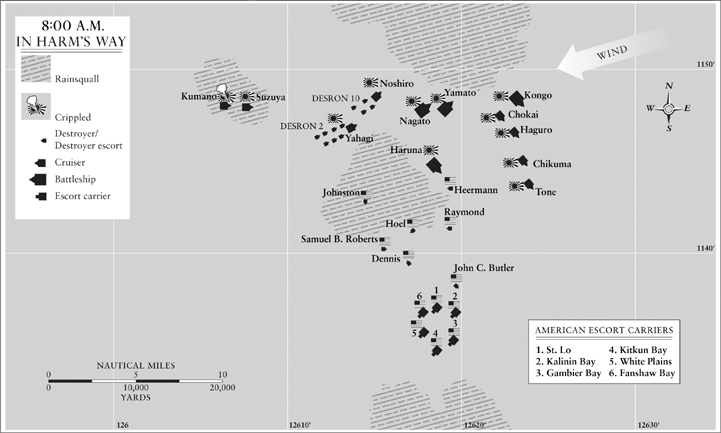
Torpedoes from the destroyer Heermann chase the battleship Yamato northward, taking Admiral Kurita’s flagship out of the battle at a critical moment. Meanwhile, Japanese heavy cruisers, led by the Tone and the Chikuma, press down on the escort carrier formation. The Samuel B. Roberts fires her torpedoes. Cdr. Amos Hathaway’s Heermann, still not hit, engages enemy battleships and heavy cruisers at close range.
* * *
AT 7:50 A.M., AS Admiral Stump’s Taffy 2 carriers were launching the last of their first air strike in support of Taffy 3—a raid comprising fifteen Avengers and twenty Wildcats—Admiral Sprague radioed to his destroyer escorts, “All small boys go in and launch torpedo attack.” The Johnston and the Hoel had already passed into harm’s way and launched their fish; the Roberts and the Heermann were at that moment only minutes away from releasing theirs. The new order sprang the Dennis and the Raymond into action. The John C. Butler, laying smoke on the far southern side of the formation, was out of position to intercept the speeding enemy cruisers.
It was preposterous to send a destroyer escort against an enemy’s main surface fleet. They didn’t do it on paper at the Naval War College, and it had not happened in the whole course of the war leading up to October 25. As the Dennis and the Raymond sortied, Bob Copeland’s ship was fighting like a true hunter-killer, bidding to take down a heavy cruiser on the open sea. The Hoel had fired two salvos of five torpedoes each. The Heermann had fired seven, then three. If Copeland was lucky, the Samuel B. Robertswould soon be in position to fire her single salvo of three.
In a quieter time, in Hawaii, before the ship’s departure for the far reaches of the western Pacific combat zone, the admiral who commanded U.S. destroyer forces in the Pacific had informed Copeland that he had recommended replacing the Roberts’s torpedo tubes with a new forty-millimeter gun mount. Copeland had surprised even himself with the tenor of his refusal: “Admiral, someday somebody is going to forget we’re boys and send us over to do a man’s work. If I’m ever sent to do a man’s work, I want a man’s weapons.” Then Copeland smiled a little. “Admiral, as far as my ship is concerned, the torpedo tubes will be removed over my dead body.” Due either to Copeland’s persuasive skills or to lack of follow-through by the bureaucracy, the Samuel B. Robertsleft Pearl Harbor with her one triple torpedo mount in place.
Now her captain had a chance to do what no destroyer escort had done before and actually use them against an enemy heavy.
Copeland was glad he hadn’t wasted precious time trying to form up with the other DEs on the far side of Taffy 3’s ring formation. Like Captains Evans, Kintberger, and Hathaway before him, Copeland knew that his first and only chance to stagger a larger foe depended on his performance now.
As the Roberts closed on the cruiser line, Lt. Bill Burton, Copeland’s gun boss, was anxious to open fire with his two five-inch guns. Burton’s two gun crews were primed and ready. But there were still about thirteen thousand yards of ocean between the Roberts and her target, a sleek heavy cruiser, probably the Chokai, steaming off the starboard bow. Every few minutes he asked, “Captain, may I open fire?” His skipper thought he had “ants in his pants.” Copeland didn’t want to waste valuable five-inch ammunition at extended range, where aim was dicey and hitting power diminished. He wanted to get closer, and so far, so good. He doubted the Japanese ship had yet spotted him. The sea through which the little ship charged was wreathed in smoke from the destroyers that had attacked ahead of her. Though numerous targets presented themselves, Copeland denied Burton’s request to open fire. The gunnery officer kept the requests coming until finally Copeland shouted, “God damn it, Mr. Burton, I’ll let you know when you may open fire!”
Through smoke that was thick but intermittent, Copeland’s visibility alternated between about five miles and zero. On the radar scope’s PPI screen, he could see the two green-white slivers of the American destroyers running south toward him. Aided by the scope, he had little risk of a collision, poor visibility or none. The torpedo attack was in excellent hands; Bob Roberts was lining it up. The exec wanted to close to five thousand yards and launch the three fish on a high-speed, forty-five-knot setting. At that speed, and from that range, the torpedoes would be difficult for the target cruiser to spot and avoid. Seated on the triple torpedo mount, chief torpedoman Rudy Skau had his speed-setting wrench in hand, preparing to match his aiming pointers to the coordinates relayed by the exec.
Suddenly there was a windy, ripping rush and a crash of metal as a Japanese shell passed through the Roberts’s rigging. The shell severed the radio antenna, and a large section of it, carrying a mass of dangling wires, fell down across the deck, whipping over Skau’s hand, nearly breaking it, and knocking the wrench into the water before the adjustments could be made. The torpedoes lay in their tubes, still set on intermediate speed. A spare wrench was kept down in the torpedo shack, but Roberts and Skau both knew there was no time to fetch it.
As the Samuel B. Roberts closed with its target, Bob Roberts reran the firing solution in his head: the enemy’s course and speed, and its range and bearing off the bow, determined the torpedo speed, deflection, and gyro setting. The variables were complex, and over the long course of a three-mile range to target, even a small error could become magnified into a gross inaccuracy. But the exec, quick with calculations, managed his best guess and shouted the tube train settings down to Chief Skau.
The Chokai was unleashing withering fire from her forward eight-inch batteries. But her gunners were not targeting the Roberts. They either did not see or did not care about the small ship with the low silhouette. No shells landed near her, though the shells arcing high overhead toward the carriers—or perhaps it was the blasts of the gun muzzles themselves—buffeted the destroyer escort with their turbulence.
Time seemed to stop, yet before Copeland knew it, the Roberts was just four thousand yards from the cruiser line, a little over two miles, and his three torpedoes were waterborne, racing toward the cruisers on Bob Roberts’s improvised firing solution. On the broad ocean’s surface four thousand yards was point-blank range.
Copeland, his ship as yet unscathed, ordered a hard left rudder, turning the Roberts back through her own smoke and toward the carriers. Down below, Lieutenant Trowbridge brought every pound of steam pressure on line. The deck shook from the twin turbines’ whining, roaring labors. The ship ran past its rated limits, to twenty-eight and a half knots and possibly beyond. As time ran down on the torpedo run—three or four minutes—Copeland indulged himself with a peek astern. Through a gap in the smoke, he was treated to the sight of a steaming column of water and flame rising from below the after mast of what he took for an Ao fez-class cruiser. Possibly it was the Chokai. As the Samuel B. Roberts raced back to her station to lay smoke by the carriers, Copeland heard someone yell, “We got her!” A cheer went up from all hands on deck, as if someone had hit a late-inning homer.
* * *
FROM HIS GUN DIRECTOR, Bob Hagen looked forward over the Johnston’s starboard bow and was shocked to see an American destroyer on a collision course. It was the Heermann. The destroyer emerged from a smoke screen heading straight at Evans’s ship, just two hundred yards away. Evans shouted, “All engines back full!” Ed DiGardi ran to the pilothouse and pulled “back full” on the engine room telegraph and ordered a left full rudder. The Johnston’s riddled hull shuddered as its one working propeller bit into the water. The Heermann did the same with her twin screws.
Stationed on the depth charge racks on the Johnston’s fantail, Bob Deal was nearly pitched over the side from the sudden change in momentum: “Our stern dug deep into the sea, and the ocean boiled over the after deck.” As water engulfed the destroyer’s fantail, the Heermann was so close—less than ten feet—that someone could have hurdled over to the other ship’s deck. Crewmen watching let out a roar of celebration as the ships backed down. Several crew on the Johnston’s deck at this point saw the wakes of three torpedoes passing silently below the surface, narrowly missing the ship. The two ships formed up momentarily into column—the Heermann would outrace the damaged Johnston quickly enough—and headed south astern the carriers.
At some point between 8:08 and 8:24 the Heermann was firing its main batteries at targets to starboard when chief yeoman Harold Whitney, Captain Hathaway’s talker, heard over his headset an excited shout from a port-side lookout. Appearing unexpectedly out of the smoke and haze came a destroyer. From the starboard bridge wing, Whitney looked across his ship’s narrow beam and saw the tin can steaming close alongside to port. Walking over to take a closer look, he saw the sharp rising prow, the blocky superstructure, the twin main gun mount, and the foreign dress of a sailor scurrying around pointing at the American destroyer, and he realized the ship was Japanese. “I could have thrown a potato and hit that kid running around there,” Whitney said.
Whitney returned to the starboard bridge wing and called the shocking development to Amos Hathaway’s attention, recommending that he order the Heermann’s machine-gunners to engage the intruder at point-blank range. Unfazed, the skipper said to his talker, “I can’t shoot at them now. We’re busy with these cruisers over here.” Evidently the imperial tin can had other priorities as well. After several tense minutes the ship peeled off to port and disappeared through the smoke and squalls that had covered its arrival.
* * *
ZIGGY SPRAGUE’S FLATTOPS SHOULD have been run down and butchered like antelope on the steppe, but they continued to elude that seemingly predestined fate. At 8:10 A.M. Sprague’s carriers were on a southwesterly heading, fleeing with the wind. The cruiser column led by the Tone, followed by the Chikuma, the Haguro, and the Chokai, was to Sprague’s northeast, running south, working a clockwise circular course toward the southwest. The aggression of the screening ships and the doggedness of the pilots were making their mark. Eighty minutes into the pursuit, the Japanese still had not overtaken them for slaughter, their thirteen-knot speed advantage notwithstanding. Every time a pursuing cruiser had to veer from course to avoid a TBM approaching with torpedo bay doors open, Sprague won valuable time. Every time a Wildcat pilot rattled a cruiser’s pilothouse, sending officers diving to the deck, it delayed course-change orders and frustrated the concentration of spotters peering through their binoculars.
As his carriers plodded along on a course of 205 degrees to the south-southwest, Sprague could scarcely believe his luck up to this point. At 8:14 Felix Stump heard him on the radio saying, “We have been straddled for the last half hour. We have not been hit yet. Their shooting is very bad.”
Admiral Kurita tended to see another reason for his inability to close for the kill—his opponents were swift fleet carriers and cruisers, able to outrun him on their own. Kurita watched his ships fail to close the range and knew he could not afford to chase them forever. He had his own fuel shortages to worry about. For all Kurita knew, this was the U.S. Third Fleet. Just fifteen hours ago Halsey’s and Mitscher’s planes had sunk one of Japan’s two greatest battleships, the Musashi. Aboard her sister ship, the Yamato, there was disagreement about where the Third Fleet was. The Japanese had heard Kinkaid’s pleas for help from heavy American ships. Though Admiral Shiraishi on the Kumano had reason to know otherwise, having sighted “light carriers” and recorded that fact in his log, he failed to report it to superiors. And so Kurita continued to believe that his opponents were larger, faster, and more capable than they actually were. He had no idea how desperate his enemy was.
Though neither Ziggy Sprague nor his captains had any reason to know it, the best way to turn back the Japanese onslaught was for their torpedoless tin cans and their weaponless airplanes to keep the bluff going.
Thirty-one
Following its near collision with the Heermann, the Johnston’s protracted streak of astonishing luck seemed simply to run out. The ship was taking hits regularly now. Shells struck in deep syncopated rhythms, each slightly less momentous and terrifying to the crew than the one before, an undifferentiated cadence that seemed to diminish in effect as shell shock set in. An armor-piercing round passed through the thin metal of an exhaust stack without exploding. Another shell rained metal shards all over the bridge, knocked crew to the deck, and showered them with asbestos insulation. Robert Billie felt something strike his communications headset, and somehow his mouth was full of blood and broken teeth. Down in the engine room the hits jarred asbestos lagging from the steam pipes and blinked the lights. According to Charles Landreth, “the ship felt like it was shaking apart…. There was a noise on the earphones, and it felt like it blew my eardrums out. Then for a short time the phones were dead…. Then someone got on the phones and said we had been hit and everyone on the bridge had been killed.”
Quartermaster Neil Dethlefs could see a large ship on the northern horizon, bright flashes leaping from its two forward turrets. The silent yellow strobes of light were followed, after a delay of several dozen seconds, by a rising, freight-train roar as the large shells ripped into the sea. He saw three hit to port and three more to starboard. “I was sure the next salvo was coming into the pilothouse,” he wrote later. “I prayed that if it did, I would get the full package and not be left with an arm or leg missing.”
“It didn’t appear we would be alive much longer,” said Charles Landreth. “Up to this time the thought of us not making it hadn’t bothered me much. I still had not seen with my eyes people getting killed. But that was soon to come. Fear was written on everyone’s face in the engine room.” The senior engineering officer, Lt. Joe Worling, was coming and going, moving back and forth between the engine room and the fireroom that energized his turbines with steam. From the expression in their lieutenant’s eyes, the men understood their chances. “I could tell by looking at him that our ship was in its first and last surface engagement,” Landreth said.
* * *
IF SHEER HUMAN WILL could have propelled the USS Hoel on a southwesterly course back toward the carriers, she would have made thirty-six knots. As it was, on only one good engine, steered manually, and confronted with an unceasing rain of fire from multiple enemy ships, the destroyer had no chance to escape. As the rainsqualls began to yield to the morning sun, the Japanese had a clear view of the stricken tin can, which now paid the price for Leon Kintberger’s gallant headlong run into the enemy’s midst.
The wounded vessel was trapped in a savage crossfire. A cruiser was close by, so close at some four thousand yards that even the forty-millimeter guns could hit her. Their rhythmic thumping was in syncopation with the blasts of the two forward five-inchers. Targets were in oversupply, but so were Japanese shells. They came from both sides, whistling and roaring and crashing to starboard and port; exploding overhead, filling the air with candy colors and showering the decks with shrapnel, drilling straight through the hull. Lieutenant Dix:
You heard the whistling whine and grinding thud,
The iron rumble following the blast,
The rattle of the instruments and gear.
You felt the shudder running through the hull.
The shaking of the deck beneath your feet.
The quiver in your limbs as each one struck.
The masts and radars toppled down on deck,
Main Radio and Charthouse took a hit,
Boats, life rafts, stacks, were riddled with the spray
Of lead and steel from air bursts crashing high.
The decks were a killing field. Bob Prater sought refuge in the aft torpedo room, but it was full of corpses. He moved to the port side and saw steam coming out of the fireroom. “The men were coming out mortally scalded…. There was blood and bodies everywhere.”
Around this time the skipper of the Raymond, Lt. Cdr. A. F. Beyer, Jr., spotted an American ship taking a terrific beating. He thought it was the Samuel B. Roberts, but Copeland’s ship had yet to be hit—it was more likely the Hoel. That he apparently mistook the destroyer for a destroyer escort may have been testimony to the battering Kintberger’s ship had taken. Her silhouette was scarcely even recognizable anymore. Her mast had fallen over the superstructure. She had only two working five-inch guns. Captain Beyer could see her rapid-fire salvos going out at the enemy. The bombardment that came in return was horrifying. It appeared to overwhelm her, swallowing the ship in a “curtain of flashes.”
A salvo struck the Hoel below the waterline, bulling through the forward engine room and letting in the sea. Lt. Cdr. John Plumb got many of his men out before they were drowned at their stations and secured the boilers before they could blow. But this hit sealed the Hoel’s fate. Her last engine was gone. Slowly, and ever more slowly, the Hoel drifted, her list worsening by the minute.
Japanese heavy cruisers and battleships were firing point-blank into her hull. Bobby DeSpain took cover on the deck beside the depth charge racks. “Lying on the deck,” he recalled, “I looked down at myself and thought I’d been hit. My body was covered with blood and gore that had flowed aft down the gutters onto me.”
The Hoel’s two forward guns fired back, crudely aimed, in the absence of a working Fox Dog set and Mark 37 gun director, by the surface-search SG radar. The Tone-class cruiser looming just two thousand yards to port had slowed down. Whether it did so from battle damage or to steady its gun platform for a final, killing fusillade is not known. It presented an excellent target for gunners who were not ready to quit. The top hatch of Gun 52 was open, and Chester Fay, the gun captain, was standing up out of it, congratulating his crew in the mount whenever they scored a hit. On the bridge Lieutenant Dix saw him and was moved: “He looked up toward the bridge as if to say, ‘We’re still not licked—we’ve got a few rounds left. We’ll sink the bastard if she stays that close.’”
Fay and his counterparts in Gun 51 swung their mounts to starboard and engaged three destroyers closing in to the point that machine guns could have opened fire to good effect had they been working. Someone on the bridge shouted the command to open fire, but power was gone and most of the men on the forties just forward of the superstructure were dead or wounded. Aft, the prospects were still worse. The light weaponry back there had been ripped to pieces and smashed, bent down and wrenched from the deck plates. Dix saw the crews of some destroyed guns hunkered behind their shields. A shell from the Tone-class cruiser passed through a bulkhead and through a forward magazine, starting a fire that raged below Gun 51. But its crew blasted away at one of the Japanese destroyers, which continued to press in, undaunted. Off the Hoel’s starboard bow, the stubby blue form of a Wildcat fighter plane appeared. The aircraft fell on a Japanese destroyer, coming in low and fast, a rain of spent shell cases cascading from its wings. The storm of .50-caliber lead rattled the Japanese destroyer so hard that the sound of the ricochets and penetrations could be heard on the decks of Kintberger’s ship.
As the Hoel drifted, a shell struck the forward stack. Lt. (jg) Myles Barrett, the supply officer, was standing on the catwalk by the forty-millimeter remote control console, filming the battle with the ship’s sixteen-millimeter movie camera. The hit set the ship’s whistle shrieking. Some of the crew thought it was the abandon ship signal. From the bridge, Lieutenant Dix looked down on the decks and watched men dragging wounded to the rails and leaping into the sea. “They took no life jackets, left rafts and nets, nothing to hold them up but their arms. More than a hundred must have gone this way. They couldn’t hear us yelling from the bridge.”
Roy Lozano was climbing the ladder from the forward fireroom when the blast wave from the hit struck him. Whoever was above him on the ladder was blown to pieces. “The force of the explosion was so great that it ripped the seam right out of my pants,” he recalled. “But we continued to climb up only to walk over dead bodies.
When we arrived topside, we went to the port side of the ship to try to get one of the lifeboats down. I don’t know why we were trying to get it down, as it was shot full of holes.”
The explosion in the fireroom collapsed the bulkhead that separated it from the emergency generator room, a compartment be-lowdecks that housed the electrical generator that kicked in if main power boards failed. Glen Foster, an interior communications electrician, was knocked to the floor as the generator toppled down on him. As hot steam poured into his space, he pushed open the hatch leading forward from his small compartment but found only smoke and fire. He tried going up to the next deck, but the escape hatch was jammed. Foster panicked when he discovered that he’d been turning the hatch the wrong way. He opened it finally, made his way through an escape hatch that led through the internal communications room, and found that it had become a charnel house, piled to a sickening depth with bodies and body parts.
One of the hits the Hoel took destroyed the ship’s safe. As supply officer, Myles Barrett was responsible for disbursing cash to the crew on payday. With the shattering of the large iron deposit box, suddenly it was payday. “Money was fluttering everywhere. Bills came blasting out of a hole in the bulkhead,” Barrett said. The fifty-dollar bills settled and stuck fast on the deck, the gruesome windfall drifting with the flow of blood down into the bilges.
* * *
THE SHIPS OF TAFFY 3’s screen fired the last of their torpedoes when Captains Beyer of the Raymond and Sig Hansen of the Dennis answered Sprague’s call, releasing their three torpedoes at a Japanese heavy cruiser not long after the Roberts did, and observing, but claiming no credit for, at least one hit. After his torpedoes were gone, Beyer wheeled the Raymond around to a 110-degree course, swiftly crossing four miles of sea, barking away with her main batteries until the range to the Japanese heavy cruiser was just 5,700 yards. The Raymond acquitted herself well enough in her ensuing gunnery duel with the Haguro to brag in any company. The crew in the handling room below Gun 52 worked so hard that several men collapsed from heat exhaustion. The aft repair party relieved them, with only slightly less impressive results, although some time-delay-fused antiaircraft rounds found their way into the hoist, resulting in a few shells exploding prematurely en route to the target. The Raymond fired 414 rounds of five-inch ammunition at the Haguro, landing numerous hits all across her superstructure. Then, improbably, the Haguro turned and headed away to the east, and Beyer checked the Raymond’s fire.
* * *
THE SMOKE FLOATING OVER the seas in the vicinity of the Johnston was so thick that Captain Evans ordered Bob Hagen not to fire his battery unless he could actually see what he intended to shoot. He had no idea what had become of his sister ships in the screen. No sense adding to their misery by hitting them with friendly fire.
Through the smoke, cruising seven thousand yards off the Johnston’s port beam, Hagen spotted the profile of the 36,000-ton British-built monster, the Kongo. The pagoda superstructure and mainmast seemed to crowd the shortened forecastle, where two twin fourteen-inch gun mounts lay. A third main battery mount sat just behind the after mast. Some distance farther aft, set so far astern gun number three as to accentuate her tremendous length, was her fourth main gun. Hagen took in the sight of the battleship and muttered to himself, “Well, I sure as hell can see that.” Once more he slewed his director toward a new target and closed his firing key.
In just forty seconds the destroyer sent thirty shells at the leviathan, landing by Hagen’s estimation fifteen hits on the superstructure tower. “As far as accomplishing anything decisive, it was like bouncing paper wads off a steel helmet,” Hagen would later write, “but we did kill some Japs and knocked out a few small guns. Then we ran back into our smoke. The BB belched a few fourteen-inchers at us but, thank God, registered only clean misses.”
Several miles behind the other surviving ships of Taffy 3’s screen, the Johnston headed south at half speed. Overtaking Evans’s ship to port was the cruiser line and the battleships behind them. To her right a line of enemy destroyers advanced to gunnery range. As wicked as the crossfire was, a sight now commanded everyone’s attention on the Johnston’s bridge: an escort carrier, listing to port, dead in the water and taking heavy fire. It was the Gambier Bay.
Thirty-two
Given her position on the windward side of the formation, the Gambier Bay rode in nearly plain sight of the cruisers to her east, her own smoke screen, and that of the tailing destroyer screen blown to the west. There was no telling how many ships had drawn a bead on her now. Under fire for nearly ninety minutes, the Gambier Bay, steaming behind the Kalinin Bay, took her first hit at 8:20, when a shell penetrated her forward engine room. The sea flooded in, and even the strenuous exertions of the bilge pumps and two portable submersible pumps could not prevent the burners from being swamped. As machinists secured the flooded boilers, the speed differential between the damaged CVE and her pursuers opened widely. The tight circle of Taffy 3’s six escort carriers stretched and fractured as the Gambier Bay, struggling along at eleven knots, dropped out of the formation and receded toward the cruisers closing in on her port quarter.
A signalman on the Gambier Bay’s twenty-four-inch carbon arc searchlight, Don Heric, spotted three ships to the southeast flashing a recognition signal. They were the Taffy 2 destroyers Hailey, Haggard, and Franks, which Admiral Stump had ordered north to intercept any Japanese ships that might pursue his CVEs. Ens. Cole Williams, the Gambier Bay’s signal officer, ordered Heric to acknowledge the challenge and request assistance. The signalman opened the shutters of his lamp and blinkered, “WE ARE UNDER ATTACK, PLEASE HELP.” No sooner had he finished the message than a large shell ripped the air close enough to burn his forearms and knock Williams to the deck. In turn, the Taffy 2 destroyers blinkered Morse for R— standard shorthand for “message received”—then turned and withdrew to the south. Upon learning at 8:17 that Japanese battleship shells were straddling his destroyers, Taffy 2 commander Admiral Stump decided against risking his most capable escorts in a dicey offensive action. If the Japanese destroyed Taffy 3 and continued south, he would need them for his own defense. Chased by salvos of fourteen-inch shells, the Hailey, the Haggard, and the Franks turned and raced south after having closed, unmolested, to within fifteen thousand yards of the Haruna and the Kongo.
High above, Edward Huxtable, commander of the Gambier Bay’s air group, VC-10, sighted the carrier taking concentrated fire from Japanese cruisers. As the FM-2 Wildcats escorting him winged over into strafing runs, Huxtable turned, descended, and leveled off in a mock torpedo attack. He made four such runs, each time keeping up the ruse, flying level with bomb bay doors open. Each time he did so, he attracted a lot of attention from Japanese antiaircraft gunners. Then Huxtable became aware of reinforcements on the way. “I heard flight leaders from the other CVE group preparing for attacks,” he said, “and decided that the situation was much improved and left for Tacloban at 0915 to bomb up.”
It was plain, however, that the Gambier Bay was in deep trouble. When the engine room was abandoned five minutes after its boilers were secured, Lt. (jg) Hank Pyzdrowski, an Avenger pilot who had been stranded when his ship turned out of the headwind in favor of its own survival, felt the intensity of the deck vibrations slacken. He looked up at the ship’s tiny island superstructure and saw the battle ensign droop. With a boiler gone, the eighteen-knot ship could do only eleven knots. She began listing to port.
The volume of ordnance flying the ship’s way was so great as to register on the ship’s surface-search radar. In the Gambier Bay’s CIC, Lt. (jg) Bill Cuming was watching the surface radar’s A-scope, taking ranges on the Japanese ships. Every now and then a quick stray blip would appear on the graph—the echo return from an inbound Japanese shell. Cuming could do nothing with that information except appreciate how long the odds were against the ship surviving much longer.
Every minute, it seemed, a salvo landed near the ship. Usually at least one shell in each salvo inflicted some damage. The vibrations were so severe, the men had trouble staying on their feet. A shell went off behind him, and aviation machinist’s mate third class Tony Potochniak was knocked to the catwalk on the port side of the ship. He stood and moved forward, preoccupied with thoughts of what the inscription on his gravestone might say: Lost at sea, age 19 years. Potochniak found bodies laid flat across the bloodied wooden flight deck. He entered a compartment that had been turned into a first-aid station. Lt. Cdr. Wayne Stewart, VC-10’s flight surgeon, shooed him aside so he could get at a severely wounded sailor lying on a stretcher. Just then another shell hit. The blast showered shrapnel into Potochniak’s hand and legs and cut down Commander Stewart as he was tending to the man. The doctor fell dead on top of his patient.
Photographer’s mate second class Allen Johnson was crossing a catwalk when he came upon a sailor crumpled against a bulkhead, clutching his arms in front of him and weeping softly. “I’m ruined, I’m ruined,” the kid was saying. Looking down, Johnson saw that his abdomen had been torn wide open. He walked forward, past a fortymillimeter gun mount, and encountered a crewman he had once heard griping about the boredom of life on a CVE. “When are we gonna see some real action?” this kid had wanted to know. Johnson looked at him now—he was glassy-eyed, gazing into the distance—and couldn’t resist a dig. “Well, buddy, is this enough action for you?” No answer came from his lips but a stream of little saliva bubbles.
* * *
AMOS HATHAWAY HEARD HIS admiral, Ziggy Sprague, cut in on the TBS circuit at 8:26: “Small boys on my starboard quarter, intercept enemy cruiser coming in on my port quarter.” Each carrier had its own gun, a single-mounted five-inch/38-caliber on its fantail, and its crew knew how to use it. But to fend off cruisers, Sprague would need the help of a real surface combatant.
Hathaway saw the Johnston limping southward, trying to comply with Sprague’s order. It was quite evident, as Captain Evans’s stricken ship moved to interdict, that it wasn’t getting anywhere fast on one screw. A signal light blinkered the message “ONLY ONE ENGINE X NO GYRO X NO RADARS.” The destroyer was in trouble. But the Heermann still had her legs. Hathaway swung his destroyer into a tight turn to port and tore across the rear of the carrier formation toward the enemy.
There remained the question of exactly how a destroyer bereft of torpedoes would turn away an armored ship of the line. Using double-talk on the open circuit, which he thought the enemy was surely monitoring, Hathaway tried to tell Sprague that he had no more torpedoes aboard. He heard other skippers doing the same. “As I listened,” he later recounted, “it became evident that there wasn’t a torpedo among us. Anything we could do from now on would have to be mostly bluff.”
The Heermann broke from the smoke to find the squat bulk of an escort carrier bearing down on her off the port bow. It was the Fanshaw Bay. Hathaway backed down to a stop to avoid a collision; then, when the ship was out of the way, he had a clear view of what Sprague was anxious about. Ahead lay the Gambier Bay, afire amidships, listing twenty degrees to port, and taking a ceaseless battering from a Tone-class cruiser to her east. The wounded carrier obscured most of the Japanese ship, so Hathaway maneuvered to gain a clearer line of sight. As his viewing geometry improved, he made out the silhouettes of three more cruisers in the haze. He thought he could see two larger ships looming to the rear.
The Heermann’s wake boiled as Amos Hathaway’s ship regained steam. Soon she was making top speed toward the Japanese cruisers. So many Japanese ships were firing on the Heermann that the ship was like a chameleon. Each time a new salvo landed near, she was doused in a different color. Each time the destroyer’s bow bit into a wave, the water rinsed the decks and gunwales clean until a shell bearing a different hue crashed a column of seawater across her decks again. Green, yellow, red, and undyed splashes rose near the ship, one after another. Chief yeoman Harold Whitney looked at his skipper and noticed that Hathaway had been dyed red from head to foot.
The gun boss, Lieutenant Meadors, kept up a steady cadence of fire all the way in. His five gun crews kept their breech trays loaded while below them the shell hoists cycled continuously, drawing ammunition up from the handling rooms as the men down there pushed powder cases through the scuttles in the bases of the turrets. His nostrils stung by the smell of cordite and burning cork and human sweat, seaman first class Stanley Urbanski was down in Gun 52’s handling room.
Round after round I take from [Ralph] Sacco, placing it in the scuttle. As the previous round is removed, I push up a new one and secure it in its seat. Forty, fifty rounds, then the violent action of the ship, a brief pause. Just enough time to bring up more shells from the lower handling room. Many times more, rapid fire, no time for thought. Keep a powder charge in the scuttle. No talk, only Sacco’s orders to keep the lower hoist moving. The human machine works flawlessly. We still know nothing of the happenings around us. No feelings, no interruptions, just keep a powder in the scuttle.
James Boulton’s crew in Gun 52 made good use of Sacco’s and Urbanski’s efficiency. Spent shell cases rattled and rolled across the deck as the Heermann blazed away, firing some five hundred shells in a twenty-minute duel with a Tone-class cruiser. Meadors counted fifty hits. The destroyer’s bombardment started several fires aboard her foe. From his lookout’s position on the bridge, Wallace Hock could see Japanese sailors being blown into the air from the ship’s deck. There appeared to be internal explosions. A large fire raged astern, where the Tone-class ships had their big seaplane hangars.
The men in Gun 52, directly forward of and below the bridge, did their jobs too well. The concussion from their fire rang in Hath-away’s ears, so he climbed to the fire-control platform to escape the cacophony, outside Lieutenant Meadors’s gun director mount. The extra elevation improved his view of the seascape. He shouted course changes into the voice tube leading down into the pilothouse, running an eastward zigzag course, chasing roiling shell splashes to keep his ship alive. The enemy’s salvos were landing closer and closer to the ship, the Japanese correcting their fire in hundred-yard steps. Hathaway could see the tight triple sets of splashes moving in his direction. The ones closest to him were red.
Destroyers did not sortie alone against columns of superior warships without paying the price. Captain Hathaway’s ship had no more business surviving this approach than Captain Evans’s Johnston had had coming through its solo run. Now a salvo found the Heermann. An eight-inch shot from a cruiser ripped through the ship’s bow, blowing a five-foot hole in the hull and flooding the forward magazines.
Another shell struck Hathaway’s destroyer amidships. It tore through an exhaust uptake leading from the boilers to the stack and exploded in a supply locker. Lt. Bob Rutter, the ship’s supply officer and paymaster, was standing on a spotting platform that girdled the after stack. The explosion knocked him down against the stack, and a hot blast washed over him, covering him with a sticky substance. The new father—he had become a dad in January 1944, while the Heermann was at sea—prayed, “God, let me see my wife and son.” He wiped a hand across his face, expecting to find blood and gore. After a terrified pause, Rutter realized he was all right, and lucky too. The mess that covered him was navy beans, cooked in storage by the blast of the shell, steamed by the sudden heat, and blown through the uptake, washing him in a blast of paste. According to Harold Whitney, Rutter “scraped the beans from his eyes and looked around with a gaze that wouldn’t believe the things it saw. He was still here.” Captain Hathaway later speculated that after this incident Rutter wouldn’t mind if he never ate another serving of beans.
With the hits forward, Gun 52’s handling room was plunged into darkness. According to Stanley Urbanski, “Suddenly all thought was lost in an explosion, total darkness, the ear-shattering hiss of a broken air ejection line. Bright red flecks scattered around our closed and dark cubicle, red-hot shrapnel. Fear sets in, I pray to my God.” Urbanski heard the sounds and felt the tremors, and his imagination filled in the rest. “Heermann is smashing through the sea. The firing starts again. Then the most violent tremor of all, a great explosion, and our Lady is wounded. She seems to have started her way to her grave. Down, down by the bow, what seems like eternity.”
As the inrushing water dragged down the bow, Hathaway momentarily thought his ship might run itself beneath the waves: “We were so far down by the head that our anchors were dragging in the bow wave, throwing torrents of water on the deck.” He considered slowing the ship to reduce pressure on the critical forward bulkheads, which crewmen belowdecks had raced to buttress with odd lengths of timber. The first lieutenant, Bill Sefton, reached Harold Whitney over the phones and pleaded with him to ask the captain to slow down. The damage to the belowdecks compartments was evident in the voluminous litter of cigarette cartons and toilet paper bobbing on the edge of the ship’s bow wake. Having weighed the risks of slowing down to stem the progressive flooding, Hathaway chose to stay at speed. He was well aware of what had happened to the Johnston and the Hoel after they slowed down. Speed was his only real defense. Whitney relayed the skipper’s refusal to Sefton, saying, “Just put more shoring in there and hope it holds.”
Another shell, a smaller one, probably from a destroyer, struck the bridge below Hathaway, scattering shrapnel in every direction. The navigator took a spray of steel full in the face, which was left pockmarked by metal fragments, as if he had been maimed with a shotgun blast from a nonlethal distance. Its impact was dampened by the man standing beside him, who crumpled to the deck. An aviator from the Gambier Bay whom the Heermann had pulled out of the sea the previous day, Lt. (jg) Walter “Bucky” Dahlen, was cut down too. He had dodged fate the day before when he tried to land his Avenger on the carrier with his bomb load still slung aboard. Caught in a slipstream flying an overloaded plane, he was short on his approach. Mac McClendon, the Gambier Bay’sveteran landing signal officer, tried to wave him off, but it was too late. Dahlen’s plane bounced hard, lost power, and plowed into the sea ahead of the carrier. Hathaway’s ship, which had plane guard duty on October 24, picked Dahlen out of the sea. The skipper put the flier to immediate use on the bridge, assigning him to help spot and identify incoming aircraft. Dahlen was supposed to transfer back to VC-10 that morning. He never got the chance.
Harold Whitney saw the carnage in the pilothouse, saw blood running across the deck, and knew in an instant that everyone had been killed. With chief quartermaster John P. Milley lying apparently dead on deck, the wheel was abandoned, and the Heermannwas running headlong toward the column of Japanese battleships, range point-blank—2,500 yards—and closing. Whitney seized the wheel and spun it around, away from the enemy leviathans, then called the executive officer, saying the bridge watch had been killed and he didn’t know where the captain was. When Whitney suggested that the exec probably ought to be conning the ship, the officer insisted that his radar-assisted view of the battle from the CIC was probably better than what he would have on the bridge. “Continue what you’re doing,” the exec said. “If I want you to change course, I’ll tell you.”
Whitney steered the ship as he had seen the skipper do it so many times, chasing shell splashes and hoping for the best. Then he felt a hand pulling at his pant leg. It was Milley. “I’ll take it,” the quartermaster told Whitney. He was bleeding, barely conscious. “I’ll take it,” he insisted. Harold Whitney helped Milley to his feet, searching him for wounds and asking if he was all right. “I’ll take it.” That was all Milley would say. Satisfied that the chief was fit for his old job, Whitney went in search of Captain Hathaway, finding him on the flying bridge, shouting steering orders into the voice tube. Whitney hadn’t heard a single one of them. He never let on that his captain’s orders had been for naught, and Hathaway didn’t seem to suspect anything was awry. Regardless of who had been doing the conning, there was no arguing with the outcome. The Heermann had survived her impossible run against the main Japanese strength.
* * *
THE STRICKEN GAMBIER BAY had fallen into the enveloping advance of the Japanese formation. There was nothing anyone in Taffy 3 could do about it. A heavy cruiser was blasting away at the CVE at an alarmingly close range. Observing the carrier’s plight, Captain Evans of the Johnston issued what Bob Hagen considered “the most courageous order I’ve ever heard.” The skipper said, “Commence firing on that cruiser, Hagen. Draw her fire on us and away from the Gambier Bay.” Hagen could see that all four turrets of the cruiser, with its distinctive flared prow, were swung out toward the carrier.
While the Japanese ship bracketed the carrier with its eight-inch salvos, Evans closed to six thousand yards, and Hagen loosed a fusillade that scored repeatedly. The cruiser’s four turrets, however, stayed trained on the carrier. Hagen considered the Japanese captain’s decision to ignore the Johnston foolish; he figured the Japanese ship had more than enough firepower to do in both targets.
At about 8:40, before Ernest Evans could press his attack further against the cruisers to Sprague’s port quarter, a column of four destroyers appeared behind the Johnston to starboard, closing rapidly with the carriers. It was Rear Adm. Susumu Kimura’s Tenth Destroyer Squadron, led by the light cruiser Yahagi. At about eight o’clock, as the Yamato was running north to avoid the Heermann’s torpedoes, strafing Wildcats had sent the Yahagi and her consorts into a wide circular evasive maneuver. By the time Kimura’s squadron finally came around and reoriented itself on a southerly course parallel to and four miles west of the Yamato and about ten miles to the northwest of the heavy cruiser column, it had nearly performed, by accident, the maneuver that Ziggy Sprague had earlier feared the whole Japanese fleet would attempt: it was slicing through the arc of his retreat. As Kimura’s squadron bore down on Sprague’s starboard beam, the American admiral was sandwiched between it and the heavy cruisers to the east.
Had Kurita’s attack been planned more deliberately, Kimura might have been joined in this attack by the Second Destroyer Squadron, which consisted of seven destroyers led by the light cruiser Noshiro. But that unit’s progress had been delayed by relentless aerial strafing. According to Admiral Ugaki, at least twice planes from the Taffies forced the Noshiro and her consorts to turn away to duck eviscerating hails of .50-caliber slugs.
Ernest Evans, seeing the looming threat to the carriers, ordered Bob Hagen to check his fire against the heavy cruiser and turned westward toward the Yahagi and her four destroyers. Closing to within ten thousand yards of the enemy ships, Evans ordered Hagen to engage the light cruiser leading the column. Hagen scored hits practically from the first salvo. He kept up the fire until the Johnston was just 7,500 yards from the Yahagi. The American tin can took several hits from five-inch shells fired by Kimura’s destroyers in return. But twelve of her own struck the Yahagi.
Then, Hagen wrote, “a most amazing thing happened. The destroyer leader [the Yahagi] proceeded to turn ninety degrees to the right and break off the action.” The lieutenant watched in astonishment as the light cruiser began withdrawing to the west. He shifted his aim to the next ship in line, a destroyer. Hagen didn’t know how far the Johnston could push its luck: “they were sleek, streamlined Terutsuki-class vessels, our match in tonnage and weight of guns, but not our match in marksmanship, crippled as we were. We should have been duck soup for them.”
The captain of Gun 55 on the fantail, Clint Carter, a Texan from the Sweetwater-Abilene area, was screaming down to the handling room, “More shells! More shells!” One of his gang grumbled, “I’m sure glad there ain’t no Japs from Texas.” Drollery in the face of mortal danger was a common sign of a disciplined combat team, and Carter had a good one. His projectileman, boatswain’s mate first class Harry Longacre, was one of the best. He was strong as a bull and demanded his own space. Nothing seemed to scare him—he had had a warship blown out from under him earlier in the war, so what else was there to fear? Given to wearing gold hoop earrings, one in each ear, Longacre cut a unique profile on the crew. He was a rebel. People referred to him as “Asiatic,” which meant he marched to a different drummer. By some accounts he was a lousy boatswain’s mate who resisted the command hierarchy. Once he went to Captain’s Mast and got busted all the way back down to seaman second for a disciplinary infraction. But at general quarters you didn’t want anybody else handling the projectiles. Harry Longacre was fast, agile, and strong. Eighteen times a minute he pulled a fifty-four-pound projectile off the shell hoist and laid it into the loading tray in sequence with the powderman, who placed a powder case on the tray behind the shell. Then the hydraulic rammer assembly shoved the tray forward, socking the shell firmly into the lands and grooves of the bore. Without electrical power, on partial local control, Gun 55 had been firing almost without break from the time of the first torpedo run. Guns 51 and 52 forward kept up a steady pace throughout the fight too.
Taking a sustained battering from the Johnston’s five-inch gun crews, the second Japanese ship in column, a destroyer, also turned west and fled with the Yahagi. The next three destroyers did the same. Hagen was dumbstruck with joy at the Japanese withdrawal. Evans was too. According to Hagen, “Commander Evans, feeling like the skipper of a battleship, was so elated he could hardly talk. He strutted across his bridge and chortled, ‘Now I’ve seen everything!’”
Evans and Hagen might have been less amazed had they known the real reason the Japanese column withdrew. It was not the Johnston’s gunnery that drove them off, but the fact that they had finished launching their torpedo attack at the carriers and were turning to reform.
Still, Captain Evans’s audacious interception of Kimura’s squadron probably encouraged the Japanese skippers to release their famed Long Lance torpedoes at extreme range and from an unfavorable angle astern their fleeing targets. Either Kimura didn’t have the stomach, faced with the Johnston’s tireless gunnery, to close to killing range, or he, like other Japanese commanders, believed his quarry were fast fleet carriers that could not be run down in any event.
The fog of war was so thick that neither side knew exactly what was happening at any given moment. But it was only the Japanese who were moved to pure fantasy. Somehow Admiral Ugaki on the Yamato acquired the hyperbolic notion that the Tenth Destroyer Squadron’s halfhearted attack had “accomplished the great feat of sinking three carriers, one cruiser, and one destroyer.”
Thirty-three
While the Johnston was engaged in her shorthanded duel with the Japanese destroyer squadron, Leon Kintberger, his ship dead in the water far to the north, concluded that the Hoel was finished. The destroyer’s graceful lines had been broken and bent beyond ready recognition. Boxed in by the enemy on three sides, the Hoel had no propulsive power to escape through the box’s open bottom.
The Kongo lofted ash-can-sized fourteen-inch rounds toward her without thrift or restraint. Having passed the stricken American tin can to the south, the Tone, the Chikuma, the Haguro, and the Chokai blasted salvo after eight-inch salvo toward her. Even the Yamato had caught up to the fight. Recovering from her ten-minute torpedo-bracketed sprint northward, the Center Force flagship lumbered steadily south. When the Hoel appeared, like a sitting duck, at a range of ten thousand yards, Cdr. Toshio Nakagawa opened fire with the Yamato’s 6.1-inch secondary battery. The Japanese battleship’s quartermaster paid the U.S. destroyer a high compliment when he noted at 8:40 A.M., “Cruiser blows up and sinks.”
The Japanese observer’s perception was somewhat ahead of events. The sea was only now starting to wash over the Hoel’s stern. Rushing into the damaged port side, the water caused a progressively worsening port-side list. The ship had taken more than forty hits of every caliber. Now Kintberger had no choice. At 8:35 he ordered the crew of the Hoel to prepare to abandon ship. Quartermaster Clarence Hood tried to call the order over the PA system, but the circuit was dead. Kintberger told his bridge personnel to descend to the main deck and pass the word to the men.
Willard Frenn was lucky to be alive. For most of the battle the gunner’s mate first class had stayed at his station in the chief’s mess, awaiting calls for gun repair. When none came, he made himself a few sandwiches, none too confident that the lack of demand for his services meant all was well topside. Having survived the blast of two armor-piercing shells that penetrated his compartment and blew him into a stack of bedding, he climbed topside and was running by the forward deckhouse below Gun 52 to find a lifeboat when he looked up and saw Lt. Bill Sanders. Though his gun director had been blasted out of action long ago, the gunnery officer was still alive, tangled up in the rigging with both of his legs shot off at the knees. Frenn asked if he could help him, and Sanders said no. “The word was to abandon ship,” Frenn recalled.
Someone finally helped Dick Santos, his feet scalded beyond use, down from his amidships quad-forty mount to the port-side main deck. He saw men filing out of a hatch leading to the engineering space belowdecks. “They were burned beyond belief! God, I remember that so well because when they tried to get out of the hatch, we tried to help lift them out, and their flesh would fall off. It was a blessing that they died almost immediately,” Santos wrote.
When the abandon ship order reached Gun 51’s ammunition handling room, the crew exited through the chief’s quarters, sloshed through the flooded mess hall, and climbed a ladder to the starboard side. Seaman Paul Miranda opened the hatch to the main deck and felt the heavy slump of a body falling against his shoulder. It was the ship’s doctor, Lt. Louis Streuter. The body slid down the slippery deck and stopped against the port-side rail. Miranda stepped aside to let the crew behind him file out. Looking up, he saw Donald Heinritz, known locally as “Tiny” for his line-of-scrimmage bulk and expansive jocularity. He had given up a football scholarship to the University of Wisconsin and enlisted in the Navy, figuring he’d go help win the war and be home in six months. Now Tiny stood there, like Paul Bunyan incarnate, balancing a load of timbers and mattresses on his lumberman’s back. He was yelling at Miranda to help him shore up the hole in the port side of the hull.
A fourteen-inch battleship shell, probably from the Kongo, had opened a hole in the waterline big enough to drive a pair of sedans through, one beside the other. Seawater was rushing through it, filling the mess hall. Paul Miranda stood on the ladder getting ready to accompany Tiny belowdecks when another shell struck. It killed most of the men from the handling room and blew Miranda off the ladder. When he got to his feet again, Tiny was gone.
The flooding mess hall was in flames. Miranda climbed back up the ladder through the smoke and found the hatch to the main deck jammed. Fear gripped him. He pulled at the dogs on the hatch, wrenching the small steel handles until, blessedly, they turned. He walked out on the deck, and when he got there, it occurred to him that he could not swim. He had never before considered the possibility that his home might sink, leaving him alone with the ocean. An eighteen-year-old was right to wonder: on a proven ship like the Hoel, and with a pair of skippers like Commander Thomas and Captain Kintberger in charge, why would a man ever have to swim?
Miranda stood on the rail of the ship, working up the nerve to jump. The ship shuddered as another Japanese shell hit somewhere, knocking him to the deck. “The next thing I knew, I was lying beside gun number one, and the deck was very hot under me. In one leap I was in the water, scared as hell.”
Radioman John Oracz exited the radio shack, following another radioman out the hatch. The sharp flash and blast of a shell propelled Oracz into unconsciousness. When he awoke, he was back in the radio compartment, bloody but only slightly wounded. The other radioman was gone. In the silence that followed the blast, he realized he was disoriented, lost in a labyrinth of smoke. He felt himself struggling to breathe as he rose to his feet and groped his way to the interior ladder leading from the bridge to the deck. The ladder was twisted away from the bulkhead, dangling. Looking forward, Oracz could see that the bow of the ship had risen slightly out of the water. Astern, the port side of the quarterdeck was awash. He saw the ship’s doctor come out of a hatch on deck just ahead of him. “I could see that he was seriously wounded in his right side and right leg, and he was bleeding severely. He could just barely walk, and as he did, he lost footing and slid down the deck to the port side.… I never saw him again.”
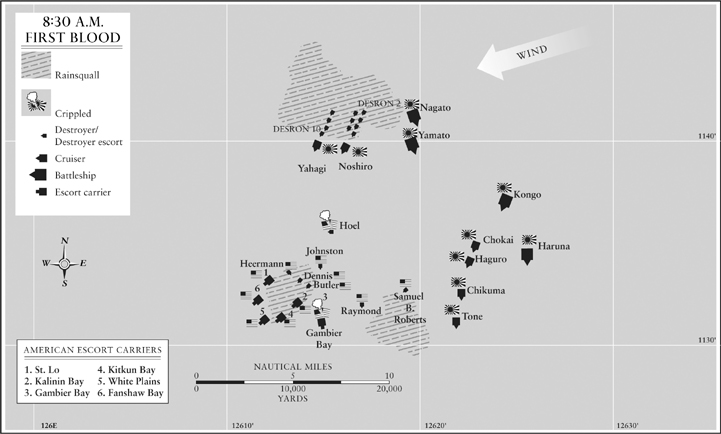
As planes from Taffy 2 and Taffy 3 strafe and bomb Kurita, the end nears for the Hoel, dead in the water as the Japanese close in. The escort carrier Gambier Bay is hit too, loses steam, and drops out of formation. Sprague orders his destroyer screen to intercept cruisers looming on his port quarter. The Haruna, ranging out to the southeast, opens fire on Taffy 2.
Bud Walton, the chief radio technician, was vaguely aware that the crowd of sailors that had gathered with him on the bridge was gone. The men—the plotting room crew and assorted gunners and fire-controlmen and men from the CIC—were cut down and scattered by the major-caliber explosion. A large piece of metal had hit him; he felt as if he had been stomped in the chest by a mule. “The ship was listing severely to port and it became impossible, due to the accumulation of debris and dead and injured, to walk.” He moved to the starboard side, where the smoke from the burning magazines was so dense that he could not see the water. “I dove over the side. It seemed to be ages before I hit the water.”
Working the plotting table when the abandon ship order came, Everett Lindorff was the last man to get out of the Hoel’s CIC. That meant he would live. The explosion that killed all the men ahead of him only knocked him cold.
When I woke up, I was still in the CIC trying to gather my wits as to what had happened. I remembered the ship was sinking, and I didn’t know how long I was lying there. So I crawled out the hatch and down the passageway over many more bodies to the outside main deck. The first thing I saw was more bodies and smoke and fire. I saw about six men trying to lower the motor whaleboat, and I wondered why because I could see holes all the way through it. In the next minute or two there was an explosion, and the men were gone. I started aft, then a shell hit the forty-millimeter ammo and depth charges. I could hear the ammo going off, then a hatch opened and two men from the engine room came out, took a few steps, and were cut down by shrapnel. I backed up against the superstructure and looked up at the bridge. There was the captain leaning on the rail looking back, just as calm as if nothing were happening. Then a large hole opened in the superstructure just a few feet from me, and about the same time I saw someone jump over the side, so I decided it was time for me to go.
Bob Wilson’s only impressions of the action derived from sound and feel: the bucking of the ship when the Hoel’s guns fired, the change in inertia when the ship turned, the sickening yaw and stutter-step when hits buckled the decks. Stationed in the machine shop belowdecks astern, Wilson had just finished checking the starboard stuffing box, which kept seawater from leaking in around the propeller shaft, and was passing through the after crew’s quarters back to the machine shop when the lights went out. He dogged shut the hatch behind him, and when he turned to continue through the sleeping quarters, there was a flash and the sound of shredding metal. Six feet from where he stood a shell pierced the starboard bulkhead and exited to port. Wilson survived only because the armor-piercing round did not explode. He was knocked flat to the deck, buried in bedding. “The compartment was filled with the smell of burnt gunpowder, and except for a little light from the hatch and some that came through the holes left by the shell, it was quite dark.”
Lightly wounded by shrapnel, Wilson dug himself out from under the bunks and went topside, where he joined a group of men huddled beside the sheltering hulk of Gun 55, disabled earlier. Off both sides of the Hoel Wilson could see the sleek dark forms of Japanese ships flashing and roaring. Their salvos screamed in fast, ripping the humid air at flat angles to the sea. At this close range, their freight-train roar was more densely pitched than when the shells were dropping lazily down, fired from extended range. All around the ship Wilson saw slicks of varicolored dye spread out in the water where shells had burst. One hit the fantail, destroying a twenty-millimeter gun tub.
There were quite a few of us by the gun mount, which at that time was out of action. Several were wounded, and some of the gun crews who were killed when the gun was put out of action were lying on the deck by the gun mount. It seemed like I was there only a short time when someone gathered a group of us together to go forward to help out. Just as we reached the vicinity of the galley, some shells hit the ship in that area. I have no idea what happened to the other guys that I was with.
His skull fractured, Wilson was dimly aware of men running past him. “Somehow I knew they were abandoning the ship and that I had to get myself over the side. I also found that I had no real control of my left arm or leg, and I couldn’t get my feet to walk,” he later wrote.
“I crawled forward past the passageway between the bridge structure and the deckhouse where a group of guys had been killed and many others severely wounded by a direct hit, and on up to the wardroom area, where I was finally able to get over the side.”
Lt. Jack Creamer, the assistant gunnery officer, exited the plotting room with a chief petty officer named Hickman, crawling through ventilation ducts part of the way to get topside. He tried to reach the bridge, but the superstructure was such a twisted wreck of metal that there was no clear route up. He and warrant officer Louis Stillwell spent their last moments aboard the Hoel walking down the starboard side, helping survivors get into life jackets and over the side into the water. All around the ship clusters of heads bobbed, survivors riding the slow, rolling swells. Creamer watched numbly as a Japanese salvo struck the sea a few hundred feet to starboard, right in the middle of a big gathering of wounded survivors. “We lost many of our shipmates to that one salvo,” he later recalled. “Mr. Stillwell and I went to the port side, assisted the few still there, and abandoned ship, port-side amidships.”
Francis Hostrander was the last one up the ladder out of the forward fireroom. One boiler was still working, but steam has no use when it has nowhere to go. Hostrander and his fellow snipes were among the first to know that the ship was dead in the water. They didn’t need reminding to abandon ship. Hostrander shimmied up the ladder to the port side. He walked forward over a deck slippery with blood, through an open-air grave of mangled bodies and body parts. He saw a Japanese heavy cruiser shooting point-blank into the ship. An eight-inch shell struck at the waterline, about ten feet from where Hostrander was standing, bringing a blinding white flash of electric light. Though the engine room was out of action, evidently a generator was still working. It had 440 volts and no place to send it. The cruiser put an end to that problem.
When Hugh Coffelt’s aft forty-millimeter gun lost power, he and his crew were ordered down to the main deck to look after the wounded. He made it down from the gun tub to the port-side deck in two jumps, then went forward and bandaged a few men injured by shrapnel and the machine guns of a Japanese floatplane that had strafed the ship. Running to sick bay to get a supply of morphine, he looked aft and saw a man jogging down the deck take a direct hit and dissolve into a red mess. Shells were hitting all around Coffelt. He slipped and fell in a blood slick, recovered, turned, and ran aft down the starboard side of the ship. Surviving a running naval battle was all stupid luck anyway; a man might as well do what a man had to do.
On that side I had a chance to see so many more of the men dead, lying on the deck, some of them only half there. I went back to the fantail. There were more men dead and half dead. I stepped into the water, as it was coming over the deck already, and I swam as quickly as I could away from the ship. I stopped just for a bit, looked back, and saw shells hitting in the place where I had just been standing.
From the bridge, Captain Kintberger had a hazy view of the battle as it passed him by, running south. The escort carrier closest to the Hoel, the Gambier Bay, intermittently visible through the black and gray smoke, was listing hard to port, with shell splashes striking up the waters all around her. According to Lieutenant Dix, “That was the last we saw of friendly ships.”
Friendly ships would soon see the last of Captain Kintberger’s hard-charging destroyer. Through the squalls Captain Copeland spotted the Hoel. There wasn’t much left of her. Listing severely to port, motionless in the water, the ship was a pile of wreckage. Her bridge had collapsed on itself, her mast was gone, and the amidships torpedo mounts had been blown off the ship. Fires were raging astern, and smoke and steam were pouring from unseen spaces be-lowdecks. Her stacks were cut through with holes of all sizes. Lifeboats were splintered and dangling from their davits. Guns were twisted down like crazy straws, bent in or pulled from the deck by their wire roots. From his position in Gun 41, one of the Roberts’s forward forties, Jack Yusen, numb from the concussion of the forward five-inch gun right next to him, couldn’t even tell that the Hoel was a Fletcher-class destroyer. Its silhouette had been mangled and reformed into a grotesque approximation of a warship.
For the Roberts’s skipper, encountering the Hoel in her final minutes was “one of those disheartening things … that puts a lump in your throat.”
We had to pass her by and leave her lying there dead in the water with a big list on her. She was on fire. We could see men scrambling around launching life rafts. We just had to steam by. In combat you have to leave the wounded behind whether they are men or ships and go on your way and fight. Nevertheless, it was something that made every man on our topside feel the same as I did, and it bothered us to leave those men at the mercy of the Japs, but there was no other choice.
Thirty-four
By 8:40 the Samuel B. Roberts was speeding toward the cruisers closing on the carrier formation’s port quarter. When Lt. Verling Pierson on the Fanshaw Bay spied the destroyer escort crossing astern his CVE, racing toward the Japanese ships, he turned to an officer standing next to him and said, “Look at that little DE committing suicide.”
In a loose column with the Johnston and the Heermann, the Roberts steamed south, the three ships cutting in and out of one another’s smoke. Whenever one rode the port-side flank nearest the enemy, the other two remained concealed in the exposed ship’s smoke, which was generously blown over them by the easterly wind.
In all likelihood, this apparent tactical improvision was the accidental by-product of their independent zigzag courses. None of the ships’ action reports suggests a coordinated advance. Bob Copeland, however, perceived deliberate maneuvering in the haphazard dance.
Whoever was out on the advance flank was taking a terrific beating. The others would be fairly well protected in her smoke and the smoke they were laying for the protection of the carriers. So every few minutes, when it got too heavy going on the outboard flank, whoever was up there would cut in to the right, fall in, and come down on the inside of the formation; and the next one would push out. We … just played leapfrog and kept peeling off.
Looming to port was the Chikuma, so close that everyone topside on the Roberts watched in fascination. Her eight big guns flashed and smoked, launching eight-inch shells at the carriers. Copeland headed toward her, closing the range between them until the heavy cruiser was almost directly off the Roberts’s port beam. The destroyer escort’s torpedoes were gone. Guns were all she had left. But in gunnery as in every other line of business aboard a destroyer escort, the Roberts’s crew made do with what they had. “I came a little bit left,” Copeland recalled, “and when the range was closed down some more, I said, ‘Mr. Burton, you may open fire.’”
Even as his guns blazed defiantly at the Japanese cruiser, the skipper of the Roberts could not help but be taken with the imperial warship’s sleek lines: “It was a beautiful ship. It had quite a flare on its bow and had four turrets all forward, a long fo’c’sle and the turrets alternated—a low one, a high one, a low one, and a high one—right up the fo’c’sle.” As the Roberts approached, two of those turrets trained slowly to starboard to engage the Roberts, while the other two continued shelling the carriers.
So began the 1,250-ton destroyer escort’s duel with a heavy cruiser twelve times her weight. The necessity of the engagement did nothing to squelch the crew’s fear. Most everyone felt it. Some were well-nigh paralyzed by it, cowering in passageways and behind bulkheads as if the ship’s thin metal plate would do anything more than block their view of the incoming projectiles. “Anybody who says that he didn’t get scared in a situation like this is either a liar or a damn fool,” Copeland wrote. “The point is, though, that you didn’t stay scared.”
Naval combat offered nowhere to run, no foxholes to dive into. You had no way to know whether the next round would fall ahead of you, behind you, to the left or right, or come burning straight in, right down Lucifer’s pike. No degree of personal cleverness could defuse or deflect a shell bound in a particular sailor’s direction. Against a faster, more powerful opponent, a sailor had neither the hope to vanquish him nor the possibility to flee. The Roberts had no way out but through this enemy cruiser. There thus remained only the duty to engage it. No one shirked from that duty. “[A]s soon as the splashes had settled back, practically everyone was over it; from then on, for the most part, we were just too busy operating and fighting the ship to think about being scared.” And no one in Taffy 3 fought more resolutely than the man who led the crew of the aft gun turret on the Samuel B. Roberts, Paul Henry Carr.
All through the Roberts’s wartime service, Carr kept his aft five-inch gun—designated Gun 52 or gun number two on a destroyer escort—clean, primed, and ready for action. His skipper considered the gunner’s mate third class valuable not merely for his ability to keep his weapon mechanically fit but for his leadership skills as well. “Gun number two had a crew just out of this world,” Copeland wrote. “It had been outstanding from the time we shook down.”
As the captain of gun number two, Carr was responsible for maintaining the delicate machinery of his mount in the midst of an inhospitable saltwater environment, and he was the catalyst to the odd mix of seamen and petty officers who manned his gun at general quarters. Carr was its full-time caretaker. “He kept that gun the way a very meticulous housewife keeps her kitchen and kitchen utensils,” Copeland wrote. “It was absolutely spotless. It is not an exaggeration to say you could have eaten off the deck of that gun mount at any time.”
Back home in Checotah, Oklahoma, Carr had painted a bull’s-eye on the barn and practiced long-snapping a football at it for hours on end. He was no less fastidious aboard the Roberts. His best qualities had a way of rubbing off on his crewmen. Seaman second class Bill Stovall, a teenage enlistee, was the pointer on Carr’s crew. “I doubt if [Stovall] weighed more than 115 pounds dripping wet,” Copeland wrote. “He was just a little shaver, but he was cool as a cucumber.” Gilbert Stansbury, the loader, and James Gregory, the trainer, were two more good men. Their counterparts on the forecastle in Gun 51 were well drilled and adept. But the gang in Gun 52 surpassed them. “It just happens that his crew on our number-two gun was the best I have ever seen and I imagine one of the best that has ever existed,” Copeland wrote. “That crew was, in fact, so good that another very good gun crew, namely number one, looked more or less mediocre by comparison.”
Unlike the guns on the larger destroyers, the gunnery system on the Roberts was relatively rudimentary, with no centralized fire-control system to direct it. A gunner on a destroyer escort could get a range from the CIC, where the exec oversaw the use of the ship’s Fox Dog surface radar. In a pinch the Mark 51 director that guided the forty-millimeter antiaircraft guns could fill in. But destroyer escort gunnery was largely a nineteenth-century affair. Their pointers and trainers were busy men.
Copeland thought he might have inadvertently discovered a weakness of the vaunted Japanese ship: its inability to hit targets too close to it. The Chikuma was so close to the low-lying DE that her gunners seemed to have trouble depressing their guns sufficiently to take the Roberts under fire. At that depressed angle the gunners couldn’t reload. Each time the Japanese cruiser let loose with a flaming, windy blast, the guns would rise up and the turrets would turn inboard as the crew reloaded. Silently then the guns would train out again. “We’d see the flash of fire; then we’d hear the blast, and seemingly much later but actually at about the same time—whoosh— they’d go right over our heads.”
Copeland’s two gun crews had no such trouble. Though it was debatable what damage the Roberts’s battery could do to a heavy cruiser, there was no doubting that Paul Carr, Bill Stovall, James Gregory, Sammy Blue, Gilbert Stansbury, and the rest of Gun 52’s crew had found their groove.
The boys took the ammunition just the way it came up the hoist—nobody cared what it was. They just took it as it came. Five-inch blind loaded and plugged, five-inch AA, five-inch common, five-inch AP, five-inch star shells, five-inch proximity fuse: just whatever came up the ammunition hoist. It was all fodder for the guns. They threw it in as fast as they could get it. It was very odd to see those star shells banging off over there in the daylight.
The Roberts couldn’t match the output of Bob Hagen’s teams on the Johnston, Bill Sanders’s on the Hoel, or Bill Meadors’s on the Heermann, but they did well enough. In thirty-five minutes of shooting, Carr’s squad in Gun 52 popped off 324 rounds at the enemy. Gun 51 on the forecastle fired 284 more.
Five-inch guns were useless shooting at a heavily armored hull, but they made a fair mess out of an exposed position. Each hit produced sheets of flame and choking gusts of metallic and asbestos dust. The star shells unloosed furiously sizzling showers of phosphorus that ate metal and flesh alike. One such hit in the right place could be debilitating; several score of them concentrated over the compact topside decks of a heavy cruiser and delivered in a short space of time could re-create purgatory itself. From what Copeland and other observers on the Roberts could see, the result of their shooting was devastating to the Chikuma: “We had the Jap cruiser on fire from the start of her bridge superstructure, just above the main deck, clear up to the fighting tops—absolutely an inferno of flames.” The cruiser’s number-three gun turret was knocked out, the bridge battered repeatedly, fires set aft, underneath the secondary control tower.
But while fires raged seventy-five feet above the Chikuma’s mainmast, the cruiser didn’t falter. Capt. Saiji Norimitsu’s determined gunners kept up a steady rate of fire at her two targets, the Samuel B. Roberts and the stricken Gambier Bay. Though the carrier made an easy target, amazingly, an hour and forty-five minutes into the battle the Roberts hadn’t been touched. Now, fighting beam to beam with a ship twelve times her displacement, she seemed to be getting the better of it. As for the opposing Goliath, there was no mistaking the fact that the Chikuma was in some serious trouble. Her number-three gun, the third one back from the bow, was no longer firing. Her bridge was a crudely holed wreck of scorched and twisted steel. Several small fires could be seen feeding on the superstructure behind the bridge.
Thirty-five
Despite the dauntless work of its screening ships, by 8:40 the Gambier Bay’s fate was sealed. A salvo from a Japanese cruiser knocked out its steering hydraulics, sliced off the starboard propeller, and quenched the ship’s last source of steam power, the number-three boiler. On the flight deck of the Gambier Bay, Lt. (jg) Hank Pyzdrowski, stranded when his ship turned out of the wind, had nothing else to do but watch the silhouettes of Japanese ships grow steadily larger. As a reader of fiction set during the age of fighting sail, he wondered whether the enemy cruisers might approach and try to board the stricken CVE. The pilot massaged his .38-caliber service revolver and the survival knife on his belt.
Pyzdrowski went down to his stateroom and discovered that his locker had been rifled and his stash of scotch raided. He sat down to collect his thoughts, and Lt. George Bisbee popped in. “Need a drink?” the pilot asked, holding forth a half-drained bottle. Pyzdrowski followed his squadronmate into the adjoining room, where mattresses taken from nearby staterooms had been gathered and stacked into a large teepee, as if the layers of foam padding could stop or even slow down the cutting arc of a shrapnel burst. From within the teepee, Pyzdrowski could hear drunken voices of some of the other VC-10 pilots who had also been stranded aboard the ship.
Empty bottles were scattered all about its base. When the after engine room was hit, the ship went dead in the water, and Capt. Walter Vieweg gave the order to abandon ship. As the emergency alarm began to sound, Pyzdrowski said to Bisbee, “Better get these guys ready to go.”
* * *
ONE OF THE JAPANESE officers responsible for the Gambier Bay’s destruction, Capt. Haruo Mayuzumi, the skipper of the Tone, was among his nation’s foremost experts on battleship gunnery. As the executive officer on the Yamato when that great ship was put into commission, he had overseen the installation of her massive 18.1-inch guns, whose bore size was so secret that even Admiral Kurita did not know it. As a tactical instructor at the naval gunnery school at Yokusuka in the years leading up to Pearl Harbor, Mayuzumi had studied intercepts of the radio chatter exchanged between U.S. battleship commanders and seaplane spotters during gunnery drills off the California coast. Japanese submarines and merchant ships readily eavesdropped on the plain-language play-by-play, and the Imperial Japanese Navy tallied the statistics as diligently as their counterparts did.
At a range of 22,000 yards, the Japanese learned, American battleships hit their targets just seven percent of the time. Japanese heavies scored at a rate three times that. Mayuzumi led the effort to open that performance gap still further. He knew that if the shells were fired at flat enough angles to the water, they need not actually “hit” a ship at all. A near miss that struck the water close aboard, continuing on an underwater path, could land the most devastating blow of all: a hit below the waterline. Fired from 22,000 yards, a sixteen-inch battleship shell entering the water at a seventeen-degree angle to the surface could penetrate seventy-six millimeters of face-hardened armor even if it “missed” by twenty-five meters. The shells retained a velocity of 1,650 feet per second at the time when they reached their targets. The key was making sure that the angle of entry was flat enough. If it was, the so-called “danger zone”—the surface area in which a shell might land and still cause major damage to the ship—extended 143 meters from the target’s hull. Mayuzumi did not anticipate that American innovations in radar would make his work seem primitive in comparison. But his findings influenced Japanese gunnery doctrine, which may have been why some Taffy 3 sailors witnessed shells skipping off flight decks like slices of shale across a calm pond.
As a connoisseur of gunnery but not bloodthirsty in the art of war, Mayuzumi watched a midshipman by his side meticulously guide the fire of the Tone’s secondary battery into the hindquarter of the Gambier Bay, gunning for an engine room. Suddenly he saw U.S. sailors gathering astern near some lifeboats, preparing to abandon ship. The Japanese skipper ordered, “Ceasefire,” and directed his midshipman to aim at the forecastle, where no people could be seen.
At roughly that time, around nine A.M., ten minutes after the abandon ship order circulated on the Gambier Bay, a flight of Wildcats fell from above and rattled the gunwales around the Tone’s bridge with squirts from their machine guns. A round struck Mayuzumi in the thigh, ricocheting off bone and ripping away an eight-by-ten-centimeter chunk of muscle. The captain fell to the deck but never left the bridge. As the ship’s surgeon tended to him, he sat there in his own blood, unable to take his eyes off the Gambier Bay’screw calmly gathering and dropping rope ladders down into the water. He could not help but admire the Americans’ evident bravery. His devotion to gunnery had borne fruit for the empire. He had helped sink the only U.S. carrier of the war to succumb to surface gunfire. But he and his compatriots would soon assess the cost of Taffy 3’s audacious resistance, the effectiveness of which no tactician could ever have foreseen and no statistician could have measured.
Thirty-six
The Samuel B. Roberts was blessed with luck and a low profile to the horizon. Shells whistled by overhead as Copeland steered his ship through the effervescent whirlpools of the enemy’s misses. As he conned the ship, he stayed focused on the ocean ahead of him, paying no mind to what lay behind him. Suddenly he heard a lookout shout, “Captain, there’s fourteen-inch splashes coming up on our stern!” The battleship Kongo lay some ten thousand yards in that direction, shooting with uncanny accuracy through the haze. At 7:22 her rangefinder had been disabled by strafing Wildcats. Now it was restored. As the Cyclops fixed on the Samuel B. Roberts, the Kongo’s guns boomed salvos of 1,485-pound shells Bob Copeland’s way.
Copeland turned and saw a procession of foaming columns walking up from behind. Gauging the progress of the explosions—the closest of them smacked the sea fifty yards astern—relative to the movement of his speeding ship, he knew what he had to do: hit the brakes. The normal procedure, designed to spare strain on expensive reduction gears, was to ratchet down from flank speed to standard, two-thirds, one-third, and stop. But Copeland’s worries went beyond the condition of Lucky Trowbridge’s precious machinery. Like a driver speeding down the freeway shifting straight into reverse, he shouted into the voice tube, “All engines back full!”
“That was the one time the old ship really shuddered and shivered and quaked,” Copeland wrote. “She just kind of lay down and pretty nearly backed her stern under water.” The destroyer escort’s bow wave collapsed as her forward movement stopped. Almost immediately there were more sounds like runaway freight trains and an ungodly buffeting of air. Directly over the ship flew another brace of battleship shells. They smacked the ocean a hundred yards ahead, right where the Roberts would have been had Copeland not slammed on the brakes.
The captain had no time to congratulate himself. No sooner had he called for flank speed again than a salvo from a heavy cruiser found the mark. From the barn-door range of 5,500 yards, the cruiser spat three eight-inch shells into the Roberts’s low-slung broadside. The time was 8:51.
Seaman first class Bill Katsur “felt as though I were a bedsheet on a clothesline being whipped by a strong wind.” The hit knocked out the electrical distribution board in the internal communications gyro room, and with the loss of auxiliary power, lights throughout many lower compartments went black. Communications throughout the ship went dead too. A second shell punctured the bulkhead of the forward handling room, penetrating without exploding and duly exiting the compartment to starboard. The third hit was the most catastrophic. It struck the main deck below the davits that held the motor whaleboat and entered the forward fireroom. Steam lines were torn, and the steam did what steam does when it is released from high-pressure lines. Amid the sudden hissing horror, all but two men died. But Jackson McCaskill, a teenage seaman second class, retained his wits. Two weeks earlier the kid had been reassigned to the black gang in the forward fireroom because he was, according to his skipper, “an absolute flop on the deck force.” The eighteen-year-old outlived that reputation now. He coolly turned off the fires beneath the boilers and spun the valves that cut the flow of steam from the boilers and the supply of fuel into the burners. McCaskill pulled the headphones from the body of Chester Kupidlowsky, a fireman killed by the blast, and called the engine room to ask for help opening the escape hatch to let the live steam escape to the open air. Then, with the flesh on his feet burned down to white bone, McCaskill wedged his 130-pound frame under a deck grating, dropped down into the bilges, and lay prostrate against the last piece of cool steel on the ship, the bottom of the hull where the keel cut the sea.
In the CIC, right above the punctured number-one boiler room, Tom Stevenson, the communications officer, found himself bathed in steam and choking in a storm of asbestos that was pulverized by the explosion and blown through the ventilation ducts. The shower of insulation turned him white and filled his mouth and nostrils with thick dust. The gyro and radar were out, rendering the CIC useless. Bob Roberts, Stevenson, and the rest of the CIC gang decided to evacuate the compartment and went up to the bridge, but the small enclosure was crowded with other displaced CIC personnel looking to escape the steam. Copeland ordered the bridge cleared—with the after fireroom working and two good engines, he still had a ship that could fight. Stevenson climbed up to the signal bridge. He felt a loud blast and a hot rush of wind. Some cloth sacks full of signal flags burst into flame near him, and Stevenson noticed he had taken shrapnel in his legs, but he was so scared that he didn’t feel a thing.
The battle was nearly two hours old when the Roberts took her first hits. With the destruction of her forward boiler, the Roberts slowed from nearly thirty knots to seventeen. Lieutenant Trow-bridge’s snipes cross-connected the number-two fireroom to both engine rooms to keep the screws turning, but the ship no longer had the power to maneuver aggressively enough to chase salvos. At the helm quartermaster third class Elbert Gentry seemed unable to process Bob Copeland’s commands. “Mr. Roberts,” Copeland asked, “would you please take the wheel and get this ship out on the heading that I am trying to get to?” The exec took the helm from the shell-shocked quartermaster as Copeland tried gamely to take the ship south toward the carrier formation.
The shells from the heavy cruiser cut the power to many stations on the ship—Paul Carr’s five-inch gun among them. Gun 52 still fired, but with the power out, certain systems critical to the mount’s safe operation no longer worked, including the automatic gas ejection system that puffed air into the breech after each shell fired, clearing it of hot gases. When that system failed, the gases stayed inside and gun number two’s breech grew hotter with every salvo. George Bray, assigned to repair party number three, relieved a man in Gun 52’s handling room who had dropped from the exhaustion and the heat. Bray’s football prowess kept him in good shape, and he and the five other men in the compartment kept a steady supply of fifty-four-pound, twenty-one-inch-long projectiles loaded into the hoist. The men from the magazine one deck below passed ammunition up to him, and Bray dropped each shell into the hoist, nose down into its funnel-shaped housing. He’d close the hatch on the hoist, and there followed an electrohydraulic shriek as one hoist carried the live round up and the empty one cycled back down to the handling room.
Carr and his superb crew in Gun 52 were in their rhythm, grabbing powder cases out of the slot, laying them in the breech, picking the projectiles off the hoist, sliding them in ahead of the powder case, ramming shut the breech, firing the gun, kicking the spent case out the hole down onto the deck, and starting the sequence again. When the power went out, they rammed the tray into the breech by hand. When the air ejection system broke down a few minutes after that, Carr and his men got off seven or eight more shots before the inevitable happened.
In the lower handling room two decks below the gun, George Bray heard a deep, percussive bfff, like a big paddle smacking a mattress. There was shouting and sounds of men in pain. A shell had cooked off in the breech, detonated by contact with the overheated tray in which it sat. Burning gunpowder sprayed out of the barrel, setting part of the fantail afire. But most of the damage stayed inside the mount. The blast killed most of Carr’s gun mount team immediately with a pressure wave that blew a tongue of flame down into the handling room beneath the turret.
In the gun mount itself, there were some lucky souls. When the shell cooked off, seaman second class Sam Blue had been standing by the mount’s open side door, half inside and half out. The explosion propelled him, unconscious, a fair distance out into the water. He hit the surface hard enough to trigger the CO2 cartridge on his inflatable life belt. Bill Stovall was blasted off the ship too, but not before inhaling a lungful of flames and superheated air that left him screaming in the water.
Little Sammy—the fifteen-pound, short-haired, mixed-breed mascot of the Roberts, the Norfolk mutt turned honorary water tender—had grown smart in the ways of ships. He could run up and down the steep ladders and find safe places to ride out the long rolls in typhoons. He was afraid of the roar down in the fireroom and had an uneasy relationship with the ship’s two five-inch gun turrets. But the dog had never before seen the likes of the pulverizing rain of shellfire now smashing his ship all around him. The explosions and their bloody effects sent Sammy into a fit. “I felt sorry for him,” Copeland wrote. “He was running up and down the deck with all the guns firing and the men he knew lying dead in blood and gore. He actually went off his beam.”
On the bridge, Copeland felt the ship shake hard as another shell struck the heavy base of the forty-millimeter mount astern. Another tore into the deckhouse to which the mount was bolted. Looking back, the skipper caught a glimpse of the bodies of men from the gun and the Mark 51 director mount hurtling through the air. As the wind shoved aside a cloud of white smoke, which drifted heavily across the fantail, Copeland discovered that the explosion had blown away the entire machine-gun mount and with it assistant gunnery officer Lt. (jg) John LeClercq and twelve crewmen. No traces of the men or the large steel mount were ever seen again.
The deck leading forward to the ship’s triple-torpedo mount lay torn away, twisted and sagging. Another concussion came as Lieutenant Trowbridge’s number-one engine room took a direct hit. Normally the eight-inch armor-piercing rounds punched through the hull spaces without detonating. This one hit an I-beam supporting a large switchboard panel and exploded. The ensuing fireball left only one survivor there, a fireman named Herman Metzger.
With one screw disabled, the Roberts had no more speed than an escort carrier and a lot less maneuverability. Lt. Bob Roberts did his best to carry the ship through the deadly gauntlet, but its miraculous dry sprint through a driving rain had come to an end. The gunners on the Kongo never relented. Now they took advantage of the wounded ship’s critical loss of speed. Three massive shells from the Japanese battleship screamed downward, struck aft, and exploded.
A thunderous blast knocked down everyone on the bridge except Charles Cronin, a yeoman second class who happened to be holding on to the levers of the engine order telegraph. To Copeland, “it seemed as if the whole ship went out from under us.” From the force involved he guessed that the Japanese had finally wised up and loaded high-explosive rounds. Thrown from the steps leading from the open-air bridge to the pilothouse, the skipper slammed into a pile with Lieutenant Roberts and Elbert Gentry. The quartermaster lifted himself up, bleeding from the mouth, missing a tooth. As Copeland dusted himself off, he looked around and felt an insane impulse to laugh at the sight of several of his talkers sprawled across the grating of the bridge wing with their big headsets knocked askew and entangled in a ludicrous mess of wires. Amazingly, no one there was hurt. But Copeland’s mood sobered when it dawned on him that his ship was no longer moving. Looking forward from the bridge, he might have wondered why.
As far as I could see, the ship was as nice as the day she left the shipyard because the damage had been down below deck, but from the stack aft she was a pretty sorry-looking sight. There were two twenty-millimeter gun tubs, number six and number eight, with parts of human bodies hanging out of them; and there was the deck of the deckhouse warped back like a piece of linoleum ripped up and from there on aft nothing but a yawning mass of blackened metal as the various thwartships and fore and aft bulkheads had been twisted together and the deck ripped off where that gun had disappeared.
There was no denying the mortal wound the Roberts had taken. At the waterline, about two-thirds of the way to the stern on the port side, gaped a cavernous hole seven to ten feet high and some fifty feet long. The massive opening would have neatly garaged a semitrailer parked sideways. The number-two engine room was completely demolished. When the after fuel-oil tanks ruptured, they threw flaming oil everywhere. The starboard “K-gun” depth-charge launcher was hanging over the side, and tar was oozing onto the deck from ruptured depth charges.
As if to remind the skipper that life could get worse, a torpedo wake came bubbling in to starboard. There was no way to avoid it. As the faint white wake came straight on amidships, Copeland gripped the edge of the bridge wing and screamed, his voice cracking, “Stand by for tor—!” But one last miracle remained, it seemed. The torpedo passed just under the destroyer escort’s keel, missing, by the captain’s estimation, by no more than a foot.
Belowdecks the men still had a chance. In the aft lower handling room, George Bray’s world had gone dark. He fumbled through the void, looking for a way out. He circled back through the after steering room and heard water rushing in from somewhere. Suddenly, through an open hatch forward, water came swirling all around him. In the torrent, mattresses floated by, like rafts on the inflow, and empty shell cases too. The flow was strong enough to carry away Bray’s life belt and left shoe. He hung on to some cables to steady himself.
Around this time Bob Copeland got his last look at the USS Johnston. When Ernest Evans’s destroyer passed close by the Roberts, and in the midst of his own ruin, Copeland was heartbroken to see up close what had become of the proud tin can. The image of the battered ship stayed with him for the rest of his life.
I can see her right now. She had taken a terrific beating. Her bridge was battered and had been abandoned. Her foremast, a steel tubular mast, coming up just abaft of the bridge superstructure, had been split from shellfre and then bent down over itself….
It gave me a hurt feeling to look at it. Her searchlights had been knocked off. One torpedo mount was gone, and her number-three gun had completely disappeared. As she went by—limping along at a pretty slow speed—I saw her captain. He was a very big man with coal-black hair; his name was Evans. I had met him at some of those conferences. He was standing on the fantail conning his ship by calling down through an open scuttle hatch into the steering engine room. I can see him now. He was stripped to the waist and was covered with blood. His left hand was wrapped in a handkerchief….
As he went by—he wasn’t over a hundred feet from us as he passed us on our starboard side—he turned a little and waved his hand at me. That’s the last I saw of him.
* * *
BOB COPELAND WAS STRUGGLING with a decision he had not wanted to make until the grotesque reality of his warship’s condition thrust it upon him: should he give the order to abandon ship? He was frankly in awe of the Sammy B.’s ruggedness under duress. The Bureau of Ships and the folks at Brown Shipyard really knew their trade. Lloyd Gurnett showed up on the bridge covered in the remains of shell-blasted asbestos lagging. As first lieutenant, he knew his ship’s compartments and passageways and ladders and bulkheads intimately. On those raw scores, the Samuel B. Roberts had little left to offer the U.S. Navy. Gurnett told Copeland that the ship was settling by the stern. The starboard list was tipping the inclinometer at eleven degrees, he said. Both engine rooms were out of action, all communications and power gone. The only unanswered question pertained to the condition of the ship’s main gun batteries. Could they still shoot at the enemy, and was there anything left in the magazines to shoot at them? Jack Moore was ordered forward to check on Gun 51, and Tom Stevenson was sent aft to appraise Paul Carr’s group.
Stevenson didn’t want to do it. He wasn’t sure he could. Ever since the aft forty-millimeter gun was carried off, Tom Stevenson had been terribly shaken up. The young officer in command back there, John LeClercq, had been one of his best friends. Stevenson had spoken with him over the phones during the battle. He was impressed by LeClercq’s calm as the young officer directed the firing of the after guns. He was a good kid and a good destroyerman for the same reason: he was always looking out for someone else. At one point LeClercq had had the presence of mind to train his forty-millimeter mount on a spread of torpedoes bubbling toward Sprague’s carriers. Johnny LeClercq was the very picture of wholesome blond American innocence, considerate of the enlisted men, devoted to the Navy, and meticulous in his duties. He wrote home regularly to his parents in Dallas, signing the letters “Sonny.” Even from a hemisphere away, he never forgot his younger brother’s rites of passage—Bobby’s birthdays, the first days of school. Though the twenty-three-year-old cultivated a superstitious side—he carried a carved wooden skunk for good luck—he kept a realistic attitude toward death. Informed by his mother of the passing of a friend in another theater of battle, he sat down at his desk sixteen days before the destruction of the USS Samuel B. Roberts and wrote this: “I am sorry to hear about H. P. Inge. He was a swell boy, and I guess that war is where brains alone won’t save you, as he would still be going now if it would…. Tell his family—chin up and don’t worry. Everything will be all right in the end.”
Because he took this latter assertion as an article of faith, death never preoccupied him. He was too busy enjoying life. He seemed to walk through his days on the Samuel B. Roberts as if lit by a sunrise within. “The few things you saw him do and say made you want to know him better,” a friend observed. Two short hours ago Tom Stevenson had shaken LeClercq’s hand, wishing him luck as the general quarters gong scattered the crew to battle stations. Now Johnny, along with so many others, was gone, truly gone, the explosions so powerful as to erase them from the air. Others had died too, but their bodies remained to be counted.
The communications department boss had encountered death at sea before. Before the war his family earned their keep operating Norwegian-licensed cargo ships out of New York Harbor. The chartered merchantmen of T. J. Stevenson & Co. took a variety of cargoes on their plodding nine-knot cruises up and down the eastern seaboard. They took lumber from St. John, New Brunswick, carried it to Jamaica, and brought sugar cane on the return leg. When he was sixteen Tom Stevenson went to sea, entering the family business as a deckboy. When he left on his first voyage, his mother stuck a big bottle of aftershave lotion in his duffel. On his first night at sea his cabinmate, a fortysomething Norwegian steward who seemed drunk all the time, stole the bottle and drank it. While Stevenson slept, the man rigged a makeshift gallows and hung himself beneath the teenager’s bunk. The following morning the captain gave Stevenson one of his first shipboard duties, ordering him to gather wood from the hold and make a coffin.
It was all very unsettling, but Stevenson had stayed aboard ship and in short order become a qualified helmsman. After high school he attended Georgetown University’s School of Foreign Service. One Sunday afternoon during his junior year Stevenson was watching a Redskins football game at Griffith Stadium when suddenly all of the admirals and generals in the crowd were called out of their seats. A war was on, it seemed, although nobody seemed to know exactly where this place, Pearl Harbor, was. Less than two years later, by which time Stevenson was a commissioned officer and a specialist in naval communications, the Samuel B. Roberts was ready for launching in Houston.
Though Tom Stevenson had joined the Navy well acquainted with death at sea, it did not prepare him for this. Nothing could have. A man hanging himself was one thing. A seagoing slaughterhouse enabled by industrial-age engines of war was quite another. Unlike the armor-piercing rounds that had penetrated earlier without exploding, the high-explosive shells that hit the Roberts now performed exactly as designed.
Stevenson looked down the ladder from the bridge wing to the deck at the dead whose bodies remained intact. Some of them appeared completely uninjured. There was no blood, no mess. They just lay there on the deck, unscathed, locked into poses that looked ridiculous, somehow vaguely athletic. Down at the foot of the ladder, corpses littered the deck. Stevenson decided he didn’t need to go down there. There was no viable route aft in any event. He could see the deckhouse back there, blasted all apart. The passageways along the rail on either side of it were obstructed by sheets of twisted, blackened metal and bodies of a similar description. The deck was aflame with burning oil and sizzling chunks of depth charge explosives. It was plain enough that Gun 52 was no longer firing, though its barrel still glowed cherry-red.
Tom Stevenson went back as far as he could, gave an exploratory shout, and getting no encouraging response, reported the grim news to his captain. Gun 51 wasn’t working either. Jack Moore came back and said there were still forty-two rounds left in the magazine, but the gun had been jarred so severely that it no longer rotated on its base.
The ship was quiet now. The guns did not fire, and the boilers no longer roared. There were no screams anymore, just a peculiar graveyard calm. The silence revealed no new horrors. If Japanese shells were still rushing by overhead, crashing in columns of colorful brine, they failed to make the same impression that they had made two hours before. They didn’t matter now. The dead were so promiscuous, the damage so profound, that there was no terror left in the shells’ descent.
Thirty-seven
In his final moments aboard the Hoel, Captain Kintberger helped Commander Thomas to the rail. The screen commander was severely wounded, with a large section of one arm torn out, from the biceps to mid-forearm. The skipper guided him overboard and jumped. The two officers hit the water and kicked out to steady themselves. Kintberger found a battered life raft whose wooden latticework had been chipped to pieces in the rain of shrapnel. He pulled several Hoel crew from the surrounding water into the raft’s sanctuary. As he went up, over, and in, Thomas gritted his teeth and tried to grin, keeping up appearances. There was a cry from behind them, and George Driscoll was there. Someone grabbed the mortally wounded chief torpedo-man by the shirt and hauled him aboard. The worst off were placed inside the raft, sheltered from the elements and stabilized so they did not have to move. Those without wounds or slightly hurt treaded water alongside, holding on to the raft’s outer shell. Going overboard, Myles Barrett had lost most of his pants when they snagged on a grappling hook. Now he took off his T-shirt and used it to stop Thomas’s bleeding. With his shirt turned into a tourniquet, he was left wearing only his belt, his boxers, and the back pockets of his pants, flapping in the tide.
Just minutes after the Japanese drew first blood from the Samuel B. Roberts, the USS Hoel rolled over and sank. As her crew turned and watched, the destroyer got it over with quickly, rolling to port and going down by the stern. Her bow rising, a windy sucking sound was heard as water rushed in and forced air out of the lower compartments. Disappearing below the surface in sequence went the bridge, then Gun 52, then Gun 51, then the neatly trimmed bow. The sea swallowed her whole. Kintberger’s raft moved toward the spot where the ship sank, drawn by the inward tug of seawater displaced as the ship passed into the deep. Lieutenant Dix:
The sound of water lapping at the raft,
The voices of the others talking low,
The strange unwelcome stillness of the scene,
Brought home the dreadful loneliness and loss
Because their ship was the first to go under, the battle passed them by, the American ships disappearing over the southern horizon. Their solitude lasted only for a few minutes. Soon enough elements of the pursuing Japanese fleet appeared. John Dix heard the deep thrum of large diesel engines and saw the low form of an approaching column of destroyers. Good God, haven’t they done enough to us today? he thought. He assumed he and his men would be butchered where they swam. The Japs would do to them precisely what the gunners and Marines aboard the Hoel had done to some Japanese seven months ago, at Emirau. Most everybody remembered the canoe incident at Emirau, though no one was eager to speak the name.
In March, during the drive to bypass and isolate the Japanese stronghold at Rabaul, the Fourth Marine Division had taken the island in the St. Matthias Group. The troops had met little resistance, and the Hoel and other destroyers patrolling the surrounding waters aimed to keep it that way. They were guarding against covert reinforcement by sea when they got their first up-close glimpse of Japanese fighting men. The destroyer came upon a native war canoe and found that it was filled with local kids, boys. It was strange, everyone thought. What were they doing in a combat zone? At least they took them for kids—until they got closer, and a man stood up in the canoe and started shooting them, one by one. They were Japanese soldiers. Their leader was not about to let them get taken prisoner.
Their audience aboard the Hoel didn’t cotton to enemy gunfire opening up so close to them. They finished what the Japanese commander started. The forward forties were the first to open up—poo-poom, poo-poom. As the destroyer circled the skiff, the Marine detachment added their rifle fire to the fray. No one was left alive on that canoe.
Would the Japanese return the favor now?
Dix expected the sound of machine guns to rip the air. There was no hiding in the raft, yet there Commander Thomas and others were, crouching down inside as if they could conceal themselves. Seeing the futility of possum-playing and more than a little curious to see the men who had done in his proud ship, Dix watched the four destroyers approach. The first one struck him as absurdly huge. The Hoel must have looked that way to the soldiers on that canoe.
And see the men, how tall they seem, how clean And neatly dressed, not like we’ve heard they look. They’re not at battle stations anymore, But khaki uniforms—must be marines. They’ve got a landing force aboard these ships. Look at ’em grin and point—they’re wavin’ now. Duck down, duck down—Okay—she’s passed on by. But there’s the second. Look! Her fish are gone. They fired the fish all right. Damn, here’s the third. Wait, she’s been hit. There, by the bridge. But she’s The only one. The others all seem clean, Well-painted. Hell, these ships are smart.
As the last enemy tin can approached, Dix feared he had pressed his luck too far with his rubbernecking. He ducked under water again and hid under the raft. Something must have told him this ship would have the killer crew. The ship steamed by, and as the raft rocked on the swells above his head, he raged at his powerlessness. Then, lungs burning, heart thumping in his chest, he went up again for air.
Myles Barrett saw them lined up by the rail. Japanese sailors, whooping it up, having a grand old time as their destroyer steamed triumphantly by. The close-up encounter with the enemy was like a throwback to another era, when sailing ships grappled and boarded one another. Even gunnery had once been conducted at such close range, yardarm to yardarm, that one ship’s men could hear the other’s shouts, prayers, songs, and pleas. The killing was more personal, but there also existed the possibility of surrender, capture, and mercy. By the middle of the twentieth century the reach of new weapons had made combat a cold, long-distance business. Warships didn’t surrender to one another any longer. Commanders were insulated from their counterparts in closed bridges, communicating by secret codes and radio frequencies. Sea warfare became thoroughly depersonalized.
This was personal. Myles Barrett could see that the Japanese were holding objects in their hands. They were lobbing them into the water. Barrett thought he was a goner. The Japs are throwing grenades at us. Then the absurd reality settled in.
They were potatoes. Just potatoes.
In time, the Japanese ships were gone. No, just the destroyers were gone.
Captain Kintberger gave a shout, Dix turned, and a warship that made the destroyers look like bathtub toys was approaching them now. Its girth and height—all its dimensions—were on another scale altogether. Steel was piled and layered and cantilevered atop steel, capped by a wide-armed rangefinder seated atop the towering pagoda superstructure. Huge triple turrets aimed out over them at some distant point on the horizon. The sight of the battleship charging south in pursuit of Taffy 3 took Dix’s breath away. They had no business being in the same ocean with this leviathan.
The sound of an airplane, a TBM Avenger, broke the spell. It bore down on that outsize superstructure’s starboard side, diving like a hornet against an ox as black puffs of flak littered the sky all around it. The pilot released a bomb. As he streaked overhead and away, the weapon struck the water beside the armored hull, raising a tall column of water short of the ship. The huge ship sliced past the survivors of the Hoel, seeming to gloat in the pilot’s failure. There went her turrets, her giant mast, her bristling secondary guns. “My God, look at that thing!” someone said. “That must be the Yamato.”
The Japanese too watched their enemy with no small degree of interest. “Passing a fairly big dark red slick,” wrote Admiral Ugaki, “we came to an area where enemy survivors were clinging to cutters and strewn all over. What did they think of the magnificent sight of our fleet in pursuit? As we were the enemies, they made no signs asking for help, though they must have wanted to.”
The survivors of the Hoel had the first and last up-close glimpse any American sailor ever got of the IJNS Yamato, the largest battleship on the high seas. All across her fighting tops, crewmen stood erect at battle stations, the very image of readiness and invincibility. Dix and the others watched the superstructure and stacks loom by, the signal flags and pennants flying past, then the huge rear turret followed by an endless stretch of quarterdeck. The roaring wash of her wake seemed to cleanse the sea of her overwhelming presence.
Astern of the Yamato, less than a thousand feet from the bobbing American destroyermen, followed the Nagato, slightly less imposing, older, but no less majestic. There came the sound of another aircraft engine, then a high-pitched scream as it entered into its dive. Through the clouds appeared a Navy F6F Hellcat—the four jeeps of Taffy 1 carried a few of the late-model Grumman fighters. As the plane fell toward the Japanese ship, seaman first class Glenn Parkin could see its six wing-mounted guns winking. He was close enough to hear the rattle of the bullets hitting the battleship’s metal superstructure and hardwood decks. The Japanese fired back, to no result. In about thirty seconds, the show was over. The Hellcat disappeared into the gray wash of clouds. The Japanese battleship steamed on, unperturbed.
It made us bitter then to watch that strength,
To feel our weakness in this awful hour,
To see their flag so boldly flying still,
To know we hadn’t done a thing to them
Nor held them back, nor even slowed them down.
They’ve sunk the carriers, the other cans!
Now they’re re-forming, getting set to go
To Leyte Gulf and strike our transport ships.
What’s happened? Lord, what’s happened to our fleet?
Thirty-eight
By the time the Hoel went down, four heavy cruisers, the Tone, the Chikuma, the Haguro, and the Chokai, damaged but hungrily in pursuit, had turned the corner from a southerly to a southwesterly course, following Sprague’s carriers in their clockwise evasive path. Having destroyed the Hoel, crippled the Gambier Bay, ravaged the Johnston, and blasted the Samuel B. Roberts in a mismatched duel, there was little else for the Japanese to do but polish off Sprague’s resilient jeeps, then charge toward Leyte Gulf, crushing whatever else lay in the way.
Shortly before nine o’clock the tail-end Charlie in the Japanese heavy cruiser column, the Chokai, absorbed a hard blow. There was no telling who fired the lucky shot. It is not easy to determine whether it came from a Taffy 3 ship or a plane. Indeed, for students of the Pacific war, the exact circumstances of the Chokai’s demise remain largely a mystery. Sometime during the wild running fight a five-inch shell exploded near the cruiser’s after torpedo tubes. Torpedoes were foreign to U.S. heavy cruisers. While the naval treaties prohibited cruisers from carrying torpedoes in any event, American designers considered the powerful weapons too volatile and dangerous to install on ships meant to stand and fight in a battle line. In breaking the Washington Naval Treaty, Japan accepted the risks, both political and tactical. The Chokai now paid the price.
She had been closing on the carriers for nearly two hours now, opening fire at 7:05 and advancing implacably on Taffy 3’s port quarter, chasing Sprague around a circle that she could never quite seem to close, owing to the unrelenting air attacks and the stout resistance of Taffy 3’s screen. Now, running nearly due west under spirited fire from assailants hidden in smoke, the Chokai took a shell amidships on the starboard side. A larger blast followed it, a fiery secondary explosion likely caused by one of her own torpedoes.
At the time lookouts on the Haguro reported that the Chokai was “under concentrated shellfire from enemy main strength, receiving hits on starboard side amidships.” Which American ships the Haguro observers considered “enemy main strength” is far from clear. Most likely it was not the Samuel B. Roberts. At the time Captain Copeland’s ship was in the last moments of its desperate duel with a cruiser positively identified by her skipper as a Tone-class ship, probably the Chikuma. The Heermann too was engaged with the Tone or the Chikuma when the Chokai received the fateful blow before nine A.M. At that time the Johnston was intercepting Admiral Kimura’s destroyer line; only after nine did Captain Evans’s ship begin alternating fire between the Japanese destroyers and cruisers. And it couldn’t have been the Hoel either—Captain Kintberger’s destroyer was by then a ruin, her guns silent, her men leaping over the rail.
Evidence suggests that the Chokai was knocked out of action by the enterprising peashooter crew on the escort carrier White Plains. If it was the White Plains’s gun crew that earned the accolade “main enemy strength,” it was a fine tribute to them—and not the only time during the battle that the Japanese misestimated their opponent. As likely as not, it was the White Plains’s marksmanship that signaled the beginning of the end for the proud imperial cruiser and a man-bites-dog shift in the momentum of the battle.
From 11,700 yards the jeep carrier’s gun crew put six shells into the Chokai. The deadly Long Lance torpedoes that had littered the Pacific Ocean floor with the hulks of American ships now backfired on one of their own. There was a large explosion. Lookouts on the Haguro saw the Chokai signal, “ENGINE OUT OF COMMISSION.” The crippled cruiser sheered out of line to port and limped away to the east, slowing and settling fast.
* * *
THROUGHOUT THE MORNING AMERICAN pilots swarmed Kurita’s ships in ever greater numbers. The first planes to strike from Taffy 3’s squadrons, armed for other missions, were suited only for harassment. Now the fliers from the other two Taffy groups weighed in. Taffy 1, farthest from Sprague, about fifty miles south, was largely occupied with the question of its own survival as Japanese Army bombers swarmed from bases on Luzon. Still, a number of planes from the Natoma Bay and other Taffy 1 carriers got into the fray off Samar. Meanwhile, mostly free of the immediate danger of air attack and surface gunfire, Taffy 2’s carriers had more time in which to arm their planes for killing ships. Plane handlers and ordnancemen worked themselves to exhaustion arming and launching planes throughout the morning.
Stump’s group had launched one well-armed strike at 7:45. Now its second strike—consisting of eight Wildcats and sixteen Avengers—aloft by 8:44, vectored itself into the fray. Led by Cdr. Richard L. Fowler, commander of the Kitkun Bay’s VC-5, these pilots had the right weapons for the job—torpedoes and five-hundred-pound semi-armor-piercing bombs. A three-plane element of TBM Avengers packed as much punch as a destroyer escort; a full squadron of the torpedo bombers matched the hitting power of a Fletcher-class destroyer. Their well-orchestrated arrival marked a new phase of the battle. The tin cans of Taffy 3 had held the line; now the planes were coming to turn the tide. Taffy 3 would not have to carry the hopeless fight alone any longer.
Four Avengers approached the Chikuma from nearly head-on, two planes coming in at a fifteen-degree angle off either side of the cruiser’s bow. It was a textbook anvil attack. If the targeted ship turned to starboard, the torpedoes off the port bow would hit her. A course change to port would expose the starboard side as the proverbial broad side of the barn. Capt. Saiji Norimitsu turned his ship to starboard, giving the planes on the port side a large broadside to hit. At 8:53 a torpedo from one of these TBMs struck the Chikuma on the port side near the stern. According to observers on her sister ship, the Tone, “there was a burst of flame and simultaneously a column of water almost as high as the length of the ship shot up into the air. [The Chikuma’s] afterdeck single-mount machine gun and other gear were seen blown into the air. The after half of the afterdeck was apparently heavily damaged, and settled in the water.” Indeed, the damage was very heavy. The torpedo explosion appears to have severed a sixty-foot section of the Chikuma’s stern. Under fire from the Samuel B. Roberts and the peashooter crews of several CVEs, the cruiser burned fiercely. Now, with the jagged remains of her truncated quarterdeck cracked and sagging, the Chikuma veered to the left, running eastward on one propeller and signaling “RUDDER DISABLED” to her compeers. While his engineers struggled to restore navigability, Captain Norimitsu signaled Admiral Kurita at 9:20, “ONE PROPELLER, SPEED EIGHTEEN KNOTS, UNABLE TO STEER.”

The Gambier Bay is abandoned, the Hoel sunk, the Samuel B. Roberts dead in the water. The battered Johnston, caught in a crossfire between enemy destroyers and heavy cruisers, fights gamely on. The heavy cruisers Tone and Haguro bear down on Sprague’s carriers. But air attacks on the Japanese pursuers intensify: the heavy cruisers Chikuma and Chokai take crippling blows.
The Chokai too was nearing her end. Already damaged by the induced explosion of one of her own torpedoes, she took her hardest blow yet from the sky. Commander Fowler had been airborne for more than two hours guiding the improvised aerial assault on the Center Force. At 9:05 he began maneuvering in order to attack with the sun at his back to blind the enemy antiaircraft gunners. Orbiting the Japanese fleet three times before the path of his flight was aligned to his liking, he led three other Avengers and a dozen Wildcats through the clouds. Surprise was complete. No flak came his way. Already limping, the cruiser, which Fowler identified as Mogami-class but more than likely was the Chokai,∗ The only two Mogami-class cruisers in the battle, the Kumano and the Suzuya, were huddled far to the north, out of the fight. Didn’t have a chance. In thirty-five seconds the VC-5 skipper, flying an unarmed plane, led Lieutenant Issitt, Lieutenant (junior grade) Globokar, and Lieutenant (junior grade) Turner down upon the unsuspecting ship. The blows they landed were staggering. Fowler reported that five five-hundred-pound bombs struck the Chokai amidships, three more blasted the bow, and another hit astern. Whether Fowler was overly optimistic or not, the cruiser was a shambles. According to Fowler, “heavy steam and black smoke rose to five hundred feet or more during a series of three heavy explosions.” The pilot watched the ship reel out of control for five hundred yards or so, then shake again from an internal blast.
Capt. Kosaku Ariga, the Chokai’s skipper, turned his cruiser sharply to the right. At 9:18 observers on the Yamato logged the the Chokai signaling, “DIRECT BOMB HIT IN FORWARD MACHINERY SPACES. ATTEMPTING TO REPAIR SAME.” Although Commander Fowler claimed the ship blew up and sank within five minutes of this strike, triumphantly calling out over the radio, “Scratch one CA,”
∗ In Navy parlance, “CA” indicates a heavy cruiser. it seems the foundering ship survived for the moment. Pilots from the Taffy 2 jeep Marcus Island reported that “the cruiser was seen to smoke heavily, stop, and then get under way slowly.” Japanese records too suggest that the Chokai got moving again. The ship reportedly limped northward until 9:40 P.M., when, finally unnavigable and settling, she was scuttled by torpedoes from the destroyer Fujinami.
His lethal work done, Fowler rendezvoused with his fellow fliers and headed for Taffy 2 to land. En route, he could see two battleships headed at high speed to the southeast—the Kongo and the Haruna— firing at extreme range at Taffy 2, thirty miles to Taffy 3’s south. Fowler radioed Admiral Stump on the Natoma Bay, informing him what was headed his way. His timing was perfect. At that moment the Taffy 2 commander was readying yet another air strike. The battleships would get some of it.
* * *
BUT THE TIDE OF battle would not turn without cost. At 9:07 the stricken Gambier Bay, abandoned twenty minutes before, alone and mercilessly battered by the heavy cruisers, finally sank. Captain Vieweg was among the last to leave the ship. He stayed on the bridge until he was satisfied of the crew’s progress, then descended the superstructure. He couldn’t see a thing. Smoke and hot gases were pouring upward from an unseen conflagration below, blinding him.
Vieweg felt his way aft, looking for the ladder down to the starboard catwalk. In the smoke and steam he missed the ladder altogether and plummeted into a void. The smoke was so black and the heat so intense that the captain, thoroughly disoriented, feared he had fallen right into the main exhaust stack. On a CVE its yawning black chasm was nearly flush with the flight deck. Panicked, Vieweg grabbed the rim of the steel enclosure he lay in and hauled himself out of it. Then he was falling again. He broke into clear air, fell about forty feet to the water, and was nearly choked by the strap on his battle helmet when he plunged in. He surfaced to find the carrier’s ten-thousand-ton bulk rolling to starboard, threatening to come down on top of him. He swam madly toward the stern and cleared the ship by the time it finally turned turtle, exhaled the last of the stale air from its compartments, and entered the formidable depths of the Philippine Sea.
From the cockpit of his Wildcat, Larry Budnick of the St. Lo’s VC-65 saw a carrier lying there, its keel bared to the sky. Wallowing upside down, the flat-bottomed carrier looked to the aviator like a brand-new flight deck. Strangely, the Japanese ships were still firing into the ruined ship. He had never imagined that this could happen. Carriers, no matter their size, were the queen bees of the fleet. In nearly three years of warfare all across the Pacific, not one had fallen to a hostile surface force’s guns. Budnick watched the Gambier Bay in her final moments and wondered: How many more are going to go? We’re going to lose the whole group.
Thirty-nine
Having apparently repelled the Yahagi and her four destroyer consorts only to see them double back and reengage, the Johnston was surrounded by enemy ships. Evans’s hobbled destroyer faced two cruisers to port, two more straight ahead, and several destroyers loitering in the smoke to starboard. Shells from Kimura’s destroyers had demolished the coding room, the chart storage compartment, and radio control. Under the renewed bombardment the forty-millimeter ready service magazine started exploding. Then Gun 52, captained by gunner’s mate third class Donald A. Coleman, took a hit right by the pointer’s seat. Everyone in the mount was either killed or critically wounded. Fires broke out in the magazine below, filling the upper handling room with smoke and making the bridge all but untenable. Inside Gun 55 Clint Carter didn’t know what had happened, but through the sight door he could see damage-control crews struggling to get around the rolling pile of empty brass powder casings around his gun mount.
Below the port bridge wing, empty shell casings from Gun 52 had piled up so thickly that it could hardly turn without sending the brass cylinders rolling and clattering all over the deck. Men on the antiaircraft guns, having nothing to shoot at, occupied themselves with this minor hazard, slinging the spent shells, still hot to the touch, over the side, when the shell hit. Several of the gun crew were blown out the hatch on the starboard side of the mount. Bill Mercer laid seaman first class Glenn Heriford on the deck along the bulkhead under the wing. “Merc, straighten my leg out,” Heriford said. There was nothing to straighten out. His leg was practically blown off.
The smoke from the fires forward flowed upward and engulfed the gun director. “The place was full of smoke,” Bob Hagen wrote, “our eyes were streaming, and we were coughing and choking as we carried out our duties. We were now in a position where all the guts and gallantry in the world couldn’t save us…. We knew we could not survive, but we figured that help for the carriers must be on the way, and every minute’s delay might count.”
Where had everybody gone? Ellsworth Welch wondered as his ship drove under reddened washes of water that hissed into steam on decks made hot by fires raging below. The lieutenant returned to the bridge and found no one there. He noticed that the classified publications were gone. He jogged back to the fantail and found Captain Evans there, relaying his course changes through his talker, Joe Woolf, who shouted down a hatch to the men in the steering engine room. Evans’s only problem seemed to be a shortage of rested crew to keep up with his rapid pace. The work of turning the wheel that drove the rudder pump was backbreaking. Gunners from useless gun mounts and other displaced crew gathered astern to take their turns at the pump wheel. But no sooner would they have the rudder turning one way than Evans would shout “Shift your rudder!” and they would swing it back around.
Chief boatswain’s mate Clyde Burnett took turns with another big man, John Scheindele, cranking the rudder, then went back topside to help the captain pass orders. Some credit their survival to the erratic course that the manually steered destroyer made. But now the Japanese pressed in close, six to ten thousand yards away, delivering innumerable hits in the long minutes after 9:10 A.M.
For half an hour, the Johnston had alternated firing between the destroyers to starboard and then the cruisers to port in a futile effort to prevent both from overtaking the carriers. But now the American ship could no longer slow them. Already the Haguro and the Tone, the swiftest heavy cruisers left to the Center Force, were pinching off Taffy 3’s southward flight and threatening to push Sprague’s ships toward the rocky coastline of Samar. The carriers fled west with their smoke screen, helped along by the light northeasterly breeze.
* * *
With the Johnston out of the way, Kurita faced a clear path to his mission objective in Leyte Gulf. Having weathered the gallant assault by Admiral Sprague’s screen—having absorbed and mostly shrugged off the thirty-nine torpedoes they had put into the water ahead of him—he was ready to make his long-planned assault on San Pedro Bay. The Heermann was still around somewhere but wouldn’t make much trouble with its ten torpedoes gone. The destroyer escort John C. Butler, unable to form up with its fellow DEs when Sprague ordered them to attack at 7:50, remained on station making smoke astern the carriers. Its three fish would not have done much to stop Kurita in any event. Admiral Stump’s Taffy 2, having already been the target of ranging salvos from the Haruna, would be next on the Center Force’s list of targets: six jeep carriers with their own seven-ship screen of destroyers and destroyer escorts. With Taffy 3’s carriers sunk and unable to help Taffy 2, Stump’s task unit would be all the easier to brush aside.
But Kurita did not yet enjoy the clear vision of hindsight. He had seen his proudest ships battered and sunk by an American air assault. By continuing south, he would only beg for more of it. His staff had intercepted a message from Capt. Richard F. Whitehead, the Seventh Fleet’s Commander of Support Aircraft, inviting all orphaned jeep carrier pilots to land at Tacloban. Kurita was worried about steaming too close to the aerial striking power that was surely now gathering ashore. His own pleas for air support had gone unanswered. The help he expected from the Imperial Army’s First and Second Air Fleets on Luzon—so central to the planning of the Sho-1 plan to begin with—never came.
Beneath unguarded skies the mighty Musashi had become a glorified target barge. Lack of air cover had cost Kurita several valuable heavy cruisers, the fastest blades in his rack of swords. He had left Brunei with ten of them, and he was down to six before he ever turned the corner coming out of San Bernardino Strait. Now he had only two. The Chokai, the Chikuma, and the Suzuya had succumbed to the audacious American air attacks. The Kumano was unfit for pursuit after the torpedo hit from the Johnston. Though the morning’s assaults did not come in well-organized waves like those that had struck him the previous afternoon, they were incessant and persistent, like angry hornets. He did not cherish the idea of moving closer to their hive.
Kurita wasn’t sure how he would re-form and enter Leyte Gulf in any event. The Center Force was strung out and scattered across some thirty miles of ocean. Reassembling into battle formation would take time that he probably did not have. From his expansive flag quarters aboard the Yamato, he did not know what his cruiser skippers knew: that they opposed mere escort carriers, and that they had nearly succeeded in cutting off Sprague’s flight, forcing the Americans toward shore, where they could be encircled and destroyed in passing by the rest of the Center Force. Their transmissions to him had been short and cryptic. Wisps of partial knowledge, they had offered little on which to base a well-informed decision.
Kurita was in no position to know these things for himself. The Yamato’s emergency turn to avoid the Heermann’s torpedoes had taken the flagship northward and largely out of the battle at a critical juncture. The floatplanes he had catapulted to reconnoiter the American force had never been heard from again. Since he did not know what his own task force faced, it is unsurprising that he also did not know that Ozawa’s decoy force had thoroughly succeeded in fooling Halsey. For all Kurita knew, Halsey was right here under his guns. His apparent inability to overtake the American carriers owed itself, he thought, to the fact that they were none other than those of the swift Third Fleet. What other explanation could there be? He had loosed his ships into a general attack, an oceangoing foxhunt rolling over the Pacific swells. He had sought to destroy their flight decks and prevent them from launching planes. In that he had failed.
These anxieties preyed upon a mind that was thoroughly battle-fatigued. Kurita hadn’t slept in three days, ever since the Atago had been torpedoed out from under him in the Palawan Passage on October 23. Fished from the sea and relocated to the Yamato, he had witnessed on the following afternoon the destruction of Japan’s proudest dreadnought, the Musashi. He had struggled with the decision to withdraw before sunset on the twenty-fourth, then turned around again and by night threaded his large formation through the perilous San Bernardino Strait. The next morning the unexpected windfall of American aircraft carriers coming under his guns further taxed his powers of analysis and command. Now even that coveted prize threatened to elude him, though he had gotten reports claiming that several U.S. flattops, including one of the “Enterprise class,” had been sunk along with two heavy cruisers and some destroyers. But truth was cruelly at variance with Kurita’s weary senses. As an American historian would wryly note, “Outfought by pygmies, he yet thought he had conquered giants.” Now Kurita had to decide whether he should press his luck, gather his scattered force, and enter Leyte Gulf.
He calculated that the transports he was to sink were, in all likelihood, empty of their valuable cargoes. On the radio he had heard Admiral Kinkaid’s plain-language calls for help. The Seventh Fleet commander’s 8:29 plea—“My situation is critical. Fast battleships and support by air strike may be able prevent enemy from destroying [escort carriers] and entering Leyte”— had been retransmitted by Allied radio units in the Admiralty Islands and intercepted by the Japanese on Formosa at 9:05. But Kurita did not see this as the signal of opportunity that it was. Like a defeated man, he perceived his enemy’s every act as evidence of its strength and ingenuity. Nishimura’s group had been destroyed. Was his next? He grew anxious, expecting powerful American reinforcements to rally to Kinkaid’s call at any moment.
“Anxieties,” wrote Alfred Thayer Mahan, “are the test and penalty of greatness.” On the cusp of a smashing victory, a commander must keep his nerve or fail altogether. According to that great American naval strategist, who had found an attentive readership in Japan:
Strenuous, unrelaxing pursuit is therefore as imperative after a battle as courage is during it. Great political results often flow from correct military action; a fact which no military commander is at liberty to ignore. He may very well not know of those results; it is enough to know that they may happen, and nothing can excuse his losing a point, which by exertion he might have scored.
But further exertion was beyond Takeo Kurita. The Japanese admiral had been pressed to his physical and emotional limits. At 9:11 on the morning of October 25, he took stock of everything he knew and did not know and issued this order to his far-flung squadron:
Rendezvous, my course north, speed 20.
The commander of Cruiser Division 7 logged the message as “All ships reassemble.” The Haguro’s signal department heard “Gradually reassemble.” Semantics aside, there was no mistaking the intent to withdraw.
The Yamato turned to port and headed north. Admiral Kimura received the withdrawal order just as his Yahagi and accompanying destroyers were again bearing down on the enemy carriers. Though the Johnston’s interdiction was gallant, it was Kurita who finally spared the jeeps. For a second time Kimura’s destroyers heeled around and headed north. At 9:20 the Tone and the Haguro, nearly in position to eviscerate Taffy 3 from point-blank range, turned in column and followed suit. At 9:25 the Kongo stopped the hunt and took her smoking fourteen-inch guns out of the battle. Five minutes later the Haruna broke off her freelancing assault on Taffy 2’s northernmost elements.
Rendezvous, my course north.
The mighty Center Force was going home.
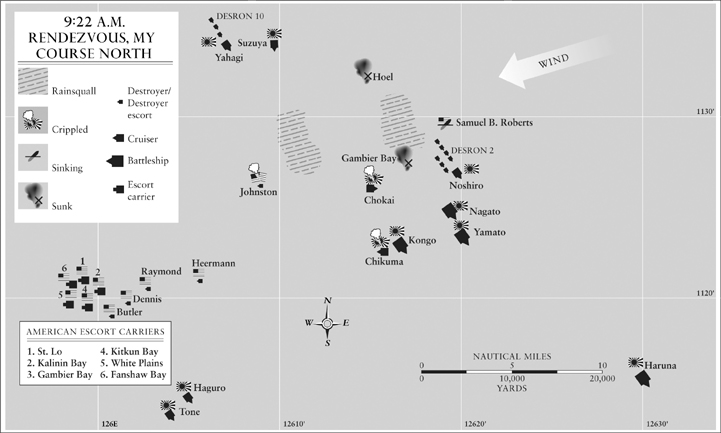
On the verge of victory, with the Samuel B. Roberts sinking and the Johnston dead in the water, Admiral Kurita loses his nerve and orders his ships to reassemble and withdraw. The threat to the U.S. beachhead in the Philippines ends.
Forty
The torpedo attack by Kimura’s destroyers was the halfhearted last gasp of Kurita’s beleaguered fleet. The torpedoes, fired at long range from an angle well abaft their targets’ beam, had barely enough fuel to reach the carriers. Still, the Americans took no chances with them. Tex Waldrop of VC-65 was returning to his carrier after a busy morning of glide-bombing and strafing runs when he noticed a big spread of torpedoes foaming toward Taffy 3. His radioman, Roy McAnally, raised the carriers to warn them of the approaching fish. Though his plane had a three-foot hole in its port wing from Japanese flak, Waldrop swooped down and opened up with his two wing-mounted fifties on the bubbling wakes, while his eighteen-year-old gunner, aviation ordnanceman second class John Ciolek, opened fire from the ball turret. One torpedo detonated in the Kalinin Bay’s wake. Another exploded off the port quarter of Waldrop’s own home ship, the St. Lo, whose peashooter crew claimed a third fish. The dramatic sight of the torpedo exploding in midocean spurred the crew to vigorous cheering. Machine-gunners on the two carriers blazed away at the remaining torpedoes, very possibly preventing a catastrophic replay of the Liscome Bay disaster.
The silhouettes of the Center Force ships, which had been growing steadily larger, darker, and more menacing as the minutes crept by, now began to recede. Aboard the Fanshaw Bay, Ziggy Sprague was occupied with avoiding the incoming Japanese torpedoes when, at 9:25, he heard a signalman shout, “God damn it, boys, they’re getting away!” It was beyond comprehension. Sprague had begun the battle expecting to make history as the commander of the first carriers ever destroyed by naval gunfire. Now he made history as the victor in the most unlikely win in U.S. naval history.
“I could not believe my eyes, but it looked as if the whole Japanese fleet was indeed retiring.” Sprague didn’t accept the astonishing turn of events until several different pilots circling overhead confirmed it for him. Even then, Sprague wrote afterward, “I could not get the fact to soak into my battle-numbed brain. At best, I had expected to be swimming by this time.”
* * *
AT 9:15 A.M., AS Kurita’s ships were forming up to retreat, Bill Brooks, studying the sea through a hole in the cloud cover, spied a small dark speck trailing a thin wake of foam. He turned his Avenger in its direction and bore on in. The speck grew steadily larger, its boxy profile readily recognizable as an American CVE. Brooks closed range with the ship, lining up to pass alongside it with his landing gear down, indicating his request to land. A signal light flashed him a “prep Charlie,” granting his request.
Wheeling around in a wide counterclockwise circle, lining up on the stern, Brooks entered the landing pattern and, with low fuel, was glad to catch an arrester wire on the first pass. The ship that took him aboard, the USS Marcus Island, was the adopted home of pilots from five different carriers. A mixed bag of aviators had found their way to the Taffy 2 carrier ahead of Brooks. Taken to separate debriefing rooms, they began drafting their action reports, then waited, endlessly waited, while their planes were taken down into the hangar deck for repairs and reloading. In the gathering of strangers, Brooks was happy to see a familiar face, that of his VC-65 squadronmate, Tom Van Brunt. In light of what they had seen that morning, neither man had much to say.
As the senior lieutenant in the group, Van Brunt was tapped to lead the next strike. Everyone was in a hyped-up state well before the squadron stewards served the coffee. Brooks took some deep breaths and said a few Hail Marys as he reflected on what he had been through. “I had really done some deep thinking as we were coming back. It was settling in on me what was happening. What can I do? I thought. I came to a realization: I didn’t want to make a suicide run. A pilot was always better off alive than dead.” Still, Brooks wasn’t sure what could be done about the long odds facing them on the next sortie. He had no idea what the status of the Japanese fleet was. He knew only that it was big. The aviator told his crewmen, Joe Downs and Ray Travers, “I don’t expect we’re going to see the sunset. So if you don’t care to join me on this mission, you’ve got my blessing. I don’t think we’re going to get out of this.” The offer was a non-starter. The two aircrewmen wouldn’t hear of it. They were all in this together.
As the plane handlers, armorers, aviation machinists, and ord-nancemen on the Marcus Island gassed, armed, and spotted the Avengers for launch, Tom Van Brunt diagrammed the plan of attack down in the ready room. In his whole aviation career Van Brunt had dropped just twelve torpedoes in practice. Only two of them had run true. That thought gripped him now. He was going out there for real, against real ships firing real flak that would kill him for real if his number came up and he took a hit. However slight his preparation, however, this was what he was there to do. He found a quiet place to pray for a moment and thought about his family—his older brother aboard the light cruiser Reno; his younger brother Bernard, whom he’d just seen at Seeadler Harbor at Manus, amid the huge gathering of Seventh Fleet ships; and his wife and first child, whose pictures adorned his desk. He prayed that somehow they would be cared for if he didn’t return.
That possibility loomed large in his mind. He knew that once he was locked into a torpedo run, evasive action was out of the question. Limitations on speed and altitude and maneuverability made the chances of returning not terribly good. The men on the ships of Taffy 3 were bound to their fate. Jumping overboard was pointless—there was nowhere to go in the water—so they just went along and did their jobs. Aviators always retained the option of escape. But the impulse to escape seized few if any of the CVE pilots in action that day. The thought never entered Van Brunt’s mind.
Forty-one
The Samuel B. Roberts was finished. Bob Copeland knew it when Lloyd Gurnett declared the ship a goner—no one would have wanted to hold on longer than the first lieutenant. “I would advise the captain to abandon ship,” he called up to the bridge. Copeland then passed on the word. “Abandon ship, men. Well done.” Copeland next ordered the ship destruction bill carried out. Shell-shocked and half conscious but eager to comply with the order to destroy sensitive equipment and documents that might fall into enemy hands, Elbert Gentry beat the lenses out of a pair of ordinary 7×50 binoculars, then smashed the glass face of a gyro repeater display. Howard Cayo, a soundman, was in better condition to discern what was top secret from what was not. A trained acrobat, Cayo took a sledgehammer and gave the sonar machine a few well-aimed blows. Then he took a Tommy gun and peppered the contraption liberally with. 45-caliber slugs, nearly hitting his skipper, Bob Roberts, and Gentry with the ricochets. Tom Stevenson and a signalman third class named Charles Natter ran belowdecks on the steadily settling ship. The communications officer was responsible for destroying the codebooks and other sensitive publications. Stevenson did his duty, though the urgency was largely lost on him. “Under fire, you’re thinking about your family. You’re thinking, This is the end. There was nothing else to do.”
Stevenson ran to the small closet adjacent to the radio shack and bagged up the metal wheels from the decoding machine, which he would throw overboard. Then he went to destroy the coding machine itself. Not finding the grenade that was supposed to be on hand for this sad contingency, Natter used a submachine gun to similar effect.
That job done, Stevenson and Natter headed below to find the safe that contained secret documents and publications, including the Leyte Gulf invasion plans. With his way lit by battery-powered battle lanterns, Stevenson climbed through a hatch scuttle and found the safe. Though the ship was shaking from hits and the list seemed to increase, he remembered the combination, and the safe door swung open. He loaded what papers he could into several weighted cloth sacks. He and Natter hauled the sacks topside and tossed them overboard. Then Stevenson went down again, alone. He fetched some more bags and ascended to the main deck.
Dick Rohde had been only too happy to hear the abandon ship order. Sitting at his desk wearing an inflatable life belt instead of a bulky kapok life vest, the radioman could feel the deck plating under his feet growing frighteningly warm. Smoke stung his nostrils. When he tried to stand, he found that his headset was still jacked into his radio console.
Rohde came out on deck and found himself standing next to his chief radioman, Tullio Serafini. “All of a sudden there was another big blast. I felt something hit me in the leg. And I looked at Serafini, and there was just blood all over the place. It was awful.” He couldn’t see how Serafini was ever going to make it. Half his left shoulder had been blown away, and he was bleeding severely. Rohde looked down at his own leg and saw a big hole in his dungarees. Underneath, the flesh looked like so much gristled hamburger. He had seen enough; no need to stare at that awful mess, he thought. Numb, he put it out of his mind and somehow climbed down the ladder from the radio shack to the main deck. Walking up to the rail, he removed his shoes and laid them neatly by the gunwale alongside another pair that belonged to another swimmer. Then Rohde lifted his good leg over the line and jumped in.
When he hit the water, he bobbed up and down a few times in the fuel oil and discovered that his life belt had been torn by shrapnel and did not hold him. Then, remembering his training to swim away from a sinking ship in order to avoid getting sucked under with it, he struck out. In the direction in which he swam, however, a Japanese warship loomed. Rohde was close enough to see crewmen staring at the stricken American ship. I’m swimming the wrong way, he thought, realizing that no one else was around him.
Floating nearby was the miniature life vest that Sam Blue had fashioned for Sammy, the ship’s celebrated mascot. Rohde tucked it under his arm for a little extra buoyancy, then swam back around the stern of the ship and joined a cluster of survivors.
The dog, too, swam to momentary safety. Somehow Sammy got off the ship and, without the benefit of his custom-tailored canine flotation device, paddled out to a raft. He was there only a short time, however, when he decided that he belonged back on the Samuel B. Roberts, his home. The dog jumped off the raft and swam back toward the sinking ship. No one knew his fate for certain, but that was the last anyone saw of him. Sammy either drowned during the swim or went down with his ship.
Though he had commanded the Samuel B. Roberts barely half a year, Copeland was bonded strongly enough to his ship to view her as a living thing, a machine with its own soul and persona. Yet he understood too the reality that the source of any ship’s life lay in the lives of those who crewed her. When Tom Stevenson returned with a second sackload of classified publications, Bob Copeland went in search of his wounded to make sure they got off the ship.
First the skipper ducked into his sea cabin and collected his letters and personal effects—whatever he could sweep together and carry. Then he went to the bridge, where he and Bob Roberts searched for and found the ship’s muster list, watch quarter, station bill, and other administrative documents.
One of the bags Tom Stevenson had thrown overboard must not have been weighted. There it was, bobbing along on the swells. Copeland told Stevenson he had better jump in and weigh it down, lest its sensitive contents fall into the wrong hands. Still wearing his microphoned talker’s helmet and realizing that this was his skipper’s way of getting another man off the ship, Stevenson leaped off the amidships rail. When he hit the surface, the helmet became a drag brake, jerking his head upward while his body lurched downward. He was weighted down by a. 45-caliber pistol, which he discarded. He threw away the helmet and a standard-issue bandolier of pistol ammunition around his waist too. He kept his supply of morphine syrettes. He and Lloyd Gurnett found an expiring crewman from the engine room, and they each jabbed him with a needleful of the numbing potion.
Copeland turned to his executive officer and said, “Now Bob, I want you to go down to the main deck and hustle things a little bit, and then I want you to get into the water and be out there to supervise the men.”
“Captain,” Roberts said, “I’m not leaving until you leave. I don’t want you to be a damn fool and get heroic and go down with the ship.”
Copeland seemed to appreciate the honor that underlay this particular kind of insubordination. “Now look, Bob,” he said, “I’m not intending to go down with the ship. I don’t know what will happen. We are still under fire. My duty is to stay here until the men are off, and I’m going to do that. As soon as everybody is off, if I’m still alive, you can rest assured that I’m getting off. I haven’t any false sense of glory like those old German naval sea captains who put on their best uniforms and stood up on the bridge and went down with the ship. But I am going to wait until I get my men off.”
The executive officer remained unmoved.
“Bob,” the captain said, “I don’t want to get tough with you; you are my exec and my good friend, but remember, this is an order. I want a responsible senior officer to be with the survivors, and I’m ordering you to leave the ship.”
“If that’s the way you put it, Captain, I’ll go.”
“That’s just the way I’m putting it. I trust I’ll see you in the water, but in case I don’t, Bob, it’s been swell being with you.” Copeland stuck out his hand. “You’ve been a swell exec, and I want you to know that.”
“It’s been wonderful serving with you, Captain. I hope you make it; I’m leaving you with reluctance.”
The two officers took their. 45s and the bandoliers of extra ammunition from their waists and with a minor ceremonial flourish—“One, two, three”—flung their weapons into the sea from the flying bridge. At that, Roberts left his skipper to go over the side.
Copeland walked aft to the rear section of the bridge and surveyed what was left of his ship. “It gave me an awfully hurt and crushed feeling to see the men lying there wounded and dead and to see our ship, once as alive as the people on her, battered and lifeless.” But even among the dead there were living. Amid a tangle of human rubble on the boat deck, Copeland saw movement. There, reclined against the ship’s stack in a pool of blood, chief electrician’s mate Charles Staubach was still alive.
The captain hollered for Frank Cantrell, the chief quartermaster, and a couple of radarmen to go look after him. As the men went up to check on Staubach, Copeland thought to check in on the CIC to make sure the classified radar equipment had been destroyed. The ship’s interior compartments were dark. Copeland found a battle lantern, but it did not light. The nearest flashlight was equally useless. He retrieved from his pocket a cigarette lighter, and it lit, and he looked around the CIC. He was satisfied to see that the machinery had been thoroughly smashed. He found himself compelled to visit his sea cabin again. He went there and looked at the photos of his family that lay beneath a large rectangular section of Plexiglas on his desk. For forty or fifty long seconds he stood there looking at the pictures of Harriet and the kids in the flickering light.
Copeland went back to the main deck, where pharmacist’s mates first class Oscar King and George Schaffer were tending to a group of wounded. Charles Staubach was there, crying, though Copeland was pretty sure the thirty-five-year-old electrician had no idea how badly he was hurt. “It really made me sick at my stomach and sick at my heart when I saw him because from his backbone clear around on his left side all was gone.” From what Copeland could tell, Staubach was paralyzed. “We ripped blue chambray shirts off six or eight dead men, wadded them up, and stuck them into his lung cavity and wrapped another shirt around him and tied him, but he didn’t know the difference.”
Staubach didn’t want to get in the water. Sobbing, he asked Copeland, “Captain, do you think I’ll live?”
“Oh sure, Staubach, get off the ship, and we’ll take care of you.”
“I don’t want to die, Captain. I’ve never seen my baby yet.”
Copeland knew that about two weeks before Staubach had learned of the birth of his baby boy. The skipper considered him a fine man and was heartbroken that he would not live to see his newborn son. Staubach tried awfully hard. They got him into the water around 9:30.
Copeland proceeded alone to look for any remaining survivors on the ship. The passageway between the galley and wardroom section and the main deckhouse was obscured by steam rolling up from the number-one fireroom. Holding his hand over his mouth and nose to avoid the heavy stench of the steam, Copeland plowed through, making his way by memory. He reached the point where he knew a hatch to be, raised his right foot to step over it, and brought it down on top of some kind of obstruction. When he looked more closely, he found his foot planted firmly in the face of a dead radioman. His body didn’t seem to have a scratch, nor did the body of the boy lying next to him, though Copeland figured these sailors had to have been blown a fair distance in order to die where they lay: “I don’t think there was a whole bone in them. They were just lying there as placid and peaceful as could be.”
Copeland became unhinged at the sight of those boys and the larger picture of destruction all around. So long as there had been a fight to conduct, a captain could occupy himself with any number of details that obscured the essential horror of what was happening to his ship and his men. There was the steady patter of information from the CIC team, the orders from Admiral Sprague over the TBS, sightings from lookouts, and reports from gunnery control, from damage parties, and from the engine rooms. He was freed of all that now, and despaired: “The ship had been a very live thing—the ship herself and the men on her. Now she was a battered piece of junk.”
In a daze he walked the length of the deck, stopping at the motor whaleboat dangling from its davits. Its wooden bottom had been shot clean out. He stood on the deck looking straight through the whaleboat’s busted hull and shuddered: “That one picture summed up the whole desolate destruction of a living ship with living men coming into an emptiness of nothing.”
He was alone on that side of the ship. He moved aft, so distraught that he lost his step. His foot slipped out ahead of him, he lurched out of balance, and he found himself sitting on the deck. He put down both of his hands, and when he picked them up, they were covered with blood. It was dripping from above, right on top of him. A headless body was hanging over the edge of a gun tub overhead. The puddle beneath it was large enough that the seat of his khakis and his loafers and socks were wet with blood. He got up and continued down the deck, not really caring what he found or what he did or what would happen. “It had taken all the heart out of me,” he recalled. “As I walked down toward the fantail, I was nearly drowned because when I got back to where the three fourteen-inch shells had ripped into us and taken the side out, the main deck was gone from there on, and I just barely caught myself from dropping right into the water.” Lt. Cdr. Robert W. Copeland could not swim.
Finding no one in any condition to save, and doubting his ability to do it in any case, Copeland made his way back to the place where Lloyd Gurnett and the other officers had gathered. He and Gurnett used their last minutes on the ship looking for more survivors. They found a man sprawled halfway into the yeoman’s office. He was still alive, though the nature of his wounds made it difficult to recognize him. “He must have had two thousand shrapnel holes in his face. When we touched him, the blood would ooze out like water from a sponge. We raised his eyelids, but he was blind in both eyes. He was unconscious. His eyeballs, his irises, and his pupils had been penetrated by fine shrapnel.”
After some time they figured out he was the chief machinist’s mate, Charles Smith. “How he ever got up there we’ll never know. But he was still alive though barely so.” Copeland ordered King and Schaffer to put Smith into a life jacket and get him over the side.
A Japanese destroyer stood nearby, lobbing the occasional shell into the Samuel B. Roberts’s ruined mass. The ship took four more hits while the abandon ship effort was under way. Water was lapping up over the port side of the destroyer escort’s fantail when machinist’s mate second class Chalmer Goheen went to check on Paul Henry Carr’s gang back in Gun 52. The gun had been silent since the muffled thud of the breech explosion. Where the water hadn’t yet reached, the decks were covered with burning oil. Goheen crossed the deck, peered into the gun mount’s ripped hatch, and found a horrific scene. Most of the men inside had been obliterated by the blast. They had gotten off 324 rounds of the 325 the ship carried in its after magazine, firing the last seven or eight shells without a working gas ejection line to clear the breech, until one of the final rounds got them.
Looking into the mount, Goheen discovered where the magazine’s last round was. It was right there before him, cradled in the arms of Paul Carr himself. The man was alive—though barely, torn from his neck to his groin. Carr was struggling to hold the shell. He begged Goheen to help him load it into the wrecked breech tray.
Goheen took the shell from Carr’s arms and laid the gunner’s mate on the floor of his mount. Then he took seaman first class James Gregory, whose leg had been severed near the hip, and carried him out and set him on the deck. When Goheen returned to the mount, Carr was on his feet again, shell cradled weakly in his arms. Goheen took the shell from Carr again, lifted him, and carried him out to the deck.
Paul Henry Carr of Checotah, Oklahoma, proud member of the Future Farmers of America, football and baseball letterman, brother to eight sisters, only son of Thomas and Minnie Mae Carr, died there on the deck of his battered, broken warship.
Forty-two
The Roberts was going down by the stern. Riding the swells, wearing a kapok life jacket and an inflated rubber belt, Bob Copeland, the skipper who couldn’t swim, turned to Lloyd Gurnett and asked, “How do you go about getting out of here?” Gurnett responded, “Well, the best way, Captain, is to roll over on your back and swim on your back. Just work your arms this way and kick your legs. You’ll get going.” The commanding officer of the Samuel B. Roberts got the rhythm of it and inched his way toward a life raft they had spotted a few hundred yards away.
Where George Bray was standing on the fantail, the water was already lapping above his knees. Chalmer Goheen had asked him to help get some of the wounded overboard. Goheen brought seaman first class Willard Thurmond to Bray. Bray could tell he was a goner. He helped Thurmond to the rail, and the mortally injured man just held on there, oblivious to his wounds. Bray helped someone else off the ship, then made his way toward the fantail. By the time he reached the depth charge racks, the water was up to his waist. He just sat down and started swimming.
When they entered the water, the survivors of the Roberts baptized themselves in their ship’s own blood. The surface of the ocean was covered with a three-inch layer of oil. All around the ruined ship bobbed black faces set with glaring white eyes and teeth. The substance was more a slippery kind of foam than a proper form of oil. The sea’s gentle swells animated it like a slowly undulating blacktop.
Copeland had been among the last to leave—the honor of being the very last man off belonged to George Schaffer—jumping ship and joining a large group of men who had clambered over the port-side rail. Forward, where the deck sloped upward—ever more steeply, as the ship settled by the stern—there was a considerable jump to make. Off the port side, Copeland joined a small group of men on a floater net, a large web of nylon mesh woven throughout with a bunch of black rubber disks that gave it its buoyancy. Spotting a raft some distance away, some survivors formed a human chain, reached out to it, reeled it in, and tied it fast to the net. The raft, designed for twenty-five men, soon wallowed under the weight of fifty. Survivors were attracted to the group as small bits of interstellar flotsam to a star’s gravitational field. They moved the raft on top of the net to increase its buoyancy.
Gathering by the life raft that kept the group together, Dick Rohde heard someone wondering whether the depth charges had been set on safe. It was Vince Goodrich’s job, and God knew there had been precious little time to stick to procedure in the midst of the hellish fusillades that tore the seas around them. The question, however, was of more than procedural significance. A depth charge that burst under water produced a wave of blast pressure that could blow a man apart from the inside out. Sailors were trained to cover their buttocks, or lift them out of the water, to avoid the potentially fatal enema that an underwater explosion could give them. Once more Rohde was on the move, paddling and kicking to get away from the ship.
Wearing khaki pants and a T-shirt, drifting with a group of survivors scattered across the water on the other side of the ship, Tom Stevenson watched Japanese vessels shooting at his sinking ship from all sides. Occasionally, an errant shell would land nearby and kick up a splash, sometimes disconcertingly close. He prayed for the Roberts to sink quickly, if only to deprive the Japanese of the pleasure and the practice.
* * *
SEAMAN FIRST CLASS BUD Comet floated off the port quarter of the ship, right below Gun 52, where a gigantic shell from the Kongo had struck, gutting that side of the ship and opening its mechanical entrails to the sea. The huge cave mouth opened into an even larger void inside, a gray steel cavern whose unseen corners reached deep into the ship. From its size Comet figured the hole was the product of a Japanese shell that had detonated on contact. Nearby he saw evidence of another shell hit, much more benign: a neatly drilled hole that an armor-piercing round had made as it passed through the ship without exploding. The contrast was remarkable. Here was the difference between life and death, determined solely by the choice of ordnance on the part of a Japanese handling room crewman be-lowdecks on a ship many miles away. Backlit by flames licking at a far bulkhead, two objects inside that cavern commanded Comet’s attention: a life raft, and the huddled form of a man inside of it.
Comet swam closer and recognized the Roberts’s chief boatswain’s mate, Cullen Wallace. He was still conscious, kneeling inside the raft. Probably he had come down a ladder and found the raft and settled into it, hoping somehow that he could paddle his way out of the ship. But he was stuck there, evidently trapped by the inrush of seawater, arms braced on the sides of the raft. Watching Comet swim his way, the chief hollered at him a few times to come help him. The oil-soaked sailor swam back to the ship, gingerly moving past the jagged threshold of the torn hull, and grabbed the raft. Then he pulled it clear of some wreckage into the pool of water that had filled that part of the Roberts and that rose slowly and serenely as the ship began to sink by the stern. Comet got the impression that the chief, like his captain, could not swim. He eased the raft across the splintered opening in the hull and watched as Edward Wheaton, a radio technician, swam up and climbed in.
Comet paddled the raft around to the stern of the ship. The depth charge racks, lying over the fantail, were submerged already. The name SAMUEL B. ROBERTS, stenciled on the transom, was under water too. Blown apart like an apple on a tree stump were the remnants of the steel shell of Gun 52, Paul Carr’s mount, turned defiantly out to port, its barrel still aglow. There was a tangle of metal piled into it from the side—the remains of the deckhouse beneath Johnny LeClercq’s disintegrated forty-millimeter mount. From the stern Comet heard a shout. It was from an officer, hollering for help. When Comet saw him and started paddling the raft in his direction, Wallace told him to leave him be: “Let him swim.” The chief didn’t want the burden of bringing anybody else aboard the raft.
But if Bud Comet remembered anything that his father had told him at the West Virginia train station six months earlier, he showed it by his actions now. Don’t dishonor your mother…. This country is worth dying for…. A coward dies a thousand times…. Defying his chief’s command, he paddled toward the fantail and picked up Ens. Jack Moore.
Once the crew had decided to abandon the Roberts, it was unbearable to watch the enemy continue to have its way with her. For all they had done, some could not escape thinking: If only we had stayed on and fought a little longer, we might have prevented this final indignity. “We were the proudest ship in the fleet. We really were,” Tom Stevenson said. “We thought we were the cat’s meow.”
Shortly after ten o’clock the Samuel B. Roberts rolled over on her beam ends and sank by the stern. No explosion followed the ship’s disappearance beneath the waves. The only reaction was a swell of sadness among the crewmen who watched her go. Floating a quarter mile away, Dick Rohde watched the Roberts sink. It took about an hour, but it seemed to take forever. She went down gracefully, seeming not to make a sound. Before she had fully committed herself to the deep, the Roberts stood nearly vertical. Stenciled with the number 413 on each side, the bow held high in the air for a moment, standing like an oblique headstone. Then the ship slowly retracted into the sea. “Boys, take off your hats. There goes a good ship,” said boatswain’s mate first class Red Harrington.
The sight of it moved Lloyd Gurnett to open sobbing. “As first lieutenant he knew every welded seam in her,” Copeland wrote, “he knew where every fitting was attached. Love of the ship was very deep in his heart.”
Once the ship was gone, the culture of cynical jocularity that had characterized the wardroom seemed to disappear. Among the men on Copeland’s raft, “It seemed as if the bottom had dropped out of things…. Now that she was gone, everyone felt low.” The white-caps kicked up a bit now. Then Staubach, the grievously wounded chief electrician’s mate, lost his mind, raving and yelling deliriously.
Scanning the oil-slicked waters for other survivors to join, Dick Rohde found his way to the raft with Jack Moore, Cullen Wallace, Jack Yusen, Bud Comet, and others. The men had fastened together their life raft and floater net into a self-contained survival pod that kept everybody together. Wallace didn’t want to do it. He said he was concerned about air attack and did not want to concentrate the men in one big vulnerable group. He also felt that such a large group would consume the raft’s limited provisions too quickly. As the officer in charge of this group, Moore overrode him, feeling that the priority should be rescue rather than avoidance of air attack.
The wooden-latticed bottom of the raft had been shot up pretty well. A pharmacist’s mate approached Rohde, who was sitting inside the raft, and tried to pour sulfa powder into his gaping leg wound. The radioman wondered what the point was. When he got back into the water, it would just wash the powder away.
Not considering himself too badly hurt, Rohde vaulted himself overboard. Later, looking up at a dozen or so men perched comfortably on the side of the raft, including Lieutenant West and Ensign Moore, though both officers seemed uninjured, he decided to hoist himself up and take a break from treading water. But when he tried to climb up, one of the men wound up and slugged him hard in the head, knocking him back down. Rohde was stunned at his first taste of the Darwinian imperative. With nerves running hot on a makeshift floating wagon train loaded with twice as many men as it was built to carry, Jack Moore decided, “There was going to have to be rationing with disciplinary backing. Everyone was already at each other’s throat.”
Forty-three
The Hoel had sunk first. The Gambier Bay went down at 9:07. The Roberts followed an hour later. Now came the Johnston’s turn. The first ship into the fight was the last to go down. Her luck had been the improbable stuff of dime novels or Hollywood fantasies: the solo charge in the battle’s opening minutes, firing guns and torpedoes into the teeth of multiple enemy broadsides, wheeling under fire to escape, taking devastating hits from battleship shells, withdrawing, returning to action against the destroyer column, and fending off the last Japanese effort to sink Clifton Sprague’s carriers. Her final destruction was not ensured until after the foe she had suicidally charged had turned and run for cover.
Bob Deal knew the ship was a goner. “Water columns were substantially higher and shells overhead had a distinctly different resonance. Came then an impact so severe I thought we might have struck a marine obstruction. The ship shuddered, rolled hard port and starboard, resuming course at a reduced speed. Going forward on the starboard side, I learned we had taken a hit in the engine room.”
Electrician’s mate first class Allen Johnson understood the fragile extent to which the Johnston held on to life. His battle station was the emergency generator room, tucked away on the starboard side of the ship between the forward fireroom and the galley. Before enlisting in 1942, the twenty-five-year-old petty officer had worked for four and a half years at the Birmingham Electric Company, running substations that brought steam and power into Dixie’s industrial center. The Johnston derived its vital electrical power from generators located in the engine rooms. The generators, like the engines, were run by steam from the boiler room attached to them. With one boiler room already out and Lt. Jesse Cochran and his men struggling in vain to gain power from the other, the only source of power on the Johnston was the emergency generator, powered not with steam but by a diesel motor. If the engine room generators were knocked out, a pilot light went off, a relay opened, and the emergency generator kicked on automatically.
When the Johnston was first hit, Johnson had the terrible sensation of being lifted from the ground and shaken violently. The hit to the after engine room knocked its electrical switchboard dead. Instantly the emergency generator in the electrician’s mate’s cramped compartment filled the void, its three-cylinder diesel motor coughing to life. But the motor bled too. The shock of the multiple blasts be-lowdecks broke the lubrication pipe that ran to the motor. Oil ran down into the corner of Johnson’s compartment. With motor machinist’s mate second class Roger Gougeon, he scooped the oil from the floor by hand and slathered it back into the diesel motor. Johnson ran to the CIC and grabbed a roll of three-quarter-inch friction tape. It didn’t stick well to the oily metal, but he used enough of it to slow if not stop the diesel motor’s bleeding. His emergency station would turn out some electricity, but only for so long. The oil leaked everywhere. They were able to return only a portion of it to the engine.
From such mundane mechanical causes do gallant ships die. Without power, Bob Hollenbaugh would fire his state-of-the-art five-inch gun like a nineteenth-century artilleryman; the men in the ammunition handling room would do the work of their electro-hydraulic hoists, passing shells by hand; light would come from battle lanterns if at all; and volunteers would turn the big wheel on the rudder’s steering pumps, struggling to keep up with Captain Evans’s course changes, shouted down from above. They would do all these things, taking the place of their equipment, or they would die along with everyone else the next time a salvo found its mark.
The endless salvos of incoming shells passing overhead, astern, off the bow, all around the ship. Now Allen Johnson felt one land close by. When the large shell struck near his emergency generator compartment, “it felt like a freight train’s coal box was dropped on top of me.” The bulkhead between his compartment and the galley was blown down flat. The only source of light he had was a small sparking electrical fire that filled the compartment with flickering shadows. With a three-quarter-inch brass bolt head having ripped through his back between the shoulder blade and spine, Johnson pulled himself to his feet and called out to Gougeon. Johnson couldn’t see him, and there came no answer to his call. Groping through the compartment, he felt Gougeon’s head and shoulders, but his torso was pinned under something—a large mass of hot metal. It was the diesel engine. It was too heavy to move, and having run steadily for well over an hour, it was too hot even to touch. With the bolt head throbbing in his right chest cavity, Johnson was becoming numb with shock. He was sure, however, of at least two things: his friend was dead, and the time had finally come to get the hell off his dying ship.
* * *
AT 9:40, WHEN“AN avalanche of shells” struck the ship, inflicting her final meaningful damage, the Johnston’s two-and-a-half-hour sprint through hell ended. The shell that sealed the destroyer’s fate struck the number-one boiler room, cutting steam to the forward turbine and stopping the starboard screw. The ship, powerless, began coasting to its final resting place. As the Pacific currents took over the work of the Johnston’s engines, Captain Evans passed the order to abandon ship.
She was a vehicle now suitable only for the dead. On the destroyer’s main deck, on the port side amidships, lay what Jesse Cochran described as “a pile of people—bodies—half alive, half dead.” Many survivors saw it, but none seemed to fathom quite how this stack of human cordwood could have formed. In part, it was the inscrutable arrangement chosen by the shock waves from heavy shells that had propelled men and parts of men out of interior compartments and into their final poses. Some sailors had been carried out and laid there by their buddies in the hope that, out in the open, they might get medical attention. Others had struggled out under their own power and lain down, exhausted beyond exhaustion, desperate for cooler air to breathe.
Ellsworth Welch went forward repeating the abandon ship order. Under the abandon ship plan—rehearsed many times but without much belief in its utility—Welch was supposed to report to a life raft stored on the ship’s port side by the wardroom. By the time Welch got there, sailors had already released the raft and jumped into the water. Welch found coxswain Ed Block struggling in vain to put on a life jacket. The morphine Welch had given him when the bridge was first hit had made him sluggish. So the officer helped him slide into the life jacket and eased him into the water. Welch then tried to help another sailor, but the severity of his wounds made the effort moot.
Dusty Rhodes and Warren Williams climbed up on the deckhouse by Bob Hollenbaugh’s Gun 54 and tossed a nylon mesh floater net into the water. “When I jumped over,” Rhodes recalled, “I had two thoughts enter my mind, both silly. One, how deep is this water, I wonder if I’ll hit bottom? Number two, how far is it to land?” Robert Billie dragged himself to the edge of the gunwale, crawling and rolling with his good left arm, then dropped down to the main deck amid bodies, body parts, and blood. On their way down from the gun director, Bob Hagen and several fire-controlmen passed Billie without a second look. Billie couldn’t speak—he could scarcely move. He didn’t blame them for consigning him to the dead. With only one good arm, he finally hauled himself to the rail. Though he wasn’t able to lift himself over and into the water, the enemy obliged him. A salvo of shells struck the ship near where he lay, and the impact—the third blast he absorbed that day—propelled him overboard. He had twenty shrapnel wounds and three useless limbs. He didn’t particularly like his chances in the water.
Captain Evans left the fantail and walked forward to the wardroom, where Lt. Robert Browne was busy doing what he could for the living. Evans tried to persuade the doctor to abandon ship, but Browne wouldn’t hear of it. There were wounded who needed to be tended to before they were given over to Neptune’s mercy in the water. The doctor could do that work better aboard ship. He would use what time he had left.
Bob Hagen, consumed with coordinating the ship’s gunfire from the director mount, was slow to get the news that Evans had passed word to abandon ship.
I peered out and couldn’t see a living soul on the fo’c’sle. “What the hell are we doing here?” I said. “Let’s abandon ship.” The last word hardly was out of my mouth when the five crewmen in the gun director with me dashed out and ran for the rail. I was so surprised that I stood stock-still a moment, then lit out myself. I made my way to the fo’c’sle—I couldn’t get aft without walking over piles of bodies—and, like a man in a dream, very carefully and leisurely took off my shoes and dived in.
In the water Hagen looked back at the ship and spotted his friend, Doc Browne, carrying wounded from the wardroom to the deck. Browne had just left the rail and headed back inside when there was a whistling rush of wind and an explosion, right where Browne had entered. Hagen broke down and cried.
The enormity of the moment was lost on many of the men who had survived to this point by attending to the myriad rote details of their assigned duties. The ship was gone and their duties with it. But men still found trivialities to occupy their minds. Leaving the ship from the port side amidships, Bill Mercer swam about a hundred yards off the port quarter with another sailor. “I recall Marquard took his comb from his pocket, neatly combed his hair, and then threw his comb away saying, ‘I don’t guess I’ll ever need that again.’” With the same habitual fastidiousness that others had exhibited, Ellsworth Welch took off his shoes and set them neatly together on deck before diving into the sea.
One of the first survivors Bob Hagen encountered in the water was torpedoman first class Jim O’Gorek. Cast afloat in four thousand fathoms of shark-infested waters, defeated in battle with friends lost forever, O’Gorek swam over to Hagen and said cheerfully, “Mr. Hagen, we got off all ten of them torpedoes, and they ran hot, straight, and normal!” Those torpedoes had made a real difference, knocking the Kumano out of the fight early in the battle, before it could close to effective gun range of the carriers.
Ellsworth Welch looked up and saw a Japanese cruiser firing shells into the destroyer’s ruined hulk.
I would watch for belches of fire from the cruiser’s guns and time the salvos so I could duck under the water before the shells hit. But wearing the life belt, I was only able to get the upper part of my body below the water. I must have looked like a duck feeding on food below.
Others saw the column of destroyers approach again. The ships that the Johnston had forced into premature torpedo launches were circling her like raiders hunting settlers on the prairie. They fired directly into her wrecked hull, no longer deterred by the spirited work of Bob Hollenbaugh or Lieutenant Hagen or anybody else in the gunnery department.
This was the Johnston’s final service to Sprague’s fleeing carriers: providing a static target for frustrated Japanese gunners who doubtlessly longed to sink something, anything, with an American flag on it. Though they had straddled the carriers repeatedly, Japanese gunners had claimed only the Gambier Bay. The five others seemed to possess luck worthy of ancient Japan’s Seven Lucky Gods themselves—the legendary Shichifukujin. The Kalinin Bay had taken fifteen hits from heavy cruiser main battery rounds and steamed on in defiance.
But the Johnston’s defiance was at an end. She would not get away. The decisions of her captain had ensured that she wouldn’t. It was not a pointless death wish. The Johnston, like the Hoel and the Samuel B. Roberts before her, had fulfilled her mission so thoroughly—had parried and riposted so well—that there was nothing left for the ship to do but pay the final price.
What fate befell the Johnston’s legendary captain is the subject of continuing conjecture among the ship’s survivors. Bob Sochor was among the last to see him. The motor machinist’s mate, having gone aft to take his turn cranking the rudder pump, returned forward to fight a fire. As he walked toward the bow, “there was a terrible, blinding yellow flash” from a shell that struck the port side near the cook’s galley. Knocked unconscious, Sochor regained his senses to find himself covered in blood from his own wounds and his dead shipmates surrounding him. Realizing that the abandon ship order had been passed, Sochor headed for the fantail, where the jump into the water was easier. “Everyone who was able to abandon ship had done so,” he wrote. “They were in rafts and nets and swimming approximately a quarter of a mile away. I went aft as Captain Evans went forward. With neither one saying a word to the other, we passed by staring blankly at one another.”
Some claim to have seen the Johnston’s skipper climbing into the motor whaleboat that he had ordered released. Others were less confident he ever made it into the boat. Obeying the order to release the small craft, Allen Johnson found that its pulley mechanism didn’t work. The electrician’s mate reached for a knife he kept in his pocket, meaning to cut the lines that kept the boat suspended from its davits, but his pants pocket had been torn away. An officer produced a blade from his boot and cut the lines. When the gig hit the water, Johnson thought it was in good condition. He saw someone wearing a khaki uniform, an officer or a chief, jump into the water, climb in, start the engine, and haul a wounded sailor aboard. Around that time, according to Johnson, Captain Evans began walking toward the fan-tail. As if beckoning him to safety, the gig drifted with him, down the length of the ship. But by the time Johnson abandoned ship, diving into the water under heavy fire, he, like the rest of the crew on record, had not seen whether the skipper got into the whaleboat. If he did, in all likelihood he didn’t go far. The craft’s bottom, badly holed in the Japanese bombardment, was not close to being seaworthy.
It has been written that so much of life is preparation, so much is routine, and so much is retrospect that the purest essence of anyone’s genius contracts itself to a precious few hours. The window opened by circumstance on the genius of Cdr. Ernest E. Evans for two and a half hours on the morning of October 25, 1944, so brilliantly lit from within, was once again closed. The “Chief” of Annapolis, the Cherokee warrior unhorsed by enemy gunfire, was lost to the whirlwind, taken to a private oblivion that to this day burnishes his mystique and deepens the legend of his late, great destroyer and its magnificent crew.
Forty-four
On orders from Admiral Kinkaid, Jesse Oldendorf’s old battleships had been standing by in Leyte Gulf awaiting their next move in a desperate but uncertain naval chess game. Mindful of his duty to guard MacArthur’s troops ashore, Kinkaid had been keeping a wary eye on Admiral Shima all morning as the remnants of the Southern Force withdrew. Admiral Sprague’s plea for help was compelling. Still, Kinkaid could not be sure that Shima would not reverse course and try again to break through into Leyte Gulf. From Kinkaid’s flagship, the Wasatch, Sprague nevertheless received a voice message assuring him that help was on the way.
Though the Seventh Fleet battleships’ magazines had spent much of their high-explosive ammunition during the shore bombardment, and a significant quantity of their armor-piercing rounds in the destruction of Nishimura’s force, their armor-piercing ammunition stocks were more than sufficient to deal with another Japanese fleet. The most serious deficiency of the Seventh Fleet Bombardment and Fire Support Group was its destroyers, which had spent their torpedoes at Surigao Strait and would not be reloaded until they could tie up to a tender again. Despite Taffy 3’s perilous straits, Kinkaid saw no alternative but to wait and see.
Shortly before ten A.M. the waiting ended. Satisfied that the Southern Force wanted no further part of him and fortified by the arrival of two fresh squadrons of destroyers, Kinkaid finally ordered Oldendorf to take half his force and rally to the aid of Ziggy Sprague’s beleaguered northern Taffy group. If Kurita continued charging southward, the American battle line would greet him memorably. But Kurita was already in full flight north. No sooner had Oldendorf relayed word to his commanders to prepare for a northward sprint than Kinkaid countermanded the order upon learning that Kurita’s fleet was in retreat.
* * *
ABOARD THE JOHNSTON, ALL was quiet except for the flames. High above the wreckage of her silent decks, forty-eight stars still flew. Harold Beresonsky thought the ship, flying Old Glory, looked proud and defiant.
In the water, Bill Mercer and J. B. Strickland found themselves sandwiched between their beaten ship and a Japanese destroyer standing off the Johnston’s port quarter firing into the ship’s hull. “I told Strick that I was sticking close to him because he owed me a hundred dollars. Strick said, ‘If we make it, you’ll sure get your hundred.’ I was only joking because neither of us thought we would make it.” Strickland had survived the Battle of Savo Island, a disastrous American defeat under the guns of a Japanese flotilla led by none other than the Chokai, late of the same day. Mercer asked Strickland how their present predicament compared to Savo Island. Strick said, “Kid, I have never seen anything like this.”
At about 10:10 the Johnston went down. “We all watched as our home for the past year slowly slid below the surface,” Mercer wrote. Orin Vadnais swam away from the ship, then turned around to see destroyers and cruisers running in their half circle around the Johnston, blazing away with all guns. “As I watched, she started to sink. First one end went down, and she slipped below the sea.”
As the ship rolled over and went down by the bow, Neil Dethlefs wondered whether he would be home in time for Christmas. Drifting along, he came upon two seamen. One was his friend, soundman first class Wally Weigand. The other sailor was holding Weigand’s head above water. Dethlefs could see that Weigand had been scalded badly. “The skin was hanging from his arms and hands like a pair of long gloves.” Weigand asked Dethlefs if he was burned too. Dethlefs said no. Weigand said, “Boy, I sure am.”
Checking his wounds, Bob Sochor found that much of the blood staining his skin probably belonged to other men. During his swim out to the life rafts, Sochor had met up with a young pharmacist’s mate, Ken Bowers. “He was very young and religious and always carried a small Bible. He had on a life jacket,” Sochor said, “so I hung on to him to rest for a few minutes. We were now about halfway between the sinking ship and the rafts and nets. He said he could not swim and he thought his life jacket would not hold the two of us. I told him I just wanted to rest a minute or so and then I would leave. We were about one-eighth of a mile from the sinking ship when I turned to him and said, ‘Take your last look at the Johnston,’ as it disappeared into the sea.”
Ellsworth Welch watched the destroyer turn over slowly and settle by the bow until only the fantail was above water. “Seeing my home go down, I felt my eyes welling with tears. But I thought, Welch, you might need the liquid, so I ceased this unseamanly display of emotion.” Bobby Chastain felt similarly. “I still remember that helpless feeling one gets while watching your home burn down.”
Bowers and another pharmacist’s mate, Clayton Schmuff, ministered to the wounded, injected morphine, tied tourniquets. As the survivors of the Johnston gathered themselves into groups, a rare sight seized their attention: the direct approach of an enemy warship. For more than three hours the ships had maneuvered under each other’s fire, shooting by haphazard sight through smoke and squalls or by the blind omniscience of radar. The range between the foes had never been short enough to see the individuals who operated them. Point-blank range in a modern naval battle was anything less than three miles. Now the enemy approached so closely that men could finally look upon other men.
Clint Carter saw the ship coming before most of his shipmates did. It was bearing down on them fast. Judging by the size of the bow wake the destroyer was throwing, it was at flank speed. Then, when the ship was just half a mile or so away, it slowed, its bow fell, its wake dissipated, and it approached them slowly, warily, ominously.
The Americans weren’t sure what to expect. Joseph Check, fearing the enemy gunners would spray them with bullets where they swam, took a hard breath and ducked under the surface. Clint Carter thought that for the Japanese killing the Americans with bullets would be too labor intensive when another tool stood at their disposal. His first thought was: They’re going to give us a giant enema. A single depth charge laid into their midst would have produced a shallow underwater explosion strong enough to blow their bowels out. Watching the crew play their automatic weapons over the waters, others braced for machine-gun fire. Neil Dethlefs started to untie Wally Weigand’s kapok so he could drag him under water when the murderous rain finally fell.
The destroyer edged closer and closer. It made a slight course change that left Clint Carter drifting off her starboard beam. He was taken with the ship’s gold-tasseled battle pennant emblazoned with a red rising sun. Bobby Chastain, swimming no more than fifty feet from the ship’s port side, could see the sailors lined up by the rail, dressed sharply in khakis and brightly polished brown boots. “They were watching us as we watched them.”
It was then that Carter realized what was going on. “It appeared to me that every man on her deck was standing at attention, like a muster, giving us one big salute.” As the Japanese warship slid by them, a smartly dressed officer was on the wing of the bridge, standing erect and, indeed, saluting. “As she eased by us,” Carter wrote, “I’m sure of one thing … she appreciated a fighting lady … USS Johnston.”
Another Japanese crewman was filming them with a handheld movie camera. Another flipped his thumb to his nose and delivered a raspberry. As the ship passed on by, a sailor standing on the fantail tossed an object in Carter’s direction. The canister was too big to be a grenade and far too small to be a depth charge. It was a large can of tomatoes. Carter retrieved the offering, examined it, and noticed the label indicating it had been packed in Arkansas. “Three years of war and they were still eating USA canned tomatoes.”
The Japanese destroyer disappeared, and the Johnston did too. A few minutes later the underwater hulk of the Johnston did to her crew what they feared its Japanese counterpart would do. There were two great explosions in the deep. Speculation flew that the ship’s boilers had blown. Others doubted the shattered machinery retained enough pressure to explode and assigned blame to unsecured depth charges. Whatever the cause, the effect was breathtaking. The first sensation the men felt was a concussion to their stomach and abdomen, and a sickening thrust of pressure into their rectums. “I thought my body had been blown in half,” wrote Charles Landreth. “What a wonderful feeling it was when I found out my body was still intact.”
* * *
WITHDRAWING NORTHWARD WITH HIS harried task group, Takeo Kurita was enjoying considerably less peace of mind. He toyed with the idea of turning around again and attempting to reenter Leyte Gulf. But late in the morning he received a radio dispatch sent at 10:18 by the skipper of one of the Southern Force destroyers, the lucky Shigure: “All ships except Shigure went down under gunfire and torpedo attack.”
So Nishimura was dead. Kurita could see no purpose in turning around and trying again to reach Leyte Gulf. The Sho-1 plan had become a jaw with one mandible.
Forty-five
For two and a half hours Takeo Kurita had been the hunter. Now, in flight northward, he became the hunted.
Tom Van Brunt and four Avengers from the Marcus Island climbed above the clouds to eight thousand feet, joined with another group of Wildcats and Avengers, and turned north in pursuit of Kurita’s withdrawing fleet. It was the third major strike that the Taffy 2 carrier group would marshal against the Center Force that morning.
They needed less than thirty minutes to find the withdrawing Japanese force. Against flak that reminded Van Brunt of the light-show one gets on an express subway train roaring through a local station, the St. Lo aviator flew to within twelve hundred feet of his target, a Kongo-class battleship, jerked the release lever, and felt his plane heave from the change in gravity as the torpedo plunged into the water.
As he flew over the Japanese ship, he felt the aircraft lurch again as a shell exploded near the rear of the fuselage. At once his left rudder cable was limp. There was nothing there. He could not turn left. The exact extent of the damage he could not yet know. His radioman, Les Frederickson, was shaken up by a nearby shell explosion that was dampened only by the TBM’s thin skin. Van Brunt hugged the sea for a mile or two, testing his controls, and found that he could navigate well enough using just right rudder. As he looped back and gained altitude for the return flight, he looked back at his target and saw a wide trail of oil issuing from astern. Van Brunt guided his riddled aircraft toward home: the friendly flight deck of the St. Lo.
By some impossible concatenation of independent miracles, the carrier had not taken a single hit during the battle, even though she rode the northern fringe of the circular formation of escort carriers, closest to Kurita’s ships. Only three of her crew were injured with superficial wounds from shrapnel. Meanwhile, the gunners on her tail-mounted five-inch gun had acquitted themselves well. The Battle off Samar was nearly over for the St. Lo, as shortly it would be for Tom Van Brunt.
The naval aviator hailed the St. Lo’s landing signal officer and informed him that his left rudder was out. Normally landing approaches were made in a descending counterclockwise circle, a flight path that allowed planes to avoid the dangerous eddy of air trailing from the carrier’s superstructure. Without a left rudder, Van Brunt could not make the usual approach. He radioed the landing signal officer that he would come in on a clockwise circle. The LSO said, “Okay, we’ll try that, but let’s get everyone else aboard first.”
Climbing to fifteen hundred feet, he was circling the carrier at a distance, watching other planes land, when a red streak flew past his greenhouse canopy. The startling appearance of a Japanese “meatball” insignia painted on a wide white wing was Van Brunt’s first indication that enemy aircraft were near. He almost collided with the Japanese plane as it descended toward the St. Lo.
Shortly before eleven A.M. Taffy 3 came under wholesale kamikaze attack. The Japanese Army Air Corps had debuted this horrific new mode of warfare earlier that morning, when six imperial planes took off from bases on Davao and attacked Thomas Sprague’s Taffy 1 task unit. One struck the escort carrier Santee, starting a huge blaze that raged in the hangar deck for about ten minutes. Only the expert marksmanship of gunners aboard the Suwannee, the Sangamon, and the Petrof Bay let them avoid similar hits.
At 10:50 five more aircraft flying from airdromes on Luzon arrived over Taffy 3 and plummeted like osprey on ships whose day of fighting should rightly have been over. The Kitkun Bay was the first of Sprague’s jeeps to confront the horrifying new tactic. A Zero fighter plane closed from the port side, crossed her bow, climbed, and dove at the bridge. Firing his machine guns as he came, the pilot guided his plane over the small island superstructure, glanced off a catwalk, and hit the sea.
Two more kamikazes attacked the Fanshaw Bay. One approaching from astern was knocked off its killing path by a five-inch shell fired by the flagship’s peashooter crew. Though that explosion tore off the plane’s left wing and the aircraft struck the water, where it disintegrated on impact, the bomb slung under its wing exploded fifteen feet from the hull, showering the ship with shrapnel. Van Brunt saw the carrier’s gunners shoot the second plane out of the sky.
Few men aboard the St. Lo ever saw the plane that hit their ship. After three hours at general quarters, half the crew was still enjoying a breather. Capt. Francis J. McKenna had ordered Condition One Easy, allowing them to secure from general quarters and get a long-awaited cup of coffee. In the CIC the air-search radar’s PPI scope was showing approaching aircraft. Though the planes did not transmit an Identification Friend or Foe beacon, everyone assumed they were friendly. Radio technician Holly Crawforth had other things on his mind—like how he was going to repair the St. Lo’s big whip antennas, shredded by the ship’s own defensive bursts—when the general quarters alarm sounded. Crawforth was startled to hear the twenty-millimeter guns chattering. The crew had learned to dread the sound; whenever the twenties were shooting, it meant the enemy was close. There—they could see it. A plane was approaching from astern. A half-mile downrange, the pilot was coming in straight and level as if lining up to land.
The quartermaster told Captain McKenna, “Sir, that’s a Jap.” No sooner had McKenna thrown the ship into a sharp evasive turn to starboard than the Zero fighter, a bomb under each wing, rose up, nosed over, and plunged into the flight deck. In a burst of flames and smoke, the engine tore loose, bounced the length of the flight deck, and skidded off the bow. One or both bombs went off. The mangled fuselage penetrated the four-inch wooden flight deck and exploded belowdecks. Captain McKenna’s first impression was that the St. Lo had suffered no serious damage. A few minutes passed, then the bulkheads began to collapse.
Ordnanceman John Getas was muscling a TBM off the port-side elevator and into the cavernous hangar deck when he heard a terrific crash. A ball of fire smashed down through the flight deck, fell through thirty feet of space between the underside of the flight deck and the steel decking of the hangar, and landed amid eight planes that chief petty officer Earl Roberts and his ordnance gang were arming for action. Piled around the space where their aircraft were being worked on was enough weaponry to blow a small town out of existence: eight torpedoes, six depth charges, fifteen 500-pound bombs, forty 100-pounders, and some 1,400 rounds of .50-caliber ammunition. Almost at once this orderly, carefully orchestrated world of ordnance turned into a hellish, flaming maelstrom.
Oh my God, Getas thought as the ammo went up. The first explosion shattered several planes, spilling burning aviation fuel onto the deck. It flowed into a large pool that covered a quarter of the cavernous hangar with flames two feet high. The plane that Getas was pushing jumped forward six feet from the pressure wave of the blast. Another aircraft blew up, mowing down a firefighting team and knocking the bodies of the dead and the living across the deck. Getas scrambled up a ladder and found that the flight deck had buckled horribly, black smoke pouring upward into the sky. A chief petty officer lurched by him in a daze. Everything but his shorts had been blown off. One arm hung by strips of skin. Below, at the inferno’s ground zero, men shambled about, wreathed in flames. Firefighters tried to gather, dragging big hoses, only to be scattered to the spon-sons and catwalks by the pops and zings of baking machine-gun rounds. In the short half hour between the enemy plane’s insane plunge through the flight deck and the ship’s final surrender, the crew marked time by a sequence of grievous secondary explosions that shook the ship.
The third and fourth explosions blew a hangar door from its hinges, launched a one-hundred-foot span of the flight deck high into the air, and rolled back another swath of flight deck like the top of a sardine can. The ship began listing to port.
After the fifth explosion, Tex Waldrop, the torpedo-busting TBM pilot, lit a cigar, wrapped his hands in rags to insulate them against friction, and rode a line down into the sea. In the water he broke his cigar in two and gave half to another survivor. Then the two men watched their home tear itself to pieces.
The sixth and seventh blasts followed in merciless sequence, ripping the ship apart, one fifty-foot stretch of steel at a time. Some of them sailed as high as a thousand feet into the air. John Getas saw the seventh blast from the water, some two hundred feet from the ship. As debris slapped the surface all around him, he stripped himself naked for buoyancy and backstroked away from the inferno.
Cool and collected, Captain McKenna directed the orderly abandonment from the forward part of the flight deck and the forecastle. Having seen to the evacuation of as many crew as possible, he left the ship after the seventh explosion. The skipper was the last man to ride a line down to the sea.
The eighth blast was a heavy one; McKenna thought it might have been the main bomb stowage going up. It finished the St. Lo, tearing her so severely below the waterline that her port list abruptly reversed itself. The ship reeled back to starboard, rolled over completely, lifted her bow from the water, and backed herself under. She stood that way for a moment, then seemed to accept her fate and went down fast. The St. Lo’s final protest was the detonation of her boilers, a muffled thump that created a pressure wave that hit John Getas and created the sensation of a broom handle being shoved up his rear.
* * *
HEARTSICK, TOM VAN BRUNT watched from the air as his ruined ship disappeared. He knew pilots who had landed on the ship. Now they were very possibly dead. Gone too was the air operations crew he had trusted with his life. He didn’t want to try his luck landing on another carrier—you never knew how good its landing signal officer would be. Van Brunt had seen LSOs on other carriers who had to take their cues from the bridge. He didn’t need that now. He turned his damaged Avenger toward Dulag, twenty miles south of Tacloban, which by all accounts was a mess of mud and wrecked airplanes.
He got there, landed, inspected his aircraft, and found, as he expected, that his left rudder cable had been severed completely. What he was less prepared to see was the condition of his elevator cable. Only three of its sixteen strands were intact. One false pull on his stick would have snapped it, plummeting him and his two crewmen into the sea. He also found that his landing hook had been shot off, without which he would have careened across a carrier flight deck right into the forward barrier, nearly as recklessly as the kamikaze that had hit the St. Lo.
Dulag had its own attractions. Van Brunt, along with Larry Bud-nick and two other pilots, spent that night with the Army. The weary pilots were given carbines, told to dig a foxhole, and instructed to watch out for the Japanese counterattack that was expected at any moment. They slept soundly in spite of everything, and the assault never came.