
Part IV
I want you to know I think you wrote the most glorious page in American naval history that day.
—Fleet Adm. William F. Halsey, comment to Rear Adm. Clifton A. F. Sprague, at Ulithi, May 1945
Fifty-five
As the survivors of the Samuel B. Roberts, the Johnston, the Hoel, the Gambier Bay, and the St. Lo were being triaged at Leyte Gulf for transfer to hospital ships and transit to Hollandia in New Guinea, Brisbane, and other points east, the Battle off Samar was receding into history. It was the Battle of Leyte Gulf’s penultimate chapter and the last large-scale engagement between opposing navies that the world would ever see. As it was ending around midmorning on October 25, Admiral Halsey’s Third Fleet planes were falling on Admiral Ozawa’s decoy Northern Force in what would become known as the Battle of Cape Engaño, Leyte’s final naval action. With Leyte won, Manila would soon fall. The Navy moved on, preparing to land Marines on Japanese soil for the first time at Iwo Jima. Journalists and historians lingered behind, evaluating the battle whose true dimensions were only beginning to emerge.
The war correspondent Fletcher Pratt wrote of Leyte in 1946, “this was Trafalgar; it was Tsushima and La Hogue and Aegospotami and Salamis and all the other utterly crushing victories, after which an entire war is changed. Seldom enough in history before had an entire navy been brought to a single battle. Never before had an entire navy lost so great a proportion of its strength as the Japs had done.”
The three-day series of melees around the Philippines in October 1944 was by multiple measures the most sprawling, spectacular, and horrible naval battle in history. If it was not as decisive, in the word’s purest sense, as the victory at Midway, it was the greatest naval battle ever fought for the distances it spanned, for the tonnage of ships sunk, for the duration of the duels between surface ships, and for the terrible losses of human life—some 13,000 sailors, airmen, and officers, including perhaps 10,000 on the Japanese side alone, and about 850 from Taffy 3. “Our defeat at Leyte was tantamount to the loss of the Philippines,” said Japan’s navy minister, Adm. Mitsumasa Yonai. “When you took the Philippines, that was the end of our resources.”
The Battle off Samar was a battle of firsts: the first time a U.S. aircraft carrier was destroyed by surface gunfire; the first time a ship was sunk by a suicide plane; the first time the mightiest battleship afloat fired on enemy warships. And it was a battle of lasts: the last massed ship-versus-ship action in naval history; the last time a battleship fired its main batteries at an enemy; the last time small destroyers charged an opposing battle line.
If Samar had never happened—if Halsey had left behind Task Force 34 to butcher the Center Force as it sailed through San Bernardino Strait—Leyte Gulf would probably have gone down in naval history as a major mop-up operation and a bloody one-way slaughter. As catastrophic as it was, Taffy 3’s historic last stand at Samar conferred to the bloody campaign an aspect of transcendence. The victory at Leyte Gulf was the product of Allied planning, savvy, and panache, to be sure. But only Samar showed the world something else: how Americans handle having their backs pushed to the wall. As Herman Wouk wrote in War and Remembrance, “The vision of Sprague’s three destroyers—the Johnston, the Hoel, and the Heermann— charging out of the smoke and the rain straight toward the main batteries of Kurita’s battleships and cruisers, can endure as a picture of the way Americans fight when they don’t have superiority. Our schoolchildren should know about that incident, and our enemies should ponder it.”
According to Admiral Nimitz, “The history of the United States Navy records no more glorious two hours of resolution, sacrifice, and success.” Though in the six months immediately ahead American troops, sailors, and airmen would suffer bloodily in the invasions of Iwo Jima and Okinawa, the Japanese, with their naval and air-power broken, would never again truly challenge the U.S. advance toward Tokyo. Accompanied by another veteran of Samar, the light cruiser Yahagi, the Yamato would make a final desperate sortie against the Americans during the Okinawa invasion. But just like her sister ship, the Musashi, sunk by Halsey’s swarming fliers on October 24, the Yamato would be destroyed by American carrier planes before she reached her goal.
The judgments of historians and strategists were far removed from the immediate concerns of Taffy 3’s survivors as they rode slow boats to rear areas for rest, replenishment, and recovery. Like most veterans, they would continue their lives saying that the truest heroes were the men who did not come back. Of the dead there were far too many. Among Taffy 3’s ships the Hoel had suffered worst, with 267 dead out of a crew of 325. The Johnston lost 184 out of 329, the Samuel B. Roberts had 90 dead out of 224, and the Gambier Bay lost 131 men out of about 900. The St. Lo’s losses of 114 out of a 900-man complement seem disproportionate to the horror the ship experienced, erupting into a towering thunderhead of smoke and flame after the kamikaze hit.
The prompt rescue of the St. Lo’s survivors was the fruit of Ziggy Sprague’s risky decision to detach the Heermann and his three remaining destroyer escorts from screening his carriers, even though his four jeeps had all been damaged by kamikaze attacks and stood to suffer more. None too eager to strip his CVEs of their protection, Sprague didn’t mind, in his official action report, taking an indirect shot at Admiral Kinkaid for the predicament: “This desperate expedient which left the Task Unit without any screen for the next eight hours was made necessary by the absence of any rescue effort from other sources.”
Sprague’s gamble paid off: that afternoon nearly eight hundred men of the St. Lo and its air group, VC-65, were saved. The Dennis, the Heermann, the John C. Butler, and the Raymond stayed behind retrieving swimmers from the lost carrier well past dark, as Sprague retired to the southeast to rendezvous with Taffy 1 and ultimately set course for rear areas. The Dennis alone hauled aboard more than four hundred St. Lo survivors, a soaked and wounded mob nearly twice as numerous as the destroyer escort’s own crew.
The ordeal of the survivors from Taffy 3’s four other sunken ships was the bitterest and saddest of memories, not much less so for Sprague than for the men themselves. The mistakes of the naval high command had started the events of October 25, and the mistakes of the naval high command influenced how they ended. Though it was not his way to air dirty laundry, Sprague privately blamed the delayed rescue effort on the commander of the Seventh Fleet, Admiral Kinkaid. Sprague had a good track record of taking care of his men. Having seen to the prompt rescue of the closest victims at hand when the fighting wound down, he had relied on his fleet commander to pick up his task unit’s remaining pieces. The pickup happened, but not before an estimated 116 men died during the three-day, two-night ordeal at sea. In the margins of his copy of C. Vann Woodward’s 1947 book The Battle of Leyte Gulf, Sprague wrote, “This was a disgrace, and I blame Kinkaid who promised rescue ships upon my demand.”
That Kinkaid initially received incorrect rescue coordinates might be due to the inevitability of error amid the confusion of war. That several hours passed between the Seventh Fleet commander’s discovery of the inaccurate coordinates and his ordering a new search, which was based on coordinates nearly as far astray as the first ones were, seems attributable to communications breakdowns within the Seventh Fleet. Pilots had been wagging their wings at Taffy 3 survivors throughout the first afternoon. Whether they broke radio silence and called in sighting reports, and what became of the reports if they were made, is unknown.
* * *
AT SAN PEDRO BAY in Leyte Gulf, Bob Copeland and the survivors of the Samuel B. Roberts were parceled out to different ships depending on their health status. The worst off were taken to the evacuation transport Tryon, the moderately wounded were loaded aboard an LST, and the mostly healthy were transferred to a PC. Though the men were well cared for, mistakes happened. Somehow Tullio Serafini got loaded aboard a PC along with his skipper and other lightly injured survivors. Shortly after being taken aboard, a Roberts survivor crawled over to Copeland’s bunk—even the uninjured were too exhausted to walk—and informed him that Serafini was dying. Lying on a cot near the fantail, the chief radioman, who even his captain said was “the kind of man I would have been proud to call my father,” passed away with his tearful shipmates gathered around him.
The survivors of Taffy 3 made their meandering ways to rear areas for rest and recuperation. After attending a somber memorial for the four Fanshaw Bay men killed during the battle, Ziggy Sprague took his carriers to Woendi, New Guinea, for refueling, then on to Manus for six days of rest. On November 7 Sprague’s carrier group set course for San Diego, arriving on November 27. The Heermann and the Dennis, flooded forward from shell hits, limped to Kossol Passage for repairs, then to Pearl Harbor.
Bob Copeland and survivors from the Roberts and other ships were taken aboard the hospital ship Comfort, which took a zigzagging course to the U.S. anchorage at Hollandia, arriving there on November 3. Copeland pulled some strings and arranged for the available Roberts survivors to return stateside aboard the SS Lurline, a passenger liner commandeered for wartime transport. In the unexpected luxury of passenger-ship staterooms, and with long hours to spend staring at the sea, the survivors had time to reflect on their experiences, to take account of the loved ones they missed, and to ponder the changes they might make to their lives now that God had entered them.
Aboard the Heermann, during its long trip from Kossol Passage to Pearl Harbor, Lt. Jules Steinberg engaged in a lively theological discussion with his fellows in the CIC. Someone noted that throughout the two and a half hours of battle, the twelve-man crew assigned to watch the surface radar had kept intensely busy, fixed to their scopes, plots, and voice tubes, relaying critical data to the bridge and the torpedo crew. Meanwhile, the twelve men in the air-search section, with no air attacks threatening, had nothing to do. An argument developed as to who deserved credit for the ship’s excellent performance: the surface-search team and others aboard the ship for efficiently doing their jobs, or their air-search counterparts and other idlers for sitting quietly and praying with such spectacular results. “I had to admit that I didn’t know the answer,” Steinberg wrote. “If I were asked today, though, I’d say that God helps those who help themselves.”
Ziggy Sprague had no trouble giving credit where it was due. In his official action report he wrote, “In summation, the failure of the enemy main body and encircling light forces to completely wipe out all vessels of this Task Unit can be attributed to our successful smoke screen, our torpedo counterattack, continuous harassment of enemy by bomb, torpedo, and strafing air attacks, timely maneuvers, and the definite partiality of Almighty God.”
Taking the Heermann to rear areas for rest and replenishment after the battle, Captain Hathaway, who had been as tough on his crew as any commander ever had been, got on the PA and declared, “You are a wonderful crew, and I am happy to have served with you. By God, you all did something. Maybe what you did was right, and maybe it was wrong, but we came through because by God you all did something.”
Regardless of the improbable sequence of cause and effect that brought the survivors home, their families patiently awaited news of their fate. Harriet Copeland, at home in Tacoma, knew something had gone wrong when her husband’s letters abruptly stopped arriving. For three weeks the postman was empty-handed. Despite the work of Navy censors, Bob Copeland had up until then slipped enough subtle hints into his correspondence to tell Harriet roughly where the Roberts had been operating. When the fighting in the Philippines began to dominate the headlines, she had a fair idea he was there. “I knew there were some big battles going on, and I knew if he had his way he’d be in the middle of it,” she said. Growing more apprehensive by the day—“It’s the long silences that you worry about”—she heard a knock at the door one evening, well after the mailman had made his last delivery. He was back again, holding an envelope that had arrived at the station while he was on his afternoon route. He said, “I found this letter for you after I went back to the post office. I think it’s from your husband. I knew you’d be anxious to have it.”
The letter, probably written aboard the Comfort, contained a brief, matter-of-fact recounting of the battle, along with the news that he would be coming home, to San Francisco, to be hospitalized for exposure and wounds. He stayed in the naval hospital there for nearly three weeks, finally getting his release on December 19. Harriet picked him up, and the couple retreated to the St. Francis Hotel, where he had proposed to her.
“It was a sort of homecoming,” Harriet said. “We just sat down together, and I said, ‘Well now, what happened?’ And he just started to tell me.
“He wasn’t emotional about it. He was pretty pragmatic. He just told me the story in great detail. And he told me all the things that happened to them when they were hanging on to the nets—not the life raft, but the nets—and somebody would swim out and stretch the nets out and they lost some men to sharks. And Bob didn’t swim a stroke.… It was a thrilling time and a scary time and everything. I was awfully relieved to have him back after I heard what they went through.”
Bob Copeland spent Christmas in Tacoma, where he would ultimately resume his legal career, before reporting to the Naval War College in Newport, Rhode Island. Tacticians were doubtlessly eager to meet the skipper of the redoubtable Samuel B. Roberts. Perhaps he found it easier to share his experiences with them than with his own family. Copeland’s children, Suzanne and Rob, heard stories from their mother about how the war had affected their dad. Copeland’s daughter, Suzanne Hartley, said, “I know things were different when he came home from the war. I think they were for so many people. I know that [Mother] said he was just not the same person. And I don’t see how you could be. I think there was a certain amount of reclusiveness. It’s probably a very private thing.… I don’t know if it’s the pain of loss, or the anxiety of the stage on which they fought. It would have to change people.”
Without doubt it did. Some wounds were physical. As often as not, those were borne in silence. One of the estimated forty shells that struck the USS Hoel peppered Myles Barrett’s back with pieces of shrapnel the diameter of pencil lead. After the war, whenever one of the small wounds began to fester, his wife Elizabeth would take a pair of tweezers and extract the tiny steel fleck. Barrett never saw a doctor. It was about two years before Elizabeth picked his back clean.
Earl “Blue” Archer, the Kalinin Bay VC-3 Avenger pilot who suffered a serious back injury amid the brambles of flak over Kurita’s fleet, went home and kept quiet about his infirmity. He soon realized he had a choice to make: he could take an eighty or ninety percent disability benefit from Uncle Sam and begin a life of inactivity, or he could take three or four aspirin twice a day and continue flying planes in the naval reserve. “I said forget it. I can make a living. I don’t need your disability.” Bragging about being the only pilot to get six hits on a Japanese battleship with a .38-caliber revolver was not enough for Archer. He continued flying in the reserves, got a desk job as a stockbroker, and had to forgo bowling or playing golf. His back bothers him to this day, but not much else seems to, so long as Louisiana State has a winning football team.
When Tommy Lupo, the Fanshaw Bay VC-68 Avenger pilot, returned home to New Orleans just before Christmas in 1944, he arrived one day behind a December 22 Western Union telegram from the chief of naval personnel informing his parents that he was missing in action. The flier had been retrieved from Tacloban after the battle and flown safely back to his carrier. But somehow the news did not reach the Bureau of Personnel. His return cured their heartache in an instant. Nothing but the passage of time, however, would heal his own scars. For months after the war, like so many other veterans, he would jump up in bed during the middle of the night, startled awake by subconscious replays of the horrible things he had seen: his roommate on the Fanshaw Bay running decapitated across the hangar deck during the air attack off Saipan.
Leonard Moser’s postwar life began with an encouraging sign that scarred and broken combatants could be brought back whole. One day during operations off Okinawa, after the Fanshaw Bay had been patched up and returned to action, the aviation machinist’s mate had watched as a Wildcat fighter plane came in too high on its landing approach, missed the last arrester cable, and began an uncontrolled, bouncing skid down the flight deck that ended when it hit the forward emergency barrier, flipped over, and landed with a crunch of metal and glass atop two other planes.
For the next two weeks, on orders from the engineering officer, Moser’s sole duty was to set up shop on the hangar deck and try to recover at least one working aircraft out of the mess. With a hand-picked assistant, he labored around the clock. Starting with a reasonably intact fuselage, they attached the landing gear from another plane, then cannibalized instruments, guns, wing roots, control surfaces, and so on, struggling, weld by weld, to build something flight-worthy. As they worked, pilots started gathering around the two airedales. Would they be able to get the work done before the next operation began? And would this Frankenstein really fly? Within ten days Moser and his helper had made a plane rise from the ashes. They declared victory.
But who would flight-test the thing? The plane looked flyable. Mechanics had checked her from propeller hub to rudder and found nothing wrong. Still no pilot volunteered to fly the navy blue phoenix, risen from the hangar deck to the catapult and poised to take to the air again. “I guess they didn’t trust our work,” Moser wrote.
Finally, a pilot stepped forward and said he would give the plane a whirl. Moser told him it was as good as any other bird the Fanshaw Bay had. Evidently Moser’s word counted. The engine roared to life, and the reconstituted Wildcat, with the large white designation J-5 stenciled on its fuselage, roared into the air.
“He really rung it out,” Moser wrote to Harold Kight. “He did dives, stalls, rolls, loops, and everything he could think of. He really put on a show for about a half an hour or so, and came in for a perfect landing.” Moser jumped up onto the wing and asked if there had been any squeaks or other irregularities. The pilot told him the only problem with the plane was all the metal screws and shavings that had been left on the floor of the cockpit. When he rolled the plane, he’d gotten a face full. Otherwise it was a warbird worthy of the Fanshaw Bay’s battle-tested aerie.
About a year later, promoted to chief and discharged at San Francisco, Moser and his wife were reunited and driving homeward to Nebraska. Eastbound on the freeway, they noticed a freight train cruising on the railroad tracks alongside them. It appeared to have a military cargo. Looking closer, Moser saw that several of the train’s flatcars carried aircraft, Wildcats among them. Moser scanned the line of planes bumping along on their own ride home, and damned if he didn’t see a fuselage stenciled with J-5 and a familiar squadron insignia. It was the same aircraft he had rebuilt aboard the Fanshaw Bay a year or so before. “We drove along beside it for several miles. It sort of gave me a funny but wonderful feeling to tell my wife that there was the plane we rebuilt. She remembers that day. I guess the wonderful feeling was the fact that I wasn’t in the Navy anymore.”
Not in the Navy anymore. The war was over. The job had been done. And so the reservists went back to their families, searching for new ways to define themselves as citizens of a nation at peace. Leonard Moser’s roadside encounter with Wildcat J-5 seemed to open up the hope that if scarred and broken machines could be patched up and brought home, scarred and broken men could be too.
Fifty-six
Rear Adm. Clifton Sprague, the unconquered hero, returned to Philadelphia to rejoin his family after the war. His daughter Patricia was shocked when she saw him get out of the car. He stood there in his khaki-green uniform, looking as if he had come straight from a street fight. In a manner of speaking, of course, he had. “He had two black eyes. He looked as tired as I’ve ever seen him,” she said. “Remarkably enough, he did not talk much about the battle. It was just his duty, he did it, and that was all he expected.”
With his retirement in 1951, Ziggy Sprague ended his thirty-seven-year career in naval aviation. With the exception of an article he wrote for the April 1945 issue of American magazine and a few scribbled marginal notes in his copy of C. Vann Woodward’s book on Leyte Gulf, Clifton Sprague never wrote about the events off Samar; nor did he ever share with his wife, Annabel, or their two girls his memories of the fateful battle. “The Navy years were over for the Sprague daughters as well,” Patricia wrote, “and busy with growing families, we did not think to ask him to reminisce.” The retired admiral threw himself into home improvement projects, followed the stock market, and watched boxing matches and baseball games on TV. From the time World War II ended until his death from heart failure on April 11, 1955, Clifton A. F. Sprague, pioneer of naval aviation, never flew in an airplane again.
Like their commander, the ships of Taffy 3 did not seem to meet the challenge of ending life as dramatically as they had lived it. Most of the escort carriers were decommissioned, placed in reserve status, and sold as scrap metal after the war. Although their veterans like to joke today that their ships were cut to pieces, sent to the smelter, and reincarnated as Toyotas, that seems unlikely, insofar as Sprague’s four surviving carriers were sold, in the late forties and fifties, to U.S.-based machinery and steel concerns. Of all the Taffy 3 ships, only the Heermann met the ironic end of steaming under a foreign flag. After serving with distinction through the end of the Pacific war, Amos Hathaway’s patched-up tin can was decommissioned in 1946, moth-balled in the reserves, and sold to the Argentine navy in 1961, where it served as the Brown.
That a gaudily decorated ship such as the Heermann could be traded away to a foreign fleet may suggest the degree of institutional amnesia or ennui that gripped the Navy as memories of the war dulled and gathered dust. For years afterward the veterans of Taffy 3 were content to leave those memories buried. Many survivors seethed in quiet rage at the way they or others were treated during their time stranded on the rafts. Some blamed Admiral Sprague for failing to rescue them. Most were angry at Admiral Halsey for leaving them vulnerable in the first place. They generally kept such emotions pent up, seldom if ever speaking of them with their spouses or children.
They corresponded with shipmates they had grown closest to. Johnny LeClercq’s mother was the recipient, at her home on Live Oak Street in Dallas, of a series of moving letters from Samuel B. Roberts survivors. Dudley Moylan, Tom Stevenson, and others wrote to her, at first to give personal testimony to the circumstances of Johnny’s death, and later to assure her that his memory was still with them. “No one suffered pain, nor were there any mangled bodies; they were all killed by the terrible blast,” Stevenson wrote her on December 1, 1944. “John died a hero’s death…. Yes, you can rightly be proud of your son. I know that I am proud to have had him as a friend.”
The details must have been hard to take. But with John’s official status as missing in action, most likely Mrs. LeClercq was glad to have the uncertainty of his fate dispelled. It must have brought a degree of closure to be informed by shipmate J. M. Reid, “I hold no hope that he is alive, none at all.”
On the tenth anniversary of the battle, on October 25, 1954, long after the shock of the Western Union telegram had subsided, Dudley Moylan wrote Mrs. LeClercq to say:
It is very easy for me to think of the Roberts and her men as still sailing somewhere, only I am rudely not with them. I miss them both, the living and the dead, and sometimes I can’t remember in which group a friend belongs. They stay alive and they stay young while I grow old. Young and carefree, young all over, young and smiling like Johnny. It is a good way to remember them.
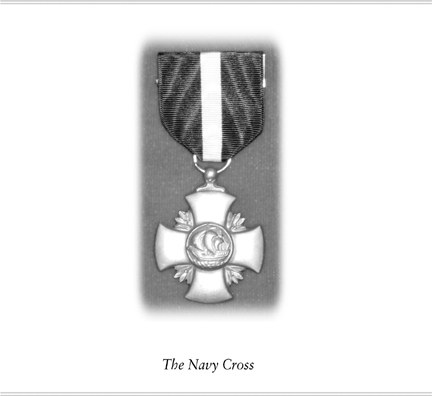
MOSTLY THEY GOT ON with their lives. The fleet commanders had been quick to send words of congratulations and praise, and official citations and awards came their way too. Chester Nimitz greeted the four surviving Taffy 3 carriers on their return to Pearl Harbor with a message that read in part, “Your successful fight against great odds will live as one of the most stirring tales of naval history.… As long as our country has men with your heart, courage, skill, and strength, she need not fear for her future.” Ziggy Sprague lobbied successfully to get all thirteen ships of Task Unit 77.4.3 awarded a Presidential Unit Citation. Ernest Evans was Taffy 3’s sole recipient of the Congressional Medal of Honor. Sprague received the Navy Cross, as did Bob Copeland, Leon Kintberger, Amos Hathaway, and several pilots, including Bill Brooks, Tom Van Brunt, Tex Waldrop, Richard Fowler, and Edward Huxtable. Sprague’s Navy Cross citation read like the rest of them, in part:
For distinguishing himself by extraordinary heroism in action against an enemy of the United States…. Admiral Sprague’s personal courage and determination in the face of overwhelming enemy surface gunfire and air attack were in keeping with the highest traditions of the Navy of the United States.
But strangely, for all the honors handed out, the Battle off Samar was for a time the victory whose name the Navy dared not speak. To celebrate it too vigorously, Admiral Nimitz felt, would unavoidably be to criticize the Navy’s most spectacular old lion. After the war Nimitz tried to quash official criticism of Admiral Halsey, fearing the public relations damage it might do to the Navy. The wartime public was in the thrall of Bull Halsey’s spark-plug persona and quotable wit. With budget battles to be fought in the postwar period, it risked too much to allow his reputation to suffer. Though Nimitz believed Halsey had blundered at Leyte—“It never occurred to me that Halsey, knowing the composition of the ships in the Sibuyan Sea, would leave San Bernardino Strait unguarded,” he wrote in a personal letter to Adm. Ernest J. King, who was himself outraged by Halsey’s decision—he suppressed open criticism of Halsey.
When one of Nimitz’s staffers included a pointed rebuke of Halsey in a draft of the Commander in Chief, Pacific Fleet’s official report on Leyte, Nimitz ordered a rewrite, scrawling on the report, “What are you trying to do … start another Sampson-Schley controversy? Tone this down.” Evoking the memory of the morale-shattering feud between two admirals during the Spanish-American War, Nimitz held true to an early career vow he’d made, never to let public controversy cloud the Navy’s achievements again.
Halsey himself seemed less sheepish, maneuvering to receive credit for as much of the Leyte victory as possible while deflecting fallout from the near disaster at Samar. As Taffy 3’s survivors were hunkering down for their first night at sea, Halsey radioed Nimitz, “It can be announced with assurance that the Japanese Navy has been beaten, routed, and broken by the Third and Seventh fleets.” As Halsey must have anticipated, President Roosevelt read the dispatch to the Washington press corps, at six P.M. EST on October 25. A naval historian observed, “Though he participated in only portions of the far-flung battle, Halsey upstaged his fellow commanders and announced the victorious news as though his had been the directing hand.” In his 1947 autobiography Halsey sustained his defensive stance, torpedoing his close friendship with Kinkaid with a single sentence: “I wondered how Kinkaid had let ‘Ziggy’ Sprague get caught like this.”
For his part, Ziggy Sprague had faith that Taffy 3’s exploits would one day receive their due. “Our Navy, for reasons that are clear to me and possibly to you too, has never played up this action to any extent,” he wrote in a personal letter to the superintendent of Annapolis, Vice Adm. Aubrey Fitch, in 1947, “but I am convinced that history will accord the proper place for it in the decisive actions of the war, probably a half a century or more after I have passed on.”
After the Leyte contretemps Halsey dulled his five stars still further when he chose to steam his fleet through major typhoons in December 1944 and July 1945, with significant loss of life. Halsey became a polarizing figure. Most sailors loved him, as did the public. But by the end of the war a powerful undercurrent of disenchantment began to emerge. As a possible indicator of the Navy’s ambivalence about Halsey’s legacy, no class of ship was named for him. A class of supercarriers was named for Admiral Nimitz. A sleek new breed of destroyer honored Halsey’s less-famous contemporary, Adm. Raymond Spruance. Halsey’s name would grace only individual ships. The guided missile cruiser USS Halsey (CG-23) was commissioned in 1963 and deactivated in 1994. A new Arleigh Burke-class destroyer of the same name (DDG-97) will be completed in 2005.
The rank and file of Taffy 3 would content themselves with quieter accolades. When Bud Comet, discharged in Seattle, arrived back at his parents’ coal company-owned house in West Virginia, an envelope awaited him. Bearing a return address to the White House, it contained a letter from Harry Truman, a Presidential Unit Citation, a Bronze Star, and a letter of commendation for meritorious conduct. His dad asked Bud what the decorations meant. All the Samuel B. Roberts survivor could say in reply was they meant that he had not dishonored his mother. The elder Comet looked at him intently and nodded his head, then asked whether the awards had any monetary value. Bud said no, he didn’t think so. His father said that if they didn’t have any monetary value, then what Bud had done was for his own satisfaction. “You’ve done well. But don’t dwell on it. You can throw this stuff in the fireplace and burn it. It has no value from this point on. Knowing in your heart that you did well is all the satisfaction that you need.”
“His logic was good,” Bud said. “But my wife didn’t throw nothing in the fireplace. She kept it.”
Over the years Bud Comet has kept quiet about a lot of things. There are certain aspects of his ship’s final hours and their horrible aftermath that he just does not want to discuss. But for others the ice began to break, and the memories began to thaw, when the survivors’ reunions began in the 1970s. Though Ziggy Sprague, Cdr. William Thomas, and a gathering of men from individual ships had held small “Taffy 3 reunions” for several years beginning in October 1946, the survivors of the Gambier Bay were the first to organize, in 1969. Eight years later the group sponsored a “Philippines pilgrimage” that would enable them to keep their vow to honor their dead, to acknowledge and dignify their sacrifice with a proper burial ceremony at the site of the sinking. Led by their onetime executive officer, Rear Adm. Richard Ballinger, and their chaplain, Rev. Verner Carlsen, the Gambier Bay group set out on an adventure of remembrance.
They took a Philippines Airlines flight to Honolulu, leapfrogged to Guam, then flew over Saipan and Tinian and through a rainsquall that told them it was October in the southwestern Pacific again. They landed in Manila, greeted by VIPs from the U.S. and Philippine navies; visited the U.S. naval base at Subic Bay; stood by the shrine to Douglas MacArthur at Red Beach on Leyte; and toured the sacred ground where GIs fell at Bataan and Corregidor.
On October 24, 1977, they boarded a Philippine navy ship out of Manila. Screened by leaping porpoises, the RPS Mt. Samat navigated San Bernardino Strait and steamed into the waters off Samar where the Gambier Bay had gone down. A typhoon loomed somewhere over the horizon, raising whitecaps and long, rolling swells. “They’re telling us that they know we’re here,” a shipmate said. “They’re kicking up the sea from below.”
As Chaplain Carlsen began reading the eulogy, their voices hushed, and all that could be heard was the slap of swells against the ship’s cold hull. The historian of the Gambier Bay/VC-10 Association, Tony Potochniak, tossed overboard a cylindrical capsule stenciled with the name of the ship and containing the personal effects of the dead and American and Philippine flags. “We now commit this capsule to the deep, in loving memory of you, our killed in action and deceased shipmates,” he said. As the names of the dead were called out, wives of the survivors took turns tossing a red carnation into the sea as the Filipino honor guard fired a single rifle shot.
* * *
A TREMENDOUS AMOUNT OF unwritten and untranslated history remains to be unearthed on the Japanese side. One wonders how or whether their veterans commemorate the battle. Certainly not many of them remain. The Japanese losses during the Sho-1 operation can only be guessed at, but they are sure to have been disastrous. Of the ten heavy cruisers that left Brunei, only three, the Tone, the Haguro, and the Kumano, made it back through San Bernardino Strait. Total Japanese losses are estimated to be around eleven thousand men.
Admiral Kurita’s reputation lay in tatters following his timid performance on the brink of victory off Samar. Owing in part to the endless inscrutability of his motives—he was exhausted and confused in his thinking; he was unclear that his objective could be achieved; he feared too many U.S. planes were gathering at Tacloban; Kinkaid’s pleas had spooked him into believing powerful reinforcements were on the way; he was low on fuel; he was regrouping to attack another American fleet—he has never been given the benefit of the doubt. In the novel War and Remembrance, which features an extensive and vivid narration of the Battle off Samar, Herman Wouk put a particularly harsh assessment in the mouth of one of his characters: “Kurita’s role at Leyte had elements of the noble and the pathetic, before his collapse into imbecility.”
A problem that plagued the Japanese side throughout the battle was fundamental confusion about the nature of the enemy who opposed them. In no small part due to the smoke roiling from the stacks and sterns of the U.S. ships, the Japanese were nearly unanimous in mistaking Ziggy Sprague’s task unit for something considerably more powerful than it really was. Kurita would describe Taffy 3 in his own action report as a “gigantic enemy task force including six or seven carriers accompanied by many cruisers and destroyers.”
Watching his first salvos roar off just before seven A.M.—the first time the mighty Yamato had ever fired on an enemy ship—Battleship Division 1’s Admiral Ugaki saw an American vessel smoking and believed the battleship’s opening broadside had sunk her. After the air raids started, the Japanese perceived “salvos of medium-caliber guns” hitting near the Yamato. That no ship in Sprague’s fleet boasted medium-caliber weaponry—as the six- or eight-inch guns of cruisers were generally called—revealed the extent of Kurita’s bewilderment. In a landscape of tropical squalls and enemy smoke, he was not at all certain what to make of the fleet that had materialized unexpectedly on the southern horizon.
Clearly by late 1944, however, hard experience had equipped both the Americans and the Japanese to appreciate the new rules of naval combat in the aircraft-carrier age. By the time the jeep carriers of Taffy 2 mustered their air groups and began launching big strikes against the Center Force after eight A.M., and once Tacloban’s airstrip had been organized as a makeshift staging ground, Kurita was facing air assaults from more than a dozen escort carriers, or the rough equivalent of four or five fleet carriers. No matter how overmatched the Americans were at Samar, no matter how dashing their screening ships were in intercepting the superior force during the critical first ninety minutes of the unlikely battle, the strength of the U.S. forces that Kurita confronted was more formidable than many analysts have allowed. It does nothing to diminish the valor of the tin can sailors aboard Taffy 3’s destroyers and destroyer escorts, or of the gallant aviators and airedales who flew on that day, to say that Kurita’s ultimate victory was by no means assured, and that withdrawing in the face of continuous and savage air assault was perhaps the prudent thing to do.
An assessment offered by Ziggy Sprague has the beauty and inescapable merit of simplicity: of Kurita’s decision to withdraw, he wrote to Admiral Fitch in 1947, “I… stated [to Admiral Nimitz] that the main reason they turned north was that they were receiving too much damage to continue and I am still of that opinion and cold analysis will eventually confirm it.”
After postwar interviews with Japanese commanders were completed by the U.S. Strategic Bombing Survey and by the historian Samuel Eliot Morison and his staff, and after the accounts of Admirals Ugaki, Koyanagi, and others were published, Japanese voices were seldom heard in the history books. In 1984 Hank Pyzdrowski, the VC-10 Avenger pilot and executive director of the Gambier Bay’s Heritage Foundation, received a letter with a Japanese postmark. “Dear Sirs,” it began,
I have the honor to write the Men of the Gambier Bay as the ex-Commanding Officer of the Tone, heavy cruiser of the Imperial Japanese Navy, who fought against bravest shipmates of the Gambier Bay in the United States Navy, off Samar island in the morning of October 25, 1944.
The correspondent, Capt. Haruo Mayuzumi, in neat cursive script blocked off on graph paper, recited his naval curriculum vitae, then, rather than discuss the battle from a personal standpoint, launched into a technical discussion of Japanese naval gunnery. It seemed strange, a chilly disquisition that would warm only a gunner’s mate’s heart: after explaining, complete with charts, graphs, and diagrams, how the caps of Japanese shells were engineered to break away so as to maximize their killing effect while traveling under water, he wrote, “I am very grateful when I read The Men of the Gambier Bay [by Edwin P. Hoyt] and knew some effect of 8” 91-A.P. of my ship.”
But Mayuzumi was more than a technician. He showed flashes of mercy and humanity too. He recalled that while firing on the sinking Gambier Bay,
my fire control officer did never direct his gun fire to the spot in which many men were waiting to come down by Jacob’s ladders. My young midshipman … was whole-heartedly sending fire to the outside of the engine room. Suddenly many crew and passengers gathered near life boats near engine room. I immediately ordered “Ceasefire.” The midshipman soon ordered to aim [at] the forecastle where no person could be seen…. I saw you brave men, under gunfire and the flame, calmly waited the turn to go down by Jacob’s ladders.… I now eagerly pray good luck to all brave men of the Gambier Bay
The survivors’ groups took it upon themselves to remember their dead and celebrate their victory, in part because no one else would do it for them, least of all, for a time, the U.S. Navy. But ultimately it was the Navy’s decision to commission a ship in their own skipper’s honor that brought the Samuel B. Roberts survivors together and catalyzed their first efforts to hold a reunion. For thirty-eight years they had tried to suppress the painful memories of the war. But in 1982 the christening of an Oliver Hazard Perry-class frigate in Bob Copeland’s name helped show them the benefits of remembrance.
The son of Roberts survivor Jack Yusen, an attorney in Washington state, saw it announced in the bar association newsletter that Bob Copeland, the Tacoma attorney and naval reserve rear admiral who had passed away in August 1973 at the age of sixty-three, would be honored with a namesake warship. The younger Yusen called his father and said, “Dad, wait till you see what I’ve got to show you!”
Jack Yusen, a charismatic organizer and leader, and others began collecting names and addresses and tracking down Samuel B. Roberts survivors, as the men of the Gambier Bay and other ships had been doing for years. The USS Copeland (FFG-25) was commissioned on August 7, 1982. The Samuel B. Roberts Survivors Association’s first formal reunion was that same year, thirty-eight years since they had last gathered as a crew. The year before, unknown to them, another Perry-class frigate, the USS Clifton Sprague (FFG-16), had been commissioned. But that ceremony had been attended only by Sprague’s family. Three years later, in 1985, more official recognition followed when a frigate, the USS Carr (FFG-52), was named for the Roberts’s heroic gunner’s mate.
The Taffy 3 reunions take place annually now, many of them in late October to coincide with the battle’s anniversary, others in May, over the Memorial Day holiday. The survivors from the destroyers, destroyer escorts, jeep carriers, and composite squadrons are proud of what they did. When Fanshaw Bay survivor Harold Kight undertook to gather an oral history of his wartime home, a shipmate wrote to him, “I think the more of us that get together, the more history may come to remembrance. A lot of history ain’t set down yet.”
They’re a generation of optimists. The newsletter of the Roberts Association features a regular section titled, “Our family keeps on growing!” It is filled with news from shipmates and their families, from long-lost survivors found six decades after the battle. Of course, the family’s first generation is not growing. It is shrinking, as it must. The Taffy 3 associations will not be around forever. Though they are formidable negotiators, their reunion coordinators exert slowly diminishing bargaining power over hotel and conference center managers every year. The escort carrier associations get a robust turnout owing to the larger complement of their ships. The Samuel B. Roberts Survivors Association, on the other hand, now holds its reunions jointly with the Johnston survivors and the tiny group from the Hoel. Perhaps the children and grandchildren who appear in growing numbers at the annual events will sustain the reunions beyond the passing of the last survivor. One hopes that they will.
To see the three groups of tin can sailors together at their joint reunion is like watching three tightly knit fraternities mingle, each with its own traditions, full of pride, but vaguely uncertain about the other groups. Though they have absolutely everything in common, they don’t seem to mix very much. While they show a cautious curiosity and no shortage of collegiality, there is not a lot of mingling and sharing of experiences. Maybe everything that can be said has been said. Maybe they’ve heard all the stories already. Or maybe the experiences are too painful still. If so, clearly they always will be.
The Hoel guys, mindful that their ship was the first to sink and with the heaviest loss of life, seem leery of all the attention the Johnston has gotten. Historians have been understandably drawn to Ernest Evans’s dashing sortie against the Japanese fleet, to Bob Hagen’s vivid and detailed official action report, and to his gripping personal account published in the May 26, 1945, issue of The Saturday Evening Post. None of that ever kept the old skipper Amos Hath-away from griping at reunions, often in mixed ships’ company, that Ernest Evans had run off ahead of orders and fought his own war.
To men from the other ships, a lot of the talk has sounded like bragging. Of course, there is a fine line between bragging and pride. The Roberts guys appear to walk it well. Just as Bob Copeland used to insist, they dress sharply. There’s a measure of solemnity and seriousness to them, but they have an unmistakable spark—the irreducible pluck of the destroyer escort sailor. Nevertheless, in the hospitality room, when all three groups are together, there is a palpable feeling that people are afraid to say the wrong thing, to inadvertently put down the contribution of another ship.
The men bonded with each other at an age when bonds harden like epoxy, in their late teenage years and early twenties. Tested by traumatic experience, the bonds became all the more enduring. Through the years the dynamics have stayed largely the same. Joe Downs, in his seventies, still seems to regard Bill Brooks, in his eighties, the way a seventeen-year-old enlisted aircrewman regards a twenty-four-year-old commissioned pilot who holds the younger boy’s life in his hands, which is to say, as nearly a superhero. “Oh man, I like that guy,” he said. “A hell of a hunk of a man.” They see each other as they did six decades ago. Picture a black-and-white photo of young Jack Kennedy, skipper of PT-109, having cheated death and with his whole life in front of him. This is how they see each other, but in living color. Brooks’s VC-65 squadronmate Tom Van Brunt joked, “At this time in my life, one of my greatest pleasures is finding my glasses before I forget why I’m looking for them.” But they see each other just fine. This time-travel magic does not seem to work outside the immediate naval fraternity. When a survivor meets someone from another ship, it’s understandable that the natural bond isn’t always there: he sees not an eighteen-year-old but an old man.
At the 2001 joint reunion of the Samuel B. Roberts, Johnston, and Hoel associations in Albuquerque, the banquet speaker told a story that punched a sizable hole in this barrier of time. Capt. Paul X. Rinn, a fifty-five-year-old New Yorker who prickles with smarts, was the skipper of the third ship to bear the name Samuel B. Roberts, a Perry-class guided-missile frigate, FFG-58. On April 14, 1988, escorting Kuwaiti oil tankers through the Persian Gulf in the midst of the Iran-Iraq war, the Roberts entered a minefield. Captain Rinn backed her down gingerly, but the ship struck a mine nonetheless, reeling from a monstrous blast that lifted the ship so high that when she fell back to sea her bow plunged under water. The explosion fractured the ship’s keel, blew eight-thousand-pound gas turbine engines from their mounts, and opened a twenty-eight-foot hole in her side. The volume of inrushing water was so great that in less than a minute, according to Rinn, the Roberts “went from being a 4,000-ton ship to a 6,000-ton ship.” She was sinking at a rate of a foot every fifteen minutes. Flames were rising 150 feet above her, nicely silhouetting the frigate for the missile-armed Iranian patrol plane and fast attack boat that were closing in.
“We took care of the Iranians, and they went away,” Rinn told the Albuquerque reunion gathering, “but there was no doubt it was not going to be a good night. And at one point about an hour and a half into this, after I’ve thought, I’m not sure we can save this ship, but we’ve got to try our damnedest—do you remember the film Titanic, when the lights start to flicker, then go out?—well, we had our Titanic moment. The lights flickered—and then they went on. And I remember standing on the bridge thinking, I don’t know how that happened, but God is good. Let’s see what we can do to save this ship.”
Captain Rinn then told his elder tin can sailors the reason his ship survived. It had to do with the teamwork and courage of an entire 214-man crew—and in particular the enterprise of two enlisted men, a fireman named Jim Tilley and a third class petty officer named George Carr. Tilley was not the most shipshape sailor. He had been a regular defendant at Captain’s Mast, where Rinn, against the repeated advice of his senior chief, always ended up giving the kid another chance. When the Roberts hit the mine, Tilley was manning auxiliary machinery room number one, a belowdecks compartment that was supposed to have been evacuated owing to the threat of mines in the area. Something told Tilley that the ship might need emergency power, and so he dogged down the hatch and stayed at his station.
Trapped belowdecks by ladders and bulkheads that had collapsed on top of his station, Tilley brought the auxiliary diesel on line with the generator, a job that usually required three people, tripped in the gear connection using an emergency technique known as a “suicide start” for the possibly destructive consequences of a malfunction, and restarted the flow of electricity that powered the lights and the pumps fighting the flooding. Tilley singlehandedly kept the Roberts from succumbing to its “Titanic moment.”
From that point on, petty officer George Carr—who shares a surname but no family heritage with petty officer Paul Henry Carr, insofar as George is black—kept the pumps running in a critical aft compartment for about thirty-six hours straight. Aware that operating a finicky pump even for just an hour was no minor feat, Rinn was amazed—and puzzled. He couldn’t remember Carr ever having gone to P-250 school, where the Navy taught the kind of advanced pump maintenance that Carr would have needed to know to do what he did. When Rinn asked, the thirty-one-year-old petty officer said no, he never went to P-250 school. “Captain, you’ve gotta understand something about me: I can’t swim a lick. I saw those sharks and I saw those snakes in the waters around here, and I decided there was no way those pumps were stopping.”
Captain Rinn had made a large bronze plaque displaying the image of old DE-413 and the names of all her crew, mounting it on the bulkhead in the amidships passageway leading to the quarterdeck. The plaque was always a focal point during the initiation of new crew members. Now it found another use. “It sent a chill through me on the night of the mining, as we were fighting to save the ship, to see crew members passing the plaque and reaching out and touching it, not just one or two guys but seemingly everyone who passed it. Clearly they were bonding with the heroism of the past.”
Here, then, beyond citations and medals and newspaper articles and unexercised bragging rights, is the true legacy of the Battle off Samar. It gave substance to a living tradition. The story, the history, of Navy men in extremis animates the idea that Americans can do anything when it is necessary and when it counts. As Captain Rinn put it:
Legend, tradition, history can drive a commitment to excellence that raises people and has them perform at a level above anything they ever dreamed they could do. And it makes all of us realize the potential that everybody has who serves for you and goes to sea on ships.
The veterans should be celebrated for the distinguished citizens they have become. But they should be remembered too as they remember themselves: as kids, frozen in time.
“I’m still trying to impress my dad,” Bud Comet said. “I’m still trying to tell him, ‘Hey, I’ve been a good son. I’ve honored you and I’ve honored Mom, and I hope that you’re pleased. I hope, if you’ve been watching over me all these years, that you’re pleased with the way I’ve conducted myself.’”