
PART FOUR
CHAPTER 11
THE NIGHT OF SEPTEMBER 16–17, 1862

TO HISTORIANS ARMED WITH HINDSIGHT AND A GOOD MAP IT IS easy to see how McClellan could have ravaged or even destroyed the Army of Northern Virginia on either the sixteenth or the seventeenth of September. McClellan’s refusal to attempt such a battle on September 16 can legitimately be blamed on his habitual excess of caution and his egregious overestimate of enemy strength. Yet the most puzzling aspect of his decision making is not his hesitation to attack on the sixteenth but his determination to attack the very next day. He cannot have doubted that the force at Sharpsburg would be reinforced on the sixteenth and would therefore be stronger when he finally moved against it. He still believed that Lee’s army, when united, would be at least equal if not superior in strength to his own. Nevertheless, when he telegraphed Halleck of his intention to attack “as soon as the situation of the enemy is developed,” he made no mention of fearful odds, made no attempt to hedge his responsibility for the ensuing result. This was not the McClellan of the Peninsula campaign, forever putting off the day of battle until his “outnumbered” army could be reinforced, his mood wildly swinging between predictions of triumph and hysterical prophecies of defeat for which he must not be blamed.1
THE TELEGRAM MCCLELLAN sent retired General in Chief Winfield Scott the day after South Mountain opens a window into his new state of mind. The old warrior had long been a figure of powerful but unresolved significance in McClellan’s life: his commander, his hero, his mentor during the war with Mexico, when McClellan and Robert E. Lee were engineer officers on Scott’s staff. It was widely known that in 1861 Scott had thought Lee the man best qualified to command the Federal armies, just as he had rated Lee the best and bravest of his staff officers in Mexico. When McClellan came to Washington, Scott was at first his patron, then his critic, then the obstacle blocking his path to control of military policy, and finally an enemy he had driven from command by a systematic campaign of intrigue and defamation. Yet even in the midst of the labor and anxiety of a military crisis, McClellan wanted Scott to know that he had routed and driven from the field an army command that had “R E Lee in command.” The Battle of South Mountain had a personal significance for McClellan that was nearly as vital as its potential strategic consequences. Scott must see, and acknowledge, that he had been wrong to prefer Lee, wrong to doubt McClellan, wrong to oppose him in the President’s councils.2
That victory also armored McClellan against the malice of his political enemies: Stanton, the Committee on the Conduct of the War, and the Radical press. Despite his protestations of contempt for his persecutors, he had taken to heart their insulting characterization of him as “the ‘Quaker,’ the ‘procrastinator,’ the ‘coward’ & the ‘traitor’!”3 What gave those taunts their stinging power was McClellan’s own uncertainty about his ability to fight and win battles. His victory at Seven Pines during the Peninsula campaign was defensive and unplanned, and since then he had known nothing but defeats. The fight at South Mountain was the first major battle he had planned, initiated, and won.
Lee’s decision to challenge battle at Antietam all but nullified the effect of South Mountain as both strategic victory and personal vindication. It was therefore necessary, as he wrote to his wife, to show “I can fight battles and win them.” As he would note in his official report, under the canons and customs of the military profession a general who brought his army face-to-face with an enemy was expected to give battle, suspect if he declined it. The point was driven home by two telegrams that reached him late on the fifteenth and on the afternoon of the sixteenth. The first was from President Lincoln: “God bless you, and all with you. Destroy the rebel army, if possible.” McClellan resented the message, which ignored his claim of a major victory and repeated the president’s nagging demand for greater efforts, more complete victories. The second reply was from Scott, and instead of acknowledging McClellan’s bettering of Scott’s erstwhile favorite, this telegram echoed Lincoln’s judgment that McClellan’s task was unfinished: “Bravo! . . . Twice more and it’s done.”4
So McClellan had to fight and win a new battle to vindicate his character and military genius, and preserve the power of the only man capable of saving the nation from the dual menace of Southern secession and Radical despotism. That meant he had to accept a standup fight against an enemy whose overall strength was at least equal to his own. However, for all the old familiar reasons, it remained vital that in undertaking the risks of the offensive he minimize the possibility of suffering a serious defeat—the kind that might wreck the army that was the republic’s best reliance and allow his enemies to fire the indispensable man. His decision to attack on the seventeenth was (for him) one of unprecedented boldness; but his execution of that decision would be constrained by his need to ensure absolutely against serious defeat.
QUESTIONABLE JUDGMENTS WERE also being made on the other side of Antietam Creek. Lee had been too sanguine about the speed with which Jackson’s force could join him at Sharpsburg, so for the whole of September 16 he had faced McClellan with a force less than half as large. His assumption that McClellan would not immediately attack in force proved correct, but his army’s situation on September 17 would be only fractionally better than it had been the day before. All of his labor and daring since September 14 had only succeeded in putting his army in an extremely dangerous position, faced with an enemy twice its strength, with its back to a river crossed by two difficult fords. To achieve a meaningful victory, Lee had not only to defend his lines but to drive the larger army back and force it to retreat behind South Mountain. If at the end of the day McClellan simply held his very strong position on the high ground east of the creek, Lee would have little choice but to retreat to Virginia. It has been said, and is certainly true, that Lee understood McClellan’s weaknesses as a battlefield tactician, and believed he could exploit these to win a victory. But that seems a slim reed on which to rest the fate of an army and, potentially, a nation.
Still, the possibility exists that Lee was unaware just how far his original force had been diminished by combat and straggling. Postbattle reports by Lee and some of his subordinates assert that the Army of Northern Virginia had lost a third of its original strength to straggling, combat, and other causes, and that it had fewer than 40,000 troops available for action. However, A. P. Hill’s Division (2,500–3,000) was still at Harpers Ferry paroling captured Federals and would not reach the battlefield till late in the afternoon. For most of the day Lee’s force was probably no larger than 37,000 and may have been as small as 35,000—which is to say it was no more than half the size of McClellan’s effective force of 72,000-plus.5
Lee’s troops were not only weak in numbers, their physical strength had been compromised by weeks of hard marching and a bad or inadequate diet, in addition to the ordinary debilitating effects of bad sanitation and polluted drinking water. A substantial fraction of Jackson’s command had been lost to straggling on the march up from Harpers Ferry, and few of the troops in line had had any rest. Even those from Longstreet’s and D. H. Hill’s commands, who had been camped around Sharpsburg since the fifteenth, still felt the effects of their hard fight and retreat from South Mountain, and many of them had spent the past twenty-four hours skirmishing with Hooker’s and Richardson’s advance elements. The men were also suffering from hunger. Most had had nothing to eat for days beyond what they could forage or scrounge on the march. The reminiscences of Private W. B. Judkins, of the Twenty-second Georgia, reveal the degree to which hunger colored the soldiers’ experience of the campaign. Judkins spends far more time writing about raids on civilian orchards and chicken coops than about combat. On the march up from Harpers Ferry with the rest of R. H. Anderson’s Division, Judkins risked arrest by the provost guard to raid a farmyard: climbed a stone fence and crammed his pockets and his mouth with grapes and a fruit unknown to him that turned out to be unripe gooseberries, which bit his tongue “like eating needles”—then hadn’t the strength to climb back over the fence. The flesh was weak, but the spirit willing. Although he was arrested for straggling, he evaded the provost guard and rejoined his regiment.6 Most of Lee’s men had been subsisting on unripe or uncooked corn and unripe fruit, which gave them the “gripes” and the “squitters.” Diarrhea and dysentery were endemic in the Rebel camps. After the fighting their abandoned battlelines could be traced in rows of loose and bloody feces.7
Nevertheless, from Lee’s perspective, there were good precedents for accepting battle against such odds. Frederick the Great had beaten Austrian armies of twice his force at Leuthen and Rossbach during the Seven Years’ War. Winfield Scott was operating at the end of an extremely tenuous supply line when he attacked and defeated a numerically superior Mexican army that was fighting in defense of its capital city. Lee himself had already triumphed over superior forces in the Seven Days and at Second Bull Run, and at Chancellorsville in May 1863 he would win a stunning victory against odds comparable to those he faced at Antietam. However, in each of these remarkable triumphs, the victor seized and held the initiative against an enemy that was badly organized and caught at a disadvantage. At Antietam Lee was compelled to stand on the defensive, allow McClellan to determine the pace and place of action—and watch for his chance to turn the tables.
He was willing to risk an attack, despite the disadvantages of his position, because the strategic calculus that had led him to invade Maryland in the first place had not changed. His own earlier victories, and Bragg’s offensive into Kentucky, had reversed the momentum of military operations, and produced a political crisis in the North. A victory now, even if it did not destroy McClellan’s army, might have a decisive effect on the Union’s midterm elections. (Unlike Davis, Lee doubted the British or French would aid the Confederacy, so the hope of intervention played no part in his decision.) McClellan might enjoy an advantage in troop and artillery strength, but as Lee saw it, these advantages were offset by the relative inexperience of many units and their commanders. From Lee’s perspective, even McClellan’s veteran troops were experienced mostly in defeat. McClellan’s corps and division commanders were drawn from two different armies and had not developed the kind of instinctive teamwork that now characterized the Army of Northern Virginia. Lee also saw McClellan as a weak combat commander. He had no great gift for battle tactics; nor had he shown that he had the moral courage to stand and fight when assailed, as he had been in the Seven Days. By his excessive caution, his refusal to move until every risk had been minimized, McClellan revealed his fear of losing control of the action.
In contrast, Lee understood and accepted the fact that battle is chaos. The strategist does what he can to create a situation in which victory is likely and the gains of battle are commensurate with the risks. But battle is the violent collision of two highly complex human systems, driven by different impulses, organized in different ways, with different strengths and solidarities. The outcome may turn on actions far down the chain of command, surprising local successes that boost the morale of one side and demoralize the other, shifts in momentum that produce a series of disruptive effects. Lee, like Napoleon, was a connoisseur of this chaos. He believed that his own skill as a commander, the experience and intelligence of his chief subordinates, the efficiency of his command system, and the superior morale of his troops would allow him to ride that chaos; and that the weaknesses of McClellan, his generals, and his army made them liable to a loss of control, a cascade of failures leading to defeat.
Lee would use the advantages conferred by the terrain and his interior lines of communication to punish McClellan’s assault columns, and watch for the opportunity to deliver the kind of counterblow that had wrecked the organization and morale of his opponents during the Seven Days and at Second Bull Run. He did not need to annihilate McClellan’s army in order to win a politically decisive victory. All he had to do was compel McClellan to retreat and leave the Army of Northern Virginia free to base itself in western Maryland and threaten a deeper invasion.
CONFEDERATE PREPARATIONS
Lee had decided to fight at Sharpsburg on the fifteenth and had spent the sixteenth laying out and manning the positions he intended to defend. His defensive line was a four-mile arc, running roughly northwest to south. In this position, the army could protect its line of supply and possible retreat, which ran west from Sharpsburg to the Shepherdstown Ford. The ford itself was held by cavalry and part of the army’s artillery reserve under Colonel William Pendleton, and Lee was able to draw guns and supplies from Pendleton’s command during the action.8
The main line of resistance followed the contour of a plateau that rose by a shallow grade above the Antietam river bottom. The reconnaissance by Hooker’s Corps on September 16 had warned Lee to expect a heavy attack from the north. He therefore assigned command of this sector to Stonewall Jackson and sent him heavy reinforcement during the night. Since speed and efficiency of movement were primary concerns, the divisions assigned to Jackson were drawn not only from his own corps but from nearby elements of Longstreet’s Corps and the general reserve. This arrangement displays very clearly the efficiency and flexibility of command structures in the Army of Northern Virginia. With veteran generals in command at corps, division, and brigade level, Lee could mix and match unit assignments freely, without any notable breakdowns in communication or mutuality of support. This is in stark contrast to McClellan’s army, where organizational rigidity and inexperience at the higher command levels would complicate and cripple operations.
In Jackson’s sector, the north-facing section of the arc was anchored on the Nicodemus Heights, which took their name from the owner of the nearest farm. The high ground here was held by two brigades of Stuart’s cavalry and the guns of Stuart’s horse artillery. At the start of the action, Early’s Brigade of infantry was stationed here as additional protection, because the position was critical to the defense. Stuart’s guns were in position to pour enfilading fire into the Yankee infantry under Hooker, whose attack was expected early on the seventeenth. The key position on this part of the field was the high ground just east of a small clapboard church belonging to the Dunkers, a German Baptist sect with a pacifist creed. The Dunker Church sat at the junction of the south-running Hagerstown Pike and the Smoketown Road, which slanted in from the northeast. It was the height of land here, and if the Federals seized it their artillery could enfilade all the defensive lines north of Sharpsburg, making Lee’s position untenable.
The terrain favored the defense. The direct line of approach to the church was a corridor of open ground some four hundred to five hundred yards wide, which ran between two large woodlots, both initially held by Confederate troops. The East Woods was some three hundred yards northeast of the church, covering the Smoketown Road. On the opposite side of the corridor the much larger West Woods jutted three hundred yards forward of the church along the western side of the Hagerstown Pike, then angled out to the west. Between the woodlots the approach was obstructed by a large cornfield, owned by a man named Miller, which filled most of the ground between the pike and the East Woods and was perhaps a quarter of a mile deep. Infantry thrashing its way through the rows of stiff man-high stalks would ultimately come up against a fence-rail breastwork sheltering Confederate riflemen. Two brigades of Ewell’s Division, commanded by General Lawton in place of the wounded Richard Ewell, held the cornfield line and the southern end of the East Woods. As a reserve for the right of his line, Lawton could call on a backup brigade, which was positioned due east of the Dunker Church near the Roulette Farm. The Dunker Church position had also been given strong artillery support by the addition of Colonel Stephen D. Lee’s reserve batteries to the divisional and brigade artillery.
To the left of the Dunker Church, the West Woods was full of Confederate infantry, with J. R. Jones’s Division in the front line and two of Lawton’s Brigades in reserve. Deeper in the West Woods, at its southern end, Hood’s Division provided a general reserve that could be used anywhere along the northern front. Counting all the artillery and reserve elements, Jackson had more than ten thousand troops with which to defend the northern sector—perhaps as many as thirteen thousand if Stuart’s two brigades are taken into account. However, Confederate cavalry were lightly armed for scouting, screening, skirmishing, and raiding, with pistols and carbines or short-barreled rifle-musket—inadequate for a standup fight against infantry armed with rifle and bayonet. But Stuart’s troopers could offer some protection to his artillery batteries, and under the right circumstances it might be able to confuse and divert the Federals by striking at the rear of Hooker’s force.
Jackson could also draw on the army’s general reserve, the divisions of McLaws (three thousand) and R. H. Anderson (four thousand), which were concentrated behind the town of Sharpsburg. These troops were under Lee’s personal command, and he would throw them into action when and where the exigencies of battle required. They had arrived less than two hours before the battle began. They were dog-tired after two days of marching and a week of short rations, and their nominal strength was diminished by stragglers who had fallen out on the march up from Harpers Ferry.
From the right flank of Jackson’s front the Confederate line turned south. The hinge was marked by the Mumma Farm buildings—and at dawn by a pillar of smoke that rose from those buildings, burned by order of Confederate brigadier Roswell Ripley, who feared they could be used to shelter Federal sharpshooters, who could seriously disrupt the defense by picking off officers and artillerymen. Four brigades of D. H. Hill’s Division (5,800) held a line that slanted southeastward from the farm, across the road that ran from the Middle Bridge to Sharpsburg, down to the bank of the Antietam. Though the flanks of this line were on relatively higher ground, the longer section just south of the Roulette Farm followed the angular crescent shape of a country road that had been cut and/or worn a yard or more below ground level. This “Sunken Road” formed a natural trench from which infantry could fight with some advantage. The ground in front of the Sunken Road rolled up in a shallow slope to form a low, smooth ridge, which would protect Federal troops approaching the Sunken Road from the north. However, as soon as the attackers topped that roll of ground they could be hit by massed fire from the entrenched Rebels, and staggered just as they prepared to make their charge across the quarter-mile of open ground. Because that low ridge also offered some protection from Federal artillery, the Sunken Road line was an extremely strong defensive position.
The same could not be said of the extended front that covered the road up from the Middle Bridge. The roadblock was held by G. B. Anderson’s Brigade of Hill’s Division. Half a mile behind it, two units totaling about a thousand men covered the front of Sharpsburg and initially provided some backup for G. B. Anderson. These units were a brigade of six hundred men commanded by G. T. “Tige” Anderson and some four hundred infantry under Brigadier General Nathan “Shanks” Evans—part of an infantry division nominally belonging to Longstreet’s command.
South of Sharpsburg, the main defensive line still followed the edge of the plateau that surrounded the town. The line of the high ground here was held by five infantry brigades of the division commanded by Major General David R. Jones, with a cavalry brigade guarding the extreme right flank. A sixth infantry brigade, commanded by Brigadier General Robert Toombs, was posted a mile or more to the east, holding the hill that looked down on the Lower Bridge of the Antietam, with skirmishers defending the high western bank of the Antietam southward to Snavely’s Ford.
Toombs was a wealthy Georgia planter, lawyer, and career politician, a big, bluff, opinionated man with a chin beard, beetling black brows, and an intimidating scowl. He had been a preeminent figure in Southern politics since the Mexican War and had nearly been selected over Jefferson Davis as provisional president of the Confederacy; had been the Confederacy’s first secretary of state, but resigned from the cabinet to lead his own brigade on the battlefield. Like many militant politicos and amateur soldiers of that time, he expressed disdain for West Point professionals, for what he supposed was their fussy insistence on troop discipline and well-regulated maneuvers. Unlike most of his type he had some skill as a troop commander.
Toombs’s position was extremely strong—if reinforced it could have served as an anchor for the southern end of Lee’s line. However, Lee’s force was so thin on the ground that it seemed prudent to use Toombs’s lone brigade as an outpost, to delay and disrupt a Federal move against the southern flank—after which it would have to fall back on the rest of the division on the plateau south of Sharpsburg. It was critical to the defense that this southern sector remain in Confederate control, to keep open the road to Boteler’s Ford—the route by which A. P. Hill’s Light Division was marching to reinforce Lee. In the fields just east of the Hagerstown Pike, John Walker’s infantry division (four thousand) was posted. It was the closest reinforcement to Toombs, but Lee considered Walker’s command part of his general reserve, and he was prepared to put it on the pike and rush it north if (as he expected) the heavy blow fell there.
The infantry force that held the four-mile arc of Lee’s defense line was outnumbered by Federal infantry two to one, but this disparity was offset by an ample supply of artillery. The Army of Northern Virginia had 221 guns on the field, as against McClellan’s 300. Thirty of the Union pieces were twenty-pounder Parrott guns, heavy pieces that outranged anything in the Confederate train, ideally suited to knocking out Confederate batteries. However, in the coming battle the lighter field batteries would prove more useful. These were the guns that went into action with or just behind the infantry, and their primary function was as infantry killers. Once the fighting came to close quarters, these weapons would provide the decisive margin of firepower. Since all the Confederate guns were in this category, the Union’s overall numerical advantage was effectively less than three to two; and at the point of contact the Confederates would often have the advantage—their infantry were positioned with their guns, while the Federals had to bring their pieces forward under fire.
MCCLELLAN PLANS HIS BATTLE
McClellan’s tasks in preparing for battle were more complex and difficult than Lee’s. He had to plan and execute an offensive battle, on problematic terrain, with an army whose commanders and major units had little experience in working together. Moreover, he was up against an aggressive and skillful enemy. Although he had commanded Federal armies for more than a year and led them in two offensive campaigns, McClellan had never both planned and directed a large-scale general engagement. In all the major battles of the Peninsula campaign, from Seven Pines through the Seven Days, the Confederates had taken the tactical offensive. McClellan’s forces had responded reflexively, and McClellan himself had not exercised tactical control of the engagements. Burnside and Hooker had ordered the maneuvers that won the Battle of South Mountain. Antietam was therefore the first general engagement that McClellan planned and conducted from start to finish.
To appreciate the tactical problem as McClellan understood it, we first need to consider his estimate of the size of the Rebel force on September 17. In his “Final Report” on the battle, McClellan would state that Lee had had 97,445 troops at Antietam, against his own 87,164. Neither figure corresponds to reality. As always, his faulty methods of intelligence gathering and analysis produced a wild exaggeration of enemy strength. He also overestimated the size of his own force by using a faulty accounting method, which counted all the troops officially credited to a command (the “aggregate present”) whether or not they were actually “present for action.” Confederates tended to err in the opposite direction, by failing to include in their strength reports the large number of noncombatants attached to each combat unit, who provided essential support services as teamsters, cooks, medical aids, officers’ servants, and ammunition carriers. During the invasion of Maryland many of these services were performed by Black slaves, whose presence did not register in accounts limited to White manpower.9
However, these figures are useful as an indication that McClellan rated the relative strength of the two armies roughly equal. The slight superiority he attributes to Lee is insignificant when set against McClellan’s claim that he had been outnumbered two to one on the Peninsula. There is also good reason to think that McClellan actually thought he had a slight superiority in troop strength. Since September 5, McClellan had been deliberately exaggerating the estimates of enemy strength reported by his cavalry chief, Brigadier General Alfred Pleasonton. The latter had initially estimated Lee’s strength as 110,000, then reduced it to about 100,000. McClellan had told Halleck that Lee had 120,000, an inflation rate of between 10 and 20 percent. If we apply a 15 percent mendacity discount to his estimate of Lee’s strength, Confederate numbers are reduced to about 83,000 against 87,000 Federals—and McClellan’s willingness to fight becomes more understandable. McClellan’s battle plan is best understood if we see it as designed to cope with an enemy of nearly, but not quite, equal strength.10
Again, these numbers only have meaning as an indication of how McClellan rated the relative strength of the two armies. By the best estimates available, the Army of the Potomac’s actual strength on September 17 was about 72,500 men. For the sake of clarity, all future references to Union troop strength are based on this estimate.11
McClellan’s tactics were formulated on the afternoon and evening of September 16, but the thinking that produced his plan remains hidden. There is no evidence that he sought a significant amount of advice from his staff, or from Fitz-John Porter. Nor did he consult with his corps commanders, to explain his rationale and objectives or to address any questions they might have about when and how they were to put their troops in action. He did meet with Burnside on the evening of September 16, but the instructions he gave him were far from precise. His other corps commanders received no written orders, only verbal instructions transmitted through staff officers. This lack of documentation creates serious problems for the historian trying to figure out what McClellan intended to do on September 17, and how he planned to do it. It seems also to have left his generals in some doubt as to what exactly he expected of them.12
It was only after the battle that McClellan would compose a general description of his plan, and he produced two different versions, a “Preliminary Report,” dated October 15, and the aforementioned “Final Report,” dated August 4, 1863. The “Final” is highly suspect. It was obviously intended to rationalize the maneuvers that actually occurred during the battle, and to respond to criticisms. The “Preliminary Report” gives a far more credible picture of his battle plan. It was written shortly after the close of active operations, and the tactical plan it lays out makes sense when correlated with McClellan’s prebattle troop dispositions.
McClellan’s forces were grouped in three maneuver elements. Hooker’s I Corps was across the Antietam, fronting Lee’s northern flank; and on the night of the sixteenth McClellan ordered the just-arrived XII Corps to cross the river and join Hooker, bringing his total force to perhaps 20,000 infantry. On the opposite flank, Burnside’s IX Corps (13,000) was bivouacked on the ridges overlooking the Lower Bridge. In the center, facing the Middle Bridge, McClellan had massed the II Corps as a mobile reserve. At nearly 18,000 veteran troops, this was his largest and strongest unit. It was backed by the two divisions of Porter’s V Corps and Pleasanton’s cavalry division. The two divisions of Franklin’s VI Corps would join Porter early on the morning of the seventeenth, and with V Corps would form the army’s general reserve. McClellan thus kept more than 45,000 of his 72,500 troops under his direct command fronting the Middle Bridge and the direct road to Sharpsburg.
The description of the battle plan in McClellan’s “Preliminary Report” is marked by an ambiguity of language that reflects the hesitancy and uncertainty of the general’s intent. He says, “The design was to make the main attack upon the enemy’s left [that is, on Hooker’s front]—at least to create a diversion in favor of the main attack, with the hope of something more by [Burnside’s] assailing the enemy’s right—and as soon as one or both of the flank movements were fully successful, to attack their center with any reserve I might then have on hand.” McClellan seems not to have decided at the outset whether Hooker’s was to be the main attack, or a diversion in favor of the main attack, which would presumably come from the center.13 He was hedging his commitment to the offensive and would wait to see how Hooker’s attack fared before deciding whether to use his mobile reserve to reinforce Hooker or to attack Lee’s center and/or right. The last part of the “Preliminary Report” gives a clearer idea of the sequence of attacks McClellan envisioned: first Hooker would attack Lee’s northern flank, then Burnside would move against the southern end of the Rebel line. If those attacks “succeeded” in breaking the Rebel line or diverting troops from Lee’s center, McClellan would “attack their center” with the forces massed in his own center. However, McClellan also allowed for the possibility that he might have to send forces from his reserve to aid Hooker and/or Burnside—either to exploit a success or to backstop a repulse. In that case, his ability to attack the Confederate center would be limited by “any reserve I might then have on hand.”14
THE DISPROPORTIONATE MASSING of infantry in the center is an indication that McClellan considered this the critical sector—either the springboard of triumphant assault or the bulwark of a final defense. That view is supported by the fact that he also chose to concentrate his cavalry at the center of his line. The horsemen, with their added force and mobility, would have been better employed on the flanks of the army, especially the southern, where they could have guarded Burnside’s advance against a flank attack by troops out of Harpers Ferry. The only reason for keeping them in the center would have been to exploit an infantry breakthrough at that point—a classic Napoleonic tactic, though one for which Federal cavalry, at this point in the war, was unsuited.
The units massing above the Middle Bridge were those McClellan considered the best in the army: the II, V, and VI Corps that had fought under his command on the Peninsula. The V and VI Corps were each reduced to two divisions and 12,500 troops, but the troops were veterans. The corps commanders, Porter and Franklin. were friends and loyalists who owed their promotions to McClellan. They were also experienced combat commanders. Porter may have been the best combat general of his rank in the Army of the Potomac, since he had played the leading role in the operations that saved McClellan’s army during the Seven Days. Now, however, he was under a cloud, falsely accused by Pope of having caused the defeat at Second Bull Run by disobedience of orders. His future depended on McClellan’s success in the forthcoming battle, and through most of the action, McClellan would keep him close at hand as confidant and chief adviser.
Major General Edwin V. Sumner commanded the II Corps, at eighteen thousand men the largest unit in the Army of the Potomac. Its power lay in quality as well as mass. Its soldiers were veterans of the Peninsula campaign who had fought with skill and courage in most of its major battles. Its division commanders were combat-tested, and rated with the best in the army; so were most of its brigadiers, whether their commissions were Regular Army or strictly Volunteer. If properly used, II Corps had the combat power to deliver a decisive blow. But McClellan could not trust “Old Bull Head” Sumner to use it properly. The old man was brave to rashness, but hapless at maneuvering any force larger than a brigade. Sumner also had the highest seniority among the corps commanders, which meant that he would automatically take charge of any detached force with which he became connected. McClellan tried to insure himself against Sumner’s blundering by keeping the old man and II Corps directly under his own command in the army’s center.
The heavy guns of the army’s artillery reserve—the batteries commanded by Weed, von Kleiser, and Taft—were posted south of the Middle Bridge on a steep ridge overlooking Antietam Creek, which served as a protective moat. From this position the twenty-pounder rifled Parrott guns had the range to hit nearly any point on the battlefield, and they were immune to counterbattery fire because Confederate guns could not reach them. However, their accuracy was hardly pinpoint, and the explosive power of the shells then in use was not sufficient to destroy well-designed artillery or infantry entrenchments. McClellan had postponed fighting until these guns were in position, because he believed their firepower offset the disadvantage inherent in having to assume the offensive against an enemy of nearly equal strength. These guns could play havoc with infantry or artillery posted on open ground, like that around the Dunker Church. However, there were inherent limits to the effectiveness of these guns: there was a lot of “dead ground” on the battlefield, a sunken road and low rolls of land behind which infantry could shelter, and woodlots whose trees blocked the gunners’ line of sight and diluted the effect of shell fire on infantry posted there.
Even with these drawbacks, the concentration of strength at the Union center gave McClellan insurance in case Hooker and Burnside should meet with disaster. It seemed quite possible to McClellan that Lee was strong enough to defeat Hooker’s attack without substantially weakening the Confederate center. Hooker’s force, isolated beyond Antietam, might then be exposed to destruction by one of Jackson’s furious assaults. In that case McClellan would have to dissipate his reserve by sending substantial reinforcements to support Hooker. Then, in his own words, his ability to strike a decisive blow at the Rebel center would be diminished to the remnant strength of “any reserve I might then have on hand.” Even if that remnant was inadequate to smash the Rebel center, it would shield the army’s vitals from a Confederate counterattack. For McClellan’s purposes, it was victory enough if his army held its ground, blocking Lee’s path of invasion and leaving the Confederates no option but retreat into Virginia.15
The center-weighted alignment had a further advantage, at once political and psychological. By holding the preponderance of his force in the center, under his immediate control, McClellan reserved to himself the maximum authority and flexibility in conducting the battle. He alone could decide whether and when to unleash the reserved power of fifty thousand troops, nearly two-thirds of his total force. He alone was in a position to decide whether to take more risk, by throwing more troops into Hooker’s and Burnside’s attacks, or to minimize that risk by either withholding his reserves or using them defensively.
But the supposed “flexibility” of the plan masked a fundamental flaw: McClellan had not decided where and how to strike the decisive blow. His tactical dispositions allowed him to postpone the critical choices, but they drastically slowed the speed with which he could respond to battlefield developments. The geography of the battlefield severely limited McClellan’s options for using the high concentration of strength at the Union center. Although II Corps was nominally available to reinforce Hooker, it would take nearly an hour and a half for its units to march from the center to Hooker’s front. They had to march nearly two miles upstream, cross the Antietam by the Upper Bridge, then march cross-lots for several miles to connect with Hooker’s flank.
The alternative to such a roundabout move was for the center units to cross the Middle Bridge and make an all-or-nothing frontal assault against the center of the Confederate line—a dangerous move, considering that the enemy was believed to be of equal strength. McClellan’s plan clearly indicates that such an attack would only occur if Hooker and Burnside had already “succeeded.”
McClellan’s orders to Burnside were in keeping with the ambiguity of his commitment to the offensive. McClellan told Burnside he would have to “attack the enemy’s right on the following morning.”16 However, because no time was specified for the attack, Burnside not unreasonably assumed that only a diversion was required. IX Corps was the weakest of McClellan’s three attack elements, mustering only thirteen thousand troops, and it could only come to grips with the enemy by fighting its way through two well-defended crossing points: the Rohrbach, or Lower, Bridge, a bottleneck only twelve feet wide completely dominated by a high, steep-sided hill on the western side; and an unmarked ford some miles below the bridge. Moreover, McClellan also assigned IX Corps a defensive task: to guard the army’s southern flank against a possible attack by a strong Confederate column from Harpers Ferry. This, too, was an indication that IX Corps was not expected to stage an all-out assault.
MCCLELLAN NOT ONLY limited the forces he entrusted to his assault commanders, he did not fully inform them of the tactical plan for the battle they were about to fight. His refusal may have reflected, and been intended to conceal, his indecision about where and how to strike his heaviest blows. It is also possible that he refused to discuss his plans with his subordinates, and declined to issue written orders, so that no one—neither his colleagues nor his rivals—would know whether his plans had been well- or ill-conceived. His defensive position had to be impregnable on both fronts. But what was good for McClellan was not helpful to the men who had to fight his battle. No corps commander, with the possible exception of Hooker in the earliest stage of the battle, had either the authority or the information that would allow him to take intelligent initiatives. McClellan would try to control the entire operation from his headquarters, working even distant units by the word of command. As a result, the army’s ability to respond to changing conditions would be slowed to the speed of mounted couriers riding to and from headquarters, where McClellan, beset by uncertainties, would ponder and decide.17
The bad effects of that policy were compounded by the fact that the least experienced corps commanders were given the most critical independent roles. Hooker had only been promoted from divisional to corps command on September 6, taking over a corps that had not only served in a different army (Pope’s) but whose commanders and constituent units were entirely unknown to him or to the members of his staff. He had led that corps in one engagement, at South Mountain, as Burnside’s subordinate. Now he was asked to command two army corps in the most complex, critical, and dangerous assignment of the battle.
He would get no help from General Joseph Mansfield, the commander of XII Corps, which had been assigned to Hooker’s support. Mansfield was fifty-nine years old, an army engineer and career staff officer with almost no experience leading troops in combat. McClellan had snatched Mansfield out of his proper sphere because he was desperate to replace Banks, a militia officer who owed his general’s star to politics and had performed poorly in the field. However, Mansfield did not catch up with the army to assume the command until forty-eight hours before the battle. XII Corps therefore went into action under a man who had no combat experience and no familiarity with the organization or the men he had to command. He was unable to consult with Hooker on the role his corps was expected to play, and Hooker’s orders were too general to be of much use. When the fighting started, Mansfield’s responses would be doubtful and uncertain.
Burnside’s command experience was both extensive and limited. He had commanded his corps for most of the year, conducting a successful joint operation with the navy to clear and hold the North Carolina sounds, but this had not entailed any large-scale engagements. Part of his corps had fought at Second Bull Run, but under the command of General Reno. The only large engagement Burnside had ever directed was South Mountain. Again, he had had little to do with the battlefield action, where Reno once again led IX Corps, until he was killed and succeeded by Cox. Now Burnside’s limitations as a field commander were augmented by his sense of grievance at being demoted and devalued by his erstwhile friend and idol McClellan. At the start of the Maryland campaign, McClellan had elevated Burnside to the status of wing commander, with authority over Hooker’s I Corps as well as his own IX Corps; and Burnside believed he had justified that promotion by winning the battle at South Mountain. However, now, to his chagrin, he found that Hooker’s Corps had been taken from him and shifted to the opposite end of the line, and that Hooker was now a wing commander in his own right, with authority over I and XII Corps.18
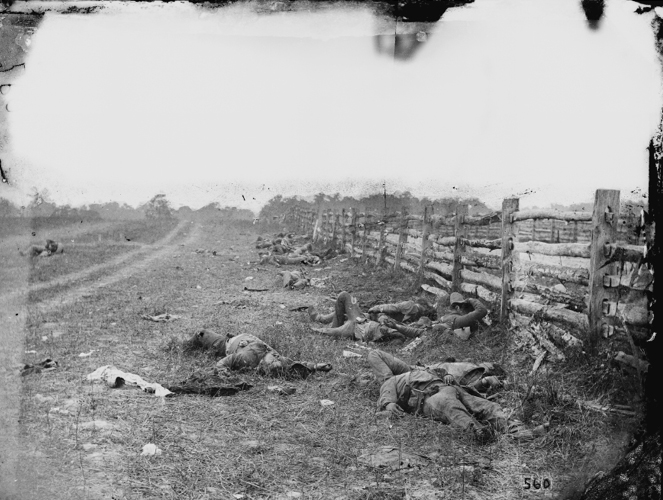
Confederate dead on Hagerstown Pike (Library of Congress)
Burnside in a crisis, whether emotional or military, lacked the intelligence and flexibility of mind to make rational adjustments to his plans or expectations. McClellan had made him a wing commander, and he was damned if he would accept any lesser role. However, when Burnside insisted that Cox command the corps in the upcoming action. Cox protested. Although he was the senior division commander under Burnside, his Kanawha Division was not formally a part of IX Corps. It was a fragment left over from the abortive Federal campaign against Jackson in the Shenandoah, back in April 1862. Cox and his staff (which was too small for the job) were therefore unfamiliar with the division and brigade commanders. Reno’s staff might have compensated for these deficiencies, but they had been allowed to leave the army to escort their general’s corpse back to Washington, a noble gesture but hardly responsive to the needs of an army in the field. As a result an already sclerotic channel of communication between McClellan and IX Corps now became even more problematic. When McClellan sent Burnside an order, Burnside would ponder its import and pass it on to Cox. Figuratively speaking, the headquarters of Burnside and Cox were now a pair of stools, between which orders and responsibilities could fall and be lost.
The most critical consequence of this inane arrangement was the failure of IX Corps staff to scout the terrain on the corps front. The infantry had been posted behind a ridgeline well back from the bridge, because the fields closer to the bridge were exposed to harassing fire by Rebel artillery. If IX Corps’ attack was to be timely and effective, its officers needed to know the lay of the land they had to cross, especially the land along the riverbank. The bridge itself was more of a bottleneck than a proper avenue of attack, twelve feet wide and overlooked by a steep hillside. Infantry trying to charge across it could have been shot like sardines in a can. Had it been defended in the kind of strength McClellan expected, IX Corps could not have done more than conduct a firefight across the stream, which was thought to be too deep near the bridge to be crossed on foot. However, there were a number of fords downstream, Snavely’s being the closest, by which troops could have crossed to outflank the bridge defenses. McClellan’s engineers informed Burnside that the ford existed, but neither he nor Cox ordered a reconnaissance to find out exactly where it was. That search would not be made until the troops went into action, and hours would be lost while local farmers were questioned as to its whereabouts. If IX Corps staff had done its job properly the ford would have been discovered on the night of the sixteenth, and a IX Corps attack, if promptly delivered, might have seriously threatened or broken Lee’s southern flank.
Yet despite all that McClellan got wrong—his false estimate of enemy strength, his obfuscated command structure, and his ill-conceived troop placement—if his plan had been properly executed it would have subjected Lee’s defense to unbearable pressure. Lee’s force was far from the 65,000 McClellan imagined, and on the morning of September 17 mustered no more than 36,000, and perhaps as few as 31,000, troops. McClellan had 60,000 troops immediately at hand, with another 12,500 from VI Corps on the march from Pleasant Valley and likely to arrive before midmorning. With that disparity of force, a sequence of strong attacks, made promptly one after the other—first on the northern flank, then on the southern—would have forced Lee to strip his center to the bare bones, making it vulnerable to a Federal breakthrough. However, the key words are “strong and coordinated.” Given the general advantages of the defense, the strength of Lee’s position, and his army’s advantage in command organization, McClellan would have to press his attacks with energy and power, committing much, if not all, of his reserve to the effort; and his attacks would have to be coordinated and mutually supporting, to offset Lee’s ability to shift his units (especially his artillery) along interior lines.