
PART FIVE
CHAPTER 16
SEPTEMBER 17–OCTOBER 1, 1862

SEPTEMBER 17 HAD BEEN THE COSTLIEST DAY OF COMBAT IN AMERICAN HISTORY, leaving twenty-five thousand Americans dead or wounded. That Lee’s army had retreated meant that the battle was a tactical victory for the Union. But the sound and fury, the immense cost in death, suffering, and grief, had not resolved the strategic crisis that began in the aftermath of the Seven Days. Hardly anyone was entirely happy with the result apart from George McClellan and his supporters. Lincoln had still not effected the strategic transformation envisioned in early July: the shift from a strategy of conciliation to a war of subjugation, in which restoration of the Union was linked to general emancipation—a shift that required the permanent sidelining of General McClellan. Victory at Antietam fulfilled one condition for issuing an emancipation proclamation, but that same victory also seemed to aggrandize McClellan, who opposed emancipation and was willing to use his power to thwart Lincoln’s policies.
MISSION ACCOMPLISHED: MCCLELLAN’S
HEADQUARTERS, SEPTEMBER 20–24, 1862
McClellan had cleared his front by defeating Robert E. Lee and saving Maryland from invasion. The rebuff suffered by Porter’s troops at Shepherdstown was of no consequence, since McClellan had no intention of taking the offensive until he had recuperated, resupplied, and reinforced his army. The setback was more than balanced by XII Corps’ seizure of Maryland Heights, a prelude to the repossession of Harpers Ferry that would be consummated two days later.
After September 20 McClellan’s military posture was passive, and though scouts and spies reported various Rebel movements, no serious effort was made to find out where Lee’s army was, or in what force. As late as the twenty-fourth of September, McClellan was unable to do more than surmise that Lee still held his main army in position to oppose a crossing of the Potomac. His chief military preoccupation was the telegraphic argument with Halleck over whether the army was being properly and promptly resupplied. There was some truth to his contention that the army needed resupply, and some real difficulty in achieving that when the forces were so far from their Washington base, without adequate rail links. But the argument was also an engagement in his ongoing war against Stanton.
IT WAS TIME to move decisively against the foe in his rear: his future would be “determined this week.” Through various friends, agents, and intermediaries in the capital he had insisted that Stanton must resign and Halleck “give way to me as Comdr in Chief.” (Presumably he meant general in chief.) “The only safety for the country & for me is to get rid of both of them.” The national interest and his personal fate were thus equated. He believed it was “now time for the country to come to my help, & remove these difficulties from my path.” Twice he had succeeded in “saving the country.” Now if his “countrymen” refused to meet his demands, “they must pardon me if I decline the thankless avocation of serving them.” What he now demanded of the people, and the government, was license to run the war with a free hand: “If I continue in its service I have at least the right to demand a guarantee that I shall not be interfered with.” This amounted to a demand for the kind of dictatorship that had been dangled before him since July 1861: exclusive control of war policy, without presidential or congressional interference.1
He believed that support for such an overturn was building. He had had a letter from Montgomery Blair, his ally in the cabinet, that assured him the President rejoiced in his victory, not least because it had vindicated McClellan, for whom (Blair said) Lincoln felt a genuine friendship. The governors of the Northern states were meeting in Altoona, Pennsylvania, to consider the state of affairs and the direction of administration policy, and make strong recommendations to Lincoln on the conduct of the war. McClellan believed that his supporters among the governors would use the occasion to “enable me to take my stand,” and support his demand “that Stanton shall be removed” and Halleck replaced by McClellan. The conference had been called by Governor Andrew Curtin of Pennsylvania, a Republican but also a long-time friend and ally of McClellan. Curtin was one of the most active and enterprising of the wartime governors, who raised 300,000 troops for the Union army, and sent them forward with the best training and equipment he could procure. He had met McClellan during the latter’s railroad-official days, had been impressed by his efficiency and professionalism, and had asked McClellan to take command of the state’s troops at the outbreak of war. He had publicly supported the general in the controversies of the past year, and during the Confederate invasion had frequently sought McClellan’s aid and advice. Other attendees would include Governor Tod of Ohio and D. G. Rose, representing Governor Morton of Indiana. Like Curtin, Tod and Martin were moderate or conservative Republicans, and had been opposed to a policy of general emancipation. Dennison was also a McClellan supporter, who had outbid Curtin for McClellan’s services in 1861.2
McClellan’s officers were aware of the potential significance of the conference, and hoped it might produce a more effective war policy, based on a rapprochement between the victor of Antietam and a moderate Republican president. General Jacob Cox, commander of the Kanawha Division, was not a member of McClellan’s inner circle. However, he had been a major figure in Ohio Republican politics before the war, and was in close contact with Ohio’s Governor Dennison during the governors’ conference. The two men deplored the estrangement between McClellan and Lincoln and believed that the two held comparable views on slavery, preferring gradual abolition to Radical ideas that were “imprudent and extreme.” Cox reached out to Colonel Thomas Key, thought by many Radicals to be McClellan’s “evil genius,” and was reassured on this score. Cox advised Key that if McClellan “would only rebuff all political intriguers and put more aggressive energy into his military operations,” there would be no quarrel with the administration, and “his career might be a success for the country as well as for himself.”3
But McClellan wanted more than a rapprochement. He wanted to force Lincoln to concede control of war policy, so that McClellan could substitute the “conservative” or Democratic program for the policy of Lincoln and his party. Through his personal advancement, the political opposition would gain control of public affairs. He believed that his battlefield triumph had restored his standing with the public as the republic’s preeminent military leader. There was enough adulation in the Democratic press, as McClellan read things, to more than offset the carping of Republican journals over Lee’s escape. Harper’s Weekly, the popular illustrated magazine which called itself “A Journal of Civilization,” praised him in terms that perfectly mirrored his own self-image:
Once more we hail thee, Chief! The nation’s heart,
Faint and desponding, stricken to the dust,
Turns back to thee with the old hopeful trust,
And childlike confidence, and love. Thou art
Our chosen Leader. We have watched thee well,
And marked how thou hast borne the taunts and sneers
Of those whose envious falsehoods harmless fell
About thine head; how, unmoved by their jeers,
Thou hast toiled on with patient fortitude,
Winning from all the Legions under thee
A love which is almost idolatry;
Thy one sole aim thy Country’s greatest good.
Press on, young Chieftain, foremost in the van!
The Hour of need has come—be thou the Man!4
Democratic Party leaders and activists began showing up at McClellan’s headquarters, as they had done during a similar lull on the Peninsula. General William “Baldy” Smith recalled that after one of these visits McClellan called him aside and told him that Fernando Wood and the other Democratic leaders had renewed an offer made to him on the Peninsula early in the summer: to support him for the presidency in 1864 if he would issue a statement laying out his own prescription for how and for what purposes the war should be conducted. Smith was an old friend, a fellow engineer who had graduated West Point one year before McClellan and served with him in Mexico. He had been an effective brigade commander on the Peninsula and had been promoted to division command in VI Corps, led by McClellan’s close protégé William Franklin. Months before, Smith had warned McClellan against that kind of political confrontation with the president. Now he thought McClellan was feeling him out to see where his loyalties lay in what promised to be a dangerous political conflict. Smith response was to say nothing, and ask for a transfer out of the Army of the Potomac.5
Despite the reassurances he had received from Colonel Key, General Cox found some of the headquarters talk disturbing and vaguely conspiratorial, suggesting “disloyal influences at work.” Some days after the battle McClellan invited his senior officers to a religious service and social gathering at the Keedysville headquarters. The prayer service was offered in the open, in a space framed by the big tents that housed the general and his staff. At the reception afterward, Cox noted the presence of a number of civilians, one of whom singled Cox out for what at first appeared a casual conversation. John Garrett, president of the Baltimore and Ohio Railroad, praised McClellan in terms that drew Cox’s loyal assent. The civilian then accused “the politicians in Washington [of] wickedly trying to sacrifice the general, and added, whispering the words emphatically in my ear, ‘But you military men have that matter in your own hands, you have but to tell the administration what they must do, and they will not dare to disregard it!’ ” This “roused” Cox, with its implication that the army should turn against the elected government. Garrett seemed shocked, and “mumbled something about having taken me for an acquaintance of his, and moved away among the company.” Cox later saw the man in close conversation with Fitz-John Porter, seemingly questioning him about who Cox was and where his sympathies might lie.6
MCCLELLAN SOON DISCOVERED that his position was not as impregnable as, in his view, it ought to have been. It seemed that Antietam was not regarded as self-evident proof of McClellan’s indispensability. Although the press had hailed the news of McClellan’s victory as a triumph, praise for his achievement was almost immediately leavened with criticism for the inaction that allowed Lee’s army to escape. Even among McClellan’s officers there was dismay at his failure to act. Franklin loyally set aside his own disappointment and admitted he was “not sorry” his attack order was rescinded, because so many veteran formations had been used up by the fighting. But others remained troubled, and their opinions were picked up by the reporters who came swarming out to the battlefield.7
Reporter George Smalley of the New York Tribune set the terms for the journalistic coverage of the battle. He had ridden to Frederick on the night of the seventeenth to telegraph his story to the Tribune. The telegrapher sent it to the War Department by mistake, and gave Stanton and Lincoln their first information about the fight. Stanton had forwarded the dispatch to New York, and it appeared in the Tribune on September 19. Smalley’s extensive, detailed, and vivid story of the fighting was the first published account of the battle, and its fair-minded treatment of McClellan gave it broad credibility despite its appearance in a Radical journal. Although Smalley detailed some of the tactical errors that marred McClellan’s performance, he presented the battle as a great and hard-won victory. He also stated his belief that an even greater triumph could be expected when, not if, the battle was renewed next day. By the time the dispatch was published both the War Department and the public knew that McClellan had not attacked on September 18, and that by the nineteenth Lee was safe across the Potomac. Thus Smalley’s account justified the Tribune editorial assertion that September 18 was a “fatal Thursday” because McClellan had refused to attack and destroy the Rebel army. Greeley’s front-page headline treated McClellan’s claims of victory with contemptuous sarcasm: “Retreat of the Rebels . . . They Run Away in the Night Again . . . Stonewall Jackson Dead Again.”8
Democratic newspapers affirmed the judgment that an opportunity had been wasted, though they blamed Stanton rather than McClellan. But the charge lacked force. McClellan, not Stanton, had been the man on the scene. He had pinned the elusive and dangerous Rebel army in a vulnerable position, with the whole Army of the Potomac in its front and a wide river with few crossing points at its back. That situation was obvious to everyone, from officers and men at the front, to the high command in Washington, to the civilian reader scanning the sketch-maps published by the newspapers. Under such circumstances it was to be expected that some attempt should be made to beat Lee from his lines and drive his army into the river.
More ominous was the fact that since September 15 McClellan had received no communications from the president—neither of congratulation nor complaint. His last word from Lincoln was the injunction following South Mountain to “destroy the enemy if possible.” On September 21 he wrote Mary Ellen that he expected such ingratitude and dismissed it; but Lincoln’s silence rankled, and he thought it a sign that new “persecutions” might be in store. He therefore sent a confidential agent to Washington, to make inquiries and even to “shadow” the president, to find out how his struggle with Stanton was playing out. That agent was Allan Pinkerton, nominally chief of intelligence for the Army of the Potomac, who would bring to this task the same powers of analysis that led him to overestimate Lee’s army by some 200–300 percent.
Pinkerton’s shadowing of the president seems not to have gone unnoticed. On September 22 Lincoln invited the chief of intelligence to his office for a chat. The president questioned him closely about the fighting and conditions at the front, but he assured Pinkerton he was not looking to find fault with anything McClellan had done; nor, as Pinkerton reported to his chief, was Lincoln fishing around “for the purpose of seeking aught against you.” Lincoln expressed his sense of profound gratitude, of a debt greater than could be repaid, for the great victories at South Mountain and Antietam. It was just that he wished to inform himself of some matters “which he supposed, from the pressure on your mind, you had not advised him on or that you considered was of minor importance, not sufficiently worthy of [presidential] notice.” Lincoln pressed Pinkerton closely about what McClellan had been doing to pursue or pressure the enemy since his victory on the seventeenth, and charmed the master detective into revealing how little had been done. Pinkerton went away filled with reassurance for his employer: “He expressed himself as highly pleased and gratified with all you had done,” even “commending your caution.”9
Lincoln was laying it on thick for the gullible Pinkerton, who was disarmed by his belief that the president was not very intelligent. Lincoln’s real evaluation of McClellan’s performance was expressed shortly after he ushered Pinkerton out of his office and crossed the hall to join a special session of the full cabinet. He had called this meeting to show them the text of a Preliminary Emancipation Proclamation, which he would sign and issue that afternoon. He told his colleagues, “The action of the army against the rebels has not been quite what I should best have liked.” He had wanted and expected Lee’s army to be destroyed. However, “they have been driven out of Maryland,” and that was victory enough to meet the conditions he had set for issuing a proclamation emancipating slaves in Rebel-held territory.
LINCOLN’S PROCLAMATION
SEPTEMBER 22–24, 1862
Lincoln presented this final draft just as he had presented the first back on July 22, as a settled decision, made by himself. The cabinet’s views were welcome but their consent was neither courted nor required. He might have explained his decision by reminding them of Seward’s political advice, which he had accepted, to delay the Emancipation Proclamation until a victory had been won. Instead he characterized his decision in religious terms. He had (he said) “made a vow, a covenant, that if God gave us the victory in the approaching battle, he would consider it an indication of divine will and that it was his duty to move forward in the matter of emancipation. It might be thought strange that he had in this way submitted the disposal of matters when the way was not clear in his mind what he should do. God had decided this question in favor of the slaves.” It was not at all unusual for Americans of that time to prayerfully beg signs of God’s will, but it was unusual for Lincoln. His closest aide, John Hay, was not aware that Lincoln experienced a spiritual crisis during the week preceding Antietam, although he had been thinking intensely about emancipation and making significant revisions in his original draft. The revised document was revolutionary in its assumption of power and its potential effects, and Lincoln may have wanted more authority for his presumption than mere political calculation.10
Lincoln had used the three months delay to make the Proclamation more radical. The most revolutionary aspect of the Proclamation was still its assertion and expansion of presidential powers in wartime. At the start of the war it had not been clear what kind of authority was actually conferred by the constitutional designation of the president as “commander-in-chief of the armed forces.” Congress had challenged Lincoln’s authority to control war policy and even military appointments, and army officers had treated Lincoln’s orders as if they were merely advisory. Now Lincoln was asserting that as commander in chief, he had the power to confiscate en masse the property of citizens inhabiting rebellious districts, without judicial or criminal proceeding to determine theirpersonal affiliation (or lack thereof) with rebellion. At a stroke of the pen some $3.5 billion in property was legally annihilated—this at a time when national GDP was less than $4.5 billion, and national wealth (the total value of all property) was about $16 billion. In purely economic terms, this was an expropriation of property on a scale approaching that of Henry VIII’s seizures of church properties during the Reformation, exceeded only by the nationalization of factories and farms after the Bolshevik Revolution.11
The new draft was also more radical in its challenge to the legal and social premises of White supremacy. The original draft had sought to alleviate racial fears by stressing the necessity for a program of colonization, to remove most if not all freed slaves from American territory. In the final draft, colonization is mentioned as a worthwhile project but not greatly stressed. Instead the legal language was strengthened to guarantee that any slaves freed by the Proclamation could not be reenslaved by any postwar court decision.
Two codicils, which were not in the first draft, had especially radical implications. One of these enjoined Blacks freed by the act “to abstain from all violence, unless in necessary self-defense.” This was intended to mollify those in the North and especially in England who feared that general emancipation would be the signal for a “servile insurrection.” However, as conservatives were quick to note, by suggesting that Blacks could use violence for self-defense, the Proclamation attacked the fundamental principle of plantation law and discipline, which not only forbade the slave to resist punishment or even abuse by a legal master, but also prohibited an appeal to either the civil or the criminal court. That principle was most clearly stated by Justice Thomas Ruffin, of the North Carolina Supreme Court, in a precedent-setting 1829 case. “The slave, to remain a slave, must be made sensible, that there is no appeal from his master; that his power is in no instance, usurped; but is conferred by the laws of man at least, if not by the law of God.” By conferring a right of self-defense on the slave—a right whose exercise civil law could test and justify—Lincoln had negated the fundamental law of slavery.
A second and more obviously radical addition was the declaration that slaves freed by the Proclamation “will be received into the armed service of the United States.” The Proclamation thus granted Blacks the civil right to join in the common defense—a right thatnone of the free states then recognized. By extending that right to African Americans through the use of Federal power, Lincoln fundamentally altered the civil status of Blacks in the north, setting a precedent and stimulating a political movement for equal citizenship. From a military perspective, this was the most significant element of the proclamation. Ultimately it would bring 180,000 African Americans into the ranks. Black troops would provide roughly 9 percent of the two million total Union armies enlistments, and their actual contribution was significantly greater, since these enlistments were concentrated in the last two years of the war, when the total strength of the Union armies varied between 700,000 and one million men.12
The Preliminary Proclamation had the form of an ultimatum: its provisions would not take effect if Southern leaders ended the rebellion by January 1, 1863. The conservative New York Herald, which was opposed to emancipation in principle, actually supported the Preliminary Proclamation in the hope that its menace would bring the South to the negotiating table.13 But Lincoln did not expect the mere threat of emancipation to induce Southern leaders to sue for peace and reunion. The January 1 deadline had been laid down in the first version of the Proclamation, and presented to the cabinet on July 22, when the South would have had nearly six months to consider acquiescence. Three months later the deadline was unchanged, which gave the South only three months to respond. Lincoln understood very clearly that the Proclamation would harden the South’s will to resist, and that the war could not in future be prosecuted as anything but a war of subjugation and a “remorseless revolutionary conflict.” For that reason it was accompanied by other draconian measures. On September 24, two days after issuing the Proclamation, the president authorized suspension of the writ of habeas corpus anywhere in the country, which allowed the arrest and detention of those accused of being Confederate agents or sympathizers, and the suppression of newspapers for “sedition.”
The cabinet meeting on September 22, and the actions that followed, transformed the politics of the Union war effort. It remained to be seen whether the military leadership was prepared to fight a war of subjugation. Lincoln and his closest advisers were most deeply concerned about how General McClellan would respond to this radical turn in policy. His opposition to emancipation and subjugation were of long standing and well known. His political support was also so formidable that for weeks the administration had been fending off demands in Congress and the press for purging Stanton from the cabinet.
Lincoln and his circle of advisers were also aware that officers close to McClellan, and leaders of the Democratic opposition, had discussed the desirability of somehow using McClellan’s control of the army to force a change in the personnel and policies of the administration. Generals Burnside and Halleck had heard that kind of talk from McClellan’s staff when they visited Harrison’s Landing in late July, and though neither made a formal report, they must have discussed the experience with colleagues. Rumors of plots and counterplots were rife in Washington; as Charles Francis Adams had said, the atmosphere was “thick with treason.” A very explicit threat had been communicated to Tribune reporter Nathaniel Paige by Colonel Thomas Key back on September 11: that high officers of the Army of the Potomac were planning to “change front on Washington,” take control of the government, and negotiate a settlement favorable to Southern independence. On the twelfth and thirteenth the Tribune had published a pair of editorials that warned of “a conspiracy between the chiefs of the Rebel and Union armies to subvert the Republic and establish a Pro-slavery despotism on its ruins” and accused the Herald of urging “Gen. McClellan to disperse [Congress] with the bayonet, after the fashion of Cromwell and Bonaparte.”14
Lincoln’s confidential secretary, John Hay, believed that there was indeed a “McClellan conspiracy” within the military, which deliberately thwarted presidential policies and aimed to discredit and ultimately displace the administration—though McClellan himself might not be its conscious agent. Lincoln considered McClellan’s refusal to aid Pope an “unpardonable” breach of faith but was uncertain whether his motives were political or driven by ambition and personal pique. Within the cabinet, only Montgomery Blair thought McClellan both loyal and capable. Otherwise, opinion ranged from Stanton and Chase’s conviction that McClellan was a conscious traitor to Welles’s more temperate view that he was merely selfish and ineffective. By any of these interpretations, McClellan was untrustworthy.15
The administration’s suspicions came to a head on September 25. On that day Interior Secretary Caleb Smith received a report from Judge Advocate Levi Turner, of Halleck’s staff, on a conversation he had had with a colleague, Major John Key. Turner had expressed “his surprise that McClellan had not followed up the victory last week by pursuing the Rebels.” Key had replied that to do so would have been against “the policy” of the army command, which was “to compel the opposing forces to adopt a compromise by stringing out the struggle till both were exhausted.” Then military leaders would assert themselves and demand a negotiated settlement. Thus “it would have been impolitic and injudicious to have destroyed the Rebel army, for that would have ended the contest without any compromise.” Major Key presumably knew whereof he spoke, since he was the brother of Colonel Thomas Key, of McClellan’s staff—the same man who, on September 11, had warned, and perhaps implicitly threatened, Tribunereporter Nathaniel Paige with his talk of a military coup. Within twenty-four hours Judge Turner’s story was known to both Navy Secretary Welles and to President Lincoln himself. After discussing the matter with John Hay on the evening of the twenty-fifth, Lincoln ordered the case investigated, “and if any such language had been used, [the officer’s] head should go off.” But when Hay sought to frame the episode as part of “the McClellan conspiracy,” Lincoln ended the discussion. “He merely said that McC. was doing nothing to make himself either respected or feared.” It is not clear whether Lincoln refused to credit the reality of conspiracy, or for political reasons refused to acknowledge its existence—since to do so would provoke a direct and dangerous confrontation between the civil and military authorities.16
However, the Key affair, which played out on September 26–27, may have tilted the balance of suspicion against McClellan. Lincoln had reason to think that what Key had said reflected views expressed at McClellan’s headquarters, and Key and Turner were summoned to Lincoln’s office on the twenty-sixth. Turner told the president that he had “asked the question why we did not bag them after the battle at Sharpsburg.” Major Key had answered that “that was not the game, that we should tire the rebels out, and ourselves, that that was the only way the Union could be preserved, we [North and South] come together fraternally, and slavery be saved.” Lincoln personally cross-examined both men and concluded: “In my view it is wholly inadmissible for any gentleman holding a military commission from the United States to utter such sentiments as Major Key is . . . proved to have done.” Key was summarily dismissed from the service, not just for his own misdeeds but as “an example and a warning” to “a class of officers in the army, not very inconsiderable in numbers, who were playing a game to not beat the enemy when they could, on some peculiar notion as to the proper way of saving the Union.”17
It is most unlikely that McClellan was playing the game described by Major Key. The idea assumes that McClellan had the skill and courage to toy with Lee’s army, feeling assured that he was too strong to be defeated. How, then, to account for Major Key’s statement? It was far too dangerous a thing to say unless Key thought it both true and worth saying. Perhaps it did reflect a thread of opinion among the staff about the way the war was going or ought to go. Or it may have been Key’s way of rationalizing a series of otherwise egregious military errors by his admired chief.
What is significant in all of this is the fact that McClellan’s past behavior, his obstructionism and displays of rancor, his public and private expressions of contempt for the administration, made plausible the belief that McClellan was playing a double game, pretending to seek victory when in fact his purpose was to postpone decisive action until he had won political control of the administration; or to deliberately seek stalemate rather than victory, so that in mutual exhaustion North and South would reconcile on terms of compromise favorable to slavery and “Southern rights.” How else explain his pattern of skillfully maneuvering to create opportunities, then refusing to use all of the forces at his disposal to exploit them? For Lincoln that question was unavoidable, and the choice of answers was stark. Either McClellan’s motives were disloyal, or he was a military incompetent; and either of these possibilities constituted good grounds for relieving him of command.
However, to fire him now would vitiate the good political effects of the victory and provoke a military crisis while public opinion was still disordered by the Emancipation Proclamation and the suspension of habeas corpus—all on the eve of the midterm elections. Although there was some disappointment, even in Democratic papers, that McClellan had failed to trap and destroy Lee’s army, the victory enhanced the general’s standing with the army and the country. Antietam had, at least, checked what had seemed an unending series of defeats inflicted by Lee and Jackson. The general was still an idol to most of his army and to the Democratic opposition, and McClellan still had support among moderates and conservatives in Lincoln’s own party. Evidence of the latter was on display at the Altoona governors’ conference, where Republicans Curtin of Pennsylvania and Tod of Ohio joined Democrat Augustus Bradford of Maryland to block a resolution sponsored by Radical governors to condemn McClellan’s leadership and call for his removal.18
So to weaken McClellan’s position, Lincoln and John Hay began feeding criticism of the general’s performance to Republican journals. One of Lincoln’s favorite criticisms of McClellan—that he was “an auger too dull to take hold”—started popping up (without attribution) in the Tribune.19 Lincoln also authorized John Hay to begin a secret journalistic campaign to expose McClellan’s flaws as a general, thus preparing the public mind for a possible removal. Hay’s method was one Lincoln had often used against opponents in the path: he satirized the general, deflating him by ridicule.
In an article first published anonymously in the Missouri Republican on September 30, Hay began by giving McClellan his due for having rallied the army after Pope’s defeat, and by denying the “outrageous slanders of treachery, cowardice” leveled against the general. However, his record of hesitation and failure can only be explained by “an inherent vice of mind . . . which makes him never ready to act.” Having beaten Lee at Antietam, “while all the world looked on and cried, ‘Bravo! God bless you, General!.’ he sat absolutely motionless on the field of battle, not sending out a picket or firing a gun till the beaten and routed enemy had safely crossed the Potomac.” To cap his critique, Hay mockingly compares McClellan to Stonewall Jackson—the “chivalrous and accomplished soldier” contrasted with “the shaggy, unkempt fanatic.” Jackson’s rapid marches and audacious attacks had violated every precept of military science, while McClellan’s operations have “never once offended against the masters who have written of war.” Yet what had been the result? “[O]ut of Jackson’s audacious follies and aimless blundering energy has grown success and honor to rebel arms, while our careful and scientific strategy has landed us, after a year’s hard fighting, at the place where we began.”20
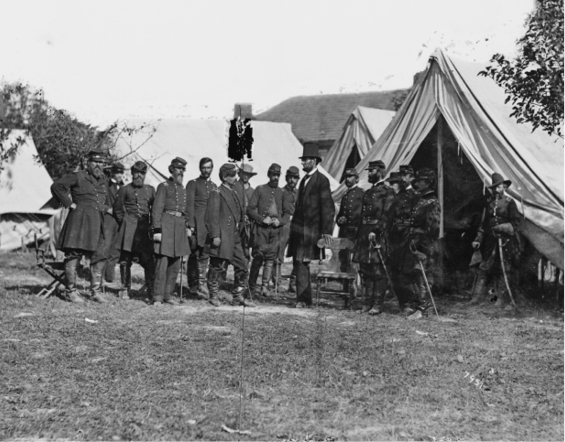
On the day Hay’s article appeared, the president decided to visit McClellan’s army at Sharpsburg, to see and judge for himself the condition and temper of the army and to learn what he could about McClellan’s plans and state of mind. When one considers the context of the visit, the disaffection of the officer corps revealed by the Key case, and the rumors of a planned “countermarch” on Washington, it might have seemed dangerous to go unarmed into McClellan’s camp. It did not seem so to Lincoln. His judgment of McClellan’s weakness as a commander was set, his suspicions of McClellan’s motives strengthened by the Key affair. But he did not think McClellan capable of actually staging a coup, and refused to act as if such a thing were possible.
Had Lincoln been aware of the discussions at McClellan’s headquarters that preceded his visit, he might have rated the dangers higher.
“LARGE PROMISE OF A FEARFUL REVOLUTION”: MCCLELLAN’S HEADQUARTERS
SEPTEMBER 24–OCTOBER 1, 1862
McClellan first learned of the president’s Emancipation Proclamation on September 24, to be followed shortly by word of the suspension of habeas corpus. The manner of discovery must have been almost as galling as the matter. Just the day before Pinkerton had reported on his meeting with Lincoln and conveyed the president’s assurances of his esteem and support. Now it was obvious that Lincoln had deliberately hoodwinked Pinkerton to surprise McClellan with this radical turn in policy. These two presidential proclamations represented Lincoln’s final and complete repudiation of the principles McClellan had laid down for his guidance in the Harrison’s Landing letter. McClellan had demanded assurance that slavery would be left alone—Lincoln had opted for general emancipation. McClellan had demanded strict limits on military actions against the rights and property of Confederate civilians—Lincoln had not only expropriated Southern property en masse, he had extended the military power of arrest and confiscation into the North. This political defeat was far more decisive than the military reverse he had inflicted on Lee.
The results of the war governor’s conference in Altoona were also disappointing. McClellan’s allies had defended him against attacks by Governors Andrew of Massachusetts and Sprague of Rhode Island—Sprague had actually called Antietam a “defeat,” because Lee had outmaneuvered McClellan. But the Conference also approved the Emancipation Proclamation and sent a delegation to the White House to make a public gesture of their endorsement.21
McClellan was outraged but at a loss how to respond. In a letter of September 25 he told his wife that “the continuation of Stanton & Halleck in office render it almost impossible for me to retain my commission & self respect at the same time. I cannot make up my mind to fight for such an accursed doctrine as that of servile insurrection. It is too infamous. Stanton is as great a villain as ever & Halleck as great a fool—he has no brains whatever!” But he could not bring himself to resign in protest. The Army of the Potomac was his creature, his family, his base of support, his instrument of power. If he left it, he would be helpless to affect the course of events. Was it possible to retain his command and still oppose the president’s policy?
McClellan discussed possible responses to the proclamation with his closest confidants on September 24. The tenor of their discussion may be indicated in a letter of that date sent by a Herald reporter to publisher James Gordon Bennett. The reporter had spoken with a number of officers, presumably at headquarters, who told him, “The sentiment throughout the whole army seems to be in favor of a change of dynasty.” If these men were indeed typical of the Potomac officer corps, “there is large promise of a fearful revolution . . . that will startle the Country and give us a Military Dictator.”22 McClellan’s own response was more controlled and tactically cautious. On September 26, he wrote to William Aspinwall, his close friend and political ally, asking him to sound out the Democratic Party leadership in New York City to see whether they would support him if he were to openly oppose the two proclamations. The tone of this letter sets it apart from the rest of his correspondence with Aspinwall, which had always been very personal and informal. This letter has the rhetorical tone of a political manifesto:
I am very anxious to know how you and men like you regard the recent Proclamations of the Presdt inaugurating servile war, emancipating the slaves, & at one stroke of the pen changing our free institutions into a despotism—for such I regard the natural effect of the last Proclamation suspending Habeas Corpus throughout the land.
I shall probably be in this vicinity [Sharpsburg] for some days &, if you regard the matter as gravely as I do, would be glad to communicate with you.23
McClellan charges Lincoln with the gravest of political offenses, akin to treason: the wish to overthrow constitutional government and establish a despotism. On that score, Lincoln’s policy is morally and politically equivalent to Southern secession. Indeed, Lincoln’s policy may represent the greater menace: a successful secession would leave the constitution intact in the North, while the triumph of Lincoln’s policy would destroy republican government North and South. How should such a threat be answered? The ordinary procedures of civil government are inadequate in such a crisis. Lincoln had responded to secession by going to war, and stretching the constitution to conduct it. Perhaps Aspinwall could suggest ways of using civil procedures to defeat Lincoln’s radical initiatives. But at the moment Lincoln and his party controlled Congress; litigation before the Supreme Court was slow and uncertain, and Lincoln had already defied the Court’s injunction against arresting secessionist legislators in Maryland. To defeat Lincoln’s reach for despotism, exceptional measures might be justified. The classical models of Roman history, familiar to McClellan, Aspinwall, and all educated men, offered examples of great men who had overthrown the existing government and assumed temporary dictatorship in order to save liberty and republican government.
In his moments of rage and frustration, McClellan had thought about using the army, his “military family,” as an instrument for bringing power to bear on the policies and indeed the political structure of the administration. He and his officers had talked loosely of a countermarch on Washington. But to attempt something of that kind was not only to risk political and military disaster but to go against the grain of national tradition, to violate the sacred principles of constitutional government that McClellan genuinely revered. Perhaps something short of that would suffice: a statement representing the army’s opinion of the proclamations and its desires for future policy, a sort of “Grand Remonstrance,” like the petition of grievances with which Parliament challenged the authority of King Charles I—but originating in the army rather than the Congress. However, such a statement issued from army headquarters would be seen as a military challenge to the supremacy of the civil government. McClellan was not prepared to make so radical a move without considering the range of possible alternatives, with their attendant risks and the consequences.
The dangers of opposition were brought home by another letter from Postmaster General Montgomery Blair, the lone dissenter at the September 22 meeting and McClellan’s only ally in the cabinet. The Blair family led the conservative faction in Lincoln’s party, and they supported McClellan not only as a conservative counter to Stanton and Chase in the making of war policy but also as an ally in helping them preserve what Blair would later call “this exclusive right of government in the white race.” On September 27, Blair secretly wrote to McClellan, warning him of the damage the Key affair had done to his standing with Lincoln and urging him to “clarify” his views on slavery, which Blair supposed were not unlike his own: disapproving the institution on moral and political grounds, wishing its gradual disappearance, but opposed to sudden or wholesale abolition. This was followed by another letter three days later from Francis P. Blair Sr., a political elder whose prestige dated from his service in Andrew Jackson’s presidency, urging McClellan to accept the Proclamation as a necessary war measure. Such a public gesture was, in Blair’s view, the only way to end those “attacks from the rear” that threatened McClellan’s command. However, to make matters more complicated, McClellan was also receiving mail from conservative Democrats who were not interested in the kind of compromise advocated by the Blairs. These men asked McClellan to clarify his views on the Proclamation, with the expectation that he would join them in resisting or reversing it.24
McClellan therefore extended his consultations beyond the circle of close confidants that included his staff and Fitz-John Porter. On or about September 27 he summoned Generals Burnside, Cox, and Cochrane to a meeting to ask their advice about “the course he should pursue respecting the Proclamation.” The three officers approached the meeting warily: they were all Republicans and known supporters of the Lincoln administration, and well aware that McClellan was considering an open breach with the president over the Emancipation Proclamation.
They met privately after dark in his big headquarters tent, with no aides present. McClellan tried to put them at ease by declaring that he wanted their advice precisely because they were “friends of the administration”—and not identified with the Radicals. He said frankly that he knew in advance that they “would oppose any hostile demonstration on his part.” He wanted them to know that he had no desire to make such a demonstration. Rather, he had been “urged to put himself in open opposition to it by politicians not only, but by army officers who were near to him. He named no names, but intimated that they were of rank and influence which gave weight to their advice.”
As Cox remembered it, the three generals first asked his opinion about the issue addressed by the Emancipation Proclamation: the continued existence of slavery. For them, as Republicans, this was the critical question: whether McClellan finally accepted the principle that slavery must be put in the way of ultimate extinction. McClellan’s answer was equivocal. He agreed that the institution must eventually be extinguished, but said that it was somehow better for that to happen piecemeal, as the army advanced, rather than by systematic change. However, he was convinced “that the Proclamation was premature, and that it indicated a change in the President’s attitude which he attributed to radical influences at Washington.”
Cox and his colleagues immediately, and without prior consultation, told him “that any declaration on his part against the Proclamation would be a fatal error . . . that any public utterance by him in his official character criticizing the civil policy of the administration would be properly regarded as a usurpation.” That told McClellan that the Republicans in his army would reject any open opposition to the president; and if the mere expression of hostile views was “usurpation,” then any physical manifestation of opposition, let alone a march on Washington, was clearly forbidden.
Nonetheless, McClellan pressed the question by posing it in the form of a denial. He “intimated” that he agreed with their view that open criticism was akin to usurpation, but said that the idea was continually being “thrust at him by others.” As an example of this, he told the three generals “that people had assured him that the army was so devoted to him that they would as one man enforce any decision he should make as to any part of the war policy.” He was, in effect, asking whether these Republican generals thought the army would follow him if he were to come out in opposition to the government or its policy. Cox responded:
that those who made such assurances were his worst enemies, and in my judgment knew much less of the army than they pretended; that our volunteer soldiers were citizens as well as soldiers, and were citizens more than soldiers; and that greatly as I knew them to be attached to him, I believed not a corporal’s guard would stand by his side if he were to depart from the strict subordination of the military to the civil authority.
McClellan answered “that he heartily believed both that it was true and that it ought to be so”—a curious way to put the case, which left the suggestion that neither proposition was entirely valid. However, he was still concerned about “an agitation in the camp on the subject, and intrigues of the sort [he] had mentioned.” Did they not think it well for him to issue an order reminding the army “that whatever might be their rights as citizens, they must as soldiers beware of any organized effort to meddle with the functions of the civil government”? The question suggested a broader agitation against the Proclamation than actually existed. Cox, Burnside, and Cochrane agreed that this was a good idea.25
Although talk about dictatorship persisted among the staff and in the press, McClellan himself made no further allusions to it in private correspondence and took no action to achieve it. Nevertheless, he was not ready to abandon the idea of taking a public stance in opposition to the Proclamation, thereby making himself the symbolic center of opposition to the administration. He made no answer to the appeals of Montgomery and Francis Blair Sr. for a reconciliation with Lincoln. Instead, Fitz-John Porter, acting on McClellan’s behalf and probably at his request, reopened his correspondence with Bennett of the Herald and Marble of the World. What had been a campaign against Secretary Stanton was now an effort to discredit the whole administration. For the moment theHerald accepted the Proclamation on the presumption that it was an ultimatum that the South, following Lee’s defeat at Antietam, might accept. But the World had immediately rejected it as proof Lincoln had been “coerced by the insanity of the radicals” into a violation of his pledge that “this was not to be a war of subjugation.” Confederate leaders “will make of this proclamation a moral weapon . . . [and] strengthen the determination of the rebels to fight to the very last.”26
On September 30, Porter wrote to Marble, justifying McClellan’s reasons for not pursuing Lee after Antietam, blaming Stanton and Halleck for the inefficiency and malfeasance that slowed the army’s resupply. All of these points would be reflected in theWorld’s coverage of army affairs over the next two months. Porter then characterized the army’s reaction to the president’s Proclamation, which was “ridiculed” and “caused disgust, discontent, and expressions of disloyalty to the views of the administration amounting, I have heard, to insubordination.” In fact, while many enlisted men were opposed to the measure, the only part of the army in which such extreme views were prevalent was McClellan’s headquarters.27
Porter went on to provide Marble with a full account of what we might call McClellan’s platform. Radical policy should be repudiated. Instead, “We must show by a conservative reign that there is no intention to oppress [the South].” Such a “reign” would conciliate the South, and see “the opinion of [its] people softened, the poor enlightened and a new reign established and before summer returns, peace reigns all over the country.” The dictatorial connotations of the word “reign” are given substance by Porter’s insistence that to achieve all this, “[t] here must be a conservative political policy, a military General-in-Chief who is honest” and who insists on “exclusion of politics from the military sphere”—by which he meant that the civil executive and Congress would have to give McClellan a free hand: “But it must be done under McClellan’s mind—not the present chief.”28 The identity of the “present chief” is a little ambiguous. Porter seems to be talking about Halleck, the present general in chief who must give way to McClellan. But Porter also took aim at the commander in chief, condemning Lincoln as “a political coward . . . who holds in his hands the lives of thousands and trifles with them,” undoing their hard-won gains by issuing his “absurd proclamation.”29
Porter does not explain how a McClellan “reign” would produce peace within the year. McClellan’s earlier statements suggest that he would have continued to follow the “conciliation” strategy that had prevailed at the outset of the conflict. He would seek to win a decisive battle at Richmond, which would convince Southern leaders that the cost of continued rebellion would be prohibitive. He would offer carrot-and-stick inducements for the South to accept a restoration of the Union, by limiting emancipation to the terms of the Confiscation Act. Only the slaves of active Rebels would be freed, and then only if they were still in arms when the districts they inhabited were actually occupied by Federal troops. The threat of confiscation in this form would give slave owners in the deep South a motive for accepting an early peace, before Northern armies could invade their districts. Implicit in this program was the necessity of reaching some type of compromise settlement of the central issues of the war, the supposed state’s “right of secession” and the future of slavery. McClellan offered no specific proposals but was on record as supporting the compromises offered by Democratic senator John Crittenden of Kentucky, with the support of Stephen A. Douglas, in the weeks before the firing on Fort Sumter. Their proposals included constitutional amendments precluding abolition by the central government; permitting slavery in any new territories acquired southward of the old Missouri Compromise line; and perhaps the recognition of Southern autonomy within the Union—for example, by giving its states the power to veto Federal legislation.30
In effect, Porter’s letter was a response to the urging of New York’s Democratic leaders that McClellan declare his positions on the critical political questions facing the nation and the party. McClellan could not make such a statement himself without transgressing his subordination to the civil authority. With this in hand, men of influence like Belmont, Barlow, Aspinwall, and Wood could organize Democratic support for his present continuation in command and advancement to general in chief and for, in the longer term, his presidential candidacy in 1864.
The day after Porter posted his letter to the World, Lincoln arrived at Sharpsburg to meet with McClellan.