
Aspromonte: Site in southern Calabria where Garibaldi and his followers were stopped from marching on Rome by Italian troops in 1862.
Brigandage: Term which the Italian government used to describe the resistance to its authority in the decade after proclamation of the Italian Kingdom (1861) in the provinces carved out of the former Kingdom of the Two Sicilies. A brutal repression was used to pacify the region.
Carbonari: The best known of the secret societies which opposed the treaties of 1815 and worked for revolutionary change in the peninsula. The Carbonari played a key role in the revolutions of 1820–21, and 1830 in Italy, but failed in their attempts to push out the Austrians and unite Italy.
Carlo Alberto (1798–1849): During the revolutionary upheaval of 1821 while serving as Regent he conceded a constitution for which he was called to task by his uncle, the King, Carlo Felice. He assumed the throne in 1831 and in 1848 granted the Piedmontese a Constitution or Statute His defeat by the Austrians during the First War of Italian Liberation (1848–49) led to his abdication and exile.
Cavour, Count Camillo di (1810–1861): Known as ‘the brain’ of Italian Unification, this aristocrat served as the architect of unity. He entered the Cabinet in Piedmont in 1850 and in 1852 became Prime Minister, following his connubio or political alliance with Urbano Rattazzi. After the Crimean War he presented the Italian case at the Congress of Paris (1856) and at Plombières (1858) he obtained Napoleon III’s support for a War against Austria. Following the Franco-Piedmontese war against Austria (1859), his scheming with revolutionaries in Central Italy, and the expedition of Garibaldi (1860), the Kingdom of Italy was proclaimed in 1861.
Civiltà Cattolica: This semi-official review of the Papacy run by the Jesuits was founded by Carlo Curci in 1850. Established initially in Naples, it subsequently moved to Rome.
Connubio: This ‘marriage’ or political alliance between Cavour of the Centre-Right and Urbano Rattazzi of the Centre-Left in 1852 provided the basis for Cavour’s parliamentary majority in the Piedmontese Parliament and paved the way for his becoming Prime Minister in 1852.
Consulta di Stato: Consultative assembly created by Pope Pius IX in 1847 to advise the Pope’s government on matters of administration, the ordering of municipalities, and other public needs. It was superseded first by the revolutionary agitation of 1848 and then the restoration of 1849.
Counter-Risorgimento: The opposition to the unification movement in the peninsula. The main role was played by the Papal regime, under the astute leadership of the Cardinal Secretary of State, Giacomo Antonelli.
First War for National Liberation: Began with a cycle of revolutions in 1848 that commenced with the revolution in Palermo and then reached a critical stage with the Five Days of Milan (March 18–22, 1848) in which the people of that city forced out the Austrian forces of General Radetzky, encouraging the King of Piedmont to launch a campaign for the liberation of Northern Italy. The Piedmontese defeat in 1848–49 led to the restoration of 1849 in the peninsula.
Garibaldi, Giuseppe (1807–1882): This foremost guerrilla leader in the fight for Italian unity is known as ‘the Sword’ of Italian unification. Influenced initially by Mazzini whose Young Italy organization he joined, he was forced into exile following the abortive revolution of 1833 in Savoy. He played a key role in the first War for National Liberation in 1848, and acted as defender of the Roman Republic. Subsequently he joined the National Society and during the Second War for National Liberation (1859), coordinated the activities of the volunteer troops. He and his Red Shirt volunteers are perhaps best known for the expedition of the thousand which overturned Bourbon rule in Sicily and Naples and brought the Italian south into the Kingdom of Italy proclaimed in 1861.
Gioberti, Vincenzo (1801–1852): This Risorgimento priest and statesman was the author of Del Primato Morale e civile degli Italiani (1843) which popularized the Italian cause, rendering respectable, even among a number of conservatives, the notion of some form of Italian unification.
Gioia, Melchiore (1767–1829): His essay on the theme of the best form of government for Italy won the prize awarded by the Cisalpine government. He called for a unitary republic.
Giovane Italia or Young Italy: This society was formed by Giuseppe Mazzini in Marseilles in 1831. Although a secret organization it hoped to spread national and democratic ideals among the masses and called for a republican Italy with Rome as its capital. It was more successful in popularizing national goals than in effecting revolutionary change, although it played an important role in bringing about the revolutionary upheaval of 1848.
Italia Irredenta or Unreedemed Italy: Refers to the territories such as Trent and Trieste which remained under Austrian control following the Third War of Italian Liberation in 1866. This inspired irredentism or the movement for the redemption of these Italian speaking areas, which strained relations between Austria and Italy from 1866 to 1914. In 1915 Italy entered World War I, which became a fifth and final war of national liberation, and these territories were finally obtained.
Mazzini, Giuseppe: The ‘soul’ or ‘heart’ of Italian unification, Mazzini sought both a religious regeneration for the Italians who he claimed could be a ‘messiah people’ to awaken the nationalism of the peoples of Italy and Europe. In 1831 he founded Giovane Italia which aimed for a unitary republic in Italy with Rome as capital. He inspired a series of revolutions which were suppressed, and in 1849 provided leadership for the Roman Republic which emerged following the flight of Pope Pius IX. Mazzini served to inspire countless Italians, not least of whom was Garibaldi who considered him the master.
Metternich, Prince Clement von (1773–1859): This Austrian diplomat was largely responsible for the Vienna settlement of 1815 which brought Lombardy and Venetia under direct Habsburg control while much of the peninsula was under Austrian influence. Like the Austrian Emperor, Metternich championed the status quo in Italy and Europe and considered Italy no more than a ‘geographical expression.’
Mezzogiorno: The Italian South, primarily the land which formerly belonged to the Kingdom of the Two Sicilies and which was integrated into the Kingdom of Italy proclaimed in 1861. It was here that ‘brigandage’ was strongest.
Muratism: Movement which hoped to restore a descendant of Joachim Murat, the former King of Naples and brother-in-law of Napoleon, to the throne of Naples.
Napoleon III (1808–1873): This nephew of Napoleon I served as President of the Second Republic (1848–52), which he transformed into the Second Empire which he ruled from 1852 to 1870. At Plombières he plotted with Cavour to wage a war against Austria, (Second War of National Liberation) and for compensation took Nice and Savoy as the Kingdom of Italy was proclaimed.
National Society: This organization founded in 1857 by Daniele Manin and Giorgio Pallavicino and Giuseppe La Farina brought popular support and led many former radicals and republicans to work with Cavour and Piedmont to achieve Italian independence.
Non expedit: Position announced by Pius IX that it was not expedient for Catholics to participate in the national political life of the state that had despoiled the Catholic Church and the Papacy of the temporal power. Later it was converted into a vital prohibition.
Orsini, Felice (1819–58): This Romagnol revolutionary and follower of Giuseppe Mazzini attempted to take the life of Napoleon III for his failure to champion the Italian cause (January 1858). Before his execution he issued a personal appeal to the French Emperor, which may have solidified Napoleon’s resolve to do something for Italy.
Papal Allocution of April 1848: This formal message issued by Pius IX made it clear that the Pope could not and would not join the national crusade and First War of National Liberation against Austria. It led to the collapse of the constitutional Antonelli ministry, the revolution in Rome, and the Pope’s flight into exile.
Papal Guarantees, Law of: This law of 1871 sought to regulate relations between the Kingdom of Italy and Holy See after the Italians seized Rome from the Pope (in the fourth War of National Liberation) as well as regulate relations between Church and State in Italy. Pius IX, who refused to recognize the loss of the temporal power, did not recognize its validity thus creating the Roman Question which plagued Italy until 1929.
Pius IX (or Pio Nono in Italian) (1792–1878): This longest reigning Pope (1846–1878), commenced his career as a reformer, but aban doned his liberal programme following the revolutions of 1848 and the restoration of 1849. Determined to preserve the Papal States (the Pope’s temporal power), he and his Secretary of State Cardinal Giacomo Antonelli led the Counter-Risorgimento. He condemned liberalism and nationalism in his Syllabus of Errors. The Vatican Council which Pius called, defended the dogma of Papal Infallibility in 1870.
Quadrilateral: This strategic zone in northern Italy was guarded by the four fortresses of Mantua, Peschiera, Verona and Legnano. They played a key role in the First and Second Wars of National Liberation and fell into Italian hands only after 1866 and Third War of National Liberation.
Red Shirts: The irregular and volunteer military forces of Garibaldi who like their leader wore red shirts as a uniform of sorts. They played a part in the First, Second, and Third Wars of Italian unification.
Risorgimento: The nineteenth century movement which led to the unification of Italy. The Italian word for resurgence was also the name chosen by Cavour for his newspaper founded in December 1847. Initially the word had a predominantly literary or cultural significance and only later assumed a political-territorial meaning as well.
Sanfedisti: Name first applied to Cardinal Ruffo’s Army of the Holy Faith or Santa Fede which overturned the French satellite Republic in Naples in 1799. After the Congress of Vienna it was applied to those ultra conservative secret groups who championed throne and altar against liberal pollution.
Second War of Italian Unification: This war of 1859 was fought by the Franco-Piedmontese forces, aided by volunteers, who defeated the Habsburg armies in northern Italy following the Plombières agreement of 1858. Cavour had hoped that the whole of northern Italy would be liberated, but by the armistice at Villafranca only Lombardy was ceded by Austria, which retained Venetia. This led to the Third War of Italian Liberation.
Statuto: The Constitution of 1848 which Carlo Alberto granted the Piedmontese. It was one of the few Italian constitutions which survived the restoration of 1849, and in modified form became the Constitution of the Italian Kingdom in 1861.
Syllabus of Errors: It was appended to Pius IX’s encyclical Quanta cura issued in 1864. In the Syllabus the Pope condemned not only pantheism, naturalism and secularism, but liberalism, nationalism, contemporary civilization, and the separation of Church and state.
Third War of Italian Unification: This war of 1866 fought alongside Prussia against Austria resulted in the liberation of Venetia from Austrian rule and brought the Quadrilateral under Italian control.
Vittorio Emanuele II (1820–1878): He was the last King of Sardinia and the first of Italy. He came to power following his father’s defeat in the First War of Italian Unification (1849), collaborated with Cavour and Napoleon to wage the Second War of 1859, which resulted in the proclamation of the Kingdom of Italy in 1861. In 1866 he brought Italy into the Third War and acquired Venetia. Finally in the Fourth War, in 1870, his troops seized Rome making it the Italian capital.
Maps
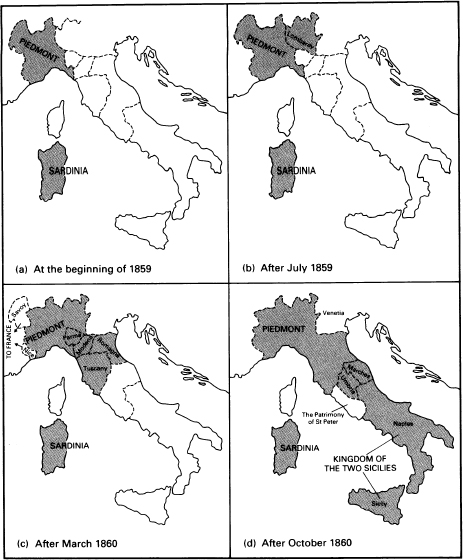
Map I: The process of Italian unification (from Derek Beales, The Risorgimento and Italian Unification, 1971)
Origins of the Italian Wars of Independence
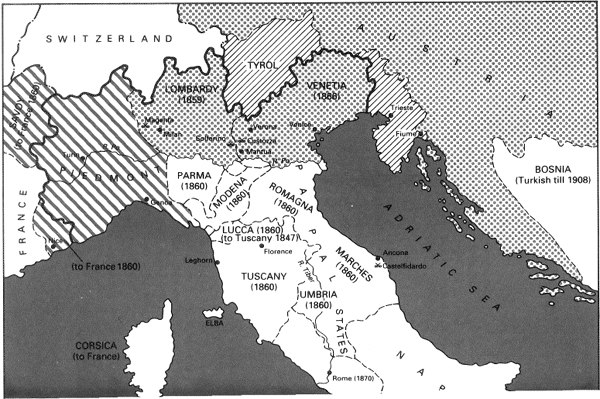
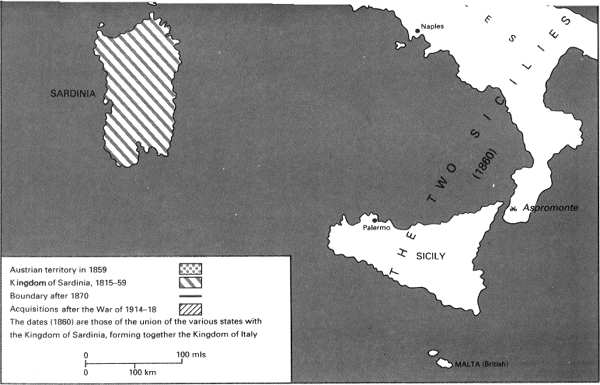
Map 2: Italy in the later Nineteenth century