
Author’s Note on Arab and Hebrew Names
In most instances, for the reader’s convenience, I have preferred to use in this book the most familiar spelling of Arab and Hebrew names, as they appear in the general literature and journalism published in English, rather than attempt to achieve consistency, at the cost of recognizability, through a more systematic academic transliteration.
Maps
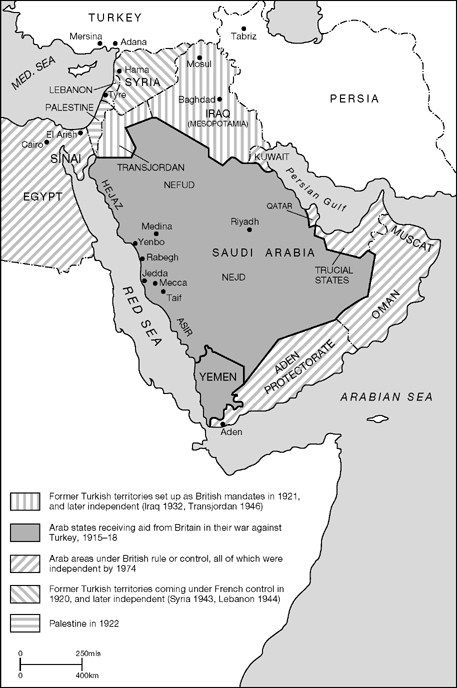
MAP 1 Britain and the Arabs 1917–74
Source: © Martin Gilbert. Redrawn from Routledge Atlas of the Arab-Israeli Conflict, 7th Edition by Martin Gilbert, p. 7. ISBN 0415281512 MB & 0415281520 PB. Published by Routledge 2002. Reprinted by permission of Routledge.
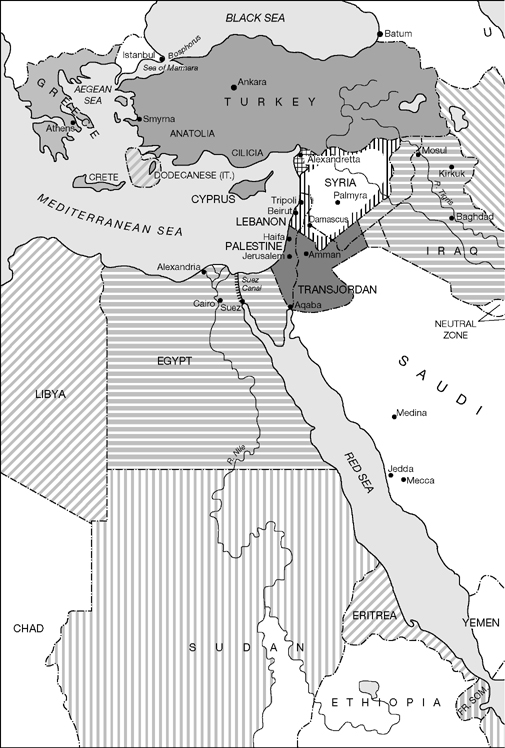
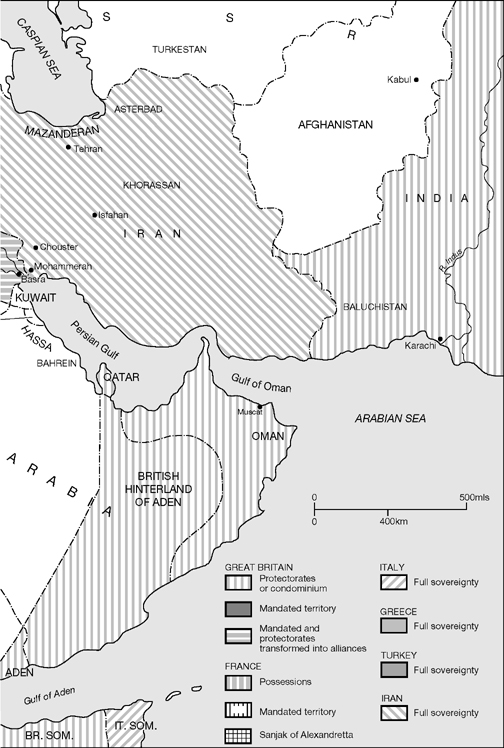
MAP 2 The Middle East in 1936
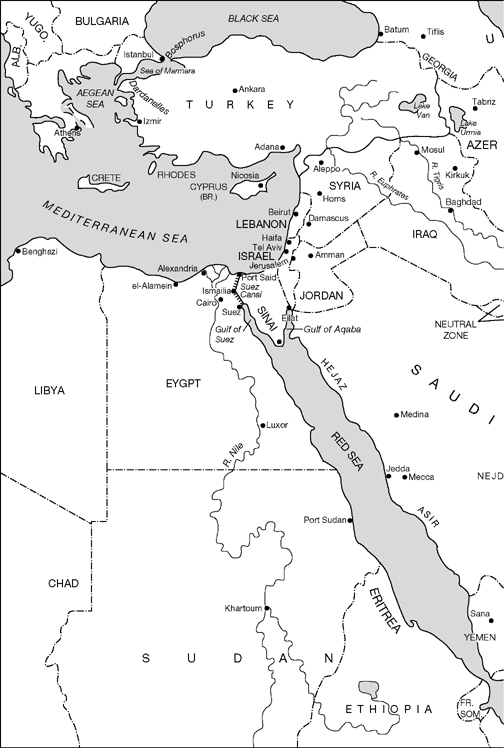
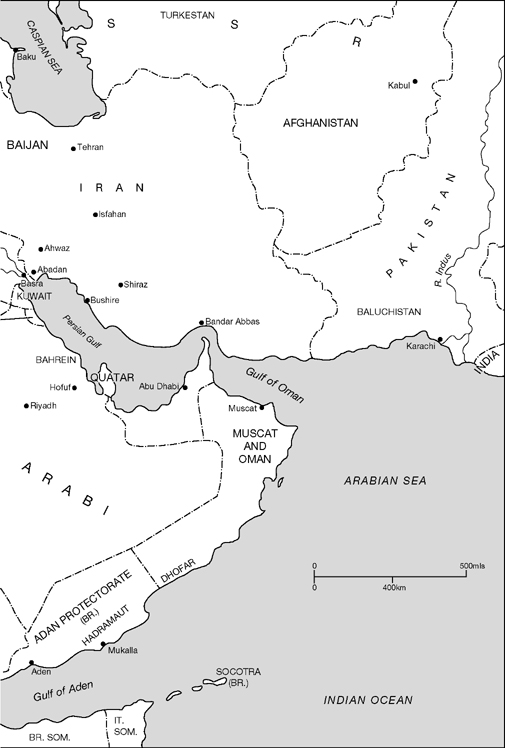
MAP 3 The Middle East in 1954
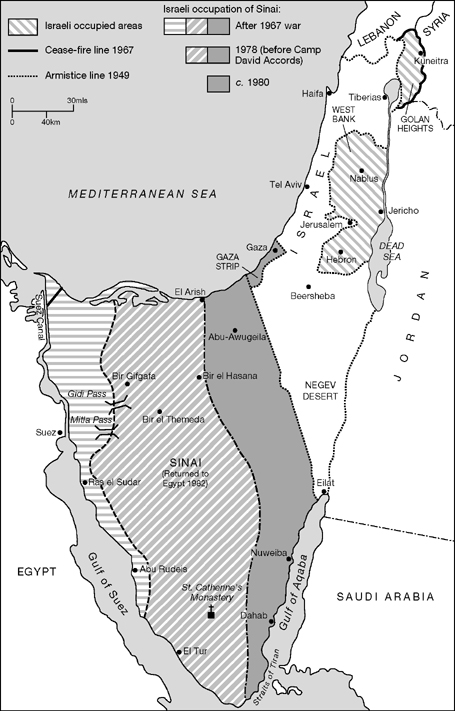
MAP 4 The revised borders after the June 1967 War
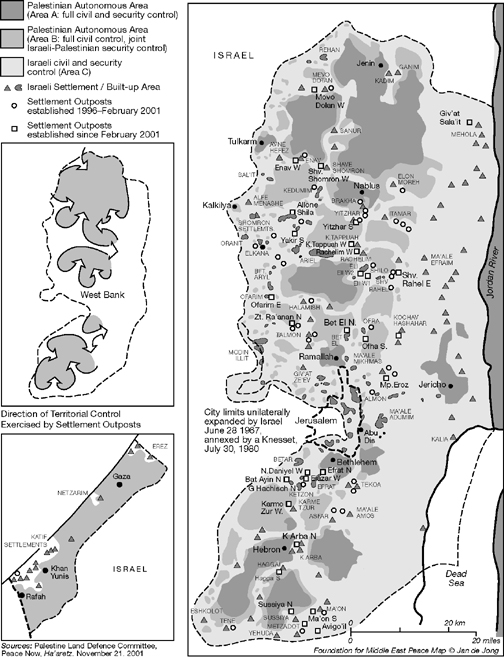
MAP 5 Israeli settlement outposts, January 2002
Source: © Redrawn from map Israeli Settlement Outposts – January 2002, from http://www.fmep.org. Reprinted by permission of the Foundation for Middle East Peace. Map © Jan de Jong.
CHAPTER ONE
At the end of 1894 a Jewish officer of the French general staff, Alfred Dreyfus, was convicted behind closed doors of espionage for Germany, and sentenced to deportation for life to Devil’s Island. The officer was publicly degraded at the École Militaire: his sword was broken; he was stripped of his uniform; and taken away in chains. The mob present shouted, ‘Death. Death to the Jews.’ Dreyfus was a parvenu, an example of social climbing by a Jewish family seeking assimilation and acceptance by high society through launching their sons on military careers. Known for boasting about his family fortune – which he spent on women – Dreyfus was not even liked by the young Austro-Hungarian journalist, Theodor Herzl, who reported the trial. But Herzl became convinced that Dreyfus was innocent, and was shaken by the apparent hostility to the Jews that the case unleashed in France. Six months later Herzl suggested to Barons Maurice de Hirsch and Albert Rothschild ‘a Jewish exodus’: for nearly 2,000 years Jews had been dispersed all over the world without a state of their own; if only the Jews had a political centre they could begin to solve the problem of anti-Semitism.
The Dreyfus affair became the symbol of Jewish inequality in European society. The confession of one officer, and the suicide of another, led to Dreyfus’s being pardoned in 1899, but he was never acquitted. The discovery of Dreyfus’s innocence did not lead to social acceptance of the Jews. Marcel Proust, the French novelist who found similarities between the exclusion forced by his Jewishness and his homosexuality, when recalling things past observed: ‘The politicians had not been wrong in thinking that the discovery of the judicial error would deal a fatal blow to anti-semitism. But provisionally, at least, a social anti-semitism was on the contrary enhanced and exacerbated by it.’1 From Emile Zola’s famous defence of Dreyfus, J’Accuse, to the 1931 play in Paris which had to be suspended because the government could not maintain order during the performances, to the 1950s Hollywood film starring José Ferrer, the affair has been kept before public consciousness. It focused attention on anti-Semitism, and helped to give birth to the Zionist movement.2
The rise of anti-Semitism in modern Europe
The ideas of liberty, equality and fraternity embodied in the French Revolution, as well as those outlined by the American Declaration of Independence, led to a certain emancipation of the Jews: in the United States in 1781, and in France in 1790, they were freed from special restrictions. The Napoleonic armies liberated Jews in many European countries. After Napoleon’s defeat there was some reaction: the 1819 ‘Hep! Hep!’ riots, starting in Würzburg and spreading throughout the German states and into Austria, Hungary, Poland and Denmark, reflected a suspicion of Jewish financiers and bankers, and suggested that the Jews were responsible for economic difficulties. These were repeated in 1830, and some central European Jews emigrated to the United States. But many Jews were assimilated into European society during the middle decades of the nineteenth century. In Britain a baptized Jew, Benjamin Disraeli, became Prime Minister in 1868, and a professing Jew, Baron Lionel de Rothschild, was elected to the House of Commons in 1858. Around 1860, however, a new word appeared, ‘anti-Semitism’, and with it a new challenge to the position of the Jews. The attack was now based not on grounds of creed, but of race. Assimilation was no longer possible: according to the new doctrine racial characteristics were unchangeable and a Jew could not, for instance, become a German through baptism and a rejection of his heritage. These ideas were popularized in the 1880s through a work by Eugen Dühring entitled The Jewish Question as a Question of Race, Morals and Civilisation. From 1851 in Russia Jews suffered increasing restrictions. Then, following the assassination of the Tsar, Alexander II, in March 1881, Russia’s difficulties were attributed to Jewish corruption, and Jews were massacred in a series of attacks in which the government either acquiesced or connived. These became known as pogroms. By 1914 it is estimated that over 2 million Jews had fled from Russia, and most had settled in the United States. But in 1882 Leon Pinsker, a Jewish doctor from Odessa, argued in his book Auto-Emancipation that anti-Semitism would persist where the Jews were a minority; they needed a homeland of their own. This suggestion, however, offered no immediate solution, and the waves of anti-Semitism in Europe from 1880, symbolized by the Dreyfus affair, meant that over 3 million Jews fled over three decades, settling in Britain, Canada, Australia and South Africa, but the vast majority found a new home in the United States. A few went to that area of the Ottoman Empire that was loosely known as Palestine. Palestine was, in the late nineteenth century, a geographic concept. Administratively, the south of Palestine was governed from Jerusalem, and the north from Beirut. The Ottoman government used the term for an area that became known as Palestine under the British mandate in 1922; the Arab and Jewish usage was imprecise as it depended on various historical interpretations.3 In 1856 a British Jew, Sir Moses Montefiore, was allowed by the Ottoman Sultan to buy land for Jewish settlement in the area. This work was later supported by the Rothschild family. With the racial anti-Semitism in Europe, symbolized by the Dreyfus affair, Palestine assumed a particular importance with some of the Jewish élite. The period saw the origins of Zionism.4
The origins of Zionism
The word ‘Zionism’ was probably first used by Nathan Birnbaum in an article published in 1886. It has come to be understood as meaning a movement for the re-establishment of a Jewish nation in Palestine, or as one writer insists, ‘Erez-Israel’.5 Followers of Zionism emphasize the historic links between the Jews and Palestine. In the second millenium BC immigrant Semitic tribesmen moved towards the sea across the Arabian Desert, and became known as Hebrews. One tribe, or group of tribes, claiming descent from Abraham of Ur, acquired the name of Israelites.
Migration to Egypt followed, but with the return under Moses to Palestine, it appears that by about 1100 BC the Israelites occupied most of the hill country in Palestine and were distinguished from the neighbouring tribesmen by their belief in only one god. The Israelites were occupied by the Assyrians, moved to Babylon, and for about four centuries administered as part of the Persian Empire. With the ascendence of Hellenism, however, the Jews successfully revolted against foreign domination, and from around 150 to 63 BC, when Palestine was subjected to the over-lordship of Rome, the Jews maintained their independence. There were unsuccessful revolts against Roman rule, and in AD 135 Jerusalem was destroyed. The Diaspora, or dispersion of the Jews around the world, had started even before 135, and in Iraq there had been a separate community of Jews for over 600 years. Six centuries after the sack of Jerusalem the Jews even followed the Arabs into North Africa and Spain where they spoke Arabic and were distinguished only by their religion. But it was in the Christian world that the Jews began to be disliked and suffered persecution, particularly at the time of the Crusades and during the medieval Inquisition. In the middle of the seventeenth century an effort was made to stop the Jews from permeating Russia, and by then Jews were often restricted to special areas of towns which became known as ghettos, and forced to wear a distinguishing yellow badge.6
With the assimilation evidenced during the nineteenth century the promise of the Jewish god that the race would eventually return to Palestine assumed a largely symbolic meaning. But the rise of anti-Semitism changed that, and Zionism played on what could be considered as the old faith.
Herzl is commonly regarded as the father of political Zionism. But several writers before him had argued in terms of a separate Jewish state. In 1833, Disraeli, in his first novel, Alroy, outlined his scheme for a Jewish empire with the Jews ruling as a separated class. This scheme was moderated to the domination of empires and diplomacy by Jewish money in Coningsby, published in 1844. In Tancred, Disraeli explained history in terms of race, and saw the Jews as being a superior race. But in George Eliot’s novel, Daniel Deronda (1876), one of the characters is there to show that the Jews still have a mission to fulfil: the repossession of Palestine. Political writers like Moses Hess with Rome and Jerusalem (1862) and Pinsker expressed similar ideas.7
When writing Der Judenstaat, most accurately translated as The State of the Jews, Herzl was seemingly unaware of these earlier writings. Recent biographies reveal Herzl to have been an isolated man who probably contracted gonorrhoea as a student, and hence did not marry till fairly late for fear of passing on the infection. But this liaison was desperately unhappy, and he was only able to think creatively when separated from his family, as happened during the composition of Der Judenstaat. Witnessing the Dreyfus affair was probably only one of several factors that led to Herzl’s conversion to Zionism. Herzl’s diaries show that in formulating his ideas he was influenced by the activities of Cecil John Rhodes, the great imperialist who bestowed his name on a country: in May 1895 Mashonaland and Matabeleland became Rhodesia, which was administered by a chartered company, the British South Africa Company. Herzl studied carefully how Rhodes had managed to wrest control of the land from the Matabele and Mashona. The diaries reveal the assumption that the land to form the Jewish state would already be populated by a few landowners and many poor peasants. The poor were to be removed by being denied work in the new Jewish country while being offered employment in ‘transit countries’. The landowners were to be dealt with by secret agents making purchases simultaneously, and giving the impression that they were paying more than the land was worth. Rhodes, once he had obtained the concession from a Black chief, used his influence to obtain a legal charter from a ‘sponsor’, Britain, and then opened Rhodesia to White settlement by defeating the Matabele with guns. Herzl was aware that Rhodes had the necessary financial backing and a sponsor who saw its interests being promoted.8
Der Judenstaat appeared in Vienna in February 1896. In the preface Herzl stated that his idea was an old one: the establishment of a state for the Jews. Anti-Semitic fervour made this an urgent necessity: that force had shown that the Jews could not assimilate and had made them into one people. The Jews’ position deteriorated whenever they lived together in any great numbers. The recent liberal laws had only encouraged anti-Semitism by enabling the Jews to become a bourgeois people, and to compete with the native middle classes. Herzl asked that the Jews be granted sovereignty over territory adequate for their national requirements. They would see to the rest. Here the influence of the Rhodesian experience is evident: a Society of Jews would establish political policies and a scientific plan; they would be executed by a ‘Jewish Company’ which would dispose of Jewish fortunes and organize commerce in the new land. Herzl had two possible regions in mind: Palestine or Argentina. Argentina was one of the most fertile countries, temperate, vast and sparsely populated. Palestine was the unforgettable historic homeland, and the very name would be a good rallying point. If the Sultan gave the Jews Palestine, Herzl said that they would, in return, manage Turkey’s finances. The state of the Jews would be part of a wall of defence for Europe in Asia, an outpost of civilization against barbarism. The Christian places could be controlled by some international arrangement. In 1895 Argentina’s population was almost 4 million, that of Palestine around 500,000. In Der Judenstaat Herzl did not mention how the local population was to be disposed of; those thoughts were reserved for his diary, at that time not intended for publication.9
With the publication of Der Judenstaat Herzl became the ambassador of the emerging Zionist movement. In June 1896 he travelled to Constantinople to see the Sultan, but was warned through an intermediary that the Sultan regarded Palestine as a cradle of other religions besides Judaism. Then, having failed to win the sympathy of Baron Edmond de Rothschild, he turned to organizing the Jewish masses behind his ideas, and arranged the first Zionist Congress which met in Basel in August 1897. There, following a tactical manœuvre by Max Nordau, Heimstätte was adopted as a synonym for state. The idea of a Jewish ‘home’ was thought to be less provocative than that of a state. Out of the Basel programme emerged the World Zionist Organization, a national flag, a national anthem, ‘Hatiqva’, and the Jewish National Fund. Herzl had further unsuccessful negotiations with the Sultan, and was photographed with the German Kaiser, but by July 1902 it was evident that he was unlikely to secure the necessary charter from the Ottoman Empire or Germany. Herzl had hopes of buying the Sultan with South African money, and wanted advice from Rhodes, but the imperial statesman died before he could meet him. There was some foundation for Herzl’s hopes in that Zionism grew rapidly in South Africa, and gained the sympathies of both the High Commissioner, Sir Alfred Milner, and the Boer leader, General Jan C. Smuts.10
Frustrated, Herzl turned to the country most likely to benefit from the crumbling of the Ottoman Empire, Britain. It appears that he hoped that if Britain granted a Jewish land company a charter with sovereign rights, that, in time, following the Rhodesian example, would lead to a sovereign Jewish state. Herzl tried to link Zionism to British imperial interests, and to play on the anti-Semitism of British statesmen who were so concerned about the flood of Jewish refugees into England following pogroms in Russia that a royal commission had been appointed to examine the question of alien immigration. Herzl gave evidence to the commission, and also met Lord Rothschild, to whom he suggested the foundation of a Jewish colony in a British possession, either in the ‘Sinai Peninsula, Egyptian Palestine, Cyprus’. The diaries reveal that Herzl felt that even if he secured only Cyprus and El Arish in Sinai, they could, through their pincer position, enable the seizure of Palestine by force when the Ottoman Empire crumbled. Through the offices of Leopold Jacob Greenberg, Herzl had an interview with the Secretary of State for the Colonies, Joseph Chamberlain, on 20 October 1902. Chamberlain, personally anti-Semitic, was worried about the number of Jews settling in Britain, and impressed with the idea that a Jewish settlement and money could further British imperial interests.11 Herzl played on these prejudices: a British conscience, disturbed by the thought of legally restricting the immigration of Russian Jews which was causing particular problems in the East End of London, could be solved if these refugees were diverted to the Middle East. Indeed, immigration could solve the Jewish problem, and Jewish capital and labour could make the British colonies prosperous. Herzl said that he wanted Cyprus, El Arish and the Sinai Peninsula. Chamberlain explained that he could not crowd out Greek Christians and Turkish Muslims for the benefit of Jewish immigrants. But Herzl envisaged a ‘golden rain’ encouraging the Muslims to move away, and the Greeks to sell their lands and move to Athens or Crete. El Arish, however, lay astride the communication links between Britain and India: strategically it could be of great significance. After discovering its position on a map Chamberlain explained that as it was part of Egypt the area was the responsibility of the Foreign Secretary, Lord Lansdowne. Lansdowne insisted on consulting the British agent and consul-general in Egypt, Lord Cromer. Cromer warned that the Egyptian authorities would insist on the Jewish colonists being subject to Egyptian law and that the Zionists would not accept that. A commission went to the area, but Egypt rejected the Zionist proposals.12
In November 1902 Chamberlain sailed for South Africa. He stopped off in Mombasa and travelled for 500 miles (800 km) up the Uganda Railway. The land along sections of the railway line, particularly the Kikuyu and Mau escarpments, looked fertile and devoid of inhabitants. It could be suitable for Jewish settlers, and such a move could help to keep East Africa British, and out of the hands of the Germans. On 24 April 1903 Chamberlain suggested to Herzl ‘Uganda’ – meaning in effect the Kenya highlands – as an area for Jewish colonization. Initially Herzl rejected the proposal: the starting-point had to be in or near Palestine. But he later warmed to the idea: it could be a beginning, and in July the Zionists sent a draft ‘charter’ to the British government. This was rejected by the assistant legal officer, Cecil Hurst, on the grounds that the Zionists wanted ‘the semblance of sovereignty’. Lansdowne feared the possibility of a state within a state: ‘it is throughout an imperium in imperio’. A letter from the Foreign Office was read to the Zionist Congress outlining a British offer of land and local autonomy conditional on British overall control. To some it appeared that the Zionists had a sponsor, even international recognition. But it was not Palestine, and the movement split. The Russian Zionists opposed the East Africa scheme, as did leading British Jews. At the next Zionist Congress in July 1905 it was rejected, and those favouring the scheme under Israel Zangwill broke away. The White settlers in East Africa, under Sir Charles Eliot, also protested at the preferential terms being offered the Jews. British sympathy cooled, and in any case the seventh Zionist Congress ruled that colonization should be confined to Palestine or its immediate environs. Herzl died in 1904. He moved into myth and became considered as the prophet of Zionism: at the end of the first Zionist Congress he noted in his diary that at Basel he had founded the Jewish state; at that time such an idea would be regarded with universal laughter, but in fifty years everyone would know it.13
The year Herzl died his successor settled in Manchester. Chaim Weizmann, a Jew born in Russia in 1874 who attended university in Berlin, was a practical man rather than a theorizer. He was influenced by the attitude of his friend, Asher Ginzberg, who wrote under the pen name of Ahad Ha-am. Ginzberg saw Palestine as being the focus for the renaissance of Judaism based on the positive love of Zion.14
Weizmann consciously chose Britain to settle in: it was the one country likely to sympathize with the Zionist movement. While researching in chemistry at Manchester University, Weizmann founded what became known as the Manchester School of Zionism. Its followers included Simon Marks, Harry Sacher and Israel Sieff, all bound together by ties of marriage and by being the sons of Jewish immigrants.15
It was during the general election campaign of 1906 that Weizmann first met Arthur James Balfour. At one time, as Prime Minister, Balfour had shown an interest in the Jewish problem since the 1890s when he had publicly deplored anti-Semitism on the Continent. But in 1905 he supported the Aliens Act which restricted the immigration of Russian Jews on allegedly economic grounds. Balfour told the House of Commons on 10 July 1905 that it possibly would not be an advantage to Britain to admit a large number of people who would remain apart. He also supported Chamberlain’s schemes for Jewish settlement in either Sinai or East Africa. Some have seen in this a latent anti-Semitism, and a desire to settle Jews somewhere other than Britain. Indeed it was Balfour’s curiosity as to why the Jews had rejected the East African offer that led to his meeting with Weizmann. Balfour learnt that any deflection from Palestine was a form of idolatry. He was apparently convinced.16
Weizmann did visit Palestine in 1907. He agreed on the need for political activity, but argued that diplomatic pressure alone was not going to convince the governments of Europe; what was necessary was practical work, particularly in the field of colonization in Palestine. Jewish immigration into the area had started in significant numbers in 1882, following the Russian pogroms. The Turks tried to restrict this settlement, but many Jews managed to circumvent the regulations. Reliable statistics are unobtainable, but it is reasonably estimated that of the 100,000 Jews who immigrated to Palestine between 1882 and 1914 at least half left after a short time. In 1882 there were around 24,000 Jews in Palestine. By 1897 the number had probably reached around 50,000 with the creation of eighteen settlements or ‘agricultural colonies’. The colonization was organized partly by Baron Edmond de Rothschild, partly by the ‘Lovers of Zion’ societies founded mainly in Russia, later by the Jewish Colonization Association under the auspices of Baron de Hirsch. By 1914 probably around 85,000 Jews had settled, and owned about 2 per cent of the land. Some estimates, however, based on 1922 census figures, argue that the number was considerably lower. Certainly, however, in 1914 the Jews did not make up more than 10 per cent of the population of Palestine.17
‘The Arab Awakening’
The area in which the new Jewish colonists settled was populated by a people commonly known as ‘Arabs’. In the second century BC Arab tribes moved out of Arabia and settled in modern Syria and Iraq. But it was really only with the rise of Islam in the seventh century that the Arab culture and language spread with the Arab conquest of Syria, Iraq, Persia, Egypt, the North African coast and finally Spain. With this flowering of civilization the meaning of ‘Arab’ changed from that of bedouin, or nomadic tribesmen of Arabia, to refer to all those peoples who spoke the Arabic language and had intermixed their blood with Arabs. In some circles the old meaning lasted. ‘Arab’ is not necessarily co-extensive with Islam, the Muslim religion, and there are examples of Christian Arabs as well as non-Arabic Muslims. The Muslim world, too, divided between those who accepted the ‘orthodox’ successors, or ‘caliphs’, to Muhammad, the Sunnis who make up the great majority of adherents, and those who believed that Ali, Muhammad’s son-in-law, was the true successor and who formed the minority, the Shiites (Shiahs), many of whom live in modern Iran. Islam demands toleration of Jews and Christians as possessors of divine revelation. And just as Jerusalem had become a holy city for Jews and Christians, it became a place of special reverence for the Muslims. Towards the end of the seventh century, in the middle of the stone platform on which the Jewish temple had once stood, the Arabs built a mosque known as the Dome of the Rock. Next to it, on the same sacred platform, was the mosque al-Aqsa: from there, the Muslims believe, Muhammad rode on his magic steed to heaven. Together with Mecca, Muhammad’s birth-place, and Medina, Jerusalem became one of the three most holy places of Islam. With the disintegration of the Arab Empire Palestine suffered subjection to the Seljuk Turks, the medieval invasions from Christian Europe known as the Crusades, then further subjection to the Mameluke dynasty in Egypt until it was conquered in 1517 by the Ottoman Turks. With the expansion of European trade routes the power of the Ottoman Empire slowly declined, and in the aftermath of the Napoleonic Wars, Russia, Britain, France and other European powers tried to manipulate Turkey, the ‘sick man of Europe’. Britain appeared concerned to maintain the integrity of the Ottoman Empire and so safeguard the route to the Indian Ocean, a lifeline of empire. But the British government, under the influence of Victorian religious morality, was prepared to interfere to attempt to improve the position of the ‘oppressed’ Ottoman subjects. The need to maintain stability in the region even led to a British occupation of Egypt in 1882, and by 1898, as in 1840, Britain was willing to go to war with France to ensure this. The Arabs that the Jewish settlers encountered were products of the disintegrating Ottoman Empire.18
In the last quarter of the nineteenth century, under Abdul Hamid II, the empire was divided into vilayet or provinces, and subdivided into sanjak or counties. Some counties were created as separate administrative units known as independent sanjak. This was the case in Jerusalem. Large areas of Arabia were only loosely under Turkish power, particularly the principalities ruled by the familes of Ibn Saud and Ibn Rashid in the interior. On the southern and eastern coasts Britain was paramount: it occupied Aden and had treaty relationships with the Arab rulers of the Persian Gulf sheikhdoms. In the Ottoman regions there was increasing antagonism from the Arab subjects towards Turkish rule. As one traveller reported in the 1880s: everywhere he encountered a hatred of the Turks, and the Arabs seemed gradually to be thinking of concerted action to get rid of the oppressor. The traveller saw, in the distance, a rising Arab movement. This growing Arab national consciousness has been traced to a literary revival in Syria in the 1850s and 1860s: newly established societies began to study Arab history, literature and culture of the golden age of the Arab Empire. It could be seen as a sort of spiritual renaissance. But this had political overtones, and one authority has argued that at a meeting of the Syrian Scientific Society, the Arab national movement uttered its first cry: a poem was read praising the achievements of the Arab race, the splendours of Arab literature and inciting the Arabs to go to their own past for inspiration. The foundation of the Syrian Protestant College in 1866, under American auspices, probably stimulated this activity.
Growing dissatisfaction with the despotism of Abdul Hamid II increased Arab national awareness. The Young Turk movement was also formed, and from 1889 it recruited supporters from students at military colleges. In 1895 a group of young Turks in Constantinople called themselves the Committee of Union and Progress. Some serving officers, in 1906, began to form themselves into revolutionary cells, and in 1908 there was mutiny in the Turkish armed forces. The Sultan promulgated a Constitution based on the representation of all the provinces. But Arab hopes for autonomous provinces enabling the development of Arab culture were frustrated. Agitation continued in the open with the Arab Literary Club in Constantinople, and also with the formation of several secret societies, the most important of which was al-Fatat. From Damascus it aimed at independence. The Committee of Union and Progress, standing for centralization, opposed these groups, and in February 1914 Arab feeling against the Turks hardened with the trial of one of the leaders of a secret society, Aziz al-Masri. The first Arab National Congress was held in Paris in 1913. It was concerned with the likely chaos in the Arab provinces brought about through Turkish thwarting of Arab aspirations; there was also the danger of European intervention. A resolution of 21 June, forwarded to Sir Edward Grey, the British Foreign Secretary, demanded that the Arabs should be able to exercise their political rights and play an effective role in the administration of the Empire. Decentralized governments should be established in the Arab provinces.19 This was only an Arab awakening; it was not yet a ‘national movement’. The Arabs, whose numbers were virtually double those of the Turks, usually put their tribal loyalties first.20
The Arabs in Palestine were conscious of this awakening. In the early 1880s, there were reports from the British consulate of sympathies for their fellows struggling for their race against Ottoman domination and misrule. But by 1891 some Arabs in Palestine were conscious of another threat to their aspirations: the increasing flow of Jewish settlers. They started to demand an end to Jewish immigration and land purchase. In the late 1890s Arabs warned the Zionist movement that its programme was not feasible. By 1914 there were 650,000 Arabs in Palestine who were already clashing with the Jewish colonists. Because of the administrative structure of the Ottoman Empire knowledge of the Zionist programme spread to the Arabs outside Palestine. It is evident that the Arabs distinguished between the ‘Ottoman’ Jew and the ‘foreign’ Jew, only the former deserving equal rights in a decentralized administration. They also knew the difference between Jew and Zionist. Between 1909 and 1914 nationalist opposition in Palestine to Zionism grew: there were fears that if the Jews conquered Palestine the territorial unity of the Arab world would be shattered and the Arab cause weakened. Some nationalists, however, were prepared to work for an agreement with the Zionists, but Arabs were not prepared to support arguments in favour of Zionism for its own sake. Indeed, from 1909, Arabs took effective action against the Zionists, and ensured the passing of restrictive legislation. Arabs outside Palestine were involved in this, and by 1914 there was an awareness that Zionism had to be considered in relation to the wider Arab cause as well as to local conditions in Palestine. Zionism was not responsible for the Arab awakening, but from an early stage it appeared as a threat.21
The growing dispute between the Arabs and the Zionists, however, was a local one and focused on land. In the first decade of the twentieth century the Middle East became increasingly an area of Great-Power rivalry. The growing German challenge forced Britain to divide its Middle Eastern interests with rivals: in 1904 Britain agreed to the French having a free hand in Morocco in exchange for the same in Egypt; in 1907 Britain and Russia divided Persia into spheres of influence. The map of Europe had been fought out in Africa; the same now happened in the Middle East. This was the age of imperialism and local aspirations were not thought particularly significant.22
References
1Marcel Proust, trans. C. K. Scott Moncrieff, The Sweet Cheat Gone (London 1941), p. 219.
2For an account of the Dreyfus affair in relation to anti-Semitism see Hannah Arendt, The Origins of Totalitarianism, 2nd edn (New York 1958), pp. 3–120; for Arendt’s analysis of the distinction between social anti-Semitism and political anti-Semitism see Richard J. Bernstein, Hannah Arendt and the Jewish Question (Cambridge 1996); L’Affaire Dreyfus, France, 1899, directed by Georges Méliès; Dreyfus, Great Britain, 1931, directed by F. W. Kraemar starring Cedric Hardwicke; The Life of Emile Zola, United States, 1937, directed by William Dieterle starring Paul Muni; I Accuse, United States, 1958, directed by and starring José Ferrer.
3Neville J. Mandel, The Arabs and Zionism before World War I (Berkeley 1976), pp. xix–xx.
4According to David J. Goldberg, To the Promised Land: A History of Zionist Thought from its Origins to the Modern State of Israel (London 1996), p. 12, the term ‘anti-Semitism’ was coined by William Marr, a journalist, in a pamphlet, ‘The Victory of Judaism over Germanism’, which went through twelve printings between 1873 and 1879. Histories of anti-Semitism include: Leon Poliakov, The History of Anti-Semitism, 3 vols (London 1966–1975); Ernest L. Abel, The Roots of Anti-Semitism (London 1975); Leonard Schroeter, The Last Exodus (Seattle 1979); James Parkes, The Jew in the Medieval Community (London 1938); Jacob Katz, Out of the Ghetto. The Social Background of Jewish Emancipation, 1770–1870 (Cambridge, Mass. 1973); Jean Laloum, La France Anti-sémite de Darquier de Pellepoix (Paris 1968); Shmuel Almog (Ed.), Antisemitism Through the Ages (Oxford 1988); Barnet Litvinoff, The Burning Bush. Antisemitism and World History (London 1988); Bernard Lewis, Semites and Anti-Semites. An Inquiry into Conflict and Prejudice (London 1986). For specialized studies see Peter G. J. Pulzer, The Rise of Political Anti-Semitism in Germany and Austria (New York 1964); Colin Holmes, Anti-Semitism in British Society, 1876–1939 (London 1979); Paul Lendvai, Anti-Semitism in Eastern Europe (London 1971); Michael N. Dobkowski, The Tarnished Dream. The Basis of American Anti-Semitism (Westport, Conn. 1979); Shlomo Avineri, The Intellectual Origins of the Jewish State (London 1981); Mitchell Cohen, Zion and State: Nation, Class and the Shaping of Modern Israel (New York 1992). Short summaries can be found in Martin Gilbert, Exile and Return. The Emergence of Jewish Statehood (London 1978), pp. 26–43; Walter Laqueur, A History of Zionism (London 1972), pp. 3–39; Harold Wilson, The Chariot of Israel. Britain, America and the State of Israel (London 1981), pp. 8–11. Excerpts from a summary of Pinsker’s Auto-Emancipation can be found in Arthur Hertzberg (Ed.), The Zionist Idea (Connecticut 1970), pp. 178–198. There is an English edition of Auto-Emancipation included in B. Natangahu (Ed.), Road to Freedom (New York 1944). A philosophical discussion of the links between the composer Richard Wagner, the philosopher Friederich Nietzsche and anti-Semitism can be found in J. L. Talmon, Israel Among the Nations (London 1970), pp. 50–67.
5David Vital, The Origins of Zionism (Oxford 1975), p. xvi. Vital argues that ‘Palestine’ was a Roman invention which fell into disuse until the arrival of the British. See also David Vital, Zionism: The Formative Years (Oxford 1982); Zionism: The Crucial Phase (Oxford 1987).
6Histories of the Jewish people include: Werner Keller, Diaspora. The Post-Biblical History of the Jews (London 1971); Roland de Vaux, The Early History of Israel, 2 vols (London 1978); John M. Allegro, The Chosen People (London 1971); H. H. Ben-Sasson (Ed.), A History of the Jewish People (London 1976); Solomon Grayzel, A History of the Jews (New York 1968); Heinrich Graetz, History of the Jews, 6 vols (Philadelphia 1898). There is a convenient summary of the history of the Jews in Cmd 5479, Palestine Royal Commission Report (July 1937), pp. 2–15; see also Gilbert, op. cit., pp. 3–25; Wilson, op. cit., pp. 1–11; and the political case made in Berl Locker, A Stiff-Necked People. Palestine in Jewish History (London 1946).
7See Hertzberg, op. cit., passim, for a collection of these writings; Vital, Origins of Zionism, pp. 23–229; Laqueur, op. cit., pp. 40–83; for a consideration of these ideas in a recent context see Harold Fisch, The Zionist Revolution. A New Perspective (London 1978); for the case made by some Arab writers that the roots of Zionism can be found in the designs of imperialism in early-nineteenth-century Europe see A. W. Kayyali (Ed.), Zionism, Imperialism and Racism (London 1979), esp. pp. 9–105. See also Tudor Parfitt, The Jews in Palestine 1800–1882 (Woodbridge, Suffolk 1987).
8Raphael Patai (Ed.), trans. Harry Zohn, The Complete Diaries of Theodor Herzl, 5 vols (New York 1960), pp. 88–89; Desmond Stewart, Theodor Herzl (London 1974), pp. 71–72, 169, 188–192.
9There are various English translations of Theodor Herzl, The Jewish State, trans. S. d’Avigdor (London 1967); a revised version by Ben Halpern and Moshe Kohn is in Hertzberg, op. cit., pp. 204–226.
10Vital, Origins of Zionism, pp. 354–370; Laqueur, op. cit., pp. 160–161; Stewart, op. cit., pp. 292–293.
11R. Patai, op. cit., pp. 1, 294, 344; Richard P. Stevens (Ed.), Zionism and Palestine before the Mandate (Beirut 1972), pp. 12–15; Julian Amery, Life of Joseph Chamberlain (London 1951), Vol. IV, pp. 256–261; Denis Judd, Balfour and the British Empire (London 1968), p. 99.
12Marvin Lowenthal (Ed.), The Diaries of Theodor Herzl (New York 1956), pp. 370–383; FO 78 (Public Record Office, London), 5479, contains the British documents of the Anglo-Zionist negotiations on Sinai; R. Patai, op. cit., pp. 1432 and 1458–1460; see also, Frank Hardie and Irwin Hermann, Britain and Zion. The Fateful Entanglement (Belfast 1980), pp. 6–8.
13Amery, op. cit., Vol. IV, pp. 262–267; FO 2 (Public Record Office, London), 785, contains the British documents on the East African discussions; Isaiah Friedman, ‘Herzl and the Uganda controversy’, in Ritchie Robertson and Edward Timms (Eds), Theodor Herzl and the Origins of Zionism (Edinburgh 1997), pp. 39–53 at p. 39; R. Patai, op. cit., pp. 1, 473–475; Stewart, op. cit., pp. 327–329; Hardie and Hermann, op. cit., pp. 9–15; R. Patai, op. cit., p. 581; a map of the East Africa settlement areas is printed in Stewart, op. cit., facing p. 205. Besides Stewart, biographers of Herzl include Alex Bein, Theodor Herzl, A Biography (London 1957); Israel Cohen, Theodor Herzl, Founder of Political Zionism (New York 1959); Jacob de Haas, Theodor Herzl, A Biographical Study, 2 vols (New York 1927); Josef Fraenkel, Theodor Herzl, A Biography (London 1946); Josef Patai, trans. Francis Magyar, Star over Jordan. The Life of Theodore Herzl (New York 1946); Amos Elon, Herzl (London 1975); see also David Vital, Zionism: The Formative Years (Oxford 1982), esp. pp. 95–271.
14Leon Simon, Ahad Ha-am. Asher Ginzberg; a biography (Philadelphia 1960), p. 193.
15For an account of Weizmann’s early life see Chaim Weizmann, Trial and Error (London 1949), pp. 11–174; see generally, Paul Goodman (Ed.), Chaim Weizmann. A Tribute on his Seventieth Birthday (London 1945); Dan Leon and Yehuda Adin, Chaim Weizmann, Statesman of the Jewish Renaissance (Jerusalem 1974); Meyer W. Weisgal and Joel Carmichael, Chaim Weizmann. A Biography by Several Hands (London 1962); Meyer W. Weisgal, Chaim Weizmann. Scientist Builder of the Jewish Commonwealth (New York 1944); for an account of the Manchester School based on information from Lord Sieff see Jon Kimche, Palestine or Israel (London 1973), pp. 93–158.
16United Kingdom Parliamentary Debates House of Commons, 149, col. 155, 10 July 1905; Sydney H. Zebel, Balfour. A Political Biography (Cambridge 1973), pp. 238–240; K. Young, Arthur James Balfour (London 1963), p. 388; Judd, op. cit., pp. 99–100; Blanche E. C. Dugdale, Arthur James Balfour, Vol. I (London 1936), pp. 433–436; Hardie and Hermann, op. cit., pp. 79–80; Weizmann, op. cit., pp. 142–145.
17Isaiah Berlin, ‘The biographical facts’, in Leon and Adin, op. cit., pp. 33–92 at p. 51; Weizmann, op. cit., pp. 156–171; Bernard Wasserstein, The British in Palestine. The Mandatory Government and the Arab-Jewish Conflict 1917–1929 (London 1978), p. 5; for an account of the Jewish settlements see Simon Schama, Two Rothschilds and the Land of Israel (London 1978); Mandel, op. cit., esp. pp. 1–31 and 229; A. L. Tibawi, Anglo-Arab Relations and the Question of Palestine 1914–1921 (London 1977), pp. 15–27.
18William Yale, The Near East. A Modern History (Ann Arbor 1958), pp. 3–144; Peter Mansfield, The Ottoman Empire and its Successors (London 1973), pp. 1–13; John Bagot Glubb, Britain and the Arabs. A Study of Fifty Years, 1908 to 1958 (London 1959), pp. 19–46; Jon Kimche, The Second Arab Awakening (London 1970), pp. 9–16; A. H. Hourani, Great Britain and the Arab World (London undated), pp. 8–10; see also J. Carmichael, The Shaping of the Arabs (London 1967); B. Lewis, The Emergence of Modern Turkey (London 1968); Thomas W. Arnold, The Caliphate 623–1924 (London 1965).
19British Documents on the Origins of the War, 1898–1914, Vol. X, pp. 824–826, esp. FO 29037/29037/13/44, Carnegie to Grey, No. 339, 24 June 1913 and Enclosure of Resolutions voted at the Arab congress.
20George Antonius, The Arab Awakening. The Story of the Arab National Movement (London 1938), pp. 13–125; a summary of critiques of Antonius can be found in George E. Kirk, A Short History of the Middle East from the Rise of Islam to Modern Times, 7th edn (London 1964), pp. 308–319; Glubb, op. cit., pp. 49–54; Mansfield, op. cit., pp. 14–33; Zeine N. Zeine, Arab-Turkish Relations and the Emergence of Arab Nationalism (Beirut 1958); The Struggle for Arab Independence (Beirut 1960); The Emergence of Arab Nationalism (Beirut 1966); Sylvia G. Haim, Arab Nationalism: An Anthology (Berkeley 1962); Albert Hourani, Arabic Thought in the Liberal Age, 1789–1939 (London 1962); Efraim and Inari Karsh, ‘Reflections on Arab nationalism’, Middle East Studies, XXXII (1996), pp. 367–392.
21A. W. Kayyali, Palestine. A Modern History (London 1978), p. 15 quoting documents in the Public Record Office London in, FO 226, FO 195, 1477; Tibawi, op. cit., pp. 18–19; Mandel, op. cit., passim. Zionist and Israeli academics, against the background of the settlement of Jews in the occupied territories after the June 1967 War, the rise of the Likud and political arguments in Israel particularly in the late 1970s and early 1980s, that there was no such thing as a Palestinian Arab, or that ‘Jordan is Arab Palestine’, have concentrated on the land and population questions. See especially Amos Elon, The Israeli, 2nd edn (New York 1983); Joan Peters, From Time Immemorial (London 1985). Charles D. Smith, Palestine and the Arab-Israeli Conflict (London 1988), pp. 20–25 offers a useful survey of some of this literature and concludes that claims of the increase of the Arab population of Palestine to around 650,000 by 1914 being brought about by the influx of Arabs from outside Palestine are suspect. See also Buruch Kimmeling and Joel S. Migdal, The Palestinians: The Making of a People (Cambridge, Mass. 1994), p. xvi.
22Elizabeth Monroe, Britain’s Moment in the Middle East, 2nd edn (London 1981), pp. 11–21; R. Robinson, J. Gallagher with A. Denny, Africa and the Victorians (London 1965).