
PART ONE
CHAPTER ONE
EUROPE’S HEGEMONY
In the middle of the nineteenth century the world was much less inhabited and developed than today, but the differences among regions and culture zones were just as striking. Only about 1.2 billion people were alive. One-third lived in China, one-third in the rest of Asia, a twelfth in Africa, and a fortieth in Latin America – altogether about 950 million. On the other hand, 265 million Europeans and North Americans resided in the regions where international power was concentrated.
The population of Europe and North America was unevenly divided among the major states: about 60 million in the Russian Empire, 35 million in France, 33 million in the German states excluding Austria, 30 million in the conglomerate domains of the Austrian Emperor, 26 million in Great Britain, 19 million in the Italian states excluding Austrian Venetia and Lombardy, 15 million in Spain, and maybe 10 million in European Turkey. The United States had only about 23 million.1
Europe as a whole and each of its major states were divided into regions of greater and lesser development in culture and in the organization of technology, economic life, administration, and politics. Great Britain had the highest level of industrialization and urbanization in the world and about 70 per cent male literacy, more than twice that of Japan, the most advanced non-Western society. The corresponding rates for France, Germany and the more advanced part of Austria were about 55 per cent, and for white males in the United States, 90 per cent. The backward parts of Austria were more like Russia, where less than 20 per cent of the men could read.
On the other hand, even within the most advanced parts of the non-Western world, traditionally educated upper classes, literate state officials, and religious leaders tried to limit intercultural contacts and innovations to what was militarily useful. In most of Latin America, native élites, sharing in a conservative European culture, by and large maintained the Iberian colonial administration. Specialization and production for the world market did not enable any of these societies to operate within the more advanced world as equal partners.
Indeed the European world bristled with zones of cultural and economic dynamism. The development of steam power and its application to mining, manufacture and transportation gave an overwhelming advantage to the developed sectors of the European world. Eventually, the non-Europeans were going to be compelled, as one East Asian put it, to adopt the Europeans’ ‘putrid’ calendar and wear their ‘filthy’ clothing.
The history of international competition from 1492, when Columbus sailed to Santo Domingo, until 1853, when the American Admiral Perry steamed to Japan, illustrates the political aspect of the Western Question for the non-Western world. In 1492 the imperialism of several Asian, African and American states flourished along with those of Europe. By 1853 five European and one North American state marched, rode or sailed off with the great prizes at the political expense of the others. When Europeans lost, it was to each other. Together, under Britain’s de facto leadership, the advanced countries presented the rest of the world with a political, legal, commercial, scientific and military culture, that, as the Japanese soon discovered, could be beaten only by being joined.
WAYS AND MEANS OF PRODUCTION
A materialist would argue that the key Western Question for the West and non-West alike lay in the technical and social organization of production. More effective circulation of money, instruments of credit, distribution of goods and capital formation went hand in hand with the more efficient tools. As is the case today, the qualitative contrasts among these forms of production and the quantitative differences among societies possessing these forms determined the economic and political ranking of states. In contrast to a century earlier, the most backward of the major European powers around 1850 was well advanced over any non-Western society, except Japan.2
Industrialization was the chief measure of advancement and the bearer of what made the West so different from its own past, not to say the rest of the world. The results could be seen in all sorts of machinery, railroads, steamships with first paddle wheels and then screw propellers, larger and stronger wrought-iron bridges, iron-frame buildings, increased newspaper circulation, the telegraph, mass production of rifles, breech-loading ordnance (artillery), and war steamers. The Great Exhibition of 1851, housed in a huge hall built of iron and glass (rebuilt as the Crystal Palace), was testimony to a new British-led industrial civilization.
To grasp the ‘modern’ world of c. 1850 and its mechanisms more accurately, however, one should also bear in mind the degree to which animal, human and wind power still prevailed and improved. For example, in 1852, Britain’s 25,000 sail carried 143 tons per craft, while the 1,270 steamers could ferry only 14 per cent more per ship. In France, the 1830s and the 1840s were the most intense decades ever for the construction of canals. Mountainous Austria witnessed a massive expansion of her primary road system for horse-drawn vehicles from the latter eighteenth century onward.3
A variety of pre-modern modes of production still flourished in the great states of Europe and North America of 1850. Small-scale agriculture, forestry, animal husbandry, fishing, crafts and the putting-out system were everywhere. Serf labour powered much of Russia’s agriculture, industry, and mining; agrarian slavery prevailed in the US South; tenant-farming was widespread in British ruled Ireland; and large scale agriculture with free labour was practised on many English and Prussian estates, as well as in Austria, where former serfs were hit with additional payments for their recently acquired freedom.4
The immensely contrasting incidence of advancement was a crucial factor in the power potential of various states. Britain’s 14,150 power-looms and 240,000 handlooms of 1820 had changed to 250,000 and 40,000 respectively in 1850, by which time there were 4.5 million industrial workers, nine times more than in Russia.5 In 1850 Britain probably had more than half of the world’s steam power and produced more than half the world’s pig iron, even though the railroad system of the United States was almost one-third longer. This speaks for Britain’s all-round development. Russia, by contrast, even when the St Petersburg-Moscow line was completed in 1851, had only 25 per cent the gross and 3 per cent the per capita amount of railways found in the agrarian American South, and no more mechanized industry than tiny Belgium. Russia thus possessed a very weak technical basis for its reputedly greatest army in the world.
Standards of living, even in advanced countries, were low in contrast to today. Although in England and the United States they were roughly twice what an average person needed to feed and house himself adequately according to 1850 standards, many working people lived well below the ‘poverty line’, especially on the European continent.6 The seasonal or semi-employed reserve proletariat, very poor rural and urban labourers, were ubiquitous figures, but indispensable to the functioning of the economies. Widespread low standards of living for the majority explain why predatory, expansionist ventures normally generated more support than opposition. Life was still quite cheap. On the other hand, the civilization of industrialization was one of periodic food shortages and hardship, Utopian nostalgia and rising expectations for working people, so even the advanced states were sitting on potential social powder kegs.7
COMMERCE AND ITS AMBITIONS
Industrial and financial power translated into commercial power, Great Britain being by far the greatest trading nation, especially for suppliers of raw materials, foodstuffs and specialized craft products. In turn, the Russian, Ottoman and Chinese Empires, India, Latin America and the United States, respectively accounted for 3.5, 5.5, 5, 11.75, 15.5 and 20 per cent of British external commerce. This extra-European ‘lion’s share’ of trade created for Britain a world-wide ‘empire in all but name’.8 As foreign trade constituted about 35 per cent of GNP, the British were very touchy about anything, including other states’ armies, fleets or fiscal and industrial policies that might disrupt or threaten this commerce.
Britain was also by far the leading foreign investor, overseas credit holdings having mushroomed from £24.6 million (12 per cent of GNP) in 1816 to £218 million (41.5 per cent of GNP) in 1851. The French, in contrast, held only about £25 million (5 per cent of GNP), most of it in neighbouring Spain, Belgium and Italy. The United States, in greater contrast, owed a net £44 million (10.5 per cent of GNP).9
Almost all of Britain’s foreign wars had been connected with commerce. As rivals raised tariffs to develop their industries, though, Britain turned to an ‘imperialism of free trade’, which accommodated competitors, forged ahead with better production techniques, and forced open the markets of backward states, sometimes with gunboats and landing parties.10 The predominance and utility of the British fleet for all trading powers, the commercial and financial dependence of the United States upon Britain, and the unwillingness of the French after Napoleon to risk any more maritime disasters all contributed to the remarkable fact that 1815 was the last year that any rivalries among the three great North Atlantic powers led to war. The residue of self-righteous hostility among them had ceded to enlightened self-interest, and a spiteful co-imperialism prevailed, whereby the maritime powers supported each other’s commercially inspired gunboat diplomacy.
France, Prussia and Austria avoided Britain’s commercial clutch and had their own special trading zones, French and Prussian industry also benefiting from Britain’s relative free trade policies. Prussia’s chief commercial concern was developing the German Zollverein or Customs Union, which also dominated Holland’s commerce (32 per cent), and, together with France, Belgium’s (26 per cent each). Austria, which included Lombardy and Venetia at this time, was, along with France, Turkey’s second largest commercial partner. Austria also predominated in the border regions in the Balkans, and traded heavily with the other northern and central Italian states.11
France and Germany, as well as the United States, could think in terms of becoming first-rate economic powers. American ‘Manifest Destiny’ envisioned expansion across the Pacific to capture and develop Asian markets.12 War with Mexico had just settled the major issues in the future south-west and California, while prudent negotiations with Britain produced the same results in the Oregon Territory. The French were cashing in on their new acquisition in Algeria, and some of them looked hungrily toward Belgium. Simultaneously, their Prussian counterparts hoped to unite Germany and turn the Zollverein into a political unit, and were not averse to taking over Belgium’s railroads.13 The leading Austrian economic thinking sought an impossible Vienna-dominated union with Germany, as well as more realistic expansion to the south, in the Balkans or Italy. North Italian capitalists and politicians in both Lombardy and independent Piedmont-Sardinia had similar ambitions towards central and southern Italy.14 Almost all of Europe’s war scares and wars involving Belgium, Germany, and Italy during 1848–71 can be traced in part to these designs of political economy, but to single out the economic factor is to tread on slippery turf.15
Russia was in a unique position, needing exports to pay off debts and import machinery, but with foreign trade only about 5 per cent of GNP, as compared to 17–20 per cent for Germany, France, the United States and the Ottoman Empire.16 Protecting her weak industries with high tariffs, Russia was hence the most autarchic great power, but lacked economic leverage. On the other hand, relative autarchy created the freedom to operate outside the British-led, capitalist-imperialistic system of the mid-nineteenth century, as well as the pipe-dream of establishing a vast commercial empire along the borders from Turkey to northern China.17 Russia’s only genuinely natural allies were states that depended upon her for support of prevailing domestic structures.
The sole place where Russian economic interests and diplomatic problems seriously intersected was at the Sulina Channel at the mouth of the Danube. Russia could hinder steamboat traffic there by obstructing the dredging process to the benefit of grain exports from Odessa. This hurt Austria, the Ottoman Empire, the latter’s Romanian Principalities and, eventually, England, and created a community of interest against a specific Russian policy by 1850.18However, this issue was not likely to lead England or any other state to provoke an expensive war with another major power. Given the prevailing monetary policies, negotiations and temporary losses were much more reasonable.
FINANCE AND ITS LIMITS
The monetary systems of the major powers were based on the old metallic principles that had served the Dutch and British so well for almost two centuries and now made the major powers cautious. Only the under-taxed, under-governed, and resource-rich United States courted fiscal anarchy by lacking a national bank, leading to great booms and busts and the generation of all sorts of venture capital, but not expensive foreign policies. In contrast the states of Europe were exceedingly cautious in the fiscal realm, except during emergencies. Money was the real and not so hidden king, and the Russian Tsar himself would not tinker with the good credit that his government had in the Amsterdam and London money markets. Consequently, even Britain suffered from a relative money shortage, while Austria and Russia were truly capital starved. France launched her innovative capital-generating Credit foncier and Credit mobilier only in 1852.19
Not least among the advantages of stable currencies, however, was a willingness to store money in savings banks, which enjoyed a remarkable development in most of Europe in the first half of the nineteenth century. Overall, sound private banking was most developed in Britain and growing. Total British deposits in 1844 were 150 per cent of the state budget; in 1855, they reached 240 per cent of the peacetime budget. This meant that money could be generated and loans subscribed whenever the London Cabinet deemed it necessary. British military allocations increased five to seven times in 1854, the initial year of the Crimean War, while France’s and Russia’s barely doubled.20 Most other states needed a huge reserve of precious metals to raise sound money quickly. Even so rich a country as France or so vast a one as Russia, not to say so financially strapped a realm as Austria, had to be cautious about launching costly foreign adventures.
GOVERNANCE: THE WESTERN PART OF THE WEST
In general, conscious activism and the application of recent learning to the solution of specific domestic and foreign policy tasks distinguished Western states from non-Western ones, since all states were organized to protect property and the prevailing social structure. However, within this rubric there were vast differences among the great powers, as in the economic realm.
The limited British monarchy had the most stable representative institution, Parliament, but was no democracy. Only about 8–9 per cent of adult men had the vote, while 35–50 per cent of the parliamentary elections were uncontested.21 The hereditary crown under Queen Victoria carried some weight, and, prodded by her German relatives, the queen was attempting to revive royal prerogatives.22 Her Majesty’s ministers, however, only paid lip-service to her office and tended to do as they chose as individuals or as a Cabinet.
An élite of landed aristocrats, upper bourgeois, and middle-class commoners of genuine talent succeeded in providing political continuity and stability. A small number of select schools and universities contributed to this, as their graduates dominated the political leadership of all the major groupings by forming a network of power-brokers and political operators, whose rivalries and disputes were balanced by their social ties.23 Traditions of liberty kept the Home Office less powerful than the typical Ministry of the Interior on the Continent, but it was sufficiently powerful to ensure social peace and the breaking of labour strikes.
The British press was the most developed in Europe, the rather moderate (London) Times, with its daily circulation of 40,000 in 1852, having seized the leadership in world journalism. The public often learned of important foreign news as soon as or even before the Foreign Office did. The various sectors of British opinion had their daily or periodical organs, and the major ones were ‘all read in the clubs’.24 The informal organizations of ‘the City’ (the London financial district) lent a strong voice to business interests. Moreover, the dichotomy between economic development and political disenfranchisement, the disparity between the rich and the working poor, dependence upon overseas trade and empire, and the workings of the free press made nationalism a key integrating force.
Politics at the centre were somewhat fluid due to shifting alliances, the two-party system of Conservatives (Tories) and Whigs (Liberals) having broken down over the issue of tariffs. The ex-Tory Peelites, by abolishing the restrictive Corn Laws in 1846, had helped to defuse the popular Chartist movement that demanded both democracy and cheap food; but the programme for radical political reform was still on the table.25 In Parliament, Conservatives, Peelites (‘Liberal-Conservatives’), and Liberals comprising Whigs, Radicals and Irish deputies manoeuvred under a handful of headstrong leaders to form and retain coalitions, which threatened to break down over special religious or fiscal interests.26
After Peel’s death in 1850, the most powerful English politician was the ex-Tory Whig, Viscount Henry Palmerston, Foreign Secretary for most of 1831–51, who knew how to play upon nationalist sentiment and snipe at those who challenged him. It was risky for any government to face the charge of not defending English interests abroad. Regardless of who was in office, England would not sleep for very long if the home islands, commerce or the Empire even appeared to be threatened.27
Across the Channel, the French republic was a new democracy, born in the revolutionary events of 1848; but it was only a democracy on paper, because it was counter-revolutionary and required absolutist and dictatorial legacies for survival. Subversive ideas found eager listeners in the countryside as well as the cities, but troops were on hand for use against revolutionaries. The Ministry of the Interior, inherited from the Imperial dictatorship of Napoleon I, remained almost a law unto itself, dedicated to order, very powerful in the prefectures, and given to cooperating with the local notables and influencing elections. Troublemakers, against whom there were ‘moral judgements’, were jailed, exiled or shipped off to prisons in Algeria or Guyana. Labour organizations or corporations operated ‘on the margins of the law’, due to the enforcement of anti-union statutes, such as the Le Chapelier law of 1791.28
The central administration in Paris had been attempting to rule and regulate the entire country since the first Napoleon, and the concentration of money in Paris and elite education in a few grandes écoles were focal points of continuity at the top.29 The conservative National Assembly, elected in 1849 on universal manhood suffrage, was a powerful legislature through 1851, and the press was almost completely free – at least temporarily. Radical political clubs, however, were suppressed. Furthermore, in 1850 the Assembly gave the local Catholic clergy a watchdog role over state schools and eliminated much of the popular vote, by extending residency requirements from six months to three years. These measures made the powerful, reactionary Catholic lobby disproportionately influential within the French body politic.30
The elected president, ‘Prince’ Louis-Napoleon, was outside the political party structure, but he spoke for nationalism, which was the only popular unifying force. The embittered Victor Hugo may have called this ‘Little Napoleon’ a ‘bandit’, ‘ragman’, and ‘plucked owl’, but he was able to gain widespread recognition on the part of both educated and uneducated society as the guarantor of social and financial stability and the best hope of the poor. He had only one four-year term that would expire in December 1852, and was properly suspected of wishing to restore his uncle’s Empire. Conservative Europe did not want that, but desired French instability even less. The prince-president’s tenuous position meant that French foreign policy would serve his domestic needs, which favoured stable relations with immediate neighbours, but did not preclude adventures further afield where the interests of his greatest supporters, commerce and Catholicism, converged.
The only major power with anything close to real democracy, at least for Caucasian men, was the United States, whose press was the most economically dynamic in the world.31 The Americans relied upon ‘free soil’ in the West to provide a social safety valve for whites, and upon ethnic hostility and prejudice to control Amerindians, free and unfree Afro-Americans, and even the numerous European immigrants in the workforce. As in any democracy, disproportionate power lay with the rich, who operated here through the political machines and mass media in the North and the oligarchical county courthouses of the South. Policy was determined by shifting political alliances among the plantation elites, industrialists, bankers, merchants, patronage-wielding urban bosses and representatives of the freeholders, who could not be ignored, since they bore arms and knew how to shoot.
The absence of strong central administrative institutions and any traditional intellectual leadership threatened to leave the United States a headless dynamo, especially with the growing controversy over slavery. Much of northern capital was British, and most of southern capital was generated by the sale of cotton to Britain, but northern and southern capital could not ally effectively due to popular ‘free soil’ opposition to the spread of the ‘peculiar institution’ of the South. The deadlock between North and South created the strong possibility that a regional interest or a passing passion might commit the nation to an aggressive foreign policy or to sectional strife. Consequently, the English felt that American democracy and nationalism had to be coddled and managed, and French and Russian statesmen hoped to use the threat of America to exert leverage upon England.32 It was, however, England that had the greatest leverage.
GOVERNANCE: THE EASTERN PART OF THE WEST
In 1850 Central and Eastern European governments did not pretend to be democratic or really liberal. The hereditary crowns controlled the very prestigious military, appointed ministers and had a decisive voice in legislation. Society was very much stratified, and, as in Britain and France, a handful of exclusive schools educated a large proportion of the élite.
Prussia, Austria and Germany as a whole were in a state of flux. A loose national Confederation of sovereign states, led by Austria, tried to impose uniform standards for law and order between 1819 and 1848 and ensure military cooperation against external aggression, but only Prussia and Austria really counted. Before 1848 both of these great powers were still absolute monarchies, with weak provincial legislatures organized on an unequal class basis favouring the nobilities as such, and strong, paternalistic central institutions balanced by respect for law and property. In both states the ministers were appointed by and responsible to the crown, which also controlled foreign policy.
In response to the revolutionary movements of 1848–49, the Prussian government granted a constitution, which left the king with all of his former powers except control over legislation and taxation. These now were shared with a parliament, which was still elected in the older, inegalitarian manner. Prejudice in favour of the titled junker class kept the army and the bureaucracy aristocratic and monarchist in its leadership. Previously, the dynamic upper bourgeoisie had been able to influence state policy only indirectly via the ministerial mechanisms whereby the state promoted economic development. The new constitution now offered some possibilities for more influence from below. Prussia also had the most advanced civil service and public education system of any of the major powers, and Germany as a whole had a diverse press, due to many sovereign states with a variety of orientations.33
A basic problem for Prussia was the issue of orientation. Pure patriots were necessarily conservative, while liberals, not to say democrats, tended to be German nationalists willing to submerge Prussia in Germany. The royal court itself was split between reactionary and moderate factions, the latter supported by the heir-apparent or Prince of Prussia, the king’s brother William. The romantic and sentimental Frederick William IV was cautious, though willing to try to expand in northern Germany if this could be done without international embarrassment. Due to the actual power and prestige of Russia and Austria, however, a Prussian Louis-Napoleon or Palmerston, who would dare to balance social conservatism, cautious domestic reform and an assertive foreign policy, was still a decade away from high office.
The Austrian monarchy faced a more difficult set of challenges, since nationalism threatened to explode the realm. The dominant German nationality did not even constitute one-fourth of the total population and had to contend with significant numbers of Hungarians, Italians, Czechs, Poles, Romanians, Slovaks, Ukrainians and South Slavs (Slovenes, Croats and Serbs), each of whom had national territories. Attempts at creating workable constitutional solutions in 1848–49 failed due chiefly to national rivalries and the ultimate cohesion of the Imperial army, composed of excellent raw material drawn from a variety of peoples.
The result was an attempt at bureaucratic centralization, with the use of the army, police, censorship and economic development policies to recreate a strong Austria. One of its most pressing tasks was to oversee the liquidation of the remnants of personal serfdom in most of the non-Alpine provinces. The seventeen-odd crown lands remained separate, but lost their autonomy. Power was now almost completely concentrated in Vienna: the court, the Council of Ministers, the Army High Command, and the upper echelons of the bureaucracy. The Catholic Church was very influential and promoted loyalty among the diverse peoples. The upper bourgeoisie lacked an institutional power base, but had some influence, since the state was in a financial crisis and needed to expand production and income.34
Most of the ethnic communities which populated the Habsburg Empire had close ties with ethno-linguistic brethren or cousins in neighbouring states. This ethnic overlap created a classic example of the Primat der Innenpolitik in the formulation of foreign policies. Austrian domestic security required stability next door and a conservative Russia that would resist the temptation to utilize Czech or South Slavic Panslavism for selfish purposes. Counter-revolutionary success in 1848–49 also presented the ambitious new Chancellor, Felix Schwarzenberg, with an occasion to reassert Austria’s influence in Germany, Italy, Switzerland and the Balkans.
The Russian Empire, like Austria, was cosmopolitan at top and multinational below. The state had been attempting to introduce Western law for a century and a half, but the power of officials remained quite arbitrary. The bloated and underpaid bureaucracy was hopelessly inefficient and corrupt, with horrendous speculation at the top. Secure private property for nobles and townsmen was an institution less than ninety years old and not respected by the masses of peasants, who considered all of the land to be theirs under God and the Tsar. From 1801 on, the state, however, fully respected and even subsidized noble, serf-holding landowners and retired army officers, who aided the appointed governors in running the provinces and keeping the peasantry under control.35
The fundamental social and political unit was the strong peasant village, nominally under a landowner, his steward or state officials. It was just as much under its own peasant oligarchy of fathers and grandfathers, who redistributed arable lands to the able-bodied adults and benefited from noble or state granaries to cover for bad harvests. Truculent young men who did not wish to submit to such a regime in the village were shipped off to the army, essentially for life. In the eyes of Karl Marx, the foundations of Russian society were those of an Oriental despotism, which explained the nature of the state and the weak development of Russian capitalism.36
The reigning Tsar, Nicholas I, saw himself as the senior European aristocrat and conservative. At heart a fatalistic martinet, police chief and his own foreign minister, he tried personally to coordinate his family’s devotional life and court activities, military training and naval development, administrative reform and cultural policies. He consulted with the Minister of War and Chief of the Third (Security Police) Section of His Majesty’s Own Imperial Chancery virtually every day. Without obstruction from any channels he could initiate a police investigation, authorize the construction of battleships, set a rigid timetable for a major project, connive to partition a neighbouring state, or mobilize the army and navy. There was no real Cabinet system as in Austria, Prussia, or even Turkey.37
The understaffed Russian Orthodox Church, by far the most intolerant of official churches among the major powers, was also a department of the state, the ruling Holy Synod of metropolitan archbishops headed by a lay Procurator instead of a patriarch. The Church disseminated official proclamations, preached obedience, and cooperated with the state in the realm of primary education and censorship for the Russians, Ukrainians and Belarusians (the latter two not recognized as such), who together comprised about 80 per cent of the population. The Old Believers and other Russian sects that had sprung from Orthodoxy in the seventeenth and eighteenth centuries, and who attracted up to one-third of the Russians, were illegal. So was that hybrid product of the defunct Polish-Lithuanian Republic, the Uniat Church, made up of Ukrainians and Belarusians, whose rituals were Slavic Orthodox, but whose organization and loyalties were Catholic. Nicholas had allowed the Holy Synod to take over the Uniat Church inside the empire and all of its buildings and institutions in the late 1830s. Catholics, Armenians, Lutherans, other established Protestants and Muslims enjoyed freedom of worship, but proselytizing and apostasy from Orthodoxy were illegal. Jews, on the other hand, were subject to far more discrimination and disabilities in the Russian Empire than in other illiberal European countries. The religious policies of the state fostered the patronage of the Orthodox Church abroad, but also contributed to Russia’s bad reputation in Europe and the Ottoman Empire, even among some Christians, as well as to discontent among some of the Tsar’s subjects.38
The press and book importation were subject to harsh, if clumsy censorship, and after 1848 there may have been more Russians working for censorship organs than there were books published.39 This created a curious anomaly. In the other major states, the press could influence policy and help create war scares. In Russia it could at times be patriotic and express the nationalists’ hatred of Austria, fear of Prussia, anger towards France, envy toward England, and disgust with Turkey, but it could not incite hostilities by expressing private opinions on current official matters. The Russian foreign ministry could not offer the excuse of nonexistent constitutional liberties.
Table 1 Mid-century economic indicators40
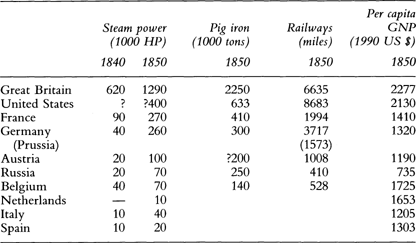
Table 2 Mid-century foreign trade (1850)

Like all autocrats (and Nicholas was far more of one than Louis-Napoleon ever could be in France), the Tsar depended upon the information his officials supplied, so their views counted, and these included both nationalism and, among certain circles, a variety of romantic conservative, liberal and socialist ideas. However, propagating radical reform projects from below was treated as illegal. Even partaking in a study group of intellectual dissidents could loand someone like the young Dostoyevsky a term in Siberia after 1848.41 On the other hand, the state could not suppress the nationalist sentiment of army officers and soldiers, officials, writers, clergy and rank-and-file urbanites. Indeed the only safe outlets for some of the people in this realm which cried out for a domestic overhaul were nationalistic foreign policy enterprises and military action.
As a defensively assertive, conservative multinational empire with concern for the governance of minority nationals of neighbouring countries, post-1848 Russia was similar to both Austria and Turkey. As a nationalist state with devilish contradictions that invited resolution via assertiveness abroad, Russia resembled France, England, the United States and Prussia.
NOTES
1.Kuan I. Chen, World Population Growth and Living Standards (New Haven 1960), p. 64; Marcel Reinard, et al. Histoire de la population mondiale (Paris 1968), Annexe statistique; Kemal H. Karpat, Ottoman Population, 1830–1914: Demographic and Social Characteristics (Madison 1985), p. 116.
2.Paul Bairoch, ‘International Industrialization Levels from 1750 to 1980’, Journal of European Economic History 11 (1982): 290–6, as cited in Paul Kennedy, The Rise and Fall of the Great Powers (New York 1987/9), p. 149.
3.B.R. Mitchell, British Historical Statistics (Cambridge, UK 1968), pp. 535–6; Paul Bairoch, Révolution industrielle et sous-développement (Paris 1974), pp. 326–7; David Good, The Economic Rise of the Habsburg Empire, 1750–1914 (Berkeley 1984), pp. 64–7.
4.Karl Dinklage, ‘Die landwirtschaftliche Entwicklung’, HM I: 401–14.
5.François Crouzet, The Victorian Economy (Anthony Forster, trans., New York 1982), p. 199; W.L. Blackwell, The Beginnings of Russian Industrialization, 1800–1860 (Princeton 1968), p. 425.
6.Bernard Cook, ‘Poverty’, and ‘Wages’, Victorian Britain. An Encyclopedia (Sally Mitchell (ed.), New York 1988), pp. 623–4, 838–9; Peter H. Lindert, ‘Reinterpreting Britain’s Social Tables, 1688–1913’, Explorations in Economic History 20 (1983): 90–104.
7.Dick Geary (ed.), Labour and Social Movements in Europe before 1914 (Oxford 1989).
8.Board of Trade, Central Statistical Office, Abstracts, 1849–53, Abstract Tables, Nos 4–7; Frank Edgar Bailey, British Policy and the Turkish Reform Movement. A Study in Anglo-Turkish Relations (Cambridge MA 1942), p. 70; Paul Bairoch, ‘Europe’s Gross National Product’, Journal of European Economic History (1976): 281; also Bernard Porter, The Lion’s Share. A Short History of British Imperialism, 1850–1970 (London 1983).
9.Albert H. Imlah, Economic Elements in the Pax Britannica (Cambridge MA 1958), pp. 42–81; Rondo Cameron, France and the Economic Development of Europe, 1800–1914 (Princeton 1961), p. 79; Lane Davis et al, American Economic Growth. An Economist’s History of the United States (New York 1972), pp. 34, 40, 316.
10.John Gallagher and Ronald Robinson, ‘The Imperialism of Free Trade’, Economic History Review, 2nd ser., VI. 1 (1953): 1–15.
11.GJ (for 1848–55); Bailey, British Policy and Turkish Reform, pp. 102–6; Ugo Cova, ‘Österreich(-Ungarn) und Italien’, HM VI. 1: 630.
12.Cf. A.K. Weinberg, Manifest Destiny: A Study in Nationalist Expansionism in American History (Baltimore 1935), pp. 59–71; Bolkhovitinov: 49–58.
13.B.R. Mitchell, European Historical Statistics, 1150–1915 (2nd rev. edn, New York 1980), p. 543; Thomas: 83–100; ZSAM HA, Rep. 50, E.I. No. 27 (from Brussels, 20 Jan. 1853).
14.Richard Charmatz, Minister Freiherr von Bruck: Der Vorkämpfer Mitteleuropas (Leipzig 1916), pp. 41–66; Paul W. Schroeder, ‘Bruck vs. Buol: The Dispute over Austrian Eastern Policy, 1853–1855’, JMH 40 (1968): 193; Herbert Matis, ‘Leitlinien der österreichischen Wirtschaftpolitik’, and Klaus Koch, ‘Österreich und der deutsche Zollverein’, HM I: 28–32, VI. 1: 537–45; Harry Hearder, Italy in the Age of the Risorgimento, 1190–1810 (London 1983), pp. 40–1.
15.William Carr, The Origins of the Wars of German Unification (London 1991), pp. 104–11; Frank Coppa, The Origins of the Wars of Italian Unification (Harlow 1992).
16.See Table 2 and Paul Bairoch, ‘Europe’s Gross National Product, 1800–1975’, p. 281.
17.Harold Ingle, Nesselrode and the Russian Rapproachment with Britain, 1836–1844 (Berkley 1978). pp. 148–56.
18.Puryear ERSQ: 82–4, 122–3.
19.Pierre Vilar, A History of Gold and Money, 1450–1920 (trans., Judith White, London 1976, first published Barcelona 1969), pp. 204–32; Ernest L. Bogart, Economic History of Europe, 1160–1939 (London 1942), p. 190.
20.Charles P. Kindelberger, A Financial History of Western Europe (London 1984), pp. 75–122, passim; Crouzet, Victorian Economy, p. 333; Alan T. Peacock, The Growth of Public Expenditure in the United Kingdom (Princeton 1961), p. 37. Kennedy, Rise of the Great Powers, p. 176.
21.David Cresap Moore, The Politics of Deference: A Study of the Mid-Nineteenth Century English Political System (New York 1976), p. 282; B.R. Mitchell, British Historical Statistics (Cambridge UK 1988), p. 793.
22.Elizabeth Longford, Queen Victoria: Born to Succeed (New York 1964), p. 202.
23.Geoffrey Best, Mid-Victorian Britain, 1851-1815 (London 1971), pp. 149–70.
24.Martin: 85–102; also Ivon Asquith, ‘The structure, ownership and control of the press, 1780–1855’, Newspaper History from the Seventeenth Century to the Present Day (Gordon Boyce, James Curran, Pauline Wingate (eds), London/Beverly Hills 1978), pp. 99–101; E.A. Smith, A History of the Press (London 1970), pp. 48–9.
25.Edward Royle and James Walvin, English Radicals and Reformers, 1160–1848 (Lexington KY 1982), pp. 160–80; D.G. Wright, Popular Radicalism. The Working-Class Experience, 1180–1880 (London 1988), pp. 138–55, 183–90.
26. J.B. Conacher, The Peelites and the Party System, 1848–1852 (Plymouth/ Devon 1972).
27.Brian Connell, Regina vs. Palmerston. The Correspondence between Queen Victoria and her Foreign and Prime Minister, 1837–1865 (Garden City NY 1961), pp. 163–75.
28.Roger Price, The Second French Republic. A Social History (London 1972), pp. 193–326; Stuart L. Campbell, The Second Republic Revisited: A Study in French Historiography (New Brunswick NJ 1978), pp. 1–26; Thomas R. Forstenzer, who uses the term ‘permanent counter-revolution’, French Provincial Police and the Fall of the Second Republic. Social Fear and Counterrevolution (Princeton 1981), pp. 3, 243; William H. Sewell, Work and Revolution in France: The Language of Labor from the Old Regime to 1848 (Cambridge UK 1980), especially pp. 90–1, 162.
29.Robert David Anderson, Education in France, 1848–1875 (Oxford 1975), pp. 39–70; Robert J. Smith, The Ecole Normale Supérieure and the Third Republic (Albany NY 1982), pp. 5–29.
30.Adrien Dansette, Histoire religieuse de la France contemporaine: de la Révolution à la Troisième République (rev. edn, 2 vols, Paris 1948–51), I: 233–375; Price, Second Republic, pp. 254–60.
31.Frank Luther Mott, American fournalism. A History, 1690–1960 (New York 1962), p. 237; two New York papers, the Sun and the Herald, rivalled the London Times in circulation.
32.For example, Cln. to Crampton 1, 8 April 1853 (CIDp. c. 125).
33.Theodore S. Hamerow, Restoration, Revolution, Reaction. Economics and Politics in Germany, 1815–1871 (Princeton 1958), pp. 173–237.
34.Dinklage, ‘Die landwirtschaftliche Entwicklung’, and Herbert Matis, ‘Leitlinien der österreichischen Wirtschaftpolitik’, HM I: 33–4, 403–15.
35.Don Karl Rowney and Walter Pinter (eds), Russian Officialdom: The Bureaucratization of Russian Society from the Seventeenth to the Twentieth Century (Chapel Hill 1960), pp. 190–249; W. Bruce Lincoln, In the Vanguard of Reform: Russia’s Enlightened Bureaucrats, 1825–1861 (DeKalb 1982), pp. 1–40; Marc Raeff, Understanding Imperial Russia (Arthur Goldhammer, trans., New York 1984), pp. 147–68.
36.Jerome Blum, Lord and Peasant in Russia from the Ninth to the Nineteenth Century (Princeton 1961), pp. 414–74; Steven Hoch, Serfdom and Social Control in Russia: Petrovskoe, A Village in Tambov (Chicago 1986), pp. 133–90; Karl Marx, ‘On Land Relations in Russia’ (first published 1875), Karl Marx and Fredereick Engels, Select Works in Two Volumes (Moscow 1956), pp. 49–61.
37.Nicholas Riasanovsky, Nicholas I and Official Nationality in Russia, 1825–1855 (Berkeley/Los Angeles 1969), pp. 1–35, 184–234; Sydney Monas, The Third Section. Police and Society in Russia under Nicholas I (Cambridge MA 1961), pp. 1–21; Anatole Mazour, The First Russian Revolution, 1825; the Decembrist Movement (Berkeley 1937), pp. 203–21.
38.Igor Smolitsch, Geschichte der russischen Kirche, 1700–1917 (Leiden 1964), pp. 287–99, 591–633; Derek Hop wood, The Russian Presence in Syria and Palestine, 1843–1914: Church and Politics in the Near East (Oxford 1969), pp. 33–45; David W. Edwards, ‘The System of Nicholas I in Church-State Relations’, Russian Orthodoxy under the Old Regime, ed. Robert Nichols and Theodore Stavrou. (Minneapolis 1978), pp. 154–69. The documents in TsGIA 796/1661 indicate a very limited role of the Synod in foreign policy regarding Orthodox Churches.
39.Monas, Third Section, pp. 132–96, 230–9; W. Bruce Lincoln, Nicholas I. Emperor and Autocrat of All the Russias (Bloomington 1978), p. 320.
40.For Tables 1 and 2, the relative figures are probably closer to reality than the estimated absolute numbers. In addition to works cited in the text: EB (1911 and 1947 edns), GJ (for 1848–53), David S. Landes, The Unbound Prometheus: Technological Change and Industrial Development in Western Europe from 1750 to the Present (Cambridge UK 1969); Richard L. Rudolph, ‘The Pattern of Austrian Industrial Growth from the Eighteenth to the Early Twentieth Century’, AHY XI (1975): 10; Ernest Bogart, Economic History of Europe, 1760–1939, p. 164; Sbornik svedenii po istorii i statistike vneshnei torgovli Rossii (St Petersburg 1902).
41.Joseph Frank, Dostoevsky. The Seeds of Revolt, 1821–1849 (Princeton 1976), pp. 239–91.