
9
Each of the factors we have been considering as possible causes of the First World War seems to have contributed something to the decisions in the final crisis of July 1914. The individuals who took those decisions were, often to a greater extent than they realized, limited in their choice of action not only by their own nature but also by a multitude of earlier decisions taken by themselves and by their predecessors in office.1 War had been avoided in the immediately preceding crises – 1908, 1911, 1913 – and yet was not avoided in 1914; however, each previous crisis contributed to the decisions of 1914. The Russians in 1913 had failed to give Serbia the backing it needed in order to secure an Adriatic port; in 1914 their choices were limited by the feeling that failure to support Serbia again would lead to a complete loss of Russian credibility and influence in the Balkans. The Austro-Hungarian government believed that, having been unable to prevent the Serbs from winning substantial territorial gains in 1913 (even if they did not get the port they wanted), they must crush Serbia this time if they were to withstand the internal threat to the Monarchy caused by the South Slavs.
The Germans believed that Austria-Hungary was their only reliable ally and as such should be supported at all costs to prevent it from collapsing or seeking help elsewhere; they also felt that they needed to stand by the Austrians in 1914 after offering only half-hearted support in the crisis of the previous year. Sir Edward Grey initially hoped to repeat his success as a mediator that he believed had prevented war in 1912–13, and this conditioned his diplomacy in the early stages of the 1914 crisis. Some have criticized Grey for failing to make clear his support of Russia and France; such clarity might, it is argued, have deterred Austria and Germany from pushing the crisis too far. But Grey and his leading advisers had long feared that, if the Entente were transformed into an alliance, it might encourage the French and the Russians to be too defiant; the Entente was, then, a careful balancing act aimed at deterring Germany while restraining France and Russia.2
Others have criticized Poincaré for pursuing a policy of révanchisme between 1912 and 1914. What John F.V. Keiger terms the ‘Poincaré-la-guerre myth’ emphasizes his roots in Lorraine and his determination to solidify further the Franco-Russian alliance – encouraging Russia’s resolve to stand by Serbia, mobilize and expand the crisis from a local into a European one. Keiger has shown, however, that although it is true that Poincaré saw the Franco-Russian alliance as the key to French security, he also saw the alliance as a way of restraining Russia in the Balkans and that he worked to reach a rapprochement with Germany in the two years before the war.3
The continuing international tension had created a feeling in Germany and Austria-Hungary that since war was inevitable sooner or later the important thing was to choose the right moment for a ‘preventive’ war – before the Russian rearmament programme was complete, for example, or the French had carried out their military reorganization or the British and Russians made an effective naval agreement. As Annika Mombauer’s study of newly available documents has shown, ‘German decision-makers consciously risked war in 1914, in order to improve the country’s deteriorating position vis-å-vis her European neighbours’.4 Once war was accepted as inevitable by the German leaders, as it was by December 1912, whether because they thought that what would now be called a pre-emptive strike was the only way of defending themselves against encirclement by hostile powers or because they thought a war was the only way to achieve the world power at which some of them were aiming, then, as the development of the July Crisis showed, their strategic plans became all-important and these had more immediate military consequences than those of any other power. It was the decision by Germany to issue Austria-Hungary with the ‘blank cheque’ that was the fateful one that expanded what might have been a localized crisis into a general war – an ironic, if tragic, outcome when it is recognized that the Austrians believed such support was essential to localize the crisis by effectively deterring the Russians from intervening. The resolution to resort to force was taken first in Vienna; what then happened ‘was a fateful meshing of aggressive German Weltpolitik with an even more aggressive, irresponsible Habsburg Balkanpolitik’.5
The arms race in which all the major powers were involved had contributed to the sense that war was bound to come, and sooner rather than later.6 It caused serious financial difficulties for all the governments involved in it, yet they were convinced that there was no way of stopping it. Although publicly it was justified as having a deterrent effect that would make for peace rather than for war, no government had in fact been deterred by the arms programmes of their rivals, increasing instead the pace of their own armament production. By 1914 Tirpitz, who had hoped that the German fleet would be so strong that no British government would risk going to war with Germany, had to face the fact that the British refused to play the role assigned to them and were determined to maintain their naval superiority whatever the financial and political cost. The continuing international tension and the strains of the armaments race each contributed to a mood in which war, when it came, was accepted almost as a relief. As a French observer in 1912 put it, ‘How many times in the last two years have we heard people repeat “Better war than this perpetual waiting!” In this wish there is no bitterness, but a secret hope.’7 ‘Il faut en finir’, the slogan that had a certain popularity in 1939, expressed equally what many people felt in 1914.
An ambitious, detailed account of the role of armaments in causing war in 1914 by David Stevenson argues that, although internal pressures and technological change contributed to its outbreak, they were not the deciding factors. Stevenson believes that ‘the international crises of the pre-war decade, long emphasized in diplomatic accounts of the origins of the war, were the essential destabilizing factor’.8 The immediately preceding international crises, the military and naval increases that had accompanied them and the mood they produced all helped to determine that this particular war broke out at that particular moment. These crises were themselves the result of long-term developments that have to be followed back for decades. In particular, the war of 1870, which had established German military predominance in Europe and left the French with a permanent grievance over the loss of Alsace and Lorraine, established the framework within which the international relations of the first years of the twentieth century were to be conducted. Added to this, the imperialism of the 1880s and 1890s had produced, especially in Britain and Germany, a new language in which international relations were discussed and a new sort of nationalism different from that which had inspired the movements for national unity and national self-determination earlier in the nineteenth century. At the same time, however, the nationalism of those peoples that still, wholly or in part, lived under alien rule – a creed that maintained that the cause of national independence was more important than anything else – was a continuous factor threatening the existence of the Habsburg and Ottoman empires and so contributing to the instability of the international system.
During and after the war diplomats – and diplomacy itself – were blamed for the outbreak of war under the charge of having practiced the ‘old’ diplomacy. This sometimes referred to Wilson’s condemnation of ‘secret agreements, secretly arrived at’, sometimes to the broader denunciation of the arcane and aristocratic nature of diplomacy’s practitioners. The first charge implied that more openness, more intense public scrutiny of diplomatic arrangements, would restrain governments from committing their states to war; the second implied that the social exclusivity of the diplomatic corps (along with those who staffed the foreign ministries) made them more inclined to support the traditional values such as ‘national honour’ and ‘military prestige’ that encouraged a willingness to go to war over issues that did not merit the blood that was shed. A study by Michael Hughes of British and Russian diplomatists concludes that these charges were misguided, that the ‘members of the British and Russian diplomatic establishments in fact devoted enormous energy in the 20 years before 1914 to avoiding war and pursuing alternative means of managing and resolving international conflict’; and, in fact, that ‘both British and Russian diplomats and Foreign Ministry officials were often appalled by the more aggressive voices that were so frequently audible in their two countries’.9
Even in the short term we have an enormous range of possible ‘causes’ of the First World War from which to choose our explanation, and the choice is, if not an arbitrary one, one that is conditioned by our own political and psychological interests and preconceptions. Some political scientists have found the acceptance of such a plurality of individual explanations intolerable and have attempted to quantify the factors in the pre-1914 situation so as to be able to measure their relative importance and, by assessing the balance of power in objective terms, show precisely what circumstances led to the war. Although this neo-positivist approach can be helpful to historians in suggesting significant factors that they might otherwise underestimate, it necessarily has limitations when it comes to assessing the significance of what are by their nature unquantifiable variables such as states of mind and questions of what is loosely called ‘morale’, even if it is possible to work out (though this is by no means certain) an accurate estimate of the economic and strategic factors that cause international instability.10
Nevertheless, the protagonists in 1914 often felt that they were the victims of forces beyond their control, or that they were part of some ineluctable historical process. For example, Bethmann Hollweg, who, as we have seen, discovered at the height of the crisis that ‘es sei die Direktion verloren’,11 had already 10 days before seen ‘a doom greater than human power hanging over Europe and our own people’,12 and Lloyd George, partly no doubt to obscure the significance of his own switch from being the spokesman of the peace party in the British Cabinet to his realizing that his future lay in being the man who would win the war, wrote later that the nations ‘slithered over the brink into the boiling cauldron of war’.13 Such a sense of the helplessness of man in the face of the inexorable processes of history provided a relief from the overwhelming sense of personal responsibility that some politicians certainly felt. But the picture of history as a great river or a mighty wind could also make men aware of the overwhelming importance of action at the right moment if they were not ‘to miss the bus’, as the phrase went. This view was vividly expressed by Bismarck:
World history with its great events does not pass by like a railway train at a constant speed. No, it goes forward by fits and starts, but then with irresistible force. We must always make sure that we see God striding through world history, then jump and cling to the hem of his garment so that we are carried along with it as far as we must go.14
Lenin also stressed, again using the simile of a railway train, the importance of decisive action at the right moment, and he despised all those who ‘would be ready to recognize the social revolution if history led up to it as peacefully, tranquilly, smoothly and accurately as a German express train approaches a station’15 instead of being able to seize the opportunity when the speed of history could be accelerated. In the crisis of 1914, we often have the feeling that none of the leading European statesmen possessed the sense of timing of a Bismarck or a Lenin that might have enabled them to seize control of events, and that they were swept away towards a goal they could not see along a road for which they lacked the maps. Certainly, Sir Edward Grey in spite of his later reflections upon ‘the lamps going out in Europe’, did not foresee the nature of the cataclysm about to be unleashed. In his speech to parliament on 3 August he warned of the economic sacrifices that would have to be made – not the coming carnage in Flanders and France – and these sacrifices would be incurred even if Britain were to remain neutral: ‘if we are engaged in war, we shall suffer but little more than we shall suffer even if we stand aside’.16
Even without adopting metaphors that suggest that history is a river or a gale or a railway or a runaway horse (‘History is galloping like a frightened horse’, the communist Karl Radek once remarked), we still feel the need to explain the outbreak of war in 1914 within a wider perspective. Each of the crucial decisions in the ‘ten fateful choices’ listed here was taken within a specific institutional and social framework. They were conditioned by a wide range of assumptions about the behaviour of individuals and governments and by values resulting from long cultural and political traditions, as well as from the social and economic structure of each country. The problem of these ever-widening circles of causation is that the attempt to find a general explanation for the outbreak of war is likely to get lost in a vast number of possible causes so that it is difficult to know where to stop if one is not to be left with explanations of such remoteness and generality that one still finds oneself without an adequate understanding of why this particular war broke out at that particular moment.
The attraction of a Marxist theory of history is that it appears to offer an explanation for a very wide range of phenomena in terms of a comparatively small number of basic factors. The importance of Marxism for non-Marxist historians is obvious, and it has changed fundamentally and irreversibly the kind of questions that historians ask. What it does not always do is to supply the answers. When, for example, we look at which economic groups stood to gain from war and which to lose, we are struck not only by the difficulty of determining the exact points at which these groups actually influenced governments but also by the complexity and divergence of interests within the capitalist world, a divergence that by no means corresponded to the divisions between national states. Even if it were accepted that war is inherent in the nature of capitalism, because capitalism developed the spirit of competition and the conditions for an armed struggle for the maintenance of profits by a few financiers and other capitalists, there is still a gap between this type of explanation and the analysis of July 1914 in terms of specific decisions by particular individuals. Although Rosa Luxemburg’s argument that imperialism colours the whole range of moral as well as economic values of a society draws attention to the connections between imperialism, protectionism and militarism, it still leaves many stages to be filled in before one can decide in what precise way Wilhelmine Germany or Edwardian Britain were imperialist societies and how this explains the actual decisions of 1914.
One solution of this particular historiographical dilemma is to reject all attempts at any long-term, wide-ranging explanation in terms of general social, economic or intellectual factors. Some historians, especially in Britain, believe that all they can hope to find out are the immediate short-term actions of politicians and the immediate short-term reasons for them. To look for anything else is to try to impose a pattern of events for which there is no evidence. But many of us are sufficiently Hegelian, if not Marxist, to want to try to bring into our explanations the moral values of a society, the Zeitgeist, as well as the economic interests of the participants both as individuals and as members of a class. Perhaps this means resigning ourselves to a kind of two-tier history. On the one hand there are the broad lines of social and economic development, of demographic change or of the even longer term effects of differences in the climate and other aspects of the environment. Some of these can be analysed in terms of scientific laws and so form the basis for predictions about the future. In changes of this kind even so revolutionary a development as the First World War is only a minor episode, a small irregularity on the graph. On the other hand, there is the world in which the decisions of individual leaders, whatever their origins, can affect the lives of millions and change the course of history for decades.
The question whether war was inevitable – or at least whether that particular war at that particular time was – is not one that can be answered except in terms of individual responsibility. In spite of all the forces making for war and in spite of all the evidence we now have about the will to war of certain sections of the European, and especially the German, ruling class and about the domestic pressures to which they were subjected, it is arguable that a war a few years later might have taken a different form and had a different result. Moreover, a study of the individual decisions of 1914 and the limits within which they were made shows that the consequences were not those that were expected. If some of the belligerents achieved the goals for which they went to war – the French recovered Alsace-Lorraine, the British ended the German naval challenge, the Italians won the Trentino and Trieste, the Serbs achieved what amounted to a greater Serbia in the shape of Yugoslavia – the price turned out to be much higher than almost anyone in 1914 had dreamed. Those countries with even more ambitious aims – the German striving for world power, the Russian drive to Constantinople, the Austro-Hungarians’ desperate bid to keep their empire intact – found that their ambitions turned to defeat and ruin, whereas those members of the governing classes who had believed that war might consolidate the state and end the prospect of revolution had to face the fact that the war produced the result it was intended to prevent.
It used to be said that a maxim impressed on young members of the British foreign service ran: ‘All actions have consequences: consequences are unpredictable: therefore take no action.’ The tragedy of political decisions derives from the fact that again and again politicians find themselves in situations in which they are constrained to act in ignorance of the consequences and without being able to assess calmly the probable results, the profit or loss that action may bring. (Nor is one more optimistic that the results will be any more predictable when some of these calculations are left to computers.) Men are not motivated by a clear view of their own interests; their minds are filled with the cloudy residues of discarded beliefs, and their motives are not always clear even to themselves.
This makes the historian’s task a difficult one. Each generation tends to approach the problem of the responsibility for the First World War in the light not only of its own political preoccupations but also of changing views of human nature and the springs of human action. In the twenty-first century we perhaps find it easier to conceive of foreign policy as being motivated by domestic preoccupations and by economic interests than by abstract concepts of the balance of power or the proper status of a Weltmacht, let alone by considerations of national prestige and glory. It does not necessarily follow that the men of 1914 thought in the same way as we do. While it is no doubt true, as Elie Halévy pointed out many years ago, that ‘the wisdom or folly of our statesmen is merely the reflection of our own wisdom or folly’, the wisdom or folly of one generation is not necessarily that of the next.17 To understand the men of 1914 we have to understand the values of 1914; and it is by these values that their actions must be measured.
Measuring actions: 10 fateful choices
One of our most fundamental historical instincts is to assign great causes to great events. Wars and revolutions, we assume, must have profound foundations – they are not to be explained by human folly, by errors and mistakes, by wounded egos or inflated conceits. There must be something deeper at work, something more measurable, more durable, less fragile and less chaotic. This instinct is deeply rooted in human needs: if there is no limit to human misjudgement, prejudice and faulty assumptions, how are we to reshape the world and avoid the tragedies that have befallen nations and empires throughout history? The cataclysmic consequences of the First World War added weight to this need: the Russian Revolution, the political and social upheavals of 1918–22 throughout Europe, the redrawing of the maps and the emergence of new national states determined the course of history for the rest of the century. It is difficult to imagine the rise of Mussolini and Hitler, the horrors of Auschwitz and Hiroshima, the Cold War contest between the United States and the USSR without the stimulus engendered by the First World War.
The predisposition to look for roots, to unearth causes and to elucidate them, is not misguided. There are indeed profound, deeply rooted phenomena to be discovered in any investigation into the causes of world-altering events. And the First World War was a world-altering event on a scale for which there were few precedents. There have been numerous attempts to classify and codify the various explanatory categories that historians, political scientists and others have designed in order to make sense of the myriad factors involved. We have been offered immediate and underlying causes, structuralist, intentionalist and systemic explanations, Darwinian, Leninist and Freudian accounts. No serious student of the subject would deny the importance of these approaches or ignore the insights they have given us in our attempt to understand the war’s origins.
In order to illuminate the place of these explanatory categories in understanding war origins, I believe it is necessary to focus attention once again on the narrative of the July Crisis. The single greatest challenge confronting historians who grapple with war origins is to connect the dots between the structural and systemic explanations and the actual behaviour of those engaged in crisis-management decision-making during the crisis. I believe it is possible, using the categories highlighted in the chapters of this book, to connect the dots, to show how the ‘concentric circles’ that James Joll referred to in the first edition, intersected with the behaviour of those whose participation in the July Crisis was crucial to its tragic outcome.
Momentous historical events are rarely the result of a single choice made by a single participant or even by a small group of leading actors. Rather, they are almost always the culmination of a series of choices, the sequence of which is instrumental in leading to the dénouement of the drama. I have identified here what I believe to be the 10 most fateful choices made during the crisis of July that led to war in August. By identifying these choices and presenting them sequentially, I believe it is possible to understand how the various general explanations – structural, systemic, intentional – influenced the actual, real-time choices made by the participants. Correlation is not causation; because these factors were present at the same moment does not mean that they were the cause. The cause is to be found in the actions of the participants, with the explanations for their actions to be found in the structures and systems within which they developed their intentions.
Take, for instance, the pivotal role played by ‘nationalism’ in determining the policies pursued by leading participants in the summer of 1914. Obviously, the ethos of the young men who engaged in the conspiracy to assassinate Franz Ferdinand was grounded fundamentally in the principle of nationality as providing the bedrock upon which states should be constructed. In their eyes, the only states that enjoyed moral legitimacy were ‘nation-states’. The attacks of Serbian nationalists directed at the Habsburg Empire in newspapers, pamphlets and speeches had, for decades, impugned the validity of that non-national state and its right to exist. They derided the notion that a state whose existence and institutions relied on the dynastic principle that stretched back centuries was still relevant in the modern world. Nationalists of all stripes (not just Serbian) demanded that those who shared a common language, culture and/or religion should be given the opportunity to transform this commonality into a political entity, that they ought to have the chance to control their own destiny. Within the Habsburg Empire and on its borders were Romanians, Czechs, Slovaks, Poles, Italians, Croats, Slovenes, Bosnians and Serbs who were demanding their independence, autonomy or the opportunity to unite with their brethren in states that already existed.
Thus, ‘nationalism’ has, quite rightly, been regarded as a significant factor in causing the First World War. Its own history and origins as a concept that took root and grew into a formidable force throughout the nineteenth century is well-known and well-documented. And so has the resistance to it. Every European dynasty in the nineteenth century was compelled to come to grips with the new force that was swelling below their feet – and most came up with a creative formula that blended traditional dynastic rights with the new precepts of nationality. Thus did the son of a duke of Savoy and king of Sardinia become the King of Italy, the ‘Padre della Patria’ (the ‘Father of the Fatherland’). Throughout Europe the old order found ingenious strategies to harness the power of the new nationalism with their hereditary rights.
Nowhere was this challenge more demanding than in the Habsburg Empire where, by 1914, the strongest connective tissue binding the disparate parts of the empire was the image of the emperor, Franz Josef, whose personal authority was the glue that held the multi-ethnic, multilingual empire together. He persisted in regarding himself as ruling by divine grace and talked of the empire as ‘his’. ‘The Monarchy is not an artificial creation but an organic body.’ He confided to an adviser. ‘It is a place of refuge, an asylum for all those fragmented nations scattered over central Europe who, if left to their own resources would lead a pitiful existence, becoming the plaything of more powerful neighbours.’18 Thus, he and those around him offered an alternative principle upon which to base their political authority – a traditional, paternalistic one. And this alternative was made real, given shape and substance by promoting the image of the emperor everywhere. Throughout the empire he was ‘seen’ by his subjects: portraits of him were hung everywhere, busts and statues of him embellished buildings and monuments; homes were adorned with commemorative tea and coffee services, fine china and crystal. His image was ubiquitous and it, and the products of the cottage industry it created, can still be seen throughout the Austrian republic and the other offshoots of the Habsburg Empire.
Thus, ‘nationalism’ was a vital factor in determining the Austro-Hungarian response to the assassination, as outlined in Step 1. Serb nationalism posed an alternative organizing principle to that offered by the Dual Monarchy. The leaders of the Habsburg empire determined that, in order to survive, they must demonstrate the vigour of the organizing principle that they offered: that of a multinational empire in which the various ethnicities, linguistic groups and co-religionists could function while being offered the umbrella of protection of the empire as a whole. Their choice to seize the moment was not irrational, not made casually or haphazardly. It was the result of having faced decades of challenges both inside the empire and on its frontiers. If the ambitions of Serb nationalists could be quashed, if the growth of the Serbian state could be stopped and perhaps reversed, it was entirely possible that the Habsburg empire might survive and even flourish even in the new age of the twentieth century.
The choices made by the participants are to be attributed not to errors, mistakes or misjudgements but to rational decisions selected from a variety of possibilities. Their choices reflected their Weltanschauung, and one that was generally shared, with the two underlying principles to be found in imperialism and social Darwinism. The most profound of the forces underlying the decisions of 1914 was the elemental belief in the simple formula: grow or die. Prosperity, security and stability seemed to depend on maximizing the size and strength of the state – and the future seemed destined to reward coherent, integrated empires, not fragments of them. This was the credo of monarchs, statesmen, strategists, diplomats and theorists in the decades before 1914; in the midst of the July Crisis it was the most important of the ‘unspoken assumptions’ elucidated by James Joll in his famous lecture. Almost everyone who mattered believed that the twentieth century would be dominated by ‘world powers’ that both transcended the fissiparous elements that they contained and which could incorporate them within the greater whole. And yet, barely a word of this is heard in the correspondence and the chatter of July. ‘Documents never speak for themselves; historians must speak for them.’19
Students of the subject would do well to heed the words of Karl Marx:
Men make their own history, but they do not make it just as they please in circumstances they choose for themselves; rather they make it in present circumstances, given and inherited. Tradition from all the dead generations weighs like a nightmare on the brain of the living.20
Step 1: The Austro-German Zweibund seizes the assassination as an opportunity
The first decisive step on the road to war was taken in the immediate aftermath of the assassination of the Archduke Franz Ferdinand by the inner circle of decision-makers in Austria-Hungary who believed that they had been presented with a golden opportunity to ‘solve’ the challenge posed by Serbian nationalism once and for all. Led by the foreign minister, the cautious and careful Count Berchtold, the common ministerial council agreed with the experts and diplomats of the Ballhausplatz that the assassination of the Habsburg heir to the imperial throne on 28 June would engender European sympathy for a vigorous Austrian response – and that they could attribute responsibility for the murder to the Serbian government. They perceived a direct threat to the existence of the multinational Habsburg empire posed by the propaganda campaign promoting a ‘pan-Serbian’ state that would unite all Serbs and perhaps even all ‘South Slavs’. The chief of general staff, Conrad von Hötzendorf, pressed the politicians to seize the opportunity to vanquish Serbia on the battlefield. Thus, ‘nationalism’ as both a positive and a negative force was inextricably connected with the evolving narrative of the July Crisis.
But the Habsburg government recognized from the outset that it could not proceed without the support of its German ally. If confronted by Austria, Serbia was likely to turn to Russia for diplomatic and political support, and Russia’s military might could only be countered by Germany’s. A memorandum recently prepared by the foreign ministry outlining the nationalist threat to the existence of the monarchy was revised for the purpose of persuading Germany of the dangers that confronted the Austro-German Zweibund. Serbia’s success in the recent Balkan wars had increased enormously its size and strength – and, the memorandum argued, Serbia was entirely under the influence of Russia, whose immediate aim was the encirclement of Austria and whose ultimate goal was to challenge Germany’s political and commercial supremacy in eastern Europe. Kaiser Wilhelm II was persuaded on 5 July to promise his ‘full support’ for a vigorous Austrian response, assuring his ally that he would stand at their side if it came to war. But Emperor Franz Josef had not asked for assistance in going to war with Serbia, and it seemed rather unlikely that the autocratic tsar of Russia would take the side of the Serbian regicides.
In spite of the ‘underlying forces’ present in Europe in the summer of 1914, these first moves in the aftermath of the assassination were neither inevitably warlike nor irreversible. Demands to restrain pan-Serbian propaganda and organizations need not have led to war and the Serbian government had already indicated its willingness to suppress ‘anarchic elements’ within Serbia.
Step 2: Austria-Hungary decides on an ultimatum
With the promise of German support, Austria-Hungary was now free to determine how to respond to the assassination. Although no evidence had yet been adduced to link the Serbian government directly to the assassins, some connections between them and Serbian military circles had been discovered and the hostile attitude of the Serbian press to the Habsburg monarchy was easily demonstrable. Almost everyone involved in making decisions at Vienna believed that the situation presented them with a golden opportunity to vanquish the threat that Serbia posed to the monarchy, and that such a positive concatenation of circumstances in Austria’s favour was unlikely to recur.
With Germany apparently on side, the only significant constraint on the Austrian ‘hawks’ was the attitude of István Tisza, minister-president of Hungary, whose constitutional authority within the Dual Monarchy gave him a virtual veto power in foreign policy. And, in spite of Germany’s indication of support, his immediate reaction was to insist that a diplomatic initiative must precede any military moves. Determined that no more Slavs be added to the Dual Monarchy, he rejected anything like a war of ‘annexation’. He proposed that Austria should present Serbia with a series of demands which, if accepted, would represent a stunning diplomatic victory for Austria. After a week of discussions, Tisza and Berchtold agreed on 14 July that they should present to Serbia a daunting series of demands in the form of an ultimatum that would expire after 48 hours.
The objective of Austrian policy was clear, even if the means of achieving it were not. Serbia was to be reduced in such a way that it would have to abandon any ambition to establish itself as the paramount power in the Balkans and would be constrained from posing a threat to the multinationalism of the Habsburg monarchy by promoting a pan-Serbian or pan-Slavic ideal. Although Tisza had succeeded in rejecting any design to annex Serb territory, if Serbia failed to submit to Austrian demands and war broke out, Serbian territory would be transferred to Bulgaria, Greece and Albania and some strategically significant frontier rectifications would be made in favour of Austria-Hungary. Serbia would also be forced to pay for the costs of a war, and additional measures would be instituted to place Serbia in a state of dependency on the Dual Monarchy in the future.
On Sunday, 19 July, two weeks after the mission of Count Hoyos to Berlin, the common ministerial council agreed to present to Serbia an array of demands ‘that no nation that still possessed self-respect and dignity could possibly accept’ according to Berchtold’s chef de cabinet. Serbia’s only alternative to submission would mean facing the prospect of war with Austria-Hungary.
Step 3: Russia adopts ‘firm and energetic’ measures in response to Austria’s ultimatum
Austria’s demands were presented to the Serbian government in Belgrade at 6 p.m. (local time) on Thursday, 23 July. Delivery of the note had been delayed since the 19th because of the visit of the French president and premier to St Petersburg. The Austrians had anticipated that the presence of Poincaré and Viviani might encourage a united front to their démarche and to a more robust backing of Serbia.
The Austrians were probably right. Two days before the presentation of the ultimatum Poincaré had already anticipated that Austria would attempt to humiliate Serbia in a coup de theatre. If Austria were to adopt a menacing stance, he promised to support a vigorous Russian defence of Serbia: ‘Sazonov needs to be firm’. Before leaving St Petersburg, he assured the tsar and the foreign minister of France’s loyalty to the alliance with Russia – a position repeatedly stressed by the French ambassador in St Petersburg after Poincaré’s departure.
When the Russian Council met on 24 July, the day after the presentation of the Austrian demands, Sazonov warned that a restrained response from Russia would be interpreted as weakness in Vienna and Berlin and would encourage them to act aggressively. If Serbia complied with Austria’s demands it would likely be transformed into a satellite of the Austro-German Zweibund. The ministers agreed that vital Russian interests were at stake, that failing to stand up on behalf of Serbia would lead to the collapse of Russia’s prestige in the Slavic world and that it would come to be regarded as a decadent, second-rate power. But, quite clearly, to take a firm stance now would run the risk of a European war, because Austria would not have acted so boldly without a guarantee of German support.
On the morning of 25 July, with the Serbian reply to the Austrian ultimatum due by 6 p.m., the Russian Grand Council met to determine how Russia should respond. The Council, consisting of government ministers, members of the royal family and other high-ranking officials, agreed that they ought to mobilize 13 army corps designated to take action against Austria-Hungary. Later that afternoon preparations were made that would enable the mobilization of the Kiev, Odessa, Moscow and Kazan military districts. Furthermore, regiments were to be recalled to their garrisons, summer manoeuvres were cancelled and military cadets were to be commissioned immediately, rather than waiting, as scheduled, until later in the autumn.
What Russia had chosen to do was to declare the existence of a ‘period preparatory to war’, which had been defined the year before as a period of ‘diplomatic tension’ that precedes the beginning of war operations. That evening, the chief of the general staff announced to his department heads that the decision had been made to respond to the Austrian ultimatum in a manner ‘worthy of Russia’. The fortresses of Warsaw, Ossovyets, Novgorod, Brest-Litovsk, Ivangorod, Vilna and Grodno were to be placed on a war footing. Bridges over rivers near the frontier were to be guarded, while St Petersburg and Warsaw were placed in a condition of ‘extraordinary protective activity’.
The Russians believed they could deter Austria-Hungary from attacking Serbia. To avoid precipitating a military response from Germany all military operations were to be aimed at Austria-Hungary alone.
Step 4: Austria rejects the Serb reply and begins to mobilize
Serbia received no encouragement from the ‘Triple Entente’ to take a firm line in responding to the Austrian demands. Sazonov advised the Serbs to offer no resistance to an Austrian invasion, advice which was echoed by France and Britain, both of whom encouraged them to be as accommodating as possible when responding to Austria. The absence of any encouragement – let alone promises of military support – from the Entente powers persuaded the Serbs that they had no choice but to attempt to placate the Austrians.
Two minutes before the deadline of 6 p.m. on Saturday, 25 July, the Serbian reply, which was handed to the Austrian minister in Belgrade struck a compliant tone: the Serbian government condemned ‘all propaganda directed against Austria-Hungary’ – that is, ‘all efforts leading to the ultimate result of disjoining parts of the territory of the Austro-Hungarian monarchy’. They indicated their willingness to except eight of the 10 demands in the ultimatum, expressing reservations on points 5 and 6, which seemed to impinge upon Serbian sovereignty as these were to authorize Austrian officials to conduct investigations within Serbian territory and to participate in Serbia’s judicial inquiry into the origins of the plot to assassinate the archduke.
In Belgrade, prime minister Pašić believed that they had gone far enough in complying with Austria’s terms to serve as a basis for continuing negotiations and avert war. In London, when Sir Edward Grey learned of the Serbian reply, he was impressed with how far they were prepared to go in accommodating the Austrians. He hoped that the Germans would encourage their ally to accept the reply as offering an adequate foundation to defer military action. In Berlin, the kaiser declared that it was a humiliating capitulation and with it ‘every cause for war’ had collapsed.
But the Austrians were determined to reject anything less than total submission. Tisza had urged the emperor to order mobilization if Serbia’s reply was unsatisfactory: ‘the slightest delay or hesitation would gravely injure the reputation of the Monarchy’. The Austrian minister in Belgrade had his orders: only complete and unreserved acceptance of all 10 demands would suffice. Failing that, the Austrian delegation was to return to Vienna immediately and diplomatic relations with Serbia would then be severed. Count Berchtold dismissed the Serbian reply as being ‘of no value’ and pleaded with the emperor to declare war in order to forestall any efforts the Triple Entente might make to mediate between them and Belgrade. Franz Josef duly signed the papers authorizing the mobilization of 13 army corps that evening. At midnight Serbia too ordered mobilization.
Step 5: Germany fails to support diplomatic initiative
Sazonov’s belief that Russia’s steps ‘preparatory to war’ might encourage a diplomatic solution to the crisis seemed destined to fail when Austria refused to extend its deadline and instead ordered mobilization on the evening of 25 July. But Germany was now the key, as it might induce the Austrians to delay military operations while the Great Powers continued to seek a diplomatic solution. Perhaps, in spite of the mobilization of both Austrian and Serbian forces, there remained a chance that war between the two of them – and a general European war – might be averted. Berchtold certainly considered this to be a possibility, which was why he urged a quick decision by Franz Josef: he feared that new initiatives undertaken by the Triple Entente to mediate between Vienna and Belgrade might succeed if backed by Germany.
Numerous reports from St Petersburg indicated that Sazonov was adopting a less strident position than previously, that he was promising to build ‘a golden bridge’ for the Austrians if they would agree to some form of mediation – and that any discussions would be limited to the two most contentious points arising from the ultimatum. Simultaneously, in London, Sir Edward Grey was proposing a mediation à quatre – that is, for Britain, France, Germany and Italy to find a way to prevent an Austro-Serbian conflict from exploding into a general European war. In Berlin Bethmann Hollweg continued to believe that the conflict could be localized, arguing that Austria’s declaration that it would not annex Serbian territory ought to be sufficient to dissuade other Powers from intervening.
By 27 July, two days after the Austrian ultimatum deadline had passed, and in spite of the military measures taken by Austria-Hungary and Russia, Sir Edward Grey continued to believe that a diplomatic resolution was possible: ironically, perhaps the steps taken by them would make war less likely, as everyone could now see that ‘localization’ was impractical and that the intervention of Europe was necessary if peace were to be preserved. He encouraged Germany to ask Austria to consider modifying its demands. He had his ambassador in Berlin present his suggestion of a conference à quatre as the ‘best proposal to make in the interests of peace’.
The German secretary of state, Jagow, dismissed Grey’s proposal as amounting to ‘a court of arbitration’ and he warned that if Russia were to mobilize against Germany, it would have to follow suit. Germany would do no more than transmit the British proposal to Vienna – and, privately, Jagow explained to the Austrians that Germany did not support the proposal and that he was passing it along only to mollify the British. At the same time, Bethmann Hollweg dismissed the Serb reply to Austria as disingenuous: they would not abandon their ‘trouble-making activities’. Austria-Hungary felt no pressure from its ally to agree to any new diplomatic initiative.
Step 6: Austria-Hungary declares war on Serbia
Although the Austrian deadline of 6 p.m. on Saturday the 25th of July had come and gone, hostilities had not begun and there were still decisions to be made that might have saved the peace. The Austrian delegation had returned to Vienna and both Austria-Hungary and Serbia had announced mobilization that evening, while other European states took the first tentative steps to prepare for a possible conflict. Nevertheless, on Sunday and Monday diplomatic activity continued in place of warlike operations. General Hans von Plessen, the German adjutant general had the impression that ‘it will all blow over’.
In St Petersburg, Sazonov insisted that there must be some way of giving the Serbs the lesson they deserved without infringing upon their sovereignty. He was prepared to recognize the justice of Austria’s complaints against them and assured the Austrian ambassador that he accepted the legitimacy of Austria’s right to preserve itself and to defend itself against propaganda designed to destroy its integrity. The Austrian ambassador in St Petersburg was encouraged by Sazonov’s attitude.
In London, they were impressed by how far the Serbs had gone in attempting to meet the Austrian demands. The permanent under-secretary at the Foreign Office concluded that the Serbs had conceded almost all of the Austrian demands and found it difficult to see how the Austrians could proceed with hostile operations when Serbia had yielded so much. Sir Edward Grey concluded that they had gone farther than he would have believed possible, that they had agreed to almost everything the Austrians had demanded. If the Austrians refused to accept their reply as the basis for negotiations it would be ‘absolutely clear’ that they were seeking an excuse to crush Serbia. The acting French foreign minister took a similar position: the Serbs had yielded to all of the demands and Austria’s refusal to accept the submissive reply was ‘incomprehensible’.
The kaiser concurred with these assessments of the Serb reply. He concluded that ‘every cause for war’ had collapsed with Serbia’s humiliating capitulation and that the Austrians had won the diplomatic contest. The Austrian legation ought not to have left Belgrade upon receiving the reply because it represented ‘a great moral success for Vienna’. But the Serbs must be held to account, as they were ‘liars, fakers and masters of evasion’: Austria should occupy Belgrade to be sure that the Serbs lived up to their promises.
Berchtold and the Austrians stood firm in spite of these positive assessments of the Serbian reply. He told the British ambassador in Vienna that instead of accepting the Austrian demands, the Serbs had prevaricated: they must not be treated as if they were a cultivated nation, and any effort to mediate would simply encourage them to go on as they had in the past. On the afternoon of 28 July, Austria-Hungary made the fateful decision to declare war on Serbia.
Step 7: Russia threatens to mobilize
When news of the Austrian declaration of war reached St Petersburg late in the afternoon of 28 July Sazonov arranged to meet immediately with Tsar Nicholas. Following their meeting, the foreign minister instructed his officials to draft two ukases for the signature of the tsar: one would institute a partial mobilization of the four military districts of Odessa, Kiev, Moscow and Kazan; a second would initiate a general mobilization and include the districts of Warsaw, Vilna and St Petersburg.
Sazonov preferred the first option of a partial mobilization because it would enable him to assure Germany that Russia’s military steps were not aimed against it. The military men argued against this scenario as being logistically impossible to fulfil, but Sazonov and the diplomats wanted to utilize the possibility as a means of convincing Germany to prod Austria into negotiating a peaceful settlement with Russia in spite of the declaration of war on Serbia. Sazonov told the German ambassador that Austria’s mobilization had compelled Russia to match it along the Austrian frontier. The Russian move, however, did not necessarily mean war: the Russian armies could remain in place for weeks without crossing into Austria. The German ambassador warned Sazonov that Russia’s action would force Austria and Germany to respond with counter-measures.
Sazonov continued to press for the renewed negotiations with Austria. The chief of the Russian general staff assured the German military attaché that as of that afternoon no mobilization had commenced anywhere, that not a single man or horse had been called up. Major Eggeling dismissed this argument as disingenuous: he had received numerous reports of military preparations and concluded that the Russians were deliberately attempting to mislead them. When Bethmann Hollweg warned that Germany would be compelled to mobilize if Russia continued to make preparations, Sazonov concluded that this was the true cause of Austria’s intransigence and agreed with the minister for war and the chief of the general staff that Russia should now prepare for war with Germany and undertake a general mobilization.
But the tsar intervened. He was in the midst of communicating directly with the kaiser via a personal correspondence and wanted to hear how Wilhelm would respond to his latest letter before taking any dramatic action. The order for general mobilization, which was to be sent out by 9 p.m. on the 29th, was rescinded by the tsar. He postponed it and reinstituted the order for a partial mobilization only. But when the tsar tried to reassure the kaiser that his order five days ago for a partial, defensive, mobilization would only begin now, Wilhelm erupted in anger: the tsar had mobilized behind his back and tried to trick him: ‘Now I must mobilize too!’
Step 8: Germany threatens Russia and France
In spite of the Austrian declaration of war on the afternoon of 28 July, there was no fighting. This was not surprising: the chief of the Austrian general staff had warned his government that it would take two weeks after mobilization before an invasion of Serbia could begin. In spite of attempting to forestall further diplomatic initiatives to mediate or arbitrate the dispute, the two-week gap between the declaration of war and an invasion of Serbia left more time for diplomacy.
But the delay created a problem for Germany. Bethmann Hollweg complained bitterly that the delay would place Germany in an ‘extraordinarily difficult position’. How was Germany to respond to the various proposals for mediation or a conference – which, if they were simply disregarded, would make Germany appear to be responsible for a world war?
At the same time, Berchtold complained of the difficult position in which Austria-Hungary found itself. Thus far, mobilization measures had excluded Galicia – along the Russian frontier – but if Russia responded aggressively to Austria’s declaration of war on Serbia, it was essential that Austria should mobilize fully. The only way to avoid this was for Germany to put sufficient pressure on Russia that it would be deterred from mobilizing against Austria, in which case Austrian military plans could focus on Serbia alone.
The German general staff supported Austria’s request, arguing that it would quite rightly have settled the issue with Serbia directly had not Russia prepared to intervene by initiating a series of military steps. A conflict between Austria and Russia would compel Germany to mobilize against Russia in order to prevent the annihilation of its ally. Moreover, the French were undertaking preparatory military measures in support of Russia, which placed Germany in a more dangerous situation with the passage of each day.
Bethmann Hollweg felt compelled to act. The day following Austria’s declaration of war on Serbia, on 29 July, the chancellor issued warnings to both Russia and France that, if they continued with their military preparations, he would proclaim Kriegsgefahr (risk of war) and begin to prepare Germany for mobilization. The chief of the German general staff was insisting that Germany had only 72 hours in which to act, that it must counter even a partial mobilization by Russia. Sazonov was warned late on the evening of 29 July that even a partial Russian mobilization could precipitate a war. Nevertheless, Bethmann continued to hold out the prospect of further negotiations – either à quatre or bilateral – if Austria was permitted to occupy Serbian territory as hostage in the meantime.
Step 9: Germany threatens mobilization
A partial Russian mobilization, designed to calm Germany by focusing military preparations on Austria-Hungary, failed to achieve its objective. The Austro-German war plan hinged on Austria taking the offensive against Russia in Galicia, thereby permitting Germany to maintain only minimal military resources in the east, and enabling it to concentrate on an offensive against France in the west. The chief of the German general staff pointed out that if Austria concentrated its forces only on Serbia it would be unable to fulfil its role of pinning down Russian forces, thereby enabling them to launch a massive offensive against Germany.
For these reasons, by 30 July Moltke was advocating that Germany mobilize by the next day and he had an announcement drafted for the kaiser to that effect. Moltke argued that Germany now must mobilize even if Russia did not or it would lose the advantage of speed that it enjoyed. Nevertheless, the chancellor resisted a declaration of the drohenden Kriegsgefahr (‘threatening danger of war’) because it would be tantamount to mobilization, and mobilization ‘meant war’.
The kaiser, however, was now convinced that Britain, Russia and France had plotted to use the Austro-Serbian conflict as an excuse to wage ‘a war of extermination’ against Germany. He complained that he was facing a dilemma: if he remained faithful to the emperor and their alliance, he would give the Entente the opportunity to annihilate Germany; if he did not remain faithful Germany would face its enemies alone. Still, he prevaricated and continued to hope that, if Austria would be satisfied with an occupation of Belgrade and surrounding territory as hostage to ensure that Serbia would live up to the promises it had made in its reply to the Austrian ultimatum, a general European war might still be avoided.
But the chancellor had, by the end of the day on 30 July, concluded that the general staff was right: Germany must make an immediate decision concerning its mobilization. Waiting any longer could be disastrous. The next morning in Berlin the kaiser received the news that Russia was now mobilizing and had ordered its reservists to report by 1 August. He was now convinced that he had no choice but to mobilize and authorized the drohenden Kriegszustand (‘imminent peril of war’) declaration, although he made one final plea to the tsar to suspend ‘every war measure’ aimed at Germany and Austria-Hungary within 12 hours. Almost simultaneously, he demanded that the French declare their willingness to remain neutral in a Russo-German war and he required a satisfactory answer from them by 4 p.m. the next day. If the French agreed, they must be prepared to hand over their fortresses at Verdun and Toul as a pledge of their neutrality in a Russo-German war.
Step 10: Britain chooses to intervene
Throughout the July Crisis, Sir Edward Grey had taken a consistent position. Britain, he maintained, had no interest in the issues between Austria-Hungary and Serbia. Britain’s only concern was to prevent a general European war from arising out of the quarrel. Russia and France repeatedly pressed the foreign secretary to commit Britain to act in unison with them, arguing that a firm line taken by the ‘Triple Entente’ would deter Austria from aggressive action against Serbia. But Grey had consistently refused to take such a clear position, maintaining that some even-handed form of mediation was Britain’s preferred course of action.
When the British cabinet met on 31 July to consider the French request for a promise that Britain would intervene on their side in a war, they were unable to reach a decision. Some opposed intervention, others wished to intervene and the remainder were undecided. Most believed that the British public would not support going to war for the sake of France but that its attitudes could change if Germany were to attack Belgium. Grey was directed to inquire of both Germany and France whether they would respect the neutrality of Belgium. In the meantime, they declined to give the French the promise of support that they had asked for. Instead, Grey tried once again to get the parties involved to agree to his proposed mediation à quatre.
The moment of decision was approaching rapidly: on 1 August the Belgians began to mobilize, warning both the Germans and the French that they would uphold their neutrality ‘to the best of their power’. The British cabinet continued to be divided, even on the issue of whether a violation of Belgian neutrality would require their intervention, or merely permit it. And a new issue was introduced: given that the French had relocated their naval forces from the English Channel to the Mediterranean as a result of their entente with Britain, what would Britain do if Germany utilized the defenceless coastline to attack France by sea? But, in spite of this issue and the fact that Germany would not promise to respect Belgian neutrality, Grey continued to resist any British commitment to join France and Russia in the event of war. He even asked the Germans whether they would respect French neutrality if France did not interfere in a Russo-German war.
Although the British cabinet remained bitterly divided, the opposition to British intervention melted away over the first few days in August, with only a few, rather minor, cabinet ministers resigning over the issue. They finally agreed to take a firm stance: if Belgian neutrality were violated, or if France was attacked from the coast, Britain would regard this as a casus belli. Grey defended this position in a speech to the House of Commons on 3 August, and Britain presented Germany with an ultimatum regarding Belgian neutrality. When Germany failed to respond by the deadline of midnight 4/5 August, war was declared.
References
· 1 Some of what follows is based on James Joll, ‘Politicians and the Freedom to Choose: The Case of July 1914’, in Alan Ryan (ed.), The Idea of Freedom: Essays in Honour of Isaiah Berlin (Oxford 1979).
· 2 See Keith Hamilton, Bertie of Thame: Edwardian Ambassador (Woodbridge 1990), especially pp. 311–13.
· 3 John F.V. Keiger, Raymond Poincaré (Cambridge 1997), especially pp. 156–62.
· 4 Annika Mombauer, Helmuth von Moltke and the Origins of the First World War (Cambridge 2001), p. 1; on the documents, see pp. 6–13.
· 5 Samuel R. Williamson Jr., ‘Vienna and July 1914: The Origins of the Great War Once More’, in Williamson and Peter Pastor (eds), Essays on World War I: Origins and Prisoners of War (New York 1983), p. 24.
· 6 David G. Herrmann, The Arming of Europe and the Making of the First World War (Princeton, NJ 1996), pp. 227–9.
· 7 ‘Agathon’, in Henri Massis and Alfred de Tarde (eds), Les Jeunes Gens d’Aujourd’hui (Paris 1913), p. 31.
· 8 David Stevenson, Armaments and the Coming of War: Europe 1904–1914 (Oxford 1996), p. 13.
· 9 Michael Hughes, Diplomacy before the Russian Revolution: Britain, Russia and the Old Diplomacy, 1894–1917 (London 2000), p. 204.
· 10 See, for example, the special issue ‘Quantitative International History: An Exchange’, Journal of Conflict Resolution 21 (1977); also George H. Questor, ‘Six Causes of War’, Jerusalem Journal of International Relations 6 (1982), and Richard F. Hamilton, ‘On the Origins of the Catastrophe’, in Richard F. Hamilton and Holger H. Herwig (eds), The Origins of World War I (Cambridge 2003), pp. 469–506.
· 11 ‘The Management is Lost’; Karl Kautsky, Graf Max Montgelas and Prof. Walter Schucking (eds), Die deutschen Dokumente zum Kriegsausbruch, Vol. II (Berlin 1919), No. 456, pp. 177–178.
· 12 See p. 43 above.
· 13 David Lloyd George, War Memoirs, Vol. 1 (new edn, London 1938), p. 32.
· 14 Quoted in Lothar Gall, Bismarck, der weisse Revolutionär (Frankfurt am Main 1980), p. 56.
· 15 V.I. Lenin, ‘Can the Bolsheviki Hold State Power?’, Oct. 1917, quoted in William Henry Chamberlain, The Russian Revolution 1917–1921, Vol. 1 (New York 1935), p. 290.
· 16 Quoted in Avner Offer, ‘The Working Classes, British Naval Plans and the Coming of the Great War’, Past and Present 107 (1985), p. 222.
· 17 Elie Halévy, The World Crisis of 1914–1918: A Reinterpretation (Rhodes Memorial Lecture, University of Oxford 1929), reprinted in E. Halévy, The Era of Tyrannies (tr. by R.K. Webb with a note by Fritz Stem) (Garden City, NY 1965), p. 245.
· 18 Stephen Beller, Francis Joseph (London 1996)
· 19 Gordon Martel, ‘Documenting the Great Game: “World Policy” and the “Turbulent Frontier” in the 1890s’, International History Review 2 (1980), p. 295.
· 20 Mark Cowling and James Martin (eds), Marx’s Eighteenth Brumaire (Post)modern Interpretations, trans. Terrell Carver (London 2002), p. 19.
Further reading
The following selection is not a ‘bibliography’ but rather suggestions for those who wish to follow up in greater detail the themes treated in this book. It is certainly not comprehensive, for it is limited to works in English and with an emphasis on more recent scholarship. The readings are organized according to the chapters in which they are most appropriate and then subdivided for ease of access.
Centenary contributions, classics and surveys
· Holger Afflerbach (ed.), The Purpose of the First World War: War Aims and Military Strategies (Berlin 2015).
· Luigi Albertini, The Origins of the War of 1914, 3 vols, trans. Isabella M. Massey (London 1952–7).
· Jack Beatty, The Lost History of 1914: Why the Great War was not Inevitable (London 2012).
· Allen Butler, The Burden of Guilt. How Germany Shattered the Last Days of Peace (Philadelphia 2013).
· Bruno Cabanes, August 1914: France, The Great War, and a Month that Changed the World Forever, trans. Stephanie O’Hara (New Haven and London 2016).
· Christopher Clark, The Sleepwalkers: How Europe Went to War in 1914 (London 2012).
· G. Lowes Dickinson, The International Anarchy 1904–1914 (2nd edn, London 1937).
· Andreas Gestrich and Hartmut Pogge von Strandmann (eds), Bid for World Power? New Research on the Outbreak of the First World War (London 2017).
· Isabel V. Hull, A Scrap of Paper: Breaking and Making International Law during the Great War (Ithaca, NY 2014).
· Heather Jones and Richard Smith (eds), Sir Edward Grey and the Outbreak of the First World War, in The International History Review 38 (2016), pp. 243–355.
· Laurence Lafore, The Long Fuse: An Interpretation of the Origins of World War I (London 1966).
· Jack S. Levy and John A. Vasquez (eds), The Outbreak of the First World War: Structure, Politics, and Decision-Making (Cambridge 2014).
· James Lyon, Serbia and the Balkan Front, 1914: The Outbreak of the Great War (New York 2015).
· Margaret MacMillan, The War that Ended Peace: How Europe Abandoned Peace for the First World War (London 2013).
· Gordon Martel, The Month that Changed the World: July 1914 (Oxford 2014).
· Sean McMeekin, July 1914: Countdown to War (New York 2013).
· Annika Mombauer (ed.), The Origins of the First World War: Diplomatic and Military Documents (Manchester 2013).
· William Mulligan, The Origins of the First World War (Cambridge 2010).
· Thomas G. Otte, July Crisis: The World’s Descent into War, Summer 1914 (Cambridge 2014).
· John C.G. Röhl, Wilhelm II: Into the Abyss of War and Exile 1900–1941 (Cambridge 2014).
· Andreas Rose, Between Empire and Continent: British Foreign Policy before the First World War (Oxford 2017).
· A.J.P. Taylor, The Struggle for Mastery in Europe 1848–1918 (Oxford 1954).
· L.C.F. Turner, The Origins of the First World War (London 1972).
The July Crisis, 1914
· Stephen J. Cimbala, ‘Steering Through Rapids: Russian Mobilization and World War I’, Journal of Slavic Military History 9 (1996), pp. 376–98.
· Christopher Clark, ‘Sir Edward Grey and the July Crisis’, International History Review 38 (2016), pp. 326–38.
· Imanuel Geiss, July 1914: Selected Documents (London 1972).
· P.H.S. Hatton, ‘Britain and Germany in 1914: The July Crisis and War Aims’, Past & Present 34 (1966), pp. 138–43.
· W. Jannen Jr., ‘The Austro-Hungarian Decision for War in July 1914’, in Samuel R. Williamson Jr and Peter Pastor (eds), Essays on World War I: Origins and Prisoners of War (New York 1983), pp. 55–81.
· Günther Kronenbitter, ‘Amnesia and Remembrance: Count Berchtold on 1914’, Contemporary Austrian Studies 23 (2014), pp. 77–90.
· Jack S. Levy and William Mulligan, ‘Shifting Power, Preventive Logic, and the Response of the Target: Germany, Russia, and the First World War’, Journal of Strategic Studies 40 (2017), pp. 731–69.
· Douglas Newton, The Darkest Days: The Truth Behind Britain’s Rush to War, 1914 (London 2014).
· Joachim Remak, Sarajevo (London 1959).
· Pierre Renouvin, The Immediate Origins of the War (28 June-4 August 1914) (New Haven, CT 1928).
· W.A. Renzi, ‘Who Composed “Sazonov’s Thirteen Points”? A Re-examination of Russia’s War Aims of 1914’, American Historical Review 88 (1983), pp. 347–57.
· Paul W. Schroeder, ‘Stealing Horses to Great Applause: Austria-Hungary’s Decision in 1914 in Systemic Perspective’, in Holger Afflerbach and David Stevenson (eds), An Improbable War: The Outbreak of World War I and European Political Culture before 1914 (New York 2007), pp. 17–42.
· Norman Stone, ‘Hungary and the Crisis of July 1914’, Journal of Contemporary History 1 (1966), pp. 153–70.
· S.J. Valone, ‘ “There Must Be Some Misunderstanding”: Sir Edward Grey’s Diplomacy of August 1, 1914’, Journal of British Studies 27 (1988), pp. 405–24.
· Samuel R. Williamson Jr., ‘Vienna and July 1914: The Origins of the Great War Once More’, in Williamson and Peter Pastor (eds), Essays on World War I: Origins and Prisoners of War (New York 1983), pp. 9–36.
· Samuel R. Williamson Jr., ‘July 1914 Revisited and Revised: The Erosion of the German Paradigm’, in Jack S. Levy and John A. Vasquez (eds), The Outbreak of the First World War: Structure, Politics and Decision-Making (Cambridge 2014).
· Keith Wilson (ed.), Decisions for War, 1914 (New York 1995).
· John W. Young, ‘Ambassador George Buchanan and the July Crisis’, International History Review 40 (2018), pp. 206–24.
· John W. Young, ‘Lewis Harcourt’s Journal of the 1914 War Crisis’, International History Review 40 (2018), pp. 436–55.
The alliance system and the old diplomacy
· Maartje Abbenhuis, ‘A Most Useful Tool for Diplomacy and Statecraft: Neutrality and Europe in the “Long” Nineteenth Century, 1815–1914’, International History Review 35 (2013), pp. 1–22.
· Maartje Abbenhuis, An Age of Neutrals: Great Power Politics, 1815–1914 (Cambridge 2014).
· Mustafa Aksakal, The Ottoman Road to War in 1914: The Ottoman Empire and the First World War (Cambridge 2008).
· Mustafa Aksakal, ‘ “Holy War Made in Germany”? Ottoman Origins of the 1914 Jihad’, War in History 18 (2011), pp. 184–99.
· R.J.W. Evans and Hartmut Pogge von Strandmann (eds), The Coming of the First World War (Oxford 1988).
· Richard F. Hamilton and Holger H. Herwig (eds), The Origins of World War I (Cambridge 2003).
· Friedrich Kießling, ‘Self-perceptions, the Official Attitude towards Pacifism, and Great Power Détente: Reflections on Diplomatic Culture before World War’, in Jessica Gienow-Hecht (ed.), Decentering America: New Directions in Culture and International History (New York 2007), pp. 345–80.
· P.G. Lauren, Diplomats and Bureaucrats: The First Institutional Responses to Twentieth Century Diplomacy in France and Germany (Stanford 1976).
· Jared Morgan McKinney, ‘Nothing Fails Like Success: The London Ambassadors’ Conference and the Coming of the First World War’, Journal of Strategic Studies 41 (2018), pp. 947–1000.
· Paul W. Schroeder, ‘The Lost Intermediaries: The Impact of 1870 on the European System’, International History Review 6 (1984), pp. 1–27.
· Paul W. Schroeder, ‘International Politics, Peace, and War, 1815–1914’, in T.C.W. Blanning (ed.), The Short Oxford History of Europe: The Nineteenth Century (Oxford 2000), pp. 158–209.
· V. Steller, ‘The Power of Protocol: On the Mechanisms of Symbolic Action in Diplomacy in Franco-German Relations, 1871–1914’, in M. Mösslang and T. Riotte (eds), The Diplomat’s World: A Cultural History of Diplomacy (Oxford 2008), pp. 195–228.
Alliance diplomacy
· F.R. Bridge, Great Britain and Austria-Hungary 1906–1914 (London 1972).
· R.J. Crampton, The Hollow Detente: Anglo-German Relations in the Balkans 1911–1914 (London 1979).
· George Kennan, The Fateful Alliance: France, Russia, and the Coming of the First World War (New York 1984).
· Paul Kennedy, The Rise of the Anglo-German Antagonism 1860–1914 (London 1980).
· Hans W. Koch, ‘The Anglo-German Alliance Negotiations, Missed Opportunity or Myth’, History 54 (1969), pp. 378–98.
· Peter Lowe, Great Britain and Japan, 1911–1915: A Study of British Far Eastern Policy (New York 1969).
· Keith Neilson, Britain and the Last Tsar: British Policy and Russia 1894–1917 (Oxford 1995).
· Ian Nish, The Anglo-Japanese Alliance: The Diplomacy of Two Island Empires, 1894–1907 (London 1977).
· D.W. Spring, ‘The Trans-Persian Railway Project and Anglo-Russian Relations, 1909–14’, Slavonic and East European Review 54 (1976), pp. 60–82.
· D.W. Spring, ‘Russia and the Franco-Russian Alliance, 1905–14: Dependence or Interdependence’, Slavonic and East European Review 66 (1988), pp. 564–92.
· Ulrich Trumpener, ‘Liman von Sanders and the German-Ottoman Alliance’, Journal of Contemporary History 1 (1966), pp. 179–92.
· John A. White, Transition to Global Rivalry: Alliance Diplomacy and the Quadruple Entente, 1895–1907 (Cambridge 1995).
· Keith M. Wilson, ‘The Anglo-Japanese Alliance of August 1905 and the Defending of India: A Case of the Worst Scenario’, Journal of Imperial and Commonwealth History 21 (1993), pp. 334–56.
Austria-Hungary
· F.R. Bridge, From Sadowa to Sarajevo: The Foreign Policy of Austria-Hungary 1866–1914 (London 1972).
· F.R. Bridge, The Habsburg Monarchy among the Great Powers (New York and Oxford 1990).
· István Diószegi, Hungarians in the Ballhausplatz: Studies on the Austro-Hungarian Common Foreign Policy (Budapest 1983).
· Marvin Benjamin Fried, Austro-Hungarian War Aims in the Balkans during World War I (London 2014).
· John Leslie, ‘The Antecedents of Austria-Hungary’s War Aims’, Wiener Beiträge zur Geschichte der Neuzeit 20 (1993), pp. 307–94.
· Solomon Wank, In the Twilight of Empire: Count Alois Lexa von Aehrenthal (1854–1912), Vol. I: The Making of an Imperial Habsburg Patriot and Statesman (Vienna 2009).
· Samuel R. Williamson Jr., Austria-Hungary and the Origins of the First World War (London 1994).
· Samuel R. Williamson Jr., ‘Leopold Count Berchtold: The Man who Could have Prevented the Great War’, in G. Bischof, F. Plasser and P. Berger (eds), From Empire to Republic: Post-World War I Austria (New Orleans, LA 2010), pp. 24–51.
Britain
· F.R. Bridge, ‘Sir Edward Grey and Austria-Hungary’, International History Review 38 (2016), pp. 264–74.
· Briton C. Busch, Hardinge of Penshurst: A Study in the Old Diplomacy (Hamden, CT 1980).
· John Charmley, Splendid Isolation? Britain, the Balance of Power and the Origins of the First World War (London 1999).
· Sibyl Crowe and Edward Corp, Our Ablest Public Servant: Sir Eyre Crowe 1864–1925 (Braunton 1993).
· Bentley B. Gilbert, ‘Pacifist to Interventionist: David Lloyd George in 1911 and 1914: Was Belgium an Issue?’, Historical Journal 28 (1985), pp. 863–84.
· Keith Hamilton, Bertie of Thame: Edwardian Ambassador (Woodbridge 1990).
· F.H. Hinsley (ed.), The Foreign Policy of Sir Edward Grey (Cambridge 1977).
· John Keiger, ‘Sir Edward Grey, France, and the Entente: How to Catch the Perfect Angler?’, International History Review 38 (2016), pp. 285–300.
· C.J. Lowe and M.L. Dockrill, The Mirage of Power: British Foreign Policy 1902–22, 3 vols (London 1972).
· Gordon Martel, ‘The Limits of Commitment: Rosebery and the Definition of the Anglo-German Understanding’, Historical Journal 26 (1983), pp. 387–404.
· Gordon Martel, Imperial Diplomacy: Rosebery and the Failure of Foreign Policy (London and Toronto 1986).
· Gordon Martel, ‘The Meaning of Power: Rethinking the Decline and Fall of Great Britain’, International History Review 13 (1991), pp. 662–94.
· B.J.C. McKercher, ‘Diplomatic Equipoise: The Lansdowne Foreign Office, the Russo-Japanese War of 1904–5, and the Global Balance of Power’, Canadian Journal of History 24 (1989), pp. 299–339.
· Annika Mombauer, ‘Sir Edward Grey, Germany, and the Outbreak of the First World War: A Re-Evaluation’, International History Review 38 (2016), pp. 301–25.
· George Monger, The End of Isolation: British Foreign Policy 1900–1907 (London 1963).
· William Mulligan, ‘ “We Can’t be more Russian than the Russians”: British Policy During the Liman von Sanders Crisis, 1913–1914’, Diplomacy & Statecraft 17 (2006), pp. 261–82.
· William Mulligan, ‘From Case to Narrative: The Marquess of Lansdowne, Sir Edward Grey, and the Threat from Germany, 1900–1906’, International History Review 30 (2008), pp. 273–302.
· Keith Neilson, ‘ “My Beloved Russians”: Sir Arthur Nicolson and Russia, 1906–1916’, International History Review 9 (1987), pp. 521–54.
· Keith Neilson, ‘ “A Dangerous Game of American Poker”: Britain and the Russo-Japanese War’, Journal of Strategic Studies 12 (1989), pp. 63–87.
· Keith Neilson, ‘ “Greatly Exaggerated”: The Myth of the Decline of Great Britain before 1914’, International History Review 13 (1991), pp. 695–725.
· Keith Neilson, ‘ “Control the Whirlwind”: Sir Edward Grey as Foreign Secretary, 1906–1916’, in Thomas G. Otte (ed.), The Makers of British Foreign Policy: From Pitt to Thatcher (Basingstoke 2002), pp. 128–49.
· Thomas G. Otte, ‘ “Almost a Law of Nature”: Sir Edward Grey, the Foreign Office and the Balance of Power, 1905–1912’, in E. Goldstein and B.J.C. McKercher (eds), Power and Stability: British Foreign Policy, 1865–1965 (London 2003), pp. 77–118.
· Thomas G. Otte, The Foreign Office Mind: The Making of British Foreign Policy, 1865–1914 (Cambridge 2011).
· Thomas G. Otte, ‘Détente 1914: Sir William Tyrrell’s Secret Mission to Germany’, Historical Journal 56 (2013), pp. 175–204.
· Thomas G. Otte, ‘ “Postponing the Evil Day”: Sir Edward Grey and British Foreign Policy’, International History Review 38 (2016), pp. 250–63.
· Keith Robbins, Sir Edward Grey (London 1971).
· Zara S. Steiner, The Foreign Office and Foreign Policy 1895–1914 (Cambridge 1969).
· Zara S. Steiner and Keith Neilson,Britain and the Origins of the First World War (2nd edn, London 2003).
· Michael Waterhouse, Edwardian Requiem: A Life of Sir Edward Grey (London 2013).
· Keith M. Wilson, The Policy of the Entente: Essays on the Determinants of British Foreign Policy (Cambridge 1985).
· Keith M. Wilson, Empire and Continent: Studies in British Foreign Policy from the 1880s to the First World War (London 1987).
· Keith Wilson, ‘Directions of Travel: The Earl of Selborne, the Cabinet, and the Threat from Germany, 1900–1904’, International History Review 30 (2008), pp. 259–72.
· Keith Wilson, ‘Grey and the Russian Threat to India, 1892–1915’, International History Review 38 (2016), pp. 275–84.
France
· Christopher Andrew, Theophile Delcassé and the Making of the Entente Cordiale: A Reappraisal of French Foreign Policy 1898–1905 (London 1968).
· Keith Eubank, Paul Cambon, Master Diplomatist (Norman, OK 1960).
· Irwin Halfond, Maurice Paléologue: The Diplomat, the Writer, the Man, and the Third French Republic (Lanham, MD 2007).
· M.B. Hayne, ‘The Quai d’Orsay and Influences on the Formulation of French Foreign Policy, 1898–1914’, French History 2 (1988), pp. 427–52.
· M.B. Hayne, ‘Change and Continuity in the Structure and Practices of the Quai d’Orsay, 1871–1898’, Australian Journal of Politics and History, 37 (1991), pp. 61–76.
· M.B. Hayne, The French Foreign Office and the Origins of the First World War 1898–1914 (Oxford 1993).
· Peter Jackson, ‘Tradition and Adaptation: The Social Universe of the French Foreign Ministry in the Era of the First World War’, French History 24 (2010), pp. 164–96.
· John F.V. Keiger, France and the Origins of the First World War (London 1983).
· John F.V. Keiger, ‘Jules Cambon and Franco-German Détente, 1907–14’, Historical Journal 26 (1983), pp. 641–59.
· John F.V. Keiger, ‘Patriotism, Politics and Policy in the Foreign Ministry 1880–1914’, in Robert Tombs (ed.), Nationhood and Nationalism in France: From Boulangism to the Great War 1889–1918 (London 1991), pp. 255–66.
· John F.V. Keiger, Raymond Poincaré (Cambridge 1997).
· John F.V. Keiger, ‘Raymond Poincaré’, in Steven Casey and Jonathan Wright (eds), Mental Maps in the Era of Two World Wars (Basingstoke 2008), pp. 1–20.
Germany
· Volker R. Berghahn, Germany and the Approach of War in 1914 (2nd edn, London 1993).
· Lamar Cecil, The German Diplomatic Service 1871–1914 (Princeton, NJ 1976).
· Lamar Cecil, ‘William II and his Russian “Colleagues” ’, in Carole Fink, Isabel Hull and MacGregor Knox (eds), German Nationalism and European Response, 1890–1945 (Norman, OK 1985), pp. 95–134.
· Ludwig Dehio, Germany and World Politics in the Twentieth Century (Eng. tr., London 1959).
· Lancelot L. Farrar Jr., Arrogance and Anxiety: The Ambivalence of German Power 1848–1914 (Iowa City 1981).
· Fritz Fischer, Germany’s Aims in the First World War (Eng. tr., London 1967).
· Fritz Fischer, War of Illusions (Eng. tr., London 1975).
· Fritz Fischer, From Kaiserreich to Third Reich: Elements of Continuity in German History, 1871–1945 (London 1979).
· Imanuel Geiss, German Foreign Policy 1871–1914 (London 1976).
· Konrad H. Jarausch, The Enigmatic Chancellor: Bethmann Hollweg and the Hubris of Imperial Germany (New Haven, CT and London 1973).
· David E. Kaiser, ‘Germany and the Origins of the First World War’, Journal of Modern History 55 (1983), pp. 442–74.
· Katharine A. Lerman, The Chancellor as Courtier: Bernhard von Bülow and the Governance of Germany 1900–9 (Cambridge 1990).
· Sean McMeekin, The Berlin-Baghdad Express. The Ottoman Empire and Germany’s Bid for World Power 1898–1918 (London 2010).
· John C.G. Röhl, ‘ “Jetzt oder nie!” The Resurgence of Serbia and Germany’s First “Blank Cheque” of November 1912’, in Dragoljub R. Živojinović (ed.), The Serbs and the First World War (Belgrade 2015), pp. 57–77.
· Jonathan Steinberg, Bismarck: A Life (Oxford University Press 2011).
· Fritz Stern, ‘Bethmann Hollweg and the War: The Limits of Responsibility’, in L. Krieger and F. Stern (eds), The Responsibility of Power: Historical Essays in Honor of Hans Holborn (New York 1967), pp. 271–307.
· Samuel R. Williamson Jr., ‘German Perceptions of the Triple Entente after 1911: Their Mounting Apprehensions Reconsidered’, Foreign Policy Analysis 7 (2011), pp. 205–14.
Italy
· Richard Bosworth, Italy, the Least of the Great Powers: Italian Foreign Policy before the First World War (Cambridge 1979).
· Richard Bosworth, Italy and the Approach of the First World War (London 1983).
· John Gooch, ‘Italy before 1915: The Quandary of the Vulnerable’, in Ernest R. May (ed.), Knowing One’s Enemies: Intelligence Assessment before the Two World Wars (Princeton, NJ 1984), pp. 205–33.
· S. Jones, ‘Antonio Salandra and the Politics of Italian Intervention in the First World War’, European History Quarterly 15 (1985), pp. 157–74.
· William A. Renzi, In the Shadow of the Sword: Italy’s Neutrality and Entrance into the Great War, 1914–1915 (New York 1987).
Russia
· Ronald Bobroff, ‘Behind the Balkan Wars. Russian Policy towards Bulgaria and the Turkish Straits, 1912–13’, Russian Review 59 (2000), pp. 76–95.
· Ronald Bobroff, Roads to Glory: Late Imperial Russia and the Turkish Straits (London 2006).
· G.H. Bolsover, ‘Izvol’sky and the Reform of the Russian Ministry of Foreign Affairs’, Slavonic and East European Review 63 (1985), pp. 21–40.
· William C. Fuller, Jr., Strategy and Power in Russia, 1600–1914 (New York 1992).
· Dominic C.B. Lieven, Russia and the Origins of the First World War (London 1983).
· Sean McMeekin, The Russian Origins of the First World War (London 2011).
· Thomas G. Otte, ‘ “A Formidable Factor in European Politics”: Views of Russia in 1914’, in Jack S. Levy and John A. Vasquez (eds), The Outbreak of the First World War: Structure, Politics, and Decision-Making (Cambridge 2014), pp. 87–114.
· Andrew Rossos, Russia and the Balkans: Inter-Balkan Rivalries and Russian Foreign Policy, 1908–1914 (Toronto 1981).
· Matthew S. Seligmann, ‘Keeping the Germans Out of the Straits: The Five Ottoman Dreadnought Thesis Reconsidered’, War in History 23 (2016), pp. 20–35.
· Marina Soroka, Britain, Russia and the Road to the First World War: The Fateful Embassy of Count Alexander Benckendorff (1903–16) (Farnham 2011).
· Fiona K. Tomaszewski, A Great Russia. Russia and the Triple Entente (Westport, CT 2002).
· Denis Vovchenko, Containing Balkan Nationalism: Imperial Russia and Ottoman Christians, 1856–1914 (New York 2016).
Militarism, armaments and strategy
· Antulio J. Echevarria II, Imagining Future War: The West’s Technological Revolution and Visions of Wars to Come, 1880–1914 (Westport, CT 2007).
· Lancelot L. Farrar, The Short-War Illusion (Santa Barbara, CA 1973).
· Dominik Geppert, William Mulligan and Andreas Rose (eds), The Wars before the Great War: Conflict and International Politics before the Outbreak of the First World War (Cambridge 2015).
· Paul Halpern, The Mediterranean Naval Situation, 1908–14 (Cambridge, MA 1971).
· Richard F. Hamilton and Holger H. Herwig (eds), War Planning 1914 (Cambridge 2009).
· Jon K. Hendrickson, Crisis in the Mediterranean: Naval Competition and Great Power Politics, 1904–1914 (Annapolis, MD 2014).
· David G. Herrmann, The Arming of Europe and the Making of the First World War (Princeton, NJ 1996).
· Paul M. Kennedy (ed.), The War Plans of the Great Powers 1880–1914 (London 1979).
· Jack S. Levy and William Mulligan, ‘Shifting Power, Preventive Logic, and the Response of the Target: Germany, Russia, and the First World War’, Journal of Strategic Studies 40 (2017), pp. 731–69.
· David MacKenzie, ‘Officer Conspirators and Nationalism in Serbia, 1901–1914’, in S. Fischer-Galati and B.K. Kiraly (eds), Essays on War and Society in East Central Europe, 1720–1920 (Boulder, CO 1987), pp. 117–50.
· S.P. Mackenzie, ‘Willpower or Firepower? The Unlearned Military Lessons of the Russo-Japanese War’, in David Wells and Sandra Wilson (eds), The Russo-Japanese War in Cultural Perspective (Basingstoke 1999), pp. 30–40.
· John H. Maurer, The Outbreak of the First World War: Strategic Planning, Crisis Decision Making, and Deterrence Failure (Westport, CT 1995).
· Steven E. Miller (ed.), Military Strategy and the Origins of the First World War (Princeton, NJ 1985).
· David Owen, The Hidden Perspective: The Military Conversations 1906–1914 (London 2014).
· Michael Palumbo, ‘Italian-Austro-Hungarian Military Relations before World War I’, in Samuel R. Williamson and Peter Pastor (eds), Essays on World War I: Origins and Prisoners of War (New York 1983), pp. 37–53.
· James Pettifer and Tom Buchanan (eds), War in the Balkans; Conflicts and Diplomacy before World War (London 2015).
· Jan Rüger, The Great Naval Game: Britain and Germany in the Age of Empire (Cambridge 2007).
· Jan Rüger, Heligoland: Britain, Germany, and the Struggle for the North Sea (New York 2017).
· Matthew S. Seligmann, ‘The Anglo-German Naval Race, 1898–1914’, in Arms Races in International Politics: From the Nineteenth to the Twenty-First Century (Oxford 2016), pp. 21–40.
· Matthew S. Seligmann, Frank Nägler and Michael Epkenhans (eds), The Naval Route to the Abyss: The Anglo-German Naval Race 1895–1914 (Farnham 2015).
· Jack Snyder, The Ideology of the Offensive: Military Decision Making and the Disasters of 1914 (Ithaca, NY 1984).
· David Stevenson, Armaments and the Coming of War: Europe 1904–1914 (Oxford 1996).
· David Stevenson, ‘Battlefield or Barrier? Rearmament and Military Planning in Belgium, 1902–1914’, International History Review 29 (2007), pp. 473–507.
· David Stevenson, ‘Fortifications and the European Military Balance before 1914’, Journal of Strategic Studies 35 (2012), pp. 829–59.
· David Stevenson, ‘Land Armaments in Europe, 1866–1914’, in Arms Races in International Politics: From the Nineteenth to the Twenty-First Century (Oxford 2016), pp. 41–60.
· Norman Stone, ‘Moltke-Conrad: Relations between the Austro-Hungarian and German General Staffs, 1909–14’, Historical Journal 9 (1966), pp. 201–28.
· Norman Stone, The Eastern Front 1914–1917 (London 1975).
· A.J.P. Taylor, War by Timetable: How the First World War Began (London 1969).
· Graydon A. Tunstall Jr., Planning for War against Russia and Serbia: Austro-Hungarian and German Military Strategies, 1871–1914 (New York 1993).
· Stephen van Evera, ‘The Cult of the Offensive and the Origins of the First World War’, in Steven Miller (ed.), Military Strategy and the Origins of the First World War (Princeton, NJ 1985), pp. 58–107.
· Samuel R. Williamson Jr., The Politics of Grand Strategy: Britain and France Prepare for War 1904–1914 (Cambridge, MA 1969).
· H.P. Willmott, The Last Century of Sea Power: 1. From Port Arthur to Chanak, 1894–1922 (Bloomington, IN 2009).
Austria-Hungary
· István Deak, Beyond Nationalism: A Social and Political History of the Habsburg Officer Corps, 1848–1918 (New York 1990).
· J.H. Maurer, ‘Field Marshal Conrad von Hötzendorf and the Outbreak of the First World War’, in T.G. Otte and C.A. Pagedas (eds), Personalities, War and Diplomacy: Essays in International History (London 1997).
· Günther E. Rothenberg, The Army of Francis Joseph (West Lafayette, IN 1976).
· Lawrence Sondhaus, The Naval Policy of Austria-Hungary 1867–1918. Navalism, Industrial Development and the Politics of Dualism (West Lafayette, IN 1994).
· Lawrence Sondhaus, Franz Ferdinand Conrad von Hötzendorf: Architect of the Apocalypse (Boston, MA 2000).
· Norman Stone, ‘Army and Society in the Habsburg Monarchy 1900–1914’, Past and Present 33 (1966), pp. 95–111.
Britain
· Marshall J. Bastable, Arms and the State: Sir William Armstrong and the Remaking of British Naval Power, 1854–1914 (Aldershot 2004).
· Christopher M. Bell, ‘Sir John Fisher’s Naval Revolution Reconsidered: Winston Churchill at the Admiralty, 1911–1914’, War in History 18 (2011), pp. 333–56.
· Christopher M. Bell, ‘Sentiment vs Strategy: British Naval Policy, Imperial Defence, and the Development of Dominion Navies, 1911–14’, International History Review 37 (2015), pp. 262–81.
· Christopher M. Bell, ‘The Myth of a Naval Revolution by Proxy: Lord Fisher’s Influence on Winston Churchill’s Naval Policy, 1911–1914’, Journal of Strategic Studies 38 (2015), pp. 1024–1044.
· Robert J. Blyth, Andrew Lambert, and Jan Rüger (eds), The Dreadnought and the Edwardian Age (Farnham 2011).
· Timothy Bowman and Mark Connelly, The Edwardian Army: Recruiting, Training, and Deploying the British Army, 1902–1914 (Oxford 2012).
· John Brooks, ‘Dreadnought: Blunder, or Stroke of Genius?’, War in History 14 (2007), pp. 157–78.
· Stephen Cobb, Preparing for Blockade 1885–1914: Naval Contingency for Economic Warfare (Farnham 2013).
· John W. Coogan, ‘The Short-War Illusion Resurrected: The Myth of Economic Warfare as the British Schlieffen Plan’, Journal of Strategic Studies 38 (2015), pp. 1045–1064.
· John W. Coogan and Peter F. Coogan, ‘The British Cabinet and the Anglo-French Staff Talks, 1905–1914: Who Knew What and When Did He Know It?’, Journal of British Studies 24 (1985), pp. 110–31.
· Nicholas D’Ombrain, War Machinery and High Policy: Defence Administration in Peacetime Britain 1902–14 (Oxford 1973).
· Richard Dunley, ‘ “Not Intended to Act as Spies”: The Consular Intelligence Service in Denmark and Germany 1906–14’, International History Review 37 (2015), pp. 481–502.
· Richard Dunley, ‘Sir John Fisher and the Policy of Strategic Deterrence, 1904–1908’, War in History 22 (2015), pp. 155–73.
· C.H. Fairbanks Jr., ‘The Origins of the Dreadnought Revolution: A Historiographical Essay’, International History Review 13 (1991), pp. 246–72.
· David French, British Economic and Strategic Planning 1905–1915 (London 1982).
· John Gooch, The Plans of War: The General Staff and British Military Strategy 1900–1916 (London 1974).
· Shawn T. Grimes, ‘The Baltic and Admiralty War Planning, 1906–1907’, Journal of Military History 74 (2010), pp. 407–37.
· Shawn T. Grimes, Strategy and War Planning in the British Navy, 1887–1918 (Woodbridge 2012).
· Paul Hayes, ‘Britain, Germany, and the Admiralty’s Plans for Attacking German Territory, 1905–1915’, in Lawrence Freedman, Paul Hayes and Robert O’Neill (eds), War, Strategy, and International Politics: Essays in Honour of Sir Michael Howard (Oxford 1992), pp. 95–116.
· Nicholas Hiley, ‘The Failure of British Counter-espionage against Germany, 1907–1914’, Historical Journal 28 (1985), pp. 835–62.
· Nicholas Lambert, Sir John Fisher’s Naval Revolution (Columbia, SC 1999).
· Nicholas A. Lambert, ‘False Prophet? The Maritime Theory of Julian Corbett and Professional Military Education’, Journal of Military History 77 (2013), pp. 1055–1078.
· Arthur J. Marder, From the Dreadnought to Scapa Flow: The Royal Navy in the Fisher Era 1904–1919, Vol. 1, The Road to War 1904–1914 (London 1961).
· Christopher Martin, ‘The Complexity of Strategy: “Jackie” Fisher and the Trouble with Submarines’, Journal of Military History 75 (2011), pp. 441–70.
· Stephen McLaughlin, ‘Battlelines and Fast Wings: Battlefield Tactics in the Royal Navy, 1900–1914’, Journal of Strategic Studies 38 (2015), pp. 985–1005.
· David G. Morgan-Owen, ‘ “History is a Record of Exploded Ideas”: Sir John Fisher and Home Defence, 1904–10’, International History Review 36 (2014), pp. 550–72.
· David G. Morgan-Owen, ‘A Revolution in Naval Affairs? Technology, Strategy and British Naval Policy in the “Fisher Era” ’, Journal of Strategic Studies, 38 (2015), pp. 944–65.
· David G. Morgan-Owen, ‘An “Intermediate Blockade”? British North Sea Strategy, 1912–1914’, War in History 22 (2015), pp. 478–502.
· Keith Neilson, ‘Watching the “Steamroller”: British Observers and the Russian Army before 1914’, Journal of Strategic Studies 8 (1985), pp. 199–217.
· Keith Neilson and Greg Kennedy (eds), The British Way in Warfare: Power and the International System, 1856–1956. Essays in Honour of David French (Farnham 2010).
· Nicholas Papastratigakis, ‘British Naval Strategy: The Russian Black Sea Fleet and the Turkish Straits, 1890–1904’, International History Review 32 (2010), pp. 643–59.
· Roger Parkinson, The Late Victorian Navy: The Pre-Dreadnought Era and the Origins of the First World War (Woodbridge 2008).
· Matthew S. Seligmann, Spies in Uniform: British Military and Naval Intelligence on the Eve of the First World War (Oxford 2006).
· Matthew S. Seligmann, ‘New Weapons for New Targets: Sir John Fisher, the Threat from Germany, and the Building of HMS Dreadnought and HMS Invincible, 1902–1907’, International History Review 30 (2008), pp. 303–31.
· Matthew S. Seligmann, ‘Switching Horses: The Admiralty’s Recognition of the Threat from Germany, 1900–1905’, International History Review 30 (2008), pp. 239–58.
· Matthew S. Seligmann, ‘Intelligence Information and the 1909 Naval Scare: The Secret Foundations of a Public Panic’, War in History, 17 (2010), pp. 37–59.
· Matthew S. Seligmann, ‘Britain’s Great Security Mirage: The Royal Navy and the Franco-Russian Naval Threat, 1898–1906’, Journal of Strategic Studies 35 (2012), pp. 861–86.
· Matthew S. Seligmann, The Royal Navy and the German Threat 1901–1914: Admiralty Plans to Protect British Trade in a War against Germany (Oxford 2012).
· Matthew S. Seligmann, ‘Naval History by Conspiracy Theory: The British Admiralty before the First World War and the Methodology of Revisionism’, Journal of Strategic Studies 38 (2015), pp. 966–84.
· Matthew S. Seligmann, ‘A Great American Scholar of the Royal Navy? The Disputed Legacy of Arthur Marder Revisited’, International History Review 38 (2016), pp. 1040–1054.
· Matthew S. Seligmann, ‘Failing to Prepare for the Great War? The Absence of Grand Strategy in British War Planning before 1914’, War in History 24 (2017), pp. 414–37.
· Matthew S. Seligmann and David Morgan-Owen, ‘Evolution or Revolution? British Naval Policy in the Fisher Era’, Journal of Strategic Studies 38 (2015), pp. 937–43.
· Jon Tetsuro Sumida, In Defence of Naval Supremacy: Finance, Technology and British Naval Policy, 1899–1914 (London 1989).
· John Tetsuro Sumida, ‘British Preparation for Global Naval War, 1904–1914: Directed Revolution or Critical Problem Solving?’, in Talbot C. Imlay and Monica Duffy Toft (eds), The Fog of Peace and War Planning: Military and Strategic Planning under Uncertainty (London 2006), pp. 126–38.
· J.J. Widen, Theorist of Maritime Strategy: Sir Julian Corbett and his Contribution to Military and Naval Thought (Farnham, Surrey and Burlington, VT 2012).
· Keith M. Wilson, ‘To the Western Front: British War Plans and the “Military Entente” with France before the First World War’, British Journal of International Studies 3 (1977), pp. 151–68.
France
· Keith Armes, ‘French Intelligence on the Russian Army on the Eve of the First World War’, Journal of Military History 82 (2018), pp. 759–82.
· Richard D. Challener, The French Theory of the Nation in Arms 1866–1914 (New York 1955).
· Rachel Chrastil, Organizing for War: France, 1870–1914 (Baton Rouge, LA 2010).
· Perti Luntinen, French Information on the Russian War Plans 1880–1914 (Helsinki 1984).
· Douglas Porch, The March to the Marne: The French Army 1871–1914 (Cambridge 1981).
· Roy A. Prete, ‘French Strategic Planning and the Deployment of the B.E.F. in France in 1914’, Canadian Journal of History 24 (1989), pp. 42–62.
· Roy A. Prete, ‘The Preparation of the French Army Prior to World War I: An Historiographical Reappraisal’, Canadian Journal of History 26 (1991), pp. 241–66.
· David B. Ralston, The Army of the Republic: The Place of the Military in the Political Evolution of France 1871–1914 (Cambridge, MA 1967).
· Arne Røksund, The Jeune École: The Strategy of the Weak (Amsterdam 2007).
Germany
· Eric Dorn Brose, The Kaiser’s Army: The Politics of Military Technology in Germany during the Machine Age, 1870–1914 (Oxford 2001).
· Arden Bucholz, Moltke, Schlieffen, and Prussian War Planning (New York and Oxford 1991).
· Gordon Craig, The Politics of the Prussian Army 1640–1945 (New York 1964).
· Robert T. Foley, German Strategy and the Path to Verdun: Erich von Falkenhayn and the Development of Attrition, 1870–1916 (New York 2005).
· Gerhard P. Groβ, ‘There Was a Schlieffen Plan: New Sources on the History of German Diplomacy’, War in History 15 (2008), pp. 389–431.
· Tim Hadley, ‘Military Diplomacy in the Dual Alliance: German Military Attaché Reporting from Vienna, 1906–1914’, War in History 17 (2010), pp. 294–312.
· Robert T. Foley, ‘The Origins of the Schlieffen Plan’, War in History 10 (2003), pp. 222–32.
· Robert T. Foley, ‘The Real Schlieffen Plan’, War in History 12 (2005), pp. 366–90.
· Holger H. Herwig, ‘Luxury’ Fleet: The Imperial German Navy 1888–1918 (London 1987).
· Holger H. Herwig, ‘Germany and the ‘ “Short War” ’ Illusion: Toward a New Interpretation’, Journal of Military History 66 (2002), pp. 681–93.
· Rolf Hobson, Imperialism at Sea: Naval Strategic Thought, the Ideology of Sea Power and the Tirpitz Plan (Boston, MA 2002).
· Terence M. Holmes, ‘All Present and Correct: The Verifiable Army of the Schlieffen Plan’, War in History 16 (2009), pp. 98–115.
· Terence M. Holmes, ‘Absolute Numbers: The Schlieffen Plan as a Critique of German Strategy in 1914’, War in History 21 (2014), pp. 193–213.
· Patrick J. Kelly, Tirpitz and the Imperial German Navy (Bloomington, IN 2011).
· Martin Kitchen, The German Officer Corps 1890–1914 (Oxford 1968).
· Ivo N. Lambi, The Navy and German Power Politics, 1862–1914 (Boston, MA 1984).
· Annika Mombauer, Helmuth von Moltke and the Origins of the First World War (Cambridge 2001).
· Annika Mombauer, ‘Of War Plans and War Guilt: The Debate Surrounding the Schlieffen Plan’, Journal of Strategic Studies 28 (2005), pp. 857–85.
· David H. Olivier, German Naval Strategy 1856–1888: Forerunners of Tirpitz (New York 2005).
· Gerhard Ritter, The Schlieffen Plan (Eng. tr., London 1958).
· Gerhard Ritter, The Sword and the Sceptre: The Problem of Militarism in Germany, 4 vols (Eng. tr., London 1972–3).
· Gunther Rothenberg, ‘Moltke and Schlieffen’, in Peter Paret (ed.), Makers of Modern Strategy from Machiavelli to the Nuclear Age (Princeton, NJ 1986), pp. 296–325.
· Dennis Showalter, ‘Army and Society in Imperial Germany: The Pains of Modernization’, Journal of Contemporary History 18 (1983), pp. 583–618.
· Dennis Showalter, ‘Army, State and Society in Germany, 1871–1914: An Interpretation’, in Jack R. Dukes and Joachim Remak (eds), Another Germany: A Reconsideration of the Imperial Era (Boulder, CO 1988), pp. 1–18.
· Jonathan Steinberg, Yesterday’s Deterrent: Tirpitz and the Birth of the German Battle Fleet (London 1965).
· Ulrich Trumpener, ‘Junkers and Others: The Rise of Commoners in the Prussian Army’, Canadian Journal of History 14 (1979), pp. 29–47.
· Terence Zuber, Inventing the Schlieffen Plan: German War Planning, 1871–1914 (Oxford 2002).
· Terence Zuber, ‘Everybody Knows There Was a “Schlieffen Plan”: A Reply to Annika Mombauer’, War in History 15 (2008), pp. 93–101.
· Terence Zuber, ‘There Never Was a “Schlieffen Plan”: A Reply to Gerhard Gross’, War in History 17 (2010), pp. 231–49.
Italy
· John Gooch, Army, State, and Society in Italy, 1870–1915 (New York 1989).
· Andrea Ungari, ‘The Italian Air Force from the Eve of the Libyan Conflict to the First World War’, War in History 17 (2010), pp. 403–34.
· John Whittam, The Politics of the Italian Army 1861–1918 (London 1977).
Russia
· Nikolai Afonin, ‘The Navy in 1900: Imperialism, Technology and Class War’, in Dominic Lieven (ed.), The Cambridge History of Russia: Vol. 2. Imperial Russia (Cambridge 2006).
· J. Bushnell, ‘Peasants in Uniform: The Tsarist Army as a Peasant Society’, Journal of Social History 13 (1980), pp. 565–76.
· J. Bushnell, ‘The Tsarist Officer Corps, 1881–1914: Customs, Duties, Inefficiency’, American Historical Review 86 (1981), pp. 753–80.
· D.R. Jones, ‘Nicholas II and the Supreme Command: An Investigation of Motives’, Sbornik 11 (1985), pp. 47–83.
· Bruce W. Menning, Bayonets before Bullets: The Imperial Russian Army, 1861–1914 (Bloomington, IN 1992).
· Bruce W. Menning, ‘War Planning and Initial Operations in the Russian Context’, in Richard F. Hamilton and Holger Herwig (eds) War Planning 1914 (Cambridge 2009), pp. 80–142.
· Bruce W. Menning, ‘Russian Military Intelligence, July 1914: What St. Petersburg Perceived and Why It Mattered’, The Historian 77 (2015), pp. 213–68.
· Bruce W. Menning, ‘The Russian Threat Calculation, 1910–1914’, in Dominik Geppert, William Mulligan and Andreas Rose (eds), The Wars before the Great War: Conflict and International Politics before the Outbreak of the First World War (Cambridge 2015), pp. 151–75.
· Bruce W. Menning, ‘The Mobilization Crises of 1912 and 1914 in Russian Perspective: Overlooked and Neglected Linkages’, in Andreas Gestrich and Hartmut Pogge von Strandmann (eds), Bid for World Power? New Research on the Outbreak of the First World War (London 2017), pp. 223–62.
· Nicholas Papastratigakis, Russian Imperialism and Naval Power: Military Strategy and the Build-Up to the Russo-Japanese War (London 2011).
· Felix Patrikeeff and Harold Shukman, Railways and the Russo-Japanese War: Transporting War (Abingdon 2009).
· Paul Robinson, ‘The Pre-war Origins of Russia’s Defeats in 1914 and 1915: Re-examining Norman Stone’s Eastern Front’, War in History 22 (2015), pp. 47–65.
· Joshua Sanborn, ‘The Mobilization of 1914 and the Question of the Russian Nation’, Slavic Review 59 (2000), pp. 267–89.
· Joshua Sanborn, Drafting the Russian Nation: Military Conscription, Total War, and Mass Politics, 1905–1925 (DeKalb, IL 2003).
· Evgeny Sergeev, Russian Military Intelligence in the War with Japan, 1904–05: Secret Operations on Land and at Sea (Abingdon 2007).
· John B. Steinberg, All the Tsar’s Men: Russia’s General Staff and the Fate of the Empire, 1898–1914 (Baltimore, MD 2010).
The primacy of domestic politics
· Niall Ferguson, ‘Public Finance and National Security: The Domestic Origins of the First World War Revisited’, Past and Present 142 (1994), pp. 141–68.
· David French, ‘The Edwardian Crisis and the Origins of the First World War’, International History Review 4 (1982), pp. 207–21.
· Michael R. Gordon, ‘Domestic Conflict and the Origins of the First World War: The British and German Cases’, Journal of Modern History 46 (1974), pp. 191–226.
· Edin Hajdarpasic, Whose Bosnia? Nationalism and Political Imagination in the Balkans, 1840–1914 (Ithaca, NY 2015).
· Barbara Jelavich, ‘Romania in the First World War: The Pre-War Crisis, 1912–1914’, International History Review 14 (1992), pp. 441–51.
· Donald Lammers, ‘Arno Mayer and the British Decision for War’, Journal of British Studies 12 (1973), pp. 137–65.
· Arno J. Mayer, ‘Domestic Causes of the First World War’, in L. Krieger and F. Stern (eds), The Responsibility of Power: Historical Essays in Honor of Hajo Holborn (New York 1967).
· Arno J. Mayer, ‘Internal Crises and War since 1870’, in Charles L. Bertrand (ed.), Revolutionary Situations in Europe (Montreal 1977).
· Arno J. Mayer, The Persistence of the Old Regime: Europe to the Great War (New York 1981).
Austria-Hungary
· John W. Boyer, ‘The End of the Old Regime: Visions of Political Reform in late Imperial Austria’, Journal of Modern History 43 (1986), pp. 159–93.
· Stephen Beller, Francis Joseph (London 1996)
· Mark Cornwall (ed.), The Last Years of Austria-Hungary: A Multinational Experiment in Early Twentieth-Century Europe (Revised and expanded edn, Exeter 2002).
· John Deak, ‘The Great War and the Forgotten Realm: The Habsburg Monarchy and the First World War’, Journal of Modern History 86 (2014), pp. 336–80.
· John Deak, Forging a Multinational State: State Making in Imperial Austria from the Enlightenment to the First World War (Stanford, CA 2015).
· Paula Sutter Fichtner, The Habsburgs: Dynasty, Culture and Politics (London 2014).
· Keith Hitchins, ‘The Nationality Problem in Hungary: István Tisza and the Rumanian National Party, 1906–1914’, Journal of Modern History 53 (1981), pp. 619–51.
· Pieter M. Judson, Guardians of the Nation: Activists on the Language Frontiers of Imperial Austria (Cambridge, MA 2006).
· Pieter M. Judson, The Habsburg Empire: A New History (Cambridge, MA 2016).
· Jonathan Kwan, Liberalism and the Habsburg Monarchy, 1861–1895 (Basingstoke 2013).
· John W. Mason, The Dissolution of the Austro-Hungarian Empire, 1867–1918 (New York 1985).
· Nicholas Miller, ‘Two Strategies in Serbian Politics in Croatia and Hungary before the First World War’, Nationalities Papers 23 (1995), pp. 327–51.
· Robin Okey, Taming Balkan Nationalism: The Habsburg ‘Civilizing Mission’ in Bosnia, 1878–1914 (New York 2007).
· Alan Sked, The Decline and Fall of the Habsburg Empire 1815–1918 (New York 1989).
· Mary Sparks, The Development of Austro-Hungarian Sarajevo, 1878–1918: An Urban History (London 2014).
· Gabor Vermes, István Tisza: The Liberal Vision and Conservative Statecraft of a Magyar Nationalist (New York 1985).
· Solomon Wank, ‘Foreign Policy and the Nationality Problem in Austria-Hungary, 1867–1914’, Austrian History Yearbook 3 (1967), pp. 37–56.
· Larry Wolff, The Idea of Galicia: History and Fantasy in Habsburg Political Culture (Stanford, CA 2010).
Britain
· Jérôme Aan de Wiel, ‘1914: What will the British do? The Irish Home Rule Crisis in the July Crisis’, International History Review 37 (2015), pp. 657–81.
· Martin Farr, Reginald McKenna: Financier among Statesmen, 1863–1916 (New York and London 2007).
· Frank McDonough, The Conservative Party and Anglo-German Relations, 1905–1914 (Basingstoke 2007).
· Avner Offer, ‘The Working Classes, British Naval Plans and the Coming of the Great War’, Past and Present 107 (1985), pp. 204–26.
· Ian Packer, Liberal Government and Politics, 1905–1915 (Basingstoke 2006).
· G.C. Peden, Arms, Economics, and British Strategy: From Dreadnoughts to Hydrogen Bombs (New York 2007).
· John W. Young, ‘Conservative Leaders, Coalition, and Britain’s Decision for War in 1914’, Diplomacy & Statecraft 25 (2014), pp. 214–39.
France
· Roger G. Brown, Fashoda Reconsidered: The Impact of Domestic Politics on French Policy in Africa, 1893–1898 (Baltimore, MD 1970).
· E. Malcolm Carroll, French Public Opinion and Foreign Affairs, 1870–1914 (New York 1931).
· Robert Lynn Fuller, The Origins of the French Nationalist Movement, 1886–1914 (Jefferson, NC 2012).
· Gerd Krumeich, Armaments and Politics in France on the Eve of the First World War (Eng. tr., Leamington Spa 1984).
· Allan Mitchell, Victors and Vanquished: The German Influence on Army and Church in France after 1870 (Chapel Hill, NC 1984).
· Eugene Weber, The Nationalist Revival in France 1905–1914 (Berkeley, CA 1959).
Germany
· Lamar Cecil, Wilhelm II, 2 vols (Chapel Hill, NC 1989 and 1996).
· Christopher Clark, Kaiser Wilhelm II (London 2000).
· Geoff Eley, Reshaping the Right: Radical Nationalism and Political Change after Bismarck (London 1980).
· Geoff Eley, ‘Sammlungspolitik, Social Imperialism and the Navy Law of 1898’, in Eley, From Unification to Nazism (London 1986), pp. 110–53.
· Holger H. Herwig, ‘Industry, Empire and the First World War’, in Gordon Martel (ed.), Modern Germany Reconsidered (London 1991), pp. 54–73.
· Mark Hewitson, National Identity and Political Thought in Germany: Wilhelmine Depictions of the French Third Republic, 1890–1914 (Oxford 2000).
· Wolfgang J. Mommsen, ‘Domestic Factors in German Foreign Policy before 1914’, Central European History 6 (1973), pp. 3–43.
· Troy R.E. Paddock, Creating the Russian Peril. Education, The Public Sphere, and National Identity in Imperial Germany, 1890–1914 (Woodbridge 2010).
· Hartmut Pogge von Strandmann, ‘Domestic Origins of German Colonial Expansion under Bismarck’, Past and Present 42 (1969), pp. 140–59.
· James Retallack, Red Saxony: Election Battles and the Spectre of Democracy in Germany, 1860–1918 (Oxford 2017).
· John C.G. Röhl, The Kaiser and his Court: Wilhelm II and the Government of Germany (Cambridge 1994).
· John C.G. Röhl, Wilhelm II: The Kaiser’s Personal Monarchy 1888–1900 (Eng. tr., Cambridge 2004).
· David Schoenbaum, Zabern 1913: Consensus Politics in Imperial Germany (London 1982).
· Gregor Schöllingen (ed.), Escape into War? The Foreign Policy of Imperial Germany (New York 1990).
Russia
· Abraham Ascher, The Revolution of 1905, 2 vols (Stanford, CA 1988–92).
· Hélène Carrère d’Encausse, Nicholas II: The Interrupted Transition (London 2000).
· Wayne Dowler, Russia in 1913 (DeKalb, IL 2010).
· Laura Engelstein, Slavophile Empire: Imperial Russia’s Illiberal Path (Ithaca, NY 2009).
· Laura Engelstein, Russia in Flames: War, Revolution, Civil War, 1914–1921 (Oxford 2017).
· Anton A. Fedyashin, Liberals Under Autocracy: Modernization and Civil Society in Russia, 1866–1904 (Madison, WI 2012).
· Marc Ferro, Nicholas II: The Last of the Tsars (London 1991).
· W.C. Fuller Jr., Civil-Military Conflict in Imperial Russia 1881–1914 (Cambridge 1981).
· Dietrich Geyer, Russian Imperialism: The Interaction of Domestic and Foreign Policy 1860–1914 (Leamington Spa 1987).
· George Gilbert, The Radical Right in Late Imperial Russia: Dreams of a True Fatherland? (Abingdon 2016).
· Sidney Harcave, Count Sergei Witte and the Twilight of Imperial Russia (New York 2004).
· G.A. Hosking, The Russian Constitutional Experiment: Government and Duma 1906–1914 (Oxford 1973).
· Dominic C.B. Lieven, Russia’s Rulers under the Old Régime (New Haven 1989).
· Dominic C.B. Lieven, Nicholas II: Twilight of the Empire (London 1993).
· Dominic C.B. Lieven, Towards the Flame: Empire, War and the End of Tsarist Russia (London 2015) published as The End of Tsarist Russia: The March to World War I and Revolution in the U.S. (New York 2015).
· David M. McDonald, United Government and Foreign Policy in Russia 1900–1914 (Cambridge, MA 1992).
· David M. McDonald, ‘A Lever without a Fulcrum: Domestic Factors and Russian Foreign Policy, 1904–1914’, in Hugh Ragsdale (ed.), Imperial Russian Foreign Policy (Cambridge 1993), pp. 268–314.
· Don C. Rawson, Russian Rightists and the Revolution of 1905 (Cambridge 1995).
· Hans Rogger, Russia in the Age of Modernization and Revolution, 1881–1917 (London 1983).
· Stephen A. Smith, Russia in Revolution: An Empire in Crisis, 1890 to 1928 (Oxford 2017).
· Mark D. Steinberg, The Russian Revolution, 1905–1921 (Oxford 2017).
· Andrew M. Verner, The Crisis of Russian Autocracy: Nicholas II and the 1905 Revolution (Princeton, NJ 1990).
· Peter Waldron, The End of Imperial Russia, 1855–1917 (Basingstoke 1997).
· Peter Waldron, Governing Tsarist Russia (Basingstoke 2007).
· Francis W. Wcislo, Tales of Imperial Russia: The Life and Times of Sergei Witte, 1849–1915 (Oxford 2011).
· Theodore R. Weeks, Nation and State in Late Imperial Russia: Nationalism and Russification on the Western Frontier, 1863–1914 (De Kalb, IL 1996).
Serbia
· Vladimir Dedijer, The Road to Sarajevo (London 1967).
· D. Djordjević, ‘Serbian Society, 1903–1914’, in D. Djordjević and B. Király (eds), East Central European Society and the Balkan Wars (Boulder, Colonial Office 1987), pp. 227–39.
· Alexander N. Dragnich, Serbia, Nikola Pasiс and Yugoslavia (New Brunswick, NJ 1971).
· Charles Jelavich, South Slav Nationalism – Textbooks and Yugoslav Union before 1914 (Columbus, OH 1990).
· David MacKenzie, ‘Serbian Nationalist and Military Organizations and the Piedmont Idea, 1844–1914’, East European Quarterly 16 (1982), pp. 323–44.
· David MacKenzie, Apis, the Congenial Conspirator: The Life of Colonel Dragutin T. Dimitrijevic (Boulder, CO 1989).
The international economy
· Marcello de Cecco, Money and Empire: The International Gold Standard 1890–1914 (Oxford 1974).
· J.H. Clapham, The Economic Development of France and Germany 1815–1914 (Cambridge 1936 [1968]).
· Sebastian Conrad, Globalisation and the Nation in Imperial Germany (Cambridge 2010).
· F.J. Coppa, Planning, Protectionism and Politics in Liberal Italy: Economics and Politics in the Giolittian Age (Washington, DC 1971).
· Herbert Feis, Europe, the World’s Banker 1870–1914 (London 1930 [1965]).
· Peter Gatrell, ‘After Tsushima: Economic and Administrative Aspects of Russian Naval Rearmament, 1905–13’, Economic History Review 2nd ser., 43 (1990), pp. 255–70.
· Peter Gatrell, Government, Industry and Rearmament in Russia, 1900–1914: The Last Argument of Tsarism (Cambridge 1994).
· E.R. Goldstein, ‘Vickers Ltd and the Tsarist Regime’, Slavonic and East European Review 58 (1980), pp. 561–71.
· David F. Good, The Economic Rise of the Habsburg Empire 1750–1914 (Berkeley, CA 1984).
· Keith Hamilton, ‘Diplomatists, Not Men of Business: The Constantinople Quays Company in Edwardian Economic Diplomacy’, Diplomacy & Statecraft 25 (2014), pp. 41–60.
· Ross J.S. Hoffman, Great Britain and the German Trade Rivalry 1875–1914 (New York 1933 [1964]).
· Nicholas A. Lambert, Planning Armageddon: British Economic Warfare and the First World War (Cambridge, MA 2012).
· Steven G. Marks, Road to Power: The Trans-Siberian Railroad and the Colonization of Asian Russia 1850–1917 (Ithaca, NY 1991).
· Ralph Menning, ‘Measure of Despair: The Syndicate for Commerce and Industry, the London Tribune, and German Foreign Policy, 1906–8’, International History Review 34 (2012), pp. 519–57.
· Alan S. Milward and S.B. Saul, The Development of the Economies of Continental Europe 1850–1914 (Cambridge, MA 1977).
· R. Roberts, Saving the City: The Great Financial Crisis of 1914 (Oxford 2014).
· Jennifer Siegel, French and British Finance in the Service of Tsars and Commissars (Oxford 2014).
· Mika Suonpää, ‘Financial Speculation, Political Risks, and Legal Complications: British Commercial Diplomacy in the Balkans, c. 1906–1914’, Historical Journal 55 (2012), pp. 97–117.
· Cornelius Torp, The Challenges of Globalization: Economy and Politics in Germany, 1860–1914 (New York 2014).
· Clive Trebilcock, ‘British Armaments and European Industrialization, 1890–1914’, Economic History Review 2nd ser., 26 (1973), pp. 254–72.
· Theodore Von Laue, Sergei Witte and the Industrialization of Russia (New York 1974).
· R.A. Webster, Industrial Imperialism in Italy, 1908–1915 (Berkeley, CA 1975).
· N. Yorulmaz, Arming the Sultan. German Arms Trade and Personal Diplomacy in the Ottoman Empire before World War I (London and New York 2014).
Imperial rivalries
The imperial impetus
· Brad Beaven, Visions of Empire: Patriotism, Popular Culture and the City, 1870–1939 (New York 2012).
· Duncan Bell, The Idea of Greater Britain: Empire and the Future of World Order, 1860–1900 (Princeton, NJ 2008).
· Jeff Bowersox, Raising Germans in the Age of Empire: Youth and Colonial Culture, 1871–1914 (Oxford 2013).
· Henri Brunschwig, French Colonialism, 1871–1914: Myths and Realities (Eng. tr., London 1966).
· P.J. Cain and A.G. Hopkins, British Imperialism: Innovation and Expansion, 1688–1914 (London 1993).
· David Ciarlo, Advertising Empire: Race and Visual Culture in Imperial Germany (Cambridge, MA 2011).
· Gregory Claeys, Imperial Sceptics: British Critics of Empire, 1850–1920 (New York 2010)
· J.J. Cooke, The New French Imperialism, 1880–1910: The Third Republic and Colonial Expansion (Hamden, CT 1973).
· J.P. Daughton, An Empire Divided: Religion, Republicanism, and the Making of French Colonialism, 1880–1914 (New York 2006).
· D.K. Fieldhouse, Economics and Empire 1830–1914 (London 1973).
· Roger Fletcher, Revisionism and Empire. Socialist Imperialism in Germany 1897–1914 (London 1984).
· W.O. Henderson, The German Colonial Empire 1884–1919 (London 1993).
· Holger Herwig, Germany’s Vision of Empire in Venezuela, 1871–1914 (Princeton, NJ 1986).
· B. Magee and Andrew S. Thompson, Empire and Globalisation: Networks of People, Goods and Capital in the British World, c. 1850–1914 (Cambridge 2010).
· Karuna Mantena, Alibis of Empire: Henry Maine and the Ends of Liberal Imperialism (Princeton, NJ 2010).
· Jennifer Pitts, A Turn to Empire: The Rise of Imperial Liberalism in Britain and France (Princeton, NJ 2006).
· Bernard Porter, The Absent-Minded Imperialists: Empire, Society, and Culture in Britain (New York 2004).
· Joshua Sanborn, Imperial Apocalypse: The Great War and the Destruction of the Russian Empire (Oxford 2014).
· Bernard Semmel, Imperialism and Social Reform: English Social and Imperial Thought 1895–1914 (London 1960).
· Richard A. Voeltz, German Colonialism and the South West Africa Company, 1894–1914 (Athens, OH 1988).
Competition and conflict
· L. Abrams and D.J. Miller, ‘Who Were the French Colonialists? A Reassessment of the Parti Colonial, 1890–1914’, Historical Journal 19 (1976), pp. 685–726.
· Stuart A. Cohen, British Policy in Mesopotamia 1903–1914 (London 1976).
· Robert D. Crews, For Prophet and Tsar: Islam and Empire in Russia and Central Asia (Cambridge, MA 2006).
· Matthew P. Fitzpatrick, Liberal Imperialism in Germany: Expansionism and Nationalism, 1848–1884 (Oxford 2008).
· David Gillard, The Struggle for Asia 1828–1914: A Study in British and Russian Imperialism (London 1977).
· Joseph Heller, British Policy towards the Ottoman Empire 1908–1914 (London 1983).
· William A. Hoisington Jr., Lyautey and the French Conquest of Morocco (New York 1995).
· Sangpil Jin, ‘Revisiting Russo-Japanese Hegemonic Rivalry in East Asia before 1904: Korean Railroads’, Diplomacy & Statecraft 31 (2020), pp. 209–30.
· Firuz Kazemzadeh, Russia and Britain in Persia 1864–1914: A Study in Imperialism (New Haven, CT and London 1968).
· Theodore Koditschek, Liberalism, Imperialism, and the Historical Imagination: Nineteenth-Century Visions of a Greater Britain (New York 2011).
· Juhani Koponen, ‘The Partition of Africa: A Scramble for a Mirage?’, Nordic Journal of African Studies 2 (1993), pp. 117–39.
· W.L. Langer, The Diplomacy of Imperialism 1890–1902 (New York 1951).
· Saho Matsumoto-Best, ‘British and Italian Imperial Rivalry in the Mediterranean, 1912–14: The Case of Egypt’, Diplomacy & Statecraft 18 (2007), pp. 297–314.
· Spencer Mawby, ‘A Crisis of Empire: The Anglo-Ottoman Dispute over the Aden Frontier, 1901–1905’, Diplomacy & Statecraft 18 (2007), pp. 27–52.
· Nancy Mitchell, The Danger of Dreams: German and American Imperialism in Latin America (Chapel Hill, NC 1999).
· J. Perkins, ‘The Congo of Europe: The Balkans and Empire in Early Twentieth-Century British Political Culture’, Historical Journal 58 (2015), pp. 565–87.
· Michael A. Reynolds, Shattering Empires: The Clash and Collapse of the Ottoman and Russian Empires, 1908–1918 (Cambridge 2011).
· R. Robinson and J. Gallagher,Africa and the Victorians: The Official Mind of Imperialism (London 1968).
· G.N. Sanderson, ‘The European Partition of Africa: Origins and Dynamics’, in Roland Oliver and G.N. Sanderson (eds), Cambridge History of Africa, Vol. 6 (Cambridge 1985), pp. 96–158.
· Matthew S. Seligmann, Rivalry in Southern Africa, 1893–99: The Transformation of German Colonial Policy (London 1998).
· Evgeny Sergeev, The Great Game 1856–1907: Russo – British Relations in Central and East Asia (Baltimore, MD 2013).
· Woodruff D. Smith, ‘Europe’s World: Power, Empire, and Colonialism’, in Gordon Martel (ed.), A Companion to Europe, 1900–1945 (Oxford 2006), pp. 119–34.
· Bruce Vandervort, Wars of Imperial Conquest in Africa, 1830–1914 (Bloomington, IN 1998).
· Keith M. Wilson, ‘Imperial Interests in the British Decision for War, 1914: The Defence of India in central Asia’, Review of International Studies 10 (1984), pp. 189–203.
· Christopher Wyatt, Afghanistan and the Defence of Empire: Diplomacy and Strategy during the Great Game (London 2012).
The mood of 1914
Emotions and enthusiasms
· M.C.C. Adams, The Great Adventure: Male Desire and the Coming of World War I (Bloomington, IN 1990).
· Jean-Jacques Becker, The Great War and the French People (Eng. tr., Leamington Spa 1985).
· Adam James Bones, ‘British National Dailies and the Outbreak of War in 1914’, International History Review 35 (2013), pp. 975–92.
· I.F. Clarke, Voices Prophesying War 1763–1914 (London 1970).
· David P. Crook, Benjamin Kidd: Portrait of a Social Darwinist (Cambridge 1984).
· Paul Crook, Darwinism, War and History: The Debate over the Biology of War from the ‘Origin of Species’ to the First World War (Cambridge 1994).
· Dominik Geppert and Robert Gerwarth (eds), Wilhelmine Germany and Edwardian Britain: Essays on Cultural Affinity (Oxford 2008).
· Adrian Gregory, ‘British “War Enthusiasm” in 1914: A Reassessment’, in G. Braybon (ed.), Evidence, History and the Great War: Historians and the Impact of 1914–18 (New York and Oxford 2003), pp. 67–85.
· Adrian Gregory, The Last Great War: British Society and the First World War (New York 2008)
· Alfred Kelly, The Descent of Darwin: The Popularization of Darwinism in Germany, 1860–1914 (Chapel Hill, NC 1981).
· Avner Offer, ‘Going to War in 1914: A Matter of Honor?’, Politics & Society 23 (1995), pp. 213–41.
· Catriona Pennell, A Kingdom United: Popular Responses to the Outbreak of the First World War in Britain and Ireland (Oxford 2012).
· Hartmut Pogge von Strandmann, ‘The Mood in Britain in 1914’, in Lothar Kettenacker and Torsten Riotte (eds), The Legacies of Two World Wars: European Societies in the Twentieth Century (New York 2011), pp. 58–76.
· Erik Ringmar, ‘ “The Spirit of 1914”: A Redefinition and a Defence’, War in History 25 (2018), pp. 26–47.
· Richard Scully, British Images of Germany: Admiration, Antagonism and Ambivalence, 1860–1914 (Basingstoke 2012).
· John Springhall, Youth, Empire and Society: British Youth Movements 1883–1940 (London 1977).
· Zara Steiner, ‘Views of War: Britain before the Great War – and after’, International Relations 17 (2003), pp. 7–33.
· Roland Stromberg, Redemption by War: The Intellectuals and 1914 (Kansas City, MO 1982).
· Richard Verhey, The Spirit of 1914: Militarism, Myth, and Mobilization in Germany (Cambridge 2000).
· Thomas Weber, Our Friend “The Enemy”: Elite Education in Britain and Germany before World War I (Stanford, CA 2008).
· David Welch, ‘August 1914: Public Opinion and the Crisis’, in Gordon Martel (ed.), A Companion to Europe, 1900–1945 (Oxford 2006), pp. 197–212.
Militarism and navalism
· R.J.Q. Adams, ‘The National Service League and Mandatory Service in Edwardian Britain’, Armed Forces and Society 12 (1985), pp. 53–74.
· M.S. Coetzee, The Army League: Popular Nationalism in Wilhelmine Germany (Oxford 1990).
· Laurence Cole, ‘Military Veterans and Popular Patriotism in Imperial Austria, 1870–1914’, in Laurence Cole and Daniel Unowsky (eds), The Limits of Loyalty. Imperial Symbolism, Popular Allegiances and State Patriotism in the Late Habsburg Monarchy (Oxford 2007), pp. 36–61.
· Laurence Cole, Military Culture and Popular Patriotism in Late Imperial Austria (Oxford 2014).
· N.C. Fleming, ‘The Imperial Maritime League: British Navalism, Conflict, and the Radical Right, c.1907–1920’, War in History 23 (2016), pp. 296–322.
· Roger Fletcher, ‘Revisionism and Militarism: War and Peace in the Pre-1914 Thought of Eduard Bernstein’, Militärgeschichtliche Mitteilungen 31 (1982), pp. 23–36.
· Isabel V. Hull, Absolute Destruction: Military Culture and the Practices of War in Imperial Germany (Ithaca, NY 2005).
· Matthew Johnson, ‘The Liberal Party and the Navy League in Britain before the Great War’, Twentieth Century British History 22 (2011), pp. 137–63.
· Matthew Johnson, Militarism and the British Left, 1902–1914 (Basingstoke 2013).
· Kevin Kramer, ‘A World of Enemies: New Perspectives on German Military Culture and the Origins of the First World War’, Central European History 39 (2006), pp. 270–98.
· Eugene Michail, ‘Western Attitudes to War in the Balkans and the Shifting Meanings of Violence, 1912–91’, Journal of Contemporary History 47 (2012), pp. 219–39.
· Nicholas Stargardt, The German Idea of Militarism: Radical and Socialist Critics, 1866–1914 (Cambridge 1994).
· Anne Summers, ‘Militarism in Britain before the Great War’, History Workshop 2 (1976), pp. 104–23.
Nationalism and terrorism
· Roger Chickering, We Who Feel Most German: A Cultural Study of the Pan-German League 1886–1914 (London 1984).
· Frans Coetzee, For Party or Country: Nationalism and the Dilemmas of Popular Conservatism in Edwardian England (Oxford 1990).
· Edin Hajdarpasic, Whose Bosnia? Nationalism and Political Imagination in the Balkans, 1840–1914 (Ithaca, NY 2015).
· Matthew C. Hendley, Organized Patriotism and the Crucible of War: Popular Imperialism in Britain, 1914–1932 (Ithaca, NY 2012).
· Mark Hewitson, National Identity and Political Thought in Germany: Wilhelmine Depictions of the French Third Republic (Oxford 2000).
· Richard Bach Jensen, The Battle against Anarchist Terrorism: An International History, 1878–1934 (Cambridge 2014).
· Paul M. Kennedy and Anthony J. Nicholls (eds), Nationalist and Racialist Movements in Britain and Germany before 1914 (London 1981).
· Marius Turda and Paul J. Weindling (eds), Blood and Homeland: Eugenics and Racial Nationalism in Central and Southeast Europe 1900–1914 (Budapest and New York 2007).
· Daniel L. Unowsky, The Pomp and Politics of Patriotism: Imperial Celebrations in Habsburg Austria, 1848–1916 (West Lafayette, IN 2007).
Pacifism and internationalism
· Martin Ceadel, Living the Great Illusion: Sir Norman Angell, 1872–1967 (Oxford 2009).
· Roger Chickering, Imperial Germany and a World Without War: The Peace Movement and German Society 1892–1914 (Princeton, NJ 1975).
· Roger Chickering, ‘War, Peace, and Social Mobilization in Imperial Germany: Patriotic Societies, the Peace Movement, and Socialist Labor’, in Charles Chatfield and Peter van den Dungen (eds), Peace Movements and Political Cultures (Knoxville, TN 1988), pp. 3–22.
· Sandi E. Cooper, ‘Pacifism in France, 1889–1914: International Peace as a Human Right’, French Historical Studies 17 (1991), pp. 359–86.
· Jost Dülffer, ‘Citizens and Diplomats: The Debate on the First Hague Conference (1899) in Germany’, in Charles Chatfield and Peter van den Dungen (eds), Peace Movements and Political Cultures (Knoxville, TN 1988), pp. 23–39.
· J. Howorth, ‘The Left in France and Germany, Internationalism and War: A Dialogue of the Deaf (1900–1914)’, in E. Cahm and V. Fisera (eds), Socialism and Nationalism in Contemporary Europe (1848–1945), Vol. 2 (Nottingham 1979), pp. 81–100.
· Daniel Hucker, ‘British Peace Activism and “New” Diplomacy: Revisiting the 1899 Hague Peace Conference’, Diplomacy & Statecraft 26 (2015), pp. 405–23.
· D. Laqua, ‘Pacifism in Fin-De-Siècle Austria: The Politics and Limits of Peace Activism’, Historical Journal 57 (2014), pp. 199–224.
· J.D.B. Miller, Norman Angell and the Futility of War (London 1986).
· A.J.A. Morris, ‘The English Radicals’ Campaign for Disarmament and the Hague Conference of 1907’, Journal of Modern History 43 (1971), pp. 367–93.
· A.J.A. Morris, Radicalism against War 1906–1914 (London 1972).
· Douglas J. Newton, British Labour, European Socialism and the Struggle for Peace 1889–1914 (Oxford 1985).
· Werner Simon, ‘The International Peace Bureau, 1892–1917: Clerk, Mediator, or Guide?’, in Charles Chatfield and Peter van den Dungen (eds), Peace Movements and Political Cultures (Knoxville, TN 1988), pp. 67–80.
· Solomon Wank, ‘The Austrian Peace Movement and the Habsburg Ruling Elite, 1906–1914’, in Charles Chatfield and Peter van den Dungen (eds), Peace Movements and Political Cultures (Knoxville, TN 1988), pp. 40–64.
· Andrew Williams, ‘Norman Angell and His French Contemporaries, 1905–1914’, Diplomacy & Statecraft 21 (2010), pp. 574–92.
Controversies, debates and the search for consensus
· Holger Afflerbach and David Stevenson (eds), An Improbable War? The Outbreak of World War I and European Political Culture before 1914 (Oxford 2007).
· David Fromkin, Europe’s Last Summer. Who Started the Great War in 1914? (New York 2004).
· Norman Ingram, The War Guilt Problem and the Ligue des droits de l’homme, 1914–1944 (Oxford 2019)
· John F.V. Keiger, ‘The War Explained: 1914 to the Present’, in John Horne (ed.), A Companion to World War I (Oxford 2010), pp. 19–31.
· W. Langdon, July 1914: The Long Debate, 1918–1990 (Oxford 1991).
· Annika Mombauer, The Origins of the First World War: Controversies and Consensus (London 2002).
· Sven Oliver Müller and Cornelius Torp (eds), Imperial Germany Revisited: Continuing Debates and New Perspectives (New York and Oxford 2011).
· Michael Neiberg, Dance of the Furies: Europe and the Outbreak of World War I (Cambridge, MA 2011).
· Keith Neilson, ‘1914: The German War?’, European History Quarterly 44 (2014), pp. 395–418.
· Thomas G. Otte, ‘A “German Paperchase”: The “Scrap of Paper” Controversy and the Problem of Myth and Memory in International History’, Diplomacy & Statecraft 18 (2007), pp. 53–87.
· Paul W. Schroeder, ‘Embedded Counterfactuals and World War I as an Unavoidable War’, in David Wetzel, Robert Jervis and Jack S. Levy (eds) Systems, Stability, and Statecraft: Essays on the International History of Modern Europe (Basingstoke 2004), pp. 157–91.
· Marc Trachtenberg, ‘The Coming of the First World War: A Reassessment’, in Trachtenberg, History and Strategy (Princeton, NJ 1991), pp. 47–99.
· Samuel R. Williamson Jr. and Ernest R. May, ‘An Identity of Opinion. Historians and July 1914’, Journal of Modern History 79 (2007), pp. 335–87.
· Jay Winter and Antoine Prost, The Great War in History: Debates and Controversies, 1914 to the Present (Cambridge 2005).
The Fischer debate
· Fritz Fischer, World Power or Decline: The Controversy over Germany’s Aims in the First World War (Eng. tr., New York 1974).
· Mark Hewitson, Germany and the Causes of the First World War (Oxford 2004).
· James Joll, ‘The 1914 Debate Continues. Fritz Fischer and His Critics’, Past and Present 34 (1966), pp. 100–13.
· H.W. Koch (ed.), The Origins of the First World War: Great Power Rivalry and War Aims (2nd edn, London 1984).
· Günther Kronenbitter, ‘Keeping a Low Profile: Austrian Historiography and the Fischer Controversy’, Journal of Contemporary History 48 (2013), pp. 333–49.
· Annika Mombauer (ed.), ‘The Fischer Controversy Fifty Years On’, Journal of Contemporary History 48 (2013), pp. 231–417.
· John A. Moses, The Politics of Illusion: The Fischer Controversy in German Historiography (London 1975).
· Hartmut Pogge von Strandmann, ‘The Political and Historical Significance of the Fischer Controversy’, Journal of Contemporary History 48 (2013), pp. 251–70.
· John C.G. Röhl, 1914: Delusion or Design (London 1973).
· John C.G. Röhl, ‘Goodbye to all that (again)? The Fischer Thesis, the New Revisionism and the Meaning of the First World War’, International Affairs 91 (2015), pp. 153–66.
· Fritz Stern, ‘German Historians and the War: Fischer and his Critics’, in F. Stern (ed.), The Failure of Illiberalism: Essays on the Political Culture of Modern Germany (New York 1972), pp. 147–58.
· Matthew Stibbe, ‘The Fischer Controversy over German War Aims in the First World War and its Reception by East German Historians, 1961–1989’, Historical Journal 40 (2003), pp. 649–68.
Recent publications in German
· Jean-Paul Bled, Franz Ferdinand: Der eigensinnige Thronfolger (Vienna 2013).
· Alma Hannig, Franz Ferdinand: Die Biografie (Vienna 2013).
· Andreas Rose, Zwischen Empire und Kontinent. Britische Außenpolitik vor dem Ersten Weltkrieg (London 2010).
· Stefan Schmidt, Frankreichs Außenpolitik in der Julikrise 1914: Ein Beitrag zur Geschichte des Ausbruchs des Ersten Weltkrieges (München 2009).
· Oliver Stein, Die deutsche Heeresriistungspolitik, 1890–1914: Das Militär und der Primat der Politik (Paderborn 2007).
Maps
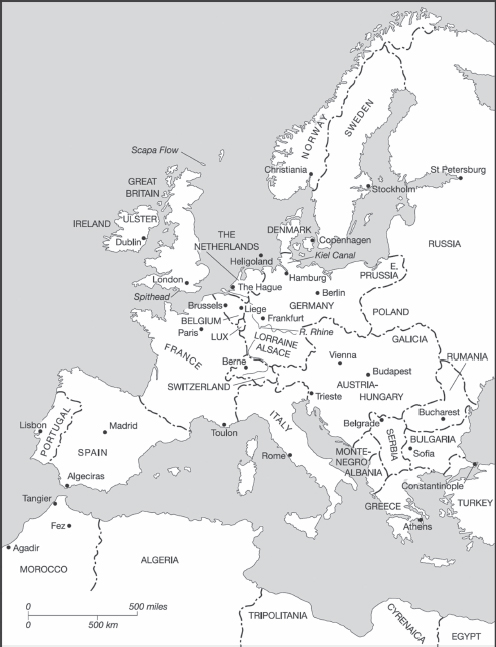
Map 1 Europe in 1914

Map 2 Austria-Hungary

Map 3 The Balkans and the effects of the Balkan Wars

Map 4 Africa and the Middle East