
administrative council
Name given to the council of junior ministers within the Siberian government headed by I.A. Mikhailov, which by mid-September 1918 appeared to have usurped many of the powers of the Siberian government itself, a development which led to a murderous political crisis described in Chapter 8. When the directory moved to Omsk, the seat of the Siberian government, in October 1918 Mikhailov tried to tie it also firmly to the coat tails of the administrative council, but only with limited success.
Assembly of Petrograd Factory Delegates
Established by Mensheviks and SRs in the spring of 1918 as a rival to the Petrograd Soviet. M.A. Likhach was a prominent SR involved in it.
CDD (Council of Departmental Directors)
The name given by Komuch to its governing administration.
Chelyabinsk State Conference
Events at the Chelyabinsk State Conference on 23 August 1918, culminating in the summoning of the Ufa State Conference, are described in Chapter 7. At Chelyabinsk the Allies and the URR took the initiative in calling a representative assembly for all anti-Bolshevik Russia at which an All-Russian government would be formed.
Committees of Poor Peasants
Established by Lenin in May 1918 to weaken the Left SRs’ hold on the peasantry. By allowing delegates from these committees to attend the Fifth Congress of Soviets in July 1918, the Bolsheviks were able to achieve a majority at the congress; but the legality of this was contested by the Left SRs.
Constituent Assembly
Russia’s first fully democratic elected assembly in which all men and women could vote. The elections began on 12 November 1917, and within days it was clear that the Socialist Revolutionaries had won. Summoned on 5 January 1918, it was dissolved by Lenin after a session lasting only a day. (Details on these events are given in Chapter 3.) Deputies elected to the assembly held two subsequent meetings in March and May 1918; and the Committee of the Constituent Assembly was established by some deputies in Samara in June 1918. Whether the 1918 Constituent Assembly should be reconvened in non-Bolshevik Russia, or a new assembly elected, became a point of contention between some SRs and supporters of the URR.
CSRM (Committee for the Salvation of the Revolution and the Motherland)
Established by those SRs and Mensheviks who walked out of the Second Congress of Soviets on 25 October 1917 in protest at the Bolshevik seizure of power. Some of its members wanted to overthrow the Bolsheviks by force and became involved in the military action started at the ‘Junker’ officers’ academy on 29 October 1917; most favoured a negotiated settlement and were prepared to attend the Railway Workers’ Union talks.
Czechoslovak Legion
Attempts at recruiting Czechoslovak prisoners of war to special units within the Russian Army had begun even under the Tsar. By the autumn of 1917 these had been transformed into a volunteer legion, based near Kiev, and organized entirely separately from the Russian Army under the leadership of the Czechoslovak National Council and Thomas Masaryk; it thus escaped the soldiers’ committee structure which by the autumn of 1917 had sapped the fighting capacity of the Russian Army. It played a central role in the Red versus Green civil war: it was wooed by Somerset Maugham in his mission to Russia in autumn 1917; it fought the Germans in February 1918 when fighting momentarily resumed; and in late May 1918 it mutinied when ordered to move north to Archangel, fearing a trap by Trotsky but actually wrecking a carefully planned operation dreamt up in London. Until Czechoslovak independence was announced as the First World War ended, the legion was the centrepiece of Allied support to the Green People’s Army.
Democratic Conference
Established by the Soviet Executive, it met from 14–22 September 1917 in the immediate aftermath of the Kornilov conspiracy. After much, at times contradictory debate it agreed to Kerensky’s proposal that a Preparliament should be summoned and a Third Coalition Government formed.
directorate
The name given to Chaikovskii’s governing administration in Archangel during the months of August and September 1918.
directory
The name given to the All-Russian government established by the Ufa State Conference on 23 September 1918. It ruled non-Bolshevik Russia until its overthrow by Admiral Kolchak on 18 November 1918. The formation of a directory was part of the programme of the URR from its foundation in April 1918.
Kadet Party
Russia’s major liberal party, led by P.N. Milyukov. Although individuals from the party were involved in General Kornilov’s conspiracy in autumn 1917, most kept their distance from what was seen as a doomed enterprise. However, the party’s public stance during the crisis meant that in the popular imagination it was associated with counter-revolution. After the October 1917 seizure of power by the Bolsheviks and the party’s poor showing in the Constituent Assembly elections, the party moved its activities first to the Don, where they were associated with General M.V. Alekseev’s Volunteer Army and its attempt to overthrow the Bolsheviks by force. After the defeat of this venture, the party became divided into pro-Allied and pro-German factions, with the pro-German faction moving to the Ukraine. Pro-Ally Kadets were associated in the spring of 1918 first with the National Centre, and then with the URR. The keenest supporters of the URR were Central Committee members N.I. Astrov and L.A. Krol, whose activities in Samara and Ekaterinburg are described in some detail in this book.
Komuch (the Committee of the Constituent Assembly)
Established by SR members of the Constituent Assembly in Samara in mid-June 1918, its organizers hoped that it would become a rallying point for all assembly deputies. As things turned out many deputies were unwilling to associate themselves with what appeared to be a venture supported only by the SR Central Committee and preferred to join up with the URR, which brought together right-wing SRs, Popular Socialists and some left-leaning liberals. The administration established by Komuch became the regional government for the Volga over the summer of 1918 and established there a goverment based on the socialist principles of the SR Party; whether that government should continue to administer the area after the formation of the directory in September 1918 became a central issue in November 1918 in the final days before Kolchak’s coup.
Left SRs
A party established by SRs disenchanted by the performance of their party members in Kerensky’s governments. Always keen to distance themselves from Lenin, they supported those Bolsheviks who wanted to see the formation of a coalition socialist government, and joined the Bolsheviks in forming such an administration in December 1917. They left this government when Lenin signed the Brest-Litovsk Treaty with the Germans, and thereafter opposed the Bolshevik government and worked for a revolutionary war to be declared on Germany; in retaliation Lenin established ‘committees of poor peasants’ to weaken the hold of the Left SRs on the peasantry. In early July 1918 during the Fifth Congress of Soviets the Left SRs tried to force a German attack by issuing a declaration of war and assassinating the German ambassador.
Mensheviks
The moderate wing of the Russian Social Democratic Labour Party, from which Lenin’s followers had split away to form the Bolsheviks. By 1917 the party was split three ways, with some on the left opposed to participation in government and hostile to the war; some agnostic on the war and in favour of participating in government; and the Unity group led by the founder of Russian marxism G.V. Plekhanov, vociferously pro-war. Although the party Central Committee opposed armed action against the Bolsheviks in the summer of 1918, I.M. Maiskii, a member of the Central Committee, ignored this injunction and became a leading member of the Komuch CDD.
Moscow State Conference
Organized by Kerensky from 12–15 August 1917 to give support to his Second Coalition Government, the conference allowed representation from Russia’s propertied classes and was the occasion for much back-stage intrigue by those involved in General Kornilov’s conspiracy.
MRC (Military Revolutionary Committee)
The committee established by the Petrograd Soviet in October 1917 to supervise troop movements, and used by Lenin to implement the seizure of power. See Chapter 2.
National Centre
The role played by this liberal organization opposed to the Bolsheviks is discussed in Chapter 6. Perhaps its leading member was N.I. Astrov, but its effectiveness was severely weakened by a split between pro-German and pro-Allied liberals.
People’s Army
The name given to the army established by Komuch in June 1918.
Popular Socialist Party
Founded in 1907 as a breakaway from the SRs, the party was opposed to the use of terror and favoured concentrating on small scale improvements in the peasants’ lot, particularly through the development of co-operatives. Its most prominent leader was N.V. Chaikovskii.
Preparliament
A representative body established by Kerensky in order to give his Third Coalition Government of September and October 1917 some sort of legitimacy. Its sessions opened on 7 October 1917 and delegates from all sections of society were represented on it, with the purpose of providing some sort of constitutional check on Kerensky’s government until a properly elected Constituent Assembly could be summoned. At its final session a vote of no confidence in Kerensky’s government was passed. The Preparliament went into oblivion with Lenin’s successful seizure of power on 25 October 1917. The president of the Preparliament was N.D. Avksentiev, later a member of the directory and a leading supporter of the URR.
Rada
The name given to the Ukrainian government.
Railway Workers’ Union
The talks organized by the Railway Workers’ Union aimed at establishing a coalition socialist government in autumn 1917 are detailed in Chapter 2.
Revolutionary Convention
A term given to the idea, mooted by the Bolshevik-Left SR coalition government in December 1917, that the Constituent Assembly and Congress of Soviets could merge into a completely new representative body.
Siberian government
Although an underground Siberian government had existed from January to July 1918, it was the Czechoslovak Legion’s mutiny which enabled those members of the underground government resident in Omsk to announce the formation of a Siberian government in the first days of July 1918. Composed of both former SRs and SRs, its relations with Komuch and the Urals government are described in Chapter 7.
Siberian Regional Assembly
Established in Siberia in January 1918, the assembly was closed by the Bolsheviks but revived when the Czechoslovak Legion and People’s Army established an anti-Bolshevik government. The assembly met in July 1918 and September 1918 in Tomsk, and on both occasions sought to bring the Siberian government under greater democratic control.
Society for Economic Rehabilitation of Russia
A counter-revolutionary organization established by the industrialists A.I. Putilov and A.I. Vyshnegradskii in April 1917, which was closely linked to General Kornilov.
SRs (Party of Socialist Revolutionaries)
Founded in 1901, the party continued the ideals of the Russian populists of the 1870s and worked to establish a vision of socialism based on rural and urban co-operatives; until the abdication of the Tsar in 1917, the party was also committed to the use of terror. In 1917 a strong right-wing group emerged within the party, which produced its own newspaper and strongly supported SRs joining the government. Other SRs were less committed to participation in government, particulary after the resignation of the party leader V.M. Chernov as a minister. By October 1917 a strong group within the party was so disenchanted with the behaviour of SR government ministers that they split away to form the Left SR party.The party continued to be racked by division after the Bolshevik seizure of power, but in the period leading up to the dissolution of the Constituent Assembly in January 1918 the divisions between the party’s Central Committee and the more right-wing assembly deputies were kept in check. Once fighting had begun in the Red versus Green civil war in June 1918, tensions re-emerged. Many right-wing assembly deputies associated themselves with the URR and distanced themselves from the Central Committee, something which caused particular controversy in October and November 1918, the period of the directory.
Ufa State Conference
Events at the Ufa State Conference from 8–23 September 1918, culminating in the establishment of the directory, are described in Chapter 8. The agreement reached there was known as the Ufa accord.
Urals government
Established by the Allies and the URR at the start of August 1918, its chief figure was L.A. Krol. Its relations with Komuch and the Siberian government are described in Chapter 7.
URR (Union for the Regeneration of Russia)
By far the most important anti-Bolshevik organization, this was set up in April 1918 by right-wing SR deputies to the Constituent Assembly, Popular Socialists and left-leaning Kadets. It proposed close co-operation with the Allies and the formation of a directory, to govern anti-Bolshevik areas of Russia until elections could be held to a new Constituent Assembly. (More details are given in Chapter 6). Its pro-Allied policy meant it was favoured by the British, who helped the establishment of the government in Archangel. It was also involved with the Allies in establishing the Urals government, before finally succeeding in bringing all local governments together in the directory in September 1918 at the Ufa State Conference. N.V. Chaikovskii and N.D. Avksentiev were perhaps its most prominent members, but all those involved in the Archangel directorate and the Ufa directory were prominent members of the URR.
Maps
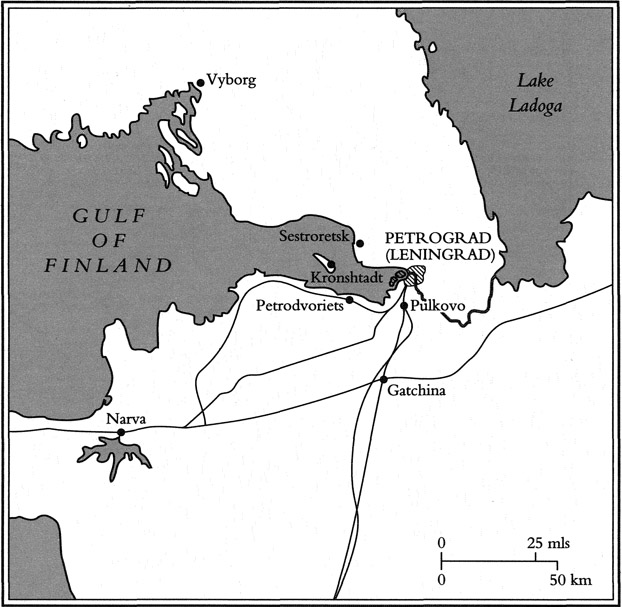
Map 1 Pulkovo and Gatchina with connecting rail links
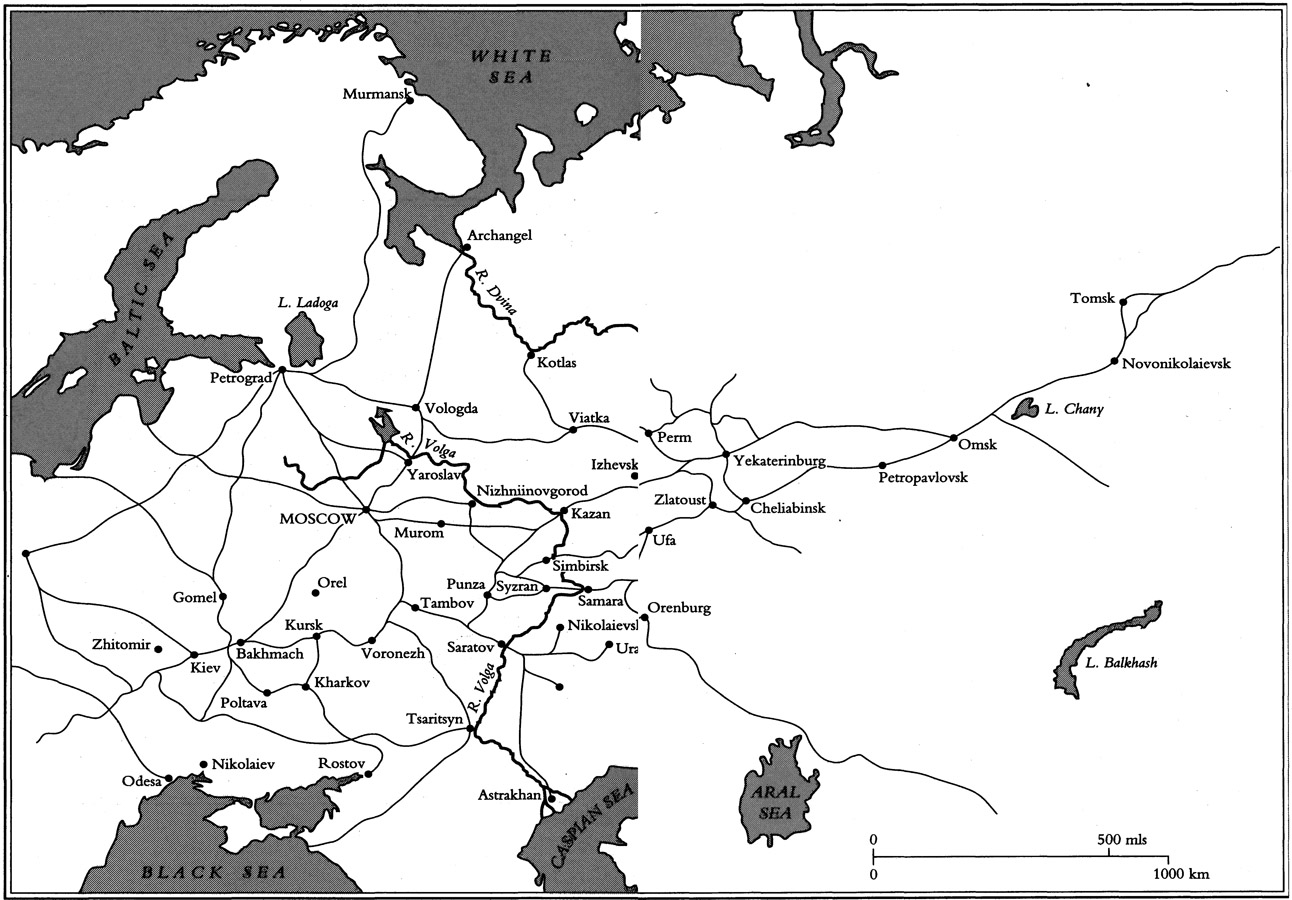
Map 2 Russia’s Railway network in 1918