
EDITOR'S FOREWORD
With the publication of this, the eighth, volume in the series, the short lull which has followed Akira Iriye's The Origins of the Second World War in Asia and the Pacific is over, and it seems likely that a second wave of volumes is beginning. It is therefore an appropriate moment for the editor to reiterate the aims of the series, and perhaps he will be forgiven for indulging in the first person.
When I first had the idea of editing a series of books on the causes of individual wars — long before I found a publisher who was wise enough to undertake the project — I was asking myself why it was that academics in other disciplines — political science, sociology, psychology, even zoology — were prepared to speculate on the causes of wars in general, while historians were inhibited from doing so. T. C. W. Blanning, in his The Origins of the French Revolutionary Wars, discussed shrewdly and amusingly the speculations of anthropologists, ethnologists, sociologists and psychologists. It seemed to me that what historians could contribute were specific analyses of the origins of individual wars, using a knowledge and understanding which the other social scientists would inevitably lack. Historians (whether they teach in departments of History, Politics or International Relations, or are, indeed, outside the academic world altogether) would bring to bear on the problem their scholarship and their research into the history of various countries and societies, and their understanding of the operation of international relations in the immediate, and not so immediate, past. In doing so they would contribute to a revival of what used to be called ‘diplomatic history’, by placing it into a much deeper perspective than it had enjoyed in the writings between the wars. That ‘diplomatic history’ has something to offer in this deeper perspective, which can better be termed ‘international history’, can hardly be doubted. Already in 1965 Jacques Godechot referred to ‘the lack of favour which has unjustly been shown towards diplomatic history in recent years’ (Les révolutions 1770–1799, Presse Universitaire de France). The injustice is now being to a great extent eliminated.
To encourage academic historians to provide an objective view of the origins of the wars in fields in which they were specialists seemed to me a worthwhile task. The series could have a double purpose. It would bring to the university public a series of syntheses of the literature on the subject and of the author's individual research and interpretation. It would thus serve on the one hand a strictly academic, scholarly, purpose. But on the other hand, I hoped that the series would contribute a body of writing which would enlighten our understanding of the causes of war in general. Dr David Gillard was kind enough to say in a review in the THES that the series ‘will be of the utmost value to all scholars, politicians, diplomats and journalists with a professional interest in why some international crises are resolved by war rather than by negotiation’. If only a very few politicians and journalists read only one or two of the volumes something will have been gained in international understanding.
I felt that the two aims were not contradictory or mutually exclusive. The author would usually view his task in writing the volume as a purely academic one — the acceptance of a challenge to get at the truth of one particular historic tragedy. But the very fact that his search was an impartial and dispassionate one would validate his work in the more general context.
Anthony Short's splendid book on The Origins of the Vietnam War takes us from the early days when the American government at first genuinely wanted to mediate between the French and the Vietminh, to the culminating tragedy of full-scale American involvement. Mr Short shows that de Gaulle's government believed Vietnamese ‘freedom’ could be obtained within the French Union, and was unaware of the significance of the word ‘independence’ for the emerging third-world countries. The French never used the word ‘independence’ with regard to Vietnam, and in this respect showed a greater inability to adjust to the post-war world than that displayed by the British. On the other hand Short makes it clear that the Americans (notably Acheson) went through a process of thought with regard to Nationalist China, and the probable ultimate success of communism there, with the Communists exploiting a revolutionary spirit in the midst of the poverty and misery of centuries. But the Americans failed to recognize an analogy between what was happening in China and what was likely to happen in Vietnam.
As the thunder clouds of the cold war gathered, the Americans evolved their domino theory, and in Short's interpretation their attitude emerges as something akin to the attitude of Christendom during the crusades of the middle ages: the infidel must at all cost be stopped. But the Communists, for their part, also believed in a ‘just war’. Short shows that the ‘just war’ concept was used by Khrushchev in a speech in 1961 with reference to Algeria, but at a time when the USSR was sending military help to Laos. In Short's words, ‘All members of his administration were apparently directed by Kennedy to read the Khrushchev speech and to consider what it portended’. If the ideological clash between the two worlds was thus in as uncomplicated a form as it had been since at least 1792, it would still be facile to assume that a confrontation in South-East Asia was in some way inevitable. When, by the summer of 1964, Johnson had in Short's words ‘reached the point where the decisions would finally have to be made, whether to fight or to let Vietnam go’, the second option was still open. Some individual political figures realized that wrong paths were being taken. All too often they were in a small minority, but that they existed at all shows, once again, that the human mind and imagination could prevent the ‘inevitable’ if it were present at the right time, in the right place, with the right powers. When Johnson in 1964 finally seemed ready to launch major American intervention in Vietnam, Short tells us that Senator Morse said: ‘We should never have gone in. We should never have stayed. We should get out.’ But the men in power — Johnson and his advisers — lacked the will, or the imagination, or the ability, to assess the possible consequences of their decisions.
A lack of imagination in political leaders is emerging in this series as a very common factor in the outbreak of war. Often it takes the form of an excessive optimism about the ease with which ends can be achieved. The Prussians in 1792, the Russians in 1904, the Germans in 1914, believed that a quick victory was attainable. Such a belief is often linked with the fear that there is danger in missing an opportunity. The need for a pre-emptive war is often given as the justification for aggression. Again the Germans in 1914 claimed that Russian armament was proceeding so quickly that Germany could not afford to postpone the conflict. The Israelis may claim that they have fought pre-emptive warfare successfully — though this may be true only in the short term. A policy which would secure more permanent peace takes a correspondingly greater leap of the imagination. Sometimes a lack of imagination leads to a simple miscalculation. Anthony Short quotes the American Assistant Secretary of State, Chester Bowles, declaring, with reference to intervention in Laos, ‘that America was going to have to fight China anyway in 2, 3, 5 or 10 years' time, and it was just a question of where, when and how’. That was 27 years ago.
But if American administrations at least avoided war with China once the Korean war was over, they regarded involvement in Vietnam more lightheartedly, in spite of warnings like that of Democratic Senator Russell, who is quoted by Short as saying: ‘it was going to be one of the worst things this country ever got into’, or Vice-Admiral Davis who wrote: ‘One cannot go over Niagara Falls in a barrel only slightly’.
But I am yielding too readily to the temptation of quoting from the text which follows — a text which adds impressively to the value of the series which I have the privilege of editing.
HARRY HEARDER
PREFACE AND ACKNOWLEDGEMENTS
As a temporary soldier in Malaya in 1948 I became more immediately aware, through some contact with the French navy and listening to the immensely confident French broadcasts from Saigon, of the war that had started in Vietnam. Fifteen years later, in January 1963, by coincidence again in Malaya, sharing a bivouac during an exercise of the Jungle Warfare School with an American colonel, John Paul Vann, rekindled my interest in what was happening in Vietnam, and at the same time, abruptly changed my perspective. John Vann, one of the most remarkable and impressive men I have met, had, a few hours before, taken part in that shameful fiasco of a battle at Ap-Bac which, like many that followed, was declared to be a victory for government forces. The reality, described by Vann, who later died in Vietnam, was very different and was a direct challenge to the assumptions and comparisons I had made.
At that time I was engaged in a study of the communist insurrection in Malaya, a comparatively small and self-contained war in a colonial context, and it subsequently became obvious to me that the struggle in Vietnam was of an entirely different order. What the American dimension would be had not yet become clear when General Westmoreland visited Kuala Lumpur the following year but the overwhelming impression was of the power of an immense American war machine that was about to engage itself when it had found the co-ordinates and could quantify the data of the Malayan experience as a means to this end. Again, it was impressive; somewhat mechanical; and rather frightening.
What happened in the end, what good, if any, came of it and the lessons to be drawn are questions that are still being discussed but a question which is almost as difficult to answer, because it is spread over such a long period, is when and how the war began. As with Scottish hills the approach may seem interminable, and rather wet, but almost before one realizes it the climb, and the struggle, has started.
Professor Harry Hearder and Longman, who suggested the ascent, must often have wished they had not, or at least, that a shorter route had been taken. One similar perhaps, to that of Professor George Herring who has dealt with the entire war in a masterpiece of compression and lucidity without losing any of the salient features. I am particularly grateful to him for an early, and continuing, source of information and ideas and wish also to record my thanks to a number of people who have contributed to my understanding of what happened in Vietnam; the misunderstandings, of course, are entirely my fault and responsibility. Individually, they are: Professor David Anderson, Sir James Cable, Mr Dacre Cole, Dr Vince Demma, Professor William Duiker, Dr Dennis Duncanson, Mr Michael Forrestal, Professor Gary Hess, Dr Edward Keefer, Mr Charles B. MacDonald, Dr Douglas Pike, Professor Douglas Ross, the Honorable Dean Rusk, the Honorable Blair Seaborn, Dr Ralph Smith, Colonel Herb Schandler, Colonel Hugh Toye, Professor William Turley, Dr Stein Tønnesson, John Cloake and Professor Geoffrey Warner.
Institutionally, I have to thank the staff of the great American Presidential Libraries in Abilene, Austin and Boston: particularly Dr David Humphrey. The National Archives in Washington: in particular Mrs Sally Marks and Dr John Taylor. The Public Record Office in London; the Library of the Department of External Affairs, Ottawa; and the Queen Mother Library of Aberdeen University, notably Mrs Gillian Johnston. Aberdeen University, The British Academy, The Carnegie Trust and the Canadian High Commission were all kind enough to support my travel and research and it is a pleasure to acknowledge the generous hospitality of Mrs Margaret Learnard in Washington, Professor and Mrs Joseph Silverstein at Princeton, and Dr and Mrs Michael Leifer in London. My thanks, too, to all of them for their encouragement. Undergraduate and postgraduate students, both of Aberdeen and the freemasonry of the Public Record Office, have either corrected or ungrudgingly shared ideas and information. My former student, Dr Myles Robertson, went out of his way in attempting to standardize the wilder inconsistencies of the manuscript. Mrs Catherine Walker has borne the brunt of the typing and my wife, Agnes, thinned out some of the denser thickets and has put up with the moods and bad temper of a much less fluent writer.
Dunbar Hall
Old Aberdeen
Age after age their tragic empires rise,
Built while they dream, and in that dreaming weep.
(Hymn 84, The Church Hymnary)
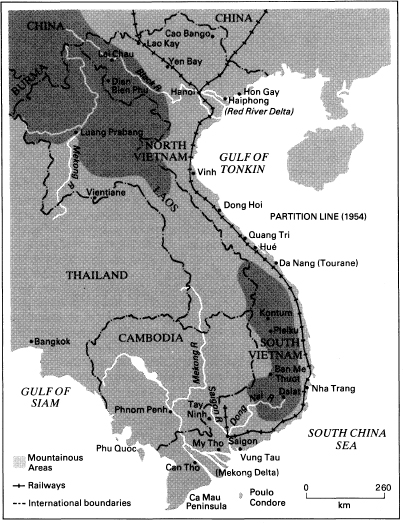
It is now a little over a hundred years since Vietnam had its first, major impact on Western politics. On 31 March 1885, three days after reports of a French military disaster in Tonkin had reached Paris, the French government fell. Thus ended the ministerial fortunes of Jules Ferry, already known as ‘le Tonkinois’; but this setback to the Tonkin expedition, while it had helped to bring down his government, had done nothing to diminish the importance of this, the most northerly part of Vietnam. ‘Marseilles and Toulon’, Ferry proclaimed, ‘would be defended quite as much in the China seas as in the Mediterranean.’ And, in justifying the strategic importance of France's colonial possessions, and in calling his fellow countrymen to greatness, he declared, ‘Nations, in our time, are great only according to the activity they develop; it is not by the peaceful extension of institutions that they are great any more.… Extension without acting, without becoming involved in the affairs of the world … is to abdicate, and in a shorter time than you would believe possible to descend from the first rank to third or fourth’.
By 1885 France was, in fact, consolidating her position in Vietnam, her most populous and perhaps most important overseas possession. Seventy years earlier her domination of Europe and what certainly passed as a Napoleonic empire had ended at Waterloo; and although her immediate, and in a sense, tactical political interests were first diverted by opportunities that lay nearer to hand in North Africa, French interest in Vietnam had existed since the time of Louis XIV. Much of the practical interest was kept alive by the French church which, from time to time, had got itself involved in political as well as in literary affairs. Indeed, French clerical support in the shape of a small unofficial expedition mounted from Pondicherry, a French possession in India, had already been given to a deposed prince, Nguyen Anh who, restored to power, proclaimed himself Emperor Gia Long.
His mentor, the man to whom he owed his life, Pigneau Behaine, bishop of Adran, had returned to Vietnam in support of his protégé ten days after the French Revolution had begun. His interests, like most of the Society of Foreign Missions, were supposedly religious: the conversion of rulers and their subjects. In practice, it proved impossible to separate religious and political activities. Already, by the 17th century, in addition to a prodigiously successful conversion rate, French priests were sometimes involved in arms procurement for their various clients although the European presence became not so much an assault upon, as an undermining of, traditional Vietnamese society.
When Nguyen Anh proclaimed himself Emperor Gia Long in 1802 and founded the last of the Vietnamese dynasties which would continue until the abdication of the Emperor Bao Dai in 1945, it was both a supreme achievement and a supreme irony. It was, as Woodside points out, the first time in history that a single Vietnamese court governed a united polity that stretched from the Kwangsi-Yunnan border all the way south to the Gulf of Siam. Hitherto the predecessors of the Nguyen dynasty had never truly controlled both the Red River delta and the Mekong delta simultaneously. In 1802 it can be said that the Vietnamese state stood on the brink of a golden age unparalleled since the late 15th century.1 For the Nguyen dynasty, once in power, the supreme purpose was the perfection of the Confucian state in a land which already gave the appearance of ‘a miniature Chinese civilisation’.2 From its court ceremonial to its Chinese-style law code the Vietnamese imperial system was ‘a calculated imitation of the more useful institutional features of the Ch'ing empire’.3 From the imperial palace at Hué, itself a replica of the Forbidden City at Peking, ‘the Mandarin road’ conveyed imperial couriers to the northern capital of Hanoi and south to the frontier lands and the southern capital of Saigon. The sophisticated dyke systems of Tonkin, in themselves a mark of the ‘hydraulic civilisation’ of China, were repaired; and French mercenary volunteers stayed on to help build the walls around the citadel at Hué as well as other fortifications. They represented the public works of a court and society which, however, has been condemned for its inability to conceive of any civilization other than that of the Celestial Empire and which deliberately shut its eyes to the outside world and the immense progress being made by Western people in science and technology.4 The supreme irony, therefore, lies in the fact that while under Gia Long's chosen successor, his fourth son, the Emperor Minh Mang, appeared to preside over the incipient consolidation of the Vietnamese state, at the same time he was presiding over its incipient dissolution. Already, within it, it contained the intellectual if not the political seeds of its own destruction.
Anything which challenged the intellectual premises of the Confucian state challenged its authority. The principal challenge came in the doctrines of Christianity and in the form of the French missionaries of the Catholic church. In spite of native converts, Christianity was obviously a foreign idea and one that was in association with foreign powers which might occasionally be of service to one dynasty or another but from whom demands were to be expected. That exposure to foreign influence might be disruptive to the bases of the Confucian state had been seen when the young prince who had accompanied Pigneau to Paris refused, after his return, to prostrate himself before the altar of his ancestors. This particular prince died before he could succeed the Emperor Gia Long and, in his place, the Emperor Minh Mang was notably less sympathetic to Christian beliefs and their foreign associates. In 1825 Christianity was proscribed by what was in effect an exclusion act and, although not applied consistently, more general persecution followed a few years later. Had it succeeded in removing the handful of Catholic missionaries from Vietnam, preventing their return and excluding others, and in confining the existing Christian villages to tolerable limits in their departure from prevailing beliefs and behaviour, then the policy might have been effective at least for a while in sealing off Vietnam and in maintaining isolation: a theme that was common to China and Japan, as well as to Korea whose uncertain relationship with the Chinese empire resembled that of Vietnam itself. Minh Mang is reported to have studied Japanese policy as a model of exclusion5; but his great fault, says Buttinger, was not that he abandoned the allegedly pro-western cause of his father but that he failed to recognize that after 1820 non-involvement had become obsolete as a defensive policy against the West.
In an entirely new world of international activity, and against previously unknown dangers that threatened Asia from the West, Vietnam's policy toward Europe remained in fact fundamentally unchanged. What Gia Long had preached while France was non-existent as a political and military factor outside of Europe, Minh-mang and his successors, Thieu Tri and Tu Duc, tried to practise against a France that soon was able to destroy Vietnamese harbours and warships at will.6
That France had such a military capacity was soon to be shown. Whether she had the intention to use it had yet to be proved; nor could she be said to have had the occasion. However, when the direction of policy becomes obvious, occasions often suggest themselves; and in the first half of the 19th century a major factor in France's relations with Vietnam seems to have been frustration. Attempts to persuade the Vietnamese court to enter into either commercial or political relationships with France were rejected and requests to receive a French consul were repeatedly refused. On the other hand, from a Vietnamese point of view, it might be argued that the French were importunate rascals; and, already, by 1825, in the final report reaching Paris of one of the Emperor's French ‘mandarins’, one finds the ominous conclusion and the principle that would be familiar for the next 150 years that, in order to obtain the necessary concessions, armed force was indispensable. Before that policy became fact, however, a cause for concern to both sides presented itself. A revolt that began in Saigon against the Emperor and his policies was supported by large numbers of Christian Vietnamese, as well as by Siam, but ended with defeat and death for practically all who had taken part or were taken prisoner. An exception was the unfortunate Father Marchand, a French priest, who not only represented the perverse and proscribed religion of the Europeans ‘which corrupts the heart of man’, but open rebellion as well. After atrocious torture he was put to death: to become a symbol of outrage for Catholic France and, for imperial Vietnam, a somewhat lesser symbol but practical reminder that ‘a philosophy which rejected Fate altogether … therefore presented a challenge to the whole of Vietnamese civilisation.’7
Outrage in France, however, did not yet manifest itself in policy; but at a time when the government of King Louis Philippe was generally rather cool to the advancement of the Church's interests in Vietnam, and when the Foreign Minister, M. Guizot, was a Protestant, the French navy maintained its reputation as a Catholic bastion and added to it an understandable desire that somewhere in the Far East there should be a port in which French ships could anchor in sight of French territory. Not only was this desirable in itself but also as a comparable mark of importance to the Dutch in the Indies, the Spanish in the Philippines, even the Portuguese at Macao; if not yet to the British who had already established themselves at Singapore, were now about to take Hong Kong and were on the point of monopolizing the China trade through enforced acquisition of facilities at a string of Chinese ports from Shanghai to Canton. Two years after a demonstration of ruthless acquisition and naval power had secured Britain the treaty of Nanking – signed on board a British warship which had penetrated three hundred miles up the Yangtze – a treaty which France also extracted from China, ensured the removal of all Chinese restrictions on the practice of Christianity. By this time, the Pope had already recognized France's primacy in the Far Eastern mission field and it was perhaps not unreasonable and certainly not unthinkable for her to imagine that the commercial and religious openings that had been conceded by China, ‘the Greater Dragon’, should also be made available by Vietnam, ‘the Lesser Dragon’. Particularly since, at least when it suited her, Vietnam still acknowledged the tributary relationship to China.
Every two years or so French warships had been appearing off Tourane – better known today as Danang – the nearest port to the Imperial capital at Hué and had engaged in ‘demonstrations’ on behalf of imprisoned or tormented missionaries. Considering the opportunities that had opened up in China, it was desirable from a French point of view that a French fleet should now be stationed in the Far East; although the question of where they were to find a base had still not been answered. One possibility that was recommended by the French navy depended on support for a rival claimant to the Vietnamese throne who could count on Christian converts in the North; and, although this was not accepted, the French government was now prepared to authorize the navy ‘to afford protection to French missionaries threatened with personal violence’ but only ‘if it could be done without involving the French flag in any altercation’.
French naval officers in the area had already engaged in rescuing French missionaries from Vietnam – some of whom withdrew the better to return – and the case of one of them, Monseigneur Lefèbvre, under sentence of death, provided the occasion for further intervention. This time there was no happy outcome and, unaware that M. Lefèbvre had been released and had already left the country, having waited two weeks at Tourane for an answer from the Emperor and having already as a precaution immobilized five Vietnamese corvettes in the proximity, the French ships eventually opened fire: apparently under the impression that they were themselves about to be attacked.
Probably, as has been suggested, it will never be known for certain who fired the first shot8; and almost a hundred years later another French cruiser opened fire at Haiphong under not entirely dissimilar circumstances and caused even heavier casualties in the immediate prologue to the outbreak of the first Vietnamese war. But on this occasion, and in this early example of what might charitably be called prophylactic fire, it was virtually an end in itself.9 The French ships withdrew leaving the French missionaries and the Christian converts to their unhappy fate and the Emperor at Hué in paroxysms. Nevertheless, aware of the encroaching European presence in Asia, his predecessor, Minh Mang, had sent an embassy to Paris in 1840 with the offer of exclusive trading rights in exchange for a defence agreement. Had it been accepted it would have had intriguing possibilities and could have cast France in the role of defender of Vietnamese independence against neighbouring kingdoms such as Siam or even Britain, rather than that of predator; but in the event Catholic feeling in France ensured that it got nowhere.10
Perhaps French naval intervention would have taken place sooner had not two French warships been wrecked in the course of a clandestine operation to put missionaries ashore in Korea in the summer of 1847. As it was, under mounting clerical pressure at home to do something about the new wave of Christian persecution in Vietnam, ten years later the government of Louis Napoleon was moving towards a new policy even before what Hall has called ‘a piece of crass stupidity’ on the part of the Emperor Tu Duc which would afford France the pretext for an international response: although in this case the only other power involved was Spain.11 The execution of the Spanish Bishop of Tonkin, Mgr Diaz, at any rate focused attention once again on the disorders of Vietnam. A few years earlier it was claimed that Christians were implicated in a rebellion in Tonkin, led by the Emperor's disaffected brother, and this had led to the execution of two more French priests. At that time France itself was still in a period of transition from the disorders of 1848 but, as Cady puts it, the advent of the Second Empire in 1852 had marked a decisive stage in the development of French policy towards Vietnam.12
A mood of intervention may indeed be sensed although not so much in the character of the Emperor Louis Napoleon himself. His entourage, however, seemed always ready to quarrel on matters of protocol and, on the matter of the unfortunate Mgr Diaz, Louis Napoleon's Spanish-born Empress, Eugénie, who, as a girl, had known the Bishop in Andalusia, was likewise in favour of intervention. One who would also have known the Bishop but who certainly did not know Vietnam, having never been there, was Abbé Huc, a former missionary in western China, described by Cady as ‘the principal protagonist of a forward French policy in Annam’.
In a secret memorandum prepared for Louis Napoleon in January, 1857, Huc argued that the Pigneau de Behaine treaty of 1787 gave France an incontestable right to occupy the port of Tourane, an action which could easily become the beginning of a new and glorious role for France in the Far East. The occupation, he said, could be achieved by French forces already in the Far East. The suffering Annamite population would receive the French as liberators and benefactors, and only a short time would be required to make them entirely Catholic. France must move quickly, however, because the English already had their eyes on Tourane.
Huc’s proposal was first submitted to the keeper of the archives at the French Foreign Office, Pierre Cintrat, for examination. On March 20 Cintrat came up with a strongly negative opinion. He reported that France had never fulfilled its part of the 1787 bargain; seizure of Tourane would therefore be an act of war without legal justification and one which could entail for France ruinous embarrassment and costs far exceeding the advantages to be realised. He expressed the opinion that France already had enough interests abroad to engage their energies without throwing itself into a hazardous and largely profitless venture in the centre of the China sea.13
The ‘special commission’ on Vietnam to whom this opinion was referred concluded that no rights in fact existed under the unexecuted treaty of 1787 but ‘the opportunity to act was afforded France by her association with the movement on behalf of progress, civilization, and commercial expansion for which China was going to be the principal theatre’.14 The commission recommended, therefore, that the three principal ports of Indo-China be occupied as chastisement for the treatment of French missionaries. A few months later Louis Napoleon was presented with a petition which declared that the preservation of Christianity in Annam was at stake and, in asking that the memorandum be forwarded to the Foreign Minister's office for examination, Cady concludes that ‘Louis Napoleon was obviously preparing to use the forces sent to the Far East under cover of joint intervention with Britain in China to gain the long-sought French foothold in Annam’.15
In the event, the decision to mount the French expedition to Vietnam, in which the Spanish were subsequently invited to join, was taken before news of Mgr Diaz's death had reached Paris; and it is significant that, instead of being dealt with by the French Foreign Ministry, it was handled by the Minister of Marine. The objective was to establish a French protectorate over Cochinchina (the southern part of Vietnam); but while the taking of Tourane was to be the first step, it could, in any event, be held as a bargaining counter in exchange for a treaty that was to be extracted from the Imperial court at Hué.
Taking, and holding, Tourane was also to be the first and irretrievable step in Western commitment in Vietnam. Previous contacts were essentially skirmishes. French warships would appear, hostilities would often ensue and the ships would eventually withdraw: indeed they could hardly do otherwise. But such demonstrations were leading nowhere in Vietnam. In China, however, and in spite of occasional reverses, UK trading interests were being advanced by similar tactics even though they represented a challenge to a much greater, and potentially at least, much more powerful established order. Trading opportunities involved and to a large extent depended upon opium: which was perhaps just as likely to undermine Chinese society as any Western ideas or beliefs, but at least they did not require anything more than limited settlement. To begin with, too, in Vietnam limited French ambitions hardly seemed to require more than limited outlay although it was difficult to see what exactly would be involved.
As it happened, the Franco-Spanish force that arrived in Tourane in 1858 was mostly French but altogether incapable of reaching Hué, where, conceivably, it might have persuaded the Imperial court to make concessions. It was in fact incapable also of doing more than barely maintaining itself in Tourane after the decision was made to switch the point of attack to Saigon. This, too, was captured without great difficulty but, as in Tourane, there were none of the expected manifestations of popular support and, again, a small garrison was left behind when the fleet sailed back to Tourane. Here it once again failed to have any effect on the court of Hué with the result that the position was finally abandoned. The French fleet sailed on to take part in joint operations with the Royal Navy along the China coast which were offering much higher dividends, at least to Britain, and it was this relationship, part ally, part rival, which was one of the factors that kept French interest in Vietnam alive. The Tourane/Saigon expedition while not quite a fiasco could hardly be presented as a success or as something of great consequence. But if it failed completely then, in the opinion of the disgruntled French naval commander at Tourane, it would be the British who would move in to take over and France would once again be trailing behind.
This in itself was a possibility that aroused certain traditional French feelings, but an equally powerful argument was that French blood had already been shed and French lives were in danger: although, to be callous and as Buttinger points out,16 80 per cent of the French troops were in fact Senegalese and Algerians. Nevertheless, a French force had been left holding Saigon, French lives were in danger and by 1860 France was becoming accustomed to intervention. In an area and to some extent a pattern that is similar today, in that year French troops had also landed at Beirut after Maronite Christians had been massacred by Druze; and a spectacular demonstration of joint imperialism occurred when a substantial Anglo-French force, by way of reprisal and putting pressure on the Chinese empire, destroyed the Summer Palace at Peking. This violent opening up of the Chinese empire to Western contact was now to be repeated in Vietnam.
In a sense the French already had a commitment to a commitment – the garrison they had left behind at Saigon – and one which, given the direction of French policy and the forces that now became available from the China theatre, was unlikely to be liquidated. French power was no longer to be confined to what came out of the mouths of naval guns and a substantial French force fought by land and sea to occupy the surrounding provinces. To French surprise, but in part because the enfeebled imperial forces had lost control of the granary in the south and in part because they were threatened by rebellion in the north, the Emperor Tu Duc sued for peace and offered not only freedom of religion but the cession of three eastern provinces of Cochinchina. Skirmishes, however, were endemic, punctuated by rebellions on a larger scale and, already, there was the problem of conflict with the contiguous ‘unoccupied’ territories. This took France not only into the rest of Cochinchina but, claiming to have inherited rights and privileges from the court at Hué, into the neighbouring kingdom of Cambodia as well.
Where, and when, interests and resolution may have wavered in Paris or were diverted, for example, by the Mexican adventure, there were always a substantial number of activists, usually in the French Navy, on the spot in Asia who were ready and anxious to keep up the momentum of French expansion. Among them was the heroic but impetuous figure of Lieutenant Gamier, an early exponent of manifest destiny, who believed that France had received a higher mission from Providence17 and that with France now installed at one end of the Mekong river there were dazzling prospects, if not glittering prizes, if China could in fact be opened up by means of an inland waterway. The Mekong, unnavigable to the extent that one can hop across it in the dry season from one sand bank to another, and thus from Laos into Siam, unfortunately was not the river that would lead to China's unbolted back door; but, it became obvious, the Red River in Tonkin was.
In concluding a treaty with France the Emperor Tu Duc had, in spite of second thoughts, been prepared to sacrifice the South and allow the French to create their enlarged colony of Cochinchina, in order to hold on, as best he could, to the middle and the North. His country's independent but tenuous existence might have continued (although the example of Cambodia was unpromising) and with a different temperament perhaps some sort of accommodation might have been reached with France. Independence, however, or its formal equivalent of sovereignty, did not have the same conceptual sharpness in Asia as it did in Europe and the attraction, for the French, of Tonkin had always to be balanced by the question of how far they could go without bringing in the Chinese. Where French and Western incursions into Vietnam were transient, the presence and proximity of China was immutable. It may be that ‘the Vietnamese in general regard the Chinese as their traditional enemy’18 and that, in halting successive incursions of China's expansionist dynasties the Vietnamese had secured their own independence. But, whether or not the Vietnamese had, in the past, saved the whole of Southeast Asia from a gradual but unrelenting process of ‘Han-hwa’, or ‘Han-isation’,19 from a Vietnamese point of view it was the French who were now attempting to reverse the natural flow by moving upwards through the narrow tube of Annam into the cone of the funnel and at some point, therefore, a collision was to be expected. Not least because, when China was able or inclined to assert herself, or Vietnam chose to acknowledge the relationship, the latter was seen not as a state in its own right but as a tributary of the Chinese Empire. Under mounting pressure from China, (at least for tactical reasons) the Vietnamese court now chose to reassert this relationship if not its dependence.
French exploration in the 1860s had already taken them up the Mekong into China and when they were published the accounts of this epic journey, comparable to that of Livingstone, aroused great interest in Paris. The author, eventually leading the expedition, was Lieutenant Garnier who, in the course of extricating his expedition via the Yangtze, after a period of over two years, met up with an equally remarkable character, Jean Dupuis, a French entrepreneur who had adopted Chinese customs and traded in guns or salt with equal facility. When Dupuis, after a gun-running trip from Hanoi to Yunnan, under more or less official Chinese auspices, found himself in difficulty he appealed to the French in Saigon for assistance. The Emperor Tu Duc, for the opposite reason, did likewise. Again, as far as France was concerned, it was an extraordinary opportunity. Lieutenant Garnier was dispatched with the ostensible purpose of removing Dupuis; but in spite of the size of his expeditionary force – he had less than 200 men – he may well have been entrusted with more ambitious projects. At any rate, after a propaganda battle with the local Vietnamese authorities, Vietnamese fears and suspicions would have been confirmed when Garnier's force stormed the citadel and routed what was apparently a garrison of 7,000 men.
There then began what was called one of the most remarkable episodes of French colonial history.
In about three weeks a region containing 2 m. inhabitants and a number of fortified towns was subdued by a force which never exceeded 180 men, commanded by officers none of whom, apart from Gamier himself, was older than 25. Some of their exploits would sound hardly credible if they were not admitted to be historical fact. Thus for instance the citadel of Ninh-Binh, defended by 1700 soldiers, surrendered to a canoe load of seven Frenchmen. It was as if the Vietnamese were hypnotised by the spell of these terrible invaders.20
Whether they were or not, or whether they were demoralized by a bombardment from French gunboats there must, on the French side, have been an equally terrible contempt for the fighting qualities of the Vietnamese forces, if not for the extraordinary irregular Chinese forces who were operating in Tonkin, the Black Flags. These veterans of the Taiping and other rebellions in China characterized the endemic disorders of Tonkin: the absence of government, tribal disaffections, an uncertain frontier and an equally uncertain relationship between China and Vietnam. In almost his last words, it is said that Garnier identified the Black Flags as the only real enemy that France had to face in Tonkin. A few minutes later, having misjudged his distances and his bravery notwithstanding, the ‘Great Mandarin Garnier’ as he had styled himself, was cut down by them, his head and his heart removed from his body, and his assailants believed, mistakenly, that they had dispatched the son-in-law of the Emperor of France.
Garnier's impetuosity, although almost certainly connived at, was officially disowned in what might be regarded as an exercise in higher statesmanship. Intent on consolidating in the south and with a government in Paris that was not yet prepared for the entailed risks of Garnier's exploits, the French withdrew from Tonkin in exchange for a treaty which appeared to recognize the ‘legitimacy’ of their possessions in Cochinchina.
This treaty of ‘peace, friendship, and perpetual alliance’ was signed at Hué on 15 March 1874. French sovereignty over Cochinchina was confirmed and, nominally, the Red River was open to navigation while Christianity became a permissible option for the Emperor's subjects. Leaving behind, in the course of a controversial evacuation of the territory which had been obtained by Garnier's exploits, essentially defenceless Christian communities, it was perhaps not surprising that they once again suffered under the vengeance that was exacted on ‘collaborators’ with the French. On the day that Nam Dinh was handed over, 14 neighbouring Christian villages were burned and the total eventually reached several hundred.21 Nevertheless, a French Resident was to be permitted at the court of Hué; it was agreed that Imperial foreign policy would be aligned to that of France; but French military assistance was qualified in that it could only be given upon Imperial request.
Did this constitute a French protectorate? In so far as it was a matter of custom, as much as of law, the issue was now complicated by the fact that the Emperor in Hué chose to send, once again, tributary missions to Peking. France itself was diffident enough not to raise the matter with its chargé-d'affaires in Peking for over a year and although the issue seems to have been skirted, on both sides, it was becoming a matter of far more than academic interest. The Chinese Marquis T'seng in his European mission had already reminded the French Foreign Minister that Vietnam was a vassal of China. As the evidence of impending French operations in Tonkin grew he wrote again, on 10 November 1880, from St Petersburg to a new Minister of Foreign Affairs in Paris:
I need not tell Your Excellency that the Chinese Government could not look with indifference on operations which would tend to alter the political situation of a country on its frontier, like the kingdom of Tongking, whose ruler down to the present day has received his investiture from the Emperor of China.22
The French position was that in the treaty of 1874 they had recognized ‘the entire independence’ of the ruler of Vietnam as regards any foreign power and had promised him aid and assistance to maintain peace and order in his dominion and to defend him against any attack. Conditions were not mentioned – it might be assumed he would get French assistance whether he wanted it or not – and when, in the uncertainty of these relationships, the new French Foreign Minister, M. Gambetta, asserted on New Year's Day 1882 that ‘Vietnam was formerly a Chinese dependency’ it was a misreading of an earlier Chinese message which read ‘Vietnam has been for a long time a Chinese dependency’.
Whether or not France chose to confront China in the last quarter of the 19th century it was, without any doubt, Vietnam which drew the two countries into war and for the next hundred years established a context if not an extra dimension to the origins of war in and about Vietnam. The outcome of the Tonkin affair therefore has to be seen as much in a relationship between France and China as between France and Vietnam. Indeed, one might argue that, for the moment, Vietnam was itself only of secondary importance. To begin with, at least, it is the mood and impetus of French imperialism which must be considered.
In the early 1870s Garnier's intentions, no matter how widely acclaimed in France, hardly represented a national impulse towards further territorial acquisition. Ten years later, in what was a virtual reprise, French national sentiment may be said to have been aroused to the point where exploits or misadventures such as his were to be sustained rather than disowned. What had happened in the interval takes on the form of and can best be explained as France's recovery, moral and material, from the national disaster of 1870. When it came, this ‘manifestation of the desire for rehabilitation, of the yearning to regain the former great power status, became almost a ritual in public gatherings, in political meetings, during scholarly banquets and the like’,23 and the desire for self-assertion and for assertion to the world remained powerful enough to impart strong impulses to imperialism: to the point where colonization and imperialism were regarded as a means of moral and national regeneration. As Cady puts it: ‘By 1880 imperialism and patriotism were virtually synonymous.’
If only in view of her reluctance to disengage from empire it would seem important to establish the principal motive of French imperialism, at least in the later 19th century, and although one hesitates to contradict the assertion of Professor Duiker, who has made formidable contributions to Vietnamese studies, and without wishing to venture into the conceptual controversies of imperialism, one must at least look twice at the proposition ‘From the beginning there was little question that the primary objectives of French colonial policy in Indo-China were economic’.24 Perhaps that simple, and misleading, assertion is to be understood in a certain way. More particularly, because a few lines further on there is the apparent contradiction that ‘for officials in Paris the main purpose of the French colonial venture in Southeast Asia could only be to enhance national security and prestige’. Compared at least to the weight of other received opinion about the nature of French imperialism there would seem to be little evidence of mercantile adventurers which would account for French involvement in Vietnam. After the event, an imperial adventurer such as Jules Ferry would, as Zeldin points out, develop a neo-mercantilist doctrine to justify his actions and to argue that France needed colonies for her economic growth and her political prestige but, in fact, just as Britain acquired much of her empire at the very time when colonies were considered to be useless, so France acquired hers when population was falling, her colonial trade minute and her people had practically no interest in overseas expansion.25
It seems more likely, as Dr Christopher Andrew suggests and as the French colonialists themselves complained, that the most characteristic attitude of French business towards colonial expansion in general was indifference; that the French colonialist movement represents the highest stage, not of French capitalism, but of French nationalism.26 ‘France’ said Zeldin, ‘exported its national pride in its most arrogant form, undiluted by universalism and its capacity for self-doubt; it was a similar national pride which rose up to expel it from its colonies’.27
To return from the general to the particular, the treaty of 1874 had given France a foothold in Tonkin. A small number of French garrisons was each to be limited to 100 men. When more than double this number arrived at Hanoi on two French ships from Saigon it was an obvious violation of the agreement. It could be, and indeed was, argued that the disorders of Tonkin required an enhanced French presence and when the conquest of Tonkin was fully under way Prime Minister Ferry argued its necessity because of the potential threat to Cochinchina from such an unfriendly and turbulent neighbour.28 Power, as Acton also observed, ‘tends to expand indefinitely, and will transcend all barriers, abroad and at home, until met by superior forces’. In the case of Vietnam at this time most of the counter force in one form or another was provided, intermittently, by the Chinese Empire of which, it will be remembered, Vietnam was still considered to be a part. In 1883 Captain Rivière's repeat performance of Lieutenant Garnier's exploits ended in the same way: he was killed in action against Black Flag guerrillas who were operating with at least the tacit approval of the Imperial courts in Peking and Hué. Even before this untoward event the French had begun a campaign of remarkable savagery with the wholesale hanging of Chinese mercenary prisoners from the yard-arms of their ships. After Rivière's death the French responded with an equally remarkable ultimatum, from Commissioner-General Harmand, which seems utterly to confirm Zeldin's attribution of ‘national pride in its most arrogant form’.
We could, for we have the means, destroy your dynasty from top to bottom down to its very roots, and seize for ourselves all the kingdom as we have done in Cochinchina. You will be perfectly aware that this would present no difficulty to us. You are incapable of putting up a serious resistance to our armies … you are at our mercy. We have the power to seize and destroy your capital and to cause you all to die of starvation. You have to choose between war and peace. We do not wish to conquer you, but you must accept our protectorate. For your people it is a guarantee of peace and prosperity: it is also the only chance of survival for your Government and your Court. We give you forty-eight hours to accept or reject, in their entirety and without discussion, the terms which in our magnanimity we offer you. We are convinced that there is nothing in them dishonourable to you, and, if carried out with sincerity on both sides, they will bring happiness to the people of Vietnam. If you reject them, you must expect the greatest evils. Imagine the most frightful things conceivable, and you will still fall short of the truth. The Dynasty, its Princes and its Court will have pronounced sentence on themselves. The name of Vietnam will no longer exist in history.29
Backed up by the now familiar bombardment, a new Emperor in Hué was persuaded to sign a treaty which gave France a comprehensive protectorate: extensive rights to intervention in Annam and complete control of Tonkin. There remained, however, not only the disputed question of Chinese suzerainty but the matter of Chinese forces which might be encountered in Tonkin. Partition was unacceptable to the French; neither side could agree a neutral zone. And the French minister was warning that China was prepared to fight. It was a risk, although French ministers denied its existence, which the French Assembly for the most part was prepared to take. Success in Vietnam now depended on the defeat of Chinese forces. At the same time, paradoxically, it was something which would be much more difficult to achieve if the French were to engage not only Chinese regular forces but a spirit of Chinese resistance which, with comparatively unlimited space and numbers at its disposal, might have been of an entirely different order of magnitude from that hitherto encountered in Vietnam. Both sides were now building up their forces and in December 1883, after due notice had been given, French forces attacked the citadel at Son-tay, one of the principal Chinese bases in Tonkin, and regarded by them as a key to the defence of Yunnan. On this occasion, after heavy fighting, and with superior French firepower, the fortress was captured at the cost of under 100 French dead but more than 1,000 killed on the Chinese side. It prompted superb Chinese defiance, rhetorically at least the equal of Harmand's ultimatum, and, more ominously, the entry of some 12,000 Chinese troops from Yunnan. Other things being equal, then, the French were now faced with at least a potentially formidable adversary. What were the costs of an encounter likely to be and would they prove acceptable?
At this point one may note interesting but ultimately perhaps rather promiscuous historical parallels with American as well as French policy in 20th-century Vietnam. For example, it began to look expensive. With parliament having a remarkably tight hold on the appropriations that were necessary to sustain French policy, it was necessary for the government, usually in the person of Jules Ferry, to make increasingly frequent public requests. Even before they were in serious difficulties with China the question of how much French policy cost came up twice in the course of one week in December 1883 when an appropriation of 9 m. francs was debated and was followed by a request for a further 20 m. When the assertion that French honour was at stake was made, patriotic arguments always carried the day although there were some, like Clemençeau, who claimed that French colonial expansion was not only contrary to revolutionary principles but that it was weakening French defences in Europe. Most of the 25,000 troops in the Far East were in fact Algerian, which may have weakened this argument, but another one soon developed when the French foreign minister, perhaps unwisely, said that France was at war with Annam. If so, said his opponents, it was a violation of the constitution because only parliament could declare war and, moreover, as it looked as if France was becoming involved in a war with China, they had not been kept properly informed.
Ferry, like President Johnson, claimed ‘It is not I who first undertook an enterprise which is based on national traditions.’ ‘Tonkin’ he said, ‘was not a personal affair for one Minister or another … from the beginning to the end it is a French affair and a national question.’ On a later occasion he turned on his outspoken critic in the Senate, the Duc de Broglie, and told him to ‘stop repeating that we are conducting an arbitrary, capricious, colonial policy. We are conducting, in this affair, the colonial policy to which the precedent created by you yourself condemned us.’30 By then, in spite of what might be called a local success in Vietnam, France was in real difficulties. The local success was in two parts. In Tien-Tsin the ascendant ‘peace party’ in the person of Li Hung-Chang agreed to recognize all existing and future treaties between France and Vietnam. By implication, at least, this meant that Chinese claims were renounced and in a symbolic act ‘the most important physical symbol of Chinese suzerainty … a seal presented 80 years ago to Gia Long, the founder of the dynasty, by his overlord the Emperor Chia Ch'ing’ was ceremonially destroyed.31 The difficulties arose out of the way in which the agreement between France and China was put into effect; and at about the same time as the Emperor's seal was being melted down French troops, attempting to enforce the evacuation from Tonkin of their Chinese counterparts (acting with what was later excused as ‘patriotic haste’) suffered a bloody nose at the hands of Chinese armed with Remingtons and retired with over twenty dead. It was obvious that in China there had been serious second thoughts about the Tien-Tsin treaty; and with Li Hung-Chang under threat of impeachment and with the new Chinese negotiating instructions being, ‘The most important thing is that the King of Vietnam should continue to be enfeoffed by Us and to pay Us tribute’, it was obvious that this was a very fragile agreement. France demanded the immediate evacuation of Chinese forces from Tonkin, plus an indemnity of 200 m. francs.
One commentator on these events32 says it is a little hard to understand why Ferry was so rash, for such an ultimatum, if it were refused, was certain to lead to war. It was just possible that the true story had been withheld from the premier by those most anxious to move energetically. But it seems more likely, as Power concludes, that the Bac-le ‘ambush’ had become a matter of French prestige; French honour was at stake and it was difficult to stop short. Nevertheless, Power concludes, (writing in 1944) that all his advisers and Ferry himself misjudged China's will and capacity to resist, even though Ferry himself realized that his local commander, Admiral Courbet, was ‘devoured by a desire for glory’ and would do anything he could ‘to lead us to Peking’.
Having ruled out that option, the problem for France, rather like that of Britain in the Crimean War, was how and where she could strike at her adversary and affect his policy. Another implicit question was whether France could ever command sufficient force to impose herself on China. While the Chinese could hardly have accepted with equanimity the bombardment of Foochow, the destruction of a Chinese fleet and a rather abortive French operation in and against the island of Formosa, (the possession of whose coal mines anticipated a later French demand for ‘productive guarantees’ from Weimar Germany) nevertheless these actions had no effect whatever on China's continuing refusal to pay anything at all by way of indemnity for an action which the Chinese attributed to French folly. ‘We are not’, said Ferry, ‘in a state of war with China: we are in a state of negotiation.’ To which one of his critics added ‘With cannon-balls!’ A couple of months later Ferry allowed that France was ‘recalling China to the observation of its international duties’.
Throughout the autumn of 1884 there was deadlock. In early 1885, with a new and energetic French War Minister and the French army having taken over command of operations in Tonkin from the navy, a Chinese force was defeated and after another engagement the French captured the border citadel at Lang Son. Encouraged by this success the French commander decided to push on and, having crossed the border into Kwangsi, ran into what might be called an ambush on a large scale. Nothing loath, the French general mustered all his forces and again advanced towards the symbolically named ‘Gate of China’. This time, after a two-day battle, and after the general himself was wounded, an alcohol-induced decision of his subordinate led to the abandonment of Lang Son and a wholesale but temporary French retreat. News of this setback, together with messages which suggested that the army hoped to hold on to the Red River Delta, reached Paris when the government was already defending its policy in Tonkin. Whether one were to regard it as the Lang Son skirmish or a great national catastrophe – and there were those who went so far as to compare it to Waterloo – it produced at least the occasion for the overthrow of Ferry's government (it has been suggested that it was his domestic rather than colonial policy which consolidated the vote against him) and he went down to defeat having demanded an appropriation of 200 m. francs to enable France to avenge her honour.
It was not one of the Assembly's more heroic moments; and comparisons were made with much greater reverses that had been suffered in Algeria and even with contemporary reaction in the House of Commons to the fall of Khartoum. It was nevertheless an example of stoical reserve on the part of Ferry himself who, as a result of negotiating behind the back of the official French representative in China, knew that he was on the brink of success but had pledged to reveal nothing until the treaty was signed.
In one sense the treaty of Tien-Tsin that was signed in June 1885 between France and China was an anti-climax: it did little more than confirm the treaty that had been signed a year earlier. But this time the Chinese effectively and finally gave up their historic claims on Vietnam and withdrew their forces. To that extent at least the French objective had been realized. The tide of Chinese imperialism had gone out: that of French imperialism had come in. Yet, as McAleavy points out, the ‘war party’ in China, muddle-headed and ignorant as they had been, were right in believing that by protracted resistance China could exact a price which no French government could ask its people to pay. And that, after Ferry's collapse, it was quite inconceivable that any French government would have been voted the enormous increase in expenditure that would have been considered necessary for a full-scale war with China.33 Had Chinese resistance continued it is conceivable that France would have withdrawn, at least temporarily, from Tonkin, based itself on Cochinchina, and hoped that it would not run into too many difficulties with what was left of Vietnamese power based on the court at Hué. As it was, both China and Vietnam were in a state of debility. For the time being France assumed the role that in the past had belonged to Vietnam: to define the southern limit of Chinese power. In short, France was now engaged in the containment of China; and her continuing success in Vietnam would depend in part upon the maintenance of this regional balance of power.
In spite of its asserted and demonstrated political differentiation from China as a state, Vietnam had succumbed to the same problems which had weakened China in its confrontation with the West. The old order was breaking down. A static if not stagnant society which was obsessed with the past was capable of spasms of resistance but in China, certainly, and in Vietnam probably, there was a feeling that foreign aggression had been made possible only by the weakening of dynastic leadership and efficiency.34 Unlike China, Vietnam had the added misfortune that the enemy was not only within the gates but about to capture the citadel itself.
Studies of 19th-century Vietnam asking, explicitly or implicitly, what had weakened resistance to the French have noted that it was the French invasion which prompted the first serious proposals for internal reform in Vietnamese society.35 One of the most prominent but ultimately unavailing series of reforms would have committed Vietnam to a policy not of protracted war but of protracted negotiation with the French. At the same time it was proposed that the Court should model itself on Thailand, rather than China, and send its ambassadors abroad to seek diplomatic support; military academies, perhaps run by Germans or British, would help to modernize the Vietnamese army; and, in effect, it was proposed that the Emperor should lead an institutional revolution in Vietnam.36 In the event none of this happened and it was, ironically, not until peace had just been concluded between France and China and the last chance had gone of co-ordinated and effective Sino-Vietnamese operations, that the standard of royal resistance was raised when the young Emperor Ham Nghi was prevailed upon to flee from Hué and to provide at least a symbol of national resistance until he was finally captured and exiled to Algeria. The episode produced a sort of romantic and despairing royalism – Can Vuong!: Aid the King! – on a level, perhaps, with the Jacobite cause after Culloden; and although one may resist the assertion that, because it was ‘ethno-centric without having any real concept of Vietnam as a nation state in competition with other nation states’, it did not therefore qualify as authentic nationalism, it may be agreed that the causes of nationalism, revolution and resistance that were shortly to be found in the 20th century would be of an entirely different order.37
REFERENCES AND NOTES
1.Alexander Woodside, ‘Vietnam, 1802–67’ in David Joel Steinberg et al. In Search of South East Asia (New York 1971), p. 123.
2.King C. Chen, Vietnam and China, 1938–54 (Princeton 1969), p. 3.
3.Woodside, op. cit.
4.Hoang Van Chi, From Colonialism to Communism (London 1964), p. 8. ‘In reviewing Vietnam's history’, says Hoang, ‘one is forced to conclude that the Han culture, although beneficial to the Vietnamese in the beginning, eventually became, with the Chu Hi school of Confucianism, the formula which conditioned every brain to the same conventional mould, deterring all independent thought and all spirit of innovation. It must be seen as the main cause of the national disaster at the end of the last century. The submission of the Vietnamese to western colonialism was in great measure the consequence of their long enslavement to China's fossilised culture.’
5.With added urgency after one of his French ‘military advisers’ presented him with a set of prints depicting Napoleon's victories.
6.Joseph Buttinger, The Smaller Dragon (London 1958), p. 274.
7.Ralph Smith, Viet-nam and the West (London 1968).
8.Stanley Karnow, Vietnam. A History (London 1983), p. 70.
9.In case one should be tempted to believe that the French reserved their violence for other people it may be remembered that a year later, in the upheavals in Paris, General Cavaignac slaughtered Frenchmen as he had Algerians: to the extent of some 3,000 civilian dead.
10.From Paris the mission went to London, where it was received by Lord Melbourne, but had no more effect.
11.D. G. E. Hall, A History of South East Asia (London 1958), p. 559.
12.John F. Cady, The Roots of French Imperialism in Eastern Asia (Cornell 1967). See also the recent study by Yoshiharu Tsuboï. L'Empire Vietnamien Face à la France et à la Chine (Paris 1987).
13.Cady, op. cit. pp. 178–9.
14.Ibid.
15.Ibid. p. 180.
16.Buttinger, op. cit. p. 348.
17.Quoted in Milton E. Osborne, The French Presence in Cochinchina and Cambodia (Cornell 1969).
18.Hoang Van Chi. op. cit. p. 6.
19.Ibid.
20.Henry McAleavy, Black Flags in Vietnam: The Story of a Chinese Intervention (London 1968).
21.Cady, op. cit. p. 287.
22.McAleavy, op. cit. p. 184.
23.Winfried Baumgart, Imperialism, The Idea and Reality of British and French Colonial Expansion 1880–1914 (Oxford 1982), p. 56.
24.William J. Duiker, Vietnam … Nation in Revolution (Boulder, Colorado), 1983.
25.Theodore Zeldin, France 1848–1945 1. Ambition, Love and Politics (Oxford 1973) p. 630. Most of Zeldin's commentary on French imperialism, in this magnificently idiosyncratic study of French history, is contained in Volume 2, Intellect, Taste and Anxiety (Oxford 1977): in the chapter entitled ‘Hierarchy and Violence’. In Volume 1, however, he allows himself an aside on Constans – ‘this bankrupt manufacturer of lavatory systems who had then become … Governor-General of Indo-China’.
26.C. M. Andrew, ‘The French Colonialist Movement during the Third Republic: the Unofficial Mind of Imperialism’ in Transactions of the Royal Historical Society, first series Vol. 26 1976. ‘Jules Ferry and the colonialists of the Third Republic wanted a great French Empire, as Bethmann-Hollweg wanted a great German Navy, “for the general purposes of French greatness, for reasons of national prestige”; and it was the nationalism of French society which made it vulnerable to a colonialism with which it was fundamentally out of sympathy.’ pp. 149–50.
27.Zeldin, op. cit. Vol. 2, p. 942.
28.Thomas F. Power, Jules Ferry and the Renaissance of French Imperialism (New York 1966), p. 170. It was, Power notes, the same argument he had used in the case of Tunisia, justifying a new acquisition as necessary not for markets but for the defence of French possessions.
29.Excerpts in Georges Taboulet La Geste Française en Indochine (Paris 1956). Vol. II pp. 805–6.
30.Power, op. cit. p. 182. Broglie was a former foreign minister.
31.McAleavy op. cit. p. 239.
32.Power, op. cit.
33.McAleavy, op. cit. p. 284.
34.See e.g. John K. Fairbank et al. East Asia The Modern Transformation Chapter 2 ‘Invasion and Rebellion in China’.
35.See e.g. Duiker; Steinberg; and David G. Marr Vietnamese Anticolonialism, 1885–1925 (Berkeley 1971).
36.Steinberg op. cit. p. 132.
37.Ibid. p. 303. One notes in passing that Kedourie in his study of nationalism maintained that it was a doctrine invented in Europe in the 18th century: in which case, in Scotland, there was a remarkable 14th-century préfiguration in the Declaration of Arbroath and the Battle of Bannockburn.